A voice carrying the timeless wisdom of Kabir Vani takes centre stage as Shabnam Virmani-Indian filmmaker, writer, singer, and the creative force behind The Kabir Project-joins the LLDC Winter Festival 2026. The evening promises an intimate confluence of mystic poetry, music, and spiritual reflection.
Part of the LLDC Winter Festival Programme
Scheduled for 25 January 2026, the performance forms a key highlight of the LLDC Winter Festival, inviting audiences to slow down and listen-deeply and collectively. Through song and contemplative pauses, the programme explores Kabir’s verses as living wisdom rather than historical text.
Song, Silence, and Soulful Connection
Known for her immersive presentations, Virmani’s approach blends melody with meaning, allowing Kabir’s words to resonate across time and context. The hour-long session is envisioned as an experiential journey-where song meets silence, and reflection opens into shared presence.
The event will be hosted at the LLDC Craft Museum, located along the Bhuj–Bhachau Highway in Ajrakhpur. Set within a region celebrated for its craft traditions and cultural memory, the venue adds a textured backdrop to the evening’s contemplative tone.
Open to the Public with Passes Available
The programme is open to the public, with passes available via advance booking. Visitors to Kutch are encouraged to include the event in their winter itinerary, experiencing a blend of music, spirituality, and place.
By bringing Kabir’s verses into a shared space of listening and reflection, Shabnam Virmani’s performance at the LLDC Winter Festival 2026 offers more than a concert-it creates a moment of stillness and connection. Set against the cultural landscape of Kutch, the evening invites audiences to engage with mystic poetry as a living, breathing presence in the present.
The Indian Independence struggle has been witnessed by several stalwarts and legends. These individuals have stood tall in the face of adversity and been the pillars on which the freedom struggle was built, executed and Independence finally achieved. Mahatma Gandhi, Nehru, Sardar Patel, Bhagat Singh the list is truly very long. But whenever the 23rd of January makes its way, I am reminded of the heroics and vision of one freedom fighter in particular. The day marks the birth anniversary of Netaji Subhas Chandra Bose. Growing up in Kolkata, West Bengal it was hard to not learn about Netaji, his ideologies, and his brave call for complete freedom.
As a child growing up in a state that was governed by communist ideals, Netaji’s callings were widely relatable. Add to that the aggressive fervor of youth and the desire to bring about ‘actual’ change made me and many like me, his admirers. His influence on the state is unquestionable and one of the reasons why the 23rd of January is a public holiday in West Bengal and many other adjoining states.
The Philosophy of Differences
Image Source
There was something always rebellious and stirring while reading about Netaji’s life journey. He parted ways with the most iconic of the Independence movement leaders, the Mahatma himself. But the difference in ideology never meant disrespect to the person. It was Netaji, who called Mahatma Gandhi the ‘Father of the Nation’ for the very first time in a radio broadcast from Rangoon. Mahatma himself called Bose, the ‘Patriot of Patriots‘.
Thus, the mutual respect that they held for each other was never relegated to a petty personal defaming discourse. A reality that we often see mouthed out from prime-time news channels these days. Politics prevailed and history bears the brunt of differing ideologies. It also finds the true essence of human intellect and democracy.
For here, it is a nation of more than a hundred crores of people. A nation that must be open to disagreements and differences. A country that must strive for all views to be heard, all ideas to find a way of execution, and all ideologies a place for documentation. Yes, there were differences in the past too, but the Gandhi-Netaji divide was one of the most landmark movements. Because it recognized that it wasn’t necessary to fall in line with principles and practices that one couldn’t agree with. Netaji was a leader who chose to create his path, breaking away from the shadows of the Indian National Congress.
The Philosophy of Non-violence
Any discussion on Netaji is quite incomplete without citing his famous quote, ‘Give me blood and I will give you freedom‘. This was in complete contrast to the non-violence approach. With the years of subjugation by the British, who themselves were not averse to using violence as a means of rule, the call for an aggressive outlook seems fair enough.
He formed the INA or Indian National Army, a force to reckon with. The British PM during the Indian Independence Clement Attlee also acknowledged the loyalty of the Indian Navy and Army to the British. It had declined due to the increase in the INA’s or Azad Hind Fauj’s activities.
The Philosophy of Success and Failures
Image Source
Netaji’s life can be viewed as a classic inspiration of success over failures. Although he cleared the Indian Civil Service examination he didn’t wish to work for an ‘alien government’. He joined the Congress and rose to the rank of the President of the party. He went ahead and founded the All India Forward Bloc within the Congress as a separate faction to strengthen the leftist ideologies. Bose with his charisma and call for total ‘swaraj’.
He believed that for independence India needed a socialist authoritarian view. It was his arrest in 1941 that led to his escape to Germany through Afghanistan. In Germany, he created the Indian Legion of about 4000 soldiers, the Indian prisoners of war who had fought for the British. However, when Germany decided to lay control over the Soviets, Bose felt disappointed because of his leftist views. He also realized that with the German army retreating it had no chance of helping him in getting the British out of India. And so in 1943, he left for Japan.
He revived the INA with strong support from Rash Behari Bose. The INA had its own set of trials and tribulations. However, a momentous moment occurred in Manipur in the town of Moirang when the Indian tricolor (designed after the Indian National Congress) was raised for the first time. The INA fought against the British in many battles, including in Burma. But with the fall of Rangoon and the Japanese surrender, the INA largely surrendered and many INA prisoners were repatriated to India.
The Philosophy of Politics
Image Source
Bose describes himself as a leftist and a socialist. In his speech, he called for a ‘synthesis between National Socialism and communism. He strongly believed that democracy was the best option for India. Many believe that his alliance with the Axis powers during the World War. It was a practical approach to reaching complete independence for India. Unlike fascist or Nazi he believed that the socialist state would be important for the re-building of the nation. Democracy and fundamental rights on equality, secularism, etc. must prevail.
The Philosophy of Equality
Image Source
One of the most visionary leaders, Netaji was far above petty classifications of gender, religion, caste, and class. He was deeply influenced by Swami Vivekananda and he gave utmost importance to social service above all.
The INA broke all stereotypes when it formed a separate women’s unit called the Rani of Jhansi Regiment. The regiment was headed by Captain Lakshmi Swaminathan. Bose also felt strongly for the cause of the peasants and laborers. He became a hero for not only India but an inspiration for many Third World countries too. He did put India and its zeal and want for independence on the global map.
In 1945 Netaji is said to have suffered fatal burns that led to his death from a plane crash. Many believe that these were conspiracy theories and that Netaji survived. His death continues to be shrouded in mystery, however, his legacy remains etched in history and memory.
Netaji in many ways symbolizes the warrior hero whose patriotism saw no bound. His strategic and pragmatic planning to overthrow the colonial regime was fraught with a relentless passion for the homeland. At the same time, his liberal ideas and unflinching ardor for acquiring complete independence through secular and unbiased approaches made him a true leader.
Yet, despite his acumen, philosophies, and liberal thinking, Netaji connected with all of us because he was humane. He was not the Mahatma, but an extraordinary human being who captured the imagination of the youth. He stood by his beliefs but did not undermine or insult the different approaches towards the same goal of independence. He instead walked his path and created a legacy that inspired many along the way. And for that Netaji will always live on.
Inspirational quotes by Netaji Subhas Chandra Bose
Freedom is Not Given, It is Taken.
It is Blood Alone that can Pay the Price of Freedom. Give Me Blood & I will Give You Freedom.
Life Loses Half its Interest if there is No Struggle – If here are No Risks to be Taken.
No Real Change in History has Ever been Achieved by Discussions.
It is Our Duty to Pay for Our Liberty with Our Own Blood.
India is Calling. Blood is Calling to Blood. Get up, We Have No Time to Lose.
One Individual May Die for an Idea, but that Idea will, After his Death, Incarnate Itself in a Thousand Lives.
The Secret of Political bargaining is to Look More Strong than What You Really Are.
FAQs on Netaji Subhas Chandra Bose
Question: Who was Netaji Subhas Chandra Bose?
Answer: Netaji Subhas Chandra Bose was a prominent Indian freedom fighter who led the Indian National Army and advocated armed resistance against British rule.
Question: Why is Subhas Chandra Bose called “Netaji”?
Answer: The honorific “Netaji,” meaning “Respected Leader,” was given to Subhas Chandra Bose by his followers for his leadership and revolutionary vision.
Question: What was the Indian National Army (INA)?
Answer: The Indian National Army was a military force formed by Subhas Chandra Bose to fight British colonial rule with the support of Indians living abroad.
Question: What is Netaji Subhas Chandra Bose’s famous slogan?
Answer: His most famous slogan was “Give me blood, and I will give you freedom,” reflecting his call for complete sacrifice for India’s independence.
Question: Why is the death of Subhas Chandra Bose controversial?
Answer: His death remains controversial due to conflicting accounts and lack of conclusive evidence, leading to ongoing public debate and investigations.
Wednesday, 21st January 2026: London-based arts non-profit The Arts Family (TAF) will mark its continued presence at India Art Fair 2026 with a curated presentation in the fair’s Institutional Section. The showcase will feature award-winning contemporary artists from the latest edition of the TAF Emerging Artist Award – South Asia 2025.
Platform Supporting South Asian Contemporary Voices
TAF has rapidly established itself as a platform committed to supporting emerging and mid-career contemporary artists and art professionals from South Asia. Through its flagship Emerging Artist Award, alongside talks, exhibitions, and residencies, the organisation fosters international exposure, critical dialogue, and long-term professional development for artists working across the region.
Award-Winning Artists at India Art Fair 2026
At India Art Fair 2026, TAF will present works by the winners of the TAF Emerging Artist Award – South Asia 2025. The participating artists include Deena Pindoria (1st winner), Ritika Sharma (2nd winner), Akshay Bhoan (2nd winner), Mohit Shelare (3rd winner), and Deshna Shah (Special Mention).
Spotlight on Deena Pindoria and Deshna Shah
Among the featured artists is Deena Pindoria, a textile-based artist from Kutch and the first winner of the TAF Award 2025. Also included is Deshna Shah (UK), recipient of the Young Artist Award, who will go on to present a solo exhibition at Nature Morte in April 2026. The presentation underscores TAF’s commitment to providing institutional visibility and sustained professional opportunities for artists.
International Jury and Founder’s Perspective
The selected artists were chosen by an international jury from nearly 1,000 submissions. Speaking about TAF’s participation, Neha Jaiswal, Founder of The Arts Family, noted that the organisation is delighted to return to India Art Fair and continue building international visibility for South Asian artists through meaningful connections and long-term support structures.
Institutional Presence at NSIC Grounds
India Art Fair 2026 will take place from 5th to 8th February 2026 at the NSIC Exhibition Grounds, New Delhi. TAF’s presentation will be located at Booth M-04 within the Institutional Section, offering fair visitors insight into some of the most promising contemporary practices emerging from South Asia.
With its return to India Art Fair 2026, The Arts Family continues to strengthen its role as a key supporter of South Asian contemporary art. By presenting award-winning artists within an institutional framework, TAF reinforces its mission of fostering visibility, dialogue, and long-term growth for emerging voices on an international stage.
Three Contemporary Practices Come Together in Delhi
A compelling mix of sculpture and painting will be presented at India Art Fair 2026, bringing together three distinct contemporary artistic practices by Sandilya Theuerkauf, Meenal Singh, and Janarthanan Rudhramoorthy. The showcase will be presented by KYNKYNY Art Gallery at Booth No. L 08, from February 5 to 8, 2026, at the NSIC Exhibition Grounds, New Delhi.
Material as an Active Force in Meaning-Making
The presentation foregrounds material and process as central to artistic expression. Moving across sculpture and painting, the works explore how substance, transformation, and material intelligence shape meaning—positioning material not as a passive medium, but as an active collaborator in contemporary practice.
Sandilya Theuerkauf: Sculpture Rooted in Ecology
Artwork – Sandilya
Sandilya Theuerkauf will present sculptural and relief works created from found plant-based materials. Rooted in ecology and forest conservation, his practice involves collecting fallen vegetal matter during daily walks and crafting each work from a single plant species. Adapting technique to the physical qualities of each material, his compositions reflect a delicate balance between human intervention and organic form, fostering a deeper environmental awareness.
Meenal Singh: Fluid Pigment and Immersive Painting
Artwork – Meenal Singh
Meenal Singh will showcase large-format oil-on-canvas paintings driven by the fluid behaviour of liquid pigment. Working without brushes or direct contact with the surface, she employs experimental, process-led techniques to create expansive, abstracted landscapes. Colour, motion, and materiality guide the viewer through immersive and contemplative visual spaces.
Janarthanan Rudhramoorthy: Metal, Body, and Presence
Artwork – Janarthanan
Janarthanan Rudhramoorthy will present iron and steel sculptures that explore the relationship between the human body and inner consciousness. Inspired by the layered structures of bird nests, his works transform dense materials into forms that evoke presence and absence, impermanence, and transformation—challenging perceptions of weight, solidity, and spatial balance.
A Curated Presentation by KYNKYNY Art Gallery
Together, the works highlight how material choice and process shape contemporary artistic language. Curated and presented by KYNKYNY Art Gallery, the showcase reflects the gallery’s long-standing engagement with practices that explore unconventional materials, ecological awareness, and conceptual depth within India’s evolving contemporary art landscape.
Through sculpture and painting, this curated presentation at India Art Fair 2026 underscores the power of material-led inquiry in contemporary art. By bringing together practices rooted in ecology, process, and spatial consciousness, the showcase invites audiences to reconsider how material, method, and meaning intersect in shaping artistic expression today.
The Festival of New Choreographies – KalaYatra 2026 is now in its final phase. It had a successful first three days on January 13, 14, and 15, and will have two epic evenings on January 28 and 29, 2026. The Kamani Auditorium, which is famous for its architecture, will host the finale. This will be the end of a celebration of modern dance styles that are based on classical Indian dance.
A Collaborative Cultural Commitment
Padma Vibhushan awardee Dr. Sonal Mansingh
Jointly presented by the Department of Art, Culture & Language, Government of NCT of Delhi, and Padma Vibhushan awardee Sonal Mansingh, KalaYatra 2026 reflects a shared commitment to nurturing India’s living classical traditions. The festival foregrounds new choreographies that draw from Bharatiya civilisational values while responding to contemporary sensibilities.
Curated by Sonal Mansingh for CICD
Curated by Dr. Sonal Mansingh for the Centre for Indian Classical Dances (CICD), the festival brings together 10 new choreographies presented by eminent dance institutions from across India. Following an overwhelming audience response to the opening days, anticipation now builds for the festival’s much-awaited finale.
Day Four Highlights: 28th January
The fourth day opens with Duryodhana, presented by Srjan, Bhubaneswar, under the guidance of Guru Ratikant Mohapatra. The choreography explores the psychological depth of Duryodhana, one of the Mahabharata’s most complex characters, tracing his arrogance, rage, and ultimate downfall leading to the Kurukshetra war.
This is followed by Chakravyuha by Shriram Bharatiya Kala Kendra, New Delhi, a powerful retelling of young Abhimanyu’s tragic journey. Drawing from Mayurbhanj Chhau and Kalaripayattu, the production captures both the ferocity of battle and the emotional poignancy of Abhimanyu’s fate.
Day Five Highlights: 29th January
The final evening opens with Bheema, presented by Chidakash Kalalay Centre of Art and Divinity, Kolkata, and directed by Piyal Bhattacharya. Performed in the Marga Natya style, the choreography depicts Bheema’s transformative encounter with Hanuman during his quest for the Saugandhika Pushpa, culminating in spiritual revelation and the imparting of Sanatana Dharma.
The festival concludes with Matrika by Rainbow Dance Troupe, Barasat, India’s all-LGBTQ+ professional dance ensemble, directed by Ratri Das. Inspired by the creation of Shakti and the emergence of the Matrikas, the production celebrates the collective power of the divine feminine through a visually striking narrative of strength, protection, and transformation.
Department of Art, Culture & Language, Govt. of NCT of Delhi & CICD
Conclusion
As KalaYatra 2026 comes to an end, the festival shows that Indian classical dance is still a living, changing tradition. The last performances will be an immersive celebration of movement, mythology, and meaning that will bring this landmark festival to a powerful close. They will use powerful stories from the Mahabharata and explore divine and human consciousness.
The Sacred Gaze Resinated Fibreglass with Automotive Paint 92” x 66” x 76”
An Immersive Presentation at The Chanakya
Renowned artist Thota Vaikuntam presents an immersive showcase of his iconic Telangana figures at The Chanakya Imagine Atelier 2026, New Delhi, on 21st and 22nd January, 2026. The presentation explores identity, materiality, and cultural memory through a striking reimagining of his visual language across embroidery, bronze, and sculptural forms.
Reimagining Painting Through Embroidery
Thota Vaikuntam 48 x 38 Silk embroidery on velvet, embellished with precious and semi-precious gemstones
In a rare and intricate collaboration between painting and craft, Vaikuntam’s signature figures find new expression through silk and zardozi embroidery. Translated onto velvet surfaces, his distinctive colours, symbols, and forms are rendered using fine silk threads and embellished with precious and semi-precious gemstones. This material shift brings tactile depth to his visual narratives, expanding their emotional and sensory resonance.
Bronze Sculptures and Quiet Strength
Moving seamlessly between two and three dimensions, Vaikuntam’s bronze works introduce his recognisable figures into sculptural form while retaining their symbolic intensity. His bronze heads of men and women convey stillness and inner strength, animated by subtle accents of colour against dark bronze surfaces. The balance between stylised abstraction and natural detail lends these works both vitality and composure.
“The Sacred Gaze” in Monumental Form
Rendered in resinated fibreglass with automotive paint, The Sacred Gaze pays homage to the Telangana woman. These sculptural heads are not conventional portraits, but distilled embodiments of identity, memory, and belonging. Monumental in scale, the works merge the contemporary with the traditional, and the spiritual with the everyday—asserting presence through form, gaze, and colour.
Presented by Black Cube Gallery
The presentation is brought to New Delhi by Black Cube Gallery as part of The Chanakya Imagine Atelier 2026, held at The Chanakya. Across material transitions—from embroidery and bronze to sculptural forms—the exhibition highlights Vaikuntam’s enduring engagement with the people and spirit of Telangana.
Tradition Rearticulated Through Contemporary Expression
Together, the works reflect how Vaikuntam’s visual language continues to evolve through material experimentation. Moving fluidly between craft, sculpture, and monumental form, the presentation offers a contemplative encounter with cultural continuity—where tradition is not preserved as static history, but reimagined through contemporary expression.
Exhibition Details
Aspects
Details
Title
Thota Vaikuntam: Iconic Telangana Figures Across Material Forms
By translating his iconic Telangana figures across diverse material forms, Thota Vaikuntam reaffirms his deep engagement with identity and cultural memory. The presentation at The Chanakya Imagine Atelier 2026 offers a nuanced dialogue between tradition and innovation-where craft, sculpture, and contemporary expression converge to keep cultural narratives alive and evolving.
A Nationally Touring Exhibition Reaches Jehangir Art Gallery
Currently touring across India, Lenscape Kerala, the travelling photography exhibition, continues its national journey in Mumbai. The exhibition will be presented at the Jehangir Art Gallery from 12th to 14th February, 2026, offering city audiences a visual immersion into Kerala’s landscapes, cultures, and lived realities.
Kerala as a Living Mosaic
Kerala is presented not merely as a destination, but as a living mosaic of landscape, culture, memory, and light. Lenscape Kerala features 100 curated photographs captured by 10 leading travel lensmen and media photographers from across India. Their journeys across the state explore themes ranging from heritage architecture and rural life to backwaters, festivals, coastal ecosystems, wildlife, monsoon moods, traditional sports, spirituality, and cuisine.
Curated by Uma Nair
Image – Manoj Arora
The exhibition has been designed and curated by eminent art historian, author, and curator Uma Nair, whose deep personal and professional connection to Kerala informs the exhibition’s narrative. The project travels across **ten Indian cities—New Delhi, Vadodara, Ahmedabad, Surat, Mumbai, Pune, Bengaluru, Chennai, Hyderabad, and Kolkata—**bringing Kerala’s cultural fabric and scenic diversity to new audiences and media ecosystems.
Curator’s Reflection on the Photographic Journey
Reflecting on the exhibition, curator Uma Nair, born in Kerala in 1955, notes that when ten photographers come together to document the state over ten days, the resulting images move between “sylvan sunsets, sunrises, and secular principles of quiet, grounded belonging.” From internationally acclaimed photographers like Aishwarya Sridhar to noted practitioners such as Kounteya Sinha, Amit Pasricha, and Manoj Arora, each photographic series emerges as an awakening to nature, land, faith, and diverse lifestyles.
Landscapes, Light, and Lived Experience
Image – Aishwarya Sridhar
From the architectural symbolism of antiquity to the winding backwaters of Kuttanad and the moody Western Ghats of northern Kerala, each photographer spent five intensive days capturing what they found imperative and evocative. Filtered light, gentle silhouettes, sculptural identities, and the dramatic gravitas of Theyyam come together to celebrate an earthy vocabulary shaped by the relationship between humans and nature.
Everyday Idioms and Timeless Atmospheres
Across colour and black-and-white compositions, the exhibition reflects Kerala’s unique ability to age beautifully within its coastal humidity. Street scenes, everyday gestures, and architectural openness encourage viewers to pause—offering moments of stillness in a world that increasingly moves at relentless speed.
A Mindful Tourism Initiative
Image – Saurabh Chatterjee
Lenscape Kerala flagged off on 20th January, 2026 in New Delhi and will conclude on 31st March, 2026 in Surat. Alongside the exhibition, curator-led walks and photographer interactions foster dialogue around image-making, ecology, heritage, and community—reinforcing the idea that travel and tourism gain meaning when practised mindfully.
An Initiative by Kerala Tourism
An initiative by the Department of Tourism, Government of Kerala, Lenscape Kerala functions as a public outreach campaign that transforms admiration into itineraries. By translating Kerala’s richness into compelling imagery, the project aims to spark travel intent, deepen cultural curiosity, and strengthen livelihoods connected to tourism. The 100-photograph collection anchors a travelling exhibition circuit and a broader suite of promotional assets for Kerala Tourism.
The exhibition features works by Aishwarya Sridhar, Amit Pasricha, H Satish, Kounteya Sinha, Manoj Arora, Natasha Kartar Hemrajani, Saibal Das, Saurabh Anand Chatterjee, Shivang Mehta, and Umesh Gogna—each contributing a distinct visual voice to the collective portrait of Kerala.
List of Participating Artist
Amit Pasricha
H Satish
Kounteya Sinha
Manoj Arora
Natasha Kartar Hemrajani
Saibal Das
Saurabh Anand Chatterjee
Shivang Mehta
Umesh Gogna
Takeaway
As Lenscape Kerala arrives in Mumbai, it offers more than a visual journey—it invites reflection on ecology, heritage, and mindful travel. Through carefully sequenced imagery and curatorial depth, the exhibition opens a space for discovery and dialogue, where Kerala’s stories unfold through light, landscape, and lived experience.
Bengaluru, January 2026: Essensai067 is set to host a culturally immersive weekend with the Made in India Flea & Patriotic Movie Evenings, scheduled from January 24 to 26. Designed as a community-driven celebration, the event foregrounds Indian craftsmanship, local makers, and shared cultural experiences rooted in everyday life.
A Flea Market Spotlighting Indian Makers
The Made in India Flea brings together a diverse range of local artisans, mindful brands, and indigenous labels. Visitors can explore textiles, apparel, accessories, lifestyle products, and everyday essentials—while engaging directly with the stories, skills, and values behind products made close to home. The flea positions conscious consumption and craft-led narratives at the heart of the experience.
Patriotic Movie Nights Under the Open Sky
Extending the cultural weekend beyond shopping, Essensai067 will host open-air Patriotic Movie Nights at its amphitheatre on the evenings of January 25 and 26. The screenings feature Uri and Border—films that evoke collective pride, nostalgia, and reflection when experienced together under the open sky.
Shared Viewing as Collective Experience
Watched in an outdoor setting, the films transform into communal moments rather than individual viewing experiences. The amphitheatre screenings invite audiences to reflect on themes of courage, sacrifice, and national identity, reinforcing the idea of cinema as a shared cultural ritual.
A Weekend Designed for City Audiences
Curated as a relaxed yet meaningful city gathering, the Made in India Flea & Patriotic Movie Evenings is positioned for inclusion in weekend listings, culture pages, and lifestyle round-ups. The event blends commerce, storytelling, and cinema—offering Bengaluru audiences a space to slow down, connect, and celebrate local creativity.
Blending craft, cinema, and community, the Made in India Flea & Patriotic Movie Evenings at Essensai067 offers more than a weekend outing. It creates a shared cultural space where local makers, mindful consumption, and collective viewing come together—reinforcing the value of homegrown creativity and togetherness in the urban cultural calendar.
Songs of freedom, equality, justice, and camaraderie come together on stage in Rang Aman Ke, a poetry and song concert rooted in the tradition of Ambedkarite Shahiri jalsa. The performance draws inspiration from poet saints and revolutionary voices across India’s long history of resistance and social reform.
Presented by Yalgaar Lok Sanskriti Manch
Presented by Mumbai-based theatre collective Yalgaar Lok Sanskriti Manch, the concert reflects on constitutional values not merely as abstract ideals, but as lived, questioned, and continuously practised realities in contemporary India. Through music and spoken word, the ensemble engages deeply with themes of dignity, equality, and collective struggle.
Marking 76 Years of the Indian Constitution
Rang Aman Ke marks the seventy-sixth anniversary of India becoming a constitution, using the occasion to revisit the spirit of the Constitution through art and community dialogue. The performance foregrounds the relevance of constitutional morality in today’s social and political climate.
An Interactive and Participatory Experience
Designed as an interactive exchange, the concert invites audiences to participate actively rather than remain passive spectators. Music, poetry, and collective responses merge to create a shared space of reflection, encouraging solidarity and dialogue in the present moment.
Venue and Audience Engagement
The performance will be held at the Indian Music Experience, a venue known for hosting immersive musical experiences. Audiences are encouraged to engage with the ideas presented, extending the concert beyond performance into a communal act of remembrance and hope.
RSVP via link in bio | More details on IME website
Takeaway
Through Rang Aman Ke, poetry and music become tools for remembrance, resistance, and renewal. By revisiting constitutional values through Ambedkarite Shahiri traditions, the performance offers audiences an opportunity to collectively reflect on freedom, equality, and justice—not as distant principles, but as living commitments shaped in the present.
National, 20 January 2026: Method, Delhi, presents RITES, a solo exhibition by Berlin– and New York–based artist and technologist Alida Sun, on view from 31 January to 15 March 2026. The exhibition brings together code, ritual, embroidery, mirrorwork, computational heritage, care, and solidarity-positioning technology as a site of resistance, intimacy, and collective imagination.
At the heart of RITES is Sun’s daily coding practice, sustained over 2,343 consecutive days and counting, where repetition becomes ritual and curiosity becomes a form of refusal. Through custom-built software systems, Sun reframes computation as a generative and communal act, offering an alternative to extractive models of Big Tech by foregrounding care, protection, and shared authorship.
Reclaiming Feminist Computational Histories
Biophony print
The exhibition draws attention to a frequently erased history—that women were the first computers and pioneers of software engineering, at a time when software was dismissed as feminised and secondary labour. RITES emerges from an urgent need to reclaim this computational heritage, restoring technology as a tool for creation and liberation rather than militarisation and surveillance.
Code Translated into Tapestry
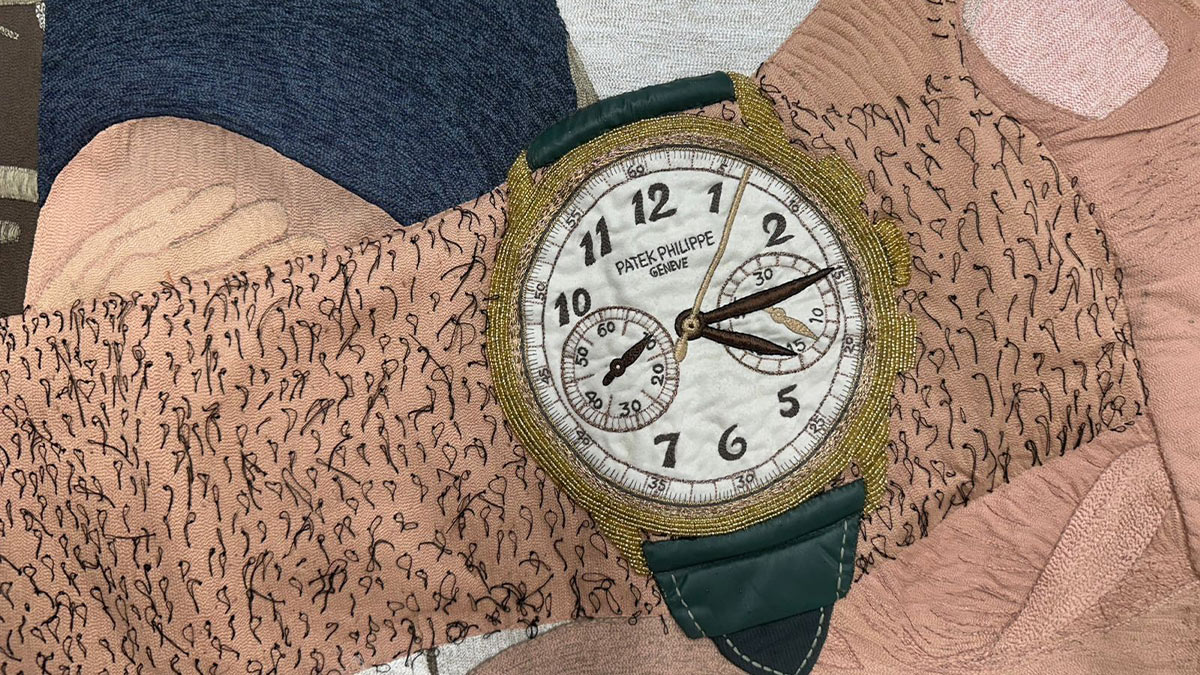
Hand-coded and hand-embroidered, the works in RITES are produced through collaboration with a community of women artisans at SSMI, translating computational logic into richly textured tapestries. These works position coding as a practice of solidarity—supporting livelihoods while sustaining cultural knowledge and craft traditions. Embedded mirrorwork, rooted in histories of spiritual protection, extends this language of care into the visual and interactive dimensions of the exhibition.
Human-Machine Portraits and Protective Encryption
Sun Tapestry
Each tapestry is generated through Sun’s bodily movement, captured via infrared light and translated into code as both signature and sigil. Every RITE becomes an abstracted human–machine portrait—functioning as dazzle camouflage and protective encryption in an age shaped by algorithmic surveillance.
Opening Night and Public Programme
The exhibition opens on 31 January 2026 at Method Delhi, with an evening hosted by Sanjana Rishi and Ruchika Sachdeva. The opening programme includes a presentation by Alida Sun, where she frames code as a living, multi-sensory medium that moves between sound, light, textiles, bodies, and space-privileging process over outcome and embracing glitches as sites of generative discovery.
Live-Coded Performance by Abhinay Khoparzi
Alida Sun – Tapestry
The opening night will conclude with a live-coded audio-visual performance by Abhinay Khoparzi. Responding directly to the exhibition, Khoparzi’s improvisational soundscapes are generated in real time through algorithmic processes. His performance echoes RITES’ themes of ritual, encryption, camouflage, and resistance—positioning code as a shared space for contemplation, solidarity, and experimentation.
RITES is an official India Art Fair Parallel. Works by Alida Sun will also be presented at Method’s booth (E10) at the India Art Fair, scheduled from 5 to 8 February 2026, extending the exhibition’s dialogue into a wider international platform.