Exploring the Spiritual Sides of Puducherry and Tiruvannamalai

0

Author – Shweta Gurjar

My recent trip to Tamil Nadu happened quite by chance. I had always kept Auroville for the day when I was finally going to be sold on vipassana. I had planned to live for a few good months, growing, eating, cleaning, and nurturing- all that the place gave me a glimpse of in three days, enough for longing to return again.

It quite happened by chance, when a friend and I decided a spiritual journey to the South. 5 days of meditation at Auroville and Thriuvanthamalai – both with their unique spirituality! Along with meditation, it was a cultural experience- with the historical French culture in Auroville and the very religious culture of the South India.
Exploring-the-Spiritual-Sides-of-Puducherry
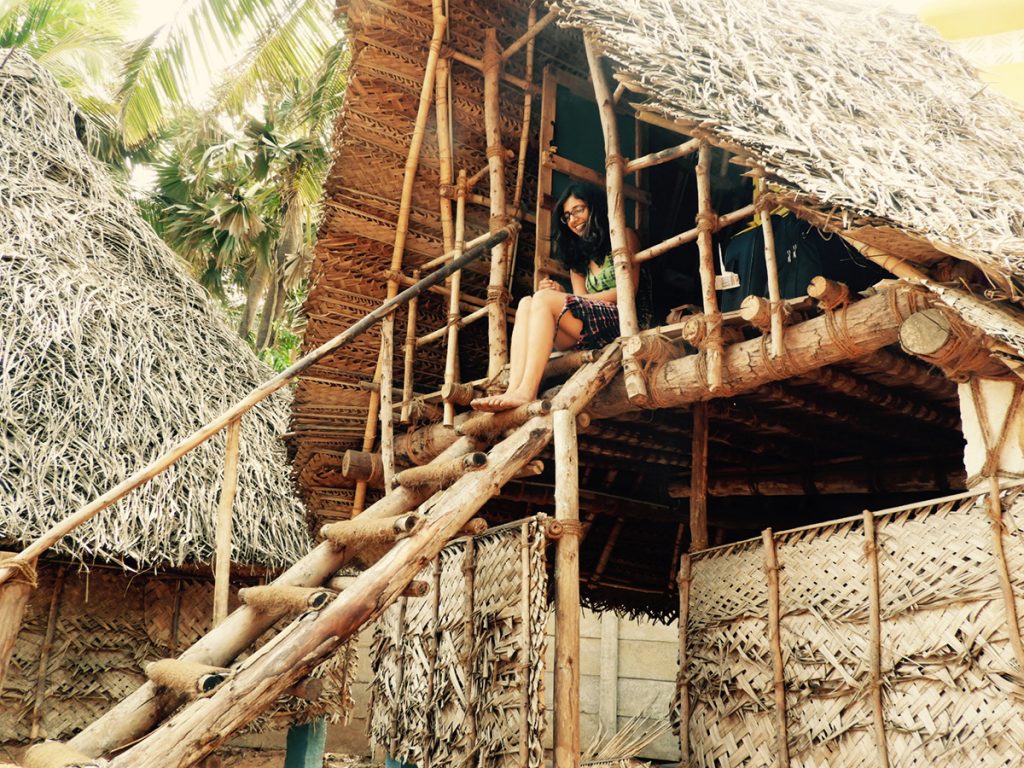
At Auro Beach

After reaching Chennai by flight, we took a cab to our destination. Cab’s are the preferred common commute, however one can take a bus as well. Although Puducherry is just seven kilometers from Tamil Nadu, there is a clear distinction between the two. Puducherry is a little more cleaner, neater, greener, richer than Tamil Nadu. Towards the end of Puducherry, the buildings start appearing a little more French, and bookstores carry more advanced French than English.

Pondicherry has the ashram of Sri Aurobindo, it is here that he meditated with The Mother and his samadhi is here. Planning to meditate by the Samadhi to enlighten our spiritual journey, we were allowed in as regular visitors. Although the ashram has a large number of daily visitors, the place maintains silence and so meditation is quite possible. Both, tourists and mediators visit here to find silence or peace. The verandah surrounding the samadhi is the meditating area. Clean, green, with little bits of sunshine through tall palm and papaya trees, it is a place to ‘check out of the world’ for a little while.

Quite close to the ashram is the White Town. Puducherry’s French heritage is mostly concentrated here. It is that place where the French left their culture through buildings, road systems, infrastructure, and memories.

Over the years, foods have changed to more Italian with maybe some French. However, it is not disappointing as a very distinct hippie commercialization of Puducherry has kept it moderately expensive, with heritage buildings, and cuisines that are invented with a combination of French, Tamil, and some alien cultures brought in by tourists. It is not uncommon to find “butter chicken with french fries (or rice)” on the menu at the small hippie restaurants.

I lived by the Auro Beach, which is equidistant from Auroville and Puducherry (about 8 kilometers). Auro Beach has scanty civilization on the beachside – a five-minute walk from the beach to the main market. It is advisable to rent a motorbike or a bicycle here due to the distances. Auto-rickshaws are expensive and often do not use the meter. So, there is always a 5 minute negotiation before the ride.

However, one can never be too upset in Tamil Nadu. The salty breeze that flows inland, the earthy atmosphere of the city in bamboo calms the mind, and the greenery around with tall palm trees with umbrella tops can always spell a charm to calm your anger.
South-Indian-Famous-Thali
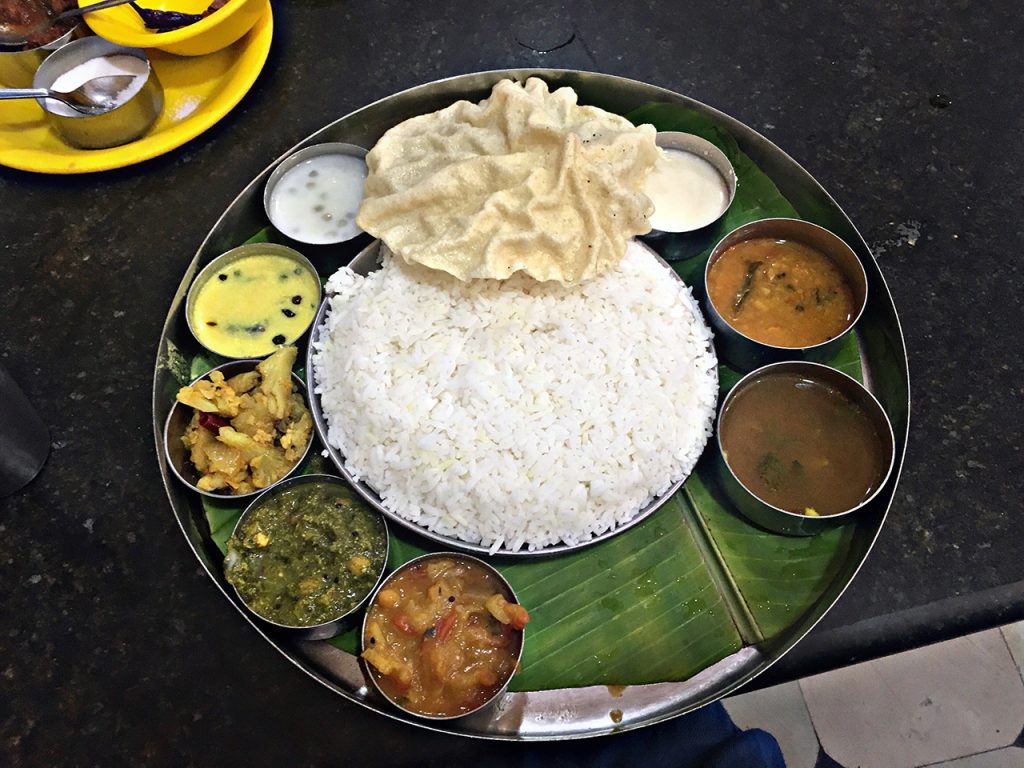
South Indian Thali

Palms and bamboos are quite revered in Tamil Nadu. It is amazing to see most house tops made by a type of bamboo that is local to Tamil Nadu. Although concrete is trickling, here and there, into the architecture, the underlying rurality of Tamil Nadu, to a large extent, has not discarded the natural bamboo housing. My cottage on the beach was also entirely made of bamboo- a ten feet tall structure that stood on long bamboo logs, with planked flooring and dried bamboo leaves for roof top- all knit together by jute, strings, and nails. A ladder climbed into a short verandah, which was great post to relax, all the while listening to the sounds of the ocean, beyond the virgin beach. This sweet melody didn’t end until I left.

One must remember that though Puducherry still has a “white man’s” culture, and it is not uncommon to be asked to leave certain places if you are an Indian, sad and true. But, there are many other places around that very welcoming. so best to stay away from places that are “villas.”

After experiencing an interesting time at Auroville, a morning cab ride took us to Tiruvannamalai. Unlike the drive to Auroville, the drive to Tiruvannamalai was a little drier and a little hotter as we drove inland.
Summit of Arunachala
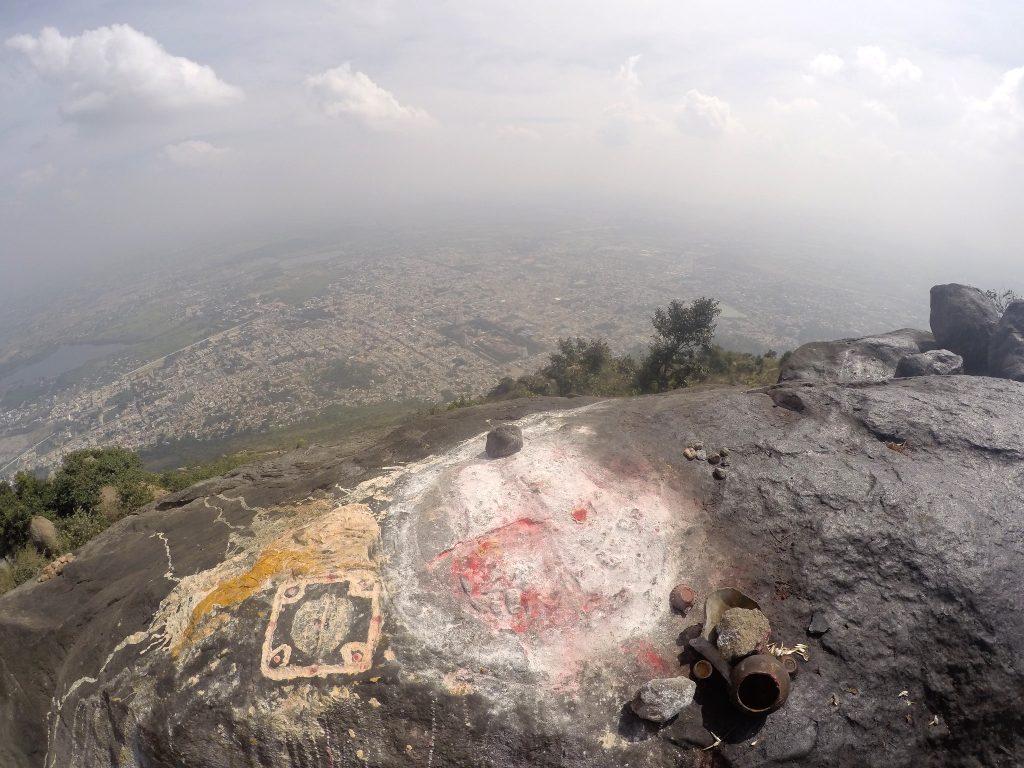
Summit of Arunachala by Martin Ehrensvärd via Flickr

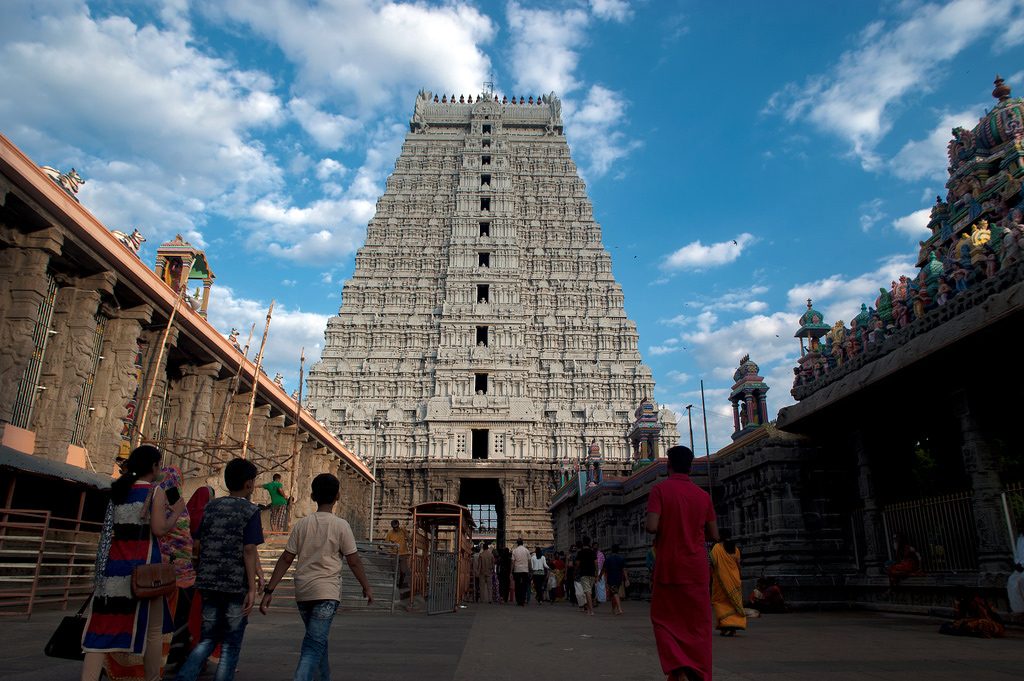
Tiruvannamalai is a hilly area situated in the Anamalai Hills of the Eastern Ghats. At the foot of the hills is the Annamalai Temple. It is said to be the largest Temple in the world, dedicated to the Hindu Lord Shiva.

The mythological story for the temple has it that Lord Shiva (the destroyer) asked Lord Bramha (the creator) and Lord Vishnu (the keeper) to find the center of the universe. Lord Bramha turned into a swan and flew as high as he could and returned with an answer. Lord Vishnu became a bore and dug deep into the earth and returned with an answer. They both admitted to have found the center of the universe. However, they had both lied. So, Shiva created an endless fire that passed through the magma of the earth below and reached the highest skies. This fire was created at Annamalai (now known as Tiruvannamalai). Shiva suggested that this is the place where ego would perish and die. Four mandapams were built around the place of this fire. Thus, the temple of Arunachalayar.
Arunachaleswarar Temple Tiruvannamalai
Arunachaleswarar Temple Tiruvannamalai by Nithi Anand via Flickr

The temple has four entrances, facing the four directions. It is suggested to be auspicious to enter from the South Gate. Annamalaiyar is prominently a Shiva temple. It is said that after Shiva created fire, he settled in the hills of Arunachala. Parvati joined him and the temple was created.

At the temple are also idols of Ganesha and Kartikeya (Murugan). Although Ganesha is the
beginner of all things good, Kartikeya is revered very highly in the Southern India. He is the God of War who kills ego and hatred. Hence in Tamilnadu, Lord Murugan’s idol is always placed before the Shiva-Parvati temple. Just like Lord Shiva has Nandi at the entrance, Lord Murugan is always accompanied with a peacock. The peacock represents the youthfulness of the Lord and his mission to fight ego and hatred.

The temple is large and takes a good 20 minutes to complete an entire circle. I took up a room next to the temple to enjoy the soothing morning aarti at 5:30 am, so culturally Southern! The early risers with early coffee shops was quite a delight to walk around and chill at before the sun rises. Being a very religious place it is extremely safe for women to be on the streets at early hours, which was a very welcoming experience.

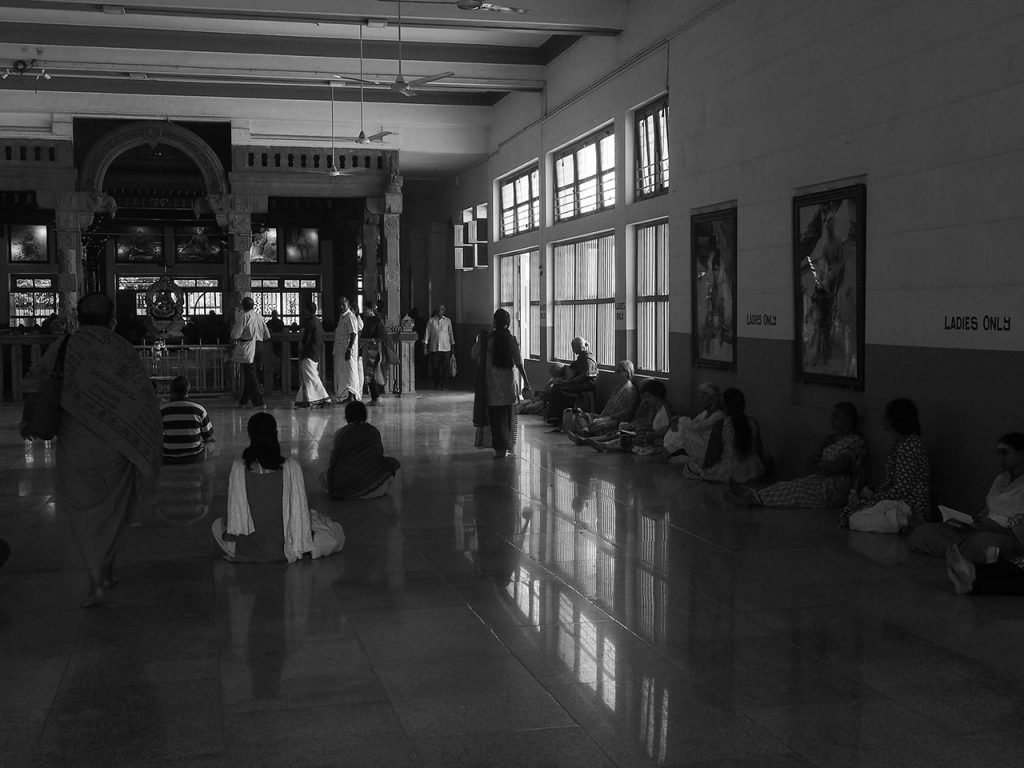
Behind the temple, about three kms away is The Ramana Ashram. Swami Ramana is said to have visited the temple in his youth and promised Lord Shiva to renounce everything, and live a life of a monk. He meditated in the caves of the Arunachalam hill, which are accessible by an hour long walk up the mountain. The caves are accessible and one must meditate in these caves just to experience silence and peace. The Virupaksha Cave was my most favorite. It still maintains its history with stony roof and muggy darkness in the mediation room.
The-Ramana-Ashram
The Ramana Ashram by Chris Jadoul via Flickr

Near the Ramana Ashram, there are traces of the hippie culture of India. An obvious German Bakery is right around the corner serving good food and cozy ambience. However, it is a must to try many other hippie cafes around like the Shanti Cafe for its Indianized yet extremely delicious cheesecake.

Five days of Tamil Nadu gave us a lot of spiritual upliftment. The meditation agenda was met, and spirituality was largely achieved through mediation, greenery, and nature. It is advisable to visit Puducherry a little more than five days as there is enough to see and do. If traveling to Tamil Nadu, the Arunachalayar temple is a must visit for its superb energies and positive vibes.

Is Amrita Sher-Gil Really the “Frida Kahlo of India”?

1
Amrita Sher-Gil
Amrita Sher-Gil – Source Wikimedia

Everytime someone talks or writes about the painter Amrita Sher-gil, the name Frida Kahlo is thrown in the mix of words, and almost always in vain. In vain because none of these writings or talks attempt to give a reason for this reference. All we get, at the maximum, is a vague statement about similarities in their painting styles or their social figures, said to be equal in the degree of unconventionality.

In this article, I try to outline the similarities and differences, between the two artists.

The fact that both the artists were born of mixed parentage, Kahlo was German-Mexican and Sher-gil, an Indian-Hungarian, is used as an argument for their similarity. But despite this common feature, their respective childhoods were in quite distant nature.

Sher-gil was born into a privileged home in Budapest, and grew up in the aristocratic circles of Europe. Her father, Umrao Sher-gil, a prominent Persian scholar, had met her mother and his second-wife, Marie Antoinette Gottesmann when she accompanied Princess Bamba Duleep Singh on her visit to Lahore and Shimla. Gottesmann was a Jewish-Hungarian singer with noble roots.

Amrita-Sher-Gil-Really-the-“Frida-Kahlo-of-India
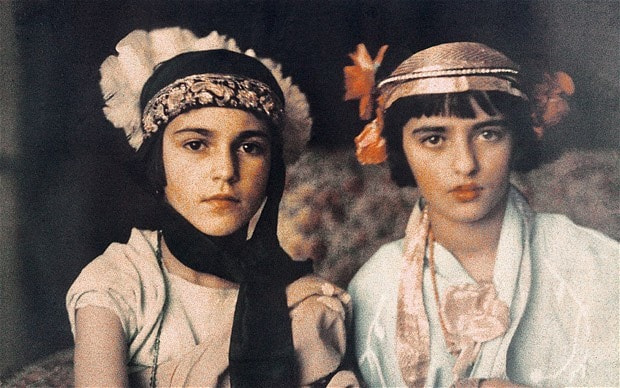
Amrita with her sister Indira (left), circa 1923. Source: Estate of Umrao Singh Sher-Gil/Photoink via Telegraph

To promote further her early talent for drawing and painting, she was enrolled in a Florence art school called Santa Annunziata, at the age of eight, and then went to the Ecole des Beaux-Arts, Paris, at sixteen.

In contrast, Kahlo’s childhood was characterized by a conservative mother, a prolonged sickness, in the form of polio that left her with a limped gait, and an overall sense of melancholy, which would later influence her art.

She didn’t attend any formal art schools, and instead was studying to become a doctor at the prominent National Preparatory School. Her orientation towards a career in science ceased when a bus accident left her with multiple injuries, including a shattered pelvis and impaled uterus. The existential feelings and social immobilization that ensued during months of being bed-ridden practically turned her into a painter.

From early adolescence, Frida was politically conscious. In the PBS documentary on Kahlo’s life, Amy Stechler tells that she changed her birth year from 1907 to 1910, probably to make it lie in the same year as the start of the Mexican Revolution.

As she grew older, her political identity inclined towards embracing her Mexican heritage, easily reflected in her traditional clothing. She also joined the Mexican Communist Party in 1927. During this time, the 1930s, fascism was at rise in Europe and as the Art Story notes, there was an attempt to distance herself from her Germanic ancestry. This was evident in the name change from ‘Frieda’ to Frida. She also had reportedly said that her father was a Hungarian Jew, a claim that has been opposed.

The same fascism may also have resulted in an environment of hostility for Sher-gil, that would later culminate in her decision to settle in India.

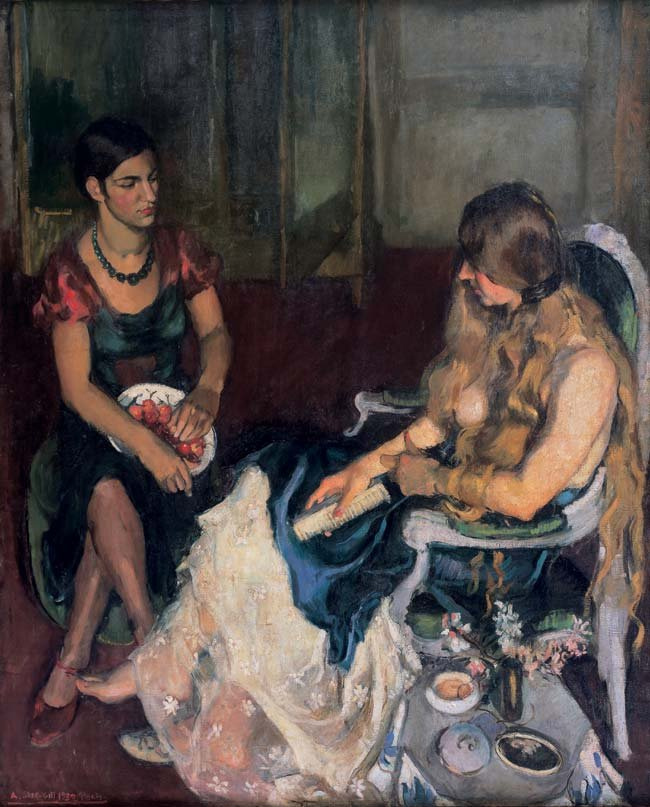
By the age of 20, Sher-gil had mastered the formal European painting styles. This mastery earned her a Gold Medal at the Grand Salon in 1933 for the oil on canvas, ‘Young Girls’.

Amrita-Sher-Gil-Really-the-“Frida-Kahlo-of-India-2
Young Girls, Oil on canvas, by Amrita Sher-gil – Source

Another example of her proficiency is the ‘Sleeping Woman’ nude from 1933, which is an evocative painting, exposing the female body, and a beauty that has emerged when the subject is disarmed by sleep.

Another nude from 1934, titled ‘Self Portrait as Tahitian’ shows a shift in her choice of colours, towards muted light tones. The painting shows Sher-gil in a bare-chested posture, her face expressing contemplation, and the background rich with depictions of oriental life. A 1931 self-portrait fetched almost Rs 17 crore at a London auction in 2015.

Although this style wasn’t to stay, she had found concretion in her choice of subject- women of life.

Her decision to settle in India was preceded by a long stay in India, during which she traveled through the South in search for a newer, original style.

This event has been told by many as a longing for roots, and as an abdication of her older style, and with it, her half-european identity. Here, one might be tempted to draw parallels with Kahlo’s gravitation towards Mexico.

But this new art, and inspiration, was something else. As her nephew Vivan Sundaram aptly comments on the topic, “she didn’t abandon the west”. In fact, in her later works, she carried forward the experiments with oil paint, finding inspiration in the Medieval miniatures and Ajanta cave paintings, and attempting to distinguish herself from the prominent Bengali School.

In his review for Yashodhara Dalmia’s book on Sher-gil’s life, Khushwant Singh adds some details to this coming-home tale. In India, he says, “she was eager to win recognition… travelled across India… but found few buyers”.

Amrita-Sher-Gil-Really-the-“Frida-Kahlo-of-India-3
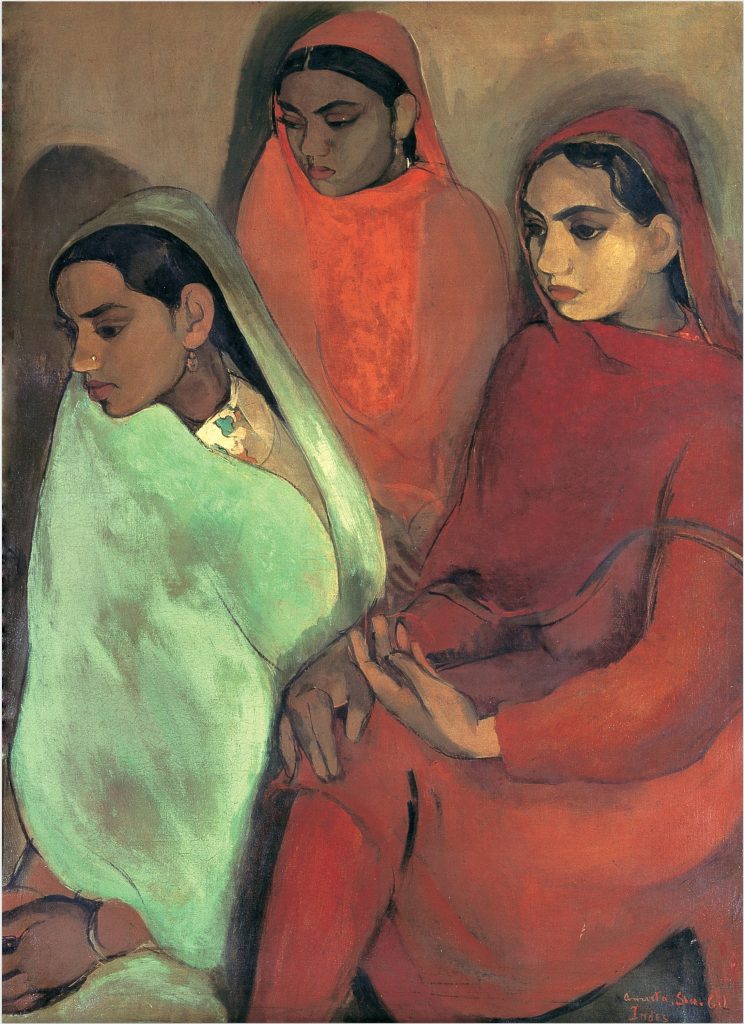
Three Girls’, Oil on canvas by Amrita Sher-gil – Source Wikimedia

An important work from this period is ‘Bride’s Toilet’, which is part of the South Indian trilogy. Extrapolating on its meaning a little, the painting can be called a study of the Indian social system, and how it related to women of the time, viewed from an outsider’s eye. The contrast between the status of the three women, shown masterfully in varying highlights, is unmistakable.

During her last years, the paintings had the subjects posing to suggest stillness, and from an non-indigenous observer’s eyes, a sense of simplicity in life. This stillness is often aided by vertical alignment and a controlled dark-hued palette. In contrast to this calm energy, her former works often communicate a vibrant mood.

Amrita-Sher-Gil-Really-the-“Frida-Kahlo-of-India-4
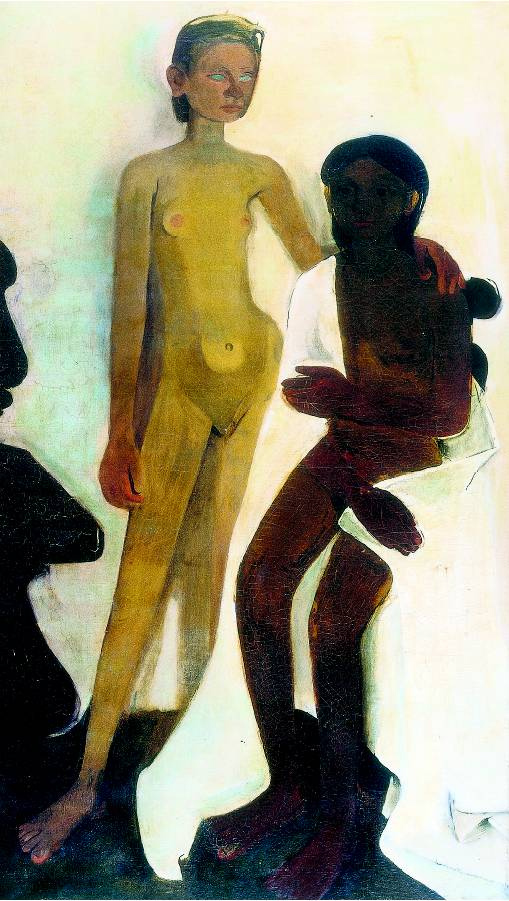
On her brief return to Europe, she painted ‘Two Girls’ in 1939, which explores her sexuality with her dual-heritage in the background – Source

An inherent sense of vanity can be observed in her oeuvre. This is noticeable in the conscious posture of the subjects, and even more so in the early series of self-portraits. These portraits often make up another argument of commonality with the Mexican painter. But Kahlo’s works diverge greatly, both in meaning and in their representation of ‘self’.

Kahlo’s life was marred by pain and her paintings, marking important events of her life, serve as renditions of her relationship with the pain. Her works can be comfortably defined as surrealist images of her insides, both physical and the non-physical emanating from it. Unsurprisingly then, in almost all her canvases, she used herself as the subject, never failing to include her iconic unibrow.

After her marriage to the celebrated painter Diego Rivera in 1929, art gradually turned into a full-time pursuit for Kahlo.

Amrita-Sher-Gil-Really-the-“Frida-Kahlo-of-India-5
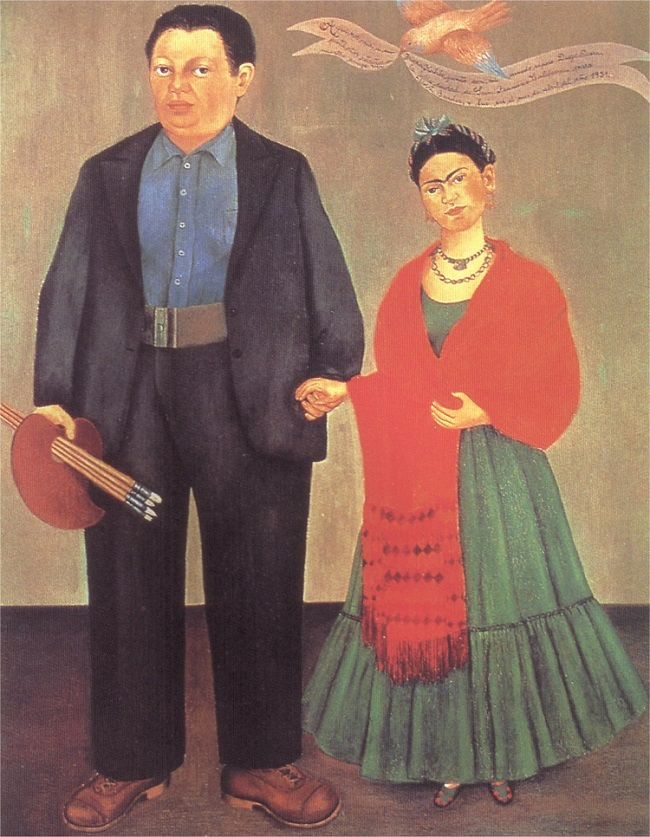
Frieda and Diego Rivera by – Source

Examples of major artworks include ‘Frieda and Diego Rivera’, which was her expression of her trying on the new role of a traditional Mexican wife. When the relations soured between the couple, as a result of Rivera’s infidelity, out came the oil on metal, ‘A Few Small Nips’.

Frida-Kahlo-A-Few-Small-Nips
A Few Small Nips by Frida Kahlo – Source

Her two failed pregnancies also drove her towards constructing revealing, and almost gory, paintings like the ‘Henry Ford Hospital’ and ‘My Birth’ in 1932. In 1940s, her health further deteriorated and she had to undergo a spinal surgery. Her coping up with the agony is symbolised in works like ‘The Broken Column’ and ‘Self Portrait with Thorn Necklace’.

Frida-Kahlo-My-Birth
My Birth by Frida Kahlo – Source
Henry Ford Hospital by Frida Kahlo – Source
Frida-Kahlo-self-portrait-with-necklace-of-thorns
Self Portrait with Thorn Necklace by Frida Kahlo – Source
Frida-Kahlo-the-broken-column
The Broken Column by Frida Kahlo – Source

It can be easily said that the two personalities were ahead of their times, both as women and as artists. It can also be said that Amrita Sher-gil wouldn’t have liked the “Frida Kahlo of India” description that the art-circle has given her. As we have seen, her disagreement would have been justified too. The same injustice would prevail if we call Kahlo the “Sher-Gil of Mexico”, or Amitabh Bachchan the “Al Pacino of India”.

Bicycle – Once A Rocket to a Kid

0
Bicycle-Nostalgia
Image – R E B E L via Dlickr

The times have moved on. Even on the smallest of roads we find motor-vehicles being ridden. Rash and hurried, a young man rides to school a motorcycle that defines not his rules. All the chaos laden traffic does make us wonder how did these children of today lose the joy of being a pedestrian, of holding their parents’ hands, and the joy of riding a cycle?

There were days when a bicycle was a dream of every primary school kid. The younger ones, watching their older siblings learn, wished, hoped, and begged for a chance to ride that big cycle. Then came times when the little ones sit behind and the elder ones peddled along. The roads weren’t full, going far and getting hurt resulted in a secret being shared between siblings and the reason for whispers.

Bicycle-Kid
Image – Bhavishya Goel via Flickr

Then came the joys of riding along to school. Up and Down, with huff and puff, we used to go in all the corners or all the roads. The joy used to be made of facing the strong winds, and of pedaling fast to race motor vehicles. But now we find the kids racing for their future in a motor ride! The rains were then a blessing in disguise, the splash through the wheels in puddles ended with enjoyment of getting drenched.

The bicycle also got people together, as everyone took turns on that one cycle, and to train the friend to ride along. That one bicycle stands alone now, as a reminder of why our childhood friendship always stayed strong.

Today, children are hurried to concentrate their time in classes, as they end up losing the joy that came from in-between commutes. As we grow old, we are adopting  bicycles not out of comforts but out of causes, like to reduce carbon footprint, or to travel around in huge campuses that forbids motor vehicles, or when we get ourselves in the mayhem of lack of physical exercise. It is not that we don’t have bicycles anymore, the trouble is that we don’t care to have space for them and the values that came with them.

Qutub Minar Through An Offbeat Lens

0

Qutub-Minar

On a warm December morning, we decided to take a trip to Qutub Minar, more to make up for our daughters missed school field study. So we packed for a picnic at the Qutab Minar. Being busy on Sundays, due to the huge turnover of people, our early trip could only begin at noon. But once we were in the complex, the stress associated with it was gone.

Passing through the security, we reached the first threshold, marked by an arched structure. It was then that nostalgia hit me- I had returned to the monument almost after 10 years. Faint memories began to cloud my mind. I knew this trip was going to be more than a picnic.

Moving on, we caught the first glimpses of the tower. My camera was soon out, although photography was never my forte and I became the self appointed tour guide for our small group of three.

Taking the other route we first saw the Alai Minar, the other victory tower which never got completed.

Alia Minar, incomplete, solid rubble building.

Alia Minar, incomplete, solid rubble building.

By now the history buff in me had met the amateur photographer. As we approached, the expression on my three-year-old face was priceless. There stood the awe-inspiring Qutub Minar in all its glory.

Now a UNESCO world heritage site, it was built around the Quwwat-ul-Islam Mosque. It served as a minaret to the Quwwat-ul-Islam mosque but its design and architectural style make it one of the most significant buildings in Indian architecture. It marks the rise of Indo-Islamic architecture in India.

Built in red sandstone, marble, limestone and rubble masonry, it has five storeys accessed by an internal spiral staircase. First three storeys are built in sandstone while the top two are built in marble, the change in material marking its evolution over time. Each storey is separated by beautiful balconies supported on intricate stone brackets.

Qutub-Minar

The desire to erect towering structures to reflect the might of monarchs and the need to create large congregational spaces for a new religion, led to the development of a new pattern of spaces. The use of Hindu craftsmen, local building material fused with Islamic construction techniques, lends the Qutub complex a unique character.

Top 10 Destinations to Visit in Maharashtra During Winter

1

Colds in Maharashtra are never as harsh as they are in the northern states. But this doesn’t stop the fun-loving Maharashtrians from enjoying the many charms of winters, particularly, staging mind-relaxing getaways. Within the state, there is no shortage of places to enjoy a few days of the cold in. In this article, we have listed ten that you should definitely visit.

1. Mahabaleshwar

Destinations-to-Visit-in-Maharashtra-Mahabaleshwar
Image – Nishanth Jois via Flickr

Mahabaleshwar is an old hill station known for its scenic beauty and many vantage points. There are many points like the Arthur’s Seat, offering an encompassing view of the Jor Valley, the Elphinstone Point, or the Wilson Point, which is the highest (~1400 metres) on this vast plateau spread over 150 kilometres. Nearby, in the Old Mahabaleshwar you can find a number of ancient temples like the Old Mahabaleshwar Temple, or the Panchganga Temple. Most importantly, Mahabaleshwar is also the source of the river Krishna.

2. Panchgani

Destinations-to-Visit-in-Maharashtra-Panchgani
Image – Ramnath Bhat via Flickr

This beautiful hill station is located about 100 kilometres from Pune, sitting in the middle of five mountains of the Sahyadri Range. Remarkably, the volcanic plateau in Panchgani, known locally as “Table Land” is the second highest in Asia. It is an extension of the Deccan Plateau. Among popular spots are the Sydney point, which offers a stunning view of the Dhom Dam Lake, and the Parsi Point that provides a vantage of the Krishna River Valley.

3. Chikhaldara

Destinations-to-Visit-in-Maharashtra-Chikhaldara
Image – Rajesh Shende via Flickr

Chikhaldara is a famous hill station in the Amravati District, located 230 kilometres from Nagpur. This place has a fair share of beautiful landscapes, lakes, waterfalls, and wildlife. Also situated nearby is the Melghat Tiger Reserve that has a sizeable population of Bengal Tigers (around 41 in 2017), along with 80 other mammalian species. Shakkar and Kalapani are the two prominent lakes.

4. GaganBawda

Destinations-to-Visit-in-Maharashtra-GaganBawda
Image – Sameerkulkarni2.blogspot.in

Located less than 300 kilometres from Pune is the small hill town of Gagan Bawda. If you take a detour to 60 kilometres north, for Mudagad Fort, or similar distance south for Shivgad Fort, you will find soul-quenching trekking opportunities in the misty Western Ghats. Among the must-see spots here are the Gagangad Fort, the Karul Ghat, and the Bhuibawada Ghat.

5. Bhandardara

Destinations-to-Visit-in-Maharashtra-Bhandardara
Image – Neeraj Tripathi via Flickr

This lakeside paradise is located in the Ahmednagar district. Lake Arthur is a hotspot for camping enthusiasts and there are many treks leading to and from it, like the Kalsubai Peak Trek. Around 7 kilometres from the camping site, one can experience water falling from 170 feet at the Randha Falls of the Pravara river. Maharashtra’s highest peak is also in Bhandardara- the Cenozoic-era Kalsubai, with a modest elevation of 1645 metres, is roughly 13 kilometres by road from Lake Arthur, and is easily accessible by trek. When you have the latest Makemytrip coupons & cashback offers, there are all the more reasons to visit this place.

6. Alibag

Kolaba fort; Image Abhiram Katta via Flickr

Located just 100 kilometres south of Mumbai, this coastal town is known for its beaches, like the Nagaon Beach or the Varsoli Beach. Another attraction is the Kanakeshwar forest, and with its up close animal encounters, it makes a great place for a leisurely trek with family. The seventeenth century Kolaba Fort is also a popular tourist destination.

7. Ganpatipule

Image – Hasnain Ali via Flickr

Ganpatipule can be easily defined by its clean beaches. The Ganpatipule beach, lined with resorts, and the Ganpatipule Temple, is a perfect place to marvel at the Arabian Sea. There is also ample provision for water sports enthusiasts. Arey Ware is to the north of the Ganpatipule and is less crowded, particularly during the winters. Further north is the Malgund beach.

8. Igatpuri

Destinations-to-Visit-in-Maharashtra-Igatpuri
Image – Priyan Nithya via Flickr

Another in the long list of Western Ghat hill stations is the isolated town of Igatpuri. This place is sure to provide you with a peaceful environment. Among the places to visit is the centuries-old Tringalwadi Fort, and the Ashoka Falls, which is surrounded by lush hills.

9. Toranmal

Destinations-to-Visit-in-Maharashtra-Vivek-Thomas
Image – Vivek Thomas via Flickr

Located in the Satpura Ranges, this humble hill station is as serene as it is beautiful. There are two lakes in the vicinity, the Yashwant Lake that spans over 1.5 kilometers, and the Lotus Lake that gets laden lotus flowers during the blossom season. Other attractions include the the Sita Khai waterfall.

10. Tadoba-Andhari Tiger Reserve

Destinations-to-Visit-in-Maharashtra-Tadoba-Andhari-Tiger-Reserve
Image – Wildnest via Flickr

This reserve was formed in 1995, as part of ‘project tiger’, and encompasses the Tadoba National Park and the Andhari Wildlife Sanctuary. The 625 square kilometres of lush green forests are dotted by the towns of Chimur, Moharali, and Kosla that are full of luxury wildlife resorts. On a wildlife safari, if you’re lucky you may spot one of the 88 Bengal Tigers, or you can witness the biodiversity marked by birds like the crested serpent eagle, and reptiles like the endangered Indian Star Tortoise.

So if you’re planning a long winter vacation, or a short getaway, you know which places should be on your list. Don’t forget to get the Latest Coupons and Offers from DesiDime.

References:
https://web.archive.org
http://tadoba-national-park.com/

Adaptive Reuse of Ancient Stepwells in Modern Times

1

Author – Rajita Mehta

Stepwells, locally called baolis or baoris, are a reminder of how civilizations have flourished in the north by tackling the dry, arid climate.

These water harvesting systems are special form of wells, in which the water can be reached by descending a set of steps. During their days of relevance, these reservoirs tapped into underground water tables and stored clean potable water.

What are Stepwells?

Rani-ki-Baoli-Step-Well
Rani ki Baoli Step Well – Image Wikimedia

A typical stepwell is linear, and comprises of a central stepped corridor, covered on three sides, pavilions, leading to a well. Over time, these simple designs evolved into more elaborate structures.

Typically, a stepwell can be several storeys deep, with lattice work on walls, carved columns, decorated towers, and intricate sculpture work. They are exceptional examples architecture of the time.

The designers also employed a number of anti-earthquake techniques. Pilasters, multiple symmetries, a low centre of gravity, pavilions (both steadying and cross bracing), and careful fitting of rectangular blocks made it nearly impossible to roll a stone out of place.

The magnificence, however, of these structures lies in the sensory experience that is provided by spatial organization of their various architectural elements. The pilasters of the pavilion at the entrance mark the only existence on ground, almost hidden in plain sight.

As one starts to descend down, the process of moving through the space itself becomes an event. The horizontal movement contrasts linear organization of elements, accentuated by inclined movement on the vertical steps, continuously changes the visual frames. The experience is also enhanced due to change in scale and proportion as one descends down this unique spatial arrangement.

This moment on, the senses are engaged in a sublime experience. Soon the cacophony of the outside world becomes hushed, and the bright light begins to darken gradually. The intense summer heat cools down at subterranean levels. The air is filled with mystery and intrigue as one observes the structure rising.

Problem of Irrelevance

Ancient-Stepwells-of-India
Plan and section, Vikia step well, Gujarat. Image source: Aesirlab.cc

For historical communities, the significance of this public utility building has been beyond its utilitarian purpose. For Hindus, for instance, the presence of water invested in these wells carried religious meaning. The micro-climate inside also provided a respite from the heat, making them appropriate resting places for travelers (sarai).

However, with changing times, these structures have lost value, not only as water harvesting systems but also as community buildings. In time of bottled water and perennial taps, use of a stepwell is nothing short of impractical. Also, the structural decay has rendered their use impossible even as water systems. However, despite this functional irrelevance, these architectural marvels continue to intrigue their visitors.

“Adaptive reuse enables a historic building to continuously derive relevance from use, and thus remain dynamically evolving.”

Adaptive Reuse as the Solution

The solution to this problem can be found in the concept of adapting the stepwells for uses that are compatible with the modern community.

One example of such reuse is The Neemrana ki Baoli, which is being converted to a Crafts’ Haat. Built in 1760s by Raja Todar Mal, this 9-storey well was to serve as a guard against famine. But in the last few decades, the baoli stood neglected- mainly because the feeding well, from which the baoli-well draws water through seepage, was ceded to private ownership, and as a result the water was rendered inappropriate for use.

The-Rani-Ki-baoli-at-Neemrana
The Rani Ki Baoli at Neemrana – Image source

The project, being undertaken by the Union Ministry of Tourism, involves restoring many roofs, re-doing the brackets, flooring, plastering, and ensuring security through metal gates and katheras (stone parapets). The steps, about 200 in number, will also be given a new birth. Undoubtedly, the interventions in the project are intentional and are meant to be permanent.

Being only 125 kilometres from Delhi and in close proximity to the Neemrana Fort-Palace, the renewal is expected to fetch substantial tourist traffic.

Crafts'-Haat-at-Neemrana-Fort-Palace
Crafts’ Haat Work in Progress at Neemran ki Baoli – Image Source – Sandeep Subhash

But there is another way of adaptive reuse, where the interventions are not directly intentional and the changes are only temporary. The In 2008, the Agrasen ki baoli, located in central Delhi, was used as the background for an art installation as part of ‘48℃ Public-Art-Ecology Festival’. Thus, for three days, the baoli served the function of an exhibition space.

Agrasen-ki-Bavdi
Temporary Exhibition Space at Agrasen ki Bavdi Image Source

The concept of adaptive reuse can be applied to any public monument or building of historical value. Historic buildings are essentials of cultural heritage, valuable resources with architectural and historic value, and with smart reuse techniques, they can also be economically and practically valuable.

Here are some more arguments:

● Adaptive reuse helps in preserving architectural and cultural heritage, which also serves educational purpose of displaying techniques and lifestyles of bygone days.
● Adaptive reuse also helps in providing job opportunities to the local craftsmen and laborers. Since most of the building is already built, the work needed to fit new function requires less money, making them economical.
● These old building are also environmentally beneficial, as they are designed to include natural light and ventilation, thus conserving energy.
● Water buildings will never return to serve as they did, but it is possible to reuse them for a new use, while still preserving the unique typology.

Jamini Roy – A Treasure of Modern Folk Art

0

Being a full-time artist is a tough job. Financial suffering aside, what breaks an artist, or simply makes it harder and harder for her to continue, is the state of not being able to find appreciation, or in worse cases- even acknowledgement. But some artists break all these barriers to become truly celebrated and their work becomes world renowned. Jamini Roy also belongs to this league.

Jamini-Roy-Folk-Art
Boating – Image Credit: The San Diego Museum via Flickr

Roy was born in the Bankura district of present-day West Bengal, and at an age 16, joined the Government School of Art and Craft at Calcutta (Kolkata). This was a time when the Indian elite was showing greater participation in patronizing and creation of new art, as is evident from the fact that Abanindranath Tagore became the first Indian to join the school. During his time here, young Jamini studied the western academic styles, particularly the post-impressionist style prominent in his early works.

Jamini-Roy-Indian-Modern-Folk-Artist
Jamini Roy – Image Credit: alchetron.com

But that style wasn’t to be permanent, and only a few years into his professional career, he started experimenting with various styles, eventually finding inspiration in folk art. This led to the complete turnover of western style and materials. Soon watercolors were substituted by tempera on diverse materials, from simple paper, to canvas, cane weaving, boards, and cloth.

Jamini-Roy-Modern-Folk-Art
Five Women – Image Credit: CEA + via Flickr

Direct associations can be drawn between his paintings and the Kalighat style. His treatment of subjects, which ranges from the early-career commissioned portraits to the Santhal tribal life, is defined by strict lines, fluid calligraphic strokes, simple symmetrical, and high-value colours.

His oeuvre features a simplification of human expressions, with eyes being emphasised through size. This can be ascribed to his experience with impressionism, and is probably meant to communicate what he thought of as the simple nature of his subjects- the Santhals in particular, or women in general. One can find this feature in the tempera on paper work titled ‘Santhal Dance’.

Santhal Dance, tempera on paper CREDIT: National Gallery of Modern Art

‘Santhal Girl’ on plyboard is another example of Roy’s proficiency in combining the western and folk styles. Curved line of the woman gives a sensual, youthful appearance, leading the eye to the decorative head flower. The posture of hands makes the subject appear as if she is self-aware of the beauty. Expression details and bodily features have been masterfully kept subdued in favour of the carnal posture.

Jamini-Roy-Modern-Folk-Art-Santhal-Girl
Santhal Girl Image Credit: Blogs.timesofindia.indiatimes.com

Other than the Santhal lifestyle, his works frequently dealt with religiosity. Examples are the works depicting the Hindu God Krishna like the ‘Kalia Mardan’ and ‘Yashoda and Krishna’ and those depicting Christ, like the one titled ‘Crucifixion’. The painter apparently also had an affinity to the mother and child relationship, and his works frequently depicted a mother caring for her child, almost always with a gesture of protection combined with the characteristic purity of his style.

Yashoda and Krishna painting by Jamini Roy
Yashoda and Krishna, tempera on cloth Credit: National Gallery of Modern Art

Before laying down the brush in 1972, this great artist would have received accolades like the 1935 Viceroy’s Gold Medal and the 1955 Padma Bhushan. Today, he is one of the only nine Indian artists whose works have been regarded as ‘art treasures’ by the Archaeological Survey of India.

8 Must-Haves to Make Your Solo Bike Trip Memorable

0
Solo Biker
Image – Pixabay

Following the same schedule day in and day out can take its toll even on people with the strongest of mindsets. Thus, it is required for you to take that break once in a while to offset the proceedings and explore something new. One of the better ways of doing so is to opt for a solo trip and that too on a bike.

Being on a solo trip is slowly becoming popular among bike owners and enthusiasts. On solo trips, you do not have to depend on an entire team. You can stop anywhere and as many times as you want to get that perfect click or try out local cuisines. You are not restricted on the destination as well, as it is all your wish. 

One could go on and on about the benefits of going on a solo trip. However, it is this very nature for which you might need to take the extra precaution as well. Here are the top 10 must-haves, if you are planning on a solo trip. 

#1 Attire

Have you packed your bags? If not, you might want to take it a bit slow. It is recommended to ride with a safety gear when you are setting out for long rides. A good pair of boots, jackets, gloves and a clean helmet are must-haves. To increase the comfort and safety levels, you can opt for jackets with extra padding on the chest and back. Similarly, look for gloves with excellent grip and the same goes for shoes as well.

#2 Bluetooth System

Since you expect to ride for a longer duration, getting a Bluetooth system for your helmet might be worth the investment. It frees you up from using the messy wires or from the constant need to stop to pick up calls while on the go. Backup for Battery

When you are on a solo trip, you need to take care of all the devices. Such as navigation, cameras, Bluetooth devices and so on. Thus, it is important to carry sufficient power backup, so that none of your devices run out of power.

#3 Sufficient Fluids and Food

One cannot be too sure about the availability of good eateries on the road. Thus, packing your bags with a healthy dose of fluids and snacks is important. It lets you take a break on the side of the road, enjoying the scenery and munching on your favorite snack.

#4 Toolkit

If you are planning on a trip to hilly or unknown territories, having a proper navigation system is imperative. Google maps will help you, but at times the good old navigation maps can be extremely helpful. And for unknown terrain, it is important that you carry a good toolkit as well. If the bike were to break down and throw some tantrums, you can take care on your own.

#5 Rain Cover

It might not even be the rainy season when you wish to travel. However, carry rain cover is crucial as the weather might change through different towns and cities that you will cross on the way. 

#6 Check Up

Before you set out for the long ride, having a quick pit stop at a garage will protect you from any potential pain. Check for all the fluids, wiring, battery and tires. Top up any fluid that is close to its minimum levels.

#7 Engine Oil

If you are going for really long rides, carry some extra fluids for your bike. The most common one being the engine oil. You can top it up on the way if you want to.

#8 Two wheeler insurance

When you are on a solo trip, you will be venturing into a lot of unknown regions. Buying a two wheeler insurance is the base of the trip. A 2 wheeler insurance is important for various reasons. For starters, it offers you legal clearance so that you can zip on any public roads without ever having to worry about a traffic police caught hold of you. 

Secondly, a 2 wheeler insurance will ensure that you can ride without any worries. If you face any unforeseen incident or accident, the policy will take care of the same. If you do not already own a two wheeler insurance, make it a point to buy one before you start.

You can buy bike insurance online with Acko general insurance. Buying bike insurance online helps you save a considerable amount on premiums and yet receive all the benefits. In fact, riding without an insurance is as dangerous as riding without any safety gear on the highways. Scary isn’t it?

10 Must-Visit Offbeat Destinations in Delhi – (Infographic)

0
Delhi-tourism-map
Ugrasen ki Baoli – By Prateek Rungta via Flickr

Delhi is an historic city. From ancient to medieval and modern, it serves as both the origination and the conclusion of many diverse storylines in Indian history. It is also a busy place, where its dwellers practice the art of fast city life. In all this hurriedness, traces of those old storylines are passed by, unacknowledged. In respect of that, we have created this infographic to help you find places to go the next time you take a break from city life. Here are the Ten Offbeat Destinations in Delhi that you should definitely visit.

Offbeat-Destinations-in-Delhi

Ghalib Ki Haveli

Now a heritage site, this haveli was once the residence of Mirza Ghalib, the celebrated Urdu poet. He spent last years of his life in the building until his death in 1869. The building provides a peek into the Mughal architecture and noblemen lifestyle of the time.

Delhi Ridge

The ridge is a part of the Cenozoic era Aravalli Range. The hills are covered densely with a variety of wild trees and are home to hundreds of bird species. There is also the Biodiversity Park set up by Delhi Development Authority (DDA), which serves two purposes, of making people aware of Delhi’s natural heritage, and of preserving its ecological balance.

Mehrauli Archaeological Park

Located near the Qutub complex, this peaceful site offers a mix of archaeological and natural beauty. The site houses more than 400 monuments, with dates ranging from the Sultanate period to the Mughal era.

Bul Bulaiyan (or Bhool Bhulaiya)

Officially known as Adam Khan’s Tomb, this 16th century monument earns its common name because visitors can easily get lost. Although there isn’t any actual maze, its pseudo-mysterious character can be attributed to the confusing passages, and the thick woods located just behind the complex.

Roshanara Garden

The garden was commissioned by the Mughal princess, Roshanara Begum. The well-maintained lawns cover a wide area and are speckled with remnants of its heyday, like the canal, the gateway, and the tomb.

Agrasen Ki Baoli

A protected monument under the Archaeological Survey of India (ASI), this less-known seasoned stepwell is believed to be from the 14th century. Although much of it has seen restoration, a mysterious historical feeling is not lost.

Okhla Bird Sanctuary

The sanctuary is actually located just outside Delhi (in Noida) and is home to more than a 130 migratory and resident bird species. In addition to this, animals like the native Nilgai, Indian Mongoose, and the Black-Naped Hare can be spotted.

Old Fort

The fort was commissioned by Sher Shah Suri, the Afghan ruler. The walls of the fort run for almost 2 kilometres. Interestingly, the structure was on the bank of Yamuna, before it changed its course.

Deer Park

Located in South Delhi, this part is a beautiful place for morning runs. It has rabbit and deer enclosures, an artificial lake, and is home to many native plant and bird species.

Tughlaqabad Fort

This fort, onne of the biggest remnants of the Delhi Sultanate, was built in the 14th Century. Much of the original fortification walls still stand, giving an essence of the original.

Indian Cultural Heritage in Malaysia

0

As a cultural enthusiast, I find it exciting how the Indian culture is not bound by political boundaries. Malaysia is a great example. I knew vaguely about the country’s South Indian cultural connection and had a craving to know more. A visit to the beautiful country was due for sure.

The holiday season brings a lot of exciting offers for travellers, and thanks to Malaysian Airlines, my flight was smooth, budget friendly, and hassle-free. After a bit of research for easy booking hotel online I opted to stay at the wonderful One World Hotel. You can book one world hotel here

Indian-Culture-in-Malaysia-01
Indian Temples in Malaysia

The modern states of India and Malaysia share a long history, from old history trade and territorial relations, to the modern British imperialism. From the time of Pallava Kings, and maybe before that, there has been a steady interaction between the people of the Indian subcontinent and the Malay.

Although, there is evidence from the early centuries of people from the southern India, particularly the Tamils, migrating to the Malay peninsula, the present Indian population there is mainly made up of direct descendants of those taken as soldiers and labourers during the British rule.

Even today, the Malaysian-Indians, making more than 7% of the population, remain working class by engaging mainly in blue-collar jobs. A substantial share of professionals, especially that of doctors (almost 25 percent), is also contributed by people of Indian heritage.

Tamil Hindus make up for most of the 2 million Indians, so in areas like Selangor, or Penang, it’s not uncommon to see people dressed in sarongs, speaking both Tamil Bahasa and Malaysia fluently.

Indian Peranakans

Indian-peranakans-of-malaysia
Indian Peranakans – Image: K Nadarajan Raja via Himalmag.com

The Malay term Peranakans loosely translates to ‘born of’. It is used to refer to peoples who are descendants of centuries-old immigrants. In addition to the Chinese Peranakans, there are the Tamil, Jawi, and Eurasian Peranakans.

Chittis, also called Tamil Peranakans, are a closely-knit community of a few thousand people. Descendants of Tamil traders that came during the 18th century, stayed back and married local women. Today, the Chittis, although still Hindus, reside mainly in the Melaka region, and demonstrate physical and cultural features of their Indochinese fore-mothers.

Jawi Peranakans, on the other hand, are descendants to Tamil-Muslim and Malay parents. The term, however, is also used to refer to those of Arab parentage. Jawi is an Arabic word used for South Asian Muslims. This shrinking elite community was once highly influential in commerce of the region during the 18th and 19th centuries.

Thaipusam

Indian-Culture-in-Malaysia
Murugan Statue at the entrance of Batu Caves

Thaipusam festival is a true celebration of the Malaysian-Indian cultural heritage. The festivities are organized in honour of Lord Murugan (also known as Kartikeya) and take place at Batu Caves, in Selangor. Devotees congregate from throughout Malaysia. Many carry Kavadis– heavy tableaus worn around waist that are meant to serve as self-retribution of misdeeds- while others subject themselves to cheek or tongue piercings, in show of enduring devotion to God. Deepavali is also a major festival for the Malaysia-Indians and is a national holiday.

Shared history means that the countries will be forever connected by the Indian-origin diaspora and its unique culture, which is a confluence of Malaysian and Indian practices.

References:
http://www.thehindu.com/MALAYSIAN-CHITTIS
https://thediplomat.com/Thaipusam
http://eresources.nlb.gov.sg