Deepawali And The Reasons To Celebrate The Festival

0
Deepawali And The Reasons To Celebrate The Festival

India, a land of extraordinary Cultures, Traditions, Rituals, and Beliefs. From floating post office through being the host of the biggest gathering of the world (Kumbh Mela) to having a place that has the maximum attendees in the world (Golden Temple), India is land of mysteries and adventures! And one of these is the festival “Deepawali.”

Deepawali is not only the biggest festival in India but also for countries like Sri Lanka, Malaysia, Singapore, Mauritius, Trinidad & Tobago, Myanmar, Nepal, and Fiji who have also declared a National Holiday on Diwali.

Every culture has its reason to celebrate Deepawali.  

  1. Hindus celebrate it in honor of Lakshmi – the Hindu goddess of wealth and prosperity. The festival also marks the return of the Lord Rama and Sita after completing fourteen years in exile.
  2. Jains celebrate the festival of lights to mark the attainment of moksha by Mahavira.
  3. Sikhs celebrate Diwali, as it marks the release of Guru Hargobind Sahibji and 52 other kings and princess of India that were made captives by Shah Jahan.
  4. Bengalis celebrate to honor the fearsome Goddess Kali on the occasion of Diwali.
  5. Nepali people celebrate Lord Krishna’s victory over the wicked king Narakaasura during Diwali.
Deepawali Gift

The reason to celebrate Deepawali may differ from place to place, but there are some common practices that are followed by most of them.

Sweets have become synonyms to India, all thanks to the food bloggers who have told the world about how passionate we Indians are about making sweets in a million different ways. Every household let it be as small as a 2 member family to as big as a 100 member family makes some kind of sweets to offer to the goddess and then to relatives, neighbors and family. “Every festival in India focusses on sharing and socializing, which brings them closer. I think this is the reason why these festivals were started to celebrate.”

Diwali Gifts make the festival for every individual merrier! The age-old ritual of exchanging gifts and sweets definitely does something magical leading to increased love and happiness in both the families. I guess it has something to do with the art of giving. This reminds of a Diwali gift suggestion you might want to consider – A Handmade Family Painting From Photo.

Deepawali Gift Options

Aren’t we all bored of the same old Dining Sets, Lamps, or Photo Frames? If Yes? Then go fetch the best photo from the family album, Upload it to the website, select a medium, select a framing option, and get it at your doorsteps! By sending just a photo, you can get the painting as an Oil, Charcoal, Watercolour, Pencil, Colour Pencil, or Acrylic painting delivered anywhere in the country. You may also see the Happy Family Portraits here.

Rangoli is an artistic drawing made by rice powder near the entrance. Since the festival is all about welcoming Goddess Lakshmi, people in households like to honor her presence by drawing a colorful Rangoli in front of the main door. A rangoli for Goddess Lakshmi has a design of Flowers and a fragrance of fresh flowers around it. Mostly the ladies of the house will gather around in the morning to start the rangoli, which is executed in multiple stages – layout, coloring and the finishing stage. The act of drawing rangoli brings the ladies of the house close as it requires 1-2 hours, coupled with morning chai and informal chats!

Firecrackers during Diwali are said to be visible from space. Bursting firecrackers after Lakshmi Poojan shows that the people are happy that goddess Lakshmi came to their house and also in another sense it signifies the victory of Lord Rama over Ravana’s defeat and their homecoming celebration.

Although we are against bursting loud firecrackers and do not promote it anyway. To celebrate the festival, you can completely avoid bursting those or stick with small crackers.

This was our best attempt to let you know the significance of Deepawali, hope you enjoyed the article.

Shubh Deepawali!

Celebrate the Joy of Giving with Daan Utsav

1

daan-utsav-3

In India, whenever there is a need to do charity or take up voluntary service, we prefer to discuss what large companies, the super rich and the government have done to change the situation on the ground. We prefer not discuss what we have done to change the world around us. It’s time we question ourselves about what our contribution has been as individuals.

Thankfully, there are a few individuals helping various voluntary organisations that are working on key social issues such as empowering women, educating underprivileged children, providing healthcare to poor, offering micro-credit to farmers, File a Right To Information case to eradicate corruption etc. Despite numerous NGOs working on various social causes, very few of them get the right visibility or get proper access to funds. Further, there are a few corrupt NGOs that swindle funds and bring disrepute to the entire voluntary sector.

Many concerned citizens who want to provide donations or work for charity are in a dilemma on whom to approach for reaching out to the right NGO that is dedicated to its cause. Similarly, corporate enterprises find it hard to evaluate a set of civil society organisations for partnering for their corporate social responsibility (CSR) activities.

Understanding this need to connect the social organisations with the corporate sector, India Cares Foundation came to being to act as an intermediary between the two. Established in 2000, India Cares Foundation provides continuous support to voluntary organisations for communicating their work effectively to public, mobilise resources and enhance their donor relations. Today it is the philanthropy partner of TCS World 10k Run in Bengaluru and Airtel Delhi Half Marathon, which are the two premium fundraising events in South and North India.

daan-utsav

India Cares Foundation hosts CSR Melas to bridge the gap and build a direct link between private companies and voluntary organisations for implementing social projects. One of these events is the ‘Daan Utsav’ a festival celebrated between October 2 and 8 every year across the country. It is a good platform that brings together people from all walks of life and encourages them to celebrate “Giving”. In fact, Daan Utsav was earlier known as the “Joy of Giving Week” when it was started in 2009.

Kusum Tamang, Senior Manager–Programmes, India Cares Foundation said Daan Utsav is a 100% volunteer driven initiative, which encourages people to do any act of giving of their choice.  There is no blueprint for the festival and the idea is to get everyone to participate in the joy of giving. As of 2015, over 1,000 cities and towns across India have celebrated giving in their own way. This includes house maids donating food grains, CEOs singing on stage to raise money, students across schools and colleges volunteering, corporate employees and several Govt departments conducting collection drives, etc.

daan-utsav-food-for-change-1

This year’s Daan Utsav has two main components –

Daan Utsav – Seva Mela is an event connecting the society to civil society organisations (NGOs) working for the empowerment and livelihood for the underprivileged. The event offers a platform for CSOs/ NGOs to showcase the products made by the community they work with and help get them sell their products to a larger market. Seva Mela is happening on 6-7 October 2016 at the Multipurpose Hall inside the International Tech Park, Bengaluru.

Daan Utsav – Food for Change brings together some of the top five star hotels and fine dining restaurants in the city to showcase their culinary talent and skills. Celebrity artists come and give their time through performing at the event to help raise funds for the social cause they are working.  Food for Change has been hosted in 4 cities of Bangalore, Chennai, Ahmedabad and Pune and has helped raise more than 10 crores in the last three years.

So the season of festivals has arrived in India with beginning of the ten-day long Dasara celebrations. We at Caleidoscope urge all our readers to take up a social cause of your interest and celebrate the joy of giving with Daan Utsav!

Can We Consider Vegetarian Food as Medicine?

0

Author – Vishal Gudlani

Macrobiotics
Food delicacies in India mainly cater two functions: be a tool for women to win the hearts of men and other to satiate the hunger of a hungry nation. But I discovered another function of food ingredients when my mom gave a ginger juice mixed with honey to get rid of my irritating cough. In India when people get ill before visiting a physician they try to get rid of ailments by home remedies. The most common home remedy people used is decoctions such as holy basil, black pepper, sugar for fever, methi for diabetes, and mixture of ginger and honey for cough & cold.

Most of the ingredients used in creating these home-made decoctions are regular food items used in our kitchens as part of our daily meals. So I wondered, “Can our food ingredients act as medicine?” I inspected my plate to discover any medicines that are disguised as food. My quest to discover and confirm the role of food as medicine was quite a fascinating one. Garlic, ginger, honey and turmeric are few food ingredients with a wide range of health benefits, but these are hardly used in modern medicine but these are extensively used in Ayurveda.

vegetarian_curry

Here is a list of food ingredients such as vegetables, fruits, spices and herbs that act as medicine:

  • Many people apply turmeric on wounds and dressing the wound because of its antiseptic properties. Injured people drink turmeric added milk as turmeric powder enhances healing. Haldi function – an important part of every Indian marriage, since turmeric can bring glow to skin.
  • Milk and besan are also used for skin benefits. Further, my mom uses chilled milk to get rid of burning sensation of the stomach due to acidity and it actually works great!
  • Water, salt and sugar are simple food ingredients that can be used to prepare an oral rehydration solution (ORS) for treating dehydration due to vomiting and diarrhea. Homemade ORS can be prepared by dissolving salt and sugar in 1:6 teaspoon in 1 litre of water.

If we are speaking of food how can we forget veggies, fruits and nuts, which are important part of our diet?

  • Green leafy vegetables are good sources of Vitamin B9 and eating them prevents megaloblastic anaemia. Similarly, jaggery, groundnuts, beetroots, green leafy vegetables and other high iron containing foodstuffs if included in diet can be used to prevent and treat mild iron deficiency anaemia.
  • Use of lemon in prevention and treatment of Scurvy is an ancient tradition, which is due to the lack of Vitamin C in diet. Lemon provides Vitamin C in appropriate quantity. Similarly, fruits like gooseberry, oranges and vegetable tomato can be used to treat scurvy. Further, lemons are also used for their anti-dandruff properties.
  • Physicians advice to have fruits and salads to people suffering from functional constipation, since they not only provide essential nutrients but also provides dietary fibres.
  • Carrots not only prevent night blindness by supplying Vitamin A as carotene but carotene also acts as antioxidant and prevents cancer.

Now you know why our moms are after our lives saying “eat your veggies!” Each and every vegetable supplies an important nutrient and plays a vital role as medicine. So we can see that vegetables have been proven to serve as medicine without any complications.

Meat does play an important role in our diet, but we can’t point out its role as medicine except of good store for iron, sea food Iodine and high protein content. Although meat’s nutrition value is much higher as compared to vegetables, but meat has very limited application as medicine. So vegetables are better medicine than meat as vegetables are less likely to be risk factor for diseases.

It is important to note meat consumption increase blood cholesterol and makes you vulnerable to cardiovascular disease. Not only cardiovascular disease, meat also acts as risk factor for the development of cancer as well as for other diseases. So this Vegetarian Day, let’s take vow to eat our veggies and consider them as medicine!

Planning your meals and shopping for groceries are a feat when you have a limited budget. It also becomes more difficult when you are keeping a healthy diet with not much in your wallet. The good news is eating healthy doesn’t have to be expensive. And eating cheap doesn’t have to be unhealthy. So how can you keep eating a nutritious diet while maintaining a low expense grocery bill?

There are several ways on how to stay within a restricted budget without sacrificing on nutrition. You’ll be surprised that it is not as daunting as it seems. We took time to prepare this useful infographic which identifies the simplest ways of eating healthy within a specified budget. You’ll find that preparing your own food is not difficult if you are working with a well-planned grocery list.

You’ll also discover the fun in cooking and eating at home. Not only are you saving on costs, but you are also gaining more control of your body by only feeding it with the essentials like protein, complex carbohydrates, fiber, and healthy fats. You can also get creative and come up with many variations of recipes from a restricted list of ingredients.

Know more about the ways on how you can work around a specified budget while managing to be healthy. Here is the infographic for you to ponder on!

Tarkeshwar Temple – An Amalgam of Truth, Mysticism and Faith

0

Author – Shalini kotnala

tarkeshwar-temple-2

Being the second generation of immigrants from Gadwal, we always spent summer holidays in our ancestral homes. Holidays were fun there as we got relief from schools, homework and Delhi’s excruciatingly hot temperature. It was the time of the year when we would meet our cousins and grandparents. We enjoyed both the familiarity and unfamiliarity among the indigenous people there. But as time flew I grew less excited about our regular trip. It was then that my mother, trying to refurbish my excitement, planned to take me to Tarkehswar temple.

Knowing her daughter’s love for stories she narrated the folklore cum fable associated with Tarkeshwar Mahadev. The fable revolves around the faith that every time there is some auspicious deed happening in a house, one has to visit the temple to express gratitude.To illustrate the point the story talks about an entire ignorant marriage procession being turned into trees for not visiting the Tarkeshwar temple. The significant mythical evidence for the story is the presence of some trees bleeding if cut with an axe. Now when I think about the fable I speculate, may be the people were so modern then that they didn’t need concepts like afforestation, global warming and climate change to realize that forests hold much importance in human lives.

tarkeshwar-temple-1

As a kid I believed the story and was scared to displease Lord Shiva. From my maternal grandparents’ house the distance to the temple is 12 km. We walked the whole way simply because we didn’t have any other option. But now the temple can be reached by hiring a taxi from Lansdowne to Gundalkhet Village or directly to Trakeshwar. Nearest railway station is at Kotdwara (70 km) and airport at Jolly Grant Airport, Dehradun.

We treaded the sloppy, steeping walkways and Nanu kept pointing to one place or the other, while mentioning its name. On the way, I saw the school where my mother studied and the place from where she denied leaving her studies in-between; because back then telling him on his face when he was at home was like asking for the devil’s wrath. Nanu also named the different trees and their fruits which were natural delicacies consistent from his childhood to mine. And in this way our five hour long journey was completed.

tarkeshwar-temple-3

What welcomed us at Tarkeshwar was a huge tree in the shape of a trishool, a weapon associated with Lord Shiva. It was almost impossible for me to believe that among thousands of deodar trees only a single deodar is in the shape of a trishool, which is in the compound of the shrine. Now there are four trees like that in four different directions surrounding the Tarkeshwar temple. Back then, seeing my expression of awe, Nanu took us inside and asked me to count all the bells of the temple, which was like counting stars. That many were there.

On an average day, 3 or 4 bells are offered to Lord Shiva after the fulfillment of a wish. In trying to make him believe that I am actually counting bells, I touched every bell I saw. And I was not the only one doing it, the gentle breeze there was also trying to caress every cold bell making them jingle. The jingling sound mixed with the chirping of birds and the sound of gushing water was harmonious.

When inside the temple my family offered milk to an idol of Lord Shiva I got offended because I was more inclined to facts than faith. I tried to make everyone understand that we were wasting milk. And then I got to know about the underground capillaries from Tarkeshwar to a place 25 km away from it, named Jhalsain, where the offered milk reaches and is taken home for those who are struck by evil spirits.

tarkeshwar-temple-4

As the residing deity of the temple is Lord Shiva, Mahashivaratri, Deepavali, Annakuta and Nrising Leela are the festivals celebrated annually with great enthusiasm. Best months to visit the temple are from March-October because the place is packed with festivals and the weather is just perfect. Back then there was no option for accommodation but now there is an ashram and a Dharamshala. If prior information of visit is confirmed, one can stay there and food is served as per ashram rules at Dharamshala.

Tarkeshwar temple is situated in a cup shaped valley surrounded by the majestic pine and deodar tress. If not the faith, at least the enthralling beauty of the shrine claims your spirituality. The place is guarded by mythological stories making it nothing less than an amalgam of truth, mysticism and faith. It’s an inner struggle between cherished facts and neglected faith which gets activated there. Being hybrids we always have to face this dilemma of choosing between city and village. For me personally, the wilderness claims my soul and the city possesses my heart.

Roopkund Trek – Chasing Tranquillity All the Way to 16000 ft

0

Author – Preetham Murthy 

One of the best treks of my life was to Roopkund, a glacial lake situated at a high altitude of approximately 15,750 feet in the Himalayas, in the Northern Indian State of Uttarakhand. It lies in the shadow of the famous Trishul peak and is accessible by a 5 day trek from the town of Lohajung in Uttarakhand. I undertook this trek in May 2016, through India Hikes.

Roopkund Trek

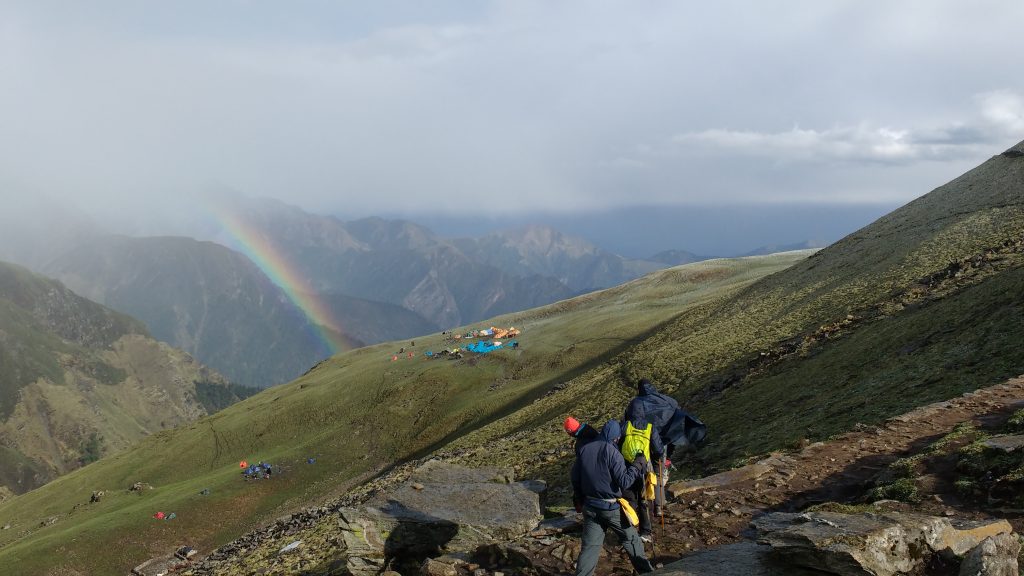
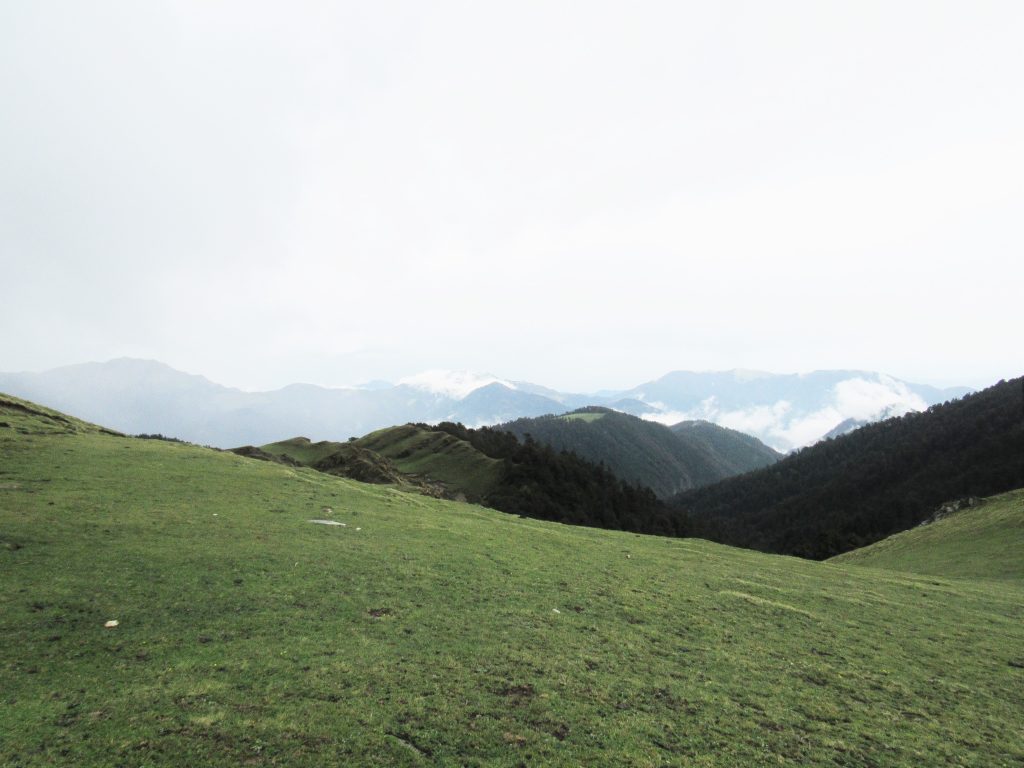
From where I was, I could not see a thing. My eyes were wide open but the mist surrounding me was all-pervasive. As I sat there for over an hour, in the bitter cold weather, I remember thinking, after four days of back-breaking climbing, I had finally found tranquillity. I was sitting on a rock overlooking a vast valley, circled by mighty snow-capped mountains. There was a waterfall somewhere close. I could hear the sound of falling water. I could hear the wind finding its way through the mountains. I could feel the soft snow flakes falling on my face.

Actually, this was not even the summit of the Roopkund Trek I was on. But such was the magnificence of the majestic mountains around us, that I was no longer focused on just the summit. The journey itself was throwing mind-blowing surprises, one after the other. They said the first day’s climb would be the hardest. Well, it was. But what was harder was to have dinner while a massive storm lashed at our camp-site. But the mountains, by their very nature, were fair and just.

While we bore through heavy rains in the evening, when I stepped out of the tent in the middle of the night, I was greeted by thickly forested mountain sides drenched in the pale pure glow of the moonlight. The forest itself had fallen silent. As if it was enjoying this gentle light that was bathing it. While I stood there spell-bound, forgetting all about why I’d stepped out in the first place, the stars started appearing in the thousands. Even with the bright moonlight lighting up the sky, there were a million more stars than I remember seeing, ever.

Roopkund Trek

The next day brought us a steep hour-long climb through thick moss-covered forests. Soon enough, we crossed the tree line and then the shrubbery. It was just about the time when clouds were forming overhead that we cleared our way into one of the most magnificent parts of the trek. The high winds and drizzling rain made an ideal setting to witness one of the largest high-altitude meadows in the whole of Asia.

Ali Bughyal, in all its splendour, lay right in front of us, rolling along on gentle slopes of mountains as far as the eye could see. Such was the magnificence of this piece of heaven that not a single one of us could describe it for a long time. We spent a long time in a small hut on one of the hillocks, partly because it was raining and partly because nobody wanted to leave. We walked around, listened to the howling wind, felt the rain drops lashing our faces, essentially submitting ourselves to this wonderful piece of nature. Alas! All things must come to an end and so did our time on these meadows. But fortunately, this was not the last of the breathtaking sights we were going to witness. We had just crossed 13,000ft!

Roopkund Trek

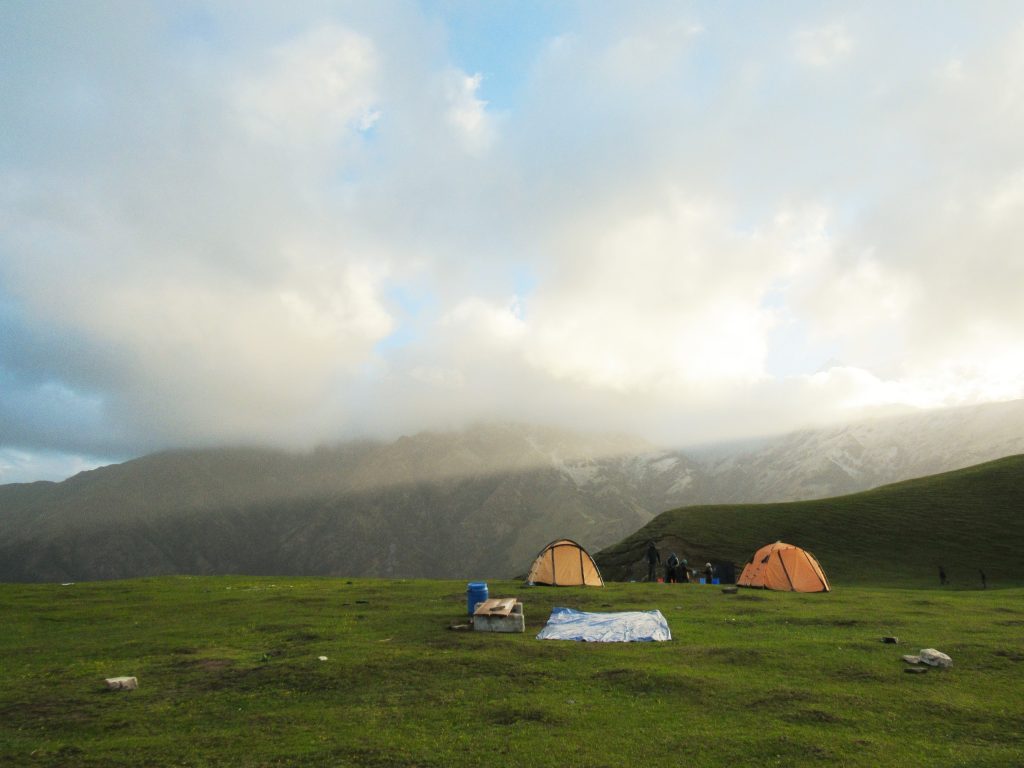
There was a storm that night, while we huddled into our tents at the Bedhni Bughyal Campsite. I am sure there were a few instances when our tent almost flew off. No one dared to step out. The next morning though, we were greeted with the entire mountain range draped in a thin veil of fresh snow. The colour scheme of the entire range had turned from Brown to White. The best part was, the day’s trail passed right through those hills. The next leg of our trek to Pather Nachouli started from there.

Pather Nachouli is essentially rocky terrain. Legend has it that God’s wrath turned a whole bunch of dancers at a King’s Court into stone in this area. It snowed again that evening. Only this time, it was gentle and beautiful and it happened while we were drinking Chai at a local shack. Imagine our joy! That night however, the storm returned with full fervour. This place was by far the windiest campsite on the trek, so far! It was getting more and more difficult to breathe. The air was thin. We were walking in micro-steps. Worst of all, it was freezing cold! No one dared touch water anymore! We were at 14,000ft!

Roopkund Trek

The next day’s trek gave us scenes right out of the Lord of the Rings trilogy. While the mighty white mountains were still our constant companions, the very ground we were walking on had turned rocky and wobbly! It could very well have been the Kingdom of Mordor! The destination was Bhagwabhasa – our final campsite before the summit. This was the coldest campsite yet and the entire place was rocky terrain. Even our tents were pitched on shaky rocks here. The plan was to sleep early and start the final leg of our trek to the Roopkund Summit the next morning, at 3 am. We had already been trained to trek the shoe spikes. Now we just lied down and waited.

As planned, we headed out for the summit around 3 am. It was pitch-dark and we were walking on thin ice and wobbly rocks under headlamps. Ice and snow were ever-present at this altitude. The most thrilling part of our trek had just started. I could possibly find a hundred adjectives to describe this part of the trek. But the video would still beat my description by a mile –

https://www.youtube.com/watch?v=e9l4XRFYWns&feature=youtu.be

Three hours we climbed, one micro-step at a time, on near vertical snow walls. Digging our spike in as deep as possible. And when we did finally arrive at the summit, it was the culmination of four days of arduous climbing among breathtakingly beautiful mountains! We were close to 16,000ft, and we were experiencing true tranquillity!

Here is the link to the map location of Roopkund Lake:

A Day to Thank 30 million Blood Stem Cell Donors Worldwide

0

Author – Aviini Ashikho

alt="bloodstemcelldonorsatDATRI"
Celebrating World Marrow Donor Day

In continuation of Organ Donors Day, today is World Marrow Donor Day, an event that was started in 2015. The occasion is celebrated on the third Saturday of September every year. This year, the day falls on 17th September and is celebrated in 52 different countries worldwide. The main objective in observing the day is to raise awareness among the general public and decision-makers about being blood stem cell donors, and the positive impact of blood stem cell transplantation on patients’ lives.

Says Manju Sharma, an emotional mother of two who met her donor for the first time, “When I got to know that none of my family members were a match, I was very apprehensive of getting a transplant from a stranger. But, I feel fortunate to have found a perfect match from a completely unknown person. I am thankful to this donor who decided to gift me a new life with his blood stem cells.”

“When I saw that my little effort could save one’s life, and I having been chosen for a special purpose, there was no looking back, I had to do it,” says the young beaming donor Akash Grover from New Delhi.

After a year, both of them met in Delhi for the first time after the successful transplant of blood stem cells. Manju was diagnosed with Acute Myeloid Leukemia (AML), and needed a blood stem cell transplant to cure her. Akash came forward and donated his precious blood stem cells when he was found to be a match for her. She considers Akash a godsend and couldn’t thank him enough for gifting her new life.

Truly, angels like Akash are God’s gift. How do patients suffering from fatal blood disorders like leukemia, lymphoma, myeloma, thalassemia etc., get a second chance to live? How can someone in need of a life-saving blood stem cell transplant find a compatible donor?

This is where adult unrelated blood stem cell registries like DATRI play an indispensable role. DATRI is India’s largest adult unrelated blood stem cell donors’ registry.  DATRI has more than 1,50,000 registered voluntary donors and has facilitated 197 blood stem cell donations including 19 donations for international patients. The organisation works with 11 collection centres and has serviced 39 Transplant Centres across the world. A not-for-profit organisation, it is registered with Bone Marrow Donors Worldwide and is a member of World Marrow Donors Association (WMDA).

Every year over 100k Indians are diagnosed with fatal blood disorders. These disorders are curable through a blood stem cell transplant. However, the chance of finding a match for these patients within the family is only 25%. The rest have to find an unrelated blood stem cell donor. The demand for adult blood stem cell donors is increasing. In 2016 alone, DATRI has had 700+ search requests from patients and only 60 donations have been facilitated this year.

The chance of finding matched blood stem cell donors is 1 in 10, 000 to 1 in million. Therefore, there is an urgent need to increase the number of donors which will in turn increase the chances of gifting new life to a patient affected with serious blood disorders.

It takes less than 5 minutes to become a potential blood stem cell donor. One has to attend an awareness session or understand the process of donation, fill up an application and a consent form, and give a cheek swab sample to determine the HLA (Human Leukocyte Antigen) type, which will be sent to the lab and stored in DATRI’s database. There is no donation required during registration. A potential donor will be called to donate only if and when found to be a match.

If found to be a match:

  • A small blood sample is collected to verify the HLA typing.
  • A master health check-up is then done to ensure that the donor is healthy to donate.
  • Once the medical examination is through, the donor has to be prepared to donate. The donor will be given GCSF (Granulocyte Colony Stimulating Factor) injection for five consecutive days to mobilize the blood stem cells from the marrow to the peripheral blood.
  • On the fifth day, the blood stem cells are collected through a process called Peripheral Blood Stem Cell Donation. The donation takes 3- 4 hours and is an outpatient process.
  • Another method to donate is the bone marrow harvest where the stem cells are collected from the hip bone.
  • DATRI will transport the blood stem cells to the patient anywhere in the country or the world.
  • By this act, the donor would have GIFTED a LIFE.

The Man behind the Mission
Mr. Raghu Rajagopal, the co-founder of DATRI, is passionate about cancer-cure and was geared to address the challenges faced by people of Indian origin who were suffering from fatal blood disorders. These patients needed a genetically matched donor who could donate blood stem cells. Along with Dr. Nezih Cereb and Dr. Soo Young Yang, Mr. Rajagopal set up DATRI to help every patient looking for a blood stem cell donor to find a healthy, willing and genetically matched donor. Moreover, Mr. Rajagopal has been very active in the entrepreneurial eco-system in the US and India and is mentoring several start-ups as an advisor.


Experience a Royal Honeymoon – Palace on Wheels

1

Author – Alina Jack

palace-on-wheels

After marriage, honeymoon is one of the events that you look forward to, eagerly. You plan meticulously- checking and then double-checking so that nothing goes wrong. It is important to you because it will be the first time you go on a holiday with your spouse and you want the experience to be flawless and without hiccups. Keeping this in mind, you book the best of hotels and flights and take the conventional route but what if we said that you could opt for an even better experience on a train journey? Don’t believe us? Well, let us prove it you. Here, we present to you an unconventional honeymoon idea that you can plan if you are all set to splurge on the trip of your lifetime- a honeymoon aboard Palace on Wheels.

palace-on-wheels-interiors

Rated as one of the top ten luxury trains of the world, Palace of Wheels is sure to offer a fine, pleasurable experience. Everything from its elegant interiors that are done to perfection, varied cuisines richly put together to give delight and the best-of-its-kind modern facilities boasts of the regal experience that the train will offer newly-wed couples.

One striking feature which distinguishes ‘Palace on Wheels Train’ from other luxury trains is an entire car dedicated to spa. It is the latest feature in an array of services offered by the train. It gives couples the opportunity to spend some romantic moments, immersed in the pleasing aroma of scented candles, therapeutic oils and spices, and soothing music.

palace-on-wheels-dining

The sitting lounge is another place to spend an evening with your better half. Here, you can have a relaxing conversation and get to know each other better, while wine is served, if you so prefer. Or you can give in to your playful side with indoor games like chess, playing cards, crosswords, Chinese checkers, etc. Apart from this, other essential services include medical aid, doctor on call, mineral water, newspapers, magazines, Wi-Fi facility. Everything is provided for your convenience so that you feel at home on-board. One additional benefit is that you can start a lovely day by sharing those beautiful morning moments with each other, in the privacy of your cabin, over breakfast.

palace-on-wheels-bar

Here is a snapshot of the destinations that might form a part of your Palace on Wheels itinerary. The tour starts from Delhi, the capital city of India, where you will receive a grand welcome on arrival. From here you board the train to head to a state known for its regal hospitality and which personifies royalty in almost every aspect- Rajasthan. First stop will be Jaipur, the capital city of Rajasthan, where you can do some sightseeing. Famous forts and palaces – Amber Fort, beautiful Hawa Mahal, admirable City Palace, etc, are all great places to go exploring with your sweetheart. The next stop is at Ranthambore where you will get a chance to go on an adventurous wild safari through the Ranthambore National Park and also on a trip to the Ranthambore Fort lying in the vicinity of the park.

palace-on-wheels-bedroom

Chittorgarh Fort is next on the list which is sure to mesmerize anyone with its magnificence. And of course, during a Rajasthan tour, how can one leave out Udaipur, especially if the tour symbolises luxury. So up next is the famous city of Udaipur, a true paradise for love birds and extremely popular among honeymooners. Exploration of the City Palace and the temples of Udaipur and a cruise over the beautiful Lake Pichola will be on the list of to-do things at Udaipur. You will be taken for a desert safari at Jaisalmer thereafter followed by a Jodhpur tour, complete with sightseeing at palatial the Mehrangarh Fort and the opulent Umaid Bhawan Palace. The last leg of the journey is a safari through the Bharatpur Bird Sanctuary which is famous world over for the diverse variety of avifauna species. The final stop is at Agra, which houses the epitome of romance – Taj Mahal.

So now you don’t need to wait to embark on a luxurious ride through the very best cities in India for your honeymoon tour. Go on and experience a ‘Palace on Wheels’ quite literally and celebrate the very first trip with your spouse, in style.

Festive Season Beckons: 5 Traditional Sarees You Can’t Say No To!

0

Autumn ushers in the festive season in the Indian subcontinent starting from Ganesh Chaturthi to Durga Puja, from Navaratri to Dussehra and Diwali. The deep-seated passion springs out in the form of larger than life celebrations. Amidst the cacophony of color, crowd and chaotic beauty the urban populace embraces its roots, a side that very seldom shows up in day-to-day life. As such sarees are quintessentially ethnic, be it the nine yard marathi specialty Lugade or the traditional red-white sarees exclusive to dashami.

This festive season indulge in some authentic hand made sarees, pamper yourself with the best of ethnic attire that goes easy on the wallet with with Tata Cliq Coupons. Enjoy the traditional you in the traditional garb! Spoiled by choices?
Worry not, we have compiled a list of traditional sarees just for this occasion.

1. Beginning the list with the country-wide famous, nay internationally famous Banarasi Sarees.

top-traditional-sarees-banarasi-saree-2
Image Courtesy – shophiranya

Banarasi Saree or Banaras Brocade as the name suggests, traces its origin to the holy city of India, Varanasi.

Known for the rich and exquisite gold & silver embroidery brocade or zari, this silk saree is not only worn on festivals but also a fan favorite when it comes to wedding dresses. Complete with floral motifs, intricate patterns and engravings, this saree is relatively heavy. But we bet you can pull it off with absolute grace!

2. Kanjeevaram Saree is second on the list.

top-traditional-sarees-kanjeevaram-saree
Image Courtesy – C/N N/G/Flickr

If Northern India has Banarasi silk, South has Kanchipuram silk or Kanjeevaram as it is popularly known as. Made out of mulberry silk this South Indian specialty traces its origins way back. So much so that it has been featured in prominent paintings especially works of Raja Ravi Varma and the likes. This is the go-to saree for any special occasion or regular temple visits. Kanjeevaram can surely give Banarasi silk a run for its money, but hey this isn’t a competition right? Why not enjoy both.

3. For the next choice on the list we travel to Eastern India. Taant or Tant saree from West Bengal.

top-traditional-sarees-taant-or-tant-saree-from-west-bengal
Image Courtesy – behance.net

Unlike it’s banarasi counterpart this saree is lighter to carry and hence is favorable for all occasions. Growing up in a bengali household you’re bound to have heard a lot about how taant sarees are the best. Quite rightly so, very few attire let alone sarees can boast of being comfortable, exquisite and versatile at the same time. Artisans from Murshidabad, Hoogly, Nadia in West Bengal and Dhaka, Tangail from Bangladesh pride themselves on the elegant designs. Although this saree can be worn on all occasions, it holds place of special importance during Durga Puja and is as essential to the ritual as Dhunuchi Naach or the maddening dhak beats!

4. Next on the list of must-have and must-wear traditional sarees we visit Western India, with the famous Bandhani Sarees.

top-traditional-sarees-bandhani-sarees
Image Courtesy – Piyush Kumar/Flickr

These sarees get their name from the process of tying knots at specific places before dyeing the fabric. After the dyeing process the knots are opened which yields the desired pattern. Depending upon the pattern in the final product, they are classified into categories like khombhi, Ghar Chola, Chandrakhani and Shikari, among numerous others. Predominantly famous among Rajasthani and Gujarati folks, the major bandhani making centers are situated in Gujarat, Rajasthan and Sindh region. Vibrant and bright colors such as red, yellow, green and blue make bandhani sarees the most sought after sarees during festivals especially Navaratri.

5. Sambalpuri Sarees are a testament to the hardworking weavers who put their heart and soul into the craft.

top-traditional-sarees-sambalpuri-sarees
Image Courtesy – wikimedia.org

The intricate weaves or ikkat as they are called, are basically knots that are tied into the fabric during the tie-dye process. As a result the dye is absorbed leaving behind the desired patterns post dyeing and untying of the knots. Famous throughout the entire country, these sarees are predominantly produced in Odisha mainly in Sambalpur (hence the name ‘Sambalpuri’), Balangir and Boudh. These sarees are a marvel to look at and the effort put in by the craftsmen deserve applaud beyond compare.

These are some of the most ethnic, stylish, comfortable yet elegant sarees that you should definitely think about investing in, this festive season. Other sarees that deserve a definite mention in the list are Kota Doria or Jali, Konrad Saree, Kerela Sari, Pashmina Silk, Mysore Crepes, Baluchari, Kantha Sari, Dhakkai Jamdani, Nauvari, Chiffon and Georgette.

Are you a DIY fanatic? If yes, then we’ve got some great news for you.
Why not design your own saree according to your patterns and motifs! Learn how to design a plain saree at home. Have a great time making sarees and don’t forget to flaunt your ethnic side this festive season.

Documenting Musical Traditions and Balancing Music Genres: IGNCA-SRC’s Deepti Navaratna

0

ignca-src-bengaluru
IGNCA SRC Bengaluru

India is a land of rich culture and vibrant traditions is an oft-repeated clichéd statement. However, there is hardly any effort to document our musical traditions and art history. Almost all documentation is being done by foreign scholars from universities abroad, who take great pains to come down to India and study our traditions.

Fortunately, Indira Gandhi National Centre for the Arts is one institution that is dedicated to the task of documenting our musical heritage both in classical music and folk music traditions. Particularly, the Southern Regional Centre of Indira Gandhi National Centre for the Arts (IGNCA-SRC) is focused on establishing an audio-visual archival centre to showcase vanishing folk cultures and classical music traditions. Last year, when Dr. Deepti Navaratna, a neuroscientist from Boston, US, was appointed as the Executive Director for IGNCA-SRC, it raised eyebrows in the social circles of Bengaluru. We met with Deepti Navaratna to get an understanding of her association with music and IGNCA-SRC’s work:

ignca-src-deepti-navaratna
Deepti Navaratna

Q: How did a neuro-scientist become connected to the world of music and become the head of an art institution like IGNCA-SRC?

A: I have always been an old Bangalore girl who grew up in an academically oriented family, which was culturally conscious as well. I grew up in Malleshwaram and Basavanagudi in an atmosphere filled with classical music. Later, I went abroad to study neurosciences and got a PhD in it and taught in Harvard. After a while, I got bored of neurosciences and left it to study masters in music. Earlier, when I was studying in Central College, Bengaluru, looking at my diverse interests my teachers used to say, “you can’t be both M S Subbulakshmi and Marie Curie, you need to focus on one thing”. Today years later, after studying the relation of music to the mind and brain, I am able to connect the dots between music and science. Great scientists like C V Raman, Raja Ramanna have also studied music and been great musicians as well. So why not?

Q: After working all your life in in America, was it difficult to fit into a government institution in India?

A: Yes, I spent all my adult life in America, working in premier scientific institutions. The work culture there was way different from India, so obviously it took time for me to fit into a bureaucratic government institution. But while cultures are different, ultimately human issues are the same – you need to learn to work within the system and be adamant about getting things done. Motivation and tenacity are the key elements for getting things done. Since I am capable of doing disconnected things at once, I am thoroughly enjoying the chaos here in India!

ignca-src-exhibition
Painting Exhibition at IGNCA SRC

Q: What is IGNCA trying to achieve in the field of music and is it giving on emphasis on classical music over folk music?

A: IGNCA’s mandate is to be a premier research institution that facilitates the study of human mind and art, and man-nature interaction. Under this broad coverage of research, the Southern Regional Centre focuses on the scientific study of civilisation and facilitate research studies and cross-cultural exchanges in the field of art and culture of India in general and the south India in particular. We also provide outsourced research grants to create scholarly manuscripts and create archives for classical music and folk music and tribal traditions.

No, we are not giving an emphasis on any one music genre; rather we have a well-balanced focus on both classical music and folk music research. For example, we have provided outsourced grants on various temple traditions of India such as the ‘Temple Murals of South India’, an ongoing study to create manuscripts. Similarly, we have a large microfilm repository for archiving and documenting music of vanishing folk cultures as well.

Q: What is IGNCA-SRC trying to archive and what exactly is this ethnographic archive?

A: IGNCA-SRC has established an audio-visual archival centre to showcase about 1,000 hours of recording of Carnatic music, which was collected from various personal collections and painstakingly catalogued and digitized. Apart from classical music, IGNCA has archived audio-visuals of folk music and tribal traditions such as Kamsale Padhagalu of Male Mahadeshwara, Siddhi folk music, Yellamana Padagalu and Chowdaki Padagalu of Karnataka, Burrakatha of Andhra Pradesh and Krishnanattam of Kerala. These archives have become part of national archives and are open to public to study music and use them in research.

In this endeavour, IGNCA-SRC working towards creating India’s first ethnographic archive of vanishing folk cultures, tribal traditions of various religious and ethnic minorities. Once completed, it will provide nearly 25,000 hours of audio-visual material pertaining to the five south Indian states. We have identified over 30 specific traditions, including the Karaga tradition of Thigala community and the tribal origins of Draupadi worship in south India.

ignca-src-music-archives
Music Archives – IGNCA SRC Bengaluru

Q: Since you are a musician yourself, what are your personal activities in this regard?

A: I have studied Carnatic music all my life so practising music is second nature. Particularly, being a global Indian, I am a big fan of M S Subbulakshmi, the greatest exponent of Carnatic classical music. Carnatic music is a vocabulary but a musician need not be restricted to one vocabulary. MSS was a cultural explorer who tried a variety of music genres. So as tribute to her 100th birth anniversary, I am conducting a concert at the Bharatiya Vidya Bhavan by beginning with a Gujarati bhajan. This event is part of our M S Subbulakshmi centenary in 2016-17, which is called “100 years, 100 days, 100 hours”. In association with Sangeeth Nritya Academy, we are touring across 12 districts of Karnataka to present the music of M S Subbulakshmi to wider audience.

To be continued…

Factfile –
Image sources & courtesy –
http://ignca.nic.in/src.htm

Innovative Ways To Decorate Your Home In 2020

0
01-Innovative-Ways-To-Decorate-Your-Home-In-2020
Photo by Patrick Perkins on Unsplash

When you think about your house, whether it is the one you currently live in or one that you hope to one day have, you probably have a specific image in your head about what you want it to look like. Maybe you want an amazing pool or water feature. Maybe you want the best barn doors to garnish the entrance of each room, or could it be that you love a warmer, more rustic look and dream of having a one of a kind fire pit in your living room. 

This year, there are a few amazing ideas to put in your home that will make it more amazing than ever. Below are just a few design tips to take your home into 2020 more stylish than ever.

1. Bookshelf with built-in seating options

Book Shelf - Innovative-Ways-To-Decorate-Your-Home-In-2020
Photo by Siniz Kim on Unsplash

2019 has come out with some amazing new bookshelves that can transform any space into something that is warm and modern at the same time. If you are someone who loves to read but you do not have a designated space to sit and read a book, then this is something for you. These bookshelves have plenty of shelving for all of your books. At the bottom, it has seats that come out of the shelf and can be sat on. If you live in a modern space or one that doesn’t have much room, this is the shelf for you.

2. Bringing nature into the home

01-Innovative-Ways-To-Decorate-Your-Home-In-2020
Image by Pixabay from Pixabay

Bringing the earth and elements of nature into the home is a big decor style that is coming out even stronger in 2020. Using these elements in every room of the house is what is really taking to the center of decor. One way to bring nature into your home is by using a textured wool rug that looks like a landscape, using furniture that is all wood whether it is built to look modern and chic or rustic, and using greenery, succulents, and flowers whether they are artificial or real around the entire house.

3. Marble accents tastefully around the house

Marble Pots-Innovative-Ways-To-Decorate-Your-Home-In-2020
Photo by Tran Mau Tri Tam on Unsplash

More and more things that we use every day like phone cases, nail art, even cakes are being decorated by using a marble pattern. That pattern is making a statement in home decor as well! Use small marble accents like accent pillows on the couch, marble flower pots, etc., around the house and add a sophisticated look to any room!

4. Add in a peppy clock

Peppy Clocks-Innovative-Ways-To-Decorate-Your-Home-In-2020
Photo by MINDY JACOBS on Unsplash

Everyone needs a clock somewhere in their home to help keep them running on schedule, and what better way to do so than to use a clock with a fun background and fluorescent hands! Fun clocks like this can hang on the wall or sit on a counter, anywhere you can see it, and is as functional as it is cute giving your space a great focal point.

5. Salt lamps

Salt Lamps-Innovative-Ways-To-Decorate-Your-Home-In-2020
Image by holzand0 from Pixabay

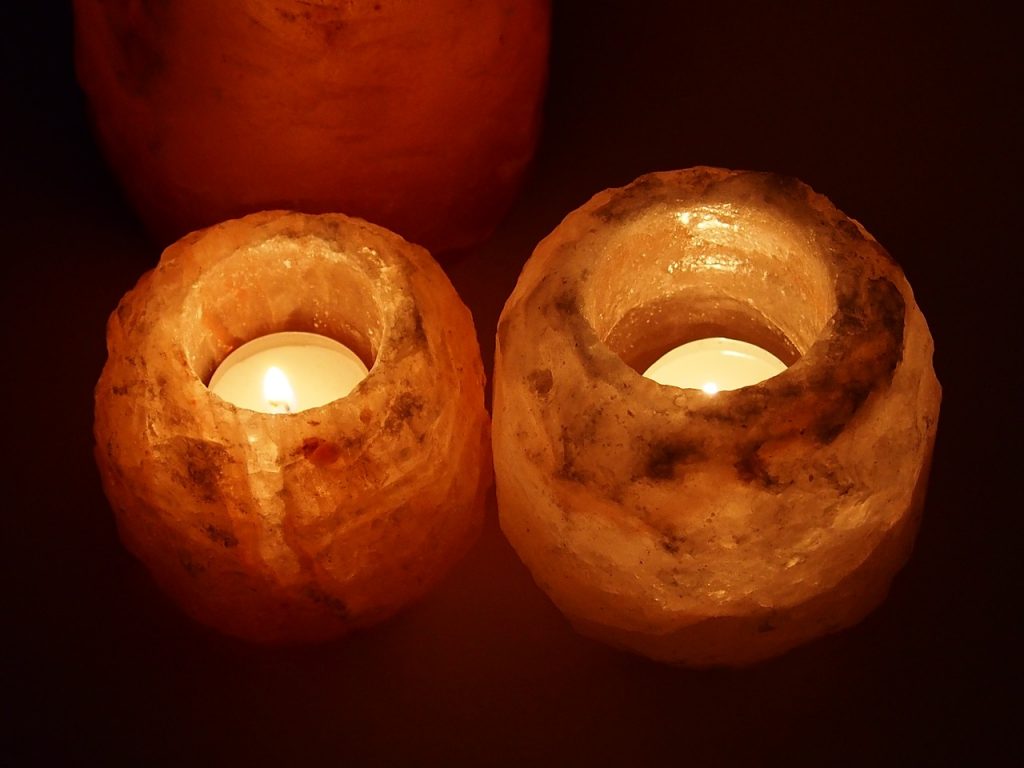
More and more people are finding out the secret of the Himalayan salt lamps. They started being used a couple of years ago, but more people than ever will be using it in the upcoming year. Not only are these lamps great to add in a warm glow to a room, but the Himalayan salt that it is made of is thought to help purify the air and help make you feel happier and healthier overall. These little lamps may or may not really purify the air, but they make any room cute and don’t break the bank doing so!

6. Have a perfect place to sit down

Kitchen Stools-Innovative-Ways-To-Decorate-Your-Home-In-2020
Photo by Christian Mackie on Unsplash

If you have an island in your kitchen, then chances are that you use it more often than not. It’s a great place for the kids to sit and do homework, for you to work while dinner is cooking, and let’s be honest, an island is a perfect place to eat meals. Don’t let it be just any drab island; pep it up by adding in some colorful bar stools. Industrial style bar stools are becoming all the rage! They provide a great place to sit while being small enough to push in and put out of the way and can even be stacked up and put away when you aren’t using them.

Decorating your home when we ring in 2020 is going to be more fun and colorful than ever, and it doesn’t have to break the bank. Follow these tips and have a home that is a beautiful oasis that you love to show off.