The Cost of Death – Hindu Funeral Rites

1

Author – Manu Mukundan

Hindu_Cremation_in_India

‘Death’ is a dreadful word for Indians despite our scriptures enlightening us that it is just a ritual of our body passing through from life to another. Be it Munshi Premchand’s famous novel ‘Godaan’ or Bollywood movies, a death and the cost associated with it, is shown in a grim and often pitiful way. From helpless heroines with no one to help them with the funerals of their loved ones, to families that are plunged into debt, Bollywood has most often used this grim side of death.

Even though, most of it is true, I would like to explore the costs associated with death, and a world that thrives on after death rituals in the Hindu community, to which I belong. The poor along with the rich tend to be rather lavish when it comes to matters associated with death. This can be attributed to our staunch belief in afterlife and to the need for honoring the dead, both of which are basic elements of Indian society. After all, no one wants to hinder the soul of a departed from achieving ‘Moksha’ ¬– eternal peace.

Hindus are a class of people who have delved deeper into death’s spiritual nature. Each caste in the Hindu community has a vast array of rituals associated with death. Since, Hindus believe in the afterlife and reincarnation of the spirit, their Hindu funeral rites have a deep spiritual meaning. One of the major pre-death rituals is the ‘Godaan’, in which a person lying in his death bed donates a cow or its monetary value to a Brahmin. The fear of afterlife compel even a poor farmer to conform to this Brahmanic tradition. Renowned social reformer Jyotirao Phule criticized these rituals that they are a ploy by the social elite to give prominence to Brahmins and ensure their religious superiority.

In early days, Hindus used to burn the corpse of the deceased in a funeral pyre in the vicinity of their home. As the urban society grew, increasing objections from neighbours and lack of proper infrastructure, made Hindus to rely heavily on private crematoriums. Such crematoriums are typically located next to a river or a lake so that later the ashes can be immersed in the water body.

Hindu funeral rites-Benares

In Kerala, the banks of the river Bharatapuzha has evolved into a hotspot of such centres, private cremation centres that cater to the needs of the ever busy Keralite. These cremation centres offer all services related to a Hindu funeral, charge anywhere from Rs.1,000-10,000, and have the capability to cremate 10-15 corpses at the same time. Even though electric cremation centres run by local governing bodies offer the same service at prices like Rs.500, religious superstition and prejudice, have inhibited their widespread use. Hindus believe that the spirit is liberated only when the skull is broken, and since this is not done in the electric cremation centres Hindus are reluctant to use them.

Thus traditional crematoriums have become a highly profitable business with very low investment.
‘Dakshina’, is a word which one will hear a lot as he goes through after death rituals, and is money that a relative pays as gratitude for a service, mostly out of fear than gratitude. Most funeral directors receive Dakshinas that average between Rs.500-1000. The bones and ash collecting ceremony three days after cremation also requires another round of Dakshina. There have been instances where funeral directors have refused to release the mortal remains without prior payment of Dakshina. They claim that the deceased’s soul will not be liberated if they are not satisfied.

Hindu funeral rites-Vavu_Bali

The next step where Dakshina pays a crucial role is Pindadaanam. Some famous centres where Keralites throng for Pindadaanam are Thirunelli, Thirunavaaya and Panchavadi. The fee charged by these temples for Pindadaanam is quite low, but here too Dakshina plays an important role. The road leading to the famous Tirunavaya temple is lined with posh, two storey homes of Ilayads and Brahmins, who supervise the Pindadaanam. This priesthood receives a modest payment from the temple authorities besides the Dakshina. Most people claim that their prosperity is a direct result of the Dakshina they receive. Due to fear of divine repercussions, Dakshina-a purely voluntary payment has now become compulsory. It is this fear of Divine repercussion that compels an already indebted family to borrow more and pay off the Brahmins, even at the peril of endangering their own financial future.

While this religious custom has become big business, we cannot solely blame the malignant section of our religious elite for exploiting the common man. For them, the common man’s financial and emotional conditions do not matter as long as they receive their cut of divine payment. It is our ignorance and blind beliefs that lead to such exploitation. This is a country where the government’s primary space agency takes replicas of spacecraft for blessings and to seek divine intervention. This blatant display of superstition at India’s premier temple of science is an example of how deep religious superstitions are entrenched in our society. Unless we get rid of this parasite that has attached itself to our society, it can never attain a wholesome evolution.

Factfile –
http://www.livemint.com
http://timesofindia.indiatimes.com
http://www.firstpost.com
http://timesofindia.indiatimes.com

Image sources & courtesy –
Pradeep Parangath
Wikimedia Commons

Indian Cricket Fans and the World Cup Down Under

0

Author – Hemal Mehta

Melbourne-Cricket-Ground

As an Indian living in Melbourne – Australia, I have witnessed too many sporting events in the last one-year. After all, Melbourne is called the sporting capital of the world and every month there will be one sporting event that takes over the city. Unfortunately, as an Indian, the only local sporting events in which I can cheer the Indian Team are perhaps ICC Cricket World Cup 2015 and Australian Open to a certain extent.

Thus, the very thought of watching the Indian cricket team play World Cup here, was super exciting for all the Indians. Perhaps, the Indian Australians were even more excited than the local Australians. Cricket is a religion in India, but in Australia it is just another sport. In a country where they have invented a local sport – ‘Footy’ (with its own league matches) and where they have teams acing almost all sports, cricket is just another sport. As a matter of fact, even though Australia is the host nation for the World Cup, the local free to air TV channels do not broadcast all the matches. Only matches that have the Australian team playing are shown on free to air TV! That’s Australia for you!

Indians at the stadiums: Act 1

Indian Cricket Fans in Melbourne

India’s first match was against Pakistan at the Adelaide Oval. Adelaide is a much smaller city compared to other state capitals in Australia and is not even a big tourist destination. However, that really didn’t stop Indian and Pakistani cricket fans from taking an eight-hour road trip to Adelaide from Melbourne. It was a sold out match and the Indian cricket fans were just gearing up!

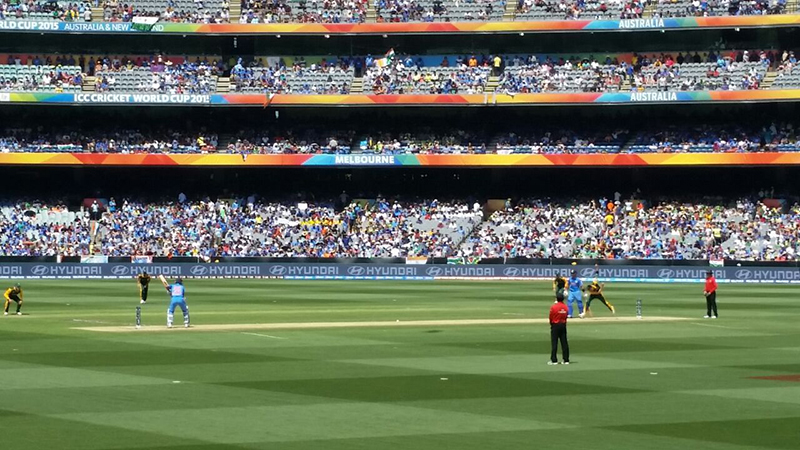
Indian Cricket FansThe next match was against South Africa at the legendary Melbourne Cricket Ground (MCG). I call it legendary because it is the biggest cricket stadium in the world, and the largest stadium in the southern hemisphere. It is an intimidating stadium, especially if you are not playing in front of your home crowd. Luckily for the Indian Cricket Team, there are many Indians in Australia. No matter which stadium they play at, they can be assured that fans will buy the tickets to watch them. This has not been the case for many other teams. As you may have noticed, most stadiums were rather deserted.

Coming back to the MCG, in a stadium that huge, you would expect a sea of fans supporting both teams. However, MCG was literally coloured in Blue. In a near-record crowd of 86,876, there were barely a few hundred South African supporters. It felt like watching a match at Wankhede Stadium. There was cheering in Hindi, people playing ‘dhols’, thousands of Indian flags, fans in ‘desi’ attires, Indian food trucks etc. The experience was thrilling. It was a Sunday and it was like a picnic for many Indian families. The crowd was loud, but well behaved. The energy in the stadium was unbeaten and it was an experience of a lifetime!

Indians at the stadiums: Act 2

Indian Cricket Fans in Australia

The next game India played at the MCG, was the quarterfinals against Bangladesh. Whether it was the excitement of making it to this level or the winning streak India had, the Indian supporters definitely seemed to be on some sort of high. One of my Bangladeshi friends watched the match in the stadium and was disgusted by the whole experience. Mind it, it was not because her team had just lost. It was because of the way Indians made her feel during the match. She concluded that Indians had no common sense, respect or decency towards anybody around them. They curse in public and can even go to the extent of being rude to others while cheering the Indian Team. She was not the only one who complained that night.

Another Indian friend of mine shared his weird experience as well. A group of Indians in front of him constantly booed the Bangladeshi supporters and bullied them by literally showing them the ‘middle finger’. Fortunately, MCG has a strict policy against harassment and bullying. After a quick complaint from the Bangladeshi fans, the Indians were cuffed and escorted out of the stadium. My friend recalls it as being embarrassing and shameful.

I even read comments online from cricket fans that insist tickets should be rationalised country wise. They feel Indian supporters overpower every venue and it is just not fair for the other teams. It seems Indian cricket fans have rubbed other cricket fans on the wrong side.

Australian Indians – the world outside cricket

Indian Cricket Fans at World-Cup

If I had to be completely honest, I confess that I feel shameful for the way Australian Indians behave during cricket matches. There have been reports of arrests not just at the stadiums but also at sports bars wherein Indians get into fights and break furniture while watching the matches. It may seem stupid or irrelevant or normal for Indians to get excited during cricket matches, but that’s not how the world rolls here. Australia is a highly multicultural society and the smallest of actions can seem racist. Every individual is skeptical about people from other races, and incidents like these just strengthen their negative bias towards Indians. It really does not matter how well the Indian Cricket Team plays, if a handful of Indian supporters play fowl – Indians across the globe lose anyway!

Image sources & courtesy – Hemal Mehta

A Bane called Caste System

2

Author – Reeti Srivastava

Caste-System

Ours is a country that has long prided itself in its multiculturalism. But, there still exists an invisible line called caste that mentally segregates us Indians from one another and has become one of the biggest flaws that cannot be rectified easily.

The word ‘Caste’ doesn’t have an exact definition. It just came into existence for easy identification of people but ended up as an apartheid. It is said that the caste system in the early Vedic period was flexible; meaning a Brahmin’s son could become a Shudra upon his will and vice versa. Caste back then was determined based on the occupation of a person, not by his birth. But with time, the upper caste established their hegemony over other castes and subjugate them for their vested interests. Thus born is the caste system as we know of it today.

Quoting Lord Krishna’s words to Arjun in ‘Bhagvad Gita’, “I have created this fourfold order (4 Varnas or castes namely – Brahmins, Kshatriyas, Vaishyas and Shudras) based on the aptitude/quality of an individual and their action”. It is clear that the roots of the caste have a different meaning while the people today have wrong notions about caste in society.

Even when our ancient texts emphasized that our comprehension of the caste system is highly misplaced, they are gone highly unnoticed. People started holding on to the roots of the caste system brought out by ruthless upper-class, rather than the one prescribed in the holy texts. According to them, a government employee’s heir is entitled to such job and a politician’s kid, a politician. Absurd be that as it may, that’s what is followed till date. For it’s in the interest of the wellbeing of elite and a great affliction to the rest.

This gives a rise to a number of questions that needs to be answered for the good of our society. Despite so much data available in our ancient texts, why is it so difficult for civilized and educated people like us to understand the futility of the caste system? Why is a deplorable thing like untouchability still prevalent in a country that aspires to join the elite club of nations in a few years from now? Why the questions of purity and insanity of a person are connected to a string called caste?

Why are certain sections of people barred from entering religious places? Why is a thing as simple as an inter-caste marriage still considered a taboo? Why do honour killings still take place and couples are disowned for marrying outside their caste? Is the fear of tarnishing image in society greater than humanity?

Many people including philosophers and thinkers tried to come out with plausible questions for these questions. But no one could ever reason it well enough. It’s a pity how the humanity has sunk so low that it gives a greater merit to a figment of someone’s imagination but discredits rationality.
Does the caste of a person simply makes someone less intelligent or less capable to work? The answer is an emphatic no!

Caste differentiation has been ingrained in most of the people right from their childhood. They learn to look down upon people from the castes lower in the social hierarchy. Calling names, stereotyping people according to their castes, mocking individual’s personal habits in the name of caste, etc. Is still very much prevalent in our society. And lest we dare forget, our politicians have ensured to repeatedly remind us by emphasizing the castes to garner votes. And naive as most of us are, we get swayed by that and vote for a candidate not based on their credentials but their caste. We bite the bait laid down by the politicians and what happens is not the elimination of this evil system, but deep rooted hatred and alienation of one group from another.

The recent elections are no exception to it. However, what should have ideally happened is that caste should have been put to a back burner with each passing election, instead the reverse seems to be happening. Caste based bonhomie appears to be more rigid and pronounced than ever.
It is upon us to take the initiative of cleansing society that is ridden with caste differentiation. There is a famous saying that goes, ‘Charity begins from home’. So, we’ve got to cleanse our minds first, and then help others. Change has to start from one person and then can be transmitted to others.

We dream of building roads in space and strive to touch the moon and the planets. We talk of development and modernization. We discuss about eliminating poverty and raising the standard of living, but we forget that until our society by and large continues to differentiate and subjugate people along the lines of castes, all our advancements in other spheres would be but a hollow victory.

Factfile –

Image Courtesy –
http://dalitnation.com/links/

Contemporary Indian Art – Finding Gems in Paintings

1

Author – Neha Gupta

Paintings are inseparable from Indian culture and heritage. Researched art work has become the strong Indian identity since artists represent India at the global platform. This is the reason why India is considered as a major cultural hub in the world. Indian painters have tried their hand on a wide spectrum of art genres. Evidently, their creativity is hugely praised by art collectors or the so called ‘art connoisseurs’. Indian painters are really creative and they can portray different situations while blending their imaginations.

Online art gallery is the latest trend and the right place to explore different genres of fine arts. There are many online art galleries which offer beautiful painting collections of famous Indian painters that are enriched with different appealing concepts and vivid imaginations that these make the paintings really desirable for art collectors. Further many art exhibitions and festivals are organised regularly to bring together the best painters and art buyers.

Art lovers who are fond of different genres of art must know that a good painting is the end result of various unique concepts. So, an artist’s concept is considered the main theme behind an awarded painting of unique creativity. If you are thinking how to make your painting more appealing, then you must concentrate on your ideas before you begin the hard work. Brainstorm is required to present the best creative work in terms of look, colour combination and scenic beauty.

Here is a list of popular and prominent genres in contemporary Indian art:

Contemporary Art

Prakash Bhende-Achievement

Contemporary art is also considered as post-modern art. Both the terms ‘modern’ and ‘contemporary’ denote the same meaning, but contemporary art portrays a periodic concept to the painting. Art collectors across the world take interest in contemporary art. This art form is relevant because it portrays the present day’s scenario and the current situation. This particular artgenre deals with innovative concepts and these paintings are best for decorating dining halls and drawing rooms.

Figurative Paintings

Prithvi Soni-Shringar Radha

A painting that portrays a human body is known as ‘figurative art’. There is a misconception that a figurative art is all about showcasing a woman’s body and sensual curves. Although it is partially true, these days artists have begun concentrating on male figures and exploring human bodies of different regions. These paintings have unique concepts and these are connected to different situations to form a story.

Landscape Paintings

Contemporary-Indian-Art
Source V-IMAgine-L

Artists often try to explore nature that has blessed us with beautiful locations and landscapes. They take initiative to draw these locations on canvas. They profoundly take the opportunity to draw different locations with utmost accuracy in blending the scenery with their vivid imaginations. Painters typically focus on hill stations, sea beaches, river banks, wild life, desserts and snow-clad mountains. With the strokes of their paint brush, they deliver the best possible creativity on canvas.

Sketches

Contemporary-Indian-Art-Sketch
Source – doodlesntangles.blogspot.in

There are art collectors who love to purchase art in black and white. They love the grey connection among several things. Pencil sketches are mainly utilised for creating portraits, while Charcoal is used for drawing different scenarios. Charcoal drawing is a well-recognised medium that shows wider variations in gray gradients and lighting techniques. Many people wonder how these images are made to look so cool with just a piece of charcoal!

Still Life Paintings

Contemporary-Indian-Art-Still-Life
Amit-kapoor – Source

We live around both living and non-living things. In still life paintings, non-living things become the subject matter. Artists use fruits, flower vases, cups and saucers and other various non-living things. Water colours are used for this type of painting and painters try to use various colour shades to create these paintings. Such still life paintings mainly attract art lovers who want to display them in their restaurants and dining rooms.

Abstract Art

Untitled by Bahuleyan CB (Image Courtesy: CIMA Gallery Pvt.Ltd)

There is a thin line in between a modern art or an abstract art painting. Modern Indian paintings generally deal with everyday events and current situations. On the other hand, an abstract painting deals with very sensitive topics with deeper meaning that need better treatment. Both these genres are highly appreciated by the Indian art collectors.

In the early days, Indian art was mainly sought by older customers who were mature enough to understand their deeper concepts. Today, Indian art is finding a new crop of buyers — younger, more involved and well-heeled. To cater to this yuppie art buyers, there is a growing trend of online art galleries that present different genres of paintings which are been offered at affordable prices. The different types of paintings shed the monotony of life and bring the positivity at its best.
Factfile –
http://www.indianartideas.in/modern-art

Aamir Khan – Socially Sensitive Star

1

Author – Amit Singh Negi

I knew him for a long time. He was a cool guy, always joking around and social with people. Then one evening, he told me something I could never forget. This fun-loving carefree guy, whom I knew since my childhood, told that he was sexually abused as a child by his neighbour. He confessed of never telling this to anyone before, not even his family. Horribly shocked, I asked him what prompted him to unravel this secret all of a sudden. He said the show “Satyamev Jayate”.

Satyamev Jayate

My friend felt so connected, so moved by the victims in the TV talk show that finally 11 year later, the painful unrest inside him could finally find a way out. He swore that no matter what he won’t let his children go through the same phase.

Whenever we discuss any social issue on any public platform, we mostly conclude with a simple suggestion of spreading awareness. There is no other show that does it to the fullest extent as Satyamev Jayate does. And this awareness is of different kind; it’s the awakening of our conscience rather than education.

In India, we live a life of double standards; we talk about principles but do accept or give dowry in the name of gifts. We know accepting or giving dowry is wrong, but we have accepted this vice. Satyamev Jayate shakes our conscience as we watch the tragic tales of victims and the potential monsters we can become.

We can easily conclude the nationwide success of Satyamev Jayate can be attributed to Bollywood star, Aamir Khan. He’s an actor who not only pays attention to his core work, but also understands his role in the society and uses his star power for the betterment of the society. Apart from making movies on social issues, he ventured into small screen with his talk show, Satyamev Jayate.

Satyamev Jayate-Aamir Khan

This show doesn’t stop at awareness but it also talks about the much required practical solutions, some of which are initiated by the host himself. Typically, we struggle to search online on YouTube to find rare documentaries to educate ourselves about a particular issue, but Satyamev Jayate did it in a touching way. The research work done by the Satyamev Jayate team before airing every episode is appreciable. Most of us know about child abuse. But when you are told that 53% of the total children are sexually abused, it creates great impact and makes you more vigilant. This is what Satyamev Jayate does; it leaves a lasting impact about social issues.

Similarly, Aamir Khan made an effort to discuss about various aspects of homosexuality in a deep and mature way. Homosexuality is a sensitive issue in India and it is important for Indians to understand that homosexuality isn’t a new entity at their home. It’s not a disease that can be cured. It’s a choice of living by some, which others need to understand and respect.

Further, the presentation of the show is truly touching and lasting. Especially the use of soulful music in the end gives you goose bumps. Satyamev Jayate has certainly helped in bringing about a positive change in the Indian society. It brought the Rajasthan government to setup fast track courts for cases that deserved urgent attention. Similarly, the Maharashtra government is seeking the show’s help to make rain water harvesting in all regions of the State. The show has helped people became aware to use the child helpline and drink line. Moreover, a sum of Rs.22.3 crore was received by the NGOs featured in the first season itself.

India is a young country, with more than 60% of its population below the age of 35. This is the same generation that has seen the transformation of Indian Television serials right from Shaktimaan to Bigg Boss. In the midst of all the melodrama of the daily soaps and the publicity stunts of reality shows, a great initiative like Satyamev Jayate comes as a fresh breath of air in our stale society.

Today, people are openly talking about social issues and are trying to understand them; which indeed is a great achievement for Indian society. I would like to thank Aamir Khan for bringing up such sensitive issues and handling them in such a mature way. Today, on his 5oth birthday, we salute Aamir Khan for opening our eyes to the harsh reality in our lives!
Image sources –

www.satyamevjayate.in

www.childlineindia.org.in

Keeping Hope Alive Always – Poem

0

Author – Sindhura Saradhi

Keeping Hope Alive

Many a time did I ask you to keep shedding the past?
All that did happen cannot be erased for sure.
Not back again the time goes, to hear the voice that says,
Wrong you had totally been, right is what you haven’t seen,
An uphill battle that had fallen apart,
should now begin right from the start.
To the way it changed, the difference lies,
For, sans relations, you are now lonely lass.
The road doesn’t look so smooth,
Not the same way, your pals do soothe,
But still the gates aren’t closed,
Of time, there’s no way to choose the end.
Every new dawn gives you hope, that there’s no limit to your scope.
It’s not just courage that drives behind; but the faith that burns inside.
Since victory is just a fine nothing, when it is not from within.

– from the poetry collection, “The Calling”

Image courtesy: pixabay.com

Virginity is a Woman Thing!

1

Authors Anuka Roy & Kavya D

virginity-of-bride

Somewhere during the higher secondary years, we might have come across the word ‘Virginity’ for the very first time. It was a back when the word sex meant sly smiles, generated giggles and many shy red faces in the class. We had just entered a new phase in our lives when the discussion of these things was a very hushed and secret affair.  Our sources of knowledge on these taboo topics were the dictionary, the internet and that one friend who knew, or at least pretended to know everything regarding such topics.

Even though there are mixed reactions to the term virginity now. Some people think it is a respectable thing to remain a virgin before marriage while others think it is ‘cool’ to lose your virginity and experience it.

Former are the people who think virginity is a very ‘woman’ thing. These stereotypes are created due to the influence of our movies and the so called ‘culture’ of our society. Men still get away for not being a virgin but if a woman is not a virgin it becomes a topic of discussion among peer groups.

Even today we find many educated and accomplished women that are rejected for matrimony just based on their hymen-status. There’s always a chance that the woman could have been in love and was hoping to get married, but when things didn’t turn out as planned, she walked out of the relationship. The woman invests emotionally and physically in a relation. But the matrimony doesn’t favor her status of being a non-virgin, although it is perfectly alright for the guy to get married with no questions asked about his virginity. Imagine the heights of chutzpah the society exhibits!

It’s sickening how our society associates virginity to purity and chastity and see no chance of a happy marriage for the woman. However, some try to justify that a woman’s respect is her virginity; once she loses it she loses everything. In Mahabharata, it is said that Draupadi had the boon to be a virgin every year by walking through fire to regain her purity. So, being a virgin woman is being a pure woman, this is still believed by many.

While there are many who argue that virginity is a sublime thing and losing it before marriage is nothing less than a sin, another enormous group exists, mostly consisting of youngsters who believe that if you haven’t lost your virginity by a certain age then you are ‘uncool’. Many youngsters experiment with sex without even knowing what actually they are doing. This can be blamed to the poor sex education in our country which leads to many unwanted teenage pregnancy every year. Being misinformed about sex sometimes leads them to use certain medicines whose results can be fatal.

While the debate still goes on, it really only comes down to one matter; Virginity is something very personal. Whether to lose it or not, discuss about it or not is an individual’s decision. This idea of ‘virginity’ being a woman thing and making it a topic of discussion is not necessary at all. Even now we can see a few frowned faces if a woman mentions she is not a virgin. Virginity, losing it or keeping, is an individual choice just like any other individual decision. Hymen or No-Hymen, it’s a woman’s decision to own her body the way she wants. It is not a parameter to judge someone, especially women. Losing virginity is neither a crime nor a round table discussion issue, it is a personal decision which should be respected by others like any other decision.

Image – Via oyepg.tumblr.com

Does India need Feminism?

2

Does India need Feminism

“You’re a girl, you have to learn to keep your voice low”, said my grandmother, when I spoke at home and tried to reason out that just because I am a girl, I don’t have a separate set of regulations to live my life. And then came the line from my grandmother, which I am sure every girl who has entered adolescence would have heard; that we have to leave behind our own house and enter another house after marriage and such behaviour would not be accepted there. I just sat there wondering, does being a girl make me any less than a man? I always thought that male and female were two equal creations of God. But, probably that’s not how people in India understood the difference in the sexes.

This in a small way sums up the mindset with which girls are brought up in India. They are subjugated to men and made to feel that it’s the right way to behave. The stress on a different set of rules is so strong that to break off from it and fight against it is a tough matter. The social hierarchy prevalent in India in terms of caste, gender, age, roles etc., has had a strong hold over society and women in India for centuries. The most striking feature of feminism in India is that it was initiated by men and women joined the fray only in end of the 20th century.

Feminism in Indian context

Sarojini-sahoo
Sarojini Sahoo

Feminism is closely associated with terms like identity, woman empowerment, equality etc. And if we look at the way Indian society is structured, we would realize that women in general did not question their situation because they never realized there was something amiss. In that sense, western feminism was concerned mainly with the needs of women in the West; it was essentially about winning the same rights for women as they existed for men, and then activating the means for those rights to be utilized.

Rita Banerji, an author, photographer and gender activist differentiates the interpretation of feminism in India and the West, with two unique factors – one, that it rejects the notion of deep rooted, tradition encouraged gender hierarchy, defined and exploited by men in the Indian society. And two, it does not ascribe the appalling state of women in India who continue to silently tolerate the patriarchal oppression, and hence sees no reason to rebel against it. While these factors might seem oddly perplexing to western feminists, there is within Indian feminism a rationalization of these outlooks.

Another proclaimed feminist writer, Sarojini Sahoo, pointed out in one of her interviews that in the ancient Vedic period India had equal rights for men and women. But, the later Vedic period created the discrimination and polarized both the sexes. Males dominated the females and treated them similar to how lower castes were treated.

Does India need Feminism?


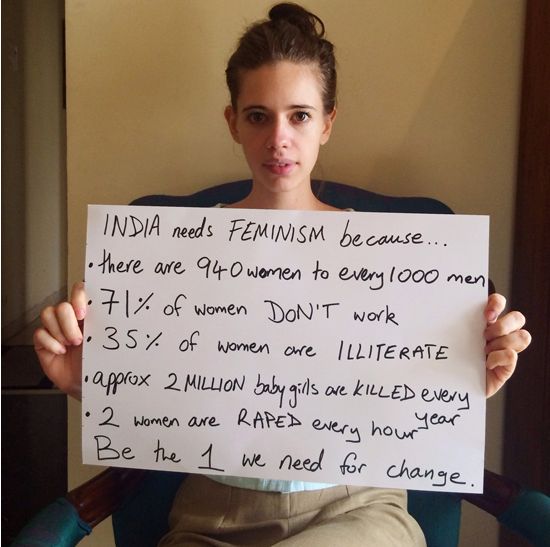
India needs feminism campaign by Kalki Koechlin

Having understood feminism in the Indian context, we may wonder why at all, India needs Feminism? The answer to this is clear. When there exists extreme oppression and male dominance in almost every industry, and women in the country have their self-respect and dignity at stake, both mentally and physically, then feminism, which demands for an equal status of both the sexes, is the only solution.

I would like to quote an example from the Indian media itself, when Bollywood stars like Salman Khan or Akshay Kumar demand for higher remuneration for their roles in a film or an appearance in any public event, it is covered showing their star power, whereas when actresses like Priyanka Chopra or Kangana Ranaut demand fees on par with their male counterparts, it is covered showing the rebellious attitudes, and not as a fight for equal status.

“It’s simply risky to be a woman at all”, argues Kavita Krishnan, Secretary of the All India Progressive Women’s Association, in the wake of the recent Uber rape case. She adds, “Blaming the survivor of an act of violence has become another brick in the wall of ‘protective’ boundaries that imprison women rather than open up safe spaces”, after seeing messages that blamed the victim to be responsible for being raped. Not just the Uber rape, but many other rape cases in the recent past has made all the big wigs, god men of the society to spill out few illogical views.

Even today, unwed mothers, separated, single or unfaithful women are considered outcasts. Living out of wedlock with a partner is still virtually unheard of. An unmarried daughter is seen as a spinster even in her late twenties who brings shame upon her parents, and is a burden. But once married, she is considered the property of her in-laws, spoke Sarojini Sahoo in an interview.

Women are not born weak. They are purposely made that way, and taught to be voiceless by the society. “Victims of violence, be it race, religion or gender based violence, are NOT inherently weak, but are weakened by constant social battering”, claims eminent feminist writer Rita Banerji. So she believes raising strong daughters is the virtue to offset the very social and cultural conditioning and values that are meant to rob women of their strengths and potentials as individuals. Parents have to consciously provide their daughters with an environment where they can realize and proudly assume their powers in full. And are able to let “their strong woman within” shine through, Ms. Banerji believes.

Thus feminism in the Indian context should not be confined to the struggle between men and women only. Their emancipation involves breaking away from the clutches of social mores. There are many social institutions and practices that act as barriers and need to be crossed.
So the next time, you say ‘Ladies First’ and give women priority, remember she does not require that; she requires opportunities equal to yours, justice similar to yours, and a LIFE just like you live!

Image sources –
Lead Photo –  American Center Mumbai
Sarojini Sahoo – commons.wikimedia.org

Factfile –

The New Age Matrimonial Ad

0

Gone will be the days where parents of young girls, who are ready to get them married off, create a profile highlighting the best qualities of their daughters on all leading matrimonial websites in India.

Indhuja Pillai matrimonial ad

The recent news of a 24 year old engineer, Indhuja Pillai’s sarcastic matrimonial website went viral. She created the website for herself after viewing the profile her parents had created on her behalf on a matrimonial site, which she felt seemed like she’s too ‘desperate’ to get hitched. She was annoyed at the description of hers on the site that as usual stated her name, height, weight, age, profession etc., and thought of this satirical way to take a dig at the society and challenge the existing practice. When I read the news about this, my interest levels broke the scale, because I am soon entering this phase in life and I am pretty sure, my parents would end up doing something just like her parents did.

I opened the website marry.indhuja.com, and my first expression after going through the content of the website was ‘WOW! This is amazing’. She described her gender as ‘Tomboy’, marital status as ‘Married to Self’, salary as ‘Overabundant for self. Saving a little to travel’. I went on to read more and she painted a portrait of herself with small details. “I wear glasses and look dorky in them,” she said. “Not a spendthrift or a shopaholic,” she described. “Not marriage material”. “Won’t grow long hair, ever!”

Indhuja Pillai | Daily Mail

She described her groom as “A man, preferably bearded, who is passionate about seeing the world. Someone who earns for himself and does NOT hate his job. Must be flexible with his parents, also means, it’s better if he is NOT a family guy. Extra points to the one who hates kids. Points for a great voice and an impressive personality. Should be able to hold a conversation for atleast 30 minutes”.

The page views, likes and shares that this website received surely does give a little ray of hope for the young ambitious and independent women of today, who are not okay with the idea of getting hitched in their early 20s. IP, as she likes being addressed poses a question on who sets the timelines, that a woman will not find a suitable groom once she crosses 30.

Her words, I’m sure act as the voice of millions of women in India, who are wanting to explore the world a little more, do a lot of fun filled and crazy stuffs before they settle down with the responsibilities of a marital life, and above all not just dream of being independent and career oriented, but also achieve that big dream.

I am entering this ‘get married soon’, phase now, and when my parents or relatives advise me to create another ‘desperate’ matrimonial ad, I am going to pose the question, “Why so early? Let me just extend the already set timeline of getting married in the early 20s.”

Kudos IP! You have inspired me and millions of such girls in the country.

Factfile –
Image courtesyhttp://www.indhuja.com/

http://www.dailymail.co.uk

Pillow Talks or Pillow Fights – What Couple are You?

0

Pillow-Talks-or-Pillow-Fights-–-What-Couple-are-You

Queer as it sounds, but a single prop can define the kind of couple you are; A Pillow Talk couple, or a Pillow Fight couple? Believe it or not, pillows can contribute in subtle ways to a relationship.

The four walls of the bedroom are more than just lovely chambers. They are the hermetic turfs, offering the awesome twosome the opportunity to embark on a road to discovery. With the banter, the affectionate fights and endless conversations, the lovebirds take a plunge into each other, giving away the ‘I,’ to find the ‘us.’

It is what happens within the confines of this romantic bedroom, that characterizes a couple. Some indulge in never ending chats while some take the fun route. It is in context to the two extremes that one is branded as a Pillow Talker or a Pillow Fighter.

So, what couple are you? Read on to find out.

Are you a Pillow Talk couple?

Pillow talking in an old expression which refers to the intimate, mushy discussions of the lovebirds, resting opposite each other on a homey bed. It is the time when most couples open their hearts out and disclose their innermost feelings. The couples of this breed are die hard romantic and find comfort in each other’s company. They talk avidly, and unleash happy hormones when together. If you are a Pillow Talk couple, then you must find answers to the following in affirmative.

Pillow-Talks-or-Pillow-Fights-–-What-Couple-are-You-1

Are you a Pillow Fight couple?

Quite the opposite to the pillow talkers are the pillow fighters. They are not the ideal love birds, but they sure are in love. Romance is not their style and they may slay dragons together. They would rather unearth each other through the loving bickering and affectionate banter. They constantly fight and always make up for it too. Their love multiplies with every quarrel. If you think you are a pillow fight couple, check out the questions below. If the answers to them mostly are yes, then you certainly fit the bill.

Pillow-Talks-or-Pillow-Fights-–-What-Couple-are-You-2

If you are tired by the end of a pillow fight, it will not hurt to have a pillow talk with your partner. Who knows, you might discover a couple of new things about each other, and add a new dimension of intimacy to your relationship.

Love is beautiful, and we suggest that you celebrate the love revelry in real spirit. Heaven be praised, two lively and determined young people through their unremitting efforts come together to experience the most beautiful feeling called love. If you already have been struck by the Cupid, then you must celebrate the pretty moments with your significant other. To crown it all, there’s good news for couples seeking privacy. OYO Rooms now brings “The Relationship Mode” feature on its website and app. By selecting the feature and specifying your relationship status as single or married, you may choose from the list of couple friendly hotels offered by OYO. For instance, if, you decide to fly to the city of dreams, Mumbai, with your partner, then numerous couple friendly OYO hotels near Mumbai airport, or the ones at Juhu Beach are easy to locate, with the newly introduced feature. If Goa is your desired destination, then couple friendly budget hotels in Goa is within your reach too. OYO is currently running a 25% special discount for couples’ check-ins, so we suggest you make the most of it.

Remember, love is a gift you give to someone and if you are one of the lucky few, you might get it back in return.