Tasty Treat on trains – Travel Khana

3

Travel khana food

yatrachefIndian Railways is considered the lifeline of passenger transport in our country. It offers the cheapest mode of transport for millions. However, anyone who has travelled by Indian railways can never vouch for the quality of the food served onboard. It is more of a case of filling your mouth without bothering about the taste and food quality. Apart from the poor quality, railway pantry cars are known to serve unhygienic food as well!

Fortunately, a lot of private operators have emerged as an alternative to the lacklustre catering service provided by Indian Railways. Food on train companies like Travel Khana, YatraChef, Thaliwale now yatrachefprovide unique food delivery services, offering a widespread choice of food for travellers. Not forgetting to mention that quality and taste are the topmost factor on agenda as far as food on train is concerned.


travel khanaTravel Khana has been the pioneer in offering food on train, which established its business in 2012. The company offered something that Indian railway travellers never experienced – quality food from the restaurant of their choice! The website caters to multiple railway junctions and major cities, offering a choice of Indian, Continental and Chinese food cuisine for both vegetarian and non-vegetarian customers. Pushpinder Singh, the company’s CEO says, “Be it Bhopal’s Celebration Restaurant or the much celebrated Biryani of Paradise Restaurant in Hyderabad, we provide a wide array of food to our customers!”

“Travel Khana was never a pet project. But when we started, we have been customers to the food available on Indian Railways, which is distant from anywhere one can call a standard. We have travelled in public transport systems, including buses, but the condition of train food remains as sad as it was 20 years ago. The main concern is not because of the management team, but more due to the lack of choices, which Travel Khana promises to alter. As we all know, our website gives the best food choices on selected trains and stations, and that’s something we are not happy about. We want all customers in maximum stations to have choices for the food they choose to pay for,” added Pushpinder Singh.

The process of ordering food is easy. All one has to do is to pick up the phone or order online. Travellers have access to a few quality restaurants, which cover the route they are travelling on. These restaurants are verified and tested based on stringent quality parameters. To order food is an easy task: select the website first, and then choose the date and the focal points of your travel. Once this is done, a list of restaurants catering to that particular route will come up. Then, you need to pick your choice of restaurant, select the type of food and order it. Once an order is placed, you will get a confirmation in the form of mobile SMS.

travel khana
Image via pnrstatus.co.in

When you place an order, convenient payment options are available in form of net banking, debit cards and cash on delivery. If you choose to avail the cash-on-delivery option, keep the exact amount of change in hand for a hassle-free delivery. You can also make advance orders for a future date of journey. It is not necessary that you have to travel to order food; you can also gift a packet of food for your near and dear ones as well.

The online catering of food does offer several advantages over the traditional way of ordering food. One can order food round the clock and the process is much faster. Secondly, one would be able to see a wide range of menu options. Last but not the least, one can see restaurant reviews along with their ratings, given by fellow customers.

With an aim to expand its reach to hundreds of stations and trains, Travel Khana will be soon adding new vendors for different states and include more stations and trains to its list for quick food ordering. The website is already in talks with many well known food chains and vendors and has given a handy railway timetable for its customers to understand bookings better. Currently, the website offers choices of vegetarian and non-vegetarian food along with Jain food choices for some of the stations listed and for special religious journeys. So with all these options, let’s hope the stale food on trains will be a thing of the past!

Famous Introverts in a Talkative World

8

Author – Poulomi Dave

 Introverts - famous Introverts

I recently read Susan Cain’s book, “Quiet: The Power of Introverts in a World that can’t stop talking” and I could directly it to my own personal experiences. Throughout my childhood, whenever I would meet a family guest, my father would always introduce me as a shy kid. That made me feel a little weird, because I was just being myself after all and yet I was being pointed at.

Throughout my life, I was always pushed to be more talkative, more expressive, basically more extrovert. As Susan Cain rightly points out, it is the society that has created this ‘Extrovert Ideal’ that it wants everyone to follow. The society has this notion that the more expressive ones are the most intelligent ones. Throughout my schooling, the teachers in my class would suggest that I need to talk more; I need to interact more. If such well-learned people couldn’t understand that it’s okay to be quiet, then we introverts can definitely not expect the larger society to understand us!

Courtesy: someecards
Courtesy: someecards.com

As the famous saying in Hindi goes “Joh dikhta hain wahi bikhta hain”, the more extrovert you are, the more you attract the ones around you and the more convincing you are. If you really want to make good progress in whatever you do, then you need to be an extrovert. Furthermore, extroverts are seen as great leaders, while introverts are not really preferred for leadership positions.

Dealing with my introversion became a little more difficult when I started working. On the very second day at work, my boss told me that I needed to talk more and I was not very surprised when she said that. However, I took it up as a challenge to prove that I can talk too. So I started having small talks with everyone in office, but I realized soon I hated these chat sessions, and I was literally forcing myself to become more outgoing, which was not right.

The society needs to understand that introverts may not be the best talkers, but they are equally capable as extroverts. The only difference between the two would be the way in which they work: extroverts are usually seen as risk takers and are more spontaneous, whereas introverts are deep thinkers and like to concentrate on one task at a time. So both of them have their ways of dealing with things, but in the end, it is an extrovert who usually takes most of the credit!

Courtey: izquotes.com

As Susan has rightly stated, “There’s zero correlation between being the best talker and having the best ideas”. She has given real world examples of some famous introverts who have had a major impact on the world today: J.K Rowling, Bill Gates, Emma Watson, Gandhiji to name a few. Even the famous Albert Einstein stated that once in a while we should all be loners, as it gives us time to wonder, to search for the truth, and have a holy curiosity.

So what does being an introvert do to you? Well, it gives you time to think deeply, which only a few can do in this busy world. So all the introverts out there should be proud of what they are and not let the society bully them into what they are not. As for the society, we introverts would really appreciate if it would accept us for who we are.

We could have a much better world if employers were not just looking for vibrant talkative employees. People need to understand that the ‘extrovert ideal’ that we have created, needs to change. I am not saying that that introverts will be better than their extrovert counterparts at work, but both need to be given equal importance and need to be understood.

The world will be a much better place when people would be themselves rather than masking themselves into something that they are not. That’s what most introverts do in order to fit in, but why fit in when you were born to stand out. I think I am getting too philosophical, but to conclude I would like to quote Oscar Wilde – “Be yourself because everyone else is taken!” So introverts and extroverts… do what you do best and for the society – please be equally appreciative to both of them.

Factfile –

http://jenniferkahnweiler.com
http://www.goodreads.com
wikipedia.org/wiki/Albert_Einstein
wikipedia.org/wiki/Mahatma_Gandhi
wikipedia.org/wiki/Emma_Watson

Memories of Poochanthe – A walk Down Nature’s Path

0

Poochanthe

Andaman Islands, source of the Nile River, Flying lizard, Post office in Abachur, Maneater of Rudraprayag, Flying saucers… Do these disparate terms mean anything to you? Do they remind you of something or someone? If not, don’t strain yourself; these are the key themes of various novels of renowned Kannada writer, K.P. Poornachandra Tejaswi. Affectionately called by his pen name, ‘Poochanthe’ was the first writer to have introduced nature themes and scientific topics into his various novels.

All of us are generally inquisitive about nature and the mystery hidden in it, which becomes apparent only for those who would like to unravel it. However, if we get to know the legends behind such mysteries of nature, we will be all the more curious. Did you know that there is a mysterious flying lizard named ‘Draco dussumieri’ that inhabits the deep jungles of Western Ghats?

Poochanthe VishmayaThat intriguing story unravels in Poochanthe’s most famous novel ‘Karvalho’. The protoganist, Karvalho, is a zoologist studying these flying lizards in the Malnad region, who is well supported by interesting characters such as Mandhanna, Yengta, Prabhakara, Kariappa, etc. Throughout the novel, the scientist is on the hunt to find the elusive flying lizard, which finally appears at the end of the novel. However, just when the scientist and his team are about to capture it, it flies down a cliff and vanishes into the vast jungle.

During my childhood, my literary friend Kaleemullah K M and I were part of an adventure activist group. In fact it was Kaleemullah who inspired me to understand nature in an in-depth manner. Once, we had camped in the tropical forest outside Koppa in Chickmagalur district to protest against deforestation. During a forest trek, someone in our group screamed out that they found a flying lizard. We were all thrilled to see such a rare species that had become famous due to Poochanthe’s Karvalho. However, later we were shocked when villagers told this was a common species found across the Malnad region!

Tejaswi, in Karvalho, talks about purchasing honey from Mudigere Jenu Society and later finds that the honey has solidified. Feeling cheated, he complains to the society about the bad quality of the honey the next day. However, Mandhanna, a worker at the society explains to him that good quality honey always solidifies in cold climate and asks him to taste the honey. After tasting, Tejaswi realises the honey was actually good since it had a strong flavour of coffee, which was due to its extraction during the coffee blooming season.

Environmentalist writer

After reading many of his novels, we could assume Poochanthe to be a staunch environmentalist. In fact, we Kannadigas can claim that Poochanthe is perhaps the first Indian author to have focused mainly on environmental themes. However, he wasn’t the typical flag bearing activist who went about protesting developmental activities. Just that his yearning for natural surroundings took him away from the cities back to the remote villages. In his own words, “There is no direct linkage between environmentalism and the numerous small incidents that I have narrated. However, I can say it is visible in the path I have walked down over the years”.

Poochanthe In fact, in his short story collection, ‘Parisaradha Kathe’, there is an episode about a wild boar hunting activity done by his friends in the forests near Mudigere. In another episode named ‘Kukkuta Pishacha’, Tejaswi narrates a simple story which teaches a great lesson that nature has its own equation and tactics to survive in this wild world. A forest hen regularly appears in front of the passersby and provoke them to catch it. The idea is to take them to far away from its nest where it is hatching its eggs.

Jugaari Cross is another novel where Tejaswi talks about underworld smuggling activities in the serene forests of the Western Ghats. By narrating the conflict between smugglers and villagers, he tries to convey the message about the issue of environmental harm and deforestation. In fact, the Jugaari Cross novel can be considered one of the best suspense thrillers in Kannada!

Extreme love for birds

While Poochanthe may claim that he wasn’t an environmentalist, his love for birds and nature at large was evident to all. Particularly, he took up photography due to his extreme passion for ornithology. Numerous descriptions about birds and their activities are scattered across many of his novels and short stories. I vividly remember two such descriptions:

Poochanthe used to regularly take his daughter to the nearby forest to see nature in close quarters. In one such occasion, they both found an abandoned nest of weaver bird. His daughter insisted on bringing it home and feeding the chicks. They did bring the chick home and nurture, but their adventure ended soon when the chick couldn’t digest any of the food given by them. Typically, an adult bird chews the food and regurgitates it for its chick, a process which Poochanthe couldn’t replicate. After the chick died, his daughter was inconsolable for days!

In another incident, a Sandpiper used to visit the riverbank where Poochanthe and his friends were fishing. Once they offered a very tiny fish to the Sandpiper. Astonishingly, after a few minutes of dilemma, overcoming its immense fear imbibed by the evolutionary intuition of not accepting offered food, the bird accepted the fish and ate it. Over a period, it became an avid follower. It was so habituated that even an act of throwing used to attract the sandpiper.

At this stage, Poochanthe and his friends get a feeling that their friendship might pose a danger to the bird, if it approaches a stranger. They try to keep a distance but it was too late. Tragically, one day, the Sandpiper swallows a bite along with the fishing hook, assuming it as food offered to it and dies instantly in front of their eyes. A point was proven again that human friendship would always spell a doom to wild creatures.

Today on his birthday, we remember our endearing Poornachandra Tejaswi, whose books, drawings and photographs brought us closer to nature much more than any Discovery or Natgeo TV channel did!

Factfile –
http://www.mysorenature.org/blog/tejaswi
http://www.kendasampige.com

Home


http://www.goodreads.com

Top 10 Places Loved By Foreign Tourists in Mumbai

1

Tourists In Mumbai

Mumbai is a great place to explore and international tourists are often amazed at the range of experiences, sights and sounds on offer. From fabulous food to historical landmarks, museums to markets, here are the places absolutely loved by foreign tourists who visit India’s most cosmopolitan city. If you are planning a trip to India, remember to get first aid training in Oakville to be ready for unexpected emergencies during your stay.

Places Most Loved by Foreign Tourists in Mumbai

Gateway Of India
Gateway Of India

The Gateway of India is perhaps Mumbai’s most iconic structure and everyone who visits the city must behold its impactful beauty. This icon was built in to mark the visit of King George V and Queen Mary in Mumbai. Located in the bustling area of Colaba, enjoy the view of the lovely Roman triumphal arch. Take a few selfies and against the beautiful sea and then head on to explore the area around that is filled with great stores, restaurants and bars.

Location: Apollo Bunder, Colaba

Crawford Market

Crawford Market
Crawford Market

Crawford Market is an iconic shopping market in the city of Mumbai. In this huge market you can purchase everything from packaged foodstuff to raw meat, fruits and nuts to party and baking supplies. Most of the stores here offer their products at wholesale prices and there are whole range of niche items you won’t find anywhere else.

Foreign tourists visit Crawford Market to get a true Mumbai shopping experience, with a plethora of goods in a wide range of categories; the noise and hustle and bustle is signature to the city’s lifestyle.

Location: Mohammed Ali Road

Leopold’s Café

Leopold’s Café
Leopold’s Café

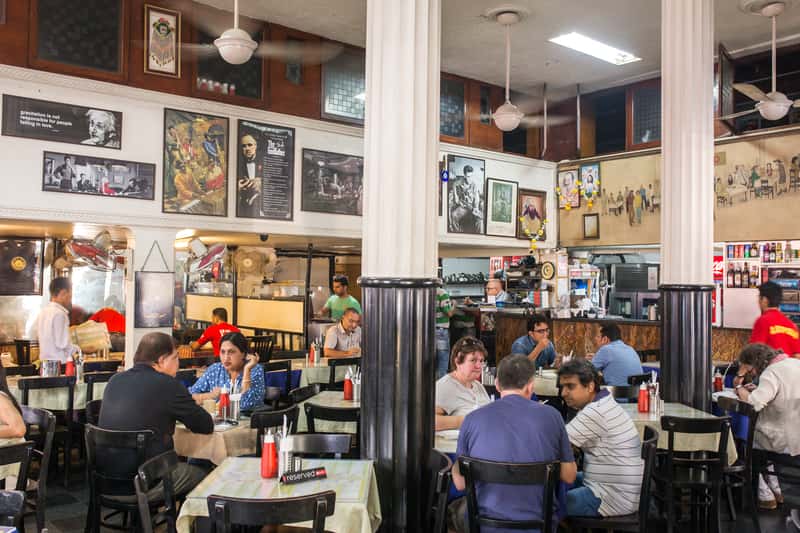
Frequented by foreigners who reside in South Mumbai for their visit, Leopold’s Cafe is on the must-visit list of almost every tourist. Established way back in 1871, this bar has a simple decor of wood furnishings and minimal fuss. Go here to try their delicious starters and gulp down some cold beers. The place is usually full up, so you may have to wait for a table, but it is well worth it.

Location: Colaba Causeway

Shree Siddhivinayak Temple

Shree Siddhivinayak Temple

Siddhivinayak temple is dedicated to Lord Siddhivinayak and is located in Prabhadevi in Mumbai. Tourists love visiting this temple to learn more about Hindu culture and admire the architectural brilliance of the building which was built way back in 1801.

The best day to go to the temple is on Tuesdays when you can see devotees walking on foot to offer their prayers.

Location: Prabhadevi

Colaba Causeway

Colaba Causeway
Colaba Causeway

Colaba Causeway is a great place to pick up gifts to take back home. There is a range of clothes, knicknacks, jewellery, bags and other products sold at discount prices. Foreign tourists come here to pick up typical Indian items such as saris, kurtas, jute bags, Indian jewellery and Indian footwear such as juttis and mojaris. The bustle of the streets and bargaining also adds to the Mumbai experience.

Location: Fort

Visiting Mumbai is an exciting and novel experience, filled with excitement and adventure as you maneuver the busy streets, iconic monuments and areas and historical sites. Foreign tourists visiting Mumbai look for comfortable, safe hotels that are well within a reasonable budget. Treebo Hotels in Mumbai are centrally located, with all the amenities you need for a pleasant stay. If you are looking for a great accomodation option, book your stay at a Treebo Hotel. Try Treebo online hotel booking App for a smooth booking experience.

Haji Ali Dargah

Haji Ali Dargah
Haji Ali Dargah – This mosque is in the middle of the sea

Situated in the middle of the sea, Haji Ali is a mosque and a dargah that is stunning to look at. Foreign tourists flock to the promenade in Worli to catch a glimpse of this mosque, which was was built to celebrate Pir Haji Ali Shah Bukhari’s memory. Here you can admire the Indo-Islamic architectural style. It is open all days of the week from 6am to 10pm.  

Location: Haji Ali

Chhatrapati Shivaji Maharaj Vastu Sangrahalaya (Prince Of Wales Museum)

Chhatrapati Shivaji Maharaj Vastu Sangrahalaya

This is by far Mumbai’s best museum and is visited by both foreign and domestic tourists. This museum is the largest in the city and houses a wide range of exhibits. An interesting mix of Islamic, British and Hindu architectural styles, inside the museum you can see collections of sculptures relating to Hinduism and Buddhism, miniature paintings and ancient weapons. Entry to the museum is Rs. 85 for Indians and Rs. 500 for foreign tourists.

Location: Fort

Prithvi Theatre

Prithvi Theatre
Prithvi Theatre – Source

Theatre buffs must visit the Prithvi Theatre in Juhu to watch India’s talented actors perform at this iconic location. The cafe outside is a lovely place to grab a snack and some coffee after watching a play.

Location: Juhu

Basilica of Our Lady of the Mount

Basilica of Our Lady of the Mount
Basilica of Our Lady of the Mount – The church at Bandstand

Mumbai has many historical churches that are beautiful to explore, with grand architecture boasting centuries in age. The Basilica Of Our Lady Of The Mount, also known colloquially as Mount Mary’s, is one such church that is located in the suburb of Bandra.

This religious structure sees thousands of devotees of all religions coming here to pray and be blessed during the novena prayers that is held in September each year. Foreign tourists too come here to experience the festivities during the Bandra Fair which begins on September 8 and is celebrated for a week.

Location: Bandra

Dharavi Slums

Dharavi Slums
The Dharavi area is home to many businesses

Dharavi is well known around the world as being one of the largest slums. What draws in tourists from all over to this place is that here you can witness poverty and enterprise, with hundreds of small industries in the heart of the location. There are special tours that show visitors around the labyrinth-like area, which can be eye opening and wonderous.

Location: Dharavi

Mumbai is India’s largest commercial city, with a cosmopolitan culture that loves to party. There’s always something happening for people of all ages, no matter what your taste in fun. From delicious food to adventure sports, from family entertainment to experimental theatre, there’s something for everyone in Mumbai.

Ready for the Rice Bucket Challenge?

4
Manju Latha Kalanidhi

Hope you have heard about the ALS Ice Bucket Challenge… While all of us have heard enough about this challenge – which many of us actually thought was silly – people across the world have taken part in it or donated to the Amyotrophic Lateral Sclerosis (ALS) Association. As expected, many Indian celebrities who have an amazing copycat behaviour, immediately took up the challenge to pour ice cold water onto themselves. Particularly, since the Indian monsoon had not covered the entire country this time, it was easy to douse cold water in the intense heat!

During my stint in a research firm in Hyderabad, I worked with a colleague named Manjulatha Kalanidhi who was also a journalist. She always had a quirky retort for everything in life. Her quick wit and one-liners always raised eyebrows. If we guys were talking about “Koffee with Karan”, Manju would say, “come, I will serve some Kashaya. Let’s have Kashaya with Kalanidhi!”

It was obvious that Manju would come up with a befitting Indian answer to this ice bucket challenge. Being quite active on social media, she messaged,

“Chalo I am all ready for a #RiceBucketChallenge… desi style… cook or buy one bucket of rice/ biryani and feed the poor in your locality. If you can’t take this challenge, donate medicines worth Rs 100 to the nearest government hospital.. Whoz joining me in this one? My own local, practical and tangible version/response to #icebucketchallenge …. save water feed the hungry!”.

Rice bucket challenge
Image Via politicalblindspot.com

The social media cyberspace went abuzz about this crazy yet sensible idea. Why pour cold water onto yourself to promote some unknown disease; better do charity at home! Over the last one week, the Rice Bucket Challenge has spread like a wildfire and has become the most discussed topic on the internet. School children, social activists, celebrities all have joined the bandwagon to take up the Rice Bucket Challenge.

While we constantly crib about our governments doing nothing, our corporate houses doing meagre CSR service, rarely we find individuals taking up social causes. I would say Manju’s act is the ultimate example of Individual Social Responsibility.

So this International Day of Charity, are you ready to take up the Rice Bucket Challenge? All you have to do, take a bucket of rice, find a needy person, click your pic while donating it, and upload it on the Facebook community link!

Factfile –
http://www.bbc.com/news
timesofindia.indiatimes.com

DU Food Haunts – A foodie’s paradise!

0

Continued from Food Haunts in Delhi University – gastronomic excellence!

Kamla Nagar haunts

DU Food - Food Joints in North Campus

While DU colleges have their canteens and there are umpteen thelas to choose from, one must not forget the food haunts in Kamla Nagar, the market closest to the campus area and GTB Nagar. Kamla Nagar has a delightful joint called F.Y.I. Maggi that serves about 15 different types of maggi! It will surprise you with Punjabi Tadka Maggi, Crispy Maggi, Maggi in White Sauce, Maggi Kebabs and so on. Each version of maggi is named after SMS abbreviations like LOL, WTF, KO, TTYL etc. It has a funky décor in bright colours and is reasonably priced. A single visit is usually not enough!

DU Food - Chache-Di-Hatti
Chache-Di-Hatti

Kamla Nagar is also famous for Chacche di Hatti that sells some delectable chole bhature. Unless you see the crowd queued outside the stall, you will not believe the extent of its popularity. There are separate queues for men and women, and the stall opens at 10 in the morning and everything is over by 3 in the afternoon. We were intrigued by the rush and decided to give it a try. Needless to say, the long wait was totally worth it and we kept going back for more.

There is a narrow lane in Kamla Nagar that once had restaurants on both sides serving delicious and reasonably priced food. Most of these are shut now but Momo’s Point continues to serve oily, spicy, fattening, lip-smacking, finger-licking food. It is a small restaurant, usually overcrowded, which serves a wide variety of modified Chinese dishes. Try their crispy chilli potatoes with fresh lime soda or their chicken salt and pepper with mocktails like Blue Lagooon and Pina Colada and you might just be surprised!

The narrow intersecting lanes hold many delights for unsuspecting foodies. The Shawarma Point is one such. The cane structure with piping hot shawarmas on paper plates are sure to impress. Similarly, Shake Square has a wide range of milk shakes and ice-cream floats that can make anyone happy on a summer day. The price is a little high in comparison to other places in the campus area, but the drinks will make it worth your money’s while.

G.T.B. Nagar haunts

G.T.B. Nagar is just a few kilometres away from the Delhi University campus and can be reached by either cycle-rickshaw or auto-rickshaw. This area has some of the better dining options that are priced slightly higher than those in Kamla Nagar. QD’s is a favourite among both students and residents of that area. Its signature dish is tandoori momo, but regular items like chilli chicken, garlic chicken, and a variety of mocktails with names like Jump Up & Kiss Me, Woo Woo, and Green Lady are equally popular. The bright interiors and a collage of posters make this a lively place to eat at.

DU Food - Tandoori-Momo-at-QDs
Tandoori-Momo-at-QDs

The Big Yellow Door is a few steps away from QD’s and is famous for its Napolitano pasta and black forest shake. If you are willing to wait outside for 30 minutes or so, then you will be seated at a table in this little restaurant that serves the best Continental food in North Campus. It is a casual but classy place and easy on the pocket.

The Patel Chest area, with its lines of photocopy and computer printout shops, is also an eatery hub. It is an especially good option for those living in hostels who wish to sip tea after midnight. There are no prominent food joints in this stretch but the little stalls that serve kachori, samosa and tea are all-time hits with the students who fill their bellies, while waiting to get their notes photocopied. Do not miss the bhelpuris that will leave you craving for more.

So, whether you are in College A or College B, whether you are a student, an alumnus or a visitor, whether you got to choose the course you wished to pursue or grudgingly took admission into a course that was second-best in your list, one thing is certain – when in Delhi University, academic excellence goes hand in hand with gastronomic pleasure.

Disclaimer – This article only mentions a few handful of the really popular eating DU food haunts, but all you need to do is peek into the corners and discover some tiny new stall serving some mouth-watering delicacies or allow yourself to join the crowd and find out what the rush is all about.

Check Out Our Exclusive Delhi Page

Delhi University Food Haunts – Gastronomic Excellence!

0
Delhi University Campus Food
Image Via delhigreens

Delhi University has been finding its name in the newspapers almost regularly these days: be it due to the confusion regarding the Four Years Undergraduate Programme (FYUP), or because of the Vice-Chancellor’s “to resign or not to resign” issues, or because of the high cut-off percentages that can formidably challenge Dettol’s 99.9% germ-killing assurance. So, as a DU-alumnus, it becomes necessary for me to highlight the non-academic aspects of the varsity. Yes, DU is not just about sky-high marks and lectures in derelict buildings; it is also a foodie’s paradise.

FOOD! Cheap food. Yummy food. A wide range of food. All of it can be found in DU. Having been a part of the north campus, I shall focus primarily on the variety of food haunts in Delhi University that the seeker of both high-end and downright cheap food can visit.  To begin with, the area between the Faculty of Arts and the Faculty of Law was our favourite haunt. If you are looking for proper meals, you will be disappointed. This is where students go between classes to drink cardamom tea, dig into piping hot samosas and bread rolls, munch on chips and cold sandwich and hold lengthy discussions on every topic under the sun.

Nandu ki Chai

Delhi University - Law Faculty Tea placeThere are two or three benches, a few circular metal tables that are not yet broken and cement slabs where students sit and pontificate on Marxism, Feminism, Modernism, Writ jurisdiction, the Civil Codes, and gossip about who is dating whom, whose car got impounded etc., while the campus dogs sniff the bins looking for leftover. The two best advantages of this place are: it is shaded by a number of trees and is close to the classrooms for those who don’t wish to be late for their lessons.

The tiny shop that sells the tea and snacks is referred to as Nandu ki Chai although who Nandu is, remains unknown to most of us. Just next to this is a juice-wala whose pomegranate juice (at least that’s what he called it) was a favourite with many of us. These places are cheap not only in terms of cost but also in appearance. Clearly not a place for snobs; but experiencing this cheapness is also being a part of DU. Plus, with the money that a student has saved, he/she can buy clothes in the Kamla Nagar roadside stalls!

DSE Mutton Dosa

Delhi University Food

Another place that was a favourite back when I was a student is the canteen at Delhi School of Economics. Among others, you will find a man popularly called Baba who serves meals, calculates the balance and shares quips with the horde of hungry students. The DSE canteen has proper seating arrangement and is quite hygienic as compared to other places in the campus. Students also take their plates and sit on the steps or under the trees sometimes.

This place is famous for its mutton dosa and egg fried rice. While the quality of the dosa is debatable, the very fact that you get mutton dosa at such a nominal rate will make you return to DSE canteen over and over again! The atmosphere, too, is warm and welcoming, regardless of which college you belong to. The J. P. Tea Stall just a few paces away from the canteen is also worth checking out.

Irfan’s Maggi Point

DU Irfans Maggi Point
Image Via dubeat

Irfan’s Maggi Point is another must visit for foodies. This tiny joint is in Shri Ram College of Commerce (SRCC). So what if you couldn’t make the cut-off and join SRCC? You can still enjoy its maggi. This is not a part of the canteen or the college establishment; it is simply an overcrowded thela that delights students, especially in bone-chilling winters, with uniquely flavoured maggi noodles.

Breakfast café at St. Stephen’s

Breakfast café at St. Stephen
Image Via dubeat

St. Stephen’s is one of the few colleges in DU which has a canteen with a non-veg menu. It is known as ‘breakfast café’ by the students and it appeals to the taste-buds of everyone who belongs to DU North Campus. The café is pleasantly lit, clean and has proper seating arrangement. However, do check the timings before you visit because unlike most other college canteens, the breakfast café does not remain open throughout the day. This place is known primarily for its spicy cutlets that can be enjoyed with strong coffee.

A quick reminder to the first time visitor: do not miss taking a look at the church of St. Stephen’s. While it is neither large nor grand, its gothic architecture and beautiful stained glass windows are worth seeing. So, eat those cutlets, sip that coffee and gaze at the warm, red-brick architecture of the college and the church which is far superior to the derelict, falling-apart buildings of the rest of the university.

Continue to read – DU Food Haunts – a foodie’s paradise!

Pran and His Epic Creation – Chacha Chaudhary

4
chacha chaudhary
Get the Chacha Chaudhary Collection

It goes without saying that with the demise of the father figure of Indian Comics – Pran Kumar Sharma, a part of our childhood would also be no more. Pran had created a fantastical world of Chacha Chaudhary, filled with delightful characters such as Sabu, Billoo, Pinki, Raaka, Shimatiji, Raman and Channi Chachi that had won hearts of millions. As children, we would eagerly wait for the next edition and grab a copy of his creation every month.

It was way back in 1969, when Pran first sketched Chacha Chaudhary for a Hindi magazine Lotpot, which made him well-known. Chacha Chaudhary was created at a time when the only comics available to Indians were foreign publications like Superman, Batman and Phantom. In the 1970-80s, these foreign publications created such an influence there was an illusory aura of muscular and good-looking superheroes. In order to break the stereotype, Pran desired to go beyond unrealistic characters. He wanted to create someone who was essentially Indian, down-to-earth, and not-so-powerful like his western counterparts. To craft such a unique inimitable character, Pran took inspiration from Chanakya – who is known for his intellect.

“Chacha Choudhary ka dimag computer se bhi tez chalta hai.”

It was important for Pran to create an image of an Indian superhero, who was a simple and realistic commoner dealing day-to-day problems with ease. The initial image of Chachaji was that of a village simpleton who wore a turban with dhoti kurta and used to carry a laathi along with him. He used to fight off petty criminals, conmen and thieves. However, with changing times, Chacha Chaudhary’s image changed too.

Soon we saw him in his modern avatar – a man wearing vest, tie, shoes, sporting a walking stick and fighting present day burning issues such as plane hijacking, terrorism, bomb blasts and so on. Over time, his characters took on modern technologies like mobile phones and computers as well. The only thing that remained intact was Chachaji’s turban and his moustache.

Pran believed in embracing the changing times not just fearlessly but also elegantly. To keep up with time, he switched not only from manual colouring to digital tinting, but also used new media like computers, television and radio to reach out the masses.

Chacha Chaudhary - Pran Kumar Sharma
Pran Kumar Sharma Image Via freepressjournal.in

Pran’s career graph was quite dynamic. In 1960s, cartooning was not considered a lucrative profession. Hence, there were no special courses to get into this field. Those cartoonists were already well-established like legendary cartoonists of India, R. K. Laxman, Abu Abraham and K. Shankar Pillai, were all self-taught. Their illustrations were serious, focusing mainly on social and political issues. Even though Pran took an inspiration from them, he wanted to try a different genre of cartooning, hence he opted for comics.

Pran began cartooning for a Hindi publication, Daily Milap. To start with, Pran created pocket cartoons that were mostly political. Soon he thought of creating something unique, and he came up with an idea to make cartoons using lines from poems by famous poets of his time like Ramdhari Singh Dinkar, Sumitranandan Pant and Nirala. When he approached Dharamveer Bharati, the editor of Dharmyug, he was thrilled with the idea and named the series Kavita Cartoon, which soon became popular.

To get his cartoons published, he approached newspapers as back then there was no concept of comic books. Initially, only a couple of newspapers showed interest in his cartooning, but soon leading dailies like Punjab Kesari, Navbharat Times, Karamveer began publishing his cartoons. Even though the pay was low, Pran enjoyed cartooning.

It was only in the 1980s when Diamond Comics approached him for compiling his cartoon strips that were published in various newspapers and magazines into a book form. To begin with, he gave them content for two 45-page comic books. He received good response with all the prints sold out within two weeks of their release. There was no looking back since then. Diamond Comics not only gave him a platform to be famous, but also gave him a stable source of income for survival.

Today, Pran has over 600 comic books and 200,000 drawings to his credit. In fact, two episodes of Chacha Chaudhary have been acquired by the International Museum of Cartoon Arts, USA. In 2005, Sahara TV, an Indian television channel approached him to adopt Chacha Chaudhary into a serial, in which Raghuvir Yadav played the lead role.

Over the years, Pran had become internationally well known that in 2006, Pran was invited by the Cartoonists Society of America in Chicago to deliver a lecture on the subject of comics. Two film documentaries – ‘Chitrakatha’ and ‘No Kidding’ had rough cut interviews of Pran in which he talked about his creation Chacha Chaudhary, how and why he became a cartoonist and how the plots as well as characters of Chacha Chaudhary kept adapting to the changing times. This year at ComicCon Delhi, Pran was awarded the Lifetime Achievement Award.

Today, my heart fills with sorrow when I realise that the man who made our childhood so memorable is no more. His creations not only made us curious when he incorporated various features like Aankh-Micholi, Saptu, Chor Police and Beer-Bhahuti into his comics, but also brought immense happiness in our childhood, which is irreplaceable!

Factfile –
http://timesofindia.indiatimes.com
http://www.chachachaudhary.com

Do we learn from mistakes?

12

Author – Sharad Yadav

Federal Bank Advt

Recently, a pleasant TV commercial of Federal Bank caught my attention. This ad portrays the importance of having a correct partner by saying that “if partner is right, life become joyful”. A cheerful old man who admits that just to give company to his laughing wife, he laughs loudly every time his wife cracks the old Santa Banta joke, which she keeps repeating very often in front of her friends.

What appealed to me more than the ad itself or the bank’s assertion that a correct partner makes life joyful was the Santa’s joke. The joke goes like this – “After seeing a banana peel on road, Santa says ‘Oh… Now I have to fall down again!” Good one, but try to find what is funny about it. The elements of humour here is that Santa is so dim that he lacks the basic human ability to learn from experience or mistakes. He remains ignorant of choosing the obvious option, i.e. not doing the same mistake again.

While we have a laugh at it, all of us have the same two elements in our actions and behaviour in personal and professional life like Santa. Give it a deep thought and to your surprise you will find it true. We keep repeating almost the same mistakes again and again. Leave aside the question of wisdom of learning from others’ mistakes; if that would have been possible then graphic videos of accidents caused due to traffic rule violations would have turned us into staunch abiders of traffic rules. The point here is how many times in life after facing the consequences of our own mistake we come out enriched with the learning of not repeating that mistake again…

Paul Walker accident | Reuters

Does an accident or a near miss on road due to our rash driving persuade us become sensible drivers for rest of our life? The answer is No. Media reports indicate the infamous Hollywood actor Paul Walker had five speeding tickets in three years before losing his life in a recent car accident and investigations revealed the cause of accident was again, speed!

Leading Indian businessman Phaneesh Murthy was fired from the post of Director in Infosys in 2002 and again in 2013, the board of iGate sacked him from the post of President & CEO. On both occasions, the reason was illicit relationship with his subordinate with accusation of sexual harassment. Take your own daily life, how many times your negligence or carelessness has aggravated a preventable and self-manageable health condition into a serious health issue necessitating medical intervention? Answer will not be one! Similarly, after losing out the last promotion to nearest competitor in office solely due to the habit of arriving office conspicuously late, does one change his/her routine and starts being punctual?

Examples are umpteen. A friend of mine runs out of fuel on road very often and he ends up pushing his bike sweating all the way to the nearest petrol pump. One fractured hand and six stitches on the forehead are not enough to stop my cousin from riding bike after drinking. Yes, merely experiencing the serious repercussions of our mistakes does not make us wiser; we have to keep imprinting that learning into our conscious mind for that. It is these accumulated learnings over the years that turn us into a wise, mature and enlightened person, who is less prone to make mistakes.

To err is human, but every mistake teaches us something and provides an opportunity to improve ourselves, so that we can be careful enough to avoid doing the same mistake in the future. Whether we utilize this opportunity to learn from mistakes or not lies in our hand. Next time, when you will see this TV ad again, the Santa joke will not sound funny but satirical unless you begin making an effort to learn from your own mistakes unlike Santa!

Factfile –
Link to video – http://www.youtube.com/watch
http://www.nydailynews.com

Selfies: The Good, The Bad, and the Ugly

2

Selfies are just a fun trend, popular on social media, right? Well sure, when you just look at the surface of the issue. Teens taking photos of themselves and then uploading them onto sites like Facebook, Instagram, and Snapchat seems like another fun trend for teenagers and young adults to participate in. Unfortunately, if left unchecked, this harmless fad could be the root of various emotional problems.

At the very best, some say that selfies are actually a form of empowerment and go a long ways toward promoting a healthy self-image as shown on wellnessgeeky.com. But more often than not, selfies can lead to an obsession of self, narcissim, and can even have lasting damage if taken too carelessly. The infographic below, by TeenSafe, sheds a little bit more light on this highly popular teen trend.

What do you think – are selfies cause for concern, or is it the more the merrier?

Selfie