Testing the Indian Rock Scene

0

Author – Mitali Khatokar

RM

The exhausting work schedules at corporate offices and the boredom of monotonous life on college campuses makes the people of evergreen city look forward to the weekends to relax and unwind. And where do they find peace? – In music, people and interaction. In India, the music scene has been on an up rise in the past decade, offering a lot of exciting possibilities for people across all ages. Indian cities are rapidly transforming into their own versions of hotbed of rock music, which comes hand in hand with the growing passion for rhythm and jive and an appetite for head banging, with people investing their money and time in listening and producing music.

Music enthusiasts and critics have come up with various theories to explain the popularity of rock music in metropolitan cities. Some attribute this to the predominant presence of the Anglo-Indian community in cities like Goa, Mumbai, Bengaluru, and Delhi which has played a pivotal role in bringing Western genres and music instruments to the forefront of the Indian music industry. Another theory is that cities of the South, like Bengaluru, is distant from the entertainment powerhouses based in Mumbai and its all-subsuming film industry has freed musicians in the city of mere commercial concerns.

Ministry of Blues

The most common theory of all, however has been initiatives taken up by private educational institutions that encourage their students in honing their skills in arts, music and performance. Schools and institutions offer courses that are specialised and inclined towards providing an all-round education in music and performance, offering young musicians a holistic music learning experience, that doesn’t necessarily revolve around Indian classical music. Nationally renowned institutes such as Visva Bharati University in Shantiniketan, West Bengal, Delhi School of Music, KM Music Conservatory in Chennai, Adarsh Kala Mandir in Madhya Pradesh are some of the esteemed music academies in India that not only professionally train young musicians but also provide professional degrees in music at under-graduate and masters levels. Smaller training institutes such as Nathaniel School of Music take the music learning experience beyond classrooms.

In a city like Bengaluru, lounges and night clubs such as The Humming Tree, B-Flat, Indigo Night Live and Opus hold open microphone nights or music gigs, which don’t just entertain the audiences but becomes an ideal opportunity among start-up bands to showcase their music and provide a Launchpad for bigger gigs to come. “Basically, all bands and artists, whether well-known or just starting out, get a good stage in all these small places like cafes, lounges or night clubs. It’s because these places have the space for sound and of course, the people,” says Abhishek Yuvan Rao, an event and artist manager, based in Bengaluru.

RM

Mainly to break away from the ties of the 1960’s – ‘70’s music culture which thrived on expression and innovation, today’s musicians are open to adopt and to explore different fusions of music and instruments. Music programmes, live performances, celebratory fests, open nights are gaining more popularity among the people as they themselves seek out places that fully support and promote musical activities. “The music scene is very relative to what’s happening around the world. Here, people are adaptive and because of that artists are more adaptive to the city spaces, to integrate into themselves the music that they make,” says Anand Vijayasimha, former guitarist of Thermal and a Quarter.

RM_3

Online music sharing portals have presently become the best platform for any artist to share his/her music. The advent of internet and the social media has triggered a positive response and immediate sharing for both the artists and audiences. More people coming up with their own music compositions yet lacking a platform to showcase their music has led to mushrooming of online music sharing portals like SoundCloud, Grooveshark, etc.

Testing the waters with the innovation of integrating new instruments such as hang drums, didgeridoo or maschine to improvise and add jarring or unique effects to the otherwise four basic keys. “People appreciate the novelty factor of any kind of music. That’s how you differentiate good music from the rest. Musicians have to explore the different genres and experiment with various instruments to find the novelty factor and there has to be an impetus to create music, which is not only for the audience but creating music for the sake of art,” says Varun Chhabria, a musician.

Music, as an art, needs to be explored and experimented with. To gain a holistic approach to it, musicians have delved head-on into acquiring unique instruments to using standard instruments in different ways. The novelty factor of music has taken over the minds of young musicians, catering to the ever changing moods and attitudes of their audience.

Fact File –
www.youthkiawaaz.com
www.dnaindia.com

Image Courtesy –
www.facebook.com/StrawberryFieldsNLS
www.facebook.com/thehummingtree

Photo Feature: Children of Nepal – Do we really care about them?

0

The devastation caused by the recent earthquake in Nepal is still fresh in our memory. More than 8,800 people are dead and thousands have been injured. Many countries including India have sent in their help into this impoverished nation, but the massive reconstruction needed is still a daunting task. However, the behavior of Indian media and our government has been the most shocking. Operation Maitri, the rescue effort by our National Disaster Response Force, which was hyped up the Indian media, has left a bitter taste in Nepal.

After the first week of rescue efforts, the message trending on Nepal’s social media was “#GoHomeIndianMedia”. As quoted by BBC, the Indian media’s “shrillness, jingoism, exaggerations, and sometimes mistakes in coverage” has disgusted the host community. Our media’s main story was not the suffering of the Nepali people, but the generosity of the Indian government!

Whenever we extend a helping hand to someone, we are not supposed to thump our chest and claim credit. Our benefactors have to acknowledge our help and they hold the right to give credit. Let’s not be so shameful to spread self-congratulatory messages, while other countries have also done a great job in Nepal.

One look at the children of Nepal shows the dire state of affairs in that poor country. Years of civil war and government apathy have resulted in pathetic conditions for the young generation. During our visit in 2007, when Nepal became a people’s republic we were touched by the kind hearted nature of the people and hardworking child labourers. On the World Day Against Child Labour, we need to look at ways to help these poor souls. I feel these pictures speak more powerful than my words –

Children of Nepal

Early morning, Jack went down the hill to fetch pail of water

Children of Nepal

The innocent smiles of these children are truly endearing

Nepal Children 3

The innocent smiles of these children are truly endearing

Nepal Children 4

Never seen more hardworking child labourers than these!

Children of Nepal

Poor children play around rich cultural heritage sites

Children of Nepal

Street smarts roam the streets of Kathmandu carrying a pet on shoulders

Children of Nepal

Pride possession carried away zealously

Children of Nepal

Seeking blessings at the Manakamana Mandir

Children of Nepal

Dirty slippers become a toy to chew!

Children of Nepal

Children are no doubt a photographer’s delight

Children of Nepal

No age limit for daredevilry!

Children of Nepal

Early morning tuitions – a rare sight in rural areas

Children of Nepal

The joyous exuberance of children despite their poverty is touching

Children of Nepal

Sharing is caring and every drop matters!

Images
Levine Lawrence
Nagaraj D.H

Top Ten Tips on How to Make It Through a Rainy Day

0
Tips for Rainy Day
Image – Pixabay

The weather can be quite fickle minded now that spring is almost over. One minute it’s sunny and warm and the next it is pouring. Sometimes it rains for days on end. 

Going to work on a rainy day is a disaster. Clothes are wet, socks are soaked, and shoes are ruined. Not the ideal way to start the day. The gloomy weather can also drag your spirits down. 

It’s a good thing we have some hacks to get you through the rainy days.

Tips on Making It Through the Rainy Day

Rainy days can be tough to get through if you are not prepared. Whether you choose to stay in or go on about your daily routine, here are some tips that can help you stay dry and get you through the downpour.

1. Check the Forecast:

It is wise to check the weather forecast before leaving the house or planning the day. Many weather apps on your phone give an accurate forecast of the day like “Heavy rain in the next 20 min”. 

Other apps give forecasts like sunny or cloudy. Follow the one that gives more accurate forecasts and sends notifications of impending rain. Do not leave the house without checking the forecast. 

2. Rain Boots:

If you are walking even a short distance, there will be puddles and streams. Your shoes are bound to get soaked. And trust me, you won’t like the feeling of wet socks on your feet. 

You will have to pass the whole day wearing wet socks in the office. Invest in some rain boots. Faveable suggests that you may try out some trendy, colorful waterproof boots to brighten up the dull, gloomy rainy days.  

They can keep your feet dry and look fashionable at the same time. 

3. Umbrella:

You can try keeping your hair dry with your hoodie, but chances are that you will get drenched if it’s raining heavily. An umbrella is the safest choice. It will keep your clothes dry as well as your hair. 

Ry to carry an umbrella with you. It comes in handy on sunny days, too. Take your umbrella with you if the forecasts give notification of potential rain. It is better to be safe than sorry. 

4. Carry Plastic Bags:

Stuff your purse with a few grocery plastic bags. Plastic bags can save you from heaps of embarrassing moments. If you carry your wet umbrella to work or to a friend’s house, you will end up leaving them with a puddle. Put the wet umbrella in the plastic bag. 

This way, you won’t leave a watery track behind you. You can also put your wet socks in the plastic bag. It will keep your purse dry. If you forget the umbrella at home, then you can place the plastic bag over your hair to protect it. 

5. Extra Cloth:

Sometimes, it rains quite heavily and you can not avoid getting drenched, even if you are carrying an umbrella. Pack an extra set of clothing just in case. 

Neatly wrap the clothing in the plastic bag, and put it inside your purse. This way, the extra set of clothing won’t get wet in the rain even if you do. You don’t want to risk catching a cold by staying in wet clothes at work. 

6. Spare A Pair of Socks and Shoes:

Keep an extra pair of socks and shoes in your drawer at work. If you have the storage space to do so, keep a spare. There is no guarantee that your feet will stay dry even with the rain boots on. 

Having spare socks in hand will keep your feet warm and dry at work, and you can not stay at work the whole day with wet rain boots. Wear the spare that you kept in the bottom drawer. 

7. Keep a Few Old Newspapers:

Newspapers are extremely absorbent. They work wonderfully to dry your shoes. Make a paper ball and stuff it inside the wet shoes. It will draw the water out. Wrap the rest of the paper around your shoes and secure it tightly with a rubber band. 

You need to change the newspapers a few times to have a completely dry shoe. Your shoe won’t shrink or crack with an old newspaper like it does when you blow hot air with a hairdryer. 

8. Microfiber Towels:

Keep a few microfiber towels in your office or in your raincoat pocket. These towels are super absorbent. If you get drenched, then the towels will dry your hair quickly. 

They will absorb most of the moisture out of your hair. You can also use microfiber towels to dry your socks. Just wrap them around a towel and squeeze. The towel will soak most of the water and your socks will be dry in no time. 

9. Put Wet Gadgets in Rice:

Not only you but your gadgets are also at the risk of getting drenched in the rain. Not all devices that we carry are waterproof, so they can easily get damaged. 

Put your phone or any other electronic devices you carry in a bag of dry rice. It is an old trick but works wonders if you do not have a dehumidifier. The rice will absorb the moisture from your phone, and it won’t damage your devices either. 

Keep them in the rice for at least 24 hours and then try turning on your devices. If they still don’t work, you can put your phone on top of a dehumidifier. 

10. Bundle Up:

Rainy days tend to be cold and gloomy. You are bound to feel the chill if you end up getting wet. Wear the cozy sweater and the woolen hat to keep warm. Use a trendy scarf to wrap around yourself. 

So, bundle up to get through the rainy day. 

Final Thoughts

Sometimes, the rain makes us want to snuggle up and stay home with a hot cup of coffee and just enjoy the day. However, that’s not the case for many of us. 

Even if we have to go to work on a rainy day, gearing up with these tips can help you get through the day with ease. Hope these tips will keep you dry and warm. 

The Flying Elephant – Quirky Names of Restaurants

0

Author – Sharath Ahuja

The Flying Elephant Chennai

The Flying Elephant Restaurant
The Flying Elephant Chennai

I was early for my dental appointment one day. As I waited for my turn, I casually flipped through the special issue on ‘Food and Drink” published by a leading Indian fashion and lifestyle magazine, featuring some of the best restaurants in India. These restaurants had strange names ranging from, “The Flying Elephant” to “Masala Library”. Thus began my journey into the world of exotic and quirky restaurant names.

Park Hyatt Chennai

Park Hyatt Chennai
Park Hyatt Chennai

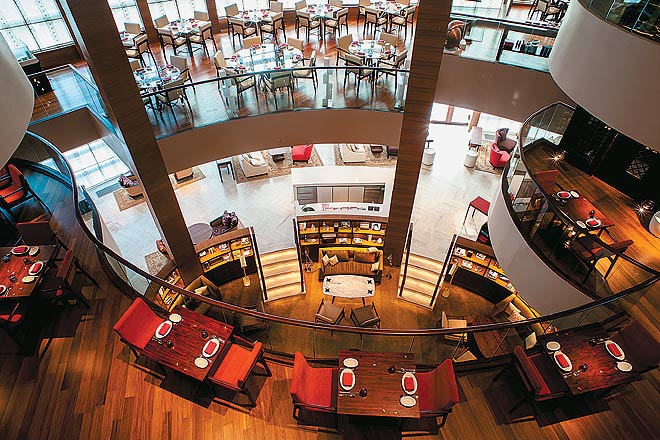
First up was a restaurant named “The Flying Elephant”. I wondered how the restaurant derived its name, until I discovered that it is an architectural masterpiece spanning over seven levels, which has a vertical restaurant and a culinary theatre. A resident DJ ensures that the Elephant keeps flying on most nights, making the name apt for this multi-cuisine restaurant at the Park Hyatt, Chennai. The only other “Flying Elephant” I have heard of, is the nickname given to the new AIRBUS A-380,  a double-deck, wide-body , four-engine jet airliner.

The Table Mumbai

The Table Mumbai
The Table Mumbai

Another restaurant was named “The Table” and I thought to myself that it should have been named “The Table and Chair” instead, because you would need a chair to sit and eat. Moving on, I came across one called “The Bricklane Grill” and the other named “Brick House”, I instantly knew that it referred to Punjabi Dhabas on the highways where they prepared Rumali roti and butter naan on a tava, balanced on two bricks.

Sunset Ashram Goa

Sunset Ashram Goa
Sunset Ashram Goa

Also, there’s this place called “Sunset Ashram”, where you would be having your dinner at the “Ashram” after “Sunset”. I discovered that “Sunset Ashram” is a restaurant and bar located in a quiet and secluded stretch in the proximity of the Ashwem Beach in Goa, offering its guests a spectacular view of the setting sun at the Arabian Sea while relaxing themselves to the soothing music and experience a sense of peace and tranquility away from it all, hence the name.

The Glass House Bangalore

The Glass House Bangalore

“The Glass House” was the next on the list, which I guess must have been named after the famous “Glass House” in the Lalbagh Botanical Gardens in Bengaluru. Continuing to flip through the special issue, I came across a restaurant named, “The Town Hall”. I knew the location of this one, the iconic Puttanachetty “Town Hall” located on J.C Road, Bengaluru. Built in 1935, this place is perpetually under renovation, ever since I can remember.

The other names mentioned in the magazine were “Benihana” (Japanese), “Zanotta Cucina” (Italian), “Yuuka” (Japanese), Mekong (Vietnamese), “Yauatcha” (Cantonese), “Peshawari” (Indo-Pak), “Amour” (French), and “Arola” (Spanish), which reminds of a veritable mini United Nations, right here in India.

Next featured was the restaurant “Ohm”. This one stumped me for I thought they had misspelt the name. But in physics, ohm is a unit of resistance and there is this famous Ohm’s law named after German physicist and mathematician Georg Simon Ohm. Gosh, the names people come up with. I wonder what names they would come up with in future.

Masala Library Mumbai

Masala Library Mumbai

There was also a restaurant named “Masala Library” which I thought served “Sizzlers” on the Kindle Fire Tablet. I wouldn’t be surprised if the waiter walked up to you and asked, “So, how would you like your book served Sir? Sautéed, deep fried or poached?” In reality, the restaurant gets its name from the four decades of research and exploration carried out by the legendary chef Jiggs Kalra on the centuries old customs and culinary traditions practiced in Indian Kitchens.  Whereas the “Library Blu” happened to be a bar which serves you all kinds of “spirits” to give you the “blues”.

I read about two Japanese restaurants named “EDO” and “EN”, which served authentic sushi, sashimi, succulent robatayaki, crisp tempura and artful bento meals. Forget Japanese, these items on the menu seemed all Greek and Latin to me.

The magazine’s last page featured a restaurant named the “Playboy Club”; I’m going in to this one, not for the food or the wine but you know why!  Just as I was about to enter the “Playboy Club” through the page, I was interrupted from my reverie as It was my turn to have the painful “wisdom tooth” extracted.

By the way, I’ve forgotten to tell you there many more restaurants with unique names like “Bhel Puri”, “Vada Pav”. “Thair Sadam”, “Bisebele Bath”, “Idly-Vada Sambar”, and not to forget the “Dosa Camp”.

I am also yet to figure out what the editor meant in her editorial, embrace the new, be it an exotic cuisine that is alien to our palate or the exciting world of “liquid nitrogen and molecular apparatus”, can you help me decipher that. And if you would be kind enough to send me your list of quirky names of restaurants that I should visit, please do so because it feels nice to know new things, especially when related to food.

Image Sources
www.hg2mumbai.com
www.lettucereview.com

Narayana Health – Treating Health as a Social Cause

0

Author – Bishakha Halder

Narayana-Health

The memories of the conversation I overheard just don’t seem to get out of my mind. Her eyes seem to have spoken all the pain she has been going through at such a tender age. But she was helpless. This girl had to become a prostitute just to support her family and raise money for her father’s heart surgery.  I was in a state of disbelief!

We claim India is a rapidly growing nation that is almost at par with other developed countries in terms of infrastructure development; then why does someone lose their childhood and live such a painful life. Today, a heart surgery seems to be creating a hole in the pocket of every middle class person. Then, just think what happens to the bottom of the pyramid!

This thought had nagged an eminent cardiologist Dr. Devi Shetty who thought about combining cost effectiveness and high quality healthcare, thus reducing the exorbitant cost of cardiac surgery. This thought gave birth to what is now known as Narayana Health, a multi-specialty hospital chain based in Bengaluru. In 1990s, Dr. Devi Shetty was working as a leading cardiac surgeon at Birla Hospital in Kolkata. During his tenure he saw that most of the heart patients he met were in acute need of a surgery but only 5% turned out. The reason being high costs associated with surgery and after care. It was a matter of fact at that time that affordability and quality did go hand in hand. For those seeking affordability, they had government hospitals but had to compromise on quality and for those seeking quality they had private hospitals to take care of them. Dr. Shetty had to come up with a model that would be economical yet provide highest quality.

With this mission, Narayana Health started its journey in 2000 with the opening of Narayana Hrudayalaya, a sprawling super-speciality hospital with 280 beds. Over the next 13 years, Narayana Health saw a tremendous growth reaching to 6,500 beds across 16 cities employing 13,000 people and 1,500 doctors. Dr. Shetty’s ideal “economies of cost” model could be achieved by having a commitment for purpose for its employees. He selected doctors and nurses who would align to the vision of Narayana Health. He used innovative marketing schemes like micro-insurance and telemedicine to attract large number of patients.

In order to increase upon the quality he harmonized Henry ford’s mass production process. This helped to increase quality as the doctor performed the same medical procedure repeatedly thus improving upon his skills and reducing mistakes. He leveraged his talent in optimising surgical procedures by making the doctors operate in teams. Each team had junior doctors, trainees, specialist, nurses and paramedical staff. Dr. Shetty calculated various bottle necks and assigned different work to different group members according to their experience levels. He found out that grafting, which takes about takes about 1 hour is the most essential part and is performed by a senior doctor. Rest of the procedures can be performed by the junior doctors and trainees. Pre operation procedures are performed by the nurse and paramedics. The supremacy of this procedure is that the senior doctor is left free to perform maximum number of operations.

To reduce equipment costs, Narayana Health takes them on lease, thereby keeping the capital costs as low as possible. An in house hub has been setup to meet the inventory levels and the central buying centre has been set up to take care of all the purchases.  Narayana Health has also invested a lot of brain on information technology; it has set up an ERP on cloud rather than setting up data centres. An SMS facility has also been developed, sending messages about previous day’s revenue and expenses. This helps the management to decide on various issues. A business intelligent system, depending on 30 parameters helps to keep track of the quality of service and helps in improving efficiency. It tracks the financial performance and clinical outcome of the doctor.

All of these efforts have helped to bring down the cost of surgery to Rs. 90,000 and as well keep the morality rate and infection rate as low as 1%. With Narayana Health, even the bottom of pyramid can think of cardiac surgeries without losing anything. He was successful in providing a cost effective and quality health care with such low, rather almost zero morality rates.

Apart from all these efforts to bring affordable healthcare to the needy, Narayana Health, has ingrained CSR in its DNA since it is modelled as a Social Enterprise rather than a corporate company. This is clearly evident in Dr. Devi Shetty’s crusade to initiate ‘Yashaswini’, a pioneering scheme launched in collaboration with the Karnataka government to enable farmers and their families to avail of free medical facilities for serious ailments at hospitals across the state. This is India’s first self-funded micro-insurance scheme, which has benefited poor farmers across the state.

Heat Wave and Global Warming – It’s time to turn the tide

0

Author – Levine Lawrence

Global Warming

It is said that the ‘weather’ is the most talked about topic across the world. We all invariably end up talking about today’s climate; but this time the heat wave is so massive that we all talk about it everyday. Yesterday, while talking about the unbearable heat, my friend said he got a power bill of Rs.5,000 this month. I said there could be a billing error, but he clarified that the bill was obvious since he has three ACs at home!

I was shocked to know that a couple living in a two bedroom house have three ACs. Why such a wastage? I wondered why the well educated people like us waste energy to such an extent that it becomes a burden on the nation, which is already facing a power crisis. While the heat wave is killing the hapless underprivileged out in the sun slogging it out, we enjoy our comforts without realising that our comfortable lifestyle is the reason that caused the heat wave in the first place! Let me explain.

In the midst of the scorching heat wave, does anyone remember the strange rains that we experienced during last winter? I can’t remember any other year when most parts of India experienced rains during winter. This was caused by a strange phenomenon called “Western Disturbance”, which is an extra-tropical storm that originates in the Mediterranean region. Do you wonder if there is any connection to the heat wave and global warming, the western disturbance and the El Nino effect that is harming our monsoon season?

heat wave

Global Warming Conspiracy Theory?

According to the weather scientists, all these weather fluctuations are being caused by ‘Global Warming’. Despite years of debate and evidences, many refused to believe that such a phenomenon is happening. Lets forget about all the evidences and counter-arguments and take only two points to consideration –

The law of conservation of energy – The Industrial Revolution is built on the power of our  machines and the fuel that powers them. Today’s rapidly evolving and competitive global economy is built on industrial growth. For this ever increasing pace of growth, enormous amount of energy is utilised mainly from fossil fuels. Since the 1750s, we have utilised billions of tons of coal, petroleum and natural gas to power our rapid industrial growth.  According to the law of conservation of energy, energy can only be transformed from one form to the other. So, all the carbon dioxide from burning fossil fuels cannot have disappeared from Earth, right?

Mitigation strategy for non-manmade climate change – Another convenient assumption is that global warming has not been caused by human activities but by natural causes. Thanks atleast for admitting that the greenhouse effect is happening in the face of overwhelming evidence. In fact, recently multinational oil companies have shocked the world by suggesting an imposition of carbon tax. Now the question is, shall we look for ways to mitigate the humongous problem by reducing our carbon emissions or shall we continue the debate until it is too late?

In every field of economy, human society has strived to innovate the best technology available and move to the next solution. Then why are we stuck with dirty coal? Simple question, Delhi government has done its best to create the best infrastructure for the city in terms of metro rail and CNG buses for transport, tree covered parks and wide roads, etc. Despite all these efforts, the pollution smog in Delhi is making international headlines. Why? Pollution from large coal thermal power plants in the heart of the city!

Economical ways for an Eco-friendly living

There are numerous ways we can help our environment by adopting tiny Eco-friendly habits. It can be simple things like switching to LED bulbs to carrying a cloth bag for shopping to using your own coffee mug at office. Thankfully, current trends indicate that the tide is turning towards an Eco-friendly lifestyle and less energy intensive activities.

Subsidy Driven Alternative Energy Myth

Today, alternative energy sources such as solar power and wind are becoming mainstream with even government offices and private homes using them. These renewable power sources have become so cheap, that they are now feasible without government subsidy. The year 2016 will be the turning point when solar power will be able to reach grid parity with conventional coal power plants! There are even solar powered air conditioners available in the market today for those who are ready to pay a little more for their comfort.

Have you heard of the Solar Impulse 2? That flimsy flight of fantasy of a solar powered plane flying across the world… That shows the power of human ingenuity will triumph over the murky politics of carbon trading and emissions mitigation.

Factfile –
www.downtoearth.org.in
www.economist.com
www.livemint.com
www.time.com

Image Source
Koshy Koshy

Velas Turtle Festival for Saving Turtles

4

Author – Samarth Goel

Velas Turtle Festival for saving turtles

We Indians celebrate numerous festivals throughout the year with much zest and vigour. Most of these festivals are religious rituals and rarely do we have any event to celebrate the nature around us. Earth Day on April 22 and World Environment Day on June 5 are two of the very few times in the year when we remember Mother Nature.

Interestingly, there is a festival organized in Maharashtra exclusively for turtles! Sea turtles are endangered species due to poaching and habitat destruction. All of the five species of marine turtles found in the sea waters around the Indian subcontinent are listed as either endangered or threatened species. Among these, Olive Ridley turtles have a distinct behaviour of forming Arribadas, which are mass gatherings of female turtles to lay eggs on the shore. In India, these Arribadas mass gatherings are observed in Orissa and Maharashtra.

While turtles breed throughout the year, their mating activities increase exponentially during the months of November to March. After mating, the female turtle comes ashore during the night and just beyond the high tide line, it dig holes up to 18 inches deep and fill them with about 100-150 eggs. Interestingly, females return to the very same beach from where they first hatched, to lay their eggs!

Velas-Turtle-Festival-for-saving-turtles-1

Over the years, most of these eggs were stolen by people and being sold in black markets. Few years ago, Sahyadri Nisarga Mitra, an eco-conservation NGO in Maharashtra, came forward to provide protection to sea turtle eggs which were being hunted in the Konkan Coast. Every year, a turtle festival is organized in a small village called Velas in Ratnagiri district, where villagers along with tourists from across India come together to release the turtle hatchlings into the sea.

The Velas Turtle Festival is organized every year between February and April. The villagers of Velas volunteer to provide home-stay facility to eager tourists who flock this village every year. According to the organisers, about 15 families volunteered to provide homestay for tourists arriving for this year’s festival. Visitors are actually are overjoyed by the level of warmth and hospitality they receive. The villagers ensure that their guests do not encounter any kind of problems, while they are reside in the village for the festival.

During this two-day festival, hundreds of visitors watch turtle hatchlings being released into the sea. Hatchlings begin to emerge out of their nests on the sea shore and begin crawling towards the see. Every year about 600-700 new turtles are sent into the sea. Basically, 600-700 new lifes are allowed to start.

The turtle conservation programme was started way back in 2002 by Vishwas (Bhau) Katdhare. According to him till 2014, Sahyadri Nisarga Mitra has released about 16,000 hatchlings into the open waters. The problem was first discovered in the 1990s, when a boat smuggling silver crashed on the beach. The police caught the smugglers and recovered most of the silver but some bricks were lost at sea. A few years later those bricks washed up the beach and it was closed for the public for the time being. It was then that the Olive Ridley turtle tracks were discovered and then it came out that villagers were stealing turtle eggs, grooming them and selling their meat.

Similarly, another turtle festival is organised in the sleepy, fishing villages in Sindhudurg district on Konkan Coast. Scores of nature lovers gather at the popular nesting site of Vengurla beach bordering Goa for the Turtle Festival in December and January. These turtle festivals are a noble initiative undertaken up by concerned villagers of Maharashtra. We need more such programmes for every endangered animal species. Assuming this festival will be organized year after year, sea turtles won’t be an endangered species anymore. Events and festivals like this teach us that every animal is a part of our larger ecosystem and we should respect and preserve them.

Image sources –
Thangaraj Kumaravel

Factfile –
http://www.theweekendleader.com
http://zeenews.india.com

Refreshing Summer Drink Inspiration

0
Summer Drink
Image – Pixabay

With the summer heat increasing daily, it is understandable that you would want to make a cool drink to beat the heat. Summer cocktails traditionally utilize a wide palette of fruity flavors as well as vanilla and chocolate. These drinks, obviously, are best served cold or frozen. Use delicious syrups such as those from Monin Canada. These add a punch of concentrated flavour to elevate drinks to the next level. This article will provide a rundown of different, refreshing summer drinks for you to enjoy this summer. In addition, some ideas about throwing a terrific summer party will also be provided, as what is a summer cocktail without a fun gathering to enjoy it?

The Bishop is a classic summer cocktail that doubles as a great way to use leftover red wine. To make this drink, mix three cups of light rum, a half cup of lime juice, a tablespoon of simple syrup, and three cups of leftover red wine. Mixing wine and rum might seem weird to some but it can be a great combination. After mixing well, serve this drink with a lime garnish and over plenty of ice. For a classy touch, consider adding some pomegranate syrup over the top of the beverage.

Another refreshing drink for summer is sangria. Sangria does not have a set recipe, just a set process, as it can be made in a variety of ways. To make sangria, wash and chop your choice of fruit or fruits, and pour into the bottom of a pitcher. Muddle thoroughly. Following this, pour some fruit flavored syrup over the fruit and then add sparkling wine or plain white wine. The choice is yours and one of personal preference.

A summer fizz is a fun and spirited drink with a cool twist. This drink combines light rum, ginger syrup, peach puree, and lemon juice, poured over a generous portion of ice. A whipped egg white mixed with simple syrup tops this beverage, along with a ginger and lemon garnish. To prevent illness from raw egg white, don’t forget to use pasteurized egg whites from a carton. There are a ton of sources online with heaps of cocktail recipes available online.

To go along with these awesome beverages, you can throw a summer party. A classic summer staple is the campfire s’more. For a great night-time summer soiree, consider making a s’mores bar. With a live fire or torches, lay out a spread of s’mores fixings, such as graham crackers, chocolate, and marshmallows. You can also get creative and add additional toppings, like peanut butter cups, chocolate sandwich cookies, or even flavored marshmallows.

A great décor idea for a summer party is twinkle lights or fairy lights. These can be wrapped around patio furniture, awnings, or trees. If you get the lights with a battery pack, there is no need for auxiliary power. Additionally, consider lowering your table and having guests sit on pillows or mattress pads on the ground. This creates a rustic feel for the party, plus it requires less furniture. Make sure that the set up can accommodate everyone who may have issues sitting for long periods of time and make sure that the ground is adequately padded for comfort.

If you are lacking a tablecloth, or you don’t want your nice tablecloth to get dirty, use a roll of plain brown paper. In addition to adding a summery look, you can paint on names, thus eliminating the need for place cards. Additionally, you can paint fun designs or place settings on this faux tablecloth. Once your party is over, this tablecloth can go right into the recycling bin – no need to go to the dry cleaners. Consider adding some flowers to the table as well, to complete the summery look.

Three delicious cocktails are the perfect accompaniment to a summer party. The Bishop, sangria, and the summer fizz are all deliciously refreshing drinks to prepare in the warmer months. They have a lower alcohol content and are more hydrating than heavier drinks. These drinks are made special with syrups and purees made by Monin Canada. Finally, these drinks all are awesome options to serve at a summer party. Whether it be a s’mores bar or a moodily-lit backyard, there is a party idea and drink for everyone.

Choosing between Telangana and Andhra

0

Author – Harika Bantupalli

Telangana and Andhra

Exactly a year ago, I remember the city of Hyderabad all adorned in Pink. It was the Telangana Formation Day and the ruling party wanted no stones unturned in making it the most spectacular event the city, or for that matter, the state had ever seen. Ever since the bifurcation of Andhra Pradesh took place, things have changed drastically for both the states.

Being born in Coastal Andhra and brought up in Telangana region, I am now latched to both the states in equally important ways. After a year of separation, I still feel uncomfortable answering to people who ask me if I was an Andhrite or Telanganite, because I can’t choose between the two of them. When I visit my native place in Andhra, I am considered a Telanganite because of my habits, while back home in Hyderabad, they consider me a blood-sucking parasite from Andhra. Does it really matter where I belong? Is state culture and division way beyond humanity?

It is a fact one can’t ignore that Telangana and Andhra, or for that matter, even Rayalaseema are diverse regions with one common thing binding them – Telugu. This language is said to be a derivative of the word ‘Trilinga’ as in ‘Trilinga Desham’, a place of three lingas, one in each region. But the language spoken has its own style, slang and dialect in each of these places, which turned into a major point for segregation even when it was the similarity that united them earlier.

Telangana Pesarattu

The differences in Telugu language added to the cultural contrast of these regions like fuel to the fire. Especially, the peculiar culture of Telangana influenced by the Nizam’s rule in Hyderabad distinguished it from the other two. What actually started off as a peasant revolt turned into a clash of cultures, resulting in the separation of the state from Andhra Pradesh after a lengthy struggle.

In many ways, Telangana is not anything like Andhra Pradesh. The Telangana dialect is often considered too brash and primitive. Further, some words in the dialect are considered offensive by Andhrites. It happened with me a number of times when I was refrained from using certain words in my village. My mom used to give me a list of words I commonly use that must be replaced with something else, or better yet, don’t even speak those words at all!

The festivals and traditions of Telangana are also unlike the others. The state is well known for Bathukamma, a spring floral festival celebrated during Durga Navratri where women dance around decorated flowers, which represent Maha Gauri. Telangana is also famous for Bonalu, a festival dedicated to Goddess Kali and her local incarnations. The devotees offer meals to the deity while few men dressed up as Pothuraju hit themselves dancing to the beats of drums. The patterns of the festivals celebrated here show the region’s devotion to Shakti – the ultimate power, whereas the festivals in Andhra Pradesh mostly focus on natural occurrences like harvest or new eras.

Hydrabad Haleem

In addition to the linguistic differences, varied traditions and cultures, food habits and the festivals, even the cinematic world divide the regions. The Telugu movie industry is dominated by Andhra Pradesh and people of Telangana are often belittled and ridiculed in most of the films. The bifurcation of the state also changed these derogatory practices to an extent.

The reasons for these drastic differences are the cultural, social and economic backgrounds as well as the historical influences on the places over the years. In short, one may say these two states are like brothers brought up in different conditions, who grew up to resent each other gradually due to the differences imbibed by those circumstances. However, at the end of the day, they are tied up with a bond called family, whether they accept it or not.

I am Andhrite by birth and Telanganite by life. Growing up as latter taught me to be tough, while the former showed me the virtue of patience. I speak my Telugu in a Telangana accent and I am not ashamed of it and at the same time, I write in the other kind of Telugu. My family might not celebrate Bathukamma or Bonalu, but I remember making those floral arrangements and dancing around them with a happy face. We had Telangana neighbours for 18 years and I have never had a tiff with them, because we didn’t see any difference among us.

When the Telangana agitation heated up and the bifurcation happened, gradually hostility developed between the people. They wanted us to identify ourselves as one among them. It didn’t matter before but suddenly it did. I couldn’t barely understand why. I wished they were together and work out somehow. But I never made a choice between Telangana and Andhra.

Image Courtasy – deccanchronicle.com

Ishani Sawant – A Young Mountaineer

1

Author – Levine Lawrence

Ishani-Sawant-2

29 May 1953 – Edmund Hillary and Tenzing Norgay become the first people to reach the summit of Mount Everest. Coincidently, 29 May was also Tenzing Norgay’s birthday! So it was truly a great day for Nepal when a humble Sherpa conquered the highest mountain in the world and the whole world recognised his feat. This conquest opened the doors for mountaineering to become a well-established serious sport, earning a steady flow tourism revenue for an impoverished Nepal.

Just when I was wondering how mountaineering and other adventure activities have become serious business today, I happened to meet a veteran mountaineer here in Pune. Ishani Sawant is already a veteran rock climber and mountaineer at a young age of 23, since she began her first at a tender age of 13 years!

Ishani-SawantYes, Ishani went to the Himalayas on her first visit along with her uncle Prasad when she was 13 years of age. That was when she fell in love with the snow-clad mountains and since then, she had participated in 11 Himalayan expeditions in Himachal, Uttarakhand, Sikkim, Ladakh and Nepal. Here are the excerpts of my interview with Ishani Sawant –

Q: What are the major differences in mountaineering expeditions and rock climbing activities?

A: Mountaineering expeditions and rock climbing expeditions require different kinds of fitness regime. While mountaineering require high endurance since you are on the mountains for an extended period of time, rock climbing expeditions require strength and mental toughness to hang onto the cliff, bevouc and do hard moves on the rock face. Mountaineering needs strong calves, leg muscles and shoulders while rock climbing needs additionally, strong forearms, finger strength, and flexibility. Further, mountaineering expeditions can accommodate bigger teams, kitchen staff, porters on the mountain itself, but it happens rarely in rock climbing.

Q: Which are the major mountain peaks you have attempted and what is the duration of a typical mountaineering expedition in the Himalayas?

A: I have done Mount Stok Kangri (Jammu & Kashmir), Draupadi-Ka-Danda-2 (Gharwal, Uttarakhand), Renok Peak (Sikkim), Mount Mera (Nepal) and 10 high altitude treks in Himachal, Sikkim, Ladakh and Nepal. An expedition ranges anywhere between 12days to a month on high altitude peaks and 1.5-3months on the 14 death-zone peaks, which are above 8,000m. The current trend is towards ‘Alpinism’, both in mountaineering and rock climbing, which is based on self-sufficiency and self-dependency. Alpine expeditions are of lesser duration however, since we hit the mountain hard and light. Like we did a record breaking climb to Stok Kangri (6,154m) in just 2days.

Ishani-Sawant

Q: While you promote safe riding on roads, why do take such risks in adventurous activities?

A: I conduct tours on extreme adventures for other people. Hence, safety is always my first priority. We give utmost importance to safety, in all kinds of events that I organise and go on, be it rock climbing, paragliding or bike rides. Adventure activities are not risky per say, it’s just getting out of your comfort zone and doing something that you have never done before, or exploring your capacities. It doesn’t at all make it life-threatening in any way.

Ishani-Sawant

Q: Do you fund your expeditions on your own? Do your parents pitch in?

A: Mountaineering and rock climbing athletes find it hard to fund themselves, since theirs’ is not a spectator sport. I have approached numerous people during my Everest expedition, but could not find sponsors. Hence, I had to stick to rock climbing since its less expensive. Currently I am ranked 6th in the National Climbing competition. I come from a middleclass family, so they also cannot afford to fund me. I arrange treks, adventure trips for groups in Pune to Sahyadri Mountains and save money to purchase the gear. It would be great if I could be sponsored. I am also into adventure photography.

Ishani-Sawant

Q: Have you observed any increase in interest among youngsters? If yes, what percentage?

A: Ohh… yes! There has been tremendous increase of adventurous activities among the youth, especially in Pune, Mumbai, Bangalore and Delhi. Like earlier our camps would be of 24-30 people max, now we keep getting batches of 40, and have events almost every weekend.

Q: Heard that climbing Mt. Everest has become a commercial activity now. What are the dangers in it?

A: Yes it has no doubt become a commercial activity. People are disregarding their strengths, knowledge and commitment to the sport and are just being dragged up the mountain like sheep with Sherpas as shepherds. Once you are on an Everest expedition, you just have to shut down your brain and do whatever your agency tells and has made arrangement. Unlike other expeditions, where we have to fix our own ropes, take turns in leading the routes, find suitable spots for campsites, and decide our own schedules, here the agency does everything. If you pay more, you are given table and heaters in your own private tents at higher camps, which we can never do on any expeditions. All basic principles of mountaineering, which help your personal development like having empathy with team mates, helping, sharing etc., are disregarded for individual success. This has resulted in major casualties, low chances of summit rate, abandoning of expeditions mid-way and hence the sport also becomes infamous in Nepal.

Ishani-Sawant

Q: What do you feel about Nepal as a country? What cultural connections do we have with them?

A:  I visited Nepal in 2012 for my expedition to Mount Mera. It is an extremely poor and underdeveloped country. Only Kathmandu and a few towns on the trekking trails like Lukla, Pokhara are prosperous ones. Kathmandu city felt like any other metro with hundreds of foreigners and I was surprised to see so many pubs and discos there. And yes, we Indians and Nepalis share the same culture. It’s like any Buddhist pilgrimage place in India. I felt like I am in Leh, the same culture, monasteries prayer flags, helpful peace loving and relaxed people.