Into the Woods – Sadhana Forest

2

Author: Sneha Sridhar

sadhana forest Auroville

There seems to be a peaceful rhythm in the way things flow at Sadhana forest. A wake up call at 5:45, and the daily work schedule begins. The volunteers make their way towards the farms to tend to their duties. Some of them start cooking breakfast for the community.

It’s difficult to describe the life in the forest. As a visitor, I suppose the experience is quite novel. The vegan lifestyle, the communal meals, and the “mini” projects are the first things we notice. Soon we see the finer details- the little water “feeder” bottles kept beside the younger saplings to encourage growth, the soak pits with banana trees, the vivid burst of green vegetable plants creeping out in between dormitories.

Skirting the periphery of Auroville in the state of Tamil Nadu, the community is well known around the world. Sadhana Forest, like Auroville, attracts a large number of volunteers every year. While I was interning with an architect in Auroville, a co-worker decided to join the community and applied through their official website. Having heard so much about the place, I decided to have a look at the forest. While Auroville is structured like a township, with zones consisting of farms, residences and workplaces, Sadhana forest began as an initiative by Aviram and Yorit, to re-grow the Tropical Dry Evergreen Forest (TDEF) which is native to Tamil Nadu. With a grant of 70 acres of barren land by the Forest Group, both Aviram and his wife began developing the forest. Considering the low capacity of the land to retain water, half the work had to go into water conservation techniques. The community began to grow as more people joined and now, they’ve covered about 55 of the 70 acres, reclaiming about five acres each year.
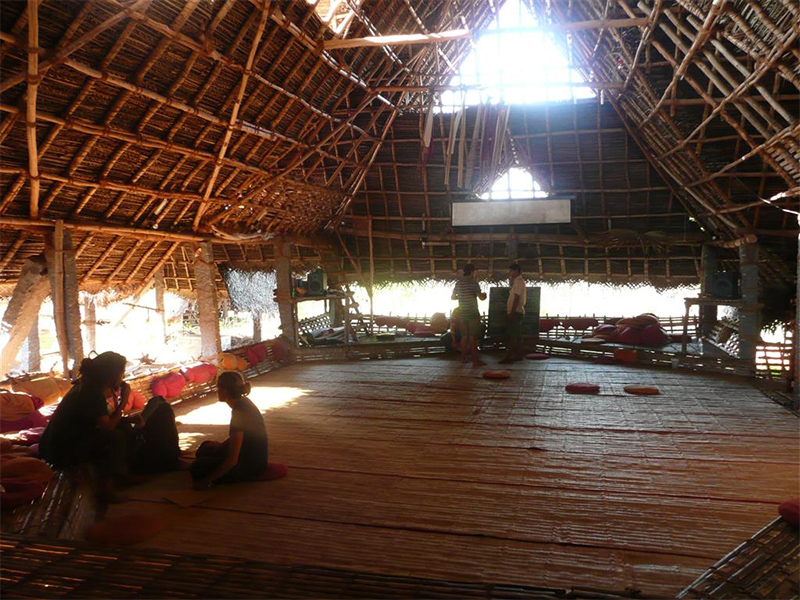
Sadhana Forest Hut
Sadhana forest welcomes visitors every Friday, as an effort to educate people about the importance of re-growing the TDEF and opting for a more sustainable lifestyle. The visitors are first taken around the forest, where we see the swales volunteers collecting water. We then make our way to whatever is left of the original forest, the “Sacred groves”. The canopies of trees in these groves spread above like spider webs and the trees block the sunlight. Religious idols and markings are seen at the base of one tree and it is assumed that they mark the boundaries between ancient villages. The trail turns back towards the periphery of the community area where the Compost toilets are located. The large collection of blue compost barrels stand out from the green of the forest. The visitors are then invited for the evening meal, where we all examine our food in amazement. It is quite remarkable to see Indian sweets without milk or ghee.

Sadhana forest hosts a vegan community. This lifestyle choice stems from the fact that the milk and meat industry is responsible for large amount of carbon dioxide emissions, contributing to the ever growing pollution the world is facing. Moreover, the community believes that it is unnatural and unfair to exploit animals in any way when there are plenty of other food choices. Sadhana forest reinforces and revolves around an eco-friendly lifestyle. From bicycle powered blenders to water feeder taps, the efforts to minimize wastage and electricity usage are commendable.
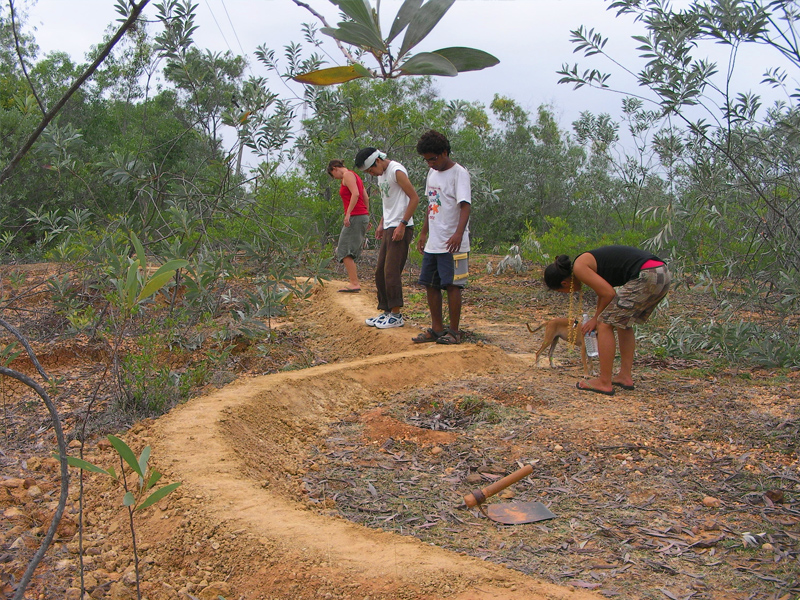
sadhana forest

The first thing that struck me as different and new was the “Unlearning” concept. Children in Sadhana forest are not sent to school. They are only taught when they express a desire to learn something. Self motivation is the only force behind their education in order to encourage the culture of learning at one’s natural pace. So you may have a five year old and a fifteen year old, both learning to read at the same time. Of course, not many may agree with this approach. Some may argue that children lack the exposure and understanding of the importance of education. Even though the residents interact with people from all walks of life, the lack of certain resources and opportunities in Sadhana Forest may deny the world a great leader or a scientist. However, it is interesting to observe a person’s natural motivation to learn and experiment.

The culture in Sadhana Forest revolves around self-motivation. Volunteers are encouraged to participate in activities but not forced. Individuals may choose to help or involve themselves in a particular project. There is no system of hierarchy. This way, everybody shares the same goals and works together as a unified body. Anyone can contribute despite their age. This philosophy is also reflected in the community’s attitude towards competitive sports and games, such activities are discouraged as it is believed that competition hampers social unity.

A minimalist life might appear primeval at first glance but the way of living at Sadhana is inspiring. The harmony and peace with which the residents work in the forest attract volunteers from all around the world. You could be building huts with an architect, cooking meals with a software engineer, and planting trees with an artist. At the end of the day, maybe that’s all that’s enough, proving that perhaps joy is truly found in the simple things.

Factfile –
Image Source – Volunteermatch.org.tw

Freedom of Speech – Do We Have it Really?

0

Author: Anubhav Sharma

Freedom of Speach India

While browsing through my Facebook page, I came across a news story shared by one of the leading English newspapers in India. The headline to this news shook me and for a moment I was dumbstruck. It said that an IT official in Goa is arrested for making comments over out now PM, Mr. Narendra Modi. Really!

We are living in a democratic nation where every citizen is given certain rights. We Indians take pride in our lengthy constitution and its contents. However, a few of our fundamental rights, like Right to the Freedom of Speech, itself cannot be practiced with that given privilege.

One day, I was watching an American show, Boston Legal which portrays attorneys dealing legal issues in their city. In one of the episodes, two of the lead characters, Alan and Denny, discuss about the political parties and whom they support and cast their vote for. Surprisingly, the pros and cons of each were talked openly and freely without fear of getting arrested or questioned at. This was what ‘Freedom of Speech’ extended to in their country.

Whereas in India, a layman cannot even express his views in social media sites like Facebook. Maybe the phrase ‘freedom in chain’ applies here as we cannot even fully exercise this fundamental right of ours.

The recent Goa incident isn’t the fresh case. Few years back, two girls were arrested for commented about the cremation ceremony of Shiv Sena Supremo, Balasaheb Thakre on Facebook. These were mere examples of many such instances that happened when someone dared make a comment on politics, especially ruling parties, on their social networking pages.

As per our constitution, every citizen of India has got a right to express their thoughts and views on topics until their views are not provoking any riots. Unfortunately, this isn’t the case as the Government is constantly keeping a check on common citizens’ opinions; a little status update or a tweet questioning the system had to face the consequences.

We live in a nation where these rights exist only on paper. When one tries to be expressive, they may go through a lot of trouble. These rights are all governed by various political and religious parties. Post such incidences, people restricted themselves from expressing their views over the social networking sites. Because for all they knew, anything might offend these political parties, and they could land up in some trouble.

However, as a solace from such incidents, marking the victory of a common man in relation to that of mighty politicians and their darling parties, the Supreme Court of India, in its landmark judgement on 24th of March 2015 struck down the section 66A of the IT act. According to this section, the social networkers can be taken into the police custody if they post anything offensive against the political parties or the people involved on their Facebook walls or Twitter feed.

This judgement brought in happiness of many citizens active on social media, as it restored the freedom of their speech and expression on these huge digital platforms for communicating with the masses.

As the Press Freedom Day is observed globally on 3rd May every year, let us stride the path of speech and expression a little more gleefully as the Indian Judiciary gave us the real freedom on Social Media by striking the untenable section 66A off the Indian constitution.

Image – Newtown grafitti

The Apolitical Indian

0

Author: Manu Mukundan

Apolitical Indian

India is the world’s largest democracy with 540 million people participating in the elections of 2014; it was truly a political Maha Kumbhmela. Every five years, the citizens of India exercise their right to vote and choose their leader in a spectacular manner.

Yet, it is surprising how a large portion of the electorate claim to be apolitical. These people are either not aligned to any political organization or believe that the entire political machinery is corrupted beyond the limit.

During the election campaigns of 2014, I came across a band of youth from my village. With their marijuana engraved pendants, Bob Marley T-Shirts, and bright-colored pairs of shoes, they were the representatives of a particular brand of youth that idealize the Reggae culture (Even though some members of these bands believe that the leaf engraved on their pendants is the Tapioca leaf).  In a conversation with them about the political system of India, I came to know that they were Apolitical, and that most of their accusations on the Ruling party were actually the ones that the Opposition Parties had brought into media attention. It was fascinating to see such self proclaimed apolitical beings promoting the propaganda of the opposition.

What is the true sense of being an Apolitical? It actually means denouncing allegiance to any political ideology or party. But, is it really possible to be Apolitical?

In a democratic country like India, where even the film stars become political icons, it is impossible to be Apolitical. An Individual, whether rich or poor, educated or uneducated is always guided by a moral conscience, an ethos by which he lives. This ultimately reflects on his political belief as well. A staunch believer of Gandhian philosophy cannot align himself with a revolutionary and often extremist leftist party. Similarly, a Maoist can neither confine himself within the framework of non-violence and multiparty democracy nor be an activist of a narrow minded, non secular religious group. Diversity is nature’s most exquisite virtue; it is an integral part of Indian politics as well. It is this diversity, which creates new parties by the day.

There was a time when a section of the Indian youth was not part of any political parties. They were simply deemed to be Apolitical. These youth never participated in any constitutional processes of the country and were harsh criticizers of the political folk.

But, the advent of ‘India against corruption’ movement in 2011 changed the entire political fabric in the country. An old Gandhi Topi wearing, non-Gandhian from the small village of Ralegan Siddhi was catapulted into political limelight that very year. Anna Hazare, a retired army truck driver shook the entire political wagon. He wanted the government to pass the Lokpal bill, thereby conceding to his demands for an Ombudsman against corruption. Several public figures like the popular RTI activist and the present chief minister of Delhi- Arvind Kejriwal, the first female IPS officer of the nation- Kiran Bedi, etc. rushed by his side to aid him in his war against corruption. It was ironic that a man who hadn’t allowed elections to be conducted in his village for two decades had become the face of the movement which stood for constitutional and democratic reforms. However, the youth had found their role model. They thronged at the agitation sites.

Later, when a member of the IAC Mr. Arvind Kejrival went on to form the Aam Aadmi party, majority of the youth associated with the IAC followed him. It was this youth power that toiled day and night for the AAP bringing them the glorious victory in the Delhi assembly elections of 2015.

It is to be noted that most of the members of the AAP came from the aforementioned class of apolitical youth. Most of them were either attracted by the AAPs ideology or its leader’s charisma. What it depicts is the fallibility of a person’s claim to be apolitical.

An Indian is political by nature. Just because a person is not affiliated to any political party doesn’t mean he’s apolitical. It means that he is just not attracted to the current parties and their ideologies. He or She will identify the dormant political being in them one day, when a new leader or ideology conforms to their moral conscience and social views arises.

It’s not too far a day, when the people of this great nation discover their inner political being, thus bringing out radical changes in the political atmosphere molding this great country into the nation that our founding fathers envisaged.

Earthquake Devastated Nepal Needs Our Help

0

Nepal Earthquake

The land that taught the world how to attain nirvana is devastated today. This is a land where diverse religions like Hinduism, Buddhism and Islam coexist in harmony. This is a land where there is an immense gap between the rich and the poor. The land is rich in natural resources, but the ignorance and poverty of its people is shocking. Yes, we are talking about our friendly neighbourhood nation, Nepal.

The land of fearless Gurkhas and the ever-smiling and hardworking Nepalis was always stricken by poverty and hardship. However, this time the gods have decided to test the resilience of Nepalis further by inflicting a devastating earthquake on them. Apart from the massive toll on human lives, world heritage monuments in and around Kathmandu have been destroyed. Last year was equally devastating for Nepal with avalanches and snowstorms killing mountain climbers near Mount Everest and the Annapurna circuit.

We Indians have always had a strong religious and cultural linkage with Nepalis. It is time for us to show our brethren that we stand by them at this time of adversity. Let us not stop showing our compassion by offering our condolences; let’s reach out to them with all the help possible in terms of money, food, clothing and other essential needs.

Here are a list of leading voluntary organisations working on the ground in Nepal, with whom you can contribute your donations-

  • British Red Cross Nepal
  • Save the Children UK
  • unicef
  • Oxfam
  • CARE
  • Association of International NGOs in Nepal/AIN

Incomplete Without You – Poem

0

Author – Sindhura Saradhi

Love poem

Lonely, as a cloud, I wander,
With the one missing beside;
Sometimes, at my shadow, I wonder,
For, there is only mine behind;
Fuddled I walk, reaching nowhere,
For, my path, your feet don’t share.
Into the emptiness, my eyes stare,
For, not your reflection lies in there.
Alone, in silence, I speak.
For, my words don’t reach you.
Not many a jiffy would it take,
With you, my bewitched heart just went.
Safe it is, my stolen heart,
Close enough to hear your breath.
Sweet memories, jib to get erased,
In my mind, with you imbued.
With innocence, your words enriched,
Leave my senses hypnotized.
I dream, in your laps to sleep,
In your words, I am truly, mad and deep.
Not a forlorn hope it is,
About to come true, a wish;
Whenever you make me feel sure,
I adore you a little bit more!

– from the poetry collection, “The Calling”

Image courtesy: pixgood.com

Tips for Eco-friendly Living for a Guilt Free Life

0

Eco-friendly_bags_Small_Steps

I’m definitely not the right person to talk about eco-friendly living or conscious consumerism, for my hands quickly go to my wallet when a beautiful pair of shoes catches my fancy.

However, I feel slightly less guilty as I try to make-up for the environmental damage I inflict with the other practices I have inculcated in my life over years. Yes, it takes years of practice and then it becomes a habit.

My eco-friendly and nomadic friends and living in the villages, jungles and mountains with the bare minimum, convinced me that we could all live a happy life with very little. It aided all my practices.

Here are some of the things I practice; I am prone to buying a pair of shoes and other extravagances that could just gather dust in a corner or on a loft; though, I’m making a gradual effort to get rid of this habit too. Remember “Sharing is caring” for the environment, so here I am sharing my best practices and tips for eco-friendly living:

Eco-friendly Banana Fiber Bag
Banana Fiber Bag
  • Never leave home without a water bottle and refill it at every opportunity. Thus, you are avoiding single-use plastic tumblers or buying mineral water bottles while on the move. This practice is not only comfortable, but also keeps you hydrated all day. More than 90% of the PET water bottles are not recycled and they take hundreds of years to decompose. Believe me; I have travelled for days without buying a single bottle of water and I have never had trouble in finding fresh drinking water to refill my bottle.
  • Carry an extra shopping bag in a handbag and avoid polythene covers while shopping. It’s not a bad idea to make a one-time investment and buy a trendy shopping bag. Moreover, a reusable cloth grocery bag could carry much more weight than an ordinary plastic cover. There are many alternatives to a plastic bag these days like jute, cotton, synthetic material, etc.
  • Avoid taking food parcels as they always involve using layers of plastic sheets, aluminium foils and plastic containers to make it leak-proof. Besides, walking up to a nearby place to eat would mean burning some calories and tasting the local food as well.
  • Although an obsolete item, especially for women, keep a handy handkerchief and avoid using serviette/tissues as much as possible.
  • Use bath-powder made of lentils and soapnut instead of chemical soap/shower gels. Where I come from it is called ‘Sunni pindi’ and you will find the recipe online. It is chemical free and acts as a gentle scrub. Use boiled Reetha water for hand wash, Hibiscus leaves for shampoo. You have no clue, how much plastic, chemicals, energy and your waste contribution you will reduce by doing this that would go towards the landfill. Furthermore, most of your skin and hair-related problems would be well under control.
  • Exchange your old books for new ones. There are many second-hand bookshops; Blossoms bookstore is one such store in Bangalore. Further, there are dime a dozen websites to sell/exchange your old or unused goods for something else you want.
  • Separate wet waste and make compost out of it and use it as manure for your kitchen garden. Growing your own food and using your own manure is happiness too!
  • If possible choose products that are in glass containers over plastic containers. Don’t use straws while drinking juice or coconut water? Try it, it is fun.
  • Change old incandescent bulbs to LED bulbs. That can bring down your power bill by 30-40%.
  • Travel everywhere with E-tickets. It’s hassle free. I can tell the trend is catching up , for my father took to it too!
  • Buy your own coffee mugs and skip the paper cup and the stirrer.
  • Turn off the lights, shut-down your laptops when not in use.
  • Pay bills online and stop paper statements. Don’t opt for a balance summary receipt when you draw cash from an ATM.
  • Never brush your teeth or shave with a running tap; instead use a mug. You will save up to 20 litres of water a day. Water is a precious commodity, more precious than gold.

SmallSteps foldable bag

As you may have already realized, it is a long list and you are probably aware of all these things yourself. Putting it in practice is not very difficult; if I can do it, everybody can do it.
The name of the game is to buy products that are durable, sustainable and recyclable. Living an eco-friendly life and being a conscious consumer is not only heroic and better for the planet, it is also better for your own health and that of your family.

These things may seem trivial, but small habits like these will go a long way and have a big impact. If each one of us influence at least one more person in developing these habits in his/her life, then we have made the difference. I have influenced my family and a few friends to a small extent; initially, they detested me and resisted the change, but now it has become their way of living and without regrets!

If you need some inspiration to get you started watch this: Story About Stuff

Today, on the eve of Earth Day, let’s pledge to make the slightest difference in our way of living to build a better planet!
Is there something you do you want to share? Be generous and share away.

Image sources –
SmallSteps foldable bag
www.smallsteps.in

Indian drivers – smart or just plain careless?

0

Author – Grace Cherian

Indian-drivers

How many of us have had a real driving test? I’ll answer that for you, none. When you enrol in a driving school, you’re given a month’s training of how to drive; you’ll be taught the basics, gears, brakes and such. After a month you’re supposed to give a test.

When I had to go for my driving test, I remember being all nerves and wondering whether I’ll pass. Imagine my surprise, when I got there and everyone told me, “Hey you don’t have to do anything, just turn the steering wheel and the rest is done by someone else accompanying you in the car”. That is precisely what I did! And I thought, what? That’s all?

In case you’re wondering, that is all you’re supposed to learn! Did you know us Indians are repeatedly ranked as some of the worst drivers in the world? One may wonder why. Take our driving tests for instance; we’re not taught anything worth learning and if you go to other countries, passing a driving test is equal to going to the moon. It’s that hard! In India, on the other hand, passing a driving test is equal to passing the fourth grade. Driving licenses can be obtained by paying bribes and driving tests can be aced if you know the instructor.

No wonder us Indians make such crappy drivers. Try driving on Indian roads once and you’ll know what I’m talking about. We get no proper formal training about how to manoeuvre roads, how to drive in a lane and how not to use the horn as a steering wheel. However, Indian drivers are clever. You mustn’t make the mistake of thinking that they don’t know squat about driving. If they sense even the tiniest bit of weakness, you’re done for. They’ll just swoosh right past you, give your car a little scrape and you’ll just be left to wonder about what just happened. A smart overtaking? That is another instance when you’ll probably be wiggling your car, questioning yourself whether to let him go or not? Tough choices, you know!

According to the reports, 118,000 people have died on our roads! God forbid you slow your car down for a while; you’ll be honked to death! Every time you take your car out on the road, it’s going to be a life or death experience. Not to mention the hordes of rickshaws, auto rickshaws, bicycles, scooters and many such automobiles that welcome you on the way. I’m not complaining about those, I guess that is what makes India so unique, you’ll find a bullock cart and a Mercedes on the same road. But there must be something we can do to combat this reckless driving issue so that the vehicles are driven in harmony, and not crashing each other down.

Instead of passing on the blame, we can concentrate more on how to improve our own driving. No single person can make a difference but if we all put in a little bit of effort together, I think there’s a chance for a lot of improvement. In the meantime, I’ll enjoy biking. Keeps me on my toes!

Factfile –
Image Source – pexels.com

Shweta Bhattad buries herself for farmers’ cause

1

Shweta Bhattad-Farmers-Haat

“Art for art’s sake” is a slogan we often hear that is raised in defiance of those who think the value of art is to serve for some moral or social purpose. But today, fine art has become such a commercial venture that it is hard to find anyone who uses art for social causes. Art fairs and festivals bring together art connoisseurs and artists and millions worth of artworks are sold both online and in galleries.

In such a situation, I was surprised to find an artist and a voluntary organisation totally dedicated to the cause of art for social activism. However, to what extent can anyone take this “art for social causes” thing? How about getting into a coffin and be buried… That is exactly what a young artist in Pune did!

Shweta Bhattad-Farmers-Haat03

Shweta Bhattad is a young artist based in Nagpur who graduated from the MS University of Baroda with a masters in sculpture. She participated in a two-week long art exchange program hosted by “Khoj International Art Residency” and “Good Artists of Pune” in Pune. Around 20 Artists from India and abroad, participated in the event, which was all about art exchange and discussions about different art practices. On the ultimate day on 1 March 2015, participating artists displayed their art works in TIFA building.

Shweta Bhattad-Farmers-Haat01

Over the last three years, Shweta Bhattad has been working with farmers and villagers through a community art project named “Farmers Haat“. This project brings together likeminded people who are concerned about poor Indian farmers and ensure that they have direct interactions with them. These likeminded people are students from medical and engineering colleges, working professionals from NGOs, individuals, and artists who believe in the concept of working with farmers in their own ways.

Farmers Haat proposes to directly connect farmers with consumers to sell their produce. The basic idea was that if concerned people working in fragments can come together on a single platform and initiate “Farmers Haat”, then there can be a sustainable farmers market, where farmers come together interact and connect directly to consumers. Shweta Bhattad brought together likeminded people in such a place where artists can paint-sculpt-perform, musicians play music and people from different fields contribute in their own ways, so that it became a vibrant and sustainable community space.

Shweta Bhattad-Farmers-Haat02Under the Farmers Haat banner, Shweta performed this daring act of being buried underground in a coffin in order to highlight the present dire situation faced by Indian farmers. Dressed in pure white saree, she was buried in a wooden coffin 2 feet underground for three hours, where she wrote continuously writing ‘Vishwas’ (faith).

Her act was with the belief that if a few of us are concerned and sensitive about social issues and if “we” come together, discuss, decide and act, then we can change such situations for better. For those who are concerned about Shweta being buried alive, she was continuously under CCTV observation by a doctor, who was helping her with a small air inlet through an oxygen cylinder.

Shweta Bhattad’s daring act has surely brought the issue exploitation of marginal farmers and has awakened us urbanites to realise the food we eat is grown by them under dire conditions. Due to this awareness campaign, there are groups of people in Pune, who wants to take this idea further and initiate weekly “Farmers Haat” to sell organic food.

Shweta is also involved in another art initiative “Gram Art Project”, which invites artists, and working professionals to join in a movement for rural life improvement upliftment of the underprivileged. It is currently working on open defecation & eco sanitation.

——————————————————-
Factfile –
Image sources & courtesy –
https://www.facebook.com/pages/Farmers-Haat/807274049347040?pnref=story
http://www.greenecosystem.in/blog/?p=97

The New Real Opportunity – Virtual Internships

2

virtual_internship

Internship is a great opportunity for students to gain work experience and learn more about their chosen field of study. However, with so many students and graduates emerging from colleges across the world, how can companies accommodate all these students in order to give them a practical short-term experience before the students enter the real profession? Virtual internship presents a delightful solution to this problem.

A virtual internship consists of gaining work experience without physically being at the company headquarters. Virtual interns utilize technology such as web or teleconferencing, email, cloud software, and Google drive to complete tasks and assignments. This type of position is new to the marketplace, but with a growing demand for interns, it is quickly becoming a means for current college students or recent graduates to balance their busy lives and still gain practical knowledge.

Virtual Internships started becoming popular in the western world in early 21st Century, and now this has become an emerging trend in India as well. Companies directly recruit interns and also join hands with websites like Twenty19, Internshala, etc., which help them find interns who are interested in the field of work in which they require man power. The interns are trained in the work online itself, and their work is submitted through the virtual medium. Most of the companies pay a stipend to these interns, along with an experience certificate that could add value to the interns resume.

internshalaVaibhav Kaley, CEO of Wondergrass states “Typically internships are sought by students to work in premier organizations. Small and Medium Enterprises (SMEs) like ours hardly have any takers for mainly two reasons. One, we cannot afford to pay a sizeable stipend and second, we do not have additional resources to train the students. However, on the other side, large organizations get too many applications from students across India, whom they have no time to neither train nor assign a job of any importance.”

Sujit Hemadri of Urbanbinge.com feels that another major attraction for interns to join SMEs is to add value on important projects, which they otherwise wouldn’t have got an opportunity. SMEs, he states, utilize the skills of talented interns who want to take pilot projects and deliver them in 2-3 months. Sujit Hemadri adds, “This way an internship benefits both the parties – companies get fresh hands with interest to work on new projects, while students get to showcase their project work on their CVs.”

One might doubt how trustworthy is the new web media, when it comes to gaining a practical experience from a student’s perspective or how accountable would the interns be from the perspective of a company hiring interns. However, virtual internships are a boon to the Gen N as their benefits outnumber their drawbacks.

Their major benefits include:

  1. Flexible Schedule: Being a virtual intern gives you the opportunity to manage a work schedule around the time slots that work best for you. This works perfectly for students who are looking for work experience, but have additional commitments i.e. student organizations, part-time jobs…homework.
  2. Location & Time Management: Most virtual internships require only an internet connection to work, so you can set up shop anywhere.
  3. Broaden Your Network: Since the freedom of a virtual internship can allow someone living in India to work for a company abroad. Participants have the opportunity to network with a whole new spectrum of professionals in their field.
  4. Practical Experience: All internships give students hands on experience outside of the classroom setting. Being a virtual intern is no exception. Interns can work on multiple projects and learn how to be part of a virtual team. The experience teaches students how to overcome challenges like working with limited communication and with time change elements.
  5. Ability to work under limited supervision: Not having constant supervision gives students the opportunity to learn how to be self-motivators and how to achieve deadlines without micromanagement. It also causes students to be more aware of the work they turn in because they need to meet deadlines and have to deal with the challenge of not being able to constantly be in touch with their superiors.

Divya Rocha, a final year student of Mass Communication in Hyderabad says “An online internship is perhaps the best for those who want professional hands on experience and at the same time need a more flexible timing and work culture.” She feels that as a creative person, ideas come best when one is in the most comfortable environment. Divya, who took up a virtual internship in Global Information Services, states with the world going viral through internet, her online internship has equipped her with the most crucial skills required in today’s corporate world.

From my very own experience of being a virtual intern, I would say that this new trend of virtual internships is like stepping stones to a good career for students today. Isn’t it cool to learn something new, gain experience for a better tomorrow in sweatpants and shabby hair at one’s own home?
Factfile –
Image sources – USDA Flickr


Memoirs of a Jackfruit

0

Jackfruit

I’m curvy and I like it. I’m also big and green. My skin is not smooth but it is useful. I’m a hard nut to crack, well, literally not a nut. I’m the perfect example that beauty is just skin deep. But once you get past the exterior, I am absolutely delicious. Yes, I’m the Jackfruit.

I live in my hometown, South India particularly the Western Ghats region. Reflecting Indian culture, I live in a huge joint family with my parents, uncles and siblings. We also have second and third cousins who have settled abroad, i.e. Nepal, Sri Lanka, Bangladesh and other neighbouring countries. Occasionally, we do have get-togethers.

Annual ceremonies for the ancestors require only Indian fruits and vegetables to be used. And being the rare fruit that we are, our demand is high. So the twitchy restless cousin, who is dying to explore the world, trotted off eagerly. He has never once called to let us know how life is outside the tree. We got our information from other sources. We know that he would hang out with the fruits like mangoes and bananas, which would also grace the ceremony. Apparently we are liked best during the summer and autumn seasons. Our sweetness is at its peak anytime during March and September depending on the rains and our health.

Kerala is our home state and Keralites are so proud of their ‘Chakka’ that we have been crowned as the “fruit of the state”. The Malayalam New Year, Vishu begins with our auspicious presence right before a mirror. I shouldn’t say so myself, but I looked good. The day began with people looking at themselves and then at us. Their eyes flickered to me briefly before fastening on the ‘king of fruits’. I really hate Mango. He steals my thunder.

A brother of mine is of the harder variety with larger flesh, while I’m femininely delicate with soft flesh. My brother shrugs off his thick green coat ready to dive into the next phase of our adventure. Since there is so much of him, he decided to try different things. He felt that the seeds were weighing him down, so he shed them. Part of him leapt into the pan of oil and swam leisurely till he became crisp and red. Then he pulled himself out and rolled onto a mixture of salt and chilli powder. The chilli powder tickled his nose. ‘Achooo!!!’ The chips were ready.

Raw Chakka can be cooked as a curry to be eaten with rice. I got to meet the red chillies. But, remembering my brother’s experience, I kept my distance. The coconut, onion and curry leaves seemed nice enough. But onion suddenly started weeping. My brother, the gallant man that he is, leapt to comfort her as did coconut and the others. They ended up in a hot pan and had a good time as they became Idichakkai Thoran. Then we met jaggery and coconut milk. The rest of my brother frolicked with them and they ended up a pudding ‘Chakka Pradaman’.

Later, it was my turn. I too shed my green coat and seeds looking for something new to do. The seeds decided to gallivant in the sun. They acquired a fairly good ‘tan’. I heard that they taste really delicious after they dance on the hot charcoal. I segregated my bulbs and urged a portion to dive inside a bowl of sugary syrup. The bulbs dawdled in there before leaping into a tin. The next set of bulbs didn’t have that much of a sweet tooth. They preferred to dip in oil with salt and chillies. So I let them be pickles. Assured of a long life, I knew they both would go places.

Who doesn’t love jam or ice cream? I just found out that I can be both. Dividing the rest of the bulbs, I sent half of them to mingle with dry ginger and cardamom to create ChakkaVaratti. Since I am health conscious and ‘diabetically’ sweet on my own, I prefer to fraternize with jaggery. The rest of them decided to live in the refrigerator as ice cream. Ripe or raw, seed or flesh, I’m useful. My family home (the tree) too, has its uses in making furniture and musical instruments.

This summer, my brother and I got the chance to go on the world tour. Stuffed with the nutrients and appropriate sweetness, we jumped into the vendor’s cart. James Joseph, a hot-blooded young Malayali man with impeccable taste for the finer things in life has launched a brand, “JackFruit365” that would revive jackfruit in our own backyard of south India. Working as a software professional, Joseph saw ripe jackfruits abandoned on the roadsides during a visit to his hometown Ernakulam. That’s when the idea struck him.

Thanks to JackFruit365, lovers of the seasonal fruit can now buy freeze-dried jackfruit as well as a variety of dishes made from it – from pies to payasam– 365 days a year. The world has become our oyster! The Clark Kent in me has found her superpowers. After the disguise in me had been unveiled, I emerged as the Super Chakka, and not just in one avatar. Now, the various ‘MEs’ have been well packed into little cans and I’m off to America. Ta-Ta!!
Factfile –
http://www.livemint.com

Image Source
http://commons.wikimedia.org