Let’s look at the person peeping into the viewfinder behind the camera. Mike Pandey, a renowned documentary film maker, once said, “Making a feature film is easy because if you miss a shot, you can re-shoot it. But while making a documentary, there are wild animals being captured and the camera is on your shoulder. There are no rehearsals,” The nature is unpredictable, tedious plans and swiftness cannot ensure a 100% success. Being at the right place on the right time with the right angle is an inevitable challenge.
There is a constant financial pressure on small budget film-makers, which forces to minimise costs and increase productivity. Such situations leave documentary film-makers starved of high-tech equipment and the resulting stretched out schedule and extra efforts required for production. Inability to shoot at night and lack of sophisticated cameras leave these visual creators in a tough spot.
Another pressing issue is the lack of clarity and standards in ethical practices that often leave wildlife film-makers caught between ethical responsibilities against practical considerations. Steve Irwin, famous presenter on Animal Planet, crossed one such blurred boundary while swimming too close to stingray for shooting his series, which resulted in his death.
The threat of wild predators attacking the film crew is an obvious and persistent danger. Romulus Whittaker while shooting for a film was chased by a Komodo dragon. He stated, “I really had no idea that Komodos would actually chase a human, but then again, why not; we must be as tasty as a deer. This was truly a surprise, and I’m glad the local guides insisted that we carry a forked stick with us and that we shouldn’t walk around alone on the island.”
However, what tops the list and is the most frustrating aspect for film-makers is the long wait to get permissions from local authorities for allowing them to carry on with their work. Sometimes they don’t understand the purpose of the film and they fear of being drawn out as the bad guys. God knows how patient a documentary filmmaker has to be!
I was having the most interesting conversation with a researcher called K V Gururaja. We were talking about frogs (anurans). There were times during the conversation when I listened agape, like when he told me about frogs that engage in deadly combat and one particular bull frog even strangles other frogs to defend its territory. Dr. K.V. Gururaja has been studying frogs for the last 15 years. His fascination for them was brought about, curiously, by his love for birds! During his master’s degree, his professor suggested that he study the birds in the university campus. Having already listed them, he wanted to do something else. He was then introduced to the world of amphibians and has not looked back since. Even now, he is constantly spellbound by them.
Frogs in India: Then and Now
Before independence, the British, Dr. Gururaja told me, had conducted a systematic study of frogs in India. Later in the 1940s, a zoologist named C.R. Narayan Rao, contributed most to the field of amphibian study, by describing around 19 species of frogs. Since then, very few new frog species have been discovered. Amphibian study requires people to spend long hours in the forest at night and there were very few researchers, who did this then. Another important reason was that people rarely looked at any frog species as an undiscovered one. It was only after the peculiar-looking Pignose Frog was described in 2003 that more people became interested in frogs. There are currently 345 different species of frogs, toads, salamanders and caecilians (together called amphibians) in India. Some of these species are found exclusively in the Western Ghats habitat. As interest in the field of amphibians grows, more species are being discovered every year.
Ponmudi Bush Frog
Where Frogs are Found and What They Do
As our conversation progresses, I begin to understand why Dr. Gururaja is so passionate about Anurans. Frogs, like all amphibians, are cold-blooded creatures that have to bask in the sun to maintain body temperature. They tend to become active only during the night, when the temperature becomes cooler. This is when Dr. Gururaja sets out to study them with a torch in hand. His day begins at 9 in the night and goes on till the wee hours of the morning. He feels there is so much to study about frogs since there is such variation in their behaviour and habitat. They have four broad habitats: aquatic, terrestrial, fossorial (living underground) and arboreal (tree-dwelling). Some frogs occupy extremely specialized habitats; for instance, the Ochlandra shrub frog found exclusively inside the hollow reeds of Ochlandra bamboo, which is used to make flutes. Or the Pignose frog which lives 8 metres underground and surfaces for only 15 days in a year!
Information about the Ponmudi bush frog on the FrogFind app
Frogs have an intriguing behaviour too. In an environment where there is a lot of ambient noise, male frogs have a tough job signalling to others by croaking. Some frogs (torrent frogs – Micrixalus saxicola) complement these auditory signals with visual ones. They extend their limbs outward repeatedly in an act called ‘foot-flagging’, to signal other frogs that they are defending their territory. Dr. Gururaja’s favourite behaviour is of a frog found in a specialized habitat called Myristica swamp. Once the monsoon is over, the female of this species carries her mate on her back to a stream, where she makes a cavity to lay her eggs. She then carefully covers it up and goes away. Dr. Gururaja is intrigued by questions like why they wait till the monsoon ends and why they cover up their eggs!
Eek! to Ooh!: People’s Reactions to Frogs
During monsoon, K V Gururaja is frequently invited to go on nature trails conducted by different organisations. He leads people into the forest to teach them about frogs and toads. He tells me that there is an increasing interest in amphibians over the past few years. Kids especially, find them fascinating and they do not have any inhibitions about touching them. Wildlife photographers join in on these trails and document the anurans they see. This helps getting more people interested.
Micrixalus saxicola a species of torrent frog found in streams of the Western Ghats
(Photo credit: Bamboo Rustles)
Threats Faced by Anurans
Habitat loss and fragmentation are the major threats that are faced by frogs. There are 17 Indian frog species that are listed as critically endangered by IUCN, indicating a high risk of extinction. Frogs legs are a delicacy in some parts of southern India. India used to be a major exporter of frog legs, until a ban was imposed in the 1980s. There are still places in Kerala and Goa where frogs legs are sold. Pesticides sprayed on crops, which find their way into water bodies also harm frogs as most species lay eggs in water and tadpoles are unable to grow in contaminated water.
Invite Frogs to your Garden
Frogs are an important link in the food chain as they curb the population of pests like mosquitoes. Dr. Gururaja tells me that fewer frogs are found in city due to unfavourable conditions. Keeping a small pond in your garden can help to attract them. Apart from being relieved of the mosquito population, you will also get a chance to study their behaviour.
Talking to KV Gururaja about frogs was like learning about friends that were close to his heart. There is no other animal that makes him tear his eyes away from frogs, except for the snake. They share his interest in frogs, albeit for a different purpose. I learnt quite a lot about frogs in the one hour that I interacted with him- enough to pique my interest and make me want to go frog hunting so I could watch some of their behaviour first hand.
Frogfind Mobile App
Last year, Dr. Gururaja wrote a book called the “Pictorial Guide to Frogs and Toads of Western Ghats”, covering 73 of the 156 species of frogs and toads found in the Western Ghats. Soon after the book was published, two software developers approached him, wanting to develop an Android app based on the book. After lengthy conversations and emails sent back and forth, FrogFind was born. It is India’s first ever mobile application to identify frogs and is a delight to use. Frogfind contains information about the habitat, distribution, key identifying features, time of activity and ecological status of frogs and toads in a visual and intuitive manner.
The app’s next version will allow users to find frogs in a 10-kilometre radius around them and will be released on the iOS platform. The team will also be working with the India Biodiversity Portal to enable the app to identify frogs based on their call, which is unique to each species. Version 2 will be used as a citizen science project, where wildlife enthusiasts and lay-persons can identify frogs and capture the location of where they were found. This helps scientists to monitor and build distribution maps of different species, over large areas.
There was a time in India, not very long ago, when festivals seem to only imply spiritual or religious celebrations. While the world was fascinated by the lengths we go to celebrate these precious holidays, we have gradually opened up to the new concepts of art, culture and film festivals. Festival travel, a term that may mean “travelling home for the festivals” for the Indian traveller, but in reality, it is all about travelling across the world to learn and appreciate the vibrant and resplendent cultural festivals that brings together people from all walks of life.
Non-religious festival travel is an adventure of its own kind; learning aside, they can be physically exhausting. But this trend is catching up in India, and we compiled some of the most popular cultural festivals in India that a cultural enthusiast shouldn’t miss for the world. Read on…
If you thought Mumbai was all about Bollywood and moolah then think again. India’s commercial capital hosts an extremely popular art festival called the Kala Ghoda Arts Festival. Now in its 16th year, this annual festival begins in the first week of February and stretches over nine days. The best part about Kala Ghoda is that it is open to all and it is free. What can you expect there? Street plays, drama, art installations and exhibitions, silk painting, dance performances, music, wine fest, movie screenings, heritage walks, bus tours and what not! The ambit and enormity of this festival is unparalleled in India.
What’s an art festival if there are no vividly coloured creations that stop you on your path and compel you to gaze. While some artists encourage you to get involved in completing an art work, others like to remind you of the more pressing problems our world is facing today. Kala Ghoda brings together artists and designers who love putting up their work for sale, right from ceramic plates that have patterns cut out to clocks made from alcohol bottles. Undeniably these works of art seem to draw a great crowd to this annual festival.
Indian Derby Weekend – Mumbai
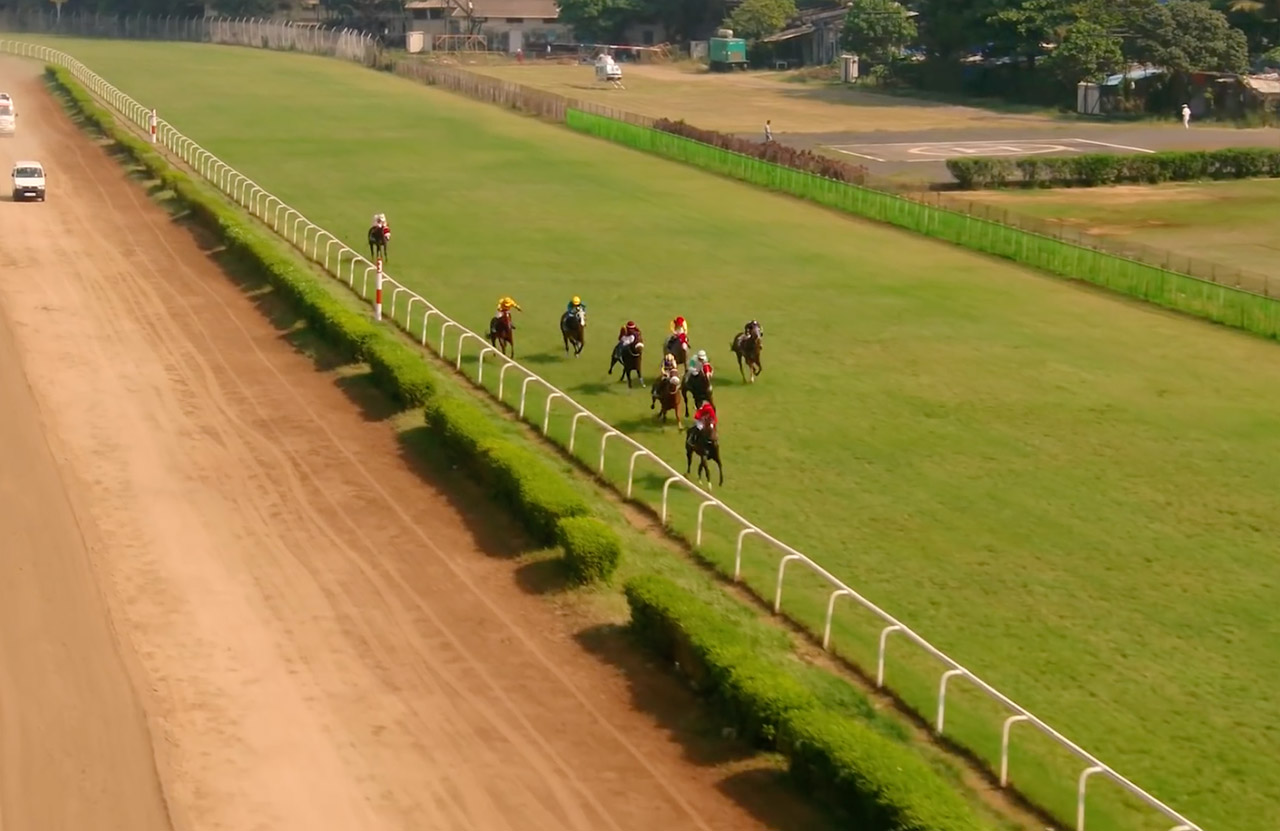
Nothing stirs up the Indian socialite circle like the Derby Weekend held in Mumbai. Film stars, industrialists, liquor barons, politicians almost everyone who is someone makes it a point to be seen, talked and photographed about in this edgy, prodigious event. What started as a modest event in 1943, McDowell’s Indian Derby has become one of the biggest sporting and glamour events in India. Over 25,000 enthusiasts flock together making it not just a horse racing event but also a platform to flaunt extravagant haute couture.
The derby weekend begins on the first Sunday of February and is held at the Mahalaxmi Racecourse. Apart from the races, the event also features some awe inspiring performances by international salsa dancers, aerial ballet, live bands, fashion shows and much more. Known as the weekend of high stakes, adrenaline, excitement, glamour and elegance, this flamboyant affair presents a prize purse of over 10 million rupees for the jockey who strikes gold.
Goa Carnival
Source
February is the month of celebrations, and when we say celebrations how can the party capital of India be left out! Goa is probably the only place in India that breaks away from the conventional persona of the country as being conservative. The Portuguese influence on the state could be the reason for the constant merry-making mentality of Goans; evidently the carnival too is an integral part of the Portuguese history.
Although the carnival is celebrated only for three days, the preparation for the festivities begin weeks earlier, which turns the streets into a chaotic spin-top as the carnival approaches. The Goa carnival is essentially a time of gala jamboree and revelry just before the solemn 40 days of Lent season for Christians. It seems to take Goa into a trance like zone where food and drinks are abundant, and dazzling processions or live music performances are always around to accompany. Music always finds its way into any Goan celebration, nudging even an innocent bystander to shake a leg. There’s almost a fairy tale like feeling in the carnival: blazing fireworks, exotic dancers, mystery fortune tellers, and most importantly an intoxicating cloud of happiness and joy.
St. Francis Xavier’s exposition
Source
If you happen to be in Goa in November, then make sure that you head for St. Francis Xavier’s exposition; a once in a decade event that is held to deepen and invigorate the faith in Christianity. St. Xavier, a renowned Catholic Jesuit missionary is predominantly known for his work in spreading the message of Jesus in Asia. Born in Spain in 1506, the saint came to India along with the Portuguese and from there travelled across Asia, spreading the Christian faith. After he died due to fever, he was first buried in the Chinese island of Shangchuan. Later St. Xavier’s body was removed and brought to Goa, where it is preserved at Basilica of Bom Jesus. Although the saint passed away in 1552, his body miraculously survived decomposition for over four centuries and his face is still discernible.
Once every 10 years, on his death anniversary on December 3rd, the saint’s body is openly displayed in a glass case. The case is taken along in a procession led by various priests and then displayed at the St Paul’s Cathedral for veneration. Apart from holy mass and choir, there will be also several shops selling trinkets and souvenirs. Food and drinks are plenty and the general atmosphere at the church is jovial and happy.
Ram Singh got back to education as he spoke fondly of his five-year-old daughter. He had dropped off a customer at the Kendriya Vidyalaya and was waiting for her to pay, when he asked her how good this school was. She said to him, there is a lucky draw every once in a while. Put your daughter’s name in it. You never know. Apparently, he was this nice to all his customers and they all ended up learning about him during the course of a ride; and he about them.
He took her advice and got his daughter into the school. But his wife still has a problem. She wanted the child to go to a private school. She also wanted him to buy land sooner, for him to have a better job, et al. And here he is, smiling his way through life, relating anecdote after anecdote and telling me that he stays out until 11 in the night so that he stays out of her way. And he talks to people so that he doesn’t miss his kids too much. They are asleep by the time he gets home, and still asleep when he leaves. Hard working and making full use of a democratic system? Yes, that’s our man.
He asked me why I had taken his rickshaw number. I candidly told him. What he said next reflected the ideals of peace feminism and a call to affirmative action. He first started out by assuring me that I will meet more good people than bad in this, or any city. A bad episode gets hyped up in the media because it draws mass sympathy. But no one is going to tell you about an average, good day: that is common place and lacks excitement. I agreed. He said, what happened to that girl in December 2012; it was very sad. But sadly, maybe fate had that in store. And when it is decreed by fate, there is little you can do to prevent something. Yes, one must be careful, he said. And this is where he took me by surprise.
In India, where a girl is invariably blamed during a mishap for her clothing or demeanour, this uneducated man said that these things were not even an issue. It was refreshing to find an open-minded person. Being safe is. He would, he said, never drop of a lady in a lonely spot. And he would ask his male passengers to be careful as well. That is simply about being sensible. And a lady needs to remember that for better or for worse, she is a minority, not because of anything else, but the fact that a drunken thug would have much more physical power.
Delhi Rickshaw | Courtesy: Jack Castleman
He has spoken with a lot of ladies, even been offered a cigarette by an American lady, and holds women-folk in high esteem. Yet, he does not judge: smoking, clothing and demeanour be damned. He is more concerned with being of service and making people smile, and that is what he does.
I asked him my final question as we were nearing my house. “Do you know about the Telangana?” On this he had a refreshingly open stance, “to each his own, madam. On one hand, you wonder how many pieces they will chop off one little finger. But then, they must have had their reasons and self-esteem to have demanded what they did for so long. All for the best!”
And with that, he delivered me safely home and true to character, refused to take the extra tip I offered. I went back home that democracy and the related ideals of governance in one, has been met fair & square for this common man. He may not have told me things that I did not already know, but he did so with the simplicity bereft of agenda and judgment. Yet, he was open to others’ views as well. I had met the real aam aadmi, the great Indian common man!
Define common, my mind told me, as I listened to this auto rickshaw driver speaking the truths of life as we know it in one of the largest democracies in the world. When he had started talking a while ago, I was surprised and I thought to myself, “wow! the real thoughts of the common man.” Yet, what I was witnessing was not so common, to say the least.
Delhi Rickshaw | Courtesy: Jack Castleman
It was around 7 pm and with the sun just down, I beat a hasty retreat from the Mall in Saket. Playing at the toy store with my little girl had literally led me to forget what time it was and by the time I looked outside, I realised that it was later than I had imagined. At least for me. I make it a point to get home before sunset. Conditioned in a country that sped towards modernisation and related security woes in the 1990s? Yes, guilty as charged. My parents did not take any chances; and these days, that voice of caution stood me in good stead.
Until this chance meeting happened recently. Let me explain.
I rushed out of the mall, huffing and puffing, in desperate search of an autorickshaw that would take me to the other side of Delhi: almost next to the airport. And what do I find? Most of them refused, smilingly citing the distance. Others simply named a sky high price and refused to listen to my pleas to use the meter that would calculate the distance and the price accordingly.
Then there was this fellow. He was already hailed down by a group of boys, but he drove right past them and asked me where I needed to get and immediately agreed before snapping on his meter. Never had I been more relieved. Yet, I asked him for his rickshaw number and promptly sent a text message containing the same to my husband, who would get home from office around then.
As I settled down, the rickshaw began trudge along and before long, a traffic signal halted it. A middle-aged woman, holding a baby approached and held out her arm. It was bandaged, bleeding and much more than I care to actually recount here. Suffice to say that it was a gory sight. As she eyed my daughter, I immediately produced a 5 rupee coin, which she took before hastening away. She remained in my thoughts for a few more seconds before I was interrupted by the rickshaw driver. Let us call him Ram Singh.
“Madam, why did you do that?”
Delhi beggar | Courtesy: mskmakm
“She was bleeding. And did you not see the state of her barely there arm?” I replied with a question of my own. He smiled an easy smile and shook his head as he answered, “Madam, do you really think that any sane doctor or nurse would leave it in that state after putting a bandage on it? What she was wearing was a fake bandage. It comes manufactured with the stub at the end of the arm and copious amounts of blood to go!”
I had heard of these stories, but I was aghast at the way Ram Singh had effortlessly diagnosed the situation. I agreed that I had been made a fool and asked him what he thought of kids begging. “Well, that’s a different story,” he began as he took me through how the begging industry works, and how even an invitation to adopt is rebuked with a crass, “we make more money than you can imagine!”
At this, our man, got into the nitty-gritty of what I would like to term as public policy ethics. And never once did he raise his voice nor use bad language. He spoke about how the system at the traffic signal works and who all are involved. The best bit? He spoke without being judgmental. He simply told the tale of how it, and how this must cease.
Soon Ram Singh got down to education. These kids need to be put in school, under the guidance of teachers and a normal childhood, he reminded me in simple words. I did not need to hear the speech of a big politico to understand the essence of what was being revealed here. However, the massive racket that thrives on alms, literally, is one that is supported by the very people who have been given tools like uniforms and authority to actually put a stop to it. But then comes the question of what they make if not this: a measly salary? The problem is from within, he reminded me, echoing the sentiment that public policy needs to be fashioned for a thorough inside-out cleansing drive. “You really want development madam?” He asked. “Give the country to the armed forces: we will be a changed nation in 10 years!”
I know many friends of mine who drink coffee regularly but do not know that coffee exists in different forms other than instant coffee. There are many who swear by Nescafe Classic or Bru Gold, which they consider premium coffee. I may sound offensive but instant coffee is not the only way; in fact it’s a very bad way of making coffee! Instant coffee cannot match up to brewed coffee’s flavour nor does it have Arabica beans. It uses Robusta beans that are lower in flavour. Don’t know the difference?! Read on…
Is that plant a genius?
That plant might be a genius! It created a chemical that would keep pests away. Fortunately for us and unfortunately for the plant – that plan did not work the way it intended to. The chemical might have averted a few pest attacks, but attracted far greater threat – human beings. The plant I am talking about is coffee and chemical is caffeine.
To begin from the beginning – coffee is from a more mature part of the tree – the seed – unlike other stimulants. The ripe berry is picked and de-pulped leaving us with a seed called ‘green bean’ or ‘green coffee’. Green bean is uncharacteristically bland with a taste nowhere close to that of coffee, but it is valued for its higher antioxidant levels.
It’s an interesting phenomenon to see how this bland green bean turns to a flavourful coffee bean. Coffee bean is a seed and like any other seed is rich in proteins, fats and all necessary ingredients for giving birth to a new plant. When exposed to heat, the fats and carbohydrates in the bean turn into essential oils, which give the characteristic taste and aroma to the coffee bean. The degree of roasting depends on the need or purpose of use.
Grind – These beans are ground so that the surface area of the bean is increased, which makes extraction easier. The bean can be ground or crushed but making the particles uniform will ensure equal extraction, or else the smaller particle will get over extracted and the larger one under extracted. Hence, the burr grinder is used to ensure that the coffee bean gets ground in a uniform way in which all particles are of similar sizes.
Pause – Does under extraction give a lighter coffee and over extraction a stronger one? No. For a lighter or stronger coffee less or more coffee powder has to be used. Why? Under extraction will not get all the flavours of the coffee as the water runs too quickly. It will not get what you want – It will taste sour. Over-extraction will bring out all unnecessary flavours rendering the taste bitter.
Resume –There are numerous ways of converting ground coffee powder to the coffee we can drink. Let’s look at a few of those popular ways:
South Indian Filter
Coffee-Filter | Courtesy: Mukesh_Thiru
– This is a versatile piece of kitchen equipment, but we restrict its use to making only one type of coffee. It is a simple four-piece equipment – a bottom vessel, a top-perforated vessel that fits on top of the bottom one, a plunger-cum tamper that goes into the top vessel and a lid. Fix up the top and bottom vessel; put grounded coffee (1-2 teaspoons) tamp it down with a plunger. Pour hot water on top. The plunger separates the coffee and water from getting into direct contact with each other. This will regulate water flow and prevent over-extraction. Gravity does the act of pulling water to the bottom vessel. Time consuming process but the decoction is strong and flavourful.
French Press – A beautiful piece with a cylinder, plunger and lid. Put in coffee ground and pour hot water. Fit the plunger and push it down after 2-3 minutes and enjoy the coffee. Coffee grounds come in direct contact with hot water so it has to be at the right temperature. French press is not capable of giving a strong decoction as it does not utilise gravity or pressure to extract it in a concentrated way. So only black coffee!
Espresso Machine – Put coffee grounds into the brew basket. Tamp and fit the brew basket to the machine, and switch it on. The water from the machine’s tank heats and turns to steam. This steam is pressurized and pushed through the tamped coffee grounds. The hot pressurized steam extracts the coffee and flows out. There are different versions of coffee machines – steam-based espresso machines (common) and real espresso machines that pressurize steam (rare).
Instant Coffee – Instant coffee is made by freeze drying decoction extracted from coffee grounds in a factory. Why is it bad? – Generally, low-grade Robusta beans are used as the better quality beans are exported or sold. Freeze drying kills all the essential oils and the coffee flavour. So it is made up with either artificial flavours or other methods. So it mainly has caffeine but loses much of its taste.
Apart from the coffee making process, there is a difference in the type of coffee bean too. Instant coffee uses Robusta beans, while brewed coffee mainly uses Arabica beans. Arabica has a milder, more aromatic taste, while Robusta possesses a stronger, harsher flavour. Most of the brewed coffee varieties we get in the Indian market are blends of Arabica and Robusta.
Specialty Coffee
These are high quality coffees that differ from normal coffee in terms of visual quality or taste. It is a type of coffee that is specifically grown in specific conditions such as altitude, climate, soil, shade grown, plant type, etc. Since all the best conditions come together we get a better tasting coffee and the taste is consistent unlike in blending. Obviously, it is costly too. Categories of specialty coffees are:
Single Origin Coffee – Coffee grown at a single geographical location or estate. E.g. Dark Forest by Coffee Day
Organic coffee – Coffee grown without using chemicals and pesticides are in great demand
Variety Coffee – Certain varieties are known to possess good inherent quality due to the genetic make-up of the plant.
Coffee making is very enjoyable act personally to me and I believe it would be to you too. Take it up and try it. I am sure you would love the buzz, the excitement in the making of a cup and everything else.
All those sports enthusiasts who love going to the stadiums to watch the game are secretly waiting for one other thing. No, it isn’t the popcorn and soda, it’s the “WAVE”. So basically a group of people get up from their chairs raising their hands up in the air, and quickly lowering them back and retiring back to their seats, then the group next to them repeats the same thing, this happens all through the stadium making a wave sort of illusion. It is like a mass hysteria that takes over the crowd and suddenly everyone wants more. The social media too has its own version of waves. Every once a while there comes this huge surge of absolutely hilarious jokes related to one particular individual or incident and takes everyone by storm, something like the trending topics in twitter but this wave is everywhere right from FB, whatsapp, messages, tweets, memes and in some cases videos too. It is just impossible to ignore them; they are like an annoying Bollywood song that slowly grows onto you.
If you still haven’t understood what we are talking about then here it is plain and simple:
Do you remember those CID jokes? Almost everything from ACP Pradhyuman’s hand gestures to Daya’s antics were hilariously illustrated, and then came the ‘Thalaiva’ himself: Rajnikanth, this wave was more of a tsunami and the effects are still felt in a lot of places.
Today it’s all about Alok Nath, no one really knows how and why these particular characters suddenly get so much publicity but you can’t stop laughing your guts out every time someone forwards one to you. Have a look at these one-liners:
Alok Nath believes in ‘Aashirwad at first sight’.
Alok Nath believes the ‘F’ in FTV stands for Family.
Alok Nath carried Hanuman-Chalisa to school instead of notebooks.
Alok Nath eats Prasad as starters.
Alok Nath goes to KFC to eat his favorite ‘Gaajar ka Halwa’.
Alok Nath had all the Senior Citizen privileges since he was 6 years old.
Alok Nath has requested for an ‘Aashirwad’ button to Twitter.
Alok Nath has zero friends because he always turns ‘Dosti into Rishtedaari’.
We found some really funny memes too..
In fact it is not just about funny one liners and memes. These insanely creative people actually write a whole song.. Check these out:
Presenting Lungi Dance in Alok Nath Version..
Dhoti ko thoda round ghumake,
Pandit ke jaisa tika lagake,Coconut ko rassi lagake
Aa jao sare mood banake.. All the Babuji fans;dont miss the chance-
Kanya Daan,Kanya Daan,Kanya Daan,Kanya Daan
Mandir me jab ye bhajan lagega,
havan ke paas aana padega,
Dhoti ko uthana padega,
Aarti karke dikhana padega.. All the Babuji fans;dont miss the chance-
Kanya Daan,Kanya Daan,Kanya Daan,Kanya Daan
Night jaagran me aya mai to,
mujhko rokega kon aur kayko
Mera mood mai Kanyadaan karega-
kisi ladki ke daddy se nahi darega.. Jisko aashirwad lena hai le lo-idhar hi mai khada pair
pakad lo..
Mandir me jake pujari ko puchlo,
mere bare me ‘Alok Nath Memes’ pe padh lo..
Kanya Daan Kanya Daan Kanya Daan Kanya Daan
Today, Neil Nitin Mukesh with his plural names is trending and Nirupama Roy with her soul wrenching sobs is soon catching up. Wonder whats in store tomorrow, lets just hope that these waves never die down..
It is said coffee culture is growing in India these days. Is it true? Surprisingly, if we flip the pages of history, we realise that there is a history to coffee culture in India that many of us are unaware. Indian Coffee has had an international journey and has political colours to it as well!
Middle East –> India –> Italy –> Europe –> Indonesia -> America
The coffee plant is evergreen and grows at high altitudes in places close to the equator as it hates frost. It bears berries that are green in colour, which slowly turn crimson when ripe. The seeds inside these berries are the coffee beans we know. Coffee was first discovered in the Middle East. There are various myths on its discovery but the most popular one is the 9th century discovery by the Ethiopian shepherd Kaldi whose goat ate the berries and became energetic and started prancing around. This raised the shepherd curiosity, who felt a rush when he consumed the seeds.
Coffee drinking slowly became popular in the Middle East where it was mainly used for spiritual purposes. Dervishes (Sufi Muslim saint) used to drink the black potion to help them reach religious ecstasy. These Sufi saints used to drink pounded, boiled coffee during spiritual gatherings and the humble café’s in Arabia in early 16th century.
The world did not know much about coffee then. Arabian traders exported coffee only in a roasted/salted format so that they do not germinate anywhere else. An Indian Sufi saint named Baba Budan, went to Mecca for pilgrimage and was fascinated by this dark drink he saw in Mocha, Yemen. He tied a few beans to his belly with a cloth and smuggled the beans out of Arabia. Legend has it that Baba Budan planted seven saplings in South India in 1670 where they grew to become coffee plantations on Baba Budangiri hills in Chickmagalur.
From the Middle East, coffee also went to Europe where it became fairly popular though with some opposition as it was termed a Muslim drink. Only after the Boston Tea Party in and the war in America in the 18th century when tea was scarcely available in America that coffee took over and then never looked back. The global coffee consumption over the years rose to reach 7,358,897 metric tons in 2008. To reach to such crazy volumes, there has to be something in it that drives people to drink it.
Cafe culture in Europe, especially Italy and Austria has been associated with socializing with people. Daily workers used to gather in the morning at the coffee bar. Talk to friends, read the newspaper and drink a shot of espresso to start the day. That’s where the culture of Starbucks originated from and now is used world over by many of the cafes we know. From the spiritual gatherings of Sufi saints coffee moved onto social gatherings in humble Café’s in Europe during the 17th -18th centuries. There were cases like in the Ottoman Empire where coffee was banned solely for the reason that people gathered at cafes and hatched rebellious plans against the ruler. The association of coffee with social gatherings and meeting people is strong, which is a prime reason for people to drink coffee.
The first Indian coffee house came up in Calcutta in 1780, of course to serve the British. Another came up in Madras later. Slowly as the British spread across hill stations and to rest of India coffee plantations went along with them. The earliest coffee plantations in Chickmagalur and Coorg were established in late 19th century. Renowned Kannada folklorist H.L. Nage Gowda has chronicled the legends of early coffee plantations in his “Bettadinda battalige – Coffeeya kathe”.
While the spread of coffee culture was confined to small pockets in South India, its wider acceptance happened after the Coffee Board of India was established in 1942. All major cities had an Indian Coffee House were intellectuals of all kind converged. However, the modern phenomenon of Starbucks cafe culture begun only in 1996 the first Cafe Coffee Day outlet was set up in Bangalore. It catered to the youth as a place to hang out and surf the internet, rather than as a coffee connoisseur’s place.
Meanwhile, Bangalore is set to host the fifth edition of India International Coffee Festival, the flagship event of the Indian coffee sector, from January 21-25, 2014. Do check out this event, which the Coffee Board of India has organised to showcase India as an emerging global coffee destination.
Today India celebrates “Pravasi Bharatiya Divas” or the “Day of the Non-Resident Indian”. Organised under the aegis of the Ministry of Overseas Indian Affairs, the event is aimed at engaging the Indian Diaspora across the globe. It is a big day for the government of India – international conferences, elaborate statements by dignitaries, signing of accords, grand cocktail dinners, hobnobbing of the bigwigs, etc. The government puts in its best efforts to showcase the country for returning NRIs and PIOs, encouraging them to set up businesses with large investments.
The theme of this year’s Pravasi Bharatiya Divas is “Engaging Diaspora: Connecting Across Generations”. Quite touching and insightful! However, one look at the recent events can bring down the grand jumbo jet of NRI pipedream and slam it to ground reality! The arrest of Indian sailor Captain Sunil James and Indian diplomat Devyani Khobragade are still raw in our collective memories. Particularly, shocking is the difference of treatment in getting these two NRIs released!
In July 2013, Captain Sunil James was wrongfully arrested in Togo on false allegations of helping pirates who had attacked his ship, MT Ocean Centurion. While his family made desperate attempts to secure his release since then, only the death of his child arouse the nation’s consciousness. Soon the government woke up to this personal tragedy and made some efforts. In contrast, the reaction to Devyani Khobragade’s arrest was violent. Both the government and the political opposition were frothing in anger against this injustice meted out by the careless US federal government!
Anyway, let’s return to the larger issue of who are NRIs and PIOs, and how well are they living abroad. While the rest of the world calls them as expatriates, we prefer to call them Non-Resident Indians! An NRI is an Indian citizen who holds an Indian passport and has temporarily immigrated to another country for six months or more. A Person of Indian Origin (PIO) is a person of Indian ancestry born abroad whose ancestors emigrated from India long ago. A PIO is not a citizen of India who has subsequently taken the citizenship of another country.
According to the Ministry of Overseas Indian Affairs, there are around 10 million NRIs living abroad as on 31 December 2012. Similarly, there are 11.9 million PIOs who have settled in 205 countries since the 18th Century when one of the earliest Indian immigrants left the country for greener pastures. Some of their stories are really interesting!
The Great Indian Diaspora Infographics
To Embed Infographics into your post Copy and paste below code
<img style=”max-width: 100%;” alt=”NRI Infographics by Caleidoscope.in” src=”https://caleidoscope.in/wp-content/uploads/2014/01/NRI-infographics-caleidoscope.jpg” />
Then came the large wave of migrants who were taken as bonded labourers by the British across their vast empire in the 19th Century. Sugarcane farms in Mauritius, Guyana, East Africa, the Caribbean and Fiji islands were filled with cheap Indian labourers indentured by debt. More prominent immigrant communities across the world were:
Gujarati Banias who went to Kenya, Tanzania, Zanzibar, and South Africa
Malabari Moplas who went to Saudi Arabia, Oman and the Emirates
Tamil Chettiyars who went to Singapore and Malaysia
Bihari Bhumihar and Kayasthas who went to Mauritius
Punjabi Sikhs who went to Canada
Despite their widespread presence, the largest concentration of PIO communities are found in a few countries. Being fourth to fifth generation descendents, most of them have lost touch with Indian language, culture and religious rituals. They are:
Malaysia and Sri Lanka with nearly 3.5 million PIOs residing there (mostly Tamilians)
The US comes next with the most diverse set of PIO communities – 1.3 million
South Africa also has a diverse set of PIO communities – 1.2 million
Canada comes next with large number of Punjabi Sikhs farmers – 0.8 million
Surprisingly, the NRI population that has been settling abroad since 1947, has grown rapidly to be on par with the PIO communities. The biggest NRI populations are seen in:
Saudi Arabia – mainly skilled workers and engineers for oil industry – 1.8 million
The UAE – mainly skilled workers and engineers for construction industry – 1.7 million
The UK – mostly well qualified doctors and engineers – 1.5 million
The US – mostly well qualified doctors and engineers – 1 million
While we are not concerned about PIOs since they are well settled in another country, the current state of NRIs is of utmost concern to us. Not only because we love our expatriate brethren, but also their money! The most noteworthy aspect about NRIs is their remittances to India. It would be surprising to note that NRI remittances in 2012 matched the total export revenue of the entire Indian IT industry!
According to the World Bank’s Migration & Development Brief-2013, India was the world’s largest recipient of foreign remittances, earning $71 billion. It was followed by China with $60 billion and the Philippines $26 billion. Obviously, the GCC countries (the Gelf money, boss!) had the lion’s share with 48%, with the US following way behind with just 13%! Again our IT guys have fallen behind. I had expected our Andhraite and Kannadiga IT engineers in the US to be minting dollars!
“Beloved younger brother,
Greetings to respectful parents. I am fine at my end. Hoping your end is fine too. With god’s grace, and parents’ blessings, I am arriving safely in America and finding good apartment near university. Kindly assure mother that I am strictly consuming vegetarian food only in restaurants, though I am not knowing if cooks are Brahmins. I am also constantly remembering Dr.Verma’s advice and strictly avoiding American women and other unhealthy habits. I hope parents’ prayers are residing with me. Younger brother, I am having so many things to tell you, I am not knowing where to start. Most surprising thing about America is it is full of Americans!”
That was the great Indian immigrant as depicted in the “The Inscrutable Americans” written by Anurag Mathur way back in 1991. The protagonist Gopal Kumar’s comical discovery of America begins this way. He is bewildered by American girls, new gadgets, naked women billboards, vegetarian cats, mobile telephone and multi-channelled colour TV!
That was the era of the ABCDs – American Born Confused Desis – where Indians who travelled or born abroad were not sure to adopt Indian culture or Western. Way back in the pre-liberalised India, the clash of Indian culture with the Western was the hottest topic debated in the media. However, over the years since liberalisation and globalisation, these cultural differences seem to have faded away. Or have they?
The evolution of a Global Indian is aptly portrayed by the NRI poster boy Shahrukh Khan in “Pardes” where he brings the two cultures to meet each other, in a well settled overseas Indian family in “Kal Ho Naa Ho”, an NRI eager to return to India and work towards its development in “Swades” and as an Indian Muslim trying to get acceptance in America in “My Name Is Khan”.
Thaipusam in Singapore – Image Courtesy William Cho
Today, you can be a burger eating, jeans-clad yuppie, who loves heavy metal, but yet remain an Indian at heart. On the other hand, our culture guardians are seriously concerned about dilution of our culture due to Westernisation of our education and entry of corporate business in every aspect of life. Many Indians are confusing Modernisation with Westernisation. Do you think that being a part of the modern society in India needs you to adopt western culture? Modernised countries like Japan and Korea have held onto to their strong cultural roots even today. Do you feel urban India is somewhere losing its cultural identity and giving way to western mix?
We at Caleidoscope seek your opinion about the emergence of a “Global Indian” amidst us. The global mindset is too complex to define. Its essence lies in a sense of curiosity and openness to learn about cultures and business environments beyond the familiar. People who have a global mindset are open to actively challenging themselves to operate beyond their comfort zone.
Living and working in a foreign land does not automatically build such a mindset. Several Indians who have lived in another country seek out the familiar even after they have been in their adopted country for years. The people they socialise with are all from the home country. Being immersed in an unfamiliar world frightens most of us. Familiarity is a warm blanket. A global mindset is about actively seeking the unknown, says Abhijit Bhaduri.
So the question is, do we have a Global Indian mindset? Why should we have it and does it help us in enriching our culture?