Birds Of The Same Feather… Celebrating Friendship

3

Once you enter the life of a vagabond, there really is no looking back. Any Indian Army Wife will tell you that. It is not about the new places; rather, it is all about the excitement of the new faces. With these hopes in my heart, I had joined my husband on a posting in the hills. I was prepared for long months of boredom, even though I had heard of fun times happening. Where was all the fun, I wondered, as I pushed the stroller carrying my daughter (a little over a year old at that time), walking down the meandering paths, reflecting at the silent, isolated beauty of the hills.

friendship day

As I walked, an awesome thing happened. Like many walkers would report, I felt a sense of happiness and elation: the inevitable happy hormones were released. I went back home and cooked a batch of stew. The next thing I know, a lady from the apartment upstairs rang my bell and asked me what the amazing fragrance was. I laughed and asked her to come on inside to try a bowlful. Soon, over daily cups of green tea, we gradually included other ladies from the two adjoining blocks. And before we knew it, friendly chats turned into gregarious potlucks. Home sickness and memories from previous cantonments were shared and soon forgotten, as we unknowingly made new ones for the future.

Art clubs, cooking classes, weekends spent driving around the hills and picnicking: there was little we did not do. When our husbands left on tour, we rounded up the kids, got together, played blaring music, danced and then played dumb charades until the wee hours of the morning. Oh, what I wouldn’t give to get those times back. Those songs, dances, and play dates with all the kids from the block; those all night chats and those late night phone calls, while the husband would haplessly await his turn to gain our attention!

family and friends dayThere were times when we would come to each other’s rescue; for instance, when preparations for a dinner party would come to an abrupt halt due to some missing ingredients in one’s house; the neighbour would supply the said ingredient. When a lady had to stay up all night working on a presentation, there were at least two others supplying her with courage and coffee. Another one left her purse at an ATM only to realise that late in the night, but a helpful neighbour took charge, drove her there and did not rest until it was found.

Is this friendship? It had to be. Because it did not merely cling onto good times; it held steadfast and proved itself worthy even in the not so good times. When this particular posting came to an end, there were tears and broken hearts. Some of those hearts are yet to heal; some still cry for the separation they had to endure; and all of them vow to keep in touch.

friendship day games

Today, my friends from that cantonment are not just friends; they are my soul mates. They have seen me through my crazy projects, egging me on and giving up a good night’s sleep to stand by me. They have seen me through my tears and hormones, asking me to hold still and let the torrid time pass, assuring me all along that I am not alone. They had asked me for courage when they had fallen prey to a particularly hard time, and they have left me with a non-stop stream of cherished memories.

We all came from different parts of the country: Jaipur, Ludhiana, Shimla, Kolkata, Mumbai, Dehradun, Agartala… an endless list. But somehow, we managed to overcome any instincts regional. We had only one instinct: and that was called fun. Each one of had decided to bring fun to the table, and the rest as they, was history.

friends

This Friendship Day, I would like offer a toast, not to any one individual, but to the gaggle of women, who will always remain girls at hearts, irrespective of the magnanimity of the rank their husbands happen to pick up (God willing)! I would like to offer a toast to the spirit of those times; to the coming of age of friendship; to the fact that we all hold something more precious than those school or college-time stories. We have seen it all; and we have seen it all together!

I will cherish and celebrate friendship with those girls who will always be in my heart; to my soul sisters… Have an immensely Happy Friendship Day! We may not necessarily have been birds of the same feather; but what makes us special is that, in our own individual way, we all flocked together!

Getting Your Photos Printed Fast!

0

Digital photography has revolutionized how we document and communicate human memories. Although they have overcome in many ways, with the worldwide web playing a big role, but can digital photos replace paper ones? This is like the age old debate between kindle and traditional paper books. But even the most devout kindle supporters agree that despite all its merits, it can’t mimic the feel and experience of a real book. That is how it is with physical photographs and if getting your favourite photos ever seemed to be too much of a hassle; you might be tempted to try on of the photo printing apps that are available in India. The Photojaanic app is definitely one to try.

Photojaanic

The app, which is only available for android devices, is well laid out with four sections. The “create section” is where you build your print order. Starting from there, I was surprised how little time it took for me to open the app, get the print job ready, and place the order. You can get all this done in less than five minutes, Or if you believe The Photojaanic marketing folks, in less than a minute.

You can obviously choose pictures from your smartphone’s gallery, but what makes the app more useful, and probably more appealing for the shutter happy generation, is the option to import pictures from your Instagram or Facebook gallery. Personally, I find the option for Google Photos import more useful as the higher quality images there will ensure that the prints have a good amount of detail.

In the create section, you get the options to choose the kind of print you want. This is pretty easy and straightforward. You can get square prints, polaroids, and framed wall prints. If you want a photobook, you can get one with a personalised cover, or if you prefer a professional design, you can choose the “designer cover’ option. The photobooks start at 399 rupees for 30 pages, which is pretty hefty a size for the price.

Photojaanic_Android_App

The worst part of the experience is probably the wait, it takes around four days for the prints to reach you. But we’ve all become somewhat accustomed to that thanks to the e-commerce boom. But the wait is kind of reimbursed when you feel the crisp polaroids of your memories in your hands.

Photojaanic_Poloroid

The prints I ordered were pretty sharp and the colours vivid. It was also because I used high quality images, which I knew were good for printing. Mobile phone screens make it hard to decide what is high quality and what is not. So, I suggest you look at the pictures on a larger display, like a tablet, television, or a computer monitor, before ordering the prints.

The printing however doesn’t have to be limited to photographs. If you’re an artist working digitally, you may like to see or distribute your work in print. In other cases, you may want to get prints for a particular poster for your wall. The uses can be many.

Why not the website

Photojaanic_Desktop

Photojaanic_Photobook-01

The Photojaanic website offers much more options in every category. You can get your photos printed in Kodak Photobooks, on stationery, calendars, and pretty much every gift item. The website also gives you access to a Pro plan, which gives you the option to use custom album designs, using different paper finishes, among other things. This is useful if you’re a professional photographer. It is easy to get lost in the horde of options that the website provides, especially, if you don’t have a clear image of what you want.

If you know what you want, dimensions and all, and prefer using a computer, you should use the website. For all others like me, who want to get good prints, easy and fast, the Photojaanic app serves them right on purpose.

The Magical Era of Doordarshan Serials – Part 1

8

The 1980s are considered to be the golden era of Doordarshan in India. For those who are ignorant, Doordarshan is the mother of all television channels in India, which still clings onto its legacy role as a public broadcaster. Particularly, DD National was the only channel available to the masses before the advent of cable TV in India in 1991. This was the time when most of today’s generation was young and impressionable. When I look back, I have to agree that nothing we see on TV today seems matches up to it! What gave the TV shows of that era their universal appeal? How did those shows manage to mesmerize an entire generation that they are still nostalgic about it? Was it merely the newness of having a TV set in your house or was it something beyond that? Here’s an attempt to find out.

1. Humlog

 Doordarshan Serials, Hum log serial
Hum log serial – Courtesy: Wikinewforum

Humlog was Doordarshan’s longest running television serial, having aired over 150 weekly episodes! This serial was quite popular when it was telecast in 1984 and many characters from this serial had a fan following which rivalled even film stars at the time. Even today they have a fan page on Facebook and my mother refers many of Humlog’s actors by their character names! Humlog was a story of a middle class family with each member of the family having a unique quirk and different aspirations. 52 episodes of this serial were originally written and telecast and then the story was stretched as per the audiences’ response. Bollywood doyen Ashok Kumar as the ‘Sutradhaar’ used to sum up each episode in a unique interaction with the audience. The show received audience response letters in huge numbers. There was a time when people thought that one of the characters was really a social worker and Ashok Kumar had to subsequently clarify that she was just an actor and not a real social worker! The appeal of this serial lies in the fact that many Indians during the ’80s could relate to the characters and the issues it dealt with.

2. Nukkad

 Doordarshan Serials, Nukkad serial
Nukkad serial | Courtesy: Flipkart

Nukkad was another popular TV serial telecast on Doordarshan during late 1980s. This was a show about the activities of a lower income suburban locality and the hardships they faced. Matching with an India that was urbanising, this show saw a lot of people identifying with the different colourful characters and could relate to their problems. Each episode was based on an everyday issue that often revolved around one or two specific characters at Nukkad. At the end of their day, members of the group met at Kaderbhai’s tea shop and talk about their day. Some of the characters from this show, like ‘Guru – the leader’, ‘Khopdi – the chronic drunkard’, ‘and ‘Gupta Seth – shop keeper’ became memorable. The first run aired for 40 episodes and each of them dealt with different everyday issues and concentrated on one or two of the main characters. Every episode ended either on a happy note or on a sad note, but what made each episode endearing was that it was true. People could see the reflection of their life, their issues in there. Subsequently there were attempts to revive the show, but nothing could match the magic of the original.

3. Malgudi Days

 Doordarshan Serials, Malgudi Days

If there was one show that fascinated both the young and the old alike, that was Malgudi Days! It was based on the short stories and novels of renowned author R. K. Narayan such as “Swami and Friends” and “The Vendor of Sweets”. Directed by the late Kannada director, Shankar Nag, the series was shot near Agumbe in Karnataka. The main story, “Swami and Friends” revolved around the life of a ten-year old boy Swaminathan (Chamy), living in a fictitious town of Malgudi. Swami hates school and prefers to roam around the town with his two best friends, Mani and Rajam. The story also included the day-to-day travails of the people in the town in general. The serial’s titles were showcased with beautiful sketches by Narayan’s brother and acclaimed cartoonist, R. K. Laxman along with the immensely hummable tune, “Taa naa na, tana nana naa…” Doordarshan aired 39 episodes of Malgudi Days in its first season. The show is running even today on Doordarshan and is aired every Saturday morning at 10am. The appeal of this series lay in its simple and realistic look; and the children, of course, couldn’t wait to see what mischief Swami got into next!

Ramayan

 Doordarshan Serials, Ramayan
Ramayan TV series | Courtesy: Banglatorrents

This was the first mythological epic TV series that gained incredible popularity in 1987-88 when 78 episodes were aired on Doordarshan. The series directed by Ramanand Sagar, was a TV adaptation of the great Hindu religious epic and was based on “Ramcharitmanas” written by Tulsidas. The Limca Book of World Records claims it to be “the world’s most viewed mythological serial”. Being a country of God fearing people brought up on mythological stories, Ramayan was bound to attract immense appeal by bringing these mythological characters to life. Incidentally, Doordarshan officials were initially sceptical about the response for such a serial and wondered if it would breed an atmosphere of communalism. But they were in for a surprise when Ramayan achieved such a popularity level due to which daily life used to come to a standstill on a Sunday morning when hordes of people gathered around the closest available TV set. Arun Govil and Deepika Chikhalia who played the roles of Ram and Sita were revered as demigods where ever they went!

Suggested Read – The Magical Era of Doordarshan Serials – Part 2

Factfile –

http://en.wikipedia.org
http://akshaygn.blogspot.in
http://movies.rediff.com
http://www.flipkart.com/
http://www.malgudidays.net

Myths About School Drop Outs

1
Curricular focus in schools

Everyone says that childhood days are the best days of our life and that we should enjoy it while it lasts. Schools, playgrounds, chocolates and lots of laughter; life seems so perfect and carefree. But what do we find when we zoom into those schools and playgrounds? Headmasters, teachers, punishments, bullies, homework and dreaded exams seem to make life miserable. Zoom in a bit more and we’ll find exam results, peer pressure, comparisons and lots of confusion. Doesn’t it seem like this “best part of life” also has other aspects to it that we tend to overlook? Just the way we overlook the real stories about those kids who drop out of school!

We live in a society that expects us to excel; they do not judge us on what we excel in, only the fact that end of the day we are the best at what we do. However, this opinion is voiced only after we excel in our chosen field. When we were kids and were about to give our first exam, our parents expected us to excel in exams even if we had other interests. You would hardly find parents asking their kids to take their exams lightly just because they were more interested in dramatics or sports. Curricular activities are viewed as the first major milestone in life that you have to excel in.

There are so many myths around school dropouts; one of the most common myths is that such kids are not very smart. When smart kids who don’t score a distinction are often questioned, what chances do the other kids have who don’t clear their exams! With such a strict narrow mindset in place, it’s only natural that school dropouts are viewed as a lost cause. Our education system does try to identify what every kid is good at, but in the end they always rate all kids based on their scholastic scores. Some kids may not be great at cracking those exams, but they could be brilliant at other skills that are not evaluated in schools. The massive turnout at reality dance and music competitions indicates that children are desperate for an outlet to their extracurricular talents.

School-education
Excellence beyond studies

Another myth about school dropouts is that these kids belong to underprivileged families. Kids belonging to middle class or upper class families are believed to have almost everything going for them, and so the necessity to drop out never comes up. A perfect example to bust this myth would be that of K. Kamaraj, one of the well known chief ministers of Tamil Nadu. This man did attend school briefly and his family was able to afford school. However tragedy struck soon and Kamaraj had to quit school immediately to work in his uncle’s cloth shop as a salesboy. Later, he got into politics and achieved great success. Kamaraj belonged to a family of traders, and he wasn’t exactly from a poor family, yet he got out of school. So, let’s not get judgemental when a kid drops out of school and assume that it is because of his/her financial status.

Indian families are closely knit; most of us live with our parents almost all our lives. In such a society, we get judged based on how our parents brought us up. If a kid fails in his/her exams or decides to quit school, parents get labelled as – being too easy on their kids, not teaching them responsibility, not making them understand the value of education, etc. However, we need to realise that parents can only guide their kids; forcing these little adults to do something they do not like will not to do any good for the kid or the parent.

Famous School Dropouts

Career Details

Dhirubhai Ambani

Ambani started his career at the age of 17 by working with an oil firm in Yemen in the 1950s and moved to Mumbai in 1958 to start his own business in spices.

Gautam Adani

Choosing not to join his father’s textile unit in Ahmedabad, Gautam set up his own diamond brokerage business in Mumbai, at the age of 20 during the 1980s.

K. Kamaraj

In 1914, at the age of 11, Kamaraj dropped out of school to support his family by working in his uncle’s clothshop as a salesboy.

Micky Jagtiani

Born in 1952, Jagtiani joined a London accounting school from which he dropped out. He drove a taxi in London for a while before taking over his family’s shop in Bahrain.

P N C Menon

At the age of 10, Menon lost his father and he had to drop out of college to do interior decoration business. Later at the age of 26, he met an Arab businessman who invited him to do business in Oman.

Sachin Tendulkar

Not a classic case of school dropout, Tendulkar scored a world record partnership during his school days in Shardashram Vidyamandir at a tender age of 15. He could not continue his education afterwards due to his international cricket career.

Shahid Balwa

Born in 1974, Balwa dropped out of college and joined his family’s hotel business. Today, he is the youngest Indian billionaire to be featured on the Forbes List.

Subhash Chandra

Born in 1950 in a small north Indian town, Chandra dropped out after Class 12 and entered his family’s rice export business at the age of 19.

Vasantdada Patil

Born in 1917 in Maharashtra, Patil could only study up to the secondary school. While working on his father’s farm, he took interest in politics and joined the Indian freedom struggle in 1942.

Gautam Adani is a billionaire commodity trader; he had his dad’s flourishing business to take care of. He was admitted into a good school but soon he dropped out. Gautam could have easily taken over his family business and settled quite comfortably. Instead he moved out of his dad’s shadow, and started his own trade to become one of the richest men in the world. Gautam broke another myth that kids who drop out of school have their ancestral wealth to fall back on.

The famous saying – “Don’t judge a fish by its ability to fly”, is quite fitting. School dropouts are much more than these myths; each one has their own stories and destinies to work towards. Not all of them achieve great success and not all of them waste their life either. Schooling is only as important as we make it to be. In the end, we are only remembered for what we have achieved and not our degrees.

Factfile –

http://www.boostup.org/en/facts/reasons
mythdebunked1
http://www.myjourneytobillionaireclub.com
http://indiapulse.sulekha.com
http://www.nytimes.com

Historic Brands That Transformed India

0

Brands-that-transformed-India

After India shed its socialistic legacy, the country has become a breeding ground for world’s leading corporate brands. While most of these brands have emerged since the days of liberalisation, some of them are historic brands that date back to the pre-independence era. In this compilation, I have tried to collect a few historic brands that have shed their old image and donned a new identity in sync with a nation in transformation. So don’t be perturbed if you can’t find great names like Godrej, ITC and Bata that have not changed their logos much.

Gattu to Gradient ribbon – Asian Paints

Asian Paints old logo

The origin of a brand that is India’s largest and Asia’s third largest paint company is surprisingly humble. In 1942, the founders, Champaklal H. Choksey, Chimanlal N. Choksi, Suryakant C. Dani and Arvind R. Vakil, chose their company’s name ‘The Asian Oil & Paint Company’, by picking a name randomly from a telephone directory! However, the founders of Asian Paints understood the concept of design much before any Indian company realised the value of branding and design. In 1954, they commissioned the famous cartoonist R K Laxman to design their mascot: “Gattu”.

Asian Paints new logo

After over four decades, Gattu was eventually phased out in 2002 during a rebranding exercise. Again in 2012, the Asian Paints logo was rebranded, but this time, the previous logo’s logotype has been kept intact, with a change of colour and accompanied by a gradient ribbon.

http://rupeeblog.wordpress.com
http://brandingsource.blogspot.in

Bajaj Auto

Bajaj Auto old logo
Bajaj Auto old logo

It is hard to forget the famous Bajaj Auto ad, “Bulandh Bharat ki bulandh tasveer, Hamara Bajaj!” Aired at a time when there was only one TV channel across India, that ad became imprinted in every young Indian’s mind. The company was founded in 1930 by Jamnalal Bajaj and soon the Bajaj brand gained a foothold in every Indian household through its omnipresent Bajaj scooter emblazoned with the hexagonal Bajaj logo.

Bajaj Auto new logo
Bajaj Auto new logo

However, the advent of liberalisation brought in a wave of latest technology Japanese bikes and scooters that made Bajaj look jaded. By early 2000s, motorcycle sales surpassed scooter sales and Bajaj Auto lost its market share to Hero Honda. In an attempt to recapture market share, Bajaj Auto restructured its business and launched new motorcycle models under a new brand. ‘Inspiring Confidence’ became the leitmotif of Bajaj Auto in 2004 with a dynamic, stylised and trendy ‘B’ with the logotype moving from lower caps to upper caps.

http://www.icmrindia.org

Banyan tree revitalised – Dabur

Dabur old logo
Dabur old logo

While Bajaj had to undergo a total transformation to shed its old jaded image, Dabur wanted to remain connected to its roots, literally! This homespun herbal specialist brand was started way back in 1884 by a Kolkata based doctor, Dr S K Burman. His name became so trustworthy that the company’s name ‘Dabur’ is derived from his name, ‘Daktar Burman’! The original logo had a banyan tree – a symbol of nature and protection – and a logotype underneath it.

Dabur new logo
Dabur new logo

The current logo adopted in 2004 retains the tree image, but gives it a dynamic and vibrant visual. The tree trunk mirrors the form for three people with their arms raised conveying exultation in achievement. The broad trunk represents stability and its multiple branches represent growth. The transformation in the company has reflected the change in its brand, which has become the world’s largest ayurvedic products company with a billion dollar turnover today.

http://www.business-standard.com
http://www.dabur.com
http://kikkidu.com

Hindustan Lever to Unilever

Hiindustan Lever old logo

Established in 1933, Hindustan Lever Ltd has dominated the Indian consumer goods market as though it was born in India. In fact many people did not even realise that it is an Anglo-Dutch multinational company until the company’s name was changed to Hindustan Unilever Limited! The erstwhile logo of Hindustan Lever had a bold typography in letter ‘H’ with a foundation of a steady effect of an angular, growing leaves, depicting the letters ‘LL’. The logo’s dark green colour lent an evergreen appeal to the visual that has high recall value even in current times.

Unilever new logo
Unilever new logo

Just before completing its 75 years in India, the company became Hindustan Unilever Limited in 2007 and adopted a new logo with a new visual treatment of 25 different icons inside the letter ‘U’ (signifying the organisation’s diversity). However, I feel the distinct leaf green image of HLL was far better than the present cluttered look of HUL logo!

Hero Honda to Hero Motocorp

Hero Honda old logo
Hero Honda old logo

Remember Hero Puch? The trendy 50CC handgeared moped was the favourite mode of transport for youngsters in 1980s. The moped’s manufacturer soon joined hands with a Japanese motorbike maker and a new brand was born. Hero Honda Motors began producing India’s first 100CC bikes that were light, easy to manoeuvre and affordable as well.

Hero Motocorp new logo

By the time the 5 millionth bike was rolled out in 2001, the joint venture between Honda and Hero Motors was beginning to wear out. Both the partners decided to separate amicably and in 2011, Hero Honda became Hero Motocorp. As part of its major rebranding exercise, a new logo was created utilising the negative space to depict ‘H’, forming as part of a ‘Closure’ technique. The designer also claims to have incorporated the Indian catapult in the design, which is not easy to spot! Whatever that is, the company’s rebranding was a phenomenal success with the “Hum mein hai Hero” TV ad becoming the anthem for the youth.

http://www.desicreative.com
http://www.heromotocorp.com


———-

Here is a book that talks about the inspiring journey of booming brands that are proudly Made in India.


Life in Big Indian Cities!

4

Life-in-big-Indian-cities
Image – Satish Krishnamurthy

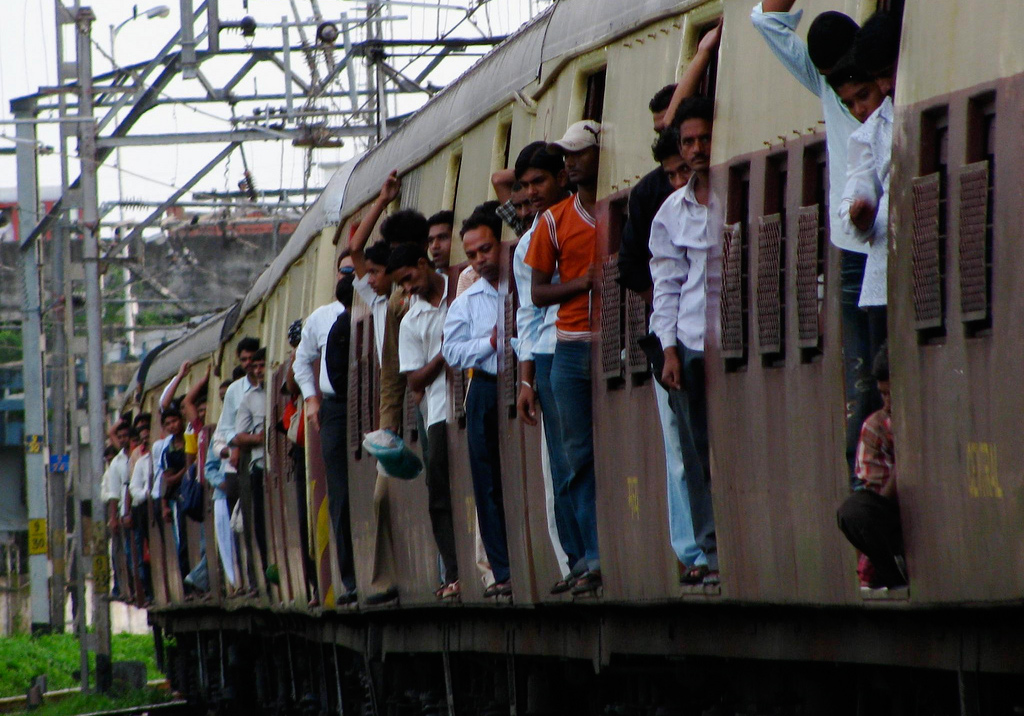
I was speaking to an old friend who is working in Mumbai. He said there is no life in the big city these days; just a mind-numbing rat race between 9-to-9 with no work-life balance whatsoever. Another friend from Delhi echoed similar feelings. “Every day it’s an uphill struggle just to get to office and return home. Weekends are lost in just lying around and recuperating from the pain. Even if you go out for shopping or cinema during weekends, the crowd everywhere just squeezes out all the fun!”

Life in big cities
Image via Flickr by Padmanaba

These words made me think… Is there any life left in big cities? Can we rate Indian cities based on standards of living and quality of life? Studying the latest data from the Census of India, 2011, I found an interesting way to find cities with better living standards. I filtered out cities with more than 3 million people and ranked them on literacy rate, gender ratio and population density. Accordingly, Nagpur, Pune and Chennai led the ranking, followed by Bengaluru, Lucknow, Ahmedabad. Surprisingly, Surat the top ranked city ‘Quality of Life’ surveys, shares the bottom rank with Kanpur due to its poor male-female ratio of 1000-758, which is one the lowest among all cities in India!

 Ranking based on Human Development Indices
City Population Sex Ratio Literacy Rate Population Density Rate
Nagpur  2,405,421 961  93.13 10,550 1
Pune  3,115,431 946  91.61 11,205 2
Chennai  4,681,087 986  90.33 25,501 3
Bengaluru  8,425,970 914  89.59 6,642 4
Lucknow  2,815,601 915  84.72 4,218 5
Ahmedabad  5,570,585 897  89.62 22,473 6
Mumbai  12,478,447 852  90.28 22,937 7
Hyderabad  6,809,970 945  82.96 18,480 8
Kolkata  4,486,679 899  87.14 27,774 9
Delhi  11,007,835 875  87.61 29,155 10
Jaipur 3,073,350 898 84.34 27,613 11
Surat 4,462,002 758 89.03 23,196 12
Kanpur 2,767,031 842 84.14 1,366 13


Incidentally, some recent surveys have also rated cities based on other criteria. Chandigarh ranked first in the national sanitation and cleanliness survey conducted under the National Urban Sanitation Policy in 2010. It is followed by Mysore, Surat and New Delhi. Similarly, the newly launched Annual Survey of India’s City-Systems by Janaagraha, Surat was the top-ranked city for urban planning, cleanliness, water supply, crime control and government services. It was closely followed by Pune and Ahmedabad. So is there life in big cities or should we all move to smaller ones? Check the data and decide.

 Quality of Life Ranking
City Rank
Surat 1
Pune 2
Ahmedabad 3
Mumbai 4
Chennai 5
Kolkata 6
Jaipur 7
Hyderabad 8
Bengaluru 9
Delhi 10
Kanpur 11


Factfile –
http://pib.nic.in
http://articles.economictimes.indiatimes.com
http://articles.timesofindia.indiatimes.com
http://www.ronanlyons.com

Memories of A Simpler Childhood

3

The other day, the 1980s Bollywood classic ‘Mr. India’ was being shown on TV and my entire family was glued to the set. The scene where the protagonist finds the bracelet which could make him invisible brought out squeals of delight from my kid. All through the movie, whenever Mr. India, the invisible messiah ran out to help the oppressed, my son cheered for him. He laughed uncontrollably every time the unseen hero performed his antics and pounded his enemies and made them scream “Jai Bajarang Bali!”

Mr India | Courtesy: Ndtv.com

My five-year old, who saw the movie for the first time enjoyed it so much that I felt really proud. Proud to be of a generation that made simple films like Mr. India, which impress children even today when they are exposed to all sorts of super-hero flicks. I was proud to belong to the generation that knew the simple joys of being children, to be born at the time when Google was not an answer to all the questions in the world!
Unlike today’s children, for us playtime meant fresh air and getting drenched in the rain; playing for hours soaking wet and then returning home to be scolded by our moms; only to be rewarded with a hot steaming cup of Horlicks or Bournvita. Our favourite games were not the destructive and very addictive Xbox games or the Angry Birds; but ‘land and water’, ‘hide and seek’, ‘lock and key’, Gilli Danda, Lagori, skipping, Kite flying, etc. Today’s games on the computers, game consoles and tablets are no match to any these outdoor games. Playground rules were simple, ‘finders keepers, losers weepers!’

Gully Cricket by Proshanto Mahato

Galli cricket, with our own indigenous rules was another highlight. If you hit the ball till the building compound wall you scored four runs and a six if the ball went out on the road. You got out for breaking a glass and had to be the one facing the music when the uncle or the auntie would come out screaming and threatening to never ever return the ball. The disappearing act that we pulled then would impress Mr. India himself!

My son got his first cycle when he was two years old. I never owned one! And yet, I love cycling more than he does. Maybe it has something to do with the fact that we used to rent bicycles and ride around the neighbourhood. Fifty paise for a half hour and one rupee for an hour were the standard rentals. One of our favourite things to do on Sundays was to get up really early and go rent a cycle. Ride around for an hour or more and then get back home in time for ‘Rangoli’, the Doordarshan TV show that featured Hindi film songs.

I also belong to a time when chai and pakoda meant just that, Chai & Pakoda! We were all treated with homemade hot fried snacks the best ‘happy meal’ ever! Laddoos, farsaan, chivda, chakli, shev, bhel, dhokla-the list is endless. It felt like our mothers and grandmothers had the powers of a genie. Chocolate was a rare item that was something that a relative staying abroad brought us once in a while. On a regular basis, candies were more than enough.

The white and black striped candies that tasted like today’s Polo, Ravalgaon Mango-bite and Pan Pasand; and the half-moon shaped orange and lime coloured candies were the most in demand. Cone ice-cream was a treat that one got only when our exam results were declared and that too, only if one had scored good marks! Nariyal pani, the hygienic fresh juice was available in abundance and Maggi was just then sneaking into our lives.

Hindi Horrorcore VCR | Courtesy: Finderskeepersrecords

Recording a collection of our favourite songs on audio cassettes, renting video cassettes and VCRs once in a while to watch movies with the entire family and neighbours… There’s so many more memories, so much more to fondly remember. Apart from watching movies on VCR at home, going to a theatre for the latest release was also a community activity. The entire neighbourhood used to be locked out and the keys handed over to one hapless neighbour who was unable to come!

However, my heart goes out to all the children of today. How different is their childhood from ours… Ours was much simpler and yet fun. Now, I think things have changed drastically due to our urban concrete jungle where there is no community feeling or any outdoor activity! Children are locked up at home since there is no security outdoors nor there is any outdoor space left to play. They have ended with their expensive gadgets and 24×7 cartoon channels; but are they really having as much fun? Or maybe they are, and I am just missing my simple childhood!

Factfile –

The Magical era of Doordarshan Serials

https://www.facebook.com
http://ezinearticles.com
http://en.wikipedia.org
https://www.facebook.com

Why Simple Logo Design is Better

0

simple logo designA logo needs to be memorable and easy to duplicate. Highly detailed logos can prove to be difficult in both cases. When someone looks at a company logo, it needs to be a symbol of the company it represents. As Microsoft uses five colors in its makeup, people recognize the image as that belonging to PC compatible software.

1. Ink Prices

 The cost of producing an image in multiple colors is far more expensive than one that consists of one or two. From a printing standpoint, each detail requires various shades and gradients in order to reproduce the effect. The cost may be minimal for one or two letter-heads, but could begin to escalate in mass production. Even the printing of signs and posters can cost between five and ten times more than they need to.

2. Iconic Imagery

Anyone who has a smartphone knows the image of the apple with a missing piece or the little green robot. Both of these images represent quality of products to the respective owners. The logos used by Apple and Google have made a profound impact in how consumers purchase their products and are void of high detail in either image.

3. Time Span

Whether it is printing or developing the logo’s image, detail will be at the expense of time. This could be the time it takes a developer to create the image or duplication. Any graphic designer loves to create extravagant imagery, but a logo doesn’t need such practices. As time is money in most cases, a simple design could save money on your advertising budget by reducing the man-hours needed to create your iconic representation.

4. Association of Memory

As long as the marketing department does its job well, even the simplest of images can be effective. An image with which your consumers can associate your specific product or service is all that is needed. For instance, Google’s green robot is associated with anything Android. People associate the Android robot with smartphones and tablets without giving it a second thought. It is how we look for items at the store when shopping. Most people will know what they are looking for at a retail store by just the logo.

Your logo doesn’t need to be extravagant in order to produce the intended result. While it can be fun at times to design an elaborate image full of detail, it’s not practical to use such an image in full-scale production. As long as your image is memorable to the customer, it will be a success.

Predesigned-logo

Memories of Manipal

0

Memories of Manipal | Courtesy: Arvind Kumar
Manipal University | Courtesy: Arvind Kumar

Manipal has been in the news for all the wrong reasons. This tiny student town is known for its amicable society and peaceful co-existence of students and locals. As a student I had been reluctant to enrol in Manipal University, as I had underestimated it. As a fresher, I was blinded by my anxiety to go away from my comfort zone to a far off location. I always chose to look at the brighter side, overlooking all the resources and the opportunities that I had been presented with in this student township.

The massive portraits of the founder of Manipal hung in every building in the campus ensure that every student gets to know the history of the place. Manipal gets its name from the lake, ‘Manipala’. It was supposedly a barren land 50 years ago, when a lightning bolt of an idea struck a visionary man. Precisely, it was 1953 that Dr.T.M.A. Pai founded India’s first private medical school, Kasturba Medical College. KMC was followed by a string of other education institutions that became the Manipal Academy of Higher Education, in other words ‘Manipal University’.

Of course Dr.T.M.A. Pai made a fortune in the education business and passed it onto his children. While one can be extremely cynical about it, but to build a university town is no child’s play! The Pai family did possess well-structured and concrete plans; it was not just about building multi-storied fancy buildings on a high terrain away from the city, but it was about building an educational community that has thrived in a place probably inhabited by wild animals.

Memories of Manipal | Courtesy - Sunnyq2010
Students at Manipal campus | Courtesy – Sunnyq2010

It almost took me around 3-4 months to get adapted to this student community, and most importantly to shake off my apprehensions and discomfort, and fully accept my surroundings. That’s when I started to observe things around me. The endless walks at End Point, lovebirds under every tree, numerous food varieties, exam time visit to the Venugopal Temple, Timmy Anna’s Night Canteen, TC, Dollops, all have left an imprint on my memory.

Autorikshaw drivers in Manipal have a notorious reputation for fleecing the new comers in town. One of those situations, when I was badmouthing an auto driver for the extremely unreasonable rates charged on students. In the middle of my rant, the driver comes up with a sarcastic comeback, surprisingly in fluent English. After many such embarrassing encounters, I realised that auto drivers, bus drivers and even waiters and almost everybody speak fluent English, and of course Hindi with the south Indian accent! So basically you can survive in Manipal, without having to learn the local language Kannada, which is an unlikely situation anywhere else in South India.

Memories of Manipal - Boys Hostel of MIT 1997
Boys Hostel of MIT 1997

Shifting focus towards my fellow students, I observe a lot of girls, who try so hard to match up to the ideals of what they think the western teenage girl would do. They wear as much make-up and hairspray as they can and sneak out in the middle of the night, which is quite strange. On the other hand, I see another set of women still stuck with their backward ideas such as women do not need more rights and freedom and they think we are indebted to our parents. Such narrow minded ideas make me literally bang my head against the wall.
Such instances prove that studying in the Manipal University is an experience in diversity itself. In addition to Indian students, lots of foreigners visit the campus for an internship or a project. I have seen such eclectic set of people from diverse places, and with different mentalities, that I guess I am a now better judge of how to deal with different people. Another eye-catching aspect is the cultural contrast between the neighbouring temple town of Udupi, which is quite traditional and extreme diversity of Manipal, which is quite modern in its outlook!

The Manipal town and the students have a symbiotic relationship. Every year, a fancy modern eatery or a bar or a gaming centre comes into existence to fulfil the daily needs of the students, and sometimes even a bookstore. Students from across india and international students from Middle East and Africa have been an indirect cause for the varied number of cuisines you find in here.
Today, I am no more a fresher and a sense of belonging has begun to sink in. When I manage to do one of those night-out jigs, just to stay awake till dawn and observe the red burning sun rising beyond the Western Ghats and the play of the colours in the sky, from grey to mauve to crimson and to bright yellow, I get a sense of fulfilment.

Text – Sanjana Sandeep

Factfile –

http://manipalblog.com/2013/06/23/the-manipal-auto-boycott-is-it-reasonable/
http://manipalblog.com/2013/05/29/30-nostalgic-photos-of-manipal-1997-to-2001/
http://lifeinmanipal.wordpress.com/2008/01/08/the-beauty-of-manipals-end-point/
http://www.flickr.com/photos/aaykay/with/358365122/
http://www.flickr.com/photos/46654842@N02/with/4284714220/

Munching on the streets of Mumbai

2

Mumbai street food - Mumbai Café Mondegar
Mumbai Café Mondegar

It was a cool pleasant afternoon and we were strolling around Mumbai. Strolling? cool? in the maximum city? Wait, correct that – rushing from one point to another, with a long list of locations trailing from my husband’s hand. This was his wish list of all lists. The 40 best places to eat out in Mumbai!
Yes, we do this in every city we visit and I follow him around, happily savouring the outcome of his research! Well, the point in question: we had 10 days in Mumbai and 40 places to visit; right from Ashok Satam’s famed vada pav to Akouri on toast at B Merwan & Co Parsi restaurant, to a MAFCO outlet of Bombay sandwiches – could we really do it?

When my husband had begun to draw up this list for our Mumbai trip, I had assumed that it would start and end at Chowpatty. But here we are, with a carefully researched list of names, hunting for a particular Parsi place in Fort Mumbai, which would serve yet another variation of Akouri on toast that he just HAD to try. We had begun looking for this place in the afternoon, after we devoured a plate of coconut and tamarind tempered shell fish at Trishna and later the squid session at Mahesh Lunch Home, in the Fort Area. And now, it was almost evening.

Mumbai street food - Mumbai Chez Vous
Mumbai Chez Vous

By late evening, we finally found this ‘hole in the wall’, and famished as we were, we quickly ordered the Akouri on toast that he was so eager to eat. The Akouri arrived, as did the ultra slim pieces of toast. He looked at it and I could see the look of puzzlement register on his face. Yet, he shrugged and wordlessly picked up the fork. Digging deep into the dish, he let it emerge with a sizable portion which he quickly put into his mouth. Then, looking up at the ceiling, he tried to decipher how good it was. And then it happened. His eyes opened wider and he made that face. The face. The face that told me something was wrong.
“What,” I asked?
“Oh my God.”
“What??”
“This tastes just like YOUR egg burji!”, which did not sound like a compliment at all! But rather than pound his head for dragging me half way across town – on foot – I began to laugh and the poor guy covered his face, utterly embarrassed! No more Akouri after that.

Mumbai street food - Mumbai Irani Chai B Merwan & Co
Mumbai Irani Chai B Merwan & Co

Later that night, we wound up at Bade Miyan after our horse carriage ride along the Marine Drive – the highpoint of our Mumbai trip. He ate the infamous Bheja fry and Boti kabab, while I ordered the less overwhelming Paneer roll. He suddenly remembered (after three consecutive nights at Bade Miyan), that I am a vegetarian. Note: good food does that to my otherwise considerate hubby!

So the next day, we landed up at Khau Galli, squeezed somewhere in the bylanes of Church Gate. The vegetarian fare was to die for. But that was not all. We made a trip to Chowpatty to try out the Bhel and it did live up to its reputation. He tried a spicy Maharashtrian dish named Misal pav, which went down well too!

Mumbai street food - Mumbai Tamarind tempered shell fish at Trishna
Mumbai Tamarind tempered shell fish at Trishna

Next up was Ashok Satam’s famous vada pav. Again, the walks around Fort Mumbai began, during which I was frequently distracted by the second hand books being sold on the footpath. While we were picking up a few books, suddenly a whiff grabbed us. A yummy one. We turned our heads in unison to find scores of people emerging from behind a tree. With vada pavs in their hands. Ah! Satam – here we come.

Hubby being hubby, asked for the spiciest version of vada pav fired with a layer of red hot chillies, peanut and garlic chutney. He took a bite and I swear I could see the smoke escaping from his ears. Nevertheless, he finished it and even stopped by on the way to the guest room to grab another one!

Mumbai street food - Mumbai My family at Kalaraksha
Mumbai My family at Kalaraksha

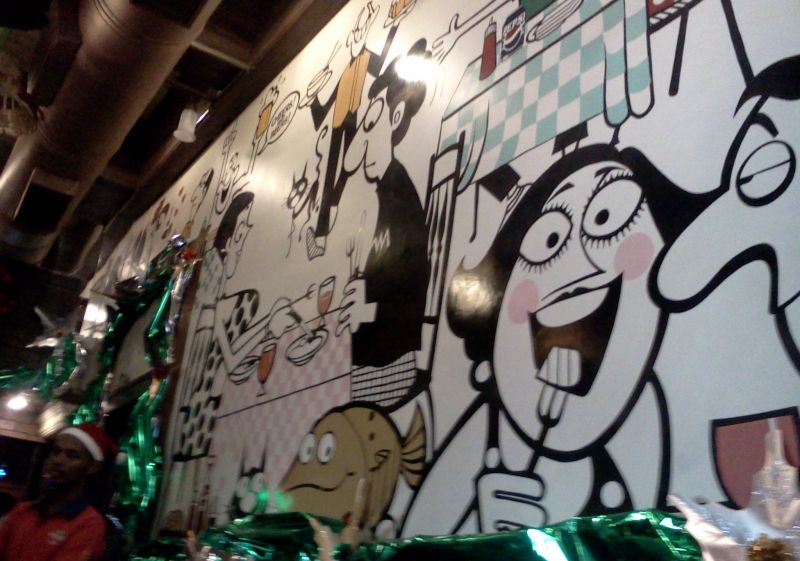
Well, thereafter we reserved our appetite strictly for shopping and wound up at Café Mondegar or Leopold’s Cafe at night. Street food or not, these cafes have that quintessential Mumbai feel – one that made you feel like you belong here no matter where you come from, or the time of the night. The jukebox, the people, the food, the waiters, the buzz – all so worth it. We went back to Café Mondegar every night after we first discovered it.

But of course, the glorious trip had to end. We staked out the best fine dining place we could see around us, and grabbed a seat. This time it was a little eatery by the name of Chez Vous, run by a Frenchman who kept checking if we liked the meal and needed anything else – very European treatment there. As the picture shows, the food was delish!

Factfile –
http://www.lonelyplanet.com
http://travel.cnn.com
Wiki/Mumbai_culture