The end of southwest monsoon heralds the arrival of the most lovable god in the Hindu pantheon. Ganesh or Ganapati or Vinayaka arrives into town in all glory with pandals erected on every street corner with loud mikes and vivid flower decoration. Vinayaka Chaturthi (Ganapati’s birthday) is celebrated with full religious fervour in the Indian states of Maharashtra, Karnataka, Andhra Pradesh and Goa.
After reigning over earth for a week’s time, Ganesha is bid adieu with much fanfare and his idols are taken around the city in grand processions to be immersed in nearby lakes and rivers. However, crass commercial activity has crept into this pious occasion with Ganesha idols made of plaster of paris and painted with toxic chemicals. When such idols are immersed into lakes and rivers, these chemicals pollute the water and create irreversible damage to the environment.

Thankfully, rising environmental awareness has brought in some sense among Ganapati devotees in the past few years. Eco-friendly handmade clay idols – ‘Parisara Ganapati’ – have begun to replace the moulded chemical idols. Since 2009, I was fortunate enough to participate in voluntary movements to build awareness about Parisara Ganapati. In Bangalore, I was part of the LIFE Group, which campaigned among school children to promote handmade clay idols of Ganesha.
Hyderabad is where I saw the fullest extent of the environment damage done by chemical idols which are immersed in the Hussain Sagar lake. Thankfully, a youth organisation – ‘Youth For Seva’ took up the task of educating youngsters about the dangers of moulded chemical idols and vigorously promoted handmade clay idols. Every year, Youth For Seva volunteers assemble children in schools to conduct workshops to make clay Ganesha idols. It was heart-warming to see privileged children from elite schools joining hands with underprivileged children studying in government schools to make these idols.

Parisara ganapati
Today, I am thrilled to see that workshops of this kind are happening across cities such as Bangalore, Hyderabad, Pune and Mumbai. There are creative people like Ganesan Manickavasagam of ClayStation in Bangalore and K Muralidhar in Hyderabad who conduct regular workshops to teach clay Ganesha idol making to both children and adults alike. Experimenting with recycled material, Muralidhar has innovated on a special type of eco-friendly clay, which is a mixture Multani mitti, cotton and wood powder.
Organisations such as EcoExist in Pune and Parisara Ganapati in Bangalore now undertake commercial orders for clay Ganesha idols. People like us who are concerned about environmental destruction can offer no excuses now – you can either learn how to make eco-friendly handmade clay idols or you can buy readymade Ganesha idols. Let’s pledge to ensure that this year’s Ganesha Chaturthi will be an eco-friendly festival!
Where to buy Eco-friendly GaneshaWe have received many enquiries about people eager to know where to buy an eco-friendly Ganesha idol and learn how to make clay idols at home. The rising awareness about preventing harm to the environment seems to be the reason behind this heightened interest. We are extremely happy that we Indians are at last showing concern about celebrating our festivals in a harmless way. Here is a list of places you can buy eco-friendly Ganapati idols –
|
Factfile –
www.parisaraganapati.net

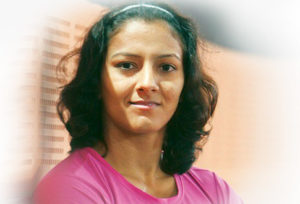
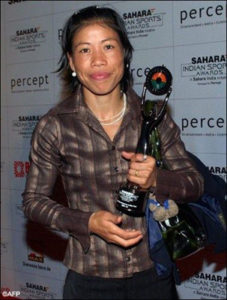
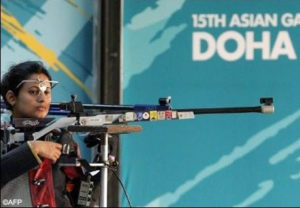
 This autorikshaw driver’s daughter from Ranchi is bound to make waves at the 2012 London Olympics. Deepika Kumari, the 18 year old daughter of Shivnarayan Mahato, already has the world at her feet: World Youth Archery Championships in 2009, gold medals at the 2010 Commonwealth Games, and World Cup gold at the individual Recurve event in 2012. Despite being ranked world no.1, success has not got into this humble village girl’s head. She still recounts the struggle her parents had to undergo to buy her equipment to practice. Apart from aiming for mangoes with stones in her village in Jharkhand, the Tata Archery Academy in Ranchi played a major role in honing her skills to become a world champion! Pic courtesy – MSN India Sports
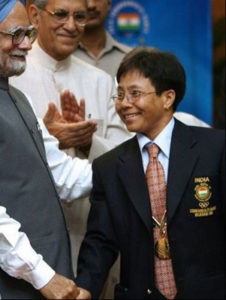 Kunjarani Devi is another Manipuri strong woman to gain limelight in the international sports arena. This diminutive weightlifter began her career with a silver medal in World Women’s Weightlifting Championship in 1989 and she followed it up with successive medals in seven world championships. She won bronze medals in both the 1990 Beijing Asian Games as well as 1994 Hiroshima Asian Games. Controversy arose when the Indian Weightlifting Federation preferred to choose Karnam Malleshwari for the 2000 Sydney Olympics citing that she has better chance in her 69kg weight category than Kunjarani in her 48kg weight category. While her compatriot basked in the glory of winning the first ever medal in the Olympics, Kunjarani faded away from public eye after she was slapped with a six month suspension due to drug use in 2001. However, she made a spectacular comeback in 2006 when she won the gold medal at the Melbourne Commonwealth Games by lifting a Games record weight of 166kg. Pic courtesy – MSN India Sports