Modern kitchenware would be incomplete without non-stick pans. These things are your best mates for easy-breezy cooking! They make flipping and searing and sliding food on your plate a walk in the park. But here’s the problem: unless you treat non-stick cookware with tender loving care, you may have to throw them away and buy new ones every now and then. The special coatings themselves are quite delicate, but with a little knowledge, you can maintain them for years to come. Here are some easy tips on how to clean non-stick pans.
Skip The Dishwashers
Yes, the temptation to just put it in the dishwasher is real, but your non-stick pans don’t stand up to those conditions. The abrasive chemicals can ruin their special coating. Even if the box says “dishwasher-safe,” it’s still a good idea to wash them by hand instead.
Wash with Hot Soapy Water
The harmful chemicals and hot temperatures of dishwashers slowly wear off that slippery coating that lets your food slide right off. Just use warm soapy water and a soft cloth to clean them instead. It takes only a minute of your time, and your pans will thank you by staying non-sticky for a whole lot longer. Here’s how to do it-
Rinse it off with warm water to dislodge loose pieces
Apply a small amount of dish soap on a soft sponge or cloth to wipe it lightly clean
Finish by drying it up quickly with a towel.
Your pan’s coating deserves delicate treatment too!
Clean Them Right Away
The second you’re done cooking, take a moment to quickly wash your pan. The longer the food sits on it, the more difficult it is to clean. When food is cooled in the pan and left to sit, it sticks even more tenaciously, which makes you scrub harder, which damages the coating. It prevents water spots from forming and makes your pan shine like new. It’s like flossing after a meal, a little maintenance beforehand prevents bigger headaches down the line! And it’s so much easier than trying to scrub dried, stuck-on food out of the pan later on.
Skip Abrasive Materials
Never scrub your pans with rough stuff. No steel wool, no abrasive sponge, no abrasive powder. The non-stick surface will get scratched up, with little grooves forming where food will begin to adhere. Even tiny scratches you can hardly see will render the pan less useful over time. Only use soft cloths, microfiber towels, and gentle sponges. For food that is stuck, just soak the pan in warm soapy water for 15-20 minutes and then wipe clean. The water will release the food so you can wipe it off without scrubbing.
Give Your Pan a Little Seasoning
Occasionally, your pans need a little tender loving care known to cooks as “seasoning.” It is not a matter of flavor, but of maintaining that smooth surface. After washing and drying the pan, rub a few drops of oil, vegetable or canola oil work well, onto the surface. Rub it around with a paper towel, making sure the whole cooking surface has a thin, even coating. Next, put the pan on the heat, at a low setting, for a minute or two, letting the oil seep into the surface. When cooled, wipe off any excess oil. This seals up the tiny pores of the coating, forming an added layer that lets food slide off easily.
Avoid the Cooking Sprays
Those easy cooking sprays have a knack for leaving behind a lingering sticky residue that is very difficult to clean. The problem lies in the additives and propellants in the spray, which char onto the surface when cooked, forming a gummy film that builds up over time. Before you know it, your one “non-stick” pan is now a “food-sticking” pan! Instead, use a minimal amount of butter, coconut oil, or olive oil when cooking. If you’re careful with your fat intake, you can just wipe it off with a paper towel. This technique gives you the same easy release for your food without the harmful buildup.
Use Baking Soda for Stubborn Residue
Got burnt food stuck on your pan? Here is how to clean non-stick pans with burnt on food using Baking Soda. It is mildly abrasive but not harsh enough to destroy your precious coating.
Simply make up a paste of baking soda and water
Apply it to the stubborn pan
Gently wash in circular motions using a soft sponge
Rinse it out thoroughly, and dry the pan
In case of very stubborn areas, you can leave the paste on for about 30 minutes before gently scrubbing. Once you’ve had this treatment, give your pan a quick oil seasoning to revive its non-stick quality.
Store Them Properly
Make sure your pans are completely dry before putting them away, as any residual moisture can lead to unsightly spots or even rust on exposed metal surfaces. If you nest your pans to save space, a habit many of us have: place a soft object like a paper towel or cloth napkin between them to avoid scratching. The bottom of one pan can easily scratch the cooking surface of other kitchen utensils. Some people hang their pans which leave the cooking surfaces untouched. Store them in a dry, cool cupboard, away from extreme heat or dampness.
When To Throw Away Non-Stick Pans?
Even with proper use, pans don’t last forever. If food is sticking way too much even after your best efforts at cleaning it, or you see deep scratches where the underlying metal is exposed, or rust or extreme discoloration, it might be time to retire your pan. The most important warning sign is if the coating is peeling or flaking off – those flakes get into your food, and nobody wants that! Most non-stick pans will last 3-5 years if you use them regularly, but some of the higher-end ones will last longer.
Conclusion
Taking care of your non-stick pans is not a chore; it is merely a case of taking a bit of care. With these easy steps, your pans will help you make tasty meals for many years to come! Whether you’re cooking fluffy pancakes, omelets, or fish fillets, a properly cared for non-stick pan makes cooking more fun and cleaning up a breeze. What is your favorite meal to cook in your non-stick pan?
Every part of the world has its own traditions and cultures, which it always tries to uphold. From the language, which is spoken by the people of a specific community to the food that they eat, every element has an important role in the state’s culture and tradition. Hence, the traditional dresses worn by the people of a specific community also play an important role in portraying the distinct culture of the state. Across India, each state in the country has its own specific attire that is culture specific and ethnic to the state it belongs to. It is the distinct and vibrant costumes of a place that add to the festive mood of the festivals. Thus traditional costumes or attires have a vital part to play in determining the culture of any state. Here we take a look at the vibrant traditional dresses of Gujarat.
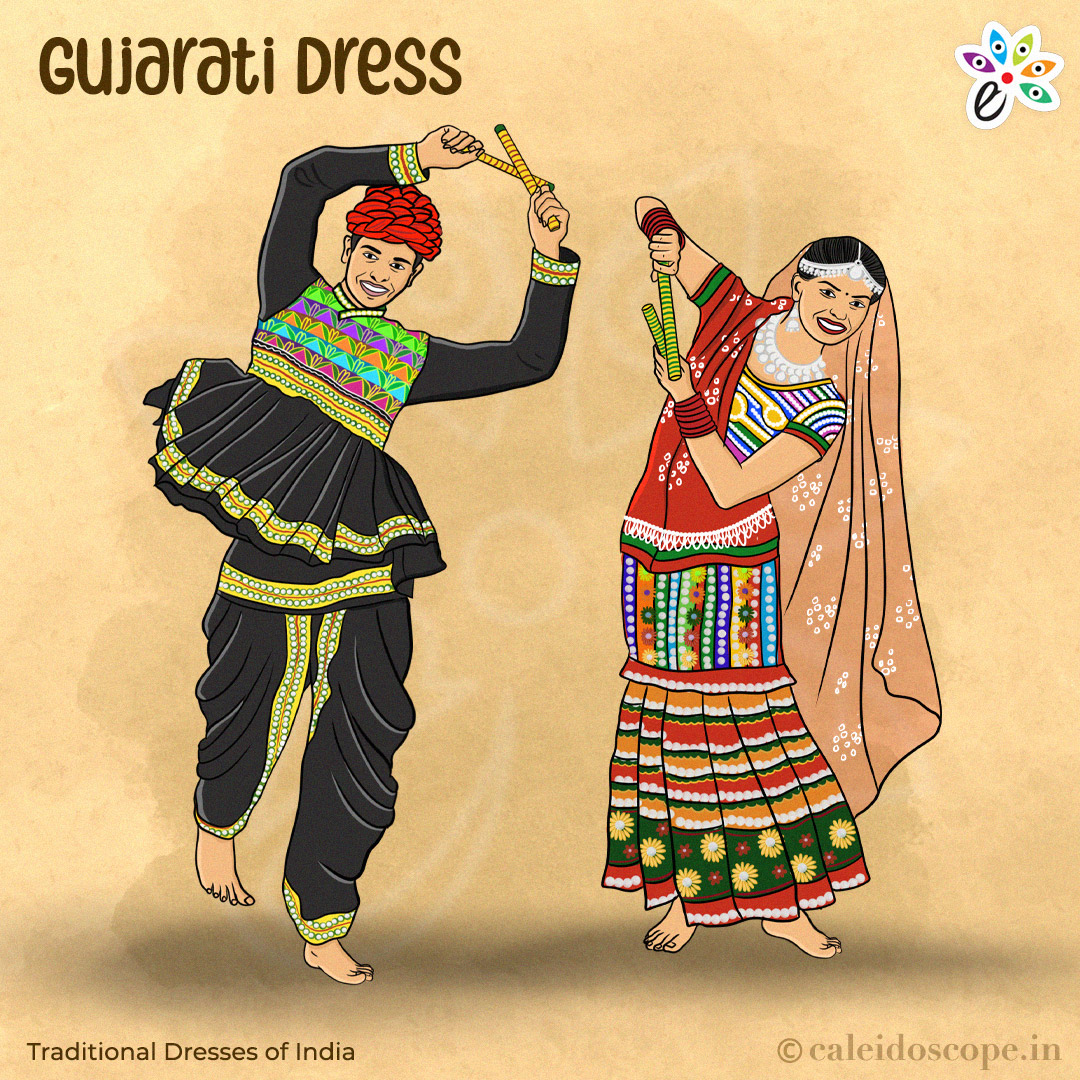
Gujarat is a state situated in India and shares its borders with the states of Rajasthan, Madhya Pradesh and Maharashtra. The state is known for its diverse culture and traditions. The costumes of the state are quite different and varied from that of other parts of the country. Since the state hosts many cultural festivals all through the year, it also has a wide variety of traditional dresses, which comprise the vibrant costumes worn by the people of the state that reflect its own culture and traditions. Men usually wear a Kurta or Kediyu, while women dress in sarees or Chaniya Choli, though recently Salwar Kameez is also preferred by Gujarat women.
Chaniya Choli – A vibrant, embroidered flared skirt (chaniya) paired with a blouse (choli) and a dupatta. Commonly worn during festivals like Navratri.
Saree (Gujarati Style) – The pallu is draped in the front, showcasing intricate embroidery, bandhani, or patola work.
Bandhani Dress – Dresses made from tie-dye bandhani fabric, a signature textile of Gujarat.
Patola Saree – A luxurious, handwoven silk saree with intricate double-ikat designs, popular in Patan.
Gharchola – A traditional saree, often worn by brides, featuring checks and zari work.
Men usually wear Chorno, which is a kind of cotton pants, and it looks quite similar to a dhoti. Chorno is one of the most common clothing which is found in the state and is hence also readily available. This clothing is adaptive to the hot and warm climate of the state. Chorno is worn along with the Kediyu at the top part of the body. It is frock-like clothing and is worn widely in the state. The Kediyu usually comes in a variety of vibrant colours and is also worn on special occasions. Men wear kurta and dhoti too. The men of Gujarat also wear a headgear called Phento.
Kediyu & Dhoti/Chorno – A flared, embroidered upper garment (kediyu) paired with a dhoti or chorno (loose pants). Often worn during Garba.
Kurta & Dhoti/Pajama – A simple cotton or silk kurta paired with a dhoti or pajama, common for festive and daily wear.
Sherwani – A formal, royal-looking attire worn on special occasions like weddings.
Phento (Turban) – A traditional headgear, symbolizing pride and respect, commonly worn in rural areas.
Women usually wear the Ghagra or the Chaniya Choli, which is quite popular not only in Gujarat but in other parts of India too. This attire is adorned with vibrant designs and is worn during festivals and other occasions. Chaniyo is another popular attire worn by the women of Gujarat. This attire is quite similar to the Lehenga in appearance. What makes the Chaniyo unique is its vibrant colours, and distinct intricate thread works and mirror works. Women also wear Chunni. Chunni looks quite similar to the dupattas and is usually used to cover their heads. The woman of Gujarat also wears the saree, in a distinct style, which is different from that of the other parts of the country. Apart from these traditional dresses, the people of Gujarat also wear special dresses for special ceremonies. During Raas Gharba, the women wear Ghagra Choli.
Gujarati Weddings
During weddings, the bride and the groom have distinct and traditional attires. Brides usually wear the Panetar Saree or the Gharchola. Panetar Saree is coloured white with a red bandhani border. Charcoal is a saree that is coloured red and has square patterns woven in it. The groom usually is dressed in a Kurtha with embroidery work.
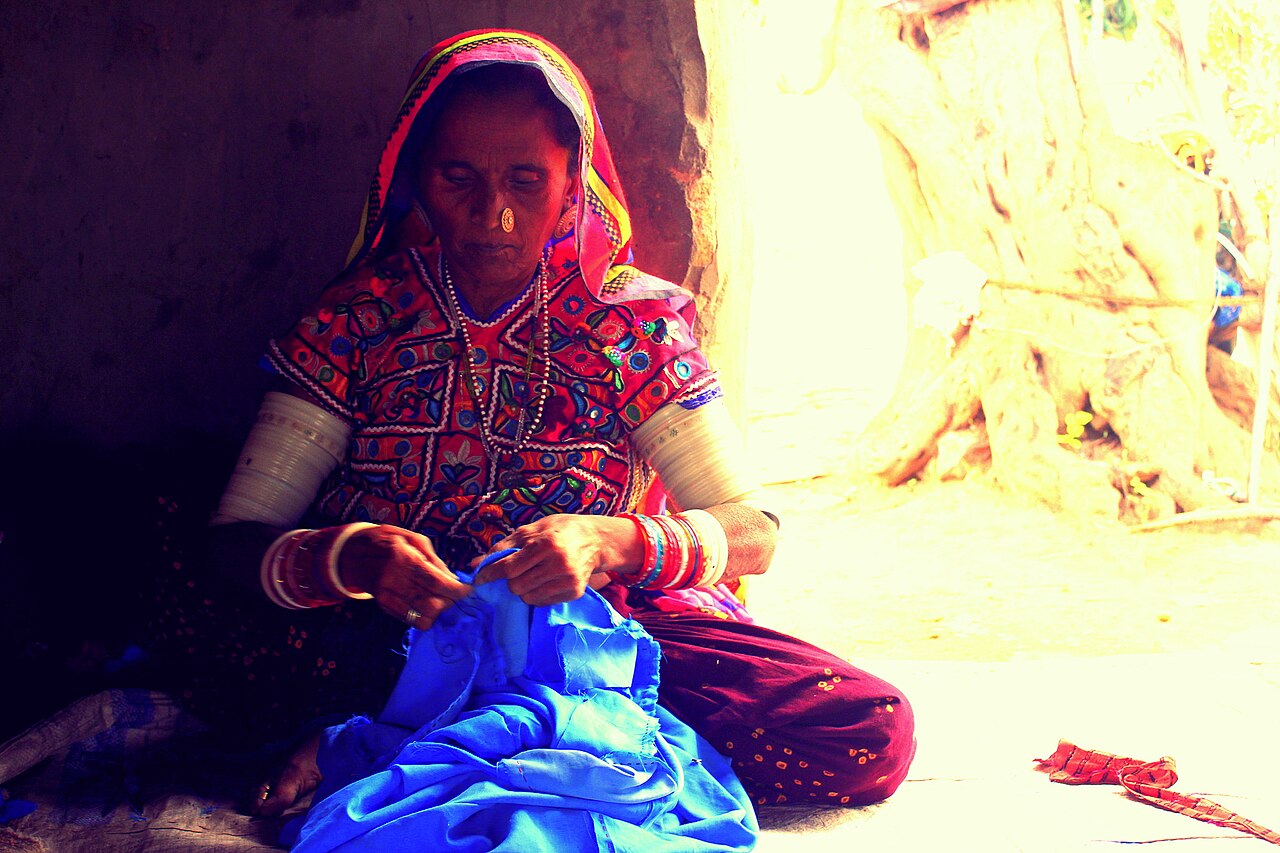
The people residing in the Kutch district, which is situated in the state of Gujarat, is also home to a distinct culture. The women of the district wear a distinct type of Choli named Abha, which is also known as kanjari. Abha consists of a long piece of blouse that is embellished with mirror work and a gold or silver thread work. Apart from these, it can also be observed that the costumes of the state differ across communities, as each community has its particular way of attire.
Though men of the state usually do not wear much jewellery, they do wear a gold chain and a gold ring. For the women of the state, the traditional jewellery includes rings, nose pins, necklaces, chains, among others. Married women wear the Mangal Sutra as a symbol of their marriage. The women from the villages in the state also wear tribal jewellery. Apart from these, the women of the state also wear small balis and nose piercings known as Nath, which is similar to the studded nose jewellery.
Earrings & Nose Jewelry
Bali (Earrings): Intricate silver or gold earrings, including mirror jhumkas and gemstone-studded studs.
Kil (Nosepin): Often adorned with rose quartz or diamonds, available in various sizes.
Necklaces & Head Ornaments
Ranihaar (Necklace): A choker-style necklace, often worn by brides.
Chandan Haar: A heavy gold necklace symbolizing prosperity.
Kundan Batti: A beaded chain worn along the crown of the head, typically during Navratri.
Damani: A head accessory similar to a mathapatti, encrusted with precious stones.
Shinka: A gold headgear with drop beads, unique to Gujarati brides.
Arm & Hand Jewelry
Bajuband (Armlet): Metal or silver armlet worn by men and women during special occasions.
Kundan Bangdi: Bangles with exquisite kundan work.
Waist & Leg Jewelry
Kandora (Waistband): Gold or silver waistband adorned with precious stones.
Patla (Waistband): Another traditional waistband made of gold.
Pocha (Anklet): Silver anklets, often adorned with bells.
Todi (Toe Ring): Silver toe rings symbolizing marital status.
The most distinct features of Gujarat’s costumes include vibrant colours, intricate embroidery, and the elaborately designed mirror work. The costumes also include stonework and beadworks. The costumes of the state also embody figurative intricate and geometrical patterns in their designs. Most of the vibrant costumes that form an important part of the culture of the state are usually worn on special occasions.
The state also has several festivals celebrated all year round. Apart from the distinct nature of the costumes worn by the people residing in Gujarat, the jewellery of the state is also quite different from that of the rest of the country. The jewellery worn by the women of the state differs between different communities. The ornaments include Bangles, chains, nose rings, among others. Intricately designed, they form an important part of their costumes. The state’s attire is also quite popular for its Bandhani and Bandhej designs, which are embroidered with Zari and gold threads.
However, in the present times, the costumes worn in the state has also undergone a significant shift. With the arrival of modernity, many attires have changed in their appearance. Women mostly wear salwar kameez while youngsters mostly prefer skirts, jeans, and tops. The western influence is evident in the clothing style of the people of the state. However, on special occasions, the people of the state usually prefer to wear their traditional attire over modern costumes. However, in many rural areas such as in the district of Kutch, people mostly wear their traditional attires.
Which is the women’s traditional attire in Gujarat?
The Chaniya Choli is the traditional attire for the Gujarati ladies. This dress includes a flared skirt chaniya, a fitted blouse choli, and a decorative scarf known as odhani or dupatta.
Which is the male traditional dress?
A typical Gujarati dress is a Kediyu (pleated long-sleeved garment) with a Dhoti or Chorno, which is a piece of cloth wrapped around the waist and legs, often found with a Bandhani turban, known as Phento.
What does the Patola saree refer to?
Patola saree refers to a typical traditional Gujarati saree that is popular for its intricate patterns and vibrant colors produced using a complex double ikat weaving technique.
What are the events where people wear traditional Gujarati attires?
Traditional Gujarati attires are most dominant at festivals like Navratri, weddings, and cultural events where people flaunt their rich cultural heritage.
How has Gujarati traditional attire influenced modern fashion?
Traditional Guajarati dress has influenced modern fashion by fusion wear in which traditionalism is merged with modernity and by inspiring the designers to take the traditional embroidery and patterns of the traditional attire into modern outfits.
Sambalpuri handloom textile (Ikat) is one of the most ancient textiles of Odisha. The age-old Sambalpuri “Ikat,” is locally known as “bandha kala”. Most of the weavers of this magnificent and globally renowned handloom are spread over different districts of Western Odisha. You can hear the sound of shedding, picking, and beating in most textile village houses, signifying the importance of handloom industries. This cottage industry, where the saris are produced by the brand “Sambalpuri saris,” plays an important role in the economy of Odisha. In this textile, the warp and weft are dyed before weaving as per a preconceived design. Like any other handloom, this is complicated, labour –intensive, and time-consuming.
Ikat is considered one of the most ancient techniques of dyeing textiles in India. Historians believe this Ikat weaving technique has been used in the region for over a thousand years. The word ‘Ikat’ is derived from the Malayan word ‘Mangikat,’ which is inherited from Indonesia. Ikat is an Indonesian word that refers to thread or knot. Ikat is produced in various traditional textile centers in India, Central Asia, Southeast Asia, Japan, Africa, and Latin America.
The name Sambalpuri was named by Padmashree Krutartha Acharya of Bargarh. The tie and dye fabrics of Orissa are much finer and more perfect than the tie and dye of other states. Despite its long history and cultural significance, Sambalpuri ikat handloom remained largely a local craft with minimal exposure to the outside world. In the 20th century, the craft began to gain recognition both in India and abroad. During the 1960s and 1970s, some western fashion designers incorporated traditional Indian handlooms into their collections. This step led to the popularization of the craft, and Sambalpuri handloom was being exported to countries all over the world by the 1980s.
This age-old Ikat weaving art, locally known as ‘bandha kala,’ is a family and caste-based profession that has been passed on from generation to generation. The entire weaver’s family contributes to the making of every product, which takes an average of over a week to produce depending upon the intricacies of the design.
The Meher Bhulia and Koshta communities are mainly engaged in this handloom weaving. It is believed that Bhulia Mehers’ ancestors migrated from Rajasthan and Delhi long ago. When Moghuls attacked Delhi during the reign of Emperor Prithviraj Chauhan, they fled from Delhi and settled in the villages of Dhamantari and Dhansa in the Raipur district of Chhattisgarh. Later they moved to Patnagarh of Bolangir district during the kingship of Chauhan King Ramai Deb. It is assumed that after settling down, the original Bhulia Meher community, intermingled with the other castes, and soon the Koshta Mehers (who are usually tussar weavers) and Kuli Mehers (who are the least skilled) came into existence.
The Subarnapur and Bargarh districts are famous and have earned fame worldwide for sambalpuri fabrics for a variety of patterns, choice of colour, and designs by Kostha and Bhulia weavers. Now the Bhulia Meher weavers are settled in the Sambalpur, Bargarh, Bolangir, Boudh, Kalahandi, and Sundergarh districts of Odisha. The Bhulias have their monopoly of inherited skill and knowledge imbibed over generations. The Kosta Meher community does not follow the traditional Ikat technique, works mostly on tussar weaves, and uses a three-shuttle loom. Bhulia Mehers are experts in tie and dye weaving in cotton and silk. In the last few decades, the Gondas have adopted this craft and become skilled by getting training in the tie and dye technique. But they are still into coarse tied- and- dyed textiles.
The weavers work independently or under master weavers who own their independent handloom enterprises or are part of different weavers’ cooperative societies (WCS) and self-help groups (SHG). The rural areas of western Odisha are the hub of Sambalpuri handloom industries. In these cottage industries the weavers produce the products under the brand “Sambalpuri” at home. The entire family of the weavers’ is engaged and contributes to the making of the finished product. They do not require any assistance from the outside. Women and children are mostly involved in the preparatory work of weaving, which includes tying the yarns with knots as per the graph, dyeing the yarn, and untying the tied knots after dyeing, whereas men are involved in the job of ‘bandha’ and then weaving. This art of ‘bandha’ (yarn tie-dye) and weaving of Mehers’ is passed from generation to generation. The Odisha “Bandha” has a district native identity because of the skill and knowledge imbibed over generations. The children learn and inherit the talent at a very young age.
Technique of Sambalpuri Ikat
Sambalpuri Ikat weaving, locally known as Bandha kala (tie and dye art), consists of two steps: (i) bandha (tie and dye) and (ii) buna (weave). First, a graph of the design is developed on paper, and then the yarns are grouped as per calculations and tied with knots as per the designs. These tied yarns are dyed and dried by the resist-dyeing technique. Once the yarns are completely dried, the knots are untied, and then each yarn is separated for weaving. Traditionally, both the warp and the weft yarns are tied and dyed before weaving. When the tied and dyed technique is used either for warp or weft, it is termed as ‘single Ikat’, and when in both it is known as ‘double Ikat.’ Now a lot of improvements have been made in the skills of the artisans and the quality of the products.
Uniqueness of Technique
The Gitagovinda sacred cloth with verses from the Gita Govinda text
By using tie & dye, designs are developed and subsequently woven into saris and fabrics.
Designs are developed by the use of tied & dyed yarn without the use of devices like dobby and jacquard.
The designs are reflected almost identically on both the side of the fabric and sari.
It is not only confined to geometrical design but also fine, artistic curvilinear designs like shanka (conch), phulla (flower), machha( fish), lata ( creeper), lahari(waves), deula ( temple), hansha (swan) etc. in the fabric, which is unique.
In double Ikat, from 5 lines to 30 lines are most frequently used, and this is the tradition of Sambalpuri Style of tie & dye.
Designs as well as letters (Calligraphy) of any shape and colour are easily produced with full perfection and accuracy.
The harmonious blending of colours, the floral and animal motifs make sambalpuri style of Ikat more appealing and unique.
The exquisite craftsmanship of the ‘bandhakala art’ is reflected in their intricate weaves, motifs, and beautiful colour combinations. The artisans acquired the skill from their ancestors. Traditionally, Sambalpuri bandha motifs were inspired by surroundings, nature, flora, fauna, alpana (jhoti/chita), and geometrical patterns. Gradually they are experimenting with contemporary designs to strive to meet the market demand. In Odisha Ikat, designs are horizontal, and motifs are mainly lion, elephant, deer, horse, swan, duck, tiger, fish, tortoise, and snake, as well as creepers, conch, Konark wheel, rudrakshya, kumbha, and flowers like lotus, lily, jasmine, etc. The Motifs of Odisha Ikat are also inspired by various sources like architecture, mythology, painting, and folk art, which make it exclusive and different from other Ikat fabrics. New types of ‘bandha’ rendering portrait, landscape, wildlife, flowerpots, and Saura tribal art. Even the mythological epics like Mahabharata, Ramayana, Jagannath culture, and folk tales of Odisha inspire the motifs of the saris. Traditional motifs such as chakra (wheel), shankha (shell), phula (flower), matsya (fish), etc., are also incorporated into these amazing hand-woven saris.
The traditional Sambalpuri Ikat saris are thematic and have specific names according to their significance. For example, ‘Panchabati’ resembles Panchabati forest, where Lord Rama was in exile; ‘Konark Chaka’ resembles the wheel of the Konark temple; ‘Asaman Tara’ resembles the shining stars of the sky; ‘Nandighosha’ resembles the chariot of Lord Jagannath; ‘Sankha’ resembles the mythological conch shell; ‘Bichitrapuri’ is a variation of Ikat on borders. The boat design in the saris represents the folk tale of Odisha, ‘Tapoi,’ which relates to the maritime heritage of Odisha centuries ago. The motifs of the saris are associated with different Hindu gods and goddesses, such as Shiva, Vishnu, Lakshmi, Durga, and Ganesh.
The names of some of the famous Saris are Muktamala, Ambika, Priyatama, Madhumati, Kalingasundari, Kalpana, Suchitra, Swarnapuri, Shaktapar, Saudamini, Bichitrapuri, Bhanumati, Vishvasundari, Lavanyavati, Mnamohini, Bijayalaxmi, Chandrika, Manipar, Satyapriya, Kumbha Kalasi, Manikeshwari, Radhaakanti, Padmatola, Padmavati, Swarnalata, Vishvavaarati, Madhuri, Chandrakala, Bhagyalaxmi, and Kanakachampa.
Few Facts about Sambalpuri Ikat
These handloom textiles preserve a sense of uniqueness and cultural identity.
The handloom industries generate employment and are environmental friendly, energy-saving, and sustainable.
A lot of local women are employed in this cottage industry, hence it plays a crucial role in women’s empowerment in the rural areas.
Some master artisans who have contributed to the development of Sambalpuri textiles are Padmashree Chatrubhuja Meher, Padmashree Kruthartha Acharya, and Padmashree Kailash Chandra Meher.
Few of the Sant Kabir Awardees in this region are Shri Shashidhar Meher, Shri Kshetra Mohan Meher, Shri Bhikhari Meher, Shri Dayalu Meher and Shri Bhaktaraj Meher.
While the normal to a little bit complicated designs take 2–3 weeks to produce the end product, the award-winning designs take a minimum of 3–6 months or sometimes even a year to complete.
The GI tag provides legal protection, encourages the weavers to export handloom products, and promotes the economic prosperity of the artisans.
The award-winning saris have an intricate, super complex design, a story or concept behind it, and are worth lakhs of rupees.
Sambalpuri Bastralaya, founded by Padmashree Krutartha Acharya is considered to be one of the largest primary societies in Asia.
Sambalpuri handloom textiles were displayed at the British Exhibition in Wembley in 1924 and 1925 and were much appreciated.
Now saris, cotton & silk dress material, and home finishing like door and window curtains, bedcovers, bedspreads, pillow covers, tablecloths, stoles, dupattas, wall hangings etc., are produced.
Conclusion
Sambalpuri saris are one of the most beautiful, unique, and distinctive types of saris in India. These saris are a symbol of the rich and diverse culture and heritage of Odisha. The strength of Odisha’s famous Sambalpuri Ikat lies in innovative, beautiful, and intricate designs. The artisans trying to keep Odia’s culture and heritage alive through this sustainable fashion. Sambalpuri Ikat is a piece of art and a testament to the skill and creativity of the weavers. No doubt these versatile and elegant saris can suit any occasion, style, and personality and make you feel special and beautiful.
QNET offers a diverse range of high-quality lifestyle and wellness products in India. These products are ideal for people who want to enhance their well-being and improve their quality of life. The extensive product portfolio includes health supplements, water purifiers, air purifiers, personal care items, and luxury goods, all designed to meet the diverse needs of Indian consumers. Here’s a closer look at some of QNET’s must-have products in India.
QNET’s Nutriplus range of health supplements addresses various needs and helps people maintain optimal health. The line includes Nutriplus DailyHealth, which contains 13 different vitamins and 10 essential minerals to support overall well-being, and Nutriplus LivHealth, a liver health supplement containing silymarin and other herbal extracts known for their liver-protective properties. These extracts aid in detoxification and promote healthy liver function.
Access to clean drinking water is a crucial concern in India. QNET tackles this issue with its HomePure water purifiers, which use advanced filtration technologies to ensure safe and clean water. The HomePure Nova, a standout in this range, employs a nine-stage filtration process that effectively removes harmful contaminants like chlorine, bacteria, heavy metals, and viruses. This ensures pure and healthy drinking water, making the HomePure Nova an essential addition to every household.
Given the increasing levels of air pollution in many Indian cities, air purifiers have become essential for maintaining indoor air quality. QNET’s air purifiers are designed to remove allergens, pollutants, and harmful particles, ensuring a healthier living environment. The HomePure Zayn advanced air purification system uses a five-stage filtration process to remove 99.87% of airborne particles, including dust, pollen, and smoke. It’s certified by the European Centre for Allergy Research Foundation and is ideal for creating a cleaner, safer indoor air environment.
QNET also offers personal care products that cater to the needs of modern consumers. The Physio Radiance skincare line is one such example. The high-end line rejuvenates, nourishes, and promotes healthy skin.
Persistent Misconceptions
The lifestyle and wellness company is driven by e-commerce, enabling millions of motivated entrepreneurs to build successful businesses. “There is no limit to what you can achieve,” stated CEO Malou Caluza.
Despite its global success, QNET is often misidentified as a scam or pyramid scheme due to a lack of understanding about the direct selling industry and ambiguous regulations in emerging markets. Over the past 26 years, some have attempted to damage QNET’s reputation, accusing the company of being a scam or pyramid scheme in various countries.
Despite these challenges, QNET has consistently upheld that it operates within legal boundaries, adhering to legitimate direct selling practices. The company is a registered and compliant entity within multiple jurisdictions of the Direct Selling Association.
QNET is frequently mischaracterized as a scam or pyramid scheme, particularly in India. This has raised questions about its legitimacy.
However, in Mumbai, QNET’s reputation and credibility have faced significant scrutiny, hampering its ability to operate transparently and equitably in India. The case escalated to the Supreme Court of India following a three-year investigation. In March 2017, the Supreme Court suspended all pending First Information Reports and investigations against the company, effectively clearing QNET of these allegations.
In 2022, the Karnataka High Court ruled that the state government cannot take any coercive actions against Vihaan Direct Selling Pvt. Ltd., a sub-franchisee of QNET. The court ordered the government to pause while it examined the applicability of the Karnataka Protection of Interest of Depositors in Financial Establishments Act of 2004, aka the KPIDFE Act, to Vihaan Direct Selling.
Vihaan Direct Selling asserted that it operates as an e-commerce-based direct selling company, not as a financial establishment, arguing that provisions of the KPIDFE Act do not apply to it since the company does not engage in financial activities such as deposit collection.
According to The Hindu, the Karnataka High Court advised the QNET sub-franchisee to cooperate with authorities during the investigation. The court’s decision followed complaints from individuals alleging that the company had persuaded them to make financial contributions.
The Supreme Court’s favorable rulings and ongoing compliance with local regulations affirm that QNET is not banned in India. The company remains a legally compliant and reliable provider of essential lifestyle and wellness products in India.
The company launched the QNETPro Initiative to address and dispel allegations and rumors that it operates as a pyramid scheme. This initiative emphasizes education and training, providing independent representatives with the tools and knowledge to establish their direct selling businesses ethically and legally. It aims to empower them to become successful entrepreneurs.
Celebrating 26 years of growth and success, the lifestyle and wellness company takes scam and fraud allegations seriously, so it established a dedicated compliance department to investigate every complaint received about policy violations. Those found guilty of misusing the QNET name or harming its reputation face penalties and may be banned from the direct selling business.
With its commitment to quality and innovation, the company continues to offer valuable solutions that enhance its customers’ well-being and quality of life. This dedication to excellence solidifies QNET’s position as a trusted leader in the direct selling industry.
In the capital city of Srinagar, there are an endless number of attractions for sightseeing. However, the one that tops the list has to be the Indira Gandhi Memorial Tulip Garden.
The Tulip Garden is located in the Firoz Bagh Area of the city, near the shoreside of Dal Lake. As you visit the Bagh, you can clearly see the Zabarwan range, tucking it in.
The Tulip Garden opening date is 22nd March and remains opens till Mid-April. It remains inaccessible for the rest of the year.
If there’s one place where you should spend your spring vacations, it has to be at this beautiful garden in Kashmir.
Tulip Festival Srinagar, celebrated during the spring season, is attended by tourists from different corners of the world. It is one of the largest festivals of not just Kashmir but of our country as well.
Here’s a complete Tulip Garden Guide for you
Opening and Closing Dates of Tulip Garden Festival
Tulip Garden Srinagar will open on the 22rd of March. Generally, it is accessible for around 20 days. It may close around the middle of April. The Garden is filled with visitors throughout the month. It can extend by the end of April depending on the prevailing weather conditions.
Every day, the gates open at 10AM and remain so till 7:30PM in the evening.
Ticket Prices for Tulip Garden
The ticket price for adults is INR 75. For Children below 12 years of age, the prices lower to INR 30. These are prices for Indian Nationals.
Foreign Nationals have to pay INR 200( 2.31 USD) for adults as well as Children.
The annual Tulip Festival is celebrated every year in Srinagar in Kashmir in the spring season. It is organized at the Indira Gandhi Memorial Tulip located in the city. It is celebrated in the months of March and April. It generally lasts for 20 days. It forms a part of Baahar-I-Kashmir. The locals welcome the spring season in the valley.
During the festival, millions of Tulips are brought from Holland for showcasing.
Different kinds of performances are featured in the festival. From traditional music and dance of Kashmir to gatherings, different types of cultural performances are a part of the Festival.
The main aim is to promote horticulture in Kashmir. It also contributes towards the development of the valley. It is an important step to enhance tourism in Kashmir.
Since the garden is a world-renowned sightseeing spot, you can expect basic facilities to be available here. Those include pure drinking water, washrooms, Free WiFi service, etc.
In 2025, it’s time to be part of one of the biggest Festivals of India.
Highlights of the Tulip Garden:
Tulip Garden is Asia’s Largest Tulip Garden. It is home to about 73+ varieties of Tulips. Multi coloured tulips, double blooming tulips, and parrot tulips, are among the popular ones in huge numbers. You can literally spend an entire day, admiring the beauty of the blooming tulips.
In the spring season, the Tulip Festival is celebrated in full enthusiasm. A major highlight of your trip would be various events and cultural programs organized here. Even social conferences are part of the celebration. Attend them and have a memorable time.
The place is perfect for those family friendly picnics. The lush garden offers some quiet yet vibrant spots for fun and enjoyment of the entire family. Here, you can also go for nature walks and strolls. The area covered by the Garden offers enough space for a relaxed time. The garden has 7 terraces with beautiful layouts. These terraces offer an exciting opportunity for strolls, nature walks, and picnics.
Photography and Videography is allowed inside the Tulip Garden. You can surely go for natural photography here. Click some stunning pictures and portraits. Bring a tripod if you’re traveling solo.
When you visit the Garden, it is not the only place you witness. Since various other attractions are located in proximity, they are clearly visible from here. Those include Dal Lake, Chashme Shahi, Shalimar Garden, etc.
The best time to visit Tulip Garden Srinagar for Tulip Festival is in the spring season from Mid-March to Mid-April.
Weather is neither too hot nor too cold. It remains pleasant and lovely for the visit. The temperature remains an average of 20°C. The valley offers a comfortable climate.
It is the ideal time for sightseeing of the Tulip flowers in the valley. The recommended time is from the 1st to 3rd week of April. The beauty of the Tulips are at their peak. The garden is thriving with vibrant flowers.
Avoid planning just as the garden opens. It is not a convenient time to fully experience the beauty of the tulips.
After spring, the garden is closed. It starts preparing for next year to welcome tourists.
How to reach Tulip Garden
In Kashmir, Sheikh Ul-Alam International Airport is the only operational airport. You can comfortably visit the Tulip Garden via air.
From the airport, the garden is about 19 kilometers away. It takes around half an hour. Cabs and taxis are found outside the airport.
If you are planning for a train journey, Jammu Tawi Railway Station in the Jammu region of Jammu and Kashmir is the only railhead. The Srinagar city is about 270-300 kilometers from the station. It is a long outstation ride of about 8-10 hours depending on the road conditions and traffic. As you reach the main Srinagar City, the Garden lies at a short distance of just 7 kilometers. Some people even hike to the garden, exploring the markets and other sightseeing spots found on route.
Whether it’s air ticket, train tickets or cabs, book them in advance via online websites. At Cliffhangers India, you are provided with various options of cabs and taxis. The time during Tulip Garden Festival is a peak season in the city. Advance booking is highly recommended.
Things to remember before visiting Tulip Garden
Remember the best time to visit Tulip Garden. It is only open from Mid-March to Mid-April. You can not access it for the rest of the year. It is closed for tourism.
Visit the garden in the first week of April as the celebrations are at peak.
If you are looking for a rather peaceful time, avoid weekends. Plan the visit on weekdays.
Being the largest Tulip Garden of Asia, it attracts Lakhs of tourists for the entire month. It is surely crowded. Make sure to book cabs, hotels, and tickets in advance for a smooth experience.
Don’t pluck or touch the Tulips. It is strictly prohibited. They are only for visual purposes.
Carry important documents here including the entry tickets, a visual ID proof, etc.
Don’t forget to carry a camera to click some postcard pictures here. It looks lovely in the garden.
It is still cold in Srinagar especially during early mornings and late evenings. Carry a few warm clothes such as a sweater or a cardigan.
Walk only on the designated paths. Keep it clean and green by avoiding throwing garbage here and there.
Conclusion:
This is everything you need to know about the Tulip Festival and Tulip Garden Srinagar. It’s time to plan an exciting visit to the Garden. Have a great time!
The debate continues – Do movies influence society or does society influence movies? Akin to what came first, the egg or the chicken, this dilemma, can ping pong and weigh heavily on either side. However, no matter who influences first, it cannot be ignored that both the real and reel cross paths on multiple occasions. Perhaps, love and romance are the best examples to understand the dynamics of how Bollywood impacts behavior and thinking. It is all well to wish for a Shah Rukh Khan, standing on a cliff with his open arms beckoning you. But does it really happen? And better, if it does, are you all too willing to believe it?
The month of love is an opportune moment to discuss the effect that films, particularly Hindi cinema, has on love and in extension, the dating culture. One would argue that Indian society, though always subtle about expressions of love and romance, is not a land that doesn’t deeply care. For us, the emotion of love, for centuries has lived in legendary tales of Anarkali, Heer Ranjha, Laila Majnu, Radha Krishna, Prithvi Raj Chauhan and Samyukta, Shah Jahan and Nur Jahan and more. Yet, the portrayal of love on screen, until recently, has never been a bombastic, full blown reality setting. Several arts, whether in paintings, dance, music or cinema have managed to walk the thin line that showcases romance under a translucent veil. Also, predominantly, Indian society has never been too verbal on the matters of love. Families don’t sit around and talk about crushes, flirtations or romantic love. Public display of affection remains largely an uncomfortable subject and dating apps, live-ins were a taboo some years back.
But undoubtedly, things are changing. And one cannot deny the role Bollywood has played in a shift in how society perceives and expresses love. Various studies have been done to statistically collect data, such as one done by the research scholars of Guru Nanak Dev University. (https://oldror.lbp.world/UploadedData/10653.pdf). 100 college students, including boys and girls, from colleges in Jalandhar were given a questionnaire. According to the study, 68% of students agreed that romantic Bollywood movies influence real life incidents. 56% agreed that these movies were getting bolder, whereas, 72% gave a big no to accepting stalking or eve teasing in the movies. 44% said that they use romantic dialogues from Bollywood movies to either impress, trap emotionally or create a romantic atmosphere. Also, 56% of students acknowledge that they find a change in themselves often or always after watching a romantic Hindi film.
The data hence, makes it clear that people, especially youngsters, are impacted by what they watch in movies.
First of all, it is important to note that there cannot be a sweeping understanding of all romantic movies of Bollywood. In all generations or decades there have been movies that have not stuck to the genre or storytelling of their time. There have always been those few movies that have been either ahead or behind their times. However, our discussion takes into consideration the overall or general mainstream films that are representative of the time and space in which they were made.
The Iconic Pyaasa
Early films, such as Pyaasa, Mughl-e-Azam or Pakeezah highlighted the idea of sacrifice in love. Shree 420, Baazi, Daag, Kala Bazaar etc. had love stories that worked in relation to a social theme. In such movies, the couple in love came together to face adversity and challenges, working in tandem with each other. Love was simple or unrequited and found a way to thrive despite social differences in class.
But in the 1960s movies started portraying complexity in love. Guide, Sahib Bibi Aur Ghulam, Sangam and Khilona were some movies that stepped out of the ‘routine’ form of love to acknowledge, extra marital affairs, love triangles and more.
Adorable Couple from Abhimaan
During the 70s and early 80s angry love and rebellion were an integral part of Bollywood. Some experts believe that due to rising unemployment and other socio-economic reasons, love stories took a backseat and the plot of movies fell heavily on revenge, injustice, gangsters, action etc. But movies, such as Bobby, Abhimaan, Mili and Koshish proved to be woven in different love story templates. Bobby in particular was a massive hit and a bold movie for its time. It too had the elements of defiance and love standing up to authority and patriarchy.
80’s Cult movie Ek Duje Ke Liye
However, in the 80s, love stories, such as Ek Duje Ke Liye, Sagar, Silsila, Chandni and others introduced different nuances, emotions and layers in the life and story of the characters. Two back to back romantic hits in 1988 and 1989, Qayamat Se Qayamat Tak and Maine Pyaar Kiya became the cornerstone of romantic expression in Bollywood. They pretty much opened the floodgates for love stories in the following decade. Both these love stories incorporated family as an important element and emerged with two very different endings.
The 90s or the post liberalisation era has had its impact not only on the economy but also on entertainment. As India opened up to the world, interactions with the global community helped in the seeping of western ideas of love. Love became more expressive, but the grandeur of Indian emotions and melodrama of family values was not let go of. Dilwale Dulhaniya Le Jaayenge in 1995 remains one of the mega romantic blockbusters till date. Kuch Kuch Hota Hain, Kabhi Khushi Kabhi Gham, Saajan, Rangeela, Dil To Pagal Hain, etc. became cinematic love stories where the hero and heroine came together against all odds. Songs, vibrant dances, grand colorful sets and beautiful costumes added to the glamour and opulence of love. In many ways, designer clothes, make-up, accents of speech etc. started to be picked up by the common youth.
The Turn of Century
Kabhi Alvida Na Kehna
Come 2000 and slowly, but surely the interest in the larger than love stories began to fade. Just like the changing times, the world was moving on, technology in its prime. The dreamy, butterfly in the stomach approach to love stories was not too appealing. Also, interestingly, up until now, most love stories centered on the collective harmony and meeting of a couple. But in the new decade, individuality was finding its voice. Movies such as, Saathiya, Kabhi Alvida Na Kehna and Salaam Namastey were not just mushy stories of two people as a single unit, but of each person that was finding his or her way into the life of the other.
21st century love stories in Bollywood were a mixed bag of everything. From the sensational Murdur to the coy Rehna Hai Tere Dil Main. From Barfi!, Rockstar to Ram Leela and Ranjhana, love stories were told in myriad different ways.
Real Love
Highlighting LGBT Rights – Shubh Mangal Zyada Saavdhan
The transition in Bollywood romance finds real life experiences in society at large. Meeting of two flowers defined closeness between a couple in yesteryears. And in reality too, expressions of love or affection were hidden and not openly expressed in front of an audience. Over the years, with better access to education and technology, love rebelled and defied. Couples in reality, were no longer scared to fall in love with someone from a different class, caste or religion. In recent times, films such as Ek Lakdi Ko Dekha To Aisa Laga and Shubh Mangal Zyada Saavdhan have begun the conversation of love in the LGBTQ community.
Also, just as in Bollywood movies, resistance to love was from external sources in earlier films. Parents, authority or societal strata were the main impediments to a happy ending. But in the 21st century, internal dilemmas are the main cause of challenges for couples. Movies, such as, Meri Pyaari Bindu, Love Aaj Kal, Befikre etc. highlight the internal conflicts that young people face.
Movies, such as Pyaar Ka Punchnama are a modern take on dating and girlfriend boyfriend dynamics. It is almost impossible to name all the romantic movies and understand their impact on real love. But it is evident that body language, dialogues, mental thought and emotions that are seen on screen find a reflection in love and dating culture in actuality.
Final Thoughts
Do people tend to get influenced by expression, complexities, individuality, couple-goals etc. from Bollywood? Yes. But does cinema also find its muse in the reality of changing love, lust and attractions – Probably yes again! The influence of global culture, a rising awareness of social and personal problems, conflicts of the mind and heart and a willingness, sometimes a defiance to explore new emotional avenues are reflected in Bollywood films, as well as, in real life. As long as there is mindful integration, people can learn a lot from films. Or rather choose what to adopt, accept, ignore and what to reject or discard. Perhaps, Valentine’s Day is the best time to introspect to define love and dating in ways of Bollywood and beyond!
Valentine’s Day falls on 14th February and has now emerged to be a significant economic activity that boosts many industries in India. The day, in the last few decades, has been transformed into an annual shopping and experience-driven festival, which benefits businesses in multiple sectors including retail, e-commerce, hospitality, jewelry, and entertainment.
Indian consumers are adapting to celebrating Valentine’s Day with globalization and digital influence with changed social norms. That’s why there has been a vast amount of expenditure by consumers regarding this particular function as brands start innovative marketing ideas with special schemes and new launching of products.
The Evolution of Valentine’s Day in India
Valentine’s Day became a popular celebration in India primarily because of the economic liberalization of the 1990s. With the increasing exposure of Indian people to western culture, it made the celebration of love on one particular day highly acceptable to the youth in cities and towns. This trend was further enhanced through social media, digital marketing, and brands from across the world that helped make Valentine’s Day a large commercial activity.
Unlike the good old days, when Valentine’s Day was just a card and flower-giving day, nowadays it has come to be an extended weeklong celebration, quite famously known as Valentine’s Week, where all days are celebrated under different themes like Rose Day, Chocolate Day, Propose Day, Teddy Day, and so on. It has given a longer period for which business houses could develop their product line and plan for marketing to create an enormous buzz in this season.
Economic Implications on Significant Industries
Valentine’s Day has emerged as a significant economic force, shaping the growth of various sectors in India. While consumer interest picks up, there is an upsurge in demand for retail, hospitality, luxury goods, e-commerce, and entertainment business ventures. The young urban consumer spends lavishly on gifts, experiences, and celebrations, thereby making this a peak revenue time for many industries.
1. Retail and Gift Industry
During Valentine’s Week, retail businesses flourish with the sale of flowers, chocolates, greeting cards, plush toys, fashion accessories, and personalized gifts. Consumers, mostly young couples, look for customized and exclusive presents which the companies provide by engraving jewelry, preparing hampers of chocolates and perfumes, and designing love-themed products like mugs and cushions. Shopping malls, local gift shops, and online portals completely exploit the trend by launching special discounts and combo offers. The demand for inexpensive yet relevant gifts ensures steady sales, which makes this a peak season for retailers.
2. Hospitality and Dining Industry
Restaurant, café, and hotel bookings go up as couples seek to dine out and spend their staycation in luxurious settings. For such an occasion as Valentine’s, many restaurants prepare special menus during Valentine’s day, candlelight dinners, or live concerts at the right moments. Luxury hotels also offer packages for romantic staycations-decorated rooms, spa services, and themed dinners. For celebrating Valentine’s Day at home, food delivery services have greatly made it comfortable with gourmet dishes and desserts to be found inside Valentine’s boxes. People will dine out or order in, spend money, remember their love, and add to revenues throughout the hospitality industry.
3. Jewelry and Luxury Goods
The sales of jewelry brands increase highly through diamond rings, platinum couple bands, and charm bracelets through the display of love. Demand for luxury premium gift items increases with designer watches, perfumes, and handbags. This trend is observed by the major jewellery companies in India.
4. E-commerce and Online Shopping
E-commerce is the fastest-growing area of digital commerce. Consumers buy through the Internet due to its accessibility to numerous product offerings at a low cost with customized gift services. On Valentine’s Day, when the marketing campaigns, discounts, and bundled offers are made available on such platforms, massive traffic hits platforms like Amazon, Flipkart, and Nykaa. It is now possible for last-minute shoppers to surprise their loved ones with the same-day and midnight delivery services.
5. Entertainment and Media Industry
Valentine’s Day is a goldmine for the entertainment industry, as increasing numbers of the population begin to ask for romantic movies, music albums, and events. Most of the film producers plan their release of romantic movies at this time, so collections will be good. On streaming platforms, love-themed playlists and special Valentine’s content can be streamed. Television channels plan special episodes or reality shows to air on Valentine’s Day. Cities in India also throw themed parties, concerts, and live events meant for the young crowd to celebrate the day. This, in turn, has increased the impact as brands are now looking to collaborate with influencers and create campaigns, ads, and viral content on Valentine’s Day.
Challenges and Cultural Sensitivities
Even though Valentine’s Day has an economic importance, it has also seen cultural resistance in India. It is a Western product for some conservative groups and, therefore, against Indian values. It is opposed in parts of the country; protests, moral policing, and campaigns have been run against its celebration. A business has to balance the available business opportunities and cultural sensitivity so that its marketing campaigns talk to the mood of the multitudes of consumers and step up with social values.
Conclusion
In India Valentine’s Day now generates more than multiple billion dollars as it shapes consumer choices which stimulate economic performance throughout different market sectors. The festival grows with new shopping patterns and digital advancements although businesses need to handle cultural sensitivities to grow permanently.
Due to growing worldwide influences and rising household purchasing power Valentine’s Day represents an expanding international economic sector so businesses can establish innovative growth models to better serve their consumers in meaningful ways.
FAQs about Valentine’s Day in India
How did Valentine’s Day become popular in India?
Valentine’s Day became popular in India with the liberalization of the Indian economy in the 1990s, which made India more accessible to the world.
Which sectors benefit the most from Valentine’s Day spending in India?
The sectors which are affected the most are Retail, hospitality, jewelry, e-commerce, and entertainment. Restaurants and hotels gain the most out of their sales along with florists and online portals selling gifts experience the maximum sales during Valentine’s Week.
Do cultural resistance issues arise during the celebration of Valentine’s Day in India?
Yes, different groups protest for celebrating Valentine’s Day saying it is the influence of the west. People protest against this and even have public morality policing against public celebrations.
In how many ways has e-commerce interfered with Valentine’s Day shopping in India?
With e-commerce, Valentine’s Day shopping in India has become easier, as services have been pretty convenient and fast.
What is the most popular Valentine’s Day gift in India?
These are flowers, chocolates, jewellery, personalized hampers, luxury and experiential gifts such as candlelight dinner and travel packages.
Few Lines about the Valentine’s Day Business in India
Valentine’s Day adds to the Indian retail industry since the demand for gift and accessories surges during this time.
Holidays or dinners during Valentine’s Week are in most demand during this time.
Jewelry sales spike as consumers invest in luxury gifts for their loved ones.
More visitors visit e-commerce sites since shoppers look for the most convenient holiday gift.
Entertainment businesses create special content for the occasion and stage events while releasing romantic releases during this period.
Cultural objections from some quarters in India threaten Valentine’s Day despite economic advantages.
Valentine’s Day serves as an opportunity for businesses to develop specific marketing initiatives with promotional activities.
The Kambala festival is a breath-taking and culturally significant event in the coastal regions of Karnataka, India. This festival, which is mainly carried out in the villages along the Arabian Sea, includes the traditional buffalo race in which pairs of buffaloes run through muddy tracks, which are driven by skilled farmers referred to as “Kambala jockeys.” Kambala is not just a race but also a presentation of the agricultural roots and strong bond between the farmers and their buffaloes, making it an interesting blend of sport, tradition, and community spirit.
The history of Kambala dates back more than a thousand years, though the historical roots are not well defined. It is believed that the tradition originated in the Tulu-speaking communities of coastal Karnataka, with some records suggesting that it was initially practiced to train buffaloes for plowing fields. Over time, this utilitarian activity evolved into a thrilling spectacle, symbolizing the bond between the farmer and his buffalo.
During the Hoysala dynasty, Kambala races were regarded as fun activities for the kings. They were even used for preparing horses to charge into war. Some feel that the quick movement and flexibility to run that are required to do the buffalo race are equivalent to the warhorses training before the battles.
Today, Kambala is celebrated not just as a race but as a vibrant community festival with villagers coming in from near and far to cheer on the participants.
Kambala is much more than an event; it is a rich cultural celebration. It encompasses the agrarian way of life that defines the people of coastal Karnataka. This festival offers the farmers the opportunity to show gratitude to the buffaloes, which are the ones they have relied upon for daily chores in the field. The mutual relationship between the animals and owners is something which remains at the core of this race.
The festival also unites people through cultural performances, music, traditional dances, and feasts. People in the locality prepare and share various local delicacies. In this way, the festival becomes a healthy celebration of the traditions of Karnataka’s coast. It also provides scope to depict the great heritage of the region along with the diversified folk traditions; thus, it is a rich cultural experience for the people attending it.
The festival of Kambala normally takes place between November and March, which is during the agricultural off-season period and the paddy fields have flooded. Since the paddy fields are filled with water, it is slippery and all muddy. As such, this makes the race tougher, in which the buffaloes would need to drive fast and make accurate movements.
They are harnessed in pairs. The jockey, who is typically a farmer, runs beside them, holding on to the plow or the rope attached to the animals. The job of the jockey is to push the buffaloes to run as fast as possible but at the same time maintain the direction they are to take. It is a race that is timed, and those that finish in the shortest time are declared winners.
For the proper care of the animals, there are a series of precautions taken. In India, the guidelines framed by the Supreme Court of the country have ensured that no buffalo gets hurt during the process of the tournament.
Although Kambala is enjoyed in most of the villages of Karnataka, some venues are especially known for grand celebrations. Thousands of spectators from other parts of the world go there and this makes the festival more ecstatic. Some of the most popular Kambala events are organized in the following villages:
Kambala at Kadri & Pilikula (Mangaluru): For its proper organization, these locations host some of the biggest and most competitive races.
Moodubidire & Puttur: These are traditional Kambala venues, where locals take a passionate interest in races.
Kakkepadavu: This is one of the best village places that present the beauty of Kambala, as its scenery is pretty beautiful.
Kuluru & Surathkal: A venue where both the races and celebrations will come hand in hand with the passion for Kambala.
Uppinangadi: A village that stands out for its energetic races and vibrant community participation.
Venur: The Kambala here features great enthusiasm and fervor so that it constitutes a major focus of the festivities.
These events are not just races; they are a testament to the deep-rooted traditions of Karnataka’s coastal communities, bringing together people of all ages, backgrounds, and cultures to celebrate their shared heritage.
Kambala has evolved into a substantial tourist destination. People from various states of India and other countries visit the coastal districts of Karnataka. Tourism, hospitality, and ancillary industries also gained good response with this festival. Many small and big restaurants and units regard it as a boom period though some small businesses and hotels fill up their capacities completely with this festival.
Beside its economic activity, the celebration of Kambala is vital for the well-preserved traditional culture of Karnataka. The current festival has developed into a powerful platform for artists, entertainers, and small-time food businessmen as they could showcase their artistic skills and productions to a significant number of onlookers. This influx of visitors opens possibilities for cross-cultural interaction in the sense that foreign visitors gain further appreciation of the traditions and style of living among the people in Karnataka.
What is Kambala? Kambala is a traditional buffalo race, which is held in the coastal districts of Karnataka. It involves running of buffaloes through the mud tracks under the directions of the farmers, who are referred to as Kambala jockeys.
When is Kambala conducted? Kambala is conducted between November and March. The races fall in the off-season when the water logging of paddy fields occurs.
Where are the main Kambala events held? Major Kambala events are conducted in villages such as Mangaluru, Puttur, Venur, Kakkepadavu, etc.
How is Kambala played? Buffaloes run in pairs over drenched paddy fields, and the team taking the least amount of time to cover the track wins. There are high regulations for the well-being of the animals.
Why was Kambala banned, and what happened next? In 2014, the Kambala attracted a ban over concerns about animal welfare. The Supreme Court, however, lifted the order to ban this festival in 2017, leaving it to be performed under rigid regulations that protect the animals.
Seven Lines about Kambala Festival
Kambala is a thrilling traditional buffalo race held in the coastal districts of Karnataka.
The festival is over a thousand years old and is a celebration of the bond between the farmer and the buffalo.
Buffaloes run through muddy paddy fields, accompanied by expert jockeys, making it a spectacle in itself.
The event is conducted between November and March, during the agricultural off-season, in flooded paddy fields.
The Indian Supreme Court has established strict guidelines to make the race between buffaloes humane.
Main Kambala events take place in villages like Mangaluru, Puttur, Venur, and Kakkepadavu.
Kambala is now an important tourist destination, as it generates revenue at the local economy level and showcases Karnataka’s cultural heritage.
Conclusion
Kambala stands out as the most interesting cultural traditions undertaken in Karnataka. Above the thrill of the race, this festival is a great epitome of the agricultural lifestyle and the feel of harmony between the people and their land. The Kambala festival, spanning years, goes to the testimony of cultural pride and resilience as well as community spirit that brings visitors from across the world to see it. Though it may change with time, there is no question as to whether Kambala would remain a part of Karnataka’s rich heritage or not. This sport symbolizes strength, agility, and unity between these buffaloes and their handlers.
Bengali widow cuisine, which is often neglected for that matter, even in writings discussing the culinary traditions of India, has got its own interesting history in the cuisine born in the confluence of many social, religious and cultural fetchers. This cuisine is based on the lifestyle of the widows in Bengali society and presents a varied collection of survival, practicalities and creativity. Here, we will delve into the vision, features and the history of ‘Bengali widow cuisine’, and unveil the different gender traditions and food practices that propel this form of cooking.
Origin and Historical Context
A Bengali Beniah or Grain seller, from the Illustrated London News, 1874 with later hand colouring – picryl.com
Doukhobors History and Present Perspectives of Inclusive and Equitative Societies Domiciliary Care Services: Historical Origins and Development of the Concept and Practices
The practice of Bengali widow cuisine can be traced back to the 19th and the early 20th centuries, when Hindu widows were expected to lead asketic lives. In numerous communities, the widow was not only expected to refrain from finding any new spouses but also abide by specific dietary practices within the informational confines. These practices, which came from a Brahmanic view of such faith, were chiefly designed to promote modesty, dispassion, and austerity. In the case of Bengali widows, it often included not consuming any form of animal protein (meat, fish, or eggs) as well as even the so-called tawas, which are considered even general in most cultures, oppression in other cultures.
There was however a unique challenge posed in the use of such ingredients that gave rise to uniqueness of cuisine as it is often referred to in simple cooking, making use of whatever available in the environment and the different seasons. Tron puli tarkari bhaja is perhaps one of the tallest trees of the cuisine in Bengal, other than dhokla which is known for its engineering of ‘thin’ ingredients. They have always held themselves back towards achieving a simple objective. Certain of those instead flourished into barriers as professed uniqueness separating inclusion into patient oriented practices that caused satisfaction as possible violable behavior. Begum Shamsun Nahar and Psychosocial rehabilitation in Mental Health in preventing Global Warming are some books that present issues regarding women’s empowerment and rehabilitation in Bengal.
To sum up anything about this cuisine, any analysis that is neutral cannot exclude individual household practices, ethnic distinctions, and intra-ethnic variations in food habits shaped by gustatory experiences and psychic dispositions.
The essence of Bengali widows’ cookery remains in the parameters of inventiveness and limitation. It bears the disadvantages of the situational factor which is the limitation in the life of the widow and preserves the artistic means which the women used to circumvent this factor. This type of cooking has served the following notable features:
Despite the fact that more women than men were able to cook meat dishes, widows were excluded from consuming fish or meat. Naga cooking, on the other hand, uses fish proclivities but predominantly incorporates plant components. Thus, widows developed a Bengali vegetarian cuisine which is primarily composed of locally grown vegetables and lentils.
Avoidance of “Heaty” Ingredients
Literature discouraged the use of onions, garlic and spices as they were viewed as heating the body and causing inappropriate thoughts. Therefore, in dishes with a very small quantity of spices applied, widows are often made with ginger, cumin and mustard – less pungent spices. This in turn allows for the absence of the sharpness of garlic or onion as the dishes are delicately balanced through layers of cooking practices and these ingredients’ presence.
Use of Bitterness and Subtle Flavors
In widow cooking, bitterness was not just a distant entity but an active player as known bitter ingredients like neem, karela, fenugreek were used in crafting dishes which to contemporary standards may be termed as too bitter. This liking of bitter taste is interesting and significant considering that it is also part of foods in ancient Ayurvedic medicine where such foods enhance cleansing and digestion and detoxification respectively.
Innovation and Resourcefulness
Often left in difficult financial situations, widows had to make do with ingredients. For example, while the dish posto (poppy seed paste) is prepared with the paste itself, it is also used to enrich otherwise bland vegetables, while cuttings of stalks, skin, and pits were used in cooking to avoid waste where possible. It was also possible to develop a good number of recipes due to the imaginative use of ingredients despite the few available.
The customs related to death also bear some distinctive cuisines which have been forgotten but preserved in the Bengali families today. In the case of contemporary cooks, ingredients like onion, garlic or fish may be incorporated in the preparation of these dishes, the original tended to remain as classic and has become the goddess of the work of art of Bengali widows.
Shukto is widely believed to be the most defining dish in the Bengali widow cuisine. Shukto is a culinary portrait of a mildly bitter vegetable stew that has bitter gourd, raw banana, potatoes, drumsticks and other vegetables. The shukto is spiced very mildly with mustard paste and at times milk is added; shukto is reputed for its engaging bitterness believed to whet one’s appetite and refresh the palate.
Labra is also a mixed-vegetable dish which combines more than half a dozen vegetables like pumpkin, radish, and spinach along with adding an occasional green banana. It uses a limited range of spices, usually ginger and mustard seeds, as it is preferred that most of the vegetables’ natural sweetness is maintained. Served along with khichuri labra is a delicious wholesome dish usually made for feasts.
Popularly known begunur tok, this dish is a tangy eggplant cooked in a watery tamarind gravy, sans jaggery. A rich dish devoid of any seasonings from garlic or onions, rather using tamarind’s sourness with possibly a touch of jaggery. This dish explains the stark contrast in cuisines enjoyed by the widows, the sour tastes versus the spiced and oily food.
4. Posto Bata (Poppy Seed Paste)
There are many uses for posto bata (poppy seed paste) in the cuisine of the Bengali widow. It is often used as a topping on cooked vegetables or sometimes on steamed rice where it imparts creaminess and a subtle nutty flavor. Poppy seeds were also high in fat content which made them an important ingredient, giving strength in a very low caloric intake.
Dhokar dalna is a singular Bengali vegetarian curry of lentil cakes, dhokas, made from fried and spiced miniscule pieces of split Bengal gram. The dhokas are fried, and then put in a thick gravy made with tomato and a few spices. Luckily enough, being high in protein, this dish reveals the cleverness of Bengali widows who were able to prepare fairly tasty and filling dishes devoid of meat.
Cultural Significance and Legacy
The Bengali widows’ cuisine is an art of creation in the kitchen, and it provides more meaning than just the ability to cook. They include, but are not limited to, the most faithful and the strongest among many individuals believed to be Bengali women, in most cases, widows. Irrespective of the dietary restrictions, and in many cases, through abandonment by society, the widows were still able to give birth to a very elaborate, healthy, and diversified body of food. Food became an outlet and a bond for women, as they taught each other how to cook, shared food, and exchanged recipes.
Bengali widow cuisine today is gaining recognition not only as a result of its historical importance but also because of the health benefits that accompany it and the captivating flavors that it possesses. This tradition of cooking has been revived after the long lull along with the growing respect for local and ethnic cuisine, with some of the dishes fast becoming staples on Bengali tables during feasts and festivities.
In contemporary Bengal, the repression of widow cuisine has transcended its original purpose and become a marker of achievements, endurance, and the possibilities of making something beautiful out of nothing. In addition, although many families prepare these dishes such as shukto and labra merely as an optional extra, it is not due to any pressing need to do so, but rather to respect the custom and the principles that it embodies. Furthermore, the emphasis of this cuisine on vegetarianism, low use of spices, and balanced nutrition complements modern trends focused on healthy and plant-based eating.
Also, rather than just in homes, the widow cuisine has found her way to restaurants and food festivals, enabling a larger section of the population to enjoy and appreciate such cuisines. There are some chefs who are reinventing and reinterpreting widow cuisine and its elements by making some slight modifications to the traditional recipes. These newer versions serve to preserve the history of widow cuisine from getting extinguished by global trends in cuisine.
Conclusion
The social restrictions and creative bent of the Bengali widow cuisine creates one more window in history, culture and values of Bengal. It had started as a meager diet but grew into a wonderful stylistic and culinary evolution that celebrates the use of basic ingredients, mild tastes and remarkable techniques. As such, Bengali widow cuisine today bears testimony to the endurance and ingenuity of the very women who had to endure it. It not only invites to relish the special dishes it contains but also invites to understand the narratives, the struggles and the creativity of Bangladeshi widows. By doing this, they became a part of Bengali culinary tradition, which is alive today in many cooks and gastronomes.
FAQs on Bengali widow cuisine
1. What is Bengali widow cuisine?
It is a traditional vegetarian cooking style developed by widows in Bengal, marked by simplicity, innovation, and the absence of certain ingredients like onion, garlic, and non-vegetarian foods.
2. Why were widows in Bengal subject to dietary restrictions?
The restrictions were rooted in social and religious norms, requiring widows to lead austere lives and avoid “heaty” or indulgent ingredients to promote detachment and humility.
3. What are some key dishes in Bengali widow cuisine?
Signature dishes include shukto (bitter vegetable stew), dhokar dalna (lentil cakes in curry), posto bata (poppy seed paste), and labra (mixed vegetable preparation).
4. How does Bengali widow cuisine differ from mainstream Bengali food?
Unlike mainstream Bengali cuisine, it excludes fish, meat, eggs, and certain spices, relying instead on fresh vegetables, lentils, and milder flavoring.
5. Is Bengali widow cuisine still practiced today?
Yes, it remains an important part of Bengali culinary culture, appreciated for its historical significance, health benefits, and unique flavors.
Few Lines on Bengali widow cuisine
Bengali widow cuisine emerged from strict dietary restrictions imposed on widows in Hindu Bengal.
It features vegetarian dishes, excluding fish, meat, eggs, onions, and garlic.
The cuisine uses simple ingredients creatively, emphasizing freshness and seasonal produce.
Bitterness and mild spices like mustard and cumin are key flavor elements.
Dishes like shukto and dhokar dalna showcase its innovative spirit.
The cuisine highlights resourcefulness and resilience in adversity.
Today, it’s celebrated as a cultural heritage and a symbol of culinary ingenuity.
The India Art Fair is one of the pillars of the art world. South Asia’s exciting and multifaceted cultural past is the crowning glory of the fair, but every year international influence helps to bring it in balance. This is one event of monumental significance in the year 2025, which promises immersive experiences of path-breaking works and programs waiting and celebrating traditional art forms along with the best in contemporary forms.
In keeping with the spirit of growth and change, this has helped to solidify its place within the sphere of arts to further serve as a door-opener to newer thoughts and opportunities cutting across borders that separate globality from local settings. India Art Fair is remodelling the art environment with its elaborate offerings and reputation across the international scene. Such an event never fails to draw every art enthusiast with a deep passion and interest in their culture.
All About India Art Fair 2025
The dates for the India Art Fair 2025 have been scheduled for 6 to 9 February 2025 at NSIC Exhibition Ground, New Delhi. The event will showcase a remarkable 116 exhibitors, including 77 galleries and 25 institutes. It reflects the level to which the fair has elevated its position as an important player on the world art stage. It’s not only because the consumers get to experience some of the best arrays of art forms but also a great opportunity for networking with artists, curators, and influencers from India and even around the world.
The fair is going to have a balance between new artists and the more established ones, and the visitors will be able to experience all sorts of artistic practices from traditional mediums of painting and sculpture to the latest digital and installation innovations. Some of the very latest art presentations will touch upon themes like technology, identity, and socio-political issues, so this event is surely a space to discuss.
Key Takeaways of the Indian Art Fair 2025
1. Various Artistic Depictions
India Art Fair 2025 will showcase work that not only is characteristic of the South Asian cultural heritage but also imports influences from other global entities. There will be an ensemble of artistic expression, for example, paintings; these will reflect a traditional feel but with contemporary techniques to depict the historical and contemporary feel.
Sculptures: delicately crafted to demonstrate mastery over form and material, inviting the viewers to experience art in 3D.
Digital Arts: Contemporary works with the application of AI, augmented reality (AR), and virtual reality (VR), which facilitates experiential and futuristic expression of participation among the participants. As the art world continues to embrace new technologies, this section promises to be a highlight for those interested in the intersection of art and technology.
2. International Collaborations
Renowned international galleries will attend, bringing along the global art world stars to New Delhi. This promises to be one of the rare instances when the greatest names on the global stage will present their works and stand alongside South Asia’s very best. The event continues to cement its position at the forefront in international cross-cultural exchange with increasingly global representation. The said collaboration also facilitates for visitors other various artistic disciplines and movements developed through different parts of the world for broader exposure toward arts happening from time to time worldwide.
3. Live performances and workshops
Live art shows at times fall into either an artist-guided workshop, as well as curator-led lectures. These initiatives shall center on discussing ideas concerning current practice in art and contributing to the establishment of conversations between the producing artists and audiences. This will empower the visiting public to communicate directly with the artists, as insights and information may be culled and harnessed to develop inspiration for further creation. The workshop sessions will further empower emerging artists to work in an environment that will sharpen their skills.
4. Emerging Talent Focus
This is going to be the event that is meant for developing the future artists. For an engaging experience, newly emerging South Asian artists who are actually breaking barriers in defining the art arena shall be put into special sections to highlight where it is meant-only on the newly emerging artists themselves, giving young talents the exposure needed to offer an alternative perspective that is currently opening up the realm of art. Such a focus on emerging artists brings diversity to this fair while securing new voices.
5. Sustainable Art Practices
The key theme of the 2025 edition would be sustainability, ensuring that the artworks and programs highlighted all aspects of environmentally friendly practices in using sustainable materials for production, relating to environmental consciousness, and possibly even partnering with environmental organizations that are promoting the green initiative to raise awareness in the fair. This kind of focus will encourage both the artists and visitors to think over the environmental concerns of art itself and its roles in the broader context of climate change and global sustainability.
Important Details About the Fair
Event Venue
The India Art Fair 2025 is going to be held at NSIC Exhibition Grounds, Okhla, New Delhi. The venue has enough space for the large exhibitions and engaging programs. The venue is central to New Delhi, hence accessible to all the art lovers in the city and beyond it, thus presenting a large and diverse audience.
Ticket Details
Tickets can be either booked online or at the venue. Booking early is advisable as the fair has always been in huge demand. The ticket prices would vary from general entry to VIP entry.
Accessibility and Amenities
The venue will include facilities such as:
Shuttle services for ease of transportation, ensuring easy access from major transit points.
Cafes, restaurants, and food courts, which will include extensive food choices including international cuisines.
Marked areas for family-friendly activities to help children with activities related to hands-on art projects.
What is Unique About India Art Fair 2025?
1. Designer-in-Residence Program
For the first time, the fair will launch a Designer-in-Residence program in partnership with iconic fashion houses. This program will allow visitors to discover a new aspect of creativity in art and fashion. The exhibits will be interactive, and the live design sessions will enable the visitors to experience the combination of artistic expression and fashion design in an entirely new synthesis of two creative realms.
2. Expansion Plans
The fair will also be expanded in footprints by hosting a satellite edition in Mumbai towards the later half of 2025, so that it would become an inevitable part of the Indian cultural landscape. The vibrant, alive culture of arts in Mumbai would pave way for art to cover more grounds of the nation and to reach everyone’s heart.
3. Emphasis on Inclusivity
This will guarantee that art will reach all kinds of audiences-from accessibility to inclusive programming. Programs for children, for senior citizens, and for visitors with different disabilities will form a significant part of this edition. Special measures will ensure that the venue is fully accessible, with wheelchair access, sign language interpretation of selected talks, and sensory engagement spaces. It will break the barriers and invite everyone to experience the power of art.
4. Collector’s Lounge
The Collector’s Lounge shall be a private facility for fine art collectors to communicate with the gallery. It shall also develop the best communications and mutual relationships. This shall also be an amazing place where the high net worth individuals and art enthusiasts can share their knowledge about the art works, maybe also acquire the piece of artwork. It is further dialogue and collaboration between and among collectors, artists, and galleries; this is burgeoning art collecting in the region.
Some FAQs About India Art Fair
What are the dates for India Art Fair 2025?
The fair will be from February 6 to 9, 2025. The event will take four days; thus, the visitors will have sufficient time to visit all the exhibits, attend the workshops, and enjoy performances.
Where will the event take place?
The venue will be NSIC Exhibition Grounds, Okhla, New Delhi. The ground is broad enough to accommodate all of the visitors.
How do I get my tickets?
You can book it online by logging on to the official website of India Art Fair or you can buy it on spot from the venue. Advance booking saves a lot of your time as you will be saved from long queues at the time of entry specially during the peak hours .
Will there be family and children activities?
Yes. There will be family-friendly workshops and interactive exhibitions designed for children in the fair, which makes art accessible to all people within the age group.
What is the leading theme of this year’s fair?
It would revolve around themes of sustainability as well as inculcation with green or environment-friendly practices about art. Almost all artists as well as exhibiting artists would present works of recycling materials. Concerning the platform, the same will support a green movement from its organization structure.
Conclusion
Combining tradition with innovation, India Art Fair 2025 would be a significant cultural event that presented an opportunity to explore the vibrant world of South Asian and global art for any interested party. The show presents a unique opportunity to research, discover, and connect with first-time visitors if you’re an artist, collector, or first-time visitor. Get ready to be inspired by this extravaganza due to diversity, passion, and creativity that characterize this occasion.