The annual fee is an important parameter when reviewing different credit cards. Obviously, you would want to choose the card that provides the best credit card reward points and benefits at minimal charges. You may even review some of the best lifetime free credit card options as they do not require you to pay any annual fee or joining fee and endow you with the best benefits.
Owning a zero annual charge credit card may provide good prospects in terms of welcome bonuses, special privileges, and additional benefits. Thus, such credit cards not only assist you to save considerable money by avoiding annual charges but also permit you to save on online and offline spending by rewarding you with cash back, discounts and reward points on every expense. Discussed here are the top 3-lifetime free credit cards in India, which you may consider opting for as per your preference and expenditure pattern.
IDFC FIRST Millennia
IDFC FIRST Millennia credit card is one of the best reward credit cards, designed to meet the lifestyle of millennials. Joining benefits of this card include a welcome voucher of Rs 500 on spending Rs 15,000 or above within 3 months of credit card generation and a 5 percent cashback of up to Rs 1,000 on transaction amount on your first EMI conversion. Privileges include a 25 per cent discount on movie tickets of up to Rs 100 on booking through the Paytm mobile app once every month, 4 complimentary access to the railway lounge per quarter, a fuel surcharge waiver of 1 per cent at all fuel stations across India, etc.
Besides the above benefits, this card even offers 10X reward points on incremental spending of over Rs 20,000 per month and expenditures conducted on your birthday. Also, you can earn 3X and 6X reward points on every offline and online spend, respectively for transactions of up to Rs 20,000 per month. Note that, the reward points you earn from this credit card come with no expiry date and can be used to instantly make in-store or online purchases.
Like the IDFC FIRST Millennia credit card, IDFC FIRST Bank provides other lifetime free credit cards too with premium features. These credit cards include IDFC FIRST Classic, IDFC FIRST Select, IDFC FIRST Wealth and IDFC FIRST Wow.
HSBC VISA Platinum
HSBC VISA Platinum credit card offers you unsurpassed rewards and benefits. It is a nil annual and joining fee credit card with an issuance benefit of 10 percent cashback of up to Rs 2,000 on a minimum expenditure of Rs 10,000 within the first 60 days. By using this card, you can get 2 reward points on every Rs 150 spent and 5X rewards on purchases made post-crossing expenditure amount of Rs 4 lakh in an anniversary year. On such spending, you may get an accelerated credit card reward points benefit of up to 15,000 points.
Like HSBC VISA Platinum, HSBC Bank offers other lifetime free credit cards that come with different features and benefits. These credit cards include HSBC Smart Value and HSBC Premier Mastercard.
One Card
One Card is India’s first metal card with full stack tech and is backed by principles of transparency, simplicity, and full control to its users. This card does not charge any joining fee, annual fee, or reward points redemption fees. Just through its app, you can control all the features and aspects of your card, be it setting transaction limits, international or domestic usage, offline or online usage and making a contactless payment. The reward points credited to you on this card never expire.
Ending note
A zero annual charge credit card is a great financial instrument, which not just allows you to gain the benefit from features that it provides but helps you form a good credit score seamlessly without the need to pay an annual fee. Many credit card issuers offer this type of credit card, so ensure to compare all the options and choose the prudent one as per your lifestyle, and preference.
If you’re craving highly spiced treats, indulge your flavor buds in some Maharashtrian dishes. It features a range of moderate to strongly spiced foods. Each cuisine from the Maharashtra represents the region it hails from. Maharashtrian cuisine can be recognized by two different styles – Konkan and Varadi. Konkan has influences from the coastal regions of Goan, Saraswat, Gaud, and Malvani. On the other hand, Varadi cooking belongs to the area of Vidarbha. The state’s fundamental ingredients consist of wheat, rice, jowar, peanuts, plenty of spices and herbs.
In a Maharashtrian kitchen, there are certain spices like the Goda Masala, the Kokum, the Tamarind, and the essential Coconut. Since Maharashtra is a large state, people’s cooking preferences vary from region to region. You must visit this state if you’re a foodie and try out their most quintessential foods.
Pudachi Vadi is the most popular traditional recipe of Vidarbha.
The filling uses delicious fresh onion, poppy seed coriander, and copra. The pocket, also known as Pudi, is filled with this stuffing, hence the name. It is then packed in an outer layer of gram flour and is deep-fried. The Pudachi Vadi should be carefully fried to perfection. This is a good choice when you need delicious and healthy snacks – although it is deep-fried, the stuffing is healthy as it is packed with coriander and coconut. These lightly-flavored fried Vadis are delicious when paired with hot masala tea. This snack is mostly made during the winter when there is plenty of coriander available.
Although popularly savored during festivals like Gudi Padwa, Holi, Ganesh Chaturthi, and Diwali this delicious flatbread can be eaten at all times. The Marathi name of the dish comes from ‘Puran’ which is a sweet lentil mixture and ‘Poli’ the bread. You will be surprised to find that Puran Poli can be compared to Obbatta or Holige prepared for Ugadi celebrations in southern India.
The filling consists of peeled and chopped black chickpeas, also known as Bengal chickpeas. Raw sugar made from sugar cane juice is the sweetness component of this dish. The poli is made of various kinds of wheat flour (atta) and flour (maida). To get a golden color, some ground turmeric powder is added to the dough. To make the mouthwatering dish at home, you need some fennel, nutmeg powder, cardamom powder, and turmeric for the spices.
Pandhra rassa, prepared with coconut, is a chicken or mutton stew. It is a well-known dish taken from Kolhapur cuisine and is usually served with the spicy tambda rassa. The Marathi term, Pandhra Rassa, literally translates to white curry. Rassa is a soup made from coconut milk, cashew paste, sliced onions, chilies, and other spices, paired with the broth acquired from the bones of the meat. Typically when the mutton is cooked in Maharashtra, it is made to be hot and spicy. Therefore to reduce the heat of the mutton curry, this rather mild and creamy soup is created. This balances the meal overall and facilitates easy digestion. It has a unique type of flavor that stays on your taste buds and hearts for a long time.
It is a magnificent stew in which every flavor on the dish is savored without overwhelming the other and yet it all shines in a beautiful and wholesome way.
Pav Bhaji is probably considered to be Mumbai’s most popular street meal. This combination is an enjoyable treat for all ages: spicy, soupy, crunchy vegetable blend, tawa fried in a unique mix of spices, served with two or three slices of the city’s famous laadi pavs, drenched in butter, chaat masala, and onions. ‘Bhaji’ means a thick vegetable curry in Marathi and Hindi, while ‘Pav’ is a soft roll of bread. Potatoes, onions, carrots, chilies, peas, bell peppers, and tomatoes may usually be included in the curry. Street vendors normally make their curry on a flat griddle (tava) and serve it hot. Pav Bhaji is a delicious weekend dinner option and a pleasurable favorite for parties.
The humble Pav Bhaji has now gained national and even global recognition, and is served with mozzarella cheese as a side dish and grated paneer, and mushrooms are usually served at stalls or small vendors in remote corners of the city. You name it and Pav Bhaji has a version ready to match your personality!
Thalipeeth is a traditional Maharashtrian flatbread, called so for the form of dough pressed into the palm. It may be prepared with several ingredients and flour mixtures, but they all require the dough to be pushed into a flat disc using an open palm. This is because the dish does not contain gluten and hence cannot be rolled up or extended in form.
Thalipeeth is also known in certain areas as dhapata since it means to pat(into shape). A multigrain meal mix called bhajani is used to make the most famous version of Thalipeeth. The dough is combined with the chopped onions, herbs, and other ingredients, and then patted flat on a tava, flaky fried in a little oil, and served with fresh butter and spicy thecha. This flour involves first roasting rice, milles, and lentils, then ground to mix in the dough. Bhajani means roasted flour. It is the best recipe to clean up leftover lentils before storing the fresh harvest of the year.
Bombil Fry is a fried bomb or Bombay duck that has gained fanatical status over time. This curiosity is not a duck, but an extremely fleshy fish. When shallow fried, it reaches a crisp exterior in a coating of semolina and rice flour with a soft buttery texture inside. This Bombil fry is perfect for days when you’re looking for fried, crunchy, and decadent. For more zing, top off it with a dab of lemon juice. This classic delicacy will definitely appeal to seafood lovers because Bombil’s bones are very soft.
Another reason people like it so much is that it does not take long, all you have to do is to cover the fish in a mixture of rice flour, red chili, lemon juice, and turmeric powder and fry until it’s crispy and golden brown. The delicious Bombil Fry is a favorite on the menu of any seafood restaurant. It’s certainly one of Mumbaikars’ most popular fish. Mumbaikars prefer to buy dried forms of this lizardfish, especially during the monsoon seasons when fishing halts off the west coast of seawater. In the summer, when you are in Mumbai, this fish is very common, see if it can be dried on a rope running through the branches.
The most prominent festival in Maharashtra is Ganesh Chaturthi. To promote culture and nationalism, the great Maratha leader Chhatrapati Shivaji Maharaj started these celebrations. In the worship of the Hindu god Ganesha, Modaks have always had special importance. In Hindu mythology, Modak is considered Ganesha’s favorite dish, which is why it is also called Modakapriya (people who like Modaki) in Sanskrit.
Modak, a sweet dumpling, can be either fried or steamed. The soft shell is made of rice or wheat flour, but it is also made of khava flour or maida flour. It consists of freshly shredded coconut. The steamed variation, known as the ukadiche modak is consumed warm with ghee. Other versions such as ragi modak, motichoor modak, and chocolate modak have grown rather famous with extensive creativity in the kitchen by professionals and home cooks alike.
As per religious traditions, Ganesh Chaturthi ends with an offering of twenty-one modaks to the deity and is ultimately served as prasadam to all the devotees.
If you are wondering what to do with excess coriander leaves in your fridge – think no more!
Use them for this wonderful Maharashtrian snack named Kothimbir Vadi consisting of gram flour and coriander leaves. Kothimbir in Marathi refers to coriander leaves, while Vadi stands for steamed cakes, which are deep/pan-fried. The steamed cakes are made of chickpea flour and finely chopped coriander leaves. It also includes essential spices and peanuts (Shengdana kut). A medium-soft dough is steamed, sliced into thick pieces, and fried. These vadis can be prepared with a range of leaves – Methi, spinach, etc. Alternatively, a steamed version of it can be tempered with some oil, mustard seeds, hing (asafoetida), and curry leaves. This delicious coriander cake, which is fully gluten-free, vegan, and can be frozen for later use, is great as an appetite, a snack, a breakfast, or an aside.
Misal is Maharashtra’s popular delicacy. It is an aromatic and spicy curry made from moth beans. A lot of exotic spices, onions, garlic, ginger, and chilies are used in the curry. The masaledaar preparation is garnished with cooked potatoes, chiwda, sev, chopped onions, coriander, green chilies, and a dash of lemon. In families of Maharashtra, Misal Pav is a regular breakfast or evening snack.
Misal comprises two elements – Ussal, which is a thick, spicy mixture, while Rassa is the watery gravy. There are several local versions on the preparation of Misal. Some are spicy, some low on the chilly scale, and some relatively plainer than their loaded counterparts. Kalya Masalyachi Misal, Shev-misal, and Dahi Misal are a few of the various preparations of this dish. Misal Pav is an integral component of the menu of almost every local restaurant, big or small. Traditionally it should be spicy enough to sweat your brows off! With a smooth butter-toasted pav, the spice is wonderfully balanced.
Keri Aamti or Kairichi Aamti is one of the most popular Maharashtrian cuisines to battle the scorching summer heat. It is a Raw Mango Curry with scrumptious gravy, stewed raw mango, tempered with mustard seeds, and dry red chili. It tastes close to perfection as a meal with bhakri or steamed rice. Kairichi amti is the most delicious seasonal cuisine in west Maharashtra in the Konkan region. Raw mangoes are one of India’s favorites. It may be utilized in different foods to make a nice and delectable feast. This fantastic and easy recipe will become one of your favorites once you try it. The freshly grated coconut provides kairichi amti its rich texture and flavor. Every bit of this curry is reminiscent of the summer when you stole mangoes from your neighbor’s backyard and transports you to childhood. Kairichi amti is like your personal sunshine in a bowl during the summer!
Local cuisine is a cornerstone of the cultural legacy of Maharashtra. The people of the state consider their food to be ‘Anna he poornabrahma’ which translates to food is equal to God. Their meals rely on Ayurvedic principles. Your daily meal should be perfectly balanced. Traditional Maharashtrian cuisine will have all nutrients that are needed for the well-being of your body. This list tries to capture all the greatness of the cuisine, so make sure to save it for future use.
With almost 5,000 years of history, the Indian saree is regarded to be one of the world’s oldest forms of clothing still in use. The Vedas, which is one of the world’s oldest written texts, mentions it, and documents from the Indus Valley Civilization (3300-1300 B.C.E.) also show its use at the period. Despite this, its age has had no effect on its appeal. The saree is still as prevalent in our society as it ever was, appearing on the runways of major fashion shows, in Bollywood, on the streets of rural and urban India, and on young college kids and their traditional grandmothers.
What is a Saree?
In Sanskrit, the term “sari” means “strip of fabric.” These expanses of cloth, however, are more than simply garments for the Indian ladies who have wrapped themselves in silk, cotton, or linen for millennia. They are emblems of national pride, ambassadors for traditional design and workmanship, and a perfect representation of India’s diversity.
The unstitched single piece of cloth emerged as a result of the traditional Hindu belief that stitching fabric rendered it dirty. As a result, the four-and-a-half to eight meters of material – wrapped across the lower body and then folded across the upper body with skillful pleating – became the go-to attire. The saree evolved to be the most appropriate apparel for South Asian women due to its capacity to be warm in winter and cool in summer, it is professional, is aesthetically appealing, and is adaptable (for example, it may be folded and tucked to be shorter). This is precisely why it is worn by both office workers and physical laborers alike.
Almost every state in India has its own individual saree weaving process, giving them a distinct look and feel. Each regional saree is the result of great craftsmanship, specialized fabric, unique designs, and unusual procedures. Each area in India has its unique variation of the saree, totaling almost 30 varieties, all of which ooze beauty.
Ashavali saree from Gujarat
Image – Garvigurjari.in
Woven in silk Gujarat, Ashavali sarees showcase intricate brocade work known as kinkhwab, which is made using metallic gold and silver threads known as zari. The Ashavali is named after Ahmedabad, which was originally known as Ashaval and has been a brocade and silk weaving center since at least the fourteenth century. It is also known as the Amdavadi or Amdavadi zari saree. The Mughals, local royalty, and the wealthy merchant elites heavily patronized the weavers of this material in Gujarat.
Ashavali sarees and brocades have traditionally been woven on pit looms using the twill weave, giving the designs a raised or embossed appearance. Because of their background, Ashavali brocades frequently incorporate Mughal-inspired designs of animals, bel, birds, flowers, paisleys, and stylized human figures. The motifs are delineated in contrasting colors to give an enamel-like minakari look, and they are grouped in patterns such as the jaal and the jangla. While brocade work can be found throughout the entire body of the saree, it is more usually seen on the border and pallu.
The Baluchari sari is worn by ladies in India and Bangladesh. This kind of saree developed in Bengal and is distinguished by representations of mythical motifs on the pallu. It is mostly created in Murshidabad, and one sari might take up to a week to make. In India, the Baluchari sari has been designated as a geographical designation. The term Baluchari came about since the weaving of these saris began roughly 500 years ago in a little village called Baluchar in West Bengal’s Murshidabad district. Due to natural disasters, the weaving establishment was relocated from Baluchar to Bishnupur, where the business flourished under British administration.
The creative designs representing episodes from the Ramayana or sculptures created on ancient temples weaved on the sari borders characterize Baluchari sarees. Others may contain animals, greenery, miniature human representations, wedding processions, brides in palanquins, horse riders, and ethnic musicians. The white outline of the motifs is an essential detail to note. Baluchari sarees are now made with highly mercerized cotton thread and silk thread work embellishment in bright colors. The mythical themes make a Baluchari saree ideal for religiously themed ceremonies and festive occasions.
Banarasi saree from Uttar Pradesh
Benarasi Sarees are important to Indian heritage, and are a non-negotiable element of the wedding trousseau in most regions of India. During the wedding rituals, the bride wears at least one Banarasi sari, which is considered extravagant and auspicious. While this is the bridal saree for many North Indian and Bengali women, for others, it may be a reception sari or the one unique drape they get as a gift from their in-laws – as shagun (the auspicious wedding gift).
Aside from cultural importance, the lavish but sophisticated Benarasis is connected with several social and economic symbolisms. Banarasi brocades are highly treasured and are said to be descended from royalty. They have traveled many regions and ages. Katan silk is a pure silk Banarasi fabric; sarees in Katan silk are normally created without zari borders but with the softest and thickest silk. They are appreciated for their exquisite purity and tenacity. This lovely cloth may be brocaded or designed in a variety of ways. Butis, or dispersed leaf/ flower patterns, are quite popular and may be created in resham or zari, or in Meenakari designs. Expensive Banarasi Katan brocades are created utilizing a time-consuming and labor-intensive procedure.
Bandhani saree from Rajasthan/Gujarat
Image – Wikimedia
Bandhani/Bandhani is derived from the Hindi/Sanskrit terms ‘Bandhna’ and ‘Bandha,’ which imply ‘tying’ or ‘to knot’. Bandhani art is a highly skilled practice. The technique includes dyeing a fabric that is securely knotted with a thread at various spots, generating a variety of designs such as Chandrakala, Bavan Baug, Shikari, and so on, depending on how the cloth is tied. Yellow, red, blue, green, and black are the primary colors used in Bandhana. Bandana’s primary colors are all natural. Because Bandhani is a tie and dye procedure, dyeing is done by hand, allowing for the greatest colors and combinations.
While Bandhani fabric is commonly used to make jackets, dupattas, chaniya cholis, turbans, purses, and other garments, the saree remains the most famous Bandhani outfit. It is considered lucky for mothers to give bandhani sarees to their daughters when they marry. In fact, the bride’s mother frequently wears the traditional Bandhej saree to the wedding ceremony. Bandhani sarees were traditionally produced solely of cotton and muslin cloth, but with changing times and the need for creativity, producers began producing Bandhani patterns on georgette, silk, cotton-silk, viscose, and other cotton variations as well. Because each fabric has a distinct character, the effect of this art varies depending on the nature of the fabric used.
Batik saree from West Bengal
The skill of producing Batik Saree, which originated in India, has progressed well beyond a simple handcraft. Batik was once thought to be a suitable employment for aristocratic females, whose delicately painted designs based on bird and flower themes were seen as a show of cultivation and refinement in the same way that excellent needlework was.
Batik sarees are made in three stages: waxing, dyeing, and dewaxing (removing the wax). The term “batik” literally means “wax writing.” It is a method of embellishing cloth that involves coating a portion of it with wax and then dying the cloth. The waxed portions retain their natural color, and the contrast between the coloured and undyed sections creates the pattern after the wax is removed.
Bomkai Silk, also known as Sonepuri Silk, is a specially woven saree from the western portion of Orissa. It is one of the oldest textiles of Odisha. Locally, bomkai is referred to as ‘Bandha.’ Since 600 B.CIt has been a part of Orissa’s culture.The original and traditional weaving of this fabric used a low-count cotton yarn that was coarse, thick, and coloured in bright colors. It is best described as an additional weft method on a pit loom. The borders, which are generally in contrasting colors, and the pallus, which are defined by complex threadwork, are two of the most intriguing aspects of fabric. On bomkai sarees, mythical scenes and historical stories are woven. Some will have myths recognised around the world, while others will just have legends within Orissa culture. Nature inspires the motifs of Bomkai. The lotus, peacock, carp-fish, and fly are some of the prominent themes.
Chanderi is a tiny town along the Betwa River in the Vindhyachal mountain ranges. Chanderi, located in Madhya Pradesh’s Ashoknagar district, is noted for its ancient history and flourishes with intensive commercial activity due to its strategic position in central India. Chanderi is known as the city of looms. Chanderi silk sarees appear to be tied to the history of Chanderi. They are claimed to have been referenced in the Vedic period’s Mahabharata. It is debatable if the pearl-embroidered sarees mention the Mahabharata, which implies Chanderi sarees, but the history of the Chanderi Saree may be traced back to the 13th or 14th century AD. Chanderi’s weaving industry flourished throughout the Mughal era.
Chanderi sarees are created using three types of fabrics: pure silk, Chanderi cotton and silk cotton. Coins, floral art, peacock, and geometric motifs are the most prevalent patterns seen on traditional sarees. A saree might take 10 days or more to make, depending on the complexity of the pattern. The price of sarees and materials is also determined by the design. The Chanderi silk sarees themselves demonstrate the weavers’ experience and hard work in the manufacturing of gorgeous silk textiles.
Chikankari is an 18th century weaving technique that originated in Lucknow. The designs on the chikan saree are inspired by Awadhi culture and are created by hand utilizing the block printing method. The term was derived from the Chikan, or embroidery stitch, with which it was first created. It is now also produced with zardozi work on the borders, pallu, and so on. It features beautiful detailing that adds an attractive touch to every ensemble. It is used for ceremonial events like weddings and holidays such as Diwali, Holi, and Eid. It is also known as the Lakhnavi saree since it originated in Lucknow, Uttar Pradesh, India. However, they are now available across India and worldwide.
Chikankari is intricate and generally done in gold or silver threads; it takes a lot of patience and time, but it’s worth every stitch. Khat-khati chikan is another kind that is commonly seen on sarees. Khata-khati work is a hybrid of zardozi, Kasab, and gili techniques. Typically, thick thread is used. The primary distinction between khata-khati and other types of chikan work is that khata-khati does not use a foundation cloth like most other types of needlework. It appears to be a monolithic chunk with no beginning or end. Traditional chikan work was done by men who sat on charpoys (rope beds) and stitched these gorgeous motifs onto sarees with their bare hands.
Dharmavaram, an old town in Andhra Pradesh’s Anantapur region, was destined to become a pivotal element of India’s silk splendor. Silk manufacturing was an easy choice for many due to the abundance of mulberry plants in the area, which naturally developed to silk weaving. Due to the sheer brightness and beauty of the weaving, Dharmavaram silks gained worldwide renown by the 19th century. Today, magnificent Dharmavaram sarees are also known as ‘wedding sarees’ and are one of the top three candidates for the most spectacular drapes, along with Banarasi and Kanjivaram sarees.
Dharmavaram sarees are traditionally woven using the interlaced weft method, however jacquard weaving is now quite popular. It takes 4 to 8 days for two weavers working simultaneously, using both their hands and legs, to weave a full saree by hand with mulberry silk and zari. Before it reaches this stage, a variety of processes take place. After the cocoons have been collected, they are cooked to produce yarn. The yarn is degummed to eliminate the natural gums and resins present before being plied to provide a balanced texture. The yarn is then dyed in the correct hues, dried, and used to produce the famed weaves.
Dharmavaram sarees are well-known for their gold-plated borders and intricate artwork. The fabric also features gold brocade designs and motifs reminiscent of those found on temple walls. The elephant, peacock, and lotus were the most prominent temple style motifs – all globally and culturally acceptable emblems.
Eri silk saree from Assam
Image – Pxhere
Eri is derived from Era, the Assamese word for castor, and is manufactured from worms that feed on the castor oil plant’s leaves.
Silk cocoons are commonly boiled with the worm inside to retain one continuous strand, resulting in a smooth and lustrous fabric. In the case of Eri, however, the silkworm spins small segments of a filament and produces a cocoon with one end open, allowing the moth to emerge. As a result, the wooly white silk is known as Ahimsa silk, or the fabric of peace. As a result, peace silk is a favorite fiber among vegetarians and Buddhists.
Eri silk is skin-friendly, iso-thermal, anti-fungal, biodegradable, and has a minimal environmental effect. It is also a sturdy and long-lasting fabric. The more it is used, the softer it becomes, and it is a terrific cloth to wear all year.
The Eri threads are delicate; the cloth is warm, and the material is sturdy, yet softer, like wool. Eri silk’s natural hue ranges from white to extremely light cream, with little variation amongst strands. Color and shade are determined by a variety of elements such as worm quality, nutrition, temperature, and environment. Men’s shawls have a more distinct tone difference since they are rarely coloured into different colors. However, in women’s clothing, the hues are concealed since they may be dyed in a variety of colors and designs.
Guntur Sarees, woven by Guntur craftspeople, are noted for their tightly-angled drapes with folds of 60-80 counts. The name is derived from Guntur, a charming city in Andhra Pradesh located southeast of Hyderabad, the state capital.
Andhra Pradesh is well-known for its magnificent array of sarees, both cotton and silk, among which Guntur is the home of the well-known Mangalagiri and Guntur. The gorgeous design and quality cotton of the Guntur sari are what distinguishes it. Guntur is well-known for its dexterous craftsmen who are great at generating good designs through weaving and dyeing.
Guntur saris are mainly single colors and designs all over, but tribal patterns that compose a distinct Ikat-style of weaving, such as checks and stripes, bring the attractiveness of the modern attire into the comfort of the cloth and its wearability element. The Guntur sari’s border is relatively thin, and the Pallu is similarly less complicated, with scant Bhuttis or flower adornments and basic stripes, however these saris are also available in intricate weft Ikats.
Garad saree from West Bengal
Source
Garad silk is a famous saree type that originated in West Bengal. Garad, sometimes known as Gorod, means ‘white.’ The crimson border and tiny paisley designs define Garad silk sarees. The silk fabric used to weave Garad sarees is not coloured, which preserves the fabric’s purity, and so these sarees hold holy significance for women in Bengal. The Murshidabad area of West Bengal excels in weaving these Sarees, with the silk threads weaved tightly together to give the sarees a beautiful texture.
Garad saree borders are distinctive in color, generally crimson and maroon, giving it a rich appearance. Korial saree (also known as laal paar sari) is similar to Garad saree except for the border, which is more vivid in pattern and rich red in color. The difference between a Garad saree and a Korial saree is that the former has little flower and paisley designs running down the length of the saree, whilst the latter is plain white with a red border. During Durga Puja, these sarees are commonly worn with sindoor khela.
Ilkal saree weaving is prevalent in and around the villages of Kolhar, Ilkal, Kamatgi, and Nidagundi in Karnataka’s Bijapur district. The pallu region of the saree is uniquely weaved in red and white. These sarees are often a dark indigo, purple, crimson, or green with classic pallu designs. Kondi is a method that joins the pallu with the body. It also contains classic designs with centipede, dot, and triangle motifs. Pallu features a white cross border pattern that spans the breadth between the two borders.
The pit loom is known as kuni manga, and it is used to weave classic gomi or chikiparas saree borders. One of the saree’s distinguishing qualities is the fine, in some cases exquisite kasuti embroidery, which is normally done as an ornament. Pallu is given great importance since it is worn on the head, whereas sarees used on important occasions are often woven with silk and created using the interlocking method known as tope-teni.
Kalamkari sarees are world-renowned for their beauty and rich tradition dating back to the Middle Ages. Kalamkari is a Persian word that combines two words. ‘Kalam’ denotes a pen, and ‘kari’ signifies artwork or workmanship. This directly translates to “pen sketch.” So Kalamkari is hand painted or block printed work on cotton cloth that is done in Andhra Pradesh and Telangana but originated in Mughal India. The Kalamkari art form was developed in Iran during the Sasani dynasty around 3000 B.C.
Kalamkari is an art form that uses natural colors. Vegetables, plants, roots, cow dung seeds, crushed flowers, seeds, and mineral salts of tin, copper, iron, and alum are used to make the colors. Green, maroon, red, black, mustard, and indigo are the most common Kalamkari fabric colors. Kalamkari sarees are decorated with a variety of motifs. Kalamkari sarees include prominent themes from Hindu epics such as Ramayana, as well as Buddhist art styles, Lord Krishna, and Lord Ganesha. Karuppur Kalamkari sarees are styled sarees woven in gold brocade works used by royal households during the Raja Shivaji era. During British administration, the Srikalahasti sarees were inspired by religious narrative and temple themes, whilst the Machilipatnam sarees were inspired by Dutch and Persian designs.
Kanjeevaram, considered one of the most beautiful sarees in the world, takes its name from the place where it originated, Kanchipuram. Kanchipuram is another name for this lovely cloth. These captivating sarees are constructed of a lovely color combination and thick fabric. Kanjeevaram sarees with a gold accent are ideal for any event or celebration.
Kanjeevaram silk sarees are works of art in and of themselves, made in pure mulberry silk. It is an exquisite combination of lovely silk from the south and pure gold and silver Zari from Gujarat.The Pallu and borders of Kanjeevaram silk sarees are weaved separately and then stitched together, which is one of its most distinguishing features. The pitni is another name for the zigzag pattern that connects both sections. The Pallu of a Kanjeevaram saree is often designed and coloured differently from the body. Kanjeevaram is regarded as one of the most durable and robust textiles available. The saree is more durable since it is composed of three Silk threads woven together with silver wire. A Kanjeevaram saree may weigh up to 2 kg.
Kanjeevaram silk sarees have always included beautiful mythological legends in their designs, as well as lovely Temple sculptures. The border of the saree also has themes from various temples and general art. The bodies of these stunning ladies have Temple motifs, stripes, and flowery buttas.
Kasavu saree from Kerala
The name kasavu refers to the zari used in the border of a Kerala sari, not the sari itself. It refers to a substance utilized in the production process. As a result, when kasavu is incorporated into a mundu (dhoti), it is referred to as a kasavu mundu.
Traditional apparel of Kerala, such as saris, mundus (sarongs worn by males), and settu mundus (a two-piece sarong sari), is referred to as kaithari, which translates to handloom. The identification of the sari is often determined by the cluster with which it is linked. The Indian government has designated three clusters in Kerala as Geographical Indication (GI), and all of them produce what are commonly known as kasavu saree, as well as white Kerala saris that replace the kasavu border with a coloured version (called kara).
This saree’s main body is either simple or handmade with traditional patterns like flowers, peacocks, mangoes, and Swans, among others. The pallu, which is the saree’s greatest attraction. The price of the saree is determined by the craftsmanship done on the pallu. In the pallu area, the intricacy displays Hindu mythology such as the Mahabharata and Ramayana, as well as floral motifs. Designers have created these sarees based on current trends by adding decorations like thread work, stones or sequins, fabric painting, and contrasting hues. A well-designed border adds a regal and one-of-a-kind touch.
Kota Doria (sometimes written Kota Dori) is a one-of-a-kind cotton and silk mix with a square check pattern. The silk adds luster to the cloth, while the cotton adds strength. Kota Doria gets its name from its birthplace in Rajasthan, India. The checkered pattern, known as ‘khat,’ is a defining element of the Kota Doria cloth. Kota Doria has a delicate weave and weighs very little. Popular applications for the cloth include sarees, salwar kameez, lehengas, and home furnishings.
The Rajasthani royal family preferred this cloth because it exuded easy elegance and charm. The majority of the sarees were white or beige in hue. However, with modern alterations and tweaks to the cloth, an infinite quantity of color and adornments of all types are added. Initially, the fabric was solely made of cotton, but silk was eventually woven with it, making it more stylish and polished.
Lehariya saree from Rajasthan
Image – Azafashions.com
Leheriya, often known as lehariya, is a traditional Indian tie dye technique. It depicts the state of Rajasthan’s rich heritage brilliantly. Furthermore, the dyeing procedure is named after the Rajasthani term meaning wave. This method produces vibrantly coloured leheriya sarees with unique wave patterns. Furthermore, what makes this ancient art so intriguing is the way the ripple effect appears in vibrant colors. If you see a leheriya saree, you will notice diagonal stripes as well as captivating color combinations. The vibrant colors and lightness of the fabric make leheriya an excellent choice on the international stage. It is also a popular fabric in the export market and has been seen in fashion shows all over the world.
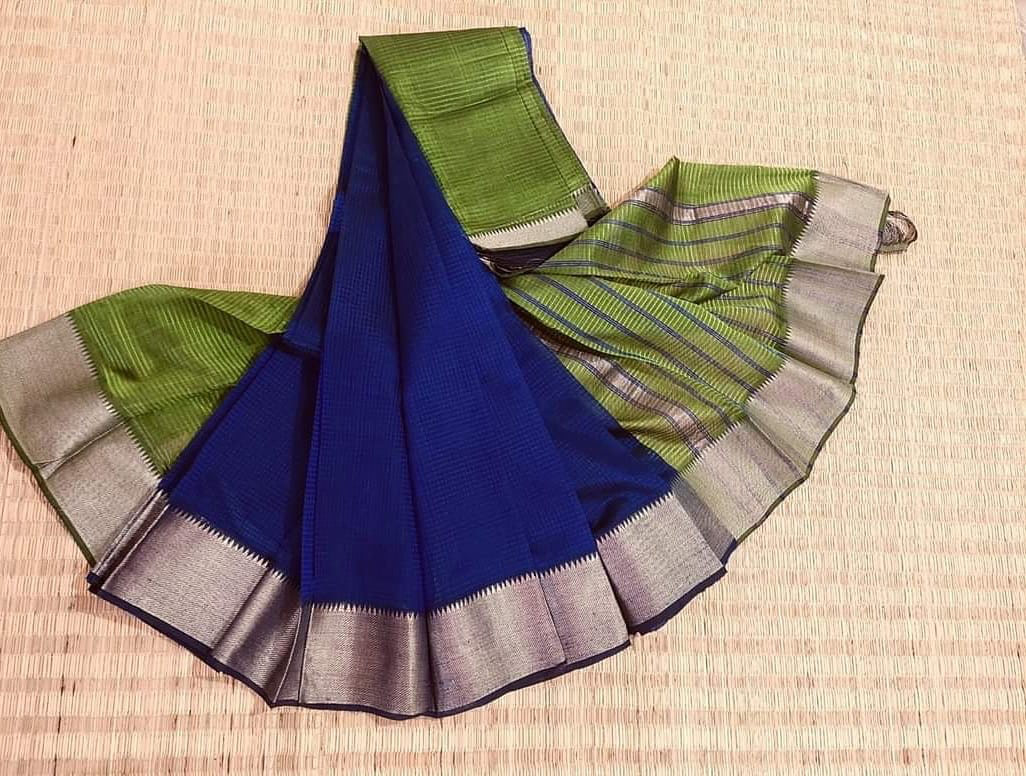
Mangalgiri sarees and suit fabrics are a prominent Andhra Pradesh handloom product. Mangalgiri derives its name from the town of Mangalagiri, which is 12 kilometers from Vijayawada. Mangalgiri is not only well-known for its exquisite sarees, but it is also a major pilgrimage destination.
This unique saree features exquisite tribal motifs woven in cotton, as well as zari or golden coloured patterns in tiny checks. This saree’s pallu (edge) is embellished with a striped motif, which is a traditional tribal ornament composed of golden embroidery. Mangalgiri sarees come in a variety of bright hues that make them seem very attractive and beautiful.
Because these sarees just feature a zari border and pallu with no woven patterns on the main body of the saree, the cloth is woven exclusively on pit looms, allowing the weaver to apply significantly greater energy throughout the weaving process without any gaps. This is what sets Mangalgiri textiles apart from other weaves.
Narayanpet is a typical peaceful small hamlet in southern India. It is located in Telangana, around 165 kilometers from Hyderabad. According to one school of thinking, during Shivaji Maharaj’s conquest in the Deccan in 1630 AD, the vividly coloured saris of the ladies captivated his eye, and so the Narayanpet saree received Royal Maratha patronage. Other versions of the story claim that weavers who were in Shivaji’s camp during a campaign were the ones who stayed behind and fashioned the shape we know today.
The saree is constructed of high-quality cotton or silk. This foundation material is often sourced from Vijayawada. This is especially important given that Telangana has highly hot temperatures all year. The saree is often made using strands in the 60s and 80s in both the warp and weft. Zari/art silk is used to weave little additional warp geometrical motifs in the border. These sarees are made on fly shuttle pit looms with lattice dobby.
Narayanpet weaves a variety of colorful silk saris with elaborate brocade work in silk and zari. The saris are lightweight and festive due to the low thread count of the silk strands.
These sarees are distinguished by their checkered body, patterned border, and plain pallu. The interlock weft method is used to weave two distinct wefts side by side. Temple pattern borders are woven in most sarees as a result of the blessings of the goddess who lives in the local temple. These sarees were given a geographical identification marking in 2012.
The Paithani sari has ancient origins, stemming from the royal dynasty of Paithan, a medieval town near Aurangabad. The sari, named for the town, is thought to have been produced using the finest silk strands from China and pure zari woven locally. This sari represents years of excess and the elegance of Indian handloom, and each piece is distinguished by the lavish and generous use of gold, as well as floral and bird-inspired designs. Paithan and Yeol’s contemporary saris are made using domestic silk strands from Bangalore, while the zari is imported from Surat.
The shiny weave provides a delightful intermingling of hues, giving the subtle appearance of shifting colors. Traditional themes include parrots, peacocks, and lotuses; nevertheless, the Hans motif, the Ashrafi motif, and the Asawalli were equally popular throughout the Peshwa time. Muniya, a kind of parrot, is commonly weaved in the borders in green, with a playful touch of scarlet at the mouth. The Panja, a geometrical flower-like motif most typically highlighted in red, the Barwa, which consists of twelve strands of a ladder and three strands on each side, and the classic Mor are some of the other motifs seen on the pallus (peacock).
Paithani sarees are an important component of Maharashtrian culture. It is regarded as the queen of saris, comparable to the Kanchipuram sari in the south. Needless to say, it is a must-have for any Maharashtrian on significant events, festive occasions, or weddings.
Patola is a double ikat woven sari produced in Patan, Gujarat, India. They are extremely expensive and were formerly only worn by members of royal and aristocratic families. These saris are popular among people with the means to pay the hefty costs. Surat also produces velvet patola designs. Patola weaving is a well guarded family tradition. In Patan, three families weave these highly treasured double ikat sarees. A sari can take anywhere from six months to a year to finish because of the time-consuming procedure of coloring each strand separately before weaving them together. Patola was manufactured in Surat, Ahmedabad, and Patan. Highly prized in Indonesia, where it formed a part of the native weaving culture.
Patolas are used in particular rituals because they are said to have mystical properties to fend against evil. Chabardi bhat (basket design), a popular pattern that includes a circle of lotus flowers, buds, and leaves, is connected with fertility and is worn for wedding rituals in several cultures. Patolas are presented to brides as part of their trousseau in Gujarat.
A Sambalpuri sari is a handwoven sari in which the warp and weft are tie-dyed before weaving. It is made in the Indian districts of Sambalpur, Balangir, Bargarh, Boudh, and Sonepur.
Sambalpuri sarees are made in a distinctive style called Baandha. Traditionally, Baandhas were made with representations of flora and wildlife or with geometrical designs. Recent crafts by current generation Baandha weavers feature newer motifs including portraits, landscapes, and flower pods. The yarns of sambalpuri sarees are knotted according to the desired designs to prevent dye absorption, and then coloured, using a tie & dye procedure. The motifs on both sides of the saree are practically the same, which distinguishes this kind of design. A craftsman may use this adaptable method to weave colorful motifs, patterns, and pictures into a saree capable of stimulating thought or expressing a message.
Sambalpuri sarees, in particular, are noted for their use of traditional themes associated with this seashore state, for example, Sankha or shell, phula or flower, chakra or wheel, swans, and fish.
Tant refers to the handlooms used to weave saris and textiles in West Bengal. Sari weaving was first documented in Bengal in the 15th century in the Shantipur area. During Mughal reign, from the 16th through the 18th century, the craft flourished alongside muslin and jamdani, receiving substantial empirical support.
A traditional six-yard tant saree has a thick two-to-four-inch border with a beautiful pallu. Each sari takes 7-10 days to weave using fine cotton yarn in a range of floral, paisley, and creative designs. Some of the most popular time-honored motifs include bhomra (bumblebee), tabij (amulet), rajmahal (a royal castle), ardha chandra (half-moon), chandmala (garland of moons), ansh (fish scales), hathi (elephant), nilambari (blue sky), ratan chokh (gem-eyed), benki (flowers).
Uppada is a coastal town in the East Godavari district of Andhra Pradesh known for its beautifully made silk sarees. The traditional Jamdani / Uppada Handlooms are highly recognised in Uppada. Uppada handlooms are highly renowned for their distinctive patterns. Uppada handlooms are typically created with cotton/silk warp and weft.
The count of the cloth determines its softness and toughness. The count in a handloom cloth refers to the number of threads woven lengthwise and breadthwise in a square inch, known as warp and weft. The count employed in Uppada is 100 (length) – 120. (breadth). The count determines the fabric’s quality. Uppada saree weavers weave the ancient Jamdani weaving technique without the use of mechanical assistance to produce beautiful designs using gold and silver zari, for which Uppada saree weavers acquired Geographical Indication (GI) recognition in 2009. Jamdani is a hand loom woven cotton fabric that was previously known as muslin. The Jamdani weaving tradition originated in Bengal.
Venkatagiri Sarees are zari cotton handwoven sarees known for its Jamdani style weaving design. Venkatagiri Sarees are one of the softest and most durable south sarees in India, hailing from the ancient town of Venkatagiri in the state of Andhra Pradesh. They are typically six yards long and good for all climates. A large Jamdani design of a peacock, parrot, swan, mango, or leaf in the pallu distinguishes a Venkatagiri saree. The sarees’ excellent weaving and distinctive zari motifs made them the favored choice of royalty in Andhra Pradesh.
These sarees are typically created using the Jamdani weaving technique, which has been passed down through 14 generations. Approximately 70,000 Venkatagiri residents are now employed in the production of the iconic Venkatagiri saree. Previously, persons from the Padmashali caste were largely involved in this activity; however, other people are now involved as well. Venkatagiri sarees are made by artisans who have worked for five generations.
Key Takeaways
As an item of traditional clothing for women of all ages, sarees are profoundly embedded in the cultural (and literal) fabric of India. This piece of garment brings together women of different socioeconomic classes from all around India. An enchanting saree is a living, breathing, and long-lasting work of art. It contains the history of a whole subcontinent, the craftsmanship of its artisans, and the memory of the women who carefully cared for it for the next generation.
Artisans and cancer survivors come together for a unique initiative, headed by the Apollo Cancer Centre (ACC), New Delhi. ArtCan recently launched by ACC is a medium that uses art to spread awareness about breast cancer. With the help of Kerala Mural arts, this initiative brings forth 8 steps of SBE or self breast examination ways that encourage women in the early detection and prevention of breast cancer.
About ArtCan
Art transcends all languages, borders and barriers and is an excellent platform to convey a message. ArtCan uses art created on a ‘can’vas for awareness about ‘can’cer. The ArtCan project has 8 murals that portray women performing self breast examination. The visual artistic SBE explanation is accompanied by stories of breast cancer survivors in the book – Chitrasutra.
Chitrasutra is thus, ArtCan’s most interesting and earnest attempt at making women aware of the SBE methods, along with the poetic prose and stories of real women who survived this disease due to early examination, detection and treatment.
Some facts
Breast cancer is globally the most diagnosed cancer. 25% of cancer cases across the world are breast cancer cases, however, early detection can lead to 90% survival rate or more. Every 1 in 8 women are affected by breast cancer and thus it is important to raise awareness about the warning signs and self examination methods to prevent women from losing lives. Early steps are the key in survival for breast cancer and ArtCan through Chitrasutra hopes to encourage, guide and inspire women to face cancer and beat it.
Also, breast cancer is caused due to several factors, including lifestyle and environmental changes, anomalies in aging, as well as, it is genetically inherited too.
Chitrasutra
Chitrasutra is a wonderful collection of 8 murals that visually and artistically depict the 8 self examination ways to detect breast cancer symptoms. With an attached prose and the story of a breast cancer survivor, each mural is a succinct, yet passionately honest endeavor to touch the lives of the people, especially women reading it. In simple steps it explains to women the basic self examining steps to undertake on a regular basis. Besides, the stories of women cancer survivors help identify and acknowledge these real heroes who fought the disease with courage and strength.
Life imitates art and ArtCan hopes to use the power of art to spread awareness about breast cancer. SBE and mammography at regular intervals is the best way to detect and protect oneself against this disease. Finally, as a line from Chitrasutra sums it all up – “From care to cure, we need to progress in this direction, then only you can win over cancer.”
Handicraft is described as the human or mechanical manipulation of raw materials to create useful or decorative objects from clay, rock, paper, stone, and other materials by skilled artisans.The amount of talent, care, and skill that goes into creating these stunning sculptures is admirable. India’s crafts are diverse, with a rich history, culture, and religion. Each state’s craft reflects the impact of different empires. These crafts have been ingrained as a culture and custom in rural areas for ages.
Since time immemorial, Indian handicrafts have been admired and revered over the world, leaving everyone in amazement. India is a true blue shopper’s paradise, thanks to its abundant cultural legacy, which is represented in the intricateness of its handicrafts.
The Indian handicrafts sector includes over 7 million craftsmen and 67000 exporters that promote regional art and craftsmanship in both local and global markets. Women and other individuals from India’s rural areas make up the majority of these craftspeople. In other words, this sector employs a number of individuals from the poorer sections of society who earn a living from their creative works of art, and India is directing the preservation of its craftsmen, art, and handicrafts in this way.
Here is a list of ten websites to buy Indian Handicrafts Online that are bridging the maker-consumer divide:
1. ExclusiveLane
ExclusiveLane was founded on a passion for handcrafted goods. The company handpicks handicraft items from rural craftsmen from various regions of India and allows them to uncover their abilities via their exquisite handicraft products. They are known for displaying diversity, heritage, and authentic items to urban customers at an accessible price while maintaining traditional art. The company was founded with the express purpose of providing economic upliftment to craftsmen concerned with conserving the history of India’s handicrafts sector. Their mission is to maximise the use of handicrafts in urban India as well as in other nations and to make ancient traditional artisans aware of their international significance via their broad skill in the simplest way possible.
This online store for handicrafts, handlooms, fabrics, jewellery, paintings, and other artworks is India’s only crafts and loom retailer with a complete inventory of handmade artisanal products ranging from phulkari dupattas in Punjab and bandhani sarees in Gujarat to ikkat handloom fabrics in Andhra Pradesh and pattachitra paintings in Odisha. With over 100,000 entries, it is the largest curated marketplace for art and handicraft products, sourcing things such as jewellery, garment materials, and home items from around 10,000 craftsmen across India. Every day, the portal adds 500 or more new goods. Every order from Gwalior-based iTokri includes a handwritten note on recycled paper and a handmade trinket neatly wrapped in eco-friendly packaging, making it one of the most popular e-commerce portals among a discerning domestic and global audience interested in Indian handicraft and handloom products.
The India Craft House is a web portal that showcases some of the world’s most ancient and exquisite craft styles. This social company was founded about ten years ago with the goal of preserving, showcasing, and sharing the talent of India’s craftsmen with the rest of the world. They want to be able to enhance the dignity of the Indian artisan in our own manner, as well as spark interest and support for an unrivalled history of the craft that spans millennia and extends across the whole country. It is their goal to develop an undoubtedly distinct collection of traditional art and craft that has been turned into a range of stunning, contemporary items. They have built partnerships with over 2000 artists directly and via colleagues throughout the years. The major goal is to empower Indian artisans and build up a group of people who are often overlooked.
Akkaara was formed from traditional stories, dusty workshops, and the fragrance of the ground. Each piece in the Akkaara line is handcrafted to magnificent imperfection and tells the narrative of its unique personality. Akkaara creates high-end lifestyle goods influenced by folklore and traditional crafts. Their items are produced by artists who have polished their expertise over years of experience. Each item in the collection has been meticulously created. Concern for the material, concern for the artists, and concern for the tradition, Akkaara seeks to resurrect what has been lost via each product: the exquisite beauty of ancient arts, the cultural legacy of generations of crafters, and the recollection of age-old stories steeped in traditional knowledge and folklore.
The development and support of the handicraft community is both vital and urgent. It is critical for the grassroots growth of local communities as well as the preservation of fading crafts and traditions passed down through generations. Kopái – Paar was inspired by this notion and is driven by passion for the handcrafted. They think that every donation, no matter how small, is beneficial, and that supporting crafts, craftsmen, and artists must be a deliberate decision. In the heart of India, in its villages, men and women produce one-of-a-kind artisan creations using the naturally accessible resources. They collaborate closely with the craftspeople to learn their processes and develop one-of-a-kind, long-lasting objects with an emphasis on inventive, eye-catching patterns and exceptional quality.
Goddess Durga is the sacred manifestation of Shakti, the feminine force that pervades the cosmos. As Shiva’s spouse, she morphed into Ekaa, the world’s most powerful God and the sole source of all energy. Their new collection of high-quality items is a representation of this very Ekaa. Each piece is created by expert local craftsmen and is unrivalled in quality and value. Each product is characterised by its intricate decorations and careful craftsmanship. This collection embodies the cosmic spirit of the incomparable Maa Durga, making each piece a trip in and of itself. Ekaa accomplishes our ambition of providing a handcrafted selection of quality handicrafts that may bring a touch of elegance and culture to your décor, from wood and marble to brass and semi-precious stone.
The ‘Gaatha’ initiative was created to fill that critical function of storytelling, delivering social and financial advantages to the artisan colonies. They want to be the tool through which craftsmen may directly engage with a worldwide audience, as well as the resource that helps craft sell stories and ideals rather than goods. Gaatha aims to facilitate ‘dialogues’ between artisans and their customers, enabling ‘co-creation’ opportunities and collective progress. They are devoted to preserving all good practises and all procedures that are compassionate, just, and environmentally balanced.
Kadam is a non-profit organisation that collaborates with around 600 artisans from West Bengal, Uttar Pradesh, Odisha, and Kashmir. Their aim is to eliminate poverty by guaranteeing that no one in India is compelled to live below the poverty line and to create opportunities that empower women and youth in rural India with a life of choice and dignity. To address this at the grassroots level, Kadam creates small and medium-sized firms that harness local resources to provide education and meaningful work prospects for young people in remote areas. Kadam enables self-reliance throughout distant rural areas by empowering semi-skilled women in communities, expanding their mobility, cultivating independence, and engaging local youth.
Chanderiyaan is an e-Commerce platform that aims to exhibit to the world the wonder and beauty of Chanderi weaving in its many colours. It is a forum for sharing the skill of the Chanderi weavers of Madhya Pradesh’s District Ashok Nagar in Central India. It is a one-stop shop for Chanderi items online. They have a diverse assortment of items ranging from Chanderi ethnic to pure designer handwork. It is a platform for sharing the wealth of weaving and design patterns that have evolved over many centuries in this weaving town, each with its own historical dynamics and stories to tell. They are a social entrepreneurship effort aimed at increasing the community’s sustainability and livelihood. Weavers may use Chanderiyaan to skip the large network of master weavers and sell their products straight into the worldwide market.
Okhai sells handcrafted clothing and lifestyle items made by rural artisans from around India. These artists have the creativity and traditional abilities to create magnificent patterns in styles distinct to their culture and background. The goods have modern designs and are competitively priced. Proceeds from sales assist these artisans in helping themselves – Okhai’s mission is to encourage women from less privileged backgrounds to learn new skills; to provide them with the self-confidence and self-esteem necessary to earn a living through their own hard work and initiative; and to enable them to carry this newly discovered skill and confidence into the wider world. Okhai recognises the rich history and customs of these rural areas and turns them into goods by combining traditional art with current designs and technological methods.
Handicrafts are a means of preserving the rich traditional art forms and legacy, as well as the abilities linked with the people’s history and way of life. The country is endowed with a plethora of highly trained craftspeople. They have raised the profile of Indian handicrafts over the world and are extremely crucial for the country’s economic prosperity.
This week Karnataka celebrates its 67th formation day – Kannada Rajyothsava. On 1 November 1956, the Kannada speaking regions spread across various other states came together to form the state of Karnataka. Today, the vibrant southern Indian state’s cosmopolitan capital Bangalore has officially become Bengaluru.
Karnataka is a land of culture, after gaining immensely popularity around the world as being the IT hub of India, the state has become a treasure trove for investors and a lucrative land for corrupt politicians.
However, there are some things about this state that hasn’t changed at all… like the culture, the hospitality, the processions, the cuisine and the language.
Ah! Kannada language!! Before the ‘IT boom’, Karnataka was primarily conversing in Kannada, and little bit of Telugu, Tamil and Marathi. The diction of North Karnataka people is slightly different in Kannada, which borrows a lot of words from Hindi and Marathi. And as you move up near the border towards Maharashtra, the language gradually changes to Marathi.
Back in the 1990s when I visited my granny’s place in Belgaum, I remember her saying something like “Priya, Kannadi madhe bolun dakho” (Priya, Speak some Kannada for me!) It really took me some time to realize that ‘Kannadi’ meant Kannada. I corrected her, but you know how it is with grannies!
However, after that incident, I kept my ears open for anyone saying Kannadi instead of Kannada. I was in for a major shock! Apparently Kannadi had a new synonym, and it was best friends with ‘Kannad’. Imagine my frustration when I had to deal with Kannad and amaze at a person’s inability to get the name of language right. We never say Marath, or Malyal or Hind, right?, so why does the world find it so difficult to say KannadA??? It’s a humble ‘A’…
It also reminds me of the infamous pronunciation of Hindi news readers calling the then prime minister, ‘Devegoda’, while it was ‘Devegowda’, as in ‘Gaul’! Forget pronunciation, most non-Kannadigas residing in Namma Bengaluru feel they can get by knowing little or no Kannada at all. How come learning a local language is not a necessity even after residing in that city for years? Can you live in Ludhiana for a few years and say I don’t know Punjabi?
I feel the primary reason for the locals’ resentment against North Indians is their utter disregard to local language. I have seen many North Indians arguing with an autorickshaw driver or the milkman in Hindi. Why don’t they have the cultural sensitivity that it is difficult for we south Indians to learn Hindi?! Obviously this kind of animosity leads to mindless violence against some innocent victim like the Manipuri student who got injured recently.
Anyway, I think it is high time we Kannadigas talk to everyone in Kannada; only then outsiders will be forced to learn Kannada. Thankfully, there are some great initiatives like Kannadagottilla.com that promote Kannada as the primary spoken language!
Blessed with fascinating beauty and majestic grandeur, the art forms of Karnataka have helped the state to secure a unique place in India. Situated in the southern part of India, the state shares its borders with the other states of Kerala, Goa, Andhra Pradesh, Telangana, and Tamil Nadu.
Karnataka is also home to the “Silicon Valley of India,” i.e, the city of Bangalore. The state is known all over India for its rich cultural heritage. It is one of the most sought-after tourist destinations in the country. Karnataka is also home to several monuments and places of historical significance. Which include Hampi, the capital of the ancient empire of Vijayanagara. The plethora of festivals and the rich tradition add to the beauty of the state.
From the urban city of Bangalore to the historically significant Hampi to the scenic and mesmerizing Coorg. It can be concluded that the state of Karnataka is home to some of the most fascinating places in India. The art, culture, and music of Karnataka are instrumental in portraying the diversity prevalent in the state.
The state is known for it’s distinct and culturally relevant art forms. The art forms of the state serve as a means to bring the communities closer. From the Yakshagana, which employs elaborate costumes, to the Chodi Ke Mela, which includes musical narration, the state has so much to offer an art lover. The art forms of the state are quite distinct from any other state of India. The difference is evident in their costumes, make-up, narration, dialogue, plot, and performance. Most of the art forms of Karnataka narrate stories from the Indian epics. The performances of these enthralling art forms usually take place during festivals, fairs, and other such special occasions. The festivals in Karnataka culture are quite colorful, splendid, vibrant and are sure to lift the spirits of the observer. The tranquility and the spirituality of the state reign supreme in its art form too.
A traditional art form of Karnataka, Yakshagana, is the most popular and the most significant art form of the state. It is said to have originated four hundred years ago and used a unique technique of narration. The word “Yaksha” refers to celestial beings, and the word “gana” refers to the song.
The performance comprises a combination of music, dance, elaborate costumes, and face painting. A Theatrical Art form, Yakshagana, has secured the pride of place among the other art forms of Karnataka. It mainly narrates stories from the Indian epics.
The lively performance of the Yakshagana usually takes place during the night-time. It is accompanied by the background music, which adds to the thrilling ambiance providing a unique experience to the viewers. The art form is generally performed during rainy seasons. It thus serves as a means to uplift the spirits.
Dollu Kunita is an energetic and vibrant dance form that is widely prevalent in the state of Karnataka. This art form is usually performed in honor of Lord Beereshwara. The performers move in quick-paced steps in a circular fashion while beating their drums. This produces a unique kind of music that is perfectly in tune with the mode of the performance. The synchronization of the movement of the performers with the music produced is one of the highlights of the performance. The performance is highly dynamic. It provides a thrilling and enthralling experience to anyone who would witness it.
Goravara Kunitha is another popular art form in the state of Karnataka. To perform this art form, the performers dress in vibrant and attractive costumes. The dancers performing in perfect synchronization with each other would mesmerize the viewer.
The dance is said to portray the hidden animalistic characteristics of human beings. The art form is esteemed and widely performed during festivals, fairs, and other special occasions.
4. Somana Kunita
A very unique and enthralling art form of Karnataka, Somana Kunitha is a symbol of the rich heritage of the state. Usually performed by two or three men, the performers wear elaborate costumes, a large mask, and huge headgear as they perform the dance.
The dance is performed in villages and is said to possess the power to protect the village and keep away all the evil spirits.
5. Krishna Parijatha
Krishna Parijatha is a fascinating theatrical art form and is most popular in the northern part of Karnataka. The folk art narrates the adventure of Lord Krishna and Lord Indra and is quite popular throughout the whole country.
The performance of Krishna Parijatha usually takes place in open-air theatres. This provides the actors ample freedom to improvise while on the stage. Along with the vibrant and distinct costumes, Krishna Parijatha has the capability to enchant the viewer with its powerful performance. Moreover, the simple dialogues and the exciting plot add to the charm of the performance.
6. Jagghalige Kunita
Jaghaligle Kunita is a folk art form of the North Karnataka region. Jaghaligle is a special percussion instrument used for the act is made of the wheels of bullock carts which are encased in buffalo hides. This performance is a custom during the Ugadi and Holi festivals. Usually the villagers make a group of 12-15 members and roll out instrument in the form of procession following the instructions of a choreographer. The rhythmic folk art imparts an atmosphere of anticipation and entertainment.
The Beesu Kamsale is one of the most dynamic folk art forms of Karnataka. It incorporates the music of the instrument called Kamsale, a brass disc iconically used in the performance. The people of Mahadeshwara Gudda mainly participate in this dance, which demands diligent practice and honed skills. The dance is performed with rhythmic and synchronised movements of the performers in tune with the music. This art form requires the performer to have intense training and concentration to present a powerful performance.
8. Chowdike Mela
The performance employs musical narration and is usually performed by women. The devotees of goddess Yellamma sing praises to her name through the Chowdike pada. They smear sacred ash on their foreheads and devote themselves to Yellamma. Chowdike Mela employs an extraordinary and unique instrument called Chowdike for its performance. Chowdike Mela is capable of providing the spectator a unique and soothing experience.
9. Veeragase
The Veeragase is a traditional dance form of the Hindu religion performed in the months of Shravana and Karthika to worship their gods . The dance got its name from Veerbhadra, a Hindu warrior from the state of Karnataka. It is a vivacious and lively folk dance, often presented during the Dasara festival procession which is held in the streets of Mysore. The devotees of Lord Shiva, who perform the Veeragase dance, are known as Lingadevaru. The performers wear extravagant costumes which include headgears, a Rudraksha mala and a hip belt of several gems.
In Bootha kola, Bhoota signifies ‘spirits’ and Kola means ‘play’ in Tulu. It is fundamentally a spirit worship ritual celebrated by Tulus in Karnataka and a few regions of Kerala. These spirits shield the town from calamities and make them prosperous. It is accepted that the outrage of these spirits brings misfortune. The ones adored are Panjurli, his sister Varthe, Kalluri, Kalkuda, Kordhabbu, Guliga, Jarandaya, Bobbarya, etc. There are stories that depict their bravery and how they came to be worshipped. These spirits are neither virtuous nor awful. Kola is additionally called ‘nema’ which implies ceremony, which continues from dusk to dawn.
11. Togalu Gombeyaata
Gombe Aata (play of dolls or Puppet show) is a distinct type of skill native to Karnataka. Gombe Aata includes narration using characters made from dolls, who are conducted by people in the background using undetectable strings. Made of wood and dressed with silk cloths, puppets are key elements of Gombe Aata. The puppetry ordinarily showcases minor plots from sagas like Ramayana, Mahabharata or different puranas/old stories. A Gombe aata show incorporates music and narration, with puppets moving around in front of an audience, as commanded by the puppeteers. They perform activities like embracing, bowing, folding their hands, etc.
Huli Vesha (otherwise known as tiger dance) is performed to honor Goddess Durga and her sacred animal, the tiger, during navratri. Huli Vesha performances usually include a troupe of dancers clothed in tiger costumes, tiger face masks or face paintings, tiger stripes on the body and yellow or orange hued shorts. The group proceeds onward to the central streets of the town, joined by drums and music, engaging general citizens and at times gathering contributions from whoever offers the same. During the dance, they take several intervals to play out certain tricks and stunts to keep the crowd more engrossed.
Suggi Kunitha is a dance form performed during the seasons of the harvesting festival in Karnataka. It is presented by the Halakki tribe during the January and February months with the sole motive of entertainment. Suggi dance is performed by a troop of twelve to fourteen who dance to the beats of the drum. It continues as they go from village to village with the beats of the drum and sing in unison and also gather grains and cash as a contribution.
On the last day, the dance lasts for the whole day and night. The drummers keep on chanting loudly to make the moment livelier. Dance steps used in this type of dance are compared to sea waves, curves on growing vines, or rivers flowing, relating the dance form to the varying phases of nature. The songs used in such performances are related to ones in Hindu Mythology. An extraordinary turban embellished with ornaments of various colours, small birds made of wood, and feathers of a peacock is worn by the dancers. The colours used in the turban are mostly red, green, yellow, and white associating with most of nature’s colours. The costumes worn by the men are colourful specifically bright while they perform the Suggi Dance.
14. Huttari Kunita
Hattari is one of the most vivacious forms of dance that has been started by the inhabitants of Coorg in Mysore. This dance has some of the most colourful clothing which is worn by the males. Women do not take part in this dance. Only the menfolk are seen dancing on the drum beats and pipe sounds. In addition, the dancers make use of shields and canes which are clutched in their hands and handled carefully and gracefully for the performance. This dance form even involves few steps which are inspired by the tandava style as they employ footwork by raising the left foot and then balancing the right foot and jumping vigorously. Hattari dance is performed in open fields where men disguise themselves in the most attractive traditional black tunics. Also, the dress worn by the dancers during the performance includes all decorative garments such as turbans, white trousers and black traditional tunics. They also tie a sash card along their waist while performing the Hattari dance. They make a circle or form a large ring and then perform the Hattari dance in round movements.
15. Karaga
The Karaga is an earthen pot that sustains a floral pyramid and a miniature figure of the goddess with a small silver umbrella on top of that. The Tigala community, who believe Draupadi as their most important god, have faith that Draupadi’s power increase during the Festival and the Carrier dressed as a woman signifies Draupadi. The contents of the pot have been a secret for centuries. The carrier’s arrival is declared by hundreds of bare-chested, dhoti-clad, turbaned Veerakumaras bearing drawn swords. Tradition has it that this frenzied procession of Veerakumaras accompanying the karaga carrier can execute him should he stumble and let the karaga fall. This festival takes place in the central part of the Bangalore city is known as Bangalore Karaga. The dancers perform various acrobatic feats while following the procession accompanied by a number of musical instruments like ‘Thavi’, “Nadaswaram”, “Muni”, “Udukka”, “Pamba”, etc. The carrier keeps dancing along with the Veerakumaras as he balances the Karaga or pot on his head. The VeeraKumaras keep banging their unsheathed swords on their chest, chanting “dik-di dik-di.”
Though the art forms of Karnataka differ widely from each other concerning their mode of performance. They all have one thing in common, the power to mesmerize the audience. Anyone who witnesses these art forms would surely be left enchanted by the charm and beauty of the performance.
Through their incredible art forms, the state has succeeded in preserving its rich culture and varied heritage through centuries
Though the art forms of Karnataka differ widely from each other concerning their mode of performance. They all have one thing in common, the power to mesmerize the audience. Anyone who witnesses these art forms would surely be left enchanted by the charm and beauty of the performance.
Through their incredible art forms, the state has succeeded in preserving its rich culture and varied heritage through centuries.
The festive season brings about a refreshing ambience in the entire country. You follow all the traditions that have been going on for years in your family. Some of these are cleaning the entire house during Diwali and even changing the home decor or renovating the whole house during this season. Not to forget, getting all the glamorous dresses to attend the Diwali functions and celebrations. Today, we’re going to talk about the home decor essentials that you must buy this Diwali by availing to the amazing Diwali offer to bring about a new look and refreshing aura to your house.
Floor rugs
If you are looking for a budget-friendly decor item that is both functional and decorative, then go for floor rugs. You get these at exclusive rates with the ongoing Diwali offer on various sites. Place them at the centre of your room as stair runners or even near your bedside to add a touch of beauty to your home.
Decorative lights
We all know that Diwali is a festival of lights. So you can’t even imagine decorating your house without this primary factor. And there are numerous kinds of decorative lights available in the market. You can choose one for your window, your door nearby the curtains, at the entrance of your bedroom or living room and so on. Get as many lights as you can get, buy them and enhance the beauty of your house instantly.
Chandeliers
When we’re talking about lights, let us not limit the option to only decorative ones. You can be as elaborating and elegant as you like in your home decor options. Like, there are chandeliers which are exclusively available in the market that you can install in your living room or the bedroom or even near your entrance. The presence of these chandeliers is enough to make your home look more decorative and magnificent.
Traditional wall paintings
Art frames and paintings have been adding beauty to your home for years. Now, if you think your previous one doesn’t match the festive theme or has been there for too long, you can get a new one this festive season. In a Diwali offer, grab a traditional-looking wall painting that depicts a story about this festival or makes your home decor look more celebrated. The choice is yours, but this decorative option in your house is definitely going to make it look more beautiful.
Candles, kandils and diyas
Time to adapt to the age-old tradition this Diwali. Try and install different kinds of candles and diyas and even candles for decoration. They are available in distinct shapes, made by different artists in different varied materials and they can be as drool-worthy as you want them to be. Just place him at the right locations, and you will see a distinct feel and festivity in your home ambience.
Artificial plants and decorative flowers
We agree that there is nothing like the original greenery, but the beauty of artificial flowers and plants can’t be challenged as well. They add a cool and refreshing factor to your home decor and can enhance the beauty of your house’s entrance, windows and other areas where you like them to be!
The holiday season has arrived, ready to brighten your homes and adorn your wardrobes with more pomp. It’s time for the Diwali festival, which is filled with zeal and glitz. It is undeniably a celebrated celebration that crosses age, ethnicity, and religious lines. While it is usual to clean and decorate your home during holidays, Diwali is also an excellent opportunity to show off your outfits. For this occasion, we all like dressing up in our finest Indian traditional costume since it honors Indian culture in all its splendor. These are the days to flaunt your finest silk sarees, picture-perfect lehengas, and other types of wardrobe opulence. If you are still unsure about your Diwali attire, we are here to assist you. Here is a selection of Diwali dress ideas that are fashionable, sophisticated, and exude festive sentiments.
Fashion trends are constantly changing and developing, ranging from loose clothing to print-on-print. What’s the most remarkable part? You do not always have to stock up on new clothing to keep up with the latest trends and fashion. Rummaging through your closet for the ideal mix and match will suffice.
You may peruse online fashion shops, choose your favorites, and have them all delivered to your doorsteps for free or at a bit of cost. Let’s get right in and discover what’s hot in fashion in 2022. We’ve rounded together the finest and trendiest Diwali costume designs.
Let’s get right in and discover what’s hot in fashion in 2022. We’ve rounded together the finest and trendiest Diwali costume designs.
1. Florals
When is floral not in style? No way. It goes with everything and still looks good. These are a wardrobe must-have. Refresh your wardrobe with flower designs in vibrant colors or delicate patterns to complement the season’s blossoms. Floral motifs come in light, monochromatic, bright, and tropical shades. These summer-patterned dresses are stylish and comfortable. You may wear flowery Anarkalis with flared palazzo trousers and sparkling decorations or pastel shoes and purses with outfits.
2. Seasonal hues
Colors like red, orange, and turquoise look great with blue denim, yellow and green, purple and coral, or purple bottoms and white tops. Bright colors are ideal for this weather to enhance mood and vitality.
You may also choose from neutrals like tan and maroon, pastels like pink and light blue, or soft pink and gray.
3. Bold style
Indian off-shoulder shirts and embroidered blouses now feature ballooning puffed sleeves, as seen in delicate Victorian costumes and long beautiful Juliet sleeved skirts. The trendy sleeves are practical and circle your shoulders.
Crop tops, maxi tunics, and cotton kurtas are popular choices for statement sleeves. You may find a lot of bargains online.
4. Anarkalis
Image – suvidhafashion.com
Anarkalis are truly timeless. These gowns feature a stunning shape inspired by the legend of the same-named courtesan who once stole the heart of a royal prince. The form of the garment corresponds perfectly to the definition of anarkali — a delicate bud/pomegranate flower. An Anarkali is the ideal costume for meeting your own prince this Diwali. Choose a floor-length anarkali to create drama and volume. Choose light and flowing fabrics like chiffon, mul, or georgette to offer a modern and trendy twist to your style, and feel free to skip the dupatta and churidar.
Yes, you can dress it up as a maxi dress and get away with it. If you choose to have a conservative tone, a sheer, floor-length dupatta will help you add that additional touch of elegance.
6. Smocks
Mini, midi, and maxi-smocked dresses in pastel colors and flowing shapes are among the most comfortable and flattering dresses for spring-summer. The dresses are lightweight, stretchy, and ideal for warmer weather.
Smocked dresses include rucked shoulder embellishments, collar ruffles, and tiers and are tightened at the waist for a casual, breezy feel. That means you can wear it with sneakers or flats!
7. Minimalist Fashion
Try out some enjoyable minimalist clothes this Diwali. Minimalistic ensembles are popular this season, and you can make the most of them during Diwali. The fundamental premise of minimalist fashion is to keep things simple. To honour the occasion, you might wear a modest sari with natural makeup and little jewellery. This Diwali apparel trend can help you stay light and make your celebration stress-free. And whoever said “less is more” was certainly correct. Layering may be used to give appeal to your minimalist approach. Mix textures to add interest to your style.
8. Accessories are essential!
Dupattas, oxidized jewelry, and basics like earrings and necklaces are must-haves, but safety comes first. So, the latest fad is a face mask. Masks now come with designer bows, chains, and stones.
Asymmetrical earrings, delicate pearls, and detachable chained hydration necessities are popular choices for dressing up for virtual informal or business situations.
9. Palazzos
Image – suvidhafashion.com
Palazzos have won our hearts with its easy-breezy charm and ultra-comfortable carryings. The best part about this Diwali fashion trend is that you can match it with a crop top, tunic, kurta, Anarkali, or even a choli and still look fashionable. Palazzos are also a popular celebrity dress trend. To give dimension to your look, pair a wide-leg palazzo pant with a long kurti. If you’re wearing it with a tunic or long top, give some shape to your style with accessories like belts.
10. Silk Saree
Every girl’s wardrobe should include a classic and timeless silk saree. When it comes to appearing stylish and powerful during Diwali without forsaking the traditional style of clothing, sarees appear to be the greatest Diwali costume alternatives. Choose from a selection of saree styles such as Silk, Banarasi, Bengali, Pure, and Chiffon Sarees to complete your festive appearance. If wearing hefty sarees makes you feel uneasy, go for lightweight sarees and bulky blouses to balance out your festival’s unique looks.
Wear your saree with a stylish blouse. Yes, the blouse is important. Three-quarter sleeves and strappy, camisole-style blouses are the safest picks, but don’t be afraid to try something new. Speaking of experimentation, while the traditional drape is a definite bet, there is no one way to wear a saree. Experiment with many styles to find which one best suits you. Diwali gatherings are the perfect reason.
You can also get heavy discounts and bumper Diwali offers for Diwali dress collections and Diwali sarees online.
Suvidha Fashion Collection provides their customers with a plethora of unique discounts and promo codes. That’s it. Following a trend does not need emptying your pocketbook. If you desire to shop Diwali Kurti Collection or the Diwali Saree collection for this festive season, you will be happy to see our coupons and discount codes.
Therefore, don’t forget to claim them if you want to boost your savings even more!
When the festival of Diwali approaches, you can half of the population strolling in the markets in the quest for the perfect Diwali gifts for their loved ones. Yes, be it gift shops or marketplaces or sweet shops, you can find crowd everywhere. So, if you are looking for some famous gift shops or markets or Diwali fairs in Delhi where you can get the best Deepavali gift for your loved ones, check out the following six best places listed below:
Select City Diwali Bazaar
Image Courtesy – Select CityWalk
Select city is one of the most popular malls in Delhi and the nearest metro station to reach there is Malviya Nagar. Every year during Diwali, there happens a event called ‘Diwali Bazaar’ at the plaza that offers approx 50+ stalls of different categories. So, whether you are looking for festive wear, gifting items, home decor, footwear, you can find all the Diwali essentials here.
Delhi Haat is one of the famous markets in Delhi known for Indian handicrafts and artifacts. There are a number of stores that offers a wide variety of handicraft items, ethnic wears, fashion accessories, and many more things. Also, you can find a number of food stalls from different states there which serve some of the best food items in Delhi.
Janpath and the Tibetan market are a great place for Diwali shopping in a cost effective way. All you need to have is a good bargaining skills to get all your Diwali essentials at a really decent price. Janpath is famous for antique jewelries and trendy outfits. While at the Tibetan market, you can find Indian artifacts, paintings, brassware etc.
Sundar Nagar market offers a number of art and antique shops. It’s a very posh market famous for silver jewelry, art, textiles, carpets, and antiques. Also, the Sunder Nagar Diwali Mela is very famous in Delhi. Just a week before Diwali, the fair takes place wherein stalls are put by owners who sell ethnic wears, jewellery, beauty products and many more things.
Atta Market
Whether you are looking for Indian or western wear or designer diyas or some amazing gift items for your loved ones, you can find the best Diwali items here. During Diwali, this market is decorated with colorful lights and it offers beautiful diyas, candles, idols of Laxmi and Ganesha etc. In short, you can find here all types of decoration items.
Needless to say that Chandni Chowk is the most famous market in Delhi for all types of things. It has been in existence for hundreds of years and ever since this market is running successfully. So, basically, there are three famous lanes in Chandni Chowk where you can find all your desired stuffs for Diwali. For fabrics, you can go to Katra Neel. For silver jewelries, you can go to Dariba Kalan’s. For ethnic wears, you can go to Kinari bazaar.
So, now that you know where to do your Diwali shopping from, go ahead to explore these places in order to find some of the best Diwali gifts, diyas, lights, jewelry etc for your loved ones.