A Centennial Celebration
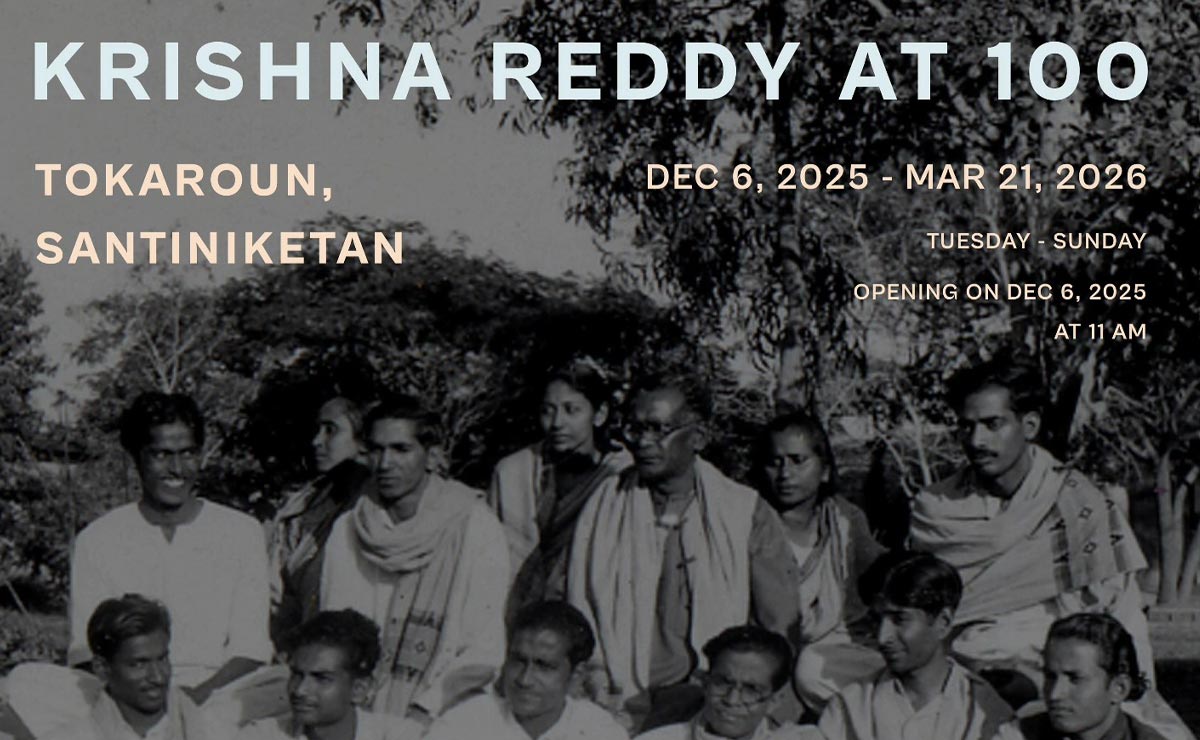
On December 6, 2025, Experimenter unveiled the first in a series of centennial exhibitions for Krishna Reddy (1925–2018), titled Krishna Reddy at 100: Of Friendships, held at Tokaroun in Santiniketan, in collaboration with Musui Art Foundation. This is a retrospective of his artistic journey and also an earnest homage to his revolutionary practice. Krishna Reddy was an established Indian printmaker, sculptor, and esteemed teacher.
Tagore’s Shantiniketan is the place where Krishna Reddy’s artistic consciousness was shaped. The exhibition acknowledges and celebrates the formative years of his sensitive development towards nature, form, and the broader human condition. The organizers’ remark that “this centennial exhibition is at the root of where he had his heart” aptly defines this event. The exhibition’s significance lies in the fact that the soul of his artworks is displayed in the place that functioned as the bedrock of his career.
Santiniketan and Early Influences
In the mid-1940s, the sixteen-year-old Krishna Reddy got enrolled at the Visva-Bharati University’s Kaa Bhavana (Institute of Fine Arts). He was one of the key carriers of the legacy established by Rabindranath Tagore, Nandalal Bose, Benode Behari Mukherjee, and Ramkinkar Baij. He found himself centred around a unique pedagogy established by the charismatic figures of art. It was in this phase of life that he developed a deep sensitivity towards nature, so much so that it continued to be a lifelong cornerstone of his art. Interestingly, Krishna Reddy’s early education was greatly influenced by the philosopher Jiddu Krishnamurti, whose support facilitated his departure for Europe for further studies.
The Tokaroun exhibition emphasises these foundational years and augments his craft. It presents key rare and early works of Reddy alongside those of his teachers, contemporaries, and students. This arrangement is consciously done to create a contrast among the different styles of his friends and apprentices, and create a composite sense of their camaraderie. Reddy’s artworks range from pre- and post-Partition India to the post-war artistic crucible of Paris and New York.
Contributions and Significance
After studying sculpture in London under Henry Moore, he moved to Paris, where his life changed forever at Stanley William Hayter’s Atelier 17. This renowned printmaking hub, including figures like Joan Miró and Alberto Giacometti, became the laboratory for Reddy’s most celebrated innovation: simultaneous multi-colour viscosity printing.
Krishna Reddy’s most significant contribution lies in modern printmaking through his development of the simultaneous multicolour viscosity-printing technique. Working alongside Hayter and others, Krishna Reddy mastered this revolutionary intaglio technique. The innovation was that by using inks of different viscosities and different hardnesses, he could apply multiple colours to a single engraved metal plate without mixing them. This resulted in a stunning range of prints with multi-layered colours in a single press run.
View this post on Instagram
This ultimately revolutionized how artists worked with colours, plates, and inks. This technique enabled each print to display a unique impression. His artwork challenges the narrow geo-centric narratives of modernism. As one scholar has argued, Reddy’s career invites a rethinking of modern art’s cultural pluralities under conditions of cross-regional contact. In practical terms, the exhibition offers valuable archival material along with sketches and sculptures. These artefacts revealed his technical experimentations and the depth of the philosophies he moulded in his art.
The Exhibition at a Glance
| Event | Details |
|---|---|
| Exhibition Title | Krishna Reddy at 100: Of Friendships |
| Duration | December 6, 2025 – March 21, 2026 |
| Venue | Tokaroun, Santiniketan, West Bengal, India |
| Collaborators | Experimenter in collaboration with Musui Art Foundation |
| Key Significance | Marks the artist’s centennial; held at Santiniketan, his key place of influence. |
Key Highlights
- Rare and early etchings and prints by Krishna Reddy, dating from the 1950s and 1960s.
- The exhibition concept draws attention to the formative influence of Santiniketan’s pedagogical environment under Bose, Mukherjee, and Baij, and maps Reddy’s global trajectory from India to Paris, Central Europe, and New York.
- A series of iconic prints, such as The Great Clown (Le Grand Clown), demonstrates his mastery of viscosity printing.
- A body of his metal printing plates, showcasing the sculptural aspect of his printmaking.
- On display are the actual engraved plates that he treated almost like sculptural objects, carved to minute depths, providing insight into his rigorous process.
- Drawings of the human form, reflecting his lifelong practice and keen observation.
- Works by Stanley William Hayter, Zarina, Ramkinkar Baij, Benode Behari Mukherjee, Nalini Malani, Shirley Witebsky, and Mona Saudi celebrate the spirit of friendship he cultivated globally.
A Unique Legacy? – An Opinion
Krishna Reddy at 100: Of Friendships successfully demonstrates him as a “global humanist”. The nature, different philosophies, and the catastrophic impact of global historical events such as the Bengal Famine and Partition left a deep mark on his mind. These are well reflected in his artworks throughout his career. This exhibition enacts the very spirit of what Krishna Reddy stood for: collaboration, cross-cultural dialogue, mentorship, and communal creation.
His move to Newyork in 1976 to lead the graphics and printmaking department at NYU strengthened his role as a revered mentor and guide. There, his studio became a refuge for many and nurtured the innovations in printmaking. This exhibition projects him beyond a technical genius. His role in the field of art is not restricted by geography and knows no limits.
The exhibition states that legacies are not constructed in isolation, but in countless acts of shared creativity, reverence, and mutual growth. Reddy’s practice bridges the modern world’s search for balance between nature, material, and human experience.