Raabta Lucknow–Calcutta Ka
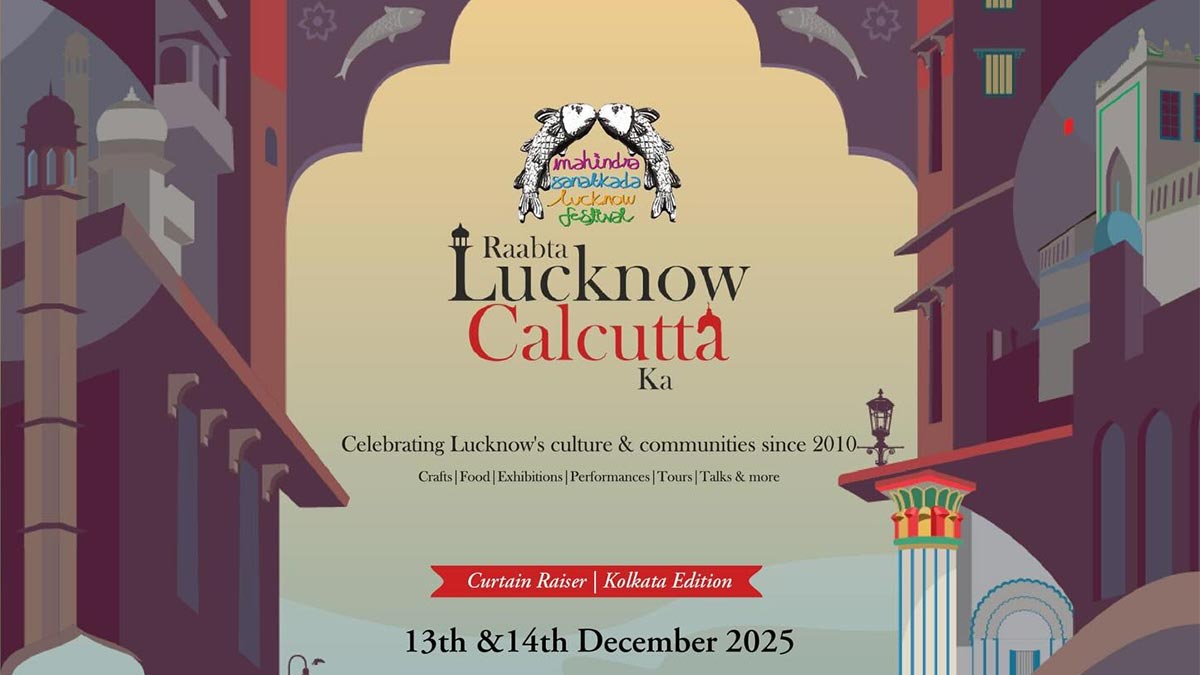
The Mahindra Sanatkada Lucknow Festival (MSLF) is the vector of the throbbing pulse of a living heritage that has continued its streak from antiquity. With its forthcoming seventeenth edition, the event marks a renewal of the richness of its own tradition. The theme for MSLF 2026 is “Raabta Lucknow Calcutta Ka” (The Connection between Lucknow and Calcutta). The festival is a highly ambitious exploration of the intimate connection between the two cultural capitals. This festival stands as a luminous pathway between the past and the present. The MSLF was conceived in 2010, and since then, it has beautifully evolved into one of India’s most significant platforms dedicated to celebrating socio-cultural syncretism. As the countdown to the seventeenth edition of MSLF 2026 officially began to tick, the anticipation of the grandeur of the celebration also flourishes. The arrival of the festival in Kolkata with a two-day curtain raiser is scheduled on December 13-14, 2025, at Studio Bari.
The scheduled curtain raiser will act as a prelude to the festival, disseminating its essence with immersive music, walks, panel discussions, and so forth. The prime festival is scheduled to take place from January 30- February 3, 2026. The official launch of the festival in Kolkata is a crucial marker of the acknowledgement of Kolkata as a subject of history and a partner in cultural exchange. The “raabta” will make people encounter the stream of history and emotions associated with the narrative of exile, migration. Artistic patronage, evolved cuisines, music, craftsmanship, and political histories have critically shaped the metamorphoses of the cities. The festival has created descriptive accounts of cultural journals, heritage platforms, etc, that demonstrate how MSLF has consistently swayed beyond the notions of nostalgia. The festival presents heritage as a living entity and as an integral part of our lives. The 2026 edition, curated around Lucknow–Calcutta connections, builds strongly on this philosophy.
The Tale of Two Cities: Oudh and Calcutta
View this post on Instagram
The thematic core of MSLF 2026 stems from the forced political movement of the Nawab of Awadh to Calcutta in the mid-19th century. The year was 1856, and India was gradually getting engulfed by the company. With the treacherous policy of the Doctrine of Lapse, many states like Satara (1848), Jaitpur & Sambhalpur (1849), Udaipur(1852), Jhansi(1853), and Nagpur (1854) were already annexed. Finally, the cherry of Awadh fell into the British hands in 1856, as the colonial power deposed the then Nawab of Oudh, Nawab Wajid Ali Shah, on the pretext of misgovernance. Despite having a legitimate heir, the doctrine was ruptured, and Awadh was absorbed. Subsequently, the deposed Nawab was exiled to the outskirts of Calcutta at Metiabruz. It is said that when the Nawab migrated, he was accompanied by a large retinue of over 6,000 attendants who proceeded with him on his journey. The Nawab also authored under the pen name Akhtar, and he did not let this political instability extinguish his cultural pursuits.
With the Nawab settling at Metiabruz, a hybrid and syncretic culture grew around that settlement and came to be christened as “Chhota Lucknow”. Thousands of retinue, including poets, musicians, craftsmen, and master Chefs (rakabdars) also followed him and found a refuge home. This settlement functioned as a premier site of cultural exchange for virtually three decades. The Awadhi dance form Kathak received further patronage in the Nawab’s new court. Musical genres like Thumri and Ghazal flourished. The most important innovation of all was the formulation of the Kolkata Biriyani with the potato. This sublime culinary excellence was born out of necessity but soon began to dominate the royal kitchens.
The aroma of Awadhi kebabs and the tradition of paan (betel) shops run by descendants of the Nawab’s paanwalas still define the Metiabruz and Kidderpore areas. Crafts also flourished under his patronage, particularly the gold-thread work of Lucknow.
The Celebration
The upcoming curtain raiser in Kolkata will narrate a huge part of this saga and offer an early glimpse into the intellectual and artistic direction of the main festival. The weaves and craft bazaar will be at the heart of the 2026 edition, featuring over 100 artisans from across the country with signature Zardari and Chikankari styles as well.
The extent of the festival can be interpreted through its setting of venues. This year, the festival is expanding its sites into the Qaiser Bagh complex, utilising Safed Baradari, Raja Ram Pal Singh Park, and the Amir-ud-Daulah Library. These venues are critically important as they once functioned as the hubs of the Nawabi culture of Lucknow. There will be literary exchanges, concerts, dance, and poetry in the famous Ganga-Jamuni Tehzeeb.
The Event At a Glance
| Aspect | Details |
|---|---|
| Festival Theme | Raabta Lucknow Calcutta Ka |
| Curtain Raiser | Two-day prelude in Kolkata (Studio Bari, Dec 13–14, 2025) to launch the theme |
| Main Festival | Five days (30 Jan – 3 Feb 2026) of crafts, food, performances, and talks in Lucknow |
| Historical Link | Exile of Nawab Wajid Ali Shah to Metiabruz in 1856, leading to “Chhota Lucknow” |
| Cultural Events | Shared traditions in Biryani, Kathak, Zardozi, and kite making |
| Signature Feature | Weaves and Crafts Bazaar |
| Venues | Safed Baradari, Raja Ram Pal Singh Park, and Amir-ud-Daulah Library, Qaiser Bagh |
| Core Focus | Living heritage, migration, crafts, music, food, memory |
Key Highlights
- Immersive music performances reflecting Indo-Awadhi and Bengali cultural syncretism
- The theme speaks of migration and adaptation, exploring stories that reach beyond familiar neighbourhoods and well-known histories
- Panel discussions on migration, memory, and cultural exchange
- Heritage walks tracing shared histories
- Expanded Weaves and Crafts Bazaar supporting artisan communities
- Focus on zardozi, kite-making, culinary traditions, and textile heritage
- The inclusion of many flavours of Lucknow and Kolkata suggests a dedicated focus on the culinary innovations born from the raabta.
- Activation of historic sites within the Qaiser Bagh complex
- Strong emphasis on living legacies and community-based heritage
Takeaway
The MSLF beautifully proposes heritage as a continuity of human interaction shaped by displacement, adaptation, resilience, and creativity. The current era is synchronizing with cultural homogenization; amidst this ongoing phenomenon, MSLF’s intervention induces a sense of inertia in it. “Raabta Lucknow Calcutta Ka” is a narration of historic truth that demands to be remembered and accepted by people at large. By protracting the focus on the exile of the Last independent ruler of Awadh, MSLF is reclaiming an opportunity to view history from multiple dimensions.