The Architect of Silence and the Painter of Pain
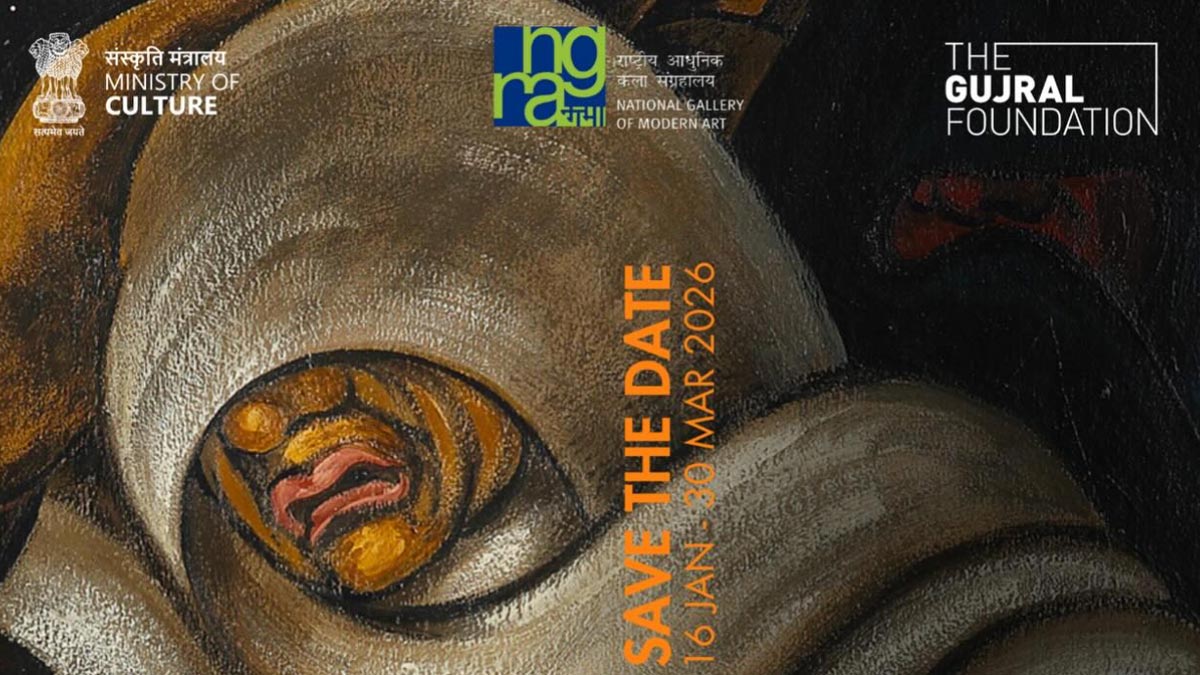
The National Gallery of Modern Art, New Delhi, recently announced an upcoming centenary exhibition dedicated to Satish Gujral (1925–2020), titled “Satish Gujral Centennial Exhibition.” Satish Gujral was a Padma Vibhushan recipient who moulded a significant trajectory of Modern Indian Art. This centenary commemoration is slated to run from January 16, 2026, to March 30, 2026. This exhibition is set to exhibit a corpus of artworks, including paintings, sculptures, drawings, archival material, and personal narratives that will trace Gujral’s extravagant career. He mastered the psychological laceration of partition and turned out to be the virtuoso of multidisciplinary artistic creations.
Born in Jhelum, the artist lost his ability to hear at a verytender age; and since then, life has been quite challenging for him. This emotional backdrop is well-reflected in his craft as it greatly symbolizes resilience, inward reflection, and a continuous lookout for alternative modes of expression. Gujral studied at the Mayo School of Arts in Lahore, followed by the Sir J.J. School of Art in Bombay. But this was interrupted by the partition of India in 1947. He himself is an eyewitness to the partition and assisted his father in transporting refugees.
Thus, he developed a raw and distinctive style that is deeply political, and most importantly, original to him.
He skilfully engages with the themes of pain, displacement, and varying human conditions. His canvases execute a typical defiance towards being decorative pieces; instead, they appear to be confrontational artworks embedded with a hue of existential unease. These are shaped by partition, war, and cultural fragmentation. This commemorative exhibition will contextualize these nuanced works under a broader label and place them in a more composed manner. His personal trauma, dating back to the partition, gave birth to his “Partition Series.” This series is one of the most raw documents of human suffering in Indian history.
The Bigger Picture: From Jhelum to the World
Satish Gujral’s craft does not lie within the periphery of paintings alone. His contribution to architecture is equally noteworthy. His architectural notions are traceable at places such as the Belgian Embassy in New Delhi, where he amalgamated sculptural form with functional modernism. His architectural mastery is also reflected at the India Islamic Cultural Centre. In the opinions of critics, Gujral was an architect who “painted with buildings.” The forthcoming retrospective aims to put his architecture in a dialogue with his paintings and other crafts. This exhibition is supported by the Gujral Foundation in collaboration with NGMA and the Ministry of Culture.
Gujral, unlike his contemporaries of the Progressive Artists’ Group (PAG), considered his own experiences as the plausible source of his artistic creation. He refused to rely on European modernism and remained rooted in his own experiences. Gujral received a scholarship to Mexico in 1952 that turned out to be a watershed moment in his life. There, he was accepted under the mentorship of muralists Diego Rivera and Siqueiros. With their guidance, he learnt to use art as a mode of “public service.” Gradually, he created murals in ceramic, steel, and wood, which today adorn the facades of major institutional buildings across India and abroad.
The Exhibition At a Glance
| Aspects | Details |
|---|---|
| Occasion | Centenary celebration of Satish Gujral |
| Venue | National Gallery of Modern Art (NGMA), New Delhi |
| Dates | January 16, 2026 – March 30, 2026 |
| Scope | Paintings, sculptures, drawings, archival material, and architectural works |
| Collaborators | Gujral Foundation, NGMA, Ministry of Culture |
| Focus | Art, architecture, resilience, and post-Independence Indian identity |
| Physical Resilience | Overcame near-total deafness from age eight; regained hearing after surgery in 1998 |
| Mexican Influence | Apprenticed under Diego Rivera and David Alfaro Siqueiros; absorbed muralism and social realism |
| Architectural Prowess | Designer of the Belgian Embassy in New Delhi, regarded as a landmark of 20th-century architecture |
| Political Lineage | Younger brother of Inder Kumar Gujral, the 12th Prime Minister of India |
Key Highlights
- A rare, consolidated retrospective spanning Satish Gujral’s entire career
- Inclusion of architectural drawings and models alongside artworks
- Archival material offering personal and historical context
- Focus on Partition, trauma, and human endurance as recurring themes
- Institutional collaboration underscores national cultural importance
- A centenary framing that invites reassessment rather than nostalgia
- The recent discovery of “The Condemned” (1957), a previously undocumented conte drawing from the Jhabvala family collection, adds a new layer to his post-Partition oeuvre
- Led by Mohit and Feroze Gujral, the foundation is launching academic programs and digital archives to preserve the artist’s legacy for future generations.
- Renewed interest in his autobiography, A Brush with Life, which details his transition from an isolated child to a Padma Vibhushan recipient.
Gujral as a Versatile Modernist
View this post on Instagram
Gujral is a distinguished individual, and this retrospective exhibition positions him within the greater context of the turbulent political past of South Asia. His artwork was long veiled from a full-fledged public engagement. Thus, with the unveiling of this centenary celebration, his artworks are placed amidst an active historical hotspot. This exhibition aims to reinterpret how Gujral is taught, studied, and remembered.
The man brilliantly experimented with burnt wood, granite, and bronze, creating sculptures that felt both démodé and futuristic. His talent in architecture was also unmatched. He possessed a stunning sense of visuals, spaces, and form, without any formal training.
Takeaway
Satish Gujral’s life is perhaps the greatest masterpiece he ever produced. This exhibition is more than a tribute to the great man; it is a commemoration and reassessment of the moral and cultural responsibilities of artistic practice in modern India. His works demand engagement, discomfort, and reflection. While other artists of his era were chasing the abstract trends of Paris or New York, Gujral stayed true to the “agony of the immigrant.” He gave a face to the faceless victims of Partition, ensuring that their pain was etched into the permanent memory of the nation. As we celebrate his 100th year, we are reminded that true art does not just decorate—it witnesses, it builds, and above all, it endures.