Beyond Form: Overview of the Exhibition
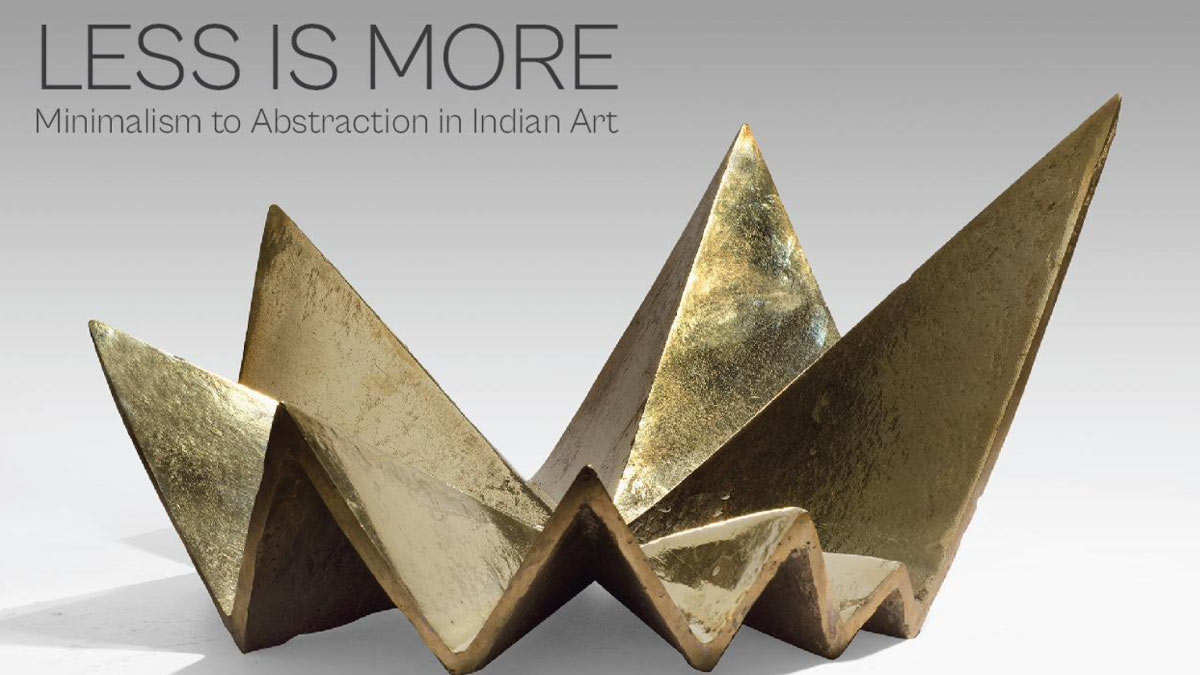
City of Joy, Kolkata, is currently hosting a thought-provoking exhibition at the Centre of International Modern Art (CIMA), titled Less Is More: Minimalism to Abstraction in Indian Art. It is a pivotal exhibition that explores the evolution and endurance of minimalism and abstract idioms in the Indian artistic landscape. This exhibition opened on December 19, 2025, and will continue to be on view till February 2026 at CIMA Gallery. Entry is free for all visitors, so that it can be accessible to all. In the realm of Indian art, minimalism and abstraction are frequently perceived as peripheral expressions.
The Narrative
The “Less is More” functions as an interrogation of how people perceive space, silence, and the “inner life” of objects. The exhibition is curated and prolegomenoned by a mindful essay from Rakhi Sarkar. Her essay opposes and judiciously dismantles the long-standing Eurocentric narratives regarding abstract art. It does not accept it only as a product of the 20th-century Western invention. It also places Indian minimalism as the historico-spiritual base stemming from the precise geometric assimilations of Jainism and the “shunya” of the Vedic philosophy. By gathering over 100 works, the exhibition provides a sanctuary of “visual detox” in an era of digital overstimulation.
View this post on Instagram
This metamorphosis is not just a stylistic element, but a conscious evolution of conscientiousness. For instance, the work of Ganesh Haloi features how the landscape transforms into a “landscape of memory” after being stripped of its natural elements. Sculptor Bimal Kundu utilizes industrial materials like aluminum to evoke the weightless essence of a bird in flight, proving that minimalism can be as emotive as any figurative work. The exhibition staunchly states the fact that although realism deals with externalism, abstraction dives into the metaphysical.
A substantial segment of the exhibition attests to historical roots that highlight the functioning of the Theosophical Society, founded in 1875, which acted as a conduit for Indian philosophical concepts of the “invisible” to reach Western pioneers of abstraction. This theosophical contextualization of the exhibition transforms the viewing experience of the observer. When one realizes this root, the viewer is no longer just perceiving the “smudges of color” or “geometric lines,” but witnessing a dialogue between the ancient and the contemporary. The “Wounds” series by Somanth Hore, pale whites of Seema Ghurayya, etc., overturns the whole experience of viewing and highlights the “heightened attentiveness,” where the absence of recognizable figures forces an encounter with scale, rhythm, and weight.
Glimpses of the Exhibition
| Important Points | Details |
|---|---|
| Exhibition Title | Less Is More: Minimalism to Abstraction in Indian Art |
| Venue | CIMA Gallery, Kolkata |
| Curatorial Vision | Tracing abstraction to indigenous roots rather than Western imports. |
| Featured Artists | Ganesh Haloi, Prabhakar Kolte, Bimal Kundu, Shakila, and others. |
| Philosophical Base | Connection to Vedic Hindu, Buddhist, and Jain geometric traditions. |
| Historical Thesis | Abstract ideas traveled from India to the West via the Theosophical Society. |
| Structure | A two-phase exhibition running until February 28, 2026. |
Key Highlights
- Less Is More presents over 100 works spanning different generations and media, rigorously exploring minimal and abstract visual vocabularies.
- The exhibition situates Indian abstract practice not as an offshoot of Western modernism but as a continuum with indigenous visual and spiritual traditions, such as yantras, mandalas, Warli, and Gond art.
- It includes works by eminent figures such as S.H. Raza, V.S. Gaitonde, Ganesh Haloi, and M.F. Husain, alongside artists whose practices reflect more recent idioms navigating shape, space, and emotion.
- Sculptural works by artists like Bimal Kundu demonstrate how minimal principles extend beyond painting into three-dimensional form.
- The exhibition is accompanied by an insightful catalogue featuring scholarly essays that deepen the conceptual engagement with the artworks on view.
- Less Is More is presented in two phases; the current first phase runs through February, with a subsequent phase introducing additional works.
- It highlights that Indian abstraction is not a modern “experiment” but a continuum from ancient mandalas and yantras.
- Features a wide range of media, including bronze sculptures, paper collages, hand-stitched textiles, and oil on canvas.
- A focus on “reductive forms” that strip away excess to reveal the essence of emotion and rhythm.
Why is it Important
In a world that equates “more” with “better,” CIMA’s curation reminds us that the most profound truths are often found in what is left out. This exhibition succeeds because it doesn’t ask the viewer to “decode” a secret message; it simply asks them to stand still and feel the resonance of a single line or a field of color. It is a hauntingly beautiful testament to the power of silence in an increasingly noisy world.
The central premise frames minimal and abstract tendencies as inherent traditional practices featuring mandalas and yantras — and in tribal idioms such as Warli and Gond, where symbolic reduction is not merely stylistic but deeply tied to cosmological concerns and spiritual schema. Among the pieces that stand out are the works of S.H. Raza, Jagdish Swaminathan, V.S. Gaitonde, and M.F. Hussain. Together, the works assemble a visual lexicon where less truly becomes more.
Takeaway
This exhibition is a corrective to entrenched narratives about Indian modernism and abstraction. It recalibrates indigenous aesthetics and lived visual histories. It depicts how these artistic forms are beyond the stringent narratives of Western dominance and are liberated by the indigenous narratives.
This exhibition is a rare opportunity for the public and students alike to witness how Indian artists have negotiated form, space, and presence in ways that are both phenomenologically rigorous and culturally resonant. In doing so, Less Is More stakes a compelling claim: that abstraction in India is not an imported aesthetic but an enduring visual language deeply embedded in the subcontinent’s artistic psyche.