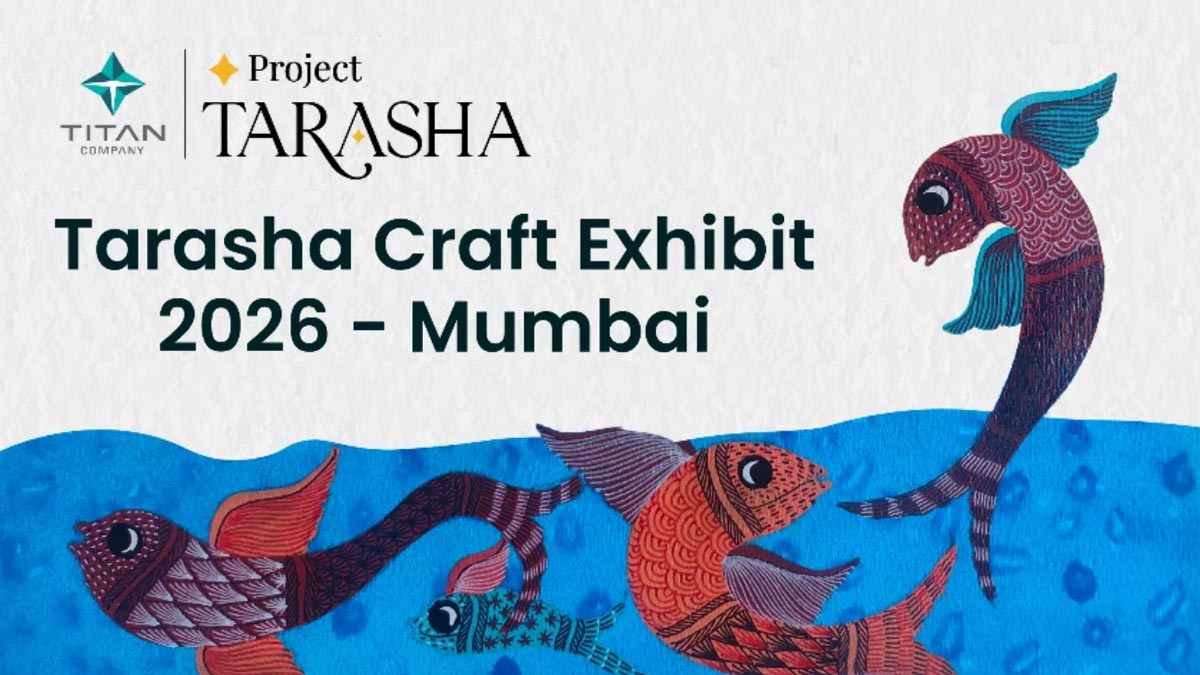
With the dawn of 2026, The Titan Company Ltd., in collaboration with Creative Dignity, is thrilled to celebrate the soul and skill of Indian craftsmanship through a social initiative titled “Project Tarasha.” They have recently announced a flagship event of the project, christened the “Tarasha Craft Exhibit.” This flagship event epitomizes a decisive convergence of heritage crafts, rural enterprise development, and engagement with mundane modernity. The exhibition is scheduled to take place from January 9 to 11, 2026, at The Vintage Garden, Bandra (West), Mumbai.
Connecting Heritage to Modern World
This craft exhibition does not fit into the traditional setup and entails a more modern curation, design, and market access. This collaboration stems from their efforts and dedication to empower rural artisans and creative sustainable livelihoods across India. This three-day exhibition is a cultural movement that aims to mitigate the existing gap between artisans and modern consumerism.
The Project Tarasha aims to address systematic scleroitism and deep-rooted institutional inertia in the Indian craft sector. This venture aims to connect artisans directly with consumers, train them in digital literacy and enterprise management. It enables the craftsmen to participate in a high-visibility rostrum, where their work will receive the appropriate appreciation and economic value.
Crucial Glimpses of The Event
| Aspects | Details |
|---|---|
| Event Name | Tarasha Craft Exhibit 2026 |
| Organizers | Project Tarasha (Titan Company Ltd.) & Creative Dignity |
| Primary Goal | Supporting craft artists and handcrafted traditions |
| Dates | January 9, 10, and 11, 2026 |
| Timings | 10:00 AM – 7:00 PM |
| Venue | The Vintage Garden, Bandra (West), Mumbai |
| Entry Fee | Free for all attendees |
| Focus | Indian crafts, artisan engagement, heritage art forms |
| Objective | Empower artisans and promote sustainable craft enterprises |
The Essence of Project Tarasha
Project Tarasha has earned the status of being a long-term pharos for the “Handmade in India” movement. This project, backed by the corporate social responsibility (CSR) wing of Titan Company Ltd., zeroes in on the socio-economic empowerment of craft communities. Their partnership with Creative Dignity is also a stupendous step. This institution is a pandemic-born movement that is dedicated to the betterment of the Indian Handmade sector. They also pose as a crucial mediating entity that facilitates digital upliftment of these people.
The craft exhibition that stems from this collaboration ensures that the artists receive fair wages, credit for their labor, and a platform that respects the ancestral lineage of their work.
The 2026 exhibition is the culmination of months of fieldwork. The prime feature that makes these craft exhibits stand out is that the team has conducted extensive research to identify and represent clusters of “dying art forms,” such as Gond art, Chola bronze casting, and intricate hand-weaving techniques.
A Cultural Fiesta with Economic Purpose
View this post on Instagram
Socio-cultural initiatives like this also act as economic catalysts in the artisanal economy. Historically, Indian artisans have been systematically deprived of direct access to the market and were under the heavy subjugation of numerous middlemen. This resulted in increased interference by the intermediaries, erosion of the actual workers’ profit margins, and dilution of cultural integrity.
Project Tarasha’s intervention aims at tackling all these issues with judicious measures. They work to facilitate direct market access, enabling craftpreneurs to interact with visitors, receive direct feedback, and engage in sales without burdensome participation fees or commissions. This model strengthens community cohesiveness and preserves the original crafts, monetizing them.
Tarasha’s programming includes hands-on engagement opportunities, with artisan-led workshops to provide an insider glimpse of their work to the visitors, demonstrating the craft processes while offering a nuclear showcase of the labour, skill, and narrative embedded in each piece.
Key Highlights
- Visitors meet master artisans and hear personal stories behind each craft.
- Visitors can expect a wide range of products, including hand-loomed textiles, sustainable home decor, and handcrafted jewelry that mirrors Titan’s legacy of precision and design.
- Regional craft forms from across India are represented, reflecting the multiplicity of heritage arts.
- Live craft demonstrations and participatory sessions enhance cultural immersion.
- The event encourages broad public access, fostering inclusivity.
- Beyond a showcase, the platform is part of a broader ecosystem approach supporting rural craftpreneurs with digital training and market connectivity.
- Unlike commercial malls, this exhibit features “Maker Spaces” where visitors can witness the labor-intensive process of creation, from the first stroke of natural dye to the final polish of a metal artifact.
- The choice of “The Vintage Garden” in Bandra is intentional.
- The event uses social media polls (as seen in the announcement) to let the audience influence the product curation, making it a community-driven experience.
Contextualising The Exhibition
View this post on Instagram
Project Tarasha demonstrates a paradigm shift into “Ethical Consumerism.” Today, the world is dominated by fast fashion and mass-produced plastic goods. Amidst this, this exhibition staunchly represents a “counter-culture.” Hitherto, Creative Dignity has marked its success in digitizing artisan catalogues, but this physical exhibition in Mumbai deserves applause. This initiative highly reflects the values such as “slow living.” This also attracts the urban youth and makes them a part of something meaningful.
In India, “craft” is more than something aesthetic. It is not just an artefact, it is a living archival assemblage of our own culture, history, and society. Events like this reclaim these sensitivities and transform them into a sustainable model that focuses on capacity building and direct artisan empowerment. Moreover, the placement of this event in Mumbai directly joins rural artisanalship with an urban metropolis.
From a developmental perspective, such platforms are indispensable in enhancing visibility for underserved craft communities. They also play a subtle yet significant role in heritage preservation. Platforms like these are vital in engaging youth with first-hand craftsmanship and integrating their interests in artforms like these. This initiative also boosts creative entrepreneurship.
Takeaway: Craft as Cultural Capital
Tarasha Craft Exhibition is a strong representation of India’s artistic fervour. While the government promotes ‘Make in India,’ initiatives like Tarasha ensure that we don’t forget the ‘Hands of India.’ The collaboration between a corporate giant like Titan and a grassroots collective like Creative Dignity provides a scalable model for how heritage can be modernized without being diluted. By providing a free-entry platform in a prime location, the organizers are democratizing access to luxury. It is a space where artistic traditions adapt, thrive, and connect with broader markets while maintaining their cultural essence. This model, which balances heritage with innovation, offers a sustainable blueprint for craft ecosystems across India and beyond.