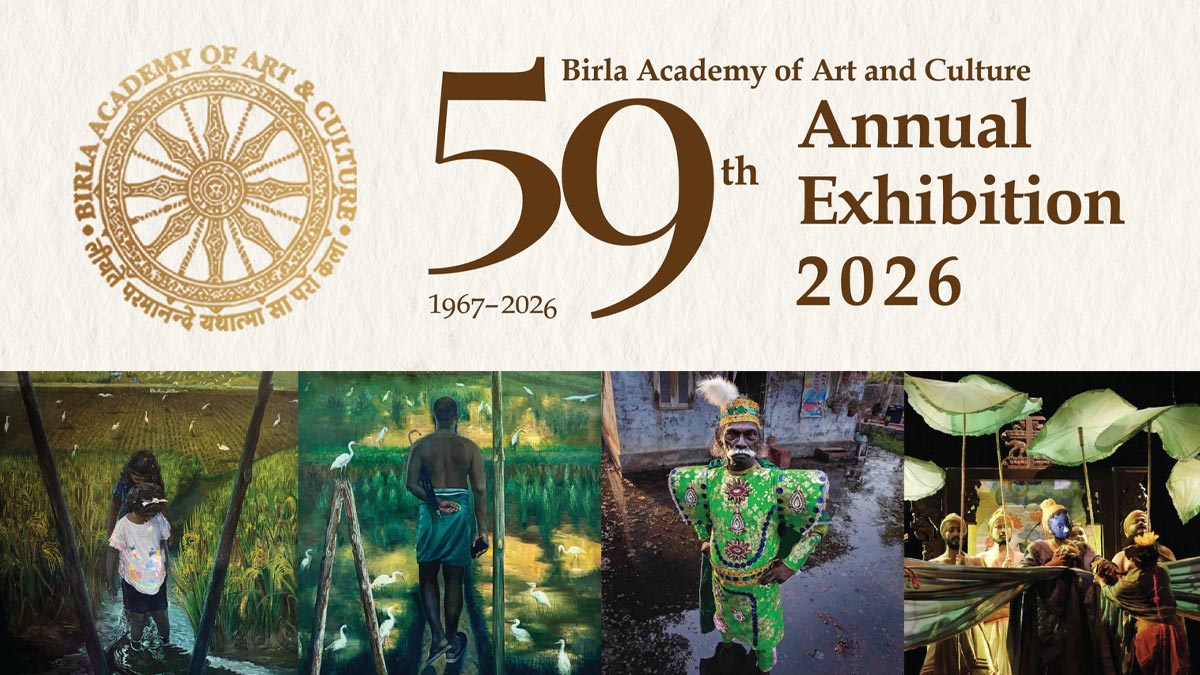
The Birla Academy of Art & Culture, Kolkata, is a key linchpin of India’s cultural landscape. For almost six decades, the Birla Academy of Art & Culture has continued its legacy as one of India’s most reputed institutions dedicated to modern and contemporary arts. Its annual exhibition is a conceptual catalogue of the evolving artistic trends that feature the generational transitions across the wave of art and aesthetics. The Birla Academy has also been a historic platform that has paved the way for many significant art practitioners.
Birla Academy at 59
The upcoming annual edition will mark the 59th version of this yearly occurrence. This exhibition was conceived in 1967 and continues to carry forward its institutional vision and aspirations to date. In its present format, the academy aims to explore the critical niches of land, ecology, and urban life. The 2026 edition is slated to inaugurate on January 9, 2026, at 06:30 PM. It will continue to be displayed until February 8, 2026. The exhibition will be open to all from Tuesday to Sunday (03:00 PM to 08:00 PM IST). It is one of the most-awaited winter calendar entries in Bengal.
The exhibition will have a key centerpiece, followed by a competitive section that features artists specializing in site-specific installations. Alongside, they also arrange a prize distribution for award winners in the competitive categories.
A Sneak Peek At The Exhibition
| Aspects | Details |
|---|---|
| Inauguration Date | Friday, 9th January 2026, 6:30 PM |
| Exhibition Duration | 9th January – 8th February 2026 |
| Edition | 59th Annual Exhibition |
| Viewing Hours | 3:00 PM – 8:00 PM (Closed on Mondays & Holidays) |
| Chief Guest | Shri Jawhar Sircar (Former MP & Ex-CEO, Prasar Bharati) |
| Venue | 108–109 Southern Avenue, Kolkata – 700029 |
| Curator (Zameen) | Ina Puri |
| New Section | Projects – Terra Kolkata |
| Lead Artist (Projects) | Anirban Das & Team |
| Special Segment | Annual Winter Performances |
The Artistic Narrative of 2026
The Birla Art Academy has been a catalytic launch pad for many stalwarts of modernism in India. The Academy’s annual exhibition is one of the few remaining “salon-style” large-scale exhibitions that continues to move along the high academic standards while also being accessible to the public. The prime conceptual core of the exhibition lies in “Zameen,” curated by Ina Puri. The word “Zameen” translates to land, which is a mere geographical entity. However, from an artistic perspective, this “land” is converted into a witnessing catalogue that bears the imprints of memories, displacement, agrarian chronicles, and socio-political intercessions. Land, when perceived through this lens, appears as a living entity that is moulded by ecological crises, urban expansion, and shifting rural economies.
Renowned Indian-American artist Zarina Hashmi is also featuring her artworks here. She is widely acknowledged for her skillful lens of exploring home and exile through the lens of minimalism. Her work will be placed in the vicinity of contemporary artists like Mithu Sen, whose work displays a persistent tension between the permanence of “zameen” and the fluid human experiences.
Other Segments and Winter performances
The section titled “Terra Kolkata” further places the exhibition amidst the local landscape. This segment positions the city as both subject and medium. This exhibition aims to remind us that art is not something to be perceived in a white-cube enclosure, but something that develops from the very soil of the city, adopting a more empirical and site-responsive approach.
The exhibition encompasses forms of art beyond the physical application of colours and drawings. There will be performances featuring classical dance, theatre, and music. The upcoming edition will also host a cross-disciplinary showcase by orchestrating two performances titled “Draupadi” (a performance by Anjana Chandak) and “Saraccandrakm” (by Chidakash Kalalaya). It establishes an inter-woven fabric of performances and visual arts and creates an aesthetic syncretism that appears extravagant and truly joyous.
Key Highlights
- 59th edition marking nearly six decades of curatorial continuity
- Thematic highlight exhibition Zameen curated by Ina Puri
- The theme “Zameen” (The Land) explores identity, belonging, and the physical/emotional connection to territory
- This flagship exhibition highlights a stellar lineup of artists, including Mithu Sen, Riyas Komu, and Zarina Hashmi
- Launch of the new Projects section focusing on urban and ecological narratives
- Terra Kolkata | Burnt Earth and Living City by Anirban Das & team
- These site-specific installations on the back lawns explore the relationship between the city’s urban evolution and the primordial element of clay/earth
- Month-long public viewing with free institutional access
- Annual winter performances complement the exhibition programme
- Prize distribution ceremony honouring award-winning artists from the competitive section
- To celebrate the Academy’s anniversary month, the lawns will host prestigious performances, including a Khayal-Thumri rendition by the legendary Pt. Ajoy Chakrabarty on January 25th
- The galleries on the 4th and 5th floors will showcase a wide array of works selected from across India, ranging from traditional paintings to experimental digital media
Takeaway: The Vitality of Institutional Continuity
The 59th Annual Exhibition at the Birla Academy is a cultural milestone as it is a reassertion of the evolving and existing artistic brilliance in India. What makes this event truly special is its democratic spirit; it places the works of established masters, like Riyas Komu, in the same building as the unnamed winners of the competitive section. This creates a rare “living archive” of Indian art.
Moreover, Shri Jawhar Sircar is invited as the Chief Guest. His presence will bridge the gap between cultural policy and artistic discourses. On January 25, 2026, Pt. Ajoy Chakrabarty will mesmerize everyone with his performance under the winter sky of Southern Avenue. The Birla Academy isn’t just showing art; it is sustaining a specific, sophisticated “Kolkata way of life” that balances intellectual rigor with soulful expression.