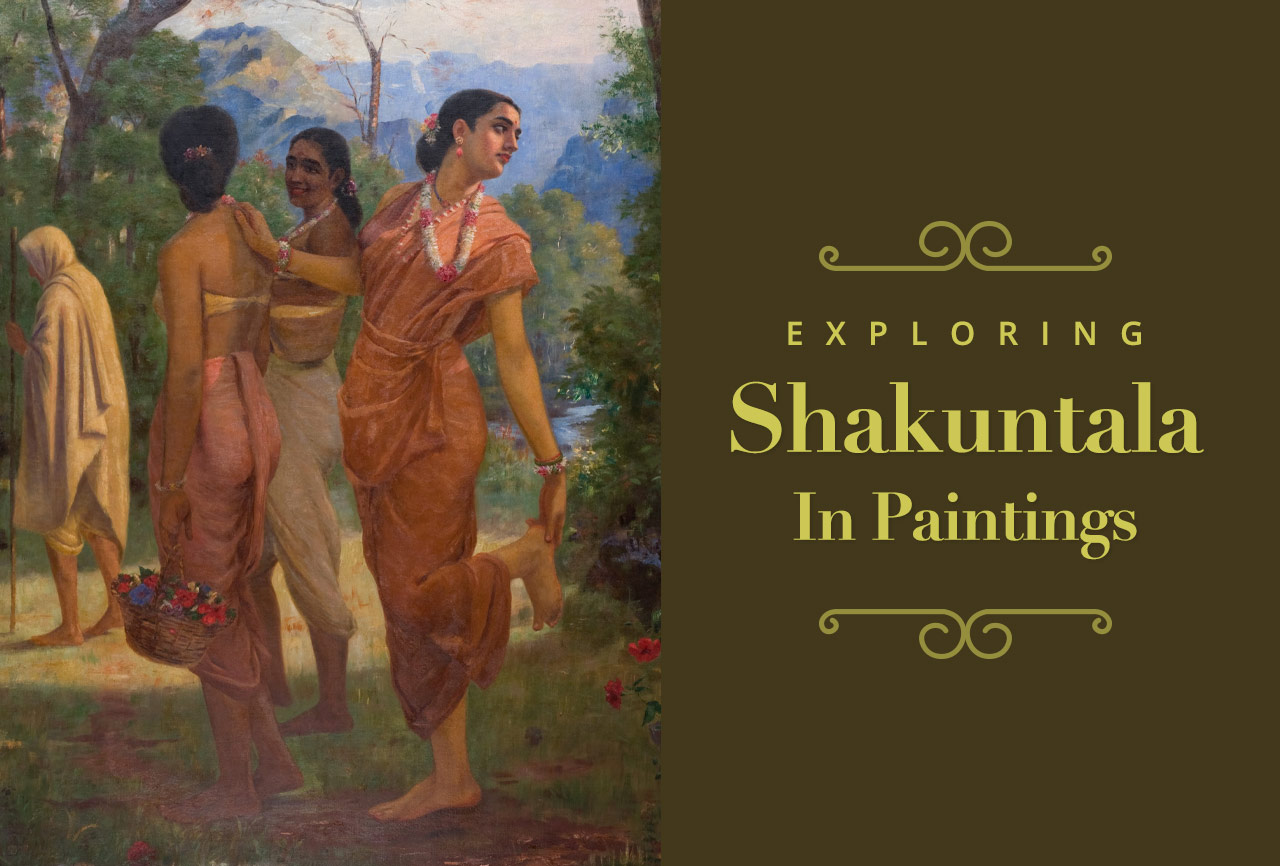
Who is Shakuntala?
Shakuntala is a heroine in ancient Indian literature, best known for her portrayal in the ancient Sanskrit play Abhijnanashakuntalam which means ‘recognition of Shakuntala’, written by the classical poet Kalidasa in the 4th or 5th century AD in Sanskrit and some use of Prakrit. Her story, however, originates in the Hindu epic, the Mahabharata, where she appears in the Adi Parva. Shakuntala is the daughter of the sage Vishwamitra and the celestial nymph Menaka. Abandoned at birth, she is raised by the sage Kanva in a forest hermitage. She later falls in love with King Dushyanta and becomes the mother of Bharata, a celebrated emperor of India who is the ancestor of Pandavas and Kuru kingdom in Mahabharata. Let us see some depictions of her life through the lens of India’s celebrated artist Raja Ravi Varma (1848 – 1906) and others including a medieval depiction.
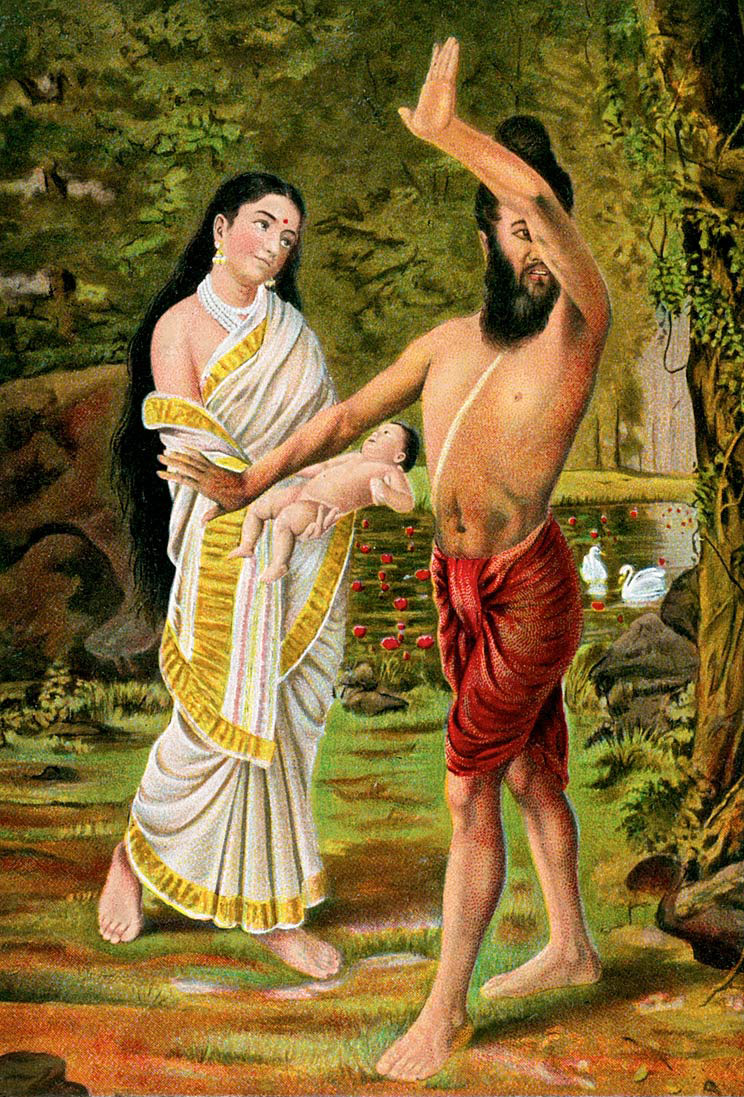
The Kalidasa Version
Kalidasa’s play presents a version of the story in which Shakuntala is cursed by Rishi Durvasa, causing King Dushyanta to forget her entirely. His memory is later restored when he discovers a golden ring of his own inside the stomach of a fish. Another version of this tale appears in the Adi Parva of the Mahabharata, traditionally attributed to Veda Vyasa.
Although Kalidasa’s work is an adaptation of the original narrative found in the Mahabharata, it has become far more popular over time. Many readers and audiences now regard it as a complete and independent story in its own right. Further details of the narrative are elaborated in the following account.
The storyline
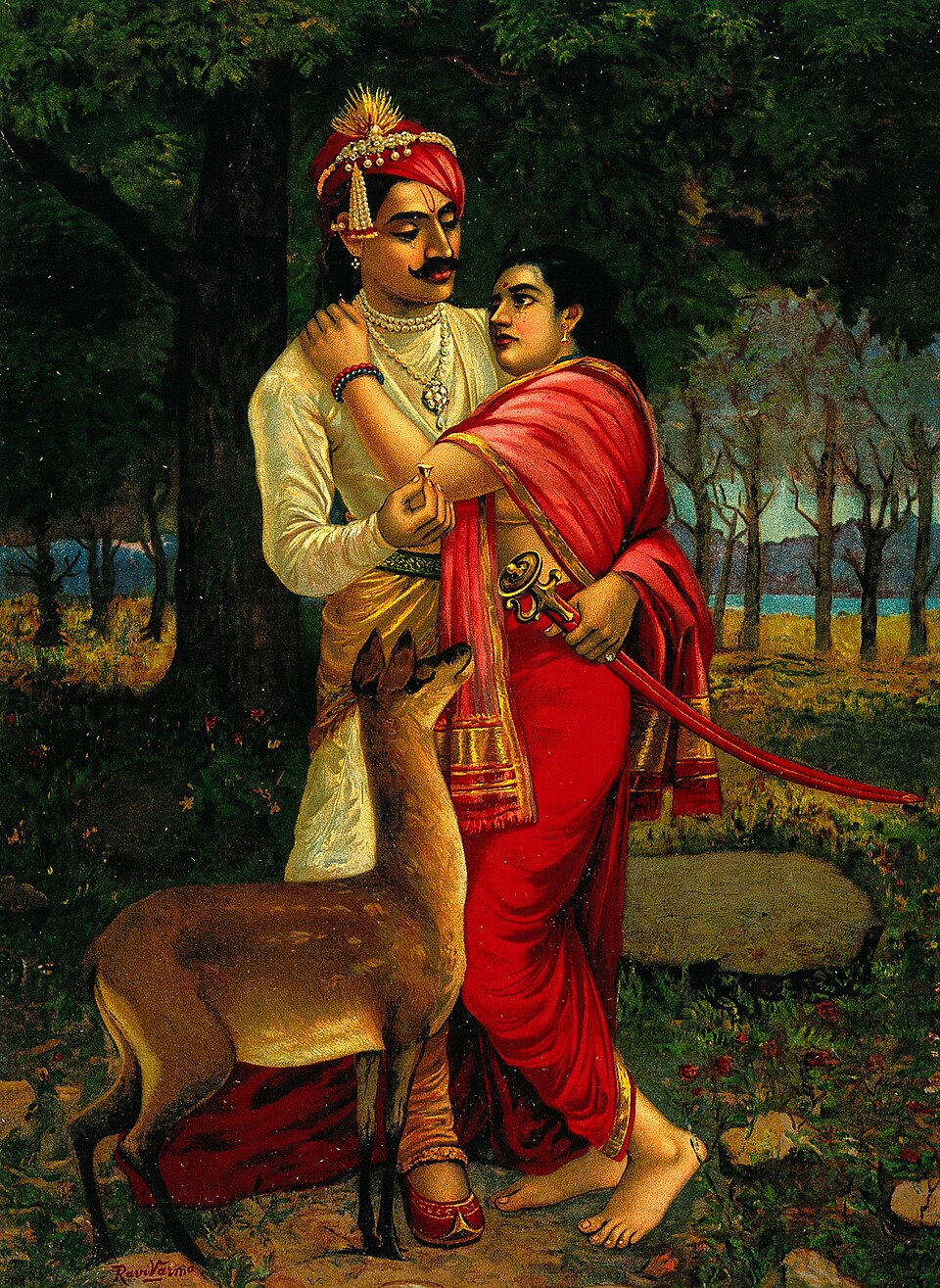
Long, long ago, during a hunting expedition, King Dushyanta of the Puru dynasty encountered Shakuntala, a young maiden living in a hermitage. The two are instantly drawn to each other and soon fall deeply in love.
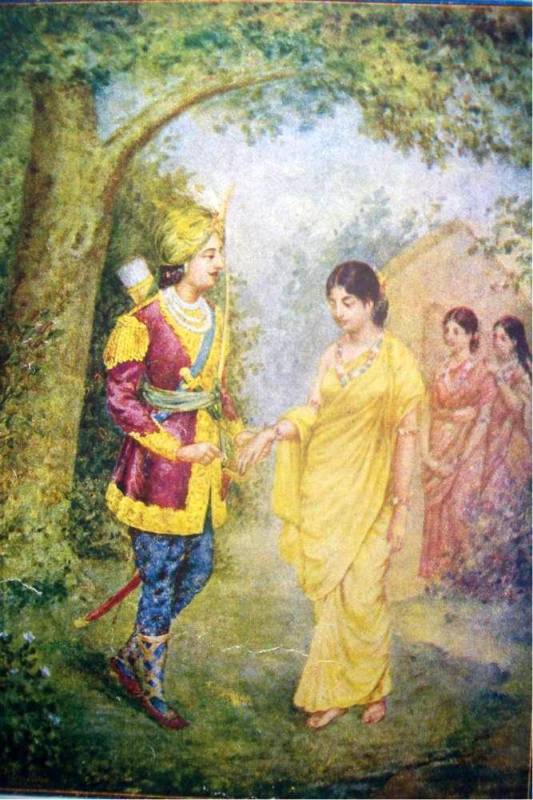
In the absence of her father, they get married through a ‘Gandharva’ marriage—a union based on mutual consent, with nature itself as their witness. When it was time for Dushyanta to return to his palace, he promises to send messengers to escort Shakuntala to the royal court. As a token of his love, he gives her his signet ring.
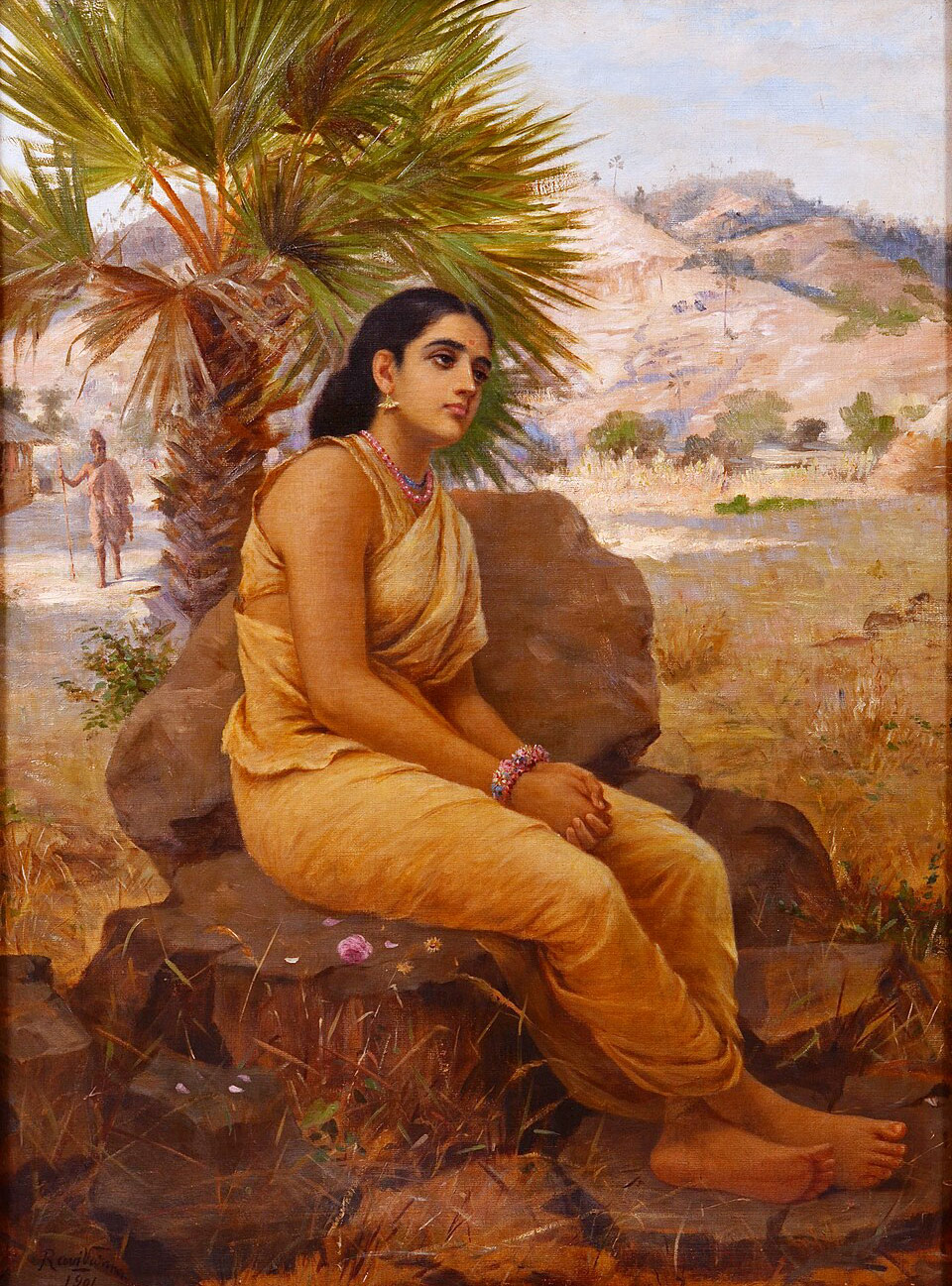
One day, the sage Durvasa arrives at Shakuntala’s hut seeking hospitality. Lost in thoughts of her beloved, she fails to notice or respond to his calls.
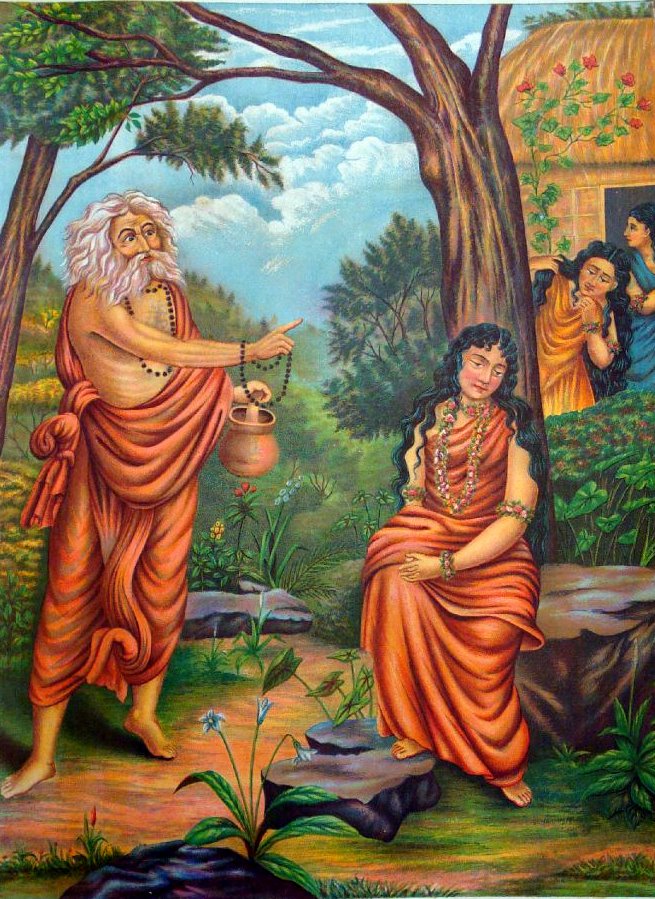
“Hey girl, you are the one causing disrespect to a guest. You are engrossed in whose thoughts. You are not paying heed to a hermit like me. The person you are trying to remember would forget you in spite of immense efforts of recollection in the same way as an insane person forgets his past”.
Offended by this neglect, the quick-tempered sage thus curses her, declaring that the man occupying her thoughts would forget her completely.
Her companions exclaim –
“Alas, alas! Something very unfortunate has happened. It seems as if Shakuntala, under the state of delirium due to infatuation for her husband, the king, has offended a sage. She has not offended an ordinary man. She has hurt maharshi Durvasa who, after invoking curse on our beloved confidante, is going back from the ashram at a fast pace”.
At the request of her companions, Durvasa softens his curse, adding that the king would regain his memory only upon seeing a meaningful token.
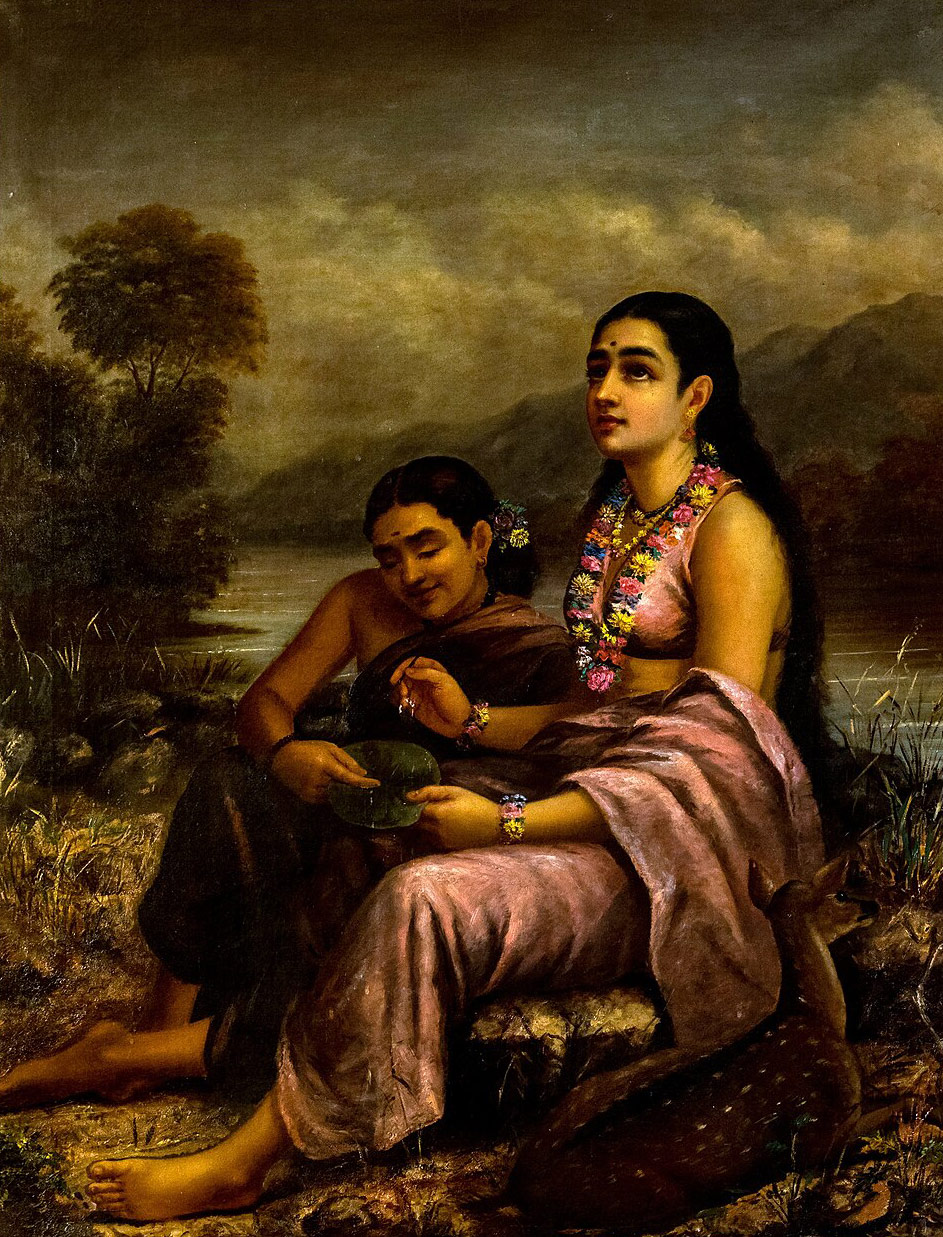
Time passes, but no one comes from the palace to fetch Shakuntala. She spends time with her friends Anusuya and Priyamvada and is lost in grief.
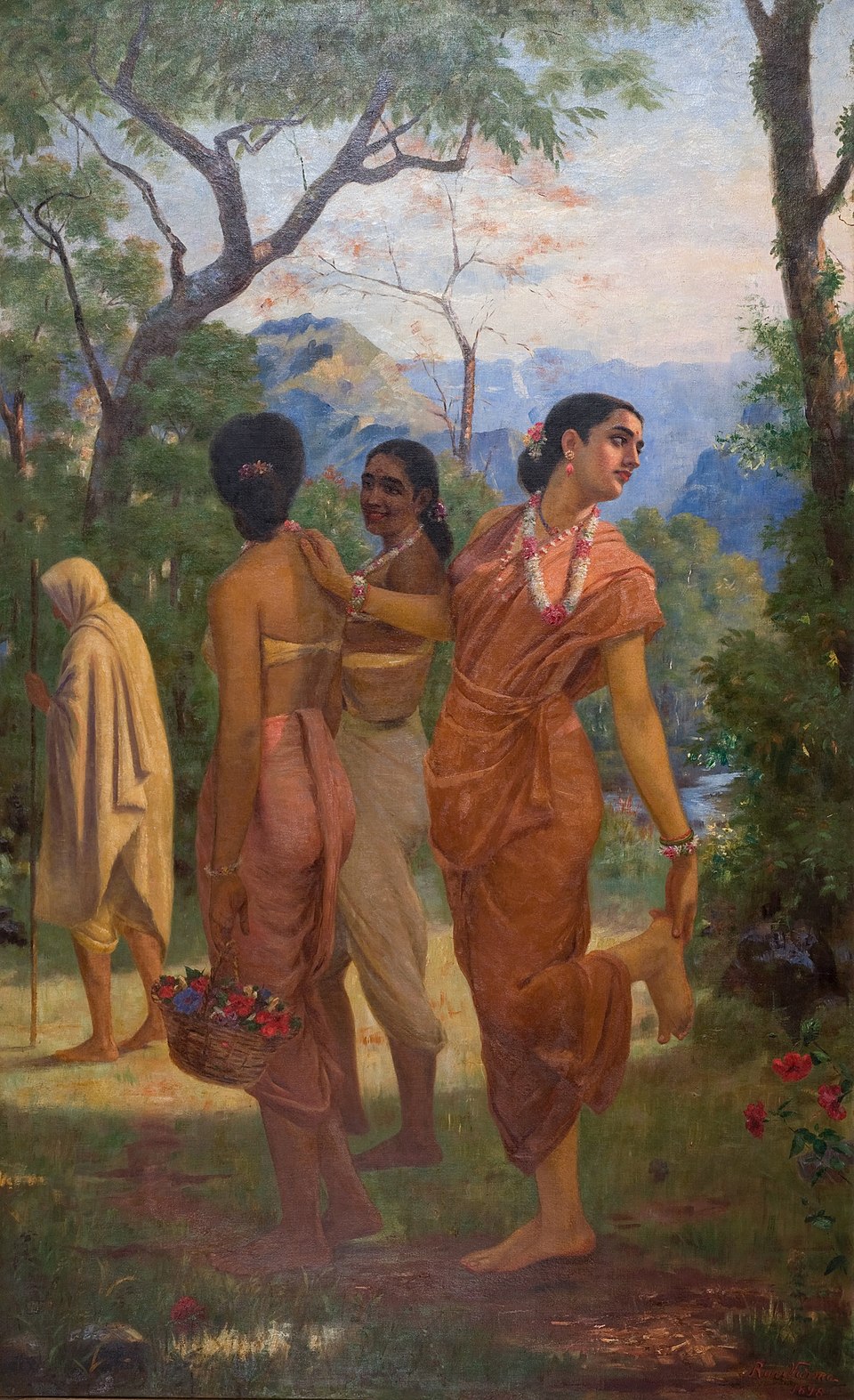
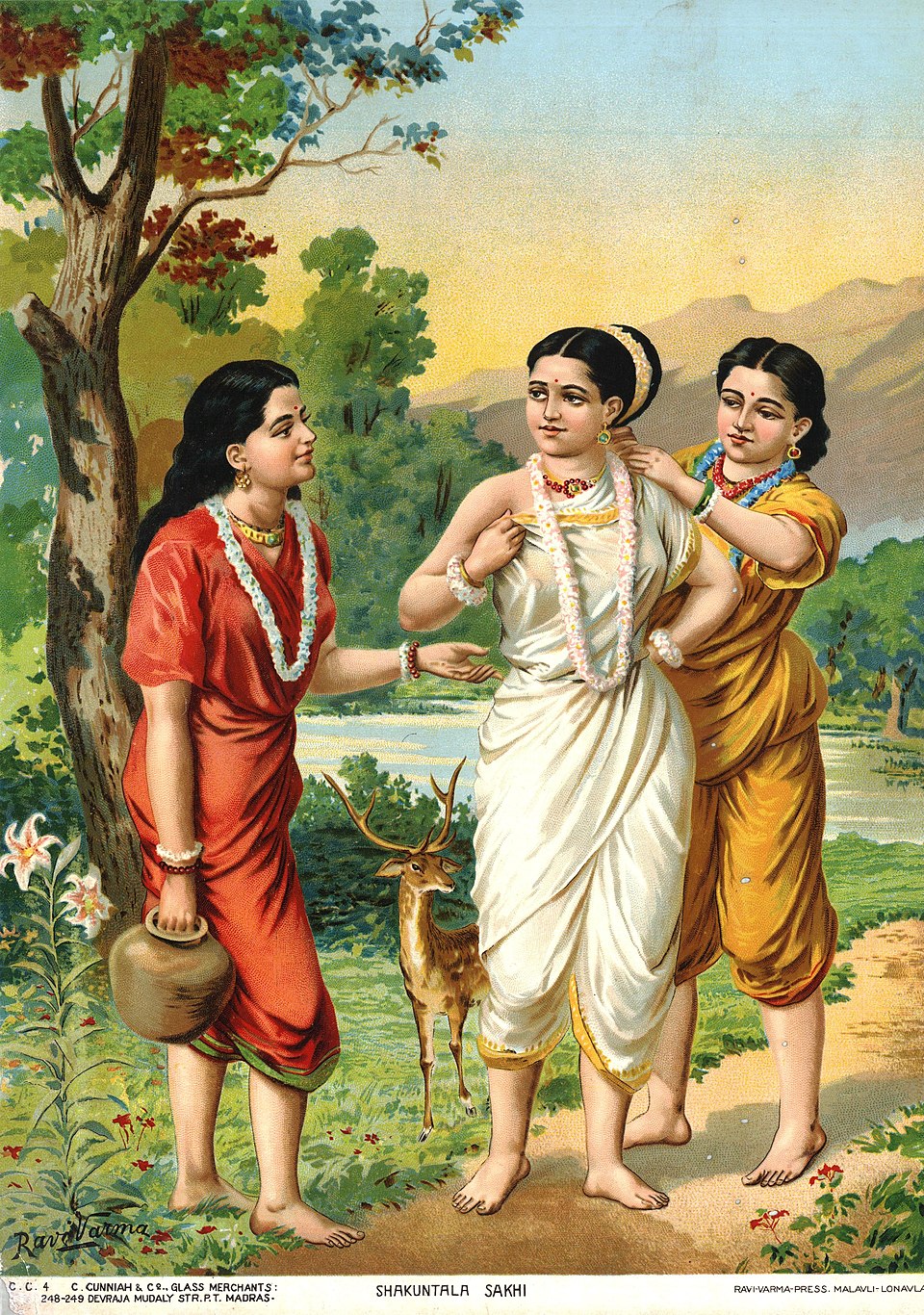
Eventually, her father decides to send her to Dushyanta himself, as she is carrying the king’s child.
Priyamvada says to Sage Kanva –
“As the fire dwells inside the tree of Shamee, similarly O brahmarshi! The ambience of Puru king Dushyant, dwells inside your daughter. Arrange to send her to her place”.
As Shakuntala prepares to leave, sage Kanva says –
“O the trees of the tapovan that is replete with forest gods! She never used to drink water without watering you. She never touched your delicate leaves, despite the fact that she loves ornaments. She was always delighted upon seeing your new buds. The same Shakuntala is going home. You see her off her love”
A sound from the skies comes –
‘May the journey of Shakuntala be fruitful. Ponds teeming with blue lotus on her way! May there be trees planted intermittently with dense shadow to save her from sunshine. May the dust have the delicacy of the lotus pollen and may the breeze, offering succour, keep blowing on the way to her home”.
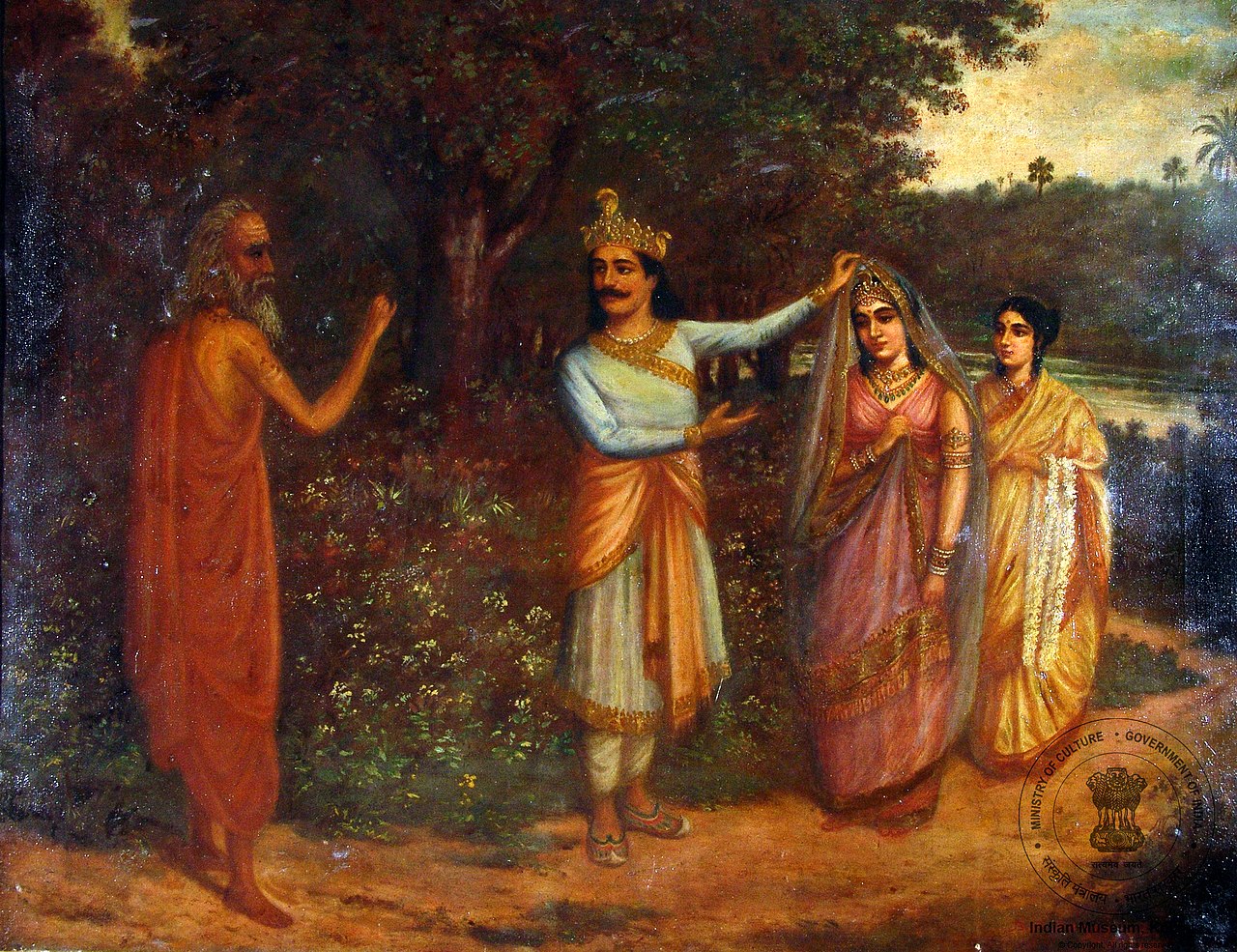
During the journey, however, Shakuntala accidentally drops the signet ring into a river, losing the very object that could have saved her. When she reaches the royal court and presents herself before Dushyanta, the curse takes full effect. The king fails to recognize her as his wife and rejects her claims.
King Dushyanta says –
“I have tried to recall repeatedly but cannot recall anything… I have ever married this ‘devi’ is not striking my memory”.
Shakuntala thinks –
“When the king is not prepared to recall anything, what would be the use of reminding him of the love that he had expressed at that time? Now my misfortune alone has remained in my life”.
Heartbroken and helpless, Shakuntalaprayes to the gods for justice. Meanwhile, fate intervenes when a fishermandiscoveres the lost signet ring inside the stomach of a fish.Upon seeing the ring, Dushyanta’s memory returns and he is overwhelmed with guilt and remorse for the wrong he has done.
Shakuntala says –
“Aryaputra! But tell me how did you remember this petty, agonized woman?
King Dushyanta –
“Let me remove my thorn-like agony first. I shall tell you everything. O beauty! On that day your tear drops were flowing down your cheeks and hurting your lips. I had inadvertently insulted those precious tears on that day. The same tear drops are visible in your eyes even today. Until I wipe them with my own hands my mind will not find peace”.
Shakuntala says –
“Aryaputra, this is your ring”.
King Dushyanta says – “Yes, I was able to recollect all those incidents after getting this ring”.
Shakuntala says –
“It had really done a vicious act. When I was going to show it as proof to you, it had disappeared at the very moment. I don’t know where it had fallen”.
King Dushyanta says –
“No, no. Now, I have no faith in it. Let Aryaputra wear it”.
Shakuntala forgives him, and the couple are joyfully reunited. In time, she gives birth to a son who is named Bharata, after whom the land of India came to be known as ‘Bharat’.
The Version in Mahabharata
In the Adi-parva of Mahabharata, Sage Kanva who finds the abandoned baby left near his hermitage by Menaka and is protected by the ‘sakunta’ birds says thus –
She was surrounded in the solitude of the wilderness by sakuntas,
therefore, hath she been named by me Shakuntala.
In the Mahabharata version of Abhijnanashakuntalam, though there is a lot of similarity in the storyline, Shakuntala is separated from her husband, King Duṣhyanta, for a long time. Their reunion comes only after the birth of their son, Bharata.
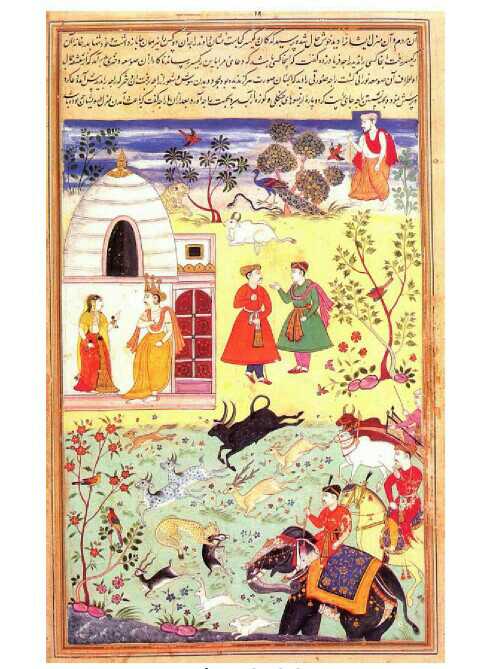
One day, Duṣyanta comes upon a young boy in the forest fearlessly playing with lion cubs, prying open their mouths with his bare hands to count their teeth. Astonished by the child’s courage and strength, the king questions him about his parents.
King Dushyanta says –
“Hey, who is this courageous boy”?
Two female hermits are coming behind him. The cubs have not adequately fed themselves with milk from their mother’s teats. That boy is pulling the cubs apart and forcing them to play with him.
Child says – “O lion! Open your mouth; I will count your teeth”.
First lady hermit says – “O prankster! Why do you harass those who we have reared as our children? Hai! Your pranks are growing day by day. The rishis have named you Sarvadaman. Plausibly, they would have given you this name after thorough deliberation”.
Second lady hermit says –
“Look, if you did not spare these cubs, the lioness, their mother, will attack you”.
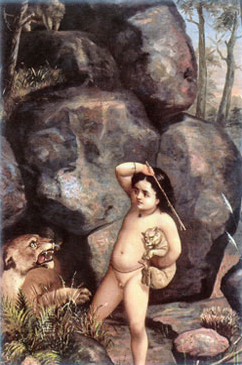
The boy leads Duṣhyanta to the hermitage of Sage Kaṇva, where the king meets Shakuntala. At that moment, Dushyanta’s lost memories return, filling his heart with warmth and joy. Reunited at last with his wife and son, he takes them back to Hastinapur, restoring his family and his happiness.
This tale from India’s ancient literature is of immense interest and very popular Even today it is enacted before appreciative audiences. The storyline still captivates even though centuries have passed since its initial narration.
References –
- Ashok Kaushik (tr.) (2020) Kalidas’ Abhignan Shakuntalam, New Delhi: Diamond Pocket Books (P) Ltd.
- https://rsmraiganj.in/wp-content/uploads/2020/04/Untitled-document-2-10.pdf (accessed on 26.12.2025)
- https://mahabore.wordpress.com/2014/03/12/shakuntala-and-dushyanta-the-mahabharata-version/ (accessed on 26.12.2025)
- The translations are by Ashok Kaushik.
- http://www.sacred-texts.com/hin/m01/m01073.htm (accessed 02.01.2026)