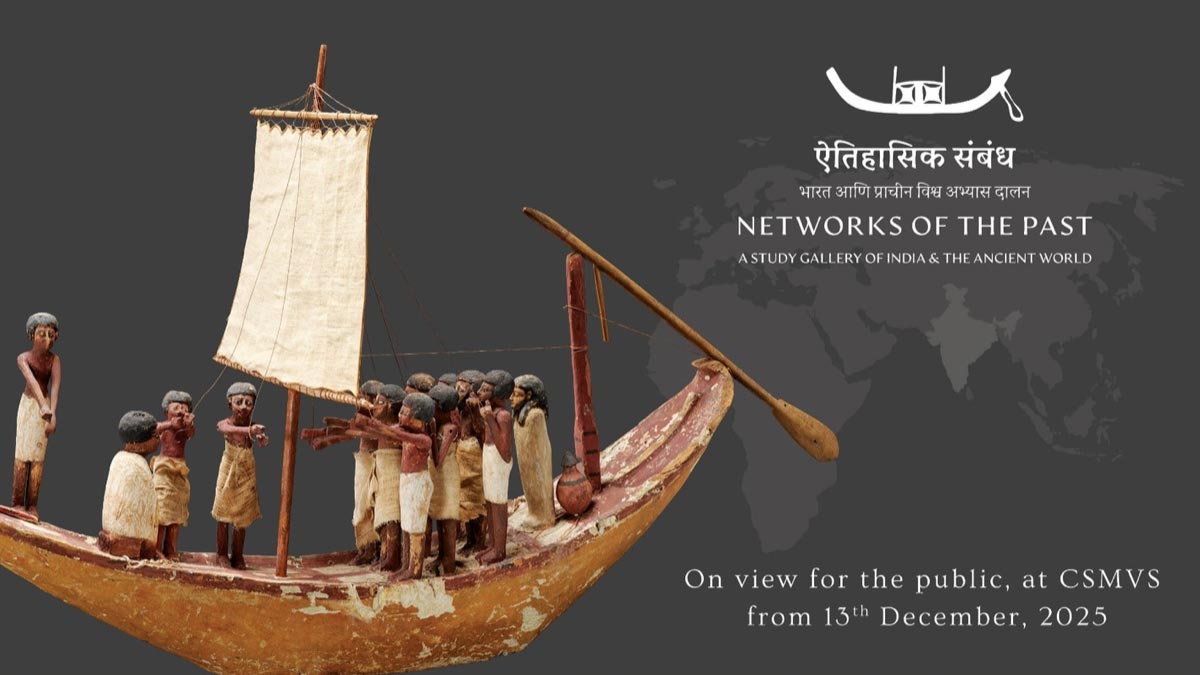
The Chhatrapati Shivaji Maharaj Vastu Sangrahalaya (CSMVS) in Mumbai is set to unveil one of India’s most ambitious and globally significant museum initiatives: “Networks of the Past: A Study Gallery of India and the Ancient World,” opening on December 13, 2025. This mega project brings together 7 international museums, 8 Indian museum lenders, and an extraordinary team of more than 100 experts, curators, conservators, researchers, and designers. With 300 objects displayed within a single immersive gallery, this exhibition represents a landmark in India’s museological and cultural diplomacy landscape.
A Paradigm of Global Artefacts
This new permanent gallery is the culmination of years of international collaboration, designed to fundamentally re-examine India’s role in the global story of antiquity. This initiative challenges the narrow traditional view of national histories and dissipates the philosophy of interconnectedness of human civilizations, stretching back over 4,000 years. In the words of the curators, the objects on display were once products of “movement, trade, belief, and life,” not static museum pieces. As the exhibition’s teaser suggests, “4000 years ago this wasn’t a museum object… it was life.” Thus, one can conclude that historical objects are not determinants of static history or “dates” alone; they were once active participants in human lives belonging to a distinct period.
View this post on Instagram
The journey of this project began with the preparatory “Pilot Project” exhibition, Ancient Sculptures: India, Egypt, Assyria, Greece, Rome, which ran from December 2023 through 2024. The subsequent permanent gallery, “Networks of the Past,” expands dramatically on this concept, acting as the capstone of CSMVS’s broader Ancient World Project. It was during this exhibition that international partners like the British Museum (London), the Staatliche Museen zu Berlin, and the J. Paul Getty Museum (Los Angeles), have loaned significant objects for an extended period. Furthermore, major participation is received from the Museum Rietberg (Zurich), the Al-Sabah Collection (Kuwait), the Benaki Museum (Athens), and the Ephorate of Antiquities of the City of Athens, Ministry of Culture, Greece. Thus, each partner institution contributes not only artefacts but scholarly expertise.
The Indian Institutions
On the Indian side, the National Museum, New Delhi, the Indian Museum, Kolkata, and key regional museums like the Government Museum, Mathura, and the Bihar Museum, Patna, are participating. Through this diverse partnership, India’s cultural heritage will reach more people. It will include a wide timeline from Harapan artefacts to the Gandhara sculptures, Gupta bronzes, and early trade-based materials that will stand tall beside their global counterparts.
Beyond the setting up of the physical gallery, the project also aims to have a greater educational outreach. Organizations like the Getty are supporting micro-exhibitions featured on the CSMVS’s successful Museum on Wheels buses. This step is taken to ensure that the global narrative reaches beyond Mumbai’s metropolitan centre. This project aims to reach millions of people, redefining the museum’s role as a catalyst for learning and social contribution.
The Storyline: How Civilisations Stayed Connected
View this post on Instagram
Movement, Trade & Maritime Linkages
The core theme of the gallery is the showcasing of civilizational interconnectedness through ancient trade routes, shared technologies, and the movement of peoples. The segment, thus, revolves around four prime river cultures: the Indus Valley Civilization (Harappa), Mesopotamia, Ancient Egypt, and Early China. And then, subsequently, there are representations of the vital connections with the Persian, Greek, and Roman worlds.
The objects collected from the British Museum might illustrate the trade of precious materials between the Mediterranean and the subcontinent, and artifacts from the Staatliche Museen zu Berlin could demonstrate shared aesthetics found across West Asia and India. Meanwhile, the Indian collections, from the Archaeological Survey of India (ASI) and key national institutions, will provide the essential context, showcasing the continuity of Indian tradition within a massive global framework. Objects such as boat models, seals, beads, ceramics, and religious icons highlight how trade in spices, textiles, metals, and precious stones paved the way for intercultural exchanges.
Belief Systems & Cultural Diffusion
The gallery also explores how religious and philosophical ideas travelled. The presence of Greek, Egyptian, and Indian ritual objects demonstrates a connected spiritual world where Buddhism, early Hindu traditions, and Mediterranean religions coexisted and interacted.
Material Culture & Everyday Life
Across 300 objects, visitors will trace commonalities in tools, household items, jewellery, artistic motifs, and technologies, revealing that ancient societies were far from isolated.
Exhibition Details
| Event | Detail |
|---|---|
| Title | Networks of the Past: A Study Gallery of India and the Ancient World |
| Opening Date | December 13, 2025 |
| Venue | Chhatrapati Shivaji Maharaj Vastu Sangrahalaya (CSMVS), Mumbai |
| Exhibition Scope | Permanent gallery focused on the interconnectedness of ancient India with global cultures. |
| Object Count | Approximately 300 artifacts are displayed in a single gallery. |
| Core Theme | Highlighting trade, belief, and cultural exchange across the four river cultures (Indus, Mesopotamia, Egypt, China) and the Greco-Roman worlds. |
Key Highlights
- Meticulously curated gallery showcasing 300 multi-civilisational objects.
- Rare artefacts from Egypt, Greece, Mesopotamia, Rome, Iran, and India.
- It is a First-of-its-kind collaborative initiative between 7 international and 8 Indian museums.
- Focus on the movement of goods, people, artistic styles, and religious concepts.
- A strong educational emphasis on how civilizations were historically interconnected.
- Supported by global institutions like the Getty and cultural stakeholders in India.
Why This Exhibition Matters Today
The initiation of this new gallery is a seminal moment for Indian museology and cultural diplomacy. Today’s world is mostly characterized by geopolitical fragmentation and debates around cultural ownership. Amidst this, Networks of the Past stands as an exception, displaying global inclusivity. It challenges the narrow perception of people regarding the cultural isolation of the ancient civilizations and weaves a theory that denotes connection through a plethora of means. It sets a precedent for scholarly collaboration, shared custodianship, and public access to world heritage. CSMVS has crafted not just an exhibition but a model for future museum partnerships in India.
By comparing the chakra-bearing Vishnu alongside a Roman Bacchus and an Egyptian Sekhmet, the exhibition sparks a wave of curiosity in people’s minds and nudges them towards dialectical conversations and analyses. As one steps into this well-curated sphere, they come in contact with artefacts that have survived thousands of years and are helping us reimagine history in a composite way. It is a testament to India’s centrality in global affairs from time immemorial.