A 75-Year Milestone in Silver and Paper
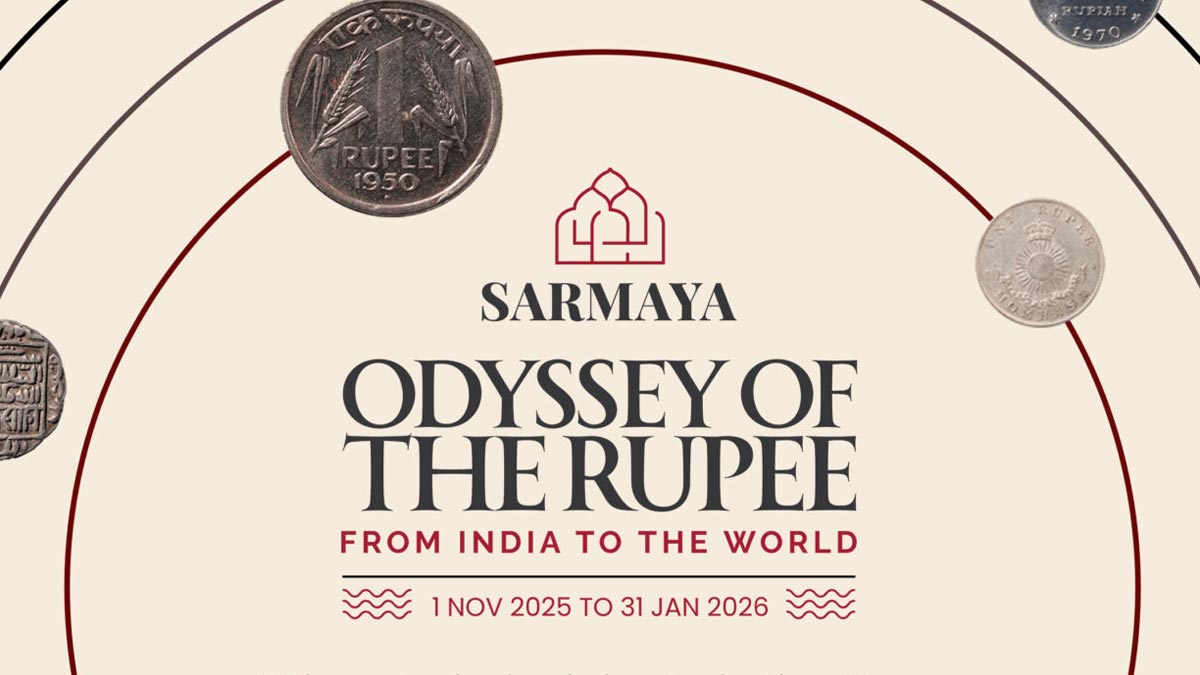
The Indian Rupee has been a witness to the rise and fall of empires, routes of commerce, and finally the formation of a nation-state. This year, our very own currency has turned 75; to commemorate this, the Sarmaya Arts Foundation has organized a landmark occasion titled Odyssey of the Rupee: From India to the World. The exhibition began on November 1, 2025, and will continue till January 31, 2026, at the Sarmaya Archive in Mumbai. This exhibition is a great opportunity to peek into the numismatic history of the subcontinent through scholarly interpretations. This fascinating showcase of the evolutionary history of the currency is curated by Dr. Shailendra Bhandare (Senior Curator for Asian Coins and Paper Money) of the Ashmolean Museum at the University of Oxford; the exhibition space is designed by Pavitra Rajaram Design. This exhibition turned out to be the museum’s largest display of historical currency to date.
Sarmaya, founded by Paul Abraham, has evolved into a museum without boundaries, and this exhibition is an attestation to its leaning towards a higher degree of scholarship. The phenomenal partnership of the foundation with Dr. Bhandare has helped them in framing the rupee within a “grander sweep of world history.” The exhibition does not restrict the viewing of the coin within glass boxes, but molds people’s perception by distinctly narrating its biography. The exhibits begin with the ancient punch-marked coins of the Janapada era (circa 6th century BCE). Then the showcase trails through the standardization under Sher Shah Suri and his silver rupiya (1538), and finally comes to a climax with the minting of modern Indian currency.
A Living Currency
One of the primary focus areas of the whole exhibition is the internationalization of the rupee. Before the USD became the standard currency on the global dias, the Indian rupee was the preferred currency across a gargantuan geography. Therefore, the undercurrent is to make people aware of the “soft power” of the Indian currency through a beguiling demonstration of currencies minted for use in East Africa, the ones that circulated in the Persian Gulf, and even examples from the Dutch East Indies (Java). An interesting case surfaces from the Cocos (Keeling) Islands, an Australian territory, that was ruled as a fiefdom by the Clunies Ross Family for generations (nearly 150 years). This kingdom is known for the creation of the Cocos Rupee, a private token currency system based on the Indian Rupee that was primarily used for trade.
View this post on Instagram
The point of disclosing these fascinating facts is to democratize the rooted perceptions related to the “Rupee” simply as a domestic currency. It becomes an important discourse to trace the movement of the currency as it functioned as the primary engine of colonial and pre-colonial global trade. Our rupee is beyond a metallic bullion; it is an archive of global affairs interlocked in the reverse and obverse facades. The visitors will take a glance at the transformation from the Mughal Rupaiya adorned with Persian calligraphy to the colonial-era mints with the British sovereigns. An interesting showcase features a silver coin of Akbar, on which the term “Rupaiyah” appeared for the first time in 1602 (47th year of his reign). People will also have the opportunity to catch sight of the first coin of the Republic of India, minted in 1950, bearing the Lion Capital of Ashoka. This resembles booting out the colonial integument and embracing an independent identity.
The exhibition also delves into the art of coin-making. The aesthetic evolution of coinage is well displayed through the presentation of hand-struck tankas to machine-made coinage. This valuable partnership with Dr. Bhandare has brought a culturally nuanced perspective towards our currency to life. There are distinctive mentions about the use of the rupee in Mozambique or its influence on the German East African rupie. This holistic presentation of the currency establishes it as a socio-cultural catalyst rather than just an economic agent.
Sequencing of The Exhibition
The exhibition opens with a segment titled, ‘Before the Rupee.’ It introduces the earliest coins produced in India, encompassing the punch-marked silver Karshapanas and regional gold issues, etc. It also taps into the ancient trade routes and the circulation of money through those channels. This segment highlights the gradual evolution of the subcontinent’s indigenous monetary nexus and its elevation into a “global currency”. It testifies to the fact that the emergence of this currency did not stem out of vacuum, and neither was it accidental.
Moving further, the catalogues and wall texts mention Sher Shah’s stable silver unit and the wider acceptability of the Mughal currencies. One of the most significant portions of the whole arrangement is the Rupee Abroad. It displays a wide collection of coins and notes from the Indian Ocean region. It testifies to the high mobility of the Indian currency and its domination in the vicinity.
The final galleries shed light on the rupee through the colonial period to the Republican era. It displays a plethora of machine-struck uniform coinage, princely rupees, and ‘Nazarana.’ It also presents wartime paper money and the 1950 coin bearing Ashoka’s Lion Capital. This section also highlights certain concerns regarding the outsourcing of minting, commemorative mints, and the transition to bimetallic and polymer forms. These aspects invoke a sense of continuity amidst the trails of change.
The Exhibition At a Glance
| Aspect | Details |
|---|---|
| Exhibition Title | Odyssey of the Rupee: From India to the World |
| Dates | November 1, 2025 – January 31, 2026 |
| Venue | Sarmaya Archive, Fort, Mumbai |
| Curator | Dr. Shailendra Bhandare (Ashmolean Museum, Oxford) |
| Exhibition Design | Pavitra Rajaram Design |
| Key Anniversary | 75th Anniversary of the Republic of India’s Rupee (1950–2025) |
| Core Theme | The journey of the rupee from a domestic coin to a global currency of trade |
| Scale of Collection | Largest-ever Sarmaya showcase, ranging from pre-rupee punch-marked coins to the first Republic rupee (1950) |
| Global Reach | Objects demonstrate the circulation of the rupee across Java, Mozambique, and Gulf polities |
| Public Engagement | Walkthroughs, school programmes, and press coverage position the show as a civic and pedagogic project |
Key highlights
- It is the first collaboration between Sarmaya and Dr. Shailendra Bhandare, lending the show deep academic rigour.
- The exhibition gathers punch-marked coins, Indo-Greek drachmas, Mughal rupees, princely state issues, East India Company and British coinage, and the first Indian Republic rupee (1950).
- Rare international issues and Gulf/Indian Ocean linkages on display — material evidence of the rupee’s role in long-distance trade and migration (examples include coins/notes linked to Java, Mozambique, Saudi Arabia, and other ports).
- Didactic panels situate objects within political and economic episodes: Sher Shah Suri’s monetary reform (1538), Mughal standardisation, the Uniform Coinage Act (1835), and 20th-century transitions to paper and alloyed coins.
- A visual timeline showing the shift from calligraphic Mughal designs to the portrait-heavy British India coins, and finally to nationalistic symbols of the Republic.
- A special ten-rupee banknote issued by the RBI in 1959 for exclusive use in the Persian Gulf is displayed. These were created to stop smugglers from buying gold abroad with regular Indian currency.
- Beyond standard currency, the show includes curious oddities like the Cocos-Keeling island currency and “Portcullis money” (struck by Elizabeth I for trade with the East).
A Clink Of History: Takeaway
The most special part of this exhibition is that it scrutinizes the rupee as a vector of the cultural past as well. The evolution of currency has undergone changes and upheavals throughout a very, very long time frame. Today, the masses are observing yet another evolutionary boom, as the clinking of the coins is getting rapidly replaced by the ping of UPI payments.
In a time like this, the Odyssey of the Rupee drags the masses back to an eon of “tangible” relationships formed through our currencies. This exhibition makes people confront what we “lose” when the physical money disappears and gets transformed into digital units in online wallets. It is a revolutionary showcase on reflective history where introspection is the key.
The rupee is a living index archiving the aspects of political sovereignty, technological change, and global entanglement. In today’s age, the physical currency is rapidly metamorphosing into something abstract, with a trend of mobile payments, digital wallets, and talk of a ‘digital rupee.’ This exhibition reminds us that money is also forged, struck, printed, and circulated.
The rupee, on completing its 75 years’ hallmark, is a great moment to look back at its physicality and the stories that followed it. The rupee has survived devaluations, demonetizations, and digitizations; this exhibition is a timely reminder that before it was data, it was silver, and it ruled the world.