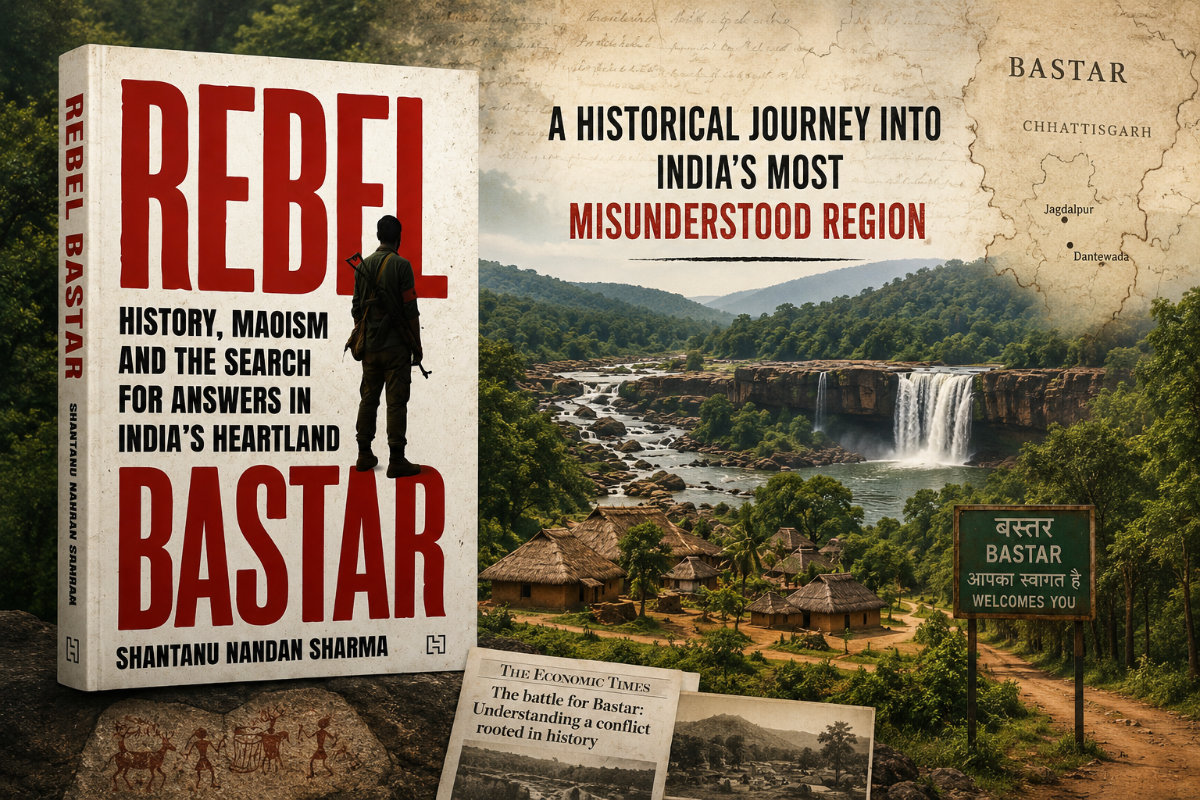
A new book by senior journalist and historian Shantanu Nandan Sharma seeks to examine Bastar beyond its long association with insurgency and conflict. Rebel Bastar: History, Maoism and the Search for Answers in India’s Heartland arrives at a time when discussions around governance, development and internal security continue to shape public policy. The publication looks beyond contemporary events to explore the historical forces that contributed to the rise and endurance of Maoism in the region.
Looking Beyond the Security Narrative
In March 2026, the Government of India announced that the Maoist insurgency had been effectively defeated. While this marked a significant moment in India’s internal security history, Sharma’s book asks a broader question: how did Bastar become the centre of one of the world’s longest-running insurgencies?
Rather than focusing exclusively on conflict, Rebel Bastar examines the region through historical, social and administrative lenses. The author argues that understanding Bastar requires looking at centuries of change involving tribal communities, governance systems, colonial intervention and developmental transitions.
Tracing Bastar Through History
Drawing on years of field reporting and historical research, Sharma reconstructs key moments in Bastar’s past. The narrative explores episodes ranging from accounts associated with Dantewada and colonial-era interventions to the growing influence of Maoist ideology in later decades.
The book examines how geography, governance and historical developments interacted over time to create conditions in which insurgency could take root. Rather than presenting a single explanation, it highlights the complex relationships between local traditions, administrative decisions and external influences.
Highlights Covered in the Book
- Tribal resistance movements and regional history
- Colonial expansion into Bastar’s forest regions
- Governance changes across different historical periods
- The emergence and growth of Maoist influence
- Development challenges and resource-related questions
- Historical context behind contemporary security concerns
A Wider Perspective on Maoism
One of the notable aspects of the publication is its inclusion of lesser-known accounts connected to the wider Maoist movement. Among them is former NITI Aayog Vice Chairman Rajiv Kumar’s recollection of briefly embracing Naxalite ideology during his student years before later rejecting it. Similar excerpts from the book have recently drawn public attention and renewed discussion about the ideological appeal of revolutionary movements among sections of educated youth.
By bringing together historical narratives and personal reflections, Sharma seeks to broaden the conversation around Maoism beyond armed conflict alone.
The Author Behind the Research
Sharma currently serves as Senior Editor at The Economic Times and has reported from across India during a journalism career spanning more than three decades. His reporting has covered diverse regions and social issues, and he has written extensively on political, economic and cultural developments across the country.
Originally from Assam, Sharma studied history at the University of Delhi before entering journalism. According to the author, his deeper engagement with Bastar began following reporting assignments in the region after India’s 2016 demonetisation, which led him to investigate the area’s longer historical trajectory.
Recognition from International Historian
The book has received praise from historian Peter Frankopan, Professor of Global History at Oxford University and author of the internationally acclaimed The Silk Roads: A New History of the World. Frankopan describes Rebel Bastar as an ambitious exploration of why Bastar became the enduring heartland of India’s Maoist insurgency. Frankopan is widely known for his work on global historical connections and has authored several bestselling history books.
Why the Book Matters Now
The publication appears at a time when policymakers, researchers and civil society groups are increasingly focused on sustaining peace and promoting development in formerly conflict-affected regions. Questions related to tribal communities, natural resources, governance and inclusive growth remain central to these discussions.
By placing contemporary developments within a broader historical framework, Rebel Bastar attempts to contribute to a more nuanced understanding of a region that is often viewed primarily through the lens of security. Combining historical research with on-the-ground reportage, the book aims to provide context for readers interested in India’s regional histories, democratic evolution and development challenges.
Final Thoughts
Rebel Bastar presents Bastar as a region shaped by centuries of social, political and historical change rather than by conflict alone. Through its examination of governance, tribal societies, colonial interventions and ideological movements, the book encourages readers to engage with deeper historical realities. In doing so, it contributes to wider conversations about development, identity and the long-term forces that continue to influence India’s heartland.