Decoding Minimalism and Abstraction in the Indian Context
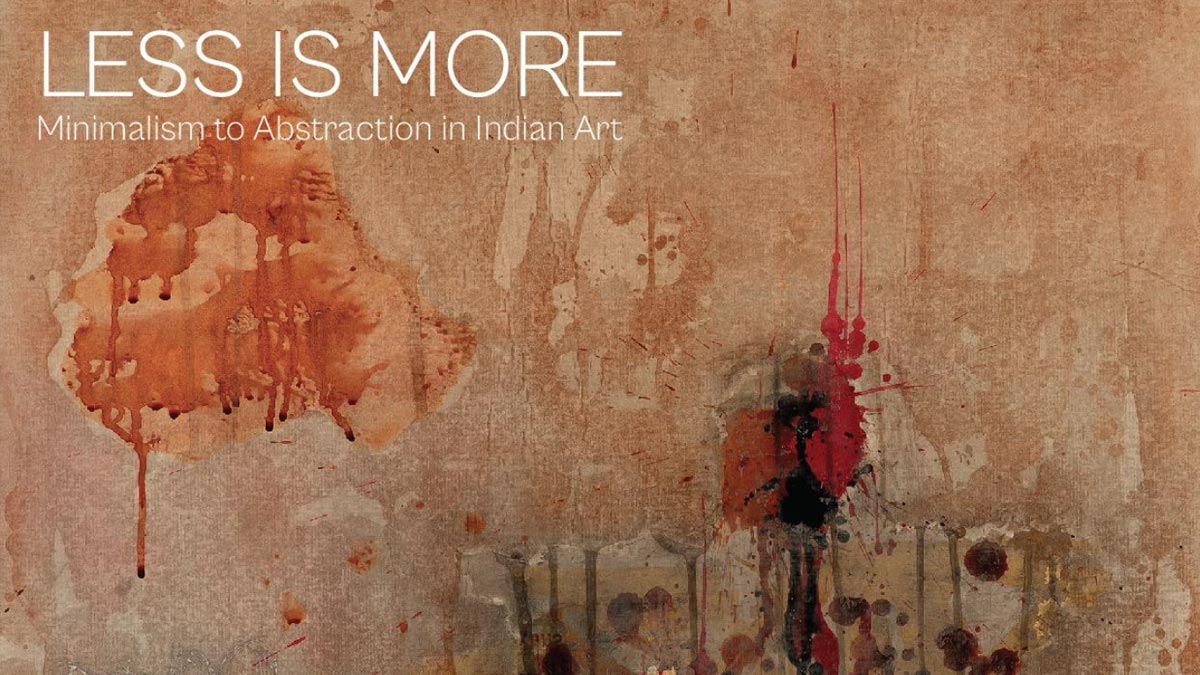
The Centre of International Modern Art (CIMA) in Kolkata, on December 19, 2025, has recently launched a watershed exhibition titled “Less Is More.” This exhibition is set to offer an experience that freewheels into the history of abstraction and minimalism in the Indian artistic landscape. The central notion is to challenge the Eurocentric view that abstract art is a Western import. A counterweight is proposed through the display of Indian aesthetics, which is sourced as the foundation of abstraction in the subcontinent. The first phase of the exhibition will be on view through February, 2026. It will be followed by a second phase featuring new artworks and fresh perspectives.
The take of this exhibition is dual; it is as philosophical as it is historical. It projects the presence of abstracts and minimalism as an intrinsic element within Indian thought and artistic practice. It projects abstraction as a continuing tradition stemming from tribal arts, other ancient forms, and so forth. The Exhibition’s catalogue essay is authored by the founder and director of CIMA, Rakhi Sarkar. This text acts almost as a guide in tapping the flow of artistic ideas from India to the West through the Theosophical Society.
Glimpse of The Exhibition
| Aspects | Details |
|---|---|
| Exhibition Venue & Duration | Hosted at CIMA Gallery, Kolkata; Phase I launched on December 19, 2025, and runs through February 2026. |
| Curatorial Vision | Directed by Rakhi Sarkar, focusing on the “inner life” of abstraction versus the “external reality” of naturalism. |
| Historical Thesis | Proposes that abstraction travelled from India to the West through philosophical exchanges such as the Theosophical Society (est. 1875). |
| Philosophical Roots | Connects minimalism to Buddhist mandalas, Jain geometry, and Vedic Hindu representations of the cosmic order. |
| Two-Phase Structure | A dynamic exhibition format where a fresh set of artworks and perspectives will be introduced in the second phase. |
| Featured Artists | Includes works by Samir Aich, Shakila, Bimal Kundu, Ashok Mallick, and Shreyasi Chatterjee. |
Contextualising Less Is More within Indian Art Historiography
Indian Modern Art predates the Western constructs about the creative consciousness of the people of the subcontinent. Renowned artists such as Bimal Das Gupta broke new ground in abstract expressionism in India during the 1940s. He dabbled with colours, forms, and spiritual themes, and established a perspicuous dichotomy with European modernism. This reflected a paradigm shift in the representation of artistic modernism. His “homegrown abstracts” borrowed heavily from indigenous thought and artistic experimentation that was brewed within the subcontinent.
Also, artistic movements such as the Bengal School of Art were eccentrically crucial in this context. The Bengal school redrafted folk aesthetics and expressed a staunch refusal to accept Western naturalism. It also opened doors for the adoption of “Indian” elements, styles, and subjects. The indigenization and formation of a new artistic vocabulary altered the vogue of art. These steps made abstract art appear more “organically.”
View this post on Instagram
The Calcutta Group, formed in 1943, represented the second phase of this transformation. While the Bengal School looked inside, the Calcutta Group decidedly engaged with Western modernism. Renowned artists like Paritosh Sen, Prodosh Das Gupta, and Gopal Ghose introduced new styles influenced by Cubism, Expressionism, and later abstraction. Their signatures bore the impression of fragmentation of forms, angular structures, and experimentation with “space.” They were believers of the notion that art should respond to contemporary realities, such as political upheaval, war, famine, and changing urban life. Together, they moulded a highly intellectual space for art.
The inclusion of these elements into the thematic umbrella of the exhibition, Less Is More, feels more like a scholarly take on art and its evolution, rather than a trivial corpus of art hung on walls.
The Art and The Artists
An expressive dimension to abstraction is visualized through the works of Samir Aich. He moves beyond pure geometric figures and creates something extraordinary on canvas that appears to be filled with life. The central theme of his art is to challenge the quietude in minimalistic art and present it in a more lively avatar, punctuated by emotional depths. Shakila is a self-taught artist hailing from a traditional Muslim family in Kolkata. Her art reuses discarded newspaper scraps and printed materials to form vibrant structures. Her vision is to evince that minimalism can also emerge from judicious reconfiguration of everyday items, not from reduction alone.
Ashok Mallik brings an international touch to the exhibition. Having spent years working in France, he absorbed European influences. His signature is post-war abstraction. But his artwork, presented in the exhibition, also incorporates Indian sensibilities. Bimal Kundu adds to the exhibition by showcasing his sculptures. He is widely acknowledged for his aluminium and steel works. His 3-D minimalist sculptures draw inspiration from industrial materials and architectural structures. He aims to describe the ambit of artistic minimalism beyond canvases.
Paintings of Yogesh Murkute exemplify the inculcation of abstraction as one of the likable genres of the younger generation. His paintings feature abstraction by bridging modernist art with a contemporary hue. A unique perspective is unfolded by the work of Shreyasi Chatterjee. She blends textile motifs with traditional Indian decorative devices and finalizes with a seamless, minimalistic outlook. Seema Ghurayya’s canvas stands out for her brilliant use of white. She emphasizes subtlety over spectatularity. Her artistic approach states that minimalism is not about visual scarcity, but about perceptual depth.
Key Highlights
- Less Is More posits that abstraction and minimalism in Indian art have deep cultural and spiritual roots.
- The exhibition features cross-generational works, showcasing evolution rather than rupture.
- Rakhi Sarkar’s essay provides a theoretical framework linking Indian aesthetic traditions to global modernism.
- Artistic contributions reflect diverse media and methodologies, from collage to painting and sculptural forms.
- The show encourages contemplative viewing, inviting audiences to reconsider the role of abstraction beyond stylistic confines.
- Despite the lack of figurative realism, the works evoke deep emotional responses.
The exhibition is an open invitation to everyone to experience these phenomenal art pieces with unhurried contemplation. This “less” allows for “more” intellectual and emotional engagement.
Takeaway
Amidst a thick envelope of digital clutter, this exhibition offers a retrospective refuge. “Less Is More” at CIMA Gallery serves as a vital aesthetic detox. It differs from the dominant Eurocentric view of abstract and minimalist art and positions those carefully within the ambit of Indian art. For too long, Indian art history has been viewed through the lens of Western influence; however, by rooting abstraction in the ancient Indian traditions, CIMA restores a sense of cultural ownership to the minimalist movement.
This exhibition is hauntingly beautiful and proves that silence can speak louder than words, if channeled through the right media. It reminds us that the “inner side of life” is far more expansive than the world we see with our eyes.