Articulating the Ineffable: “The Body Speaks”
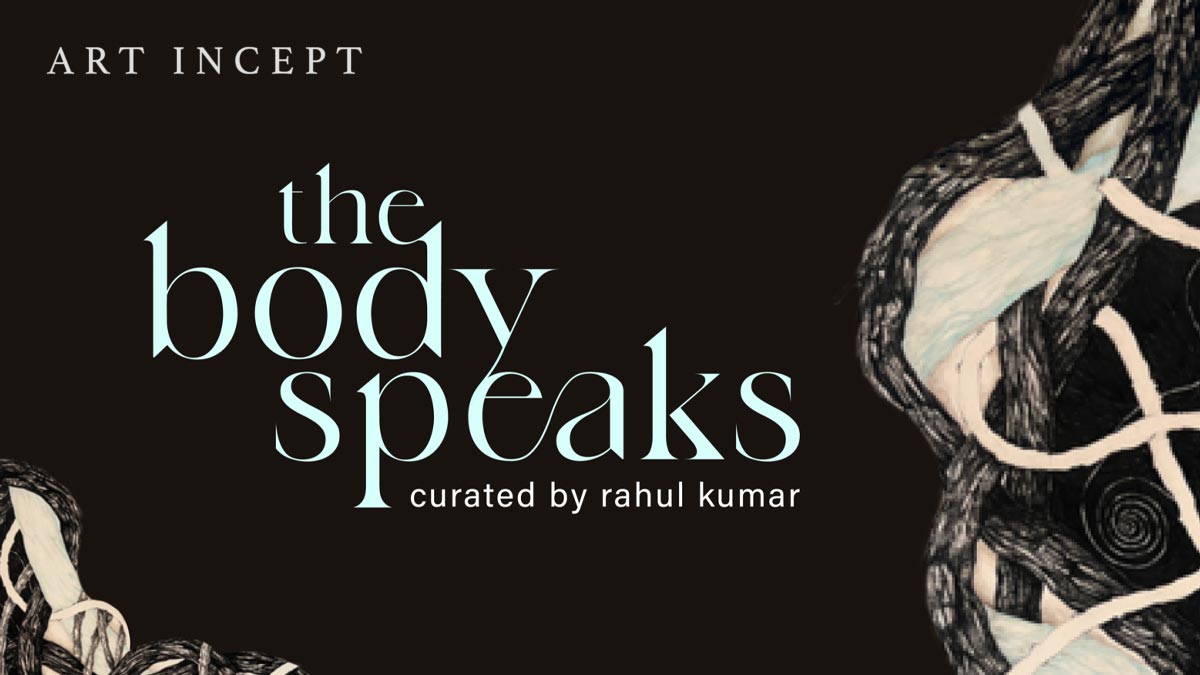
Gurugram’s South Point Mall houses ‘Art Incept,’ a gallery known for supporting emerging and mid-career artists from South Asia. This time, the gallery is featuring “The body speaks,” a group exhibition curated by Rahul Kumar, running from December 5th, 2025, to January 10th, 2026. This exhibition taps the inner contours of human experience and translates them through canvases. The premise of the event is to perceive the human body as “canvas, vessel, and voice.” The exhibition features the work of 5 artists, namely Badush Babu, Deepanjali Shekhar, Indu Antony, Isha Sharma Haritash, and Rinku Choudhary. In their art, the body becomes the medium through which stories of labour, grief, joy, desire, and social injury are narrated.
The Body as Canvas, Vessel, and Voice
In the history of art, no other motif has possibly enjoyed the privilege of multiple subjectivity as the “humans”. The exhibition positions the human body as the “first landscape.” The body becomes the living archive of time and life. Every curve and scar bears the weight of care, exhaustion, aegin, and desires. Curated by Rahul Kumar, whose previous curatorial projects like ‘Precarious’ and ‘Original Shadows’ have also tackled profound human and artistic concerns, the exhibition sought to reveal the “inner world” through expressive forms.
The body becomes a metaphor for expressing universal experience. The artists used different media to convey their distinctive styles. These include painting, photography, and mixed media. This wide range of media helps in creating an intersection where almost every aspect of “human life” is touched. It asks pointed questions: What does it mean to belong in a body? How does one negotiate visibility and erasure? What forms can freedom take when the body itself is a site of regulation? The subject of the exhibition is based on the dichotomy of the body, which is vulnerable and resilient at the same time. The works challenged viewers to confront their own physicality and their own stories.
Mapping the Human Form as Archive, Threshold and Voice
A sense of animatedness is invoked in the audience with the ongoing charcoal series, Silent Stories by Badush Babu. He puts forth recollections of his mother’s garden, depicting mushrooms, vines, moths, and other organic elements that symbolize growth, decay, and metamorphosis. He named it the “healing touch” and created it during a difficult phase of life. As he attempted to cope with the difficulties, nature accompanied him, becoming his healer and easing the process of dealing with turbulences in life. His purposeful reliance on charcoal and soot crosses the peripheral understanding of aesthetics. He himself spoke about the medium as metamorphic. The imperfect texture of coal and soot personifies the instability of both memory and the body.
Deepali Shekhar views the human body as an evolving inner ecology. Her paintings, titled “Stages of growing up,” “They are welcoming in nature,” and the “Dance of Joy” series, together construct an organism-like motif. The core of her presentation is unspoken emotions, and these are aptly translated through botanical forms and microbiological structures.
View this post on Instagram
Indu Antony, from her Archive of Memories and Names they called series, forges a sharper social and feminist character into the exhibition. She works with cyanotype prints, combined with her own hair and khadi cloth painstakingly embroidered with words. This technique helps her depict the human body as a wounded text. Names they called emerge from her long-term engagement with gendered abuse and eve-teasing, where derogatory words hurled at women are literally stitched onto a fabric using the artist’s own hair strands. Upon viewing, it appears like an exorcism of trauma. Her Archive of Memories series further augments the theme via photographic processes. The body is never directly depicted, yet obsessively indexed through traces in hair, cloth as skin, cyanotype as ghost-image.
Isha Sharma Haritash, and Rinku Choudhary also contribute to this saga with their untitled works, where fragments of the body appear to oscillate between presence and disappearance. Their artworks contribute to the plurality of the exhibition.
The Exhibition At a Glance
| Aspects | Description |
|---|---|
| Exhibition Title | The Body Speaks |
| Curator | Rahul Kumar (also credited as @rahulclaystudio) |
| Venue | Art Incept, 227 South Point Mall, Gurugram |
| Duration | December 5, 2025 – January 10, 2026 (Preview on Dec 5th) |
| Timings | 11:00 am – 6:30 pm, closed on Sundays |
| Core Theme | The human body is explored as a metaphor for expression, identity, vulnerability, and resilience. |
| Featured Artists | Badush Babu, Deepanjali Shekhar, Indu Antony, Isha Sharma Haritash, and Rinku Choudhary |
| Media | Drawing, charcoal works, cyanotype, textile-based installation, mixed-media photography |
Key Highlights
- Curated, conceptually cohesive show that explicitly frames the body as canvas, vessel, and voice rather than mere subject.
- Strong material dramaturgy: charcoal, cyanotype, hair, cloth, and intricate drawing push the idea of the body beyond representation into tactility and residue.
- Participating artists span different regions and life experiences, bringing together ecological, feminist, psychological, and autobiographical perspectives on the body.
- The exhibition is embedded in Art Incept’s broader mandate to support emerging voices and critical discourse around contemporary Indian art.
- The show is accessible yet conceptually layered, inviting both casual viewers and informed audiences to reflect on how bodies carry memory, violence, care, and transformation.
Takeaway
Today, bodies are constantly constrained by law, technology, and social norms. Amidst such a climate, The Body Speaks feels like a necessary provocation that speaks on behalf of the body, that it must listen to its own terms. The exhibits refute the easy, spectacularised images of human form. It displays a quieter part of the struggle and stresses more on pain, care, solitude, and healing. It becomes a space where people can intellectually reclaim their bodies and converse with their inner selves. Every artwork feels like a relatable self-reflection and re-evaluates the body as our home. Art Incept continues to solidify its role as a vital cultural hub, bridging the gap between emerging South Asian talent and a globally conscious art audience.