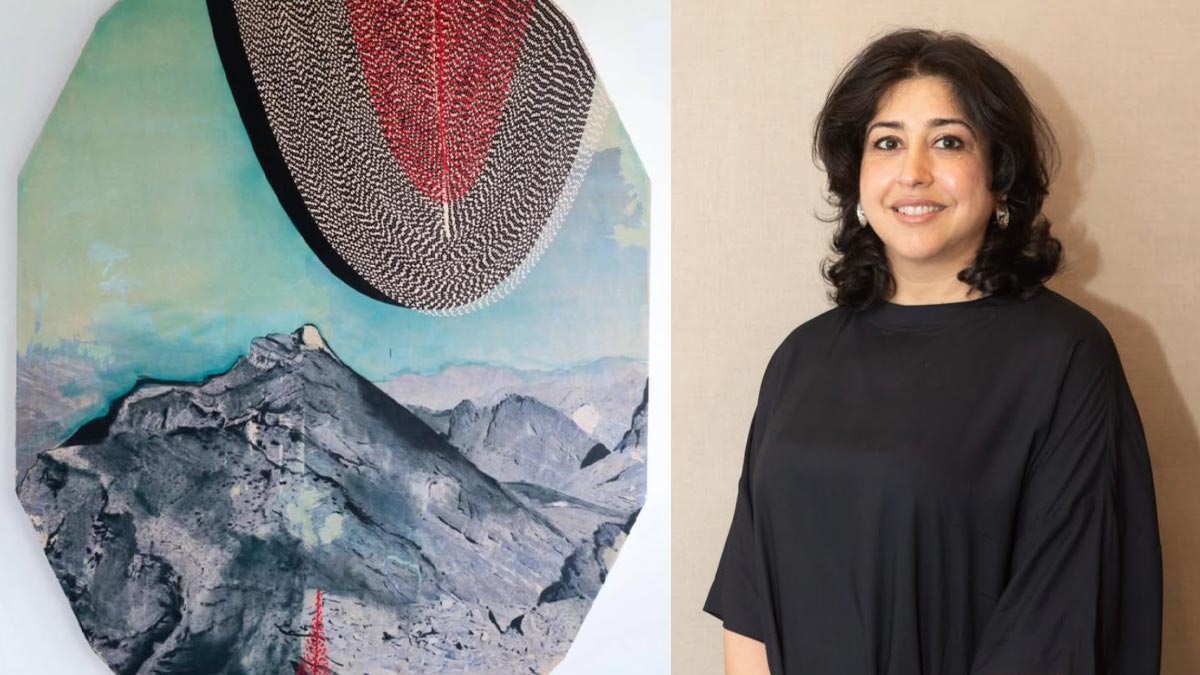
Radhika Khimji is a renowned artist whose artworks overlap the cultural and geographical boundaries between Muscat, Oman, and London. She has recently stepped into Kolkata with her latest and third solo, ‘The Line in Time,’ at Experimenter gallery, Hindustan Road, Kolkata, till January 3, 2026. Her artwork probes into deeper queries of life through an introspective corpus of paintings, sculptures, and installations. In ‘The Line in Time’, Khimji draws the viewer into a complex geometric landscape where lozenges, triangles, and other shapes, rendered in rich earth tones and charcoal grey, appear to float or lean precariously against one another.
A Deep Dive Into The Exhibition
Radhika’s approach towards time is utterly subjective, which is measured by our internal time-consciousness. Her art challenges the linear perception of time. Upon entering the gallery, people are confronted with surfaces dotted with dormant and inchoate narratives. However, upon a closer look, people find networks of lines coated with earthly hues. Her artworks initially appear abstract, but then the visual elements pop up one by one based on the painter’s philosophy of discernible reality.
The presentation of her works stands out with the inclusion of photo transfers featuring the harsh, hilly terrain of the Hajar mountains of Oman, Muscat being Radhika’s primary home. These nuanced variations in the depiction of geology immediately stir the idea of time as vast and non-linear.
As the artist herself belongs to a family that settled in Oman 150 years ago, her paintings are thus accompanied by a shifting cultural and geographical identity. Her positioning at a particular place has always been subject to an influx. She can translate her narrative of displacement directly into her canvases. This concept is reiterated in her paintings through the depictions of fragmented spaces.
View this post on Instagram
Interestingly, the Lozenge shape is a recurring motif in her art, and this has a strong symbolic meaning. It is not a mere shape with geometric dimensions; it suggests the cut of the diamonds worn by the deity Shrinathji of Nathdwara, whom her family traditionally worships. These jewels, whose parure (set of ornaments) and matching costumes are changed throughout the day, weave a nexus of muses that encapsulates rituals, daily life, time, etc.
She also employs the dots, or bindu, in her art. It becomes a very important part in narrating the cross-cultural saga. It draws parallels to the dot-painting of Australian Aboriginal art linked to the tradition of Nigerian art, or the lacy dot patterns prevalent in Ethiopian traditions of tattoos and scarification. By using a global symbol, Radhuka judiciously unites many cultures in one plane. The lines where these dots converge are presented as a “tactile portal,” a space where memories and linear time can be disentangled from their logical sequence.
Her paintings literally cover a lot, starting from the geological history of the Arabian Peninsula to the specific rituals of Nathdwara, and then to a global history of mark-making. These concepts elevate the exhibition to serve as a visual atlas.
Ultimately, it is the sensory-based experience of her art that honestly makes it stand out. Radhika maneuvered the understanding of art as experiential and seamlessly stepped out of the didactic box. The inclusion of geometry in her art is also a phenomenal execution of her precision. With these techniques at her disposal, she can create magic in the most trivial way possible.
The Exhibition At a Glance
| Aspect | Key Insight |
|---|---|
| Exhibition Title | “The Line in Time” |
| Artist | Radhika Khimji is a contemporary artist based between Muscat and London. |
| Venue | Experimenter Gallery, Hindustan Road, Kolkata |
| Dates & Timings | On view until 3 January 2026; gallery hours as per Experimenter’s regular schedule. |
| Visual Elements | Recurrent use of geometry, dots, lines, and layered surfaces that oscillate between abstraction and material presence. |
| Medium & Technique | A layered, collaged approach using oil, photo transfer, gesso, and stitching on materials like canvas, paper, and wood (MDF panel). |
| Conceptual Core | Time is explored as non-linear and experiential rather than chronological, embedded in gesture and surface. |
Key Highlights
- Radhika’s use of lozenges, triangles, and weaving lines invites viewers into an immersive field where the gesture functions as a trace of lived time and movement.
- Works in the show intentionally disrupt linear time, proposing simultaneous timelines that intertwine memory and perception in layered visual forms.
- The geometric motifs have been read as alluding to diverse cultural reference points, from Aboriginal dot traditions to African scarification and Indian bindu practices, although such interpretations are intentionally suggestive rather than prescriptive.
- Radhika’s technique foregrounds the tactile quality of materials, thread, photo transfers, and paint, which reinforces an embodied encounter with time and space.
- Subtle photographic shadows of terrains embedded in the works allude to wider geographies and the artist’s diasporic positionality.
- Radhika’s work acts as a visual manifestation of her Omani-Indian heritage, drawing connections between the Nathdwara tradition and the landscape of Muscat.
- The works deliberately blur the lines between painting, drawing, collage, and sculpture, informed by the physicality and materiality of the making process itself.
Takeaway
In “The Line is Time, ” Radhika achieves a synthesis by integrating geology, time, and internal consciousness. Her refusal to submit to linear narratives of time and deliberation on displacement and other issues is simply remarkable. Radhika Khimji is among contemporary artists who move away from linear storytelling. The strength of the exhibition lies in its openness; viewers are encouraged to form their own interpretations through direct, physical engagement with the works. She explores her own fluid identity and gives us a way to think about our own sense of belonging in the modern world. She shows us that time, like her artwork, is flexible, personal, and something we create for ourselves. Radhika’s work invites viewers to slow down and engage with art patiently and thoughtfully.