Reimagining Ancient Worlds Through Contemporary Eyes
During the Tamil Sangam era, the “Thinai” (திணை) was an ecosophical and poetic scaffolding that classified the Tamizhagam (meaning the home of Tamil) into five distinctive tableaus (Ainthinai). The five places represented cultural life, occupations, deities, flora, and fauna. It also conjoined human emotions with the natural environment. This systematic classification dates back over two millennia to the Sangam period.
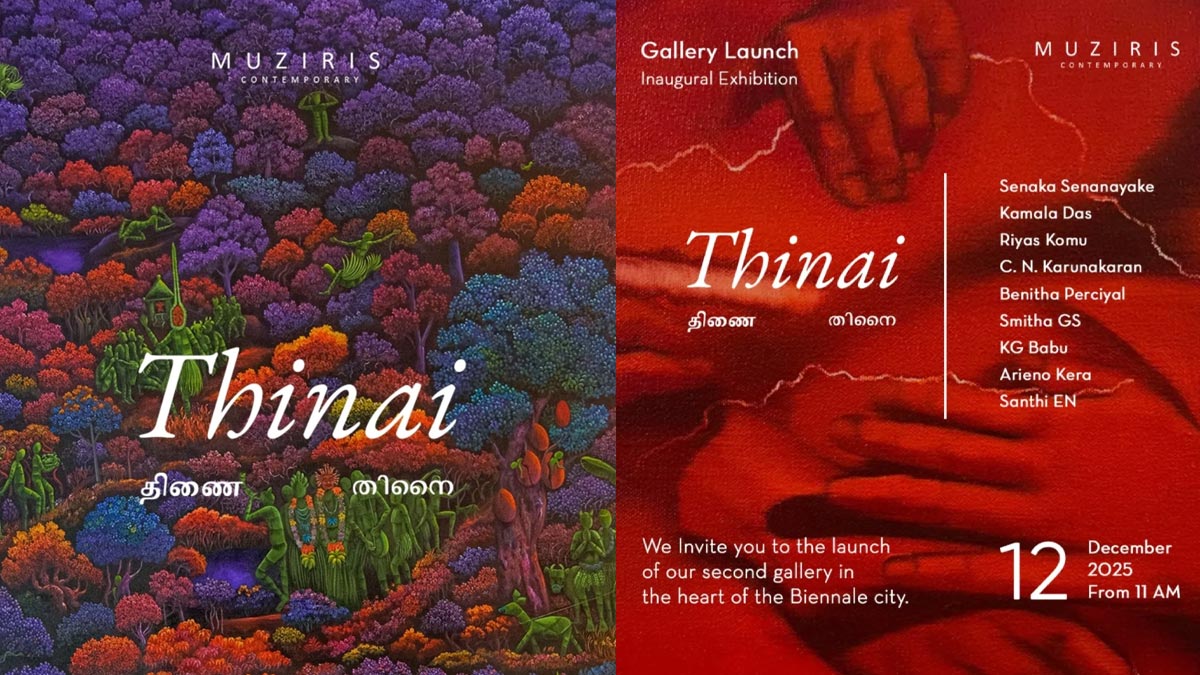
As Kochi metamorphoses into a global hub for art with the onset of the 6th Kochi-Muziris Biennale 2025-26, it showcased a beguiling and contemplative exhibition titled “Thinai.” Housed in Fort Kochi, this exhibition is an aesthetic foray into the ancient Tamil idea that attests to sustainability even when it was not a globally recognized phenomenon. This is the inaugural exhibition at the Muziris Contemporary, which offers a thoughtful purview into the ecological and emotional thought processes of human life. This exhibition presents an immersive exploration of how place, emotion, and ecology can be read as interdependent systems of meaning.
Exploring the Landscapes of Memory
The conceptual philosophy of Thinai bridges the five classical landscapes with today’s socio-environmental realities. It brings in the masterful works of artistic stalwarts like CN Karunakaran, Senaka Senanayake, and KG Babu. The exhibition places the human body and the natural world as inseparable receptacles of memory. From a poetic perspective, the Thinai signifies a terrain that encompasses the Kurinji (mountains), Mullai (forests), Marutham (croplands), Neithal (seashore), and Palai (desert). These were never just geographical entities; they are psychic contours manifested in physical formats.
The exhibition’s curatorial vision reflects dialogues between antiquity and the present. Thinai draws direct references and inspiration from the ancient Tamil Literature and creates the sense of a moving plane that is experiencing love, longing, conflict, patience, separation, and reunion. Muziris Contemporary has reimagined this essence into a perceptible body of artworks that are up for viewing at the biennale. It presents the works by nine pioneering artists from across the Indian subcontinent whose practices echo these ancient world-making systems.
The Confluence of The Artists
View this post on Instagram
The canvases of Senaka Senanayake evoke the spirit of Mullai, focusing on the biodiversity of the rainforest. Santhi EN’s work mirrors the groundedness of Marutham. Kamala Das’s Akam (interior emotional world) sensibility resonates alongside Riyas Komu’s Puram (external, socio-political), confronting war, violence, and collective numbness. Smitha G.S.’s engagement with shola forests symbolizes Marutham’s fertile reciprocity between people and land. C.N. Karunakaran’s wetlands echo agrarian ecologies. The exhibition seamlessly aligns with the bigger motto of the Biennale, “For the Time Being,” curated by Nikhil Chopra, which focuses on the body as a site of “embodied knowledge.” In Thinai, the landscape is the body, and the body is the landscape.
Artist Arieno Kera’s rhododendron-based art enhances the ambit of Thinai-like sensitivities into the Himalayan region. K.G. Babu’s portraits represent human figures as inseparable from the dense forests. The representational brilliance of this exhibition settles in with the positioning of diverse artworks under the umbrella theme of Thinai. The exhibition also pays homage to the local roots of the Muziris region, addressing the mythical past of the ancient port through modern installations that appear like “archaeological finds” of the future.
The Event At A Glance
| Aspects | Details |
|---|---|
| Exhibition Title | Thinai |
| Venue | Muziris Contemporary, Kochi |
| Dates | 12 December 2025 – 25 January 2026 |
| Conceptual Framework | Sangam thinai (ecological-emotional landscapes) |
| Number of Artists | 9 artists from the Indian subcontinent |
| Core Themes | Ecology, emotion, memory, landscape, belonging |
| Artistic Forms | Painting, works on paper, organic material-based works |
| Key Artists | KG Babu, Senaka Senanayake, Kamala Das, C.N. Karunakaran, Santhi E.N., Smitha G.S. |
| Artistic Mediums | From traditional oil on canvas to site-specific organic installations |
Key Highlights
- Inaugural exhibition at Muziris Contemporary, marking a new chapter in Kochi’s contemporary art scene.
- The exhibition serves as a form of “eco-poetics,” using ancient classifications to highlight modern climate anxieties.
- Rooted in the ancient Sangam literary system of thinai, bridging classical Tamil poetics with contemporary visual practice.
- Many works draw direct inspiration from Sangam poems, translating the Ullurai (inner meaning) of the verses into visual metaphors.
- Features nine prominent South Asian artists whose works are mapped to specific emotional-ecological landscapes.
- By featuring both Sri Lankan masters like Senanayake and local Kerala icons like Karunakaran, the show emphasizes a shared “maritime cosmopolis.”
- Large-scale immersive paintings dominate the exhibition, creating enveloping sensory environments.
- The use of “found materials,” spices, and earth in several installations nods to the historical trade legacy of the Muziris port.
- Strong ecological and emotional consciousness, foregrounding land as a living, emotional entity.
- Offers a rare philosophical coherence between curatorial concept and artistic execution.
- As part of the wider “People’s Biennale” ecosystem, the exhibition is designed to be accessible, moving art from elite galleries into the lived spaces of Fort Kochi.
Takeaway
The Thinai is a bigger philosophical fabric manifested through artworks. It is not another satellite event; it is a crucial, erudite segment of the biennale. Today, the climate crisis is no longer “tomorrow’s concern, ” it is an issue of the present, and this exhibition brings people one step closer to climate-based sensitization by experiencing it in avisual format. The artists do not merely “paint nature”; they inhabit it. The exhibition also treats Sangam literature as a living, breathing guide for survival. By resurrecting Sangam cosmologies within contemporary artistic practice, the exhibition does more than aestheticise ecology; it re-sacralises it. Thinai stands as a rare, intellectually rigorous, and emotionally resonant intervention that reminds us that the future of ecological consciousness might well lie in our oldest poetic systems of understanding the world.