The Warp and Weft of History
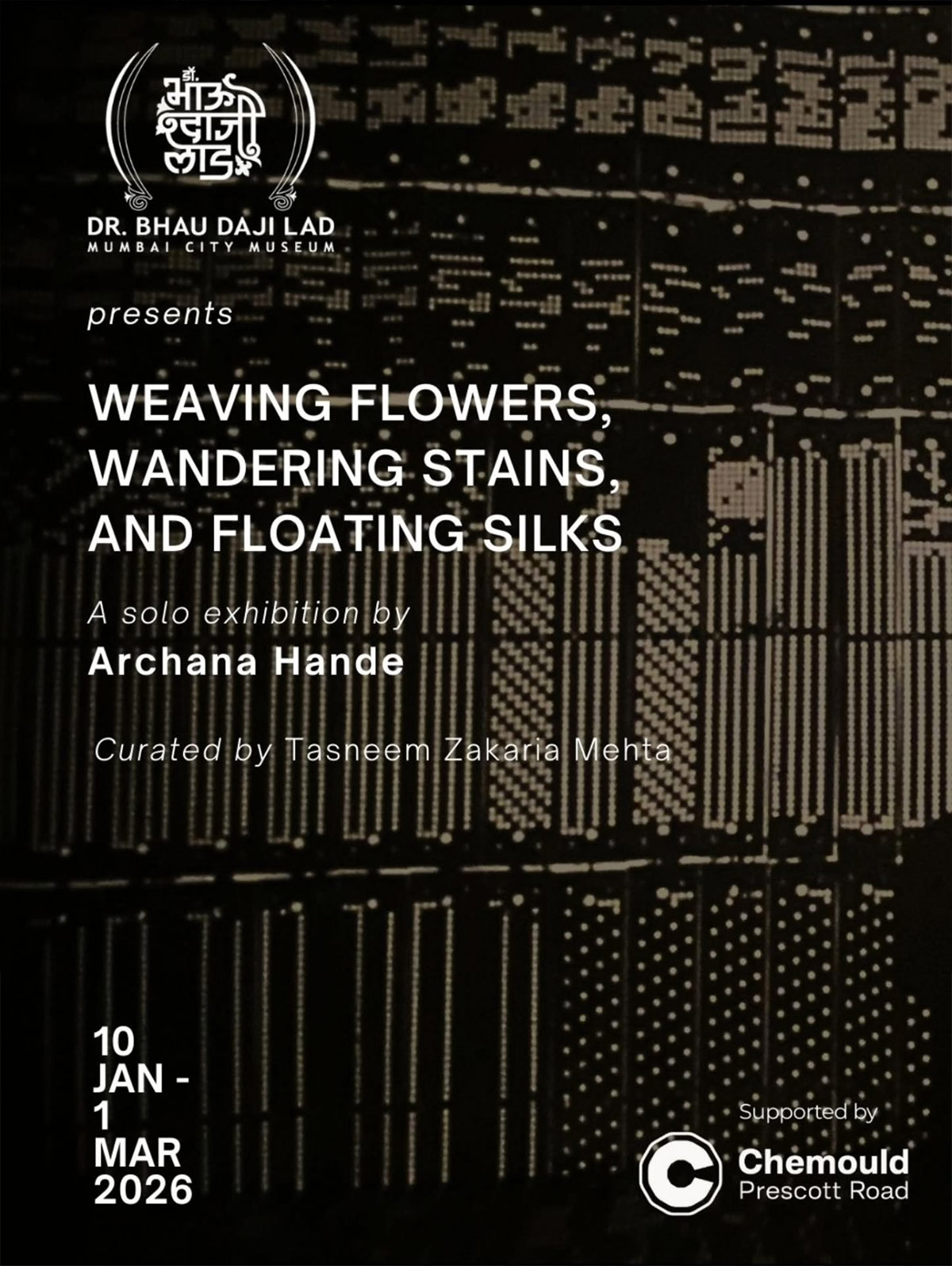
The Dr. Bhau Daji Lad (BDL) Museum is Mumbai’s oldest museum and a jewel of Victorian architecture. This premier institution is poised to officiate a profound exploration of India’s socio-industrial chorography, by housing a brand new exhibition titled ‘Weaving Flowers, Wandering Stains and Floating Silks.’ This showcase, running from January 10th to March 1st, 2026, is a solo survey exhibition by the renowned artist Archana Hande. It functions as a vital conduit bridging between the city’s colonial past and its contemporary urban identity. The exhibition, curated by Tasneem Zakaria Mehta, appears to be a catalytic retrospective into the interstratified contexts of textile, labour histories, colonial prowess, and personal narratives.
The Artist Archana Hande is an alumna of the prestigious Visva-Bharati University (Santiniketan) and MSU Baroda. Her artwork stems from deep research and nuanced exploration of her domain, which is reflected in the BDL Museum. Her artwork explores the very bedrock of cities like Mumbai and Bengaluru, which were critically manipulated and indoctrinated by the colonial labour policies, and ultimately resulted in the reshaping of local identities.
Mapping Textiles, Memory and Modernity
Equipped with years of research, political sensitivity, and nuanced practice, Archana has scrutinized how colonial economic systems, industrialisation, and migration altered India’s textile industry. These parameters are not just measured in terms of production, but in shaping identities, moulding aspirations, and finally summing up to “cultural loss.”
The housing of this exhibition in the BDL museum creates a contrast, as the museum itself is a colonial-era institution. The exhibition features her works in the form of textile-based installations, drawings, archival interventions, and mixed media that trace how fabrics, dyes, stains, fibres, and weaving patterns operate as carriers of memory, displacement, and power.
The Tapestry of Resistance and Memory
View this post on Instagram
The artist herself spent tears in decoding the history of Mumbai’s textile mills and discovered that while the city, in contemporary times, is known for its skyline, it was originally built on the “profundity of labor.” The exhibition pursues the “wandering stains” of industrialization. It critically set the lens against the marks left by sweat, dye, and the systemic obscuration of the artisanal prerogative and their creative agency.
Her signature can be seen in the act of attaching emotions to distinct geographies. She creatively depicts textile cities like Bombay, Bangalore, and others. She showcases these places as rostrums where livelihoods were both forged and lost, where craft lineages disappeared due to migration, and where labour remained largely “invisible.”
She highlights the streaks of migrant workers from the hinterland to “Girangaon” (the Village of Mills). Her depictions prolong the dichotomy of loss of habitat and the formation of a fractured urban culture. Archana carefully sheds light on the “secret” desires woven into the fabrics. This reflects the neglected aspirations of the workers that got lost within the grand narratives of economic history. In her artistic practice, fabric becomes both witness and archive.
Glimpses of the Exhibition
| Aspects | Details |
|---|---|
| Artist | Archana Hande |
| Curator | Tasneem Zakaria Mehta |
| Venue | Dr. Bhau Daji Lad Museum, Mumbai |
| Duration | 10th January – 1st March, 2026 |
| Supporter | Chemould Prescott Road |
| Primary Theme | Labor, Textile History, and Colonial Identity |
| Focus cities | Mumbai, Bangalore, and other textile centres |
| Core Concerns | Craft invisibility, power relations, loss of habitat, desire, and memory |
Key Highlights
- A rare survey-format presentation mapping decades of Archana Hande’s research-based practice.
- Deep engagement with Mumbai’s mill history and labour movements as aesthetic and political material.
- Textile as an archival medium, fabric, stains, and fibres narrating histories of displacement and survival.
- Curatorial framework by Tasneem Zakaria Mehta that situates the exhibition within broader postcolonial discourse.
- Supported by Chemould Prescott Road, underlining its institutional and contemporary relevance.
- Works that explore desire, memory, and intimate personal narratives embedded within textile traditions.
- A comprehensive look at Archana’s career showcases her evolution from a student of traditional techniques to a critical commentator on global trade.
- Incorporation of Mumbai’s labor movement histories, reflecting the strikes and struggles that defined the city’s 20th-century political landscape.
- It offers an analysis of how British policies intentionally disrupted indigenous textile ecosystems to favor industrial mass production.
- It focuses on the invisibility of the craftsman in the modern capitalist value chain, reclaiming the artisan as a central figure of civilization.
Beyond Fabric: A Dialogue with the Site
Under Tasneem Zakaria Mehta’s curation, the exhibition complements the museum’s permanent collection, creating a “living archive.” As Archana Hande’s work intersects the critical junctures of history and material explorations, her artworks earned the title of “material historiography.”
Her installations frequently function as mnemonic devices, inviting viewers to read textiles as socio-political documents rather than decorative artefacts. In the context of Weaving Flowers, Wandering Stains, and Floating Silks, this approach expands into a museum-scale narrative. Through the distinct segment of “floating silks,” Archana explores how tradition is often carried by those who have been displaced.
Archana challenges the romanticism of craft by emphasizing inequitable power structures that governed colonial and post-colonial modes of production. By drawing attention to unacknowledged artisans and disrupted communities, her art speaks not only to art history but to labour studies and migration discourse.
Takeaway
Weaving Flowers, Wandering Stains, and Floating Silks is a historical discourse that is meant to be contemplated and felt. In an era of fast fashion, Archana Hande teleports the audience to the very core of what we now recognize as “vogue.” Her practice insists that fabric remembers what societies try to forget: labour, displacement, aspiration, and loss. Today, Mumbai is known for its growing luxury real estate, which is growing at the cost of its rapidly diminishing industrial heritage. Thus, the artist’s work conscientiously nudges the audience to focus on and acknowledge the ghosts of the looms. This is a must-visit for anyone who wishes to understand the true cost of the modern city. It is, quite simply, one of the most intellectually and emotionally significant exhibitions Mumbai will host in 2026.
Suggested Story: ‘Warp and Weft’ – Weaving a Rustic Tale