Cave Paintings in India – Reflection of Indian Culture on the Rocks

0
List of Cave Paintings in India
Ajanta Caves – Saurabh Chatterjee/Flickr

India has a rich history of paintings in its culture and tradition. There are quite a lot of types of paintings and art forms that we have. These include Meenakari paintings, Warli paintings, Madhubani paintings, and Phad paintings that originated centuries ago. Another such type of painting that we will know about today is Cave Paintings. These paintings date back to the pre-historic era and are ancient but still kept preserved and well maintained. The paintings on caves and rock-cut structures survive for many centuries. These cave paintings got their inspiration from nature. These paintings mostly depict gods and goddesses, mythological stories and characters, epics, nature, flora and fauna, humans, and religion. Let’s take a look at some of the cave paintings in India.

1. Ajanta Caves

Famous Cave Paintings in India, Ajanta
Image-Vu2sga/Wikimedia

The Ajanta caves are Buddhist caves. These are located at a distance of around 100 km from the city of Aurangabad in Maharashtra. The Ajanta caves contain the oldest Indian paintings which were made around 1 st century BC. Other than that, the caves contain many portraits and illustrations. They depict the Life of Buddha, his rebirth, and his preaching.

There are many frescoes, murals, paintings, and rock-cut sculptures inside the caves. The Ajanta caves have beautiful frescoes painted all over the walls and the ceilings. These frescoes and paintings represent court life, processions, feasts, people working, festivals and events, and scenes from nature like animals, birds, and flowers. They mostly revolve around Lord Buddha and the most common theme is Jataka-the incarnations of Lord Buddha. They also depict yakshas, nagas and Ganga, and the Yamuna- the river goddesses, etc. The artists made the paintings in wet plaster. Then they put a layer of lime plaster over the paintings to protect and preserve them.

The Ajanta cave paintings are also known as the masterpieces of Buddhist art. It is one of the best examples of ancient Indian art. There are a total of 30 caves in Ajanta which have some wonderful, brightly – colored paintings. Some of the famous paintings of the Ajanta caves are the one which shows a procession of elephants, one which shows a dancer and women musicians, the Chhadanta Jataka in Cave 10, and Bodhisattva – an elephant with six tusks. The Ajanta caves have been declared a UNESCO World Heritage Site.

2. Ellora Caves

Cave Paintings in India, Ellora
Image-Santanu Sen/Flickr

The Ellora caves are situated in the Charandari Hills. It is located at a distance of about 29 km from the city of Aurangabad, Maharashtra, and about 100 km from the Ajanta caves. The place contains over 100 caves out of which 34 caves are open for the public. These caves feature and celebrate Hinduism, Buddhism, and Jainism. Out of these caves, 5 caves have these paintings. They contain engraved pre-historic paintings divided into two sections. One section depicts Lord Vishnu and Goddess Lakshmi. The other section portrays Lord Shiva and his followers and the procession of Apsaras and Shaivas. Caves 32 and 33 are Jain temples that contain remains of some beautiful murals. These caves are from around the 9th century.

Kailasanatha, a Hindu temple dedicated to Lord Shiva, Cave 16 was built around 760 – 860 AD. It contains some of the best-preserved paintings which have been repainted almost three times. This Kailasanatha or Kailash temple, a chariot-shaped monument in Cave 16, is the largest single monolithic rock excavation in the world. The Hindu caves, built around 600 – 875 AD, contain paintings based on Apsaras, trees, nature, and deities whereas the Buddhist caves, built around 550 – 750 AD, contain paintings based on the Lord Buddha. The Jain caves were built around 800 – 1000 AD and they contain some magnificent murals. Some famous paintings are of Lord Vishnu and Goddess Lakshmi with clouds as a backdrop and Ravan ki Khai. The Ellora caves are one of the largest rock-cut Hindu temple caves all over the world and they have also been declared a UNESCO World Heritage Site.

3. Elephanta Caves

Cave Paintings in India, Elephanta Caves
Image-Arian Zwegers/Flickr

Elephanta caves, also known as, Gharapuri (city of caves) are located on the Elephanta Island of Mumbai, Maharashtra. These historic caves contain several ancient Hindu temples, paintings, sculptures, carvings, etc. These caves depict Hinduism and Buddhism. These caves consist of five Hindu caves and two Buddhist caves. The paintings here are brightly colored and mostly represent the artist’s culture. Cave 1 is also known as the grand cave or the great cave. There are many sculptures here like Ardhanarishvara, Ravananugraha, Yogishvara, and Hindu deities such as Kartikeya, Ganesha, Dvarapala, Lord Shiva, etc. There is also a Trimurti statue which is around 20 feet high. It is also the most important sculpture of this cave. To reach the cave, one has to climb 120 steps.

The most popular and celebrated carvings of the Elephanta caves are the large monolithic Trimurti Sadashiva, Nataraja, and Yogishvara. These paintings and artworks were made between the 5th and the 9th century. There is also a carving depicting Kalyanasundara, the wedding of Shiva and Parvati, where one can see many gods and goddesses, Brahma, Vishnu, King Parvata, Chandra (moon god), and apsaras witnessing and blessing the wedding. The Elephanta caves were also declared a UNESCO World Heritage Site.

4. Sittanavasal Caves

Cave Paintings in India, Sittanavasal Cave
Image-R.K.Lakshmi/Wikiemdia

The Sittanavasal Cave is also known as the Arivar Koil. It is a Jain cave located in the Pudukottai district of Tamil Nadu. This cave was created by Jains and is a rock-cut cave temple of the Arihants. This cave was built in the 2nd century. it contains remains of many well-known murals which dated back to the 7th century. The paintings here were done with vegetable and mineral dyes and colors which include black, blue, white, yellow, green, and orange. The paintings were made over a thin wet layer of lime plaster.

The Sittanavasal cave depicts Jainism and to reach the cave, one has to climb around 100 steps. The main themes of paintings are lotus pond, lotus flowers, two dancing figures, lilies, geese, fish, buffaloes, and elephants. Another common theme of paintings was Jain
Samavasarana, meaning the attainment of nirvana and Khatika bhumi. There are decorative and beautiful paintings of the sanctum and a lotus tank, men, flowers, birds, animals, fishes, and a dancing girl, the king and the queen all over the pillars and the ceilings. These Sittanavasal cave paintings depict the Pandyan period of the 9th century. They also contain inscriptions from the 9th and the 10th century. The paintings and the artwork of the Sittanavasal caves are very similar. It is believed to be connected to the Ajanta caves. The technique which was used in making these paintings is called fresco-secco.

5. Bhimbetka Caves

Oldest cave paintings in India, Bhimbetka Cave
Image-Bernard Gagnon/Wikimedia

The Bhimbetka rock shelters situated in Central India is an archaeological site from the Palaeolithic and Mesolithic periods. These rock shelters are located in the Raisen district in the state of Madhya Pradesh. There are traces of the Stone Age at the site. The site also contains seven hills with over 750 rock shelters and caves. There are beautiful, prehistoric cave paintings among which some are even 10,000 years old. Some common themes of these cave paintings were animals, dancing and hunting, elephant, deer, peacock, and snake. The paintings here belong to several different periods like the early historic, the medieval period, and the Chalcolithic age. Some paintings included gatherers, metals, horse riding, and fighting. Some caves here even date back to 100,000 years. The most common colors used in these paintings were red and white.

These rock shelters consist of over 600 caves and even the ceilings of these caves are decorated. These decorative paintings depict religious motifs, tree gods, magical sky chariots, humans, war scenes with kings and soldiers on horses, and people enjoying and living daily life. The place has a well-known rock caked “Zoo Rock”. It has paintings of bison, deer, bear, peacock, snake, and the sun god on it. Bhimbetka is the oldest known rock art in India. This place was named “Bhimbetka” after Bhima, a Pandava from Mahabharata. The name was derived from Bhim Bhatika which means the place where Bheem used to sit. The Bhimbetka rock shelters were also declared a UNESCO World Heritage Site.

6. Lenyadri Caves 

Cave Paintings in India, Lenyadri Caves 
Image – Wikimedia

The word “Lenyadri” can be interpreted as “a  mountainous cave.” This word comes from ‘Lena,’ (‘Cave’ in Marathi ) and ‘adri’ (‘stone’ in Sanskrit). There are about 40 rock-cut caves in Lenyadri. The most well-known and frequented is the set of 30 caverns in a small group facing south. These caves were established as a Buddhist monastery in the 1st – 3rd centuries AD. One of the Buddhist residences afterwards became a prominent Hindu god Ganesh shrine. Lenyadri is listed on the major Ashtavinayaks: the eight most honoured Ganeshas of Maharashtra. These paintings are said to be at least 250 years old, as they have yet to be found an accurate record of their origin. For now, however, their origin can be considered more or less from the Peshwa era, because the style of this era is identical. Steps 283 cut stones grouped in 10 stairs which were constructed in the 19th century are used to reach the caves. According to the canon of time – Hinayana, the Buddhists created these caves. There are two big shrines in the group of 30 caverns — chaitya griha and one mini chaitya. Other caves for monks — viharas – have been built. The majority of viharas are composed of a porch, centre hall and cells placed around the main hall. Hill features four additional rocky caverns that are older than the main group caves. A little chaitya with a graved entrance design – lotus, geometrical motifs, is one of the caves. Shrines are located in other caves. Traces of old cave paintings and inscriptions have remained in the caves of Lenyadri.

7. Bagh Caves

Cave Paintings in India, Bagh Caves
Image – Wikimedia

Situated in the Dhar district of Madhya Pradesh, on the banks of the Baghani River, these rock-cut caves have the most beautiful murals that early man has ever done. Only 5 of the first 9 caverns have survived up to now. The tradition has it that the Buddhist monk Dataka sculpted such caves in the late fourth – sixth centuries AD. For mural paintings, the Bagh Caves are often appreciated. The walls and ceilings were coated in brownish orange with thick mud plaster. Lime-priming was done over this plaster and paintings were subsequently applied. This is also called a tempera technique that refers to the use of a paint medium that is permanently quick-drying, made of a coloured pigment and a water-soluble binding substance.

Ajanta Caves are considered to be the only examples of these cave paintings in the outside world. However, it has been proved that these paintings have existed from much before. And this did not end with Ajanta, but was supported in many places of India by people of many faiths.

Only the cave no. 3 and 4 had endured the ravages of time when the caves in Bagh were first discovered. Bagh’s walls depict the Indian classical art in its “golden age.”

8. Armamalai Caves  

Cave-Paintings-in-India-Armamalai-Cave-Painting
Image – Wikimedia

Armamalai cave is a natural cave, that in the 8th century was remade into a Jain temple. The cave comprises paintings, petroglyphs, rock paintings from the Saints of the Jains of the 8th century. These are on the walls of the cave and the frescoes on the roof. The artworks have been produced by using colours on the fine limestone surface and dense exterior dirt. These paintings were painted by Jain monks who resided in them during the ancient Tamil kingdom in the time when their faith flourished. Two methods of frescoing and tempera are employed in the caves. They look like Sittanavasal Cave, old Jain Caves, Bagh Caves, old Buddhist cave in Madhya Pradesh. The cave paintings are seen in India as medieval rock sculptures.

In the late 1960s, rock paintings were uncovered by archaeologists in the cave. The old Pallava Dynasty was founded by Gabriel Jouveau-Dubreuil, who died in 1945. Jouveau Dubreuil stated that he discovered a cave from information he obtained on the copper plate of Udayendiram that sounded like Kumaramangalam to the village, Pallava Ruler Nandivarman II. He was able to locate a cave in western Malayampattu upon further investigation. Photos illustrate the native histories of Jainism as well as Astathik Palakas pictures of Agni, Vayu, Kubera, Eesanya, Indra, Yama, Niruthi and Varuna. There are plant and swans are represented in a petroglyph. The cave walls also include Tamil-Brahmi inscriptions. Most of the art and paintings in these caves have been destroyed for varying reasons.

9. Badami caves

Cave-Paintings-in-India-Badami-Cave-Painting
Bhootnath Temple, Badami – Saurabh Chatterjee/Flickr

One of the best preserved structures of ancient India is the Badami or Vatapi, as was originally known. The paintings in the rock-cut caves belong mostly to the sixth and eighth centuries. The caverns of Badami were a major source of inspiration for Mahabalipuram’s structures. The monarch of Pallava fascinated by art and architecture in the caves in Badami Chalukya and came up with the idea to imitate his realm in the same way. There is a clear message of this in the ruins of Mahabalipuram. Later history also presents Chalukyas indication of Pallava’s architectural signs.

The earliest relics of the Hindu paintings are badami mural paintings. Many could not withstand the impact of time, but some of them have survived. The paintings were destroyed during the time of Puleksin I’s son King Mangalishwara. The Vatapi’s caves were completely ornamented with walls; several were puranas-inspired. The surviving ones are Shiva and Parvathi’s paintings as well as several other figures.

The pictures have been lavishly adorned since the ruins clearly indicate the grandeur and splendour of India’s ancient times. The pictures have brought together religions as the art is part of the Hindu, Jain and Buddhist inclinations, which in those times demonstrated the prevalence of secularism and tolerance. The 4th cave features Adinata’s wall art, the tirthankara of Jain.

10. Adamgarh Hills

Cave-Paintings-in-India-Adamgarh-Hills
Image – Wikimedia

The hills of Adamgarh are positioned 2 km to the south of the village of Hoshangabad beside the Narmada river. Manoranjan Ghosh found rock shelters in 1922, D.H. Gordon and other archaeologists such as Mitra (1927, CE), Silberrad (1932), Brown (1932) and Hunter (1935) carried out the futhtur required research. Adamgarh is home to roughly 18 rock shelters; 11 of which contain visible artwork, some faded with time, others because of visitor damage. The shelters are largely made of small paintings with Shelter No. 10 being highly interesting since paintings from different times are overlaid on the other.

The paintings are simplistic, less creative and in most cases without clear physical proportions. The human figures are painted in red, dark brown and white only, while the figurines of animals are a little more detailed. In Australia, South Africa, East Spain and South America, the activity of people and animals has been exceptionally trapped on the walls, which may be well compared by their numerous pictures. In fact there are paintings of numerous creatures such as oxen, monkeys, horses, fish, peacocks, and in one case giraffes, and even fighting scenes, horsemen, soldiers with bows and arrows, and swords. Trees have also been depicted, but the lack of detail makes it rather hard to identify.

11. Jogimara Caves

Cave-Paintings-in-India-Jogimara-cave
Image – Wikimedia

Jogimara Cave, regarded as a symbol of the legacy of Chhattisgarh, is located in the district of Surguja city of Ambikapur. This old cave is decorated with drawings of animals, birds and humans which date back to around 300 BC. The cave also features an inscription written in Brahmi, which is regarded as the first written message of love to be documented on earth. There are no religious motifs in the paintings represented in this cave, but natural aspects are shown. Legend has it that heroes of the Ramayan — brothers, Rama and Lakshman and Rama’s wife Sita – hid here during their exile. 

These caves measure approximately 10x6x6 feet. On them, there are numerous paintings of animals, people, birds and flowers. Each picture is painted with a red outline on white plaster. The design on a number of panels – homes (architecture), animals and individuals – depict a variety of things. On the boundaries, there have been recurring motifs of fish, makara, man, lions etc.

White ants, dripping water down the walls and the inadequate Indian environment ruined the plaster of the walls on which the artwork was made. Likewise, the structural buildings created during that period were without a doubt made of wood and unbaked brick, which hindered them from being long-lasting. It has been assumed that the surface of these constructions was achieved by crudely made plaster soil and in some cases were painted. In Jogimara,  an entire example of the edifices with the art of the time has not been found yet. 

These caves are positioned in a wonderful natural environment, an enormous mountain jungle. The caves are accessible in a natural tunnel in order to make this happen.

How to Embrace the Warmth in Your HDB

0

ACVision-Interiors

In Singapore, HDB flats aren’t the most spacious form of accommodation. In most cases, residents get 3-room units that don’t leave much room for the imagination. Still, there are some simple steps to turn your small space into a cosy home interior design. 

In the past few years, many homeowners and interior designers have embraced minimalist and Scandinavian interiors. Indeed, those two styles are genuinely great at opening up tiny HDB interiors. However, most of the time, they are generic and lack the touch of personality. 

In the quest of making their home look more prominent, most homeowners overlook cosiness and warmth. Of course, you can always be straightforward about it. However, achieving the unique serene and bright atmosphere opts for some creative ideas. Here are 5 tips on how to embrace the warmth in your HDB flat:

Bet on Geometrical Layouts

ACVision-Interiors-05
ACVision, Resale HDB 4-Room

Geometrical forms and shapes aren’t new in interior design. Surprisingly, they haven’t been very trendy lately, but they’ll undoubtedly serve as a background for your focal points. Whether you’re using a TV backboard or a flushed white wardrobe, geometrical layouts will streamline your eyesight. 

The lack of handles on your drawers and cabinets will only make everything easier on the eye. Ultimately, your interior design will give the impression of an organised set of forms completing each other.

Introduce Warm-toned Wood

Perhaps, using a few geometrical layouts won’t have the same effect without using the proper material. In this regard, wood is the easiest choice you can make. Pick warm-toned wood and simply use it everywhere around your home – from furniture to flooring and wall decoration.

Of course, you would want to avoid monochromatic combinations, as you want your home to feel lively and warm. In this case, your best shot would be to choose veneered cabinets with white elements. Alternatively, you can come up with warm pastel hues like creamy white or beige.

Accentuate with Proper Lighting

ACVision-Interiors-06
ACVision, HDB BTO 3-Gen Flat

Arguably, the best way to accentuate different parts of your home is to use lighting. Needless to say, using single lighting in a room is the worst mistake to make. Instead, you should try and use different forms of illumination throughout your HDB interior design. 

Typically, you can use anything from wall scones to bedside lamps and LED strips. Use the latter to illuminate the nooks within or under your cabinets. Also, you can use a unique chandelier for each part of your room. Of course, don’t forget to place your lamps wisely, or you’ll later regret the hefty electricity bills. 

Add Dark Accents for a More Dramatic Look

Contrary to popular belief, dark accents are essential for every modern interior design. Whether you’re going for a luxe look or something more casual, dark brown or black will bring in contrast. In turn, you’ll create a sense of variation, and the warm tones will pop out even more.

In this regard, you can experiment with different elements in your HDB interior design. For example, you can bring a leather bed to your bedroom. Also, you can do the same with your living room sofa. On the other hand, you can be more subtle and simply go for a two-toned TV cabinet with flushed black doors.

Decorate with Greenery

ACVision-Interiors-07

Last but not least, don’t forget to think about the more minor details. If there’s something that will make your HDB interior design cosy and warm, it’s a bunch of greenery. While they will go with your wooden elements, they will make your rooms look full and lively. Ultimately, they will complete your interior design concept.

Undoubtedly, the easiest way to nail the idea is to bring in some succulents or cacti. Usually, they are small and will fit in spaces like showcases, shelves and drawers. If you want to make a statement or simply love greenery, go for a snake or spider plant. Both of them aren’t very picky about watering or light, so you won’t have hassle taking care of them. 

You can bring in a Bromeliad plant if you’re an expert plant-lover. Just place it in a corner near the window, but ensure it gets filtered light and copious amounts of water and humidity.

Conclusion

To conclude, creating a warm and cosy HDB interior design is totally possible. Perhaps, the first thing to do when planning your home interior is to prioritise genuine wood and light veneers. Indeed, this will set the tone, but you shouldn’t forget the illumination as a way to highlight the main idea. 

Of course, plenty of other ideas will work in a personalised concept like this. Arguably, the interior designers at AC Vision are experts at nailing such designs that can completely change your HDB home’s mood. If you’re eager to bring in the warmth back to your home, make sure you check out the company’s portfolio of HDB interior design ideas.

Bhangarh Fort Curse – Everything You Need to Know About It

0
Bhangarh Fort Curse
Image – Wikimedia Commons

Is your Netflix’s horror movies list frequently visited than the other genres? Does your appetite for a good read always crave for Stephen King or Mary Shelly or the likes? Well then, welcome to the club of horror story fans. Bhangarh Fort is a name and place known to almost all horror story buffs of India. Most of us are curious that Bhangarh Fort is equivalent to the stories and videos the internet contains. All those who have been to Bhangarh have an extraordinary narrative about the place. For those who have not yet been to Bhangarh, make-do with the snippets from others. 

To quench our curiosity and get an insight into the mystery Bhangarh Fort stands for, let us read about the place. Starting from the history, the curses, and the aftermath, let us read everything we need to know about the famous Bhangarh Fort.  

History of Bhangarh Fort  

History of Bhangarh Fort  
Image – Wikimedia Commons

Bhangarh Fort is in the present-day state of Rajasthan. To be more precise, the Fort is at the edge of the Sariska Tiger Reserve, between Alwar and Jaipur. A once prominent and lively city, Bhangarh is now commonly known as the ‘ghost city of India’. 

The Bhangarh Fort’s origin goes back to many centuries. The Kachwaha ruler of Amber, Raja Bhagwant Das, had built the Fort for his younger son Madho Singh in 1573 AD. Man Singh, general of King Akbar, was Madho Singh’s brother. Chatr Singh was the son of Madho Singh, and he took over the palace after his father’s death.  

Suggested Read – Kumbhalgarh Wonders- From Birthplace of Maharana Pratap

Raja Bhagwant Das built the Fort after seeking permission from the ascetic Guru Balu Nath, whose place of meditation was in the precinct. Guru Balu Nath had one condition that the shadow of the Fort should not touch his shrine. If the palace’s shadow was to reach Guru Balu Nath’s place of meditation, then Bhangarh will be cursed and remain roofless. Raja Bhagwant Das agreed to the condition and built the Bhangarh Fort.  

Curses on the Bhangarh Fort

There are primarily two curses in association with the fall of Bhangarh Fort.  

Curse of Guru Balu Nath 

Bhangarh Fort Curse, Curse of Guru Balu Nath 
Image – Wikimedia Commons

As per the condition of building the Fort, no shadow reached the place of meditation of Guru Balu Nath. Unfortunately, one of the ascendants of the Fort did not adhere to the condition.  

When the shadow of the Fort fell on the shrine of Guru Balu Nath, he put a curse on the place. All the houses of the Bhangarh Fort were to remain roofless.  

Curse of a Tantrik 

Bhangarh Fort Curse, Curse of a Tantrik 
Image – Parth Joshi/Flickr

The second curse that befell Bhangarh Fort was the curse of a ‘lovelorn’ Tantrik.  

Princess Ratnavati’s beauty was famous widely. Marriage proposals from far and wide flew into Bhangarh, asking for Princess Ratnavati’s hand. Singhia Tantrik, a practitioner of spells and magic, also fell for her.  

One day the Singhia Tantrik saw Princess Ratnavati’s maid buying hair oil for her. The Tantrik saw a chance and took it. He put a love spell in the hair oil. The Princess herself was aware of such spells and magic. Seeing the swirl in the hair oil, she knew there was a spell in it. Princess Ratnavati threw the bottle away. The moment the bottle touched the ground, it enlarged into a boulder. The boulder, in turn, became the doom of Singhia Tantrik. Before breathing his last, Singhia put a curse on Princess Ratnavati and everyone in the place. The curse was a warning to the people of Bhangarh to leave home or else they were to die a painful death and would never be able to rest in peace.  

The aftermath of the curses 

Bhangarh Fort Curse, The aftermath of the curses 
Image – Parth Joshi/Flickr

Bhangarh Fort was a place like any other fort or palace of India. The place was lively with markets, Dance Havelis, things for amusement, and, most importantly, people. Once the curses fell on the spot, Bhangarh Fort uncannily became a lifeless place, the air itself carrying a smell of suspense and a bad omen.  

The ruins of Bhangarh Fort that remains today are unlike other ruins of forts and palaces of India. For starters, the roofs are entirely missing from the houses inside the Fort. The temples inside the Fort are devoid of their Gods. The people who once lived inside left their homes behind and settled outside.  

Today the Bhangarh Fort is a place of tourist attraction. Visitors from across the country look forward to their Rajasthan trip. Out of the many attractions of Rajasthan, Bhangarh Fort has a place in their itinerary. What fascinates people even more is the restrictions imposed by the government of India. 

Restrictions on Bhangarh Fort

Bhangarh Fort Curse, Restrictions on Bhangarh Fort
Image – Wikimedia Commons

The Archaeological Survey of India has put up a board at the entrance of the Bhangarh Fort, stating, ‘Entry to the Bhangarh Fort is restricted after sunset and before sunrise.’ The statement piques the interest of many. Young people are drawn to the place even more because of their quest for adventure and ghost-hunting spirit.  

Another peculiar restriction is the limit on foreign visitors. Foreign visitors are not permissible to the Fort without special permission. Though the Bhangarh Fort is a popular haunted place globally, foreigners are not allowed inside the premises.

Signs of rituals 

Bhangarh Fort Curse, Signs of rituals 
Image – Wikimedia Commons

Moving along the narrow passageways inside the Bhangarh Fort, people notice items of spiritual significance. Some of the palace doors are marked off-limits by placing the orange cloth as a symbol of a ritual.  

People with stalls outside of the Fort have temples outside as a symbol to guard them against evil spirits inside. In many interviews, the sellers have said that they are no longer afraid of the djinns and ghosts of Bhangarh because they have protection from their Gods. 

Incidents/ Accidents 

Bhangarh Fort Curse, Incidents or Accidents 
Image – Wikimedia Commons

Youngsters have a curiosity to find out why the restriction on timings is there for Bhangarh Fort. Some ghost hunters, with special permission, spend a night inside Bhangarh in the hope to encounter a ghost. But there is one popular story about three young boys who were found dead after spending a night in Bhangarh.  

Other narratives of unfortunate accidents are also familiar. People fear and believe the tales of Bhangarh all the more because of these tragic incidents. The belief in evil spirits is instilled in the hearts of many locals.  

Alternative to ghosts 

Bhangarh Fort Curse, Alternative to ghosts 
Image – Parth Joshi/Flickr

Given the fairy tale type curses associated with Bhangarh Fort, the title ‘haunted fort’ is apt for the place. But in today’s practical and reasonable world, a rational reason is more believable than ghosts.  

In an interview, an officer of the ASI had refuted the claims of there being ghosts inside Bhangarh Fort. The reason for putting a restriction on the timing according to the ASI is the proximity to the Sariska Tiger Reserve the Fort has. It can be dangerous for people after dark, for wild animals are common in that area. They have their security guards patrolling the site, and none of them affirmed seeing or facing any paranormal activities in the area.  

Suggested read – The Rajput Architecture – Cultural Mingling of Various Times

So, to believe or not to believe in the ghosts of Bhangarh Fort? It is, of course, all up to the individuals. But ghosts or no ghosts, Bhangarh Fort’s ruins do tug the heart in believing in some kind of supernatural power. The suspense in the air carries the smell of age-old curses. Therefore, the best remedy is to visit Bhangarh Fort and then decide what to believe or not to believe in. Because of the tag of a haunted place, Bhangarh Fort receives many tourists. So why not, for the sake of a trip, you go and visit this famous place to quench your curiosity? We are sure that Bhangarh Fort will not disappoint you, given its history and location in the beautiful state of Rajasthan.  

Why Living in a Joint Family has Many Advantages

0
joint family advantages
Image – Unsplash

Imagine a huge house bustling with too many people. There is the head of the family who manages the overall affairs and has the final decision in all matters. And there are kids running around snaking their way across different rooms or racing down the stairs. The kitchen is a buzz with constant chatter of the women with the aroma of the food lacing its way through idle conversation. Out on the porch the men are gathered, some reading the paper and others idling their time. There is noise, clatter and a sense of being absolutely alive. Welcome to the Indian joint family which until a few decades ago was a reality of our social and cultural environment. Today, the joint family system has declined considerably with most families shifting to nuclear or small households. However, joint families still do exist!

What is a joint family?

What is a joint family
Image – nevil zaveri / Flickr

A joint family is one where people who are related to each other live together. This means, they cook, eat and also perform all social and religious activities together as a family from under a single roof. However, when one thinks of a joint family, one imagines it quite like the description above. Yet, we often forget that a married son living with his parents also counts as a joint family. This is probably why though it might seem that the joint family system is deteriorating in India, some research say otherwise. 

Some Stats and Facts

According to research by Etienne Breton the nuclear families in India have increased only marginally. According to the National Sample Survey only 4.4% of elders above the age of 60 years live alone in rural India, whereas 3.6% in urban areas. (https://timesofindia.indiatimes.com/india/nsso-more-60-years-and-above-people-living-alone-in-villages/articleshow/77075946.cms). Slower rate of urbanization is one of the reasons for a slower growth of nuclear families. Also, surprisingly contrary to perception it is the poorer section of society that are adapting to nuclear families when compared to the elite urban class. The poor are migrating to the cities as they have fewer elements to hold them back, such as large property etc. 

Yet the concept of joint families is not alien to the world. Many countries, including China, Korea, Japan and Taiwan have had a prevalent joint family system which started declining in the early 21st century due to more women joining the workforce. However, a study in India throws light on how women in joint families are less likely to take up a job due to family restrictions or social status etc. (https://www.livemint.com/news/india/great-indian-family-doesn-t-help-working-women-1550524334031.html)

The Cultural Undertones of a Joint Family

The Cultural Undertones of a Joint Family
Image – Nicolas Mirguet / Flickr

The joint family in India has always been a cultural distinguisher. Even today children do not move out of their parent’s homes after a certain age, as often seen in the west. The values and respect for elders is ingrained in a cultural DNA, so much so that children often feel the burden of guilt on leaving their old parents behind. The strong sense of bonding and dependency on each family member also makes it difficult for youngsters to live independently. The relationships within the joint family are the fundamentals on which the structure of love and bonhomie is built.

Whether it is festivals, celebrations or a time of sorrow, the joint family system has been the glue that has sealed the economic, mental and emotional development of the individual. In rural areas, the joint family has been an essential advantage during the agriculture seasons. And hence, the Indian joint family has made a deep place in our cultural landscape, where family values help in expanding and involving the same principles in society at large. 

Advantages of a Joint Family

Advantages-of-a-Joint-Family-01
Image – Milan Bhatt/Flickr

Let’s take a look at some of the advantages of living in a joint family:

1. Sharing Responsibilities

Advantages-of-a-Joint-Family-Sharing-Responsibilities
Image – ILRI/Flickr

One of the biggest practical advantages of a joint family is the sharing of the load. With a lot of people staying together, the workload of the household is evenly divided. Basic household chores, such as shopping, cleaning, washing clothes and cooking are divided amongst the members. So each individual has a reduced work load. Also, when working collectively the completion of the total work takes less time than otherwise. 

2. Manageable Financial Burdens

Advantages-of-a-Joint-Family-Manageable Financial Burdens
Image Pixabay

Just as household chores are shared, the financial responsibilities of the home are also distributed amongst all the members. The entire burden of earning and running the budget of the home doesn’t fall on a single person. In fact, the finances are pooled in from the different sources of the joint family and hence usually there always remains an economic stability. 

3. Discipline and Teamwork

Advantages-of-a-Joint-Family Discipline and Teamwork
Image – Alliance of Bioversity/Flickr

The adults and especially the children living in a joint family understand the importance of discipline. Since there are many members, the house cannot run efficiently if each member is not disciplined or stuck to their routine. The family figures out a smooth way to live their personal desires and manage their time in ways that do not infringe upon the space or time of the other members. And thus, a sense of discipline and habit is easily adapted by the members of a joint family. Also, they all learn to work together as a team, whether it comes to living together or managing duties etc.

4. Strengthened Love, Care and Family Bonds

Advantages-of-a-Joint-Family-02
Image – Unsplash

The biggest disadvantage of a nuclear family is that the bonding or sense of ‘family’ is often limited to fewer people. However, this is a huge advantage of a joint family. The feeling of being loved, accepted and cared for is extremely strong in a joint family. The bonding between the members is inevitable because they live, eat and spend time together. There is always the emotion of someone having your back or covering up for you in the hardest of times. The sense of not being alone or lonely is paramount as seen in the recent times of lockdown and quarantine. As humans, we crave for an emotional attachment and joint families are a wonderful medium to provide emotional and mental stability to its members. 

5. Better Child Care

Advantages-of-a-Joint-Family-Better-Child-Care
Image – Pixahive

The saying goes, ‘it takes a village to raise a child’. And this is reflected in the way a child is brought up in a joint family. The responsibility of the parents alone reduces because the child is often spending time with other members of the family. This helps in a more rounded development of the child. At the same time, it frees up time for the mother or father too. The children are exposed to more members or people from birth, helping them to imbibe and learn from a larger group.

6. Learning of Values

Advantages-of-a-Joint-Family Learning of Values
Image – Pabak Sarkar via Flickr

Fundamental values, such as sharing, caring, team work, discipline etc. are easily acquired in a joint family. This paves the way for the members to exhibit the same set of values even at the larger community level. This doesn’t mean that those living in nuclear families have only negative values instilled, but the range and exhibition of these in a joint family are far greater. 

7. Strong Support System

Advantages-of-a-Joint-Family Strong Support System

One needs the family the most during both happy and trying times. Whenever there is an emergency or loss in the family, the support of everyone coming together helps to turn the tide. Imagine a death or crisis in a nuclear family. The responsibility falls solely on a single or two people who have to manage all aspects of it on their own. On the other hand, the same situation becomes relatively easier to handle in a joint family. The same can be viewed during weddings or any other celebrations. There is far more practical, mental, emotional and physical support in a joint family.

8. Improved Learning and Skills

Advantages-of-a-Joint-Family Improved Learning and Skills
Image – Pixabay

Though acquiring skills or learning is not exclusive to a joint family set up, it definitely helps. Each member of the joint family brings with him/her skills, talents and experiences that can be useful to the entire family. Whether it be grandparents or uncles and aunts or even cousins, the experiences and skills from each other are great to bounce off ideas and new learning. 

There are many logistical and practical advantages of living in a joint family. Yet, it would be untrue to assume that all joint family systems yield only positive and excellent results. The advantages of a joint family only reap benefits when the people who make up the family are genuine themselves. Clashes and arguments may be common, however, the way these are handled and the maturity that each member of the family shows in conducting themselves is of paramount importance. 

Finally, the basis of a joint family lies on its stress of basic values, such as caring, sharing, brotherhood, helpfulness or standing up for each other. Such values and temperaments are very important components of our cultural outlook and for the overall betterment of the society and world.

Marvellous Historical Sites in Odisha One Must Not Miss!

1

Going to a destination where you may relive history including your lineage is one of the finest ways to comprehend it. Heritage tourism, or “travelling to experience the places, artefacts, and activities that authentically represent the stories and people of the past and present,” is a term used to describe this type of travel. Visits to cultural, historic, and natural resources are all included.

Odisha has a long and illustrious religious and cultural history dating back over two thousand years. There are numerous historical sites to visit throughout the state, as well as several heritage monuments that represent history and culture of Odisha. The state is home to Hindus, Jains, and Buddhists, has ancient landmarks and tourist attractions that will enchant you. In Odisha, there are several historical monuments located around the state. Nobody leaves Odisha unhappy thanks to these sites. You would not want to miss the best historical sites in Odisha if you are interested in historical tourism. Odisha is actually home to several UNESCO World Heritage Sites, which makes it a must visit state.

1. Sun Temple

Historical Sites in Odisha, Sun Temple
Image- Wikimedia

The Sun Temple at Konark is a UNESCO World Heritage Site and the apex of Odisha Temple Architecture. The temple represents the culmination of seven centuries of toil in the pursuit of perfection. The Sun Temple at Konark, dedicated to the Sun God and built by King Narasimha Deva I in the 12th century AD, continues to enchant us with its colossal construction, symmetry, accuracy, and detailed workmanship.

According to archaeologists, the height of the Sun Temple at Konark is estimated to be over 227 feet, making it one of the country’s highest temples. However, the spectacular Jagamohana (Entrance Hall) is all that is left today, with the sanctum sanctorum on the verge of collapsing. The Natya Mandap, which is missing its roof, is the other edifice that still survives among the ruins.

The temple was modelled after the Sun God’s chariot, which was propelled by seven horses and had twenty-four magnificently carved wheels. Historians are enthralled by its scientific precision in addition to its beauty. For example, the wheels are built in such a manner that the sun’s shadow thrown on the spokes of the wheels may be used to determine the time of day. Not only that, but the carvings on the spokes and axesls represent typical activities at that time of day. The wheels, also known as Konark Chakra, are a favourite gift among travellers who visit the shrine.

The laterite stone for the boundary walls, flooring, and stairway, Khondalite for the structure, and Chlorite stone for the door jams and lintel were used to build the temple. Iron strips used to keep the construction together may be spotted among the temple’s ruins.
Some academics believe the Sun Temple was erected in the sea to give the appearance of the Sun God rising from the ocean at daybreak. Because of the gloomy effect of the temple’s roof, European sailors referred to it as Black Pagoda. It acted as a significant marker for sailors sailing the Bay of Bengal at the time.

2. Jagannath Temple

Historical Sites in Odisha, Jagannath Temple
Image- Wikimedia

Odisha is renowned as Lord Jagannath’s home state (literally meaning the Lord of the Universe). The temple, which was established in the 12th century AD, is the core of the Jagannath cult, and people from all over the globe visit Puri throughout the year.

The mysticism surrounding Lord Jagannath’s adoration overshadows the architectural splendour of this magnificent temple.The huge temple, which is constructed on a high platform, is a work of art in and of itself.

New extensions to the temple’s construction were made until the 16th century AD. Unlike other temples in the region, the sculptures on the temples are largely of gods and goddesses. Two concentric walls surround the whole temple complex: the Kuruma Bheda (Inner wall) and the Meghnad Pachira (Outer wall) (Wall). The primary entry to the temple is through Singhadwara, which is located on the temple’s eastern façade, with three more entrances positioned in each of the four cardinal directions. However, the other gates are not structurally aligned, suggesting that they were built for security reasons because the temple was in the middle of a stormy time during the 16th and 18th centuries.

Puri hosts a number of Sri Jagannath celebrations throughout the year. Snana Yatra, Netrotsava, Ratha Yatra (vehicle festival), Sayan Ekadasi, Chitalagi Amabasya, Shri Krishna Janma, Dussehra, and other festivals are examples. The world-famous Rath Yatra (Car Festival) and Bahuda Yatra are the most prominent festivals. This celebration has attracted a great throng to see Lord Jagannath perform.

3. Lingaraj Temple

Historical Sites in Odisha, Lingaraj Temple
Image- Wikimedia

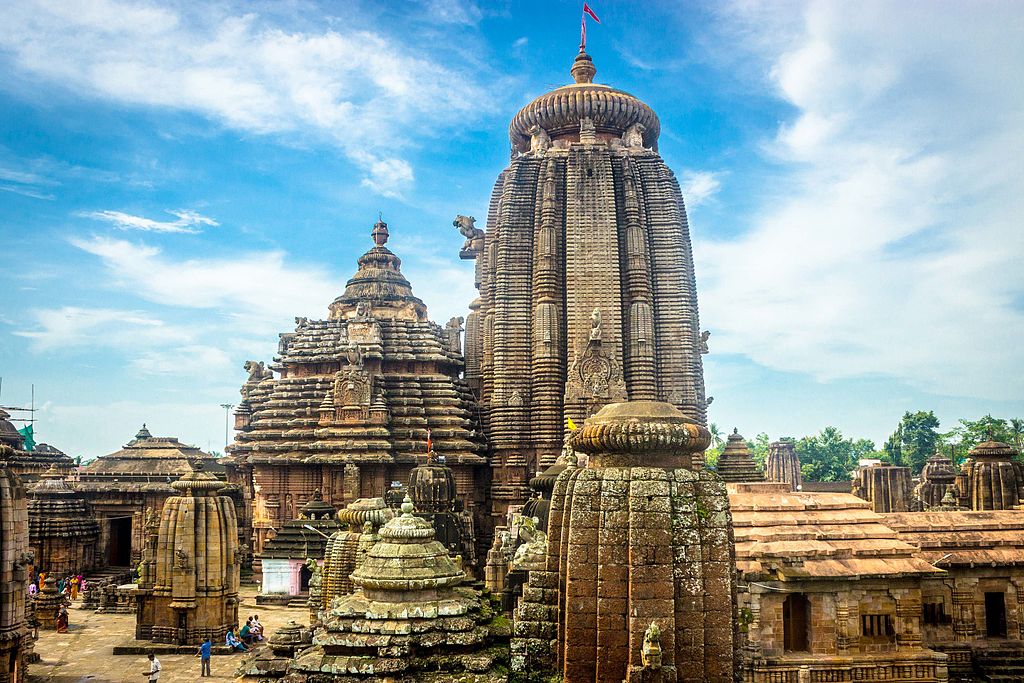
The majestic temple, which stands 180 feet tall, inspires awe and reverence in its visitors. It was built in the eleventh century AD.. James Fergusson, a famous critic and historian, has called the temple “one of the finest examples of purely Hindu temple in India” (1808-1886). The temple represents the pinnacle of temple construction in Bhubaneswar, the birthplace of the Kalinga School of Temple Architecture. There are 150 subsidiary shrines throughout the large temple complex.

For their comprehensive layout, proportions, smooth joints, beautiful craftsmanship, and astonishing grandeur, the temples are regarded as a masterpiece of Indian architecture. The temple is divided into four major halls in general. The Garba Griha (Holy of Holies), the Yajana Mandapa (prayer hall), the Natya Mandapa (dancing and music hall), and the Bhoga Mandapa (where devotees can partake of the Lord’s Prasad (offering). Apart from being a place of prayer, the superb carvings illustrating daily life duties, as well as the activity centres, make the temple a venue for social and cultural gatherings, similar to a modern community centre.

Swayambhu is the name given to Lingaraj (self-originated Shivling). Another significant feature of the temple is that it represents Odisha’s syncretization of the Shaivism and Vaishnavism faiths. Hari Hara is the name given to the Shivling. Perhaps the rise of Lord Jagannath’s cult, which coincided with the building of the Lingaraja Temple, played a part.
Non-Hindus are not permitted to enter the temple. However, from an elevated platform created specifically for tourists just outside the temple complex, one may obtain a glimpse of the whole temple complex and snap photos.

Another feature is the Bindusagar Lake, which is located on the temple’s north side. The 1300 ft long and 700 ft broad lake is the heart of Old Town’s activity and the site of temple celebrations.
The lovely garden of Ekamra Van is located on the western bank of Bindu Sagar and is called after the Hindu legendary scriptures in which Bhubaneswar, the capital city of Odisha, is referred to as Ekamra van or a forest of a single mango tree. The garden is home to a variety of plants that have spiritual and therapeutic value and are traditionally linked with Hindu gods and goddesses.

4. Udaygiri & Khandagiri Caves

Historical Sites in Odisha, Udaygiri & Khandagiri Caves
Image- Wikimedia

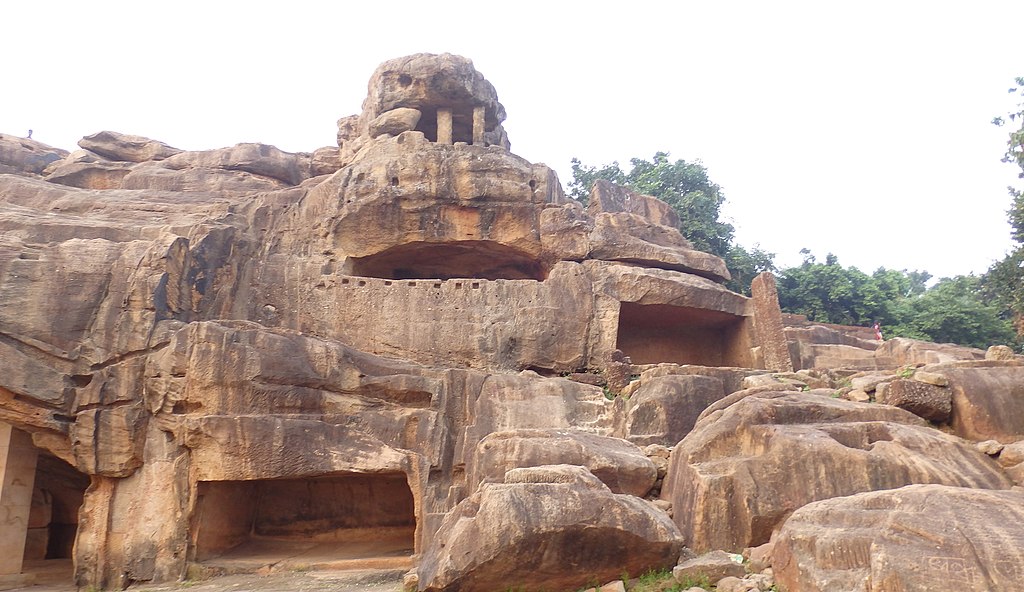
The caverns, located 7 kilometers from Bhubaneswar, transport us back in time and are perhaps the sole documented history of an age cloaked in mystery. Built around the 2nd century BC by Ruler Kharavela of the Meghavahana dynasty, usually considered as Odisha’s most powerful king, these ancient rock cut caverns were first found in the 19th century AD by a young British officer named Andrew Sterling.
In the chambers constructed on the Kumari mountain range, the Jain monks were provided a place to live and meditate. Only thirty-three caverns out of the original one hundred and seventeen caves have survived to this day. The Udayagiri hill has eighteen caverns and fifteen caves.

In the caverns constructed on the Kumari mountain range, the Jain monks were provided a place to live and meditate. Only thirty-three caverns out of the original one hundred and seventeen caves have survived to this day. The Udayagiri hill has eighteen caverns, whereas the Khandagiri hill has fifteen.
The Udaygiri caves are managed by the Archeological Survey of India (ASI) and are a ticketed attraction. The Udaygiri caves’ main features include:

  • King Kharavela’s inscriptions may be found in Hathigumpha, or the Elephant Cave. The seventeen lines discuss his numerous conquests as well as his leadership style.
  • The Rani Gumpha, also known as the Queen Cave, is a two-story building with intricate carvings. Apart from the exquisite sculptures, the cave is recognised for its acoustic qualities.
  • The Ganesh Gumpha is a cave dedicated to Lord Ganesha, notable for its Jain teerthankar carvings and other sculptures. Much later, the carvings of Lord Ganesha and two elephants were added.
  • The Vyaghara Gumpha, or Tiger Cave, is named after the entrance, which is formed like a tiger’s head, and the door, which is fashioned like a tiger’s throat.

The ASI does not have jurisdiction over the caves in the Khandagiri hills. Khandagiri’s most famous ones are:

  • The twelve-armed Sasana Devis, as well as Tirthankar statues, are shown in arabhuji Gumpha.
  • Trushula Gumpha — The cave’s walls are adorned with carvings of the twenty-four Jain Tirthankars. TirthankarRishab Dev’s sculpture is very notable.
  • Ambika Gumpha – On the cave’s walls are engraved the Yaksha and Yakshini of each Tirthankar.

The most remarkable feature of these exquisitely sculpted caverns is that each cave and artwork was carefully carved by hand with little equipment. The architecture is wonderful, as is the sculpture. The engravings included allusions to mythology and history. The representation of the Kalinga War, in which women and teens battle to preserve their motherland from Ashoka’s troops, is one of the most moving sections of carving.

The caverns were used as Jain monks’ houses and were furnished with a water source in the shape of a tiny canal that runs through each cave, an inventive communication system via holes, a location to light the lamps, and a slanted flooring that functioned as a head rest. Many of the caverns are two-story, and it’s thought that the caves’ top chambers were utilised for intense meditation.

5. Mukteswar Temple

Historical Sites in Odisha, Mukteswar Temple
Image- Wikimedia

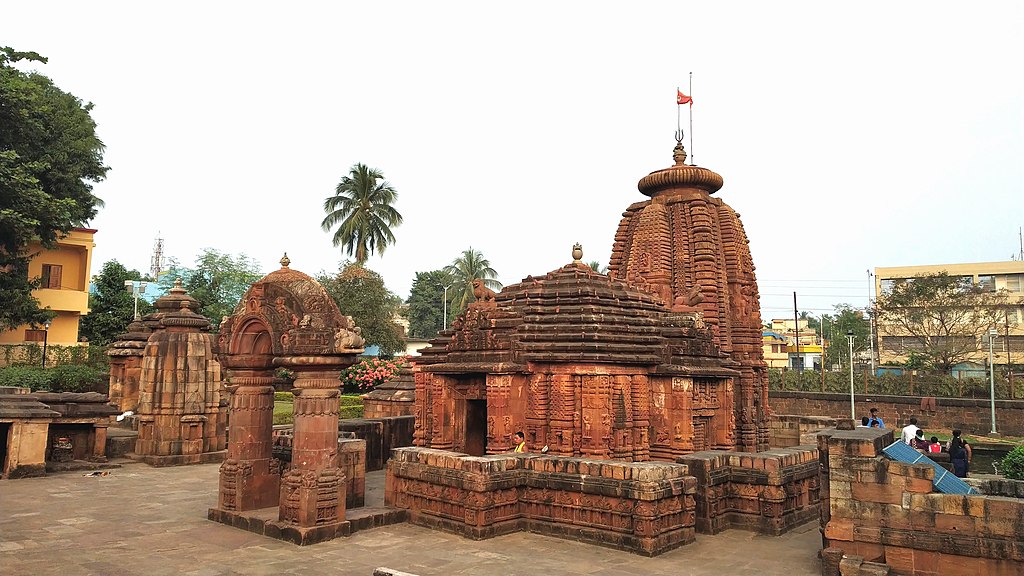
If Parasumreswar symbolizes the beginning of Odisha’s temple building progression, Mukteswar reflects its maturation. Ironically, the two temples lie next to each other, and this may be the only occasion in history where one can view man’s architectural progress in such close proximity.

Mukteswar’s sculptures are adorned with finely carved finery. The figures are smaller and more proportional. The Jagamohana, or main entrance, blends into the sanctum sanctorum. Images of Lakulisa, the saint who spread the Shaivism pashupata sect in the state during the 6th century AD, may be seen. On the temple’s outside walls, there are additional images of emaciated hermits or ascetics in meditative stances. A letter-writing woman is seen in one of the carvings. Despite its harmless appearance, the sculpture reveals that women did have a place in society back then.

The temple was constructed around the year 1000 AD. Lord Shiva, also known as Lord Mukteswara or Lord of Spiritual Freedom, is the temple’s presiding deity. Historians have described the temple as a “miniature gem” because of its complex and well-proportioned construction.
The Torana, or arched gate, is the temple’s trademark structure and one of India’s, if not the world’s, most photographed architectural structures. The arched gate’s finely carved pillars stun tourists and visitors with their unparalleled accuracy and expertise.

The temple’s beautifully carved roof, which is evocative of Central Indian temples, is a noteworthy feature. This is due to the fact that the temple was built during the reign of the Somavamsi dynasty, who arrived in Odisha from Central India.

6. Rajarani Temple

Historical Sites in Odisha, Rajarani Temple
Image- Wikimedia

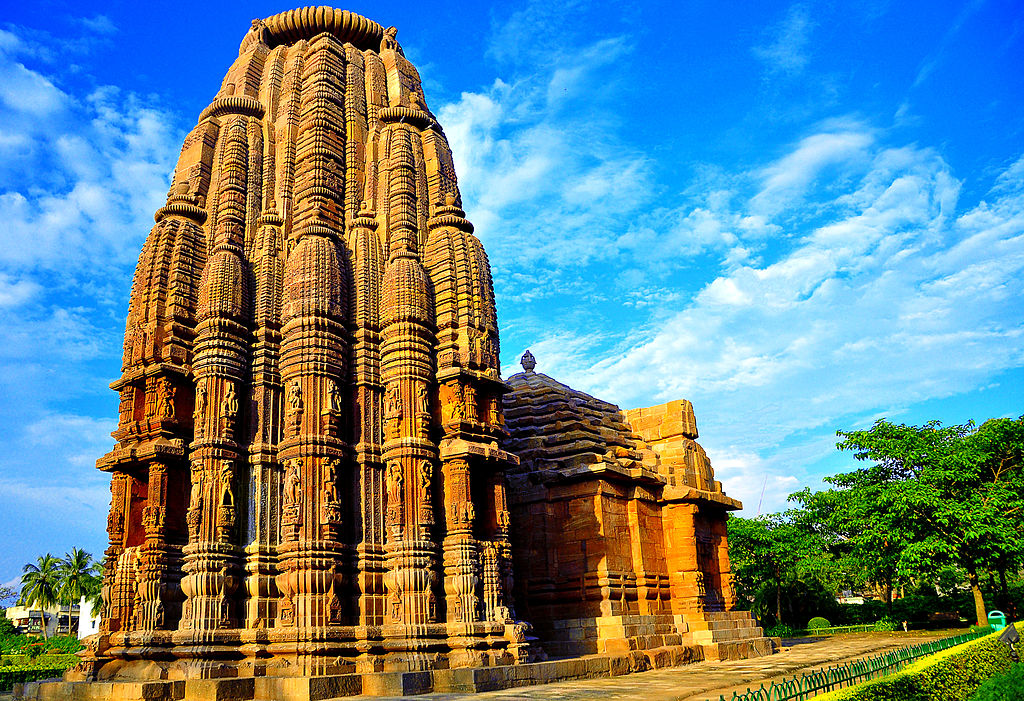
Rajarani temple is a beautiful symphony of skilled design, symmetry of form, and excellent craftsmanship, situated in scenic environs. It’s no surprise that it’s considered an Odisha Temple Architecture masterpiece. Historians believe it was devoted to Lord Shiva and was called Indresvara Temple.
The temple was constructed in the 11th century AD during the reign of the Somavamsi dynasty. Although there is no presiding god in the temple now, there are clear indicators in the construction indicating it was once a temple devoted to Lord Shiva, the most noteworthy of which is the sculpture of sage Lakulisa directly over the entry door and below the navagrahas.

Because of the red and yellow sandstone that was utilized in its construction, the temple is known as Rajarani Temple. With the passage of time, the stone takes on an amber hue, enhancing the temple’s architectural splendor.
The temple’s construction layout is similar to the Kandariya Mahadev Temple in Khajuraho, which may be traced to the Somavamsi’s arrival in Odisha from Central India. The jagamohana (entry hall), unlike the sanctum sanctorum, is devoid of sculptures (it is thought that the temple could not be finished for some reason). The sharp contrast only adds to the temple’s splendor.

Another fascinating characteristic of the temple is that the tower over the Sanctum Sanctorum rises from the ground like a beehive, with tiny miniature towers, one on top of the other, integrating perfectly with it, similar to a mountain range where the peak is encircled by lesser mountains. This might be seen as the human soul’s desire to rise higher and higher until it combines with the everlasting almighty spirit.
Rajarani temple is a monument to the architects’ abilities, as well as their clients’ immense patience and endurance. The Archeological Survey of India (ASI) now manages the temple, which is a ticketed attraction.

7. Dhauli

Historical Sites in Odisha, Dhauli
Image- Wikimedia

Dhauli is a tiny village 8 kilometers south of Bhubaneswar, situated on the banks of the Daya River, and bears immense significance for Lord Buddha’s devotees. Dhauli is claimed to have seen Ashoka’s character change.

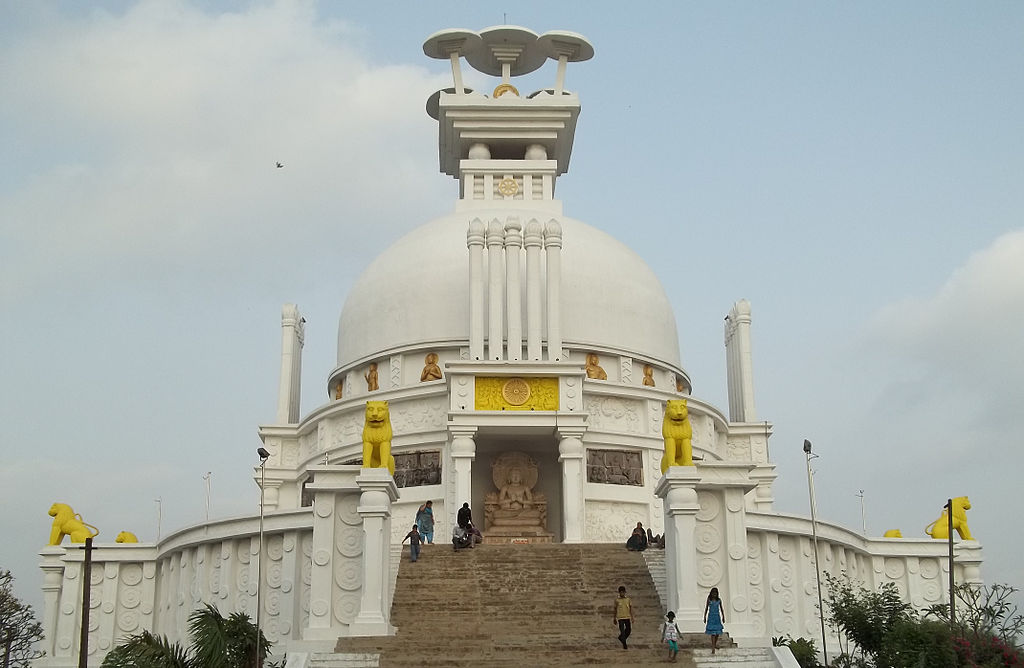
This is said to be the site of the 3rd century B.C. Kalinga War between the Mauryan Empire commanded by Great Ashoka and the Kalinga kingdom. The slaughter was so terrible during the conflict that Daya’s water was supposed to have turned red from the massacre. This caused King Ashoka’s opinions to alter dramatically, and he finally converted to Buddhism. Ashoka edicts, which are essentially rock formations with inscriptions on them, were used to chronicle his reactions to the battle. Dhauli is presently an important Buddhist centre in India, including numerous key Ashoka edicts. Ashoka constructed countless Stupas, Chaityas, and Pillars across the town and did his utmost to promote peace after the conflict by assisting others. Dhauli is home to a stunning Peace Pagoda that draws thousands of visitors each year. Hindus, in addition to Buddhists, go to Dhauli to visit some of the town’s old temples, which are revered worldwide. Other sights in Dhauli include rock cut caverns and the Sadharma vihar monastery, which will make your stay worthwhile.

8. Barabati Fort

Historical Sites in Odisha, Barabati Fort
Image- Wikimedia

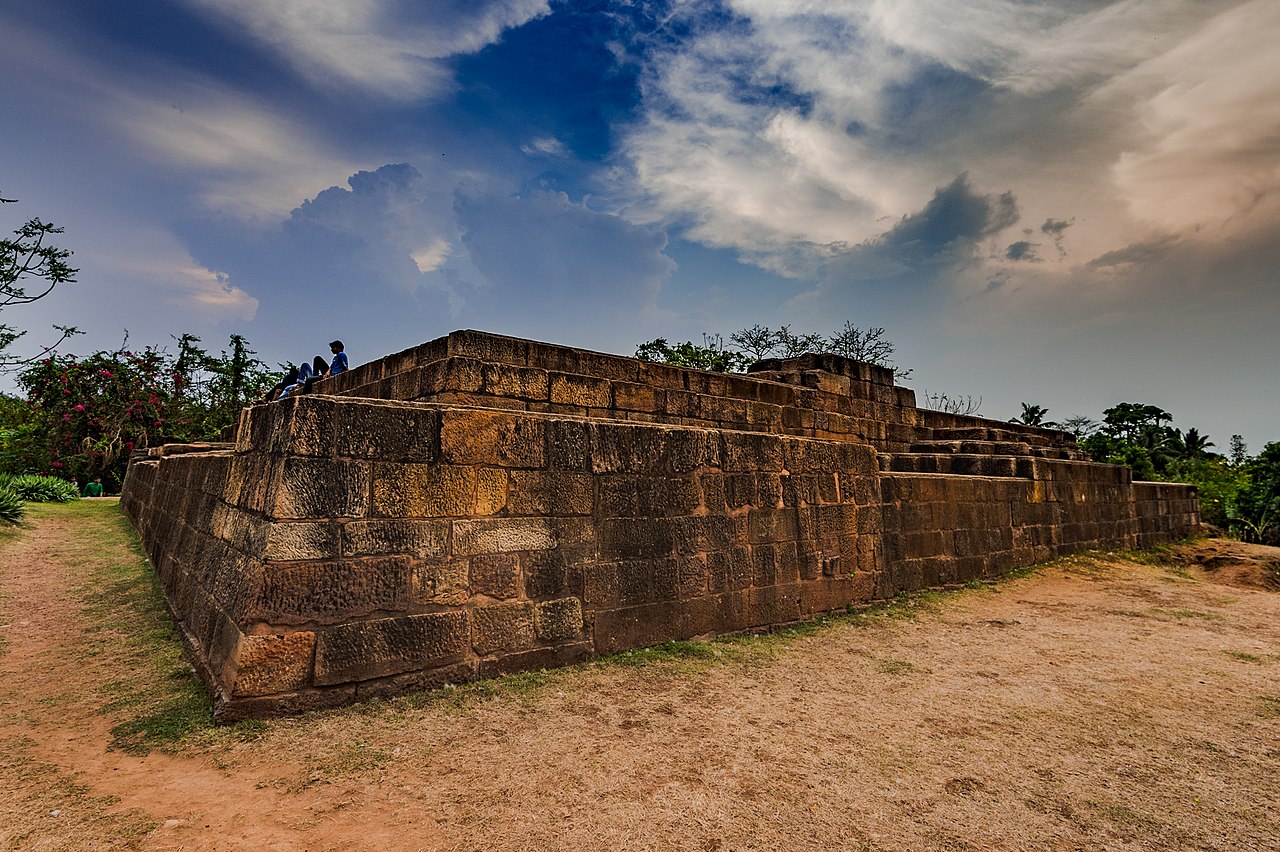
Barabati Fort, located in Cuttack, Odisha, is a well-known fort with carved entryway. It’s around 8 kilometers from the city center. It is a fort erected in the 14th century by the Ganga dynasty. The Mahanadi River runs through the fort. The fort is situated in such a strategic place that it provides a spectacular view over the contemporary Cuttack metropolis. It’s the nine-story palace’s earthen mound. To guard against enemy attacks, the monument was erected with fortifications. A neighboring Barabati stadium is now being built for cultural and sporting activities. A temple has been built in honour Katak Chandi.The fort adds to the city’s splendor while also showcasing its illustrious past.

9. Chausath Yogini Temple

Historical Sites in Odisha, Chausath Yogini Temple
Image- Wikimedia

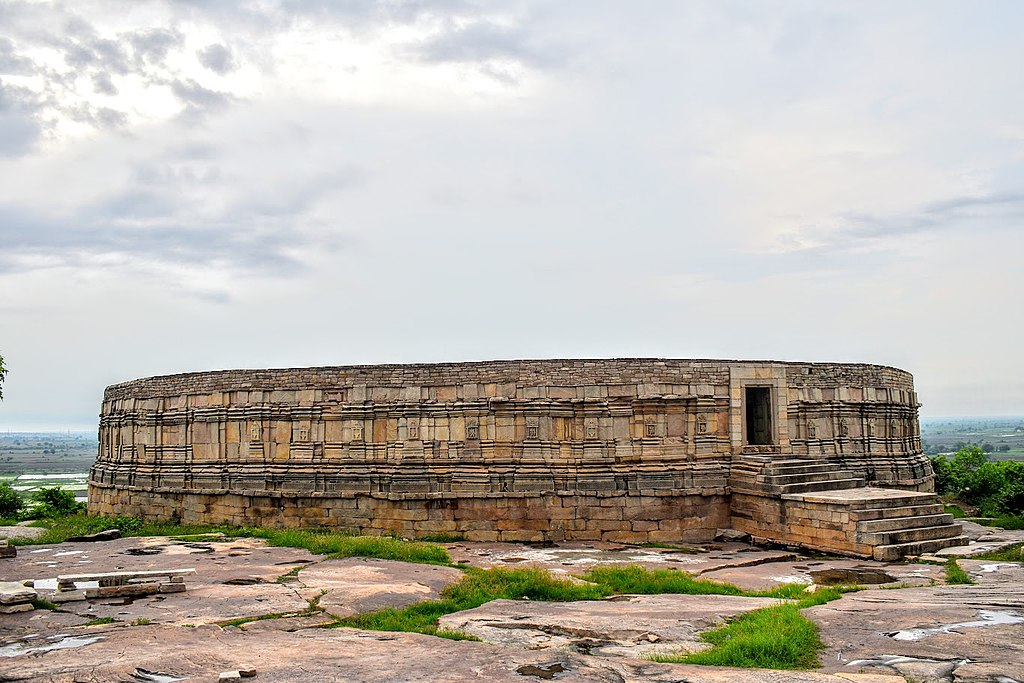
Queen Hiradevi of the Bramha dynasty is thought to have erected the Chausath Yogini Temple in the 9th century. It was created with 56 chambers on the inner portion of its wall that centre on the central altar and was built entirely of sandstone stones. The centre altar, in turn, features eight chambers for Goddess Kali statues. Goddesses occupy 63 of the holes in the contemporary era, with the 64th sculpture reported missing.

The goddess Kali is the temple’s most spectacular sculpture. She is typically shown standing atop a human head, implying that our bodies are continuously triumphing over our bodies. Despite the fact that the Chausath Yogini Temple is an important part of our past, it remains mostly unknown. This is largely due to the fact that it was kept as one of the cult’s most sacred secrets.

Hirapur Chausath Yogini Temple only became well-known in 1953, when distinguished historian Kedarnath Mohapatra patched it back together and restored it to its former splendour as a circular roofless edifice. The temple is around 20 kilometres from the city of Bhubaneshwar. The temple is easily accessible through the Bhubaneshwar-Puri highway and the dirt road going to Hirapur. Traveling through this city, you will undoubtedly come across old tantric traditions and one of the most magnificent architectural styles that is distinct from typical Kalingan architecture. The temple is well worth seeing.

Odisha has a plethora of historical landmarks, especially marvelous temples, that showcase the state’s culture and heritage. A heritage tour of the state will show locations that have played significant roles in Indian history and should not be missed.

Festivals of Arunachal Pradesh You Must Witness to Enjoy

0
Festivals-of-Arunachal-Pradesh
Image –Wikimedia

In a culturally rich country like India, Arunachal Pradesh is a state that has a uniquely diverse culture of its own. Arunachal Pradesh is home to various tribal groups, and the different groups have their beliefs and traditions and together form the dynamic and wholesome culture of Arunachal Pradesh.  

Festivals are a vital element of any culture. Festivals are a celebration of traditions and beliefs that are crucial to any community. Arunachal Pradesh has a plethora of diverse festivals, courtesy of the different tribal communities of the state. These occasions mark various essential dates, agricultural seasons, and other religious beliefs. The festivals are a great way to experience the authentic and diverse culture of Arunachal Pradesh. 

In this article, we bring you the different festivals of Arunachal Pradesh. For those who like to explore the various cultures of our country, read on to learn about the beautiful festivals of Arunachal Pradesh. Those who would like to experience the celebrations firsthand can plan their next trip accordingly. 

Siang River Festival 

Festivals-of-Arunachal-Pradesh-Siang-River-Festival
Image Source

Siang River Festival is one of the most popular festivals of Arunachal Pradesh. The festival is also known as the Yomgo River festival. This festival is a celebration of communal harmony in the state and also promotes ecotourism. This festival was a part of the Brahmaputra Darshan festival till 2005. Now, the celebration is notable for the various adventurous and fun activities that are its part. Traditional elephant races, boat races, cultural shows, food stalls, arts and crafts stalls, and Didi, the Mishmis’s mock war game, are essential. The festival portrays the possibilities Arunachal Pradesh as a state has to offer to promote its tourism. The Siang River festival is a great occasion to experience the versatile nature of Arunachal Pradesh’s tourism. The event takes place in December. The people who are keen on witnessing this festival can plan their trip accordingly. 

Ziro Festival of Music 

Festivals-of-Arunachal-Pradesh-Ziro-Festival-of-Music
Image Source

All the music lovers, take note of this festival of Arunachal Pradesh. Ziro Festival of Music in Arunachal Pradesh’s take on the famous Sunburn Music festival. The venue of the festival is the Ziro valley. People from across the different North-Eastern states and other parts of the country gather here. Famous national, international, and folk artists perform at this festival. The Ziro Festival of Music is a very versatile event that also features the folk culture of Arunachal Pradesh. The festival takes place for four days. During this time, visitors can enjoy the live music and listen to the state’s folk songs. The Ziro valley also offers its scenic beauty. One can enjoy both nature and art in a hearty combination at this festival.  

Pangsau Pass Winter Festival 

Festivals-of-Arunachal-Pradesh-Pangsau-Pass-Winter-Festival
Image Source

Pangsau Pass Winter Festival is a modern winter festival that began in 2007. The festival has been gaining popularity since its inauguration. This is a three-day festival, and the venue is Nampong of Changlang district of Arunachal Pradesh. The festival is a way to celebrate the ethnicity of the people of the state. People from across Arunachal Pradesh and the neighboring North-Eastern states put up handlooms and handicrafts to exhibit their craftsmanship. Folk dances and folk songs are also a part of the festival.  

The festival extends a beautiful message because there is a designated stall for Myanmar also. The festival highlights the culture and traditions of both the North-Eastern states of India and Myanmar. The event takes place in January every year, and those keen on witnessing such a wholesome occasion can visit the state during this time. 

Losar Festival 

Festivals-of Arunachal Pradesh, Losar
Image – Wikimedia

Losar festival is the celebration to welcome the new year. The festival is particular to the Monpa tribe of Arunachal Pradesh. Losar is a famous festival in the state. The Monpa tribe has a large population in the Tawang and West Kemang districts, making Losar an important festival. During the festival, people clean their houses, offer prayers, hoist religious flags atop their homes, read holy scriptures, and light lamps with butter. It is a very spiritual and sacred occasion. People worship the local deities for the welfare of society and its people. The festival lasts for eight to fifteen days, during which people indulge in merry-making. Local delicacies and drinks are a must during the Losar. The actual date of the festival varies according to the Buddhist calendar but falls around February to March.  

Boori Boot Festival 

Festivals of Arunachal Pradesh, Boori Boot Festival 
Image – KAMLE District

Boori Boot is a festival that celebrates a good harvest. Hill-Miris in the Upper Subansiri and Lower Subansiri district is the locus of this festival. The festival lasts for three days and takes place in February. The Boori Boot festival contains a very wholesome message. The celebration marks people coming together irrespective of their caste, religion, sex, and age to welcome Spring. The religious side of the festival is to offer prayers to the spirit of Boori Boot to get blessings of prosperity and good health. People from across Arunachal Pradesh flock to the Upper Subansiri and Lower Subansiri districts to participate in the activities and participate in hearty celebrations.  

Sanken Festival 

Festivals of Arunachal Pradesh, Sanken Festival 
Image – Sangken Poi / Facebook

Sanken is a holy festival famous in the Khampti tribe of the Lohit district of Arunachal Pradesh. The festival takes place on the 14th of February and continues for three days to mark the beginning of the new year. During the three days of the Sanken festival, people bathe the idol of Lord Buddha. This holy period is observed by offering prayers and beating drums and gongs. People maintain a very pious lifestyle during the days of the festivities. They refrain from killing animals, having intoxicating drinks, and doing other sinful activities. People sprinkle holy water and exchange greetings after bathing the Buddha idols and sacred shrines. On the final day of the celebrations, the model of Buddha is installed back in its shrine, and a feast takes place. 

Nyokum Festival 

Festivals of Arunachal Pradesh, Nyokum Festival 
Image – Wikimedia

Nyokum Festival is particular to the Nyishi tribe of Arunachal Pradesh. The celebration takes place for the prosperity and harmony of the people. The event takes place on the 28th of February each year, and the venue is East Kemang district, Lower Subansiri district, Papumpar district, and Kurung Kummey district. Nyokum is made of two words of the native dialect, and its translation is Nyok, meaning land, and Kum meaning people.

It is a two-day celebration when men and women come together to enjoy themselves. Dance, music, and food are quintessential parts of the festivities. Men and women perform the traditional dance by holding hands and forming a circle. The high priest performs the religious rituals and offers prayers for the prosperity of each household. One who visits Arunachal Pradesh during this time of the year can witness the authentic celebrations of the people for the people of Arunachal Pradesh. 

The festivals of Arunachal Pradesh signify the rural and pure lifestyle led by the different tribal communities of the state. Each festival is unique and showcases the religious and traditional beliefs of the people. One can enjoy and learn about the vast culture of Arunachal Pradesh by experiencing its vibrant festivals.  

15 Recreational Activities to Keep You Fresh & Inspired

0

Recreational-Activities

There is nothing like a good outdoor recreational activity to keep you fresh and inspired. Whether you’re looking for something to do with friends or family, here are five great options for getting out and having a good time.

There are many recreational activities that people can participate in. Some popular ones include hiking, biking, swimming, fishing and playing sports. These recreational activities can be a lot of motivation to get exercise. They can also be the best way to meet new people and make friends.

Hiking requires water, food, a first-aid kit, and a map, compass and warm clothes. Biking does require some physical fitness. Swimming requires a swimsuit, towel, sunscreen, sunglasses and a water bottle.

Fishing requires a fishing rod, reel, line, bait, and tackle. However, the most important thing about fishing is to bring quality items with you before you move out. MeltonTackle ensures A-to-Z quality fishing items at an affordable price. Others such sports items that may be needed depending on the sport. You may find it in the quality sports zone. In this article, you will find a list of 15 Recreational Activities and how they Keep You Fresh & Active.

The 15 Fun Activities How to Keep Your Mind Active & Stay fresh?

  • Keep You Excited & Inspired!
  • Keep Your Mind Active!
  • Re-energize Yourself and Stay Fresh!
  • Keep You from Getting Bored This Summer!
  • Keep You Happy and Physically Active!
  • That Will Keep You Mentally Stimulated!

If you ever feel like your mind just seems to wander when you are not doing anything? Well, there are plenty of ways to keep your brain active and fresh. Here are 15 fun recreational activities to get you started:

  • Playing Card Games: Playing card games like Pyramid Solitaire can be an excellent way to keep your mind active and stay fresh. The game requires strategic thinking and decision-making as you try to clear the pyramid by pairing cards that total 13. This mental stimulation can help improve memory, concentration, and problem-solving skills, contributing to overall cognitive well-being.
  • Hiking: Hiking is best to get fresh air and exercise, which can help you to feel refreshed. Hiking also allows you to see beautiful scenery and wildlife, which can be very inspiring. don’t miss carrying water, food, a first-aid kit, a map, compass and warm clothes with you to go for Hiking.
  • Biking: Biking is good to get fresh air and stay active. It is also a great way to explore new areas and find inspiration for your work. Biking can help you clear your head and come up with new ideas.
  • Swimming: Swimming keeps yourself fresh because it is a fun, low-impact workout that releases endorphins, which are hormones that make you happy. It is also best for exploring your local area and meeting new people. a swimsuit, towel, sunscreen, sunglasses and a water bottle carry with you to go swimming.
  • Fishing: Fishing is a good way to relax and clear your mind. You can get some exercise and fresh air. Without a quality reel, fishing rod, line, bait, and tackle, you cannot catch fish. don’t move out without these items with you for this recreational activity.
  • Running: Running can keep yourself feeling fresh. It is  a way to get your heart rate up and to work off some energy, and it can be really fun to do outdoors. Running can also help you clear your head and come up with new ideas, so it is best to stay productive.
  • Yoga: Yoga makes your body and mind fresh. It is a form of exercise that is both challenging and relaxing, and it can be tailored to fit your own needs and abilities. Yoga can help you stay centered and focused, and it can remove stress and tension.
  • Pilates: Pilates is a way to keep your body feeling good and looking young. It helps you stay flexible, strong, and balanced. Pilates is also the best way to clear your mind and stay inspired.
  • Golfing: Golfing can keep yourself fresh. It is a fun and relaxing way to get some exercise, and it can be the best way to clear your mind and relieve stress. Golfing can also help you learn new skills and strategies, and it can give you the opportunity to meet new people and make new friends.
  • Tennis: Playing tennis can inspire you and stay active because it is a great way to get exercise and fresh air. It is also a fun way to spend time with friends or family.
  • Badminton: Badminton is a good way to keep you fresh. It is a very active sport that requires a lot of movement, which is great for your overall health. It is also a very competitive sport, which can help motivate you to push yourself harder and achieve more.
  • Frisbee: There are a few things that Frisbee can do to keep you fresh and inspired. First, it is best to get some exercise and fresh air. It is also a fun way to socialize and meet new people. Finally, Frisbee can be a great source of inspiration – seeing others play well can motivate you to improve your own skills.
  • Soccer: Soccer is a great way to keep you fresh. It is a very physical sport that requires a lot of running, so it’s a good way to stay in shape. It’s also a very social sport, so it is best to meet new people.
  • Basketball: There are a lot of things that basketball can do for you. It can help keep you fresh and inspired. When you’re playing, you’re constantly moving, and it is a perfect workout. You are also constantly working on your skills, so you never get bored. And when you’re not playing, you can watch games or even play video games to keep the excitement going.
  • Spin: Spin is best to keep you feeling fresh. A fast-paced, high-intensity workout is the way to get your heart rate up and burn calories. Plus, the music and energy of the class will keep you motivated throughout the entire workout.
  • Rock climbing: Rock climbing can keep your body and mind fresh. It is a challenging sport that requires focus and concentration, which can help you stay mentally sharp. It is also a great workout, which can help keep you physically fit. Climbing can be a fun way to explore new places and see beautiful scenery. And finally, it’s a social activity that can help you meet new people.

There are many recreational activities that can keep you fresh and inspired. If you are sure to get started with an activity that suits your interests and personality. find ways to connect with friends and family. Whatever you do, get out there and explore your community! Make sure to enjoy yourself and always be active.

10 Exceptional Things Uttar Pradesh is Famous For!

0

Uttar-Pradesh-is-Famous-For

Uttar Pradesh is a culturally diverse state with a rich history, festivals, agriculture, cuisines, and tourism. From ancient temples to national parks, wildlife sanctuaries, historic monuments, incredible architectural marvels, massive forts, and scenic splendour, the state is rich in every way. Uttar Pradesh is a pilgrimage destination with religious ghats where millions of people bathe each year. This is where the holy Ganga emerges, fertilising the state’s plains. Not only does the Ganga bless millions of people every day, but Varanasi’s Kashi Vishwanath temple does as well (Lord Shiva). The Taj Mahal, one of the world’s seven wonders, is the top draw not only in India but also in the world, and the state is highly proud of its tourism attractions. 

Suggested read – Uttar Pradesh Culture – A Microcosm of Multicultural India

Taj Mahal

 Uttar Pradesh is Famous For Taj Mahal

“The embodiment of all things pure,” wrote Rudyard Kipling of the Taj Mahal’s grandeur, and he wasn’t joking; the Taj is undeniably beautiful. It is an immortal lyric carved in white marble, and it is the most beautiful expression of an emperor’s love for his queen. It was built on the banks of the River Yamuna in 1631 by Mughal Emperor Shah Jahan in memory of his beloved wife and Queen Mumtaz Mahal, who died giving birth to their child and whose last wish to her husband was “to build such a tomb in her memory as the world has never seen before,” The magnificent tomb took 17 years, 22000 workers, and 1000 elephants to construct. The Taj Mahal is one of India’s three UNESCO World Heritage Sites. The monument is set in a tranquil Mughal Garden and stands on a high marble platform with its back to the Yamuna River. The Taj Mahal’s four sides are perfectly symmetrical, with majestic vaulted arches adorned with Pietra Dura scrollwork and verses from the Quran written in calligraphy with inlaid jasper. Photographers and foreign tourists flock to this architectural gem in India. The Taj Mahal is as beautiful today as it was when it was initially built, mesmerizing passersby.

Kashi Vishwanath Temple

 Uttar Pradesh is Famous For Kashi Vishwanath Temple
Image- Wikimedia

The Shri Kashi Vishwanath temple in Varanasi is revered by Hindus and is one of India’s most prominent temples dedicated to Lord Shiva. One of the twelve Jyotirlingas, the celestial shrine stands towering on the western bank of the holy river Ganga. The major deity is known as Vishvanatha or Vishveshvara, which means Ruler of the universe. Because Varanasi is also known as Kashi, the shrine is also known as Kashi Vishwanath Temple. The Kashi Vishwanath Temple is adorned with three gold-domed domes! According to common belief, any wish made after witnessing the golden chatra is granted.

Ganga Aarti at Dashashwamedh Ghat 

 Uttar Pradesh is Famous For Ganga Aarti at Dashashwamedh Ghat 
Image- Wikimedia

Ganga aarti on one of the famous ghats Dashashwamedh in Varanasi is a shining light of devotion and bliss that allows us to feel the god inside and around us. The sacred Ganga River has been cherished from the beginning of time. It is one of the must-see attractions on any traveller’s itinerary, and people from all walks of life flock to the city to witness the Ganga aarti. This event is led by a group of saints clad in silky saffron and white robes. Each pandit or saint takes a designated position on the Ghat and begins the ritual by presenting flowers to the river. Many oil lamps, such as the snake hood light, are carried in sync during the rite.

Lucknowi Biryani and kebabs

 Uttar Pradesh is Famous For Lucknowi Biryani and kebabs
Image- Wikimedia

Lucknawi Biryani is a national favourite made with cashew nut paste, saffron, curd, mace powder, and star anise. This flagship dish, in which the meat (mutton or chicken) is roasted over a slow fire, is an essential part of Awadhi cuisine. 

Lucknow’s soft Tunday kebabs are known for their savoury, melt-in-your-mouth flavour. These kebabs are cooked with lamb or buffalo meat and over a dozen spices to give them a distinct flavour. Galouti kebabs are a mainstay of Awadhi cuisine and a must-try for any foodie looking for something scrumptious to eat. This dish consists of a delicious minced meat kebab seasoned with a variety of spices. As soon as you bite into the kebabs, they melt in your mouth, leaving you wanting more. The nawabs were famed for enjoying Galawati or Galouti Kebabs, which were a regal delicacy at the time.

Suggested read – 10 Lucknow Food Delicacies that Will Make You a Foodie for Sure!

Chaats

 Uttar Pradesh is Famous For Chaat
Image- Wikimedia

Uttar Pradesh is known for its scrumptious street cuisine, from a variety of chaats to delectable kulfis, and visitors from all over the country rush to Lucknow, Kanpur, and Agra, among other places, to enjoy these delectable treats. It has a wide range of flavours, as well as various toppings and masala. The most well-known chaats include samosa chaat, aloo tikki chaat, and matar chaat.

Banarasi Sari from Varanasi

 Uttar Pradesh is Famous For Banarasi Sari from Varanasi
Image- Robert GLOD/ Flickr

A sari created in Varanasi (Banaras), also known as Benares, is known as a Banarasi sari. The saris are famed for their gold and silver brocade or zari, quality silk, and lavish embroidery, and are among India’s finest. The saris are composed of carefully woven silk and are embellished with complex designs. They are relatively heavy due to the engravings. Each sari can take anything from 15 days to a month, and even up to six months to make, depending on the complexity of the intricate patterns and colours. Banarasi saris are traditional Indian saris usually worn at weddings that are designed to be enhanced by the woman’s most prized jewellery.

Lucknowi Chikankari

 Uttar Pradesh is Famous For Lucknowi Chikankari
Image- Wikimedia

Chikankari is a type of Lucknow embroidery that is incredibly delicate. Chikan literally translates to “embroidery,” and it is thought that the Mughals were the first to introduce this art style. The garment has a refined vibe thanks to the basic and accurate, yet detailed hand stitch. Indian chikan work dates back to the early third century BC, according to one legend, with a traveller teaching chikan to a farmer in exchange for drinking water. The most popular and factually verifiable myth is that Noor Jahan, the wife of Mughal emperor Jehangir, was the first to introduce Persian art to India in the 17th century. She was a gifted embroiderer herself, with a particular affinity for the craft. Her husband is said to have appreciated chikan work as well, and has established several studios in India to perfect the art form. Back when it was first invented as a white-on-white stitching technique, the preferred fabric was muslin or mulmul, which was best suited to the warm, slightly damp atmosphere. Chikankari artists moved across India after the Mughal Empire fell apart, although Lucknow remained the main hub, with Awadh a close second. The 400-plus-year-old art genre is still a global craze today.

Suggested read – Embroideries of India – Showcasing the Skills of Regional Artisans

Kathak

 Uttar Pradesh is Famous For Kathak
Image- Wikimedia

Kathak is a popular Northern Indian classical dance genre. Uttar Pradesh is the state where it is most popular. The name Kathak literally means “narrator.” Kathak dance is the technique of telling a story with smooth but precise body motions. It is accompanied by the tabla or pakhawaj, a traditional instrument.

The Lucknow Gharana is the most well-known. This Gharana grew up around a lovely Kathak style. The dancers portray the story with beautiful wrist and hand movements. The Lucknow Gharana was founded by Pandit Ishwari Prasad. Pandit Birju Maharaj is the most prominent and well-known dancer of the Lucknow Gharana. Renowned Kathak dancer Janakiprasad created the Kathak Banaras Gharana. He was born in Bikaner and grew up there. While teaching his students the nuances of this classical dance, he founded the Banaras Gharana of Kathak.

Kumbh Mela

 Uttar Pradesh is Famous For Kumb-mela
Source

The Prayag Kumbh Mela is a Hindu religious gathering annually in Allahabad (also Prayagraj), India, near the Prayag or Triveni Sangam, which depicts the confluence of three rivers, two of which, the Ganges (also Ganga) and the Yamuna, which have objective reality while the third, the Sarasvati, which is mythological. The festival is marked by a ritual dip in the waters, but it is also a celebration of community trade, with multiple fairs, education, religious talks by saints, mass feedings of monks or the destitute, and a spectacle of entertainment. 

Holi in Vrindavan and Mathura

 Uttar Pradesh is Famous For Holi in Vrindavan and Mathura
Image- Saurabh Chatterjee/ Flickr

While Holi is celebrated in practically every section of India, it is especially well-known in Braj. Braj is a historical territory that includes Mathura, Vrindavan, and other surrounding locations. Because of its unique customs and traditions, Holi attracts visitors from all around the world to Vrindavan, Mathura, and Barsana. It is, after all, a grand occasion. Lord Krishna was born in the city of Mathura, and he spent his boyhood in the city of Vrindavan. Despite the fact that Holi has a set date, the festivities begin on Basant Panchami and last until the day of Holi (Phalgun Purnima). Holi is celebrated in Vrindavan with coloured water and gulal, which is a colour made from organic ingredients like flowers and Kesar. The atmosphere is heightened by the presence of music (bhajans) in the background, which causes people to dance to the beats while taking in the sights.

Suggested read – Festivals of Uttar Pradesh – Celebrating Extant Traditions of the State

In fact, it can be claimed that Hindi and Urdu art, craft, dance, literature, music, and poetry have penetrated throughout the state, and the microcosmic fabric of its cultural worldview has impacted Indian culture to a large extent. As a result, the label of Uttar Pradesh as the “cradle of Indian culture” is quite appropriate.

The Dynamic and Colourful Folk Dances of Gujarat

3
Folk-Dances-of-Gujarat
Image – Wikimedia

The first thing that comes to mind when someone says Gujarat is colour, vibrancy, culture, and of course, folk dances. Gujaratis love to celebrate every auspicious day with tremendous pomp, show and celebration, since it is one of the most ancient lands of festivals. Folk Dances of Gujarat are an important element of the culture there. The traditional dances and dramas are vivid, colourful, and dynamic, and they genuinely depict the culture. Gujarati dance forms are remarkable in that most of them are centuries old but have been effectively conserved over time. The majority of art traditions can be traced back to antiquity. People of the state are known to have a natural ability to sing and dance. The numerous types of folk dance forms are certainly a visual feast and mirror to the culture of Gujarat.

Garba Dance

Folk Dances of Gujarat, Garba
Image- Wikimedia

Garba is a popular dance form from Gujarat, whose name comes from the Sanskrit terms Garbha (womb) and Deepa (dance). It is traditionally danced around a central lamp or Goddess Shakti. Other spiritual dances, such as those of Sufi culture, contain comparable circular and spiral moves. This dance is done by Gujarati women and is associated with Shakti-Puja. It is thought to have originated in the worship of the goddess Jagdamba. Garba dance is performed for nine nights during the Navratri festival. This folk dance is given in a circle by the ladies at events such as Sharad Purnima, Vasant Panchami, and Holi. 

During the performance, damru, tabla, nagara, Murli, Turi, and shehnai are commonly used as accompaniments, and the clothing includes a kedia, churidar and Ghagra choli along with elaborate jewelry sets with nose rings, bangles, anklets and earrings. The movements symbolize the life cycle from birth to death, with Goddess Shakti as the only constant. The dance depicts God as the only constant in an ever-changing universe, taking on a feminine form in Garba. Aside from that, there is a variation of Garba known as Garbi that is usually performed by men during religious festivals like Janmashtami.

Dandiya Dance

Folk Dances of Gujarat, Dandiya
Image- Pinterest

The dance form of Dandiya, also known as the stick dance, is one of Gujarat’s most popular folk dances. This dance form depicts a mock battle between the Goddess Durga and Mahishasura, the demon king. Dancers move their feet and arms in a complex, choreographed fashion during dandiya, with the dhol serving as a supplementary percussion instrument. The dance sticks (dandiyas) are said to resemble Durga’s swords.

This is another unique type of dance that is also a part of Navaratri, one of India’s most popular festivals. Garba and Dandiya dance performances are distinguished by the fact that Garba takes place before Aarti and Dandiya Ras takes place after it. Garba is only done by women, however, Dandiya is open to both men and women. It is primarily performed by ladies in a graceful and rhythmic style, although when performed in couples, men also participate. They usually dress in traditional Gujarati garba, such as ghagras, cholis, and bandhani dupattas, and accessorise with silver jewellery.

Bhavai, Gujarati Folk Theatre

Folk Dances of Gujarat, Bhavai
Image- Wikimedia

Bhavai is a popular Gujarati folk theatre form with a 700-year history. The word Bhavai is derived from a mixture of two words: bhav, which means emotion, and vahini, which means carrier, hence it is designated as an art form that is a carrier of emotion. With simple narrative and exaggerated performances, it evolved into an open-air style with the main aim of mass awareness and entertainment. Several skits are presented within a single performance night, and these tiny skits are known as vesha. The highlights of any Bhavai vesha are music, dance, and vernacular humour. Bhavai uses a variety of instruments, including the bhungal, tabla, kansijoda, jhaanjh, sarangi, and harmonium. 

In several regions of Gujarat, the Bhavaiyya community, also known as Vyas or Nayak, has a historical claim to Bhavai art and heritage. While today’s actors come from all walks of life to train and perform Bhavai, the Bhavaiyya community’s male members were the sole performers for the majority of the play’s existence.

Tippani Dance

Folk Dances of Gujarat, Tippani
Image Source

Tippani is a Gujarati dance form that originated in the Chorwad region of Saurashtra. Tippani dance evolved from an ancient technique of pounding lime into a house’s foundation with a tippani, a long pole with a square wooden or iron block at one end. Tippani dance was created by women to enjoy the tedious and exhausting tasks. The women from two lines, facing each other, sing and dance while beating the tippani in time. Tippani dances are done at festivals and weddings.

The costumes and gear used in this folk dance are also traditional and representative. A short coat known as “Kedia” with tight sleeves and exaggerated shoulders and borders, tight pants such as Churidars, and vibrantly overstated caps or embellished turbans and a decorative waistband are common folk costumes for the dance. The major musical instruments utilised to control the cadence and tempo of the arrangements are the dhol, Marinara, and Shehnai. Throughout this rhythmic melodic technique, they illuminate their toil. 

Padhar Dance

Folk Dances of Gujarat, Padhar
Image – Restless mind via Flickr

The Padhar dance, performed by members of the Padhar community, is another popular traditional dance in Gujarat. Padhar people are primarily fishermen who reside along the banks of the Bhal region’s Nal Sarovar. They are Hindu devotees who worship Goddess Durga in various forms. The dancer imitates situations that occur in the lives of seamen while performing this dance. The performer dances while holding little sticks in their hands and enacts boat rowing while singing songs about water.

The Padhar people are a nomadic agricultural community. They wander around, living by the water and leading the lifestyles of seamen. Their music and dancing are a reflection of their persistent desire to travel. The rise and fall of sea waves, as well as the life of seamen, are frequently employed as subjects in these dance performances. Their lively merriment and ardent Padhar folk dance movement exemplifies the region’s rich cultural heritage. Through music and dance, the seafarers’ daily tasks and lifestyle, as well as their feelings and sentiments, are conveyed.

Hudo Dance

Folk Dances of Gujarat, Hudo
Image Source

Hudo is one of Gujarat’s most well-known folk dances. It is the shepherd community of Gujarat’s Bharwad Tribe’s folk dance genre. Sheep battles were the inspiration for the dance. This dance form imitates the actions of two sheep banging their heads against one other. The dancers clap their hands together in a rhythmic and strong manner. Hudo Dance is performed by both men and women. It is also customary for them to choose their life partners at the end of the dance. Both men and women from the village take part in this dance. The men wear colourful dhotis with elegant borders, Koti, a native cap with a multicoloured frill, and silver ornaments like Kadu, Tavij, Kadi, and bright mala. Women, on the other hand, wear dark Jimy, Kapdu, and Odhani, as well as silver jewellery such as a long necklace, earrings, Chudla, Kadu, and Damani.

As an accompaniment, traditional musical instruments such as the Dhol, Dholak, Harmonium, Flute, Kansi, Joda, and Manjira are employed.

Dance is the most effective means of expressing emotions and sentiments that are difficult to explain in words. The dances also depict the way of life of people in a particular place. As a result, all of the above dance genres represent Gujarat’s rich culture and tradition.

Bhim Geets: Narrating Struggle Through Songs

10
Bhim-Geet
Source: bhim-geetmala.blogspot.com

One is lost in the days of India’s longest social revolution spearheaded by Dr. Ambedkar when one hears Wo baat karo paida tum apni jubano mein (Let your tongues narrate those tales) by Prakashnath Patankar. Years old, the tunes of the qawwali still beat in the hearts of Ambedkarites. 

This social struggle has indeed left a staggering legacy behind. However, hardly anyone, during Dr. Ambedkar’s time, might have imagined that the movement will one day find a place not just in the pages of history books, but also in songs, qawwalis, and gazals – that commonly came to be referred to as Bhim Geets, literally, songs composed on Dr. Babasaheb Bhimrao Ambedkar. As a source of a historical movement, today, Bhim Geets narrate those unsung tales.

Historically, the roots of this cultural practice can be traced to the period of Satyashodhkiya Jalsas prevalent amongst the anti-caste activists of Western Maharasthra between the late nineteenth and early twentieth century. Based on the social literature of Mahatma Phule, these Jalsas were pioneered by poets like Bhimrao Mahamuni. Gopal Baba Walangkar and Kisan Faguji Bansode were other notable activists who used them as a form of resistance in the social movement. 

In Dr. Ambedkar’s era, Bhimrao Kardak evolved Bhimrao Jalsa, and continued the tradition. While, in the post-Ambedkar era, Ambedkarites like Kerubuva Gaikwad, Wamandada Kardak, Shahir Vithhal Umap and Prahlad Shinde intensified the use of such compositions – shayaris, geets, and qawwalis

It was in 1965 that the first such composition in the form of a song was released by HMV. Music enthusiasts and vocalists amongst Ambedkarites now saw an opportunity to leverage their artistic skills to carry ahead their saviour’s legacy. They created, economically, an income source and artistically, a new genre. Slowly the trend assumed a vigorous form, especially in Maharashtra, and steadily spread to other parts of India.

“With time, Jalsas and Shayaris underwent many transformations and adapted to contemporary styles. However, the radical element was intact. The contemporary forms of Ambedkarite songs – Bhim Geets – are products of pre-Ambedkar era Jalsas,” notes ethnomusicology researcher Sagar Chakranarayan.

Bhim Geets revolve around different facets of Dr. Ambekar’s life. This covers right from his childhood and struggles to pursue education, his social revolution, the struggles of his pious wife, Ramabai to his embracing Buddhism. 

For instance, Soniyachi ugavali sakaal by Pralhad Shinde gives us an account of the birth of Dr. Ambedkar. Motha jhala shikla savarla, sandipa mag pudhe to tharla, jirna rudhicha karjankaar, janmas aale bhim bal (Growing up and becoming educated, he proved to be a lamp for his society; an iconoclast, a nemesis of orthodox traditions, Bhima was born) goes the song, describing how Dr. Ambedkar proved to be a trailblazer in the social movement.

There is no dearth of songs that eulogize Babasaheb Ambedkar, as various accounts associated with his different social ventures create the scope for artists to come up with unique compositions. Sparshile tu onjaline, khule kele paani chaudar talyache, hakka deun mansache kele sone piditanchya jivnache (Dipping your cupped hands, you opened the Chaudaar tank; by giving rights, you emancipated the lives of your depressed people) sings Adarsh Shinde. 

Like every other Bhim Geet, this too has a deep meaning. Reading between the lines, we find how mere few words cover the mammoth account of the struggle that was launched to gain social rights. Finally, the song has been supplemented with Dr. Ambedkar’s iconic slogan, shika, sanghateet vha aani sangharsha kara (educated, unite and agitate), before it ends hailing Ambedkar as Bhimraya, literally the lord. 

Bhim-Geet-1

Babasaheb Ambedkar’s life is incomplete without the mention of Ramabai. Her contribution to his movement was invaluable. Bhim Geets don’t miss capturing her story; in fact, songs composed on Ramabai’s life are the ones that give you goosebumps. You can empathize with the struggle of a wife whose husband had completely devoted himself to a social cause. Nahi keli aasha sonyachi, kari chinta sada dhanyachi… Rama upvashi rahali, din dalitanchi mauli, nav kamvila shraman… (She was never attracted to material pursuits and always prayed for her spouse’s welfare… Rama, the mother of depressed masses, went without food and made her name with her labour and toil…) recounts Majha bhimacha navana kunku lavila Raman by Sushma Devi.

When we analyze this song, we find that despite Ambedkar earning degrees and doctorates from the world’s renowned universities, Ramabai didn’t harbour expectations like a common wife. She knew that their lives were meant for the welfare of their people, and the education her husband had pursued was not for their own individual benefit, rather it had a greater social purpose. Bhim Geets, thus, let us beautifully understand the noble and magnanimous mindset of the social revolutionary couple.

The most noteworthy dimension of Bhim Geet is that they touch upon the Buddha and Buddhism. Melody and meaning combining in Pimpalachya panavar pahile chitra Gautmache (On the pipal leaf, I saw the picture of Lord Gautama) let us have a realisation of this. Bodhivrukshane kathan kele te charitrya gautamache… Asthagatha managalmay te pavitrya gautamache…. Kadhi kela nahi garva, na vaad kadhi kela…. Bhimdutas kalale te sanmitra gautamache…. (The holy Bodhi tree spoke about the great character of Lord Gautama Buddha… The noble eightfold path highlighted the virtue of Lord Gautama Buddha…. Never did he go arrogant, and never did he get into an argument… Bhima i.e. Dr. Ambedkar got to know this goodness of Lord Gautama Buddha) goes the song.

In a way, these compositions combine art, history, and sociology; and listening to them, we do not realize when the artists turn up as historians. 

By keeping the oral tradition alive, Bhim Geets are conveying Dr. Ambedkar’s message and work across generations. They implore youngsters to imbibe the Ambedkarian virtue, like the meaning Anand Shinde’s Tujha rakta madhla Bhimrao pahije (Need the Babasaheb in your blood) delivers. With a broad message, it asks them to pursue higher education, consistently seek growth opportunities, and lend their hands towards the upliftment of the socially backward.

An initiative of humble souls, Bhim Geet is an epitome of using arts as a medium for bringing a social change. It’s like an insurmountable tide that is constantly surging ahead, as Wamandada Kardak’s Me wadal wara captures. Me Wadal Wara… Vishamtela khaara tithe jato majha bhara… (I am the storm that breaks the shackles of discrimination…). It is an artistic force that will keep resisting and bringing turnarounds, so that equality pervades our social spheres.