One is lost in the days of India’s longest social revolution spearheaded by Dr. Ambedkar when one hears Wo baat karo paida tum apni jubano mein (Let your tongues narrate those tales) by Prakashnath Patankar. Years old, the tunes of the qawwali still beat in the hearts of Ambedkarites.
This social struggle has indeed left a staggering legacy behind. However, hardly anyone, during Dr. Ambedkar’s time, might have imagined that the movement will one day find a place not just in the pages of history books, but also in songs, qawwalis, and gazals – that commonly came to be referred to as Bhim Geets, literally, songs composed on Dr. Babasaheb Bhimrao Ambedkar. As a source of a historical movement, today, Bhim Geets narrate those unsung tales.
Historically, the roots of this cultural practice can be traced to the period of SatyashodhkiyaJalsas prevalent amongst the anti-caste activists of Western Maharasthra between the late nineteenth and early twentieth century. Based on the social literature of Mahatma Phule, these Jalsas were pioneered by poets like Bhimrao Mahamuni. Gopal Baba Walangkar and Kisan Faguji Bansode were other notable activists who used them as a form of resistance in the social movement.
In Dr. Ambedkar’s era, Bhimrao Kardak evolved Bhimrao Jalsa, and continued the tradition. While, in the post-Ambedkar era, Ambedkarites like Kerubuva Gaikwad, Wamandada Kardak, Shahir Vithhal Umap and Prahlad Shinde intensified the use of such compositions – shayaris, geets, and qawwalis.
It was in 1965 that the first such composition in the form of a song was released by HMV. Music enthusiasts and vocalists amongst Ambedkarites now saw an opportunity to leverage their artistic skills to carry ahead their saviour’s legacy. They created, economically, an income source and artistically, a new genre. Slowly the trend assumed a vigorous form, especially in Maharashtra, and steadily spread to other parts of India.
“With time, Jalsas and Shayaris underwent many transformations and adapted to contemporary styles. However, the radical element was intact. The contemporary forms of Ambedkarite songs – Bhim Geets – are products of pre-Ambedkar era Jalsas,” notes ethnomusicology researcher Sagar Chakranarayan.
Bhim Geets revolve around different facets of Dr. Ambekar’s life. This covers right from his childhood and struggles to pursue education, his social revolution, the struggles of his pious wife, Ramabai to his embracing Buddhism.
For instance, Soniyachi ugavali sakaal by Pralhad Shinde gives us an account of the birth of Dr. Ambedkar. Motha jhala shikla savarla, sandipa mag pudhe to tharla, jirna rudhicha karjankaar, janmas aale bhim bal (Growing up and becoming educated, he proved to be a lamp for his society; an iconoclast, a nemesis of orthodox traditions, Bhima was born) goes the song, describing how Dr. Ambedkar proved to be a trailblazer in the social movement.
There is no dearth of songs that eulogize Babasaheb Ambedkar, as various accounts associated with his different social ventures create the scope for artists to come up with unique compositions. Sparshile tu onjaline, khule kele paani chaudar talyache, hakka deun mansache kele sone piditanchya jivnache (Dipping your cupped hands, you opened the Chaudaar tank; by giving rights, you emancipated the lives of your depressed people) sings Adarsh Shinde.
Like every other Bhim Geet, this too has a deep meaning. Reading between the lines, we find how mere few words cover the mammoth account of the struggle that was launched to gain social rights. Finally, the song has been supplemented with Dr. Ambedkar’s iconic slogan, shika, sanghateet vha aani sangharsha kara (educated, unite and agitate), before it ends hailing Ambedkar as Bhimraya, literally the lord.
Babasaheb Ambedkar’s life is incomplete without the mention of Ramabai. Her contribution to his movement was invaluable. Bhim Geets don’t miss capturing her story; in fact, songs composed on Ramabai’s life are the ones that give you goosebumps. You can empathize with the struggle of a wife whose husband had completely devoted himself to a social cause. Nahi keli aasha sonyachi, kari chinta sada dhanyachi… Rama upvashi rahali, din dalitanchi mauli, nav kamvila shraman… (She was never attracted to material pursuits and always prayed for her spouse’s welfare… Rama, the mother of depressed masses, went without food and made her name with her labour and toil…) recounts Majha bhimacha navana kunku lavila Raman by Sushma Devi.
When we analyze this song, we find that despite Ambedkar earning degrees and doctorates from the world’s renowned universities, Ramabai didn’t harbour expectations like a common wife. She knew that their lives were meant for the welfare of their people, and the education her husband had pursued was not for their own individual benefit, rather it had a greater social purpose. Bhim Geets, thus, let us beautifully understand the noble and magnanimous mindset of the social revolutionary couple.
The most noteworthy dimension of Bhim Geet is that they touch upon the Buddha and Buddhism. Melody and meaning combining in Pimpalachya panavar pahile chitra Gautmache (On the pipal leaf, I saw the picture of Lord Gautama) let us have a realisation of this. Bodhivrukshane kathan kele te charitrya gautamache… Asthagatha managalmay te pavitrya gautamache…. Kadhi kela nahi garva, na vaad kadhi kela…. Bhimdutas kalale te sanmitra gautamache…. (The holy Bodhi tree spoke about the great character of Lord Gautama Buddha… The noble eightfold path highlighted the virtue of Lord Gautama Buddha…. Never did he go arrogant, and never did he get into an argument… Bhima i.e. Dr. Ambedkar got to know this goodness of Lord Gautama Buddha) goes the song.
In a way, these compositions combine art, history, and sociology; and listening to them, we do not realize when the artists turn up as historians.
By keeping the oral tradition alive, Bhim Geets are conveying Dr. Ambedkar’s message and work across generations. They implore youngsters to imbibe the Ambedkarian virtue, like the meaning Anand Shinde’s Tujha rakta madhla Bhimrao pahije (Need the Babasaheb in your blood) delivers. With a broad message, it asks them to pursue higher education, consistently seek growth opportunities, and lend their hands towards the upliftment of the socially backward.
An initiative of humble souls, Bhim Geet is an epitome of using arts as a medium for bringing a social change. It’s like an insurmountable tide that is constantly surging ahead, as Wamandada Kardak’s Me wadal wara captures. Me Wadal Wara… Vishamtela khaara tithe jato majha bhara… (I am the storm that breaks the shackles of discrimination…). It is an artistic force that will keep resisting and bringing turnarounds, so that equality pervades our social spheres.
Indian cuisine can be both thrilling and daunting, with its exotic ingredients, unexpected recipes, and tongue-tingling flavors. The great number of options offered is one of the most enticing characteristics of Indian cuisine or Indian food. They are all indigenous to the country and were developed there. India is a region with a wide range of soil types, climates, and occupations, thus its food differs greatly across the country. Other factors that impact cuisine include spices, fruits, vegetables, and herbs, all of which are readily available in each locale. Even the climate varies from one region to the next, which is a significant factor. Indian cuisine is continually evolving now as a result of the country’s continued adoption of new concepts from various cultures.
Indian cuisine is supposed to be enjoyed socially until everyone is pleased. On a thali plate, all of your courses will be served at the same time. Some foods are gentle and sweet, while others are hot and spicy. Most dinners are given later in the evening because many Indians eat several smaller meals during the day. The menu includes everything from simple vegetarian meals to complex non-vegetarian delicacies with layers of texture and flavour. Meals, no matter how simple or complex, are planned and prepared with great care.
Here is a compilation of best dishes of India one must try at all costs!
Biryani is a timeless classic that requires no introduction. In terms of cuisine, India has a lot to offer, but one dish that all Indians agree on is the exquisite biryani. One is spoiled for choice when it comes to savouring this melting pot of flavours since local and hyperlocal variations have blossomed into unique biryani types.
Biryani isn’t something you can throw together in a hurry. To get the best-tasting result, it must be made in a very exact process. It is nothing short of a piece of art when properly prepared. The intertwining of the white and coloured rice grains, as well as the bits of meat or vegetable, is a sight to behold when layers of freshly cooked biryani are gently mixed together.
Biryani is a full meal on its own. Apart from the Hyderabadi, there are several versions of this popular meal. Awadhi (or Lucknowi), Kolkata, Ambur, Dindigul, Thalassery, Donne, Bhatkali, and many others are among them.
Dosa is a highly regarded South Indian dish that can now be found all throughout India. Just one taste of those thin, wafer-like crepes stuffed with flavorful masalas whisks you away to another world.
It is a delectable rice pancake that originated in the southern part of India and is usually eaten for breakfast. It’s the perfect way to start your day because it contains the proper amount of carbs and protein while avoiding saturated fats and sweets. The Dosa looks like a thin crepe and is made of fermented rice and lentil batter. It’s frequently served with sides like sambar (a tangy lentil soup with veggies) and various chutneys (coconut, tomato, tamarind, mint).
The beauty of dosa is that it can be used in so many different ways. You can alter the fillings, condiments, and base flour used to make it, and it can rival any fast food.
These two words are music to any Mumbai resident who eats this meal from street vendors on a regular basis. Despite the fact that it is devoured on almost every outing or chance, the flavour lingers long after the food has been eaten, inviting again and again. Pav Bhaji is Mumbai’s most popular street food item. A spicy, soupy, crunchy medley of veggies, pan-fried or Tawa-fried in a special blend of spices, served with two or three servings of the city’s famous laadi pavs drenched in butter and chaat masala — this is a joy for any passionate foodie.
Punjabi Chole Bhature is more than just food; it’s one of the most tempting delicacies to thoroughly satisfy your taste senses. We’re confident you won’t be able to stop yourself from eating more chole bhature after just one bite. If you’ve ever travelled to India’s northwestern states or lived in Delhi, you’re well aware of the spicy and wonderful cuisine there. Treating your stomach with the goodness and warmth of some of Punjab’s spice-laden delights is not only an obligation but a necessity. Chole Bhature is one such delectable and flavorful dish from Punjabi cuisine. This delicacy combines fried flatbreads with zesty chickpea curry. Many people in Northern India consider it to be one of their favourite breakfast/snack foods.
Butter chicken has a certain allure. It’s those silky, creamy, and melt-in-your-mouth lines. The colours of the sunset are reflected on the plate. The dish, which is also known as Murgh Makhani in Hindi, is without a doubt India’s most popular cuisine; it may also be one of the world’s most popular dishes. If you’re visiting an Indian restaurant for the first time, your friends are likely to suggest it as a good place to start. Its moderately spicy, creamy, savoury flavour is not only wonderful but also approachable to practically any palette. The dish’s distinct taste comes from a specific blend of spices that has been refined over time. In an Indian restaurant, the chicken is typically marinated for hours in yoghurt with spices like garlic, coriander, garam masala, ginger, cumin, and others — but this varies by location. The meat is then cooked (tandoori-style) and boiled in a mild curry sauce with butter, cashew paste.
Indian cuisine is as diverse and as specific as its population. The cuisines of India are extensively impacted by the country’s history, invaders, trading partners, and religious and cultural customs. Fish curries, with their fleshy pieces drenched in a creamy stew with a hint of spice and a heavenly scent, may satisfy even the pickiest eaters. King Fish, Pomfret, Sea Bass, Indian Mackerel, White Snapper, Malabar Trevally, Pearl Spot, Katla, and Hilsa, to name a few, are drawn to India’s wide coastline. You’re perplexed not only by the variety but also by the range of different ways of cooking. Indian cuisine is well-known for its huge array of fish curries.It’s a mainstay in most coastal communities, where the populace is as diverse as the flavours, cooking skills, and local resources.The core of the country’s seafood delights are West Bengal, Andhra Pradesh, Goa, Kerala, Tamil Nadu, Maharashtra, and the North-Eastern states.
Khar is an Assamese dish with a particular astringent flavour derived from an indigenous alkaline substance. An Alkaline extract is typically made by charring the sun dried peel of humped feather back bananas (locally known as ‘Bhim Kol’) and, in some cases, the root. Khar is made from charred peel (near to ashes) dipped in water and filtered extract.
While there are many variations of a Khar dish, most of which are based on the ingredients used (some popular ones include raw green papaya, various types of gourds, lentils, greens, or fish head), the most popular one that is an indisputable part of a traditional Assamese thali is the ‘Omitar Khar’ or ‘Raw Green Papaya’.
The Khar dish is so essential to the Assamese that the word “Khar Khuwa Axomiya” (Khar Eating Assamese) is used to describe an Assamese who lives by and embodies all of the characteristics and traditions that constitute the Assamese culture.
Vindaloo is a popular Indian dish that has its origins in the Goan area of India. It’s a spicy dish that can be vegetarian with tofu or contain meats such as pork, chicken. Indian vindaloo is scorching hot and spicy thanks to the chillies!
The word vindaloo is a mispronunciation of the Portuguese meal ‘carne de vinha d’alhos’ (marinated pork in wine-vinegar and garlic), which was introduced to Indians by Portuguese explorers in the 15th century. The meal was updated to suit the local climate. Caramelised onions, curry paste, coconut milk, vinegar, ginger, chillies, jalapeño, garlic, chickpeas, lentils, and additional spices including garam masala, salt, pepper, paprika, and turmeric are used to make vindaloo sauce. Depending on how spicy you prefer your cuisine, you can alter the number of chilies and jalapeno you use!
Littis dripping in pure desi ghee, along with baingan and aloo ka chokha, evokes the Bihari gastronomic experience. Litti-Chokha is a unique Bihar dish that is well-known throughout India. The flavours are representative of Bihar’s earthiness, and they may be found at street stalls as well as fine-dining establishments. Litti is a stuffed dough ball baked until cooked before being dipped in pure desi ghee to improve the flavour, whereas Chokha is a mixture of baingan (eggplant), potatoes, tomatoes, and a variety of spices. Chokha is a roasted vegetable mix that is not cooked like a standard sabzi. To acquire that pungent flavour, some people choose to roast Litti Chokha in mustard oil.
Litti is also available in a dry form. Chokha is a grilled eggplant dish with onions, tomatoes, cumin powder, coriander, and turmeric powder. Litti Chokha’s best feature is that it is nutritious in the sense that both dishes are roasted and grilled. Of course, excluding the desi ghee, there is no frying involved.
In Rajasthan, India, Dal-Bati-Churma is a complete dish that is quite popular. It’s traditionally served by finely mashing the Baati and then pouring pure Ghee on top. It’s accompanied by daal (lentil) and spicy garlic chutney. The term “Dal-Baati-Churma” refers to a dish that combines three different foods: daal (lentils), baati, and churma (Sweet).The baati, the initial component of this culinary puzzle, dates back to Bappa Rawal’s reign as the founder of the Mewar empire. It was a popular wartime dinner at the time. According to legend, Rajput troops would cover little dough balls with a thin layer of sand and bake them in the sun. After returning from the fight, wonderfully prepared baati, coated with ghee and frequently eaten with curd, would be ready. When traders from the Gupta Empire arrived in Mewar, they brought the Dal with them. The Guptas introduced panchmel dal, a blend of five different dals — moong dal, chana dal, toor dal, masoor dal, and urad dal – and it was an instant hit. Churma, the dish’s third component, is a sweet crumb brought by Mewar’s Guhilot dynasty. According to the tale, a cook poured sugarcane juice on several baatis by accident, making them even softer. This technique was adopted by the women, who began soaking the baatis in water to keep them soft for their husbands. This was eventually changed to a cardamom-flavored baati combination.
Non-vegetarians all across the country owe a debt of gratitude to the inventor of the Butter Chicken for giving the ever-so-creamy and scrumptious treat upon mankind. On the other side, vegetarians have similar feelings about Dal Makkhani. Butter Chicken and Dal Makhani, being a staple at every ‘north Indian restaurant’ around the world, have retained their allure. Traditionally, this dal was cooked slowly over charcoal for hours. It had a creamier texture as a result of this. It was flavoured with’malai’ (cream) or fresh butter. Lentils and beans were soaked for at least 8 hours before being gently cooked with ginger, garlic, and a few additional spices on low heat (garam masala). In Punjab and most of Northern India, it is a lavish dinner and a staple diet. It goes well with roti, rice, and naan chapatis.
Kerala’s traditional food is known for its varied lip-smacking delicacies, in addition to being one of India’s most attractive places to visit. The spicy stir-fries and meat roasts, nourishing curries, biryanis, and airy appams are all full of flavour. Even the simplest dishes, such as the Avial, the most popular comfort food among the inhabitants, leave an indelible memory. Avial is a creamy vegetarian curry cooked with coconut milk and curd, as well as a variety of seasonal vegetables. Before serving, tadka of curry leaves fried in coconut oil is drizzled on top to enhance the flavour.
The kebab is one of the most versatile foods ever, having originated in the Turkish kitchen, been transported to India by the Afghans, and then popularised by the Mughals. The word kebab literally means “to roast.” A meat patty combined with spices is another name for the word. There are many different types of kebabs, with shish kebab being one of the most well-known. Doner kebab literally means ‘spinning kebab.’ On a vertical revolving spit, it is roasted or grilled. The genuine form of doner is lamb meat, however, the type of doner meat varies by area and depends on personal preferences. Chicken, lamb, goat, cattle, and fish are examples of other meats. Though, in India, kebab refers to more than only meat. In fact, some of the most delicious Indian versions, such as Hariyali Kebab, Paneer Tikka, and Dahi Ke Kebab, originated in India.
Gajar halwa is a traditional Indian dessert that is enjoyed by many people in India and beyond. This dessert is not only delicious but is also healthful due to the presence of several nutritious elements. Gajar halwa, also known as Gajrela, is a delectable North Indian cuisine, particularly Punjabi. People in North India enjoy eating Gajar ka halwa after a hearty lunch or in the evening with a soothing cup of masala chai during the winter season. Carrots, ghee, milk, khoya, sugar/gur, almonds, and cardamom are all used in this traditional Indian dessert. It’s a famous Punjabi meal that can be served cold or hot.
Ras malai is an Indian delicacy made with white cream, sugar, milk, and chhana, a cardamom-flavoured paneer cheese. Almonds, cashews, and saffron are widely used as garnishes. Ras malai, a West Bengali dish is sometimes described as a luscious cheesecake with no crust. The dessert’s name is a mix of two Hindi words: ras, which means juice, and malai, which means cream. It’s usually served chilled, with cardamom seeds or dried fruits on top. It is a popular milk-based delicacy in India that originated in the state of West Bengal. This Bengali delicacy is spongy, supple, and aromatic, and it’s traditionally offered at the end of a meal.
India, with its rich and diversified cultural legacy, is recognised as the country of condiments and spices, which are utilised in the preparation of cuisines all over the world. To comprehend a country’s culture, one should look for the people’s living conditions and eating habits in the way they prepare, serve, and enjoy food. Food has a far deeper meaning for Indians. Food, according to Indians, can nearly be seen as a form of providing identity to an individual or group. Food also plays a role in rituals and customs, religious beliefs, and the reunification of families.
Would you like to celebrate your wedding traditionally, in a banquet hall, among hundreds of guests? How about a new trend — a destination wedding in some exotic place? An interesting and non-standard wedding celebration can be organized in one of the most delightful places in the world — India. Such a ceremony in the spirit of adventure will not lose its romantic atmosphere, it will charge you with vivid emotions and colorful memories for the rest of your family life. And with the help of ancient Indian traditions, you can find harmony in your relationships.
Unique Experience
Image – mywed.com
A distinctive feature of weddings in India is the splendor of the solemn procession and the observance of many ceremonies. We offer to consider following the most popular of them.
Wear wedding attire of incredible beauty — a colorful sari for the bride and a turban, a Sherwani jacket, and churidar trousers for the groom. These garments cannot be replaced by the usual puffy snow-white dress and classic suit.
Another great tradition is Mehndi, which is the application of henna patterns. Usually, the bride’s hands are decorated with complex drawings, which mean strong feelings, and the shade that appears, yellow, brick or black, predicts further family life.
According to Indian rules, the newlyweds must come to the wedding venue separately. The time spent on the ceremony is directly determined by the number of rites chosen. Among the obligatory customs, it should be mentioned that the bride and groom should exchange their wedding garlands. It symbolizes the gift of one’s own heart. The ceremony is followed by spectacular rituals with fire, and after that, the brahmin reads mantras over the newlyweds. Where else can you get such an experience?
Cost-Effective two-in-one: wedding trip plus celebration
The expenses for organizing a wedding celebration provided by a travel agency make up a wide range. This cost includes the organization of the wedding ceremony, pre-wedding preparations, costume rental, payment for the services of musicians, transportation costs, and more. Maybe, a wedding celebration lasting three days for a narrow circle of friends and family will cost you less than organizing a celebration for a hundred guests in your hometown. You can take package marriage deals from wedding hotels and save some money.
A Family Trip
Image Courtesy – mywed.com
It can be a wedding event for two or a narrow circle with the close members of both families. If crowds of guests make you sad, and your dreams are only about romance and solitude, then celebrating a wedding celebration in India is perfect for you. And to show respect for loved ones, it is enough to organize the usual registration at the registry office at the place of residence, where you can invite relatives, colleagues and friends. And then you will fly away from daily worries and spend some quality time with your new family exploring tourist attractions and getting to know new family members better.
Bringing Families Closer
Where else you can get such a chance to introduce the groom’s parents to the bride’s parents? They can walk together down the crowded Connaught Place and Main Bazar, and explore the largest historical monument in Old Delhi — The Red Fort. Shared memories of unforgettable trips will bring two families together.
Closer to Culture
Image Courtesy – mywed.com
An Indian wedding is a real carnival of colors and a riot of bright colors. The Hindu wedding is accompanied by many interesting traditions and rituals. Indian people regard marriage as the most important event in the life of a man and a woman. They believe that on this day the souls of spouses merge into one for seven future lives. The customs, which to this day play one of the main roles in the life of Indian people, are truly unique. They may seem at first glance strange and inexplicable, even frightening, but this is not at all the case if you look a little closer.
It is this unquestioning faith in the power of traditions and adherence to the centuries-old rules of marriage that make weddings in India a real cultural phenomenon: having once visited such a celebration, it is impossible to forget it, let alone to be the main heroes of it.
Image Courtesy – mywed.com
To make your ceremony even brighter, you can order more services, reflecting traditional customs. For example, walking on elephants, musical accompaniment, conducting the custom of “7 steps” and “gifts to the god of fire.” The service of some hotels also includes paid festive fireworks.
If you really follow all local traditions, then after the event you will be given a certificate that confirms that you are husband and wife according to the Hindu religion.
An exotic and unforgettable wedding celebration strictly observes the covenants of the ancestors, while surprisingly combining them with modern trends. You can be part of a typical ceremony in India and the modern banquet that follows it, which cannot even be imagined without incendiary dances and delicious treats.
Delightful Photographs
Image Courtesy – mywed.com
A wedding photo session in India can be very beautiful. Exotic nature, ancient monuments, temples, palaces and sights will be the perfect backdrop for wedding photography. They will bring to it an exotic color and atmosphere, which cannot be obtained in a modern metropolis. You can find examples of photography from weddings in India or look through portfolios of local wedding photographers in Delhi. Surely, they know all the great spots and, hiring them, you can get photos of a true Indian wedding.
Why Delhi?
Image Courtesy – mywed.com
The gigantic metropolis combines the incompatible: many different beliefs, cultural heritages, ancient rituals and modern trends. Big cities gradually reduce the influence of long-standing ceremonies and ingrained opinions. Therefore, the union of young people for love in Delhi is becoming more common. But no one completely abandons the heritage, and wedding ceremonies are still held here in national attire, with Brahmin and ancient rites.
One of the wonders of the world and a world cultural heritage is located here — the Taj Mahal mausoleum, a monument to the eternal feeling of love. You will simply be speechless by visiting this place. Graceful architecture, magnificent patterns and stucco will not leave anyone indifferent. According to legend, to confess feelings on the temple steps is to a long love, the same as that of its creator.
More and more couples choose to spend the most important event of their lives abroad. The main reason for this is the desire to make the wedding really unusual, original and memorable. As for the cost, the wedding ceremony itself abroad and preparation for it can cost a relatively small amount, but photographs and memories will be precious.
Jharkhand is a kaleidoscopic land of culture. The land is a beautiful coexistence of natural wonders along with the people who inhabit it. Culture of Jharkhand is rich with the influence of different civilizations, various ways of life, traditions, and much more. This article will discuss a particular aspect of Jharkhand’s culture, i.e., folk dances of Jharkhand. Folk dance is a primitive attribute of India, and the different states of India boast about their contribution to India’s vast arena of folk culture.
Jharkhand houses various tribal groups. The tribals’ way of living is deeply connected with nature. The folk culture of the tribals is one of the main attractions of Jharkhand. The folk songs and folk dances of Jharkhand have a unique history.
Without further ado, let us find out in detail about the various folk dances of Jharkhand. These dances have their stories and significance that make them a part of the rich folk culture of India.
Jhumair is one of the most famous folk dances of Jharkhand. The dance is significant for its relation to the harvest season. Jhumair is a popular folk dance celebrating the happy life of the tribal folks of Jharkhand.
The dance takes place in the formation of a human chain. Men mostly dance, and the dancers themselves sing the melodious tune accompanying the dance. The dancers move along in a circular shape all the time, holding each other’s hands. Jhumair is a treat for the eye. The colorful costumes are bright and enhance the mood of the performance. Musical instruments are also a vital part of the dance. Dhol, Kartal, bansuri, and sangi provide the tune to sway along in this folk dance.
Jhumair is sometimes performed by women also. When women dance the Jhumair, the name of the folk dance changes to Janani Jhumair, another form of Jhumair is called Mardana Jhumair. This version has a touch of martial arts in its moves.
Chhau dance is one of the most famous folk dances of India. The dance is renowned for its powerful moves and distinctive mask that is a quintessential part of Chhau. Jharkhand’s neighboring states Odisha and West Bengal, are also famous for indulging in the Chhau dance.
Chhau dance takes place in an open field, primarily at night time. Etymologically Chhau comes from the Sanskrit word Chhaya which means shadow, image, shade, or mask. The main attraction of the Chhau dance is the mask that the dancers wear during the performance. The performers are both men and women who display strength through their powerful and bold dance moves. The dance dress is colorful, but the mask with its expressive, detailed work takes the spotlight. The different mask represents different characters, even figures of Gods. Chhau is also called nrithya natika, which means dance drama. The highly engaging music, rhythm, and beats accompanying the dance create a dramatic ambiance, especially with the field’s lanterns. The dance often falls in the description of to attack or hunt, adding to its dramatic effect.
Chhau is a very traditional folk dance of Jharkhand and its neighboring states. The dance is not particular to any festival but is a part of every happy occasion. Different states have specific names for Chhau dance.
Paika is a unique dance form that is a combination of martial arts with other local dance steps. It is a dance form that requires male participation.
The dance is exciting to behold. The dance has a high degree of martial arts that involves a lot of risks. Paikas originally were a group of soldiers serving and protecting the kingdom. The Paika dance is a ceremonial dance in which physical excitement and inner courage highlight the performance. The dancers wear colorful attires with a sword in one hand and a shield in the other. Headgears and chest plates are worn as safety measures. The entire attire of the dancers and the build-up to the performance lead to the ambiance of the preparation of war. The dance steps and the martial arts are a replica of the move soldiers perform on the battlefield.
The music of this folk dance comes from the instruments of dhak, shehnai, and narsingh. The upbeat music and the bold dance moves are a joy to behold. In present days, Paika performances take place at weddings and during festive seasons. Another significant interpretation of the dance is to welcome special guests and during religious processions.
Domakch is a folk dance that is a part of the wedding rituals. Mostly the women take part in this dance while going in the baraat from the bridegroom’s house.
Domkach is an energetic and happy folk dance. The music accompanying the dance is equally enthusiastic. The women participating in the hop sing themselves. The lyrics of the song are very satirical. They crack jokes while moving around in circles. Both the women and men dress up in their colorful dresses. They all form a semi-circle while holding each other’s hand and sway along to the lively music. This wedding folk dance keeps up the high spirit of the families.
Domkach is popular in Bihar and Jharkhand. In Bihar, it is popular in Mithila and Bhojpur regions. In Jharkhand, it is also known as the Nagpuri folk dance.
Karam dance’s name comes from the sacred tree Kadamba. People believe the Kadamba tree to be the harbinger of prosperity and good luck.
The Karam dance symbolizes the worship and planting of the Kadamba tree. The dancers, men and women, form a circle with their hands around each other’s waist. They pass a branch of the Kadamba tree while swaying to the rhythm. Once a circle passing the Kadamba branch is complete, they wash the branch with rice and milk. They believe that the branch must not touch the ground after these rituals are done. After one round, they once again start passing the branch amongst themselves.
People organize the Karam dance in August. The planting of the auspicious tree brings a lot of faith in the people.
Hunta dance is the hunting dance of the Santhals of the hilly plateaus of the Chotanagpur area. The dance is a symbol of showcasing the strength, unity, and pride of the Santhals.
Both men and women participate in this dance. They attire themselves in colorful costumes, and they synchronize the color of their dresses, and their dance moves very uniquely. The men wear dhoti and turban, and the women wear their traditional saree. They all accessorize themselves with branches, leaves, and flowers. The Santhals are very close to nature, and their dresses also represent their beliefs. The Hunta dance moves depict the stance of preparing for the hunt.
The Hunta dance is a representation of the Santhals’ way of living. The dance involves mime, slow and decisive steps, and measured movements, and these features are distinctive of this ancient tribal dance.
Phagua dance is another popular folk dance of Jharkhand, and the dance is an integral part of the festival of Holi.
The festival of Holi is in itself vivacious. The Phagua dance adds more enthusiasm to the colorful occasion. Only men took part in the dance earlier. In recent times, both men and women have taken part in this dance. The dancers freely move along to the lilting tune of the instruments. Mandar, dhol, and bansi are the main instruments of the Phagua dance. The dancers throw gulaal and colored water at each other.
The name of the Phagua dance comes from Falgun, the onset of Spring. The festival of Holi, along with the Phagua dance, marks the start of the festive seasons.
These folk dances of Jharkhand are also popular in its neighboring states. The tribal communities of Jharkhand try to keep the history of their culture alive with these dances. People take part in these dances enthusiastically. Visitors from across the nation and from different countries take a keen interest in these folk dances. Once you witness these dances, it is hard to stop yourself from swaying to the tunes of the instruments and joining hands with the performers.
Great Konark Wheel and Indus Valley Civilization – Science and Technology Heritage of India Gallery – Science Exploration Hall – Science City – Kolkata – Wikimedia
‘A people without the knowledge of their past history, origin and culture is like a tree without roots’ – Marcus Gravey
Often people neglect the importance of knowing and understanding history. Deemed as sometimes boring and unnecessary it is flipped aside as an appendage, as all eyes are set for the future. Yet, the wise understand that knowing the past is the fundamental bedrock on which the future is built. And though there are many ways of recognizing and learning about the past, museums play a crucial role in preserving history and heritage.
Museums – The Preservers of History
What is a museum? It is defined as ‘a building or institution that cares for and displays a collection of artifacts and other objects of artistic, cultural, historical or scientific importance.’ (https://en.wikipedia.org/wiki/Museum)
The definition itself presents a wide scope of credit that museums must be given for preserving history. And Indian history undoubtedly, is one of the richest and varied histories of the world. But history comes in different forms. It could be through art, culture, science or natural objects. History can be understood through esteemed facets, such as paintings, carvings, documents, and weaponry. At the same time it can also be seen through the prism of daily objects, such as clothing, pots and pans, toys, cutlery and more. Either way history or heritage is preserved through tangible articles and it is a museum that houses these.
While a museum always finds itself marked as an attractive tourist destination for any place, it is perhaps not visited with as much enthusiasm. However, the world over, museums have garnered momentum by designing and aligning themselves to provide a holistic experience to its visitors. The Museum of Art & Photography, situated in Bengaluru includes not only art galleries, but also an art and research library, an education center, a conversation lab and much more.
Similarly, museums in India are waking up to their true worth and value. Also, considering the physical and cultural landscape of the country, it is imperative that each region has its own unique local histories and heritages that merge into the larger national perspective. And hence, as repositories of Indian history and heritage, why do we think museums are beneficial?
Benefits of Museums
Interior view – National Museum, New Delhi – Wikimedia
There are a number of benefits of museums. They are the providers of authentic and trusted knowledge. While igniting curiosity, museums are a perfect reflection of what one learns in history books. Reading about the Harappan civilization is essential, but imagine complementing that knowledge with being able to see relics from the same age. From teaching critical thinking, social tolerance and cultural significance, museums are one of the best ways to educate children and adults.
However, the role of museums in the preservation of history and heritage is paramount. The Museum of Art & Photography, for example, has a collection of over 18,000 works of art dating from the 10th century to the present, and the Museum also undertakes the preservation and conservation of its artifacts. Art from across South Asia showcases the historical significance and expression across and over time and over different geographic regions.
Preservation of History and Heritage
Rishabhantika Ardhanari, Chennai Museum – Badri Seshadri
There are many ways to preserve the past. And museums, such as the Museum of Art & Photography, as well as many others across the world are able to do so in myriad ways.
Documenting the daily
One of the easiest ways to preserve history and heritage is to document the daily happenings. Cultures are disappearing at an alarming rate with the growth of urbanization and modernization. And hence keeping a record of the lifestyle, beliefs and traditions of these cultures is a sure shot way of preserving them for posterity. Rituals, food, art, music, architecture etc. find place in museums. And such artifacts are a clear reflection of the daily life and culture of people in specific regions or cultures or time.
An alternative perspective
Museums have collections that are not specific to a single perspective. History can get biased when viewed from a single lens. It could be through art or books or music written by a set of groups or sub-groups. However, there are always differing opinions and sides. And it is in museums that all perspectives find a place.
Recording events
Just as documenting the daily or routine traditions, the recording of major events in history is also important. Wars, famines, calamities or landmarks of prosperity and wealth etc. are highlights that are also influenced by spatial and temporal heritages. The establishment of new eras or the fall of kingdoms also affects the local cultural nuances. For example, Persian techniques in art were introduced when the Mughals arrived. Similarly, the overlap and influences of cultures is also captured through historical references, such as art, music, food etc.
Education on culture
Datei:Coin Gallery – Indian Museum – Kolkata – Wikimedia
Museums are a perfect platform for education. The displays and artifacts educate and spread awareness of different histories and cultures. For the present generation of the same culture, museums give an insight of their cultural heritage. For different cultures, museums act as a source of information of other heritages and lands.
The Museum of Art & Photography is where one can learn of the different cultures of South Asia through centuries. Similarly, all private and national museums are preservers of history, traditions and heritages. Their presence and contribution in the making of history is often understated, but cannot be denied or ignored.
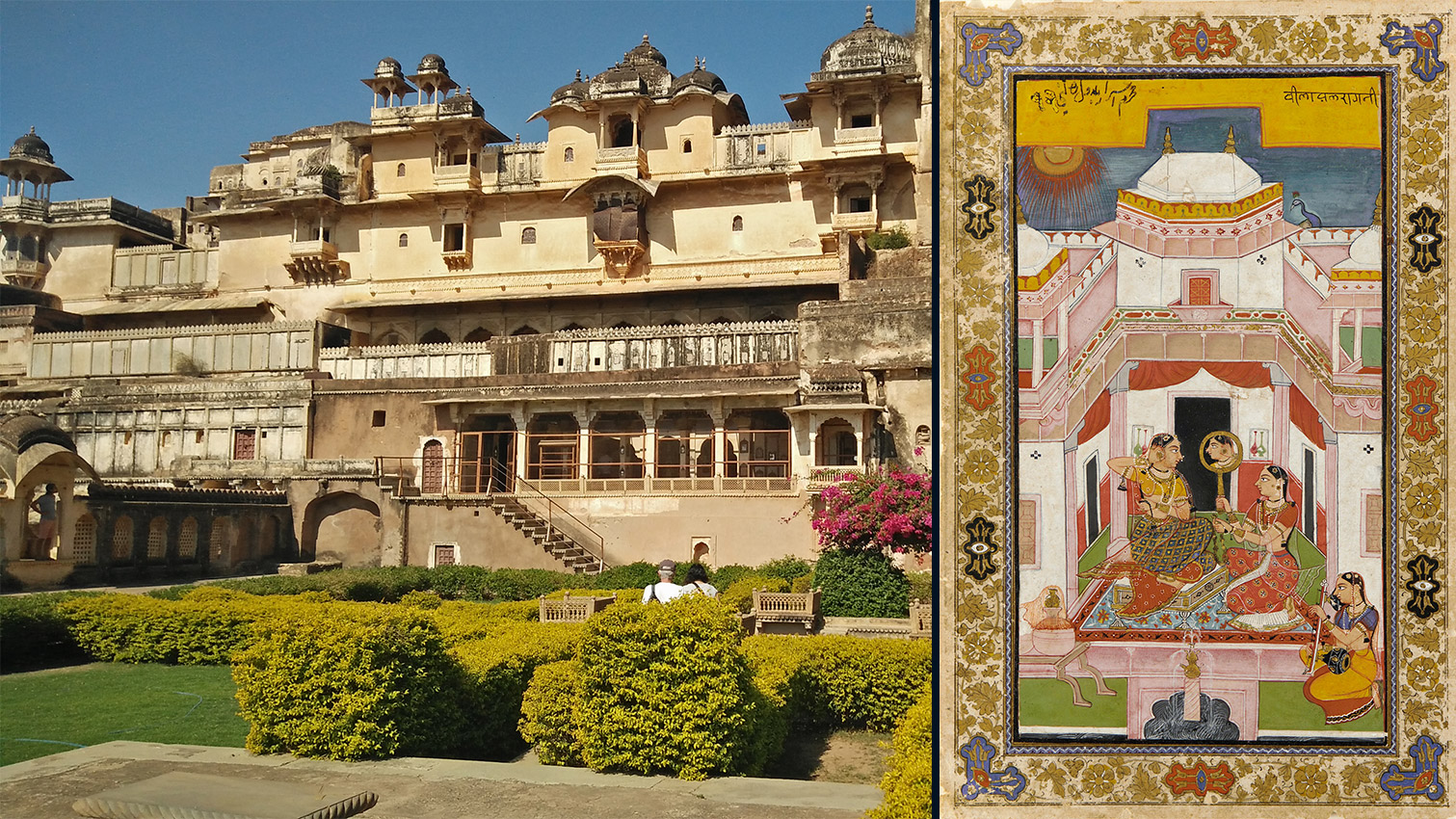
#Didyouknow that many miniature paintings from the genre of ‘Ragamala’ depict the anguish of separation in love? The School of Bundi from the broader Rajasthani School has produced many such paintings. A city in the Hadoti region belonging to the Hada Rajputs of Rajasthan state in northwest India, Bundi has a rich history and was the capital of the former princely state with the same name of Rajputana in India. Bundi is located in a narrow valley within the Aravalli Mountain range. It is famous for its lakes, natural vegetation, palaces, forts and its paintings; murals at Chitrashala in the Garh palace made during the reign of Umed Singh, and many other works on paper, now in different collections.
As mentioned, the Hadoti region belonged to the Hada Rajputs. The Chunar Ragamala was executed in 1591 A.D under the Hada Rajput, Bhoj Singh (r.1585-1607, son of Surjan Singh) and is a landmark in the history of Ragamala painting. The ruler who was under the Mughals was stationed at Chunar, near Varanasi and functioned from his palace there. The set was painted by three artists Shaykh Hasan, Shaykh Ali, and Shaykh Hatim, who were pupils of Mir Sayyid Ali and Khwaja Abddus Samad of the Mughal atelier; who had been gifted by Emperor Akbar. This set was iconic and influenced the later Ragamalas produced at Bundi.
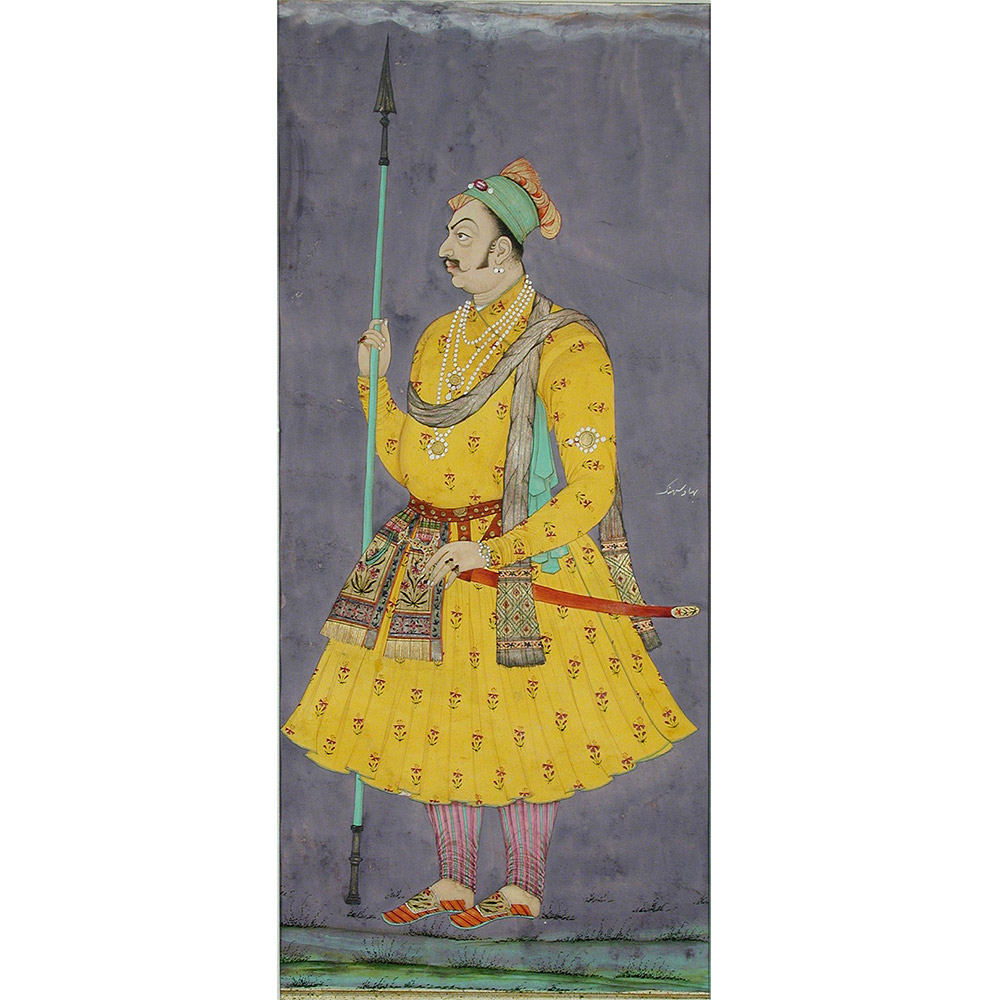
The Bundi school flowered later under Rao Chattrasal (r.1631 -1659), a governor under Shahjahan who helped in conquering of the Deccan by the Mughals and his son Rao Bhao Singh (r.1659-1682). The Bundi paintings show not just Mughal influence but also Deccan influence, given the use of bright hues. His successors Aniruddha Singh (r.1682-1702), Budh Singh (r.1703-1749), Umed Singh (r. 1749-1771), Bishen Singh (r.1771-1821) and Ram Singh (r.1821-1889) kept the school alive by royal patronage.
The school made different kinds of paintings. Ragamalas, royal portraits and lifestyle, hunting scenes, birds and animals, dance and music events, processions, also Krishna-Leela scenes, the Baramasa, Gita Govinda, Rasikpriya illustrations among many others. Lush vegetation is well-depicted in Bundi paintings. The women are seen wearing elaborate jewellery and colourful garments.
The Genre of Ragamala Paintings
A ‘Ragamala’ means ‘garland of ragas’, which is a set of paintings in which each raga, an Indian musical mode, actually a melody, is represented by a scene relating to the raga. A raga has its own essence and has been defined as ’a permutation and combination of notes or frequencies illustrated by melodic movements which are capable of producing a pleasant sensation, mood or an emotion in the mind of the listener’. The Ragamalas are a symphony of art, poetry and classical music of India. These ragas depict bhavas or emotions and are meant to be sung at a particular time of the day and in a particular season. Ragamala paintings have an accompanying verse written on top describing the painting and mentioning the raga it represents. The Ragamalas depict various moods of love, worship of gods, the action on a battlefield and many other scenarios including ascetic life. There are six main ragas; Bhairava, Malkaus, Deepak, Hindol, Shri and Megha and each raga has accompanying female ‘raginis’ as well, also their numerous sons, ‘ragaputra’ and daughters ‘ragaputri’. The ragas are expressed pictorially in the Ragamalas.
Let us explore some Ragamalas to do with the theme of love and longing, from this princely state!
Malasri Ragini
Malasri Ragini from the Chunar Ragamala Series – Wikimedia
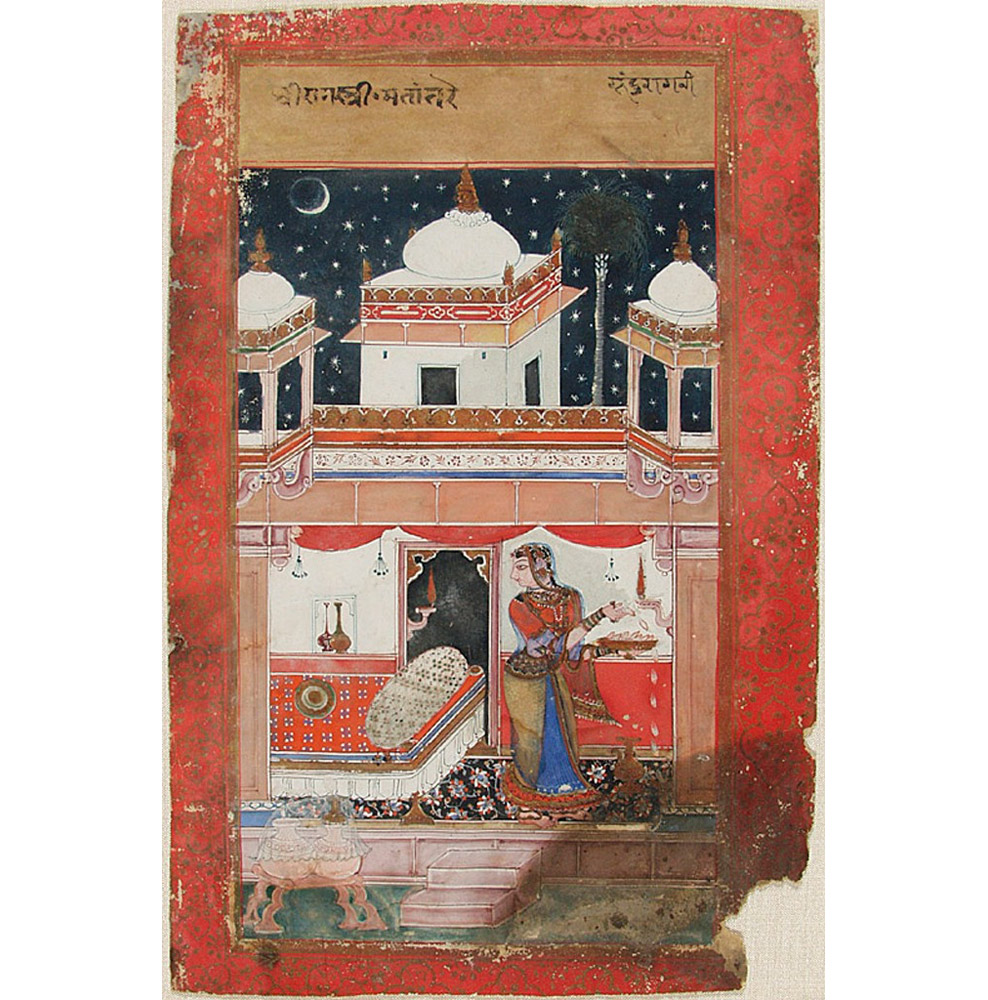
This Malasri ragini from the Chunar Ragamala of 1591 is at the Arthur M. Sackler Museum, U S A. Malasri ragini is depicted by a woman who is waiting for her lover. She is seen plucking at a flower from a string or petals as she waits in anticipation. We can see the petals falling as she plucks them. It is night time with stars and a crescent moon, the lamp is lit. Sometimes a companion is shown with her in depictions of Malasri.
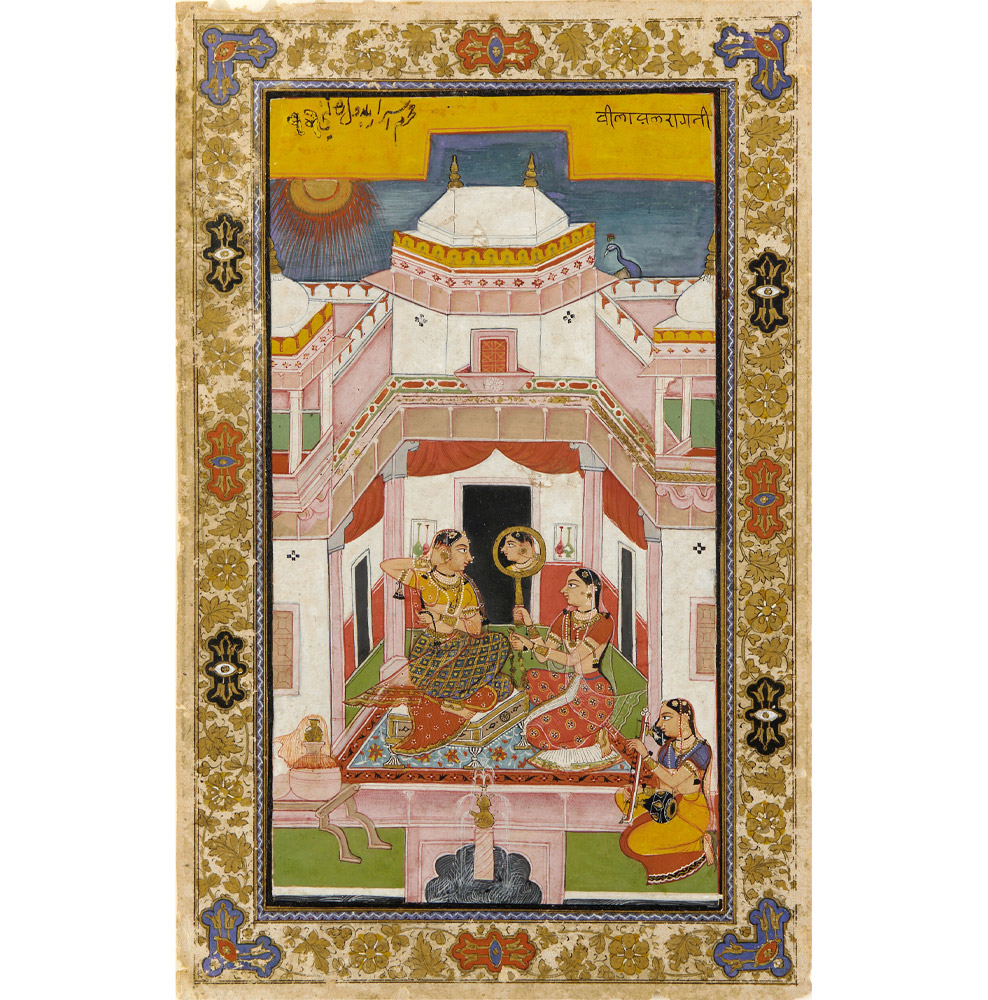
Vilaval Ragini
Vilaval Ragini from a Ragamala Series, CA 1680 – Wikimedia
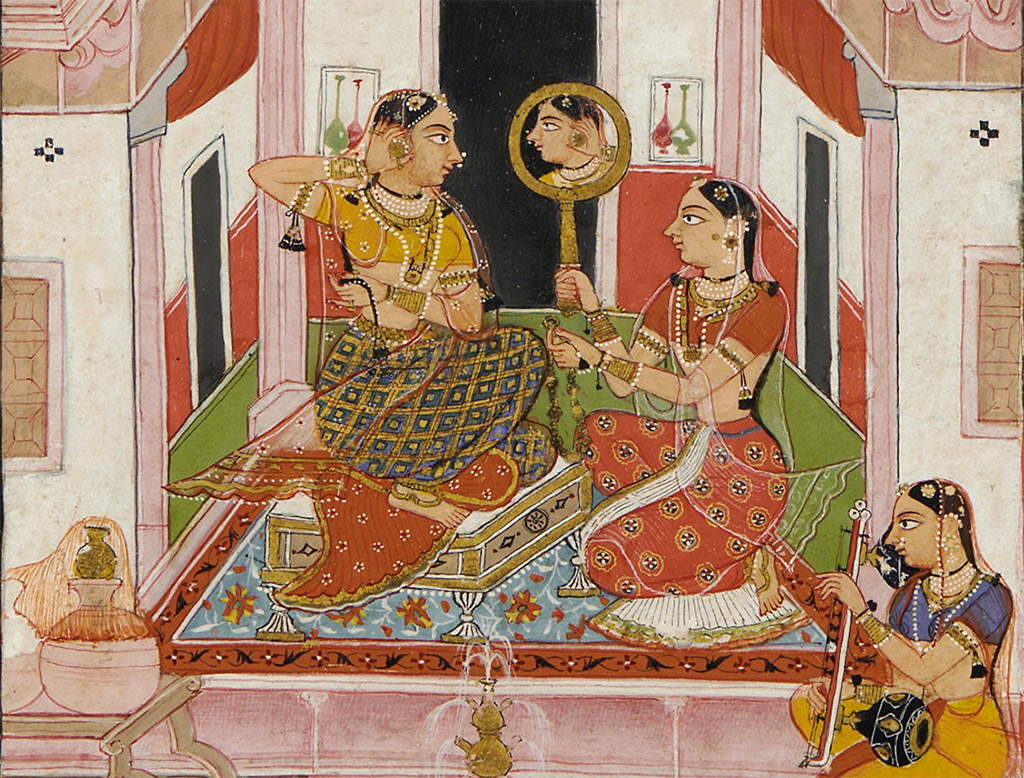
Vilaval ragini depicts a noble-woman dressing up and wearing earrings. The heroine is dressing up to meet her beloved. Her attendant holds a mirror for her while another lady plays on an instrument. A fountain in the foreground. The sun is strong in the sky and a peacock is on the parapet. The composition of circa 1680 housed at Freer Gallery of Art, U S A, has an ornate foliate border in gold and other colours.
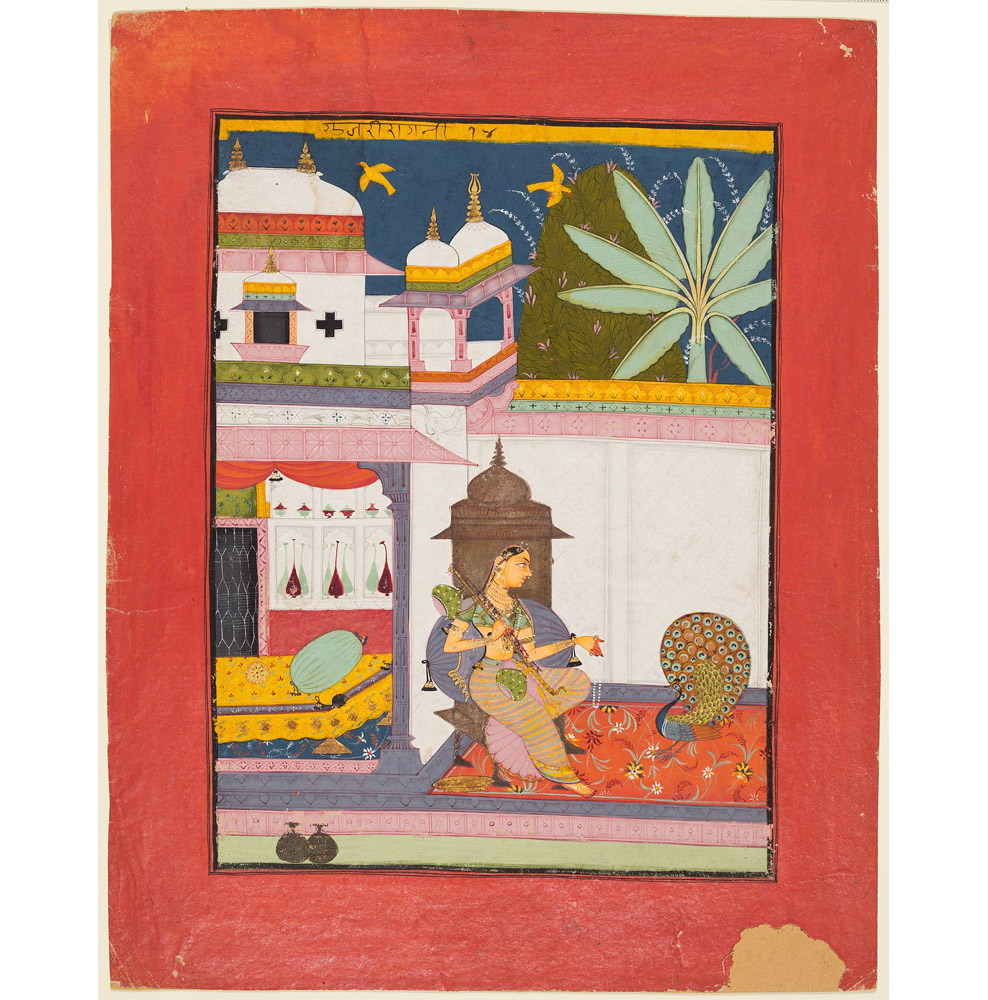
Gujari Ragini
Gujari Ragini, Circa 1670, Bundi or Raghogarh – Wikimedia
Gujari ragini depicts a lady seated with a veena. A peacock is also in her company in this painting from circa 1670 housed at the Cleveland Museum of Art, Ohio, U S A. The peacock is symbolic of the absent lover for whom she is waiting. There are two pots in the foreground which are again symbolic. It is a melody of the monsoon, depicting the sorrow of separation. A ragini of pathos and longing.
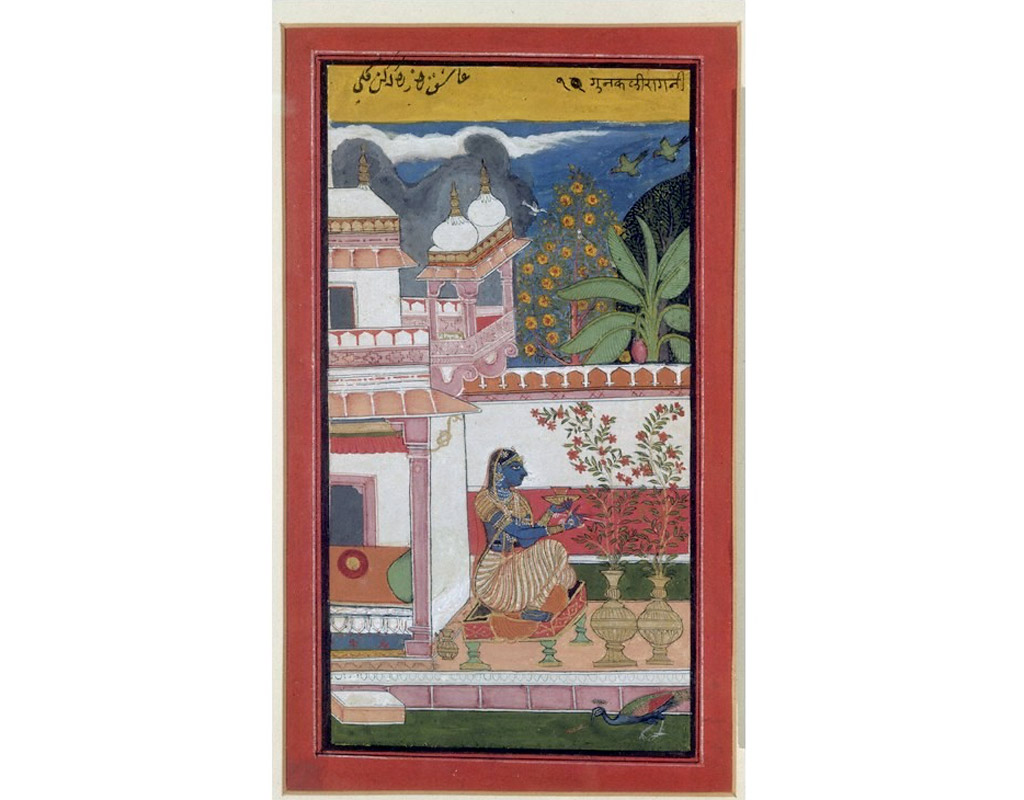
A lady is picking flowers to make garlands in preparation for the arrival of her lover, which is the representation of Gunakari ragini. Garlands are symbolic of the tryst of love. A plantain tree is in the backdrop alongside a flowering one with birds and clouds in the sky. A peacock is in the foreground, maybe symbolising the absent beloved. The ragini is one of anticipation. The work dated to circa 1660 is with the V& A Museum, London.
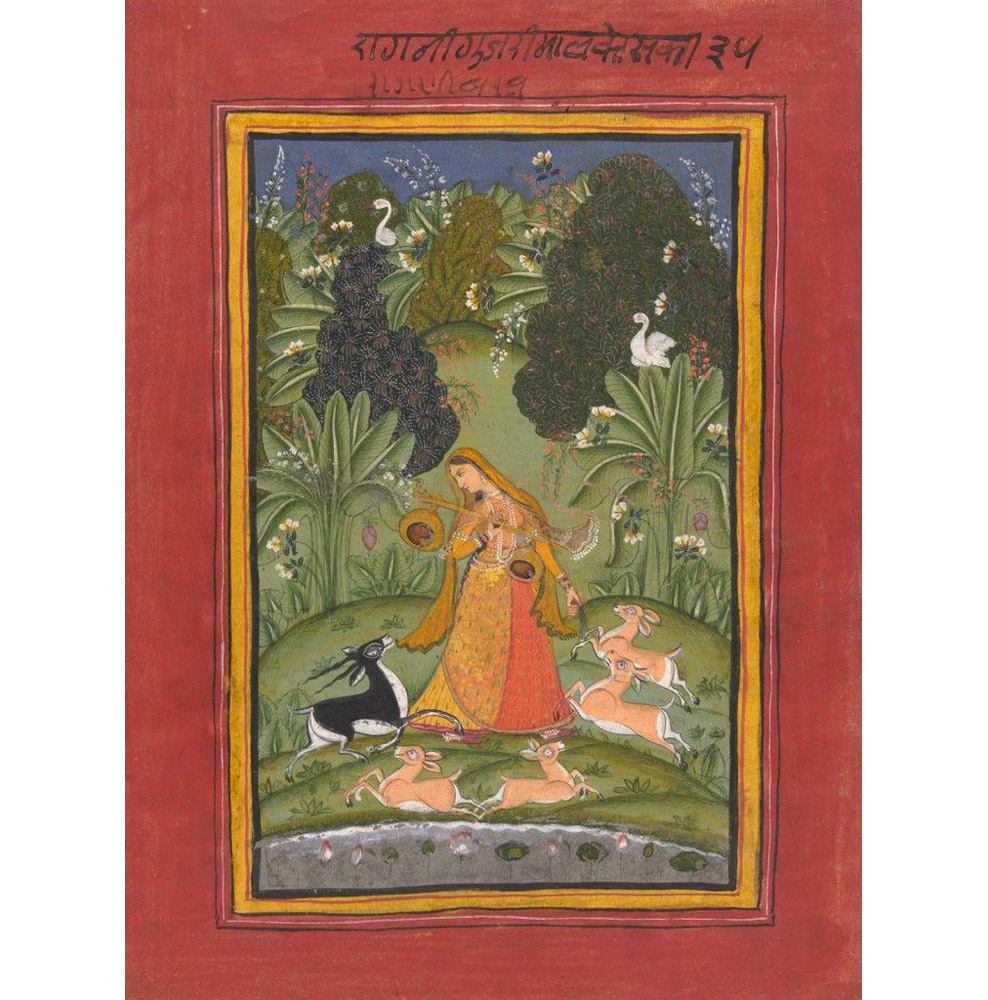
Todi Ragini
Todi Ragini, Ragamala, Bundi, Rajasthan, 1591 – Wikimedia
The Todi ragini is an image of a beautiful forlorn woman wandering in a grove, who has been separated from her lover. Her companions are the deer who listen to her mesmerising music as she plays the Todi ragini on her veena. She searches the forest for her beloved. The Todi ragini is an old tribal folk melody; turned later into a classical melody. This painting is with the Rijksmuseum, Amsterdam dated to circa 1779.
References –
Sodhi, Jiwan (1999) A study of Bundi School of painting, New Delhi: Abhinav Publications
Amrita Kumar,ed (1994) Ragamala painting, New Delhi: Rupa & Co.
Gangoly, O. C (1935) Ragas and Raginis, Calcutta: Clive Press
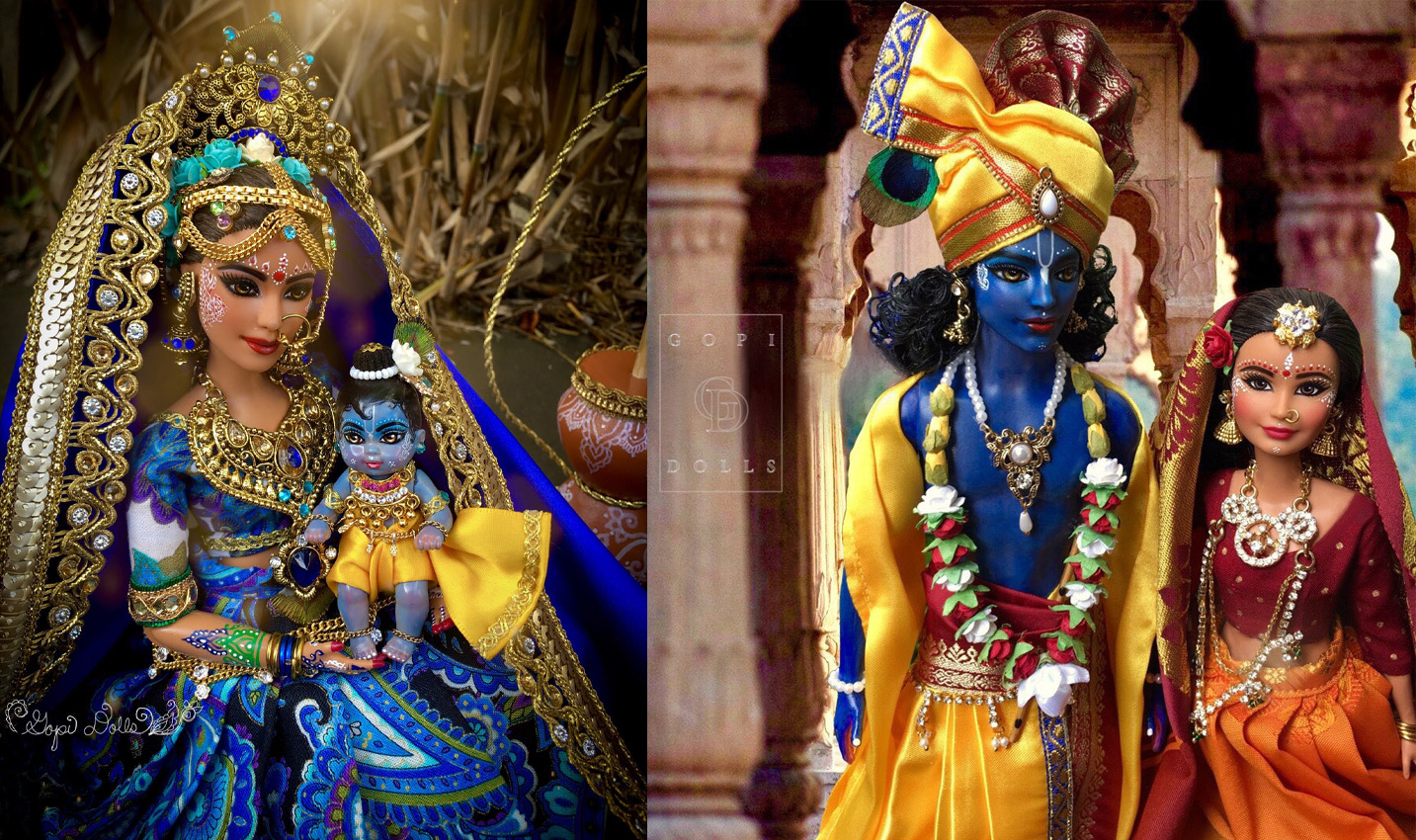
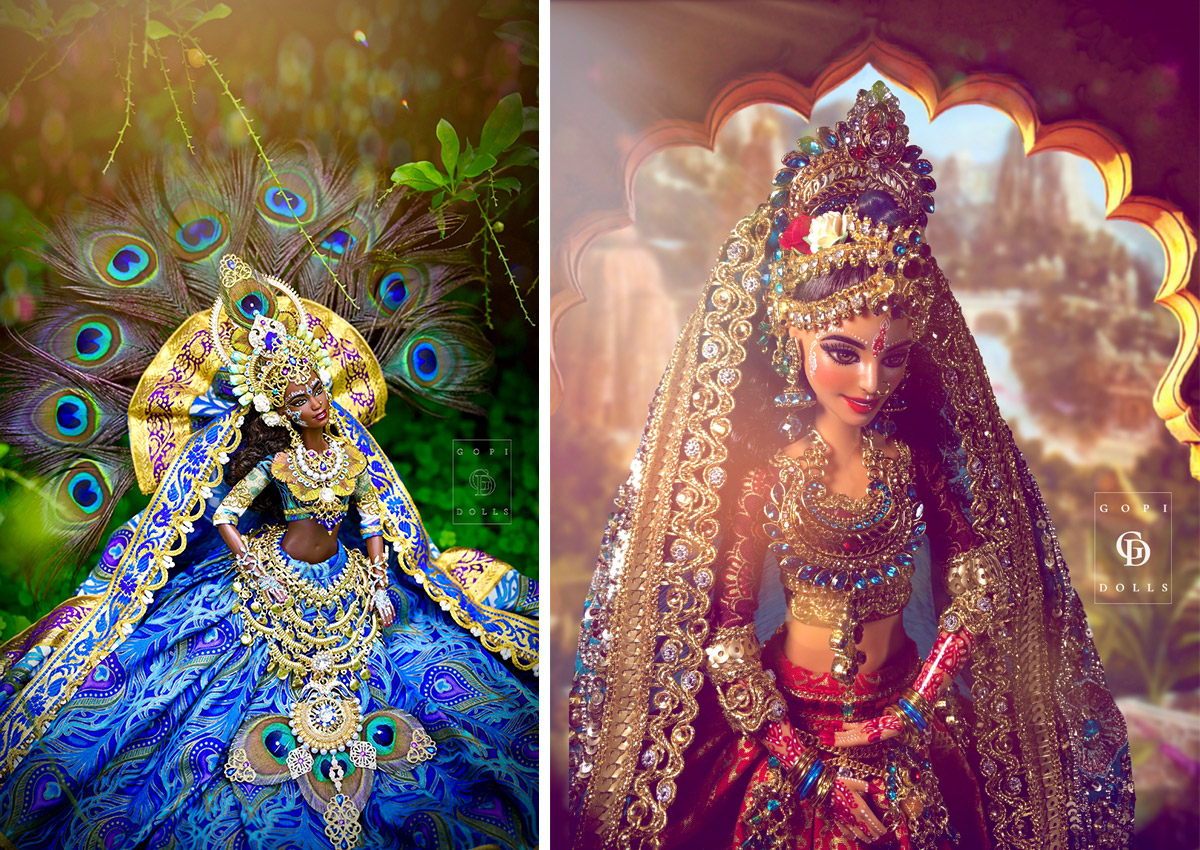
Gopi Dolls is at the heart of its creator Nandini Zaldivar, who is a professional artist, and Deity painter. Presently living in Pottsville Beach, New South Wales, Australia, Nandini grew up in America as a Hare Krishna devotee from Alachua, as her parents were disciples of Srila Prabhupada. Now, a mother of two daughters, Nandini passes on the same tradition inherited from her parents in a playful way. While Nandini played with Barbies all her childhood, she wanted her daughters to have dolls resembling their culture. Each of her creations is unique with a story sewed into it, and is now a large part of a number of children’s fantasy worlds, encouraging play and learning simultaneously. What initially started as a hobby of dressing up Barbies into Gopi Doll traditional outfits, has become sensational quickly. In conversation with Nandini, we found out about:
Nandini Zaldivar – The Composer
I have been designing dolls for many years now. Besides dolls, I also sell prints, photography, and other artwork that I make. Additionally, I do Mehendi Art for fun sometimes, which is usually for friends and family, and their weddings, parties, and to entertain my kids. This is generally done with acrylic paints than with traditional cones, which I find a lot easier to control, and since several people are not comfortable committing to the stains, especially those who work and cannot go to their workplace with permanent hand paints. Presently, I am not offering it as a professional service.
Talking about my education, I have formal training in Fine Arts as I have been doing arts all my life. I grew up observing my mother’s artistic creations who then taught me sewing, painting, and drawing as I overlooked her shoulders. She used to sew for the Hare Krishna Temple in New Raman Reti Farm in Alachua for the Radhe Krishna deities. She used to do beading, jewelry designing, backdrop making, garland making, and most importantly, she decorated my Barbie dolls, and I suppose it is safe to say that she created the first ever Gopi Doll. Inspired, I took art classes, and when I graduated from high school, I was awarded a scholarship for my academics, only to later switch to Arts Major where my whole world opened up. I went to art shows, and won accolades at university level.
The Beginning of Gopi Dolls
Born and brought up in a family of Krishna worshippers, my daughters inherited the same culture. What I initially created as a fun hobby for my daughters in 2008-09 were Hare Krishna Barbies for playing dress up. I started sewing them by hand as I did not own a sewing machine back when I was still new to Australia. With no intent of converting this hobby into a business in mind, my daughter’s friends inquired about where she found these dolls from. Upon responding, “My mommy made them,” I received requests from their moms to make them similar Gopi Dolls – my first unexpected commission work.
When I later moved to another town where I owned a little thrift store, I was suggested to add my Gopi Dolls to the collection. With a number of Krishna devotees from Sydney, they spotted me near the Hare Krishna Farm with my Gopi Dolls, willing to spend their money to buy them. That is when I came across the term ‘Adult Doll Collectors’, and that there is an actual market for these collectors. With the inception of Instagram, a whole movement of OOAK (One Of A Kind) dolls began, when people began describing their dissatisfaction with the customized barbies. Either the factory paint, clothing, and hair disappointed them, or they were really looking forward to a variety in terms of tradition. With the inclusion of different body types, made-to-move, articulated Barbies, it was an opportunity for me to decorate them in line with the vedas and mythology.
Conversion to a Business Model
In 2008, the same year I started creating Gopi Doll clothing, my friend who is a Computer Programmer asked me to put this on Facebook without any further ado. Initially timid, I was motivated to create a simple profile, and to my surprise the news went around the other parts of the world. With it reaching my native town of Florida, a lot of friends and family requested to buy it for themselves as well as for their daughters. The rest is now history.
Gopi Dolls Fashion
Gopi Dolls Fashion was a rather side chapter of Gopi Dolls, specifically for clothing and redressing ideas. The motive was to sell outfits separately if one already owned a doll. Presently, I also sell individual jewelry pieces, salwar kameez and anarkalis.
Gopi Dolls – A Narrative of the Secondary Characters
Interviewer: One thing that really intrigues me is that while Rasleela talks about the dance of Krishna and Radha as protagonists with Gopis/Sakhis as supporting characters, you, by setting up ‘Gopi Dolls’ are introducing little girls and boys to a world beyond the Great Krishna, it is in a way revolutionary, to popularize the background characters. You are motivating these kids to look beyond the popular narrative. How were you inspired that Gopis would be the central character of your little world?
Although it was not a thoughtful thing, it began as a challenge posed to painting Ken as Krishna. From loving female fashion, to recreating vedic scriptures, I learnt that worshiping devotees close to Krishna can get you closer to Him. Each time I create a Gopi and no Krishna, I suggest a mood of separation which is spoken in Rasleela when he leaves for Dwarka. My Gopis miss him, and I always create them keeping in mind that mood.
Ken to Krishna
I love Lord Krishna. I have created many Krishna dolls over the years, and I intend to continue making them. The process however is not a cakewalk: the skin is plastic and slippery, as a
result, it is not as easy to paint the face so well. It either peels the eye or does not stay. I am waiting to create something of good quality, so that my Gopis and Krishna are not forever in separation.
Naming the Gopi Dolls
One of my favorite collections or series so far is called the Queens of Dwarka. Now, the nomenclature requires its research, therefore I sat and read about all the primary Queens; mind you, there are more than just the primary ones. First I created many Queen Rukmanis. I referred to her description and created her accordingly. Next is Queen Kalindi who is characterized as one having a dark skin tone. For Tulsi Maharani, the theme was deciphered as that of the holy plant tulsi, hence drawing a green veil, with her holding a parrot (since the doll had a holding hand), and many peacock feathers. Then there is Govinda Nandini, who is not named after me but chosen by a friend who requested for her.
At times, I do not dedicatedly follow the descriptions. For instance, I Google certain names and their meanings, and create a doll accordingly. Every so often, my daughters suggest names. Like this one time, she came up with the name of Sabala, after Cow Sabala with a peacock tail (backstory: Vashistha had a cow called Sabala. It was a divine being and the moment she was instructed to arrange for the feast, she yielded sugarcanes and all its produce such as sugar, jaggery, sweet wines). Therefore, Sabala had a peacock theme, starting from her outfit, to a peacock feather in her hair. Other beautiful names of my Gopi Dolls are Dhruva, Damayanti, and Ishwari.
The Imagination behind the Imagery
In every Instagram post, or the paintings that I sell, you would often distinguish the background as green lush gardens, with pots, a little paalna, and some animal imagery of monkeys, and cows. Each background is inspired by either beach walks, stories that I hear at Krishna park, or from reading vedic scriptures. I have a mass collection of stuff such as animals to add to the scenery.
The last scenery that I worked on was Mother Yashoda and Baby Krishna. Having made a number of them, coming with new setups is demanding as I did not want to use the same materials again and again. So, I dressed them up in the same fabric but in a different style, and added new things that I bought six months ago such as the harmonium, and some hanging pots. I am also inspired by other creators who use the altar next to a window from where life spills in. This one time, it was raining and it looked surreal. I also love doing garden shots as I own one big garden.
Other Mythological Characters
I created a Ravana doll as a custom request for a man who is a theater actor from Sydney of Indian descent, who happened to stumble upon my page. For his Diwali play, he was playing the role of Ravana, and wanted to create a doll that looked exactly like him. Although it was out of my comfort zone, I was anxious about how my fan base would react. To my surprise, they were awestruck! I can only imagine the fun in creating Rama, Laxman, Sita, Hanuman, and Ravana as a whole dramatic Ramayana world for kids.
The Challenges
There are plenty of challenges that I face as an artist, but then Lord Krishna guides my hand to overcome them. The biggest challenge is repainting their faces to give them a traditional makeup, combined with a contemporary feel so that my customers relate to them, yet trying not to defy the vedas since they have their own set of rules. Secondly, I mess up all the time – failing in matching one eye to the other, wiping it off, respraying, removing glue from the face, and then fixing the mess for several hours. Sometimes, a doll can take upto two hours and yet some can take upto two years. Contentedly, all this is worth the lesson.
To overcome these challenges, I often go for beach walks as Pottsville Beach is close to my home. The energy is constantly renewing with every wave releasing my stress, to come back all refreshed, renewed, and ready to start something new. Eat a pizza, read some book, watch something beautiful, observe other vedic artists, check my social media, read and respond to a few letters, until a few ideas pop up in my head – for me stepping back for a while is the solution.
The Reception
Krishna dolls are mostly custom ordered, so I imagine they are what are the most preferred. I am not regularly creating Krishna and Radha dolls, so it is safe to say that I keep my audience hankering for more. And, the baby Krishnas never last as they get sold straight away in the flick of a finger.
Future Plans
Recently, I launched Gopi Doll Plushie, and her name is Princess Jambavati (backstory: Princess Jambavati is the daughter of King Jambavan who grows up to marry Lord Krishna and becomes one of the prominent Queens of Dwarka). All of her accessories are made to come off as well as can be put back on. I have also been contacted for manufacturing Gopi Dolls on a large scale, but presently I am being really cautious and waiting for the right moment. In the time to come, many new dolls will be launched who are now under creation, especially many baby Krishna Dolls. Moreover, over the years I have collected many dolls besides Barbies, Integrity Toys, and Disney Princesses, which are really cute. As my New Year’s resolution, I decided to go through my box of dolls and start working on them because why not! There are many more dolls that I will be launching in bigger quality, although truth be told, I am still testing out my paints, but for now they continue to be a secret as big ideas need the time. Presently, I am
working on a couples’ outfits who are getting married in September, for whom I am outsourcing and ordering many pieces from both India and Australia.
Send across your dolls for a spectacular transformation
People (particularly parents) send me their dolls all the time, either second hand bought at an op shop, or a brand new doll. They often attach a reference in the form of photos or descriptions, based on which I fix their hair, paint and re-design their faces, and redress them traditionally. Previously, one of my clients sent me a very expensive doll, mind you it was not a Barbie but a Fashion Royalty by Integrity Toys, costing approximately $900 doll! The inspiration she sent along was that of Deepika Padukone, who was then transformed into Ishwari, a traditional yet contemporary bride for her daughter who is half-Indian. She said this would be reminiscent of her heritage with which she could grow up. Not to miss, I also receive requests for custom faces.
You can reach out to Nandini in one of the following ways:
The old school way of Gmail on gopidolls@gmail.com, her Etsy shop, Pinterest, her main account on Instagram through a DM, or a comment. Get your hands on a Gopi Doll today!
Marriage ceremonies are one of the most important social events in India. These social functions have been greatly celebrated since the times historic. A wedding is unquestionably the most important day in one’s life. A perfect destination can make it even more memorable. India is full of such locations which might make you love-struck. Here is a list of 10 destinations for the big fat Indian wedding to leave you in awe.
Udaipur tops our list of best destinations for a big fat Indian wedding. We don’t call Udaipur the ‘Venice’ of the East for no reason. The glorifying history and marvellous architecture of the city attract not only Indians but also foreigners. If you plan for a traditional yet enchanting wedding, Udaipur is the best place for your big day. The vibrant, cheerful, and opulent vibe surrounding the city makes it stand out from all other locations.
Everyone wants to experience being a king or a queen at their wedding, so why not grab a chance when you can become one for real! The royal-style marriage in a staggering palace is what everyone wishes for, and Udaipur is here as a genie to fulfil this majestic dream. After the tourist season, the best time to plan your wedding in Udaipur is from September to February. City Palace at lake Pichola, Leela Palace, Jagmandir Island Palace are some of the best venues in Udaipur to light up your wedding day.
What could be better than a wedding with a sea breeze and pristine beach view? Goa serves the best place for the cute wedding you are looking for. The open beaches with lush green bushes, deep blue sea, and crystal sky make Goa a beautiful destination for marriages. Not to forget the old churches and exotic resorts all around the state. Moreover, if you want to party hard, Goa is just the right place.
The best time to book your venue in Goa is all year long. However, keeping the climate in mind, September to October end is considered as the best time. The Park Hyatt Resort in Goa is among the best venues in India for tying a knot. Taj Exotica, Zuri White Sands, and Kenilworth Resort are also among the top venues in the state.
Royalty starts with the alphabet ‘R’, and so does our prepossessing state Rajasthan. Rajasthan has one of the best destinations for the big fat Indian wedding you have been looking for. No one can deny a fairy tale wedding with exquisite grandeurs. The Sun City, Jodhpur, has been one of the prime choices of people for wedding venues.
You can find grand palaces in this Desert capital of India. September is the best month to have a ceremony in the city. Umaid Bhawan is the jewel of this city, famous worldwide for its luxurious design and royal-style weddings. However, it is not the only option on the platter. The other venues include Ajit Bhawan Palace, Taj Hari Mahal Palace, and many more.
The snow-covered mountains, calming chilly wind, beautiful environment, and pleasant climate makes Shimla one of the most aesthetic locations in the country. In the lap of nature, the ceremony in the ‘Queen of hills’ becomes even more glorious. It is best to plan your destination wedding in Shimla in the spring or summer seasons.
Your destination wedding under the crystal sky, calm surroundings, and love blooming valleys of Shimla would be memorable. Taj Theong Resort, The Oberoi Cecil, Hotel Willow banks are among the top wedding venues in Shimla.
It is yet another destination for the mountainside wedding, surrounded by lush green, tall trees, and calming cool winds. JW Marriott Walnut Grove Resort is one of the best venues in India for a destination wedding. The idiosyncratic Grand Orchard Ballroom makes it stand out. Mussoorie has in its sack, blue sky with the surreal view of the Himalayas, enchanting sunset as well as the dazzling night sky full of stars. This makes it the best place for both night and daytime weddings.
Jaipur has one of the charming venues for luxurious weddings. The pink city is pink in colour street walls and architecture and the pink Rosie-love vibe in the air. This city holds the potential to turn your aristocratic fantasy into reality.
The Jai Mahal Palace is world-famous for its phenomenal wedding ceremonies. Further, the Raj Palace and the Rambagh Palace are also the architectural masterpieces of the city. The grand wedding with elephants, camels, and horses is a remarkable feature of Jaipur weddings.
‘Away from the city hassle, away from the meadows, close to the water, close to the shingles’. If this is what’s occupying your mind, the Indian islands, Andaman and Nicobar Islands, are the best place for you. Their unique unrelenting ritualistic nature best characterizes the wedding ceremonies held at Andaman and Nicobar Islands amidst tranquility.
It is the place to make the dream of every couple’s beach wedding come true. The islands provide a serene and charming option for a small wedding, with about 60-100 guests. Havelock Island offers the best resort options; Port Blair is yet another option for an exotic wedding.
One of the best places for a destination wedding if you are planning for the same in the South. Famous for the offbeat, eccentric weddings. The best time to plan a wedding in Kerala is from September to March. You can schedule a wedding in the backwaters of Alleppey or a wedding at one of the beautiful beaches in the state. What can one ask for other than a pristine wedding at ‘God’s own country?
Jim Corbett is one of the most exotic wedding destinations in the country. Who wouldn’t love a mandapa set up amidst the forest beside the soft humming water streams? The place has arrangements for outdoor, indoor, as well as, poolside weddings. Venues like Wood Castle Resort, Den Corbett Resort, Clarks Exotica, Dukes Den Resort are famous among the urban populations of India as well as abroad.
The resort also provides the facility of forest safari, birdwatching, and nature walking in their packages. The excellent service, along with modest prices, makes Jim Corbett an attractive destination for tying a knot.
Also called Bangalore, the Garden city is the last on our list. It has some of the world-famous venues, including the Bengaluru Palace and Guttahalli Palace. The best time to plan your in-budget destination wedding in Bangalore is between September and February. Bangalore has mesmerizing architecture and beauty at its peak, with a perfect blend of old traditions in the modern era.
This list includes some of the most famous and renowned places in India, often chosen by families. However, besides the destinations mentioned above, one might also consider New Delhi, Rishikesh, Jaisalmer, and many more. The list goes on and on!
LED undoubtedly is the future of lightning given the several benefits it offers – energy-efficiency, cost-effectiveness, eco-friendliness, just to name a few of them. And it is these benefits that have led to an increasing number of people replacing their conventional lighting solutions such as incandescents, halogens, and fluorescents with new age LEDs.
If you, too, are planning to switch to LED but are procrastinating your LED buying decision because of lack of information, here’s a post that gives you five Important tips that you must follow when looking for LED lights for home.
Let’s get started.
1. First Things First – It’s Lumens, Not Watts.
You might have heard people talk about conventional bulbs in terms of their wattage. That’s because when incandescents were in demand people used to buy bulbs on the basis of their wattage as it was their way of determining the amount of light they could expect from a bulb of a particular watt. The brightness of an LED is, however, represented in Lumens (and not Watts) as it’s a more appropriate unit for representing brightness of any lighting solution.
2. Look For An LED With A Dimming Feature.
Unlike conventional lightings LEDs can be dimmed as per the mood or the occasion. The unique dimming feature can help change the mood of any space. Just make sure that you buy a dimmer that comes with a continuous dimming option rather than a step level dimming option. This will allow you to choose between countless dimming levels. The Smart Switch Batten from Luminous comes with an automatic dimmer that allows smooth transition from brightness to darkness when switched off.
3. Go For A Multi-Color LED Light.
The good thing about LED lights is that they come in a wide range of colors. What’s even better, some lights come with multiple color options so that you can change the color as per your preference. The Comet Concealed Light from Luminous India, for instance, allows users to choose between various colors depending on their mood. The color options that it offers are – Red, Green, Blur, Cool White, Warm White.
4. Pay Attention To The Design And Shape Of The LED.
Unlike traditional lights that used to be plain, simple and lacked in design, the new age LED solutions are available in a variety of designs, styles and shapes. This allows LED buyers to experiment with the look, feel and aesthetics of their rooms. That’s because LED manufacturing companies understand the importance of an LED in a home’s decor. So make sure you buy an LED that goes with your home decor. If you are looking for an LED that’s square in shape you must check out the Galaxia Square Light by Luminous India. For a round shape light you can consider Luminous India’s Comet Concealed Light.
5. Compare LEDs On The Basis Of Their Power Consumption.
While LEDs are far more energy efficient as compared to conventional lights, it is still recommended that you compare the shortlisted LEDs on the basis of their power consumption to find out which of them is the most power efficient. The lower the power consumption, the more the savings you make on your energy bills, and the sooner you get to recover the amount you spent on purchasing the LED.
Last Word
Besides the above mentioned things you must also ensure that the LED you buy comes with a generous warranty. Just make sure that you buy from a reputable brand that is known for offering great after sales support. One such brand that you must consider when looking for an LED light is Luminous India. It’s a 3 decade old company that has millions of satisfied customers. In fact, don’t just believe what we say, go online and read customer reviews to get an idea about the company’s offerings.
For centuries, the historical state of Punjab has been ruled by numerous heroic kings of the country, resulting in the construction of eye-catching buildings, monuments, and lavish palaces. While rural Punjab is known throughout the country for its lush green terrains, paddy fields, and wheat outputs, urban Punjab is known for its link with Sikh Gurus and brave rulers. The historical and scientific architectural worth of the forts and palaces created throughout the state is highly praised. The artistic brilliance of most of these heritage buildings is deserving of praise, and they give history lovers considerable material to ponder. Punjab is a must-see for anyone interested in ancient civilization, spirituality, or history. The people here are extremely proud of their religion and culture, as evidenced by their happy grins.
The Golden Temple in Amritsar is the first thing that springs to mind whenever someone mentions Punjab. It is the Sikh community’s most important cultural treasure, not just a temple or a tourist attraction. It is one of the Indian subcontinent’s most valuable assets. The work began in 1577 AD with the excavation of the Amrit Sarovar, a sacred lake. Sri Guru Amar Dass Ji devised the idea, and Sri Guru Ram Dass Ji carried it out. Sri Guru Arjan Dev Ji started the construction of Sri Harmandir Sahib in 1588 AD. Sri Guru Granth Sahib, the Sikhs’ holy book, was first introduced in this holy sanctuary in 1604 AD. The temple’s architecture conveys a message about life. The temple is erected at a lower level than the surrounding area, opposing human pride and ego. The presence of four gates in four directions denotes that this location is open to all. Visiting this temple would undoubtedly be a once-in-a-lifetime experience!
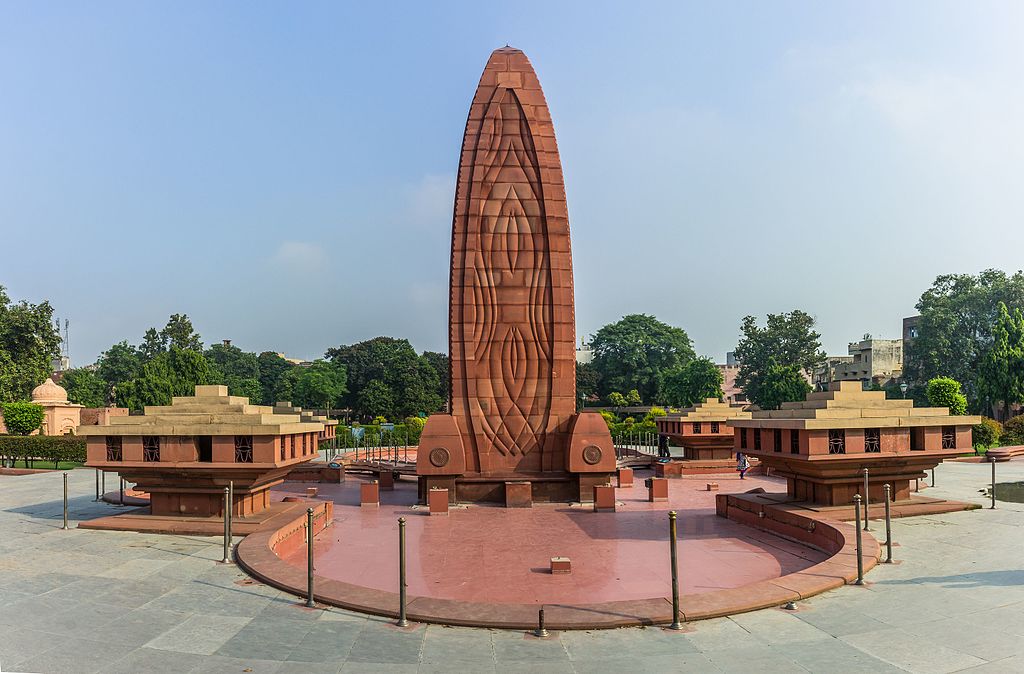
In the history of British rule in India, April 13, 1919 is remembered as a dark day. Thousands of nonviolent protests were ruthlessly slaughtered by a British unit led by General Reginald Dyer, who suspected a plot against British power since the nonviolent protest was planned by Mahatma Gandhi against the Rowlatt Act’s implementation. The bloodbath occurred in the Jallianwala Bagh grounds, as British troops opened fire without warning.In the history of the British rule in India, April 13, 1919, is remembered as a dark day. Thousands of nonviolent protests were ruthlessly slaughtered by a British unit led by General Reginald Dyer, who suspected a plot against British power since the nonviolent protest was planned by Mahatma Gandhi against the Rowlatt Act’s implementation. The bloodbath occurred in the Jallianwala Bagh grounds, as British troops opened fire without warning.
A memorial was built at Jallianwala Bagh after independence to remember the sacrifice of the innocent Indians. Dr Rajendra Prasad, India’s first President, dedicated the memorial. Visitors are still haunted by the memories of the spine-chilling incident left by gunshot marks on the wall.
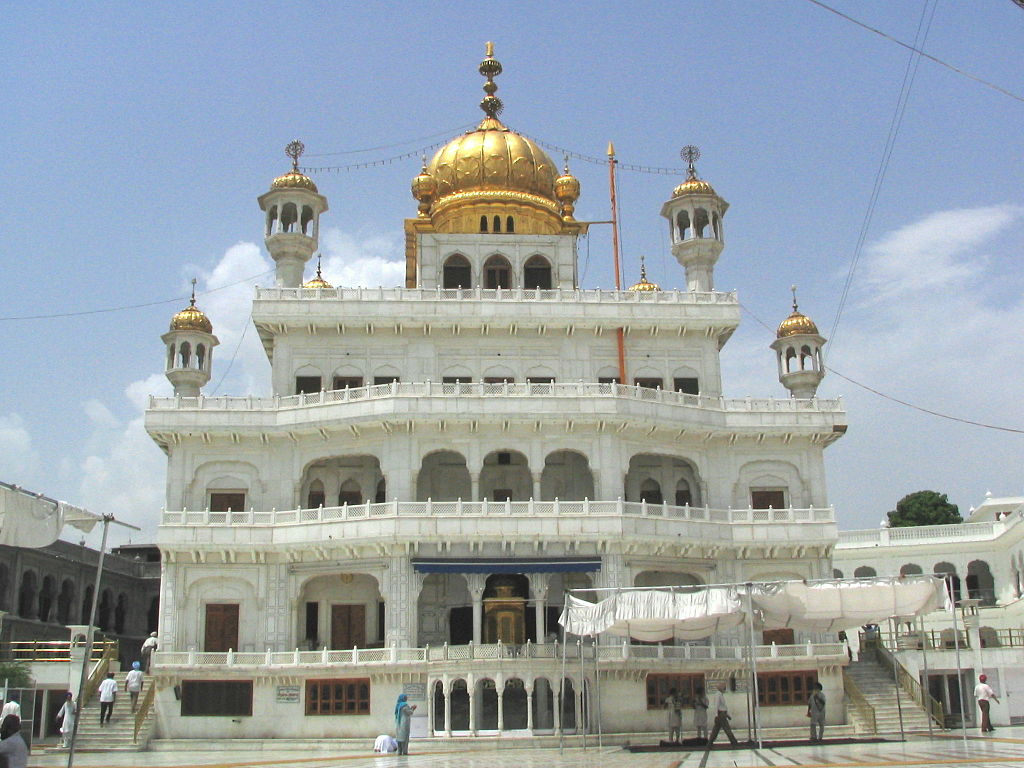
The Akal Takht, which means ‘everlasting seat,’ is the high throne of the Sikh Gurus in the Harmandir Sahib. The seat was built in 1606 by Guru Hargovind Sahib. The Akal Takht, one of the five thrones of the Sikhs, served as a judicial seat for the Sikh Gurus to render decisions on religious matters.
The Akal Takht was built 12 feet high, in violation of Emperor Jehangir’s decree, breaching the 3 foot limit for all thrones except the Emperor’s. During Operation Blue Star in 1984, it was vandalized and eventually repaired with contributions.
The beautiful Quila Mubarak lies in the middle of Bhatinda, evoking memories of the great monarchs of the past, such as Kanishka, Sultan Mahmud, Razia Sultana, and Prithvi Raj Chauhan. The fort was built on King Kanishka’s initiative during the Kushana dynasty, and it is also known as the Bhatinda Fort. In this medieval fort, Rajia Sultana, the first lady to hold the throne of Delhi, was imprisoned. The fort is divided into two sections, one of which is known as Quila Androon and the other as Quila Mubarak.
The royal family used to live in Qila Androon. It is designed in a grand architectural style that combines Rajasthani and Mughal influences. A visit to this magnificent quila is an experience of awe and magnificence.
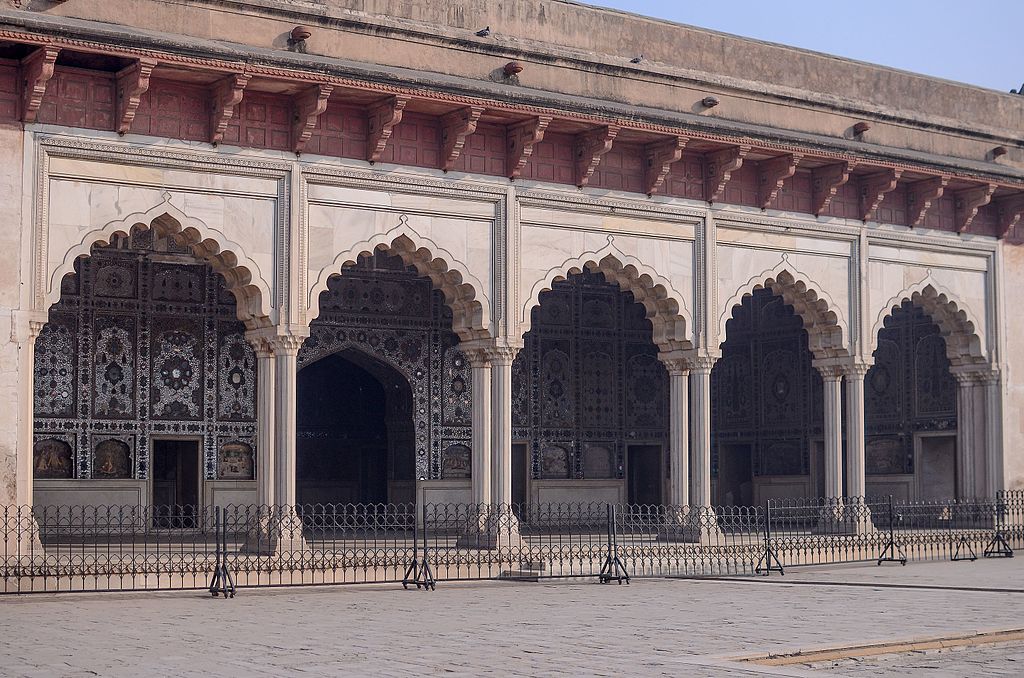
Sheesh Mahal, often known as the ‘Palace of Mirrors,’ is a magnificent visual marvel in Patiala. It was once the residence of the Patiala Kings. Maharaja Narinder Singh conceptualised the palace’s design. A section of the palace is made of tinted glass, which adds a splash of colour to the castle’s beauty. Rajasthani painters painted murals on the walls and ceilings depicting ancient tales. The splendour of the premises is enhanced to a heavenly amount by a beautiful garden, fountains, an artificial lake, and a bridge known as the Lakshman Jhoola.
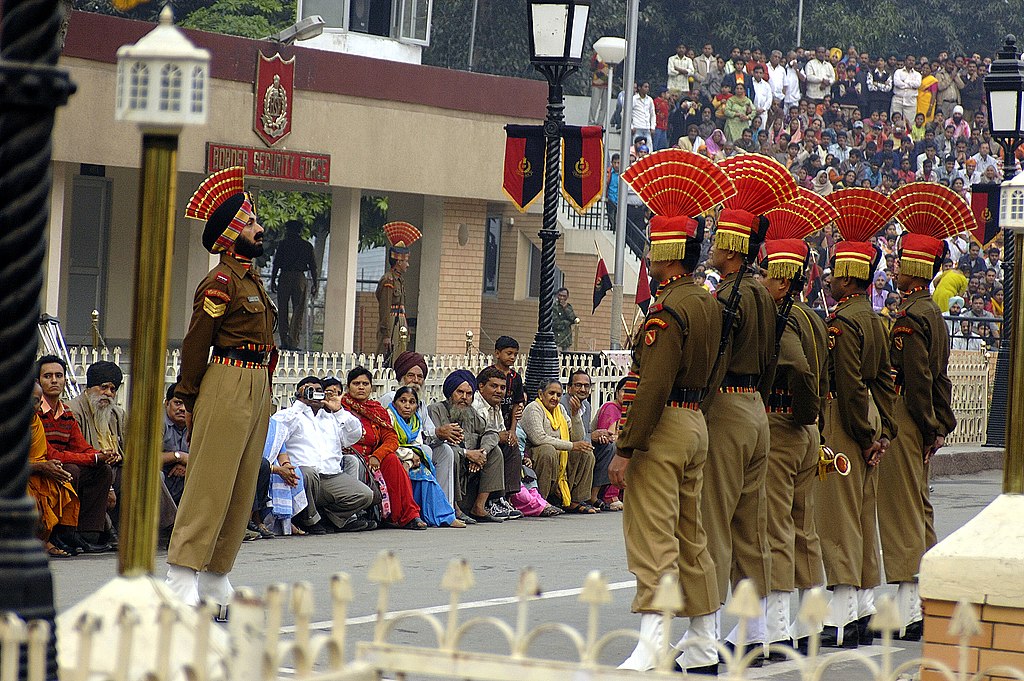
The Wagah Border, which runs along the Grand Trunk Road and is 22 kilometres from Lahore, Pakistan, and 28 kilometres from Amritsar, India, marks the border between India and Pakistan. The Wagah Border Ceremony, also known as the Beating Retreat Ceremony, is the main attraction. It takes place every day. Every evening, shortly before dusk, Indian and Pakistani soldiers gather at this border station for a 30-minute display of military friendship and showmanship. The international gates will be closed, and both countries’ flags will be lowered during this ceremony. Since 1959, the Indian Border Security Force and Pakistan Rangers have held a flag ceremony.
Entertainment is also provided as a show of national pride for the thousands of visitors who come here every day. The crowd participates in chanting the Indian national anthem, applauding, and Bollywood-style dancing to Hindi songs during the build-up to the ceremony.
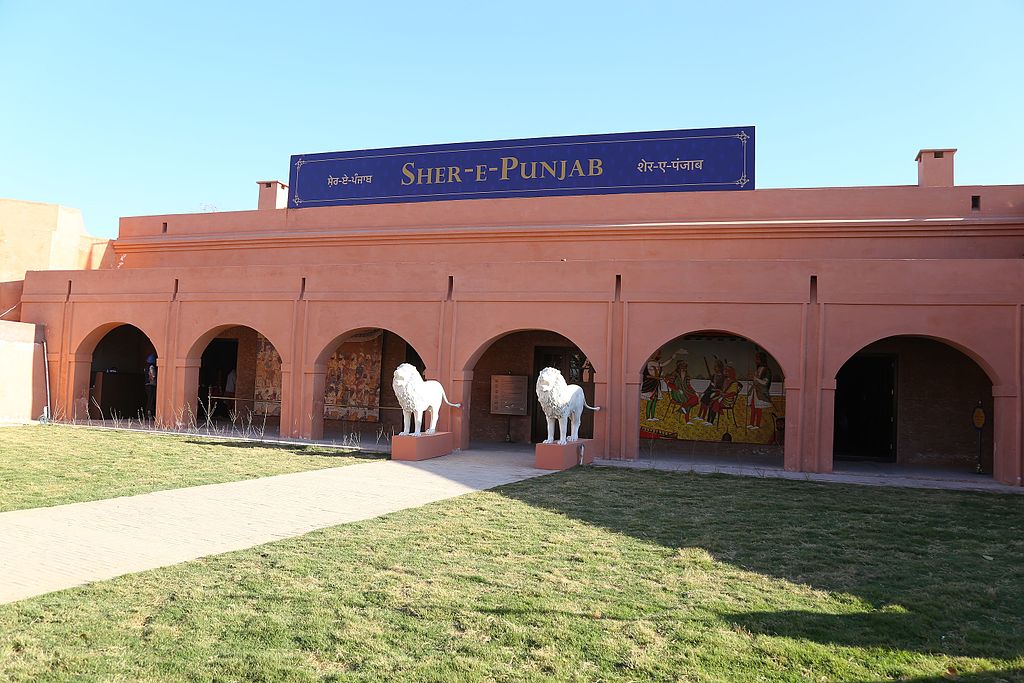
The Maharaja Ranjit Singh Museum is located in Amritsar’s Company Bagh. It was the summer home of Maharaja Ranjit Singh, the first king of the Sikh Empire, after whom the museum is named. The Maharaja’s life, as well as the history, art, and architecture of the Sikh community in the 18th and 19th centuries, are currently on display at the museum. The museum is 1.5 kilometres from Amritsar Junction and 4 kilometres from the Golden Temple.
The museum, which was converted into a museum in 1977, contains several antiquities and personal things of the Maharaja, such as his armour and weaponry. It also has wonderful paintings, manuscripts, and coins from previous ages on display. This reflects Maharaja’s secular ethos as well as the province’s rich history. The paintings generally represent scenes from the court and camp of the Sikh ruler. Among all of them, the one showing the city of Lahore is the most well-known among observers. The famous Rambagh Gardens surround the palace, which is known for their monument of the legendary monarch with his horse.
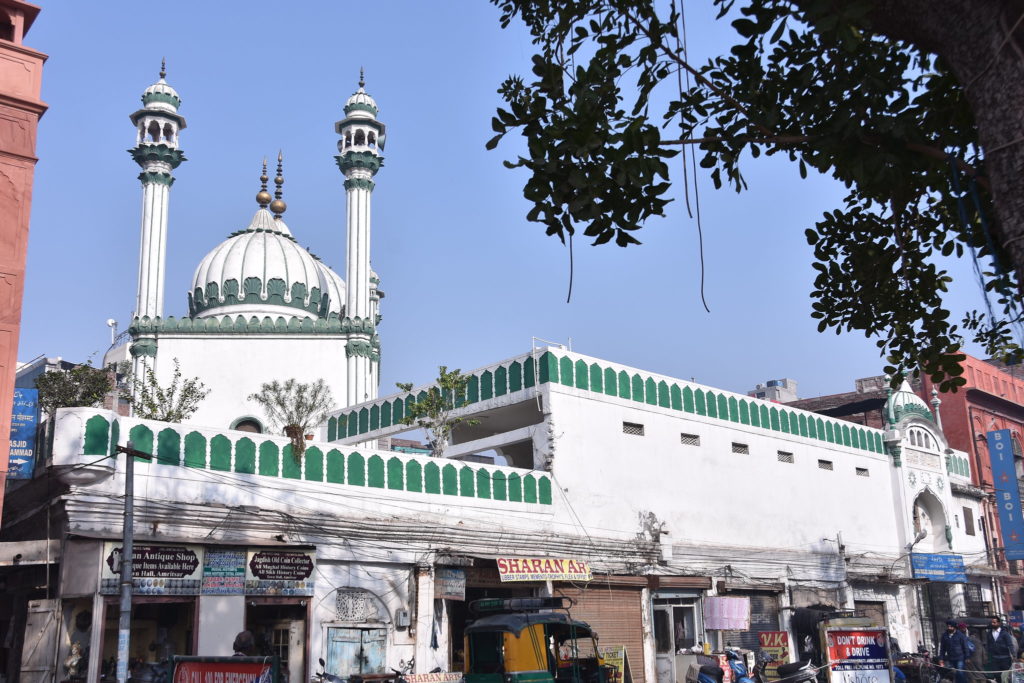
Khair-ud-Din Masjid was built in 1876 by Mohd. Khairuddin is known for its architecture. The Khairuddin Masjid, also known as Jama Masjid, is a majestic mosque that played a significant role in India’s independence war. From the brackets of this mosque, Syed Ata Ullah Shah Bukhari, a Muslim scholar and political leader, urged the people to take up arms against British rule. It was from here that Tootie-e-Hind, Shah Attaullah Bukhari, issued the momentous call to wage war against the plundering British.
This spectacular formation, built in the arcuate style, is reminiscent of classic Islamic architecture, with exquisite beams and arches. The Jama Masjid’s walls are embellished with beautiful calligraphy Aayats. Built of white marble stone, the intricate designs including miniature paintings are done in green colour that perfectly compliments the white and pops out immediately. This insanely beautiful mosque is visited by locals as well as tourists regularly.
On the west side of Amritsar’s Golden Temple sits Mata Kaulan’s sacred shrine, also known as Gurudwara Mata Kaulan. This Gurdwara is named after Bibi Kaulan, a renowned devotee of Guru Har Gobind. The older members of the Sikh community recall her kirtans, which she sang diligently every evening.
Guru Har Gobind encouraged worshippers to take a plunge in the Kaulsar Sarovar before heading to the Amrit Sarovar, which is located next to the Gurdwara Mata Kaulan. The Sarovar is also the first holy water tank in the Muslim world to be named after a woman.
Guru Ke Mahal, which houses the Granth Sahib and their gurus, was founded by Guru Ram Das in 1573 as a little cottage that grew to house the Sikhs’ famous gurus. Gurudwara Guru Ke Mahal is a simple cottage located on Guru Bazaar’s main street near the Golden Temple in Ramdaspur’s holy city (now known as Amritsar).
The structure was converted into a Gurdwara after it served as a house for Sri Guru Ram Das, the founder of Amritsar. It’s a three-story tabernacle with an elevated platform on which the Sikhs’ holy book, Guru Granth Sahib, is kept.
The Mahal’s structure is separated into three levels. The Gurus used to meditate in the basement, which now functions as a meditation space. On the second floor, there is space for people to sit together and participate in kirtans. The Guru Granth Sahib has been repeated on the uppermost floor. On Baisakhi, Sri Guru Tegh Bahadur is said to have been born in the Mahal. As a result, Baisakhi is also his birthday. On Baisakhi, in addition to the usual rituals, special kirtans and langar known as Guru ka Langar are held. On Guru Tegh Bahadur Jayanti, hundreds of Sikhs and tourists flock to this religious monument.
This simple small cottage, founded by Sri Guru Ram Das Ji, quickly became known as the headquarters of Sikh gurus, albeit it was shortly relocated. The subsequent gurus expanded and embellished this small cottage till it resembled a Mahal.
Gobindgarh Fort, also known as Gujar Singh Fort, is a mediaeval military bastion in the heart of Amritsar, built by the Bhangi Misi Rulers in the 1760s. The fort, which was originally built of mud, was seized by Maharaja Ranjit Singh and renamed Gobind Garh after the prominent Sikhism religious figure Guru Gobind Singh. The fort was built with bricks and lime andis by Ranjit Singh. A parapet and two doorways may be found on every corner of the fort. Nalwa Gate is the main entrance, and Killer Gate is the back gate. The fort houses the Maharaja’s treasury, weaponry, and other personal effects. The fort is said to have a hidden underground tunnel that leads to Lahore.Gobindgarh Fort, also known as Gujar Singh Fort, is a mediaeval military bastion in the heart of Amritsar, built by the Bhangi Misi Rulers in the 1760s. The fort, which was originally built of mud, was seized by Maharaja Ranjit Singh and renamed Gobind Garh after the prominent Sikhism religious figure Guru Gobind Singh. The fort was built with bricks and lime andis by Ranjit Singh. A parapet and two doorways may be found on every corner of the fort. Nalwa Gate is the main entrance, and Killer Gate is the back gate. The fort houses the Maharaja’s treasury, weaponry, and other personal effects. The fort is said to have a hidden underground tunnel that leads to Lahore.
In Punjab, there are numerous historical sites to visit, each of which will reveal its own unique stories from the past. Punjab, as one can see, has a plethora of tourism attractions. The state offers diverse tourism and is rich in culture and heritage. Punjab is rich in culture, heritage, gastronomy, festivals, fairs, rural life, indigenous arts and crafts, old castles and monuments, religious sites, and much more.