Indian Culture vs Western Culture: The Beauty of Diversity

17

Indian-Culture-vs-Western-Culture

The debate on Indian culture vs Western Culture has been going on for a long time. Everyone contributes their unique insights on the topic. Both these cultures are unique, significant, and beautiful in their distinguished ways. The world, as we know it today, would never have existed had either of these cultures been absent. 

Western Culture derives most of its customs and traditions from the European culture. Indian culture, however, is more diverse. Each state in the country brings with it, its traditions and cultures that are quite different from those of its neighbor. Analyzing the differences between them, it comes as no surprise that the ever-living debate on Indian culture vs Western culture still finds an audience.

The History

Indian-Culture-vs-Western-Culture-History
Left Image – Wikimedia, Right Image – Wikimedia

The term culture refers to the norms, rituals, beliefs, and practices followed by a set of people belonging to a particular region or community. Each nation and continent has its own culture. It is this knowledge of their indigenous culture that distinguishes a particular nation or community from others. The culture of land has a considerable role in influencing the lifestyle of its natives.

Indian History is quite ancient in comparison to the Western history. In fact, Indian history is said to have been begun with the advent of the Indus Valley civilization in 2600 BC. Through the ages, the country had undergone a number of changes, which are aptly reflected in the art, culture, literature and architecture of India.

Western civilization is also quite ancient and is said to have had its roots in the ancient civilization of Greece. Through the ages, the western culture and civilizations have provided a number of significant contributions to world literature and architecture. A glimpse through the western history would undoubtedly reveal several literary and artistic legends such as Michelangelo and William Shakespeare, who have been stalwarts in shaping the culture of the Western world today.

Religion

Indian-Culture-vs-Western-Culture-Religions

India is the land of many religion, though majority of the Indian population follow Hinduism, Islam, Christianity, Buddhism, and Jainism are also practiced by a significant number of people. In most Western countries, Christianity is the most followed religion, with Islam and Judaism also being practiced by a considerable number of people.

Festivals

Indian-Culture-vs-Western-Culture-Festival

Indian culture is one of the most ancient cultures, which is prevalent in the world today. India is home to many festivals that take place all year round. Each state has its own distinct festivals, which mark certain pivotal events. The festivals are all celebrated with much pomp and splendour. Indian festivals include Holi, Onam, Pongal among others.

In Western culture too, people celebrate festivals with much joy. Popular Western festivals include Mardi Gras, Thanksgiving, St. Patrick’s Day, and many more. However, certain festivals are global. Many people across the world celebrate festivals like Christmas ad Eid regardless of their nationality.

Music

Indian-Culture-vs-Western-Culture-Music
Left Image – Barka Fabianova via Flickr

Music has always been an inherent part of every culture around the world; each country has its distinct musical style, which suits the land and its people. Western music is entirely different from Indian music in several ways. Indian music is composed mainly of Hindustani Classical Music, Carnatic Music, among others. Traditional musical instruments, such as the Tabla, Veena, and Shehnai, are still used to produce soothing and melodious music in India.

In contrast to this, the Western musical scenario is quite different; it includes mainly jazz, rock, heavy metal, and Hip Hop. The opera is another popular attraction. It is a theatrical art form and is prominent for its musical component. 

Dance

Indian-Culture-vs-Western-Culture-Dance
Left: Mohiniyattam. Right: Ballet

India has a number of the art forms spread across the nation. From the mesmerizing Bharatanatyam and the splendid Mohiniyattam to the lively Garba and graceful Manipuri, the country has beautiful and majestic dance forms that are unique to each state.

In Western countries, one can find many different forms of dance as well! Ballet, Waltz, Salsa, Tango, etc. are some of the most popular dance, performed in various settings.

Art

Indian-Culture-vs-Western-Culture-Art
Left – Jatayu Vadha By Raja Ravi Varma via Wikimedia. Right – Landscape by Vincent Van Gogh via Pixabay

The themes of Indian art are different and varied in contrast to that of the Western art. Indian art mostly comprised elements of religious significance. The paintings also portrayed scenes inspired from the daily life of the artist. The legends of Indian art include, Abindranath Tagore, Raja Ravi Varma, M. F. Hussain, Jamini Roy, among others.

Western paintings are quite popular for its unique representation of the human figure and the mesmerizing landscapes. Apart from this, many paintings also portray scenes from the Bible. The legends of western art include, Vincent Van Gogh, Michelangelo, Leonardo Da Vinci, Picasso and more.

Literature

Indian-Culture-vs-Western-Culture-Literature
Left Rabindranath Tagore – Wikimedia. Right Shakespeare –  Pixabay

Western literature is an apt reflection of the society. Apart from the realistic portrayal of their life, Western literature is quite unique due to its liberal use of a variety of techniques to narrate the story. Chivalry, romance, loyalty, fantasy, and Individualism are some of the key elements of Western literature. The western literary legends include, William Shakespeare, Christopher Marlowe, and George Bernard Shaw.

Indian literature differs from that of the Western literature in both- themes and style of narration. Indian literature mostly focusses on the realistic portrayal of the issues that are prevalent in the society. Obedience, morality, bravery, and human values are some of the most recurring themes in Indian literature. Rabindranath Tagore, Sarojini Naidu, and Premchand are some of the most popular literary legends of India.

Traditional Attire

Indian-Culture-vs-Western-Culture-Attire
Image – Pexels

Every state in India has a distinct culture and hence, the dressing styles differ from one region to another. For instance, the attire worn in Rajasthan is widely different from the one worn in the southern state of Kerala. Most of the people in many states prefer the traditional attire that is saree for women and kurta, dothi for men.

People in the Western countries wear clothes which are perceived to be more modern than Indian clothes. But many indigenous communities in the West still take pride in their traditional clothing, which embodies their rich culture and history. But with the advent of globalization, people all over the world are adapting to a universal style of dressing which include jeans, skirts, t-shirts, etc. The younger generation of India is more attracted to the western style of clothing as opposed to traditional wear.

Suggested read – Diversity Among The Traditional Dress of India (Infographic)

Family Values

Indian-Culture-vs-Western-Culture-Family-Values

Though most of the modern families in India are mostly nuclear in contemporary times, this was not the case some years ago. Earlier, Indian families were mostly joint families, with every member of the family living under the same roof. The concept of arranged marriages, which is very popular in India, would undoubtedly be unheard of in the western countries.

Food Culture

Indian-Culture-vs-Western-Culture-Food

The Indian staple mostly comprises of rice, and the cuisine includes a wide variety of side dishes. In India, the North Indian Cuisine varies significantly from that of the South Indian Cuisine. The popular dishes of North Indian cuisine include, Parathas, Pani Puri, Chole Bature, among others. While South Indian cuisine includes dishes such as, Dosa, Sambhar, Payasam, and Sadhya.

In western countries, food habits are quite distinct. The western cuisine is a mixture of various food cultures such as the European cuisine, North American cuisine, Mexican Cuisine, and more, Each of these cuisines are quite different from the other. The most popular dishes of the European cuisine include, the Arancini, Pierogi, and Palatschinken, while the Mexican cuisine is popular for its Tacos and Burritos. The people of the Western countries mostly prefer wheat over rice. Hence it forms a major part of their diet.

The Verdict

In almost every aspect of life, these cultures have their specific perspectives and practices, which suit their land and lifestyle. From the music they listen to, their dressing style, and the food they consume, everything highlights the differences which are prevalent between both the cultures.

Each culture is unique and beautiful in its own way. The Indian Culture vs Western Culture debate may never see its end. But it is up to the individual to choose the right elements from each culture, and incorporate that in their life.

Psynergy – Musical Art with a Cause and Concern for Climate Change

0

Psynergy-poster

As toxic gases fume into the air, fires burn across forests and garbage of plastic and various rubbish lines along our ocean and sea shores, the future seems dark and dangerous. The music ominously dances in the background, the screen flashes with black hues. The artists groove to the dance of the death as scenes of callous changes in our environment pass through our eyes. 

Psynergy whose music is written, composed and produced by Tao Issaro is a collaboration of various artists who come together for a singular cause. Climate change is a stark reality of our times. Yes, the human race has rapidly played a pivotal role in the deterioration of the planet, pushing it further to the brink of an unbalanced disharmony. And it is through this thought provoking music video that the artists hope to bring to light the damages of climate change with hard hitting visuals. The music video released on 20th November and you can watch it here – 

The performances by Isha Sharvani and Ian Wilkes silhouetted against the tirades of destruction add to the emotion of the video that is heavily aided by its music and composition. 

About Psynergy

Tao Issaro an Indian/Australian percussionist and music composer has collaborated with artists from Kerala, Australia and Israel to make the music video called Psynergy. The video ‘shines a light on climate change and the devastating effects it can have on the planet’. However, the idea of the video originated earlier. It was ‘birthed in Australia as a stage production by Ochre Contemporary Dance Company called ‘Kwongkan (Sand)’ which featured aboriginal Australian artists along with Indian artists Tao Issaro and Isha Sharvani. The work premiered at the Perth International Arts Festival in Feb 2019 to large audiences and rave reviews.’

With COVID gripping our lives totally, there has been a significant slowdown in the usual busy humdrum of life and industries. And hence the group of collaborators decided to make Psynergy that ‘encompasses the soul of what they were trying to say with ‘Kwongkan’. 

The Artists

Isha-Sharvani-and-Tao-Issaro
Isha Sharvani & Tao Issaro

Tao Issaro was a part of the Daksha Sheth Dance Company and has performed in more than 30 countries. His more than 3000 performances include 25 International Art Festivals. He has been performing since the young age of 9 and is credited with ‘developing a unique and dynamic live performance language combining percussion, movement, physical theatre and storytelling.’

Isha Sharvani is a familiar face in India. She is a multi-disciplinary stage artist with an experience of more than 20 years. She is also an actress, an aerialist, teacher and mother. She is highly influenced by the martial art Kalaripayattu, Yoga, Kathak and Malakhamb. She has trained extensively in circus and also western aerial’s, such as Lyra, Silks, hand/foot loop. She is pursuing her journey in western contemporary dance. 

Mark-Howett
Mark Howett

Mark Howett from Western Australia is the director and editor of the video. He has lent his direction to theatre, dance, opera and films though he started out as a lightening designer initially. He learnt Theatre Design at the School of Drama, Yale University. Since 1979, he has worked with various international film, theatre, dance and opera companies. Some of this works include being a senior creative on production in projects, such as Sweeny Todd, Royal Opera at Covent Garden, Cabaret at Savoy Theatre West End, Evita at Dominion Theatre West End, A Country Girl at Apollo Theatre West End, Rites Bangarra and Australian Ballet at Paris Opera House, Cloudstreet Co B Belvoir at Brooklyn Academy of Music, and Secret River Sydney Theatre Co to name a few.

The music of the video has been mixed and mastered by Laurie Singara and the vocals are provided by Ajitha Prabhakran. Legendary Strawberry Man has played the Australian Aboriginal wind instrument didgeridoo. The artwork of the video is credited to Boris Colin, the logo to Kiran Venugopalan and titles are by Ramesh Ram. 

What the Artists Say

Each of the artists shares the concern that climate change has on our environment and planet. It is these strong emotions and the urgency to act, that aid their performances and skill, as they come together to create the music video. 

Kwongkan the original stage production sparked the idea of the music video. “As part of the development for the show (Kwongkan) the company toured to remote and regional areas in Australia and India and found that the climate change issue has hit much closer to home than any of us realized” says Tao Issaro.

After COVID the realization that mankind had played havoc with nature only hit further.
“If Covid-19 is to teach us anything it is that we should listen to the collective wisdom of science and professionals who have dedicated their whole lives to the field” Tao says

Mark Howett, on the other hand is an aboriginal Australian hailing from the Wadjuk Noongar tribe in Western Australia. He says, “The outcome of these affects leads to an issue that involves every single human being regardless of caste, color or economic background” 

Yet, in spite of a public awakening and a lot more awareness than earlier, the governments of the world seem to still not have fathomed its seriousness. There is still a lot that is not done for the ecological balance of the planet, on the pretext of economy and development. “If government’s are not interested in the wellbeing of our planet and all its inhabitants, then it is our duty as citizens to make sure our voices are heard” says actress/dancer Isha Sharvani.

Through the video the artists hope’ to raise awareness of the severity and danger our fragile environment is facing and offers people multiple platforms to become part of the fight against climate change.’

Climate Change Facts

As you watch the video let a few facts sink in too. 

  • Carbon dioxide from human activity is increasing more than 250 times faster than it did from natural sources after the last Ice Age.
  • The concentration of carbon dioxide in our atmosphere, as of May 2020, is the highest it has been in human history.
  • The planet’s average surface temperature has risen about 2.05 degrees Fahrenheit (1.14 degree Celsius) since the last 19th century.
  • The oceans have absorbed much of the heat too. The top 100 m of ocean shows warming of more than 0.6 degrees Fahrenheit or 0.33 degree Celsius. 
  • 11% of all global greenhouse gas emissions caused by humans are due to deforestation.
  • The level of the greenhouse gases are higher now than at any time in the last 800,000 years
  • 2019 concluded a decade of exceptional global heat, retreating ice and record sea levels driven by greenhouse gases produced by human activities.

Of course, there are many more such facts that indicate the disaster we are headed for, unless we understand and correct our course of action. The planet needs our care and sensible use of resources can lead to environmental, as well, human and economic development too. We hope we do not reach a stage where the Cree Indian proverb proves true – “Only when the last tree has died and the last river been poisoned and the last fish been caught will we realise we cannot eat money” 

Meanwhile, you could join the global fight against climate change by clicking on the links below;
https://fridaysforfuture.org/
https://350.org/?fbclid=IwAR1Q8mo97-ch9b-cXbfUpoHBqSxPr_0Wccb6AkijkfPmYLqYcVtclC87-Zo
https://www.youthengagedinwetlands.com/
https://www.gybn.org/
https://www.unep.org/
Reference for facts: 
https://climate.nasa.gov/evidence/
https://www.conservation.org/stories/11-climate-change-facts-you-need-to-know
https://www.nationalgeographic.com/environment/global-warming/global-warming-overview/
https://www.unenvironment.org/explore-topics/climate-change/facts-about-climate-emergency

Top 7 All Time Favourite Cartoon Characters in India We Love Till Date

0
Cartoon Characters in India
Image Source

Cartoon characters are children’s best friends. They are full of expressions, antics and always have something up their sleeves. As a kid (a long time ago), I found solace and fun in some of my most favourite super heroes. Whether it was the different chases between Tom and Jerry or the sudden power and strength that overcame Popeye after eating spinach, these scenes are etched in memory. Not just for me, but for generations after me, who have glued themselves to the idiot box or flipped through our favourite comic books.

Cartoon Characters in India

However, we all grew up to a staple dose of iconic cartoon characters that were mostly not geographically or culturally located in India. Yet, it is almost sinful to not remember our very own desi cartoon characters that touched our hearts and tugged at them just a tad bit longer. Chacha Chaudhary with his wit was one of my dearest characters, and so were the wonderful idiosyncrasies of characters from Tinkle. These characters resonated with us because they seemed pretty much surrounded in a milieu that was both familiar and relatable. Their way of talking, phrases, attires all reflected the cultural and social environment in which we survive. And hence, these cartoon characters formed the foundation for storytelling for many children growing up.

Also, the trend of introducing more and more Indian based characters and stories has heightened during the recent times. Several newer additions in the family of comics or television shows have increased the number of viewing or reading options for our children. Though not all match up to the status and standards set by erstwhile characters, some are extremely popular and a rage amongst the kids. Chhota Bheem, for example, has reached cult status and become the number one favourite of the children of today’s time. Yet, none of us has forgotten Mowgli (including Walt Disney Pictures) or Suppandi for sure.

And so compiling a list of some of the best cartoon characters was not too hard a task. However, though we recognize the characters themselves, we often forget the real heroes behind the scene. We forget the creators of these famous characters. The brilliant minds that give these cartoons on paper a voice and a face. Let’s take a look at the most popular Indian cartoon characters and their creators, exploring a little more about each of them.

1. Mowgli, The Jungle Book

Cartoon Characters in India-Mowgli

The Jungle Book is one of the defining stories of our times. Originally a book it has been adapted into films and cartoon series as well. The protagonist Mowgli is a household name, and with Rudyard Kipling’s brilliance, all characters and storyline have had many side stories, spin-offs etc. Whether it be the various movies or multiple adaptations, the adventures of Mowgli, Bagheera and Bhalu don’t ever disappoint.

And yes of course, for those growing up in the ’90s, ‘Jungle Jungle baat chali hai pata chala hai…’ will always be a song remembered till eternity.

2. Chacha Chaudhary and Sabu

Cartoon Characters in India-Chacha-Chaudhary
Image Source

Created by Pran Kumar Sharma or fondly known as Pran, Chacha Chaudhary first came into being in 1971. The comic first ran for Lotpot a Hindi magazine and became immensely popular in no time. Chacha Chaudhary is a petite old man whose ‘brain works faster than a computer’. Along with the massive alien from Jupiter called Sabu, Chacha Chaudhary manages to solve mysteries and cases with his acute intelligence. The household consists of his wife or Chachi, Sabu and his faithful dog Rocket. Chachaji in his turban and wooden stick is the quintessential wise old man. Similarly, Chachiji with her ‘belan’ and polka-dotted sari reflects a middle-class home that might be changing fast in these modern times but is nonetheless nostalgic and recognizable.

Pran is one of the best known Indian cartoonists of India. He has created various other cartoon characters, such as Billoo, Pinki, Shrimatiji and more. Awarded the Padma Shri posthumously, Pran’s contribution to Indian cartoons and caricatures is profound.

3. Suppandi

Cartoon Characters in India-Suppandi
Image – Wikimedia

The Suppandi stories or comics appear in the Tinkle comics. Suppandi was not originally planned or conceptualized by the Tinkle magazine creators. He was, however, introduced by narratives sent over by P. Varadarajan. The concept was then taken on in a comic style and format by Ram Waeerkar. The character is a faithful servant, albeit stupid and extremely naïve. His meddling ways and lack of intelligence lead to hilarious situations that can leave one in splits.

Ram Waeerkar is a comic artist for the Amar Chitra Katha series. Some of the other characters that he gave life to included Nasruddin Hodja, Pyarelal and more.

4. Shikari Shambu

Cartoon Characters in India, Shikari Shambu

Created by Vasant Halbe and Luis Fernandes in 1982, Shikari Shambu is an Indian hunter that features in Tinkle. Characterized as lazy, Shikari Shambu somehow manages to impress himself upon others as a courageous and brave hunter. His escapades are usually achieved with pure luck. Dressed as a typical hunter with his trademark moustaches, Shikari Shambu is a much-loved character from the Tinkle comics.

5. Chhota Bheem

Cartoon Characters in India, Chhota Bheem

Unlike the earlier characters that are parts of comics, Chhota Bheem is an animated television show. Chhota Bheem a strong and courageous boy can show stars to his opponents after gulping down a laddoo. He, along with his friends from Dholakpur village, is a bunch of kids who play and do the right thing by protecting the innocent. The village setting, their attires and the different characters that are part of the series exude the typical aura of rural India. Also, the plots are underlined with folklore and magical tales keeping children on the edge and excited.

Rajiv Chilaka is the maker of Chhota Bheem and also the CEO and founder of Green Gold Animations. His other cartoons include the Krishna series as well.

6. Motu Patlu

Cartoon Characters in India, Motu-Patlu

Another animated series on television, Motu Patlu is also an adaptation from the comic Lotpot. Motu is plump, whereas Patlu is his thin friend. A loose spin-off from Laurel and Hardy, the comics and the series focus on the various mishaps in their lives. The original creator of the characters was Kripa Shankar Bharadwaj. After him most of the series was created by Harvinder Mankkar.

Kripa Shankar Bharadwaj is regarded as a great cartoonist of India. 70% of the characters in the Lotpot series have been created by him.

7. Feluda

Cartoon Characters in India, Feluda

Not exactly a cartoon character, Feluda is a fictional detective character. Based along the lines of Sherlock Holmes, he is often assisted by his cousin Topshe on various investigative cases. Feluda stars in a series of novels and short stories in Bengali and is one of the most popular fictional characters in West Bengal. Created by Satyajit Ray, the master storyteller, the Feluda series has been adapted on various mediums, including in films, television, animations and radio.

We often relegate cartoon characters to being entertainment sources for children. Yet, cartoons have often transcended from mere childish gimmicks to serious conversational and opinionated mediums. RK Laxman’s Common Man is a classic example of how a simple cartoon character became a representation for the aspirations, hopes and commentaries of the common man of those times. Amul’s ‘Girl’ cartoon often speaks her mind through witty lines that are a sharp satire or an analysis of current situations or incidents.

Cartoon Characters Not Just for Kids!

Cartoon Characters in India-Common-Man by R K Laxman
RK Laxman’s Common Man

Controversial cartoons have got people in trouble, whether it be political jabs or religious sentiments. And hence, cartoons like all forms of artistic expressions should not be seen only as tools to create animated content for young ones. But also, as a mode of expression that can reach and impact an audience with limited words or punch lines and caricatures.

Fiction vs Reality

Finally, fiction is often closer to reality. Through animations and comics, stories and characters that are fictional unfold and bring to the surface the touching realities of our lives. Every character brings with them their typical personality. There are real emotions that are laden under the façade of drawings or graphics. The stories and character graphs of each of these fictional characters are also important because they are often a larger extension than of just themselves. It is not just Chacha Chaudhary that we see solving a case.

We see an old wise uncle in our family or a dear neighbour who exhibits the same acumen. We laugh over Supandi and Shikari Shambu’s tales, but we relate to their confusions and stupidity readily. Don’t we wish to escape and lunge on trees like Mowgli and feel the raw fear in times of distress? We understand the bonds of friendships through Chhota Bheem’s gang, and we are reminded of our neighbourhood friends with whom we love to spend our evenings. Yes, there is a bit of ourselves in each of these characters and their culture and social rootedness makes them fond members of our growing up years. And in the midst of all of it, we hope not to forget the genius and artistry of those who created them!

Richa Agarwal – A Collector And Connoisseur Of All Things Artsy

0

Richa-Agarwal-A-Collector-And-Connoisseur-Of-All-Things-Artsy

Ms Richa Agarwal, the CEO of Emami Art and Chairperson of Kolkata Center For Creativity, has been involved in artistic endeavours since 2007. She is a patron for artists across the state and the country. As an art connoisseur and art collector, she has her own perspective of looking at art. With her continuous efforts, she regularly bridges the gap of art jargon between artists and art consumers.

Emami Art is the extension of the deep-rooted passion for art that of the joint chairmen Emami Group of companies Mr R.S. Agarwal and Mr R.S. Goenka very strongly believe in. In 2007, while they were building their corporate office, they felt it was a good time to start a process of giving back to their city and its art community. Apart from art and its attached price tag, they were always emotionally driven by art collections, and hence, they drove along.

Mr-R.S.-Agarwal-and-Mr-R.S.-Goenka-Emami-Group
Mr R.S. Agarwal and Mr R.S. Goenka

Traditional, modern and contemporary art are like three generations of the art living together. Every age, every form and every wave with its familial ties has strengthened the art of today, together. The sync and the balance is achieved very organically and it is better untouched. This Organic Evolution is the process of noticing art, conversing with it and then forming judgements and critiques. Richa at her place weighs all the ages of art and worships their existence each day. From Raza Art (contemporary art) to Nataraj Moorti (traditional art) and a Glass Sculpture (modern art), they all blend her place into a fine setting.

Art is not a piece of news that you read early in the morning. Art doesn’t block your mind, it lets your mind wander. It gives you food for thought. It starts a conversation within oneself. There exists no poll to like or dislike but to ponder. She would encourage you to jump beyond your realism and find your light.

Emami-Art-Gallery-Emami-Art-Gallery

Art in most of our heads is what we see on the walls, but that is only one facet of it. Art is performing, adorning, verbal, clickable – the way we choose to live is a form of art. It is the music we hear, the food we eat and also a good workout – it is as therapeutic as nature. The initial stage to host an exhibition with Emami Art is by applying to their Mentorship Program. The artists, when selected, get a chance to interact with a mentor and to discuss their portfolio. The evaluation of artwork takes place only in its physical form and not the virtual one.

They try to look at it from all different angles as well from the eyes of different age groups because let’s face it, there is no well-defined age to learn! KCC, a not-for-profit organisation explores the plethora of these possibilities and simultaneously considers the concept of sustainability, mental health and flexible life choices.

Emami-Art-Gallery
The Gallery Store.jpg

Richa at KCC makes art available for the soul, which gives people a chance to delve deeper. For a change, they can do something for themselves and not for others. You can say art is the opposite of capitalism! It creates an equilibrium between who you are and who people perceive you as. There are classes, for students, artists as well as people of other professions.

During the lockdown months, Emami Art adapted and smoothly transitioned to an online platform. The online revolution of exhibitions was hosted, and it is safe to say that they succeeded. From initial, petit glitches to a massive stage of talk shows, events and exhibitions, Emami Art happily achieved what they wanted. Starting with one exhibition initially, they are now curating multiple, events and classes every month with diversified artists from nooks and corners of the world! Gladly, they have not sat back one day or given up on gloomy days!

Prasanta-Sahu-Art-Exibution-Suburban-Shadows-02
Prasanta Sahu

Prasanta Sahu’s ongoing virtual exhibition titled Suburban Shadows underlines the quintessential yet invisible hands and their non-verbal roar through the food they cultivate. The figurative, as well as non-figurative description in everyday images, paintings and their subsequent deconstructions, are very well highlighted.

Talking about Prasanta Sahu, Richa Agarwal deemed him as a silent, dedicated artist. He is daunting and lets his art speak for him majorly. Prasanta Sahu is one of the faculty members at the Kala Bhawan. Richa admits that there is a lot of inspiration to draw from Kala Bhawan.

Prasanta-Sahu-Art-Exibution-Suburban-Shadows-03
Prasanta Sahu’s Work

Richa’s visits to Shanti Niketan acquainted her with Prasanta’s artwork, and it mesmerised her. The studio at his place was an abode of artwork that breathed life. Richa states, “At Shanti Niketan he works in the calm and serene surroundings, ready to take onto the world.” Richa’s favourite art piece of Prasanta is his Paper Weaving Series… The simplicity with which he weaves his story, and his language onto the paper is magical. Now, at last, they have had this honour to present his artwork through their platform. People can join these art exhibitions through their website and their social media pages. Apart from online curation, they have received artworks through couriers. This indicates the artists’ great passion to communicate with the world.

Emami Art is now live with their new exhibition Suburban Shadows by Prasanta Sahu on their website till 30th November, 2020. Here’s the link to the exhibition

Dreaming of Words – Njattyela Sreedharan United Four Languages and Hearts Through His Unique Dictionary

4

Njattyela-Sreedharan-Dreaming-of-Words-Poster

Who is Njattyela Sreedharan? An 82 year old retired senior citizen? A fourth standard drop out? Or an extraordinary lexicographer and a language expert who has managed to compile a dictionary connecting four Indian languages single-handedly?

Well, he is all the above and in fact, much more. Njattyela Sreedharan is a shining example of unfettered single-mindedness towards a goal. And a very unusual goal too! There are many who either joke or are unsure about the similarities and differences of southern state languages. Each of these, be it Malayalam, Telugu, Tamil or Kannada are often mistaken or just bracketed into a single oratory class. But Mr. Sreedharan with his simple approach and astonishing efforts has managed to clear the air of confusion and overlaps with years of dedication. He has managed to, all by himself; make a multilingual dictionary that offers comparative studies of the four languages – Malayalam, Tamil, Kannada and Telugu. 

Of course, it is wasn’t easy but his mind boggling and inspiring life journey has deservedly been brought alive on screen through a documentary. Called ‘Dreaming of Words’ the documentary is directed by Nandan and traces Mr. Sreedharan’s ‘life, work, love for languages and the struggles to get the dictionary published.’ 

About Njjattyela Sreedharan

Njattyela-Sreedharan-Dreaming-of-Words-Poster-02

Born in Thalassery, Kerala in 1938, Mr. Sreedharan had to drop out of school in his fourth standard. He started working in a Beedi factory in Palakkad where he learnt Tamil. While he worked he also read and schooled himself to pass the ESLC examination privately.  In spite of not having a proper educational setting to pursue his knowledge, he never shied away from continuing to learn. In fact, during his younger days he spent a lot of his free time in studies and also teaching others as part of literacy programs. He also wrote various articles for Malayalam dailies and magazines that stressed on the correction and aspects of ‘popular linguistic norms in Malayalam.’ And his profound grasp of the Malayalam language can be gauged through the works he read, which included the likes of A.R. Raja Raja Varma, Sheshagiri Prabhu, Campbell etc. 

He later worked as a blue printer in Kerala Public Works Department. It was here that he got acquainted with Dr. T. P Sukumaran who was a professor at the Nirmalagiri College. It was Dr. Sukumaran that suggested the idea of ‘compiling a dictionary of colloquial usages of words in Malayalam.’ Since Mr. Sreedharan was familiar with only Malayalam and Tamil, he decided to study the other two Dravidian languages, Kannada and Telugu. And it was also then that he decided to embark on his life journey to compile a dictionary that would connect all these four languages. 

Learning Kannada and Telugu

With this mission Mr. Sreedharan set out to learn! He learnt Kannada from his colleague Govinda Naik and writer C Raghavan Master. However, for further understanding the local nuances of the language he went to Karnataka and stayed over for many weeks for his research. 

He learnt Telugu from Eashwaraprasad Rao an officer at the District Agricultural Farm, Taliparamba, and his wife Seethamma Garu. For further research he travelled to Nellore in Andhra Pradesh several times, interacting with people and picking up the local and colloquial facets of the language. 

As seen in the trailer of the documentary, Mr. Sreedharan talks about his stay in Mysore and in Andhra. And he reminisces how people received him with positive and pleasant response once they learnt that he was there to learn their language. 

The compilation and making of the dictionary

After he retired in 1994, Mr. Sreedharan put all his energies in the compilation of his dream project. His knowledge and understanding of the languages was so deep that he also corrected errors in other dictionaries. In his dictionary for each Malayalam word, there is a corresponding word in Kannada, Telugu and Tamil. ‘For words with several meanings, all different meanings are given in the other three languages. This way there are about 125000 words in this unique dictionary’.

The Challenges and Hurdles

Njattyela-Sreedharan-Dreaming-of-Words-Poster-01

One would believe that this massive effort on Mr. Sreedharan’s part would have been enough. The mere fact, that an individual on his own accord and interest, had managed to compile a multi-lingual dictionary that could have an intense impact on linguistic studies, would have seen the light of the day without any hiccups. But that wasn’t to be. While the dictionary was nearing completion a local media bought this story to the limelight. And yet, Mr. Sreedharan had problems trying to get someone to publish his hard work. ‘The economic viability and the reason that Mr. Sreedharan did not have any formal academic qualifications became barriers.’  He approached several private publications but was refuted by all. 

Finally, he submitted the dictionary to Kerala Bhasha Institute (The State Institute of Languages). The institute went ahead and published the dictionary not in four, but only two languages, Malayalam and Tamil in 2012. They found it difficult to proofread and due to lack of experts in the field they decided to publish the dictionary in only two languages. To add to the woes, the handwritten dictionary suddenly went missing at the institute and was retrieved in 2014 after Mr.Sreedharan filed a legal notice. Currently another copy of the dictionary is with the Kerala Sahitya Akademi under consideration. 

At last, Mr. Sreedharan cleared all hurdles and with the collective efforts of the Senior Citizens Forum in Kerala the dictionary was published on first of November this year. 

The documented man

Film maker Nandan has documented the life of Mr. Sreedharan in a film that also ‘explores the linguistic and cultural diversity of India.’ Mr. Sreedharan’s contribution is undoubtedly huge on several levels. Yes, his endeavor and 25 years of toil for the sake of linguistic clarity is applaud able. However, when one watches him on screen, there seems to be an urge or will that pushes him to talk about his passion with an innocence that can only be seen in either little children or old adults. A sense of curiosity and wonder that doesn’t cease, yet, enveloped in a deep feeling of satisfaction and contentment. 

Watch the trailer of ‘Dreaming of Words’ – https://drive.google.com/file/d/1I7HeHb-tbogDmfonZsC11ShOnkGlyUN9/view?usp=sharing

IMDB Link: https://www.imdb.com/title/tt13150132/

Vishwarang 2020 – Join the Celebration of Indian Art, Culture & Literature

0


Vishwarang-2020-Event

Vishwarang Art and Literature festival is the celebration and commemoration of the art, the literature and the music of India. Bhopal-based Rabindranath Tagore University is organising the second edition of Vishwarang in collaboration with the Tagore International Centre for Arts & Culture, Bhopal. This mega event is an intersection of cultural activities to make art attainable in different forms.

Just like Rabindranath Tagore who travelled around the world for the love of literature and cultural hope, Vishwarang in its three phases will be doing the same. The first phase was the Poorv Rang phase which started from 1st of October till 8th of November. Under Poorv Rang, live discussions on Katha Desh, which is an 18-volume compilation of significant pieces of work in Hindi story-writing spanning nearly 200 years, was held. Moreover, a national painting exhibition, a short film competition, a Nukkad Natak festival and various competitions for university students were held as part of Poorv Rang.

The second phase, namely the Vishwarang International Festival was held from 6th November to 8th November. It aimed at honoring the culture, art and literature heritage of 15 countries! The festival was held online with participation of more than 100 artists from countries like the USA, Australia, Canada, Netherlands, Singapore, Russia, Uzbekistan, Sri Lanka, Fiji, Ukraine, Sweden, Kazakhstan, UAE and the UK. The gigantic participation, the cultural exchanges and the esteemed reception from different continents were some of the things to bring home. 

The third and final phase of the event called Vishwarang 2020 will witness a plethora of sessions along with the participation of over 1,000 artists, poets and authors from nearly 50 countries. The final phase will carry out remembrances, a feature film, band performances, book inaugurations, poetry recitals, literary exchanges with writers, and storytelling sessions.

Vishwarang-2020

Additionally, to increase youth and children participation, two new categories namely, an International Film Festival and a Children’s Literature, Art and Music Festival have been added to Vishwarang this year. The first edition of the Vishwarang Children’s Literature, Art & Music Festival is being organized in collaboration with Get Set Parent with Pallavi, which is one of the fastest growing parenting YouTube channels in India. The event will be held for 2 hours everyday starting from 22nd to 29th November on her Youtube channel. 

Children of the age group 4-12 years can come forward and register for the fun and frolic sessions free of cost! An itinerary of events that will take place is as follows: 

-An Inaugural Session in conversation with the Celebrated Author Ruskin Bond who is one of India’s most loved children’s writers 

-An interactive session with Bestselling Indian mythological fiction writer Anand Neelakantan during the closing session on the last day of the event  

-Performances by the Puppet Art Theatre Company as well as Tholpavakoothu & Puppet Centre

-Interactive session with Priya Narayanan, whose book ‘Friend of Numbers’ is the winner of the Neev Book Award 2020 in the ‘Emerging Reader’ category 

-Claude Monet Painting Workshop and Gond Art Workshop by Akanksha Goenka of art advisory and appreciation company ‘Artlinks’  

-Several Indian Art appreciation workshops on Warli Art and Madhubani Art Workshops by Arty Bits’ Founder and art tutor Salomi Parekh from Arty Bits

-Several storytelling sessions hosted Veteran writer-illustrator Ashok Rajagopalan, who is the creator of hilarious children’s book series ‘Gajapati Kulapati’; Nandini Nayar, who is the award-winning author of over fifty books for children of all ages; actor and storyteller Janaki Sabesh; and Bangalore-based international academy of storytelling ‘Kathalaya’

-Special Children’s Medley performance by the Shillong Chamber Choir

-Doodle Workshop on making your own storybook by Singapore-based Kirkus Best Prize nominated illustrator and graphic novelist Debasmita Dasgupta  

-Theatre Workshop by Helen O’Grady International, which is the world’s largest after-school developmental drama programme

-Comic Workshop on learning how to draw your favourite Tinkle Toon ‘Suppandi’ and make comic strips with Suppandi by Savio Mascarenhas, Group Art Director, Amar Chitra Katha

For registering and further queries, please visit their website vishwarang.com

Top 10 Adventure Activities in India 2020

0
Top-10-Adventure-activities-in-India
Photo by Rahul Bhosale

Gone are those days when traveling means sightseeing only. Yes, sightseeing and escaping boredom are the main objectives while going on a trip. But adventure activities now often occupy a place in thrill seeker’s tour plans too. 

Snow-covered lofty mountains, seas stretching to the horizon, fast-flowing rivers, deserts, cliffs, gorges, forests enrich India’s topography. This much versatility of landscape all over India makes perfect ground for adventure sports and activities. 

Favored by the youths, these activities can be carried out by anyone from teens to young olds. 

There are numerous adventure places in India operating different kinds of thrill sports for daredevils. Here, in this article, I am introducing you to the 10 most popular among all. 

River Rafting

Top-10-Adventure-activities-in-India-Rafting
Photo by NARINDER PAL on Unsplash

Riding on an inflatable raft, sailing through the downstream of a turbulent river is river rafting. The gradient of riverbeds, big boulders, tricky turns along the way a river flows, make rapids of different grades which host this adventure sport. 

This is one of the most daring and riveting adventure activities which demands physical exertion and a joint effort of all team members. This recreational outdoor sport arouses fun, awe, and a sense of inclusion within its participants. 

River rafting in Rishikesh is one of the world-famous water sports in Uttarakhand. The river Ganga in Rishikesh offers multiple stretches like Shivpuri, Brahmapuri, Kaudiyala as routes for rafting. Other than this, rafting in Zanskar river in Ladakh, Brahmaputra river in Arunachal Pradesh (18 days long rafting expedition from Tuting to Pasighat), white water rafting in the Kundalika river of Kolad, Maharashtra, and the Kali river rafting in Dandeli, Karnataka offers unmatchable rafting experience.

Bungee Jumping

Skip to main contentSkip to toolbar Dashboard Home Updates 6 Jetpack Dashboard Settings Backup Site Stats Akismet Anti-Spam Newspaper Welcome Plugins Support Install demos System status Updates Theme panel Posts All Posts Add New Categories Tags Landing Pages All Pages Add New Page Media Library Add New Pages All Pages Add New Disqus Opinion Stage Getting Started Create… Placements Directory listings Directory listings Create new listing Directory categories Directory locations Directory tags Cloud Templates All Templates Directory invoices Contact 1 Contact Forms 1 Add New Integration Appearance Themes Customize Widgets Menus Directory settings Install Plugins Theme Editor Plugins 5 Installed Plugins Add New Plugin Editor Users All Users Add New Profile User Role Editor Tools Available Tools Import Export Site Health Export Personal Data Erase Personal Data Settings General Writing Reading Discussion Media Permalinks Privacy MailMunch Advanced Editor Tools (TinyMCE Advanced) Udinra Sitemap User Role Editor User Submitted Posts WP Super Cache wpRichFeeds WP Maintenance Mode SEO 11 notification General Search Appearance Social Tools Premium Notifications All Notifications Add New Settings Add-on Licenses Documentation Premium Add-ons Priority Support MailMunch Forms Landing Pages Autoresponders Settings SG Optimizer Directory Admin Directory settings Listings directories Listings levels Listings upgrade Locations levels Content fields CSV Import/Export Demo data Import WP-Optimize Database Images Cache Minify Settings Help Premium Upgrade Easy Social Share Buttons Share Buttons Where to Display Followers Counter Profile Links Native Social Buttons Social Chat Subscribe Forms Instagram Feed Social Proof Notifications Lite Advanced Style Settings Import / Export / Reset Extensions About Envato Market Collapse menu About WordPress Caleidoscope | Indian Culture, Heritage 65 Plugin Updates, 1 Theme Update New Easy Social Share Buttons SEOEnter a focus keyphrase to calculate the SEO score Delete Cache Disqus Theme support Purge SG Cache Howdy, Caleidoscope Log Out Screen Options Help Add New Post Best Sitemap plugin with XML, Image, Video, HTML Sitemap support. Know More | Hide Notice Add title Permalink: https://caleidoscope.in/uncategorized/top-10-adventure…es-in-india-2020 ‎Edit Add Media Add a Poll, Survey, Quiz or Form Social MediaVisualText File Edit View Insert Format Tools Table Shortcodes Paragraph P Word count: 1536 Draft saved at 5:48:36 pm. Publish Move upMove downToggle panel: Publish Preview (opens in a new tab) Status: Draft Edit Edit status Visibility: Public Edit Edit visibility Publish immediately Edit Edit date and time Readability: Needs improvement SEO: Not available Move to Trash Author Move upMove downToggle panel: Author Author Categories Move upMove downToggle panel: Categories All Categories Most Used Alternative-lifestyle Art & Culture Caleidoscope-Blog Design Eco-Ideaz Featured Nostalgiphilia Offbeat Travel Uncategorized Volunteering + Add New Category Featured image Move upMove downToggle panel: Featured image Set featured image Tags Move upMove downToggle panel: Tags Add New Tag Separate tags with commas Choose from the most used tags Format Move upMove downToggle panel: Format Post Formats Standard Video Audio Easy Social Share Buttons Move upMove downToggle panel: Easy Social Share Buttons Featured Video Move upMove downToggle panel: Featured Video Paste a video link from Youtube, Vimeo, Dailymotion, Facebook or Twitter it will be embedded in the post and the thumb used as the featured image of this post. You need to choose Video Format from above to use Featured Video. Notice: Use only with those post templates: Post style default Post style 1 Post style 2 Post style 9 Post style 10 Post style 11 Find more about this feature Editor Move upMove downToggle panel: Editor Switch to block editor Featured Audio Move upMove downToggle panel: Featured Audio Paste an audio link from SoundCloud it will be embedded in the post and the thumb used as the featured image of this post. You need to choose Audio Format from above to use Featured Audio. Excerpt Move upMove downToggle panel: Excerpt Excerpt Excerpts are optional hand-crafted summaries of your content that can be used in your theme. Learn more about manual excerpts. Yoast SEO Move upMove downToggle panel: Yoast SEO SEO Readability Schema Social Focus keyphraseHelp on choosing the perfect focus keyphrase(Opens in a new browser tab) Get related keyphrases(Opens in a new browser window) Google preview Preview as: Mobile resultDesktop result Url preview:caleidoscope.in › top-10-adventure-activities-in-india-2020SEO title preview: Top 10 Adventure Activities in India 2020 Meta description preview: Nov 12, 2020 ⋅ Gone are those days when traveling means sightseeing only. Yes, sightseeing and escaping boredom are the main objectives while going on a trip. But SEO title Insert variable Title Site title Title Primary category Separator Slug Meta description Insert variable Excerpt Site title Title Primary category Separator SEO analysis Enter a focus keyphrase to calculate the SEO score Add related keyphrase Cornerstone content Advanced Easy Social Share Buttons: Share Options Move upMove downToggle panel: Easy Social Share Buttons: Share Options Send Trackbacks Move upMove downToggle panel: Send Trackbacks Post Settings Move upMove downToggle panel: Post Settings General Smart List Reviews Post template: ? Single Post Template 7 (2) Draft - Single Template Single Post Template 7 Primary category: ? If the posts has multiple categories, the one selected here will be used for settings and it appears in the category labels. Sidebar position: ? Custom sidebar: ? Default Sidebar Subtitle: This text will appear under the title Quote on blocks: Show a quote (only when this article shows up in blocks that support quote and only on blocks that are on one column) Source name: This name will appear at the end of the article in the "source" spot on single posts Source url: Full url to the source Via name: Via (your source) name, this will appear at the end of the article in the "via" spot Via url: Full url for via Custom Fields Move upMove downToggle panel: Custom Fields Discussion Move upMove downToggle panel: Discussion Allow comments Allow trackbacks and pingbacks on this page Slug Move upMove downToggle panel: Slug Slug Thank you for creating with WordPress. Version 5.5.3 Top 10 Adventure Activities in India 2020 Close dialog Edit image Selected media actions Back Select Files
Photo by Laurynas Mereckas

Bungee is a strong and robust nylon cased band made of rubber. Bungee jumping is an adventure activity where the bungee rope is fastened in the ankle of the person partaking in the activity and he or she then jumps from a platform fixed at a large height. Bungee jumping can also be performed from moving helicopters or air balloons.

The experience of free falling from a height is fear inducing initially but at the same time, insanely rewarding as your adrenaline rushes down your vein and you feel like a shooting star. 

In India, Rishikesh is famous and most known for bungee jumping adventure sports. Besides Rishikesh, New Delhi, Goa, Bangalore, Jagdalpur, Lonavala in Maharashtra are some places where this sports facility is available.

Trekking and Camping

Top-10-Adventure-activities-in-India-camping
Image – Moxtain

Trekking is a well-known adventure sport that involves walking along a rough hilly trail to explore the area and enjoy natural bounty.

Trekking routes often lead to snow-covered mountain peaks, high altitude lakes, and valleys, or remote areas. From a greenhorn person to an expert, this activity is suitable for everyone depending upon how difficult the trail actually is. 

Jammu & Kashmir, Himachal Pradesh, Uttarakhand, Sikkim, Ladakh where the great Himalayan range stands- are home to most of the trekking trails in India. Some of these trails are less arduous and some of them are risky and strenuous. The Nilgiri hills and the western ghats of South India are the other two places where trekking takes place. 

Camping is an outdoor activity often followed after a whole day of trekking, rafting, hiking, or kayaking. Camping is setting up a tent under the open sky to spend the night generally away from the hustle-bustle of city life. It allows connecting soul with mother nature and heals it in the process. The closeness camping offers us with nature and wildlife is incredible.

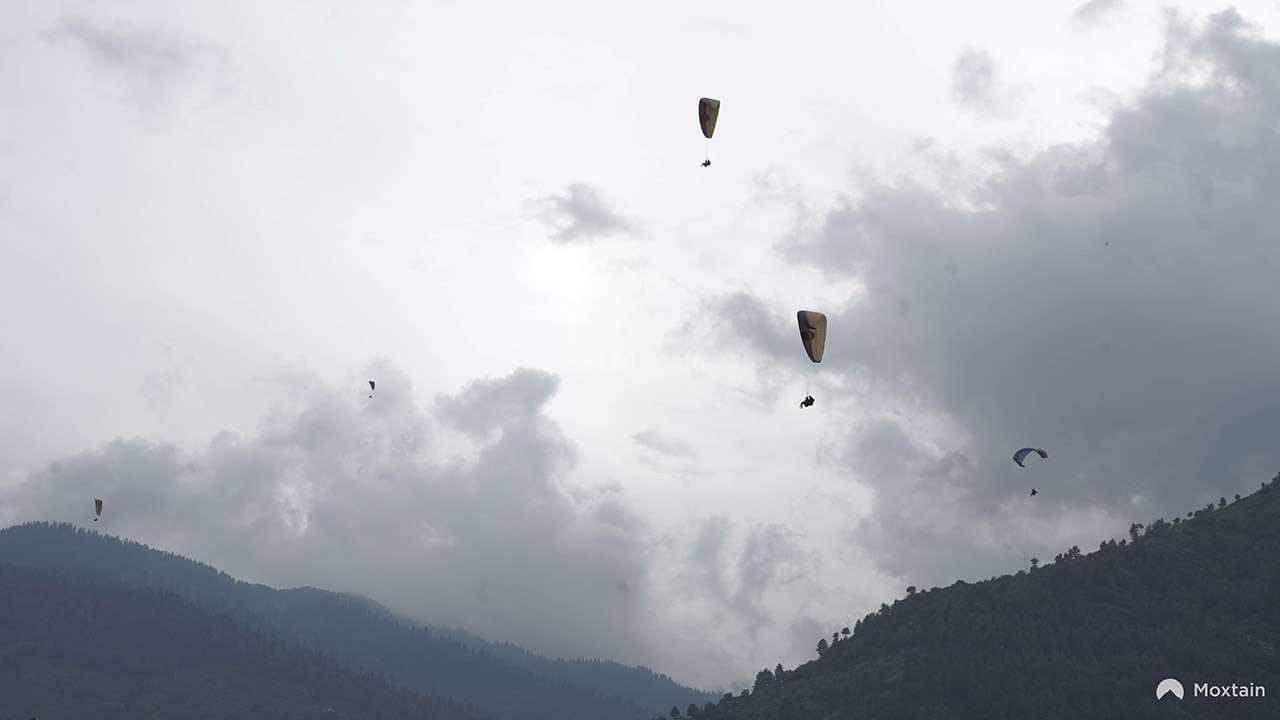
Paragliding

Top-10-Adventure-activities-in-India-paragliding
Image – Moxtain

Paragliding is smoothly gliding through the air with the help of a specially designed parachute. Flying free like a bird in the sky is everybody’s childhood dream. Paragliding may help this dream come true. 

The person flying with the paraglider sits on a harness suspended from the edges of the parachute (Paraglider) and the paraglider is controlled by the wing lines connected with the seat from the glider itself. 

Anyone can do paragliding if he or she is in shape and is well trained because this recreational sport is physically and mentally demanding. 

The most famous spot for paragliding is Bir Billing in Palampur, Himachal Pradesh. Nandi hills near Bangalore is another location. Paragliding is one of the best adventure sports in Manali for the spectacular view of the surroundings while floating in the sky. Kamshet near Mumbai, Gangtok in Sikkim, Mussoorie, Nainital, Ranikhet, and Bedni Bugyal on the trail of Roopkund trek in Uttarakhand also offers paragliding. 

Skiing

Top-10-Adventure-activities-in-India-Skiing
Reference Image – Harrison Moore

Skiing is an ice sport and a competitive activity. A thin, long, and flat piece of fiberglass or plastic called ski is attached with the heels of the skier which helps to slide on the ice. Earlier a mode of transportation in the cold arctic area of Northern Europe skiing has gained worldwide popularity now. 

Pahalgam, Gulmarg in Jammu & Kashmir, Solang Nallah, Kufri, Narkandai in Himachal Pradesh, Munsiyari, Auli, Dayara Bugyal of Uttarakhand are the best known as skiing spots. Skiing as snow sports in Manali, Himachal Pradesh attracts lots of tourists to the region.

Rappelling 

Top-10-Adventure-activities-in-India Rappelling
Image – Pixabay

Rappelling is climbing down a steep rock or cliff by fastening a rope tightly on the top of the cliff. Rappelling is useful to cover those parts of a mountain trail which cannot be walked or trekked. 

Rappelling is surely not for the faint-hearted as here one needs to trek to the top of a rock face or cliff and then descend straight while hanging on to the rope. 

However, rappelling is done across waterfalls too, known as water rappelling. Chelavara waterfalls in Karnataka, Bekare waterfalls, Kondana caves waterfalls, Madap waterfalls in Maharashtra are some of the places offering water rappelling. 

Rappelling is one of the adventure sports in Rishikesh, where mountain and water rappelling both are performed. Sikkim has several locations with waterfalls for this activity. Rappelling is one of the Manali water sports too. The jogini waterfalls in Manali is a spot revered for this adrenaline-pumping activity. 

Zorbing

Top-10-Adventure-activities-in-India-Zorbing
Image – Pixabay

In this strange yet fun sport two transparent and robust plastic balls are mounted one inside another and the whole set up is inflated to accommodate one to three participants. Operators then push the ball with passengers inside and it rolls down the slope. Water zorbing is another version of zorbing where the ball floats on water and the person taking part can walk, jump, dance, or run on the water surface. 

Zorbing is one of the best adventure sports in Kullu Manali, especially in Manali. The Della adventure park near Lonavala, Maharashtra offers water, aqua, and roller zorbing, respectively. 

In New Delhi, India Gate and Purana Qila are the two famous zorbing destinations. Pahalgam in Kashmir also offers zorbing.

Rock Climbing

Top-10-Adventure-activities-in-India-rock-climbing
Image – Moxtain

Rock climbing is another adventure sport of ascending or descending a naturally formed rock face or artificially structured rock wall. It takes place with ropes and special tools crafted exclusively for the activity. 

The sport needs a climber to be physically fit and mentally strong cause it tests the climber’s endurance and nimbleness. 

Malshej ghat- a mountain pass in the Western ghats of Maharashtra is an apt site for rock climbing. Hampi in Karnataka is a world heritage site and has a perfect rock structure to host this sport. Jammu and Kashmir’s Shey Rock, New Delhi’s Lado Sarai are two sites where beginners can give it a try. Miyar valley and Parvati valley of Himachal Pradesh are other two well-known locations.

Zip Lining

Top-10-Adventure-activities-in-India-Zip-Lining
Image – Praveen Ramavath via Flickr

Like in paragliding where one experiences flying like a bird, zip-lining also makes one feel the thrill and excitement of flight in the open air. Two destination points on different heights are set up and are connected with a cable and pulley system. The pulley and a harness attach and secure the person with the wire. The journey is by sliding from the higher point to the lower point under the influence of gravity.

 Generally, these two points are set up on the two sides of gorges, between a forest or canyons which make the experience one of a kind with breathtaking panoramic views. 

Shivpuri near Rishikesh, Mussoorie in Uttarakhand, Munnar in Kerala, Kerwa Dam in Madhya Pradesh, Kolad in Maharashtra are some of the adventure places in India for zip lining. 

Canoeing and Kayaking

Top-10-Adventure-activities-in-India-Canoeing-and-Kayaking
Image – Trip Jodi via Flickr

Canoeing and kayaking are two interesting watersports in Uttarakhand and some other Himalayan states in India that recently developed popularity. Both of these two use almost similar looking boats with a slight difference in structure. Canoe boats are pointed towards both sides and have open and uncovered decks whereas Kayaks have closed and covered decks. Kayaks are lightweight and faster while Canoes offer more stability and are suitable to be paddled over slowly moving water. 

Whitewater canoeing and kayaking are no less adventurous than the rest of the sports mentioned here. Like rafting, Kayaking maneuvers the speed and navigation with a double blade and Canoeing with a single blade. Open to more flexibility kayaking and some modern canoeing takes place in white water rapids, rivers, waterfalls, and even seas. 

Rivers widely known for water sports such as Zanskar in Ladakh, Ganga in Rishikesh, Mandvi in Goa, Teesta in Sikkim, the Brahmaputra in Arunachal Pradesh, and backwaters of Kerala are the Canoeing and Kayaking destinations of India. 

Author’s Bio: Deepabali Saha is a content writer at Moxtain. She lives in a beautiful town in West Bengal and is an Electronics and Communication Engineer from MAKAUT, Kolkata, West Bengal. Her passion for doing something creative and appealing with words has led her to be a content writer. She has learned and practiced Indian classical music and Rabindrasangeet for a decade starting from her childhood.

Gond Art : A Folk Art Form with Beautiful Tribal Colours, Themes, and Shapes

4
Gond-Art-01
Painting By Jangarh Singh Shyam – Jean-Pierre Dalbéra via Flickr

The Gond tribe has its origin in Madhya Pradesh, and derived its name from the word ‘Kond’, meaning “green mountain”. Although Gond art of this tribe is considered to be primarily from Madhya Pradesh, it is also popular in regions like Andhra Pradesh, Maharashtra, Chhattisgarh, and Odisha. The government of India has taken several steps to preserve the art of the Gond tribe. These measures are not taken only to empower the artisans economically, but also for the sake of the future generation’s artistic fulfilment. The efforts resulted in more popularity of Gond art and paintings. Now, these folk art works are put on display with pride in various international exhibitions. They also bring in thousands of rupees.

The Rich History of Gond Art

The Rich History of Gond Art
Muria people a part of Gondi Tribe – Collin Key via Flickr

Amongst the Gond people, painting and other forms of expressive art are a popular and traditional practice. Dating back to more than 1400 years ago, the Gond tribe has painted and carved art on the walls of caves which all belong to the Mesolithic Period. The Gonds believe that viewing good images brought in good luck. Thus, traditionally, they painted motifs, tattoos, and images on the floors and walls of their houses. Their paintings are also a means to record and pass on historical knowledge and teachings.

We Recommend…
Fevicryl DIY Self Painting Art of India Kit – Gond Art

The Pardhan Gonds are extremely skilled artists who are renowned for their paintings and music. In the 1980s, the director of the Bharat Bhavan Museum in Bhopal, J. Swaminathan wanted to exhibit urban and tribal art together. For this purpose, he sent some of his students to various villages in the Dindori district in search of artists. One of them was the exceptional painter Jangarh Singh Shyam, a Pardhan Gond. He was the first tribal artist to use canvas and paper for his artwork.

The Natural Themes of Gond Art

Gond Artist Painting
Image – Wikimedia

The Gond people believe that every element of nature, be it the hills, the sky or the trees, is inhabited by a spirit. Recreating the forms of nature therefore is done with reverence and worship of their sacred essence. These paintings serve as examples of the Gond tribe’s close connection to the spirit of nature. Gond paintings take inspiration from the myths and legends of India. They also depict scenes from the contemporary life of the people. A detailed narrative portrays abstract concepts encompassing emotions, dreams, and imaginative constructs. Since many of the Pardhan Gonds are accomplished musicians, their paintings often portray the stories of their songs.

We Recommend…
DIY Colouring Kit – Gond Painting of Madhya Pradesh by Potli

The most significant subjects explored and depicted in Gond paintings include birds, animals, and mythical beasts. Since the paintings also derive themes from the daily lives of the people, the Mahua Tree is an important subject. Considered as the Tree of Life, the flowers, fruits, seeds, and leaves from the Mahua tree serve many purposes for the tribe. Urban themes depict modern subjects such as technology and automobiles. Folktales and local deities like Phulvari Devi, Jalharin Devi, and Marahi Devi are of cultural importance.

The Exquisite Shapes of Gond Art

The-Exquisite-Shapes-of-Gond-Art
Image – Mike Prince via Flickr

The style that is incorporated takes care that the lines, whether of the border or the interior intricacies, that create the subjects grab the attention of the viewer instantly. The dots and dashes enhance the details with exquisite brilliance that is unique to the Gond paintings. Incorporating various geometric shapes and patterns, like the ones resembling fish scales, drops of water and seed shapes flesh out the expressive value of the art. The sense of movement is established through the curves and strokes of the lines, and hence many critics best described it as ‘on line work’.

The Vivid Colours of Gond Art

gond-art-painting
Image – Wikimedia

The Gond paintings flourished with vivid colours, especially red, blue, yellow, and white, that serve the view with their excellent contrast. These bright paints are usually derived and extracted from organic sources such as coloured soil, charcoal, plant leaves and sap, and even cow dung. The local sand called Chui Mitti helps in the production of the yellow colour, while Gheru Mitti serves the brown colour. Charcoal provides the black colour, Hibiscus flower gives red, and plant leaves impart green.

Resembling Australian aboriginal art, the Gond paintings are usually drawn during important festivals like those of Holi and Diwali. In the modern age, one can commonly find Gond art on wooden trays, boxes, and other objects of smooth surfaces. However, they are no longer painted on walls and floors. For the sake of convenience, the artists now prefer canvas. This ease of mobility has increased purchase and exchange, thus, aiding the popularity. Today, Gond artists use poster colours and other artificial paints to put their talent into the best portrayal. Combined with this, the use of simple canvas has enhanced modern Gond paintings into more vibrancy than its traditional counterparts.

10 Best Cookbooks on Traditional Indian Food to Nurture Your Culinary Skills

1
Best-Indian cookbooks
Image – Pritya Books via Flickr

Cooking is an art. And I believe it since I am no artist. Cooking though is an existential essential, has had a catharsis of sorts over the recent past. When once cooking a meal was just a mundane responsibility today the story is very different. The culinary world has developed and emerged as a leading economic and cultural market. Cookbooks, cook shows and various marketing strategies have elevated cooking into a definitive skill set. Add to that the lockdown has allowed people to try their book hand at various dishes and delicacies of their choice.

Globally, there is a range of cuisines that highly please our palates. However, traditional Indian foods always have a special place in the culinary world. The blend of spices and flavours is a unique feature of traditional Indian foods that has mesmerized the international audiences as well.

There are details, precision and a lot of hard work that goes into preparing a dish. Of course, the common idea that usually floats around is that cooking is about passion. It is the desire to create something with a lot of love and care. However, there is a science to it too. And to understand it, cookbooks are one of the best resources, to begin with. For the amateur or experienced cooks, cookbooks provide a different take and perception, which can be both a learning and a refreshing change.

Why are cookbooks important for traditional Indian cooking?

Indian-cooking
Photo by Pratiksha Mohanty

Traditional Indian cooking is a lot more than just the recipes. It is about the ingredients and their true meaning. It is also about acknowledging the local flavours and incorporating them in the dish. The method of cooking is another significant aspect that defines traditional food preparation. Modern cooking has evolved with the usage of electronics and gadgets. And hence, cookbooks help in creating traditional meals with modern methods and utensils. Cooking experts understand the fine balance that is struck when tradition meets modern. And it is only then that the resultant effect is both delicious and beautiful.

Also, Indian traditional dishes are an amalgamation of many small steps. And it is their coming together that creates a perfect dish. Besides, undoubtedly it’s hard to categorize the traditional foods in a single bracket. There are so many regional variations and local ingredients that go into preparing a traditional Indian dish. And thus, a reference point or guide material becomes inadvertently important. Cookbooks, therefore, are a handy, quick and authentic medium to learn recipes and try them out at home.

So here we list the top 10 cookbooks on traditional Indian cooking that will help those who are not cooking artists. However, these are also great reads for those who enjoy cooking and look to understand the technique and purpose while preparing a dish.

My First Kitchen – Vikas Khanna

Vikas Khanna is a well-known name in Indian, as well as the international culinary world. This is one of the best books for beginners because it gives a holistic approach to the skill. There are more than a hundred recipes, besides many related tips.

Made in India: Cooked in Britain: Recipes from an Indian Family Kitchen – Meera Sodha

Meera Sodha’s Made in India – Recipes from an Indian family is a joy to read. She passed down recipes of traditional home-cooked dishes that she grew up eating with her family. It was not until she moved out of her home for studies that she realized what a great cook her mother was. This book contains recipes, family anecdotes, and a lot of fun.

Indian Housewife’s Recipe Book – Laxmi Khurana

This book is a wonderful assortment of traditional Indian meals. It opens your eyes to the fact that dal and curries can be made in umpteen numbers of ways. There are more than a hundred recipes in the book that range from the main course to snacks, starters, chutneys etc. Traditional recipes passed down from generations, Laxmi Khurana’s book is a perfect step by step explanation of recipes that are easy and tasty to cook.

India: The Cookbook – Pushpesh Pant

With around 1000 recipes, Pushpesh Pant’s India: The Cookbook is a comprehensive guide for ardent cooks. A great book for those who have tried their hand on Indian cooking, this book gives a deeper understanding of the dish, through historical references etc. There are also tips on the utensils to use, various ingredients, etc. Pushpesh Pant lives in Delhi unlike many other authors of Indian cookbooks who cater their culinary expertise at international locales. The recipes are varied and also of uncommon dishes, such as sambharachi kodi, bakarkhani roti and more. The chapters are divided into pickles, bread, chutney, pasta etc.

Indian Cookery – Madhur Jaffrey

Madhur Jaffrey is a traveller, food writer, actress and can be credited for a lot of westerners learning about Indian food. She has written quite a few cookbooks, including Curry Easy and Ultimate Curry Bible. However, Indian Cookery is regarded as one of the best cookbooks on traditional Indian food. The cookbook includes classic recipes, such as Chicken Tandoori and Rogan Gosh.

The Indian Cooking Course – Monisha Bharadwaj

Monisha Bharadwaj’s The Indian Cooking Course is an easy step by step guide for beginners. For those who love Indian food but really don’t know how to go about preparing it, this book is perfect. It explores various dishes across different regions of the country. However, it goes beyond just providing the recipe. In fact, it gives insight and background information on the different dishes. This helps in understanding the true essence of the dishes.

Prashad at Home: Everyday Indian Cooking From our Vegetarian Kitchen – Kaushy Patel

Kaushy Patel gets inspiration from her grandmother for instilling a deep love for Indian cuisine. This book explores the vegetarian recipes of the country and is perfect for those who avoid meat. Most of the meals in this edition are quick and easy to make.

50 Great Curries of India – Camellia Panjabi

This is one of the best cookbooks that introduce you to Indian curries. Authentic regional curries also feature in this bestselling cookbook. Camelia Punjabi was born in Mumbai, and she later moved to England for her studies. She began her culinary business and ran a chain of restaurants in London. In this book, some of the recipes to watch out for include the Sindhi curry, Madras lamb curry and more. The book also has wonderful illustrations to guide novice cooks.

Tasting India – Chef Christine Manfield

Australian chef Christine Manfield writes tasting India. The book is an amalgamation of his travel and food experiences in the country. The book gives an insight into Indian cooking from a foreigner’s point of view. Some of her recipes of the beetroot curry and coconut chutney are worth trying out. The book in total includes around 250 recipes of Indian food.

How to Cook Indian: More than 500 Classic Recipes for the Modern Kitchen – Sanjeev Kapoor

Sanjeev Kapoor is a household name. Many credit him and Tarla Dalal for bringing cooking on a larger, digital platform and making it popular. This book uses easy ingredients to whip up authentic dishes and is handy for those whose kitchens are not always stocked with all culinary requirements. Though the book has no illustrations, the list without either one of the iconic Indian cooking masters would definitely seem incomplete. It is undoubtedly one of the best cookbooks on traditional Indian food.

Indian cooking has its distinct uniqueness and flavors. This is in spite the fact that it is hard to categorize the wide range of gourmet delights that are prevalent nationwide. With every region boasting its own kind of cuisine, the Indian cuisine is hard to define. Yet, on the other hand, there are certain dishes that are absolutely ‘Indian’. Cookbooks help to bring to forefront the different flavors of the regions and states of India. At the same time, they also help highlight the various meals and dishes that everyone can easily identify as being Indian. However, the biggest advantage of cookbooks lie in their authenticity and legacy. Recipes passed down from grandmothers are safely sealed and preserved in their pages. They are not lost through time, but reinvented and relieved with each passing generation.

Digital media is another wonderful way to spread cooking skills. However, the charm of cookbooks opened amidst the scatter of ingredients as soft music plays in the background is unmatched. Yes, artists are born with lots of handwork and help. And cooking is definitely an art that needs a bit of both.

Importance of Sculptures in this Modern Era

0

Importance-of-Sculptures-in-this-Modern-Era-01

Sculptures over the years have become a popular addition in many spaces. More and more designers are making it a part of their designing projects. The primary reason why sculptures have become so popular is that they are very engaging and attractive. Looking at sculptures gives a different perspective than looking at a painting. People also get more fascinated by the way sculptures are created. And over the years, sculptures have moved beyond wood, stone, bronze, and marble. You can use anything such as bullets, salvaged materials, etc., to create sculptures. Following are the reasons why sculptures have become popular in the modern world – 

A Perfect Mix Of Modern and Classic

A classic marble sculpture can be a perfect twist to a modern interior space. If you like abstract arts, then you can also choose a marble torso or Greek-style sculptures. It is not necessary to include modern materials like iron or metal. Wooden and marble sculptures are also perfect for adding warmth to your contemporary space. 

A Bold Addition

People who like minimal, contemporary decor could choose abstract sculptures accompanied by more significant dimensions. There are tons of options including clean lines, matte or shiny, thin or thick surfaces; there are immense options. In terms of aesthetics, you can never go wrong with a custom metal sculpture made from copper or wire. 

The Aura Of Feng Shui

Feng Shui is reckoned as the art of creating and arranging objects to bring them together in harmony. A particularity of this art is placing Budha sculptures across space, and there is strong philosophy behind it. The philosophy is considered that these statues offer serenity into space and improve the energy slowly. Even experts agree that Buddha statues should be placed in the front door so that when the chi energizes the house, it comes face-to-face with the positive aura of the deity. 

Go Wild With Animal Sculptures

Animal sculptures bring prosperity, money, and luck. There are cultures in which bigger or smaller sculptures of frogs, elephants, or turtles are highly famous. However, in recent times one animal has become extremely popular that includes a flamingo bird. Irrespective of whether you choose metallic or pink, the elongated and graceful flamingo gives a nice pop of colour to any ambience. 

Going Chic With Rococo

Rich and vibrant, Rocco style stands out for its premium appearance. And, pieces like that can accentuate the look of the home and add a touch of sophistication. The good thing about Rocco is that they are not only available in sculptures, also in furniture that has luxury wooden constructions featuring a lot of flowers and leaves. 

Final Thoughts

Art is an inspiration that has the power to illuminate, educate, motivate, and transform an individual. Addition of art creates interest in the space. One of the vital art elements that you can include is sculptures. In recent times, the popularity of sculpture has increased manifolds. Above are some examples of how you can add sculptures to accentuate the appeal of your space.