Kalarippayattu: The Ancient Martial Art of Warfare

0
Kalarippayattu-The Ancient Martial Art of Warfare
Image/Pixabay

Kalarippayattu means “Martial Art of the Battlefield”. The word “Kalari” refers to the battlefield. Several martial arts within the world have created their ineradicable mark on many individuals. Karate, Kung Fu, and Taekwondo square measure, a number of the world’s most well-liked martial arts that exude a way of awe, determination, and dedication. However, many self-protection forms in India are a mixture of old data practices, discipline, and a deep understanding of combat warfare mainly of the body and mind. It is acknowledged and respected all over the world A number of the glorious martial arts of India embody Kalarippayattu, Thang-Ta, Silambam, Gatka, Mardaani Khel, and added.

History of Kalarippayattu

Kalarippayattu-The Ancient Martial Art of Warfare
Image/Wikimedia

Kalaripayattu is believed to be one of the oldest extant martial arts and is over 3000 years previous, and Lord Parashurama is alleged to be its creator. Realizing the recognition of the shape, the Kerala government has currently introduced a Kalaripayattu academy in Thiruvananthapuram. Kalarippayattu originates from Kerala and thus finds several of its disciples hailing from the state. Kalarippayattu is one of the foremost standard martial arts of India and dates back to the third century B.C. For those practicing this rigorously for years, it’s over simply associate degree art, it’s some way of life, a style of meditation, and a religious attempt. Individuals that are square measure drawn towards Kalarippayattu attribute to its positive effects on the wholesome fitness level and its healing benefits.

The Sangam era is that the earliest era to possess, documented in its literature the employment of swords, spears, bows, and shields. However, the current style of self-protection is claimed to have been developed within the sixth century throughout the amount of long warfare between the Chola and Chera dynasties.

Techniques in Kalarippayattu

History-of-Kalarippayattu-01
Image – Smruti Damania/Flickr

Kalarippayattu is about the steps or ‘chuvadu’ and postures or ‘vadivu’. The various postures square measure are named once animals, and square measure sometimes eight in range. It involves kicks, grappling, strikes, and actions like jumping, running, and flip. At the side of the employment of weapons starting from swords, sticks, spears, and more. Learned practitioners of this art square measure believed to grasp the very important points known as ‘marmam’ of the body. Light pressure on these very important points will kill or fully disable the opponent, and so is tutored to solely people who square measure trusty enough to not misuse it. This elaborated data of the body has conjointly led to activity ailments like rheumatism and displaced bones.

Kalarippayattu-Martial Arts of battlefield
Image/Wikimedia

Those learning Kalarippayattu conjointly would like associate degree understanding of the very important points and Ayurveda. Particularly once the art is passed down from one generation to a different one, the transfer of information is far deeper and holistic. With no shortcuts or piecemeal or convenient data. Kalarippayattu is learned and down over years and therefore the fantastic thing about the art lies within the proven fact that it will bring down a wound nevertheless also can heal. The self-protection is for combat, for a fight, however, its data is additionally wont to recover or improve a health condition. This skinny line of differentiation is maybe its biggest highlight. Couple this with the actual fact that self-protection is for warfare, United Nations agency practices it, the training from it’s not aggressive. It’s concerning the initial dominant, the mind, and therefore the physical being or body. Being agile, versatile, and therefore the management of oneself, square measure the most pointers that are square measure tutored in Kalarippayattu.

Kalarippayattu-Martial Art of battlefield
Image/Smruti Damania/Flickr

The weapons square measure simply associate degree extension of the body itself. If one will manage and acquire the body flowing within the desired means then the weapons imitate. Before starting to observe, students sometimes kneel and pray on the ground of the battlefield where they are meant to perform. Reinforcing the religious affiliation that’s felt once active self-protection. Integration Kalarippayattu isn’t intrinsically integrated with, however several of its principles square measure is taken from Yoga, and therefore the finger movements are employed by dancers, thence several self-protection designs closely match and square measure connected to yoga, dance, and different humanistic discipline. A number of the moves of Kalarippayattu are utilized in dance. United Nations agency recognizes Kalarippayattu square measure glorious to raised dancers than others. Some dance colleges use Kalarippayattu as a style of exercise too.

Medication and Massage in Kalarippayattu

Medication-and-Massage-in-Kalarippayattu
Image – Patrik M. Loeff/Flickr

Professional Kalarippayattu trainees apply oil and massage their bodies before venturing into combat. This helps their body to be greased and be additional ready for light soreness, thence the understanding of massaging the vital and relevant body components has led several professional trainers of the self-protection to be able to ease varied body pains and wounds using the victimization oil massages, herbs, and paste. The usage of the oils and herbs at the side of the understanding of wherever to use what proportion pressure and the way to massage for the general betterment of the pain is that the key here. In short, the marma points square measure employed by the Kalari massager to heal.

Kalarippayattu and Faith

Kalarippayattu and Faith
Image – Ashwin Kumar/Fliclkr

Kalarippayattu is practiced and performed sometimes inside an internal gymnasium. Kalari means that the field of honor, however, in today’s time the observe gymnasium is additionally known as a similar. The Kalari is wherever the deities that signify completely different values square measure are unbroken and adored. Hence, kalarippayattu is additionally related to faith. wherever the deities of Hindu deity signifying power, Vigneswa for strength, Kali for expression, Vadugashcha for posture, and Channiga for patience square measure are worshiped.

Today additional individuals have gotten interested in the traditional self-protection style of Kalarippayattu. They’re finding it to be an improved possibility than sweating at the athletic facility. It’s gained recognition these days, due to the multiple movies additionally as its incorporation into Kerala’s business enterprise circuit. Also, Kalarippayattu like several martial arts is interlocking into the cultural, social, and non-secular lifetime of the tiro, creating an important part of his or her life, changing into some way of life itself. Several exponents of the art can recognize, the combat is usually with oneself. Kalarippayattu thence aims for internal peace and focus because that is the best means to fight external challenges.

Indian Classical Music – A Rock Solid Rhythmic Foundation

0
Indian-Classical-Music-Hindustani-Pt.Ravi-Shankar
Image – Invisible Mind/FB

Music is universal. It is not so much about words or language, as it is about rhythm and melody. There is probably no one who has not been touched by the influence of any kind of music. And hence, music is that rare entity that transcends all kinds of boundaries and limitations to reach the spiritual and divine. Those who are stalwarts in the study and practice of music are the legends who dedicate their entire lives to the soulful stirrings of melodies. And in the process, we often find the true meaning of emotions, brotherhood, as well as individuality and the self.

India is the land of rich music. There are multitudes of musical forms that add color and variation to the musical minds of this nation. However, the foundation or cornerstone of almost all musical forms begins or lays in Indian Classical Music. 

The History Indian Classical Music

History-of-Indian-Musci
Image – allaboutmusicin.blogspot.com

When did music or Classical Music first emerge no one knows. But it is believed that the foundations of Indian Classical Music are found in the Vedas. The Vedic literature text of the Natyashastra is the most important classical text that is the root of all classical arts in India. Written by Bharata Muni, the Natyashastra remains the basic repository of ancient classical art forms. The Natyashastra is the bedrock on which Indian Classical Music is shaped.  

With political and societal changes, Indian Classical Music crafted its journey. The Sangita-Ratnakara is a text of study for both Hindustani and Carnatic music. Written by Sarngadeva during the Yadava dynasty the text discusses ‘Ragas’ and ‘Talas’. However, by the 16th century, Indian Classical Music had developed into its two different forms, Hindustani and Carnatic. Though there are differences between the two, they both also have a great number of similarities due to their same source of origin. 

Hindustani Classical Music

Indian-classical Music-Hindustani Tansen
Tansen – Image/Wikimedia

Also called Hindustani Shastriya Sangeet, Hindustani Music is the classical soul of North India. The process of the division of the Indian Classical Music may have started around the time of the Delhi Sultanate. However, it was during the time of Akbar’s rule that Hindustani Music reached a high pinnacle. Often considered the founder, it was Tansen who led the way and inspired many new ‘Gharanas’ in Hindustani Music. 

Besides North India, Hindustani Classical Music is also popular in Pakistan and Bangladesh. The four main forms of Hindustani Music are Dhrupad, Tarana, Khyal, and Thumri. Each of these is also divided into other forms specific to various regions, for example, the Lucknow Gharana and Banaras Gharana in Thumri or the integration of folk to create Tappa. Hindustani music is also influenced by Persian and Arab music. 

Carnatic Music

Indian-classical Music Karnatic-Purandara-Dasa
Purandardasa – Image/Wikimedia

Carnatic Music is more structure orientated as compared to Hindustani Music. Its compositions are similar to Western Classical Music. Purandara Dasa of the Vijayanagara Empire is called the ‘grandfather’ of Carnatic music. His musical theories and exercises are considered one of the best ways for musicians to gain control and perfection of the art.

Raga and Tala

Indian-Classical-Music-Raga-and-Tala
Image – Partha Siddharth/Flickr

Raga and Tala form the main crux of Indian Classical Music. Raga means the melody, whereas, Tala is the rhythm. The musical artist can improvise the scale of Raga. Though there can be thousands of Ragas, and practically, the classical musicians rely on around 500 Ragas or more. Students of music first learn the important Ragas and then become the master of the Raga of their liking and choice. 

One of the principal nine Rasas or sentiments usually dominates each Raga– Shringara (romantic), Hasya (humor), Veera (heroic), Vibhasta (disgustful), Bhayanaka (fear), Adhbhuta (amazed), and Ahanta (peaceful).

Tala or Taal is the rhythm or the beat of the song. The measurement of musical timing is what a Tala means. There are hundreds of Tala, but again, practically only a few are used. Examples of Tala are, Teen-Tala, Jhap-Tala, Keherwa, and more. 

Indian Classical Music Instruments

Indian-Classical-Music-carnatic
M. S. Subbulakshmi Group, Carnatic classical music vocalist- Feminisminindia.com

The most defining object to a layman that identifies a musical rendition as classical is the use of certain specific traditional musical instruments. Hindustani Music usually uses the Sitar, Veena, Sarod, Tanpura, Esraj, Bansuri, Sarangi, Shehnai, Santoor, Tabla, etc. Carnatic music on the other hand uses the Veena, Khanjira, Gottuvadyam, Venu, Harmonium, Ghatam, Mridangam, etc. 

Learning Indian Classical Music requires dedication and seriousness; however, it is also about showing and showering respect for the Guru or teacher. A Guru has been the most important link that has passed the knowledge of classical music from one generation to another. And, despite all technological advances, the role of the Guru or teacher remains an integral part of the Indian classical musical diaspora. 

Smt. Ashwini Bhide – Hindustani classical music vocalist – Tutincommon/Flickr

Music is the finding of the innermost self and its rendition is soulful and almost like a dream to the millions who listen to it. Not all are blessed with musical capabilities, but the few who are deserve special mention and respect. Some of the most renowned Hindustani classical artists are Ravi Shankar, Zakir Hussain, Shivkumar Sharma, Hariprasad Chaurasia, Jasraj, Bismillah Khan, and more. Carnatic artists include the talented MS Subbulakshmi, L Subramaniam, Aruna Sairam, U Srinivas, Lalgudi Jayaraman, and more. 

Kashmiri Singer Shameema Akhter Touches Millions of Hearts Through Her Devotional Songs

37
Kashmiri-Singer-Shameema-Akhter-02
Shameema Akhter

A young Kashmiri singer has become a sensation not only in Maharashtra, where she is staying at present, but has also transcended the national boundaries. Shameema Akhter has sung songs in Punjabi, Bengali, Dogri and in her mother tongue Kashmiri. However, her Marathi devotional songs are being applauded on social media in the subcontinent, including Pakistan, Nepal and Bangladesh. Millions of people have viewed, liked and shared them. She credits her success to the religion she belongs to, saying humanism is the very basis of Islam, and adds that Hinduism and all other religions propagate humanism too. Popular Marathi devotional songs appeal to her fans in Pakistan and Bangladesh because they promote peace and love among people of diverse faiths. She is thankful that Maharashtra, particularly Pune and NGO Sarhad with which she is currently associated, has provided her a platform to showcase her singing talent to the world. Here are some excerpts of her interview with Shirish Shinde.

Q: How did you develop interest in music?

My Nana (maternal grandfather) was a poet. He used to play the Rabab, a Kashmiri string instrument. My Dada (paternal grandfather) was a ‘Pir’ (saint). Both were followers of Kashmiri Sufi saint Lala Aragami. During the Urs (festival held in the Sufi saint’s memory), qawwalis and devotional Sufi songs used to be played continuously twice a year in my home. I grew up listening to these songs. Later, I started developing interest in them. I used to sing during school assemblies. Looking at my interest in singing, my Abbu (father) asked a classical music expert in Srinagar to teach me music. So once or twice a week, I used to travel from Bandipora, my hometown, to Srinagar just to learn Hindustani classical music. I wanted to learn more. So, my father sent me to the Bhatkhande Music University, Lucknow. I completed my ‘Visharad’ masters in Hindustani classical music. I have also taken music exams from the Allahabad University. Mazhar Siddiqui, my friend and music guide, I met during my college days in Lucknow. We are working together. He composes music and I sing for Sarhad Music, a YouTube music channel. Mazhar has taught a lot to me in classical music.

Q: How long did you practise music daily (Riyaz) during your college days?

I used to stay in a hostel. My room-mates and I used to practise singing all the time, around 4-5 hours daily. It was my daily practice to complete at least one Raag (a basic melodic structure for improvising, similar to a melodic mode). I was passionate about learning music. I used to be among top two students in my class. I used to practise just one note such as ‘Sa’ for one hour on the Tanpura daily. This was new to us. I used to practise it on the harmonium, which was not allowed in the Bhatkhande University.

Q: How did you get associated with Pune-based NGO Sarhad?

I used to hear about Sarhad in Kashmir during my childhood. Some of my childhood friends had joined the Sarhad School, which I also wanted to. However, it did not materialize. In 2016, I visited Pune to participate as a singer in a Kashmiri Festival, where I met my childhood friends from Sarhad. I thought that I could realise my dream to become a singer here in Pune. Sanjay Nahar Sir, who is a Farishta (an angel) to us, has been mentoring me and other Kashmiri students. However, I joined Sarhad Music later in 2018 after completing my studies. We started our music band Gaash (meaning ‘light’). My sister Rukaya Maqool is also a singer in this band. We want to spread the message of peace and brotherhood through our band. I am helping Marathi and Bengali singers to sing Kashmiri songs while they give me tips in singing in their respective language.

Q: What is the reaction of non-Maharashtrians when they listen to your Marathi devotional songs?

My family, particularly my father, has been very supportive. My father, though he doesn’t understand Marathi, listens to my each new Marathi song several times. He asks me their meaning. Some relatives show their disapproval, but my father says, ‘If you are honest to your roots, you can sing songs in any language and from any religion because all religions teach humanism’. However, many of my Kashmiri neighbours, friends and others in Kashmir praise me and wonder how I could accomplish this by staying outside Kashmir. They appreciate my efforts. We have been reaching out to people in various States through Gaash. After I sang ‘Pasaydan’ composed by Sant Dnyaneshwar, it became an instant hit. I was interviewed by a popular Marathi TV channel. Pasaydan got over a million hits within the first week of its release. We had a show in Kolkata. Then we performed in the annual Kashmiri Festival in Pune. Recently, we had an online show for the Indian Academy of Science, Bangalore. We had to decline many offers from other States after the pandemic reached its peak.

Q: How do youngsters respond to your songs?

We get many messages on a daily basis. Youths are very positive and supportive in Maharashtra. They call me ‘Tai’ (elder sister). Even Muslim youths from Maharashtra, UP and other places post affirmative comments. A Maharashtrian youth became emotional and posted that he wept after listening to Pasaydan. He asked other youths also had similar experiences to react to his comment. Around a thousand had a similar experience.

Q: How do you select these ‘Abhangs’ (devotional songs) for singing?

We deliberately choose those songs, which are already popular and sung by stalwarts such as Lata ji or Bhimsen ji. People like them because they are sung by a Kashmiri singer and composed with some improvisation. Abhangs such as ‘Runuzunu runuzunu re bhramara’, ‘Maze maher Pandhari’, ‘Pail to ge kau’, ‘Vrukshavalli amha soyare’, etc have got overwhelming response from listeners. My rendition of ‘Ek Omkar Satnam’ was lauded by Punjabi singer-composer Diljit Dosanjh. Celebrities such as Chief Minister Uddhav Thackeray, Raj Thackeray, Anna Hazare and many others have personally conveyed their good wishes. People have been demanding new Abhangs. We are recording them now.

Kashmiri-Singer-Shameema-Akhter-01

Q: How do you prepare before you sing a non-Kashmiri, non-Hindi song?

Initially, I repeat it several times till I master pronunciation of those words. Then I write the entire song in Urdu. I do dummy recording. Then I understand meaning of each word, which gives me a fair idea of emotions attached with each line. This helps in expressing those feelings and emotions in the final recording.

Q: Who helps you with Marathi?

Sushma Nahar Madam and Gopal dada have helped me immensely with ‘Pasaydan’, which is a Dua (prayer) for ‘world peace’ and is sung in Maharashtra and Marathi people across the world. When I understood its meaning from both of them. I was awestruck. It is a beautiful poem. Our Kashmiri friend Zahid Bhat, who speaks fluent Marathi, also helps me with Marathi. Mukhtar Dar has also been very supportive.

Q: What do you find common to all these Indian languages?

Since I have learnt classical music, I started singing ‘Bandish’ (a melodic composition) in Sanskrit, Persian, Hindi, Urdu, Avadhi, etc. in a particular ‘Raag’. A Bandish has a few lines, which I practise. I see the composition from the angle of a Raag, then everything else falls in place. I develop my own ‘Aalaps’ (improvised prologue in a Raag). Hence, learning classical music is imperative for a singer.

Q: How much time do you spend on a composition?

Since we choose cover songs for singing, we don’t have to spend much time. However, two to three weeks are spent on preparing a song.

Q: Can you recall a particular experience after becoming popular on social media?

My parents have always been boosting my morale. Still, I used to have some doubt, I don’t know why. However, when I sang ‘Maze maher Pandhari’, a Pakistani youth YouTube channel, which reviews music, did a rave review and was liked by thousands of Pakistanis, I realized the universal appeal of these renditions. I was happy that non-Maharashtrians, Muslims related to the message of peace and love. When the news of reactions from Pakistan was broken to me, I was scared for a moment. My family is in Kashmir. Initial negative feelings gave way to happiness when I learnt that it was hugely applauded in Pakistan also. Devotion knows no barrier of language or religion.

Q: What is your message to Kashmiri youths?

I always tell my Kashmiri friends that they should have a plan B ready. Those who want to become singers should first learn classical music. This improves quality of your voice and you can sing in other Indian languages also. Sarhad is planning to establish a music university. We will help Kashmiri youngsters, who want to pursue a career in music.

Indian Spices – With Love From India to Global Cuisine!

0
Indian-Spices
Image/Marco Verch/Flickr

Who doesn’t like a little spice in their life! But here we quite literally mean it. Spices have always been such an important part of Indian cuisine. It’s a commonality to find someone enquiring about your health if you chose to eat blandly. A pinch of the fantastic flavors can do wonders to a dish. And it is not only about flavors. Indian spices also add aging aromas and vibrant colors to the platter. They also have some medicinal values. They blend in seamlessly with the delicacy, sometimes dominating the curries with their exquisite presence or sometimes hidden in its fold unsuspectingly.

No doubt that Indian spices are too hot to handle!. Yet, even those who find their taste intimidating cannot help acknowledge their vitality and exuberance. So sought after were the Indian spices, that they can be credited to a large part for attracting the western colonies. The British, French, and Dutch embarked on controlling trade in the subcontinent with spices as almost the central focus. A lot of discussions, in fact, associate globalization with spices. The trade and economics of spices led to the opening and exchange between different parts of the world.

So what are the special Indian spices that are found in almost all homes of the nation? Let’s take a look:

Cumin

Indian Spices - Cumin
Image/Pixabay

India continues to be the major consumer and producer of this spice. It is also commonly known as “Jeera”.It can be fried, roasted, powdered, or used in dry form. It is one of the basic ingredients that is spewed in oil while preparing curries, gravies, rice, or dry savories. It adds depth to any dish.

Cardamom

Indian Spices - Cardamom
Image/Pixabay

It is commonly known as “Elaichi” in India. It takes quite a bit of work to grow cardamom. This petite seeded spice is multi-purpose and can be used in beverages such as tea too. It is also added in sweets, such as kheer. It adds a warm and subtle flavor to food. It also happens to be one of the expensive spices.

Cinnamon

Indian Spices - Cinnamon
Image/formulatehealth.com

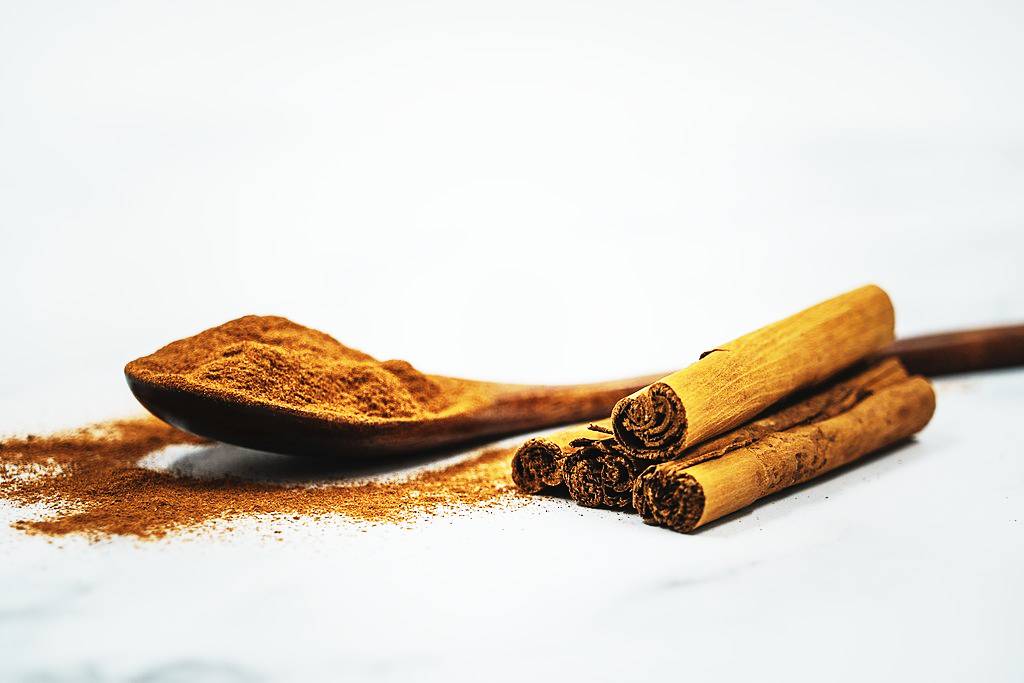
Also known as “Dalchini”.This woody spice has a slightly sweet tinge to it. Used in various desserts it grows mostly along the Malabar coast of India. But it is also added in spice-laden dishes, such as the biryani or mutton, or chicken dishes.

Dried Coriander

Indian Spices - Dried Corriendar
Image/ Pixabay

The oval-shaped coriander seeds have a unique aroma. Again they can be used in a powdered or whole form. It is mostly used to add flavors in dishes that are eaten with chapati or rice.

Turmeric

Indian Spices - Turmeric
Image/Marco Verch/Flickr

“Haldi” is a favorite and used in many dishes for various purposes. It has a warm and slightly bitter taste. It adds color and flavor to the food. Due to its medical properties, it is often a perfect ingredient to add during cold and coughs.

Saffron

Indian Spices - Saffron
Image/Wikimedia

Also known as “Kesar”. This spice is derived from the flower “Saffron Crocus”. One of the most expensive spices, a pinch of saffron can change the look of the dish. Its royal charm makes any dish loaded with opulence and class. Used in a wide range of dishes, the saffron is grown most in Kashmir. It is rich in anti-oxidants and enhances weight loss.

 Clove

Indian Spices - Clove
Image/Fazlul Alam/Pixabay

Also known as ” Laung” in India.  Clove is the flower bud obtained from the Clove tree. Clove looks like a little lollipop.  It is a sweet and aromatic spice. It has a strong flavor and is hence used cautiously. It adds a spicy warmth to dishes.

Black pepper

Indian Spices - Black Pepper
Image/Pixabay

Pepper is such a must that it is hard to even think of it as special. From breakfast to dinner, pepper is sprinkled on a wide range of dishes. It adds a definite flavor that is different from chilies or any other spice.

Mustard seeds and Fenugreek seeds

Indian-Spice-Mustard-seeds-and-Fenugreek-seeds

Both these seeds add a distinct taste to the dish. Used more in south India, they are also lightly fried in oil and spluttered as the final ‘tadka’ on dal or curries. Mustard seeds are good for bones. Fenugreek seeds reduce cholesterol and lower inflammation.

Medicinal uses

Indian-Spice Medicinal Values
Image/Karolina Grabowska/Pexels

Spices are not only about taste or color. They are good for one’s health too. Each of these spices has some medicinal properties that make them stand out. Their traditional medicinal value is much appreciated even in today’s chemical-driven world.

Cinnamon helps lower blood pressure and diabetes. Similarly, fenugreek seeds are used to control blood sugar levels and many people gulp a handful of the seeds along with water as a morning routine or soak the seeds in water overnight and drink the water later.

Those who have ever had a toothache know how effective clove is. It also kills bacteria, is rich in antioxidants, and improves liver health. Cumin helps in a better digestive system and also is a good ingredient to add to the diet during cold and cough. It also helps in weight loss, controlling cholesterol, and improving memory. Black pepper contains iron and helps reduce blood pressure. It also helps boost the absorption of nutrients and has anti-inflammatory properties. Cardamom too provides relief during throat irritations and is known to better digestion. It also helps in improving immunity and reduces swelling. Turmeric has many medicinal uses, including anti-inflammatory properties, and is also used for cleansing of the skin, etc.

Finally, spices in India are much more than just food ingredients. They resonate with historical significance, economic use, as well as medicinal values. The tiny bits of spices are small in size and quantity. But packed in these small sizes is a load and burst of flavors. With myriad advantages, they breathe into Indian cuisine, the foundation of taste and deliciousness.

And yes, the best thing about the ‘gram masala’ is this. Though each has its special place in the kitchen, they work best in a combination. The spices when grounded or added in proper proportion together give the dish an extra edge and special status. Perhaps, pretty much like its people, the spices of the nation too, elevate and enhance flavors when they work in tandem of unity.

Spicy, Saucy, Sweet: Mysore’s Famous Food You Must Try!

0
Mysore-Famous-Food
Image/Vivek vasudevan/Flickr

The vastness of the Mysore city is also reflected in its food. Mysore settles a massive variety of dishes that are delicious to eat and equally enchanting to look at. Ranging from the most famous of all that is idli, masala dosa, uttapam, vada, the list continues and reaches the most luscious Mysore Pak. Leaving you with a watering mouth, this complete list of Mysore’s famous food would make you a fan by, sampling and would also tempt you to try out these exquisite South Indian dishes.

Mysore offers a variety of dishes: some greatly influenced by the Udipi style, and others which originated in the city itself. South Indian cuisine is the most conventional among the people.

Here is a list of Mysore’s famous food, all of which serve as culinary delights:

1. Idli

Image/Pexels

Idlis are steamed rice cakes that are served with a spicy lentil soup and coconut chutney. They are suitable for breakfast meals and are a favorite food among the local people of Mysore. Some restaurants sell fried Idlis, which is not a traditional practice but still serves as a delicious experience. Others make Idlis with semolina or jackfruit. Idlis are served in food stalls, mobile food carts, and restaurants.

2. Vada

Uddina-Vada-Mysore-Famous-Food
Image / Ravi Talwar / Flickr

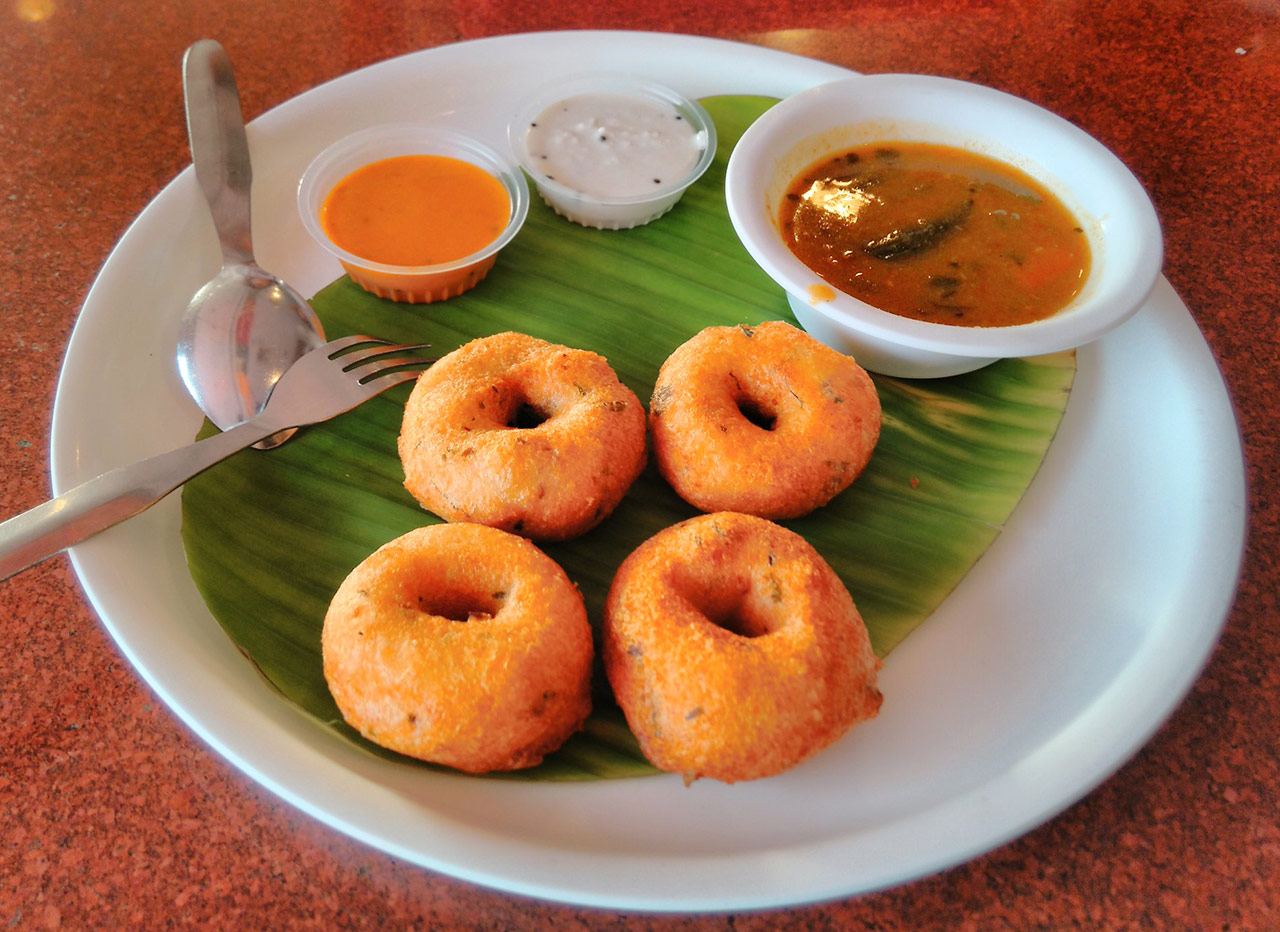
The deep-fried crust of the Vada produces a crispy cover around the mixed stuffing of black gram flour, cumin, curry leaves, onion, and chili. It is served with a spicy lentil soup and coconut chutney. The combination of one Idli and one Vada is a common preference for breakfast or snack-time.

3. Bonda

Image/Gopal Krishna/pixahive

The ball-shaped Bonda is a type of pakoda or dumpling usually eaten during breakfast or lunch. The people of Mysore love a popular variation of Bonda which is the Aloo Bonda, made from mashed potato. Like most local delicacies, Bonda is served hot with lentil soup and coconut chutney. A hot cup of tea is an excellent accompaniment during breakfast.

4. Khara Bath

Image/Megha Upadya/2.bp.blogspot.com

Khara Bath is also known as Upma and Uppittu. It is a conventional South Indian breakfast item that is made up of semolina, roasted with vegetables and spices. For a final delicious touch, one may top it with cashew nuts. Khara Bath offers a light, savory meal comprising only a few spices; yet it is fulfilling for the appetite. It can also be consumed with coconut chutney.

5. Kesari Bath

Image/Charles Haynes/flickr

Kesari Bath is a sweet delicacy conventionally eaten for breakfast. It is known by other names like Sheera or Sooji Halwa in Northern India. In Mysore, it is commonly offered as ‘prasad’ at temples during festivals. Also, it is a customary practice in most restaurants to serve a pineapple-flavored version of Kesari Bath on Sundays.

6. Mysore Masala Dosa

Mysore-Famous-Food-Masala-Dosa
Image/Nadir Hashmi/Flickr

Masala Dosa’s preparation varies from one region to another. The Mysore Masala Dosa specializes in its signature red chutney that is smeared on the inside of the cover. The crispy dosa is then stuffed with a preparation of mashed potatoes and onions, called Aloo Bhaji. Served hot alongside coconut chutney, the dosa is abundant for lunch.

Price: Masala Dosa usually ranges between Rs. 50 to Rs. 55 per plate.

Best Eateries: Gayatri Tiffin Room, Nalpak.

7. Uttapam

Image/Steve R /flickr

Uttapam is a thick and piquant rice pancake generally cooked with vegetables. A must-try variation of dosa, it tastes best when consumed immediately after it is prepared. The most popular versions of it are topped with onions and tomatoes.

8. Poori Saagu

Mysore-Famous-Food Poori Saagu
Image/Catie & Linds/Flickr

Poori varies in different regions as it is served all across India. In Mysore, it is known as Poori Saagu. The dough is deep-fried in oil until it becomes puffy and soft. It is consumed with a delectable preparation of vegetable curry.

  • Price: The price ranges from Rs.35 to 80 per plate.
  • Best Eateries: Vinayaka Mylari.

10.Shavige Bath

Image/Wikimedia

Shavige Bath is made from thin and light vermicelli. Chopped vegetables and nuts are added along with curry leaves, mustard seeds, and turmeric for a delightful flavor. The dish is light on the stomach, like Upma or Kesari Bath, and served with coconut chutney.

11. Bisibelabath

Image/Wikimedia

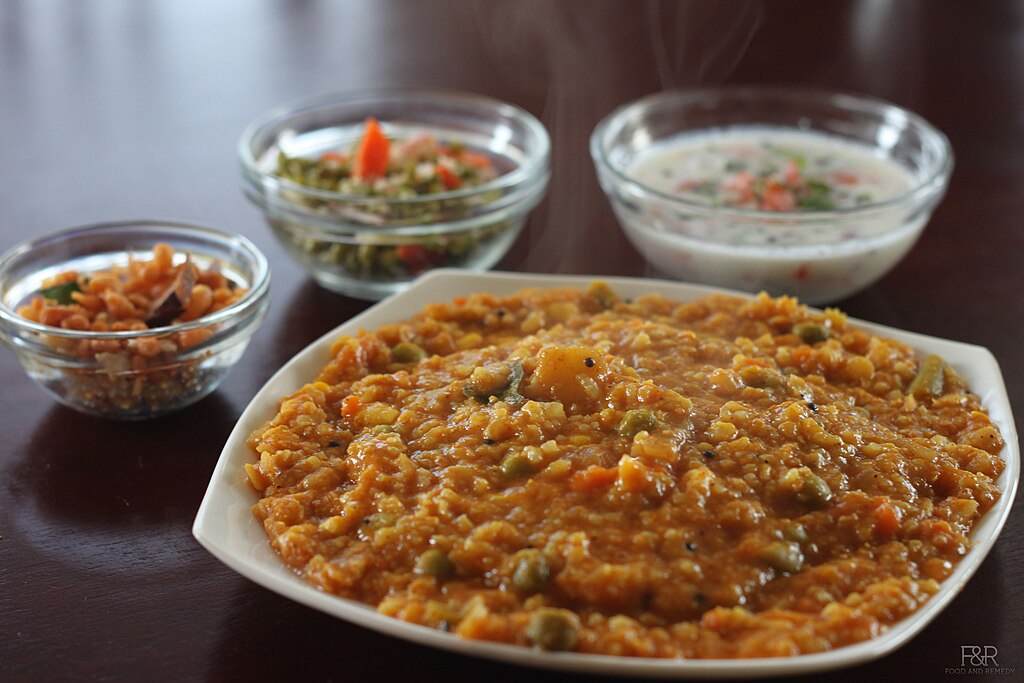
Bisibelabath is a popular lunch item of Karnataka. The name means “hot lentil rice” in the Kannada language. One can savor this dish to the fullest when eaten with chutney, boondi, salad, or even potato chips.

12. Mysore Pak

Image/Vijay Kumar/Flickr

The historical delicacy of Mysore Paaka was invented in the Mysore Palace during the reign of Krishna Raja Wadiyar IV. The brilliant royal chef, Kakasura Madappa, was the first to make this incredible sweet dish. Mysore Paak contains plentiful amounts of gram flour, sugar, ghee, and cardamom. The dessert is a significant cultural cuisine of Mysore. It is offered in most restaurants and sold in sweet shops by the kilo.

13. Payasam

Mysore-Famous-Food-Payasam
Image/Manish Chauhan/Flickr

Payasam is a creamy, sweet dish made with milk and rice or vermicelli. It is topped with nuts and raisins and poses as a lovely dessert for any occasion, be it a delicious diversion after lunch or a wedding ceremony.

14.Kori Gassi

Image/Wikimedia

Kori Gassi is a meat dish that originally belonged to the Bunt community of the Mangalore region. Today, however, this immaculate preparation is a favorite all across Karnataka among the non-vegetarian people. Also known as Mangalorean Chicken Curry, it consists of soft and juicy pieces of chicken cooked with finely ground fresh coconut and spices. It matches best with rice or Neer Dosa.

  • Price: It costs Rs. 150 per plate.
  • Best Eateries: Hotel RRR.

15. Hanumanthu Biryani

Mysore's-Famous-Food-Hanumanthu-Biryani
Image – Hanumanthuoriginal/FB

Hanumanthu Biriyani is one of the oldest and most authentic biryani you can get in Mysore. The place is legendary and getting a taste of the popular Mutton Biriyani is almost a herculean task! The biryani rice is filled with aroma and the perfectly cooked pieces of mutton, with a slight bite with the organ meat and fat of the mutton, intensify the meaty flavours in this biryani.

16. Tandoori Tea Hot Coffee

Mysore's-Famous-Food-Tanduri-Chai

Tandoori Tea is made by taking iron tongs and an earthen cup which is placed in a glowing hot tandoor (or just a large metal drum).

When the cup is fuming, it’s taken out and sweet milky chai is poured in (the same is done with coffee), which sizzles and froths over. Then this chai is poured into a different kulhad and served. The process gives it smoky, earthy tones, with some caramelisation from the sugar. It’s delightful and makes for an entertaining show.

17. Churmuri

Mysore's-Famous-Food-Churmuri-01
Image – Wikimedia

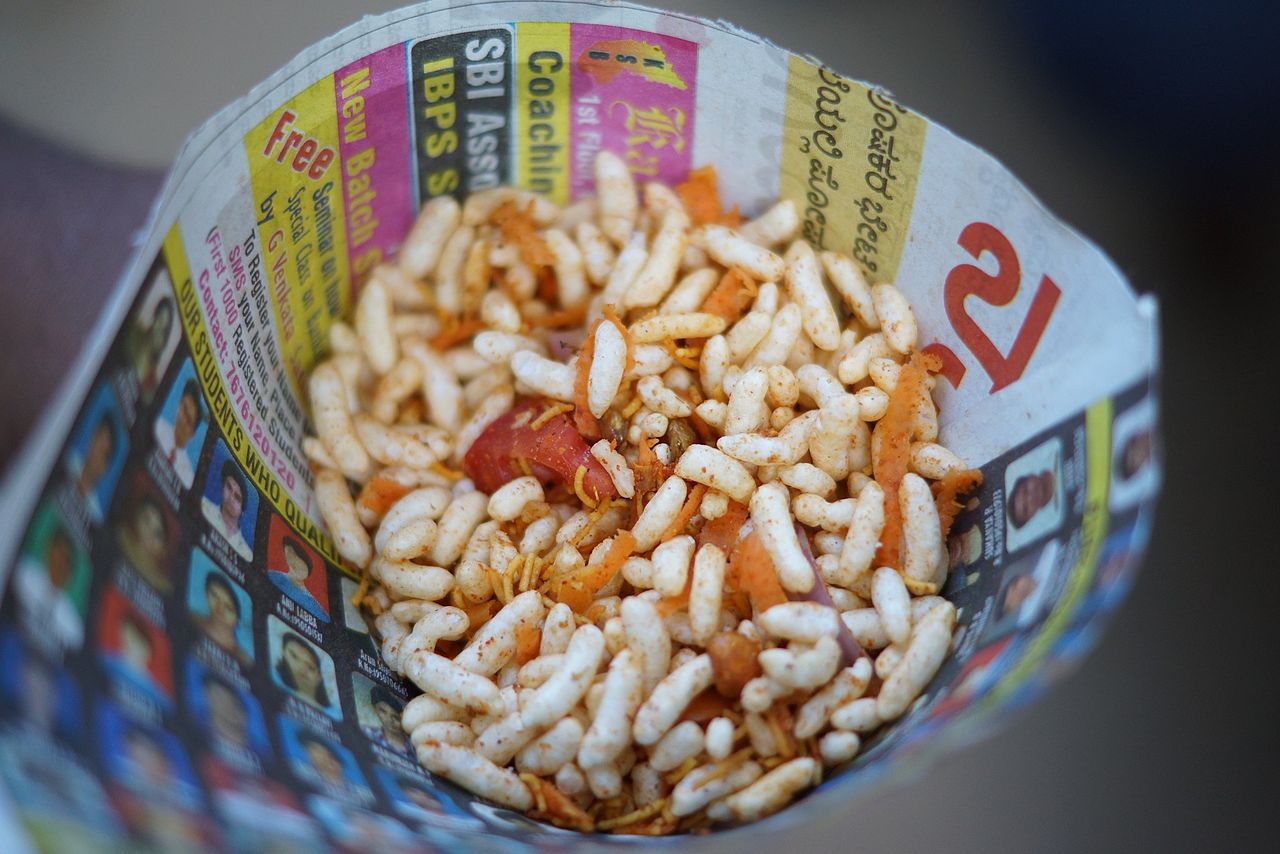
Like every State in India, Karnataka has its very own favourite evening snack, the Churumuri. This appetising mix of puffed rice, grated carrots and other seasonings has since seen many variations but the base remains the same — puri or puffed rice.

While Bhel-puri and Masala Pori have a few wet ingredients like tamarind syrup or boiled peanuts, Churumuri is a completely dry mixture. It’s a refreshing, crunchy salad with finely grated carrots, a little spice mixture, a handful of Congress kadlekai (spiced-shelled peanuts), chopped onions, tomatoes topped with a dash of lime and coriander. All this is cosily stuffed in a conical paper cup.

The places mentioned above are only a few of the numerous ones that serve delicious food in Mysore. There is an abundance of options for a new visitor to try out from.

Vuri Studio – Here’s To Having A Killer Wardrobe Without Killing The Planet

2

Urvi-Soni-Vuri-Studio-04

Fashion industry is an ever-growing industry across continents and cultures. However, it is also one of the major contributors to industrial waste, thereby polluting the environment. A great deal of fabric is discarded and dumped everyday! With the growth of various thrift stores and Indie sustainable brands, we found a brand that celebrates feminism and sustainability. Like the light at the end of the tunnel, we discovered Vuri Studio and it is our special find. We got real candid with the founder aka creative mind behind Vuri Studio, Urvi Soni.

The Beginning

Vuri-Studio-01

Urvi is a 24 years old fashion designer from Delhi. A student of fashion from the Pearl Academy, New Delhi and FIDM, Los Angeles, she found her niche in upcycling. From draping dresses on herself using her mother’s dupattas when she was 6, to crafting clothes for herself, she found her brand identity. Let us find more about her and her label:

What does your brand name ‘Vuri’ mean?

‘Vuri’ has no meaning of its own. It is an anagram of my name, Urvi. We define this word as having a killer wardrobe that doesn’t kill the planet. It also explains the brand’s philosophy. I defo hope that in the future Vuri finds its way to the wordbook and people associate it with sustainable fashion.

The Eco Touch

Vuri-Studio-02

‘Here’s to having a killer wardrobe without killing the planet’ – How do your collections promise what they preach?

Our fashion industry is said to be the second biggest contributor to pollution on this planet. The clothes that we wear have a very short life and mostly end up in bins or in landfills. There, they stay dumped for centuries and if burnt, release harmful chemicals into the air. We strongly contradict this practice and believe in giving a second chance to the fabric. 

In our collections so far, we have used fabric that was either discarded by us at home or by the export companies. This is one reason why we are conditioned to make one of a kind or limited edition pieces. We try not to follow trends and make statement pieces or use classic silhouettes so that our clothes can still be worn along the years without giving it a second thought and thus, extending it’s life even further. 

Urvi-Soni-Vuri-Studio-02

Additionally, we practice a zero waste policy at the studio where not even a single piece of thread goes into the bin. Whatever little waste remains, we use it to make bags, earrings or hair accessories. We avoid using any plastic trims in our clothes (zippers, plastic buttons, plastic beads) and opt for more sustainable alternatives, such as wooden buttons and drawstring closures and glass/wooden beads. We also try to keep our price points lower than most of the sustainable brands in the market, giving our customers a conscious alternative to fast fashion brands. 

We also keep our personal profits low, and our designs fun and spunky. We are making sustainable alternatives for people at an affordable price. 

The Inspiration

Urvi-Soni-Vuri-Studio-01

Just curious, how and when did it occur to you that you want to start your sustainable fashion label?

My mother used to make clothes for me while I was growing up. She stitched these from her old kurtas and left over fabrics from other projects. Each time I wore those garments out in public, I was flooded with compliments. This was significantly because what I was wearing was unique and not seen anywhere else in the market. And upcycling is all I have ever known all my life.

Then later in college, I realised that what I had been doing all my life is actually the need of the hour. Last year, during the lockdown, while I was making clothes for myself, I got the idea of starting my own clothing line of upcycled garments. Unable to walk out or source materials, I started making clothes from the bits and pieces I had at home, be it sarees, dupattas, shirts, bedsheets – everything that was available.

Where do you acquire your fabrics from? 

Most of the fabric so far has been acquired from home. These are mostly sarees and dupattas that we no longer used. Many of my relatives also provided me with their unused clothes. Then the fabric goes through a series of washing and sanitizing routines before we start working with them. Other than these, I source my fabric from export surplus markets in Delhi. 

For the Women

Urvi-Soni-Vuri-Studio-03

Does your label cater to every woman? If yes, then how?

With every collection I work on, I try to cater to a different woman. I love to experiment with different genres of capsule upcycled collections. Recently, I dedicated a collection to very tribal/boho vibes. Then, another one had badass street vibes. And my latest collection has very feminine, soft vibes. It’s a great way to reach out to different niches and challenge yourself to do new things. I am looking forward to continuing to experiment along the same base. I also make certain that my clothes flatter every body type and that all women feel comfortable wearing them. 

Name one favourite collection of yours so far. I would like to take the risk of asking you for your outfit from the same collection.

My favourite collection by far is the BANJARAN collection. It was a capsule streetwear collection confluencing with the age-old craft of bandhej and thus, giving it a modern look. Also, I loved each and every piece from that collection and so cannot pick one (giggles)

Follow V U R I | Sustainable Fashion on Instagram

8 Must Try Dishes in Pune that Describe Pune Food Culture

0
Pune Food
Image – Premshree Pillai/Flickr

Food connects people and defines a place, culture, custom, and tradition. It acts as a motivation for people, especially for passionate eaters. It is a way to link people of distinct cultures and traditions. When it comes to food, Pune is the perfect junction where a person can find assorted mouth-watering tasty delicacies amplified by its traditional aspect. Pune has been home to many saints, freedom fighters, and poets. Pune mirrors the Maharashtrian Culture. Pune is a west-central Maharashtrian state known by the name of “Queen of the Deccan”. It is a Queen for food lovers as it offers a wide range of variety in Maharashtrian courses. Thus, this stunning city is a famous food destination where one can get spicy tangy delicious food in any nukad and corner of the city. Pune food culture is an amalgam of tradition and food giving more refined flavors to the dishes. Along with this, the Maharashtrian spices add a spark to the simple yet piquant dishes.

Let’s take a look at some of the delicious of Maharashtrian food items that describe the food culture of the resplendent city, Pune:

1. Vada Pav

Vada Pav-Pune Food Culture
Image/ Akshay Gupta/Pixahive

Vada pav is one of the simplest yet best in taste dishes of Maharashtrian food. Vada Pav was invented by Ashok Vaidya, a local food vendor. Over the years this simple yet delicious dish has gained popularity. The vada, is a deep-fried dumpling made of spicy potato filling sandwiched between the bread roll, is served with a medley of chutneys which adds uniqueness according to the place. The famous one is the classic green chutney, red chutney, quite spicy in taste and the famous  red dry garlic chutney. The places to get the best of Vada Pav in Pune are Garden Vada Pav Centre, Parihar Sweets, The Wada Pav Café, and Priyadarshan snacks.

2. Pav Bhaji

Pune Food Pave Bhaji-01
Image/Wikimedia

Paav Bhaji is one of the popular street foods of Maharashtra. In Paav Bhaji, the Bhaji, made of mashed vegetables in a thick gravy of tomato puree vegetables and Maharashtrian spices like turmeric, red chili powder, paav bhaji masala, etc and decorated with sliced butter while Paav is the bread roll generously buttered on a hot pan. The dish served with sliced onions and lemon which enhances the taste of the recipe. The places where one can enjoy the best of Paav Bhaji in Pune are Relax Pure Veg, Falhaar, Supreme Snacks, Cream center, Siddharth Paav Bhaji and Durga Famous Paav Bhaji.

3. Puran Poli

Puran Poli-Pune Food Culture
Image/Wikimedia

Puran Poli is a well-known Maharashtrian savory in which flatbread stuffed with a dense sweet filling made of the powered gram, ghee, and jaggery. , it is a festive dish that makes the occasion more grand. In this dish, the sweet filling part is the ‘Puran’ while the flatbread part is the ‘Poli’. Served with a combo of milk and ghee to enhance the taste. It is also known as Holige, Obbattu, and Bobbattu in the Southern parts of India. It is healthy as it hastens the fat burning process. Mumma’s Kitchen, Hotel Peshwa, Saoji Khamang, and Asha Dining Hall, Ratnaj Kitchen, Shubhangi’s Kitchen are some of the places which are famous for Puran Poli in Pune.

4. Misal Pav

Misal Pav-Pune Food Culture
Image/Wikimedia

Misal Pav is a delicious breakfast recipe having originated from Nashik and Ahmednagar. It is a spicy and tangy delicacy. In Misal Pav, the Misal portion, made of sprouted pulses, is cooked with spicy Maharashtrian masalas, while paav is a bread roll generously buttered. The dish garnished with sliced onion, wedge lemon, sev, and coriander is irresistible. The places famous for Misal Paav in Pune are Vaidya Upagar Gruha, Khasbag Misal, Shri Kala Snacks, and Hotel Ramnath, Shri Krishna Bhavan, Hotel Malhar.

5. Sabudana Khichdi

Sabudana kitchdi- Pune Food Culture
Image/Wikimedia

Sabudana Khichdi is a famous recipe generally eaten during fasting and for breakfast. Sabudana is a carbohydrate rich variant of tapioca. Made of soaked sabudana with roasted peanuts, spices, and potato slices. The dish, served with sliced lemon and curd which complements the whole recipe. It is easy to make and good for digestion. The best places to get enjoy Sabudana Khichdi are Khadadi, Amruteshwar, Shree Upahar Gruha, and K2H Meals, Appa Deccan Gymkhana, Bipin Snacks, Kharadi Kharadi, Pune.

6. Bhajaniche Thalipeeth

Bhajaniche Thalipeeth-Pune Food Culture
Image/ Wikimedia

Bhajaniche Thalipeeth is a traditional Maharashtrian dish that is mostly served as breakfast or for snacks. So, in short, it is a multi-grain Maharashtrian flatbread made from roasted grains, cereals, and spices. It is a perfect combo of appetizing and healthy recipe full of nutrition. It is served with delicious butter and chutney, onion slices and chilies. The famous stops to enjoy this dish are Shabari Thalipith Centre, Durvankur, Wadeshwar, and Shabree Restaurant, Mathura, Khadadi, Durvankur.

7. Bakarwadi

Bhakarwadi- Pune Food Culture
Image/Wikimedia

Bakrwadi is a very famous Maharashtrian snack with a combination of sweet and spicy ingredients. The outer portion of Bakarwadi, made of either gram flour or all-purpose flour while the inner portion consists of stuffing made of poppy seeds, sesame seeds, tamarind, coconut, dry mango powder with some spices.  It is the perfect snack for your small breaks. The places to enjoy the best of Bakarwadi in Pune are Chitale Bandhu Mithaiwale, Hotel Shreyas, Kayani Bakery, and Martand Malhar.

8. Zunka Bhakri

Zunka Bhakri-Pune Food Culture
Image/Wikimedia

It is also known as Pithla Bhakri. It is a traditional vegetarian Maharashtrian dish. Pithla, which is also known as poor man’s food, made of gram flour which is mixed with water to form a paste. This is then cooked in oil and other spices such as turmeric, red chili powder, salt, mustard seeds, cumin seeds, and garnished with coriander. Bhakri is a flatbread made of wheat, jowar, bajra, rice, or nachni flour. It is very healthy and nutritious. This dish is usually served with spicy chili thecha, made of green chilies. The best places to have this dish in Pune are, Singhgad Fort, Hotel Girija,Kailash Garden, Maratha Samrat Restaurant, Mathura Pure Veg, Shantai Zunka Bhakar, Jhunka Bhakar Kendra.

Visiting Pune anytime soon? Well, make sure you try these dishes out to know about the Pune Food Culture!

Traditional Indian Way of Celebrating Birthday is Quite Different and Unique

2

Traditional-Indian-Way-of-Celebrating-Birthday

Well, when it is your birthday and your day probably begins with jingling birthday wishes that light up your phone every once in a while. There is a surprise birthday party or a bash you organize yourself. There is the cake, the snacks, the music and some merry time with your loved ones.

However, this form of celebration though fun is nonetheless essentially a western concept. It is no secret that Indians like to celebrate. The Republic of India has documented everywhere the planet as a rustic of endless cultural and ancient festivals and celebrations. Why ought to birthdays be something less? Birthdays in the Republic of India area unit an extremely huge deal and therefore the chance to pack in the maximum amount of celebration as potential isn’t taken as a right. Birthday rituals take issue slightly across the country and area unit distinctive to completely different regions. though several ancient ritual area units slowly dying out with modernization, above all inside the urban Republic of India, several area units are still discovered nowadays. The traditional Indian way of welcoming one’s birthday is quite different and unique and is still followed in many parts of the country.

Thanking God

Celebrating Birthday's the Traditional way
Image/Pixabay

A typical traditional birthday morning begins with a visit to the temple. Almost all cultures and religions that exist here believe in seeking blessings from the almighty as a very important ritual of birthday celebrations. This is a notable feature of the collective Indian culture. Where to embark on anything new, important, or joyous by first kneeling to the divine for thankfulness and prayers. This understanding is passed from one generation to another. It is a deep-rooted philosophy that in many ways humbles and revolves around the realm of spirituality.

In many Hindu homes, an aarti is prepared, with lighted diyas arranged on a silver tray, and is encircled over the birthday boy or girl. Rice smeared with turmeric is applied on the forehead. Prayers or pujas are also held especially on birthdays to ask the Gods for longer life, health and success. In many Muslim homes, a visit to the dargah or offering of chadars (netted flowers or material strewn carefully over the holy tomb) is a common practice.

Sometimes, coconut or dry fruits are laid out on a tray. They are encircled over the birthday boy or girl, very much like an aarti, to ensure that all ill-effects are waded away. Similarly, different regions and religions perform specific spiritual rituals and deem it the most important way to begin the birthday.

New Clothes

Celebrating Birthday's the traditional way
Image/Pixabay

Like youngsters in most cultures, birthdays square measure the most event of the year and cause abundant excitement. At school, kids in India square measure the center of attention on their birthdays, dodging their college uniforms for a fashionable, brilliantly colored outfit. the full outfit is sometimes fresh and worn for the primary time on their birthday. This is often followed by distributing sweets in the school and having the whole class sing for the birthday boy/girl.

Reaching out to the Needy

Another very interesting way of celebrating is to give and reach out to the less fortunate on birthdays. This may not essentially be only an Indian concept and is followed by many people across the globe. It is common practice in traditional birthday celebrations to give food, clothes, or money to the needy and poor. Usually, this is done to distribute food outside temples or give money to domestic helpers. Visiting an orphanage or shelter and spending time with the inmates is another way.

On deeper thought, it may be assumed that our elders sought to teach us that birthdays are more fulfilling when we try giving. Helping others and elevating ourselves to think beyond our existence alone. Also, the idea of sharing the joy with those who are less fortunate is a wonderful way to keep a check on growing arrogance. Inculcating traits of compassion. It also reminds us in today’s times, that on an occasion when you feel on top of the world, the best way to sustain and enhance that feeling is to make another lesser person’s day better by helping them. In some cultures, such as with the Parsi community planting a tree is deemed to be extremely auspicious on one’s birthday.

The differences between Indian and Western Celebrations

Birthday Celebrations the traditional way
Image/Wikimedia

So does this mean that modern western ways of celebrating one’s birthday are not a welcome addition to our already diverse culture? Well no! However, many subtle differences pop up between our traditional methods and modern ways. Simple examples, such as lighting candles and diyas on one’s birthday as opposed to blowing off candles on birthday cakes. It is believed that blowing off the light means cutting short life and diminishing success. On one hand, cakes are cut using knives. However, many traditional religions and cultures are averse to the idea of using any sharp object to celebrate birthdays.

Party time!

Celebrating Birthdays the traditional way
Image/Pexels

Surprisingly, though traditional celebrations lay importance on the spiritual, philosophical, and soul-stirring moments. It also encourages spending time with family and friends, have lavish birthday platters prepared, frolic, fun, and laughter. We all know that as we were growing up, though there were no parties on each of our birthdays like our mothers and grandmothers toiled endlessly in the kitchen to make delightful assortments and opulent meals, most of our likings. The whole household would be working since morning for the grand party that was to be held in the evening. The concept of celebrating one’s birthday with pomp though is restricted by some sects of religious groups. Overall, traditional birthday celebrations are no less festive than modern-day parties. There is food, calling over friends and family, an inflow of gifts and merriment.

Well it is your birthday and your phone may be jingling, your party planned and your mood upbeat, but take a while to bite into the sweet ladoos during aarti, say a short prayer, and help someone needy. After which you deserve a great party. Happy Birthday!

These Are Some of the Most Beautiful Places in the World To Visit

0

There are many reasons to seek out and visit beautiful places. Maybe you are looking for inspiration or inner peace. Maybe you are an avid social media personality looking to enhance your brand with travel photos. Maybe you are looking for significant experiences to share with loved ones. As long as you are respectful of the places and their people, there is no bad reason to seek out beautiful places to explore. If you aren’t sure where to start your excursions, here are some of the most beautiful places in the world you must add to your bucket list.

Glacier Bay National Park, Alaska

Most Beautiful Places in the World Glacier Bay National Park, Alaska
Image by kristirubino from Pixabay

If you’re thinking about cruises in 2022, consider an Inside Passage cruise. This allows you to travel by boat or kayak to Glacier Bay National Park. The trip gives you an opportunity to see wildlife such as mountain goats and bears on the shore, as well as marine animals such as sea lions and orcas. You may also get to witness the birth of an iceberg breaking off the Margerie Glacier.

Mount Fuji, Japan

Most Beautiful Places in the World Mount Fuji, Japan
Image by kimura2 from Pixabay

Mount Fuji is the tallest mountain in Japan and one of the most photogenic because of its symmetrical appearance and nearly perpetual cover of snow. Though an active volcano, Mount Fuji has not erupted since the early 1700s. While some people climb Mount Fuji, others prefer to admire it from a distance. In either case, you should try to schedule your visit for spring so that you can also experience the wonder of Japanese cherry blossoms in full bloom.

Black Hills and Badlands, South Dakota

Most-Beautiful-Places-in-the-World-Black-Hills-and-Badlands,-South-Dakota
Photo by Kevin Wenning on Unsplash

Many people don’t fully realize how beautiful this unassuming Midwestern state can be until they come for a visit and see it for themselves. Western South Dakota features the Black Hills and the Badlands, two completely different but equally gorgeous landforms. Covered in evergreen forests, the Black Hills are most famous as the home of Mount Rushmore, which is well worth a visit but shouldn’t be the only stop on your trip. Other attractions include an expansive state park, caves, canyons, nature areas, and a steam engine that takes paying passengers through some of the most pristine green countryside you will ever see.

The Badlands featured prominently in the movie “Nomadland,” winner of the Academy Award for Best Picture in 2021. The name comes from the Lakota language indicating how harsh and arid the region is. It is an otherworldly landscape of stone pinnacles and buttes that have been sharply eroded over millennia to reveal different-colored striations.

Banff National Park, Canada

Most-Beautiful-Places-in-the-World-Banff National Park, Canada
Image by Jörg Vieli from Pixabay

Banff National Park is located in the Rocky Mountains near the southwestern border of the province of Alberta. You’ll find some of the bluest water you’ve ever seen in its glacial lakes that reflect the surrounding mountains. There are plenty of accommodations to suit the preferences of all visitors, ranging from the cozy to the luxurious. Therefore, don’t cheat yourself out of a trip to Banff National Park because you don’t feel that you are particularly “outdoorsy.”

Machu Picchu, Peru

Most-Beautiful-Places-in-the-World Machu Picchu, Peru
Image by mailanmaik from Pixabay

Machu Picchu is an ancient terraced city located 8,000 feet above sea level. Not only does it offer sweeping views of the surrounding mountains but the remaining architecture is remarkable. There is a good reason why Machu Picchu is the most famous spot in Peru and designated a World Heritage site.

Venice, Italy

Most-Beautiful-Places-in-the-World Venice, Italy
Image by Gerhard G. from Pixabay

Venice is one of the most famous cities in the world because a good portion of it is underwater. Venice often has canals in place of streets and boats in place of cars. However, it is not only this curiosity that makes the city unique. Venice was also a medieval center of art, architecture, literature, and other scholarly pursuits. Just strolling along the arched bridges and sidewalks can be a wildly romantic experience. However, if you want to have an authentic gondola ride, that is an option as well.

It is worthwhile to seek out and visit some of the most beautiful places in the world. However, remember that you don’t necessarily have to travel far to find beauty. It is present in every place if you try to look for it.

List of Best IVF Doctors in Mumbai

0

IVF

In vitro fertilization (IVF) is a complex set of procedures used to aid in the conception of a child or to help with fertility or to avoid genetic problems. In IVF, mature eggs are extracted (retrieved) from the ovaries and fertilized in a laboratory with sperm. The fertilized egg (embryo) or eggs (embryos) are then transferred to a uterus for further growth. IVF takes about three weeks to complete. When these steps are broken down into smaller chunks, the process can take longer.

The most successful method of assisted reproductive technology is in vitro fertilization (IVF). Many factors influence your chances of getting a healthy baby through IVF, including your age, the cause of infertility, your doctor’s experience, clinic facilities, and so on. IVF is a time-consuming, costly, and invasive procedure. IVF will result in a pregnancy with multiple fetuses if more than one embryo is transferred to your uterus (multiple pregnancy). As a result, finding the right IVF doctor is critical for better outcomes. Your doctor should explain how IVF works, the risks involved, and whether this form of infertility treatment is right for you.

Dr. Mohit Saraogi

Dr.-Mohit-Saraogi 


Dr. Mohit Saraogi has earned three gold medals in the FCPS, DGO, and ICOG exams. He is one of the best IVF doctors in Mumbai because of his extensive expertise and experience in the field of fertility care. He is working with IRIS IVF centre in Mumbai. The hospital’s team of doctors, which includes full-time IVF specialists and an endoscopic surgeon, works tirelessly to ensure that patients receive good outcomes.

Apart from that, the IRIS IVF centre in Mumbai has state-of-the-art facilities and the most up-to-date medical equipment. We have state-of-the-art Andrology and IVF laboratories on site, which is the most important requirement for an IVF clinic. The progress rate of IVF/ICSI treatments is the most significant achievement of the IRIS IVF centre in Saraogi hospital. The procedure is performed using the freeze all process, which has a success rate of more than 70%.

Dr. Indira Hinduja

Dr.-Indira-Hinduja


Dr. Indira Hinduja was one of the first doctors in India to introduce in vitro fertilization (IVF). Dr Indira comes from a humble background and was trained as a gynaecologist and infertility specialist at the prestigious King Edward Memorial hospital in Mumbai.

She has come a long way from studying at a municipal school in Belgaum, Karnataka, with limited resources and in a period when girls were discouraged from attending school, to being awarded the Padma Shri in 2011.

As she puts it, as a child of this generation, she understands the value of opportunity. “There were many twists and turns in (my) life, so it was a ‘aha’ moment whenever I could transform adversity into an opportunity.” Dr. Hinduja is now practicing at the Hinduja hospital in Mumbai, where she helps couples struggling with infertility.

Dr. Hrishikesh Pai

Dr.-Hrishikesh-Pai


Dr. Hrishikesh Pai, MD, FCPS, FICOG, MSc, is a leading gynecologist in the world. He is currently the Secretary General of India’s Federation of Obstetric and Gynaecological Societies (FOGSI). In 2006, Dr Pai served as the Senior Vice President of FOGSI.

Since 1991, Dr. Pai has been a pioneer in the area of infertility and IVF. He is the Director of the Bloom IVF Group, which owns and operates nine IVF clinics across India, including Lilavati Hospital and Bhatia Hospital in Mumbai, as well as Fortis Hospitals in New Delhi, Gurgaon, Faridabad, Noida, Mohali, and Navi Mumbai.

He was the first doctor in India to implement a number of medical breakthroughs, including assisted laser hatching, spindle view, ovarian tissue freezing for cancer patients, oocyte freezing, IMSI, and the embryoscope. In 2013, the international agency Frost & Sullivan awarded him the best IVF community in India award in recognition of his significant contributions. In recognition of his efforts, Dr. Pai has been elected to the International Federation of Fertility Societies (IFFS) as a member of the Board of Directors, a first for an Indian.

Dr. Akash Surana

Dr.-Akash-D-Surana


Dr. Akash Surana, is currently employed by Nova IVF Fertility in Andheri, which is located in the heart of the city and is ISAR-certified (Indian Society for Assisted Reproduction). This centre has a patient-centred care program that has assisted us in addressing the best male and female infertility therapies.

At Nova IVF Fertility in Andheri, a team of skilled medical professionals, including in-house gynecologists, IVF physicians, and infertility specialists, ensure that you receive treatment procedures that make your path to parenthood as easy as possible. To that end, they have the most cost-effective care options, including 0% EMI and other simple payment options.

Dr. Jatin P. Shah

Dr.-Jatin-P.-Shah


Dr. Jatin P Shah is known for conducting all IVF tasks himself, including Ultrasonography, Oocyte Retrieval Surgery, IVF Embryology, and Embryo  Transfer, resulting in extremely high success rates. His ability to troubleshoot and solve problems in various laboratories’ IVF and ICSI systems has won him the nickname “IVF Commando.” Over the last two decades, he has brought joy to infertile couples by assisting them in realizing their hopes of having a child or children.