Splendid Folk Dances of Jammu and Kashmir You Must Experience in The Valley

1
Dances-of-Jammu-and-Kashmir-1
Photo by Imad

What do you get when you combine vivid scenic beauty, including various serene lakes and gardens, soft pashmina shawls, exceptional handicrafts, and apples so delicious, trust me, will spoil the rest for you? You get paradise on Earth. You get; Jammu and Kashmir and it’s a personal guarantee that folk dances region will captivate you with their charm. It’s shocking, nay, disheartening, that more people aren’t aware of this. So let’s fix that, shall we? Let’s take a look at some of the splendid folk dances of Jammu and Kashmir you must experience in the valley.

1. Kud Dance

Folk-Dances-of-Jammu-and-Kashmir-Kud-01
Image Source

At the zenith of folk dances in Jammu and Kashmir lies the dance of Kud, which is executed by the inhabitants of the region at night gathered around the bonfire contributing to its ‘homey feel. This truly enchanting piece is considered a thanksgiving dance because it is presented to state deep gratitude towards the Lok Devtas (gods of the people). This piece is mainly by farmers who sometimes refer to the gods as ‘Gramdevta’ (the gods of the village) to show their appreciation for providing the people, cattle, and crops protection from natural disasters. What makes this piece extraordinary is its inclusive nature. The steps are quite simple and men, as well as women of all ages, enjoy the rhythmic dance of Kud.

Tourists also often join in and are overwhelmed purely because of the joy and merriment around them. It is normally performed by 20 to 30 members who are beautifully dressed in vibrant colors. The men wear kurtas and churidars, conventionally of the same color along with a turban while they are playing a melodious tune on the trumpet. The blend of music produced by the various instruments such as drums and flutes is a true representation of the culture of Kashmir.

2. Rouf Dance
Folk Dances of Jammu & Kashmir-Rouf
Image/ Ramesh Lalwani/Flickr

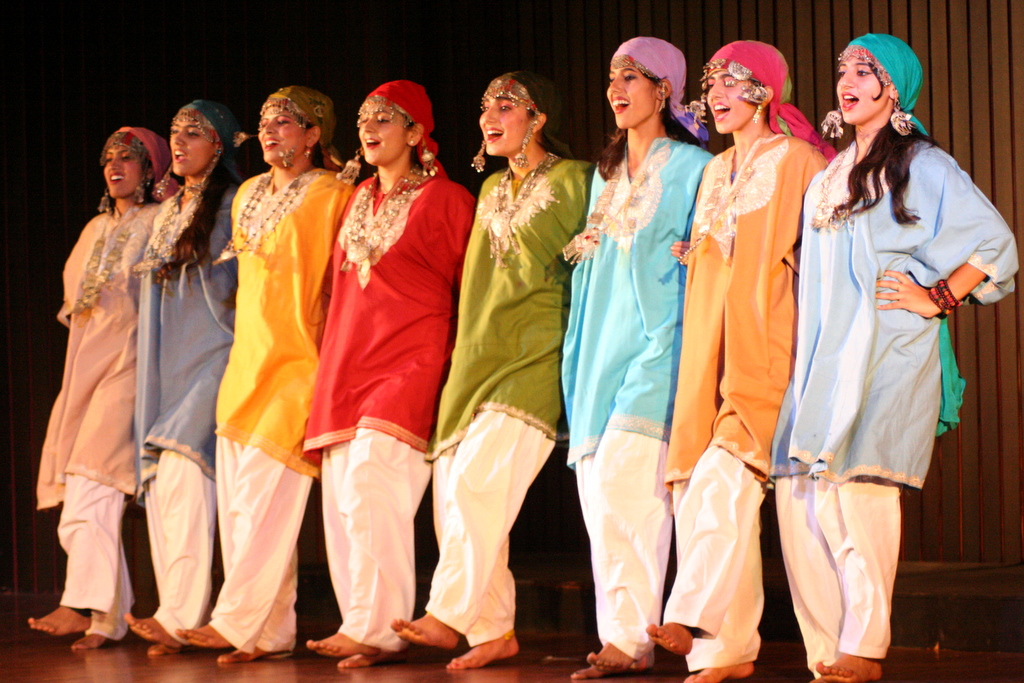
An integral component of the ethos of Jammu and Kashmir, this mesmerizing dance was initiated by a society of Muslim Kashmiri women. It is presented by a group of women who stand in front of each other through its entirety. Their attire comprises beautiful traditional dresses paired off with exquisite jewelry. It is ordinarily executed during spring when the weather is quite blissful as well as on festivals such as Eid and Ramzan. Furthermore, it also celebrates the yielding season. The women rhythmically perform to the melody of mystical poems that comprise the music for this dance which is praised by all for its intricate footwork referred to as Chakri in the local language which can only be described as eloquent. That also forms the reason this dance has received recognition both nationally and internationally.

3. Dumhal Dance

Folk Dances of Jammu & Kashmir-Dumhal
Image/Wikimedia

Another eminent dance form of Kashmir is Dumhal. The dancers comprise of the men of the tribe of Wattal, who execute this moving piece mostly on special occasions of merriment to the tribe itself. A bright and vivid robe with a conical-shaped cap that is decorated with ornamental beads forms the get-up for this alluring dance. The dancers apart from dancing also sing in a melodious chorus accompanied by drums. The specialty of this piece is that the dancers dig a flag/banner with a special message on it at the location previously decided and the performance commences with them dancing around said banner.

4. Hafiza Dance
Folk Dances of Jammu & Kashmir-Hafiza
Image/rajeshnyahoo

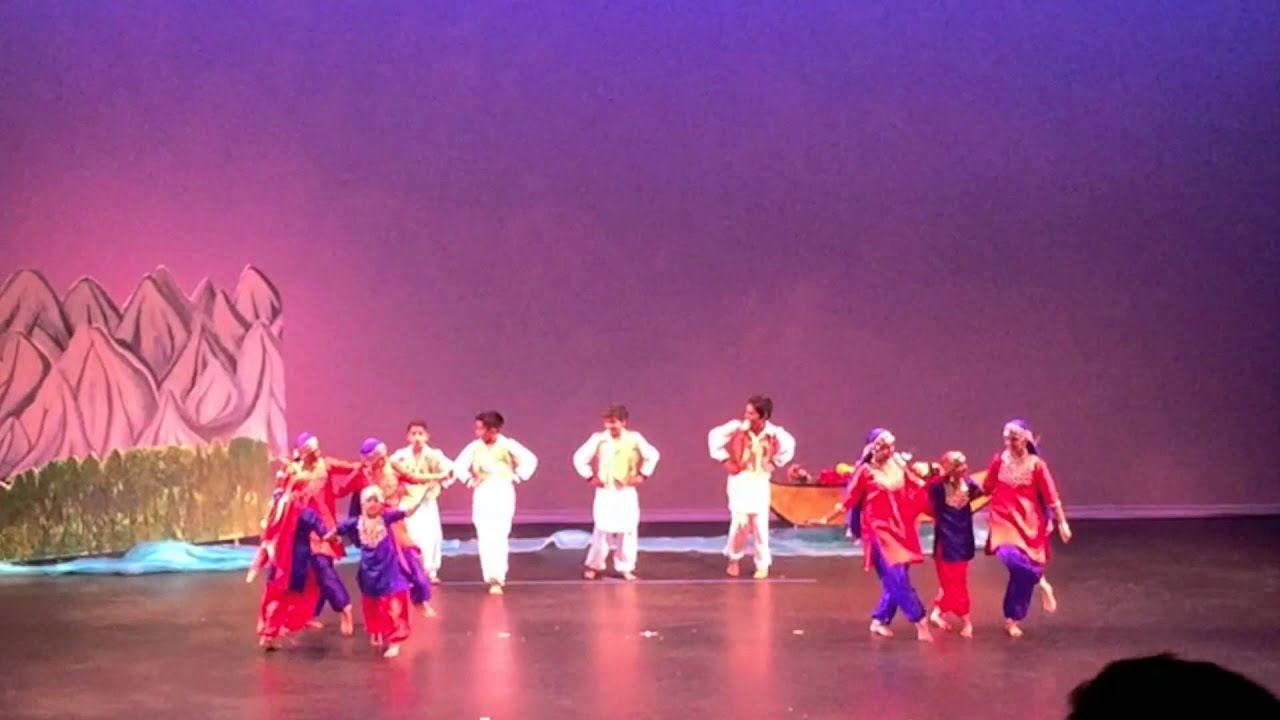
Hafiza forms an essential fragment of the Kashmiri culture. It is executed by Kashmiri women wearing bright-colored attire. The movements give the impression that they are quite simple. However, the reality is far from it for the dancers are trained and make it seem effortless. The dance is predominantly performed on the occasion of weddings. It is said that Hafiza has been inspired by Persian literature and Sufi philosophy and is danced to the melody of Sufi Kalam Music, the classical music of Kashmir. That is accompanied by a special instrument called ‘Santoor’ which is a stringed instrument and is played by a stick.

5. Bacha Nagma Dance

Folk-Dances-of-Jammu-and-Kashmir-Bacha-Nagma-01
Image Source

The Bacha Nagma Dance is a variation of the Hafiza dance which was thought to be ‘too intimate’ as per the Maharaja of Jammu and Kashmir and was therefore banned. The dance’s origins can be traced back to Afghanistan. It is executed by young boys to disguise themselves as girls by the clever usage of long skirts and other colorful female attire along with makeup. It is usually executed on festive occasions such as parties and as well as during the yielding seasons. This dance was a very prevalent source of entertainment due to the loud music and the overall exciting temperament of the dance, during ancient times. The adolescent boys can impeccably imitate the steps and formations of the female dancers. They also sometimes sing by replicating the voices of girls, adding on to the ‘entertaining’ quality of it.

6. Bhand-Pather Dance

Folk-Dances-of-Jammu-&-Kashmir-Bandh-Pather-02
Image Source

The Bhand-Pather is an infamous dance throughout Jammu and Kashmir. It is a dance with the twist that well, the dancers utter dialogues. When broken down into it, this play-cum-dance has three elements: Classical Instrumental Music, Dance, and Acting. The word Bhand refers to Clown and the word Pather means Celebration which indicates the humorous style of the plays. The music is produced by various instruments such as the dhol, nagara, and swarnai. It is executed typically on joyous occasions, such as festivals. In this dance, the men sometimes take up the parts of women and Muslims take up the parts of Hindus which teaches the audience the lesson of unity in diversity and embracing our differences. Unfortunately, its popularity is declining in the current scenario and therefore we need to take sustainable steps to preserve it and stay connected to our roots.

I have always been a firm believer in embracing your past and culture. However, it seems like not everybody shares the same opinion. The decline of folk dances and the shifting focus on contemporary dances is concerning, to say the least. It is the need of the hour to generate awareness about the same and encourage taking pleasure even in the simplicity and grace of folk dances. I truly hope that said realization is achieved via joint action by the community to protect the sanctity of our culture.

Suggested read: Kashmir Quotes and Captions

Expert Guide To Choose The Best Sports Shoes For Men

0

Guide-To-Choose-The-Best-Sports-Shoes-For-Men

Footwear makes up for a massive part of both our wardrobe and our personality. All the different types of shoes available in the market have something that works great for everyone. No matter what occasion or what outfit you want shoes for, the footwear industry will have just the thing for you. However, while versatility in your footwear collection will surely go a long way, any collection is incomplete without a few shoes that go with anything and everything. Having some fashionable yet comfortable shoes that look perfect when paired with all types of clothing is very important, and there’s nothing that fills this role better than sports shoes for men. 

While the history of sports shoes for men dates back as far as the 1800s, they have undergone many changes throughout the years. Having been a standard part of countless fashion trends, sports shoes for men are a favourite and have never changed. Sports shoes have been intensively developed and are now manufactured to rank high on many different aspects that make them so popular. Due to this, choosing the best sports shoes for men can be a tricky game to play. So, here’s a quick guide to how you can pick out the best ones for you:

  • Fit: This factor requires careful consideration as the wrong fit can lead to significant discomfort or even potential injuries. Measure the length as well as the width of your shoes and aim for one that fits snugly. It should not be too tight or too loose, and a bit of space between your big toe and the shoe is mandatory. If you’re buying sports shoes for men online, shop from sites like Mochi Shoes that have reliable sizing charts.
  • Comfort: The stability and fit all play a part in the comfort, so make sure you go for a textured outsole as those provide a sturdy grip to prevent any accidents. Look for cushioned footbeds to make sure the impact between your foot and the ground never hits too hard. Also, look for any tags or stickers on the inside of the shoe that can later be uncomfortable.
  • Material: Sports shoes for men are made of many different materials, and all of them can affect the weight, comfort, durability, etc., of your shoes. So, make sure you go for materials like nylon, polyester and even spandex. These are all flexible, stretchable, moisture-wicking and regulate the temperature in both cold and hot weather.
  • Purpose: While sports shoes for men are versatile, it is essential to remember that these come in various types, too. Consider your needs before you go shopping for sports shoes for men as the ideal pair for you will differ according to your requirements.

Along with these, style certainly plays an integral part in how well your shoes work for you, so don’t be scared of exploring different colours. Neutrals, vibrant colours, warm colours are all great, and you can shop for them in high-quality options from Mochi shoes. Get started!

The Original Keventers, Now Shakes Square, Delhi: The Real Reason Behind The Name Change

2

Keventers-Milk-Shakes-01

Connaught Place is one of the eternally busy hubs of the capital. Life palpitates here. It is a fairly frenetic business centre, a shopper’s delight and a reunion hotspot for friends. The Georgian-styled buildings stand tall as the colonial hallmark; the ever-crowded shopping spree station Janpath and the peaceful Sikh temple Gurdwara Bangla Sahib are some places to come home to. Amongst these hustling-bustling hubs rests a small but utterly popular shakes outlet, formerly called Keventers.

If you are a true Delhite, you would be aware that Keventers has been the original server of flavored milk even before it was cool. Strawberry, chocolate, butterscotch, cold coffee, vanilla (and many more) are some flavours that customers still savour on. There is a nostalgia in their shakes that Delhites still resonate to. However, in the recent past there have been too many Keventers outlets around the city. 

What led to such an expansion?

Keventers-Outlet

The recent branches around the city are not related to the old Keventers. In fact, the Original Keventers never was the Original Keventers (WHAT!). It was an eponymous franchise of the many Edward Keventer [Successors] Pvt. Ltd. that were set-up in the 1920s.

The story of Edward Keventer [Successors] Pvt. Ltd.

Shakes-Square-Delhi-01

In the 1920s, Edward Keventers, a Danish dairy entrepreneur, decided to set up dairy manufacturing units in India. Within a decade he set up-eponymous plants in Delhi, Aligarh, Calcutta and Darjeeling. By the 1940s, Edward Keventer emerged as one of the prominent dairy manufacturers in India. After Independence, the dairy acquired Indian ownership, when Ram Krishna Dalmia bought the Keventer dairy project located in Sardar Patel Marg, Delhi from Edward Keventers’ son, Werner. Thereafter, the company is known by the name Edward Keventer [Successors] Pvt. Ltd.

R K Dalmia continually upgraded the facilities, focused on modernization and added newer variants and products. The latest milk bottling machinery manufactured in England called UDECK was added. To ensure freshness and purity, a pasteurizer made by a Swedish company, ALFA LAVAL was acquired, a reputed brand even used today in milk pasteurization.

To increase the company’s milk varieties a cream separator made in Westphalia, Germany was purchased. With this, they produced toned milk, skimmed milk, full cream milk, etc. With separated cream, they were also able to produce butter, therefore a butter churner SILKEBORG was imported from Denmark. Butter and ghee later became popular products. The final addition to the Keventers plant was NEDOU, the milk powder atomizer that enabled the conversion of milk into condensed milk powder. At that time these acquisitions enabled Keventers to develop into a leading manufacturer of dairy products.

Original-Keventers

Keventers condensed milk powder and milkshakes became known far and wide. In Delhi alone, Keventers had 48 distributors (Shake Square being one of them) and stockists, a distribution network that had grown to meet the increased demand for fresh Keventers’ milk. Through this wide network, milk, milkshake, ice cream and butter reached different parts of Delhi. Less perishable items such as condensed milk and milk powder were shipped to various markets throughout the country.

By the late 1960s, Keventers was equated with dairy excellence. All products had the ISI standardization mark as well as the AGMARK mark of quality. It is therefore not surprising that even the armed forces throughout the country, including such far flung places as Assam, relied on them for condensed milk and milk powder. Due to this, in 1969 the Lt. Governor declared in a written communication that Keventers was a Public Utility Undertaking.

Keventers-Milk-Shakes

Our typical ice cream cart all over Delhi was cream coloured with red borders, however the late 60s saw Keventers’ carts bathed in psychedelic colours. In the early 70s Keventers’ appointed an ad agency – Ad Infinitum – and launched various catchy and attractive slogans such as ‘I scream, you scream, we all scream for ice cream’

At the Asia ’72 exhibition, the Keventers’ stall was very popular. They had many ice cream varieties in cups, cones and bars. One of the most expensive was cassata, with a triple layer of strawberry, vanilla and pista, resting on a bed of delicious spongy cake.

The butter they sold was wrapped in a cream and blue printed wrapper and was much in demand for its quality. For those who wanted the goodness of ghee there was nothing like Keventers. One of their most remembered products was their milkshakes. Attractive wide mouthed bottles containing nourishing Keventers’ milk arrived fresh and cool every morning all over the city, with water droplets forming over the bottles and red and blue aluminium foil caps. Three of the most popular flavours were yellow banana, pink strawberry and green pineapple. The name of Keventers became synonymous with dairy products in Delhi, for example, a milkshake was no longer referred to as a ‘milk’ shake, but rather as a ‘Keventers’ shake.


View this post on Instagram


A post shared by Keventers (@keventers)

As the city of New Delhi grew and changed, so did the area of Chanakyapuri in which the factory was located. It became a prime residential and diplomatic area, rather than an industrial one. Keventers therefore was no longer allowed to run its dairy factory there. This proud dairy of Delhi which had been carefully planned and located next to its market, was forced to close its doors.

In 2015, Agastya Dalmia, the great-grandson of Ram Krishna Dalmia, along with his friends Aman Arora and Sohrab Sitaram, decided to resurrect the brand. The first outlet launched in March 2015 in New Delhi, India. Upon receiving an overwhelmingly positive response, they quickly expanded their outlets across 65 cities in India, Kathmandu (Nepal), Dubai, Sharjah, Nairobi (Kenya). The legacy lives on and a new chapter is being written in their story. (Source: https://www.keventers.com)

Name change and more

Keventers had not been in business since the 1970s, as stated by the now owner Agastya Dalmia. But the very popular CP branch had been active all this while. When Agastya Dalmia decided to bring the brand back to life, the unregistered Keventers branch in CP was already doing business. In an amicable settlement, the then Keventers decided to give up the namesake and rename their outlet as Shake Square. 

More than 48 years of creation and serving of cult milk bottles teaches us the compliant ways of adhering to the new school of business. In 1971, Sh. K.L. Pahuja, founder of Shake Square, introduced the concept of flavoured milkshakes with his secret recipe of 7 flavours blending it with milk to get that pure bottle of happiness. (Source: http://shakesquare.co.in/about)

Despite all the inevident ruckus this may have caused the two entities and the consumers, shop #17 in Block A will always be reminiscent of the good ol’ days that breathed life. 


View this post on Instagram


A post shared by Shake Square ® (@shakesquare)

How to reach: Get down at Gate 7 of Connaught Place Metro Station
Location: Shop No. 17, Block A, Inner Circle, Connaught Place
More about Shake Square: http://shakesquare.co.in/
More about Keventers: https://www.keventers.com/

Enchanting Folk Dances of Andhra Pradesh Reflecting Telugu Culture

6
Folk dances of Andhra Pradesh
Image/Wikimedia

The only Indian state with three capitals – Andra Pradesh is a boon to India. Packed with emerald greenery, soul-soothing rivers and serene temples, the state of Andra Pradesh lies on the southeastern coast of India. While it is widely known for its rice agriculture (also known as the ‘rice bowl of India’), Andra Pradesh is also well stocked with plenty of indigenous art and culture. The traditional dances of this state are highly regarded and are performed in several parts of India. Below listed are a few popular dances prevalent in Andra Pradesh that will make you fall in love with the state:

1. Kuchipudi

Folk Dances of Andhra Pradesh-Kutchipudi
Image/Wikimedia

One of the 8 classical dances in India, Kuchipudi originated from the ancient text of Natya Shastra. The dancers are adorned with lovely, colorful jewelry and a traditional saree. The dance is pleasant to watch and contains both fast and slow movements. Along with vocals, the dance also consists of several instruments to create a musical sound, such as the veena or violin, the mridangam, and a cymbal player. Kuchipudi mainly plays the role of alerting people about the evil powers that exist in the world. Interestingly, it is said that Kuchipudi gets its name from a village with the same name.

2. Veeranatyam

Folk-dances-of-Andhra-Pradesh-Veeranatyam-01
Image Source

Also known as Veerangam and Veerabhadra Nriyatam, this dance form is performed as a tribute to Lord Shiva. The men in this performance maintain complex and fierce positions to honor the incarnation of Lord Shiva, Veerabhadra. The interesting story behind the roots of this dance goes back to when Sati was humiliated by her father, Daksha. Legend says that after she sacrificed herself, Lord Shiva arose, furious and agonized, and gave birth to two forms; one of which was Veerbhadra. The birth of the two forms was followed by widespread destruction and loss. It is said that the descendants of Veerbhadra carry on this age-old dance to date. The dancers skillfully display the fury and tsunami of emotions that Lord Shiva felt after the death of his beloved.

3. Burra Katha

Folk Dances of Andhra Pradesh-Burra Katha
Image/Wikimedia

A form of theatrical performance, Burra Katha is a narrative that includes dance, dialogues, poems, music, jokes, etc. The main idea behind the performance is to showcase the devotion of the dancers towards their God. It usually contains 3-4 dancers with only one (main) storyteller. To aid the music, the dancers play tambura and veena extensively throughout the performance. Originally done as a pastime in villages, Burra Katha now is also seen during festivals such as Diwali and Sankranti.

4. Andra Natyam

Folk Dances of Andhra Pradesh-Andhranatayam
Image/Jogesh S/Flickr

Andra Natyam is a dance form that was discovered about 2000 years back. Similar to Bharat Natyam, this dance form focuses more on the foot movements and facial expressions of the dancer. Due to its purity and sanctity, Andra Natyam is usually performed by temple dancers and it makes use of several musical instruments such as the veena, tanpura, manjira, and surpeti. Although this exquisite dance form was on the road to decline during the Mughal reign, it was fortunately revived in the 20th century. Both men and women can perform this dance.

5. Vilasini Natyam

Folk Dances of Andhra Pradesh-Vilasini Natayam
Image/Ramesh Lalwani/Filckr

This special dance is solely for the Telugu Devdasis. In simple terms, a devdasi is a woman who is married to the temple deity and is considered especially auspicious. The devdasis danced in the courts of kings for entertainment and to educate the people. They used dance, to convey music and knowledge of literature to people. In another instance, they would also perform for the illiterate audience and convey the knowledge and stories from the Hindu scriptures. This dance form was heavily scrutinized during the British raj and was condemned, however, people are now gradually reviving and honoring the Vilasini Natyam for its grace and beauty.

6. Butta Bommalu

Folk Dances of Andhra Pradesh-Butta Bommalu
Image Sourtesy / Kowshik Maridi

The epitome of color and joy, this dance form truly mesmerizes its audience. Butta Bommalu correctly means ‘basket toys’ or ‘dance of masks’ because this folk dance uses life-sized toy-like costumes, which are hollow from the inside. Wearing big, colorful clothing, the dance does not make use of sound. The performers simply imitate the characters, causing raging curiosity amongst their audience. Butta Bommalu essentially celebrates happiness during festivals. Therefore, the costumes usually vary depending on what festival it is. For example, the costumes of Hanuman, Parvati, Lord Shiva, and Ram are most likely to be seen.

7. Lambadi

Folk Dances of Andhra Pradesh-Lambadi
Image/Ramesh Lalwani/Flickr

The number of fascinating tribal communities in India will leave you awestruck! And to know about their cultures and traditions is cherry on top! The Lambadi dance is the folk dance of the Banjara community of Andra Pradesh. It is mainly done to celebrate and praise the Lord for a good harvest. While women are known to perform this tribal dance, men aren’t restricted to take part. Furthermore, the heavily embroidered clothing and heavy brass ornaments worn by the performers add to the beauty of this dance.

8. Kolattam

Folk-Dances-of-Andhra-Pradesh-Kolattam-01
Image Source

Known as the ‘Stick Dance’, Kolattam is prevalent in several parts of India with different names. The history behind the origins of this village dance form is highly interesting. The story follows the vicious and malevolent demon Basavasura who reaped havoc in the village. One day a group of girls performed the Kolattam dance routine in front of the asur. Basavasura was so enchanted by the graceful dance that he quickly relinquished his abhorrence. Moreover, it is also said that Basavasura was an incarnation of Lord Shiva, the destroyer. The beauty of the dance is enhanced by the bright-colored skirts of the dancers. They wear lovely jewelry and synchronize their footsteps to form a splendid dance pattern. Truly a treat for the eyes!

9. Dappu

Folk-Dances-of-Andhra-Pradesh-Dappu
Image Source

Dappu is the traditional form of percussion instruments. It uses a very simplistic drumming instrument. It is an integral part of many folk forms of performing arts and folk dances, especially the Dappu folk dance. Made of goatskin, a tambourine-like drum is struck with sticks producing a rhythm that is softened by the ankle bells that the 16 to 20 dancers wear. Dappu dancers are at the front of any procession, whether it be for jataras, festivals or marriages, this is truly a celebration of the percussive powers of dance. This invigorating art form hails from Nizamabad District. The performers in colourful make-up and even more eccentric costumes dance to the musical patterns set by cymbals, tabla and a harmonium. Mythological themes are usually enacted and the audience is rural folk.

10. Dhimsa

Folk-Dances-of-Andhra-Pradesh-Dhimsa
Image – Wikimedia

Dhimsa is a dance which does not discriminate and is suitable for people of ages from the Valmiki, Bagata, Khond and Kotia clans – dwelling in the charming Araku Valley in the hilly stretches of the Vishakhapatam area. Tribals perform this dance during the months of Chaitra i.e March/April, at weddings and different events. During the celebrations, artists of one village visit the other to participate in the dance and join the community feast. Such is known as the “Sankidi Kelbar”. A remarkable aspect of the Dhimsa dance is that it encourages friendship and fraternity between individuals of various regions. This being traditionally an ancestral dance, womenfolk are attired in common ancestral dress and adornments and dance in gatherings to the tune of Mori, Kiridi, Tudumu, Dappu and Jodukommulu.

11. Tappeta Gullu

Folk-Dances-of-Andhra-Pradesh-Tappeta-Gullu
Image Source

Tappeta Gullu is a devotional dance of Andhra Pradesh common in the districts of Srikakulam, Vizianagaram and Vishakhapatnam. During ancient times it was performed by cowherds and shepherds to entertain the Rain Goddess, Gangamma. At present, the dance is performed in all village festivals celebrated in honour of the deity. The vigour, rhythm and tempo of Tappeta Gullu is exceptional. The songs that are sung throughout the Tappeta Gullu dance are mostly in praise of Lord Vishnu. Tappeta Gullu is performed by a group of twelve to thirty men, who are dressed in a shirt, a turban and a loincloth. They also wear ankle bells. The performers of the dance are accompanied by Tappeta or gundlu, hung on the chest. It is a musical instrument comparable to a drum. The dance of Tappeta Gullu requires tremendous skill and muscle power. A vital characteristic of the dance is that while dancing the artists display rare skills in acrobatics. While performing, the dancers stand one above the other on the thighs and shoulders of each other and form the shape of a gopuram or a tree.

12. Bonalu

Folk-Dances-of-Andhra-Pradesh Bonalu
Image – Rajesh_India/Flickr

Bonalu began as a harvest feast gradually progressing into a procession dance. It is one of the folk festivals prevalent in the Telangana region of Andhra Pradesh. Celebrated in the month of Aashadha, according to the Hindi calendar, (which falls in the month of June or July) this festival is predominantly seen among Hindus. An intriguing thing about Bonalu is that women participate in the procession carrying ‘Ghatams’ or ornamented pots filled with flowers on their heads. The women devotees also carry brass vessels or clay pots filled with cooked rice and adorned with neem leaves. In the procession, men accompany the women devotees by playing the drums and go to worship the local deity. Dressed in multicoloured dresses they balance the pots to the rhythmic songs and tunes, sung in glorifying the village deity Mahankali. The male dancers are known as Potharajus, lead the procession by lashing whips and neem leaves.

It is rightly said by our forefathers that dance is the language of the soul. Performed for thousands of years, these folk dances speak of ancient cultures and traditions which have been carefully preserved and treasured. These dance forms and folk arts form an integral part of our identity. By knowing these traditions, we can know what our age-old culture holds for us. We need to carry these dance forms forward and pass this gold on from generation to generation. After all, we owe it to our forefathers, don’t we?

Sculpting Art: Giving Life to Earth!

0
Sculpting-Art
Image/Pixabay

Chipping and shaping stone and metal into figures and objects and bringing them to life is no mean task. The sculpture is an Art form that has continually been the center of attraction. The emergence of this art form dates back to the traditional past, once when the civilization was in its developing stages. As time marched on, Indian sculpture has flourished and evolved an excellent deal. Since the first ages, Bharat sculpting has undergone completely different phases through experimentation and sensible superior skill. With its potentialities in its varied dimensions, Indian sculpture found an equal footing with alternative two art forms — painting and handcraft. The current article is aimed toward educating those that have the interest to understand the techniques, individualism, and also the intricacies of the world-renowned Indian sculpture of each past and gift.

With its abundant history and cultural richness, India is home to several fine specimens that are unit testament to the distinctive ability of these estimable sculptors. World Health Organization introduced new designs and forms. With its original firmly entrenched into the traditional timeframe of Indus depression Civilization, Indian sculptures depict completely different histories concerning themselves that provide the United States a way of understanding the amount.

Majorly inscribed from stone, earthenware, and bronze, these celebrated Indian sculptures represent an era that left its marks because of the proof of their existence. Sculptors have a skill of persisting over their task creatively and adding meaning to a piece of otherwise, shapeless object. Sculpting in India, is in fact, pretty ubiquitous as we are surrounded by sculptures, some of which we hardly seem to recognize or register. Statues and sculptures have always been important landmarks, showcasing the symbolization of ideologies and personalities. And sculpting of religious deities and structures is inherent to the spiritual structure of the nation’s religious and cultural society.

History of Sculpting Art

Sculpting Art History
Mahabalipuram Mahishasura /Wikimedia

One of the finest sculptures dates back to the Indus Valley Civilization. The Dancing Girl of Mohenjo- Daro is more than 4000 years old and is an exquisite piece of metal sculpting along with a few other stone and bronze sculptures. The earliest sculptures to be standing in their place of creation were formed during the reign of Ashoka. Where the Mauryan Empire created wonderful statues that to date are symbols of integrity. The Ashoka Pillar, Yaksha Statue, sculpting on Shanti Stupa, and many other Buddhist and Jain statues still exist.

Next were the Cave Temple arts, immortalized by the Temples of Khajuraho, as well as, the bronze sculptures of religious deities during the Chola Dynasty reign in southern India.It was only during the colonial rule that sculpting shifted focus from religious figures to making statues of real people. The statues of Queen Victoria and various governors-general were erected, as well as, there was a heavy foreign influence in subject and style during the British rule. Post-Independence has seen the advent of modern sculptors that include DP Roy Choudhury and Ramkinkar Baij.

Figures of Gods in Sculpting Art

Sculpting: Giving Life to Earth
Khajuraho/Wikimedia

Sculpting deities and religious heads have been and continue to be a big part of Indian sculpting. Idol worship is one of the fundamentals of the Hindu religion and in temples across the country. The deities and sculpted with a lot of care and reverence. In many specific festivals, such as Ganesh Chaturthi in Maharashtra or Durga Puja in West Bengal, the idols are prepared for months by skilled artisans using various kinds of raw materials.

Similarly, Buddhism also has contributed to the development of religious sculptures. Many statues of the Buddha in various poses and stances are spread across the monasteries and Buddhist centers. Some of these include the Great Buddha in Bodhgaya, Reclining Buddha, and the Standing Buddha in Sarnath. Besides, the statues of Buddha, the Buddhist style of sculpting are also recognized in various places. Such as the Indian Emblem and Ashoka Temple. Again, Hinduism, Jainism, and Buddhism styles have given us gems, such as the Ajanta Ellora Caves.

Ajanta Caves – Salil S/Flickr

Religion and mythology being the foremost common subjects within the medieval age, most of the Indian sculptors found them engraving temple walls and etching rocks into prodigious bodies of Hindu and religious belief deities. As time marched on and completely different artworks emerged, Indian sculpture additionally began to evolve clutches newer techniques and approaches. The sculpture within the medieval era shifted a lot towards the portrayal of the modern social life vogue. Besides, it adopts several foreign influences, while not rejecting Indian attributes.

Personalities in Sculpting Art

Sculpting: Giving life to Earth
Bodh Gaya kaniths /Flickr

During British rule, the focus of sculpting shifted to building statues of important people. During the early British rule, the statues were placed within churches. For example, the sculpture of Lieutenant-Colonel John Campbell in St. Thomas Cathedral in Madras. English sculptors also built monuments, memorials, and government houses which are iconic landmarks of cities, such as Flora Fountain in Mumbai or Victoria Memorial in Kolkata.

Sculpting Art in Modern Times

Sculpting: Giving life to Earth
Victoria Memorial, Kolkata/Wikimedia

Modern sculptures found a unique place that was influenced by its all predecessor generations, yet matched with its age and time. Many are credited with forging nationalist sentiments with their works during the Independence struggle. Ramkinker Baij is considered one of the most prominent sculptors of this time and is credited with amalgamating the western and traditional styles to form a modern outlook. The famous Santhal Family, his sculptures of the Bengal Famine, and Dandi March are some examples of his excellence.

Some other big names in the modern sculpting field include DP Roy Chowdhury known for his sculptures of the Triumph of Labor in Chennai. Fanindra Nath Bose, VP Karmarkar who sculpted the bronze 13 feet high Shivaji statue in Pune, and more. For those interested in looking at the works of upcoming sculptors, a visit to the National Gallery of Modern Art of NGMA in Delhi can do wonders. One can witness the works of sculptors of our time, such as KS Radhakrishnan and Sankho Chaudhuri.

Sculptures, monuments, and statues in India are a large part of our physical city, village, and even tourist landscapes. They attract visitors, on one hand, devotees on the other, and at times, they just happen to be found on our road intersections too. They are found at our railway stations, at markets, and also in galleries. And thus it remains one of the finest and most accessible art forms of India.

Folk Dances of Assam – Mesmerising Expressions of Assamese Culture

2
Folk Dances of Assam
Image/Pxhere

Assam is one of the seven sisters of the north-eastern states and is known for its picturesque scenic beauty, wildlife, silk, and handicraft and how could anyone forget about the tea so delicious, it might leave you delirious. Assam also possesses an exotic culture full of life and the folk dances of the state are no exception. Grab a cup of some lovely Assamese tea and get ready to be enchanted by the magnificence of some of the most popular folk dances of Assam!

1. Bihu Dance

Folk-Dances-of-Assam-Bihu
Image/Wikimedia

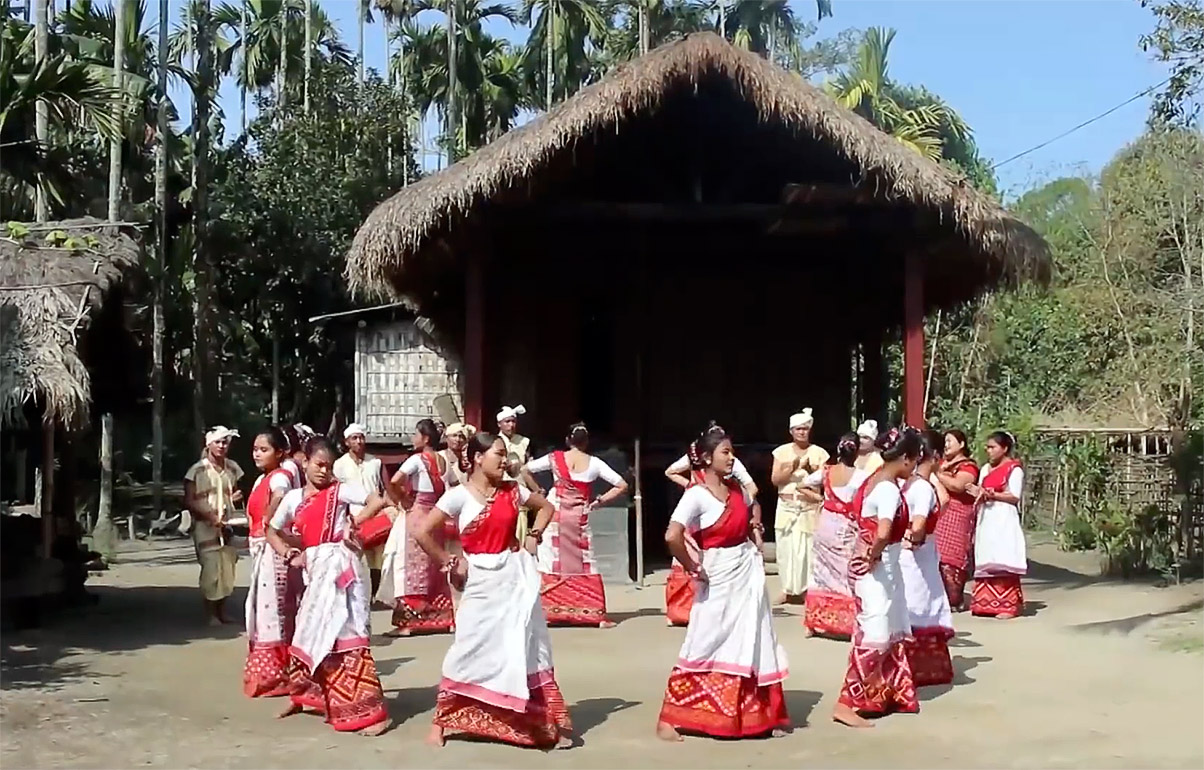
Watching most beautiful folk dance form of Northeast “Bihu” being performed, one cannot help but start smiling as they watch the people of Assam dancing and enthusiastically celebrating their regional new year on Ranguli Bihu which is from where the dance derives its name. What makes this dance special is firstly its invigorating movements and formations which involve energized hand movements and steps. Its colorful and bright costumes make the dance even more extraordinary. The girls look truly beautiful wearing a costume called ‘chadormekhela’ which is mainly made from silk, which is also something Assam is renowned for.

The boys’ attire comprises a dhoti and gamocha, a type of turban. They dance to the tunes of various instruments, mainly the ‘Dhol’ and ‘Pepa’, which is a hornpipe. Its origins can be traced to the districts of Tezpur and Darrang as early as the 9th century. A little-known fact about Bihu is that it was originally a courtship dance and therefore is also considered as a symbol of merriment and seduction. Bihu has managed to create an impact at a global level which is something that we can all be proud of.

2. Jhumar Dance

Folk-Dances-of-Assam-Jhumar
Image Courtesy – Indancesteps.blogspot.com

Another eminent dance form of Assam is Jhumar which is popular with the tea community who after a day of hard work commemorate the occasion of their apparent freedom from work by dancing. It helps them to get away from the tedious nature of their work. That is why this dance form is also known as Chah Baganar Jumur Nach. It is specially performed during harvest festivals as well as other joyous festivities. The reason this dance is referred to as Jhumar is because of the bells worn by the dancers around their ankles which make the ‘jhumar’ sound.

The Jhumar dance has various variations depending upon the occasion. It may be portrayed as a ritual of devotion, as a courtship dance, or as a request to the gods to serve the people with rain and to later thank them for the same. It can be typically witnessed in an open area, with the male dressed in long traditional apparel playing the Mandar which is a type of drum, while the women gracefully execute various movements in sync with hands on each other’s waists. It is truly a refreshing symbolization of the epic highs and lows of just everyday life which is something rarely seen.

3. Bagurumba Dance

Folk-Dances-of-Assam-Bagurumba
Image – Shirushree Saikia

Bagurumba dance is a piece that is mostly performed by the Bodo tribe of Assam. When you witness the dance and notice the formations executed by the dancers, they remind you of nature and wildlife with some of them depicting birds, animals, a flowing river, and so on, and the creative usage of the cloth around their neck (which is special to the Bodo community) during the dance immediately causes your mind to resonate it with the image of a butterfly flapping its wings which is why it is also called the ‘butterfly’ dance. It is mainly performed by women at the Bwishagu Festival who dance to the tunes of various instruments such as the Serja, Jota, Gongwa, etc. The women are dressed in their traditional vibrant clothing which poetically represents nature.

4. Sattriya Dance

Folk Dances Of Assam-Sattriya
Image/Ramesh Lalwani/Flickr

When describing this dance form, the first two words that come to mind are elegant and graceful. Sattriya is one of the eight principle Indian Classical Dances (it received said status in the year 2000 by the Sangeet Natak Academy) and its origins are traced back to the monasteries called ‘Sattras’ that were set up Mahapurush Srimanta Sankardev for the spread of Vaishnavism during the 15th and 16th century in Assam. The dancers perform to the tunes of Assamese music called Borgeet. Sattriya depicts the stories of mythologies and the lessons learned from them in mainly three themes: Ramdani, Guru Vandana, and Geet Abhinaya. This dance form also stands out particularly because of the costume’s alluring blend of colors which is a perfect representation of the Assamese culture.

5. Deodhani

Folk-Dances-of-Assam Deodhani
Image – Ramesh Lalwani/Flickr

Deodhani is another dance form popular in Assam. It is typically performed by one person or a group of three to four women to honor Manasa, the snake goddess. It is a Shaman folk dance. The word ‘Deo’ means god and the word ‘Dhani’ refers to a woman possessed by a shaman. The dancers take swords in their hands as props and they present a war dance with their hair kept open. The dancer depicts a strong woman, a warrior who is unmarried and a believer of Goddess Padma and takes charge of her fate following the legend of Behulaa who had to dance to protect her husband’s life in front of Manasa.

6. Gumrag

Folk-Dance-of-Assam-Gumrag

Gumrag makes the list of one of the most infamous dances in Assam, particularly famous with the people of the Mishing tribe. Gumrag is performed during Ali Aye Ligang  festival, it is usually associated with agriculture because of the reflection of its meaning. The word ‘Ali’ means roots and seeds, the word ‘Ai’ means fruit and lastly, the word ‘Ligang’ means sowing. The dance’s said connection with agriculture is the reason it is enthusiastically celebrated by both boys and girls, dressed in traditional clothing with brisk movements, during the Ahu Paddy Cultivation to appreciate our Mother Earth.

Apart from the tea and silk, Assam has so much more to offer and its folk dances are one of them. They are a truly immersive experience that I, personally, would recommend you witness. However, the very little knowledge about them is what disappoints me for they are a gem left undiscovered. Let’s leave no stone unturned. Let’s enjoy the beauty of our rich culture and heritage.

Also Read
Vibrant Folk Dance Forms of Northeast India
Northeastern Tribes of India – Little Known Things About Their Culture
Folk Dances of Himachal Pradesh – Reflecting the Culture of Pahari people

Folk Dances of Himachal Pradesh – Reflecting the Culture of Pahari people

8
Folk dance of Himachal Pradesh
Kayang Dance /Wikimedia

The land of hill stations, Himachal Pradesh encompasses a ton additional to be savored, and unfortunately few tourists. If you’re thinking that Himachal Pradesh is all concerning mountains, hills, forests, and valleys, then you continue to haven’t witnessed its actual beauty, that lies in its antique culture and traditions. Yes, you’ll savor the whole Himachal Pradesh provided that you rehearse the paths of its villages and tiny cities that have been alive for hundreds of years. Ancient dance is a very important part of the Himachali culture. To watch someone dance is to watch their heart speak and their spirit let go. As anyone who has watched a folk dance being performed can attest to, it derives its beauty from the grace and elegance of the movements and the look of merriment, joy, and pride on the dancer’s face. It is rightly said, “Heaven may be a myth but Himachal is real.” Let us dive into some of the truly breathtaking folk dances of Himachal Pradesh that symbolize the culture of the place:

1. Nati Dance

Folk dances of Himachal Pradesh-Nati
Image/Wikimedia

Nati is one of the most prominent dances of Himachal Pradesh which is enthusiastically performed in different forms throughout the state such as the Shimla Nati, Kullu Nati, Shiv Badar Nati, Sirmauri Nati, to name a few. Nati is a dance of celebration, whether it be the new harvest season or a marriage in the family. Both men and women take part in this dance dressed in colorful attire. It is a beautiful depiction of a story, for example, the Kullu Nathi customarily tells stories such as the ras-Lila or stories involving Hindu Gods Krishna and Gopis. Nati can be considered an essential part of any function in Himachal Pradesh. This dance also holds the title of the largest folk dance, about the number of people, in the Guinness Book of World Records. This was inevitable because the fanfare and festive nature of the dance in a way forces every spectator to join.

2. Dangi Dance

Folk-Dance-of-Himachal-Pradesh-Dangi-Dance-1
Image Source

Another popular dance form of Himachal Pradesh is Dangi. It is predominantly performed by female dancers, wearing traditional dresses, holding hands to form a semi-circle, and dancing with their lower bodies. This dance takes place at Naina Devi’s Temple as a symbol of their devotion. It is based upon classic folklore of the state and has two themes. The first one depicts the eternal feeling of love. A charming and courageous king who fell in love with someone he wasn’t supposed to – a common girl. Their love was deemed wrong and they were shamed for it but as we all know, love conquers all. The second one is business, which is a necessity for survival and it shows us the simple process of a person giving their products and services to someone and in return, they ask for something of value to them. That is how business works and so does life.

3. Chhanak Chham Dance

Folk-Dance-of-Himachal-Pradesh-Chhanak-Chham-Dance-01
Image Source

This dance is performed in honor and memory of Lord Buddha usually by monks or lamas in front of monasteries during religious festivities. This dance is renowned for its intricate costume made from red and yellow glitters, oversized masks that have bizarre and peculiar designs made from wood, paper-mache, and plastic along with headgear known as Chhanak from which the dance gets its name. Their appearance and the knives and swords they hold make them look similar to soldiers.

Legend states that this holy dance is a form of exorcism and gets rid of evil spirits that may be wandering around by symbolizing the death of the Evil King who represents the demons, monsters, and natural disasters that may befall upon us. For precisely this reason, it is also known as ‘Devil Dance’ and people from all over the village gather to watch it. The instruments enclosed during this dance type are ‘Tangchim’(the long pipe-like instrument), Drums called ‘Ghann’. The dance is legendary for its Headgear that appears completely unique, as well as its costumes, and masks. The dance is additionally well-known in an exceeding exceeding country like Singapore.

4. Kayang Mala Dance

Folk-Dance-of-Himachal-Pradesh-Kayang-Mala-dance-1
Image Source

The Kayang Mala or the Garland Dance is one of the most famous dance forms of Himachal Pradesh. It derives its name from the garland formed by the dancers by weaving their arms in a criss-cross pattern and each dancer becomes a bead or a part of what goes on to be a truly alluring formation. Each one of the ‘beads’ is beautifully dressed and heavily ornamented. It is a common tradition to consume a glass of Chhang before the dance. Today, Kayang is one of the foremost ancient dances in Himachal Pradesh, and therefore you mustn’t miss out on exploring its beauty. So, pack your luggage and witness in person the villages of Himachal Pradesh now!

5. The Rakshasa (Demon) Dance

Rakshasa (Demon) Dance is also known as Chhambha Dance and it is said to bear similarities to the bhangra dance in Punjab. Its origins can be traced to the Kinnaur region in Himachal Pradesh. Kinnaurs are a representation of spirited deer in this mesmerizing piece. This can be seen during joyous festivals such as Chaitol and Bishu with men and women holding hands and dancing. The dancers wear masks to depict demons attacking the fields and crops and them being chased away by the forces of gods. Their leader is referred to as ‘Ghure’ and everyone follows the path laid down by them.

I envy anyone who has the privilege of witnessing these enthralling dance forms in person. I, myself, am enticed to purchase a ticket to Himachal Pradesh to take in their beautiful culture which is elegantly portrayed through these dances. Dance is an expression of man and always has a story to tell. It is rightly said, “The best and most beautiful things in this world cannot be seen or even touched – they must be felt with the heart.”

Also Read
Vibrant Folk Dance Forms of Northeast India
Northeastern Tribes of India – Little Known Things About Their Culture
Folk Dances of Assam – Mesmerising Expressions of Assamese Culture

Top 15 Street Food of Kolkata You Must Try When You Visit the City

0
Kolkata-Street-Food
Image – Nicolas Mirguet/Flickr

Street food is pretty much the heartbeat of a town or city. It finds its presence amid throbbing crowds and the hustle of street life. There is a very rustic and rooted feeling that forms the basis of street food as hawkers sell their tasty dishes in an ambiance that is far from the lush luxury of a restaurant. Usually squatted on a box or standing, the sellers operate with alarming dexterity as they almost single-handedly serve the ongoing crowd that gathers together awaiting their turn patiently. There is a subtle mix of the aroma of the food mixed with the whiff of sweat and the noise of the traffic. 

Several cities and towns of India are famous for their street food, but Kolkata somehow takes away the crowned glory of housing several delectable and delightful street foods that are lip-smacking, innovative, and very light on the pocket as well. 

Street food Kolkata stands out for its variety and discernable distinct taste. Its street food touches upon all kinds of food, whether it is dry, roasted or fried, crunchy, soggy, or spoonful. 

Whether it is Tibetan momos or south Indian dosas, north India’s Dahi vada or eastern India’s Aaloo luchi, Kolkata streets have it all lined up. Here is taking a look at the top 15 street foods of Kolkata and the best places to try them out. Let’s hope we can wander once again and binge at these favorite street food stalls soon.

1. Puchkas 

Kolkata-Street-Food-Puchka
Image-Saurabhdas/wikimedia

Undoubtedly, the most prized street food of Kolkata, the puchkas are what people call Pani puri in Maharashtra and Golgappas in north India. However, there is a twist. The stuffing is made from potatoes and along with the tangy water the puchka just slurps in the mouth as once crunches their way through them. you will find Puchka sellers in almost every locality at a distance of not more than 3-4 streets away. They are the most ubiquitous street food with a loyal customer base of the surrounding neighbourhood. Some popular stalls to try out the puchka are Gariahat Road, Vivekananda Park, Bhawanipore, Vardan Market, etc.

2. Churmur 

Kolkata-Street-Food-Churmur
Image Courtesy – Bong Eats /Youtube

A street food closely related to the puchka, the churmur is made from crushed dry puchka puris. Potatoes, onions, tamarind, etc. are added to it to give a spicy and tangy taste. A unique Kolkata street food the churmur is served at all puchkas stalls. You can try it out especially at Bhawanipore, Southern Avenue, and Park Street. 

3. Kathi Rolls 

Kolkata-Street-Food-Kathi-Roll
Image-Satyajit Dhawale (Satyajit888)/wikimedia

With juicy, roasted kebab fillings delicately enveloped in tender and layered parathas, the Kathi roll is among the heartiest and most satisfying of street foods in the city. A roll should be always be served hot. So the assembly process, once the paratha has been fried, needs to be quick and efficient. The filling should be evenly distributed so you get a little of everything with each bite. Finally, the mark of an excellently wrapped roll is that you can eat it using just one hand. In Kolkata, shops serving rolls are widely called ‘Roll-er-dokaan’ and people use ‘roll’ to refer to a Kathi roll. Chicken roll and egg roll are the two most common variants of Kathi roll. Best places to try out the same are:

  • Nizam’s Restaurant: 21&22 Hogg Street, New Market, Dharmatala, Kolkata
  • Kusum Roll: 21, Karnani Mansion, Park Street Area, Kolkata, Taltala, Kolkata

4. Jhaal Muri 

Kolkata-Street-Food-jhal-muri
Image by M Ameen from Pixabay

Puffed rice has never been so appetizing as when made into the jhaal muri. Mixed with onion, tomatoes, sev, etc., and a dash of the special masala, the jhaal muri is a light breezy snack that is one of Kolkata’s best street foods. And of course, besides the muri itself, the small paper ‘thongas’ or bags in which it is served also adds to the experience of devouring it. Some great places to try out the jhaal muri are Triangular Park, Jawaharlal Nehru Road, Lord Sinha Road, etc.

5. Mughlai Paratha

Street-Food-of-Kolkata-Mughlai-Paratha
Image – Hmm!/Youtube

The very beloved street food of Kolkata, Mughlai Paratha is basically a deep-fried rectangular paratha that is folded like an envelope with a rich filling of eggs, keema (minced meat) and lots of spices. The name itself generates interest in its origin.  Bored with simple paranthas with kheema, Emperor Jahangir gave his cook Adil Hafiz Usman to make something unique, which came to be known as Mughlai parantha. Later it had been brought to Kolkata by Usman’s offspring and became widely popular in Kolkata at Mughlai restaurants and among the Bengalis. If you want to try this lip-smacking stuffed deep-fried bread, then you must visit the following eateries that serve the best Mughlai paratha in Kolkata.

  • Anadi Cabin – 9A, Jawaharlal Nehru Rd, Esplanade, Dharmatala, Taltala, Kolkata, West Bengal 700013 
  • Basanta Cabin – 53, College Street, near Medical College, Kolkata

6. Shingara or samosa and kachoris

Kolkata-Street-Food-Shingara
Image-Priyam1307/wikimedia

What is known as samosa in most parts of the country are fondly called shingaras in Kolkata? These triangular fried snacks are just perfect with the evening tea. The stuffing which is usually made of potatoes also ranges from chicken, mutton, moong dal, and more. Similarly, kachoris are fried stuffed round snacks that are usually found alongside the samosa. Shingaras are also readily available at most tea stalls across the city. Some places that you can try out this delicacy are Balaram Mullick, Nabakrishna Guin (Bowbazar),Haldar Mohashay (Shovabazar Bazaar) etc.

7. Aloo Kabli 

Kolkata-Street-Food-Aloo-Kabli
Image Courtesy – Subhrajit Chakraborty/Youtube

Aloo kabli is one of the most popular street dishes and is found outside almost all schools in Kolkata.During tiffin breaks, or after school, children gather around the tiny makeshift stand that the aloo kabli seller sets up with rapt attention, mouths watering. Within minutes freshly made aloo kabli is filled in tiny thongas (small pockets) and handed out, to be hungrily devoured and shared with friends. Made with potatoes mixed with spices, tamarind, chickpeas, onions, etc. this is a flavorful dish that will keep you licking your lips for long. Try this at Surya Sen Street, Vardaan Market, C.R Park etc.

8. Ghugni Chaat 

kolkata-street-food-Ghugni-Chaat
Image-lorises/Flickr

Made with yellow peas, Ghugni is a healthy street food option. It is one of the most loved of Bengali snacks. It is a dish made of curried whole-yellow peas or motor (matar) dal. A proper ghugni is one in which the motor dal is well-cooked, but remains a whole. The key is to never overboil the dal. The consistency also needs be just right, slurpy but not watery. Mixed with tomato, onion, and spices it conjures up a delightful plateful. One can try out the ghugni at New Market, Dacres Lane, Gariahat Market, Ramji Ghugniwala (Park Street) etc.

9. Chops and Cutlets 

Street-Food-of-Kolkata-Chops-and-Cutlets 
Image Courtesy – Mitra Cafe

There is nothing warm and fuzzy like munching on a fried soft vegetable cutlet or meat and fish chops. Fish Fry, Alur Chop, Vegetable and Tele bhaja are just some of the fan favourites. Served with various sauces and salad including the iconic Kasundi these are often served as accompaniment with the evening tea or chai. Best places to try them out are Badshah (Jadavpur), Mitra Cafe (Sobhabazar) and Apanjan in Kalighat. 

10. Chow Mein 

Kolkata-Street-Food-Chow-mein
Image-Aaron Gustafson/Flickr

Now what most people would know as noodles, is called chow mein in Kolkata. The long noodles are tossed with vegetables or chicken along with various sauces. Common street food is also packed to carry home. Yes, it’s a different feeling standing on the roadside with friends slurping on the chow mein as the stall owner deftly tosses and turns the ingredients on a large pan or tawa and expertly pours it out on plates. Try the chow mein at Dacre Street, Vardan Market, Park Street, China Town and more.

11. Momos 

Kolkata-Street-Food-Momos
Image – Eatbhaieat.blogspot.com

A Tibetan delicacy the momos are also a wonderful and filling street food of Kolkata. Served usually with pepper soup and the chili garlic sauce, the momos are hot and spicy tantalizing the taste buds to the tee. Both the steamed and fried momos are easily available. China Town, Tiretti Bazaar, Rabindra Sadan, and Camac Street are some places where you can try eating the momos.

12. Kochuri Alur Dom

Street-Food-of-Kolkata-Kochuri-Alur-Dom-
Image – Tanhir Paakshala/Youtube

A meal that can be eaten for any meal of the day, be it breakfast, lunch, or dinner the luchi or puri served with potato curry is a mouthwatering dish. Sometimes the luchi is also stuffed with dal making it even more yum. One can try it at Dacre Street, BBD Bag, Phears Lane, etc.

13. Mishti

Street-Food-of-Kolkata-Mishti
Image – Pexels

When in Kolkata how can you ignore the ‘mishti’? Yes, sweet dishes are the soul of the city and their range is huge. One can avail the roshogollas, mishti doi, chomchoms, sandesh, chhanar jilipi, and all of the other opulent sweet items at the many roadside shops. Some sweet shops are renowned; however, many other small corner shops also serve the purpose. Some of the best-known sweet shops include KC Das, Ganguram, Gupta Brothers, Balaram Mullick & Radharam Mullick, and more.

15. Drinks and Paan 

Kolkata-Street-Food-Paan
Image-Biswarup Ganguly/wikimedia

No street food meal is quite complete without topping it off with a drink and finally chewing on a mitha paan. Several different types of drinks, such as juices, lassi, shikanji, sodas are available in street food hubs including New Market, Vardaan Market, Gariahat, etc. Some of the popular shops to try beverages are Azad Hind Dhabba, Coffee House, Balwant Singh Eating House, Paramount etc.

The biggest USP of Kolkata street food is its easy accessibility and reasonable rates. At very nominal prices, one can fill their stomach, feel nourished, and walk away with the squishy feeling of good tasty food. Add to it the unique taste and distinct flavors that are so Kolkata that it’s hard to replicate them in any other place. 

Kolkata is a city that has an aura around it. With a strong history, the city often enjoys if not a slow, but not a fast-paced lifestyle. The Bengali culture is well-rooted in even the most modern generations and hence, food forms a large part of the city landscape. Street food in Kolkata’s charm and its fun lies in not only the food itself but the relationships that thrive between the seller and consumer, the cramped and crowded yet generous outlook of its people. When in Kolkata try out its street food. You will enjoy the platter as much as the conversations, serving mediums, and mannerisms.

Five Best Tenali Ramakrishna Stories For Your Kids Bed Time

0
Best-Tenali-Ramakrishna-Stories-01
Image Courtesy – MocomiKids

Every Indian child has spent his childhood marveling over the witty and incredible tales of Birbal and Tenali Raman with unwavering attention and fascination. These stories have always helped children in distinguishing right from wrong. 

Tenali Ramakrishna Stories was a prominent scholar, poet, and advisor to King Krishnadevaraya in the Kingdom of Vijayanagara. Today let’s explore five of the best Tenali Ramakrishna stories, which portray his wisdom and knowledge.

1. A Handful of Grain and the Coins

Best-Tenali-Ramakrishna-Stories
Image courtesy – MocomiKids/Youtube

In the kingdom of Vijayanagar, there lived a woman named Vidhyulatha. Vidyulatha prided herself on her achievements and believed that no one could surpass her in knowledge and wisdom. Thus to prove her superior intellect, she put up a board in front of her house, announcing a prize of a thousand gold coins to anyone who could defeat her in knowledge. 

One day, it so happened that a firewood seller arrived in front of her house, and started shouting for someone to buy his firewood.

Disturbed and wanting to send away the firewood seller, Vidhyulatha agreed to buy the man’s firewood. The man immediately demanded that he would exchange his firewood only for a ‘handful of grain.’

He further added that if she couldn’t complete his challenge, she had to give him the thousand gold coins promised to the person who outwits her. This eventually led to an argument among the two and resulted in the matter being taken to court. The judge asked the firewood seller to explain his actions. 

The Firewood seller explained that he had asked for a ‘Handful grain,’ which meant that he wanted a single grain that would fit in his hand. Hearing this, the judge too agreed with the firewood seller, and Vidhyulatha had to concede defeat. Eventually, after a while, she asked the firewood seller who he was, upon which Tenali Rama took off his disguise and revealed himself. The story tells us not to be arrogant in our accomplishments and to be humble in our achievements. 

Watch this Story on Youtube | Buy Tenali Rama Stories Book

We Recommend…
The Illustrated Stories Of Tenali Raman: Classic Tales From India

2. The Cursed Man or King

Best-Tenali-Ramakrishna-Stories-the-cursed-man
Image courtesy – Youtube

There was a rumor in the kingdom that whoever saw Ramayya, first thing in the morning, would undoubtedly lose his appetite for the whole day. When the King came to know about this widespread rumor, he decided to test it out himself. Hence one day, the King intentionally met Ramayya first thing in the morning before attending to his duties. 

That day, the King was unable to have his food because there was a fly in his food.

When food was served for the second time, the King had lost his appetite. This incident made the King believe that Ramaya was indeed cursed, and hence he ordered Ramaya to be hanged. Hearing this, Ramaya’s wife immediately went to Tenali Rama to plead with him to think of a way to save her husband’s life. Thus Tenali Rama met Ramaya and whispered something into his ear. Accordingly, before he was hanged, Ramaya sent a note to the King, requesting him to read the message. In the letter, Ramaya had asked the King, “who was the more cursed, him or the King, for if anyone sees him in the morning, they lose their appetite, but if they saw the King first, they were destined to lose their life”. When the King read this, he understood his mistake and freed the man.

Listen this Story on Youtube | Buy Tenali Rama Stories Book

We Recommend…
10 Fantastically Witty Stories of Tenali Raman

3. The Dream Palace of the King

Best-Tenali-Ramakrishna-Stories-the-dream-palace
Image courtesy – MocomiKids/Youtube

One day the King had a dream about a majestic palace that floated in the air. Upon waking up from his sleep, the King decided that he was going to build such a castle and announced that he would give away a thousand gold coins to anyone who could build him such a palace. Upon hearing this, all the courtiers were surprised as they knew that it was impossible to build such a palace, but in fear of angering the King, they kept silent. When Tenali Rama came to know about this, he decided to help the courtiers. 

One day, an older man came to the palace of the King and accused the King of robbing him. When further questioned, the man revealed that the night before, he had a dream in which the King himself had arrived at his home with several soldiers and robbed him. 

Hearing this, the King got angry and said that dreams are far from reality. Hearing this, the older man removed his disguise, revealing him to be none other than Tenali Rama. Tenali Rama then humbly asked the King, if dreams are not real, then how anyone could build a floating palace that the king had seen in a dream. The King thus realized his mistake and appreciated the intelligence of Tenali Rama. 

Watch this Story on Youtube | Buy Tenali Rama Stories Book

We Recommend…
151 Stories of Tenali Raman

4. Tenali Raman and the Cat

Best-Tenali-Ramakrishna-Stories-the-Cat-Hates-Milk
Image courtesy – Geethanjali Kids/Youtube

Once in court, the topic of the debate was on which animal was the smartest. One minister said with conviction that the cat was the most intelligent and smart animal. Everyone agreed with his opinion. Thus the King decided to organize a competition to find out which cat was the smartest. Hence all the courtiers were asked to bring their cats the next day. The King also announced that he would give a reward for the cat that would do something that the other cats don’t. 

Eventually, the competition was held. The King brought milk in a golden plate, and soon as the milk arrived, all cats except one ran to drink it. It was Tenali Rama’s cat who refused to drink the milk. Tenali Rama asked the King to reward him as his cat had done something that the other cats had not. And hence the King declared the cat of Tenali Raman as the winner. 

Later the King asked Tenali Raman how he had managed to train his cat not to drink milk. Tenali Raman explained that his cat had once unintentionally drunk hot milk and burnt his tongue. Since then, the cat has always been afraid of milk. This incident gave the King a hearty laugh.

Watch this Story on Youtube | Buy Tenali Rama Stories Book

We Recommend…
Tenali Raman : The Best of Tenali Raman (Classics Tales for Children)

5. Tenali Rama and the Weight-Lifter

Best-Tenali-Ramakrishna-Stories-Weight-Lifter
Image courtesy – MocomiKids/Youtube

One day when Tenali Raman and his wife were going on a journey, they witnessed a large crowd. On further investigation, they came to know that the crowd was gathered around a man who was carrying about 500 quintals of rice on his shoulders. Everyone seemed quite amazed and perplexed. Suddenly Tenali Rama said that the man was capable of nothing when compared to him as he could carry an entire hill on his shoulders. 

The villagers seemed quite amazed and urged him to do so. However, Tenali Rama said that he would need at least six months for some necessary preparations, as the man who carried mere 500 quintals of rice on his shoulders needed three months to practice.

Everyone agreed to this, and Tenali Rama was allowed to stay in the village for six months. During this time, he was treated with respect and was given good food and everything that he asked for.

Eventually, six months were over, and the day for Tenali Rama to perform arrived. As he had said, Tenali Rama walked to the foot of the hill and stood still. Seeing this, the villagers asked him why he wasn’t carrying the hill on his shoulders. To this, he replied that he was waiting for them to place the hill on his shoulders so that he could carry it, as he had not said that he could lift it. For a moment, the villagers were surprised, and no one spoke. After the initial silence, everyone laughed heartily and congratulated Tenali Rama for his quick wit.

Watch this Story on Youtube | Buy Tenali Rama Stories Book

We Recommend…
Laugh with Tenali Raman – Books for kids (KathaKids)

All the Tenali Ramakrishna stories are, though interesting and witty, also embody deep meaning. Through the simple incidents depicted in the story, people of any age can draw invaluable lessons on life. Today the stories of Tenali Rama are quite popular and widely read. 

10 Best Indian Contemporary Dancers From Yesteryear Till Present You Should Know

0

Indian-Contemporary-Dancers

The definition of Indian contemporary dance ranges over a variety of styles that are flexible and individualistic. It can mean Bollywood movie choreographies or a fusion of the East and the West. It is imaginative and can form an unprecedented league of its own. Most importantly, Indian contemporary dance is that which veers away from the strictures and codifications of the classical forms. 

Although classical dance forms of India are revered as indispensable in terms of cultural heritage, contemporary dance has achieved its deserved honors and took its place in the spirit of dancers and audiences alike. We explore today some of the significant names who brought fame and development to the field of Indian contemporary dance. 

1. Uday Shankar

Indian-Contemporary-Dancers-Uday-Shankar
Uday Shankar – Commeaucinema.com

Uday Shankar was an idealist who sought expression through various genres of dance. During the 1920s, Shankar was learning ballet in England. Soon, he was chosen by the Russian ballerina Anna Pavlova as her partner in the ballet titled ‘Radha and Krishna’. The series of ballets that he performed with Pavlova was based on Indian stories and exhibited an Oriental feel in costumes and narrative.

On his return to India, Shankar blended modern musical sounds with those of classical instruments. He employed classical and folk elements in the music and put up a ballet stage of such brilliant Western and Indian classical amalgamation, unlike anyone, ever seen before. These performances included ‘Shiva-Parvati’ and ‘Lanka Dahan’. Shankar deftly incorporated socio-political themes in ‘Rhythm of Life’ (1938) and in ‘Labour and Machinery’ (1939). In 1939, he established the Uday Shankar India Culture Centre at Almora, where originated the Pan-Indian dance style. 

It was his wife, Amala, who had suggested keeping the Indian word ‘Kalpana’ for their film, instead of ‘Imagination’. The dancing couple took charge of the lead roles and their Shiva-Parvati dance remains a wonder to date. Shankar choreographed over 80 dances for this film, and thus, it is considered an invaluable archive for dancers today.

2. Shanti Bardhan

Indian-Contemporary-Dancers-Shanti-Bardhan
Image Courtesy – Youtube

Shanti Bardhan was a junior colleague of Uday Shankar. Bardhan’s imaginative excellence is portrayed in the dance that he produced in the 20th century. He founded the Little Ballet Troupe in Andheri, Bombay (Mumbai), in 1952. The dance drama ‘Ramayana’ involved the actors gesticulating and dancing like puppets. Bardhan’s posthumous production ‘Panchatantra’ (The Winning of Friends) was inspired by an ancient fable of four friends: Mouse, Turtle, Deer, and Crow. Here, he used masks and the actors mimed the movements of animals and birds.

3. Amala Shankar

Indian-Contemporary-Dancers-Amala-Shankar
Image Courtesy – Youtube

It was the exemplary dancing skill of young Amala that led Uday Shankar to choreograph ‘Kaliya Daman’ for her to perform in Belgium, 1931. 

In 1938, on their return to India, Amala joined the Culture Centre at Almora. She acquired the dance techniques developed by Shankar and carried the legacy with honor and grace.

The strong-willed Amala was also a tremendous support to her husband other than being an exuberant performer who developed her dance personality. Amala choreographed the shadow play ‘Life of Gautama Buddha’ and took up the leading role. Skilled in stage direction, she also designed the costumes and painted slides for projection. Amala Shankar went on performing well into her old years.

4. Manjushree Chaki Sircar

Indian-Contemporary-Dancers-Manjushree-Chaki-Sircar
Image Courtesy – Youtube

While staying in New York, Manjushree Chaki Sircar came across the new developments in contemporary dance that were brought about by Martha Graham and Merce Cunningham. She founded her school of dance and began developing a new form that she called Navan Nritya. The techniques of Navan Nritya drew inspiration from major Indian classical and folk dance forms, such as Chauu and Thang-Ta.

Manjushree returned to Kolkata in 1979 and, alongside her daughter Ranjabati Sircar, she built the troupe of Dancers’ Guild. She ventured into extensive research and formulated the rules of her new dance style. Among her numerous productions, ‘Tomari Matir Kanya’ was an inspired version of Tagore’s ‘Chandalika’. Another masterpiece ‘Aranya Amrita’ was based on legends of the Bishnois, ‘Krouncho Katha’, ‘Parama Prakriti’, as well as Ranjabati’s unfinished work. 

Manjushree earned awards as the Shiromani Puraskar, the Uday Shankar Puraskar, and the Sangeet Natak Academy award. 

5. Ranjabati Sircar

Indian-Contemporary-Dancers-Ranjabati-Sircar
Image Source

The daughter of the legendary Manjushree Chaki Sarkar, Ranjabati Sircar was a treasure trove of talent, strong persona, and hard work. Ranjabati and her mother established the Dancers’ Guild which focused on feminist themes and was deliberately revolutionary. The choreographies derived elements from folk arts, myths, and legends and created beautiful, unique contexts for the story of the Navan Nrityam performances.  

Ranjabati performed at Karyanubhav Manjari festival (Madras), New Directions Festival (New Delhi), National Centre for the Performing Arts (Mumbai), and Sangeet Natak Akademi Choreography Festival (Calcutta).

Beyond the borders of India, she thrived spellbinding stages during Festival Creadores and Festival Danza por la Vida, both in Caracas. She also participated in the Vivarta Festival, London, while onboard Queen Elizabeth II, in 1994 and 1995. At the Maison des Cultures du Monde, Paris, 1996, she performed a work titled Wounded Earth. Ranjabati was honored with the Dance Umbrella Award. 

6. Astad Deboo

Indian-Contemporary-Dancers-Astad-Deboo
Image – Hemanshu Kumar/Flickr

Astad Deboo learned Martha Graham’s contemporary dance techniques in the London School of Contemporary Dance and thereafter went on to master José Limón’s techniques in New York. Deboo traveled across Europe, America, Japan, and Indonesia to master various forms of contemporary dance. 

In 1977, Deboo returned to India and trained under Guru E. Krishna Panikar in the classical dance form of Kathakali. Deboo’s extensive training in various forms of dance, both Western and Indian classical, helped him build an outstanding amalgamation of techniques derived from worldwide dance styles.

Astad Deboo’s skills and knowledge earned him notable collaborations. In 1986, Pierre Cardin had commissioned Deboo to choreograph for Maya Plisetskaya, the prima ballerina of the ballet company Bolshoi Theater. Deboo went on to work with popular personalities, including Pink Floyd, at the Chelsea Town Hall, London.

With Tim McCarthy, Deboo worked for several years at Gallaudet University, Washington. During the production of “Road Signs” in 1995, he toured India with a troupe composed of dancers from Gallaudet and Deboo’s Indian students.

Astad Deboo performed at the 20th Annual Deaf Olympics, Melbourne, Australia, in January 2005. His troupe consisted of 12 young women from the Clarke School for the Deaf, Chennai, and some of his trainees from Astad Deboo Dance Foundation. He also choreographed painter M.F Hussain’s 2004 Hindi movie, ‘Meenaxi: A Tale of Three Cities

In 2009, Deboo joined hands with 14 children from the Salaam Baalak Trust NGO and performed his production, ‘Breaking Boundaries’. 

7. Padmini Chettur

Indian-Contemporary-Dancers-Padmini-Chettur
Image Courtesy – Youtube

The noteworthy mark in Padmini Chettur’s dancing career began with her training at the dance company under renowned dancer Chandralekha, in 1991. During the years here, Chettur participated in excellent productions including ‘Lilavati’, ‘Sharira’, ‘Prana’, ‘Sri’, ‘Angika’ and ‘Mahakaal’. Her first significant solo performance was titled ‘Wings and Masks’ (1999). Her other exemplary works include ‘Fragility’ (2001), ‘Solo’ (2003), and ‘Paperdoll’ (2005).

Chettur’s production ‘Pushed’ premiered at the Seoul Performing Arts Festival (SPAF) in 2006. Two of her most intricate pieces of work include ‘Beautiful Thing 1’ and ‘Beautiful Thing 2’, where she explores the beauty of the body in its space. 

These were performed in India as well as on international platforms. The group production ‘Wall Dancing’ was her first proscenium work. She created ‘Kolam’ in collaboration with French choreographer David Rolland. In 2016, she produced and performed ‘Varnam’.

Chettur has co-founded Basement 21, an artists’ collective which is based in Chennai, India. 

8. Terence Lewis

Indian-Contemporary-Dancers-Terence-Lewis
Image Courtesy -Pintrest

Apart from innumerable musicals, feature films, international stage shows, music videos, and dance competitions, contemporary dancer Terence Lewis has choreographed significant Bollywood movies like Lagaan (2001), Jhankaar Beats (2003), and Goliyon Ki Raasleela Ram-Leela (2013). He has been a reputable judge in Indian reality television dance series, like ‘Dance India Dance’, ‘Nach Baliye’ and ‘India’s Best Dancer’. 

Lewis holds numerous dance workshops across India and abroad. He established the Terence Lewis Contemporary Dance Company in Mumbai, India, and trains hundreds of keen dancers every year. 

Lewis has received honors like the Staar Parivaar Award for Favourite Judge and the 2002 American Choreography Award for his team choreography work in the movie Lagaan. He is the first Indian who received the danceWEB Europe Scholarship and he represented India in Vienna, Austria. 

9. Preethi Athreya

Indian-Contemporary-Dancers-Preethi-Athreya
Image Courtesy – Youtube

Preethi Athreya trained in Bharatnatyam and then went on to get her postgraduate degree in Dance Studies from Laban Centre, London. Athreya chose to pivot her dancing career in her native city of Chennai and, from 1999 to 2011, worked with Padmini Chettur. She has endeavored to constantly redefine the human body through dance.

Athreya aims to unravel in her dance: the process of discarding the strict codes of her early Bharatanatyam training and redefining her choreography as an agent of change. She is an outstanding performer and choreographer, the essence of whose work is enhanced by the process itself.

‘The Jumping Project’ was her ensemble work in 2015 which emphasized the discovery of the truest nature of the body, free of superficiality, that connects to the context of its experience. Some of her most significant projects are Kamakshi (2003), Porcelain (2007), Pillar to Post (2007), Sweet Sorrow (2010), Light Doesn’t Have Arms To Carry Us (2013), and The Lost Wax Project (2018). 

Preethi is also one of the co-founders of the Chennai-based Basement 21, alongside Padmini Chettur and others.

10. Shakti Mohan

Indian-Contemporary-Dancers-Shakti-Mohan
Image Courtesy – Youtube

Shakti Mohan graduated from Terence Lewis Dance Foundation Scholarship Trust in 2009 with a diploma in contemporary dance. Her first major achievement was her victory in the second season of the dance reality show ‘Dance India Dance’. 

Mohan has mentored 4 seasons of ‘Dance Plus’, the reality television series, and appeared in several other television shows. She participated in choreography for high-profile Bollywood movies like Dhoom 3 and Padmaavat, other than starring in numerous songs. 

In 2012, Shakti Mohan collaborated with composer Mohammed Fairouz on a dance project in New York, sponsored by BBC. With her brand NrityaShakti, she has also produced the Youtube web series titled “Break A Leg”, comprising two seasons.

Many classical dancers have stepped into the arena of Indian contemporary dance and encouraged fusion or creation of one or more dance styles. This is due to the rising interaction among dancers and dancing troupes from all over the world. Bringing together different cultures or styles of dance expands artistic expression. Various modern-day issues have also received greater exposure through the language of contemporary dance. And thus, it has brought together the society towards its goals of change, development, and revolution.