Traditional House of Kerala – Adding Beauty to the God’s Own Country

0
Traditional-House-of-Kerala
Image – Quora

Blessed with abundant greenery and mesmerizing beauty, Kerala is, without a doubt is one of the most beautiful places on earth. From the coconut trees and paddy fields that adorn the state to the magnificent mountains and tranquil backwaters, the land is blessed with enthralling and exhilarating beauty. Hence, it comes as no surprise that the state is known as “God’s own country.” Apart from its scenic beauty, the state is also home to a rich and diverse culture and heritage. The state’s traditions and culture can be observed through the traditional house of Kerala. They are an embodiment of the customs and heritage of the state and hence occupies a significant part in the history and culture of the state.

Nalukettu

Nalukettu – Riju K

The traditional houses of Kerala are known as Naalukettu (“Naalu” means four, and “Kettu” refers to blocks). Typically a Naalukettu house would comprise four blocks. The Vadakkini (the Northern Block), Padinjatini (the Western Block), Kizhakkini (the Eastern Bloc), and the Thekini (the Southern Block). Though however, it can be observed that some wealthy and larger families also build Ettukettu (meaning eight blocks). Even Pathinaaru kettu (meaning sixteen blocks). In Ettukettu, the house would include two central courtyards, and in Pathinaarukettu, the house would consist of four central courtyards.

Tharavad

Usually rectangular, the Naalukettu is constructed large enough to accommodate all the members of the family. In earlier times, joint families were the norm, and the Naalekettu was passed on through generations. A Naalukettu, which has belonged to a particular family for generations, came to be known as the Tharavad of the family. The Tharavad was a source of great prestige and honor for the family which resided in it.

Traditional-House-of-Kerala-Tharavad
Image Courtesy – Tharavad

Construction

Usually made of teak wood, Mahagony, sandalwood, and the wood from the jackfruit tree and bricks, the Naalukettu houses had a unique architecture. The house included doors and windows made of wood, verandahs with wooden pillars, Padippura, and the Nadumuttam. These homes had better ventilation and lighting, which allowed the home to be well aerated at all times of the day. Also, owing to the better lighting, the house was always well lit. The architecture of the house is also equally brilliant and majestic. Almost all the Naalukettu houses are built in a unique manner. This enables them to blend in perfectly with their natural surroundings. The people residing in the state are well connected to nature. hence their homes too are designed in such a way that they merge in entirely with the nature that envelops them. Almost all the traditional Naalukettu houses are carefully placed in the center of the courtyard, in the lap of nature.

Traditional-House-of-Kerala-using-vastu
Pathmanabapuram Palace – Thejas Panarkandy via Flickr

Astrological Significance

These traditional houses are built based on the Thatchu Shastra or the Vastu Shastra. They are made in such a way that the house faces the east direction, and hence the entrance of the house is also placed in the east direction.

Climatic Endurance

The roofs of these houses are also quite different from that of others and are sure to grab the attention of anyone who visits the state. The roofs are either pitched or sloped and are embellished with incredible tiles. They are built in this unique fashion due to the climatic conditions of the state. Kerala is a land where rainfall is quite common. In this scenario, the sloping roof is more suitable than a flat roof. For the tiles, sometimes clay was used, which provided a cool atmosphere for the house members. In most of these traditional houses, the roof’s color is a unique shade of red.

Padippura and Poomukham

Traditional-House-of-Kerala Padippura
Padippura – Prabha Nair via Pintrest

However, in modern houses, a wide range of colors are used. The entrance of the Nalukettu or the traditional Kerala house is known as the Padippura. This entrance comprises a traditionally designed door and a tiled floor, along with a sloped roof, which resembles a temple. After you enter the padippura, one reaches the poomukham. Poomukham refers to the shaded veranda space. The veranda usually is quite spacious and gives a grand appearance to the house.

Charupadi

Traditional-House-of-Kerala-Charupadi
Image – Pintrest

The charupadi is, in simple words, a built-in wooden seat that is constructed to face the Poomukham. In the olden days, the charupadi was used by the elders of the home to interact with any outsiders who visited them.

Nadumuttam

Traditional-House-of-Kerala-Nadumuttam
Image – Wikimedia

However, the most distinguishing factor of a traditional house in Kerala is undoubtedly the Nadumuttam, situated at its center.

The Nadumuttam is open to an air courtyard shaped like a square or a rectangle, located in the house’s central part. At the time of rain, members of the house can enjoy it by standing around the floor of the Nadumuttam, inside the house. The Nadumuttam also provides the space for the members of the family to gather together. Apart from just being a meeting place, this place also serves as a place for the family members to celebrate festivals together. These traditional houses even include a pond, which was used exclusively by the members of the family.

Traditional-House-of-Kerala-pond
Nalukettu has its own Kulam or Pond – Wikimedia

Apart from this, the Naalukettu houses also involved a kitchen, veranda, granaries, dining room, bedroom, Pooja room, and a well. The traditional houses of Kerala always seem to be in harmony with their natural surroundings. These traditional Nalukettu houses were usually built in the midst of nature and had planted around its courtyard a wide variety of trees. This shows the amity between people and nature, which is still prevalent in the state.

However, as time passed, the nalukettu, which used to be owned by joint families, slowly became replaced with nuclear families, building modern homes. Modern houses built in the state also share some of their characteristics with the traditional houses of the state. The pitched or sloped roof is an apt example to show the influence of the traditional Nalukettu homes in today’s modern homes. Most of the houses built in the present day would include the pitched roof, but instead of a single shade of red, a wide range of colors are used.

Traditional-House-of-Kerala-01
Image – Lensnmatter via Flickr

Nowadays, some modern houses also add a small central courtyard (mostly roofed), which signifies the Nadumuttam. It was present in the traditional Naalukettu houses.

The Nalukettu homes were designed elegantly. They accurately reflected the state’s culture, traditions, and rich heritage. As one observes the Naalukettu houses’ construction, one feels enchanted by the architectural brilliance.

These houses were built so that they are well accommodated to the changin seasons throughout the year. Living in these homes, one would never feel distanced from nature but instead would feel that they too were a part of nature. Naalukettu houses thus still occupy a very significant role in the history and culture of Kerala.

Bohra Sisters: A Sisterly Upholding Of The Good Old Days Through Art

2

Bohra-Sisters

Childhood was undeniably the happiest phase of our lives. And if you have lived through the early 90s, you have lived through the good old days of Doordarshan (especially Chitrahaar). Now, when we see something distinctly similar to the good ol’ days, our nostalgic vein is triggered. The virtual throwback through animations, doodles, graphics and music satisfies our thirst for the innocent days. Bohra Sisters (@bohrasisters) is one such Instagram page that we discovered recently. This sister-duo animates GIFs and slow-motion graphics inspired from their lives set during the 80s-90s with music from our lovable Indian cinema.

Bohra Sisters take you through the lanes of their lives which are hella relatable! The gramophone, the flavoursome chuski, the lonely letter box, the lalten to the rescue days are some recurring symbols that are unmissable. Bohra Sisters through their videos infuse a sense of homecoming. We talked to one of the Bohra Sisters aka Zainab Bohra to gather a perspective of their work:

So who are sister-creators of the Instagram handle @BohraSisters? 

Bohra-Sisters

My name is Zainab and my sister’s name is Sakina. We two are the creators, curators, runners of the Bohra Sisters. Professionally, we both are engineers but soon after, we shifted into the field of designing. I used to work as a graphic designer in a digital marketing agency and my sister was into marketing. However, we both quit our jobs and are currently concentrating on Bohra Sisters. We also enjoy motherhood this way (since we both had a baby last year!). While I am based in Kuwait, Sakina resides in California. Yes, we are working virtually from two different continents (giggles)!

What motivated you both to pursue a business in designing?


View this post on Instagram


A post shared by Bohra Sisters (@bohrasisters)

We actually started the Bohra Sisters page as a side hobby. My sister always loved to draw everyday life. Once I became interested in designing and animation, we thought this would be a good side project to work on, together. We started small, but slowly yet soon, we started receiving major appreciation from our viewers. It was the love for the art that was very familiar to them. This motivated us to continue pursuing our passion.

Which is the personal favorite innocent day’s memory of the Bohra Sisters?


View this post on Instagram


A post shared by Bohra Sisters (@bohrasisters)

All the videos that we make are in a way inspired from our favorite childhood memories. Be it the old, gadget free days motifs and symbols like nani ka batua, knitting/stitching, gramophone, chuski days, or the radio. If I had to choose one, I think one of my most cherished memories was having a sweet tooth for Gulaab Jamun with my Dadaji. Every sunday, he used to get Gulaab Jamuns for us. Despite his diabetes, he used to covertly bring them in by hiding them in his pocket. 

Another one, especially close to my sister’s heart was sipping malai chai with our Naniji. Naniji used to save some extra malai everytime as she loved it. 

That is adorable! I am guessing you have shared some of your childhood with Indian cinema as well. How long have you stayed in India?

We moved to India during the gulf war and resided there for almost 7 years. Our most precious childhood years were in India! Undoubtedly, we love the Indian Cinema and routinely incorporate its songs in our animations. Oh, and we visit India often!


View this post on Instagram


A post shared by Bohra Sisters (@bohrasisters)

Any favourite musicians/songs/movies that you would like us to know?

Sakina loves all the Shyam Benegal movies! It will be really hard to pick one song but I think no song can come before Aayega Aane Wala from the movie Mahal for her. And I am a big fan of animation movies and my all time favorite is Lion King. My favorite singer is Asha Bhosle and my favorite song is Oh Mere Sona Re from Teesri Manzil.

There is so much diversity in your posts. What other themes and values will we be seeing in the future?

There is too much negativity in today’s world and all we want to do is spread love through our posts. Our videos are inclusive of souvenirs of childhood (like kite flying and chuski), festival motifs (like Diwali torans and plum cakes), promoting Indian tourism (like Charminar) and social initiatives (clean environment and Yoga).


View this post on Instagram


A post shared by Bohra Sisters (@bohrasisters)

Talking about the millennials, do you think they are drifting away from their cultural roots?

Everyone is entitled to their likes and dislikes. We are no one to judge others for the choices they make. In fact, India itself is very culturally diverse and millennials add their flavour to this culture.

How do the Bohra Sisters earn from their stop motion illustrations? How are people outsourcing your service?

Our clients pay us to make customized videos for them. They range from invitation videos for various occasions to product marketing videos.

And how do you seem to intermesh the present world with the classic cinema and cultures?

It’s not that tough. India has been blessed with amazing talent and artists. Our classic cinema, which was called the golden age of cinema, has plenty of evergreen content that’s actually timeless and remains relevant over generations.


View this post on Instagram


A post shared by Bohra Sisters (@bohrasisters)

What is in store for us as social media consumers in the future?

Our mission and vision has always been to bring a smile to people’s faces and spread love by showcasing our loving memories through the lens of the most popular thing in our culture – our Indian cinema. And we will try to continue that in the future as well.

To get your customisations, drop them a DM on Instagram at @bohrasisters

Great Indian Scientists and Researchers That Every Indian Must Know

0

Most-Famous-Indian-Scientists-and-Researchers

People depend on science in their daily lives today more than they can imagine. Scientific discoveries began many years ago and great men and women discovered things like the bulb, wheels, medicine, and simple machines.

From the last century, scientists have continually improved the inventions and discovered more. Great Indian scientists like S.S. Abhyankar, famously known for his contributions to mathematics, played a big role in modern science. There many renowned Indian scientists and researchers whose influence today is felt worldwide.

C V Raman

Indian-Great-Scientists-C-V-Raman
Sir C. V. Raman

The 1930 Nobel prize winner Chandrasekhara Venkata Raman is famous for his discovery of the scattering light phenomenon. In his scattering of light discovery, he wrote that light that goes through a transparent material has some of it deflected and changes its wavelength. The phenomenon came to be famously known as the Raman scattering and the effect is called the Raman effect.

Born in 1888, Raman made history as the first Indian and non-white person to receive a Nobel prize in the science field and for making great steps in the research process. He founded the Raman Research Institute located in Bangalore. Raman died in his institute’s gardens in 1970.

Sir M. Visvesvaraya

Indian-Great-Scientists-M-Visvesvaraya
Sir M. Visvesvaraya

Mokshagundam Visvesvaraya was a renowned engineer and was also recognized as a scholar and statesman in India. Born in 1860, he became the Diwan of Mysore between 1912 and 1918.

The Indian engineer invented the block irrigation system and the automatic sluice gate, which are considered the most engineering marvels. He also developed a better way to filter water via collector well, something that was rare in other parts of the globe. Visvesvaraya received Bharat Rama, the highest recognition in India.

S.A. Ramanujan

Indian-Great-Scientists-Srinivasa-Ramanujan
S.A. Ramanujan

Srinivasa Aiyangar Ramanujan is known for his love of mathematics and is regarded as a genius. At a young age, he received a pure mathematics book which helped him develop his unique mathematical formulas and ideas.

He would write his discovered ideas and formulas in notebooks which later came to be known as Ramanujan’s Notebooks. He didn’t graduate from college and in 1911, he wrote a research paper on Bernoulli Numbers and published it in the Indian Mathematical Journal.

The journal helped him become known. He later joined Trinity college in the US and became a famous mathematician. In the US, Ramanujan became the second Indian to join the Royal Society of London. He died in 1920.

Prafulla Chandra Roy

Indian-Great-Scientists-Prafulla-Chandra-Ray
Prafulla Chandra Roy

Prafulla Chandra Roy was a famous chemist in India and he would donate his money to the government of India to help develop chemical science. As a result, he gained the title of a philanthropist. He founded a chemistry research school, the first of its kind in India, and was recognized as an educationist.

Roy continued pursuing his work of chemical research involving organic and inorganic nitrates, which created a big impact in India and beyond. He further researched mercury and discovered that it could be used in Ayurvedic medicine. His work is useful in modern India.

Considering the great contributions made by scientists and researchers in the past, we can say students today have better chances to invent greater things. As a student, you could do better if you take ample time to research. You will be able to write wonderful papers and produce unique research-based scientific discoveries.

However, if you find yourself unable to do conclusive reports and write unique papers, you might consider sourcing for help. A commendable place to consider will be studyclerk.com/buying-research-paper for buying a research paper from your choice of a professional writer. The site is well-known has plenty of reviews because of its outstanding work quality.

Homi J. Bhabha

Indian-Great-Scientists-Homi-Jehangir-Bhabha
Homi Jehangir Bhabha

Homi Jehangir Bhabha is respected for his work in Quantum Theory. Born in 1909, he studied nuclear science in Britain, and on his return to India, he managed to convince Congress to start a nuclear program for India. The Atomic Energy Commission of India was formed and he became its first chairperson. He died from a plane crash in 1966 and is today respected as the father of India’s atomic energy.

Salim Ali

Indian-Great-Scientists-Salim-Ali
Salim Ali

Salim Moizuddin Abdul Ali, famously recognized by the alias name  Birdman of India, was an established naturalist and ornithologist. His love for nature led him to strongly defend the great silent valley forest from being destroyed.

Today, the forest is home to Silent Valley National Park. He co-authored and published a book called Birds of India and Pakistan and later wrote an autobiography titled Fall of a Sparrow. His famous recognitions were the 1958 Padma Bhushan and the 1976 Padma Vibhushan.

Birbal Sahni

Indian-Great-Scientists-Birbal-Sahni
Birbal Sahni

Birbal Sahni was a famous paleobotanist, geologist, and archeologist in India. He spent his time studying plants and fossils found in the Indian subcontinent. He founded The Paleobotanical Society of India, through which the Institute of Palaeobotany was started in 1946.

He was admitted into the Royal Society of London in 1936 and later became the first person of Indian origin to be awarded the highest British scientific honor.

Conclusion 

When each generation works hard to invent things, it serves as a base for the next generation to become better. From the last century, many Indian scientists and researchers sacrificed their resources and time to discover things that are useful to many generations today. Currently, many discoveries are being made in India as another generation of scientists spends time in laboratories and the field researching.

If you liked this article don’t miss the below ones

Unsung Heroes of Indian Science – Part I
Indian Scientists – Unsung Heroes – Part II
Indian Women Who Broke the Barriers & Became the ‘Firsts’
Abdul Kalam, You’re My Hero!

Author Bio: 
Paul Calderon has everything that a good writer and editor must have. He has been trained and coached by the pioneers in the writing industry and has professional qualifications from premier institutes. His rich work experience and natural flair for writing have helped him carve a name in the industry and gain a massive fan following.

How Much Does Fine Art School Cost in India?

0

Fine Art School Cost in India

Art is a way of experiencing life, and India has always been famous for its vivacious culture. The maintenance of the ancient cave art at Bhimbetka is a testimony to this. Through the pages of history, clay work, pottery, and other work of Indus Valley civilization have garnered the attention of experts till date. The Mughals and Persians were also patrons of the fine arts and helped it reach new heights. Moreover, let us not forget that India got independence from the British raj and has housed artistic geniuses like Raja Ravi Varma, Jamini Roy and MF Hussain ever since. After you decide which college to choose, you may be interested in getting help with your admission essay, and services like https://writemyessayonline.com will help you with that.

It is common for a country with a huge history of arts to have a great number of youngsters interested in arts. As a result, to cater to the huge population, there are several Fine Art Schools in India of par excellence. Among thousands of universities offering such courses, here are the top nine of them that could provide you with the utmost services for fine arts.

It is common for a country with a huge history of arts to have a great number of youngsters interested in arts. As a result, to cater to the huge population, there are several Fine Art Schools in India of par excellence, and many of them offer online art degrees as well. Among thousands of universities offering such courses, here are the top nine of them that could provide you with the utmost services for fine arts.

1. College of Art New Delhi

The fee structure reasonably stands at around 55,500 for a three year course, amounting to approximately 18,500 annually. Ultimately students can get their goods of painting. It will foster a great way for students to come up with their fresh artistic marvels weekly. Moreover, another major thing about this fine arts institution is that they will prepare you from the ground level. One does not need to have the prerequisite knowledge, just an interest in the field is enough to be eligible for this course.

2. Faculty of visual arts, Banaras Hindu University

Another institution of excellence in the field of fine arts. The institution has a fee structure of 1.53 lakh annually. The institution has always been one of the major custodians of the Hindu form of arts and its adaptability and enhancement of the course material through time has solidified this university as a frontrunner for decades.

3. Sir J College of Applied art, Mumbai

The fee structure of the Bachelor of Fine Arts stands for 75 000 annually with total fees summed up to 3 lakhs for four years. They provide several scholarships for the same. This institution’s notable feature is that it is located centrally in the city known as the heart of art and culture of the nation. The college is one of the first institutions of its kind in the country and was established its way back in the year 1879 in the colonial era of India. The prime reason for founding the university was imparting European culture to native Indians. Over the years, the university has played an important role in harnessing the country’s culture and art.

4. Faculty of fine arts, Maharaja Sayajirao University of Baroda, Vadodara

The fee structure of this college ranges from 16,700 to 49,200 depending on what course one chooses annually. What sets this institution apart from the other is that it sets the gender ratio to 1:1. This is done to foster equality and promote fairness of arts and culture among all its students.

5. Faculty of fine arts, Jamia Millia Islamia, New Delhi

The university offers both regular and part-time courses in the field of fine arts with its fees starting at 12,000. Furthermore, the sheer number of electives that are offered to its students is laudable. The college has an excellent infrastructure.

6. College of fine arts, Trivandrum

The college is one of the top institutions, with one of its remarkable features being that there are 50% of seats are unreserved, whereas the other 50% are then allotted to the ST, SC, and OBC candidates in the proportions of 8%, 15%, and then 27% respectively. Established in 1881, the fee structure of this institution is a little on the higher side which stands at around Rs 2.68 lakh annually.

7. Jawaharlal Nehru Architecture and fine arts university, Hyderabad

The fees of fine arts in the institution is Rs 20,000 annually. There are numerous amounts of scholarships that are offered for all those who cannot afford the same. Moreover, the college boasts of distinguished highly qualified faculty, and most of whom have more than two decades of experience in the fine arts faculty. The staff here is extremely learned and due to the praiseworthy student-teacher ratio, the students get a lot of hands-on experience to work with their faculty members.

8. Government College of fine arts, Chennai

The art courses in this institution offer a good number of opportunities to their students. Most people who have graduated from this place recently are working as faculty members in other institutions. The entire course’s fee structure is standing somewhere near Rs 3 lakhs in the institution.

9. Department of fine arts, Mahatma Gandhi Kashi Vidyapith, Varanasi

It is a private institution that was established back in 2006. The fee structure here is around 20,745 for a three year course. The notice here is that it is the most technologically advanced school of fine arts in the whole of India.

Disclaimer: All the fee details mentioned above are collected from the credible sources, but we cannot guarantee that the same will remain static for ever. Please do contact the college administration to get the latest fee structure.

The Flame of the Forest: The Flames that Rekindle Hope

6

The-Flame-of-the-Forest-Flower-02

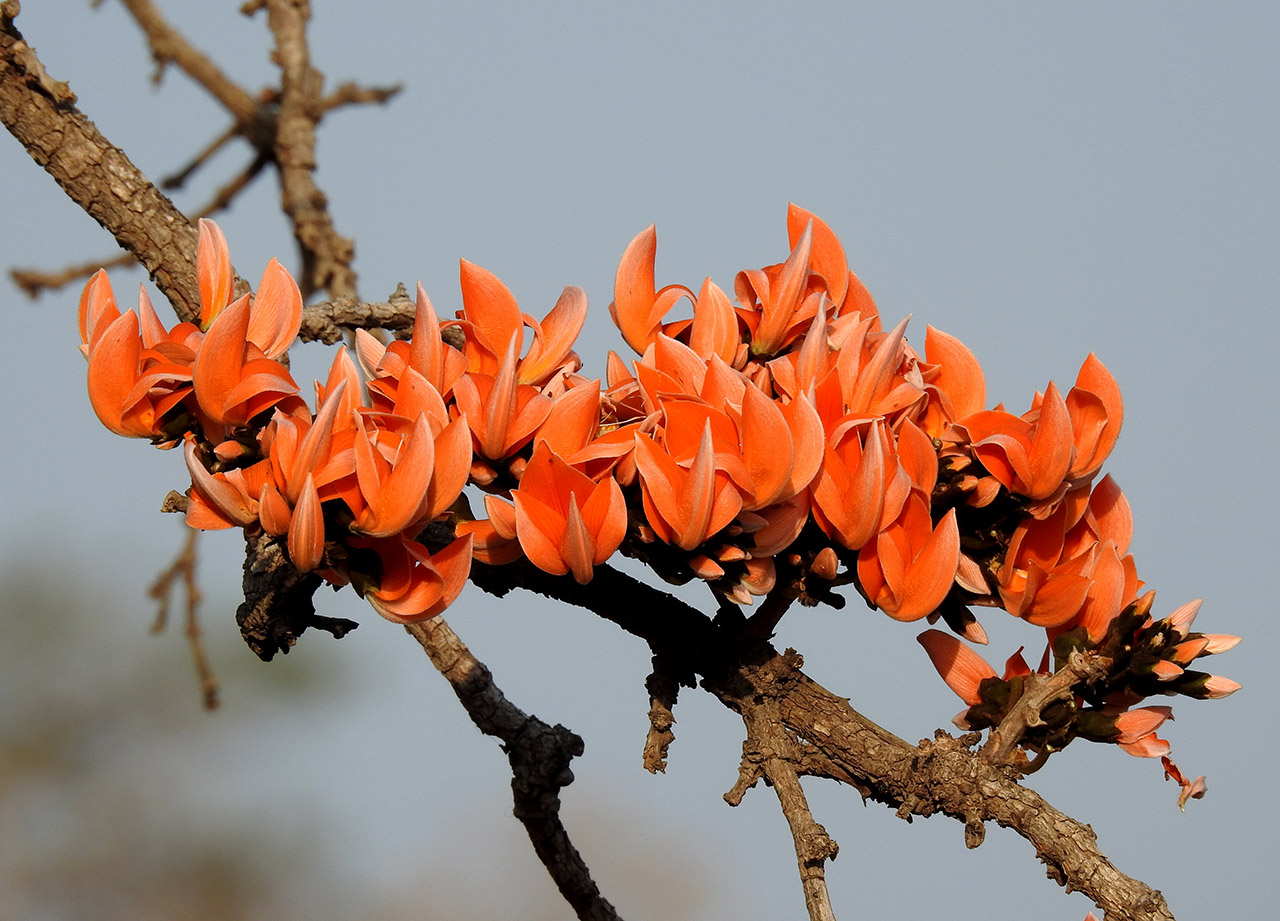
The flowers are on a sojourn; they have illuminated the dry forests with their glittering hues, like the fire flames that illuminate the darkness. 

At the winter’s fag end, in the month of February, the teak intensifies shedding its broad leaves and the entire landscape wears a desolate look. But nature has its own equation to keep its beauty intact and the flame of the forest reminds us of this power of protean nature.

No sooner does dryness hit the deciduous forests of Central India, than nature dons a new avatar. In the spring springs the hope, as the flame of the forest begin imparting a majestic appearance to the seemingly desiccated forest landscape.   

By introducing the flame of the forest, nature imbues the rufous landscape with freshness and hopefulness. With the flower’s arrival, the landscape rejuvenates, and a poet is made to express his emotions:

The-Flame-of-the-Forest-Flower-01

The spring is in her glory,
as she has received her favourite flower.

Wavering by the gentle breeze,
the flames spread the orange hues throughout.

With the flames burning against clear blue skies,
the nature goddess is shining.

Flowering in the dense jungle,
the flame of the forest has brought cheerfulness.

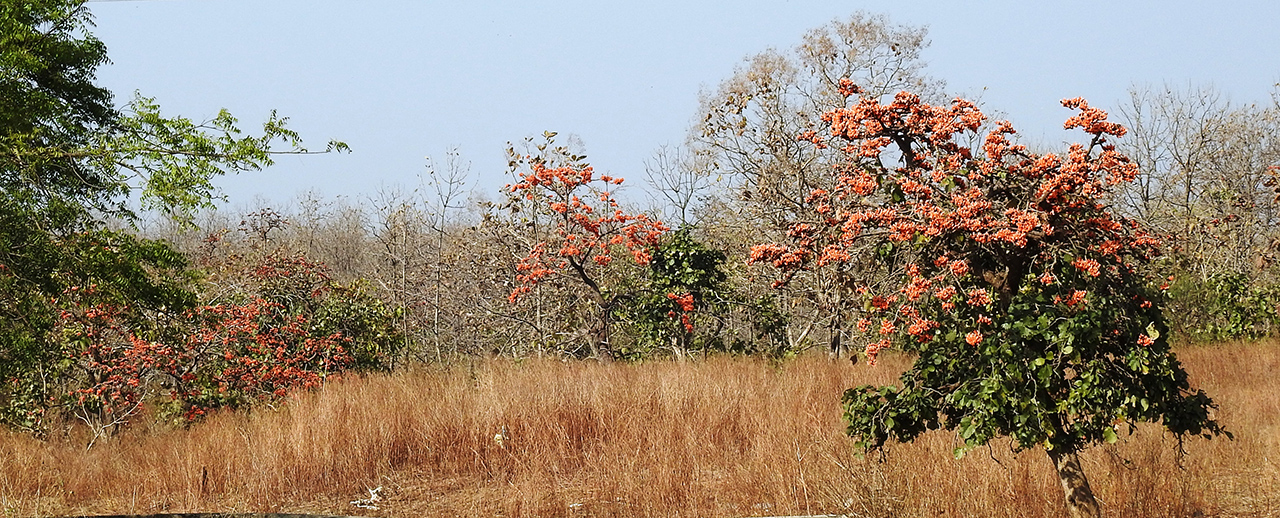
As you take a drive through the jungles of Central India, your eyes are automatically riveted to gleaming flame-orange flowers. Burningly shining in the hot afternoon, they set themselves starkly against the tawny backdrop. Now, otherwise unnoticeable palash (Butea monosperma) trees become distinguishable in the landscape interspersed with mixed-deciduous vegetation.

The-Flame-of-the-Forest-Tree-01

When seen from a height, the jungle appears all speckled and blotched with orange and vermillion shades. At a time when the teak has denuded, the leaves have parched, and the ground is all covered with thick leaf litter, the flame of the forest adorns the jungle.

Coinciding with the season of the Holi festival, the flame of the forest is also called the Holi flower. The fame of the flower being traditionally used to make Holi colours is quite widespread across the country. With the blooming flowers, the mercury rises slowly towards 40 degrees Celsius.

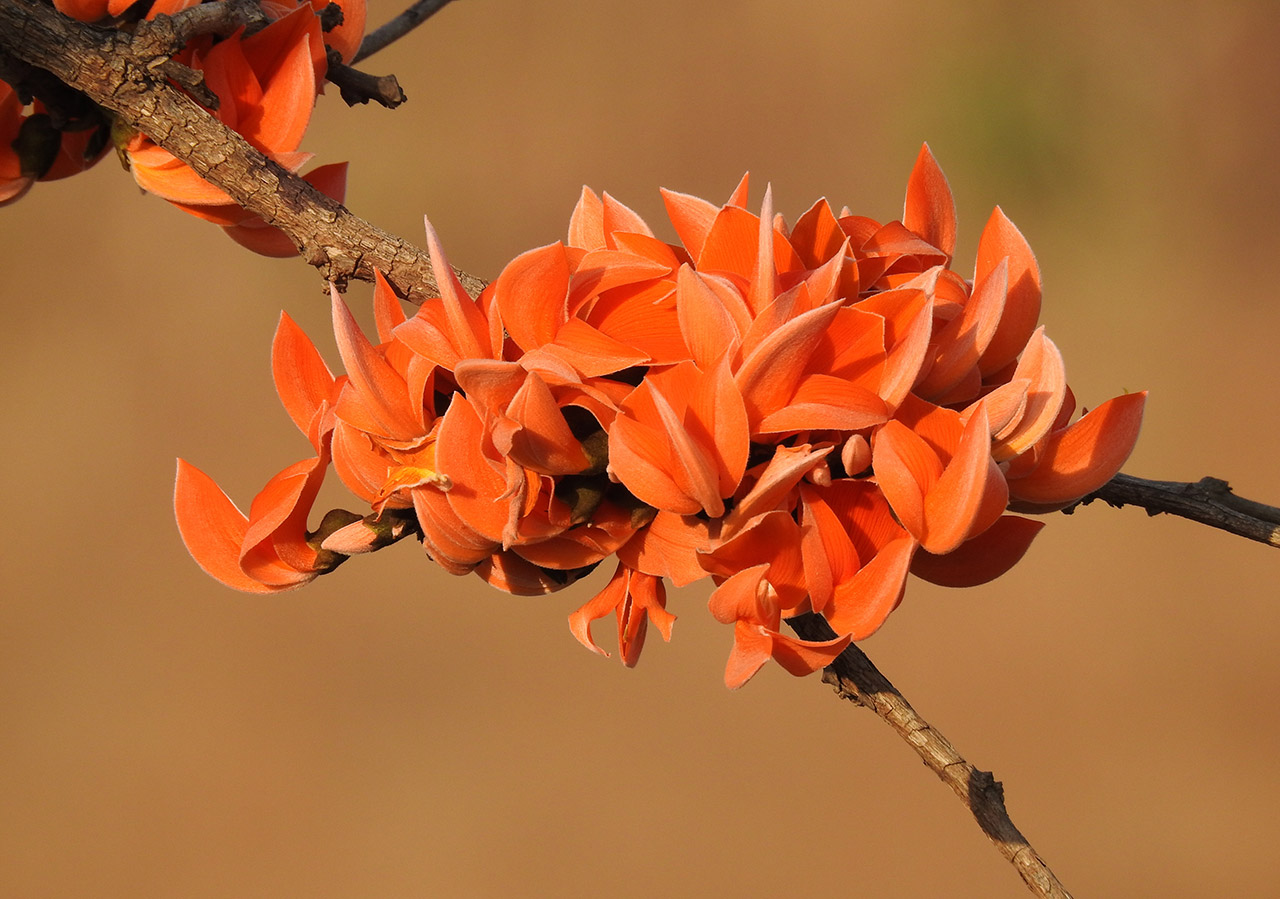
The flower’s unique appearance amazes one. In the middle is one cone-shaped petal that rises, assuming pointed end. Two curved petals emerge from dark black velvety sepal on either side of the pointed petal. The orange flowers and black sepal bring to the fore, literally, the painter in nature. The juxtapositioned individuals form bunches that appear like fire flames in the mildly hot spring afternoons.

The respite the flowers offer to avian species during the transition to summer justifies the old adages: “nature remains in her beauty throughout the year” and “she knows how to regulate the cycles.” 

The-Flame-of-the-Forest-Flower-03

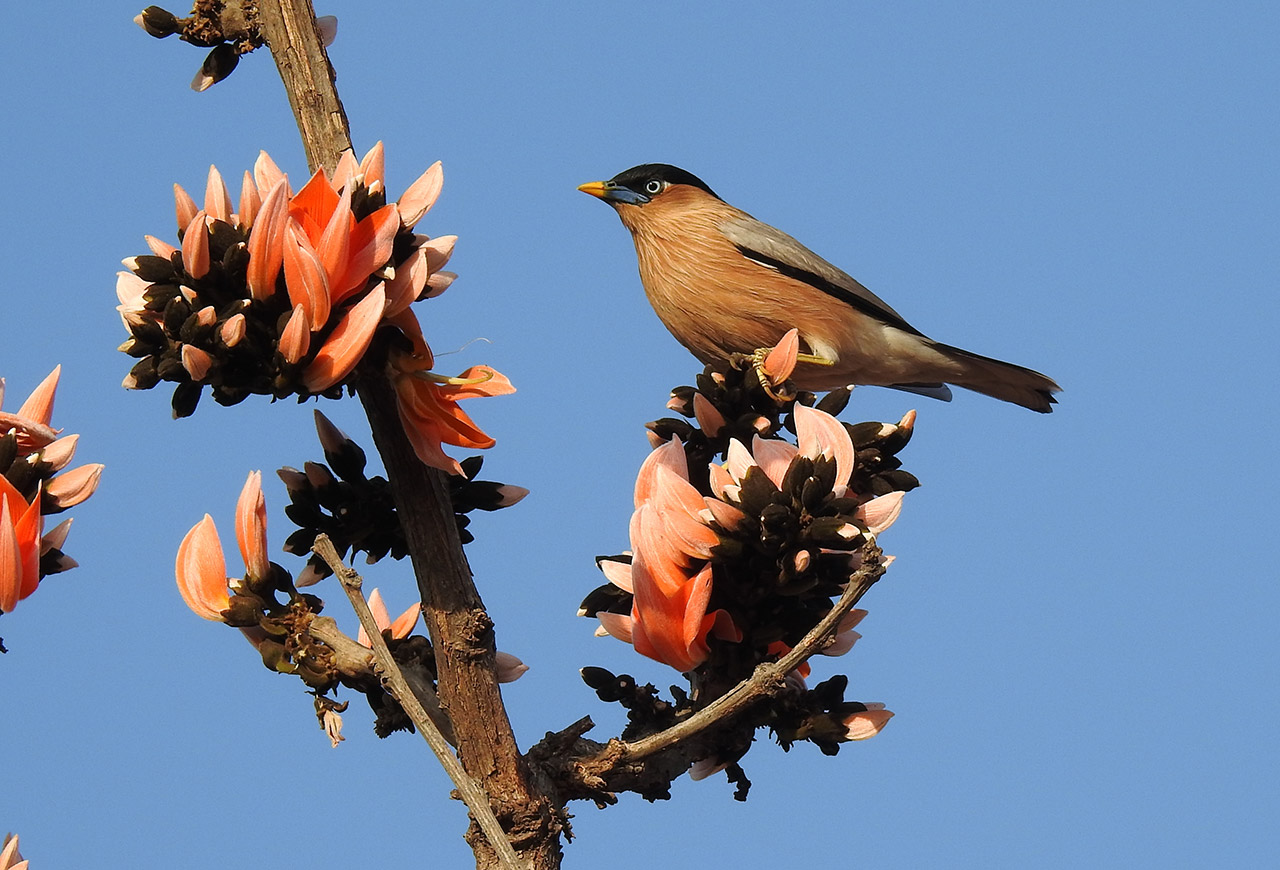
As drying vegetation leaves birds and bees scrambling for food, the flame of the forest invites them to have a feast. Right from an apparent plum-headed parakeet to the tiniest red ant, wildlife is all enthused. The chestnut-shouldered petronia and the bramhiny starling cleverly camouflage themselves amidst the flowers, as they suck the nectar. The purple sunbird mounts itself on top of bunches and flutters, in between, amidst the shining shades.   

When nature has all her energies dissipated, the flame of the forest arrives to revitalize her and maintain the equilibrium.

But then, the floral guest has to bear the brunt of climate change– erratic rains and fluctuating temperatures. Also, fast-expanding human settlements pose potent dangers to the landscape that hosts the lovely flower. 

The sustainable existence of the soft floral species – a nature’s angel – however, is capable of offering powerful impetus to decimate the negative impacts of climate change and human actions. With intensified conservation, we can have the flames burning. 

Remaining unflickered throughout their stay, the flames keep satiating nature’s needs, before finally getting extinguished by themselves. Finally, the flame of the forest wilts and falls to the ground. The sojourn ends!

Culture of Rajasthan : Exploring the Vibrant Tradition, Art, Music, Food and Festivals

0
Culture-of-Rajasthan-01
Image – Ninara via Flickr

The ancient Rajputana culture of Rajasthan remains engraved in the comparatively modern lifestyle of people. Great dynasties like those of the Rajput and the Marathas have contributed to the diverse and rich history of the state. The vast expanse of deserts, olden forts and palaces, and vibrant arts, all represent the culture of Rajasthan

We explore in detail below the aspects that govern the traditions of the land. 

Traditional Dresses Rajasthan

Traditional-Dress-of-Rajasthan-0

The traditional dress of Rajasthani women comprise the long, gorgeously embroidered skirt called Ghagra, the blouse called Choli and the light cloth of Odani draped over their head and shoulders. The men, on the other hand, wear a cotton cloth called the Dhoti wrapped around the waist under a traditional shirt known as Kurta. The headgear of Pagadi is an important aspect of their attire as a mark of cultural pride. 

Music and Dance of Rajasthan

Culture-of-Rajasthan-Music-and-Dance
Image – Well-Bred Kannan via Flickr

The multitude of dynasties that ruled the land of Rajasthan resulted in a diverse variety of folk music and dance from one region to another. They are similar in flavor yet different in their techniques and styles. The reputable groups of Manganiyar and Langa have made valuable contributions to the folk music of Rajasthan. The Ragas are dedicated to appropriate occasions, as during the pre-monsoon season when the performers call upon the rains. Other famous folk groups include the Banjara, the Mirasi, and the Jodi. 

Culture-of-Rajasthan-Music-and-Dance-01
Image – Jon Gudorf Photography Via Flickr

Most of the folk songs, usually in the form of ballads, pertain to special occasions like weddings and birth ceremonies. They narrate tales of valor and love, which are passed on from one generation to another. The dance forms also vary according to the locations. In ancient times, they were mainly performed to entertain the King. Ghoomar, Chang, Tejali, Bhopa, and Kathipudi are historical forms of Rajasthan dance. Some of the traditional instruments that mark the Rajasthani culture are Sarangi, Kamayach, Shehnai, and Dhol. 

Rajasthani Cuisine

Culture-of-Rajasthan-Food
Image – Wikimedia

The variant spices and sweet delights of Rajasthani cuisine lure tourists to try out the delicacies. The popular Dal Bati dish consists of pulse, wheat flour, and yogurt, all dipped in ghee. The spicy Pyaaz Kachori and the sweet Mawa Kachori are available all across Rajasthan food stalls. Among the sweet dishes, Ghewar and Gheriya originated in Mewar and are offered in most eateries of Rajasthan. Although most of the population is vegetarian, Lal Maas and Mohan Maas are two of the scruptiptipus meat preparations of Rajasthan culture. Drinks like Jaljira and Masala Chach are refreshing and unique. Mirchi Vada, Kalakand, Gatte, Malpua, and Kadhi are some other notable cuisines that entice food lovers. 

Architecture of Rajasthan

Culture-of-Rajasthan-Architecture
Ranakpur Temple – Andrew Miller via Flickr

The buildings, forts, and other structures in Rajasthan exhibit an imbibement of Islamic, Hindu, colonial as well as post-colonial architecture. Some of the exemplary sites that put on display the brilliance of Rajasthan architecture include the Ranakpur Jain temple, built back in the 15th century. It is built in the Maru-Gurjara style of architecture that incorporates various shapes and structures, on the domes, upon pillars, and on the ceilings. 

Culture-of-Rajasthan-Architecture-Umaid-Bhawan
Umaid Bhavan Palace – BOMBMAN via Flickr

The Umaid Bhawan Palace, built by Maharaja Jai Singh II and located in Jodhpur, is constructed in Beaux-Arts style, bringing together Western and Indian styles. The historical Jaisalmer Fort and Golden Fort were both built by Rajput king Rawal Jaisal, in 1156 AD. Regarded as a World Heritage Site by UNESCO, the fort contains several gates, Jain temples, and Havelis. The city of Jaipur lives up to its iconic title with its flourish of pink-colored buildings. 

Religion in Rajasthan

Culture-of-Rajasthan-Religion
Image – Ninara via Flickr

The primary religions of Rajasthan are Hindus, Muslims, and Jains. The state abounds with numerous reputed pilgrimage sites, like the Lodrakar Jain Temple, the Ranakpur Jain Temple, and the Jagdish Temple. 

Arts and Crafts of Rajasthan

Arts-and-Crafts-of Rajasthan-Arts-and-Crafts
Image – VD vial Flickr

The artisans of Rajasthan offer a wide collection of carpets, ethnic garments, jewelry, and ornaments. Camel leather is the most commonly used item to make shoes, bags, and journals. The carpets are woven in Persian hand-knitting style, designed with geometric patterns and shapes. Showpieces and toys made of terracotta and clay are decorative pieces and a gleeful sight, particularly for children. The Safah or the Pagadi is a craft of heritage. Numerous shops offer antique pieces from the times of kings and nobles. 

Languages in Rajasthan

Culture-of-Rajasthan-Language
Image – McKay Savage via Flickr

Marwari is the most widespread dialect of Rajasthan, other than Malvi, Mewati, Jaipuri, or Dhundhari. Since a major part of the economy is based on tourism, the natives have learned Hindi as well as English to be able to communicate better with the tourists. 

Festivals of Rajasthan

Festivals-of Rajasthan
Pushkar Mela – Saurabh Chatterjee via Flickr

Rajasthan organizes a variety of festivals that brings together the people in joyous harmony. The iconic camel fairs take place every year in regions like Bikaner, Pushkar, and many others. Dedicated to the camels and their owners, there are several events organized that go on for a couple of days, especially competitions like camel races and camel dance.

The Rajasthan International Folk Festival draws in visitors from all across the country as well as from beyond borders. Artists showcase their exquisite talents in this festival of Jodhpur. 

The Udaipur Mewar Festival, the Teej Festival, the Summer and Winter festival at Mount Abu, and the Brajholi festival of Bharatpur with its famous Raasleela dance are some other popular festivals of Rajasthan. 

Customs of Rajasthan

Culture-of-Rajasthan-Customs
Image – Jean-Claude MORAND via Flickr

An ancient custom that the people practice is known as the ‘Samskaras’. These refer to a total of 16 different important points in a person’s life which are celebrated as occasions. The chain of Samskaras starts with Garbandhan, marking the point of the child’s conception, and ends in Antyeshti, which are the rites performed after death. 

The people of Rajasthan believe in and practice the notion of ‘Atithi Devo Bhava, wherein they treat a guest as equal to God. The famous welcoming folk song of ‘Padharo Mhare Desh’ exhibits the kind of spirit the people have when it comes to tourists and visitors upon their land. 

Rajasthan is a state that attracts hundreds of tourists throughout the year. The depth of its folk culture and practices bear historical dignity. It is one of the most enriching and ornate states of India.

History and Development of Indian Literature

0
History-and-Development-of-Indian-Literature
Manuscript from the Bhagawad Gita composed in Sanskrit ca 400 BC – Wikimedia

Without a doubt, the Indian literary tradition is one of the oldest in the world. It comprises 22 officially recognized tribal and foreign languages like Persian, French, Portuguese and English. While a significant amount of the Indian literature is written, a lot more is propagated orally in regional languages, all of which have received an enormous reception worldwide. 

The first ancient Indian literature was Sanskrit literature which comprised Rig Veda, Mahabharata, and Kannada, all of which were written in the first millennium BCE. They were then followed by Marathi, Urdu and into the modern times, with Rabindra Nath Tagore, a bengali writer who went on to become the first Indian to receive a Nobel Prize for his literary work.

A Brief History of Indian Literature

During the anti-colonial period, the Indians began gauging themselves with the rest of the world in education. To keep pace with the world’s developed literature, the Indian linguist created genres unknown to the past. Genres like fiction, essay, lyrical poetry, theatre, criticism and literary history started to be all been shaped according to Indian demands and public reception.

The essence of the writings suffered a sea-change, apart from revolution in forms. The increasing pace of industrialization and urbanization exposed literary imagination to the experience of the city. The impact of science and rationality encouraged authors to criticise institutions and practises that did not otherwise face logical scrutiny. The other worldly concerns of pre-modern literature gave way to a growing curiosity for the current reality around them. In addition to bringing the ancient gods, Indian creativities established new gods. Men in society and nature were the foremost of these.

Literature education has been made easy as students can use the best academic services available online when doing college assignments like writing work, essay writing, and other services. Students often use Edubirdie when they face complex essays and research topics. This is especially true when they come from a different background but have to write in another.

Tagore: The Arch-Writer

Rabindranath-Tagore
Image – oldindianphotos.in

Tagore is a perfect representation of traditional and modern Indian writers. Although he was deeply interested in Indian traditions, he cannot be said to be a traditionalist. He was not a blind modernist, even though he was attracted by West and the rest of the world. In plays like Bisorjon, he dramatized his dissatisfaction with the outmoded conventions. He also criticised the blind pursuit of modernity in Muktadhara without regard to humans and nature.

The same can be said about some of his fiction works and poetry; they created matchless idioms, communion, solitude and hope. In one line, Tagore calls upon the nation to let love be the light of the world.

Being the most significant Indian literature figure in the 20th century, most of his writings typifies many other outstanding contemporary writings in different native languages like Kuvempu, Subrahmanya, Kannada Prasad Hindi.

After Independence, this attitude of millennial hope changed. The self-axis and the world axis never converge in fantasy as it does in reality. Although the fruits of the liberation from the yoke of foreign authority fell into Indians’ hands, with the new dawn there was violence. The killing of Mahatma Gandhi, the father of the nation, the division of the subcontinent into India, and Pakistan, led to massacres that took heavy toll of life and property during the Hindu/Muslim revolt.  Urdu poet Faiz Ahmed Faiz said, ‘This is a false dawn. Caravan, move on,’ 

There were two reactions to this disillusionment: one was the sorrowful hope that the world would be reconstructed; another was to undertake a clinical diagnosis of the disease. The first led to the progressive writing movement, an ideology that puts an end to inequity and exploitation; while the second led to introspective modernism. Novels such as Tamas (Hindi) by Bhisham Sahani and Alai Osai (Tamil) by Kalki made a healthy diagnosis of communal hysteria and called upon the depths of humanism. Nabanna, Bijon Bhattacharya’s tragic Bengal classic, spoke about universal hunger in Bengal during the fake famine. 

The introverted withdrawal from each other’s space was visible in works of writers like the Bengali poet Jibanandadas or the Gujarati poet Raoji Patel: ‘When did I become an alien, tell me, in your house?’ Sometimes, in works of great writers like the Hindi poet Muktibodh the twin impulses to optimism and despair combined.

The works of the progressive group were directed towards Soviet socialist realism while the introverts were affected by modernism in the West. The shifting literary forms mirrored this. In modernist experimentation, Fiction bid farewell to linear narrative, poetry to metre and drama. In the 1960s and 1970, the French academy of existentialist philosophy found great favour. For example Ashadh Ka Ek Din by Mohan Rakesh (Hindi) and Yayati by Khandekar (Marathi), the alienation of the author from his self and from the world was dramatised.

In the literature created in India following the mid-70s, the anguish and boredom of the modernists and the futural comforts of the progressives were examined critically. This period saw the growth of formerly disadvantaged, non-literate parts of marginalised India, not simply just the proclamation of emergency; dalits, tribals and women, which began to understand the self and the world in different light than their predecessors.

Dalit writers

Dalit-writers 

Dalit authors first began dismantelling the complete edifice of Indian ideals in Maharashtra and later in other regions, with the teachings of the first large modern Dalit leader, Ambedkar. They have not only punished in the heart of their burning poems the foundations of Caste Society like the Marathi poet, Namdev Dhasal, but also challenged the same society to rebirth. The autobiographic form was restored in a fresh way by Dalit sensibility in several languages. Even the straightforward story of their lives was a severe shock to the respectable society.

The best Dalit authors introduced not only a new substance but also a revolutionary new language, which drew pictures and metaphors of the non Dalit world unknown to people in life. They produced great heroes from the ordinary men and women of Dalit. Sakavva, the protagonist of Devanuru Mahadeva’s Kannada Dalit novel, has the claim of being scared of Yama’s Death, for she cannot conceive of greater pain than she has previously experienced.

Development-of-Indian-Literature
Image Courtesy – Indian Express

Since the beginning of the first millennium, there have always been excellent female writers in India, among whom some excel their male counterparts in creative talent. The women who debuted in the 70s, however, reveals a new kind of relationship with the world. They refused to look at the world from male bifocals and started to honour their ideas of women. Senior writers such as Mahashweta Devi (Bengali) and Sugathakumari (Malayalam) had blazed the way in their books.

The emergence and growth of feminist movements had given women the defiant idiom of a writer, based on the rejection of male idiom, as in the mighty expressions of the first Dalit English woman poet, Meena Kandasami.

Tribal and other marginalised authors, like Dalits and women, are adding to contemporary Indian literature.

Development of Indian English Literature 

Famous-Short-Story-Writers

India’s development in English Literature gained momentum as British imperialism became more consolidated in India. The first definitive Indian work in English has a diversity of opinions, however critics agree that Indian literature in English goes back to at least the early 19th century. Three sources give their impetus to its origins – educational reforms by the British Government, missionary activities, and the reception by the upper-class Indians of English and literature.  

English literature was developed in India because of the mixture of the social codes between British and Indians. The mindset of the people and a wider acceptance in the country of the English language led many writers to use English as a medium of education and expression, which led to the steady development of English literature.

The work of writers continues to be valued by award-winning institutions like Jnanpeeth and Saraswati Samman, centre academies and states, as well as by large sections of readers. The creative expression of literature in India is now ready for another significant change, as e-books come, internet space is being opened and new techniques of electronic reproduction are being introduced.

The Impact of Western Education

One cannot doubt the significance of western education on the growth and development of Indian literature. When the Indians embraced western education, literature writers had no choice but to develop literature pieces that were in line with western education.

Today, things have become even better as new Indian literature students have better facilities at their disposal. Modern tools like citation generators, digital resources for references etc have proven to be of great benefit.

Conclusion

The reception of foreign languages in India, especially the English language, brought many radical changes, yet history still views mixed feelings. Thus, the rise of Indian literature can be attributed to the intermingling of social codes between the colony and colonialist Indians and British. The British changed the mindset of the Indian literature writers and prompted many writers to improve their writings and embrace English as a medium of literature development.

Author Bio:

Julius Sim is a well-known figure in the corporate sector and he’s currently working as the Head of Support Team at Edubirdie. His new-age management techniques and strong educational background have helped his team stand out in the customer service sphere. He’s a training expert as well and holds sessions for young students every weekend.

Mistakes To Avoid While Planning For Your Child Education Plan

0

Child-Education-PlanApart from ensuring that your child is well taken care of while a toddler, it is also your responsibility as a parent to save for your child’s future. With every passing day, education is becoming more expensive than ever, which makes choosing a child education plan one of the most important aspects of financial planning for every parent. Be it a child insurance plan or a child education plan, identifying the appropriate investment avenues is important. However, some parents are either negligent towards the importance of saving while some are simply unaware of its benefits. Here are a few mistakes to avoid while planning for your child education plan.

Do not start late

The idea behind a child education plan and a child insurance plan is to amass a sufficient amount of money with the help of small monthly contributions. This makes it a long-term financial goal. It is wise to start saving right after the birth of your child. It will give you roughly two decades to ensure that the funds you saved are enough to guarantee quality education for your child.

Don’t underestimate the cost of education

It shouldn’t come as a surprise when we tell you that education these days is far more expensive than it was a couple of decades ago. Also, the cost of education in our country may drastically differ from the education expenses abroad. Irrespective of what your child may want to do when he or she grows up, it is your responsibility to be prepared to help them accomplish their dreams and choose a suitable plan.

Choosing the wrong investment options

There are multiple ways in which you can fund your child’s education, be it mutual funds, fixed deposits, a specialized child education plan, or even ULIP insurance. However, you need to choose an option that generates adequate returns that match your goal. A specialized child insurance plan is one of the most attractive investment options.

Don’t compromise on your personal finances

We understand that as parents you want what is best for your child, but life is all about prioritizing. Saving money for your child’s education does not mean you need to repay a hefty amount for the rest of your life or be financially dependent on your children forever. You need to secure your financial independence before saving for your children’s education.

We hope you will avoid these mistakes whenever it is time for you to start thinking about a child education plan in the future.

Women in Indian Politics – On the Right Path, But Not Just About Yet There!

0

Women-in-Indian-Politics

When one talks about women in politics in India, one is often reminded of the pending 2008 bill. The women reservation bill that asks for 33% reservation for women in Parliament might still be stuck in debate and political tact. However, its very limbo makes it a case for discussing women in the politics of India. In fact, perhaps, on Women’s Day this year, we can take a look at the role of women in political circles across the world to see how much of an impact and influence do women have on governance and governments. 

Women in Politics – A global view

Again when one thinks of women in politics globally a few names that stand out include, Jacinda Arden, Angela Merkel and Sanna Marin. Women constitute of less than a quarter of members of parliament across the world. Various countries have adopted affirmative measures to consciously increase the participation and membership of women in parliaments and governments. For example, countries such as Philippines, Bangladesh and Pakistan legislated reservation for women in their respective parliaments. However, the results of the reservation did not necessarily imply women empowerment in each case. In certain cases, the lack of women candidates in the first place made the reservation policy partially meaningless. 

In many other countries, such as Argentina, France and Nepal the legislation was to have a quota of women representatives in the candidate lists of parties. In other countries, such as Sweden, Germany and South Africa though there is no official legislation of quotas, the number of women both in national parties and the national assembly are quite high. 

In India, the women representatives in the parliament have been increasing over the years. The last central elections in 2019 saw 14.3% women representation in the parliament. This is quite low when compared to other countries, such as US at 32% and Bangladesh at 21%.

So what is it about women in politics in India that a low number of female electives make it to the most important executive and legislative body of the country? Is it social and cultural significance or is the story more about opportunities and economic disparities?

History of Women in Politics

In India, women have always been an integral part of politics and political outcomes. Even when one looks at kingdoms historically, there are gallant stories of politically acclaimed and strategic thinking women and queens who headed kingdoms into glory. Whether it was the Rani of Jhansi, Rani Avanti Bai or Begum Hazrat Mahal, these queens were not mere arm pieces. 

During the independence struggle a number of women have left a mark in the annals of history. Whether it was Sarojini Naidu, Annie Beasant, Aruna Asaf Ali, Tara Rani, Lakshmi Sahgal the list can go on for sure. Similarly, women were an important part of the constituent assembly and played a major role in drafting the Constitution of India. 15 women were a part of the Constituent Assembly, some of them included Ammu Swaminathan, Begum Aizaz Rasul, Durgabai Deshmukh, Dakshayani Velayudhan, Kamala Chaudhary, Leela Roy etc. 

Over the years, the women in politics have etched a distinct mark for themselves. India has had a woman Prime Minister, a woman President and many women chief ministers too over the years. A lot of ministries and posts are and have been held by women. There are big names that crop up when one thinks of women politicians in India. These women are real, powerful with astounding political will and acumen. They are not puppets or scapegoats covering or speaking up for the men. And hence, women in Indian politics have almost always been real game changers and at equal par with the men in all aspects. They have led parties, foreign ministries and also headed the finances, making it clear that no role is based on gender bias or stereotypes. 

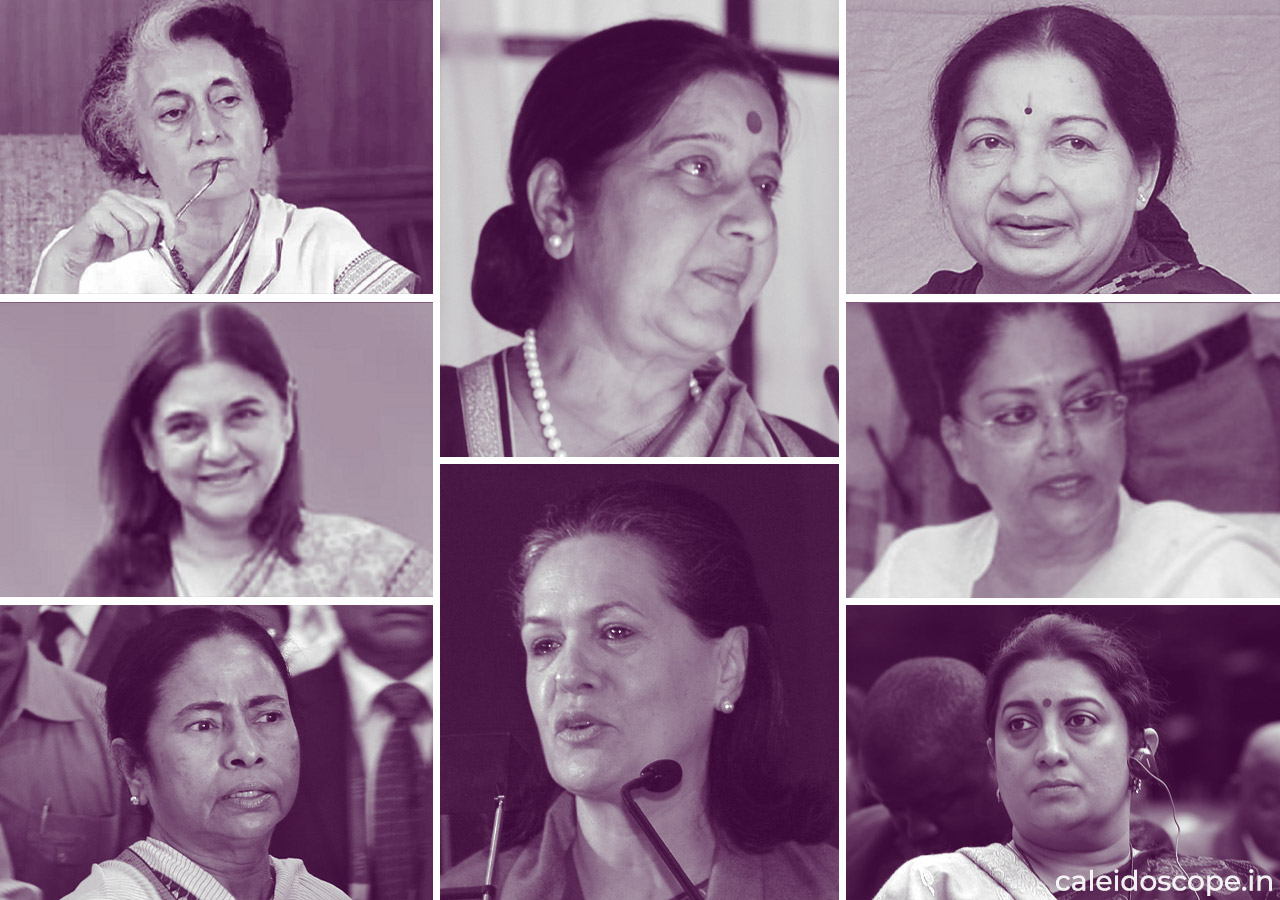
Nirmala Sitharaman is our finance minister, Sonia Gandhi, Sushma Swaraj, Mamata Banerjee, Mayawati, Sheila Dixit, Jayalalitha, Vasundhara Raje and many more women in the political field have proved that they are as competitive and a force to reckon as the men. More recently, the new age women politicians are making their foray into the political field with as much grit and passion as in other profession. Be it Mahua Moitra, Surpriya Sule, Kavita Krishnan, Nusrat Jahan, Atishi Marlena, Mimi Chakroborty, Agatha Sangma the list here too is long. But the question is, is it long enough?

Women at Grass Root Levels

The story of women at the panchayat level is however a story of hope. Contrary to perception the women elected at the gram panchayats are not puppets or dummies serving their patriarchal families or husbands. The 73rd amendment gave a 33% reservation to women in the panchayat for certain seats and positions. There has been discernable improvement in administration, where the elected women have been more open, honest and approachable. There are many examples of how women representatives at the panchayat level have stood up for ethical and honest change, such as Uma Maiti who was against corruption in Kanthipad village in West Bengal (downtoearth.org.in). Elected women are also helping to get better sanitation, education and solving water problems of their panchayats. Saroj Rana the women pradhan in Siyoni block in Uttarakashi has constructed a school and road for her panchayat, similarly Kantibai Dhurve in Savalkheda MP was elected president of her gram panchayat even whilst she was opposed by seven men. Women at the panchayat level making in roads that genuinely direct towards good governance is a fantastic cause to celebrate. Of course, there is a long way to go, but the fact that the foundations for women to be taken seriously at the grass roots are building only stronger, imply that there is a huge chance at substantial change. 

Women and Voting Patterns

India was one of the first countries to give universal suffrage and voting rights for all women of the country after Independence. Women have always been given equal voting rights, however, their turnout historically has been lower than men. But over the years this gap has narrowed considerably, where in the elections of 2014 the male voter turnout was 67.09%, whereas, the female voter turnout stood at 65.30%. With only a gap of 1.79% this margin was further narrowed during the 2019 elections. In fact, in some states such as Bihar, Arunachal Pradesh, Himachal Pradesh, Manipur, Meghalaya, Tamil Nadu and more the women voter turnout was larger than the men voter turnout during the 2014 general election. Another considerable change is seen in the social and overall emancipation of the women. The new women voters are more educated than their previous generation of women. These women are far more aware and independent to make their own choices. As per a survey (source) 3 out of 5 women said that they would vote for a candidate of their choice, without any influence of their family. 

The involvement of women in the grass root level has also led to a cadre of politically aware women who understand the principles of governance and exercise their voting power without bias or influence. 

Finally, though the percentage of women in elected offices remains less when compared to many other countries of the world, the holistic empowerment of women in various statures is definitely helping the cause. Women are no longer seen as a shadow of men and their capabilities as leaders is paving way for better understanding of issues and implementation of ideas. With education playing a huge role, more women are breaking into various government jobs, including administrative services, defense, planning commissions etc. 

Can more women leaders bring about a considerable change in global and world policies? Perhaps, the governance of a Jacinda Arden or Angela Merkel are indicators to go by, that women are leading nations with far more clarity and acumen than men in those same positions across the world. There is Kamala Harris now paving the way for more political consciousness for women across other disparities and discriminations. Yet, women at various strata of society have slowly and steadily been moving forward in the political halls of governance, legislatures and planning. 

More women participation across all political aspects is one of the most basic ways to ensure equal opportunity and representation. Let’s hope that with bright beginnings so far, the journey ahead will be fruitful and inclusive.

Image Sources

https://www.idiva.com
https://commons.wikimedia.org
https://en.wikipedia.org/wiki/J._Jayalalithaa
https://commons.wikimedia.org/wiki/File:Smriti
https://en.wikipedia.org/wiki/Sonia_Gandhi
https://commons.wikimedia.org/wiki/File:Mamata_Banerjee
https://commons.wikimedia.org/wiki/File:Sonia_Gandhi

Traditional Martial Arts of India that are Deep Rooted in the Culture of India

1

Martial Arts of India are a deeply respected art form. Unlike the general perception that martial arts are all about combat and fights, there is a much deeper understanding that goes into it. Mastered with dedication, courage and ‘inner peace’, as famously said by Po in Kung Fu Panda, martial arts define a person’s discipline and balance more than their strength. Martial art forms India are no different. And though the Chinese and Japanese martial arts are well-known throughout the world, Indian martial arts are slowly becoming popular, though they still have a long way to go. 

Here is taking a look at some of the traditional martial art of India. Each of these is not only a holistic art form on its own, but also, is reflective of practices of its place of origin. In other words, these martial arts are rooted in the culture of the land from where they come. Each of these forms also has a spiritual connection, where physical exercising and combat is closely related to mental stability. Prayers and divinity are an integral part of martial arts training and performances. Another interesting aspect of most of these martial art forms is the preparation that goes into it before the start of a fight or performance, such as oil massages in some forms, and respective attire and weapons (if required). Finally, there is a subtle integration of the Indian dance forms with the martial arts, each crossing into the territory of the other with ease and magnificence.

1. Kalaripayattu

Martial-Arts-of-India-Kalaripayattu
Image Source

One of the oldest forms of martial arts, Kalaripayattu finds its origins in Kerala. It can be performed with bare hands or using swords. Believed to have been introduced by Parasurama this art form includes strikes and kicks. Footwork is the most important aspect of Kalaripayattu, where Kalari means a training hall or school and ‘payattu’ translates to practice. 

2. Gatka

Martial-Arts-of-India-Gatka
Image Source

Originating from Punjab this martial art is believed to have introduced by the Sikh warriors. Its earlier version, called Shastar Vidya, was banned by the British after the Anglo-Sikh wars. However, Gatka remains in the spirit and moves very much like the original art form, though its weapons have changed over time. Gatka is performed, using sticks, kirpan, swords and kataar. It is performed on different festivals and in fairs. 

3. Silambam

Martial-Arts-of-India-Silambam
Image Source

From Tamil Nadu, Silambam uses animal movements as a form of attack and defence. It is becoming an increasingly popular art form, especially with women who want to learn the different self-defence moves to protect themselves. A long stick or staff is used for mock fights or practice. Silambam is also one of the oldest martial art forms that use footwork and attack the body at different levels such as a snake, hawk, tiger, or monkey would. There is a use of force and smart strategies. 

4. Mardaani Khel

Martial-Arts-of-India-Mardaani-Khel
Image Source

Originating from Maharashtra, this is a weapon-based art form. Mardaani Khel saw its emergence and growth during the Maratha Empire. After the 1857 Revolt, the British banned martial art, and it was kept alive in the form of a folk game. However, today its moves and weapons are less dangerous and lethal. The weapons used included bamboo sticks, daggers, javelin, darts, and swords. 

5. Thang-Ta and Sarit Sarak

Martial-Arts-of-India-Thang-Ta
Image Source

This martial art form is from Manipur where ‘thang’ means a sword, and ‘ta’ means the spear. Sarit Sarak, on the other hand, is the unarmed art form. Thang-Ta is also called Huyen Lallong and is practised using other weapons, such as axes and shields. The sword, however, remains Thang Ta’s most revered possession with numerous moves that teach the trainee various techniques and drills.

6. Thoda

Martial-Arts-of-India-Thoda

From Himachal Pradesh, this art form uses bows and arrows. Thoda means a wooden piece attached to the head of an arrow. This martial art is also performed as a cultural and sporting activity. Closely related to the legends of Mahabharata the Thoda game is played with two teams with 500 players in each. Not all are archers but are also dancers that help boost the morale of the team.

7. Lathi Khel

Martial-Arts-of-India-Lathi-Khel

Finding its roots in Punjab and Bengal, the Lathi Khel is a form of martial arts that uses the oldest weaponry, the ‘lathi’ or stick for combat. The stick can be used and wielded in different ways to make the blow lethal or light. The Indian Police uses the Lathi to date as a potent weapon. 

8. Pari-Khandaa

Martial-Arts-of-India-Pari-Khandaa

This martial art form, from Bihar, was created by the Rajputs. Pari means the shield and khanda means sword. The moves, technique, and steps, are also used in the famous Chhau dance of Bihar.

9. Musti Yuddha

Martial-Arts-of-India-Musti-Yuddha
Image Source

This unarmed martial art finds its origins in Varanasi. Punches, kicks and strikes are the arts fiercest weapons, and though this art form is not so popular today, it was at its peak during the Middle Ages. 

10. Kuttu Varisai

Martial-Arts-of-India-Kuttu-Varisai-01
Image Source

Again an unarmed art form, Kuttu Varisai concentrates on grappling and locking techniques. Popular in South India this art form uses many steps from yoga and gymnastics.

11. Sqay

Martial-Arts-of-India-Sqay

Practised in Kashmir, Sqay uses armed as well as unarmed combat moves. The sword or Tora, is paired with the shield or Bargula. Competitions require a blue uniform and a belt on the waist, along with standard approved size of swords. 

12. Kushti

Martial-Arts-of-India-Kushti
Image – Michal Svec via Flickr

Traditional wrestling or Kushti is perhaps the most popular and ubiquitous martial art form. Popularized by movies, Kushti began during the Mughal Era where the local sport called, Malla Yuddha, was combined with the Persian equivalent Varzesh-e-Bastani. 

India is the land of many martial art forms that need to be encouraged and learned by future generations. With karate, taekwondo, and Kung Fu courses available in schools and other training institutions, it is time that the Indian martial arts also find a rightful place. The first step is being aware of their existence. Several martial artists practice these Indian martial art forms. It is also time to give them recognition and learn from them before it is too late.