5 Unexpected Reasons for Personal Loan Rejection

0

Reasons-for-Personal-Loan-Rejection

When you plan on availing a loan, you do your research to get the best possible lending option available in the financial market. Comparing multiple lenders and what they have to offer in terms of the loan will give you an idea whether it is the right kind of lending for you. Numerous banks and lending institutions offer a reasonable rate of interest for personal loans. So, you do not have to pay high-interest rates on loan. When choosing the lender, make sure to compare the rates and options offered in the market and opt for the one that works for you. Generally, a reasonable interest rate on loan is one that’s lower than the national average rate, which is 9.41% p.a. Your credit score, debt-to-income ratio and other factors all determine the interest rate for personal loan.

To get low-interest rates on loan, you need to make sure you have a good credit score, less financial liabilities, higher income and no default record in your credit history. However, there are times when loan application might get rejected for some other reasons. Apart from the eligibility criteria of the loan we tend to miss little details when submitting the loan application, that might lead to rejection of your loan.

Eligibility Criteria

There are specific personal loan eligibility criteria that need to be fulfilled to avail a loan. They are as follows:

  • To apply for a personal loan the applicant should be between the ages of 23 to 55 years
  • If you are an Indian resident you are eligible for a personal loan
  • You should be an employed at an MNC, private or a public limited company

Documents Required

The documents required to get a personal loan are as follows-

  • KYC documents such as PAN, Aadhaar Card, Driving license, Voter’s ID, Passport
  • Bank Statements for the last three months
  • Salary slip of the previous two months
  • Passport-size Photographs

Unexpected Reasons for Personal Loan Rejection

  • Credit Report Errors

Your credit report contains all the financial information of an individual’s past loan repayments and credit cards. Lenders consider your past behaviour along with your present activity to determine your loan repayment intent in the future. Your credit score is an important factor considered by the lenders when availing a personal loan. The lenders make the final decision of granting the loan based on your score. If your credit score is low then there are higher chances of getting your loan application rejected or you may be charged with a high-interest rate on loan. With a good credit score, the lender gets convinced that you will be able to repay the loan on time.

  • A signature mismatch can lead to rejection

When you submit the loan documents and application form you need to make sure your signature is the same everywhere. Though it is quite understandable that you are supposed to provide your signature on many forms and documents. There are chances of making a different signature compared to the documents. Hence, you need to make sure the signature is correct to avoid mismatch that may lead to rejection of your loan.

  • Absence of NOC (No Objection Certificate)

If you have already closed your previous loan and are planning to get another loan you need to get a NOC from your previous lender. Without a NOC your loan application will get rejected. When you get this certificate it gets reflected in your CIBIL report. If the lenders check your credit history and don’t find a NOC of your previous loan, your application might get rejected. So, make sure to get it from your previous lender before you apply for a new loan.

  • Bank’s Loan Default List

If you want to avail a loan and you live in a location or area that falls under a negative zone or falls under the bank’s defaulter list, there are high chances of getting your loan application rejected. Banks and financial institutions have their own record of address, location and other details and if your current location is under the defaulter list or a negative zone there are higher chances of loan rejection.

  • Inaccurate information

Since a personal loan is an unsecured type of loan every detail mentioned of a borrower is verified for authenticity. If the lender finds any inaccurate information mentioned in the application form the loan gets rejected. Hence, it is essential to carefully provide accurate information and read the filled up form before submitting it.

Hair Transplant – Selecting the Right Extraction Method

0

Hair Transplant for men

Are you planning to get a hair transplant? Do you know which of the two types of Hair Transplant Procedures, namely, Follicular Unit Transplant that is, FUT, and Follicular Unit Extraction that is FUE are better? Do you know the difference between these two methods? Well, it’s not only you, many other patients also have the same question. So in this article, we have views on this topic from two specialists Dr. Manas Jain & Dr. Mohit Srivastava who are working in this field for several years & are known for best in class hair transplant.

Dr. Manas Jain is one of the best hair transplant surgeon in Mysore. In this article he will be explaining the whole hair transplant process & will elaborate the two major procedures of hair transplant.

hairnimages.com, who is established hair transplant surgeon in Surat. In this article, he will be explaining the difference between FUE & FUT & will also guide you to select the best surgeon for hair transplant. This article will help you to make the best decision while selecting the method of hair transplant.

Hair Transplant:

What-is-Hair-Transplant

So, let us try to understand what a hair transplant actually is. Basically, a hair transplant is a process where a surgeon extracts your own hair from your donor area and implants it onto the recipient area or bald area. Majorly the back of your scalp is used as the donor area & is also known as the permanent hair zone. The grafts are extracted from this donor area either by the FUT or FUE procedure.

Hair transplant is a costly procedure. But remember, you are spending only once for the treatment as it is a permanent solution to hair loss. Click here to know more about hair transplant cost.

Follicular Unit Transplant (FUT):

In this procedure, a thin strip of 4 to 6 inches is extracted from the donor area which is later divided into 500 to 2000 grafts. The number of grafts required depend upon the level of your baldness, hair type & quality as well. These grafts are then implanted in the recipient area.

Follicular Unit Extraction (FUE):

This is a recent & more advanced method of hair transplant. A surgeon will extract individual hair follicles rather than extracting a strip. The entire scalp is shaved off before the transplant. The surgeon will numb the area & will use a follicle extracting pen, also known as a punch needle to extract individual hair follicles.

Baldness Hair Transplantation Set

Implanting Process:

The implanting process is more or less the same for both methods. Your surgeon will numb the recipient area so that you won’t feel any pain during the process. He then will use a small needle or scalpel to make small slits in your scalp. Hair grafts are then implanted in those slits. Each hair graft contains 2-4 hair. The whole process takes around 6-8 hours to complete. Though it depends upon the number of grafts. Usually, a patient needs 1000-5000 grafts. But the focus here is the quality of grafts, rather than quantity.

Post Surgery:

After the surgery, the scalp is usually very sensitive. Patients will feel some discomfort & pain in the scalp when the anesthesia will start to wear off. Your surgeon may also ask to consume certain medications to manage the post-surgery pain. 2- 3 weeks after the surgery, you will notice hair fall from the recipient area. However, you need not worry as this is a part of the treatment itself. Once the shedding phase is completed, it will take around 6 to 8 months for new hair to grow again.

FUT vs FUE:

Hair Transplantation Fut Vs Fue

Now as we have gone through the surgery process, let’s try to compare the two most common methods of hair transplant that are Follicular Unit Transplant & Follicular Unit Extraction. We can majorly differentiate the two processes on the following basis.

  • Scar- As mentioned earlier, in FUT a whole strip is extracted from the back of your scalp, which means it is a more invasive process. As a result, it leaves a permanent visible linear scar on the donor area. But in the case of FUE, it is a more minimally invasive method where one hair follicle or groups of follicles are removed one at a time using a very small instrument. It leaves small circular marks that are recovered within 15-20 days after the surgery.
  • Pain- Both these procedures are done under local anesthesia and therefore, patients don’t feel pain during the procedure. However, after the FUT procedures, patients will feel some tension on the scalp due to the removal of a strip. This tension will fade away eventually. The healing time

for the FUE method is comparatively less than the FUT method. In fact, the pain felt by a patient during the FUE method is almost negligible. Patients will feel some numbness during the FUT method. But one doesn’t feel such numbness during the FUE method. Patients will face minimal swelling after both procedures. This swelling is common & it reduces in 6 to 8 days.

  • Result- It is important to store these grafts safely and properly as well. These grafts are extremely delicate and they dehydrate very quickly. In the FUE procedure, the ratio of yield of these grafts and their survival rate tends to be less comparatively. The survival rate is comparatively higher in the FUT procedure. If these grafts aren’t handled carefully in both of the procedures, then this can damage the healthy hair follicles which will impact the result adversely. The number of grafts getting damaged during storage is less in the FUT procedure.

Selecting The Right Surgeon:

men-with-bald-head-black-wall-close-up_120739-761

Whatever the extraction method is, the success of a hair transplant depends on various other factors as well. Such as the Surgeon’s experience, skills, and training impact the success rate of the surgery. No matter what procedure you go for, we always suggest looking for an experienced doctor & a clinic where modern facilities are available.

Selecting Right Method:

Both of these procedures can bring you good results. One cannot simply say that only one of these procedures is better than the others. Both these procedures come with their own pros and cons. What method is better for you is something you need to discuss with your surgeon. Your surgeon will carefully observe your scalp, the quality of your remaining hair, and the hair density of the donor area. They also observe the donor to recipient ratio to determine the number of grafts to be extracted. They will carry out some comprehensive tests to determine whether FUE or FUT will be the right extraction method for you. Remember, choosing the right extraction method is very important for a successful hair transplant. For patients suffering from Grade 5 or Grade 6 baldness, they may even need for both these procedures to be done in combination with one another. Nowadays, most patients prefer the FUE procedure over the FUT procedure due to less pain & minimal scar.

Final Takeaway:

Remember, whether you choose FUT or FUE, both these method comes with their own advantages and disadvantages. Therefore, you need to make a well-informed decision for your hair transplant. Discuss your expectations clearly & frankly with your surgeon. Talk to your surgeon about which procedure will suit you the best. Tell your surgeon about your expectations from this surgery, also mention your time constraints or availabilities. Cost is a very important factor. So, discuss it with your surgeon and then only make the decision of going for a hair transplant. Your surgeon will be helping you in choosing the right extraction method for you.

Here’s How You Should Rethink Business Travel Post Pandemic

0

business-travel

Considering the pandemic, the travel industry is one of the worst-hit industries of the economy. It is taking time to revive slowly and get back on track. Despite adopting the ‘new normal’ attitude, people are still conscious of traveling. 

We can certainly postpone our vacations until everything gets back to normal, but businesses cannot wait. Important meetings, important deals, or new contracts cannot be completely handled via online meetings and require a personal touch and face-to-face conversation. Already businesses have been hampered largely, and now, people have become impatient trying to pull up and bring things back on course. 

Earlier, the travel insurance plans did not cover mishaps related to Coronavirus, but insurance companies have started including it since the end is quite unpredictable.

Despite everything being so fluid, travel is being anticipated differently in the new world. Travel insurance is playing a significant role in several aspects.

Trip Delay/Cancellation

Due to any reason, if there’s any delay in your trip or cancellation, you’ll be compensated and helped in the best way possible if you’re covered under travel insurance. Being on a business trip involves a lot of traveling because, in a short period, you need to get over with so many meetings and tasks. You might get burdened under huge loss during these uncertain times if you don’t take up travel insurance while planning your trip.

Medical Cover

Along with other benefits, travel insurance also provides medical cover that depends on the policy you choose and its specifications. Assuming many of your business trips to be solo, you have to take care of everything yourself. With travel insurance, you can be prepared in advance for any health issues to get medical assistance without worrying about the financial side.

Baggage Cover

While going on business trips, you might have many valuable documents in your baggage, losing which might cost you a considerable amount. Under travel insurance, you’ve got your baggage loss covered as well. Depending on your policy, your insurer will compensate you for the same.

Interrupted Airline Services

Due to the availability of limited staff and limited parking spaces for airplanes along with a constraint budget, it is getting difficult for many airline service providers to keep up with service efficiency like before. They are trying hard to provide the best they can at this time. But still, uncertainties can pop up at any time, and you should be prepared with your travel insurance.

Unexpected lockdown

Due to an uneven graph of Coronavirus cases still, any country or state can impose a lockdown at any time, due to which you might get stuck at that place. For that matter, even you might get stranded in the same. Therefore, you should be all-prepared for unexpected events and uncertainties.

Why Is Buying Travel Insurance Worth And Unavoidable?

Having gone through such a tough time, no one is ready to take up any more losses or difficulties. Though you don’t have any control over unpredictable happenings, you can at least make arrangements to stay prepared for the same. Many insurance companies like Tata AIG provides coverage for Coronavirus in their travel insurance plans. Due to the growing disruptions and inefficient functioning of service providers, it would be wise to buy a suitable travel insurance plan. Wondering if buying travel insurance worth the price paid? It would be best to stay on the safer side with travel insurance rather than learning from mistakes. 

Get insured and travel safer and happy-go-lucky!

5 Factors Affecting TDS in Your Drinking Water

0

5-Factors-Affecting-TDS-in-Your-Drinking-Watera

Total dissolved Solids, popularly known as TDS, are inorganic components present in the drinking water. It includes salt, heavy metals, and certain traces of organic ingredients dissolved in water.

Sometimes, these organic matters that are naturally present in the drinking water can be extremely harmful. The TDS present is a significant reason for turbidity and sediments in drinking water. If it is left unfiltered, TDS can be a cause of different fatal diseases.

TDS can be measured in the form of the combined aggregate of organic and inorganic substances present in the drinking water. This includes anything prevalent in the water other than the pure H20 molecules. These solids include salts, minerals, and organic matters showing the general indication of water quality.

The TDS is measured in terms of milligrams/ unit volume of water or mg/l. It is also denoted in parts per million (ppm).

Here are some factors affecting TDS in your drinking water.

1. High Flow Rates

When we refer to the TDS concentration, the water body’s flow rate can be a prominent factor. Fast-flowing water can have more amounts of large-sized sediment. During heavy rains, the water picks up clay, salt, silt, and many other things like leaves, soil, or other particles.

In addition to this, a variation in the flow rate can have a tremendous effect on total suspended particles. Change in the water current’s speed or direction results in the suspension of particulate substances from sediments.

2. Soil Erosion

Soil erosion is a result of improper or mishandling of resources on the surface of the land. This may be a result of unsolicited logging, mining activities, forest fires, and construction. The eroded soil particles are carried to the surface water during storms, which increases TDS and TSS levels in the drinking water.

3. Urban Runoff

As soon as the storm passes, the debris, dust, and other solid particles from the commercial or residential places get washed away straight into the streams. It is also common in urban areas that the pavement increases the infiltration and also the velocity. Eventually, all these sediments and particles are carried into the streams and brooks during storms.

4. Surplus Septic & Wastewater System

One of the major factors leading to higher TDS in drinking water is the wastewater mechanism. These particles present in the water treatment plants greatly impact the TDS levels of the water you drink.

The residential areas’ wastewater system carries human excreta, food leftovers, and other materials flushed in the drain. The initial filtration and treatment discard most solid impurities, but not everything impure component is removed during this process.

5. Rotting Animals & Plants

Many plants and animals rot in the surrounding, and their decayed body and other suspended particles are carried to the natural water bodies. When mixed with water, it has a huge impact on the TDS and TSS levels of drinking water.

Concluding Thoughts

Hence, it is often said that it is incredibly vital to measure the TDS levels in the drinking water. When the TDS levels go over 1000 mg/liter, it is generally considered ill-fit for human beings for drinking purposes. A high TDS level is also an indication of potential harm to the populace, making a case for further scrutinization.

More often than not, high levels of TDS result from chloride, sodium, and potassium. These ions have negligible short term effects. However, toxic ions, like lead arsenic, nitrate, cadmium, etc., might also dissolve in water. This is where it becomes crucial to take note of the TDS levels in the drinking water.  I hope the five factors that I have mentioned in this write-up helps you understand the importance of checking TDS levels before drinking water.

How to Achieve the Right Balance between work and Family

0

How-to-Achieve-the-Right-Balance-between-work-and-Family-01

Family. Work. Both of these things are important to many.

But many of us end up getting overwhelmed by one or the other, and it’s important to achieve a balance. Whether it be to teach family values or even to just be a valuable asset to your family unit, understanding that a balance between both is needed is important. 

Here, we’ll go over how you can achieve the right balance between the two, and the best way to do it. 

Have Your Priorities Straight 

First and foremost, set priorities straight. You can juggle both of these, and if you know something is important on one day or another, you should definitely have it take precedence. 

For example, if you want to be an involved parent, you should set aside time each day for you to spend time with the kids, and make sure to not let that fall by the wayside due to work things. You have to set up a schedule, and make sure you focus on that. 

Set Up Time Specifically for One and The Other 

You should have time set aside. Work on a schedule, and you’ll be much happier. 

For example, if you’re taking your kids to see the butterflies, take time to show them this, and don’t get sucked into work things in the process. 

If you need to do a work project, set time for that, and maintain a schedule too. It will help provide the right balance, and make it easier for you to improve your life too. 

Do Things in Advance 

Next, do things in advance. If you have work that needs to be done, do it ahead of time. That way, when you want to spend time with the kids, you can.

Meal prep is also a good thing too, since it can help you since you just have to reheat, and then boom, you’ve got several meals in play too. This is great because it saves you the stress of work. 

Have a Cutoff Time 

For work, have a cutoff time. This prevents you from getting sucked into it.

A lot of people spend more time with work than family if they do this, so if you have a work day, establish it, and when it’s done, you’re done.

This also applies to those who work from home too. 

Negotiate Hours if Possible 

Finally, negotiate hours if you need to. 

If you have a stressful household and need some time set aside to take care of it, talk to your boss about it. They’ll probably be willing to let you have a more flexible schedule for a small period of time. 

Get Help! 

If things are too much for you, know that you can get help. 

Sometimes, this can cause a lot of stress, and you might need to talk to someone. 

Going to Mind Diagnostics can help you improve your health and wellness. 

They can help you identify exactly what’s going on, and get you the help that you need to. 

Don’t suffer because of too much work or too much family. Finding that balance is essential, and we gave you ways to figure it out here.

Marie-MiguelAbout Author – Marie Miguel has been a writing and research expert for nearly a decade, covering a variety of health- related topics. Currently, she is contributing to the expansion and growth of a free online mental health resource with Mind-Diagnostics.org. With an interest and dedication to addressing stigmas associated with mental health, she continues to specifically target subjects related to anxiety and depression.
4 Questions to Ask yourself Before Taking a Personal Loan

0

Personal Loan

Many individuals who require financial assistance opt for a personal loan. Being an unsecured type of loan, it gives the borrower freedom of availing a loan without pledging collateral as security. The reason behind the popularity of this loan is that the funds can be used for numerous purposes and not just for a specific need unlike a car loan or a home loan. However, you need to make sure you are applying for a loan for the right reasons. Keep in mind that these are debts that need to be repaid based on the set tenure. So, here are a few questions to ask yourself before applying for a personal loan.

1. Why do you need a Personal Loan?

This question is one of the first things you need to think about carefully. You need to carefully check whether you really need the loan or you can manage it with your personal savings. Also, check  If you require financing for an upcoming event at your home or need the money to purchase a house or a car. This way you can plan the loan amount you need to apply for with the lender. Hence, it is best to think through all the aspects of your requirement before getting a loan.

2. Are you eligible for the loan?

The top reason for loan rejection is the eligibility factor of the loan. It is essential for you to look for lenders that have minimal eligibility criteria. You need to make sure you fulfil the basic eligibility criteria set by the lender for a smooth loan process. Banks and financial institutions look at the credit score, income, affordability, and depending on the value of the loan. Borrowers should find eligibility criteria of lending companies online and then proceed with the loan application.

3. Can you manage the loan repayment?

Before you apply for a loan analyze your current financial standing. It is important to consider this beforehand or else you might get in trouble later and sink in bigger debts. To avoid such situations you can take the help of loan EMI calculators available online. This will give you a fair idea of the monthly repayment based on the loan amount, duration, and the interest rate that is to be paid towards the loan.

4. What is the tenure of the loan?

Many banks and NBFCs offer flexible repayment tenure on personal loans. You need to check with the loan tenure when you apply for a loan with a lender. If you opt for a longer loan tenure the EMI amount will be less but the interest can be slightly higher. It is advisable to opt for a short loan tenure to avoid high-interest rates.   However, with flexible loan tenure, you can choose the tenure of the loan based on your financial capability and make convenient loan repayments.

Loan EMI Calculator

When you think of getting a loan, the first thing that pops on your mind is the EMI (Equated Monthly Installment) amount and the rate of interest. The loan amount is repaid in EMIs and it will turn into a regular monthly outflow, this is why it is important to get an idea about the EMI amount you have to repay towards your loan. You can now get an estimate of the EMI using the Personal Loan EMI Calculator available online and it is easy-to-use. When you use the calculator, you do not need to visit the financial institution’s branch to gain insights about the personal loan EMI that you will need to pay on the loan.

How does the loan calculator work?

The loan EMI calculator is an online tool, which helps in getting an estimated EMI outflow. The calculator can also be used to plan the amount needed along with the tenure for which you require the loan. An EMI calculator for  personal loan is an interest-only calculator, this means the calculator will only consider the loan amount, tenure of the loan and the interest applicable on the loan.

How to use an EMI calculator personal loan?

To use the loan EMI calculator, you can simply look up for it online. Many banks and financial institutions have  EMI calculators on their website. You can provide basic details like the loan amount, tenure, and the interest rate to estimate the monthly instalment. You also have the option to make changes in the loan amount as per your convenience until you have a set personal loan EMI you can manage to pay. During the application process after you have checked with the eligibility criteria of a loan, you need to calculate your loan EMI. The EMI calculator provides an estimate based on the loan amount and tenure to help you identify the amount you require and the amount you need to repay. Overall a personal loan EMI calculator will guide you to make a well thought out borrowing decision.

Pichwai Paintings – An Elegant Folk Art Form of Rajasthan

4
Pichwai-Paintings-01
Festival of the Cattle – Wikimedia

As a country with a diverse heritage and rich culture, India is home to some of the most beautiful folk art traditions, which are admired around the world. Each part of India has its own form of art. The folk art forms of India are abundant in its vibrancy and beauty. Colourful patterns, elaborate designs, and the presence of religious and mystical elements are the essential features of Indian folk art. These folk arts are instrumental in showcasing the ethnic mosaic of culture and heritage that India possesses. The popular folk art forms include Pattachitra Paintings from Odisha, Madhubani Paintings from Bihar, Phad and Pichwai Paintings from Rajasthan, and the Warli Painting from Maharashtra.

Among these varied styles of painting, one of the most popular and renowned styles of painting is the Pichwai Paintings. The Pichwai Paintings are believed to have originated about four centuries ago. It hails from the state of Rajasthan, more precisely from the Nathdwara town in the state. The word “Pichh” means back, and the word “wai” translates to textile hanging. The Pichwai paintings were usually hung behind the deity in the shrines of Srinathji. These paintings have an acute attention to detail and were more intricate and detail-oriented than the traditional Phad paintings from Rajasthan.

The paintings are famous for their spectacular depiction of tales from the life of Lord Krishna. Usually made on cloth, these paintings are stately and stunning. The Pichwai Painting demands intense focus and immense skill on the part of the artist. These paintings have to be painted with much precision. The artists pay profound attention to even the smallest detail in the paintings. The Pichwai paintings are a splendid and glorious addition to the many textile arts, prominent in the country.

Pichwai-Paintings-02
Festival of Cows – Wikimedia

The Pichwai art tradition has been passed through generations in a quite sacred manner. The painting is not taught in an educational institution but is learned under the guidance of a master artist. To this day, this is the practice adopted to master this art.

The mesmerizing Pichwai paintings portray Lord Krishna as Shrinathji. Apart from Lord Krishna; Radha, Gopis, and the images of lotuses, also have a prominent presence in the paintings. This textile painting also depicts various Indian festivals such as Diwali, Janmashtami, Holi, Sharad Purnima, Raas Leela and Anakoot, among others.

The Pichwai painting is created on a piece of handspun cotton, through a few steps. First, the sketches of the paintings are created with the utmost attention. Later these images are painted using only organic paints, colours, and natural brushes. Coals, Indigo, silver, are some of the significant sources of these natural colours used for the Pichwai paintings. The painting is also sometimes enhanced using gems, and crystals.  The fact that the painting requires pure gold in its making adds even more to the value of the Pichwai paintings. 

 The Pichwai paintings are quite colourful and have several colours drawn and combined with creativity and skill. The main colours used are red, green, and yellow, among others.

Pichwai-Paintings-03A
Gopis and cows – Wikimedia

The Pichwai paintings are renowned for their depiction of festivals such as Janmashtami, Sharad Purnima, Raas Leela, Diwali, among others through their paintings.  The paintings which illustrate festivals, portray Srinathji differently as compared to the Pichwai paintings of other festivals. For instance, in the Pichwai paintings of Janmashtami, the festival which celebrates the birth of Lord Krishna, the idol of Srinathji, is placed at the centre of the painting. In the paintings depicting Sharad Purnima too, Shrinathji is presented as the central figure. The Pichwai paintings of Sharad Purnima, depicts the full moon, in all its glory, adding a distinct beauty to the artwork. The powerful imagery of the painting is perhaps what attracts the observer the most. The characters represented in the paintings wear elaborate and attractive costumes with vibrant colours. The characters are created in such a manner that the observer immediately establishes a connection with them. 

Painted in a miniature style, the Pichwai paintings are quite mesmerizing and manage to capture the attention of the observer the moment they set eyes on it. The unique colour combination, the intense detail-oriented style, and the intricate manner of painting make the Pichwai paintings one of a kind. 

Today, the Pichwai paintings have many admirers from around the world and are highly valued in the country. The attractive design and the intricate details, along with the powerful imagery, make the Pichwai paintings one of a kind. Though the art pieces are of religious significance, nowadays, it is not uncommon to see the Pichwai paintings being collected by art lovers. The paintings are said to evoke positive and joyous feelings in the observers. Since the paintings portray joyous occasions, it induces positive thoughts and feelings in the observer.

The folk art tradition is said to have had a very long history in India, and its history can be traced to centuries ago. Folk art is one of the most integral factors that represent the culture of India.  Each state in the country has its own unique, distinct, and beautiful kind of art termed folk art. Each of these is distinguishable from the other through the manner and style of the painting, along with what it represents.  The notable and the impeccable quality of these folk arts have, have earned the attention of art lovers from around the world. Owing to this fact, the arts and crafts of India are exceptionally high in demand among foreigners. Apart from this, the aesthetic feel and the sense of identity provided by these folk arts are beyond comparison. Hence it would not be wrong to say that the culture or tradition of a country or a state in India will be incomplete without its folk art form. The Madhubani paintings, which are popular for their vibrant colours and patterns, the Warli folk paintings, which take their name from the Warli tribe, are renowned for their depiction of the daily social events of the Warli tribe, are just a few among the many fascinating folk arts practised in India.

Assam Culture: Gateway to The Rich Tradition, Art, Music, Food and Festivals

1
Assam Culture-01
Image – Wikimedia

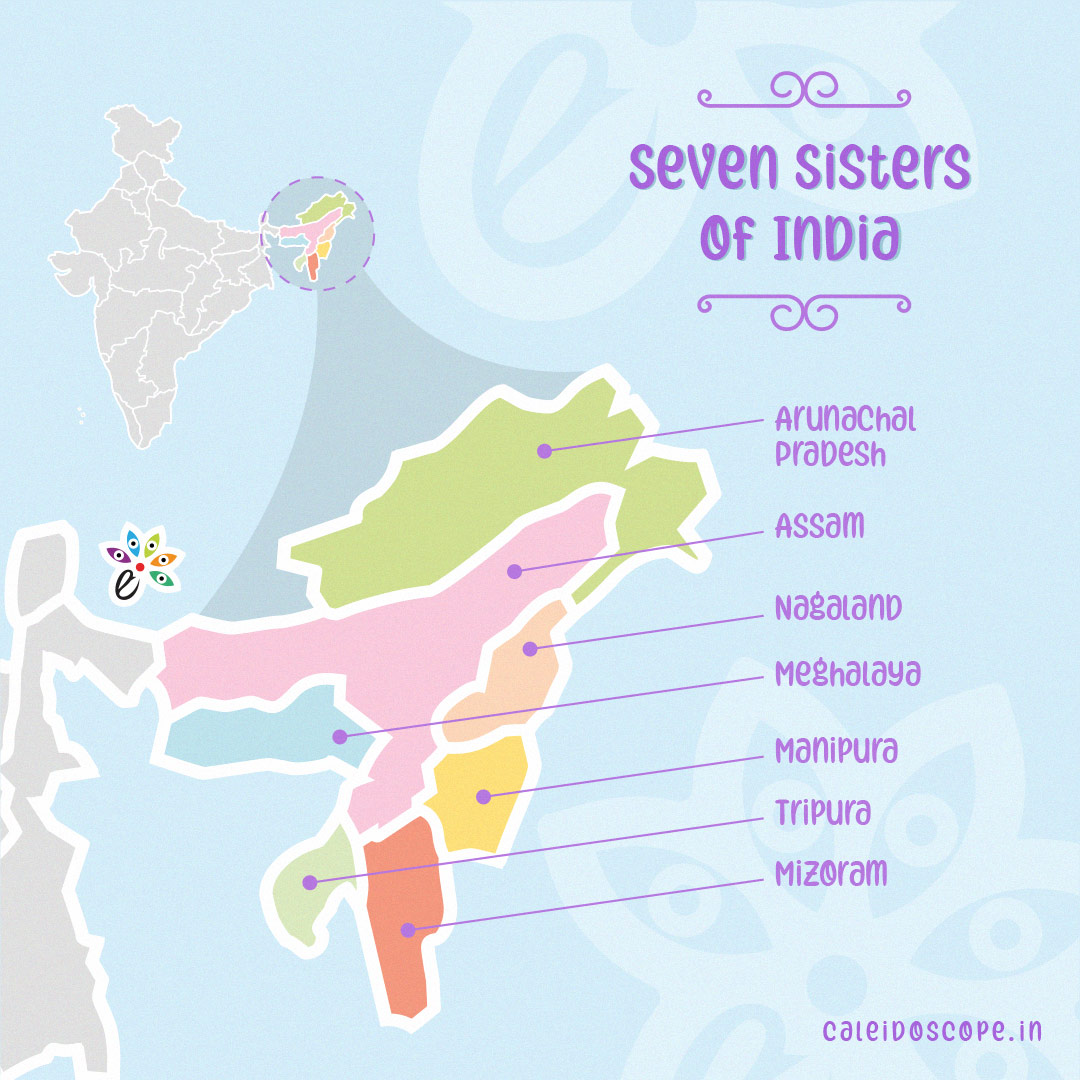
Situated in the northeastern region of India, Assam shares its borders with the neighbouring countries, Bhutan and Bangladesh, and the states of West Bengal, Manipur, Sikkim, Nagaland, Meghalaya, Mizoram, Tripura, and Arunachal Pradesh. The vivid culture and heritage of Assam is also reflected in its natural beauty.

The Seven Sisters

Seven-Sisters-of-India-Map

The state has mesmerizing greenery along with rivers such as the Brahmaputra and Subansiri, which add to its appeal. The state is also known for its large areas composed of forests. Assam is known as the “Gateway to northeast India” due to its pivotal position in the northeastern part of India. The state is also one of the “Seven Sister States” of northeastern India.

Traditional Dress of Assam

Culture of Assam - Traditional Dress
Image – Michael Foley via Flickr

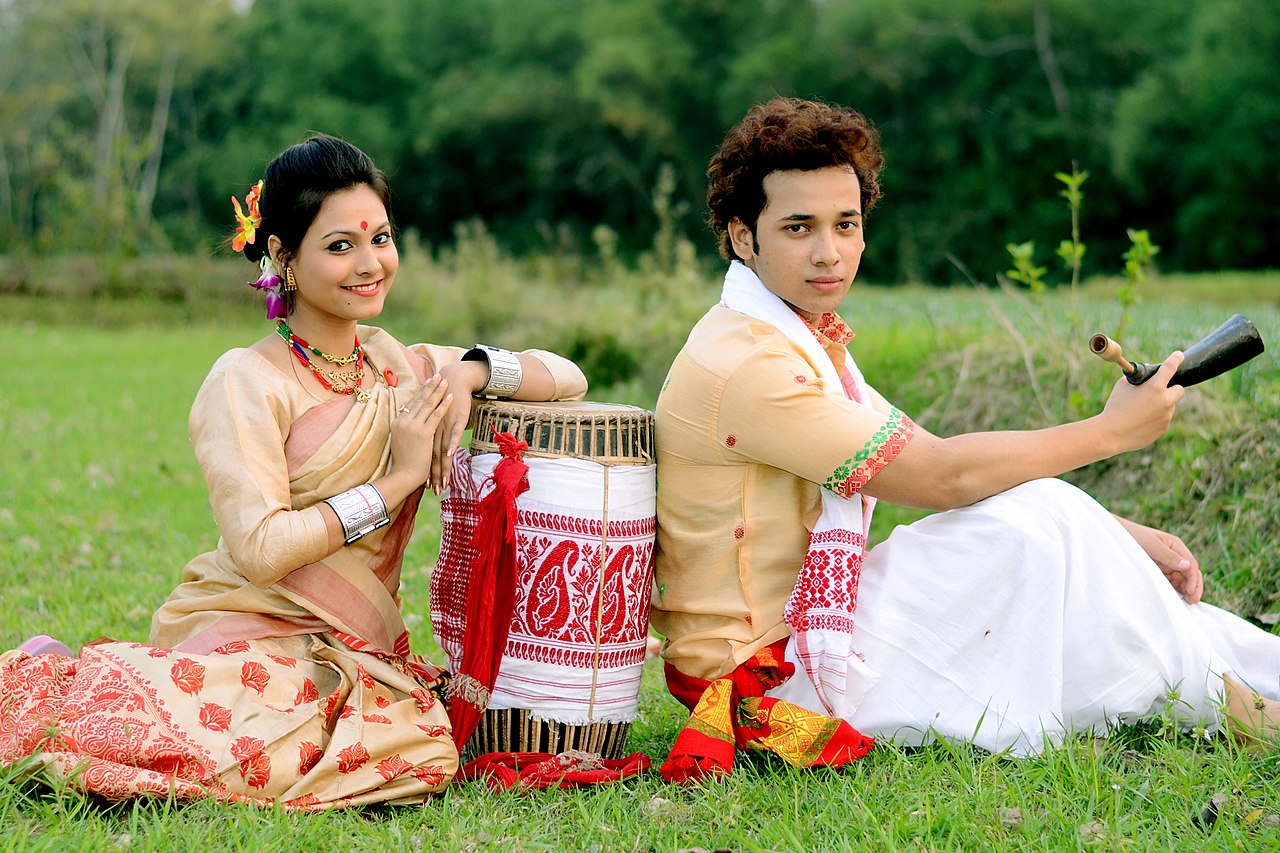
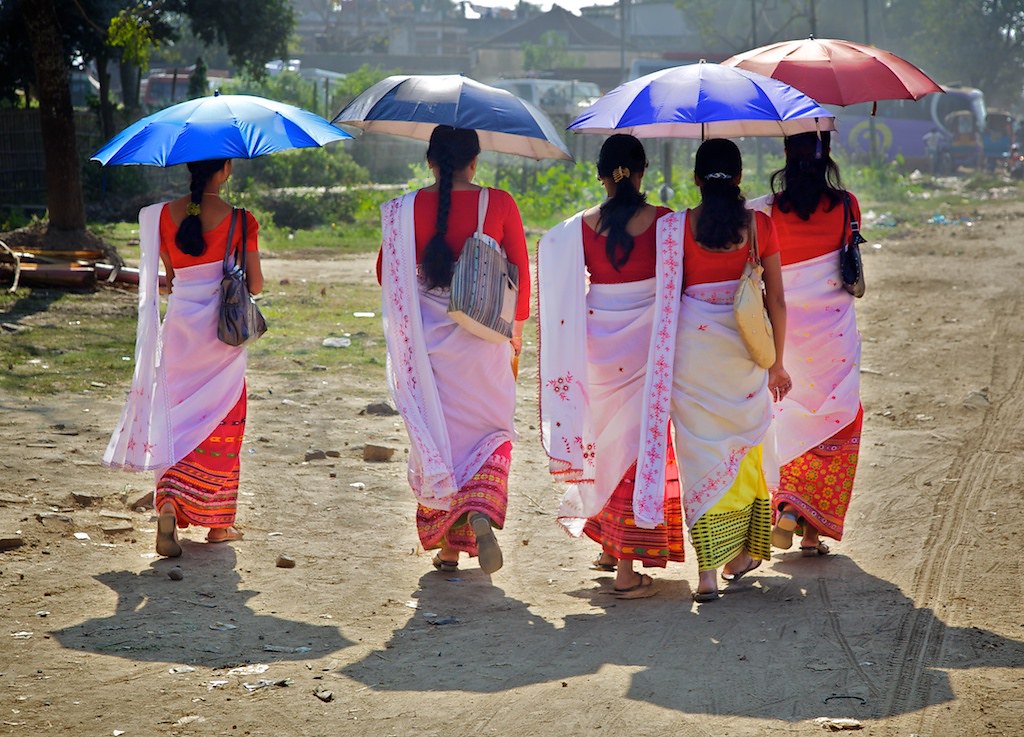
The traditional dresses of Assam culture are usually simple and elegant and mostly hand-loomed. Women typically wear the Mekhela Chador, which is a two-piece garment worn by women of all ages. Men resort to wearing the Dhoti and the Gamosa.

Culture of Assam
Image – Rita Willaert via Flickr

Each tribal group in the state has its own distinct style of dressing, which is quite different from the others. In the case of the Dimasa Tribe, the women usually dress up in the vibrantly colored “Righu”. Simultaneously, the men wear a special kind of Dhoti called Risha and a “Sgaopha”(a type of turban), generally on formal occasions. In the Bodo Tribe, women usually wear “Dokhona”. An outfit called Kaum Kontong is worn by the women of the Rabha community while the men of the same community wear the Dhoti and Gamosa.

Traditional Dress of Assam
Image – Rita Willaert via Flickr

The people of Assam also adorn themselves with elegant pieces of jewelry that are quite unique and distinct to the state. The pieces of jewelry are usually handmade with gold and silver. Men wear Biri, Lokaparo, Kundal Matamoni, and Magardana, while women wear Gam-kharu, Thuriya, Aargathi, Kharu Nupur, Nalak among others.

Assam Cuisine

Assam Cuisine
Image – Wikimedia

The diversity of the state is prevalent in its food culture as well. The cuisine of Assam shows the influence of the food cultures of its neighboring states too. The staple food is rice and it is combined with fish and vegetables. Even the rice is prepared in many different ways. The food is mostly non-spicy and is usually prepared in earthenware. Machor Tenga is one of Assam’s most popular dishes and is made of fish, combined with tomatoes, lemon, and outenga (aka Elephant Apple).

Dried fish is also a common delicacy of the state. Other dishes include Xaak aru bhaji (meaning herbs and vegetables), Aloo Pitika, among others. The state also has a variety of sweet dishes. The most popular of the sweet dishes is undoubtedly Pitha, which is prepared from rice. Komolar Kheer, Bora Chaulor Payas, Xutuli Pithaare are among the other quite popular sweet delicacies of the state.

Traditional Music of Assam

Assam Music
Image – Joegoauk Goa via Flickr

The state is also quite popular for its soft and soothing music. Songs are an indispensable part of the Assamese culture and hence, are abundant in number. The most popular songs are undoubtedly, the Bihu songs (Bihu Geet), which are sung along with the Bihu Dance performance on the occasion of Bihu.

Other folk songs include Tokari Geet, Kamrupiya Lokageet, Aainam, among others. The songs are accompanied by the music of special musical instruments which add to the ethnicity and charm of the songs.

Traditional Dances of Assam

Traditional Dances of Assam
Image Source

The most prominent and popular dance form of Assam is undoubtedly the Bihu dance. Fast-paced steps along with rhythmic hand gestures are the characteristic feature of the Bihu dance. Both men and women take part in the Bihu dance. Women usually wear Chador and Mekhela while men wear Gamosa and Dhoti during the performance. Along with the dance performers, skilled musicians provide background music through traditional musical instruments such as Dhol, Pepa Toka, Xutuli, Gogona, and Baanhi.

Apart from the Bihu dance, many other dance forms are also prevalent in the state including the Sattriya Nritya (portrays the Sattriya Culture), Bagurumba (performed by the Bogo tribe), and many more.

Festivals of Assam

Festivals-of-Assam
Image – Wikimedia

The state has a plethora of festivals, among which the most important one is undoubtedly Bihu. Celebrated around April, the festival signals the onset of the agricultural season. Bihu festival is a collection of three festivals that signal the important events of cultivation. The Bohag Bihu (held in mid-April) declares the onset of the agricultural season, Kati Bihu, (celebrated in mid-October), and Magh Bihu (mid-January) celebrates the end of the harvest season. Bihu is celebrated by everyone in the state with much pomp and joy.

The first harvested crop is offered to God as a token of their gratitude for the harvest. Apart from the Bihu festival, the state is also home to several other festivals such as Ras Lila in Majuli, the Tea Festival, Majuli Festival, and the Ambubachi Festival.

Customs and Traditions of Assam

Customs-and-Traditions-of-Assam
Image – donvikro

The state gives enormous respect and reverence to its customs and traditions laid down by their ancestors. From welcoming a guest to inheriting the property from one’s parents, certain customs have to be followed by all natives. The state is home to several tribal groups and each group has its own traditions that differ from each other. This difference portrays itself in the wide variety of the tradition and customs followed in the state.

For example, in some communities, the son inherits the father’s property and the daughter inherits the mother’s property, whereas, in others a matriarchal system of inheritance is observed. These customs make up a significant portion of the Assam culture.

Traditional Crafts of Assam

Traditional-Crafts-of-Assam
Image – Wikimedia

The people of Assam are known for their great skill in weaving and it is a major occupation of the state. Apart from weaving, the state is also popular for its wide variety of handicrafts, one of the most famous being the Jaapi.

Handicrafts of Assam
Image – Michael Foley/Flickr

Bamboo crafts, brass crafts, terracotta work, jewelry making, and pottery are among the most famous traditional crafts of the state. The crafts of the state have a special charm of its own, and the history of this handicraft-making can be traced back to centuries.

Occupation of Assam

Occupation-of-Assam
Image – Wikimedia

The majority of the population of Assam is engaged in agriculture. They cultivate rice, pulses, jute, and tea. It is worth mentioning that the state of Assam is well known for its tea plantation. It is noteworthy, that the state of Assam contributes to a certain percent of tea output of the world.

Takeaway

Weaving is also another principal occupation of the state which women usually take up. Assam is also quite famous for its production of silk and tussar materials. The state is well-known for its Assam silk, which is popular all over the country for its excellent quality.

How To Teach Traditional Indian Family Values To Children In Modern Times

0
Teach-Traditional-Indian-Family-Values-To-Children
Image – Sundaram Ramaswamy via Flickr

The family has been the social institution that plays a pivotal role in guiding an individual into maturity, self-sufficiency and integrity. The microcosmic unit of the bigger society is first acquainted with the child in their family. The child thus imbibes its practices and knowledge. The Indian society is built on the principle of collectivism, unlike the West which emphasizes individualistic values. The social unit of the family in India, therefore, aims to incorporate the values of loyalty, reciprocity and unity within the members.

With the unhindered influence of modernism, the norms and ways of a family in the Indian system have seen drastic changes which have led to varying degrees of consequences. Thus, it is essential to incorporate into the child the right ways of the world. They can mould themselves with confidence according to the evolving needs of the time, respect the traditional values of reciprocity and empathy, and yet not be held back by orthodox principles that hinder humanity.

Loyalty

teaching-Indian-Family-Value-Loyalty-to-Kids
Image – Pixels

In a competitive world where technological developments and status ambitions are of pivotal importance, the traditional base of loyalty has been fading unwittingly amongst the members of a family. Children are thrown into the bustling world of grooming and academics at an early stage to meet the requirements of a capitalist country. They often end up isolating themselves from their parents once they grow up. The bond that ties the members is not only of biological heredity, but it also requires to have faith in each other.

The genuine feelings of loyalty to one’s family cannot bloom unless children are given the space to acquire an understanding of how nothing is for granted. It is imperative to have a healthy home environment where children are taught, one step at a time, according to their individual needs. They will gradually learn how to value the people who will always have their back when the hour comes.

Equality

teaching-Indian-Family-Value-Equality-to-Kids
Image – Nithi Anand via Flickr

The Sanskrit philosophy of Vasudhaiva kutumbakam, meaning ‘the world is one family’, is an imperative aspect of Indian family values that help a child acquire what it means to regard different people with equality and consideration. A human being should be respected regardless of gender, caste, sexuality, and religion. In a country where the political situation is turbulent and social evils are still brazenly out in the open, a person has to imbibe ways of confronting the world from the age of schooling. Teaching children to firmly consider equity towards everyone they come across so that the seeds of backdated habits and narrow-mindedness do not grow stronger in their roots.

Respect

teaching-Indian-Family-Value-Respect-to-Kids
Image – Pabak Sarkar via Flickr

Respecting one’s elders has been a stringent value in Indian families since ancient times. A family is a social institution that passes its wisdom and family traditions from one generation to another. The older family members are regarded as knowledgeable and experienced. Their teachings help the child to keep their grasp on India’s rich heritage and appreciate its culture and historical significance. Most of the time, however, the redundant practices and thought structures are not left behind during such lessons. Adults should ensure that the child does not incorporate chauvinistic thinking and fanatical actions that will hinder their personal development as a decent human being and create considerable problems for society.

Charity and sacrifice

teaching-Indian-Family-Value-Charity-and-sacrifice-to-Kids
Image – Philippe Put via Flickr

Sacrifice has been regarded as a source of contentment for everyone in terms of the joy of giving that was so revered in ancient India. The children are taught that wealth is temporary, and one day its custodian will be passed onto someone else. However, one can only help others when one has attained sufficient standing to do so. Senseless giving in a competitive economy where most struggle to survive is not something one would want to indulge on. Yet, the child should learn not to clutch at wealth and property with greed and acknowledge the support that comes their way.

On a different aspect, the practice of ‘dana’ or charity does not only apply to the greater collective good of the society but also the compromises that one does for the family. The traditional hierarchy of the Indian family being a patriarchal society, the responsibility of giving up is thrust upon women. Instead of being reduced to orthodox gender roles, a child must be taught to mould their identity as a good person who not only respects others but also esteems themselves.

Empathy

teaching-Indian-Family-Value-Empathy-to-Kids
Image – Arian Zwegers via Flickr

In India’s collectivistic society where inter-dependence is the traditional norm, a child needs to learn to empathise with diverse kinds of people, from various strata of society. The country’s economy and social standing is structured upon the requirement of interdependence to survive. Empathy begins with simplicity when the child is taught to help their siblings and friends. It is then nurtured into a holistic perception where the child understands how to give others the deserved opportunity to speak and respect their position and situation with sensibility.

Dealing with hate or spite with maturity

teaching-Indian-Family-Value-Dealing-with-hate-to-Kids
Image – Philippe Put via Flickr

Non-violence and respectful behaviour are essential values taught in any Indian family. It is also important to make sure that a child grows up to be a voice instead of just an echo. The child should learn to listen to what others say, regard its importance and have the confidence to build their own opinion through learning and unlearning. Standing up for what one deems right does not imply hot-headed action and crude words. Anger is significant for society as well as the individual to progress, but misdirecting it and letting it go out of its leash will only culminate to grave consequences.

Self-evaluation

teaching-Indian-Family-Value-Self-evaluation-to-Kids
Image – Indian Yug via Flickr

Consulting the other members of a family for advice and making decisions is an important practice. However, self-evaluation is also a necessary part of teaching that trains the child to develop their personality and intellectual faculties. The process of ‘atma vichar’ helps one regard their decisions throughout life. It leads the child into knowing themselves as they grow up to be a mature adult.

The system of the traditional Indian joint family was based on the patriarchal hierarchy. Many of the values that were once highly esteemed have come to be exposed as oppressive. The traditional Indian family have always thrived on the principle of interdependence, but nuclear values have grown rapidly into importance as the country adapted itself into modernity, in social as well as economic aspects. It is imperative, therefore, that the children learn the appropriate values and norms from their family.

7 Types of Tea in India And Their Amazing Health Benefits

0
7-Types-of-Tea-in-India
Photo by Mareefe

The tea industry in India has revolutionized to adapt to the growing economic demands of the country. The regional speciality has added to the fervour, like how the most recognized teas of Darjeeling and Assam are only cultivated in India. Of immaculate taste and flavour, some of the most popular types of tea in India that are grown and prepared in different parts of our country.

1. Assam Tea

Assam-Tea
Image – Tracy ducasse via Flickr

Tea-production in Assam is an indispensable source of livelihood since the state produces more than 500 million kilograms of tea per year. Made from the leaves of Camellia sinensis, the black tea from Assam is cultivated in a warm, humid climate and at sea-level which contributes to its distinct malty flavour.

The leaves are harvested and withered, then are made to undergo an oxidising or fermentation process. It is called by other names as well, like English breakfast tea and Irish breakfast tea, thanks to its high amount of caffeine content. It boosts the body and mind with energy and alertness. Rich in antioxidants, it also promotes heart health as well as greater immunity.

2. Nilgiri Tea

7-Types-of-Tea-in-India-Nilgiri-Tea
Image Source

The tea grown in the Nilgiri hills of Tamil Nadu, located in the southern portion of the Western Ghats, is intensely aromatic, with a mellow taste and subtle natural sweetness. Some of the best flavours of iced tea are made from Nilgiri tea-leaves. They have been produced for commercial purposes since the 1850s.

Nilgiri tea is grown in abundance year-round, such that the plants experience two monsoons each year. The amino acid L-theanine contained in the leaves relaxes the mind into stress-free alertness. The rich amount of flavonoids helps improve blood flow and strengthens the heart.

3. Darjeeling Tea

7-Types-of-Tea-in-India-Darjeeling-Tea
Image – Michael Pieracci via Flickr

Grown in the Darjeeling hill region, between the Himalayas and the Bay of Bengal, the tea from the Darjeeling and Kalimpong districts experiences the cool land air during the dry winter months, followed by the monsoon rains. The tea leaves are usually processed as black tea and are harvested by the famous process of plucking pairs of the plant’s top leaves along with the bud.

The harvesting season is divided into four flush periods starting from March to November. Rich in antioxidants, the Darjeeling tea provides several health benefits, including the elimination of toxin and enhanced digestion. With a caffeine content that varies depending on the flush, it also helps in regulating stress.

4. Masala Chai

7-Types-of-Tea-in-India-Masala-Chai
Image – Alpha via Flickr

A beverage prepared by blending a plethora of spices, Masala Chai serves a cup full of nutrient and health benefits. The spices balance the caffeine of the black leaves, and thus, it is a safe source of energy upliftment. The spices, namely cinnamon and clove, help in strengthening the immunity, while ginger helps in improving blood circulation and relieving aches and pains.

Often, tulsi leaves are blended with elaichi in the preparation, which facilitates better digestion. The most prevalent method of simplistic preparation of masala chai is through decoction. A mixture of milk and water is actively boiled with the loose tea leaves, and the adequate amount of the spices and sweeteners is added. The tradition may vary according to the tastes or customs of the local region.

5. Noon Chai

Noon-Chai
Image – Wikimedia

Noon Chai is also known by different names of shir chai, Kashmiri tea, pink tea or gulabi chai. It is believed to have originated in the Kashmir Valley of India. To prepare this beverage, green tea leaves are brewed in sodium bicarbonate or baking soda to obtain a thick, reddish-brown extract called ‘tueth’.

It is then followed by dilution with water, then milk and salt are added to it. In a traditional practice, the tea is served in a large samovar or a brass utensil which keeps it warm for a longer period. People love to drink hot noon chai particularly during winters, to attain warmth. It offers improved digestive and stress-reducing properties and also prevents heartburn and bloating because of the cardamom and baking soda content.

6. Green Tea

7-Types-of-Tea-in-India-Green Tea
Image by Jill Wellington

The large-leafed Camellia Sinensis Assamica plants grow in a warm, moist climate, especially in sub-tropical forests. To prepare green tea, the leaves of the plant are harvested and then heated as soon as possible through steaming or pan-frying. Unlike oolong tea and black tea, green tea does not undergo the process of withering and oxidation to prevent the leaves from turning brown and maintain their fresh flavour.
The colour of the brewed tea is usually green, yellow or light brown, but it depends on the processing and cultivation method used.

Some of the factors to be considered are the time of the year when it was plucked, how the plant was pruned, the kind of heat applied to the leaves to stop oxidation, and the way the leaves were shaped, rolled or dried. The flavour of a correctly brewed cup of green tea can range from toasted vegetal to sweet, seaweed-like, and is affected by the “terroir” or the environment in which it was grown. It is best to consume Green tea within six months or a year of purchase so that its flavour and benefits can be savoured adequately. Loaded with antioxidants, it provides many health benefits like improved brain function, well-maintained weight, protection against cancer and lower risk of heart diseases.

7. Butter Tea

Butter-Tea
Image – Wikimedia

A beverage of the Himalayan people of India, butter tea is also known as po cha and cha süma. In the climate of the mountains where the air is cold and thin, the traditional preparation of butter tea gives the people energy and calories. Traditionally, it is made from butter derived from the milk of yak. Producers heat the milk then place it in a solar-powered device that separates the butter. The tea leaves are boiled in water for several hours until a dark brown colour is achieved, then it is poured into a container with fresh yak butter and salt. The resultant mixture is a thick liquid that is stored into tea-pots or jars, ready to be served.

Butter tea is also used for eating tsampa, which is a high caloric paste, also including other components like highland barley paste and curds. In Tibetan medicine, it is considered that the combination of butter and tea gives greater balance in mind and body than either item individually. The consumption of butter tea enhances the body’s blood flow and muscle and bone strength essential to cope with the stress of work and farming activities at high altitudes. Caffeine stimulates the central nervous system, and thus provides further energy.

Tea is an indispensable beverage for the average individual of India. It is a household refreshment for breakfast as well as the standard serving for an official meeting. It provides for physical health benefits as well as soothes the mind from overwhelming stress.

Some more great reads on Tea:
How the Art of Drinking Tea has Changed My Life
‘Tea’totaller: Learning the Art of Making Tea
India’s Streetside Coffee and Tea Culture
Finjaan Tea – A Royal Tea Treat