Vishwarang Art and Literature festival is the celebration and commemoration of the art, the literature and the music of India. Bhopal-based Rabindranath Tagore University is organising the second edition of Vishwarang in collaboration with the Tagore International Centre for Arts & Culture, Bhopal. This mega event is an intersection of cultural activities to make art attainable in different forms.
Just like Rabindranath Tagore who travelled around the world for the love of literature and cultural hope, Vishwarang in its three phases will be doing the same. The first phase was the Poorv Rang phase which started from 1st of October till 8th of November. Under Poorv Rang, live discussions on Katha Desh, which is an 18-volume compilation of significant pieces of work in Hindi story-writing spanning nearly 200 years, was held. Moreover, a national painting exhibition, a short film competition, a Nukkad Natak festival and various competitions for university students were held as part of Poorv Rang.
The second phase, namely the Vishwarang International Festival was held from 6th November to 8th November. It aimed at honoring the culture, art and literature heritage of 15 countries! The festival was held online with participation of more than 100 artists from countries like the USA, Australia, Canada, Netherlands, Singapore, Russia, Uzbekistan, Sri Lanka, Fiji, Ukraine, Sweden, Kazakhstan, UAE and the UK. The gigantic participation, the cultural exchanges and the esteemed reception from different continents were some of the things to bring home.
The third and final phase of the event called Vishwarang 2020 will witness a plethora of sessions along with the participation of over 1,000 artists, poets and authors from nearly 50 countries. The final phase will carry out remembrances, a feature film, band performances, book inaugurations, poetry recitals, literary exchanges with writers, and storytelling sessions.
Additionally, to increase youth and children participation, two new categories namely, an International Film Festival and a Children’s Literature, Art and Music Festival have been added to Vishwarang this year. The first edition of the Vishwarang Children’s Literature, Art & Music Festival is being organized in collaboration with Get Set Parent with Pallavi, which is one of the fastest growing parenting YouTube channels in India. The event will be held for 2 hours everyday starting from 22nd to 29th November on her Youtube channel.
Children of the age group 4-12 years can come forward and register for the fun and frolic sessions free of cost! An itinerary of events that will take place is as follows:
-An Inaugural Session in conversation with the Celebrated Author Ruskin Bond who is one of India’s most loved children’s writers
-An interactive session with Bestselling Indian mythological fiction writer Anand Neelakantan during the closing session on the last day of the event
-Performances by the Puppet Art Theatre Company as well as Tholpavakoothu & Puppet Centre
-Interactive session with Priya Narayanan, whose book ‘Friend of Numbers’ is the winner of the Neev Book Award 2020 in the ‘Emerging Reader’ category
-Claude Monet Painting Workshop and Gond Art Workshop by Akanksha Goenka of art advisory and appreciation company ‘Artlinks’
-Several Indian Art appreciation workshops on Warli Art and Madhubani Art Workshops by Arty Bits’ Founder and art tutor Salomi Parekh from Arty Bits
-Several storytelling sessions hosted Veteran writer-illustrator Ashok Rajagopalan, who is the creator of hilarious children’s book series ‘Gajapati Kulapati’; Nandini Nayar, who is the award-winning author of over fifty books for children of all ages; actor and storyteller Janaki Sabesh; and Bangalore-based international academy of storytelling ‘Kathalaya’
-Special Children’s Medley performance by the Shillong Chamber Choir
-Doodle Workshop on making your own storybook by Singapore-based Kirkus Best Prize nominated illustrator and graphic novelist Debasmita Dasgupta
-Theatre Workshop by Helen O’Grady International, which is the world’s largest after-school developmental drama programme
-Comic Workshop on learning how to draw your favourite Tinkle Toon ‘Suppandi’ and make comic strips with Suppandi by Savio Mascarenhas, Group Art Director, Amar Chitra Katha
For registering and further queries, please visit their website vishwarang.com
Gone are those days when traveling means sightseeing only. Yes, sightseeing and escaping boredom are the main objectives while going on a trip. But adventure activities now often occupy a place in thrill seeker’s tour plans too.
Snow-covered lofty mountains, seas stretching to the horizon, fast-flowing rivers, deserts, cliffs, gorges, forests enrich India’s topography. This much versatility of landscape all over India makes perfect ground for adventure sports and activities.
Favored by the youths, these activities can be carried out by anyone from teens to young olds.
There are numerous adventure places in India operating different kinds of thrill sports for daredevils. Here, in this article, I am introducing you to the 10 most popular among all.
Riding on an inflatable raft, sailing through the downstream of a turbulent river is river rafting. The gradient of riverbeds, big boulders, tricky turns along the way a river flows, make rapids of different grades which host this adventure sport.
This is one of the most daring and riveting adventure activities which demands physical exertion and a joint effort of all team members. This recreational outdoor sport arouses fun, awe, and a sense of inclusion within its participants.
River rafting in Rishikesh is one of the world-famous water sports in Uttarakhand. The river Ganga in Rishikesh offers multiple stretches like Shivpuri, Brahmapuri, Kaudiyala as routes for rafting. Other than this, rafting in Zanskar river in Ladakh, Brahmaputra river in Arunachal Pradesh (18 days long rafting expedition from Tuting to Pasighat), white water rafting in the Kundalika river of Kolad, Maharashtra, and the Kali river rafting in Dandeli, Karnataka offers unmatchable rafting experience.
Bungee is a strong and robust nylon cased band made of rubber. Bungee jumping is an adventure activity where the bungee rope is fastened in the ankle of the person partaking in the activity and he or she then jumps from a platform fixed at a large height. Bungee jumping can also be performed from moving helicopters or air balloons.
The experience of free falling from a height is fear inducing initially but at the same time, insanely rewarding as your adrenaline rushes down your vein and you feel like a shooting star.
In India, Rishikesh is famous and most known for bungee jumping adventure sports. Besides Rishikesh, New Delhi, Goa, Bangalore, Jagdalpur, Lonavala in Maharashtra are some places where this sports facility is available.
Trekking is a well-known adventure sport that involves walking along a rough hilly trail to explore the area and enjoy natural bounty.
Trekking routes often lead to snow-covered mountain peaks, high altitude lakes, and valleys, or remote areas. From a greenhorn person to an expert, this activity is suitable for everyone depending upon how difficult the trail actually is.
Camping is an outdoor activity often followed after a whole day of trekking, rafting, hiking, or kayaking. Camping is setting up a tent under the open sky to spend the night generally away from the hustle-bustle of city life. It allows connecting soul with mother nature and heals it in the process. The closeness camping offers us with nature and wildlife is incredible.
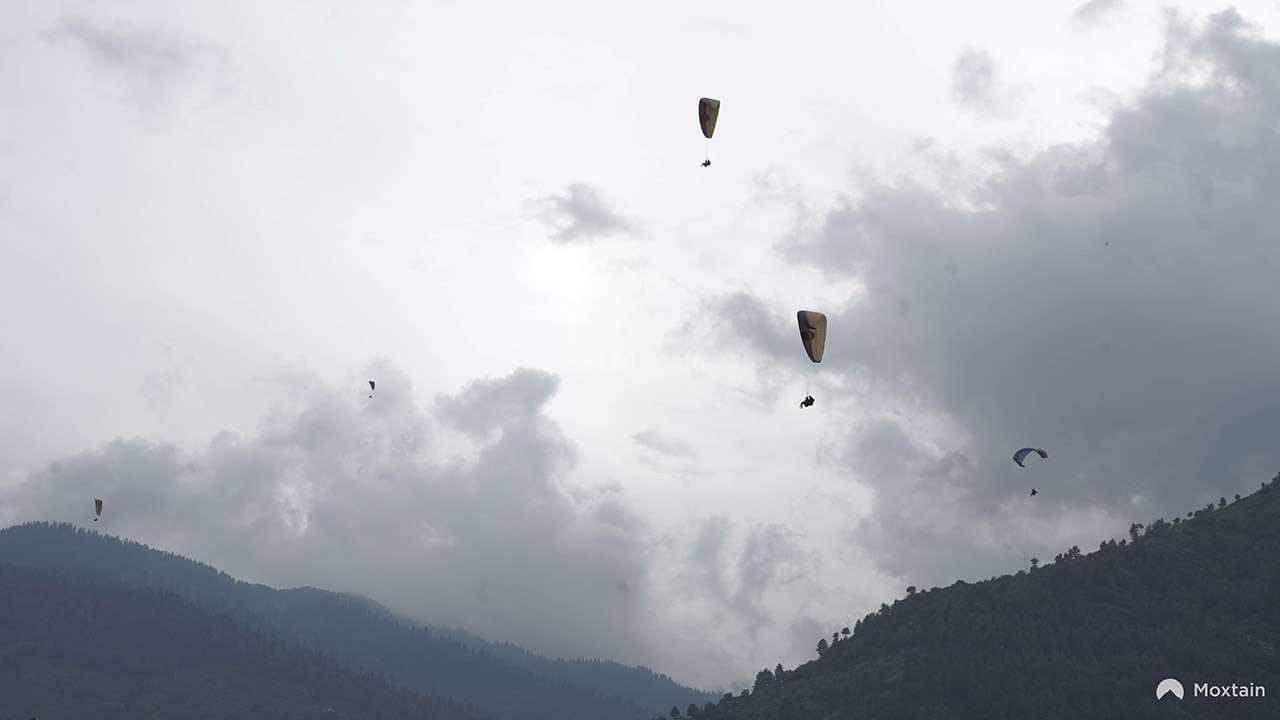
Paragliding is smoothly gliding through the air with the help of a specially designed parachute. Flying free like a bird in the sky is everybody’s childhood dream. Paragliding may help this dream come true.
The person flying with the paraglider sits on a harness suspended from the edges of the parachute (Paraglider) and the paraglider is controlled by the wing lines connected with the seat from the glider itself.
Anyone can do paragliding if he or she is in shape and is well trained because this recreational sport is physically and mentally demanding.
The most famous spot for paragliding is Bir Billing in Palampur, Himachal Pradesh. Nandi hills near Bangalore is another location. Paragliding is one of the best adventure sports in Manali for the spectacular view of the surroundings while floating in the sky. Kamshet near Mumbai, Gangtok in Sikkim, Mussoorie, Nainital, Ranikhet, and Bedni Bugyal on the trail of Roopkund trek in Uttarakhand also offers paragliding.
Skiing is an ice sport and a competitive activity. A thin, long, and flat piece of fiberglass or plastic called ski is attached with the heels of the skier which helps to slide on the ice. Earlier a mode of transportation in the cold arctic area of Northern Europe skiing has gained worldwide popularity now.
Pahalgam, Gulmarg in Jammu & Kashmir, Solang Nallah, Kufri, Narkandai in Himachal Pradesh, Munsiyari, Auli, Dayara Bugyal of Uttarakhand are the best known as skiing spots. Skiing as snow sports in Manali, Himachal Pradesh attracts lots of tourists to the region.
Rappelling
Image – Pixabay
Rappelling is climbing down a steep rock or cliff by fastening a rope tightly on the top of the cliff. Rappelling is useful to cover those parts of a mountain trail which cannot be walked or trekked.
Rappelling is surely not for the faint-hearted as here one needs to trek to the top of a rock face or cliff and then descend straight while hanging on to the rope.
However, rappelling is done across waterfalls too, known as water rappelling. Chelavara waterfalls in Karnataka, Bekare waterfalls, Kondana caves waterfalls, Madap waterfalls in Maharashtra are some of the places offering water rappelling.
Rappelling is one of the adventure sports in Rishikesh, where mountain and water rappelling both are performed. Sikkim has several locations with waterfalls for this activity. Rappelling is one of the Manali water sports too. The jogini waterfalls in Manali is a spot revered for this adrenaline-pumping activity.
Zorbing
Image – Pixabay
In this strange yet fun sport two transparent and robust plastic balls are mounted one inside another and the whole set up is inflated to accommodate one to three participants. Operators then push the ball with passengers inside and it rolls down the slope. Water zorbing is another version of zorbing where the ball floats on water and the person taking part can walk, jump, dance, or run on the water surface.
Zorbing is one of the best adventure sports in Kullu Manali, especially in Manali. The Della adventure park near Lonavala, Maharashtra offers water, aqua, and roller zorbing, respectively.
In New Delhi, India Gate and Purana Qila are the two famous zorbing destinations. Pahalgam in Kashmir also offers zorbing.
Rock climbing is another adventure sport of ascending or descending a naturally formed rock face or artificially structured rock wall. It takes place with ropes and special tools crafted exclusively for the activity.
The sport needs a climber to be physically fit and mentally strong cause it tests the climber’s endurance and nimbleness.
Malshej ghat- a mountain pass in the Western ghats of Maharashtra is an apt site for rock climbing. Hampi in Karnataka is a world heritage site and has a perfect rock structure to host this sport. Jammu and Kashmir’s Shey Rock, New Delhi’s Lado Sarai are two sites where beginners can give it a try. Miyar valley and Parvati valley of Himachal Pradesh are other two well-known locations.
Like in paragliding where one experiences flying like a bird, zip-lining also makes one feel the thrill and excitement of flight in the open air. Two destination points on different heights are set up and are connected with a cable and pulley system. The pulley and a harness attach and secure the person with the wire. The journey is by sliding from the higher point to the lower point under the influence of gravity.
Generally, these two points are set up on the two sides of gorges, between a forest or canyons which make the experience one of a kind with breathtaking panoramic views.
Shivpuri near Rishikesh, Mussoorie in Uttarakhand, Munnar in Kerala, Kerwa Dam in Madhya Pradesh, Kolad in Maharashtra are some of the adventure places in India for zip lining.
Canoeing and kayaking are two interesting watersports in Uttarakhand and some other Himalayan states in India that recently developed popularity. Both of these two use almost similar looking boats with a slight difference in structure. Canoe boats are pointed towards both sides and have open and uncovered decks whereas Kayaks have closed and covered decks. Kayaks are lightweight and faster while Canoes offer more stability and are suitable to be paddled over slowly moving water.
Whitewater canoeing and kayaking are no less adventurous than the rest of the sports mentioned here. Like rafting, Kayaking maneuvers the speed and navigation with a double blade and Canoeing with a single blade. Open to more flexibility kayaking and some modern canoeing takes place in white water rapids, rivers, waterfalls, and even seas.
Rivers widely known for water sports such as Zanskar in Ladakh, Ganga in Rishikesh, Mandvi in Goa, Teesta in Sikkim, the Brahmaputra in Arunachal Pradesh, and backwaters of Kerala are the Canoeing and Kayaking destinations of India.
Author’s Bio: Deepabali Saha is a content writer at Moxtain. She lives in a beautiful town in West Bengal and is an Electronics and Communication Engineer from MAKAUT, Kolkata, West Bengal. Her passion for doing something creative and appealing with words has led her to be a content writer. She has learned and practiced Indian classical music and Rabindrasangeet for a decade starting from her childhood.
The Gond tribe has its origin in Madhya Pradesh, and derived its name from the word ‘Kond’, meaning “green mountain”. Although Gond art of this tribe is considered to be primarily from Madhya Pradesh, it is also popular in regions like Andhra Pradesh, Maharashtra, Chhattisgarh, and Odisha. The government of India has taken several steps to preserve the art of the Gond tribe. These measures are not taken only to empower the artisans economically, but also for the sake of the future generation’s artistic fulfilment. The efforts resulted in more popularity of Gond art and paintings. Now, these folk art works are put on display with pride in various international exhibitions. They also bring in thousands of rupees.
Amongst the Gond people, painting and other forms of expressive art are a popular and traditional practice. Dating back to more than 1400 years ago, the Gond tribe has painted and carved art on the walls of caves which all belong to the Mesolithic Period. The Gonds believe that viewing good images brought in good luck. Thus, traditionally, they painted motifs, tattoos, and images on the floors and walls of their houses. Their paintings are also a means to record and pass on historical knowledge and teachings.
The Pardhan Gonds are extremely skilled artists who are renowned for their paintings and music. In the 1980s, the director of the Bharat Bhavan Museum in Bhopal, J. Swaminathan wanted to exhibit urban and tribal art together. For this purpose, he sent some of his students to various villages in the Dindori district in search of artists. One of them was the exceptional painter Jangarh Singh Shyam, a Pardhan Gond. He was the first tribal artist to use canvas and paper for his artwork.
The Gond people believe that every element of nature, be it the hills, the sky or the trees, is inhabited by a spirit. Recreating the forms of nature therefore is done with reverence and worship of their sacred essence. These paintings serve as examples of the Gond tribe’s close connection to the spirit of nature. Gond paintings take inspiration from the myths and legends of India. They also depict scenes from the contemporary life of the people. A detailed narrative portrays abstract concepts encompassing emotions, dreams, and imaginative constructs. Since many of the Pardhan Gonds are accomplished musicians, their paintings often portray the stories of their songs.
The most significant subjects explored and depicted in Gond paintings include birds, animals, and mythical beasts. Since the paintings also derive themes from the daily lives of the people, the Mahua Tree is an important subject. Considered as the Tree of Life, the flowers, fruits, seeds, and leaves from the Mahua tree serve many purposes for the tribe. Urban themes depict modern subjects such as technology and automobiles. Folktales and local deities like Phulvari Devi, Jalharin Devi, and Marahi Devi are of cultural importance.
The style that is incorporated takes care that the lines, whether of the border or the interior intricacies, that create the subjects grab the attention of the viewer instantly. The dots and dashes enhance the details with exquisite brilliance that is unique to the Gond paintings. Incorporating various geometric shapes and patterns, like the ones resembling fish scales, drops of water and seed shapes flesh out the expressive value of the art. The sense of movement is established through the curves and strokes of the lines, and hence many critics best described it as ‘on line work’.
The Gond paintings flourished with vivid colours, especially red, blue, yellow, and white, that serve the view with their excellent contrast. These bright paints are usually derived and extracted from organic sources such as coloured soil, charcoal, plant leaves and sap, and even cow dung. The local sand called Chui Mitti helps in the production of the yellow colour, while Gheru Mitti serves the brown colour. Charcoal provides the black colour, Hibiscus flower gives red, and plant leaves impart green.
Resembling Australian aboriginal art, the Gond paintings are usually drawn during important festivals like those of Holi and Diwali. In the modern age, one can commonly find Gond art on wooden trays, boxes, and other objects of smooth surfaces. However, they are no longer painted on walls and floors. For the sake of convenience, the artists now prefer canvas. This ease of mobility has increased purchase and exchange, thus, aiding the popularity. Today, Gond artists use poster colours and other artificial paints to put their talent into the best portrayal. Combined with this, the use of simple canvas has enhanced modern Gond paintings into more vibrancy than its traditional counterparts.
Cooking is an art. And I believe it since I am no artist. Cooking though is an existential essential, has had a catharsis of sorts over the recent past. When once cooking a meal was just a mundane responsibility today the story is very different. The culinary world has developed and emerged as a leading economic and cultural market. Cookbooks, cook shows and various marketing strategies have elevated cooking into a definitive skill set. Add to that the lockdown has allowed people to try their book hand at various dishes and delicacies of their choice.
Globally, there is a range of cuisines that highly please our palates. However, traditional Indian foods always have a special place in the culinary world. The blend of spices and flavours is a unique feature of traditional Indian foods that has mesmerized the international audiences as well.
There are details, precision and a lot of hard work that goes into preparing a dish. Of course, the common idea that usually floats around is that cooking is about passion. It is the desire to create something with a lot of love and care. However, there is a science to it too. And to understand it, cookbooks are one of the best resources, to begin with. For the amateur or experienced cooks, cookbooks provide a different take and perception, which can be both a learning and a refreshing change.
Why are cookbooks important for traditional Indian cooking?
Traditional Indian cooking is a lot more than just the recipes. It is about the ingredients and their true meaning. It is also about acknowledging the local flavours and incorporating them in the dish. The method of cooking is another significant aspect that defines traditional food preparation. Modern cooking has evolved with the usage of electronics and gadgets. And hence, cookbooks help in creating traditional meals with modern methods and utensils. Cooking experts understand the fine balance that is struck when tradition meets modern. And it is only then that the resultant effect is both delicious and beautiful.
Also, Indian traditional dishes are an amalgamation of many small steps. And it is their coming together that creates a perfect dish. Besides, undoubtedly it’s hard to categorize the traditional foods in a single bracket. There are so many regional variations and local ingredients that go into preparing a traditional Indian dish. And thus, a reference point or guide material becomes inadvertently important. Cookbooks, therefore, are a handy, quick and authentic medium to learn recipes and try them out at home.
So here we list the top 10 cookbooks on traditional Indian cooking that will help those who are not cooking artists. However, these are also great reads for those who enjoy cooking and look to understand the technique and purpose while preparing a dish.
My First Kitchen – Vikas Khanna
Vikas Khanna is a well-known name in Indian, as well as the international culinary world. This is one of the best books for beginners because it gives a holistic approach to the skill. There are more than a hundred recipes, besides many related tips.
Made in India: Cooked in Britain: Recipes from an Indian Family Kitchen – Meera Sodha
Meera Sodha’s Made in India – Recipes from an Indian family is a joy to read. She passed down recipes of traditional home-cooked dishes that she grew up eating with her family. It was not until she moved out of her home for studies that she realized what a great cook her mother was. This book contains recipes, family anecdotes, and a lot of fun.
Indian Housewife’s Recipe Book – Laxmi Khurana
This book is a wonderful assortment of traditional Indian meals. It opens your eyes to the fact that dal and curries can be made in umpteen numbers of ways. There are more than a hundred recipes in the book that range from the main course to snacks, starters, chutneys etc. Traditional recipes passed down from generations, Laxmi Khurana’s book is a perfect step by step explanation of recipes that are easy and tasty to cook.
India: The Cookbook – Pushpesh Pant
With around 1000 recipes, Pushpesh Pant’s India: The Cookbook is a comprehensive guide for ardent cooks. A great book for those who have tried their hand on Indian cooking, this book gives a deeper understanding of the dish, through historical references etc. There are also tips on the utensils to use, various ingredients, etc. Pushpesh Pant lives in Delhi unlike many other authors of Indian cookbooks who cater their culinary expertise at international locales. The recipes are varied and also of uncommon dishes, such as sambharachi kodi, bakarkhani roti and more. The chapters are divided into pickles, bread, chutney, pasta etc.
Indian Cookery – Madhur Jaffrey
Madhur Jaffrey is a traveller, food writer, actress and can be credited for a lot of westerners learning about Indian food. She has written quite a few cookbooks, including Curry Easy and Ultimate Curry Bible. However, Indian Cookery is regarded as one of the best cookbooks on traditional Indian food. The cookbook includes classic recipes, such as Chicken Tandoori and Rogan Gosh.
The Indian Cooking Course – Monisha Bharadwaj
Monisha Bharadwaj’s The Indian Cooking Course is an easy step by step guide for beginners. For those who love Indian food but really don’t know how to go about preparing it, this book is perfect. It explores various dishes across different regions of the country. However, it goes beyond just providing the recipe. In fact, it gives insight and background information on the different dishes. This helps in understanding the true essence of the dishes.
Prashad at Home: Everyday Indian Cooking From our Vegetarian Kitchen – Kaushy Patel
Kaushy Patel gets inspiration from her grandmother for instilling a deep love for Indian cuisine. This book explores the vegetarian recipes of the country and is perfect for those who avoid meat. Most of the meals in this edition are quick and easy to make.
50 Great Curries of India – Camellia Panjabi
This is one of the best cookbooks that introduce you to Indian curries. Authentic regional curries also feature in this bestselling cookbook. Camelia Punjabi was born in Mumbai, and she later moved to England for her studies. She began her culinary business and ran a chain of restaurants in London. In this book, some of the recipes to watch out for include the Sindhi curry, Madras lamb curry and more. The book also has wonderful illustrations to guide novice cooks.
Tasting India – Chef Christine Manfield
Australian chef Christine Manfield writes tasting India. The book is an amalgamation of his travel and food experiences in the country. The book gives an insight into Indian cooking from a foreigner’s point of view. Some of her recipes of the beetroot curry and coconut chutney are worth trying out. The book in total includes around 250 recipes of Indian food.
How to Cook Indian: More than 500 Classic Recipes for the Modern Kitchen – Sanjeev Kapoor
Sanjeev Kapoor is a household name. Many credit him and Tarla Dalal for bringing cooking on a larger, digital platform and making it popular. This book uses easy ingredients to whip up authentic dishes and is handy for those whose kitchens are not always stocked with all culinary requirements. Though the book has no illustrations, the list without either one of the iconic Indian cooking masters would definitely seem incomplete. It is undoubtedly one of the best cookbooks on traditional Indian food.
Indian cooking has its distinct uniqueness and flavors. This is in spite the fact that it is hard to categorize the wide range of gourmet delights that are prevalent nationwide. With every region boasting its own kind of cuisine, the Indian cuisine is hard to define. Yet, on the other hand, there are certain dishes that are absolutely ‘Indian’. Cookbooks help to bring to forefront the different flavors of the regions and states of India. At the same time, they also help highlight the various meals and dishes that everyone can easily identify as being Indian. However, the biggest advantage of cookbooks lie in their authenticity and legacy. Recipes passed down from grandmothers are safely sealed and preserved in their pages. They are not lost through time, but reinvented and relieved with each passing generation.
Digital media is another wonderful way to spread cooking skills. However, the charm of cookbooks opened amidst the scatter of ingredients as soft music plays in the background is unmatched. Yes, artists are born with lots of handwork and help. And cooking is definitely an art that needs a bit of both.
Sculptures over the years have become a popular addition in many spaces. More and more designers are making it a part of their designing projects. The primary reason why sculptures have become so popular is that they are very engaging and attractive. Looking at sculptures gives a different perspective than looking at a painting. People also get more fascinated by the way sculptures are created. And over the years, sculptures have moved beyond wood, stone, bronze, and marble. You can use anything such as bullets, salvaged materials, etc., to create sculptures. Following are the reasons why sculptures have become popular in the modern world –
A Perfect Mix Of Modern and Classic
A classic marble sculpture can be a perfect twist to a modern interior space. If you like abstract arts, then you can also choose a marble torso or Greek-style sculptures. It is not necessary to include modern materials like iron or metal. Wooden and marble sculptures are also perfect for adding warmth to your contemporary space.
A Bold Addition
People who like minimal, contemporary decor could choose abstract sculptures accompanied by more significant dimensions. There are tons of options including clean lines, matte or shiny, thin or thick surfaces; there are immense options. In terms of aesthetics, you can never go wrong with a custom metal sculpture made from copper or wire.
The Aura Of Feng Shui
Feng Shui is reckoned as the art of creating and arranging objects to bring them together in harmony. A particularity of this art is placing Budha sculptures across space, and there is strong philosophy behind it. The philosophy is considered that these statues offer serenity into space and improve the energy slowly. Even experts agree that Buddha statues should be placed in the front door so that when the chi energizes the house, it comes face-to-face with the positive aura of the deity.
Go Wild With Animal Sculptures
Animal sculptures bring prosperity, money, and luck. There are cultures in which bigger or smaller sculptures of frogs, elephants, or turtles are highly famous. However, in recent times one animal has become extremely popular that includes a flamingo bird. Irrespective of whether you choose metallic or pink, the elongated and graceful flamingo gives a nice pop of colour to any ambience.
Going Chic With Rococo
Rich and vibrant, Rocco style stands out for its premium appearance. And, pieces like that can accentuate the look of the home and add a touch of sophistication. The good thing about Rocco is that they are not only available in sculptures, also in furniture that has luxury wooden constructions featuring a lot of flowers and leaves.
Final Thoughts
Art is an inspiration that has the power to illuminate, educate, motivate, and transform an individual. Addition of art creates interest in the space. One of the vital art elements that you can include is sculptures. In recent times, the popularity of sculpture has increased manifolds. Above are some examples of how you can add sculptures to accentuate the appeal of your space.
Seeing your favorite band or singer performing live could be a life changing experience. Besides, watching a concert helps you understand the immense commitment, dedication and energy that go into presenting a musical piece. Mumbai offers a host of renowned Bollywood artists on vocals. However, in Bangalore, one can explore several other styles, including rock and metal, as well as soothing South Indian melodies.
Mumbai to Bangalore flights operate all day at reasonable rates. So, if you wish to explore the musical scene of the electronic capital of India, consider booking yours tickets ASAP. Once you land, check out these top live gig locations for a deeper appreciation of musicians.
Opus, Sarjapur Road
Image Courtesy – Opus
Locals say that this place is a slice of Goa in Bangalore. From electronic DJs and Jazz to Blues and Metal Men, there’s no dearth of entertainment options. People throng here from all over the city and the outskirts for their stellar Karaoke nights, Greek themed ambience and fine dining opportunities. In fact, you can also score Goan food here at affordable prices.
They brew fine craft beers and host lively musicians from all across the country. The most popular genres include funk, jazz, global, folk and reggae. A few regulars here are Lucky Ali, The Raghu Dixit Project, Blackstrat Blues and the popular carnatic vocalist, Bombay Jayashri. After deboarding your Mumbai to Bangalore flight, drop by to savor exceptionally talented artists, warm ambience and appealing food and drinks.
Mumbaikars will feel right at home here, since it has multiple outlets in Mumbai too. It does not require an introduction. This quintessential music space is known widely for the battle of bands that it hosts occasionally. The brick wall, stone interiors and the instrument themed décor creates an irresistible charm. While grooving to the beautiful numbers, don’t forget to relish their handcrafted drinks.
While checking out air tickets from Mumbai to Bangalore, take some time to explore this premium music venue. It is probably Bangalore’s first music bar and hosts DJs and solo performers. Check their calendar beforehand to plan your visit around your favorite band. You can also enjoy stand-up comedians, sip on classic cocktails and get yourself photographed before the internationally designed graffiti interiors.
Anyone who wishes to enjoy a same day visit to this venue should book flight tickets from Mumbai to Bangalore for the daytime. The venue remains open past midnight, offering a lively session with underground artists. As you enter, get set to enjoy Grey Matter, Hard Rock, Metal, Diana King, Distortian Culture and Infected Mushroom. Both indoor and outdoor seating is available to help you pick according to your preference.
All of these spots blend live entertainment with delicious food options. There’s nothing like grooving to soulful music to relieve stress and unwind from a hectic day. In fact, it helps improve your general well-being, while letting your unplug from your devices for a while. Make sure to come back each time you wish to soak in the aesthetic beauty and music offerings of these places.
Traveling ends your boredom and makes you feel refreshed. But, it does not always go according to plan. Uncertainties happen, and you cannot predict them. The only thing you can do is to stay prepared. Here, travel insurance plans play a vital role. But, when you start looking for an international travel insurance policy, there is a high possibility you end with lots of confusion. So, here are the ways to pick the best travel insurance to attain peace of mind while traveling.
How to Pick the Best Travel Insurance Plans?
Read these quick ways that help you to select one of the most comprehensive international travel insurance plans:
Travel Purpose
Whenever you opt for travel insurance, consider your travel purpose, whether it is a single or multiple trips, individual, family, business, leisure, or study trip. Different travel insurance companies like Care Travel Insurance, ICICI Lombard, Reliance Travel Insurance, etc., offer travel insurance plans with several unique features, benefits, and premiums. So choose the one that serves your purpose the best.
Medical and Non-Medical Coverage
The healthcare cost out of India is expensive. Pick the overseas travel insurance policy that offers coverage for both medical and non-medical travel risks. Get the plans’ details and choose the one that gives you maximum coverage, including cashless hospitalization in a foreign country, reimbursement for baggage loss, coverage for personal accident, theft, etc.
Compare Premium
Do not make a hurry with your decision. Compare the premium of different travel insurance plans offered by several leading companies. In this way, you choose the most affordable travel insurance that fits right in your travel budget as well.
Check Exclusions
Travel insurance also has some exclusions, and you will not get the claim for the same. Therefore, before finalizing overseas travel insurance, you should read the list of the exclusions to ensure timely claim settlement and avoid last-minute chaos.
Read Customer Reviews
Last but not least. These days when you get international travel insurance online. The good thing is you can check the customer reviews and ratings about the travel insurance companies. It gives you an idea of how good and trustworthy the company is when it comes to claim settlement and customer services. Covertrip is one, if not the best that provides the most comprehensive reviews to travel insurance companies in the business.
Top Travel Insurance Companies Offer International Travel Insurance in India
Bharti AXA Travel Insurance
Care Travel Insurance
Digit Travel Insurance
Future Generali Travel Insurance
HDFC Ergo Health Travel Insurance
You can check the details of their travel insurance plans while visiting their official websites.
Over to You!
So, take around from east or west, but never forget overseas travel insurance. It adds more joy to your trip and makes you strong to face any problematic situation in a foreign country. Choose the best travel insurance wisely and enjoy your holidays worry-free.
Let’s be honest, for almost all of us the food was our first love. The various spices and masalas, all combined to make our childhood a delicious one. Food has always served a much bigger purpose than just satisfying our hunger. It is an important means of communication and bonding among people. No matter where you hail from, you would still remember the delicious flavour of those dishes you savoured in your childhood. It has a unique power to transcend the barriers set by language or culture. Around the world, thoughts may be different, costumes may vary, and lifestyles might differ, but put them all together around the dinner table, and watch the miracle unfold. And the best Indian Food Festivals is testimony to that!
It is no surprise that food festivals always attract a large crowd. Who would want to miss a rendezvous of dishes from around the world?. In a country like India, where different varieties of dishes exist and are considered to be an important part of the culture, it is no wonder that food festivals are both abundant in number and equally prosperous. Indian food festivals stand proud due to their variety of unique and tasty dishes as well as the large number of visitors who arrive from different parts of the globe. Owing to its unique blend of ingredients and incredible aroma, Indian food is already quite popular among food lovers from around the world. Here we bring to you the top Indian food festivals from around the country which are known for their variety and tasty dishes.
No one can argue with the fact that street food always tastes the best. National Street Food Festival is a unique Indian food festival, which brings together street food from different states across the country. If you are an ardent fan of street food, this food festival will surely set you off on a joyful tasty ride. Usually held during December or in January, this Indian food festival is the central hub of street food, including Golgappas, Samosas, Dosa, Jalebi, and anything that comes in the platter of street food, name it, and you have it.
The second on the list for street food festivals in India is undoubtedly the Mumbai truck fest. As the name suggests, this festival features incredible delicacies served from food trucks across the country. It is the biggest Food Truck festival in India. This Indian Food festival features more than a hundred unique dishes from across India. With free entry and several dishes to choose from, this food festival is sure to send your taste buds on a delicious ride.
This Indian food festival takes place over three days and comprises dishes from around the world—Korean, Chinese, French, Japanese, Vietnamese, etc. Every kind of delicacy from the sushi to the seafood platter, you will find here. This International food festival brings together the food culture from around the world and can be termed as the food lover’s paradise.
The Grub Fest is the largest food fest organized in India and is known for its wide variety of delicacies. During this food fest, chefs from prominent restaurants around the country, come together to serve the food lovers with the best of their dishes. It is certain that The Grub Fest is not one to be missed by a staunch food lover. Apart from the incredible cuisine, this Indian food festival also features workshops, movies and fun games to entertain the visitors. This food fest takes place in Mumbai, Delhi, and Pune.
Venue: DB Bandodkar Grounds, Campal, Panaji When: March
Here is another reason to visit the beautiful state of Goa. Apart from the breathtaking beauty and the soothing ambience, the state is also home to the Goa Food and Cultural Festival. This unique food festival celebrates the rich culture of Goa and serves the traditional delicacies. Anyone who loves to explore the culture of Goa is sure to enjoy this grand event. One visit to this festival and anyone would undoubtedly fall in love with the food culture of the state.
Venue: DB Bandodkar Grounds, Campal, Panaji When: April
Though not a massive food fest like the ones discussed above, the beauty of this food festival lies in its simplicity. The 10 Head festival is not solely held as a food festival but is a significant part of the 10 Head festival. From the high-end restaurants to the street food vendors, everyone takes part in this festival, giving food lovers a unique chance to explore a variety of delicacies under one roof. Apart from this, you can get.
Venue: Dhanchiri Camping Resort, NH-8, Gurgaon When: October
7. Bengaluru Food Fete
Image – Eventshigh
The city of Bangalore needs no special introduction to food lovers. The city prides itself for being the ultimate stop for food lovers around the country. The Food Fete held in April is quite popular among the people. On this day, eminent and aspiring chefs, bakers and restaurateurs, all gather together to display their variety of delicacies. Apart from the food, the place also hosts stand up comedies and musical performances to entertain the spectators.
Venue: KTPO Trade Centre & Itpl Main Road, Bangalore When: April
8. International Mango Festival
Image – International Mango Festival
Remember those summer seasons in your childhood, when the mango tree was your favourite haunt. Well, it would not be an exaggeration to say that the best part of the scorching summer days are the soothing and relishing mangoes we get at the end. If you agree with me, then the International Mango Festival is the right place for you. Held in Delhi, the festival displays more than 500 varieties of mangoes! It serves an array of juices and desserts all prepared from mangoes. If you are a mango lover like me, do not lose this opportunity.
Venue: Dilli Haat, Janakpuri, New Delhi When: July
A blissful state, Meghalaya is known for its scenic beauty and magical appearance. The Mei Ramew is one of the most significant attractions of Meghalaya. This food festival is held by the state to acquaint the people with the traditional delicacies prepared by the ethnic communities of the state. The meals served in this festival are prepared from organic food items collected from the forest.
Venue: Sacred Grove, Mawphlang, Meghalaya When: December
The people of Bengal are undoubtedly some of the greatest lovers of food. This food festival held in Kolkata and includes all the dishes, which are indigenous to the state. From the Bhapa Ilish to the Mishit Doi, every dish belonging to the Bengali cuisine can be found here. This festival is one of the major hubs for food lovers.
Venue: Milan Mela Grounds, Kolkata When: Kolkata
Indian food festivals have a distinct charm and beauty of their own. They provide a delightful abode for food lovers from around the world. With its variety of dishes to choose from, Indian food festivals are sure to satisfy anyone who visits them. It is through these amazing festivals that people gain awareness about the indigenous food culture and the rich diversity. The Indian food festivals help in rekindling the spirit of unity among different communities, as they bond over the incredible variety of dishes. Indian Food Festivals are thus an integral part of the culture of India and has an important role in highlighting the rich culture and diversity of the country.
Experiencing women’s heritage through the transforming narrative of the sustainable drape
‘The Surviving Saree’ was presented at the Global Fashion Conference, France 2020 and is an artistic expression of the emotional journey of the saree, a 5-9 yards rectangular piece of fabric which speaks about heritage and identity. It is a garment that is known to be one of the oldest surviving drapes. The Saree can be traced back to one of the oldest Indian civilizations and has survived centuries of social, political and economic changes in India. Clothing and particularly, the saree has played a significant role in women’s heritage. Saree has not just evolved, but it stands as the most sustainable garment even today reflecting the renewal of fashion as it is draped entirely, with zero wastage of fabric as it doesn’t involve garment cutting techniques. The project explores the saree, not just as a garment but as the ignition of emotional aspects, stories of women, their transformation with the transforming saree, and the renewal of fashion in India.
Growing up in India, I have been observing and visiting many places across the country to study the paintings, sculptures at museums and historical sites like Ajanta and Ellora caves. My observations have helped me understand the evolution of the drape, but the evolution is not just related to draping styles. The physical transformation of the drape is linked to the social, cultural and ideological changes. We see a significant difference in the ways women approached the drape in the ancient eras to medieval, and this also connects to how the saree is such a significant part of women’s heritage. The draping styles symbolized beauty and sense of freedom for women. The model of respect and identity has been transmission and transferred from one generation to another. I have witnessed may folk tales around the saree and how it stands for a women’s modesty.
In India, in many social rituals and ceremonies even today, sarees are gifted, or the bride has specific colours for the saree that symbolize marriage and good fortune. We see a very interesting blend of rituals, application of colours, and connectivity of the drape to spirituality. I have observed changes in the draping styles from the ancient culture to the medieval period. There is a major shift in the identity, ideology and draping styles during the Mughal and British rule in India. India has a rich cultural history and has seen the blend of many cultures.
The most interesting find from my research has been to see how the saree kept evolving, and women saw themselves, their changing identity through the oldest surviving drape. It has evolved with women and their heritage. Changes in clothing throughout history have always been an adaptation to new styles. None of the earlier styles has been discarded. They have beautifully transformed. Women have adopted new ways as per the changing social, cultural, and economic needs and then adapt to those needs as and when they find it necessary or useful to their daily existence (Rathi, 2018). Today, the saree is a symbol of heritage, culture, and identity but what we also see is our future in this drape. The fact that the saree is very sustainable, can be draped around every body type and is an evolving drape, makes a fascinating suggestion towards the future as we are talking about sustainability.
With no pattern cutting and textile wastage, the saree remains one of the most sustainable zero waste clothing styles we know of. Saree, being one of the oldest surviving drapes has proved that the ability of a garment to respond to change is the ultimate. Flexibility in transformation, adaptability through multiple social, economic, political, geographic and cultural changes have made the philosophy of the Saree much stronger. The Saree still stands as a symbol of culture, identity, and heritage and above everything today, individuality and sustainability. The Surviving Saree is not just a research project but a voice of the future. The sustainable future we dream of, the zero waste clothing the world is looking at today.
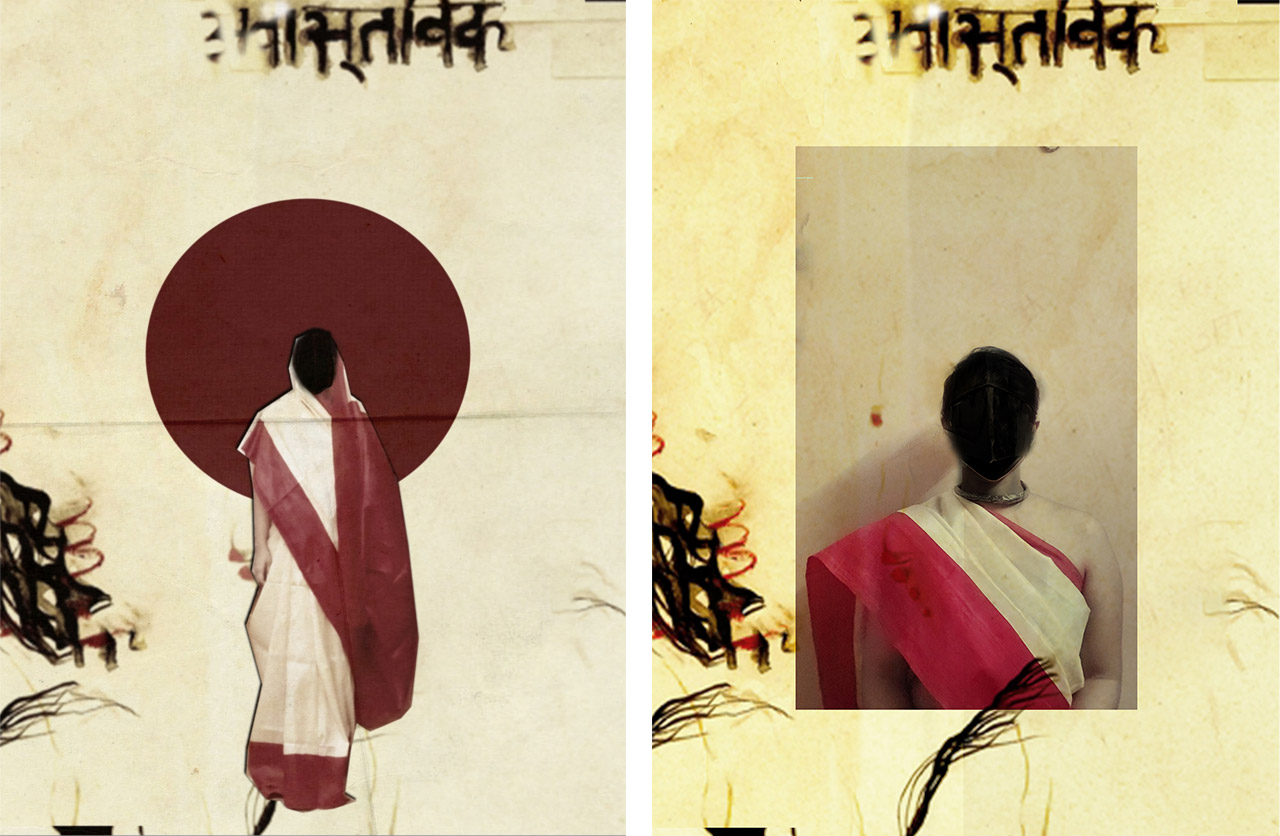
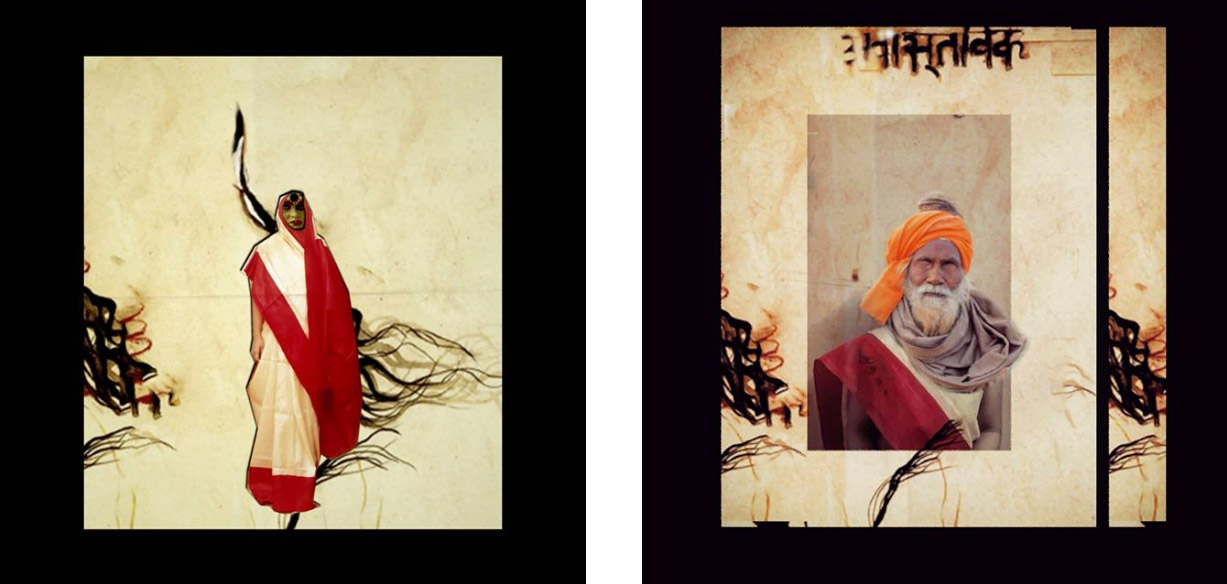
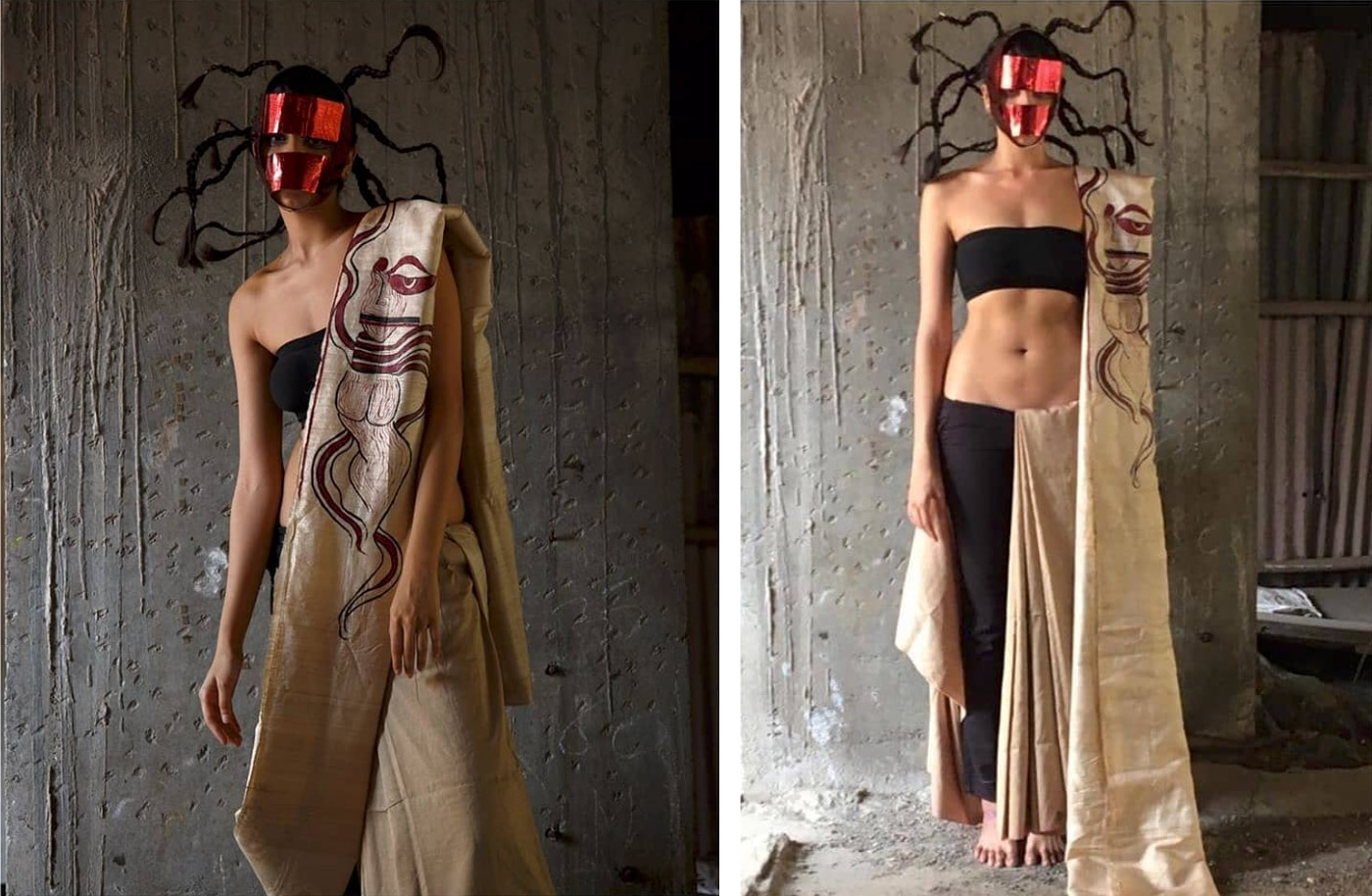
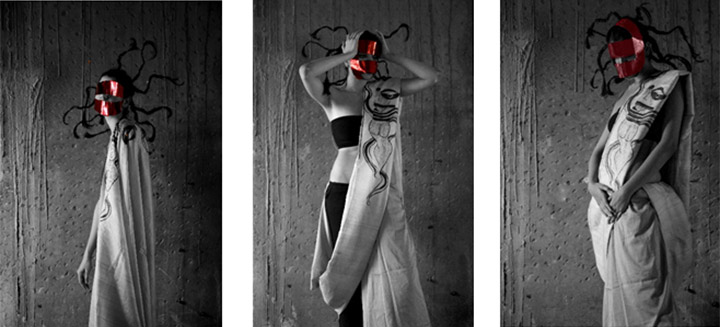
With sustainability, the saree also answers questions on gender equality and acceptance. Where today the world is speaking of gender-neutral clothing, it found way back in the Harappa civilization (Image 1) where we see men draped in fabrics. The Saree drape over the years has been associated with women, but I believe the drape is gender-free and stands for a sustainable and equal tomorrow. Taking my conclusion further into application of my research and explorations, the outcome of this project consists of series of images created with recycled, old sarees styled on men and women wearing masks to express gender neutrality in the current scenario. My outcome is an artistic expression of my research and conceptualisation.
The following series was created in 2020 during the Covid-19 pandemic and is interlinked with the mask. The Mask and the Saree are genderless forms of self-expression. The art of draping is our voice for tomorrow and the voice of gender-neutral clothing. I am looking at the future through my Saree, and here is a visual representation of my concept.
About the Author: Ms.Ishi Srivastava, lecturer at Pearl Academy, Mumbai is an artist, stylist and designer based in Mumbai. A fashion design graduate from Pearl Academy Delhi, she has worked in the industry as a freelance stylist, graphic designer, costume designer, visual artist and was running her own clothing line. Her styling work has been featured in multiple magazines like Mob Journal, Lucy’s, Mordant, Women’s Era, Malvie and Clichémag. She is also a part of the Khadi Design Council of India and has presented and will be presenting her research paper on ‘The Virtual Studio’ (online education), ‘The surviving Saree’ and ‘The Future Universe’ at platforms like Fashion Colloquia, Jaipur, From Place to Space (Virtual conference) and Global Fashion Conference 2020. Ishi believes in driving change through education, fashion, art and is constantly working to achieve this.
Fact File-
The Surviving Saree – Innovation in Future Saree designed from recycled old sarees and hand painted with abstract artwork inspired from the story of Drapaudi In the Hindu epic Mahabharata by Author Ms.Ishi Srivastava
Team
Stylist: Ishi Srivastava @ishisrivasatava
Concept & Creative direction : @ishisrivasatava, @darkknitestudios
India is a beautiful country known prominently for its rich and varied culture. Through the ages, India has been in constant contact with diverse cultures from around the world. The monuments situated in the country represent the harmonious confluence of various traditions and cultures together. Apart from the cultural diversity and the historical relevance, these Indian monuments must be visited to experience the grandeur and magnificence of the architectural miracles that add to the beauty of our country.
In today’s digital world, when videogames and smartphones seem to be rapidly replacing books, we must educate our children on the rich and diverse culture that our country is home to. The first step in introducing the rich and diverse Indian culture to young minds is to acquaint them with the relics left behind by the past generations, the Monuments of India. Indian Monuments give a gist of the varied heritage that our country is part of. Here, we have compiled the list of ten such monuments, which will teach your child about the rich culture of our country.
Taj Mahal
Image by enjoytheworld
Any discussion on the Monuments of India must undoubtedly begin with the most beautiful and majestic Monument, the Taj Mahal. Situated in Agra, on the banks of the river Yamuna, the Taj Mahal was built by the Mughal Emperor, Shah Jahan, in memory of his wife, Mumtaz Mahal. The Monument’s mesmerizing beauty, along with the magnificent architecture, makes it one of a kind. Made entirely of white marble, this Indian Monument is considered to be an outstanding architectural achievement of the Indo-Islamic architecture. The Monument blends in perfectly with its natural surroundings, enhancing its aesthetic aspect. Cited by UNESCO as a World Heritage Site, the Taj Mahal is one of the Seven Wonders of the World.
Situated in Jaipur, the capital city of Rajasthan, the Hawa Mahal is a grand palace built with red sandstone. Said to have been constructed by the Rajput ruler Sawai Pratap Singh in 1799, the Hawa Mahal occupies an important place among the monuments of India. “The Palace of Wind” is said to have been constructed to allow the royal women, who were not supposed to be seen in public, to view the processions and festivals, which took place on the street. The Monument consists of 953 casements, each of which has a window. Built as an extension to the City Palace, situated nearby, the Hawa Mahal is both grand and beautiful. It is also quite popular among foreigners and is a central hub for tourists each year.
Constructed in 1193 AD by Qutb-ud-din-Aibak, the Qutab Minar is recognized as one of the three World Heritage Sites in New Delhi by UNESCO. The tower was built to commemorate the victory of Qutab-ud-din-Aibak over the previous ruler of Delhi. This majestic tower contains scriptures from the holy Quran carved in it. This great Monument is an accurate representation of the beauty and grandeur of Indo-Islamic art. It is the architectural brilliance and the peaceful ambience that enhances the beauty of this majestic tower. This renowned Indian Monument is the tallest brick minaret in the world and is a striking 72.5 meters high.
Situated in the state of Odisha, the Konark Sun Temple, is said to have been built by Narasimha Deva in the early 13th century. Declared to be a World Heritage Site by UNESCO, this Indian Monument is representative of the splendid architectural beauty that the country is home to. The Monument is built in the form of a chariot with twelve pairs of wheels, which are pulled by seven horses. The Monument is stunning; the marvellous design and sculptural work, along with the peaceful ambience, make this Monument one of a kind.
Completed in 1591 by Quli Qutub Shah, the majestic and glorious Charminar is situated in the city of Hyderabad, in the state of Telangana. The Monument gains its name from its four minarets (“Char,” meaning four and “Minar,” meaning Minarets). This Indian Monument is quite popular and is said to have been built to celebrate the end of a deadly plague, which had occurred at the time. The tranquil and welcoming ambience of the Monument gives the Charminar a special charm of its own. The magnificent and exquisite beauty of the Monument can be attributed to its marvellous architecture. The Indo-Islamic architecture can be found at its zenith in this Monument.
Agra Fort
Image by Bishnu Sarangi
Located in Agra, the Agra Fort served as the residence of the Mughal Emperors till 1638. This UNESCO World Heritage Site is made entirely of red sandstone and is located quite close to the Taj Mahal. This Monument occupies a significant position in the list of Indian monuments due to its historical relevance and marvellous architecture. This historical Monument is often referred to as a walled city and is one of the most popular and renowned Monuments in the country.
The Sanchi Stupa is believed to be one of the oldest monuments to have been constructed in India. This incredible Monument is located in Bhopal, the capital state of Madhya Pradesh. This Monument is an example of the spectacular architecture prevalent during the reign of Emperor Ashoka. Said to have been constructed by Ashoka to preserve and spread the philosophy of Buddhism. The Monument has a calm and tranquil ambience, capable of providing instant peace to anyone who visits it.
Gateway of India
Image by Bishnu Sarangi
Situated in the busy city of Mumbai, the Gateway of India is one of the most sought after tourist destinations in the country. It was built to commemorate the visit of the King of England, George V, and Queen Anne in 1924. The monument is embellished with the Indo-Saracenic style of architecture. Though it was mostly built to showcase the power of the British Raj in India, the Gateway eventually served as the passage for the departure of the British troops from India.
The “City of Palaces,” Mysore, is home to one of India’s most incredible palaces, the Mysore Palace. One of the most popular historical monuments located in Karnataka, the Mysore Palace used to be the residence of the Wodeyar Dynasty. This spectacular palace is built in an Indo-Saracenic style and combines elements from Mughal, Hindu, and Gothic architectural styles. One of the largest palaces in the country, the Mysore Palace, was designed by Henry Irwin. Today, this magnificent palace has been converted into a museum and is home to the art and architecture that belonged to the Wodeyar Dynasty.
The India Gate
Image by shalender kumar
The India Gate is situated in the capital state of India, New Delhi. This Monument is known for its striking resemblance to the Arc de Triomphe, located in Paris. The Monument was built during the British rule in India and was designed by Sir Edwin Lutyens, and the cornerstone for the monument was laid by the Duke of Connaught. The India gate was built as a war memorial and stood as a tribute to the British Indian troops who died during the First World War. After the Indo-Pak war of 1971, the Amar Jawan Jyoti, the Indian Memorial was added to the monument. The memorial is dedicated to the Indian soldiers who were martyred in the war.
Each monument in the country is relevant and plays an integral part in the history of the nation. From the mesmerizing Taj Mahal to the tranquil Shanti Stupa, the Indian monuments reflect both its diversity and rich culture. Apart from its immense historical relevance, these monuments also add to the fascinating beauty of the country.