How to Do the Matsyasana Yoga (Fish pose), Its Meaning & Health Benefits

1
Matsyasana
Photo by Elly Fairytale from Pexels

Matsyasana or the Fish pose has an interesting story behind it. The name of this asana comes from the Sanskrit language. The word Matsya means fish and the word asana means yoga asana or yoga posture. It is pronounced as mot see ahs ana. This yoga asana is practiced in the most authentic way in 200 hour yoga teacher training in India.

According to the Hindu mythology, Matsya was actually an incarnation of Lord Vishnu. Lord Vishnu is known as the preserver or the one who saves the Universe. It is believed that a massive flood was going to wash away all of the Earth because it had become corrupt. This is because Lord Vishnu incarnated as a fish known as Matsya and helped in transporting all the saints and sages to safety. He also ensured that wisdom was preserved through the entire process. This yoga asana is practiced to instil focus and resilience whenever a person feels out of balance similar to the time when Matsya came to restore balance between the Earth and the sea.

Why Matsyasana?

Why Matsyasana
Image – Wikimedia

This yoga asana is actually practices to increase focus and resilience in a person. Anytime a person feels unsure or shaken due to any problem, this asana works wonders. Legs are supposed to be grounded till the point your legs feel firmly and deeply fixed on the ground. This helps in lifting the chest area and also helps in the breath to become more deep. This yoga pose will make your back and stomach stronger than ever. Similar to all the back bending yoga postures, this asana helps to lighten up the mood and reduces the anxiety.

This yoga asana is considered to work like a relaxing and refreshing break that helps in grounding you and waking you up. You will weigh more energize and full of life once you practice it regularly. You can do this asana even at work by creating some movements similar to the Matsyasana. Desk job can make your spine round due to sitting all day in one position. You can reverse the imprints of your posture while sitting on your seat.

How to Do Matsyasana?

  1. Begin by lying straight and flat on your back while making sure that both your legs are kept close to each other and your arms on the side of your body.
  2. Place both of your palms under your buttock in a way that your palms face in the direction of the ground. Now bring both your elbows together so that they comes closer to your waist.
  3. Cross both of our legs with each other while making sure that they touch your torso and your thighs. Make sure that your knees are placed flat on the floor.
  4. Take a deep breath in and lift up your chest in a way that your head is lifted as well. Make sure that your crown is touching the floor.
  5. Remember to ensure that the entire weight of your body rests on your elbows and not on your head. While you lift your chest, pressurize your shoulder blades in a light manner.
  6. Stay in this position till the time you feel comfortable while breathing in the right way.
  7. Exhale while you let go off this position. Do this by first lifting your head and subsequently dropping your chest on the ground. Separate your legs and bring them in the normal resting position.

Benefits of Matsyasana


Image – Wikimedia

Out of the many amazing benefits of the Matsyasana, some of the best are:

  1. This yoga asana helps in improving the nutrient absorption. It also helps in stretching the chest area and the neck area while releasing tension in these regions.
  2. It helps in getting rid of all the respiratory problems because with its regular practice, a person learns how to breathe properly.
  3. It helps in strengthening and toning the pituitary gland, pineal gland or the third eye and the parathyroid.
  4. It helps in effectively stretching the back region and also helps in toning of that region. All the strain gets relieved from the back as a result of doing this yoga asana every day.
  5. The muscles of the upper back and the neck region get stronger as a result of practicing this yoga asana every day.
  6. The hip flexor muscles get a good stretch situated between the ribs with the regular practice of this yoga asana.
  7. All the muscles situated in the front of the neck region and abdomen area get activated with the help of this yoga asana. 
  8. The digestive tract and the throat of a person get a good massage with everyday practice of this asana.
  9. This yoga asana helps greatly in improving the correct posture of a person. 
  10. This asana can help in getting rid of all the disease mentioned below: 
  • Constipation
  • Anxiety
  • Tiredness
  • Backache
  • Menstrual problems
  • Respiratory problems

Precautions & Considerations

There are some precautions and contradictions of this yoga asana that must be followed. They are as the following:

  1. It is best to stay away from this posture on the off chance that you experience the ill effects of high or low circulatory strain (blood pressure problems). 
  2. Likewise, patients with a sleeping disorder and headache are requested to stay away from practicing the Fish Pose. 
  3. On the off chance that you have had any kind of back damage, it is emphatically suggested that you keep away from this asana.

Beginner’s Tip

If you are a beginner then it is quite possible that you might feel some kind of strain in your back and your neck when you start practicing this asana. To make sure that this does not happen, bring down your chest region in a marginal direction or you can put a cover on your head till the time you begin to feel comfortable while doing this asana.

4 “Must do” Things in Kodaikanal

0

Kodaikanal
Image Pixabay

Often known as Kodai, this place has never failed to seize every traveller’s mind with its ethereal beauty. This beauty of the Southern province of India has a lot to offer to its visitors, from picturesque hills to serene lakes, the possibilities are literally endless. Gifted with striking natural beauty, reaching this place via flights is easier than you thought. Book a flight to Madurai and then take a few hours more journeys to reach the beautiful land with amazing trekking routes and waterfalls. 

In this article, we are going to be sharing some of the best things to do while you are visiting Kodaikanal. 

Visit the Kodai’s lake

Kodai’s lake
Image – Simian Wolverine via Flickr

Situated just in the middle of the Kodaikanal city, encompassed between the virgin forests of the Palani hills, the Kodai lake is a must visit when in Kodaikanal. It is possibly the most popular tourist spots in the area and if you are visiting during the summers, just be assured to be enthralled by the beauty of the flowers and the boat pageant events around. Looking at the entire place around on the body is possibly the highlight that you simply can’t afford missing out on. 

Visit the Silent Valley View at the Echo Point

Silent Valley View at the Echo Point
Image –Wishvam via Flickr

If you are a nature lover, visiting the silent valley view at the echo point must be in your itinerary. The enticing panoramic beauty and view of the entire place around are just too good to miss out on. Combine this amazing view with the lush greenery and the calmer atmosphere around you and you are surely going to be mesmerized with the place. Since the valley, for the most part, is covered in mist, the best time visit is either during the early morning or during the late afternoons.

Try some photography at Berijam Lake

Berijam Lake
Image – Wikimedia

Hidden between the dense forest of the Palani hills, the berajim lake is a treat for every photographer and nature lover. The lake is surrounded by a thick blanket of acacia as well as pine trees and is encompassed with picturesque views of the entire landscape. Not just that, even the lake has rich habitats of flora and fauna which just adds to the beauty for every photographer. Just consult the authorities there and get your forest pass and you are all ready to enjoy the amazing beauty of the place. 

See the Glass House located at the Bryant Park

http://www.thewhatsupguy.in/2014/06/Bryant-Park-Kodaikanal.html
Image – Thewhatsupguy.in

When in Kodaikanal, visiting the Bryant Park is a must do. But what makes the experience even more riveting is when you go to see the glass house of the Bryant park. It is an exhibit for some of the most beautiful flowers including orchids, ferns and even some of the most exotic plants. The entire park is just a recluse for every nature lover which nobody can just miss out on. 

Greensole – Paving the Way for Sustainable Footwear

0

Greensole

One of the tabs on Greensole’s website reads, ‘Did you know?’, and furnishes some awakening statistics. Every year 350 million shoes are discarded worldwide and according to a WHO report 1.5 billion people are infected by diseases that can be prevented by wearing shoes or proper footwear.

This information alone is an eye opener and highlights the equation between the have and have not of our society. And hence came forth the wonderful concept of Greensole founded in 2013 by Shriyans Bhandari and Ramesh Dhami, a business model which seeks to ‘To contribute to the social good, by creating a self-sustaining infrastructure that facilitates the provision of the basic necessity of footwear to everyone, forever…’ They started by providing 50,000 people in need of footwear across villages of India and today boast of some fantastic achievements, such as, crossing one lakh footwear in 2018, estimating 360,000 of CO2 emissions saved (LBS)and dreaming that no under-served is barefoot in the World by 2023.

How did it begin?

Both the founders of the company, as athletes found the need to discard about 3-4 expensive sports shoes each year because of wear and tear. This led them to brainstorm an idea wherein the discarded shoes could be refurbished and recycled into slippers that could be distributed to those in need of footwear. At the same time, it had a positive effect on the environment, by keeping the disposed shoes away from landfills and thus reducing the carbon emissions significantly.

How does it work?

The discarded shoes are taken to the manufacturing unit in Mumbai where they are dissembled. The soles of the disposed shoes are used as the base in slippers, the lacing and outer shoe used to make straps and more.

Why providing footwear is important?

Greensole-Recycled-Footware-01

According to UNESCO and WHO 1.5 billion people contract various diseases by walking barefoot. The Hookworm Infection is when the larvae penetrates into the skin of the foot and can migrate to the lungs. Other diseases that are associated with walking barefoot, include, stongyloidiasis, tungiasis, creeping eruption and tetanus. Besides, injuries to the foot or being bitten or stung by animals are a common resultant of being barefoot.

In India, in the many thousands of villages, buying a decent pair of shoes remains an unnecessary indulgence. This is most prominent in schools, where children usually wear hand down shoes of older siblings and a new pair of footwear is rarely given priority over meals, uniforms and books. Children in villages help parents in the fields and doing so barefoot can have its undue consequences.

Also, many children walk for 4-5 kilometers to reach their school highlighting all the more the need of proper footwear.

Bridging the gap

The founders of Greensole have to be congratulated on building a sustainable business model that gives equal importance to the social and environmental impact. Collecting discarded shoes and recycling them leads to less strain on the environment and generates employment by engaging people in the manufacturing units. However, the idea just does not stop here and in fact takes the initiative a large step ahead. The trendy recycled slippers are not only sold to potential buyers thereby generating a profitable business but are also donated to the hundreds of children and people in villages who would never have gone out of their way to buy a pair of slippers for themselves. This merger of a successful business model seamlessly merged with a social responsibility that not many people would think of merits applause and support.

Greensole-Recycled-Footware-02

Shriyans, Ramesh and their entire team have managed to grow a business excellently balancing the social, environmental and economic aspects. Having partnered with multiple businesses under CSR (Corporate Social Responsibility), as well as through donations and the sale of their refurbished slippers, Greensole in its own words is here to ‘Donate Walks’.

With encouraging words, from Ratan Tata, Barack Obama and Anuj Puri as well as being featured on multiple platforms, such as, BBC, Forbes and Vogue India, Greensole provides an easy eco-friendly footwear option for users, who are waking up to trying to do their bit for the environment and society at large.

What can you do?

Next time you want to discard your used shoes think before throwing them in the bin. Instead donate a pair to Greensole or find out the nearest collection center.

You can also help the cause by buying your new slippers or shoes online from Greensole.

Companies and startups like Greensole stir our conscious a bit and make us sit and take notice of things we at some point have started shoving in our subconscious mind. It also paves way, in showing youngsters and business enthusiasts on how to balance fulfilling a social cause with a sustainable environment and economic approach.

Everything You Need to Know About Indian Kurtis

0

KNOW-ABOUT-INDIAN-KURTIS

Many people may have heard of the Indian Kurtis but may not know where it originated from. Every person should at least have a brief history of the Kurtis. It was called the daughter of the traditional long Kurta that was used in the past back in northern India. Over the years, it has spread and become part of the world. Kurta originated from standard long shirts which were worn in Northern India.

In the Western countries, the tunic was worn for some religious and traditional ceremonies with cloak beneath it. Many industries have emerged due to the spread of the Indian Kurtis and it has resulted in job employment and development of infrastructure all over the great country of India. This popular garment is made up of fabric and the amazing thing with it is that any fabric can be used to make this wonderful garment. Many leading manufacturers of this garment usually do it according to the latest fashion trends that will suit the needs of the customer since everybody likes to be in the newest fashion in town.

Importance of the Indian Kurtis

KNOW-ABOUT-INDIAN-KURTIS-2

Some people may tend to buy the Indian Kurtis but may not know the appropriate uses/when to wear it or where to wear it and from where to buy it. You can buy it from stylecaret.

The following is a brief about the different uses of Indian Kurtis:

FESTIVAL GARMENT- Indian Kurtis is used as a festival garment and worn during various festive seasons. So if you are in a festive season and you don’t have any garment to wear, consider Indian Kurtis and it will give you the perfect outlook on that memorable festival season.

OFFICE WEAR- many people are used to going to offices with skirts and blouses but this popular type of garment known as the Indian Kurtis will be fitting for your office work.

CASUAL WEAR- most people prefer to wear jeans as their casual wear but the Indian Kurtis is the most appropriate garment to wear as your casual garment since it helps you feel free and able to walk around when you are happy and relaxed. Try it today and you will definitely get a new nice experience.

Varieties of Indian Kurtis

KNOW-ABOUT-INDIAN-KURTIS-2

Many people may tend to think that there is only one type of Indian Kurtis and they are absolutely wrong since there are various varieties of this popular garment.

The varieties include:

  1. Chiffon designer 
  2. Chiffon beaded 
  3. Georgette designer
  4. Georgette beaded

Kurti Styles & Design

KNOW-ABOUT-INDIAN-KURTIS

 Kurtis may come in different styles and designs in order to present that magnificent look that one may deserve while wearing the garment.

The following are some of the styles in which Kurtis may come in

PRINTED KURTIS- this Kurtis contain printed images of things such as beautiful flowers, dots or even some presentable dots.

FLARED KURTIS- these are Kurtis which form a certain shape at the base presenting that excellent look

LONG KURTIS-this type of design is the one which goes beyond the knees and perhaps may reach the toes or even the angle. This type of Kurtis is preferred by older women who don’t like short clothes.

STRAIGHT KURTIS- this type of Kurtis are usually straight in nature with no cures and don’t form any shape at the base. They are just straight in nature. They are preferred for office work.

Latest Kurtis Design

KNOW-ABOUT-INDIAN-KURTIS-2

As a matter of fact most people want the latest fashion designs so as to rhyme with their peers. The manufacturing industries are doing their best to manufacture latest designs so as to sustain their endless market and demands from their customers.

The following are the latest designs of Indian Kurtis in the market:

EMBROIDED JACKET DESIGN- this design is basically a long Kurtis and it is like a jacket.

This design is popular mainly among the young generation.

KITE DESIGN- this garment is basically triangular in shape and can be made from cotton or fabric.

It is fitting up to the waist then it spreads giving that elegant shape of a kite.

This design is selling in the market like hot cake.

SIDE LAYERED KURTI-this type of Kurti is made up from the georgette material. It gives a straight line on one of the sides. This garment also has a top which looks like that of a coat and it has long sleeves. It also has the popular semi-necklace design. This design is also popular despite the fact of it emerging only this year.

BROCKED LAYERED- this marvelous type of garment is made up from pure silk. It contains the brocket layering in the knee part and gives a new pattern. It is appropriate for special occasions. Moreover, it contains long sleeves. This type of garment is gotten from a traditional type of dress

DHOTI STYLE-this type of garment improves your style standard. It is made up of silk. The lower part of the dress is made up from georgette material. It contains some golden decorations on the front. It is mainly worn in parties.

SINGLE SHOLDER- this design is very common in teens and the youth. It is made up of silk material. Given a wrap design that forms layers from the shoulder towards the opposite side. It has the single shoulder design spicing up to its beauty.

Navy Raw Design

According to research, this is the recent design in the market and everybody is rushing to purchase it while stock lasts. It is made of silk. It has horizontal lines which are usually in 3 colors. In the base, there is a golden lace. It contains a dress look. It is fitting at the waist.

Buying the Kurtis Online

KNOW-ABOUT-INDIAN-KURTIS

One can purchase the garments online via different sites like stylecaret at an affordable price since the shop may be too far from your location. Once you buy the garment it is delivered right at your door step and you pay for it on delivery. They come in different sizes and materials in which you can choose from. Buying online is relatively cheap than buying from a shop.

Turmeric – The Flawless Flavor of Indian Culture

0

turmeric-in-Indian-culture
Image – Pixabay

It is surprising how some things exist for centuries and are part of our everyday existence, but we only wake up to its full potential when shaken from our slumber. Turmeric or Haldi is one such Indian kitchen/social/religious ingredient that has for years been a vital part of the Indian culture, adding color and flavors into all that it is poured into. The West, however, has adopted its benefits only recently yet in our homes turmeric has always been around, the humble yellow powder used for myriad utilities.

Indian culture many a times throws up surprises that are hard to understand. Though the world at large is recognizing many of our cultural and traditional nuances, these have in fact been the very fabric of our social and individual lives. Yet, it is somewhat astonishing to figure out the history of how a simple inconspicuous turmeric plant could have been woven so intricately into our culture and homes that it has somehow seeped into our subconscious mind, groveling in our being but never superseding or overtly exerting its supremacy, worth and value.

Usage of Turmeric

haldi-ceremony
Image – Aritra Sen Via Flickr

Turmeric, the word, is a Sanskrit synonym for yellow color and has been cited in many Sanskrit texts dating back to the 4th and 5th century. Used in Ayurveda medicines as well as known to be a household remedy for many ailments, ranging from a simple cough and cold to treating wounds and jaundice, turmeric has many medicinal uses and often works as an anti-infection dose.

Turmeric curcumin benefits are many Cosmetically haldi is deemed as a perfect product for skin related ailments as well as for beautifying and nourishing the skin. Women over generations have used turmeric paste over their faces and hands and today many cosmetic products incorporate turmeric into toothpastes, face washes and shampoos.

In fact it would not be too far-fetched to say that turmeric as medicine can be applied or used for just about everything. Apply it on a burn, on an acne, wound or drink it with water for indigestion, bloating or intestinal troubles. Blend it with milk to curb the nagging throat pain or add it while boiling or cooking your favorite non veg dish to get rid of any infectant.

Haldi Doodh
Pixabay

Besides, turmeric is the most staple spice ingredient that goes into practically all dishes while cooking. Also called the healer’s spice it adds a simple yet essential taste to any platter, always playing the double role of providing the perfect pinch in taste, color as well as giving the food its nutritional and curative touch.

Cultural usage

However, culturally the usage of turmeric is far more than a kitchen spice or medicinal plant. It is also deemed auspicious and before weddings the groom and bride across many religions are often smeared with haldi paste. During the wedding a string dyed in turmeric paste, called the mangalsutra is worn around the neck of the bride, an indication of her being married.  Robes of the Buddhist monks are also dyed in turmeric, whereas invitation cards from Hindus usually have a mark of haldi when sharing some happy news.

Haldi_Mangalsutra
Image – Strandofsilk

It is also believed that turmeric was first grown to help tribes transitioning into agriculture to use in decorative masks, weaving and drawing deities.

Hence the significance of turmeric in Indian culture has always been attached to its sacredness and good omen and has a huge bearing on the culture and social traditions of society. In fact, besides haldi, there are many other foods and ingredients that are believed to be auspicious and influence the culture of the land – for example, eating curd and sugar before venturing for an exam, interview or any new endeavor, sprinkling saffron or kesar on wedding cards, cracking a coconut while beginning something new and so on. However, out of the many superstitions and beliefs, very few really can be explained to have a practical or pragmatic approach as much as haldi. Turmeric stands out racing ahead of the other foods with a religious or social significance, because its benefits are vastly accepted and to a certain point proven as well. Turmeric is made up of curcumin which has antioxidant properties and is anti- inflammatory. In fact studies have proved that the consumption of turmeric has had positive effects on diseases such as, arthritis, depression, and even cancer.

turmeric-for-health
Image Source

With more and more awareness being spread about the spice, more people have realized the importance of turmeric. And though turmeric has been a part of our lives since ever, it is good to know that it’s worth and importance is being recognized across the globe. At the same time, turmeric also essentially means much more to an Indian than just a spice that has many benefits, it is in fact as the author Chitra Banerjee Divakaruni says in her novel, Mistress of Spices, “Turmeric the auspicious spice, placed on the heads of the newborns for luck, sprinkled over coconuts at pujas, rubbed into the borders of wedding saris.”

10 Unknown Facts of Ikat: The Magical Weave of India

0

Facts-of-Ikat

These facts about Telia Rumaal (Puttpaka) ikat craft would blow your mind off, came from horse’s mouth (Padmashri Gajam Govardhana) and not available anywhere else:

  1. The father of Telia Rumaal is Pendem Narasimhan who has developed this craft to what it is today by introducing concept of double ikat in Telia Rumaal, this legacy was taken over by Gajam Govardhan knowing that double ikat was on the verge of extinction!
  2. The hanks and yarns has to be dipped in Sesame oil for minimum 21 days, post which without draining out it is put for resist dyeing based on the patterns designed on Graph and then put on the loom for weaving.
  3. The reason why this oil was used as it has the natural character of maintaining warmth in cold weather and cool in warm climates. That is why this fabric was used as a Barter system for other materials with Arab countries and the Middle East. Telia Rumaal was used as the turban by all the men in the Middle East and one can see the ikat checks on the fabrics that has been used to be worn by travellers in deserts to beat the heat for days and months.
  4. The tel (oil) treated fabric used to act as water repellent fabric for the fishermen and women working on sea shores (fishing), it also used to protect their skin from sea salt water. This was amongst the first water repellent fabrics invented ever!
  5. The original telia rumaal had only three colours deep red (Maroon), Black & White, legend says that the red colours acted as an attraction to catch fish, whereas in contrast it used to save women and men from wild animals working in fields and jungles (colour theory has been used as a scientific method to protect from external sources).
  6. Telia Rumaal acted as the uniform for all the staff members under Hyderabad Nizam Government, including members of court, police, civil servants and the part of Nizam Government. It was used as the differentiating factor amongst general public and government officials mainly.
  7. The holy fabric of Ajmer Dargah Sharif is officially Telia Rumaal that is being draped on all the shrines at the Dargah Sharif of Ajmer city, this tradition is till date alive.
  8. Today in the name of Telia Rumaal, people apply the oil on the loom itself while weaving that is not at all authentic, and the whole Andhra is selling these fakes in name of Telia Rumaal…Also now people use chemical colours instead of natural colours.
  9. Last not least, it is the natural colour that is absorbed by the oil soaked yarns and interestingly no chemical dye can penetrate these oil soaked hanks, therefore making Telia Rumaal soaked in oil an authentic piece with Natural Colours.
  10. Japan has championed Art of Indigo ikat which no body in the world has been able to copy so far!

Ikat-Weavers

ITI TYAGIInputs provided by:
ITI TYAGI, Founder of CRAFT VILLAGE, India’s only social enterprise, works for the revival and up-liftment of crafts and craftsperson, through various awareness programs workshops and events.

Traditional Bridal Fashion: The Nath

0

Traditional-Bridal-Fashion-The-Nath
Image – Rupali Neelkanth

What is a Nath?

The ‘nath’ or nose ring is a popular piece of Indian jewellery worn by brides in each and every part of India. The practice of piercing the nose with a ring or a stud dates back to the 16th century, when rulers belonging to the Mughal Empire brought this fashion to the country from the Middle East, and this practice persists to this day. Brides wear the nose stud or ring either on the left side or on both sides, and the ring is mostly connected to the ear with a long chain of gold. You can look for gold chain design for female relatives of yours that can be made into a nath.

As a way of honoring Devi Parvati, the Hindu goddess of marriage, Hindu brides are mostly seen wearing nose rings. These are also worn as a symbol of getting married. This is indicated by the fact that in some parts of the country, women refuse to remove their nose rings even after their marriage.

Significance of the Nath in Wedding Attire

Traditional-Bridal-Fashion-Nath

In Hindu cultures, the nose ring has been traditionally worn to indicate the virginity of the bride. Whether she would wear the ring or not on her wedding day is left to the choice of the bride herself. If she wants to wear it, she should have a nose ring made with metals and colors that would go well with the lehenga-choli or the saree that she has already bought for her wedding. The bride also needs to make sure that her nose ring complements her necklace, earrings, maang tikka, bangles, and other pieces of her wedding jewellery. The size of the nose ring should be chosen keeping in mind the shape of the bride’s face as well as her nose. For example, a woman having a big round face will look better with a large nose ring. However, it must be kept in mind that nose rings are not made to suit each and every bride. And what’s more, just because naths are generally associated with Hindu culture, it does not mean that brides belonging to other religions or cultural backgrounds do not wear them. For instance, nose rings are popular among Muslim brides as well.

Beneficial for Health

The nose ring is typically worn on the left side of the nose in the northern parts of India. On the other hand, brides in the southern states of India usually wear the ring on the right. But in most cases, women prefer to pierce the left side of their nose. This is because the ancient Indian medicine incorporating a natural system of healing, called Ayurveda, has given rise to the belief that since the nerves in the left side of the nose are connected to the reproductive organs in the female, piercing that side of the nose can reduce the pain and stress experienced by a woman while giving birth to a child. It is also held by another theory that piercing a particular part of the nose can relieve the woman during menstrual pain.

Types of Naths in India

Traditional-Bridal-Fashion-Nath-1

The most common of the nose rings worn by married women in India, especially in Bihar, is the laung, which is shaped like a clove. In Rajasthan, the nathuri worn by brides is a small ring made of gold or silver and set with semi-precious stones, while brides in Uttar Pradesh wear naths adorned with beads and pearls as a blessing for prosperity. Usually gold nose pin designs with price available online are a favorite with brides all over India.

Mesmerizing Fabric Arts of India Reflecting the Great Indian Culture

1

Fabric-Art-of-India

India is a land of a massive diversity and often when we talk about the different things that make up this single country, we talk about different languages, castes, creeds, religions and so on. Very rarely, do we talk about the different handlooms of India or embroideries of India that are found in practically every state and region of the country.

The fabric or material quality, design, color, method of weaving and embroidery are extremely varied across the length and breadth of the country. The unique artistic skills are a wonderful feature that has for generations been passed down and preserved. Though the weavers face tough competition from machines the Indian fabrics have not lost out completely and are consciously being brought into the mainstream of fashion.

However, the sheer variety of fabric art of India is mind boggling. Here is taking a look at some of the special fabrics, material and designs that are special to each state.

1. Bandhani (Gujarat)

Fabric Arts of India, Bandhani
Image – Andrea Kirkby via Flickr

Tie and dye popularly known as bandhini is vibrant and colorful fabric material that radiates and shines with its loud hues and mirror work. The little square or round designs are a result of the tie and dye method, the technique that involves dyeing the fabric which is tied tightly around various points. Practiced by the Khatri community of Gujarat Bandhini work is carried out by highly skilled craftsman.

2. Chikankari (Uttar Pradesh)

Fabric Arts of India, Chikankari
Image – Thecolorcaravan

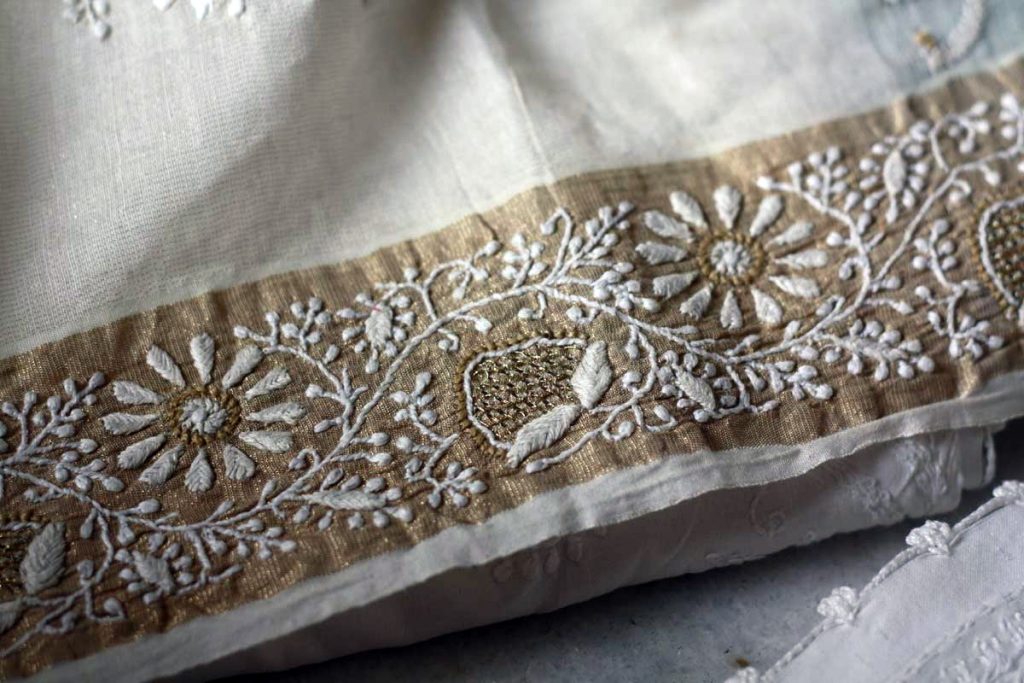
Believed to have been introduced by Nur Jehan the wife of Mughal emperor Jahangir, this delicately embroidered fabric is a smart attire choice. The design over the cloth is first block printed after which the chicken stitches are embroidered over.

3. Lepcha (Sikkim)

Fabric Arts of India, Lepcha
Source

The Lepcha tribe of Sikkim is well skilled handloom tribe and the lepcha material is used for their traditional garments as well as in the market for bags, cushion covers, table mats and more. The cotton based material is interwoven with woolen motifs.

4. Phulkari (Punjab)

Fabric Arts of India, Phulkari
Source – Utsavpedia

Practiced as a way to pass time by the Punjabi women the Phulkari embroidery designs, as the name suggests, are floral embroidery on the base cloth. The stitches are taken on the reverse side of the cloth as the artwork takes shape at the front. The Phulkari fabrics are usually light based colors with the embroidered design in darker shades.

5. Eri Silk (Meghalaya)

Fabric Arts of India, Eri-Silk
Ritika Mittal

This soft textured fabric of Eri silk has a natural dull golden shine to it and is one of the most sought after materials in the fashion world today. It is also preferred by the Buddhist monks because of the ecofriendly form of production as no living being is harmed in its manufacturing process.

5. Paithani (Maharashtra)

Fabric Arts of India, Paithani
Image – Ashley Van Haeften via Flickr

This exquisite hand woven fabric is a specialty in many regions of Maharashtra. The beautiful material is produced after much hard work resulting in a design and pattern that is exactly same on both sides. Made from fine silk they are produced in some wonderful shades of colors and the delicacy of work, where zari is interwoven with the cloth gives the fabric a luxurious feel and look.

7. Ikat (Odisha and Andhra Pradesh)

Fabric Arts of India, Ikat
Image – RubyGoes via Flickr

Ikat is practiced in many parts of the country, such as, Odisha and Andhra Pradesh. Here the material is first dyed before the process of weaving. In Odisha Ikat was practiced by several tribes, such as, the Bhulia and Meher and their fabric art revolved around their traditional culture. Pochampally ikat from Andhra is usually associated with a heavy border and the process of weaving takes quite long, making it also one of the expensive fabric materials in the market.

8. Patola (Gujarat)

Fabric Arts of India, Patola
Image – Saurabh Chatterjee via Flickr

Coming from Patan in Gujarat this fabric weave involves printing on the material. Produced in various colors, designs and motifs the Patola weave is also how a double ikat pattern comes to life.

9. Kalamkari (Andhra Pradesh)

Fabric Arts of India, Kalamkari

Kalam meaning pen and kari meaning craftsmanship, the kalamkari weaving is a pen art that at once concentrated on weaving stories from Hindu mythology on to the fabric. Patronized by the Mughals this fabric art form is today used as block prints over saris and dupattas.

10. Brocades (Uttar Pradesh)

Fabric Arts of India, Brocades
Image – Wikimedia

The very renowned Banarasi saris are a part of the fantastic brocades that come from this state. The gold and silver threads are interwoven to form an exotically beautiful design that is both classy and high quality.

11. Zari work (Madhya Pradesh)

Fabric Arts of India, Zari-work
Source – Thesethingscalledwords.wordpress.com

Though another form of the brocade the zari threads are interwoven into the weaving and embroidery giving the fabric a distinctly different and rich look.

12. Kanjeevaram (Tamil Nadu)

Fabric Arts of India, Kanjeevaram
Image Source

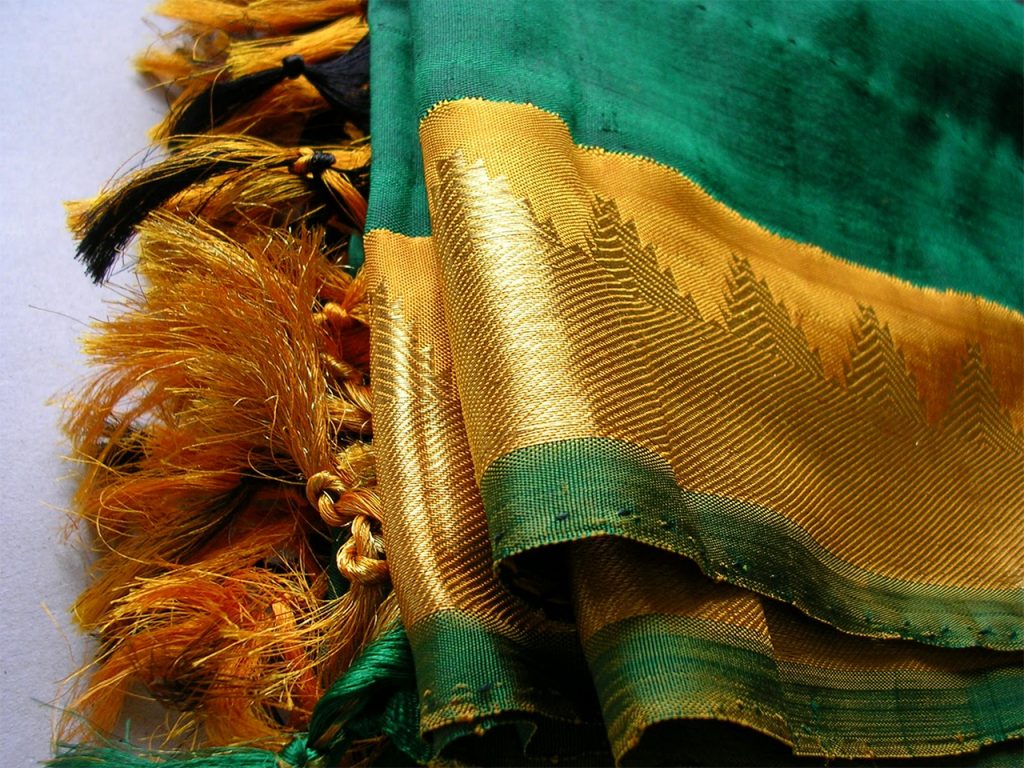
Made popular from the town of Kanchi or Kanchipuram the Kanjeevaram silk is one of the most popular sari fabrics of South India and a favorite bridal choice. The heavy laden border is the highlight of the stunning fabric.

13. Kasavu (Kerala)

Fabric Arts of India, Kasavu

The trademark white and gold fabric that is synonymous with Kerala culture and worn by women during Onam is golden zari work done on the base of a mundu sari that is woven from completely unbleached cotton.

Suggested Read – Handlooms of Kerala – Holding onto the Flag of Tradition

The list can go on, such as, Panchachuli from Uttarakhand, Shisha from Rajasthan, Naga shawls from Nagaland, Phanek from Manipur, Chanderi from Madhya Pradesh, Mysore Silk from Karnataka, Kuchai Silk from Jharkhand, Kunbi from Goa, Panja from Haryana and many more.

Though each state has its specific weave and handloom fabrics, they are not necessarily exclusive in that region alone. Different material and weaving patterns have emerged from different parts of the country and in many cases there are cross patterns, variations and off shoots that are practiced in the same as well as other regions of the country.

The skill, level of creativity and patience needs to be applauded of the local tribes and villages who have managed to retain their fabric art over generations. Attire is an integral part of the culture of any region, and the unique fabrics have a deep connection to their places of origin and practice. This cultural connection of the weavers with their material, designs and home make the handloom and material art of India unique.

Some Great Books on Indian Fabric

The Fabric of India – First truly comprehensive book on Indian textiles

Best-Book-on-Indian-Fabric
Get the Book

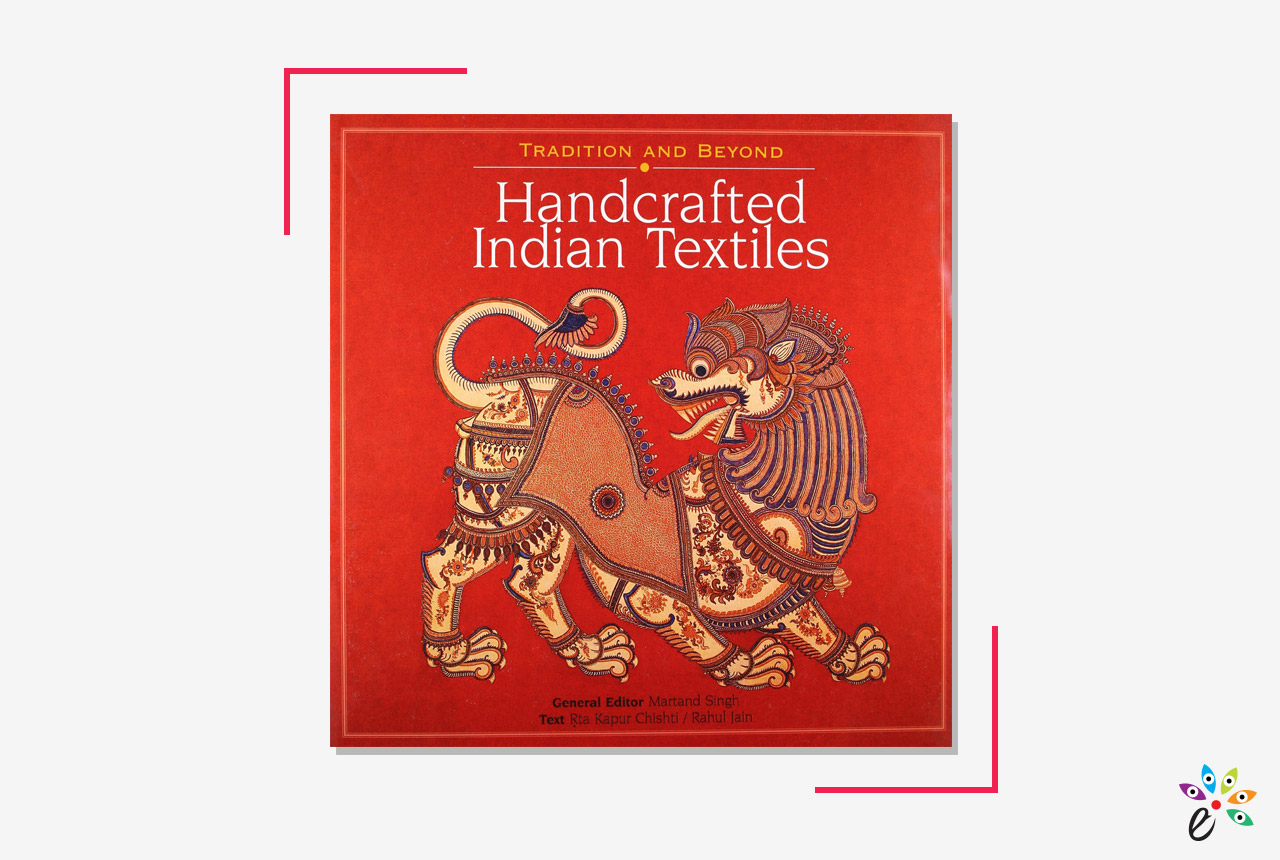
Handcrafted Indian Textiles – A book is, indeed, a treasure for both the textile aficionado and designer.

Indian-Fabric-book
Get this Book

Indian Textiles – An excellent book giving an overall picture of the regional textile differences.

textile-motifs-of-india-book
Get this Book

Best Heritage Walking Tours in India to Go Offbeat

0

India is known for its rich heritage, vibrant culture and raw ethnicity. The authenticity pulsates and radiates from each corner of the subcontinent. But what is the best way to experience the wonders of this beautiful and charming mosaic? Walking! If you are looking to experience this cradle of civilization closely with a more personal outlook then a walking tour will bring you more in contact to the heart of India. Some of the best travel agents in India will advise you not to be a tourist, but instead make yourself at home and experience India like one of the locals.

Here are some of the places where you can have an enchantingly memorable and one of the best heritage walking tours in India:

Goa Walking Tour

Best-Heritage-Walks-Tours-in-India-Goa
Image Source

Known for it’s never ending parties, friendly locals, scrumptious sea food and of course, the white sandy beaches, Goa is a town riddled with rich heritage and visible European influences. You will be made to walk along the charming and delightful streets of Goa where it is dotted with humble quarters, churches and colorful gardens. Walking along the spine of the enchanting town of Panjim, you will witness the grand Adil shah palace, Old central library and the regal Panjim church. The walls in these streets are adorned with tiled mosaic images, quirky illustrations and other images which represent the rich Portugese culture that made this town a prime tourist destination in India. The peaceful collision of the Portugese and Indian culture can be experienced as well as witnessed in the architecture, food and lifestyle of the locals. Walking through old Goa you will be greeted with a variety of pleasant bazaars and enthralling landscapes.

Best time to visit – mid November to mid-February

Old Delhi Walking Tour

Best-Heritage-Walks-Tours-in-India-Delhi
Image Source

Known for its fast paced life and for being one of the best metropolitan cities to live in India, the old Delhi heritage walk will be a pleasant surprise. Contrary to New Delhi, old Delhi will teleport you back in time. With narrow, age old alleyways, buildings dating back to the Mughal era and a rich fragrance of the local and famous food preparations in the air, a heritage walk of Old Delhi will give you a glimpse into the foundations of the present day Delhi. From exploring the vibrant bazaars and spice markets of the largest wholesale market in India, tasting some of the most delicious and one of a kind food to witnessing the splendor of the well preserved and one of the largest mosques in India Jama masjid, you will be awe struck with the secrets this city still holds. This old Delhi heritage tour can be experienced by foodies, photographers, avid readers, history lovers as well as shopaholics alike.

Best time to visit – November to February

Pondicherry Walking Tour

Best-Heritage-Walks-Tours-in-India-Pondicherry
Image – Alessandro Malatesta via Flickr

With brightly colored quirky buildings, French architecture with ornate windows and clean streets lined with tall green trees, Pondicherry is a town which is best experienced on foot. A heritage walk of the town will take you on a journey through history and time dating back to 17th century when this coastal town was brought to life by the long term French reign here. A safe haven for nature and peace lovers and an oasis for avid and amateur photographers, this post colonial town has a series of French and Tamil quarters remnants. The colonial influence has been beautifully mingled with the traditional culture of the town giving it a personality of its own. You will be exploring some of the most iconic structures of the town like, Ayi Mandapam, Pondicherry museum and Le Café. Taking a walk among this enchanting town will bring you closer to the life and times of the locals.

Best time to visit – November to February

Varanasi Walking Tour

Best-Heritage-Walks-Tours-in-India-Varanasi
Image – juggadery via Flickr

Being one of the oldest living cities in the world, a walking tour of Varanasi will evoke not just a sense of extreme spirituality but will also bring you in close contact with the ancient stories that make up one for one of the oldest and widely accepted religion in the world. You will be made to explore the true vibrancy of the holy river of Ganga and its neatly lined ghats, along with taking a dip into the rich history by walking through the alleyways of ancient and some of the most pious temples like Kashi Vishwanath, Sankat Mochan Hanuman mandir, bharat mata mandir and more. There are several undiscovered and hidden gems in Varansai which can only be truly experienced by taking a walk within these winding roads. All this walking is bound to make you hungry, which can be satiated by gorging on the delicious street food, whose taste is unmatched.

Best time to visit – November to March

Mysore Heritage Walking Tour

Royal Mysore Walks
Image Source

Mysore is a land which is brimming with an opulent history, unique culture and traditions that date back to ages ago. Home to the famous Mysore silk sarees and Mysore masala dosa, this grand town is located comfortably on the foothills of Chamundi Hills which serves the purpose of creating a picturesque backdrop. Walking in this though provoking heritage town, you will be taken through a century old market, you will be made to taste some of the most delicious food. The engaging Mysore heritage walking tour will take you through some of the magnificent structures like, Amba Vilas palace, Crawford Hall, Jaganmohana palace, Devaraja Market and visiting local artisans. If you are looking for a holiday where you expect to soak in some prolific history of the place by taking a walk among the locals then Mysore is the place to be.

Best time to visit – October to March

Author Bio
Hello, I am Sakshi. You will find me jotting down hurriedly the inadvertent whisperings of my muse who meets me whilst I am on the move across the meanderings of this wide, wild world. Read more of my write-ups inspired by my extensive travels at Atlas Travel

Bikaner – The Road Less Travelled

0

Bikaner
Bikaner – Alok Sharma

For most vacationers, a Rajasthan holiday is usually about the vast deserts of Jaisalmer, the glorious Pink City of Jaipur, or the lake palace of Udaipur, or exploring the wilderness of Ranthambore National Park. But the land of the royals is steeped in history in every corner, every region, waiting to be discovered by the off-beat explorer. Take the ancient town of Bikaner for example. The 500-year old settlement has stories hidden in its palaces, temples, and historic structures, yet less explored. And that is why Bikaner makes for an interesting holiday destination in Rajasthan.

How to reach

The city of Bikaner does not have an airport of its own. Lesser commercialization is probably one of the reasons why this region still retains its antiquated charm. However, you can reach the town by road from its neighboring major cities. Bikaner is about 500 Km from Udaipur and 335 Km from Jaipur. You can hire a taxi service from Udaipur and reach Bikaner in about nine hours.

7 Off-beat Ways to Explore Bikaner

Luxurious stay

Narendra Bhawan Bikaner by Puru via Flickr

Thankfully, Rajasthan is the only place in India which lets you live like an ancient royal, even today. To experience the luxury of the royals, book a stay at the Narendra Bhawan. The ancient palace of Maharaja Narendra Singh is now turned into an exotic hotel-resort. Tastefully done, while retaining the original architectural elements, this palace surely makes for an indulgent stay.

Ancient trail

Rampuriya Haveli
Rampuriya Haveli by Nagarjun via Flickr

Take a walk through the ancient trading trail of red sandstone and marble structures like Rampuriya Haveli, Golchha Haveli, Punan Chand Haveli, etc. In the earlier days, Bikaner served as a trading route between the West and the Asian subcontinent. Merchants from neighboring countries and different parts of India used to trade silk, spices, precious stones, metals, and perfumes. What remain of that culture today, are the ornate palaces (haveli), temples, and important monuments built by the affluent merchants.

Architectural wonder

Junagarh-fort-Bikaner
Image Pixabay

Take an art tour of some of the prominent historical structures of Bikaner. The 16th-century Junagarh Fort, the Lalgarh Palace, the Laxminath Temple, are a few places reflecting the rich Victorian style architecture with a touch of Rajputana artistry.

Old religion

Karni-Mata-Temple

Take a trip to the 15th-century Karni Mata Temple. Be ready for a shock-and-awe experience when you see the temple is dedicated to rats. More than 20000 rats roam around the premise, whom the devotees offer food and worship them. Of all, spotting a white rat is believed to bring good luck.

Rich art

Rajastani-miniature-art
Source Wikimedia

Explore miniature art – a specialty art form originated in Rajasthan. A blend of Mughal artistry elements and Rajputana color palette, this painting style has a rich history. Even today, internationally acclaimed artists like Mahaveer Swami, continue to practice miniature art in Bikaner. You can explore his workshop and witness how everything, from paper to natural dyes, is processed and used for the final painting.

Culinary delights

Dal Baati Choorma
Dal Baati Choorma by Ivan Lian via Flickr

Give in to gastronomic indulgence. After all, how can a trip to Rajasthan be complete if you do not eat like the rajas? Enjoy a luxurious thali (meal) at Laxmi Niwas Palace with a spread of Dal Baati Choorma, Kher Sangri, Govind Gatta, Bajra de Roti, Peshawari Dal, Halwa, Kheer, and more items than you can count.

On another day, sample a hearty serving of the famous Binakeri Ghewar- a sinful, sugary confection made of flour, ghee, dried nuts, and condiments that is sure to give you a food high.

Natural wonders

dunes of the Thar Desert
Thar Desert by vil.sandi via Flickr

Explore the sand dunes of the Thar Desert. Bikaner, like an oasis, sits right in the middle of the Great Indian Desert. Outside the city limits, there are camping grounds where you can camp from sundown till sunrise, or take a camel ride through the sunset and enjoy the dusk. If you are lucky, you might be able to spot a Chinkara, blackbuck, or stray raptors.

Bikaner gives you an opportunity to go back in time and take a delightful peep into the ancient riches of merchants, noblemen, and royal families, making your holiday a truly special one! If you are travelling in a larger group it is recommended to book an Innova cab in Jaipur for a more confortable journey.