Travel is an amazing way to gain a new perspective, experience the beauty of other cultures, and refresh your mind. Any successful trip takes planning, though, and this is especially true if you’re traveling to an entirely different region of the world. Some of the most popular areas to travel to are Europe and the Middle East, since the countries there are all close together and offer a wide variety of things to do and see. As you’re deciding where to go next, here are some differences and similarities between the two that may help you plan more effectively.
Even though you can visit a large number of countries in a short amount of time in both the Middle East and Europe, the way you can do that varies between the two. When you’re traveling between countries in Europe, you have a wide variety of transportation options, including the train, a commuter plane or a boat ride such as an Amsterdam cruise. Because the European Union makes passing through borders simpler, it’s very easy to visit multiple countries on your trip, even on the spur of the moment. Doing this in the Middle East, however, requires more planning. There are no trains that cross international borders, and while buses and cars can cross borders with relative ease, these methods can be slow and dangerous. Flying is usually the best option since it’s faster and bypasses more dangerous areas, but it does take some careful planning, since, for example, you can only fly into Israel from Turkey, Jordan and Egypt.
Climate
While the climates you’ll encounter on your trip will obviously vary depending on where and when you go, Europe is generally cooler than the Middle East. However, many Middle Eastern countries boast wide varieties of microclimates. In Israel, for example, you can be enjoying intense sun on the beautiful Red Sea and deserts of the south and then be in the cool mountains in the north just a few hours later. Lebanon also boasts temperate forests and mountains, while Egypt and Saudi Arabia are much hotter during the day and colder at night. Similarly, the British Isles and Scandinavia will be much cooler than the European countries around the Mediterranean. Wherever you go, be prepared for a variety of temperatures, but make sure you do your research on the specific places and time of year you’re going before you pack.
Both Europe and the Middle East have delicious, unique cuisines. Throughout much of Europe, bread, meat and cheese are the main performers, while in the Middle East you’ll encounter more Kosher and Halal cuisines, which means meat and dairy won’t be mixed and you won’t see much pork. In either place, the food will reflect the culture, climate and history of the region where you’re eating. Countries around the Mediterranean will feature more fresh vegetables and fish, while those further inland and north will often have heartier meat-based dishes. No matter where you go, you’ll enjoy tasting new foods and learning new customs, whether you find yourself sipping Turkish coffee, British tea or German beer.
Clothing
Many of the most popular tourist attractions in both Europe and the Middle East are religious sites, which often require that you meet a certain standard of modesty before you can enter. This usually means that both men’s and women’s knees and shoulders need to be covered, and some may ask you to cover your head as well. These sites uMany cities in the Middle East and in Europe have vibrant nightlife, formal restaurants and cultural events, and opportunities for outdoor adventures as well, so come prepared for those as well. Pack for your planned activities as much as possible, but try to bring versatile clothing that you can quickly dress up or down, just in case.
Both the Middle East and Europe are filled with natural beauty, rich history and diverse cultures. When you’re choosing where to go next, use these tips to decide which is the best choice for you, or maybe just plan to visit both.
Standing near the Ganges, vicariously experiencing its fresh air and the carrying the sacred essence of the historic city is precisely the most captivating thing one can do. It was a normal winter evening with the cool bracing air, many devout pilgrims’ worshipping, and tourists collecting countless photographs of the scenic beauty, shopkeepers selling out their local products, a busy city life. After viewing this, one will undoubtedly find the city as normal as any other cities. Then, like many others, I also took a boat ride to visit the ghats and adequately explore their historical origin and mythological stories connected with them.
The city we are verbalizing about is Varanasi situated in Uttar Pradesh and is the cultural hub of many sacred temples. However, the origin of this city has been a mystery until now. As we know, that India remains a country where many conflicting religious beliefs and practices co-exist. Divine faith is deeply implanted in many shrines and religious places, which leaves the people in bemusement. Therefore, let us instantly make a journey straight to the sacred land and find out about the gruesome tourism of death at the Manikarnika Ghat.
The Manikarnika Ghat is one of the oldest and the holiest among the sacred riverfronts. Not a single day passes when dead bodies are uncremated here with the number increasing from two to three hundred every day. It is believed that after death, a human soul, attains salvation (Moksha). In India, death is considered as the gateway to another life depending on our recent actions (Karma).
Every day the routine ceremony starts when the dead body being draped in red clothes arrive and is carried on a bamboo stretcher. The cost of cremation is discussed, and it depends on the weight and type of wood being used. Sandalwood is undoubtedly the most expensive wood being used for cremation. At that point in time, the corpse is dipped in the holy water of Ganga and is left till the water from the body gets drained. Till then the burning woods are carefully stacked to properly build the funeral pyre.
The sacred fire in Manikarnika Ghat never sleeps to be it at daytime or night. Certain caste of people tend to professionally perform these ceremonial rituals and funeral pyre at this ghat. The caretaking is traditionally passed from one generation to another generation. But astonishingly these people are considered to be lowly untouchables, they are not even allowed to merely visit the main Kashi Vishwanath Temple.
Manikarnika Ghat has two legends Lord Vishnu and Lord Shiva. One of the mythological stories says that Lord Shiva along with Parvati came to Varanasi before Vishnu to grant him his wish. Then Lord Vishnu dug a well on the bank of the river Ganga for their bath. While taking a bath a Mani (jewel) from Lord Shiva’s ear fell into it. Since then Manikarnika name(Mani: Beads Karna: Ear) opted for this place.
Another Myth states when Lord Shakti sacrificed herself in a fire during a ritual conducted by her father to humiliate Lord Shiva, he took her burning body to the Himalayas. Lord Vishnu decided to end the sorrow and cut the body into 51 pieces that fell on the earth. The place where Shakti’s earring fell is called Manikarnika Ghat.
At the Manikarnika Ghat, death is celebrated. This burning ghat is also termed as Maha Shamshan where chants are sung every hour of the day and dead bodies are cremated for eternal peace. Though photography is prohibited still one can capture pictures of these rituals without disturbing the people around.
Welcome to the Gateway of heaven and Peace at Manikarnika Ghat||
Instagram is one of the most preferred social media platforms for people from different walks of life. It is also the place where brands engage with their existing and potential audience.
If you are in the travel industry, Instagram offers a great platform to market your brand. It is the perfect place to pursue travel marketing. The visual platform allows you to showcase exotic places, scenic attractions, hotels, markets, and more from your perspective.
As people use Instagram to discover more of the beautiful destinations from around the world, you can leverage the platform to get yourself noticed and promote your products and services to your target audience.
If you won a travel related business and looking for better ways to promote your business. Here are some tips for making Instagram work for your travel business:
Share Crisp Travel Content
Travel companies should focus on creating highly visual content. It should come with high resolution imagery to get your audience to pack their suitcases and book their tickets. Inspiring and beautiful images from professional photographers is required. They should appear as authentic as possible.
It is important that content should be diverse; pretty images of mountains can become boring after some time. So, remember to mix it up with inspirational quotes and keep juggling it with content that reflects your brand identity.
Create a Social Media Calendar
At a certain time of the year, you would want to focus on a certain type of content that focuses on achieving your content marketing goals. As a travel company, you might want to focus on breaks in spring and autumn, beach destinations during summer, and winter breaks during winter. By having a social media calendar and taking note of the holidays, festivals and events, you can ensure that your content is relevant and is thus more likely to engage your audience.
Having a Unique Brand Identity
You need to create a strong brand identity, which is a mix of the fonts, colors, and assets that perfectly match your brand’s tone. By having a clear concept in your mind, you will need to bring in the same visual style in all the posts you make. Your business needs to achieve a distinct visual presentation in order to make your presence felt in front of the audience.
Use Relevant Hashtags Related to Your Brand
A good way to become a recognizable brand is to create a hashtag for your company. It can be your name or experience. It can even be a word to help you make it memorable. These hashtags can be used to host giveaways and start competitions.
Hashtags offer the advantage to connect with your audience. They can also be a great way to collect user-generated content which you can share on your profile. Some of the popular travel hashtags include #travelgram, #travelphotography, #traveltheworld etc.
Create a Well-curated Feed
When it comes to travel, you need to leverage visual content properly. The photos and videos need to speak for your brand and play an essential role in attracting customers.
So, it is important to fine-tune your content. Use high-quality images, videos, and proper photo editing with the aim to attract an audience. Instagram offers filters and themes to help you add a voice to your brand.
Instagram as a Guide for Your Audience
Use Instagram photos and videos to educate your audience about hotels, homestays, and destinations worldwide. Complement the visuals with informative captions to guide your audience. Keep them hooked to your brand with interesting information. The more relevant and fresh your content is, the easier it will be to engage your audience.
You can experiment with different formats and features on Instagram, apart from sharing captivating photos. You can also use Instagram Stories, Live, and Reels to give your audience a tour of various destinations.
Collaborate with Instagram Influencers
Influencer marketing can work wonders. It can help in generating engagement and has the power to impact people’s choices. Whether it is an experience or a destination, you can rely on influencers to create impactful content. As influencers are also content creators, you can rely on them to convey your message to the target audience.
Run User-generated Content Campaigns
You can create an authentic experience using user-generated content(UGC). Featuring UGC from tagged photos can be great. However, do not forget to give due credit to the photographer. UGC helps establish a sense of trust among the audience and makes your brand look authentic. You can also create branded hashtag campaigns and ask your audience to share content related to the hashtag.
Monitor Analytics
You need to measure how your posts are working and how effectively your campaign is running. To do so, you can analyze your posts using a proper social media analytics tool. It will help you uncover important insights about your posts and help you track overall engagement. At the same time, it will allow you to dig deeper and conduct story-wise analytics.
Run Virtual Tours
IGTV offers you long-form vertical video to communicate your message to your followers and grow your audience. Unlike stories, IGTV videos can last up to hours for you to run virtual tours of a place. They present an opportunity to showcase your offerings and present a more polished product. The key to maximizing your potential as a brand is to curate more engaging and appropriate long-form content. This includes extended guides, travel tips, and videos focused upon local cuisine.
Conclusion
The companies which succeed on Instagram understand that it is much more than just posting postcard images. It is all about leveraging the platform to inspire those who are scrolling through Instagram looking for a getaway. As you look to sell a dream, make sure that Instagram is an integral part of your online strategy. Focus on creative immersive content to help travellers discover new and exciting destinations.
At times the mundane things in life make the most impact. A day started just like any other. The flamboyant monsoon sky of the Bhadra month, painted in the hues of orange, red and coupled the green surrounding compelled me to take a stroll around our locality. As I sauntered zig-sawing through the muddy patches, I came across our community Naamghor (Prayer houses for congregational worship in Assam and mainly for the Ekasaran sect of Hinduism). As I bow down outside the main gate to pay my obeisance to the Almighty, my mind was captivated by an old lost divine fragrance from a nearby tree. Speculating the same, I find myself face to face of a huge canopy with bright green branches, outside the Naamghor gate and strewn below are the petite creamish flowers, radiating that divine fragrance, which pulled all my senses to act synchronously. These are the Bakul flowers, long lost in the memory lane. I gently picked those flowers, till it filled my fist. Though I make a point to visit the Naamghor, everytime I am home, but somewhere laid neglected were those forgotten splendours. As I stared at those forgotten miniature beauties, its celestial scent brought in some limpid memories of the yester years that laid the foundation of my beliefs and inclination towards spirituality.
Unlike the jasmine, ketaki, rajnigandhi or the gaudy roses, renowned for its marvellous tints, these tiny flowers are neither of flashy appearance nor of very hard fragrance. They are considered amongst the scared exotic flowering trees. They are associated with the deities and legends from mythologies. They are always found at the entrance of Naamghors. They are considered to be the male trees and following the ancient custom of marrying male and female trees, Bakul trees are ideally planted on the right side, whereas the chalta (elephant apple) tree which is considered to be a female tree is always planted on the left. Though they are of sombre appearance, but their potently sweet fragrance can pervade the surrounding locality and divulge a purified consciousness by burning away the uncertainties of the mind. Whenever we make flower offerings before the Almighty, we generally pluck fresh flowers and then offer them and not the ones fallen on the ground. But Bakul, Shiuli (Shefali / Parijat/ Har-Sringar) and Champa are the only flowers which can be picked up from the ground and offered to God. They fall naturally to the ground as offerings from the tree. They are frequently mentioned in romantic contexts. In Hindu mythology it is believed that Lord Krishna charmed the milkmaids of Vrindavan with the melodious notes of his flute which he played relaxing under a Bakul tree. They are generally sewed into garlands and are then offered to the Almighty. The divinity of their fragrance is such that it keeps lingering on in the surrounding even after they have dried up.
These flowers reminded of those childhood days, where I would fondly accompany my grandma to the Naamghor for the evening Naams (singing devotional songs), which she regularly attended during the month of Bhadra, with a bait to collect some aromatic Bakul flower garlands. Joining her regularly, though I successfully mugged up some Naams sang by her and the other lady Bhakats there, but never bothered to understand the meanings of those songs. It was only for my love for those flowers I accompanied her. The days when I couldn’t accompany her, I would impatiently wait for her return, as she without a fail would bring a garland for me and which I would fondly place in the prayer-asana of our home without fail.
Now Naamghors and Naam- Kirtan is an indispensible part of the Assamese culture. Till the advent of 15th century, the horrors of casteism reached its zenith, breaking the social harmony into fragments. Also, some of the religious cults in Shaktism paved way for Tantrik practices which also posed as a threat to humanity. When a religious renaissance was felt, Mahapurush Sankardeva propagated and founded the panentheistic form of Hinduism, the Ek-saraniya dharma, i.e, devotion to a single God, for which he used the form of Krishna, solely by uttering his various names (naam), thus surfacing the Neo-Vaishnivism movement of Assam, which differed from the greater Bhakti movement by rejecting vedic and other estoric rites of worship. This lead to the establishment of various Sattras , which are the institutional centres associated with the Eksaran tradition, under the control of individual adhikars or Satradhikars. Naamghors, also emerged as a part of this religious movement. These are basically the Kirtan Ghars primarily used for worship but also functions as a meeting place for congregations and as well as theatres for dramatic performances (Bhaona).
This religious system is defined by the four reals or the sari vastu, i.e.,
Guru:- admiration of a Guru or Spiritual Preceptor.
Deva:- Worshipping a single God
Naam:- Congregational prayers sung in admiration for the Lord from Vaishnavite religious texts like Kirtan Ghosha. Generally, taal, khol nagara and clapping of hands are used as instruments. The songs are sung in a response style. The month of Bhadra is considered a sacred month and evening naams are held regularly for a month in Naamghors.
Bhakat or Bhakta:- The associated devotees.
But as reality struck, the effervescent and exuberant voices of the young and middle-aged naamotis (women who sing naams in naamghors) and bhaakats, which once made the surrounding empyrean, have now become frail and feeble. Even their once zealous clapping of hands while singing those naams, sounded languid.
The Bakul flowers too remain scattered below, waiting to be picked and stitched into a garland so that it can be offered to the Lord, thus fulfilling its purpose of its existence in this world. In this fast pacing and competitive life, where people are juggling continuously for a better life of comfort and luxuries, somehow these traditions seem to be waning away. Although we may outgrow such customs, but their impact can be hold in simile with the fragrance of those flowers, whose celestial fragrance continue to exist even after they have dried up.
Cultures amuse me. They run like railway tracks – parallel, but never meeting, never quite the same – and that is where the beauty of cultures lies. Be it intra-nation, in a country as diverse as ours – where in one part of the country, women are obligated to touch the feet of the elderly, while in another, getting your feet touched by a female is a sin; or inter-nation, such as the cultural contrast between the Chinese, and the English – “who believe it’s a slur on your hosts’ food if you don’t clear your plate whereas the Chinese feel you’re questioning their generosity” as quoted by an HSBC cultural advertisement uploaded on YouTube, each culture is uniquely fascinating in comparison and in contrast to another.
This is a major reason why, when my parents announced a seven-day trip to Japan, I was nothing but thrilled. Coming from a country like India, known for the plethora of religions that coexist and the languages that abound; and going to a country often referred to as “a country of cultures and customs”, I knew I was in for a cultural treat. From the very moment I stepped upon the JAL (Japan Airlines), the almost ninety-degree bows, and the soft nods of the Japanese aircrew began to foreshadow how the two countries are complex cultural conglomerates which share various cultural differences and similarities, all at the same time.
Apart from simply observing the high-rises and the women garbed in kimonos, in my quest to deeply understand the Japanese culture, I also interviewed about ten-odd Japanese individuals belonging to different gender, age and socio-economic backgrounds. Some of these interviewees were my own Japanese friends, while the others were complete strangers.
Food
My research revealed that in Japan, Western impact has clearly penetrated into the younger generation with a noticeable rise in the number of McDonalds joints opening in the city, akin to the metropolitan cities of India. However, irrespective of the strong Japanese gastronomical walls coming down, it was found that Japanese food is still preferred by the youngsters who live with their families, and more so, by the older generation. For instance, one of the sixteen-year-old interviewees, Hotaka, who is an avid traveler, exclaimed “I probably eat Japanese six days a week!” which may resonate with how even today, most Indian families, irrespective of the difference in their socio-economic backgrounds, come home to a meal that is predominantly Indian.
However, a noticeable pattern exists in the young work-driven individuals who prefer take-out over a home cooked meal, for the sheer sake of convenience – which could be a possible reason for the marginalization of Indian food – a major issue covered by the Times of India in the article “Recreating lost cuisines of India.” Nevertheless, while Indian gastronomical dilution may be a hot issue right now (pun intended) in the case of Japan, the continued prevalence of traditional Japanese food in the country could possibly be due to the presence of budget-friendly, fast food chains such as Matsuya or Yoshinoya that exist above all, to serve traditional Japanese cuisine, which as described by multiple tourists and locals alike is “Delicious, fast and cheap!”
In contrast to the relatively homogenous Japanese cuisine, India offers a variety of cross-cultural food options that correspond to its many regions and traditions. Therefore, although Indian fast food chains exist which supply cuisine belonging to popularly known regions, for instance, Pind Baluchi for authentic Punjabi butter chicken, or Sagar Ratna for delectable South Indian Dosas, sadly, several lesser-known regions of the country do not find adequate representation in these “popular” food joints.
Oolong Tea
Apart from the lack of large fast food chains serving meals cross culturally in India, another key factor in both cultures that plays a crucial role in native food preservation is affordability; authentic Indian or Japanese food offered by highly rated restaurants tend to be extremely expensive in comparison to the same food that is being cooked in households belonging to the respective countries. For example, according to interviewee Rino Hamanishi, the difference between the “authentic” sushi, and the “regular” sushi could be a whooping ratio of $20 to $2.
Lastly, an interesting factor in relation to food that surfaced was the marked tendency amongst the youngsters to exotify their dietary preferences in both cultures. “Many of my friends here (in Japan) say that they like Mexican or Italian, but they eat Japanese food most often!” quipped another interviewee. A parallel situation in India is often observed in cities like Gurgaon, where a fourteen, or fifteen-year-old would possibly identify a non-native cuisine as their to-go option, but one would find the typical chicken tikka or kadhai paneer cooking at their home.
Clothing
Sadly, my short trip coupled with the several interviews taught me, in the words of one of the interviewees, “Kimonos are not as common as you think!” And while I did spot a couple of women wearing Yukatas (light cotton kimono) at Asakusa and Tokyo Disneyland, similar patterns were seen between both countries, in terms of how frequently traditional clothing is preferred over the classic jeans-t-shirt combo. In both countries, Traditional clothing has been relegated to the margins of celebratory occasions such as Matsuri or Seijinshiki in Japan, and Diwali or Holi in India.
Japanese Wearing Kimono – Source
Based on my analysis, this is due to two key factors – convenience and expense. In terms of cost, in both countries, authentic traditional clothing is much more expensive than Western clothes that come fresh out of conveyor belt mechanisms. According to The New York Times, an average Kimono costs $800 while a Kanchipuram sari may cost anywhere in between $95 to $1,450 – which relatively speaking, are truly exorbitant prices for a clothing item that may only peek out of the wardrobe once a year!
Furthermore, in terms of convenience, Sarees and Kimonos are both difficult to wear and manage. From my own personal experience, when I had the opportunity to wear a kimono for the typical-tourist–in-traditional-attire picture, it took two people to help me wear the garment in almost twenty to forty minutes, exclusive of make-up – which is not the kind of time women and/or men generally have today.
However, these twenty to forty minutes are hardly tiresome if we consider the existence of various Japanese cultural patrons who spend years at specialized schools devoted to the art of wearing a Kimono, among other traditional activities such as the Tea ceremony – with no limits to how many years it may take to master the skill to perfection. An example of one such school can be – the Iida Kimono institute – mentioned by a cultural guide I interviewed in Tokyo – which boasts of “teaching the culture, traditions, and joys of Kimono.” Yurako-sensei, the head of the institution has now been teaching Japanese women how to wear kimonos for over 40 years at her school in Zushi.
Tourist Costume
But specialized institutions are not the only factor responsible for preserving the strong cultural heritage of Japan as we know it. Japanese celebrations which foster traditional attire such as Shichi-Go-San (celebrating the growth and well-being of three, five and seven-year-old children) and Tanabata (celebrating the meeting of the deities Orihime and Hikoboshi) are prevalent even today. But in that respect, Indian festivals such as Bihu, Durga Puja Diwali, Pongal and Ganesh Chathurthi also emphasize the need to wear traditional clothing specific to festivities.
In the case of the highly diversified Indian gastronomy, due to the reason that there is a fair amount of heterogeneity in festivals which differ according to geographic differences, the traditional clothing too varies accordingly. Unlike India, Japan is a country with a relatively consistent culture, being geographically not as diverse a terrain as the former; Japanese Traditional clothing is mostly limited to Kimonos, Haori, Hakama or Happi coats; the attires differ according to festivals, and not according to geographic areas.
On the contrary, in India, particularly festivals associated to specific areas such as Bihu from Assam, entail women to wear a Mekhela Sador (a two-piece garment that is wrapped in a way similar to a sari) whereas, Durga Puja from Bengal sees married women dressed traditionally in white saris with red borders to celebrate the Visarjan ceremony (the concluding day of the festival). Furthermore, every Indian wedding, varying from region-to-region, and consequently depending upon culture and religion, differs – with a Hindu wedding requiring a bride to have the 16-pieces-traditiional set called Solah Shringar while a Bengali wedding would witness the bride in a typical Bengali saree which is decorated with heavy gold or silver zari work and embroidery, often weighing up to two kilograms. While one may wonder at the immensity of the burden, the jewelry – instead of weighing the bride down – simply adds weight to her existing charms.
On a more serious note however, a key similarity between both countries can be seen in the approaches that people belonging to different age groups have towards traditional clothing. A fifty year old Japanese guide with some regret in her eyes explained, “I have learnt how to wear a Kimono and the tea ceremony for years, but my daughter…she can’t. She can’t wear it.” The same is prevalent in India as well, with the youth increasingly opting for cheap and fast globalized fashion over the comfort of hand-woven Kurtis from local weavers. Nevertheless, parental nurturing aside, educational institutes from both countries too, are working to bridge the ever-widening gap between tradition and convenience.
Educational institutes and their role in preserving cultural heritage
While this may seem surreal to a majority of students studying in the more “up-scale” schools in cities like Mumbai or Delhi NCR, several interviewees from Japan highlighted the importance of educational institutes in promoting their outlook towards culture and traditions through clubs, history lessons and field trips.
Ikebana Flower Arrangement – Source
To start with, Japanese schools allow their students to be members of different clubs that nurture the growth of traditional Japanese activities such as Ikebana (the Japanese art of flower arrangement), the art of wearing a Kimono and Japanese Tea ceremonies, at a very young age. Moreover, an interviewee revealed that at his school “every club takes a lot of time” with some activities consuming up to two hours, for as many as five days a week. This amount of dedication clearly shows the level of importance that the Japanese education system places upon preserving their culture.
Additionally, the indoctrination of culture is apparent in the way that the Japanese government mandates Primary Schools to provide basic Japanese cultural history textbooks to their students. Most interviewees also explained that Origami is a very common skill in Japan possibly because Primary Schools inculcate regular Origami lessons as part of the course curriculum (and here I am struggling to make a simple boat!). Indian schools, on the other hand, do not focus on Indian history until the students reach higher standards in the education system which may possibly explain the Hindi phrase “History, geography badi bewafaa, shaam ko parho subh ko safa” meaning, History and geography are very unfaithful: study them at night, you’ll have forgotten everything by morning –hinting at the subtle dislike towards Indian History as a subject that is generations old.
However, exceptions exist, and one may see equal importance allotted to culture in some Indian schools and colleges, even today. Clubs or houses in certain Indian schools and colleges are named after Indian revolutionaries, popular leaders, rivers and so on. The activities undertaken by these clubs often include few Traditional Indian activities such as Yoga, Classical Dance, Classical Music and Rangoli making competitions, in addition to certain elite schools offering more globalized activities such as Horse Riding, Golf and language lessons in French, Spanish and German.
A point of conflict where Japanese schools seem to fall short based on my research was that although several Japanese schools do offer lessons on how to wear a Kimono, most schools do not give students the opportunity to wear traditional clothes, unlike several Indian schools such as The Heritage School and The Modern School which either have days reserved for Ethnic wear, or have traditional uniforms such as Salwaar Kameez. To that, certain Indian universities like the Christ University or Guwahati University mandate either Ethnic wear as part of their uniform or have uniforms which are completely traditional – allowing students to comprehend how it is critical for teenagers to have respect for the civilization that has cultivated them for millennia, and recognize that they are a product of this civilization.
Kabuki Theater – Source
Having said that, Japanese schools also facilitate cultural preservation through frequent field trips. According to the interviewees, regular field trips are organized where the students are taken to Kabuki (Japanese opera), Sumo-wrestling and other heritage monuments. Although Indian schools also do offer trips to cultural heritage monuments, namely The Taj Mahal, The Qutub Minar and so on, the difference, I believe is how the two cultures take into consideration the interest of the students and the extent to which they are involved. For instance, a field trip to an Indian clothing factory would not cultivate the same amount of interest in the students as a trip to a traditional Japanese weaver’s home.
Furthermore, I believe some things speak for themselves – like the political history of Japan. Since Japan was never colonized, and immigrants were not allowed to take up residence until 1868, there exists a language dilemma in the sense that people seldom speak English there. This has undoubtedly helped in cultural preservation, as in many ways the country has remained linguistically isolated. In contrast, India being the second largest English speaking country, does not present one with this problem. However, this has also resulted in social chaos and is a growing topic of concern in many Indian households. To that, Sahit Aula from Forbes very beautifully writes, “a person’s socioeconomic status in Indian society is approximately in line with his or her fluency in the (English) language.”
Accordingly, most Indian schools offer education primarily in the English medium. I mention this because my seven-day-trip taught me how learning Angrezi is not the end of the world – and mastering it during the primary years in school should definitely not be one’s top agendas. I can flaunt these wise words of wisdom since I had an interaction (mostly sign-language) with my Japanese friend – Manami’s eleven-year-old brother. As my just-turned ten-year-old brother and he stood side by side, one had no knowledge of the English language beyond Yes and No; while the other, my own brother – was expected to understand extremely complex words and grammatical syntactic nuances in English, simply because of societal norms where Indians expect other Indians to be fluent in the language of the colonizers.
Yukatas Tokyo Disney Land
To conclude, I would like to draw one last poignant comparison between the two countries, because what are endings if not bittersweet? Even as we try to sink our roots into the rich dark soil of our cultures, it crumbles beneath our feet like loose sand. In the cut throat competition of Darwin’s metropolitan desert, our cultures are falling apart. Ninjas and samurai have become relegated to children’s cartoons, people barely wear the cumbersome kimonos or mekhela sadors any longer and the dhoti is almost a thing of the past. But sixteen years of living in the country of Bollywood has inculcated a hopeless sense of hope in me.
Through the eyes of my younger brother and the younger generation in general, I see communities, governments, educational institutions as well as individuals all work together to become increasingly aware of cultural heritage, both Japanese and Indian. This wild hope is substantiated by the fact that the more estranged we become, as the world loses itself in a perpetual Identity crisis, the more we learn to amalgamate tradition and progress, culture and growth. After a hard day’s work, all anyone really wants isn’t a bed-full of money, but family to come home to, a niche to fit into.
India is a profoundly spiritual country, and festivals of all sorts are at the heart of people’s lives. The numerous holidays and festivals are held throughout the year open a unique chance of seeing and learning more about rich Indian culture. Don’t miss these popular festivals in India. Let incredible India impress you with ancient and colourful traditions!
Ganesh Chaturthi
Source
Ganesh Chaturthi is probably one of the most popular of Hindu holidays. It honours the birthday of Lord Ganesha, the elephant-headed Hindu god of arts and wisdom, a younger son of Lord Shiva and Parvati goddess. The holiday falls on the 4th day of the bright fortnight of Bhadrapada in August or September. Celebrations are observed throughout India. During the festival, you’ll witness huge crafted statues of Lord Ganesha installed in homes and public spaces on the specially-constructed and decorated podiums. For over a week people worship Ganesha, offering jaggery, modak, coconut, durva grass, and red hibiscus flowers to the idols. At the end of the festivals, the sacred statues are paraded through the towns with an accompaniment of dancing and singing. Then they are submerged in the ocean waters. One of the most famous celebrations takes place in Mumbai, where about 150,000 statues of the worshipped god were dropped in water.
Goa Carnival
Goa Carnival – Image – Goa Tourism
Goa Carnival is one of the most colourful events in Goa that has been celebrated here since the 18th century. It’s a unique part of Portuguese heritage in Goa, as the area was a colony for over 500 years. The state hosts fantastic parades with colourful costumes, dances, beautifully decorated floats, and lots of music. The Carnival is an excellent showcase of the Goat art and culture, food and music. The most popular float parade is held in Panaji; it is led by a big float hosting King Momo who declares the decree of food, drinks and merry. On the final day, watch the red-and-black dance held in Panjim by the Clube Nacional, it’s simply incredible! Every day is about eating, drinking, and fun. Evenings are filled with non-stop parties. The festivities usually fall in February or March before the Lent and last for three days and nights. Goa is the only part of India that celebrates the carnival, so tourists from other areas head there for celebrations.
Diwali (Deepavali)
Source
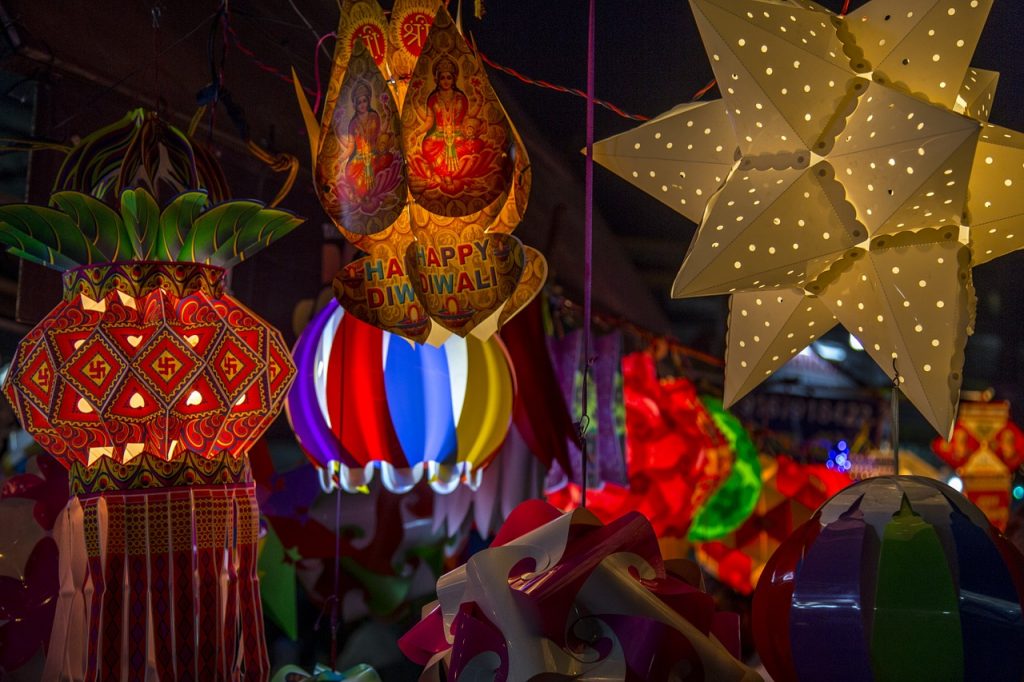
One of the most anticipated festivals of the year, Diwali, a Hindu festival of lights, celebrates the victory of light over darkness, good powers over evil ones. Hindus honour the return of Lord Rama, his wife Sita, Lord Hanuman and brother Lakshmana to Ayodhya from the 14-year exile in Sri Lanka. Their path was illuminated by the ‘diyas’ (traditional oil lamps) to signify the triumph of good over evil. Nowadays the Festival of Lights is celebrated with fireworks, lit clay lamps and candles. Every year, Diwali falls in October or November, depending on the moon cycle. It’s traditionally observed on the 15th day of Kartik, the holy month in the Hindu calendar.
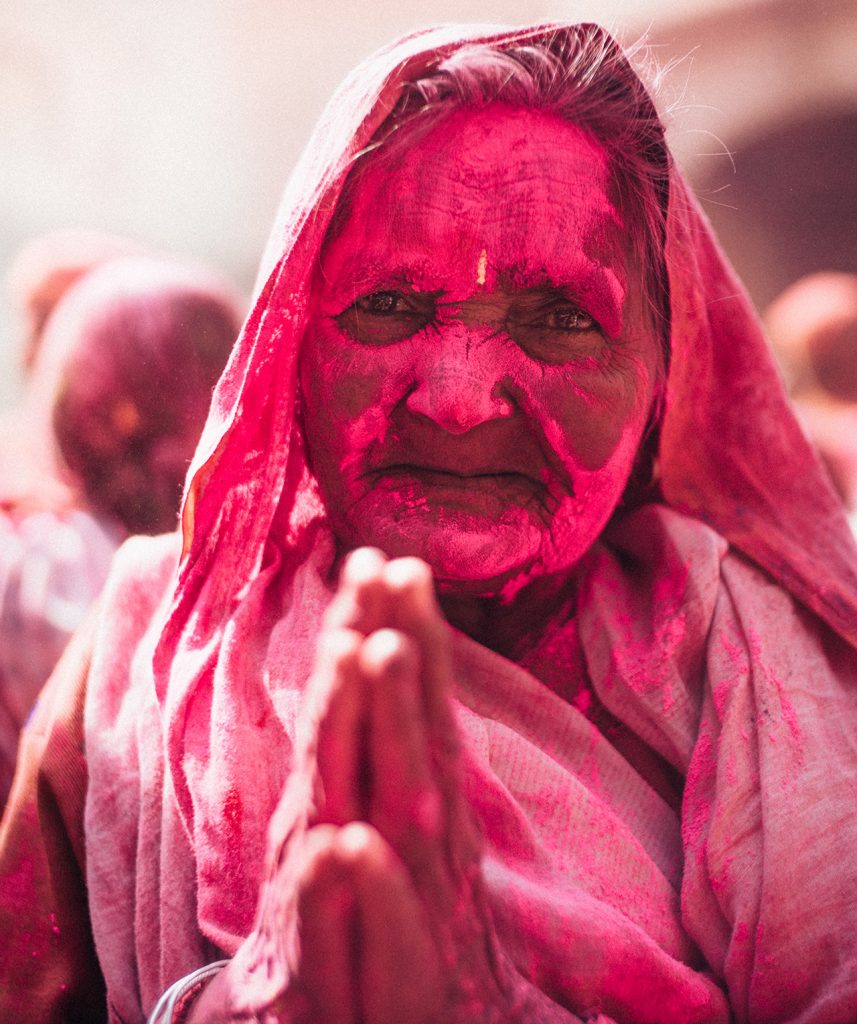
Holi is another great celebration of the victory of good over evil. It is also a festival that marks the end of winter and the abundance of the spring harvest. Locals and foreigners often call it “Festival of Colors”. During the celebrations you’ll people exuberantly throwing coloured powder and water at each other, having parties, and dancing under water sprinklers. They say you can try some Bhang, a cannabis-based paste. For everyone who doesn’t mind getting wet and dirty, Holi is a great carefree celebration. The biggest Holi celebrations take place in Mathura and Vrindavan, about four hours from Delhi. There are some safety issues for women due to the rowdy behaviour of the local men, so it’s recommended to travel with a guided group tour.
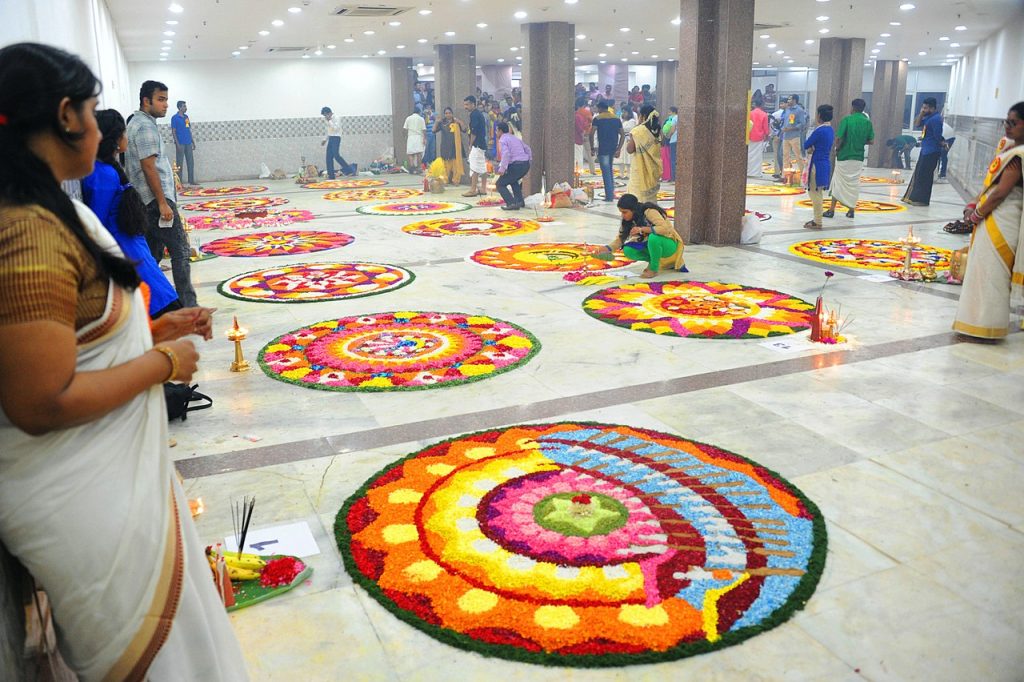
Onam is the biggest festival in Kerala. This ten-day harvest festival is a celebration of the homecoming of the mythical King Mahabali from the underworld. The culmination falls on the last day of the festivities. This festival is rich in culture and heritage of Kerala. You’ll see how people decorate the ground in front of houses with flowers shaped in beautiful patterns to as a sign of welcoming the King. The celebrations also include wearing new clothes, eating feasts served on banana leaves, sports, games, dancing, and snake boat races. The most spectacular Onam celebrations take place in Kochi, Thrissur, Trivandrum, and Kottayam.
This is one of the most popular cultures of India which has found its way to the western world in the present days. Namaskaara or namaskar finds its roots in the ancient Hindu scripture of the Vedas. Literally the word translates into – I bow to you. Greeting one another by a Namaste is a common practice in India and it can also mean – may our minds meet. Namaste is done by joinging the palms and placing them before your chest. The word ‘namah’ is also divided and translated to na ma which means not mine, this signifies the reduction of a person’s ego in the presence of another person hence showcasing humbleness. Bowing while saying Namaste lightly in front of a person of importance, worshipping a deity at the temple or an elder also means – I bow to the divine in you. This gesture is commonly practiced not only in India but also throughout Nepal, Bangaldesh, parts of South East Asia.
People in India are known for being extremely religious and a firm believer of the divine creator. Everyone in India has their own religion, set of gods/goddesses and means of showing their respect towards the supernatural deity. People in India take up one of the most sacred and highly pious journeys of char dham yatra or chota char dham yatra to proclaim their devotion and love for their holy lord. They believe that paying a visit to these places of worship will rid them of their sins and grant them heaven upon their death. Millions of devotees take up the yatra during the ON season to showcase their devotion and love by walking kilometers at a stretch, while simultaneously fighting tiredness, fatigue and pain caused on the journey. Another purpose of this yatra is to attain some self actiualisation in their life. Some of the most famous pilgrimage done by the people in India are: Vaishno devi, char dham yatra, chota char dham yatra, Rath yatra, amaranth yatra, hajj yatra and Kashi yatra.
One of the most vital parts of the Indian culture is fasting. Also known as vrat or upvas in native tongue, the significance of fasting represents the act of saying no to the entire worldly physical requirement. It is also one of the prime ways of showcasing your utmost sincerity and gratitude to various gods and goddesses with an aim of pleasing them. Indians all across the subcontinent observe this culture of fasting on various festivals, occasions and holy times. Some Indians also fast on various days of the week in order to express their respect for their choice of god or goddess. This culture is seen a way of cleansing your soul and mind by depriving your body of food (basic necessity) hence refreshing your entire being. There are innumerable rules and regulations written down for fasting at every specific religious occasion. This culture finds its roots in the vedic ritual of setting aflame a sacrificial fire for the purpose of sacrificing, which is named upvas.
In the Indian culture, a cow is considered to be one of the most holy animals. She is kept at par with a maternal figure in the family, and is worshiped in many parts of India. They are considered to be a bountiful gift from mother earth and nobody is permitted to kill her. This holy culture dates back to the time when Lord Krishna was a cow herder, and is also nicknamed as Gopala or Govinda which literally means a friend and the protector of the cow. Lord Shiva’s vehicle is also depicted to be Nandi – a sacred bull. All these reasons make cow one of the most prominently significant animals in India. Feeding cows and making contributions to cow shelters are considered to be extremely holy and a sacred duty which any Hindu can perform. The holy nature of cows are also mentioned in the holy scriptures, which site and emphasise the need of protecting and caring the cow. Cow as a whole is an immense source of life sustaining vitalities, like in rural India cow dung is used as fuel, while milk is also utilized by the people. However, killing a cow or the consumption of cow meat is considered to be a major sin among Indians and devout Hindus. Due to these reasons several states in India has banned the slaughter and killing of cows.
Just like the clothes and temples Indian food is also incredibly culturally diverse. Indian food not only holds cultural importance but is also one of the most significant factors in its popularity worldwide. From ingredients to the style of cooking every region in India has its own specialty. Indian food is known all over the world for being extremely fragrant and flavorful and filled with natural herbs and spices. Just like various distinct classical dances, clothes and languages one is sure to fall in love with India’s wide variety of food items and cuisines. Almost every different region in India has a signature dish or even a signature ingredient which sets it apart from the rest. Vegetarian food is an integral part of Gujarati, South Indian and Rajasthani cuisines, while non vegetarian cuisines are a vital part of Bengal, North East India, Punjab and Mughlai.
Apart from these, India is deeply riddled with uncountable age old cultures and traditions which may leave an outsider baffled or confused. However, this wonderful feature of our country sets us apart from the rest of the world.
Author Bio:
Hey! I am Sakshi. I am avid reader, writer and lover of everything positive. When I am not writing, I can be seen laughing at funny animal videos. If you want to explore and learn about Indian culture then head on to Namaste India Trip and check out my writing!
Now you are away from home and a happy traveler. Traveling is fun but hectic as well because you explore places the entire day and this demands good sleep. You are going around places means it’s a dream come true. But have you thought about the amount of fatigue a traveler can experience and the kind of sleep you need? We don’t want you to have dark circles visible while you are posing for a selfie. Yes, you need to recharge yourself after all those jet lags, bus journeys, and bumpy rides. So, here are a few tips so that you can stay well-rested even while traveling.
These are a few of the tired and tested stuff and have definitely come from avid travelers around the world. Take a look:
Plan your own sleep routine
You definitely have a sleep clock that you stick to on a regular basis, stick to that routine and try to get some more rest if possible. If you are going to places having a different time zone, it might be a bit difficult for you but you need to get yourself habituated to the time-zone. You need to make up your mind that you are going to adjust to the timings patterns. Plan so that you can give yourself plenty of sleep.
Take sleep mask along
Sleep masks are excellent to carry with while you are traveling. It’s a mask that blindfolds your eyes very gently giving you good night’s sleep. In case you are guessing what good it can do, it blocks the light, keeps your ears covered so that you are not distracted and with no time you fall asleep. This mask also keeps the skin around the eyes protected and you can sleep very comfortably. It’s very important to choose the right kind of mask so that the mask does not fit too tightly or is not too loose. You can buy masks that come with profiles so that the mask does not stick to your face and it won’t be a reason for discomfort. Choose a mask that suits your requirements, there are masks for men, women, and travelers too.
Cut down on caffeine
A cup of coffee gives you relaxation and most of the travelers are used to taking coffee in the mornings so that they can get out of bed and get ready for traveling. Keep coffee limited to mornings only, do not have cups in the evening. The problem with caffeine is it metabolizes gradually and promotes lack of sleep. According to experts, you must quit taking coffee 9-10 hours before sleeping. If you want some rejuvenation, try green tea or herbal tea along with your snacks. Apart from caffeine, just do not go overboard with rich food and alcohol. Drinking too much alcohol just because of fun could spoil your night rather than giving rest.
Feel at home
Sleep is a problem for many when they change the location and this can leave you sleeps deprived. Book your stay in a comfortable hotel or resort so that it’s easier for you to feel at home. You can carry some of your favorite items like best nightwear, bedsheet, maybe a pillow, bathroom slippers, scented candles etc. This would help create a homely ambiance.
No technology at night
You have come to travel and enjoy your tour, you also need a fair amount of relaxation. You don’t need to be a techno geek at night working on your laptop or operating the smartphone in the dark till late hours. This will give you lack of sleep and you might not have a good mood to travel the next day. Keep technology away to have the freshness of mind and get good night’s sleep. Travelling is also a mode of unwinding and de-stressing yourself.
During your travel, your sleep timings or cycle might alter due to traveling itself, as per your itinerary or due to the time zone and other factors. But you can always prepare a little ahead of time and make sure that the travel does not take a toll on your health. Good rest and sleep with actually motivate you to make the most of the vacation time.
Indian tribes are capable of producing from within their folds artistic gems that have been protected over generations but finally find an outward recognition in some form or the other. The Warli paintings, created by the Warli tribe, residing in the north Sahyadri Range is one such priceless folk art form that though carried on for years by the tribe has found fame, appreciation and usability in today’s modern times.
The biggest appeal of the Warli paintings is their simplicity. They essentially use very basic geometric shapes, the circle, triangle, square and dotted lines to construct and create magic on their mud walls. Even the color scheme is extremely simplistic, with the usage of white pigment as paint and a mixture of branches, earth and red bricks that act as the canvas or backdrop. Painted on walls and floors of their houses, the Warli paintings have long been an integral part of the tribe and are often compared to the cave art because of its antiquity and depiction of real life events.
The Warli painting unlike many other art forms in India do not always depict Gods, Goddesses or spiritual events. Instead they are characterized by the depiction of the social life of its painters, their lifestyle, occupation as well as deep respect and love for nature. Every day activities like drawing water from the well, fishing, hunting or dancing on the tunes of the tarpa are depicted with ease in the Warli paintings. However, their huge reverence for nature and all things natural is seen through the bird, flower and tree motifs that find a place in many of the paintings. Another recurring element is the Mother Goddess signifying fertility which is placed within the square called the ‘chalk’ or ‘shaukat’ as a central motif surrounded by natural objects or dance and festival celebrations.
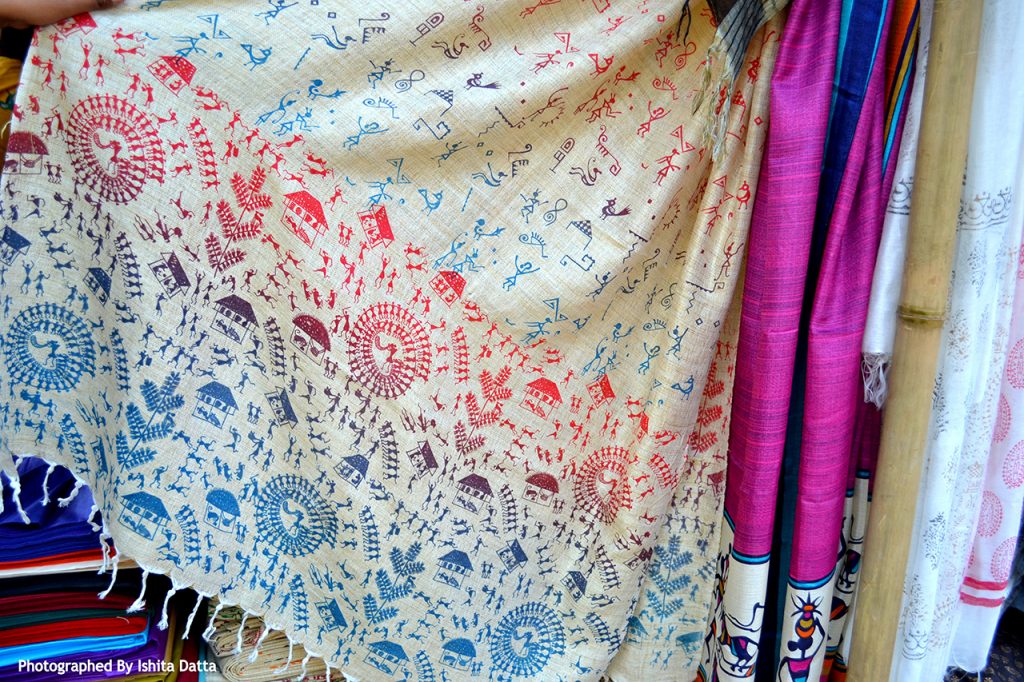
Social events, such as, marriages, births and festivals have also found their due form of representation in the Warli paintings. The human figures and animals are represented by triangles, one inverse triangle placed on top of another other, with the larger triangle at the top signifying a man and a wider triangle at the bottom signifying a woman. Such simplistic approach to the paintings tends to give it a touch of animation at the same time the paintings manage to convey the authenticity of its depiction with absolute conviction.
However, no discussion on the content of Warli paintngs can be complete without mentioning the circular dance formation by the tribes using the tarpa as a musical instrument. This trumpet like instrument, usually played by a man who stands centrally surrounded by village men and women with entwined hands who move in the continuous circle as the music plays on is a symbolic Warli painting that highlights an essential cultural connection and ritual that the villagers follow with mirth and anticipation. The dancers follow the central music director and turn or change directions to the beat of the rhythm without ever showing their backs to the tarpa. This circle formation is often compared to the circle of life, hence proclaiming a very basic aspect of tribal culture – every dance form, song or ritual is always rooted in the pretext of a philosophy that involves the natural surroundings, nature and the larger understanding of life and living.
In spite of Warli art being practiced for generations by the tribe, it was introduced to the world at large only in 1970’s. Prior to it the artists made the paintings in the confines of their homes and as a part of their personal cultural requirement. However, it was recently that Jivya Soma Mashe a talented Warli painter decided to break the norm and start painting for artistic pursuits rather than cultural or ritualistic reasons alone. The world hence needs to thank him for introducing this wonderful art form and bringing about basic changes, such as making the paintings on paper and hence increasing their longevity. What this managed to do was that it opened up a whole new market of art connoisseurs and innovators who were willing to experiment and use these paintings on different canvasses for different needs.
Today the Warli art finds expression on different commodities, such as, cushions, mugs, bags and even cell phone covers. The Fashion industry has taken an instant warm liking to these petite and simple paintings, and leading designers have used Warli paintings on their fabrics in major fashion shows. Warli painted saris are quite a sensation, and so are other clothing lines, such as, shawls, stoles, kurtis etc. that look smart and add a touch of cultural style to the garments. In fact, the paintings are easily generated using modern printing techniques on fabrics and the color scheme is no longer limited to a few handfuls of colors. Bright colors as well as even newer designs depicting modern amenities, such as, bicycles, roads and other urban surroundings have also found expression in the paintings.
Warli art is one example of how tribal culture restored over generations finds acceptance, appreciation and even a drastic growth when exposed to the outside world. The Warli paintings are registered with Geographical Indication under intellectual property rights acknowledging the contribution of the tribe.
Warli paintings have now moved out successfully from the exclusivity of the tribe itself, featuring in schools, online courses as well painting classes. This spread of the cultural nuances of a particular tribe into the mainstream is an excellent example of how art crosses boundaries and time to remain pricelessly beautiful and timeless.
The combination of harsh terrain and scenic beauty in the Himalayas offers terrific traveling opportunities. This means that it satisfies both the poles of travelers, those seeking extreme adventure and those simply looking for a peaceful escape from everyday monotony. Recursions like the Hampta Pass trek offer great opportunities for adventure-minded individuals.
The right time to visit most places in the Himalayas is from mid-June up to the second week of October. As monsoon milds down starting from the second week of August, the roads start to clear, with the reduced risk of landslides and road blockages. Rest of the year, the treks are closed due to snow, and from April to May, as the temperature rises and snow melts, the roads become accessible.
The dry weather of the summer, except the monsoon of course, is appropriate for going on treks in the Himalayas. The week-long Hampta Pass Trek sits in the right place between those treks that are so easy that they become unexciting, and those that are so advanced that become inaccessible to beginners.
The Hampta Pass
Hampta pass is located in the Manali region and has gained popularity amongst travelers as an option other than the Rohtang Pass. It is located at the convergence of the Kullu valley and the Spiti Lahaul valley. The contrast in the terrain of the two gives Hampta a unique geography.
The pass is 4270 meters higher than the sea-level and the trek also peaks at this height. However, the height for the trek averages around 11,000 feet, which is moderate and makes the trek accessible to first-timers and novices.
Still, as the oxygen levels at 14,000 feet are around 20 percent lower than at the sea level, it is advisable that you get a green light from your physician before backpacking for the adventure.
The Trek
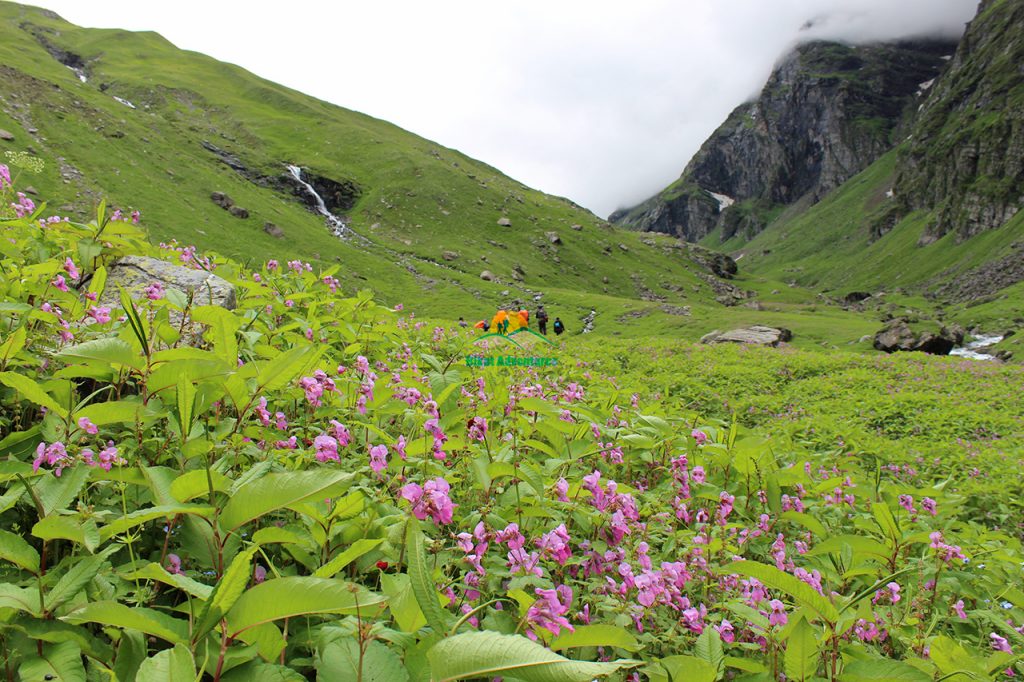
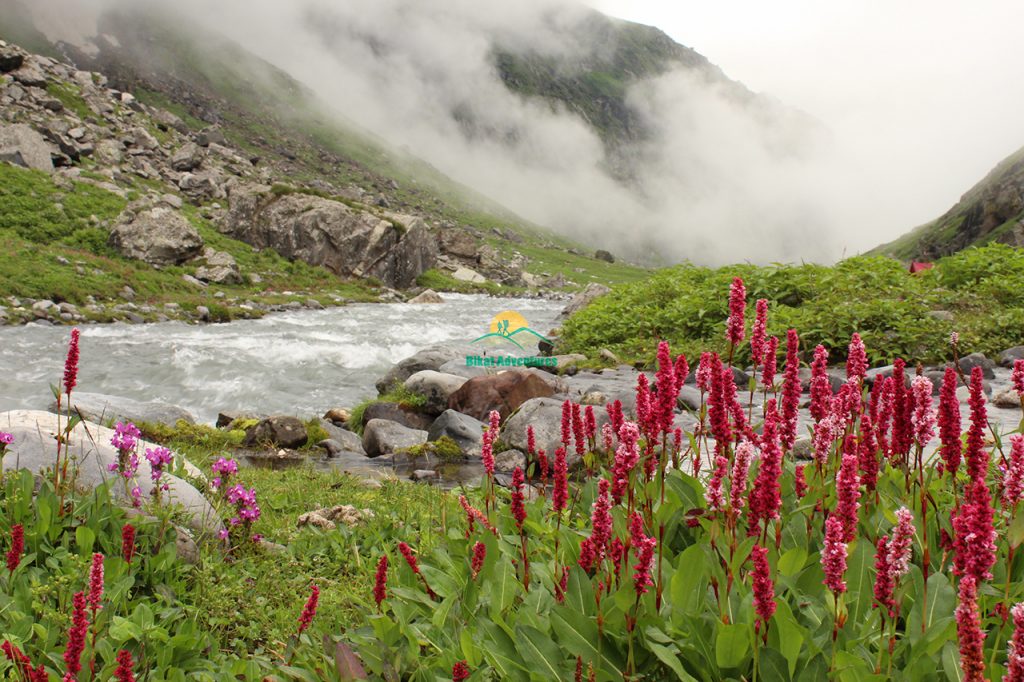
The trek begins at Jobra. The first day is a short three kilometers trek upto the first campsite which is Chika. The route goes along the riverside and the trekkers get to bask in the misty silver birch greens extending up to the hilltops. At the same time, this also gives them an opportunity to acclimatize and get their bodies primed for the next three days. In the following days, the trekkers get to cross two water streams, witness an awe-inspiring scenery, and challenge themselves with a variety of mountainous terrain.
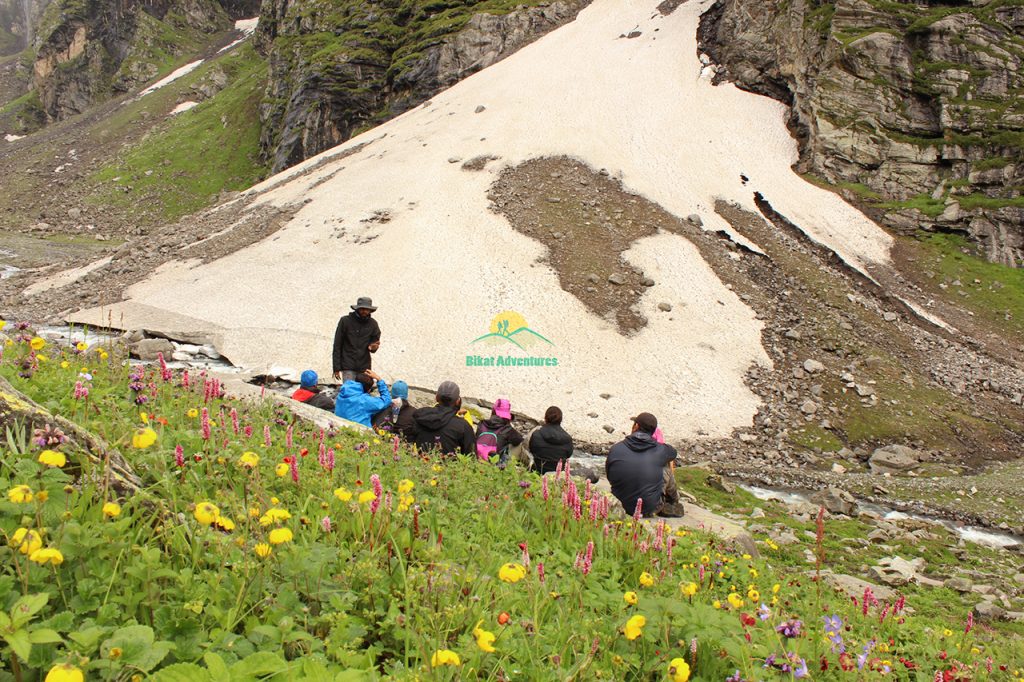
On the 2nd day, the trekkers hike to the next stop, which is the Balu Ka Gera Campsite. This part includes heights of around 12000 feet and a river stream crossing. The site is located where the river diverges into multiple flows for a few kilometers, forming sort of a delta.
The trekkers cross the Hampta Pass on the third day. This is where the terrain really starts to transform into the cold semi-arid of the Lahaul-Spiti region. The route goes via the Shea Goru Campsite to Chhatru. From here, the trekkers are driven back to Manali via Rohtang Pass.
If the weather permits, most trek packages also include a visit to Chandratal. This adds one more day to the trip. The travelers are driven to Chandratal, via Batal from the Batal-Kaza Road.
Chandratal is an alpine lake located at 14000 feet from sea level. Unlike Pangong in Leh or the Tso Moriri, this lake has gained popularity amongst travelers only in the recent years. Its teal colored water contrasts with the earthy colors of the surrounding desert, and along with the snowy tops in the distance, creates a heavenly sight.
The trekkers camp either at Chandratal or back at Chhatru. The nights in the Lahaul region are awe-inspiring as the sky is lit with starlight. On the following day, the campers are finally driven to Manali, marking an end to the five-day-long trip.
Getting to Manali (Jobra)
Since Manali is the starting point of the itinerary, you need to get there, which is easy as the city is well connected. Direct flights operate from Delhi and Chandigarh, to the Kullu-Manali Airport in Bhuntar, which is around 50 kilometers from Manali and 60 kilometres from Jobra. From Delhi or Chandigarh, one can also reach the Manali Bus Stand by state-run or private operator buses, which is around 20 kilometers, by road, from Jobra.
The Hampta Pass Trek is a great trek for those who are looking to get more out of their week-long travel to the Himalayas. It offers beautiful, fast-changing landscapes, which range from lush pinewood forests to the dry, snow-clad peaks of the Lahaul Spiti region.
In recent years, the increasing number of tourists in the Himalayas has disrupted the ecology and the environment, which has a sharp impact on the lives of locals. At caleidoscope, we believe in responsible tourism. So, when you’re enjoying the Hampta Pass Trek, try to be a responsible traveler and work towards reducing your environmental footprint.