Bearing Fulfilling Lives: What is Right Education?

0

Author – Sahana Rajan

The World Book Fair comes to Delhi on 11th and 12th of January 2016, bringing with it pertinent questions about education and the role of reading in it. Reading is an integral part of any English class of a school. In the same way, many habits form together the apparatus of a school classroom. Is classroom the rightful locus of education? What is the purpose of education? This piece talks about current condition of education system, the motives of education and practice of alternative education.

Where are we now?: Education as a pathway to livelihood

What is Right Education
Source: Sense Internationa

At the most basic level, education is viewed as a pathway to achieving a livelihood. School is seen as the locus of education. In this sense, education is the transfer of information from an individual of expertise (teacher) to an aspirant (student), which would enable the student to eventually earn adequately (amongst other optional motives of fame, prestige and honour). Such an individual generally specializes in specific subjects. The entire schema of education is developed in order to prepare the child for a career which would enable her to lead a fulfilling and decent life eventually.

Is education about a fulfilling life?: Ethics and Education

If the end is a fulfilling life, then can education be only about livelihood? Even if it were about livelihood, should the system need not explore the child in multiple dimensions before even beginning to prepare him for later fulfillment? Most of the educational institutions have an ordered set of subjects which become the only menu for livelihood. For that matter, philosophy was never a subject in my school and I only came to read about philosophy before choosing a subject for graduation. This relates to the need of creating conditions to allow child to explore diverse livelihoods to choose one which would be fulfilling.

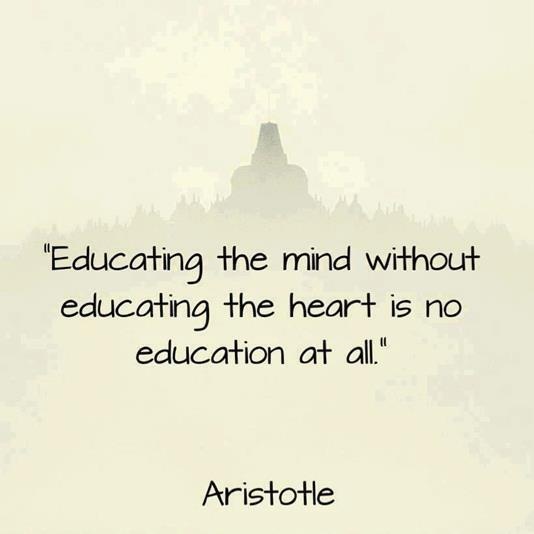
Apart from livelihood, what would be expected of an education? Essentially, the birth of ethical persons. Such a birth is generally alleged to take place through moral education, which in itself, is only normative. This means that moral education does not stimulate the child to ask questions for which the answer would be: “That is why it is best to be honest.” or “This is a case of loyalty.” Children are only given moral norms which they are expected to blindly follow. Such a blind following could be broken in adverse conditions as they are not based on principles or experience, but on passive acceptance. In any educational system, it is important to remember that any obedience is only respectful when it is an acceptance of understanding and not of passivity.
Source: PinInterest
Source: PinInterest

How does an education system create ethical persons? By creating conditions where children recognize values as central to living a fulfilling life. This would require that students be seen not only as students alone but as human beings first. Such a transition from student-to-human perspective can occur when education focuses on inculcating sensitivity as an educational need.

When children are exposed to instances of sensitivity (like a video of cow feeding calf or dogs being rescued from abuse), they react positively and imbibe the importance of recognizing others’ needs. Of course, we must teach children that doing good is an end-in-itself. The movement from first way of receiving ethical values (for self-satisfaction) to the second can occur in stages beginning from practice of sensitivity followed by exploration of situations which question this sensitivity. What would you do if your brother stole from parents? What would you do if you found money on the road and you could use it to save your mother? And so on. Ultimately, through such questioning, children reach the destination of instilling ethical values to their lives.

Most educational institutions never explore the stage of sensitivity and for this reason, their execution of the last stage (dictating which moral values are ideal) is unproductive. Once the child practises sensitivity, the first concern of a fulfilling livelihood is also handled. How? Because the child gains capacity to recognize her own abilities and thus, chooses a career which would fulfil her mental needs as well.

An education system for which the basic unit is child, as a human being holistically preparing for a fulfilling life that would answer to his/her physical and mental needs, is considered alternative education. Such a system does not receive the classroom alone as locus of education and explores different practices for unfolding the potential of children.

The practice of alternative education

alternative education
Mirambika Free School Source: Blogspot

The practice of alternative education involves inclusion of following tools (amongst others) to create ways for the

child to explore, to understand sensitivity of life and eventually, to choose a way of living which would be fulfilling:

An exposure to social and cultural causes through world happenings

Visit to NGOs and animal shelters to understand the diverse ways of living

Regular educational trips involving stays at different cultural set-ups

Introduction to India’s philosophical background (to nurture originality)

Robust crafts and arts regime

Exploration into everyday habits: Eating, washing of utensils, way of dressing (not with intention to homogenize their lives but to question inherited tendencies and discover ways which would most express oneself).

In India, the following schools practice alternative education: Rishi Valley (Andhra Pradesh), Mirambika (Delhi), Riverhouse Academy (Goa), Aurinko Academy (Bangalore), Roopantara Center for Learning (Bangalore), Shikshantar (Haryana), Pallikoodam (Kerala), Adarshila Learning Center (Madhya Pradesh), Gram Mangal (Maharashtra), Anugriha (Tamil Nadu) and Vidyashram (Uttar Pradesh). You can find more detailed list of alternative educational schools here.

Thus, a right education would enable a child to explore herself, create conditions to practice ethical values (and realize its significance) and ultimately, to lead a fulfilling life.

Basic Etiquette to Teach Your Dog at Home

0

Author- David Lyod

Teach-Your-Dog-at-Home-2
Source

It’s always exciting when one brings a new puppy at home. However, a new pet always comes with some challenges. Dogs may be a man’s best friend, but there are times when they don’t act wisely. Mentioned below are some good manners that you can teach your dog at home.

Walk calmly on leash

Many dog training schools may never help your dog master this art. You must first ask the dog to sit still before putting on the leash. Every time your dog gets out of control, it is essential that you instantly stop the walk, stand still and wait for them to calm down before continuing the walk. It will take a tremendous effort on your part, but it will pay off if you persevere. Initially, practice indoors and once the dog is under control, proceed to the great outdoors.

Teach-Your-Dog-at-Home
Source

Pet commands

Every dog should understand five basic code languages: sit, stay, lay down, come, and heel. All these commands will help one to communicate with dogs and will also serve as a groundwork for further advanced training. Try to keep all the training sessions indoors or at quiet places to avoid distractions. After your dog has learned the commands well, have sessions at different places so your dog learns to listen in spite of distractions.

Teaching your dog to relax

Many a times, dogs feel stressed when there are fireworks and thunderstorms. One would be surprised to know that calming behaviour can be taught to the dog. Take breaks from your play time to teach your dog how to relax. Physical exercise, yoga, body wrap and counter-conditioning are some of the things that can help the dog to remain calm. Make sure that you take the training process calm and slow.

Control barking

Teach-Your-Dog-at-Home-1
Source

Dog barking is a good sign as it is the way it communicates and alerts the owner. But excessive barking may not be good as it shows that your dog is uncomfortable around new people. Try reducing dog’s exposure to strangers if it barks too much. Avoid encouraging your dog to bark at people at the door by saying ‘Who’s there?’ This will cause your dog to be on guard and will likely lead to alert barking. Even after following these steps, if your dog continues to bark, then it would be better to contact a certified dog trainer.

House training

House training is the most important thing when it comes to having a pet. Teaching dog to relieve itself can be an arduous task and one must have the patience to understand their schedule to avoid embarrassing ‘accidents’ in the house. It is harder in case of puppies as they do not have bladder control. To ensure that your dog defecates properly, take him to a place that is relatively quiet and without too many distractions. Get your dog acquainted with that area. Allow him to relieve without any disturbance. In case, your dog has urinated or defecated indoor, clean it up immediately. Do not yell at the dog for doing that.

Meal & dining etiquette

Dog Meal & dining etiquette
Source

It is necessary to teach the dog to have some patience before having food. Keep them in sitting position while the food is being served. Use commands like ‘okay’ and ‘eat’ to communicate with your dog. Have a feeding schedule to predict when your dog will have to go to the bathroom. This will make the whole process of house training easier. It is important that one should feed their dog as per their age and weight. Consult with your veterinary for specific recommendations for your dog. If there is a puppy at home, schedule feeding three times a day. Usually, dogs hog a lot at the dinner table. Pet disturbance is not a good behaviour and it even embarrasses the owners in front of the guest. Also, the food that we eat should not be served to the dogs as it is not good for their health. It will take a lot of patience to teach your dog dining and meal habits, but the end result will be less stressful and embarrassing. However, if the dog is showing no sign of improvement, then it would advisable to look for some better solution. Consult the pet behaviour specialist in case of any problem.  It takes a lot of patience to train a dog but one should have a control over their temper. Above all, have fun and enjoy with your pal.
Have a happy dog training!

Reverse Brain Drain to India?

1

Author – Ayushi Bhardwaj

Brain Drain
Source

Hope you have heard of “Brain Drain” or human capital flight, a term that defines the emigration of intelligent, well-educated individuals to developed nations for better pay or conditions, causing their countries of origin to lose skilled people, or ‘brains’. Interestingly, now there is a different phenomenon happening in India – “Reverse Brain Drain”!

Reverse brain drain is where highly qualified people originally from developing countries, return home after acquiring skills and working in developed economies. Recently, this phenomenon has been observed as a rising trend among well educated Indians living abroad. Here are the stories of six Indian migrants who have returned back to either set up their businesses and to attempt solve the big problems that India faces:

Himanshu Batra was raised in a small town named Yamuna Nagar in Haryana with eyes set on making a huge impact on his community. Himanshu graduated from the University of Illinois, Chicago and started a boutique web development firm to get small businesses online. He soon landed a consulting job at Google in California, where he spent seven years learning the corporate ropes and working with the finest tech talent.

“Throughout this time I kept a keen eye on how the Indian economy was shaping up. Right from hosting political parties at home to working with the NGO ‘Code for India’ to bring tech solutions to solve some of the country’s issues, I stayed closely tied to India.” says Himanshu. He observed that education is the key to solving most of India’s issues and a mere 1% of Indian graduates from top universities were able to make an impact globally. He is now in India to empower the rest 99% with his education technology startup ‘Acad View’. Himanshu stated, “The tech space in India resembles the late 1990s in the Silicon Valley – I wouldn’t want miss the opportunity to contribute to this growth spurt for anything!”

Neena-Budhiraja-Himanshu-Batra-Google

Nina Batra and Himanshu Batra – Source

Nina Batra grew up in Dubai and got an MBA from Carnegie Mellon University. She has worn many hats in her career: engineer, financial analyst, chief of staff and product manager. “Besides finding myself intellectually challenged during my six years at Google, I also enjoyed its many perks: I actually met my husband at a Bhangra class there. Life was comfortable. Silicon Valley allowed one to work hard, party harder and live a full life. After eight years in the US, I wondered: What is my goal and impact in life? I came to India to volunteer in the non-profit sector, with an NGO Azad Foundation in Delhi, a for-women by-women cab service”. Now, Nina has taken up the role of Director of Product Management for Growth at Ola Cabs.

Yet another fascinating story is that of IIT Kharagpur graduate Swapnil Kant Dixit, known for co-founding Jagriti Yatra, an annual 10,000km train journey that takes 450 young students across India to meet with and learn from change-makers. Swapnil pursued an MBA from the University of California at Berkeley, and worked in a start-up in Silicon Valley. His passion for deploying technology to solve India’s basic problems brought him back to India.

Swapnil Kant Dixit - Source
Swapnil Kant Dixit – Source

Swapnil has recently founded an education platform called “Dhang Se Padhai”, which uses the Internet and mobile technology to enable qualified volunteers to teach under-served children in remote locations. A version of this project was recently selected among the top 20 world-changing ideas at the “Big ideas @ Berkeley” competition. Swapnil says, “Encouraging people to dream, and turning their dreams into executable initiatives is what excites me immensely. Often, all the magic needed is someone saying ‘you can do it’.

Harshavardhana Tyagi was born in a small town in Uttar Pradesh and was a graduate from Radha Govindh Engineering College. He spent his 10 years as a software developer in the Indian IT Industry. “My work mainly consists of software designing and coding. I have been on site to Dubai and the US, but I am back to India now and presently working here. There is a vast difference in working abroad and working in India both on compensation and on individual’s technical capabilities. Most people change their jobs in the US and seek to get a green card. However, they fail for the simple reason since they do not possess the technical capabilities required to get into a product based company” says Harshavardhana. Currently, he is working as a lead engineer in a product based company in Bangalore.

However, people with better skill set find it difficult to grow professionally in the Silicon Valley, because of stagnation that prevails there. Such people, like any other investor look at investing their brains in growing the Indian economy, which provides much better opportunities for growth in unexplored markets. Seems like these professionals are realising what we were taught back then – giving back to the society – is the key factor that satisfies us! These brain drivers moving to India to start their entrepreneurial journey by struggling here is a welcome change and is an inspiration for all of us.

Will Bajirao Mastani Come Alive in Movie Halls Today?

0

Author – Shirish Shinde

Bajirao-Mastani-film

Romantic stories in any art form sell and Bollywood has been encashing on the topic ever since its birth. It has churned out classics, run-of-the-mill hits, and numerous potboilers. And as long as they entertain and enrich viewers’ experience, one should not have a problem. However, the cultural atmosphere is vitiated, when they start courting controversies. To counter that, Central Board of Film Certification (CBFC), a panel of experts, watch the movie and decide whether the depiction of a particular theme is right or wrong. It is then up to the board to certify the movie and decide if it deserves an A or U or an A/U certificate. But of late, the trend has changed a bit, for many movies have drawn the strict scrutiny of not just the board but political parties or an individual, if the theme or the plot has, by any means, hurt their sentiments.

Such controversies may have some substance or they may be stage-managed.

The latest one to face protest is Sanjay Leela Bhansali’s period drama Bajirao Mastani. The depiction of great Maratha warrior, Bajirao I and his wife Kashibai, from the epic film is mired in controversy. The descendants of the Peshwa and the Chhatrasal dynasties, along with a local MLA, recently protested in front of Shaniwarwada in Pune, alleging the wrong portrayal of the leading characters in the songs released by the production company.

Bajirao-Mastani-film4

Further, BJP MLA Medha Kulkarni recently met chief minister Devendra Fadnavis in Nagpur and requested him to intervene in the matter. She was quoted by an English daily saying, “The film songs have distorted the history of Bajirao Peshwa. This amounts to a crime. Hence, historians must take a look at the film before its release.” Defending Kulkarni’s stand, Shiv Sena, and its MLA Pratap Sarnaik, have also sought similar action. Sarnaik said, “Bajirao Peshwa had played an important role in Maharashtra’s history. Bhansali did not give a thought to the Marathi culture and the Peshwa’s legacy before making the film.”

They have objected to the song ‘Pinga,’ in which Deepika Padukone and Priyanka Chopra as Mastani and Kashibai respectively, are seen dancing together. The descendants have called it a vulgar display. Udaysinh Peshwa alleged that the movie shows just one aspect of Bajirao’s life. He has also objected to a scene, where Bajirao pours water over Kashibai’s head. Udaysinh said, “Those are private moments. How can they become public? While taking the cinematic liberty, the dignity of a person should be maintained.” The descendants of Mastani have also expressed their reservations against a dialogue in the film.

Bajirao-Mastani-film

Upset over the manner the film shows Bajirao dancing in a song sequence, Kulkarni in her letter to Fadnavis stated, “Bajirao has been shown dancing. However, Bajirao Peshwa in his life of 41 years fought 21 battles and won all of them. It is an insult to his stature. A Pune court has also been moved requesting a ban on the film.

In a letter to Bhansali following the release of the song ‘Pinga,’ Mohini Karkarey, a descendant of the Peshwas, stated that Kashibai was suffering from arthritis. “How could she dance?”

Further, there are many theories about the life of Mastani. One among them is that Mastani was the daughter Maharaja Chhatrasal of Bundelkhand, present-day Madhya Pradesh. Her mother Ruhaani Bai, a Persian-Muslim, was a dancer at the Hyderabad Nizam’s darbar. When Mohammad Khan Bangash attacked Bundelkhand in 1728, Chhattrasal sought Bajirao’s help, who was on a military campaign in the region. Bajirao helped Chhatrasal, who gave Bajirao his daughter in marriage. Some sources also said that Mastani was Hyderabad Nizam’s daughter. Chhatrasal had defeated the Nizam in 1698. Nizam extended a friendly gesture to Chhatrasal by marrying off his daughter to the Bundela king.

Bajirao-Mastani-film3

However, the theory that Mastani was Chhatrasal and Ruhaani Bai’s daughter has been accepted.

It is said that Mastani was Bajirao’s courtesan. However, she was his legal wife. Mastani had learned skills needed to become a warrior and was a good singer and dancer. She also used to go with Bajirao on his military campaigns.

However, Bajirao’s first wife, Kashibai, and his other family members were against this marriage. They were not happy with this relationship as Bajirao used to neglect Kashibai. Later, the warrior king built a separate palace for Mastani elsewhere in Pune.

Soon after Bajirao’s death in 1740, when he was on a campaign in Madhya Pradesh, Mastani also passed away near Pune. There are theories about her death, too. Unable to bear the loss of her beloved, she ended her life. One theory says she committed sati. In this backdrop, Sanjay Leela Bhansali has created this film. As there has been no response from his side to the controversy so far, it is assumed that he is relying on the certification provided by the CBFC. Legally, the film has been cleared for public screenings. However, Bajirao and Mastani’s descendants and the BJP-Shiv Sena have raised objections to the epic, thus putting its smooth release in doubt.

Bajirao-Mastani-tomb
Tomb of Real Bajirao Mastani

Meanwhile, a press release issued on December 17 by the Kothrud, Pune branch of the Bharatiya Janata Party, stated that a petition had been submitted to the owner of the City Pride multiplex, Kothrud, to not screen the movie releasing on Friday in the city. They told the multiplex owner that the film had distorted the history about the architect of Maratha empire, Bajirao Peshwa.

“There is a growing sentiment that our idols are being defamed. The movie hall owner should respect this sentiment and not screen the film, failing which they will solely be responsible for any loss,” stated the release.

Factfile: https://en.wikipedia.org/wiki/Bajirao_I

For the Jane Austen in Us

0

Even after two centuries later, Jane Austen remains to be one of the bestselling authors of all time. Her books are widely read, appreciated and have left a lasting impression on generations of students over the years. Be it Sense and Sensibility, Pride and Prejudice or Persuasion, her novels have always been way ahead of its time. With eight books (two unfinished), she continues to be one of the most renowned authors of the 19th century. I remember reading my first Jane Austen book at the age of 16. Her plots never lacked finesse and her subjects were exuberant, so much that they have been adapted into movies and television series.
And it is time to once again explore the plots that are relevant even today as Jane Austen celebrates her 240th birthday on December 16.

Gold-digging Mothers Looking for Rich Grooms

Source: FlixChatter
Source: FlixChatter

In India, this is the case. A rich groom is what a girl’s mother dreams of and Mrs Bennette from Pride and Prejudice matches this character perfectly! In the movie Bride and Prejudice, a bollywood-style adaptation of Pride and Prejudice, this character was played by Nadira Babbar, who is determined to get her daughters married off to wealthy men.

Jane Austen
Jane Austen Source

The Gossiper

Jane Austen’s books are incomplete without a tattle-tale. Be it in Persuasion or Sense and Sensibility, her novels usually had at least one character with a high gossip quotient. It can either be Mrs Phillips from Pride and Prejudice or Emma from the novel Emma, who thrived on gossip. Jane nailed the characters to perfection! In fact, such characters can now be seen on television series and films.

The Strong and Silent Heroes

The quiet, honest and dignified men of Jane Austen have gained popularity among the girls. And why not? Name one girl who doesn’t have the ‘Darcy fancy.’ He is the strong silent type, who has a heart of gold and not the flirting kind who falls for beauty alone. Meanwhile, Colonel Brandon from Sense and Sensibility, Knightly from Emma, and Captain Wentworth of Persuasion are the trademark heroes of romance novels. Our movies, too, have taken inspiration from these men. Be it Abhay Deol in the movie Aisha or Pakistani actor Fawad Khan in TV show, Zindagi Gulzar Hai. They remind us of the qualities that Jane’s men possessed in the novels.

Girl Next Door

Jane Austen’s heroines were nothing about the looks. It was all about being unconventional, witty and bold. In her stories, Jane defined her girls to be plain-looking, but possessing exemplary characters.
Anne of Persuasion is the best example. Witty, clever and considerate, she is persuaded to break off her engagement at the age of 19. She is isolated and unloved, but this does not force her to give up her elegance and sensibility. In the end, Mr Wentworth cannot help but fall in love with her all over again! And this theme has been used umpteen times in the movies as well. Jane Austen, take a bow, for your characters are still alive!

Dance, Music and Parties

Dance and music have been an integral part of Jane Austen’s works. Her love stories would usually start in a ball or at dinner parties. And so is the case even today! Dance and music is an important part of every love story till date as the romance quotient rises with it. Thanks to Ms Austen! Our bollywood movies are filled with these.

Women of Substance

Aishwarya Rai as Lalita Bakshi from the movie Bride and Prejudice, a Bollywood-style adaptation of Pride and Prejudice Source: Fanpop
Aishwarya Rai as Lalita Bakshi from the movie Bride and Prejudice, a Bollywood-style adaptation of Pride and Prejudice. Source: Fanpop


Jane Austen’s heroines have a mind of their own. They belonged to a conservative period, and yet had the courage to express their thoughts gracefully. Anne of Persuasion seems submissive but she is actually not. She strongly opposes her status-conscious father to be with her poor friend. Similarly, Elizabeth of Pride and Prejudice disapproves with Lady Catherine de Bourgh’s ideas, thus being the first one ever to disagree with her.

Status and Position in Society

Titles and status played a major role in Jane Austen’s books during the Victorian era. Jane often mocked the characters with fine social status. In Pride and Prejudice, the author highlights how Fitzwilliam Darcy talks about his social status at great length. This is also evident when he goes down on his knees and wishes to take Elizabeth as her wife ‘despite her family status.’ No wonder Lizzy turns him down! Similarly, status plays a big role in our present world, doesn’t it? The love stories between a poor girl and rich guy or a rich guy-poor girl are still relevant in the movies and daily soaps. Examples are movies like Raja Hindustani or even Kabhi Khushi Kabhi Gham.

Extended Families

Kyunki
Kyunki Saas Bhi Kabhi Bahu thi tellychakkar.com

Extended families provide all the ‘extra’ drama we need to spice up a novel and Jane Austen majored in that art. All her books dealt with huge families that had cousins, uncles, aunts, and the neighbours. Their stories were interwoven with the main plot in such a way that the characters never seemed out of place. Interestingly, our current soaps also deal with such families but alas not to the same affect. All Ekta Kapoor serials have taken a cue from this. Starting from Kyunki Saas Bhi Kabhi Bahu thi to Yeh Hai Mohbattein, all have huge families. The more the merrier, right?

Factfile:

http://www.sparknotes.com
https://en.wikipedia.org

7 Memorable Silent Movies of Indian Cinema

4

Author – Jitendra

A century is not a small time; a lot has changed in the last 100 years. And when we talk about Indian cinema, the change is all the more apparent. Be it the well-groomed classic actors of the 1950s or the ‘bad boys turned good’ of the 1990s, filmmaking has seen tremendous progress with time. And who can forget the pragmatic plots the movies gave us in the last decade. With characters, the story, technique, and presentation also changed. While reminiscing the different phases of cinematic culture, the period of silent films seems to be one of the toughest and often overlooked phases of Indian cinema. It was an era where actors could not talk and worked really hard on their acting skills, since everything depended on their expressions. Let’s take a look at some of the famous silent movies of Indian cinema:

Raja Harishchandra (1913)

Top Silent Movies - Raja-Harishchandra-1913
Source

Not many know this, but ‘Raja Harishchandra’ was not the first Indian movie. It was ‘Shree Pundalik’, the first feature-length Indian film directed and produced by Dadasaheb Torne, which released in 1912. However, since it was made under a British production, the honour of producing the first Indian film went to Raja Harishchandra.
Produced and directed by Dadasaheb Phalke, this movie was based on the mythological story of Harishchandra and succeeded in drawing many admirers. Interestingly, it had an all-male cast since women, at that time, found it indecent to work in the movies. A determined Phalke then convinced a few Marathi male actors to play the part of women in the movie. Convinced by his dream project, they agreed and it is said that the actors in the film portrayed both male and female characters elegantly. The movie was released in 1913, which eventually made way for Phalke as the first producer in Indian cinema.

Lanka Dahan (1917)

Top Silent Movies Lanka_Dahan_1917_film
Source

Encouraged by the success of Raja Harishchandra, Dadasaheb Phalke made a few more mythological movies such as Satyavan Savitri, Mohini Bhasmasur and Lanka Dahan. If Raja Harishchandra was the first successful attempt, Lanka Dahan was the first box-office hit. The mythological movie, which narrated Sita’s abduction, was first screened at 7am and it was showed throughout the day, attracting viewers of all age groups until midnight. The film was well received and was a mega hit among the masses. Lanka Dahan was incredibly advanced in terms of special effects and technology. Interestingly, it was also the first film that had a double role for the same actor—Anna Salunke— who played both the roles of Rama and Sita! Salunke was also the first person to perform the female lead in Phalke’s Raja Harishchandra.

Keechaka Vadham (1918)

Top-Silent-Movies-Keechaka-Vadham-(1918)
Source

The success of Lanka Dahan encouraged many enthusiasts to pursue a career in filmmaking, since it had now assured them of financial viability. In 1918, South India got its first film, Keechaka Vadham, produced, directed and edited by R Nataraja Mudaliar. Based on a legend from Mahabharata, this movie had a Tamil cast, hence it became the first silent Tamil film.

Shankuntala (1920)

Top Silent Movies Shankuntala, 1920
Source

This movie was a respite from the mythological topics that were, until then, an all-time favourite of filmmakers. Based on the story written by Kalidas, Shakuntala was directed by Suchet Singh, who took a few artistic liberties that slightly changed the treatment of the main characters. However, the Indian mindset at that time was not ready to accept such liberal portrayal, which prevented the movie from getting any success. As time progressed, the Indian mentality changed and the movie was later recognized as a masterpiece.

Bhakta Vidur (1921)

Top Silent Movies Bhakta Vidur
Source

The 1920s saw huge economic possibilities. By that time, film production houses were professionally managed and had dedicated employees in different units to play different roles. One such house was Kohinoor Studios that made yet another silent mythological movie, Bhakt Vidur. Directed by Kanjibhai Rathod, this film was based on Hindu epic, Mahabharata. Incidentally, Bhakt Vidur was also the first Indian movie to face a ban, for it had scenes where the lead character was seen wearing a Gandhi cap and showed many contemporary political events of India.

Top Silent Movies Bilat Ferat (1921)
Source

Bilat Ferat (1921)

Bilat Ferat was a Bengali romantic movie that made an attempt to create a more contemporary approach in Indian cinema. Directed by NC Lahiri, this movie talked about Indians returning from foreign countries after completing their education and adopting a pro-western mindset. It was also the first love story of Indian cinema that aptly suited the demands of young, educated viewers. Inspired by British and American films, Bilat Ferat had many realistic romantic scenes, which were not appreciated by the Indian audience of that time.

Top Silent Movies Pati Bhakti
Source

Pati Bhakti (1922)

This movie by JJ Madan advocated the philosophy that an ideal wife should be completely devoted to her husband and serve him in any and every possible way. The leading role of Leelavati was played by Patience Cooper, and her performance garnered many accolades, making her the biggest star of that era. Pati Bhakti also attracted the ire of Censor Board over an obscene dance. After the board intervened, the song was removed before the film’s release.

Factfile –
https://en.wikipedia.org

Should India demand Climate Justice at Paris Talks?

0

Author – Solipsistic Sid

Climate Change Debet

Limiting the rising global temperatures to no more than 2 degrees Celsius above the current levels is at the central theme talks at the UN Conference on Climate Change in Paris underway currently. The Government of India has put on a brave face at the Paris Climate Change Summit with talk shows and webinars, sending a message to the international community that it is all about transparency and firm resolve when it comes to environment-related issues.

India’s standpoint remains clear that the burden of bringing down global temperature should lie with the developed countries, who are responsible for global warming and not developing nations that are just emerging. The world’s third largest carbon emitting nation, which spends 2.7% of its GDP for climate-related issues is not entirely on the wrong side when it demands “historical climate justice” from developed nations.

One out of five among the 1.3 billion Indians do not have access to the basic amenities of life, they live in utter poverty and look with hopeful eyes towards the people in power to lift them up. If India wants to alleviate its poor, it will have to close the gap between the amount of coal it produces domestically and the amount it’s consuming, particularly for electricity generation.

Source: National Geographic

Various ultra mega power projects with a capacity of 4000+ MW each are underway across the country as a part of a colossal drive for fulfilling India’s energy needs. India will have to continue to open up a new coal mine every month for the next five years if it wants to meet the energy demands of its teeming millions. India’s current aim is to produce 1.5 billion metric tons of the fossil fuel by 2020, up from about 800 million metric tons a year consumed currently.

Having said that, it is not as if we are not doing anything to counter the effects of our carbon emissions for helping in the fight against climate change. Alongside its coal production, India has made a significant expansion in the use of renewable energy sources such as solar power.  Prime Minister Narendra Modi has taken up the difficult task of creating an International Solar Alliance. The International Agency for Solar Policy and Application is aimed at bringing together a host of African and Asian nations located between the Tropic of Cancer and the Tropic of Capricorn.

India is also planning to grow its forest cover to absorb more carbon dioxide and implement new technologies to make its energy sector more efficient. India is planning to add as much in renewable energy capacity as its entire power grid over the next 15 years. Under the Paris agreement, India has committed to ensure 40% of its energy mix will come from renewable energy sources by 2030. Although India has not specified a cap on its emissions like China, that set a target to reduce its fossil fuel pollution by 2030 last year, there is a plan to improve the emission intensity by using fewer amounts of carbon to fuel our growth. To achieve this ambitious target, a mega plan of installing 100 GW of solar capacity by 2022 has been set in place.

The Bone Of Contention

The elephant in the room that the delegates at the Paris Climate Change Summit want to address is the continuous rise of India’s carbon emissions in the coming years. This to occur even if everything India has planned works out well enough, something that is highly unlikely due to the recurring instances of corruption and an inefficient government framework. To add to this, the recent setbacks to the ruling party in Bihar elections, which has been very suitably portrayed as a drop in popularity of the Modi government by the western media, thereby putting a question mark on delivering on these long-term commitments!

When we talk about “Climate Justice”, we need to set the record straight. According to IEA figures, India accounted for just 3% of energy-related carbon dioxide emissions since 1890. In per capita terms, India’s emissions stood at 1.6 metric tons per capita in 2014—just 10% of the level for the US and a quarter of the level for China that will cap its emissions and likely phase out coal after building a 1000 megawatt power plant a week for the last 15 years. According to Navroz K. Dubash a senior fellow at the Centre for Policy Research, China’s emissions are vastly more than India’s, though both countries have similar population.

Surely, we are doing what we can but there are many fronts to which we are turning a blind eye, e.g. our population explosion. If poverty is what we claim to be the reason behind our standpoint, what have we done to put a stop to the rising population in our country? Have we been as bold as China in adopting a one-child policy? India is set to overtake China in the next decade as the most populated country; it is not like we never knew of the issue, we had enough time with us, but we failed to act. We could adopt some innovative eco-friendly solutions that are indigenously created in India.

Climate justice must be served, but not at the cost of our planet. Yes, we have every right to demand climatic finance from the developed nations; they owe it to the world. Western countries cannot shift the onus on developing nations, but we as a growing nation also cannot simply turn our head away from issues that we can easily resolve with a firm political will and without assistance from the outside. Hopefully, we will take some action and reach a consensus for confronting the burning issues at the Paris Summit.

Image sources –
Pixabay

Two Contrasting Shades – Govind & Pahlaj Nihalani

0

Author – Sushmita Iyer

“Sanskari sabko hona chahiye. Sanskari hona galat baat nahi hai.”
…And with this very sentence, the baton of ‘sanskar’ has been passed on to Pahlaj Nihalani, the new head of Central Board of Film Certification (CBFC), to keep up with the sanskari times!

Source: The Hindu
Source: The Hindu

A sanskari torch that was held by none other than Bollywood’s favourite Babuji, Alok Nath, will now be associated with Nihalani’s ‘custodian’ act. Sorry James Bond, for you may have a license to kill but not to ‘kiss!’
To update you, the Censor Board of India headed by Pahlaj Nihalani, has cut short the length of the kissing scenes in James Bond’s latest instalment, ‘Spectre’, calling it too ‘excessive’ and not adhering to the guidelines. Interestingly, the censor board chief has not even watched the movie! And what’s more? He has no qualms about it! Too much Sanskar?

This is not the first time when our censor board has raised a stink over a film. In the past, Nihalani banned ‘Fifty Shades of Grey’, and ‘the Battle for Benaras’, a documentary that covered the heated contest between Arvind Kejriwal and Narendra Modi during the 2014 general elections in Varanasi. Other films like ‘Masaan’ and ‘Margarita with a Straw’ also had to go through its hawk-eyed scrutiny.

Besides banning curse words, Pahlaj has also beeped words like ‘lesbian’ and raised an eyebrow over the use of the word ‘Bombay’ instead of Mumbai in films. However, what stunned the country was his decision to censor the word ‘rakhail’ (mistress) from the movie ‘Prem Ratan Dhan Payo’, a film by Suraj Barjatya, whose movies are the epitome of Sanskar!

But does Pahlaj Nihalani practice what he preaches?

In 1982, Pahlaj Nihalani produced his first movie ‘Hathkadi’. His other films Mitti aur Sona, Aankhen, and Shola aur Shabnam were huge commercial successes, but failed to bag any award. And then in 1994 came the movie ‘Andaz’, starring Anil Kapoor, Juhi Chawla and Karisma Kapoor that threw Pahlaj in a storm of controversy. The soundtrack of the movie is still talked about for its double meaning lyrics and picturisation. Sample line: “Khada hai, khada hai, le lo le lo mera and Mein maal gaadi mujhe dhakka laga”.

Whenever asked about such sleazy numbers, Pahlaj shakes his head in denial and says it was not meant to be shot that way. Well, of course, he did not mean that way! It is all in our mind, right? Probably we got it wrong when the camera zoomed on Anil Kapoor’s crotch area, while the song in the background went “Khada hai”! Fortunately, Pahlaj did us a favour by deleting the song from the movie before it reached the theatres. Similarly, the lip-lock between Sunny Deol and Archana Puran Singh by the swimming pool in the movie ‘Aag Ka Gola’. Very Sanskari now?

Contrast with Govind Nihalani

Source: The Hindu
Source: The Hindu

On the contrary, we have Pahlaj’s older brother Govind Nihalani— a Padma Shri recipient — a pioneer of Indian parallel cinema, who has a history of producing cult classics. Unlike his brother, Govind, an auteur film director, producer, screenwriter, and cinematographer, is not so famous at the box office. However, his films have always made an attempt to uncover the profound hypocritical extremes, thus setting a paradigm.

Govind’s film ‘Party’ is one such example. Released in 1984, the film is a satire aimed at those urban elites who pretend to have an interest in art, however, fail to show any sympathy towards the society. Based on a play by Indian playwright Mahesh Elkunchwar, the film became the official entry to the 32nd International Film Festival of India.
Meanwhile, Govind’s other films Junoon, Aakrosh, Ardh Satya, Drishti, and Hazaar Chaurasi Ki Maa have helped him clinch various national film awards. He has also received the Nargis Dutt Award for Best Feature Film on National Integration for the movie Tamas, which was set in the backdrop of riot-stricken Pakistan at the time of partition.

Meanwhile, in 1996, Govind’s script for Drohkaal was remade in Tamil as Kuruthipunal by Kamal Hassan, which eventually became India’s official entry to the Oscars under the Foreign Language category. His last movie Dev was released in 2004, after which he did not direct any film for the next 10 years. However, after taking a long break, he did a come back in 2014 with an animated film for kids, Kamlu Happy Happy, which talks about a baby camel who dreams of flying.

While nothing much has been said or written about Govind’s political connections, Pahlaj has clearly displayed his political affiliation on numerous occasions. During the general elections in 2014, Pahlaj produced a campaign video called, “Har Har Modi, Ghar Ghar Modi”, thus making his stand clear.

He recently made a video, ‘Mera Desh Hai Mahaan’ that showed PM Narendra Modi meditating atop a mountain, and was played in theatres during the interval of Prem Ratan Dhan Paayo. While some called it a spoof, others criticised the video for using various visuals of foreign countries to show how great India is. In his defence, Pahlaj said that “Images of developed countries have been used to show visions of Modi’s new India”. He also went on to say: “If this is chamchagiri (sycophancy), then I am proud of it”!

Factfile –
http://www.ndtv.com/india-news
https://en.wikipedia.org/wiki/Govind_Nihalani
https://en.wikipedia.org/wiki/Pahlaj_Nihalani

Home Away From Home, the Kenyan Indians

1

Kenyan Indians

Walking on the streets of the capital of Kenya, Nairobi, and you will be intrigued to see shops dotted with Indians, who are locally referred to as “Wahindi” and “Muhindi”. Are they Kenyans and do they consider themselves as Kenyans? Yes, they are Kenyans who were born and raised in Kenya, though they have ancestral roots in Asia. Kenyan Indians are normally referred to as “Wahindi” (plural) and “Muhindi” (singular), the nicknames given by indigenous Kenyans.

Origins of Indians in Kenya

Most of their ancestors settled in modern Kenya during the British colonial rule, when the construction of the Kenya–Uganda Railway was undertaken between 1896 and 1901. The indigenous population were resistant to the British efforts thus, Indian labourers were brought in large numbers to carry out the railway construction. After the railway construction, these Indians decided to settle in the then British East African Protectorate, which covers the region of the modern Kenya, Uganda and Tanzania.

After the Second World War, Kenyan Asians began handling all kinds of occupations, ranging from business, the police force, bureaucracy and other service professions in Nairobi and its surroundings. Their commercial contribution led to the steady economic development of Kenya and the rest of East Africa.

Famous Indians In Kenya

History indicates that Kenyan Indians wholeheartedly participated in the struggle for Kenya’s independence, thus reaffirming their patriotism as Kenyans. Some of the well known Non-Resident Indians in Kenya are:

Kenyan Indians | Pio Gama Pinto | Source: Kenyaunsolved
Pio Gama Pinto | Source: Kenyaunsolved
  • Pio Gama Pinto – He was a journalist, politician, and freedom fighter. This socialist leader devoted his life to liberate Kenyan people from post-colonial dictatorship. Pio Gama Pinto was killed due to his outspoken way of living and became independent Kenya’s first martyr in 1965.
  • Makhan Singh – This Punjabi was the pioneer of trade unionism in Kenya. In 1927, he moved with his family to Nairobi from Punjab at a tender age of 13. Later in 1935, he formed the first trade union in Kenya and was quite active in the Ghadr/Kirti Party that struggled for Kenyan independence. In 1949, he together with Fred Kubai, a Kenyan, formed the East African Trade Union.
  • A R Kapila – Born in 1926, Aachhroo Ram Kapila was a prominent criminal lawyer of Kenyan Asian background. He is remembered in Kenya for his role in fighting for the rights and compensations of the Mau Mau Freedom Fighters during their independence struggle.
  • Fitz de Souza – He was a Kenyan Indian lawyer, who became a member of Parliament, and later deputy speaker of the Kenyan parliament.
  • Shakeel Shabbir – He is the current Member of Parliament for Kisumu, a large city in Kenya. Although he has an Indian lineage, he was elected to the parliament by indigenous Kenyans, which shows that he is accepted irrespective of his origins.

Indian Contribution to Kenyan Economy

Achhru Ram Kapila | Source: Slideshare

Kenyan Indians, though they constitute 1% of the Kenyan population, they control a much larger share in the country’s economy. The Kenyan Asians’ community makes a substantial economic contribution to the larger society and they are found in almost all sectors of the economy. Most Wahindis are in private businesses and they have formed large business groups to keep them together. They have business ventures in all the major towns of Kenya – Kisumu, Mombasa, Nairobi, Nakuru, Eldoret and Kakamega. Even rural areas are not left behind; Wahindi has moved into rural areas to invest in small and big businesses as well.

The problem with the ordinary Muhindi is (ordinary Kenyan Indians who do not manage big businesses or in politics), they just live in their own bubbles and refuse to participate in the country’s governance. Later, they cry foul when they are treated differently, or when they are told that they are “not Kenyans”! Visiting Kenya in the 1970s, the renowned writer V S Naipaul referring to the inward focus of the Asian community, commented that “the Indian in East Africa brought India with him and kept it inviolate”.

Most Wahindi have settled in Kenya, have tentative roots there; made investments in properties and even buried their loved ones there. However, they are still afraid to love Kenya too much in the fear that their love might be stamped out by a steel boot. So by staying inside their cocoon, they think they are protecting themselves from being hurt. Some of them feel helpless… not feeling Kenyan yet having nowhere else to call home!

No matter how long Wahindi have stayed in Kenya, they don’t feel welcomed in their land of birth – Kenya. Some indigenous Kenyans view Kenyan Indians as exploiters. They are stereotyped as mean businessmen, who pay low wages to their workers and are exploitive in business.

Relation with indigenous Kenyans
When it comes to building relationships, Kenyan Indians do not like intermarrying with locals. They prefer marriage among themselves to keep the family lineage alive. Parents discourage their youth from getting intimate with indigenous Kenyans, but there are a few cases of those who rebel and get married to Kenyans. On Sundays, they break from their routine of running businesses and gather together with their entire families in those business groups in order to bond. This bonding helps them to feel at home.

Do They Miss India?
Kenyan Indians, especially those who are idle miss India very much. They think that, maybe, if they were in India, life could have been better than it is in Kenya. But is this true? If hardworking Indians are comfortable in Kenya and are competing favourably with indigenous Kenyans, then notion of having a better life in India is contradictory. As long as they are lazy and not ready to hustle in life, even taking them back to India and showing them their roots won’t help much. Today, anybody can settle anywhere in the world and be successful. Home is all in the mind; the world has become is a global village!

Image sources –
http://magnusbogucki.com

Top 10 Indian Food Bloggers – Divas with Delicious Dishes

2

Indian-food-bloggers-Anushruti_RK
Anushruti RK divinetaste.com

The joy of cooking is exhilarating! To create delicious, mouthwatering food on your own is a feeling like no other. Yes, the rotis may resemble maps of various countries initially, but later the perfectly round, soft and succulent phulkas will be your pride. Global cuisine is an attractive arena, but the challenge of mastering the Indian gastronomy isn’t for weak-hearted!

The quintessential Indian preparations have been handed down by generations. However, when these native MasterChefs decided to log onto the internet to share their creativity, knowledge and experiments, these amateur cooks found their holy grail! For all those who are struggling in kitchen, who seem to mess things up in the process, who wish to unlock the secret of flawless cooking and those who pine for mere ghar ka khana (my home-cooked food), go for the angels who have made cooking a piece of cake.

With their clear-cut blogs, step-wise instructions along with pictures, hilarious/satirical anecdotes and the story behind the recipe, cooking will in true essence became an exhilarating experience for you. The choice, the festivity and diversity that Indian food brings to the table is mesmerizing. Here is a list of top Indian food bloggers, who can be trusted for their distinguished palate, amazing creativity and discretion in matter of food –

Indian-food-bloggers VeganRichaVegan Richa

Vegan, organic, whole and healthy food, all seems nice on paper, but making them a part of our daily diet is a huge task. With Vegan Richa, you can make this a reality. Get your health freak on and enjoy Indian breads, vegan, whole and organic food made by Richa Hingle in your very own kitchen.

www.veganricha.com

Indian-food-bloggers Simply Tadka PreetiPreeti’s Simply Tadka

Tadka is a standard process loved by every Indian cook. Experimental Indian cooks cannot possibly resist adding tadka to international dishes. With Preeti’s blog, explore some fascinating results where tadka goes international. Apart from this innovative streak, the blog also gives some simple and relishing recipes to create a vegetarians paradise. The formal presentation for an A-grade is made a cake-walk. To classý up your dinner party, turn to simplytadka.

www.simplytadka.com

Indian-food-bloggers Parzen PatelParzen Patel

Another food lover making her presence felt is Perzen, the Bawi Bride of Mumbai! How many times have you tasted authentic Parsi food and thought ‘damn, if I could cook like this, I will rule the kitchen’! The Bawi Bride blog takes you on a yummy tour through the world of Parsi food. Her blog is not just about ingredients-method-picture; her blog is an experience. You will get to know the dish, the story behind it, the variations and her experimentations. If you wish to foray into the intimidating world of Parsi cooking, hold on to her blog.

www.bawibride.kitchen/blog/

Indian-food-bloggers PadhuskitchenPadma (a.k.a) Padhu’s Kitchen

Started in 2009, Padma’s blog has over 700 true-blue vegetarian recipes. She has tried and tested them all before she featured on the blog. This blog has a special focus on health, nourishment and ease of cooking. This is a particularly interesting blog for bachelors and busy professionals, since it has an easy, visually-aided step-wise instruction, which gives you one-pot meals without compromising on nutrition and of course, the taste.

www.padhuskitchen.com

Indian-food-bloggers Deeba-RajpalDeeba Rajpal’s Baking Blog

When the talk is about baking, pictures speak louder than words. Be ready to be mesmerized by the simply drool-worthy pictures of all the magic Deeba creates. As the name goes, this this expert cook’s blog is the place for all baking enthusiasts, be it amateur or seasoned bakers. Deeba has taken the western baking techniques and added some Indian elements to them.

www.passionateaboutbaking.com

Indian-food-bloggers ThasneenThasneen – Cooking with Thas – “A Step-by-Step Visual Guide to Effortless Cooking”

This blog started off as a picture-upload activity. Soon, Thasneen began receiving requests for the recipes of her yummy-looking preparations! Her forte is not just Indian food, but handpicked delights from all over the world. The simplicity and originality of the blog keeps it real. Log on once to her blog and the cook-in-you won’t be able to resist!

www.thasneen.com

Indian-food-bloggers Dassana-AmitDassana’s Veg Recipes

This virtual kitchen offers you various vegetarian, vegan and baked recipes to make delicious food. We need to thank Dassan’s hubby for he insisted that his wifey dearest should share her talents with the world. We agree! This blog is relatable for it is traditional, learned-on-go experience of a seasoned cook. Dassana innovates, experiments and lays it all out just the way it is.

www.vegrecipesofindia.com

Indian-food-bloggers Kajal-TejsinghaniKajal Tejsinghani

If quality food is more important to you than the easy associated with the process, head over to Aapplemint.com. This place has some lip-smacking recipes that are customized to sooth a healthy soul. The approach here is to give you a gold-standard recipe with alternative healthy options. Now you can indulge yourself without skewing your diet chart. Tit-bits about the right choice also make the read interesting.

www.aapplemint.com

Indian-food-bloggers Anushruti_RKAnushruti’s Sattvic Food

We are what we eat; this is the life-funda for Anushruti. She is fascinated by Ayurvedic Sattvic food, and how they impact the human mind, and how we react to different food items in our diet. Anushruti’s blog is full of life; it breaks the fourth wall and gets to the reader in form of story-style read. Further, the visually appealing photos are an ode to her passion of photography.

www.divinetaste.com

Indian-food-bloggers Sia_Monsoon_SpiceSia’s Monsoon Spice

This blogger doesn’t shy away from complicated dishes. Sia takes any difficult recipe and breaks it down in such a way that any amateur cook can ace it. Her roots are in South India and she is armed with the priceless knowledge of recipes from her granny, mum, mom-in-law and a half dozen aunts. As expected, the blog is plethora of tradition mixed with zest of youthful cooking.

www.monsoonspice.com

Sailaja

All those who crave the sour and spicy Andhra cuisine, head over to this blog to create a similar magic in your house. Preparing the mouth-watering Tomato Rasam will no more be a bittersweet memory for you now, since you can whip it up on your own. Apart from this specialty, Sailaja offers you a variety of north Indian, south Indian and Mexican delights as well.

www.sailusfood.com

Indian food blogging has way more to offer than the 11 bloggers listed above.

If gourmandizing is a crime, I happily plead guilty!