There is a reason why they say childhood is the best time of a person’s life. It is something so simple, yet absolutely beautiful.
When we were kids, the smallest of things gave us immense pleasure. Neither did we need materialistic stuff to be happy, nor there was a place for selfishness in our hearts. Now that we’ve walked past the most beautiful phase of our lives, the only way left to experience it again is to cherish, remember and relive all those sweet memories whenever possible.
Here’s to the sheer Joys of Childhood that can bring a wide smile to your face with just a single thought.
When colourful toddler tricycles were the best means of transport
Trying to catch those fascinating water bubbles
Remember group lunches and group studies?
Being resourceful by collecting firewood for home
Splashing water is so much fun!
Hanging out with the group of friends
The great joy of planting trees every year and forgetting all about it
Naked bath in the water streamlets
Petting of fluffy little kittens is a must
In the company of cattle…
Blindly following our elder siblings and doing what they did
Roaming the streets like vagabonds
A simple polythene bag would serve as a fish net
Now we need to widen our net and catch bigger fish
Never bothered about the harmful effects of Holi colours
Deriving great joy from simple activities like skipping
I must have been in the 8th standard, when for the first time, I had given my name for a debate. I had opted to speak in the favour of the notion, “Can India be a super power by 2020?”. Looking for some content for the debate, I browsed through the books in our school library. Preoccupied in cursing myself for taking all this trouble, my eyes fell on a book with blue-green cover, analogous to the colour of a globe.
I picked up the book; it was titled “India 2020: A Vision for the New Millennium”. Relieved to have found something suitable to my debate topic, I sat down to begin reading it without giving any attention to the author. After reading the preface, I was compelled to look for the author’s name. Dr. A.P.J. Abdul Kalam, along with Yagnaswami Sundara Rajan was its author. I then recalled him to be the President of India and wondered at the length of his name! I continued reading and I got so lost in the book that the librarian scolded me of deliberately bunking classes.
That was my first acquaintance with this legendary name. The book might not have had the best of the endings, but I felt fortunate for having picked it up. Because from then, Dr. Kalam started to play a great role in forging my thoughts, moulding my intellect and igniting my mind. I read another of his amazing work ‘Ignited Minds’, which was basically a message to the Indian youth about how we should strive to achieve the Vision 2020. His books provided me that mental framework, that inspiration, and that urge for patriotism, which I felt my formal and technical education had failed to give.
Dr. Kalam not only made our generation aware of the problems our country is facing and would face in future, but also suggested the right solutions. He taught us about our roles in building India via Action-Plans framed in the form of quotes, among which my favourite one is –
They may be just three simple lines, but that quote contains the basic principle, which many of us fail to realize and abide by throughout our lives.
For me, Dr. Kalam was no less than a visionary of our generation! Talk about his stylish long grey hair that curled onto his face, or his lifelong bachelor status. He gave his very own example that you can look awesomely cool and still have a great scientific and visionary mind. You can be the ‘Missile Man’ of a military power like India and still be a preacher of peace and harmony on international forums. His unconventional, original and very realistic approach towards life made him a True Youth Icon.
Dr. Kalam came as a breath of fresh air into our contemporary Indian society, which suffers from an acute crisis of true leadership. He showed that one can lead a scientific and spiritual living, and be an administrator, statesman, and a youth icon without compromising on your values and ethics.
One of the biggest desires of an eternal being is to die in honour. Trust me, I have never witnessed such a deep and nationwide mourning for any public figure as for Dr. Kalam. I am stating so because I have seen my mother, a 50-year old woman whose world is limited to family, house work and daily soaps, in grief for the first time. Everybody respects Dr. Kalam, irrespective of their religion, culture, nationality, beliefs, political parties, age, and gender. Even in his death, Dr. Kalam gave us a message worth remembering. He died doing what he loved the most – teaching and igniting young people’s minds with his words of wisdom.
A leader, a visionary and a great scientist with a grandeur as high as Mr. Kalam deserves great homage and honor. But do we really respect our leaders who dedicate their lives our country? Sadly, it’s ironic that just hours after his death, cyberspace was going wild over an incident in which the Jharkhand education minister blundered as she paid a floral tribute to Dr. Kalam almost a week in advance of his death. The event organizers later defended the act by saying they garlanded his photograph as a mark of respect. According to the Indian beliefs, a living person’s image should not be garlanded. If done so, the person will die soon. It’s utterly painful and derogatory that in the hour of such utmost grief, people are using the death of this national hero to justify whether the myth is true or not.
Dr. Kalam, you may have heard it many times throughout your life. But let me say it again – WE ARE PROUD OF YOU! India is proud, and the world is proud of you!
The thought of books brings to mind the warm memories of my grandfather. He loved books and I think I have inherited this particular trait of his. Every week, I would accompany him to the little dingy library at the end of our street. Those old books always smelt wonderful, felt warm and alive. Surprisingly the smallest libraries hosted the rarest books.
It is safe to say that the habit of reading has become obsolete and it is a rare, almost mutant like trait present in a privileged few. From the age I could read fairly well, I bonded with books. Starting with Dr. Seuss comics like Cat in the Hat, moving on to Amar Chitra Katha and then moral stories like Panchatantra, it was the beginning of a beautiful journey.
My grandfather read all sorts of books right from Tinkle comics to Sidney Sheldon. We had discussions regarding our favourite characters. We used to wonder about acquiring our own wands and making life easier. Fred and George, the Weasley twins, were few of our favourite Harry Potter characters. He admired the spunky Miss Elizabeth Bennet who was to become the wife of a single man in possession of a good fortune. He introduced the abridged versions of the popular classics to a ten-year-old me.
In school, the non-detailed textbooks contained interesting stories. It was probably the one class to which we all looked forward. The fact that this was the pre-mobile phone era is noteworthy. I distinctly remember the first story ‘A Scandal in Bohemia’ which saw the Victorian Detective Sherlock Holmes being outwitted by a woman. That impressed everyone and we proceeded to read about the wonderful village of Malgudi. It was followed by the adventures of Bond, Ruskin Bond!
Reading has become a lost habit. Just as literature is often associated only with Shakespeare and the classics, reading has been reduced to a historic practice whose relevance in present day life has been rendered redundant. These are a few famous Indian short story writers whose works will help you in reviving the habit of reading.
One of the few Indian authors who was genuinely and unashamedly Indian, R K Narayan is one of my favourites. Unlike many contemporary authors who imitate the Western writers in style and content, RK Narayan brought to life a typical South Indian village in all its glory. His writings made me yearn to visit the fictitious Malgudi. Most of his novels and short stories were set in that village.
His stories involved ordinary characters whom one could relate to or identify. A subtle humour pervaded in his works. The language was simple yet effective. He retained certain Tamil words to create an impactful South Indian flavour. The postman Thanappa with an affectionate albeit slightly interfering nature, the witty astrologer who met his match and the unlucky Iswaran are all beloved characters roaming through Market Street and Town Hall Park.
Another beloved children’s writer, Ruskin Bond captured the beautiful Himalayas and hill stations in the north. My favourite was his omnibus of ghost stories. Most of the stories were based on Indian myths, beliefs, and experiences. The horror element was subtle and pervading without it being overbearing or completely unrealistic.
In school, we had read the novel The Hidden Pool which traced the story of an English boy who befriends two Indian boys. Friendship and nature are the recurring themes in his works. His simple language is appealing to children. Most adults fondly reminiscence about their childhood memories which were interspersed with stories of Bond and Narayan.
Most famous for The Jungle Book, Rudyard Kipling was an English author of Indian descent. He was considered an Anglo-Indian. Accepted completely by neither race, British and Indian, Kipling felt ostracized. His loneliness is reflected in his works. This showed how colonization affected not only the colonized but also the colonizers in a subtle, covert fashion. Kipling was subjected to imperialism in the form of rejection.
His stories focused on an orphaned boy who befriended animals and was forsaken by the human race. Mowgli, the wolf boy, belonged to a pack of wolves and was friends with Bagheera, the panther and Baloo, the bear. The wonderful Walt Disney cartoon of The Jungle Book showcased a happy picture which hid all of Kipling’s intentions and emotions. His horror stories were just creepy and hair-raising enough for an eleven-year-old me.
‘Where the mind is without fear’! A profound statement describing the awakening of a newly independent India is a clear touch of Rabindranath Tagore. He was famous for more than his acclaimed collection, Gitanjali. Religion and nature dominated the works and lent an ethereal effect. A lonely boy in a family of fourteen, poetry was his best friend. We owe our national anthem to his poetic genius. His existence in a typically patriarchal society did not alter his respect for women.
His stories reflect a poignant sadness. I liked the story of Kabuliwallah the best. While his poems received acclaim, his stories are not that well remembered. They are often dismissed as secondary to his poetry. Popular opinion is that the Bengali version of his works is mind blowing. I found the English version very profound and definitely think it’s worth reading. His stories break the stereotype of ‘happily ever after’ and present a realistic outlook.
“…I also believe that introversion is my greatest strength. I have such a strong inner life that I’m never bored and only occasionally lonely. No matter what mayhem is happening around me, I know I can always turn inward.”
-Susan Cain
Very often, growing up with a more confident and extroverted sibling which is quite opposite to your personality, is not easy. You are termed as the “shy one”. This comparison, which constantly remains by your side is no good to your self-esteem.
Normally, introversion is strongly discouraged by the society as it is negatively received. I am told that my way of being more withdrawn from social situations is not necessarily the right way to go. But it is probably only the introvert who understands how his or her mind functions. Introverts need time to grow and reflect. We do not speak just to fill the silence, and it is only done after a lot of thinking. On the contrary, indulging in small talk that interests us completely, would require a lot of effort to shut us up, once we are in the drift. Although it does come with a negative sometimes, as we do not excel in the art of starting a conversation.
Everyone is always in the process of creating themselves, as we try our best to project at being someone that we have always been anxious about. But when this brims to the level of consciousness, we realize that trying to be evasive from one’s true existence or one’s own element can be quite frightful. For me, it has taken nineteen years to fully appreciate the benefits and accept this trait of mine. Not that I sat and thought about it the whole time, but what I am trying to say is that, It’s OK to be an introvert! You are not anti-social or depressed as most people would assume.
Nobody is 100% introverted or 100% extroverted, you could bump into such a person only at the mental hospital. Either you are an introverted extrovert or an extroverted introvert, meaning that you tend to lean more onto one of the sides.
Being painfully shy is synonymous to being an introvert, is a common myth that must be broken. Introversion is not the same as being shy. Only that, the shier introverts are much easier to spot.
One very interesting fun fact is that one in every two persons is an introvert, which is half of the population. Bottom line- we are not excluded; but every now and then, we just want to be secluded for some time so that when we join the fray, we do give a productive output.
Eid-ul-Fitr is observed on the first day of Shawwal month. It is an important festival celebrated by the Islamic communities across the globe. In India, it is the time of great joy where people come together and spread love and happiness. On this day, our Muslim brothers attend communal prayers, listen to the holy sermons and indulge themselves in charity activities. The celebrations end with sharing communal meals, wishing and gifting one another.
Here is the photographic essay of Eid-ul-Fitr 2015 at Siliguri, West Bengal.
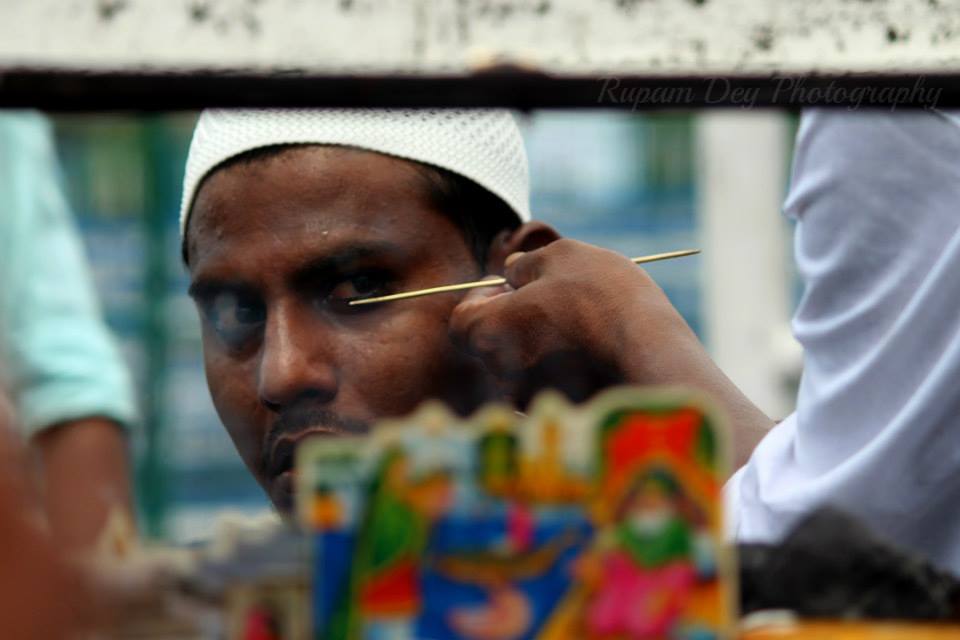
Surma Mera Nirala
VAZU – Getting Ready For the Namaz
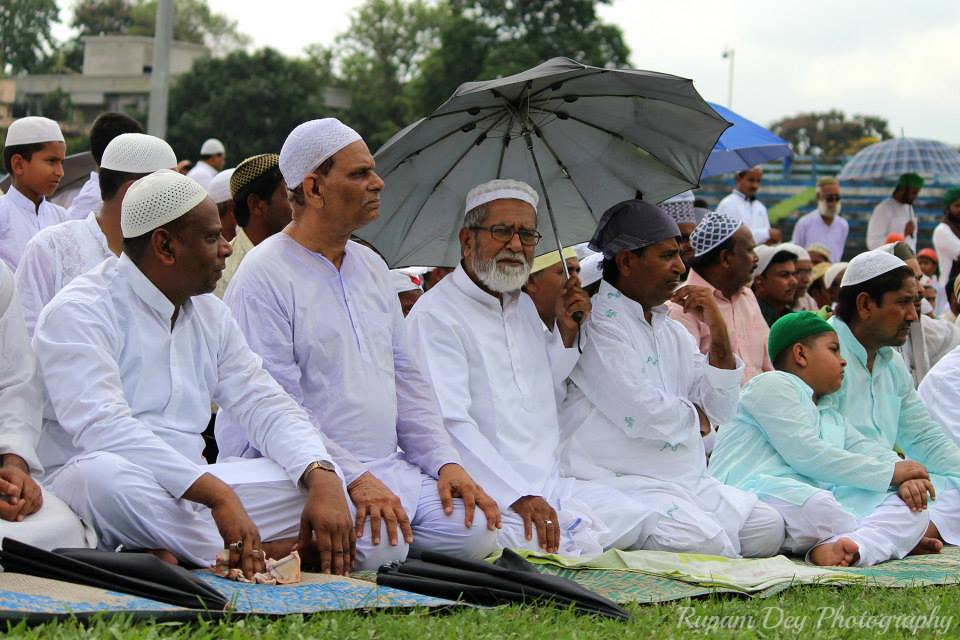
Waiting for the Prayer to Start
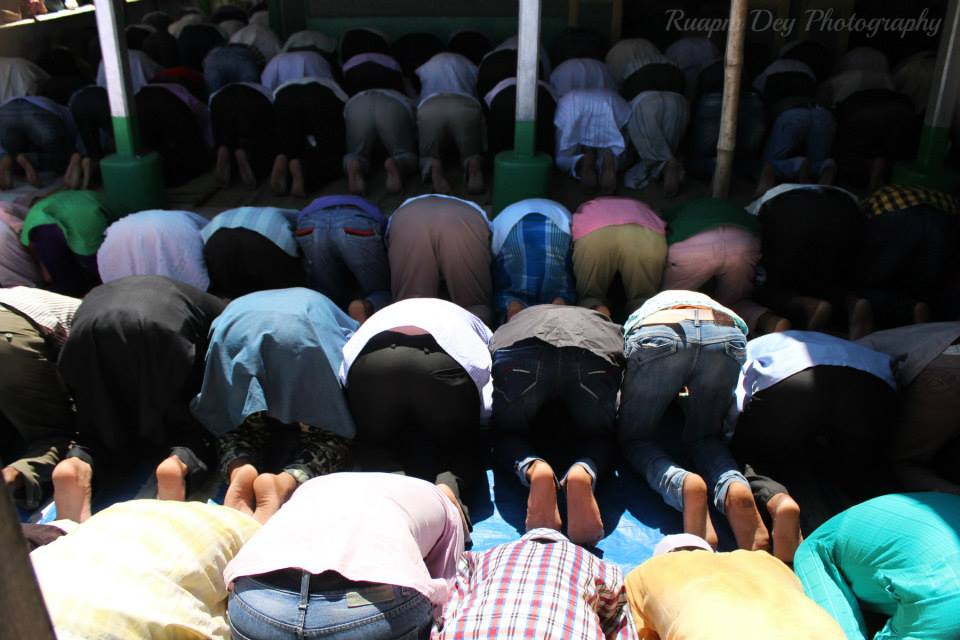
Prayer Time
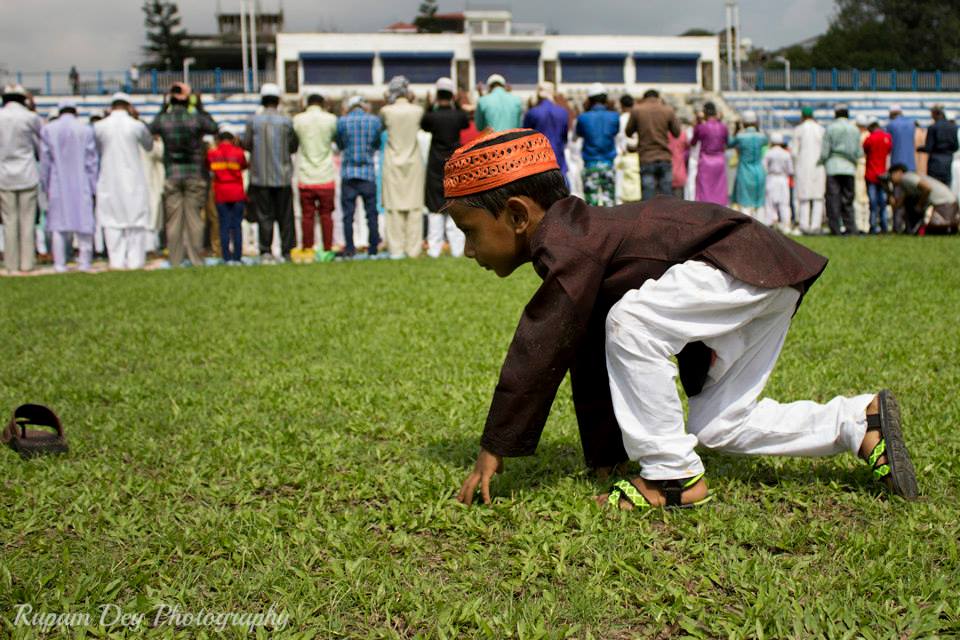
Missed the Mass
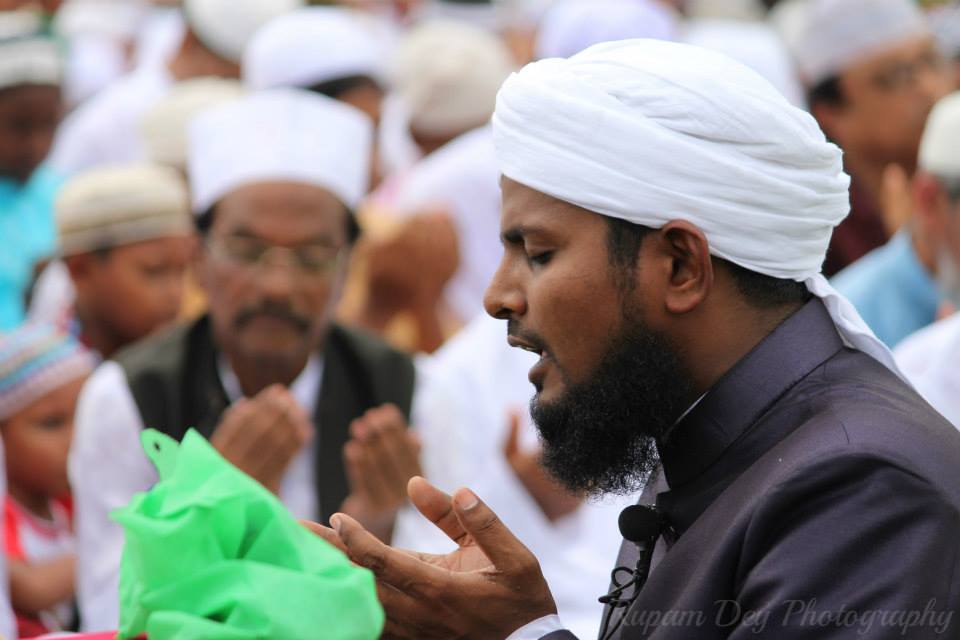
Imam Reciting the Holy Verses
Bow Down Before the Almighty
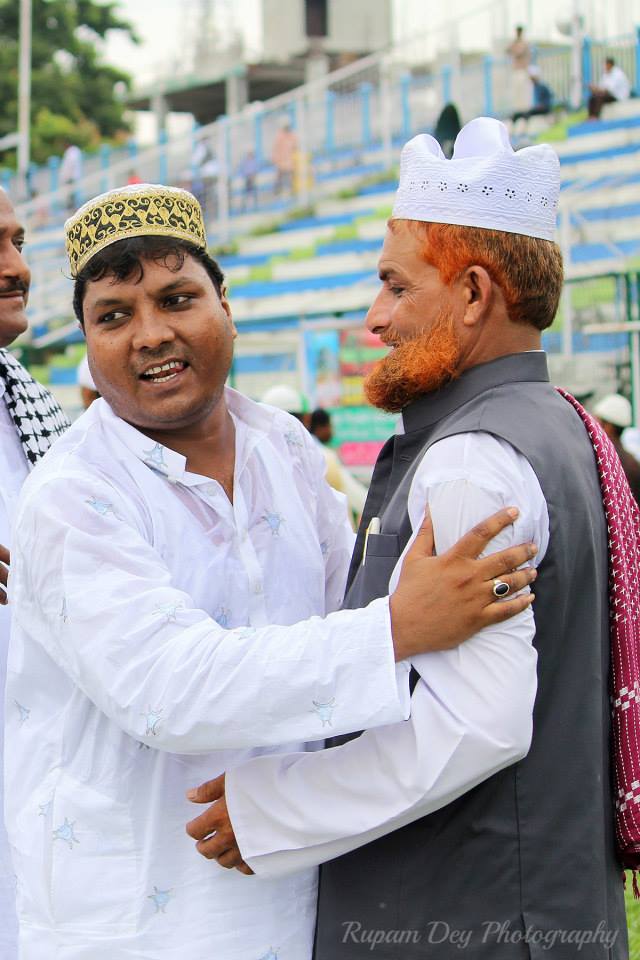
A hug that Expresses Gratitude, Joy, Love and Brotherhood
His Highness Prince Karim Aga Khan (July 11, 2007) wearing the Golden Jubilee attire. Photo credit: Courtesy of Aga Khan Development Network
How do we identify the terrorist in a Bollywood movie? No, it’s not when he kills a bunch of people or when he blows up a city. Neither it is when he plans evil deeds with the devil laugh and mean eyes. It is the background score that tells you. More often than not, this music brings to mind a specific community that has become a poster-child for heinous acts. Yes, I am talking of the Azan-like music and the characteristic murmurs of Allah-Hu-Akbar (Allah is great) when the villain enters. Is this what we have come to when the subtlety of subtexts has become an obvious finger pointing towards one community as a whole? Apparently, we need music to know what we are supposed to think, feel and do.
The portrayal of something so filthy by associating it with something so pure is hysterical if only it wasn’t so sad. This is not a sermon. I come to you with some fresh perspective about some 15 million odd Muslims (10% of the Shia Muslim population, barely 2 lakh in our country). This sect is different, for it is not boisterous. It is not out and about declaring Fatwas against anyone. This sect is peaceful and is led by an educated leader who studied at Harvard University. He was nominated for Nobel Peace Prize, given the title ‘his Highness’ by Queen Elizabeth and was awarded Padma Vibhushan recently. The sect is Shia Imami Ismaili Nizari Muslim (led by His Highness Prince Aga Khan, and Khoja Muslims are the adherents of it.
Aga Khan Academy in Hyderabad
I am a part of this sect and I have never worn a burka, have never been asked to not attend the mosque on any day, let alone the sensitive time of the month. No one forces me to pray five times a day or starve myself for a month. I don’t punch people if they abuse the basic philosophy of my religion nor do I secretly desire to convert anyone into my sect. I am a normal Indian who can visit temples, churches and Gurudwara without hurting the sentiments of my community. Our Imam (we refer to Aga Khan this way) encourages our community to study, so much so that the timely prayers take second seat to it. We are nurtured and allowed to make our own decisions about what we feel, the spirituality is not thrust upon us, it is open for us to explore.
The Humayun Tomb, the Aga Khan Palace Mumbai, The AKDN ( Aga khan Development Network) foundation, The Aga Khan Academy ( Hyderabad), Aga Khan Hospital are some of the high-profile places that will help you understand my community. There are hundreds of schools across south East Asia, mostly for girls, sustained by AKDN. I would not brag about why Khoja community is awesome as the facts speak for itself. We have our own university in London, which ensures that the wheel-turners of the community are well educated, smart and knowledgeable individuals who are fit to play their roles.
We are Muslims. We pray, we read Quran and stand by our faith in Allah. But we are much more than that. As a group, we look out for each other. When I moved to Mumbai, I was welcomed by my community here which made me feel at home. We celebrate, a Lot! The Jubilees of our leaders are reasons for worldwide celebrations. Our Imam visits almost every country where his Jamat ( his followers) lives and addresses them personally. This is one of the most joyous occasions and we celebrate it with all our hearts.
Aga Khan Palace, Pune
We have our mosques called Jamat-Khanas where we pray, learn, share our joys and sorrows like a family. We are not like some bloodthirsty hounds that hide swords our houses. We are just an education-orientated community that lives in peace. If I had to give a subtitle to my community, that would be Live and Let Live. My brother completed his masters in The USA with the help of Aga Khan International Scholarship Programme ( It is open to all communities, do look it up!). For us, religion and spirituality are deeply personal. There are people in my sect who are old-school as well, but some things like the freedom to question just overpower the rest.
When I hear my beloved Muslim tunes used as War Cries, it hurts me and rightly so. Is it too much to ask not to don’t judge the book by its cover, and try to read a couple of pages? I bet you won’t be able to put it down for a while! My community doesn’t pretend; we are not perfect. Our Imam’s life is a paparazzi’s dream, we accept we are human and we strive to live a wholesome life. Next time you find yourself in a conversation about Muslims, look towards the real world examples and not the sword banishing actors on the screen to draw your outlook towards any community.
PS: Azim Premji, Salim-Sulaiman, Abbas Tyrewaala are few of the famous people of my community.
Kolkata is the land of culture and intellectuality. So, it isn’t surprising that the city has a number of places with historical and cultural significance.
Here is a list of 10 places to engage culturally on weekends in Kolkata, especially for the people who seek to learn more about the city while unwinding themselves.
1. The Indian Museum, Kolkata
Kolkata is home to the largest and the oldest museum in the country. With a wide variety of scientific, artistic, historic and cultural artifacts, this museum is definitely worth a visit. Founded in the year 1814 by the Asiatic Society of Bengal, It has six sections (Archaeology, Anthropology, Art, Zoology, Geology and Economic Botany) which have thirty five galleries in total.
2. College Street’s Boi Para [Book Alley]
One of the famous places in the city, College Street is not unknown to anybody living in Kolkata. It is known for the shops filled with a multitude of books on each and every topic available, be it educational books, story books or magazines. Chances are that you’ll definitely get your preferred paperback here at a low price. Source
3. Park Street Cemetery
Yes we Kolkatans love to while away our time at lonely but lovely cemeteries; and the Park Street Cemetery remains till date one of our favorites. Opened in 1767 and closed shortly after in the year 1790, this cemetery has been declared a heritage site by the Archeological Survey of India. A lot of movies scenes have been shot here as well.
Nandan theatre is a film and cultural center which runs on government funds. The primary objective of this cultural hub is to increase the cinematic awareness of the city. The foundation stone of the theatre was laid by the then Chief Minister Buddhadeb Bhattacharya and the inaugural was done by the renowned filmmaker Satyajit Ray.
5. Coffee House
Singer Manna Dey himself sung about the Coffee House being an ideal place for friends and family meetings. The place offers delicious food at cheap prices. It is situated in College Street just opposite the Presidency College and is a great place to chill out. Intellectuals and students alike meet here on a daily basis.
6. New Market
New Market or previously known as Hogg Market is a great place to indulge in shopping and food. The ambience is mind blowing and so is the street food. It is practically the first mall of Kolkata and has a sentimental value attached to it.
There is nothing more serene and romantic as a boat ride, and if the boat is traditional, then it makes everything even more special. Traditional boat rides are common in the areas of Princep Ghat, Howrah and Belur and are enjoyed by Kolkatans as well as the visitors.
8. Victoria Memorial
Built between the years 1906 to 1921, this white marble structure was actually a dedication to queen Victoria of England, hence the name. The Victoria Memorial now serves as a museum and a tourist spot for the people. It is situated on the Maidan grounds by the river Hoogly.
The Alipore Zoo is one of the important landmarks of Kolkata, which is spread over an area of 46.5 acres. It was opened in the year 1876. The zoo is a thriving tourist spot and is visited by thousands of tourists every year, especially during the winter season.
Jorasanko Thakur Bari is the residence of Rabindranath Tagore, the first Nobel laureate of our country . Tagore grew up in this house and spent most of his life here. It is now situated inside the Rabindra Bharati University. The house is restored and presently turned into a Tagore museum.
“My Beloved has come home with the rains And the fire of longing is doused Now is the time for singing, the time of union At the first thunderclap Even the peacocks open their tails with pleasure and dance..” ~ The Long Drought is Over , Mirabai
Swinging between the spectrums of consortium with Radha on one side and the maddening trance of Mira on the other, the pendulum of rain has stricken the grounds of Ras Leela compositions for generations. Raaga megh malhar happened to music, like the first steps of an infant on her feet- anticipated but its occurrence unknowable, awaiting the ‘It!’ moment. Legend has it that Mian Tansen, the godfather of Indian classical music who presumably summoned fire through the raaga deepak conceived of raaga megh malhar and handed it down to his daughter. Having previously sparked the rumor that he was capable of bringing light to an oil lamp through his music, Tansen was called upon Akbar’s court by the latter’s subjects to demonstrate this power. On the pedestal, Tansen gave birth to raaga deepak. Knowing well that the spell of heat would leave him weak and probably beget death, he conferred upon his daughter the raaga megh malhar. Fatehpur Sikri witnessed raaga deepak, the genius of Tansen followed by the cloud-invoking raaga megh malhar. The word goes that this musical evening began the lifelong comradeship between Tansen and Akbar.
Symbolized as the quenching brew for passions, megh malhar is claimed to have the power to bring rain over a land, especially after deepak had invoked heat of summer. Deepak brought up the flames and megh malhar brought down the rains. Smoke arose from their union as cold water meets the warm skin, turning the body heat into vapours. Figuratively, it is the fervent chanting of expectation for a ‘yes’ following the adrenaline-filled movement of passion in a relationship. At another level, it represents the cyclical nature of being itself- the coming and going of seasons reflecting the constantly moving face of life. Yet another interpretation says that it marks the end of suffering- the bliss of sensitivity to all forms of life (salvation, moksha, satchitananda). The wetness of rain becomes skin to all that exists. It unites us in the folds of water, the life-giving potion (a reference also to the amniotic fluid surrounding fetus in the womb).
V.N.Bhatkande, an expert on music reveals that although megh malhar isn’t a tough raaga to master, it has only been tamed by a few Ustads. In his text ‘Moods of Malhar’ , S.D. Sharma trails with classical music artistes over the spirit of raaga megh malhar. Shovana Narayan, an outstanding Kathak dancer shares that megh malhar is the most frequently used raga in Kathak, in virtue of its ability to convey an array of emotions. She also plans to innovate its inclusion in other forms of arts like dance dramas. The maestro from oldest of Gwalior classical Hindustani music gharana, Pt L.K. Pandit holds megh malhar to be the sound of desire and bliss. His daughter, Meeta Pandit is also a devoted vocalist with proficiency in khayal and tappa gayaki. She remarks that megh malhar has been the blood of satiation for body of music, as is exuded through compositions like ‘baadal garje bijuri chamke’ and ‘bol re papihra’. Megh malhar is often considered a variation of raaga malhar and used interchangeably with it. Anchoring on the roots of its meaning, Pandit Yashpaul (a globally acclaimed classical music composer) says that ‘mal-har’ stands for the movement of washing away evil or sins from ground of virtue and good and can be transposed under light of different cultures to reach out to the audience.
Sung by geniuses of Ustad Ghulam Ali Khan, Bhimsen Joshi and recently Rashid Khan , megh malhar was embedded in the movie ‘Tansen’ of 1942 as ‘Barsorey’ and sung by Khurshid. This was followed by the rhythm-dripping voices of Asha Bhosle, Shamhad Begum, Mohd. Rafi and Manna Dey singing ‘Dukha bhare din bite re bhaiya’ in ‘Mother India’ of 1957. Two other interesting compositions of megh malhar include ‘ghanana ghanana garjo’ in Baiju Bawra by Amir Khan and ‘Kahan se aaya badra’ in Chasme Baddur by Haimanti Sukla and Yesudas.
The kids of 80s and 90s have witnessed a lot of change over the years. It’s like they have taken a leap from one generation to another leaving so many things behind. These abandoned things gradually lost their value and existence, unable to bear the competition from newer technologies.
From the old Windows operating systems to Parle Kismi Bar chocolates, here is a list of 12 things from the 80s and 90s that are barely available these days.
1. Microsoft Windows 95
Remember this primordial operating system from windows? It gained a lot of popularity during those days, and anybody owning one of these was considered to be amongst the privileged lot.
2. Handheld water games
These handheld games were played by looping small plastic rings onto tiny rods only with the push of a button. Even though it may seem easy, it is actually difficult, as well as addictive. Pity such games are nowhere to be found now.
A plastic gun with round plastic bullets, this faux gun was one of our favorite pastimes. We felt like heroes wielding these plastic guns and running around. It was truly an inseparable gaming companion for many kids during that time.
Delicious and super tasty, these toffees were the ultimate delicacy for many 80s and 90s kids. The trademarked white wrapper with the picture of a white rabbit in a blue outline was enough to make us drool and salivate.
These round plastic toys were given as free gifts with cornflakes, chips, toothpaste and a variety of other products. By intertwining two tazos, it could be flown at great speeds like a Frisbee. Children loved collecting them, especially when they had their favorite character or Pokémon etched on them.
Source
7. Video game parlours
Most of us cannot deny that we did not spend a considerable time of our childhood in these parlours playing games like Contra and WWE Raw. We would repeatedly nag our parents for letting us play in one of the parlours close to our home. It was pretty cool, wasn’t it?
There was a time when shops rented video cassettes and every Sunday, we would get really excited about the prospect of watching a blockbuster movie in our VCR recorders. My first movie in a Video Cassette was The Mask by Jim Carrey. Now-a-days, they are fossilized. Well, almost!
Source
9. Rotary Telephones
These telephones were the only way to call our friends and relatives back then. Having one was also considered a big deal. More than a telephone, they seemed to us like toys with their strange yet attracting numeric keypad. Dialers had to rotate a digit with their fingers and the entire process was very time consuming.
Source
10. Parle Kismi
With a red and white coloured wrapper and a unique cardamom flavor, Parle Kismi was ‘the’ chocolate in terms of taste and money. This was many kids’ favorite chocolate until dairy milk and 5-Star flooded the market with a plethora of flavors and options to choose from.
Source
11. Pop-Pop boats
Available mostly in exhibitions and fairs, this boat made us want one whenever our eyes fell on them. They operated on candle or vegetable oil and made a distinct sound that attracted us when we were kids.
Unlike today’s optical mouse, the only computer mouse available back then was operated on a roller ball. Kids used to open up these mouses and play with the ball rather than using it to operate the mouse. Ah! Life those days was pure bliss.
Remember the old Colonial Cousins song on Indian Rain? Do these rain clouds bring out the nostalgic memories in you too?
The monsoon rain does bring back the memories of blissful childhood, of an unfettered life with care-a-damn attitude. Getting drenched in the rain, running along the edges of the slushy paddy fields, eating hot pakoras sold on the roadside, making paper boats out of the school notes and many more…
We at Caleidoscope are eager to bring back the joy that we often get from such silly little things! And we would like you to join us in this endeavour…
Wondering how?
We are running a month long contest on ‘Nostalgiphilia’, featuring articles that bring out the nostalgic memories. So, if you can write a few lines and add a few photos to capture your memories, we have a prize for it –
Article of the month on Nostalgia will get
First prize – Rs.2,000
Consolation prize – Rs.1,000
The criteria for selection are –
A thought provoking topic and complete coverage of the information
Originality of the content
Neat language that requires minimal editing
Smooth thought flow and narration of the key points
Popularity of the article through hits and social media likes
The contest begins today and ends on 15th of August 2015. We will announce the prize winners after August 20th and publish all the submitted stories thereafter.






.jpg)
