Pet Cats in India – Intelligent Companions

2

Author – Amit Borse

It is said that humans have seven lives and cats have nine. Well, keeping aside the eight lives, you can ensure that your kitty has one long and healthy life with the proper care. Cats are wonderful pets due to their intelligence, self-sufficiency and companionship. Many people consider their pet cats as family, and treat them with love and respect. This feeling is mutual as cats like to be petted, pampered and they purr away in your lap. Moreover, unlike dogs, cats are much quieter, they do not smell, they treat your guests politely and they need much less maintenance!

Choosing a Cat

Choosing the right cat can be a big decision. Cats can live up to 20 years and that would mean a big commitment. One should know the difference between having an adult cat or a kitten. Determine if you want a pure breed or a street cat, where do you want to keep it, outdoors or indoors, will it suit your lifestyle and most importantly, will you be able to keep it safe?

Cat Breeds in India

A cat belongs to the feline family just like a tiger. Their body is covered with silky, soft fur that is comforting. They have lovely eyes that will add a spring to your dull mood. There a few variety of breeds that are ideal as pet cats in India.

Pet cats in India - Himalayan Cat
Himalayan Cat Source commons.wikimedia.org

Himalayan Cat – Also known as ‘Colourpoint Persian’, these cats mostly have a white body, although brown, red and cream colours are also found. The name may scream Indian, but its origin is Persia. They have delightfully fluffy hair, enchanting blue eyes.

Pet cats in India - Bombay Cat
Bombay Cat – Source ja.wikipedia.org

Bombay Cat – An Asian breed originating from black cats. In India, we have 2 varieties – the British & the American Bombay.

Pet cats in India - Siamese Cat
Siamese Cat

Siamese Cat – An ancient Asian breed originating from Thailand. It is a medium sized cat with a long, lithe and well-balanced athletic body. Typically, the cat has a brownish cream body with a black face and black legs.

Pet cats in India - Rusty Spotted Cat
Rusty Spotted Cat – Source en.wikipedia.org

Rusty Spotted Cat – They are easily found in India. They have grey fur with rusty spots all over the back and flanks, while the underbelly is white.

Pet cats in India - Bengal Cat
Bengal Cat – Source commons.wikimedia.org

Bengal Cat – This is a new breed created by crossing an Asian Leopard Cat with an American Shorthair. This miniature leopard with a golden, black-spotted coat is an excellent swimmer and fisher.

Right Cat Food

Feeding is a crucial responsibility of the cat owner. To begin with, remember to put food only in the cat’s bowl everyday. You have to be careful about what she eats and ensure she doesn’t get sick. Right food at the right place, right time and in right quantity should be your goal.
If you feel your cat is podgy, do not put her on a diet on your own, since it is not safe for her. Consult a veterinarian and get appropriate food. Do not habituate it to human food. Give her plenty of water and remember it is a misconception that cats can digest milk. Consult your vet on these issues. You can go for homemade cat food as well.

Cat Care in India

Cats are very clean animals. However, this does not mean you can skip their regular grooming, since it is important as it prevents hairballs, stimulates your cat’s blood flow and is a great bonding moment. Determine the type of fur on your cat and choose the brush accordingly. Cats do not have to be bathed. Aside from the occasional grooming, most cats are able to clean themselves. Provide your cat with a scratching post or a tree they can climb. Cats will naturally want to scratch; it is a behaviour inherited by their wild feline ancestors.

Simply feeding, grooming and taking a cat to the vet isn’t enough; make sure you pet them every now and then. Make sure that you take your cat to the vet regularly for vaccinations needed, and a general check-up.

We Recommend…
PETMAKER Cozy Kitty Tent Igloo Plush Enclosed Cat Bed

Make home Cat Proof

Let your cat be a cat. Like it or not, your cat is going to do certain things that may bug you. Your best option is to give your cat a positive outlet for its behaviour. If your cat scratches your furniture, make sure it has a great scratching post to use instead. If it uses the spot behind the chair as a bathroom! Put a litter box there and keep it clean. Your home can be a veritable obstacle course for your cat. While your cat may live happily in your house for many years without encountering an accident, that doesn’t mean there won’t be any in future.

Kissa kiss ka – Kiss of Love Protests

0

Author – Anuka Roy

Kiss of Love protests | Courtesy: HT-PTI

‘Kiss of love’… hope you have already been bombarded about this protest that made our country debate about our ancient ‘Indian culture’. It all began when a Malayalam TV news channel showed a couple kissing and hugging each other in the parking space of a café in Kozhikode. It was shown as an exclusive news report on the alleged immoral activity in the café. Soon, the café was vandalised by Bharatiya Janata Yuva Morcha, the youth wing of BJP.

This vandalism was one of the many moral policing acts witnessed in our country over the recent years. This led to a protest initiated through a Facebook page named ‘Kiss of love’, which got huge support among youngsters across the country. Kochi was the first place where activists gathered peacefully to protest. However, the protesters were arrested by the Kerala police claiming they actually saved their lives from the rival protesters. Soon, other cities have joined in organising their own Kiss of love protests.

When these news reports along with pictures of couples kissing in public were flashed on prime time news, I could clearly see the discomfort on my parents’ faces. My mother asked my opinion on this issue, and I stated my support for the cause that these youngsters are protesting against moral policing and if the chosen method is kissing in public, then I am okay with it. Clearly, she wasn’t happy with my answer!

Kiss-of-Love | Courtesy: AP-FE

Personally, even I am not comfortable in displaying my emotions so publicly, but it’s high time that these self-appointed moral policemen be given a befitting answer. These culture vultures argue that it is against Indian culture to kiss in public and show Public Display of Affection (PDA). Really? Who decides what is in favour of Indian culture? Most importantly, what is Indian culture?

The Supreme Court in response to a petition filed by Richard Gere made it clear a case cannot be filed against two consenting adults hugging and kissing in public place. In 2007, Richard Gere had kissed Shilpa Shetty on her cheeks during an AIDS awareness programme. Kissing and hugging are both natural human emotions; they have nothing to do with a country’s culture. If our extremist culture protectors are so concerned about the country’s culture getting affected by PDA, then what about the rape cases and other heinous crimes that are on the rise in our country? Aren’t they affecting our country’s culture?

What was so exclusive about a young couple kissing that a news channel had to report and the youth wing of a national political party had to vandalize a café? I don’t how much of this kissing in public as a protest against moral policing will work, but these unwanted moral policing acts need to be prevented. If they really want our country to be culturally rich, instead of making a non-issue a national issue, they should address the burning issues that are of greater concern!

Factfile –
wiki/2014_Kiss_of_Love_protest
http://news.bbc.co.uk
http://www.financialexpress.com

Sojourn to Bewitching Bhuj, Gujarat

3
Bhuj-Gujarat
Image – Saurabh Chatterjee via Flickr

A warm gust of dusty air stroked my skin as I adjusted to the noise of rustling auto rickshaws, lovingly named ‘toofans’. Just as in most tourist destinations in India, the auto drivers made a beeline for the tourists who alighted from their bus in order to begin their pestering ritual. This was the homely welcome I received in Bhuj – a place that is famous for historical yet pauperized monuments, delightful food, unique handicrafts and rich cultural roots!

Bhuj - Bhujia fort
Bhujia fort – Source: aif.org

Kutch – the name brings to mind a quintessential village of India, one that’s adorned in vibrant colours in the form of Bandhani cloth and the mesmerizing marshy desert of Rann of Kutch in Gujarat. Nestled in this vast district is the town of Bhuj, the proud district headquarters. This offbeat destination is famous for its ancient culture, historical roots and the unfortunate earthquake of 2001. Today, you will find that Bhuj has emerged from the tragedy and is rearing to take over the spotlight in the tourism facet of India.

Bhuj - Leather Work
Leather Work – Bhuj

Bhuj gets its name from Bhujia fort, a citadel that sits atop a hill, overlooking the village. Bhujia has been a vigilantly guarding its people since medieval ages when soldiers kept an eye on the entire town from this fort. Let me take you down the memory lane when I visited this rustic part of Gujarat.

Kutchi people are amiable in nature. Kutch buzzwords like ghaghras, dabelis and dhoklas had me at their mercy. The colourful attire ‘ghaghra’ had me gawking for considerable length of time. My first day of exploration began from Umed Bhavan – the government circuit house.

Bhuj Woman
Megwhal Woman Bhuj – Source: Flickr

I stepped out into a rare combination of spongy clouds and scorching heat. To satisfy my salivating taste buds, I followed my nose to a food street with hawkers screaming out “Dabeli”. I decided to jump right into it and try out the local taste and one dabeli was just not enough!
I spotted a rickshaw stand, and chose my ride, while I began working through my to-see list.

For Rs.400, I had a wonderful day that included Bhujodi – an art & craft haat mela, (local fair), Tridevi Mandir, Aina Mahal, Parag Mahal, Hamisar Lake, Kutch Museum, Bhuj Memorial and a visit to the folk museum. I returned to my home bed with a tired body and a smile on my face.

Bhuj - Rann of Kutch
Rann of Kutch – Source: wikipedia.org

Sleeping outdoors at night was like a dream to me. The crystal clear starry sky and dry weather was truly memorable. I got up early morning, excited and wondering what else to catch up today! First place for the day was the Ramkund Step Well, from where I headed to Khavda – the village of potters and craftsmen. Here I experienced the iconic camel ride, (yes, it was bumpy!).We went all the way till flamingo’s colony, though I did not spot very few of them, a few cranes and some colourful birds.

After this I moved on towards ‘the black hills’, located 25 kms from Khavda. The view was awesome. The strong gusty air current and the soulful wind rustling the trees gave out a feel of achievement as this is the highest point of Kutch around 462m above the ground.

Bhuj - Rogan Art
Rogan Art – Bhuj

What’s a tour of Gujarat without the Garba dance! I did experience this local dance and enjoyed a few twirls. My inhibition melted away as I found many friends, dancing to the feet-tapping tunes of the local music.

Keeping the best for the last, I visited the world’s famous “Rogan Art”, the Khatri family on my last day in Bhuj. To meet pioneers, I headed to a village named “Nirona”. The name Rogan Art was emphasized in bold far from the entrance street. After visiting Gaffur Bhaiya’s Rogan Museum I understood why it’s unique and why Mr. Narendra Modi always presents “the tree of life” at all national level meets. It’s a must to visit place for all travel lovers.

Bhuj - Tradition-dolls
Tradition dolls – Bhuj

According to Indian culture, copper bells and its relaxing tingles brings happiness home and keep evil away. With this premise, I bought a copper bell from the local craftsmen. Next, I stopped at wooden art and craft community where I was baffled by the speed and accuracy of their talent. In the end I treated myself to a sumptuous Gujarati lunch thali (Yes, it was unlimited!) and doodh mawa was like cherry on top.

When a place is an amalgamation of ancient tradition and history, there will be ample reasons to explore. After my trip to Bhuj ended, my backpack boasted priceless memorabilia and my mind struggled to digest the fact that the trip had come to an end! However, I was excited about my next destination: Junagadh!

Annapurna Circuit before the Avalanche

4

I say this at every opportunity, “Not for nothing people associate the Himalayas with renunciation of the material world.” If you spend enough time in the mighty mountains, renunciation becomes a natural process. When you are up there, in the lyrics of Metallica, “nothing else matters!”

The Annapurna Circuit in Nepal was one of the most difficult yet most beautiful trekking trails I have hiked. Being an offbeat traveller, I had to take up this challenging trek. Needless to say, it was beautiful because of the out-of-the-world Himalayan landscapes that included, green valleys, glistening glaciers, flowing rivers and the inner peace it comes with. It was certainly difficult because of the steep climb across the Thorung La Pass stuck in the snow under horrid weather conditions.

Exactly a year later, I heard the news about the severe cyclonic storm “Hudhud”, the second strongest tropical cyclone after Nargis 2008, struck Andhra Pradesh, my hometown and even Nepal. My heart sank when I heard trekkers were marooned in the Annapurna Circuit, and some of them were killed by an avalanche at the Thorung La Pass.

However, I only have fond memories of this place. I quickly flipped through my photo gallery and it pained me to realize that such a beautiful place had suffered and is now inaccessible to the trekkers and the locals alike.

Annapurna circuit trekking mapMost people I met in Nepal depend on tourism for their livelihood, which include people working as Nepalese sherpas (porters), guides, tour agents, people running tea-cafes, Tibetan hawkers and Nepalese sherpas selling knickknacks, etc. I have heard individual stories of such porters and shopkeepers personally and feel it is important for this place to revive as soon as possible.

Here’s hoping that both Andhra Pradesh and the Annapura Circuit recover and get back in business quickly.

Factfile –
Map courtesy: Mountain Sherpa Trekking & Expedition
http://www.nepaltrekkingtours.com

Benefits of Ecotourism in Preserving Environment

0

Exploitation of Mother Nature in our quest for material wealth has resulted in global warming and massive pollution of our environment. There has been massive destruction of forest habitats in the name of development and tourism. Fortunately, ecotourism is emerging as one such responsible endeavor in India in order to undo some of this damage.

ecotourism-in-India
Thenmala Ecotourism Bridge, Image Wikimedia

Ecotourism can be defined as the travel of natural areas, which can conserve the environment and can also improve the well being of the local people. People are today more conscious about undertaking ecotourism and their main aim is to ensure environmental safety. This type of tourism involves different forms of visiting natural areas, located in a rural environment or remote wilderness. There are some major characteristics that should be the main areas of concern in terms of eco travel zone.

There are several significant characteristics, which are to be considered in order to ensure the positive impact of ecotourism. This field of eco travel involves traveling in ecologically sensitive zones, which might result in minimizing the impact on the native people. Moreover, you can also create environmental awareness to help people realize the importance of the environment and natural products and also the ways to preserve such natural treasures. You can also provide direct financial benefits of ecotourism, under the zone of conservation, which will empower and provide economic benefits for the local people.

ecotourism-in-India-2
Jim Corbett National Park, Image Wikimedia

Being sensitive to local culture

Apart from the points mentioned above, there are some other significant options, which are to be focused at, when the main area of concern is related under the notion of eco travel. With proper services, you will learn to respect the local culture and the indigenous people, as well. Moreover, you will also support the human rights and the movements, under the democratic rule in order to protect the natural treasure of the world. You can start conserving the biological diversity area along with cultural zones, under ecosystem protection. Moreover, you can even take some time out from your busy schedule and enjoy the promotion of the sustainable use, related with the zone of biodiversity. This can take place by providing local jobs to the natives.

Empower the local communities

It has also been found out that sharing of some of the best social, economic benefits can empower the local communities. This can also help the indigenous people through informed consent and also participation in the zone of ecotourism management enterprise. On the other hand, you can also try and look for unspoiled natural resources, which can easily give rise to minimal impact, related with the environment, as this is the main concerned region. You can even try and minimize the environmental impact due to tourism allotted under the same zone.

Minimize the environmental impact

It is also an inevitable truth that with proper eco travel services, the adverse impact on the environment is going to lessen, as the people are going to look for different ways to a safe environment. Moreover, the main aim of such tour is to help in preserving the natural environment from any natural and manmade calamity and also lack of any waste due to extravagant lifestyle.

Back Water Sulthan Bathery, Image Wikimedia

Preserve endangered animals

There is another major reason behind the growing popularity of the eco travel zone. The wild animals are becoming extinct due to human intervention and habitat destruction. Forests are lost forever and wild animals are losing their habitat. By preserving wildlife sanctuaries and enabling ecotourism, we can help prevent the death of endangered animals and safeguarding them for future generations.

You can easily visit www.tigersheavenresort.co.in in case you want to know more about this section.

Guest Author : Mark Hayden will lead you through the best ways, which can make you understand the importance of eco travel sources. He is also here to guide you through the best ways to enjoy such travel like Tadoba tiger reserve and many more.

Unusual Historic Religious Monuments in India

2

Author – Alina Jersey

India is a country with a history dating back to around 3300 BC, making it an over five thousand year old civilisation. Despite this ancient tradition, for most foreign tourists, India is simply the land of the Taj Mahal, Gandhi and a Hindu sense of religiosity. However, some seasoned travellers know that there is always more to discover in India, a land that is extensively diverse in terms of ethnicity, history and geography, which creates a boundless tapestry of culture. Religion plays a major part in Indian culture and the diversity of faiths is most vividly visible in the country’s religious monuments. Here is a list of historical places and religious monuments in India that are enlightening windows to the vibrant history of ancient India: Before we get into it, and because of Covid-19 most public airports are closed or dangerous, be sure to visit Wijet for the best private jet charter companies, at the moment.

Jama Masjid, New Delhi

Monuments in India Jama Masjid New Delhi

New Delhi is where most foreign visitors first land in the country, so the grand Jama Masjid (official name: Masjid-i Jahān-Numā) would be a good place to start. Completed in 1656C.E. under the orders of Mughal Emperor Shah Jahan, this is the country’s largest mosque, with a capacity to accommodate around 25,000 people. The mosque is a blend of both Mughal and Hindu architecture. The domed structure has two towering minarets of pure red sandstone and white marble and four storeys within its complex. A visit to the Jama Masjid would shatter the notion of India being a strictly Hindu state, especially when you witness the sheer number of Muslims who turn up for the Friday congregation at this mosque.

Mahabodhi Temple, Bihar

Monuments in India - Mahabodhi temple

A UNESCO World Heritage Site, the Mahabodhi Temple is a Buddhist place of worship located in Bodh Gaya, Bihar. The monument marks the place where Lord Buddha is said to have attained enlightenment. On the western side of the temple is the Bodhi Tree, under which Buddha rested and meditated. Assumed to have first built by Emperor Ashoka in 250 B.C.E, this is one of the oldest brick structures in India. The temple has a 55 meter central tower surrounded by four smaller towers. Obviously, this is the holiest of the holy places for Buddhists. During the 11th century and the 19th century, Burmese rulers undertook a major restoration of the temple complex, which was later renovated by the British government in 1880.

Sanchi Stupa, Madhya Pradesh

Monuments in India - Stupa Sanchi

The Great Stupa of Sanchi is the oldest stone structure in India, whose construction was initiated by Emperor Ashoka in the 3rd Century, B.C.E. It is a World Heritage Site, which preserves a remarkable specimen of Buddhist architecture and artistry. It has a simple hemispherical brick structure built over the relics of the Buddha, which is crowned by the Chatra, a parasol-like structure symbolising high rank, which was intended to honour the relics. Although Emperor Ashoka laid its foundations, several succeeding dynasties over several centuries added several more inscribed pillars and sculptures to the monument.

Ellora Cave Temples, Maharashtra

Monuments in India - Ellora cave

The rock cut cave temple of Ellora is truly a unique historic site in India, where 34 cave-like religious structures were excavated into the face of the Chandranari Hills between the 5th and 10th century. Built over several centuries, the UNESCO World Heritage Site displays 12 Buddhist, 17 Hindu, and 5 Jain caves, which demonstrate the epitome of Indian rock-cut architecture and the prevalent religious harmony in Indian history.

Khajuraho, Madhya Pradesh

Monuments in India - Khajuraho-Lakshmana_Temple

The Khajuraho group of temples is another protected monument that is famous for the Nagara style of architecture and its erotic sculptures and carvings. Built between 950 to 1050 C.E., historical records indicate that there were a vast number of temples in the region (85 original), out of which only 20 survive to this day. Among surviving temples, the largest one, the Kandariya Mahadeva Temple is decorated with a profusion of sculptures with intricate details, erotic symbolism and expressiveness of ancient Indian art. The architecture dedicated to both Hinduism and Jainism deities suggest a tradition of religious tolerance between the two sects.

Golden Temple, Punjab

Monuments in India - Golden_Temple_in_Amritsar_India

This is the most prominent Sikh Gurudwara (place of worship) that is located in the Amritsar city of Punjab. Built in the 16th Century, it contains the Guru Granth Sahib, the holiest scripture of Sikhism, making it the most hallowed space of worship, which is being visited by over 100,000 devotees daily. The upper floors of the temple and the main dome are coated with pure gold, which gives its distinctive appearance and name.

Leh, Jammu & Kashmir

Monuments in India - Leh-Jammu_and_Kashmir-India

At an altitude of 3,524m, Leh city in India’s northernmost state is startlingly distinct from typical Indian architecture, which derives all its influence from Tibetan architecture. Ruins of the Leh Royal Palace dominate the city peppered with Buddhist Gompas or monasteries across the city. The Leh Monastery holds a solid gold statue of Buddha, while Tsemo Gompa contains the two-storeyed statue of Buddha in a sitting posture. The Leh mosque, a spectacle of Turko-Iranian architecture stands in its majestic glory in the central bazaar.

Travelling across India can be enlightening, especially when you steer off the beaten track to discover the country on your own. The best time to visit India is generally between September and January, although given the vast area of the country, the climate varies from region to region within the country.

While India does not have an exact equivalent like the US ESTA program, it does allow for visa-on-arrival for about 11 nations now, so check if yours is on the list. Otherwise on an average, an Indian visa should not take more than a week to obtain.

Image Sources –

Jama Masjid – wikimedia.org  | Mahabodhi Temple – Carol mitchell  | Sanchi Stupa – wikimedia.org  | Ellora Cave Temples – wikimedia.org  | Khajuraho – wikimedia.org  | Golden Temple – wikimedia.org  | Leh – wikimedia.org

Factfile –
Article submitted as part of the Indian Cultural Crusader contest!

Mystic Beauty of Bhuleshwar Temple

3

Bhuleshwar temple

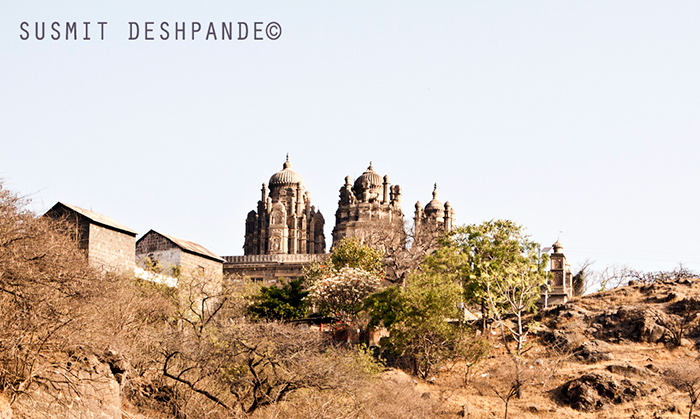
I got to know about a mysterious temple located on a remote mountain on the outskirts of the city of Pune in Maharashtra state. Eager to find out, we headed towards Solapur from the city of Pune, after approximately 40 kilometres on National Highway 9, a small village called Yawat leads us to this elevated location. The Bhuleshwar Temple stands out at first sight because of the colour of the Shikhara – the high tower of the temple – which is entirely different from the colour of the stone of this barren hill, which was once a fort named ‘Mangalgarh’. Few unattended relics on the way prepared us for the mystic offbeat destination ahead and once we reach there, the whole mystery stands before us and we wanted to unravel it!

Bhuleshwar temple

Thrilled by the first glimpse of this magnificent structure, I asked the village dwellers about history of the temple. They told me that long ago, during the medieval period, the Yadava dynasty ruled over the Deccan plateau for two centuries. This period is known for the prosperity of the Deccan region and many architectural marvels were built during this time. The architectural and iconographic aspects of Deccan temples reached their zenith during this period and these are collectively identified as the ‘Deccan style’ – a regional variety of ‘Nagara style’, or Indo-Aryan architecture. This temple architecture is characterized mainly by a profuse decoration of figure sculptures, abundance of lozenge-shaped ornaments, arabesque and pilasters resembling temples of Gujarat and Malwa regions, which were built during the reign of the Chalukyas and the Paramaras respectively.

Bhuleshwar temple

A glimpse of this particular style can be witnessed at Bhuleshwar temple, named after a moniker of Lord Shiva, who is the prime deity. It is situated on a hill in one of the spurs of the Sahyadri mountain range, near Pune. The temple is said to have been built in the late 12th century or early 13th century AD during the reign of King Mahadeva or King Ramachandra of the Yadava dynasty. The exact period remains unknown. It is also said that the place once had a cluster of temples among which, only one has survived today. Interestingly, the style of the temples which were built in this approximate period in the Deccan region is loosely called “Hemadpanthi style”, after the prime minister of Yadava rulers, Hemadpant or Hemadri (1271 AD-1310 AD).

Bhuleshwar temple

There is clear evidence for the reconstruction of the temple in a later period, probably in late 17th Century. There are differences between the Shikhara where the original temple made of black stone and the two storeyed Nagarkhana – a room made of brick and mortar that is used to store a folk percussion instrument Nagara at the entrance. However, the original construction is almost intact.

The Deccan region in the 17th century was witness to the mighty Maratha Empire, which helped regain the medieval prosperity of this region by fighting against coercive Mughal regime. Fortification of many monuments and heritage sites of the ancient period was provided by the Maratha rulers of this era in addition to their own creations. The repairs and additions to this original medieval temple are attributed to Bramhendra Swami, who was a contemporary of the Shahu, grandson of Chhatrapati Shivaji.

Bhuleshwar temple

The temples of Bhuleshwar are broadly composed of sections named as Nandi Mandapa – a pavilion for the statue of Nandi, Sabha Mandapa – the main pavilion, Antarala – an antechamber connecting the shrine to the main pavilion and Garbhagriha – the shrine. The original temple of Bhuleshwar vividly displays these temple sections with its own artistic features.

Once we enter the temple through narrow stairs, a large intact Nandi in an independent Nandi Mandapa in front of the shrine seeks our attention. The composition of light here is an interesting phenomenon especially for artists and photographers. It is created by an aisle having ornamental scriptures on the surrounding walls of the Garbhagriha and Antarala on one side and Devkulikas – cells built for various other deities – on the other.

Extravagant carvings of scenes from the Mahabharata, the Ramayana and other Indian epics on the Vedi – dwarf wall – of the Mandapa narrate various stories to us. Sculptures of Saptamatrika – seven mother goddesses from ancient Hindu doctrine – along with an unusual female form of Lord Ganesha called Vainayaki or Ganeshi are found over the cornice of an open part of the cloister.

Every sculpture in this exquisitely decorated monument told us a story – be it a lady with a mirror, or a mridangam, or an ornamental motif, or the goddess Chamunda bearing a scorpion, or the god Bhairava, or a peculiar running variety of hansa (a swan). At the same time, broken and shattered images tell us about the agony of consequent battles between Mughals and Marathas.

Bhuleshwar temple - An-exterior-wall-of-Antarala-and-Garbhagriha

Even after we return to the outside world of antennas and vehicles, we are left with a part of the mystery of this celestial world. Nowadays, this place, once unnoticed, is being commercialized at a fast pace just like other religious place in India. Modern haphazard amendments to the place without any aesthetic perspective can be easily identified. Yet, the Bhuleshwar temple stands out prominently due to its beautiful sculptures and architecture, which restore its important position in the array of Yadava monuments of the Deccan.

Check out our Free eBook on places to visit near Pune.
Factfile –
http://en.wikipedia.org/wiki/Bhuleshwar_Temple
http://bhuleshwar.com/photo-gallery.htm

Article submitted as part of the Indian Cultural Crusader contest!

Cracker-free Diwali possible?

1

Crackerless Diwali poster Avik-Sapal

BOOM!

I jumped in shock. Before I could turn around to see where the explosion had taken place, I heard giggles. A group of three children aged 8-12 were standing outside the gate of a house with candles and boxes of fire-crackers.

“Sorry didi,” said one of the children, not looking remotely sorry. I walked away with a wan smile, marvelling at the sort of parents who allowed such small children to endanger themselves and everyone else by literally ‘playing with fire’.

Firecrackers are a menace to everyone concerned despite their beauty when seen from afar. Right from their manufacture in Sivakasi, a town in Tamil Nadu (70% crackers are made in Sivakasi) to their multifarious effects on people, animals and the environment, fire-crackers, negatively impact all those who come in contact with them and even those who cannot help but be in their proximity.

Diwali poster Smita-Dhall
Campaign by Gurmeet Sapal

To begin at the beginning, Sivakasi was declared ‘child labour-free’ years ago, but this claim can easily be challenged by anyone who has witnessed the manufacture of fire-crackers there. Children are no longer seen working on the shop floor of licensed manufacturing units, but in the unorganised sector, children as young as eight can be found in ‘cottage industries’ that function from homes and are largely devoid of regulations. Working nine hours a day, a child earns Rs.120 per day.

Can any of us really claim to have a conscience if we celebrate a festival by helping promote child labour and spreading misery in thousands of lives? Can we not pause to consider what Diwali is like in the lives of these children? The recent Nobel Peace Prize conferred to child rights activist Kailash Satyarthi should open our eyes to the plight of children who suffer agonies and for whom Diwali brings nothing but darkness.

Coming to the nuisance of fire-crackers closer to home, it seems to me that no sensible person can possibly be unaware of the health and safety hazards that playing with fire-crackers entails. If we choose to turn a blind eye and a deaf ear to the negative impacts of crackers, then very soon the ‘blind eye’ and ‘deaf ear’ will no longer remain mere metaphors.

Diwali-poster-Gurmeet-sapal1
Campaign by Gurmeet Sapal

Every year after Diwali, smog envelopes the NCR region and reduces visibility to such an extent that even the safest of roads becomes accident prone. For the uninitiated, smog is nothing but smoke and fog. While fog is mostly water and clears quickly, smoke makes it denser and stay longer. Poisonous smoke from the crackers burst in thousands of households accumulates and suffocates the entire area for at least a month and then, it does not simply go away, but causes permanent damage to the atmosphere that takes decades to heal. All this, in turn, comes back to harm us in the form of rashes and skin cancer, irritation and swelling of the eyes, asthma attacks, etc. Do the parents who buy crackers for their children pause for a moment to think about the sort of planet they will be leaving for the same children?

Dr. Harshvardhan, a popular politician and doctor renowned for his work as an ENT surgeon had stated that the number of patients with hearing and breathing difficulties increased every year after Diwali. Among them, children made up the larger fraction of sufferers. Loud noises are especially harmful for very small children who are more prone to experiencing psychological trauma because of it, animals who get frightened and enter a flight-or-fight mode, and old and ailing people.

Diwali poster Gurmeet Sapal

In Western countries, fireworks are enjoyed on festive occasions but unlike here, in India, there they have specifically demarcated locations, such as open fields, away from populated places, where fire-crackers are burst. We keep being told that we emulate the West but in this regard, it is my opinion that emulating the West would be a good idea.

Finally, when the crackers are burst and rockets are shot, all that one sees is debris. Piles of soiled remains of used crackers can be seen everywhere. Some of this is carried by the wind into our homes. The entire picture is one of mess and filth and certainly not becoming of a ‘festival’.

The Delhi government has been conducting an anti-fire cracker campaign to sensitise residents to the impact of crackers. Well known environmental cinematographer and photographer Gurmeet Sapal has created an eye-catching photo campaign to build awareness about a cracker-free Diwali.

The government and private organisations can only make laws and build awareness. Unless we, the common people, the buyers of firecrackers, the wilfully careless people who spread pollution that comes back to haunt us, choose to put an end to the noise, the smoke, and the fire, no law and no regulation can make a difference. So can this Deepavali be a brightly lit yet noiseless cracker-less festival of lights?

Factfile –
http://www.ndtv.com/
https://www.facebook.com/gurmeet.sapal

Maharashtra – End of Marathi Regionalism? [Infographic]

1

Infographics - Maharashtra Region Map

Introduction

The much hyped Maha elections have drawn to a close, and all the major political parties are awaiting the results with a bated breath. This time, there is much confusion among both parties and their supporters due to the collapse of alliances on all sides. On the one side, Sharad Pawar led NCP broke up with Indian National Congress, while on the other, Shiv Sena broke their 25-year old alliance with BJP. While politicians on both sides have their amazingly logical reasoning for this separation, the voters of Maharashtra are today a confused lot.

Maharashtra is the second most populous state in India and also the third largest state in terms of area. Further, the state dominates the Indian economic landscape as well, being the home to the nation’s largest industrial belt and its financial capital. Culturally as well, the Marathi identity is quite established at the national level as the most prominent regionalism movement.
However, the identity of “Marathi Maanus” has been quite a divisive issue in India during 1960-1980s. Since then, Marathi politicians have been playing this identity politics to unite Maharashtrians against the migrants from rest of India, who are often portrayed as bunch of opportunists trying to steal away jobs and economic prosperity.

Old States of India before 1956 | Source: Wikipedia

Among the parties, Shiv Sena has been the flag bearer of Marathi regionalism and has taken up numerous campaigns against outsiders who threaten the socio-economic and cultural well being of Marathi-speaking population. It began with protest against a wave South Indians who came into Mumbai during 1960s to run restaurants or to work in industries. Soon this identity campaign widened to cover all outsiders, be it migrants from UP, Bihar or illegal immigrants from Bangladesh.

While all this political and social upheaval was underway, Maharashtrians seemed to remain surprisingly nonchalant about it. It is serious doubtful if all these years of campaign for building a powerful unified Marathi identity has created anything of a solid monolithic culture. One simple question can reveal the answer. While Indian states with strong regional language and culture have their own regional party to represent their politics, I was surprised to know there is no single political party that holds sway across the state of Maharashtra!

The sub-regions of Maharashtra have a homogeneity in terms of language, food cuisine, clothing, etc. This large state can be sub-divided into five divisions, each having their own unique cultural identity. Here is a brief description of the major sub-regions in Maharashtra:

Vidarbha

Maharashtra Region - Vidarbha RegionThis region lies to the extreme eastern hinterland of the state with Nagpur as its central hub. Vidarbha existed as an independent state during the medieval ages under the Bahmani Kingdom until the Mughal Empire annexed it. After the region regularly changed hands from Maratha rulers to Hyderabad Nizam and finally the British. The Berar region, which is now called “Amravati division” is also part of the larger Vidarbha region. This roughly corresponds to the former province of Berar, which was ceded to Hyderabad Nizam by the Maratha Maharajas of Nagpur in 1803.

During the linguistic reorganisation of states in India, the Fazal Ali Commission recommended creating a separate state for the region. However, sporadic calls for statehood have not strengthened into a major movement unlike the neighbouring Telangana. The region is rich in minerals and Nagpur is now emerging as a major regional hub for industries. With regional parties weakening their grip and BJP strengthening its position in this region, the call for Vidarbha statehood has renewed in vigour.

Marathwada

Maharashtra Region - MarathwadaThis dry arid region adjoining Vidarbha lies at the centre of Maharashtra. This is the most neglected and socio-economically backward region in the state. After the Mughal rule declined, this region was ruled by Maratha kings until it was annexed by the Hyderabad Nizam. The region has major historical significance with numerous world heritage monuments in and around Aurangabad, the regional hub. Tourism is the only thriving industry catering to visitors for historical sites such as Ajanta, Ellora, Daulatabad Fort and pilgrimage centres such as Ghrishneshwar Mandir, Nanded Gurudhwara, Shaktipeeth temple, etc.
Marathwada has lagged behind the rest of Maharashtra in economic prosperity due to Lacks natural resources and water scarcity. Since it is a rain-shadow region, it is prone to drought and there are numerous farmer suicides due to inability repay agricultural loans.

Maharashtra Region - KhandeshKhandesh

Khandesh is also known as Nashik division or Northern Maharashtra. It is one of the lesser known regions of the state. The name “Khandesh” is derived from the “Khan” title given by Ahmad-I of Gujarat (1411-1443) to Malik Nasir Khan, the second of the Faruqi kings. According to some sources, the name comes from the Khandava forest of Mahabharat. After the Mughal rule declined, this region was ruled by Maratha kings until the British took over. Fed by the river Tapti, the Khandesh region is fertile to grow cotton, banana, pulses, etc. Jalgaon is the regional hub which has built a reputation as a major agricultural trading centre.

Desh

Maharashtra Region - Desh“Desh” is the abbreviation for “Maharashtra-desh”, that denotes the historical region of the west-central Deccan Plateau centred on Pune. Marathwada, which was part of it earlier became separate when it was conquered by the Nizam of Hyderabad. Desh is considered the cultural heart of Maharashtra with Pune as its cultural capital. This region was the birthplace of the Maratha Empire in the 17th century, and is home to a number of large cities like Kolhapur, Sangli, Satara, that are associated with Maratha history. Today, the region is the most prosperous due to its agricultural production, large manufacturing base and a growing services industry.

Konkan

Maharashtra Region - KonkanKonkan is the coastal belt of Maharastra , which is narrow strip of land between the Western Ghats and the Arabian Sea. Stretching from Gujarat border to Goa, the Konkan Coast is known for its rich vegetation, exquisite beaches, delicious food, palm and coconut trees. Native residents of the Konkan region speak the Konkani language or Konkan Marathi, which is a dialect. After the Maratha dynasty lost its hegemony, the Konkani Brahmins inherited the region and expanded their hold to the adjoining parts of India. Fisheries and agriculture were the main occupation, until the British established various manufacturing industries in and around Mumbai. Today, Mumbai dominates the Konkan region, but other districts such as Thane, Raigad, Ratnagiri, Sindhudurg are slowly making their presence felt due to industries and tourism.

Differences in Regions of Maharashtra

Region Geography Staple food Language
Vidarbha Deccan Plateau with adequate rain Wheat Hindi, Marathi
Marathwada Arid Deccan Plateau Jowar Marathi
Khandesh Deccan Plateau with adequate rain Wheat Marathi
Desh Deccan Plateau with adequate rain Wheat Marathi
Konkan Coastal Rice Konkani, Marathi

Factfile –
http://en.wikipedia.org
http://timesofindia.indiatimes.com
http://www.discoveredindia.com
http://www.mapsofindia.com
http://www.rediff.com/news
http://articles.economictimes.indiatimes.com
http://www.rediff.com/news
http://upload.wikimedia.org
http://www.rediff.com
http://jalgaon.gov.in
http://www.world66.com

Borra Caves Near Vizag – A Natural Wonder

1

Borra Caves Near Vizag

Typically, travellers in India go aboard to see natural wonders; however, there are some wonders in our country that haven’t got the attention they deserve. Particularly, caves in India have not been considered a major offbeat tourist destination. The rock cut temples of Ellora, Badami and Pattadakal and the Buddhist Chaityas of Ajanta are few of the prominent examples.

Most caves in India have either been inhabited during pre-historic times or modified as religious structures later during recorded history. Rarely, we find a natural cave in India that remains in pristine conditions untouched by humans. Among them, the ‘Burra Caves’ or ‘Borra Guhalu’, as they are called in Telugu language, are the most prominent. Located in the Visakhapatnam district in Araku Valley of the Ananthagiri Hills – which is part of the Eastern Ghats mountain range – they are barely known by people outside the coastal region of Andhra Pradesh. Being a native of Vizag, I knew that these do caves exist! Borra Caves are truly one of a kind in India; both scientists and laymen need to visit them to understand its uniqueness.

Fascinating train journey Borra Caves

Borra-Caves-Train_View

There are two ways to reach Borra Caves: You can take the road from Vizag meandering through the Eastern Ghats, which is quite scenic. However, the second option of travel by train is much more beautiful. The Vizag-Kirandul passenger train climbs the Eastern Ghat mountains passes through many tunnels and bridges on the way, which literally transports you to another world altogether. The serene scenery and mountain landscape are breathtaking and you can’t keep away from clicking your camera!

Borra Caves Near Vizag 5

The real treat, however, lies at your destination. The train reaches the Borra Caves station after three hours’ of journey. Numerous private tourist operators eagerly approach travellers as soon as they get down from the train to carry them to the caves and then on a tour of the famous Araku Valley. Although I was visiting the caves for the second time, it seemed as if I was coming here for the first time! The freshness in the air and anticipation was palpable!

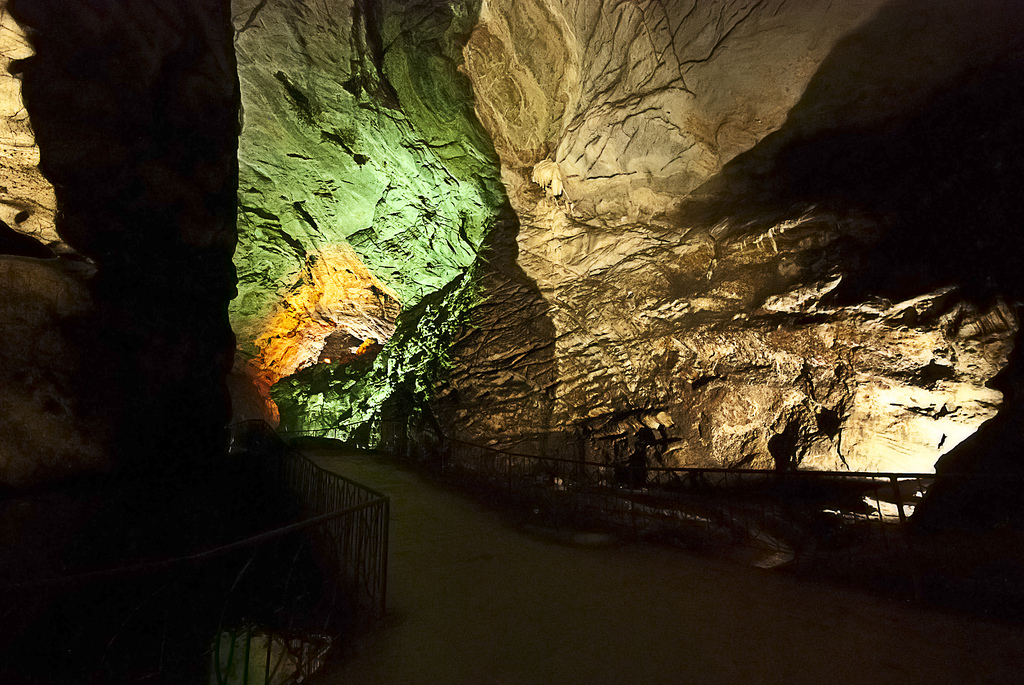
Borra Caves straddle the valley created by the Gosthani River. The meandering route with rocky banks reminded me of the Beas River in Manali. Once you enter the wide cavernous opening, we began our descent into the caves with bated breath. The cave entrance have spacious steps descending, going in an almost spiral way, taking us down to the nether world. I must say that the steps were built in such a way that we could hardly feel that we were going below 25 feet.

Borra Caves Near Vizag 2

Enter the Borra Caves

The first thing that hits us was the cool temperature inside even though it was scorching hot outside. It seems the temperature inside the cave is always around 24-25 degrees C. Monkeys are a bit of a menace here; you must watch out for them if you are carrying food. They are known to snatch packaged food and cold drinks. Somebody should study the effect of junk food on monkeys’ health!

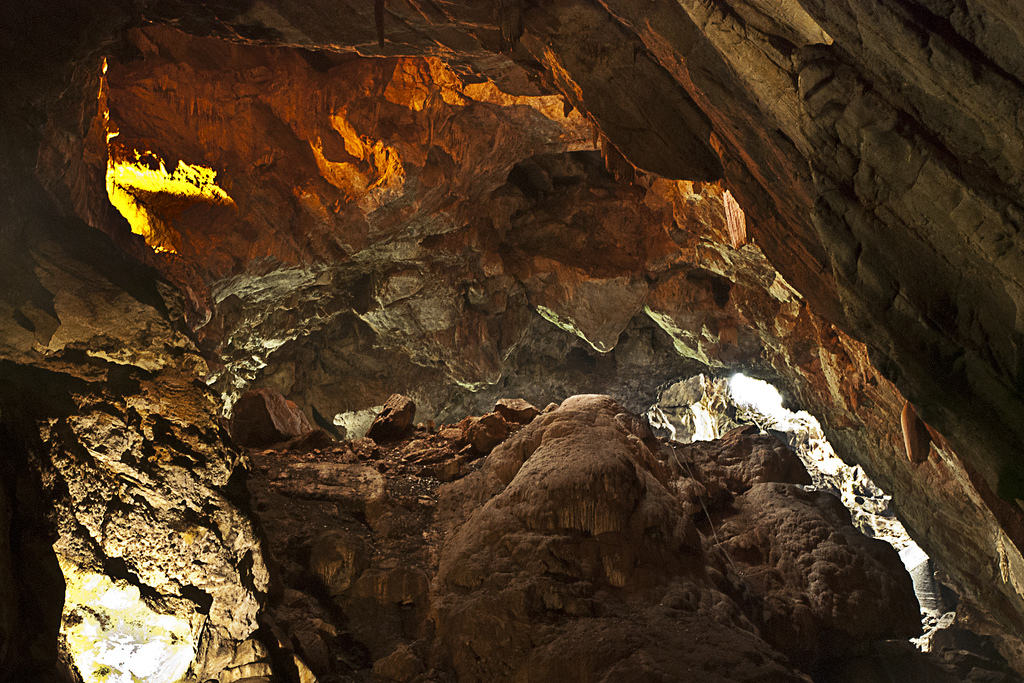
We found a tour guide at the entrance and he took our group to show us around. We were glad to have taken a guide because he told us things which we might not have known had we chosen to go alone. The caves have myriad beautiful structures of stalagmites and stalactites. The guide told us was that the caves were discovered when a cow fell into the caves and, shockingly, showed up alive in the Gosthani River (meaning cow’s udder in Sanskrit). Realising that the caves must have saved the cow, locals revered the cave and some of the Shiva Lingam-shaped structures are worshipped by the tribal natives during Shivaratri.

Borra Caves Near Vizag 3

The caves are geologically active; that is, we can still see drops of water dripping from the top to form the stalagmites below! When we reached the bottom, we noticed that it was quite dark and there were artificial lights set up to show the way for tourists. Some of the stones were shining in the light like diamonds. When we asked our guide, he told us that these stones were combination of marble and limestone, which gave them the sparkle. One interesting part was, there is a point where the railway line goes right on top of the Borra Caves. The railway line has not harmed this marvel of nature!

Our guide entertained us by showing various formations in the cave, which he named Sai Baba, Mother & Child, Lion and so on. We also added one or two to his collection. However, the most fascinating thing was the brain like formation deep inside the cave.

Borra Caves Near Vizag 4

There is a tiny stream with yellow-hued water running through the caves. The colour is apparently due to the presence of sulphur. There is also a huge staircase built all the way to the top of the cave where there is another temple. The roof is full of bats and we had to watch out for bat droppings! We took a lot of pictures but our images we took could not justify the marvel that our eyes saw.

I feel you must visit this enchanting place to know what treasures in stored in the remote corners of our country. Today, as we look at all our pictures, we began to wonder if God was indeed an expert architect for making our earth so beautiful.

Factfile –

How to get there: There is a passenger train available from Visakhapatnam station as well as daily bus services to Araku Valley.
The ideal way to visit these caves would be to take the train from Vizag (leaves 6:50am) and reaches Borra Caves around 10:30am. The whole tour takes around two hours, if you are a brisk walker. You can finish the entire trip by 1:00pm and then have lunch at just outside the caves. There are some spectacular view points from which one can look down the Gosthani River. On my first visit the monsoon waters were gushing through the river; we trekked down to the river and had a whale of a time! However, the strenuous trek while returning is tough.

Fee: The cave entrance ticket is quite nominal. For a group of seven, the guide charges Rs.100.

Food: Outside the caves, there is the Andhra Pradesh Tourism restaurant, which is basic but good. There are restaurants in Araku valley as well where more variety can be found.

Lodging: There are numerous resorts available in Araku valley with good amenities.

Article submitted as part of the Indian Cultural Crusader contest!

Image Courtesy – Abhijith Rao