Mesmerizing Display of Talent – Indian Art Festival

0

Author – Sneha Pujani

I had the exciting opportunity to participate in the Indian Art Festival, which celebrated its fourth year of inception. The festival was established in 2011 as a podium for showcasing fine art and bringing together artists from all around the world. The gentle mingling of artists and art enthusiasts in the diverse galleries was a tribute to the mesmerizing display of talent. Every gallery had something new to offer. As no two fingerprints are same, no two works of art are similar. The paintings and the sculptures that were exhibited were the embodiment of the artists who were not novices in any way. They had bared their soul on canvas and placed it on display for art connoisseurs at the Indian Art Festival.

Mukund Kelkar – Joy of Life

Indian Art Festival - Mukund Kelkar-Joy of Life

The Indian Art Festival saw over 300 individual artists from 50 cities across the world come together to display their talent. When the talent pool is so varied, discussions had added flavours. The paintings and the philosophy behind them had different roots, but they did combine to create a multifaceted art show.

During the four days of the festival exposition, artists, art critics, gallerists, architects, historians, museum professionals, cultural organizers, art connoisseurs, media publishers thronged the elegant setting of Nehru Centre, located in central Mumbai. The venue, Nehru Centre in itself is a grand place with a rich history. The festival was spread across the centre with the ground floor covered by exhibitions of 33 different art galleries, while the second floor had stalls for solo and group artists. There were 86 booths each hosting a dynamic talent of its own.

Eminent speakers took to stage and discussed on topics like ‘Why Exhibit’, ‘The Exhibition as a Variable Medium’, ‘The Exhibition by Other Means’, ‘Exhibition and Its Backdrops’, ‘New Publics for the Arts’ etc. The speakers reflected on various issues like how an artist plays the roles of curators and poets, how this affects the artwork and why it happens that the artists have to take up these responsibilities. The thought process of an artist, the way they think and process the ideas before they put it on paper and how the process brings out a change in their paintings were also discussed.

The art show had many painting techniques on display. The most popular one was the classic ‘oil on canvas’ painting. Mix-media, pallet knife, oil and acrylic were also the favoured choices. Charcoal and ink paintings were comparatively few. Another the interesting art form on show was installation, which gave a 3D effect to the painting by using natural elements like leaves or wood to bring about the actual feel of the place. Modern art is a difficult artform to comprehend for a novice like me, since it needs a trained eye to grasp the beauty of this contemporary art form. Going by the consensus, we can say it is very well received.

Moving from techniques to themes, I found that the spiritual aspect of Indian culture was beautifully depicted on canvas. Radha-Krishna remained one of the most captivating subjects for artists. The mischief in Krishna’s eye and the redness of Radha’s cheeks were beautifully and artistically captured in vivid colours. It is noteworthy that even after all these years; artists haven’t had their fill with the enchanting Kanha and still paint his expressions on canvas. Similarly, paintings of Hindu deities Ganesh, Hanuman and scenes from Ramayana, Mahabharata were quite prevalent.

Prithvi Soni – Shringar Radha

Indian Art Festival - Prithvi Soni-Shringar Radha

Spirituality and freedom was another major theme that was displayed generously. Right from Feng shui to Aum, the concept of peace and stillness was put on paper; some artists used a riot of colours, while some went for subtle impressions. The art conveyed every bit of the artist’s feelings, be it storm or calm. Certain pieces captivated you, drew you in and hit bulls-eye. The artists look at the brushwork or the use of light, a novice looks for the feel. A perfect piece would have both; it will speak to you in a different language on a different level. The festival had a treasure trove of such talent and evidently these four days were pure happiness for art lovers.

Prakash Bhende – Achievement

Indian Art Festival - Prakash Bhende-Achievement

Animals were another preferred theme at the show. Horses were particularly loved for they are considered to be the ambassadors of freedom, of protection and of strength. The beauty of a herd of horses running in rhythm was a challenge taken up by many artists in the festival.

Wildlife photography was another art on display where the tiger’s eyes shone as he lapped water from the stream. The ferocity of the animal and the gleam of its fur can be seem clearly in Anand Anikode‘s work.

Rajrani Sisodia – Lakoon and his two sons

Indian Art Festival - Rajrani Sisodia-Lakoon and his two sons

Vibrantly coloured peacocks were captured on thread work by Rajrani Sisodia. The colour shades were brought about by the intricate use of thread and needle work. The minute details and the captured effect were breathtaking!

Pramila Giria – Behind the Mask

Indian Art Festival - Pramila Giria-Behind the Mask

The concept of Feminism beautifully portrayed on canvas. The piercing eyes of the portrayed subjects will bore into your soul as you look at them look at you. Further, the vibrant colours add to the enigma of feminine power.

Bhavesh Patel – Proposal

Indian Art Festival - Bhavesh Patel-Proposal

Water was another concept marvellously used in the expression of feelings the rise and fall of the tide, the play of light on every droplet and the addition of human emotions make water a sophisticated and rich subject for artists. Bhavesh Patel’s work was particularly noteworthy.

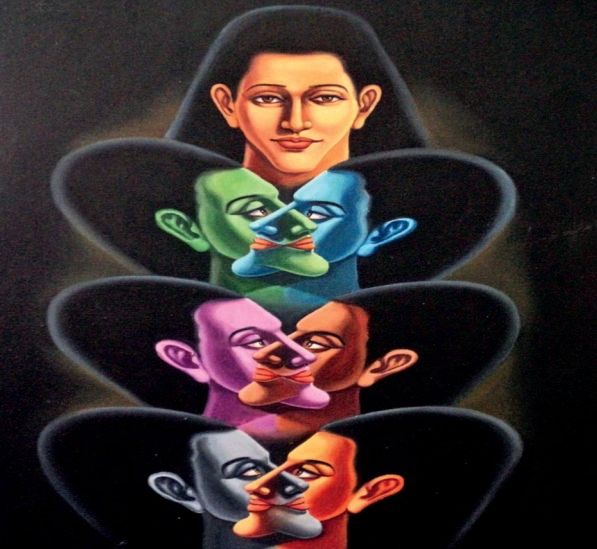
Siddhidatri Sharma – Conference
Indian Art Festival - Siddhidatri Sharma – Conference

Indian Art Festival doesn’t allow any amateur or novice artists to feature their work. The art work has to be of professional standards. When the show has works of eminent artists such as M F Hussain, S H Raza on display, even seasoned artists hesitate to share the stage. However, this proved to be a myth when the Sharma siblings all of 15 (Siddhidatri) and 10 (Siddhesh) years of age were accepted as participants two years back.

Since then, the Mumbai-based siblings have consistently stumped the art world by displaying unbound talent with no formal training. They have exhibited their work which is on par with professionals. When we look at their artwork, we cannot possibly guess it to be a child’s brushwork.

Rohan Shamdhenu Sonawne – Peace

Indian Art Festival - Rohan Shamdhenu Sonawne-Peace

We shouldn’t be mistaken in thinking that the Indian Art Festival was all about paintings. Sculpture works also took their appropriate praises. Some of the bronze and metal works were beautiful. They brought to life the joys of childhood and imaginations of artists. The sheer detailing in some these pieces can captivate you for a long time.

Thus, the Indian Art Festival proved to an ideal platform for every artist and art enthusiast to be part of the rich talent pool we have in our midst. A big reason to move away from the daily TV sitcoms and chat rooms! The festival and art in itself is a wonderful way to engage and challenge your imagination by the storm of talent that artists unleash in such a platform!

Kisan Expo Shows Agriculture is Big Business

6

Kisan Expo Pune

Village folk leaving their barren farms to seek better livelihood is old story. The reverse migration among urbanites who go back to their roots to take farming is the new trend! Agriculture seems to become a fashionable business for educated youth as well as well experienced professionals working in other industries. For services industry professional like me, a visit to the sprawling venue of Kisan Expo in Pune was quite an eye opener!

There were around 300-400 stalls occupied by a diverse range of companies displaying farm tools, machineries, pesticides, fertilizers, dairy animals, fish breeds, etc. Kisan Expo organizers claimed that 11,000 farmers from Gujarat, 8,000 farmers from Karnataka, 3500 farmers from MP had participated, along with thousands from Maharashtra. Although I cannot vouch for that, I could see a large crowd of farmers at all venues. It was surprising to see farmers filling up entry forms and willingly paying Rs.100 entry fee!

Agriculture has always been a serious business for the rural farming community, but now ‘agricultural services’ has become the buzzword. Both small entrepreneurs and large companies offered a wide spectrum of services such as soil fertility management, groundwater survey, weather forecasting, poly greenhouse construction, organic farming certification, pest management, biotech-based tissue culture, market linkage services, etc.

As a person who is inclined to see innovative businesses, I was thrilled to see some interesting ideas being implemented in the Indian agricultural sector, which is considered the most retarded in terms of innovation! Here are some of the innovative ideas displayed in Kisan Expo:

Kisan Expo - banana fibre handicraft

Coimbatore-based Eco Green Unit displayed some wonderful banana fibre handicraft products extracted from waste banana plants. They had two varieties – the silky smooth thread harvested from fresh banana plants that can be woven into garments and the rough coarse fibre from dried plants, which are used for making carpets, baskets, ropes, etc.

Kisan-Expo-Pune-14

Fine Trap India is an innovative device for biological control of borer pests. It is a simple tool that is non-toxic and cheap as well.

Kisan Expo Pune - Nuciterra Magigro Bags

Nuciterra Magigro Bags are high density, co-extruded plastic bags filled with Cocopeat, compost and other nutrients that are designed for use in greenhouse hydroponic vegetable and flower crop production.

Hydroponics seems to be the next big thing in agriculture; it is a method of growing plants using mineral nutrient solutions in water, without any soil. The Institute of Simplified Hydroponics has established India’s first vegetable hydroponics garden in a rural school near Bangalore.

Hifield AG offered micro-nutrients of amino acid and humic acid made from sea-weeds, which are used as the base for producing bio-fertilizers.

Kisan-Expo-Pune-13

Numerous stalls for organic products and bio-fertilizers were such a relief, since chemical fertilizers were conspicuously rare!

Global Green Agri Nova’s Perfekt Pesticide is a phytotonic made from herbal extracts which repels sucking pests and makes the plant disease resistant.

Plastic fencing net for plants was another curious product. This simple metal reinforced net helps ward off grazing animals.

Kisan Expo Pune - Plastic & polymer materia

Plastic & polymer material were everywhere – pipes, sapling pouches, mulching covers, tissue culture trays, greenhouses, etc.

Raghava Gowda's Milking Machine

Low cost manual milking machine that can extract 1.5-2 litres of milk every minute. Raghava Gowda P, a dairy farmer from Karnataka has created this innovative machine.

Kisan-Expo-Pune-18

Tissue culture has become the norm for seedlings in agriculture since high-yield varieties can be easily propagated and there is higher rate of plant survival. Sophisticated biotech labs are churning out saplings of sugarcane, banana, vegetables, etc. for the benefit of farmers.

Kisan-Expo-Pune-17

Drip irrigation is increasingly becoming the norm in horticulture due to innovative water storage techniques and water piping solutions.

Kisan-Expo-Pune-07

Solar power panels for lighting and wind power water pumps are making big inroads into the rural areas.

Further, numerous market research firms, consultancy firms, govt agencies, were discussing about creating aknowledge park for agri-business in order to promote farm mechanization

Even Café Coffee Day found it good enough to host a stall and found flourishing business as well!

I hope all this frenzied business activity would radically change the ground reality for our farmers and bring better prospects from them.
————————————-
Factfile –
http://www.ecoideaz.com/?s=biological+control+
https://caleidoscope.in/eco-ideaz/eco-friendly-ideas-from-india-part-2

The Power of One Voice that Held High the Flag of Freedom

0

Jodi tor đak shune keu na ashe tôbe êkla chôlo re!

Many of us who have lived in a society, who have worked together as teams at workplace, mingled with friends during weekends, cannot imagine doing things alone. Be it watching movies or going on a trip, we always seek companions to accompany us in whatever we do. In such a situation is it possible for us to stand alone for a cause… swim against the tide… fight a lonely battle against the system…

We live in a society where many times collective action by a large group of people doesn’t make much of an impact. However, we are amazed by the sudden and devastating impact caused by the action of one individual. Sometimes we wonder if such a thing can really happen and what motivates that individual to wage a lonely battle against the system. Today, as we observe the Human Rights Day, we pay tribute to the power of one voice that held high the flag of freedom.

Mohamed Bouazizi

The Power of One Voice - Mohammed Bouazizi

Mohamed Bouazizi was an ordinary street vendor eking out a living in Sidi Bouzid, a rural town in Tunisia. Being the eldest of a family of six children, Bouazizi took the responsibility of earning for the family. He could not complete highschool and was forced to work as a teenager in various jobs. Bouazizi was said to be a well-known person in his town who would often provide free fruit and vegetables to poor families. Local police officers regularly ill-treated Bouazizi by confiscating his wheelbarrow, since he did not have a street vendor’s permit. Corruption was rampant in Tunisia and Bouazizi did not have the funds to bribe officials.

On 17 December 2010, things went seriously wrong when he was publicly humiliated by a municipal official. Angered by this, Bouazizi ran to the governor’s office to complain, but the governor refused to see him. To protest against this injustice, Bouazizi doused gasoline and set himself on fire. He later died of his burn wounds, but he had set a nation on fire. Outraged by Bouazizi’s self-immolation, protests erupted in Sidi Bouzid that soon spread to the capital, Tunis. People’s anger became so intense that President Ben Ali fled Tunisia, ending his 23-year misrule. A chain reaction of events that followed in 2011, brought down the governments in neighbouring Libya, Egypt and protests spread across the Middle East. Today, we know these events as the “Arab Spring” revolution!

Jyoti Singh Pandey

The Power of One Voice - 2012 Delhi rape protests

Jyoti was a 23-year-old student who studied physiotherapy in a medical college in Delhi. Her father sold his agricultural land to educate her and worked double shifts to pay for her schooling. On the night of 16 December 2012, she and her boyfriend were returning home after watching a movie. They boarded a private charter bus that was being driven by joyriders. Jyoti’s friend became suspicious when the bus deviated from its normal route and its doors were shut. When he objected, the group of six men assaulted him and knocked him unconscious. They raped Jyoti and seriously injured her when she protested. Later, both she and her friend were thrown out of the bus.

Passersby took them to hospital and police took action to arrest the culprits. However, this incident broke the patience of youth in Delhi, which is considered the rape capital. New Delhi has the highest number of sex crimes among India’s major cities, but only one out of 706 rape cases filed in 2012 ended in conviction. Thousands of people came out to protest at the India Gate for many days, leading to frequent clashes with the police. Similar protests occurred all over India. These protests were seen as expressions of middle-class angst against a failing law & order machinery in the nation and a loss of social fabric. Today, we know it as the ‘Nirbhaya’ 2012 Delhi rape protests.

Satyendra Dubey

The Power of One Voice - NHAI-GQ-Satyendra Dubey

Satyendra Dubey was a civil engineer from Bihar, who completed his B.Tech and M.Tech from IIT Kanpur and IIT Varanasi respectively. He joined the Indian Engineering Service and in 2002, he was deputed to the National Highway Authority of India, where he was the Project Manager of Koderma region in Jharkhand. Dubey was responsible for managing a part of the Aurangabad-Barachatti section of National Highway 2, which is a part of the Golden Quadrilateral Corridor Project, the Prime Minister’s initiative.

During this period, Satyendra Dubey found numerous financial irregularities. He uncovered corruption among construction contractors and the involvement of the local mafia, but no action was taken by the higher authorities against his complaints. He forced a contractor to rebuild six kilometres of sub-standard road, which was a huge loss to the contract mafia. As a result he was transferred to Gaya. Later, Dubey wrote a letter to the Prime Minister informing him about the irregularities. On 27 November 2003, on his 30th birthday, he was killed while returning home from a wedding in Varanasi. His brutal murder resulted in public outcry and questions were raised in the Parliament on how a whistleblower’s identity was revealed. Two years later, another IIT, IIM alumni Shanmughan Manjunath was killed on duty. These two sensational cases forced the Indian Parliament to pass the Whistle Blowers Protection Act in 2011.

Malala Yousafzai

The Power of One Voice - Malala Yousafzai

Malala Yousafzai is a 17-year old girl from Khyber Pakhtunkhwa province in Pakistan. Despite being born in a Pashtun Muslim family, Malala was well educated by her father, Ziauddin Yousafzai, who is a poet and an educational activist himself. Her main struggle was to ensure the right to education for all children in her region. As part of her rights campaign, she became an anonymous blogger for the BBC, for whom she reported about the situation in Swat valley in Khyber Pakhtunkhwa under the Taliban, who had outlawed female education in the region. New York Times filmed a documentary on her struggle to continue her education.

After the documentary, Malala became famous and her identity as the blogger was revealed. She openly advocated girl child education, which was not tolerated by the Taliban. On 9 October 2012, she was shot by Taliban militants on her way back home after her school exams. Despite a serious head injury, she survived the assassination attempt due to timely medical attention. Today, Malala has become an inspiration to many oppressed girls and she is one of the youngest activists speaking at various international forums like the Harvard University and the UN. The worldwide adulation for this courageous girl has culminated in Malala becoming the co-recipient of the 2014 Nobel Peace Prize and the youngest Nobel Laureate!

Kailash Satyarthi

The Power of One Voice - Kailash Satyarthi

Surprisingly, India and Pakistan are lucky to have co-recipients of the Nobel Peace Prize on the same year! Kailash Satyarthi has been a dedicated advocate of child rights for decades now. Born in Vidisha district of Madhya Pradesh, Satyarthi gave up his career as a teacher in 1980 and founded the non-profit organisation, Bachpan Bachao Andolan to campaign against child labour. That year, he became the Secretary General for the Bonded Labour Liberation Front. His early attempts to raid factories that employed child labourers met with hostile reaction from the factory owners and at times the police, but the significance of his work was slowly recognised.

Satyarathi brought focus on child labour as a major human rights issue. Over the last three decades, Satyarthi’s organisation has helped to rescue 80,000 child bonded labourers almost all parts of the country. He created the Global March Against Child Labour, a movement that is active in many countries. He is also credited with establishing ‘Rugmark’ carpets in 1994, which are hand-woven carpets carrying a certification against the use of child labour. Currently, he is working towards bringing child labour and slavery into the post-2015 development agenda for the United Nation’s Millennium Development Goals.

Anna Hazare

The Power of One Voice - Anna Hazare

Born as Kisan Baburao Hazare in Bhingar, near Ahmednagar, he adopted the name ‘Anna’, which means elder person in Marathi. He was drafted in the Indian Army where he worked as an army truck driver and later as a soldier. During the Indo-Pakistan War of 1965, Hazare was posted at the border in the Khem Karan sector and was the sole survivor during an enemy attack. Hazare moved back to his ancestral village in Ralegan Siddhi and used the pension from his military services to turn it into a model village. He set up a grain bank so that no one would go hungry, improved the irrigation system, set up schools and removed social barriers like untouchability in the village.

In 1992, the Indian government honoured Anna Hazare with Padma Bhushan for his contributions rural upliftment. Being a follower of Gandhian principles of Satyagraha, Hazare sat on a hunger strike to exert pressure on the Indian government to enact a stringent anti-corruption law, The Lokpal Bill, 2011 as viewed in the Jan Lokpal Bill, for the institution of a moderator with the power to deal with corruption in public places. This one of the incidents in recent times which brought the whole country together to fight for a common cause, in this case wiping out corruption from India.

Image Courtesy –
Mohamed Bouazizi : Image source – Chris Belsten photostream
2012 Delhi rape protests : Image source – commons.wikimedia.org
Kailash Satyarthi : Image source – Global Panorama via Flickr
Malala Yousafzai : Image source – Southbank Centre Via Flickr
Anna Hazare : Image source – Ramesh Lalwani Via Flickr

Factfile –

Ekla Chalo Re
Mohamed Bouazizi
Rashomon Effect
Whistle Blowers Protection Act
Whistleblowing Law
Malala Yousafzai
Kailash Satyarthi
Anna_Hazare

Voices of Transition – Raising Ecological Questions

11

Natural disasters, otherwise known as ‘acts of God’, have known to cause irreparable damage to human life. In the last few decades, India and the world have faced major environmental problems such as global warming, rising food prices, growing water scarcity, falling groundwater tables, water pollution, biodiversity loss, soil degradation, etc. Our concern about such issues has provided ample material for many filmmakers. In the last 20 years, a few commercially successful fiction and non-fiction movies on the environmental issues have been made by Hollywood directors.

One such attempt is “Voices of Transition”, an independent documentary film by French filmmaker Nils Aguilar, which really goes a long way in us questioning our own individual contributions towards our ecology and eventually to our society. The film starts with a voiceover by renowned environmentalist Vandana Shiva speaking about world food prices and how the global economy is controlling local poor economies. The documentary sums up various issues faced by many countries all over and the issues that are discussed in the documentary.

Voices of Transition PosterThe WTO, IMF and the World Bank have been partners in managing the global economy and their policies are endorsed by economically dominant countries. Their neoliberal policies have been known to cripple the weaker economies. On the other hand, we have MNCs that use various means to control the world economies and resources. This grim situation forms the backdrop for the many transitions that the movie puts forth.

One line in the movie that really made me reflect is “if you are always running after something, you never see the end”. Over the last few decades, we have been concentrating our efforts on maximizing our food produce and have lost track of the processes or ways to achieve the end. Voices of Transition makes us reflect on our means and their long-term consequences. The documentary depicts who researchers who are fearful of a future where our dependency on crude oil, which leads to fluctuation in price and shortages of supply and to non-renewable seeds under monopolistic MNCs will lead us to the gradual destruction of soil and the eventual food loss.

The documentary film takes us through the experience of many farmers, agro-engineers and soil microbiology experts who speak about the failure of the Green Revolution over the years and how chemical fertilizers have killed the organic matter of the soil and eventually making it inert. Multinational firms control more than 50% of the commercial seed market and their business model is based on “patenting living beings and licensing non-renewable seeds”. Industrial agriculture is responsible for 40% of the global greenhouse gas emissions.

The film shows us the various ways in which transitions as argued in the film are possible and provides us details of such examples of France, the UK and lastly Cuba. Many solutions like agro-forestry, forest garden system, policy changes etc are advocated in many parts of the film.

In France, we see the issues of soil depletion, high yielding seeds and industrial agriculture due to the related effects of green revolution and MNCs. Monoculture and chemicals promoted by the MNCs in turn cause more environmental problems. Many French farmers have turned to organic farming to solve their issues. Organic farming also seems to offer solutions to farm produce pricing, since farmers do not get enough help from their government. Change in farm policies is a solution suggested in the film.

In England, we see the examples of agro-forestry and forest garden systems as solutions. An independent activist, Rob Hopkins speak on a where the disaster is able to spread out and eventually taken care of. I especially liked the part where he speaks of the transition culture that he co-founded – Transition Town Totnes and Transition Network. The success of such organizations offer enough hope for our collective future. This alternative viewpoint was an eye opener of sorts. Looking inwards and making ourselves stronger within. Becoming more practical and communicating with our environment can only enrich our lives!

Cuba’s example of achieving food autonomy and how it has achieved both the UN criteria for high levels of human development and the WWF criteria for a balanced ecological footprint are truly amazing. Cuba fought the “peak oil” crises and became an organic society in a self-sufficient and community-oriented manner.

At the deepest level, this documentary makes us question the accepted approach of our times where we fail to see the benefits of the traditional methods and are blindly guided by what the IMF and World Bank propose. A sense of community needs to be built over time, which will see us through – this is the transition that is needed. A major statement made by the movie that makes us question what we have been accepting for decades is, “The rules of WTO are incompatible with the principles of food sovereignty”.

You can buy this documentary here:
http://voicesoftransition.org/shop
https://facebook.com/voicesoftransition
wiki/Voices_of_Transition
Factfile –
Image Source –
Theatrical poster Voices of Transition
http://www.transitiontowntotnes.org

Holidaying with family or friends?

0

Holidaying with family

Busy at office, busy at home, busy with academics and no time for family? A holiday is a great way to reconnect and take a break from the monotony.

With everyone busy with work and struggling with different time schedules, there is often an absence of family activities such as dining together or a weekend outing. As a result of the stress and tensions at the workplace or in college, relationships are affected and the bond between family members is often strained.

It is at times like these a family holiday becomes important, sometimes even acting as an indicator of how important one regards one’s family ties. It is a gesture that acknowledges that one’s parents, siblings and children are important and are worth the effort involved in making the journey.

Earlier, parents decided on a place and the family travelled there, no questions asked. With changing times, the entire meaning of a family holiday has been transformed, with children and parents going on separate holidays due to different tastes. As more youngsters travel independently or with friends, the trend of family trips seems to be on the decline.

Avantika, a college student, says, “I would go holidaying with cousins of my age to places where there is a lot of adventure and partying rather than going with my parents on a holiday spot, which is boring.” At the other end of the spectrum is Thanmayi, an engineering student, who prefers going on holiday with family, since they are very jovial and perfect companions.

Malini Muralidhar, a housewife, is all for family trips. She says, “Going on a holiday with my family at least once a year gives me a break from the household chores and tensions and gives me time to relax with my husband and two daughters.” However, some parents complain that even if the children are physically present, their attention is elsewhere.

Meena Anil, a central government employee, says that she has observed that even on a holiday with the family, her children do not show interest in spending some quality time with them. Instead they get busy with games on their mobile phones.

Holidaying with friends

Family vacations are intended to bring people closer, but they might also bring out the underlying tensions. Compromises will have to be made, boredom will have to be endured and minor fights will have to be resolved. However, the benefits outweigh the negatives and a family vacation is often a great way to get to know each other, away from the worries of everyday life.

Busy schedules do not allow for much communication, but a family holiday provides the time to talk to each other about the different developments in each other’s life. Adult children who are working may not be able to take some time out for their aged parents, to sit and talk and ensure their support. Even their aging parents would not want to disturb their children’s schedule.

So, a family holiday acts as a platform for both children and parents to share their problems and find solutions. Even a simple getaway, even if not very expensive or extravagant, can work wonders for a person as well as the family.

Caleidoscope Cultural Contest Results

0

Hi Folks,

Our Caleidoscope Cultural Contest has reached its culminating point. We were seeking Cultural Crusaders who are always on the hunt to discover something unique about India and tell the world about it.

We have found some great writers who sought and dug out the hidden secrets of an offbeat travel destination. They understood a region’s art & culture and wrote about it crisply. Some of them clicked vivid pictures that enticed viewers to visit the place.

Here are the participants of our Cultural Contest –

  1. Anubhav Sharma:– Connect with Local – Serving Authentic Maharashtrian Food
  2. Anuka Roy: Kissa kiss ka – Kiss of Love Protests
  3. Alina Jersey: Unusual Historic Religious Monuments in India
  4. Rutuja Chaphekar: Mystic beauty of Bhuleshwar temple
  5. Nischitha Sharath: Fiery folk art form – Bhoota Kola
  6. Shristi Rai: Alpine skiing in Narkanda – Himachal
  7. Gayatri D: Borra Caves near Vizag – a natural wonder
  8. Keerthana Muralidhar: Holidaying with family or friends?
  9. Ishita Gupta: National Adventure Festival

Participants of Cultural Photographer Contest are:

  1. Shilpa Sharma: Sojourn to Bewitching Bhuj
  2. Mamta Naidu: Annapurna Circuit before the Avalanche
  3. Sandip Bose: A Day with Channapatna Toys Makers

And the Consolation Prize winners are –

  • Shristi Rai – Alpine skiing in Narkanda – Himachal
  • Anubhav Sharma – Connect with Local – Serving Authentic Maharashtrian Food
  • Mamta Naidu – Annapurna Circuit before the Avalanche
  • Sandip Bose: A Day with Channapatna Toys Makers

Prize winners can await their prizes to arrive by post early next week!

*Note: Since we did not get a minimum of 10 entries for each contest, we are forced to cancel the announced cash prizes and offer only consolation prizes. Some of the unpublished articles will be uploaded soon.

Top 7 Offbeat Travel Destinations in Himachal Pradesh

3

The mountainous state of Himachal Pradesh in India nestled in Himalayas is a paradise in itself. The beauty and grandeur of its hills, the serenity of its lakes and the hospitality of its people will entice you to visit again and again. Although Himachal is a busy tourist hub, you can still sample some of its offbeat destinations that have remained unexplored. Here are a few popular offbeat travel destinations in Himachal Pradesh:

1. The Rohtang Pass

Himachal Pradesh - Rohtang Pass Photo

One of the most popular spots in Manali, the name ‘Rohtang La’ literally means pile of corpses! The pass was named so due to the numerous deaths that happened here because of bad weather, when people tried to cross it. Rohtang La connects the lower Kullu Valley with the upper regions of Lahaul and Spiti Valleys, and is open between May-November. Although still a difficult stretch to traverse, the Rohtang pass is among the comparatively easier terrains in the Himalayan region. Sipping on a cup of hot tea that does not remain hot for more than a minute, with the icy thin air blowing over your face and gazing at the spectacular view of the valleys before you is an unforgettable experience!

2. Lahaul and Spiti

Himachal Pradesh - Lahaul-Spiti

The district of Lahaul-Spiti is famous for its ancient monasteries and natural formations. Lahaul is more on the greener side of the valley and is populated by people of Tibetan and Indo-Aryan descent, while Spiti is an elevated cold-desert valley. The village of Spiti is also known as ‘little Tibet’ due to the Tibetan Buddhist influence visible in its culture and landscape. The region celebrates ‘Losar Festival’, the Tibetan new year in a grand manner, which is a feast to watch out for.

3. Dharamkot

Himachal Pradesh - Dharamkot

For those visiting Mcleodganj, there is an option to pass through Dharamkot, a small village offering scenic views of the valleys. The village has become a popular offbeat travel spot for tourists due to the availability of marijuana, smoked by the villagers. Apart from the friendly Pahadi people, you can sample the local cuisine inside cafes located in the jungle. Another experience here is to trek to the top of the Triund mountain.

4. Sangla / Baspa Valley

Himachal Pradesh - Baspa-Valley

It is located in the greater Himalayan range and provides a breathtaking view of the mountains. Sangla provides overnight trekking and numerous adventurous stay options. This valley abounds in apple orchards, apricot, walnut and cedar trees and is famous for Kinnauri shawls and silver jewellery studded with Tibetan pearls. The crystal clear waters of the Baspa river that flows through the Sangla valley is ideal for trout fishing.

5. Kasauli

Himachal Pradesh - kasauli

While Shimla is the most popular hill station in Himachal, Kasauli town in Solan district with its diverse forests of pine, oak and horse-chestnut trees, colonial ambience and little gardens with a 19th century feel, which distinguishes it from other commercialised destinations. Around 15 kms from Kasauli is the fort of Kuthar. It is more than 800 years old and once served as the residence of the royal family of Kuthar. The exteriors of the fort showcase intricate Rajput architecture and the interiors display alluring wooden carvings and fine paintings that will take you back in time to the British colonial era.

6. Tirthan Valley

Himachal Pradesh - The-Great-Himalayan-National-Park

Tirthan Valley has become popular in Himachal, since it retains a unique nature that lies undisturbed. The valley is surrounded by the Great Himalayan National Park where you can spot wildlife. The valley is carved by the Tirthan River where you can relax and experience purest form of Mother Nature. Good news is that the valley remains open throughout the year, but the blooming flowers during spring would be the best time to visit.

7. Sarahan

Himachal Pradesh - Sarahan-Temple

One area that remains unexplored in Himachal is Sarahan. Sarahan is a tiny town in Himachal Pradesh, which is known as the gateway of Kinnaur. It is the site of famous Bhimakali temple, dedicated to the mother goddess Bhimakali. Another point of attraction here is the Daranghati wildlife sanctuary. However, since the place lacks proper accommodation, you may plan a day visit here and leave in the evening. Driving through offers a great experience.
So pack your bags and visit these amazing offbeat travel destinations in the beautiful state of Himachal Pradesh today!

Author Bio – 
Anita Joseph is a passionate blogger who works for Australian Visas. She has been writing content for the web professionally since 2006. She loves to travel and as an avid reader and blogger, she shares her experience through her articles on travel, education, technology, parenting and many more.

Factfile –
Image Sources
Rohtang Pass –  Image Source sandeepachetan
Lahaul – Image Source commons.wikimedia.org
Dharamkot –  Image Source en.wikipedia.org
Sangla / Baspa Valley –  Image Source en.wikipedia.org
Kasauli –  Image Source Debraj Ghosh
Tirthan Valley –  Image Source en.wikipedia.org
Sarahan –  Image Source commons.wikimedia.org
http://www.himachaltourism.gov.in

Imagining A World Without Art?

2

Author – Aarohi Mekvan

Indian art festival
Indian Art Festival – Courtesy: sandsarts.blogspot.in

A friend of mine informed me the Indian Art Festival is happening in city. Being a fine art fanatic, I was quite eager to participate in it. While he made an effort to inform me about it, he was cynical about the purpose the festival serves. Being an extremely pragmatic person, he felt art has no role to play in our society where everything is driven by economics. Is it?

The Contemporary Woman by Champa Mohan

Art is an expression of human forms to depict the neural connections developed in the left hemisphere of the brain which solicits creativity. It is in every form of existence ranging from an author writing a book that would never be published, to a social networking freak trying to crack a witty comment, to a tailor stitching a blouse for his client, to a guy cooking dinner for his woman, to an artist’s painting the street walls on a theme, to a guitarist collaborating the chords to the music created by the song writer of his band, to the blind weaving beads to make some jewellery, to the stunt rider performing for a mass of riders, to making love.

Imagining the world without art would be imagining our own self without eyebrows. There would be nobody who would make movies, music or paint. There would be nobody who would watch movies, listen to music or go to art galleries. Art binds the eternity into one soul, so without the art present among us, the evolution would be like the lubricating agent that causes friction, making no sense at all. Foremost, there would be no designer labels and neither the models walking the ramp on fashion shows for them.

I mean, there would be no teenaged guy watching Fashion TV with open wide eyes and awestruck mouth. There would be no magicians challenging the law of nature which would make many of us loathsome due to disuse of the artistic creativity. There would be no captured memories as there would be no words and no photography. People would not travel and cause the cultural diversity that makes so many of us identical on the footwear we wear.

She Series by V Ravindra Prasad

Shakespeare and Mozart would have been mere names. Dinners would be like somebody eating the weeds from their garden everyday and claiming malnourishment as a trend. There would be nobody who would think about death and birth after getting high on Mary Jane. Sans art the Earth would not have been round and Newton would still be staring at the rotten apple sitting under that tree.

A world without art would be weird. The world without art would be “eh!?”

If you like fancy text and would like it to create one for yourself, try this Word art generator app available on google Play store.

Factfile –
http://www.indiaartfestival.com/

Alpine Skiing in Narkanda – Himachal

2

“The wind longs to play with your hair”

When someone says, let’s go skiing, more often than not you would think, an expensive trip! That’s because we’ve been accustomed to relate snow with Switzerland thanks to Yash Raj Films. That is far from reality. If you are ready to explore your own country, there’s skiing in India!

offbeat travel in himachal - Skiing in Narkanda

Skiing in Himachal | Courtesy: en.wikipedia.org

A few years ago, I got an opportunity to go skiing in Narkanda, Himachal Pradesh. In a fascinating search, I found that there are not one or two, but five locations across India that offer professional training: Gulmarg, Jammu & Kashmir; Auli, Uttarakhand; Manali, Narkanda, and Solang Himachal Pradesh. We chose to go to Narkanda, the least inhabited of the lot, for a 22-day basic skiing course.

In order to reach Narkanda in those days, we took a good three days: 36 hours train journey from Mumbai to Ambala, Haryana, followed by an overnight bus journey via Zirkapur crossing over to Kalka and finally Shimla in Himachal Pradesh. After a halt at Shimla, we resumed our journey uphill via Kufri where. Narkanda is just at a distance of 65 km from Shimla and yet the drop in temperature was easily 10 degrees in March, as we climbed an altitude of 2708m. Being a mountain road, the route was full of steep hairpin bends and breathtaking valleys, with glimpses of the snow peaked mountains of the Himalayas at a distance with every turn. At one of our halts, I touched my very first snow, which surprisingly wasn’t soft at all!

On our arrival at the Himachal Mountaineering Institute, Narkanda, we were greeted by the warmest smiles of the Pahadi community. The institute has an old world charm with its unmaintained yet sturdy structure of two floors. On the ground floor is a cosy kitchen and dining area with an old TV, where the instructors spend their free time. Upstairs are the dorms for students. Weather conditions are so severe that no water comes out of the tap and hot water is a luxury for us. We are welcomed, shown our rooms, given our sleeping bags and other winter clothing.

Narkanda - HimachalThe next day morning at 6 am, they make us trek with our snow boots on the ski slopes about 5 km away. The skis weighing 6 kg each are strapped over our shoulders. The ski boots weigh 5 kgs each and have an inner shoe and outer shoe with a hard shell. To balance in them even on plain ground requires the skills of a ballerina dancer! Wearing them, along with all our windproof jackets, woollen sweaters and inners, we head to the slopes super excited to see and touch snow.

As we slip and tumble on our way towards the slopes, losing our enthusiasm initially, we are told that the snow must first be broken as it is frozen and not fit for skiing. The powdered first layer must be removed to make the snow more accident free. We clamp on our skis and start to bang the snow with it, much like our PT exercises at school. It is hard work we realize, far from what we’ve seen on TV and movies. The sun comes up overhead and the snow glistens like an ocean of diamonds. Total internal reflection, I recall with a smile as I put on my goggles.

This daily routine lasted 22 days, with more than eight hours of training each day on the snow. They taught us to side step, traverse, snow plough, keep our backs arched, the signals to be communicated to a far off skier, ways to break our fall, to ski among scrubs, to learn from a five year old son of an instructor ski fearlessly, fall even more fearlessly, the use of poles, the use of flags, the science behind an avalanche and finally the lunch at 2 o clock!

Hot parathas with achar and sabzi would be brought to our slopes. We ate like our stomachs knew no bottom and had the yummiest coffee on those slopes. By the end of training, we would be sweating despite the 10 degree Celsius temperature and be tanned black, yet our hearts would be singing as we trekked back to our institute. The evenings were spent bonding, watching TV, having Maggi noodles and the most amazing bread omelette sandwiches for just Rs. 20 nearby by the chulha. People from all walks of life and of all ages would gather there to discuss their one common love, mountains.

Skiing Narkanda - Himachal

Skiing in Narkanda | Courtesy: yoyowall.com

We had a test on the last day and we passed with good grades. We had become a family, we had three bonfires, we danced together, ate together, drank together. The Pahadi instructors never ever stop smiling. It is the way of the mountains.

When you return to the city, you are again overshadowed by mundane problems, water, electricity, traffic, deadlines, etc. But when you think of those mountain inhabitants who walk for miles together to collect firewood or groceries, live without running water, electricity and all the necessities that we are used to, you remember how they never forget to give a warm smile to make another person happy, you find your problems melting away and feel blessed that you got to cherish a few moments of your life with them.

Article submitted as part of the Indian Cultural Crusader contest!

Factfile –
http://www.adventurehimalaya.org/skiing.asp

Connect with Local – Serving Authentic Food of Maharashtra

2

Maharashtrian food

I am a big-time foodie; that doesn’t mean that I hog all the time and eat whatever is being served. Rather I have a craving for authentic food. I am so much inclined towards authentic Indian cuisine that I tend to ignore the price and place sometimes. I fancy those places that provide food that satisfies my tongue.

Every region in India has its own cuisine. The dish may be the same, ingredients may be same, but the preparation differs, which brings out the distinct taste in that dish. This distinct taste of a regional delicacy is what attracts me. However, thanks to the cosmopolitan affect, all these distinct dishes from various Indian regions have begun to lose their essence in the recent years. People have started to experiment with dishes and add their feature to it, which further changes the distinct taste of that dish. To people like me who are particular about their food, that isn’t great news!

Recently, I came across a group named ‘Connect with Local’ in Pune, who introduced me to various authentic foods. This certainly was a big relief for me. The Connect with Local website started off with a motive to bring people of different religions and regions together. Shreeram Kunte and Mangesh Wagh, the people behind this concept believe that food is one platform that can attract people from different regions to come together not only to enjoy what they like, but also to exchange ideas and culture among themselves.

The organizers explained that there are two sets of people: the hosts and the guests. Since both parties are don’t know each other, hosts puts up an advertisement on Connect with Local along with the details of the dishes they would be serving with a price per person. Guests browse through the website and seek food events that are happening in the city. Then, they decide to visit an event based on the information provided by the host. They pay, and book a place for themselves. On the day of event, they reach the venue, which is the host’s house and interact.

Source: Veg Recipes of India

I was thrilled to hear about such a unique idea! I decided to witness a food event myself and I booked for an event that was being organised at Bavdhan-Pashan link road. The host was serving authentic traditional cuisine of Maharashtra. The menu included Puran poli, Katachi aamatee, Varan bhaat, Aloo wadi, Batataa bhaaji, Papad kurdai, Panchamrut, Naral chatni and Khamang kakadi koshimbir.

Reaching the venue, I was heartwarmingly welcomed by an elderly lady putting ‘kumkum’ on my forehead, to adhere to Indian tradition of ‘Athiti Devo Bhava’. We were served with welcome drink of buttermilk. I was joined by six other guests from different backgrounds. Our hosts ensured that we felt comfortable despite being total strangers. We started discussing and shared our experiences. As we started to converse, I realized that we were no more strangers. At that point I realized that it is not hard to begin a conversation with a total stranger. We are brought up to welcome our guest without discriminating about their origin.

When the food was served, I wasn’t surprised at all. Be it Puran poli, or Naral chatni, every dish was prepared just the way they should be. I could easily make out the distinct Maharashtrian taste of every dish. Since I had eaten at a restaurant that claims to serve authentic Maharashtrian food, I could easily make out that this dinner was far better. Furthermore, I was sitting among people with similar likes and tastes. We relished not only the delicious food served in a homely environment, but also discussing about various things. What more can a foodie ask for?

We Indians feel in pride when we speak about perfect amalgamation of various cultures. We try to blend various cultures together in the name of cosmopolitan. But, we forget that in this blend, we are losing out the authenticity of our culture and cuisines that is the identity of each region.

I am not against two cultures coming together; but I am for preserving the true taste of food that is vanishing in the current scenario. However, with platforms like Connect with Local, foodies like me will never be disappointed. Despite the numerous eat-outs, it is hard to find a good restaurant that can serve you with such authenticity in a homely environment where you can relax and exchange cultural ideas with people from different regions or culture!