

Author – Eshaa Patnaik
Intense dialectic between exclusion and self-empowerment?
 Are you selfie ready? The new Pond’s “#PondsSelfieReady” TV ad campaign uses this punch line to attract more youngsters to participate in their contest. My first reaction as any young self-respecting and media savvy person was that I should try it out and post my first selfie on Facebook at least. Most brands have tried to leverage the word to their advantage. So much so that in the recent 16th Lok Sabha elections, our prime ministerial candidate Narendra Modi used it to his fullest advantage. Modi took selfies at numerous occasions and connected with the emerging crowd of “net generation Indians”. Our youth are imbued with sophisticated technical skills and to connect with them or use their language, one would require being media savvy.
For those who came in late, a selfie is a self-portrait photograph, typically taken either with a camera held at arm’s length or in a mirror. The popularity of the word “selfie” can also be gauged from the fact that Oxford Dictionaries announced it as the “word of the year” for 2013. This year there may not be something as popular. To be honest, it definitely captures a snapshot of our social-media-obsessed moment. Social media was earlier accused of feeding the voyeuristic urges of people, but now it’s taken on an entirely new meaning.
Our social media has one defining feature now. It’s absurd stress on self-absorption… Gone are the days of looking at oneself in the mirror and being happy at your reflection. Now we need nothing short of at least 20 comments on our selfie posted on Facebook to make us happy. I got many responses when I asked around about the so called “selfie generation” or category. Some felt that it was a sheer waste of time, some felt it was something that only teens engaged in; but the most interesting comment that I received was that the selfie helped in self-realization.
It satisfied the urge to announce that “they had arrived” and most importantly to use their space in social media as a personal memorial. The trend has caught on very recently of being individualistic and different. And nothing better than using the internet and social media to announce it to the world. The narcissist culture on cyberspace has firmly established itself.

Are we talking about a trend here or have the youth always been a confused and self-absorbed lot? Is it something to do with the present one, the Millennial Generation (starting from the mid-teens to 30), or it something like a fad and caught the fancy of all for some time? In a research study done at the University of Michigan, psychologist Jean Twenge has labeled the current generation of young people the “iGeneration,” or “Generation Me“.
In her books, Jean Twenge describes how young people today “take it for granted that the self comes first”, and has labeled this time a “narcissism epidemic”, stating that we are “living in the age of entitlement”. Sara Konrath, another researcher at the University of Michigan Institute for Social Research calls the current generation “one of the most self-centered, narcissistic, competitive, confident and individualistic in recent history. It’s not surprising that this growing emphasis on the self is accompanied by a corresponding devaluing of others”.
Although going to the extent of “devaluing of others” may not always be very appropriate when we talk of selfies, but a generation gap wider than the normal gap seems to be the case here.
This brings me to my first question – Selfie? Intense dialectic between exclusion and self-empowerment? Without going too deep into sociology to explain away the selfie, it definitely poses us a question. Are we not either involved in empowering ourselves with exclusivity or excluding all others from our world? It definitely is a fad for now, but the popularity of this trend makes me believe it’s something that’s going to stay on.
Factfile –
http://www.narcissismepidemic.com
http://www.generationme.org
http://time.com


 Temple of singing bowls


 Reuse and recycle is a mantra that most people are now becoming aware of and integrating into their lifestyles. Home décor is perhaps the perfect place to reuse and recycle. Look around your home. There are plenty of things which are going to end up in your trash and consequently in the landfill. The shame does not lie in the fact that there are so many things which are going to wind up waste. The shame lies in the fact that not many of use consider recycling and reusing them in order to make our own home décor.
 Author – Arpita Gaidhane


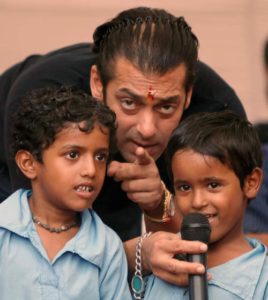 In his early days of film career, Salman Khan had a notorious reputation of being a playboy with utter disregard to society. However, with his NGO for the underprivileged children, “Being Human”, he seems to have won many hearts. Salman Khan’s love for children helped him to initiate this project. Being Human works in the areas like education and healthcare for the underprivileged children.
 She is looked upon as the ultimate beauty in India. Today, Aishwarya Rai Bachchan is a global name for Indian Cinema. After winning the Miss World pageant in 1994, she joined the eye donation campaign run by the Eye Bank Association, when she pledged to donate her eyes. Later, she became the ambassador for the Indian Government’s Pulse Polio campaign to eradicate polio. In 2004, she established an NGO, the Aishwarya Rai Foundation, which works towards helping needy people.
 Nafisa Ali is a lesser known actress from the 1970-80s who is today more known for her social activism. Till date, she has been a part of various NGOs and projects. In 1999, Nafisa Ali started the Orissa Cyclone Relief fund when Odisha was struck by a massive cyclone. Later in 2001, she actively participated to rehabilitate the earthquake victims in 48 villages of Gujarat, where she helped construct 340 huts. During the Gujarat riots, she worked towards creating peace and harmony in the riot affected areas. She made a documentary on the same named ‘Where Did We Go Wrong’. Nafisa Ali is associated with Action India that works towards spreading awareness about HIV/AIDS, for which she made a documentary, named ‘United against AIDS’. She started a care home named Ashraya to provide support and holistic care for AIDS victims and HIV+ people.
 There is a saying “When you give to the needy, do not let your left hand know what your right hand is doing”. John Abraham seems to have taken this quote seriously. He says, “For me, doing social work and supporting NGOs is more important than endorsing a brand.” Being an animal lover, John Abraham supports various projects of PETA. He is also associated with the People for Animals, who work towards freeing the horses pulling Victoria Carriage on the beaches of Mumbai. His love for animals extends to the ‘Save Our Tiger’ campaign.
 The megastar of Indian Cinema is probably the most influential celebrity in India today. ‘Big B’, who has been ruling Bollywood for decades, has made sure that people know him not only for his creative work, but for his social activities as well. Being the first brand ambassador for the Pulse Polio campaign by Indian Government, Amitabh Bachchan has influenced the masses with his ‘Do Boond Zindagi Ki’ TV ad. In 2005, he officially became the Goodwill Ambassador for UNICEF. He also supports organisations to create awareness about HIV/AIDS.


