Day of the Non-Returning Indian? [Infographic]

3
NRI Resident Indian Captain Sunil James | Change.org
Captain Sunil James | Change.org

Today India celebrates “Pravasi Bharatiya Divas” or the “Day of the Non-Resident Indian”. Organised under the aegis of the Ministry of Overseas Indian Affairs, the event is aimed at engaging the Indian Diaspora across the globe. It is a big day for the government of India – international conferences, elaborate statements by dignitaries, signing of accords, grand cocktail dinners, hobnobbing of the bigwigs, etc. The government puts in its best efforts to showcase the country for returning NRIs and PIOs, encouraging them to set up businesses with large investments.

The theme of this year’s Pravasi Bharatiya Divas is “Engaging Diaspora: Connecting Across Generations”. Quite touching and insightful! However, one look at the recent events can bring down the grand jumbo jet of NRI pipedream and slam it to ground reality! The arrest of Indian sailor Captain Sunil James and Indian diplomat Devyani Khobragade are still raw in our collective memories. Particularly, shocking is the difference of treatment in getting these two NRIs released!

In July 2013, Captain Sunil James was wrongfully arrested in Togo on false allegations of helping pirates who had attacked his ship, MT Ocean Centurion. While his family made desperate attempts to secure his release since then, only the death of his child arouse the nation’s consciousness. Soon the government woke up to this personal tragedy and made some efforts. In contrast, the reaction to Devyani Khobragade’s arrest was violent. Both the government and the political opposition were frothing in anger against this injustice meted out by the careless US federal government!

Anyway, let’s return to the larger issue of who are NRIs and PIOs, and how well are they living abroad. While the rest of the world calls them as expatriates, we prefer to call them Non-Resident Indians! An NRI is an Indian citizen who holds an Indian passport and has temporarily immigrated to another country for six months or more. A Person of Indian Origin (PIO) is a person of Indian ancestry born abroad whose ancestors emigrated from India long ago. A PIO is not a citizen of India who has subsequently taken the citizenship of another country.

According to the Ministry of Overseas Indian Affairs, there are around 10 million NRIs living abroad as on 31 December 2012. Similarly, there are 11.9 million PIOs who have settled in 205 countries since the 18th Century when one of the earliest Indian immigrants left the country for greener pastures. Some of their stories are really interesting!

The Great Indian Diaspora Infographics

India infographic on NRIs

To Embed Infographics into your post Copy and paste below code
<img style=”max-width: 100%;” alt=”NRI Infographics by Caleidoscope.in” src=”https://caleidoscope.in/wp-content/uploads/2014/01/NRI-infographics-caleidoscope.jpg” />

Then came the large wave of migrants who were taken as bonded labourers by the British across their vast empire in the 19th Century. Sugarcane farms in Mauritius, Guyana, East Africa, the Caribbean and Fiji islands were filled with cheap Indian labourers indentured by debt. More prominent immigrant communities across the world were:

  • Gujarati Banias who went to Kenya, Tanzania, Zanzibar, and South Africa
  • Malabari Moplas who went to Saudi Arabia, Oman and the Emirates
  • Tamil Chettiyars who went to Singapore and Malaysia
  • Bihari Bhumihar and Kayasthas who went to Mauritius
  • Punjabi Sikhs who went to Canada

Despite their widespread presence, the largest concentration of PIO communities are found in a few countries. Being fourth to fifth generation descendents, most of them have lost touch with Indian language, culture and religious rituals. They are:

  • Malaysia and Sri Lanka with nearly 3.5 million PIOs residing there (mostly Tamilians)
  • The US comes next with the most diverse set of PIO communities – 1.3 million
  • South Africa also has a diverse set of PIO communities – 1.2 million
  • Canada comes next with large number of Punjabi Sikhs farmers – 0.8 million

Surprisingly, the NRI population that has been settling abroad since 1947, has grown rapidly to be on par with the PIO communities. The biggest NRI populations are seen in:

  • Saudi Arabia – mainly skilled workers and engineers for oil industry – 1.8 million
  • The UAE – mainly skilled workers and engineers for construction industry – 1.7 million
  • The UK – mostly well qualified doctors and engineers – 1.5 million
  • The US – mostly well qualified doctors and engineers – 1 million

While we are not concerned about PIOs since they are well settled in another country, the current state of NRIs is of utmost concern to us. Not only because we love our expatriate brethren, but also their money! The most noteworthy aspect about NRIs is their remittances to India. It would be surprising to note that NRI remittances in 2012 matched the total export revenue of the entire Indian IT industry!

According to the World Bank’s Migration & Development Brief-2013, India was the world’s largest recipient of foreign remittances, earning $71 billion. It was followed by China with $60 billion and the Philippines $26 billion. Obviously, the GCC countries (the Gelf money, boss!) had the lion’s share with 48%, with the US following way behind with just 13%! Again our IT guys have fallen behind. I had expected our Andhraite and Kannadiga IT engineers in the US to be minting dollars!

First published with our media partner – the Indian Republic

Factfile –
http://en.wikipedia.org
http://www.worldbank.org

Global Indian Mindset – what’s that?

2
global indians

Global Indians Photo courtesy – DFID – UK

“Beloved younger brother,
Greetings to respectful parents. I am fine at my end. Hoping your end is fine too. With god’s grace, and parents’ blessings, I am arriving safely in America and finding good apartment near university. Kindly assure mother that I am strictly consuming vegetarian food only in restaurants, though I am not knowing if cooks are Brahmins. I am also constantly remembering Dr.Verma’s advice and strictly avoiding American women and other unhealthy habits. I hope parents’ prayers are residing with me. Younger brother, I am having so many things to tell you, I am not knowing where to start. Most surprising thing about America is it is full of Americans!”

That was the great Indian immigrant as depicted in the “The Inscrutable Americans” written by Anurag Mathur way back in 1991. The protagonist Gopal Kumar’s comical discovery of America begins this way. He is bewildered by American girls, new gadgets, naked women billboards, vegetarian cats, mobile telephone and multi-channelled colour TV!

Thaipusam Singapore
Thaipusam Singapore – Image Courtesy  Nestor Lacle

That was the era of the ABCDs – American Born Confused Desis – where Indians who travelled or born abroad were not sure to adopt Indian culture or Western. Way back in the pre-liberalised India, the clash of Indian culture with the Western was the hottest topic debated in the media. However, over the years since liberalisation and globalisation, these cultural differences seem to have faded away. Or have they?

The evolution of a Global Indian is aptly portrayed by the NRI poster boy Shahrukh Khan in “Pardes” where he brings the two cultures to meet each other, in a well settled overseas Indian family in “Kal Ho Naa Ho”, an NRI eager to return to India and work towards its development in “Swades” and as an Indian Muslim trying to get acceptance in America in “My Name Is Khan”.

Thaipusam in Singapore
Thaipusam in Singapore – Image Courtesy William Cho

Today, you can be a burger eating, jeans-clad yuppie, who loves heavy metal, but yet remain an Indian at heart. On the other hand, our culture guardians are seriously concerned about dilution of our culture due to Westernisation of our education and entry of corporate business in every aspect of life. Many Indians are confusing Modernisation with Westernisation. Do you think that being a part of the modern society in India needs you to adopt western culture? Modernised countries like Japan and Korea have held onto to their strong cultural roots even today. Do you feel urban India is somewhere losing its cultural identity and giving way to western mix?

Global Indians Mindset
Global Indians – Image Courtesy Harsha K R

We at Caleidoscope seek your opinion about the emergence of a “Global Indian” amidst us. The global mindset is too complex to define. Its essence lies in a sense of curiosity and openness to learn about cultures and business environments beyond the familiar. People who have a global mindset are open to actively challenging themselves to operate beyond their comfort zone.

Living and working in a foreign land does not automatically build such a mindset. Several Indians who have lived in another country seek out the familiar even after they have been in their adopted country for years. The people they socialise with are all from the home country. Being immersed in an unfamiliar world frightens most of us. Familiarity is a warm blanket. A global mindset is about actively seeking the unknown, says Abhijit Bhaduri.

So the question is, do we have a Global Indian mindset? Why should we have it and does it help us in enriching our culture?

Youth Power Can Transform the Nation

7

youth power in India
Source

Don’t hate me but even I was one of those people who used to say “Iss desh ka kuch nahi ho sakta” until few months back. Nobody can blame me for thinking so as our country is plagued with social evils such as corruption, unemployment, inequality, and what not. I bet none of us can say “Sare Jahan Se Achcha” without a bit of hesitation.

Shockingly, something drastic happened recently, which altered my views. I came across some college students who were involved in politics. I asked one of them “Do you think all your hardwork will pay off? Isn’t it wastage of time?” He replied calmly, “I don’t know whether my efforts will bear fruits or not, but I do know that instead of blaming others I actually tried to make India the nation of my dreams. The satisfaction of trying is enough for me.” He is a common man like us.

Gone are the days when people used to buckle down in the face of injustice, corruption and other social evils. No, I am not saying that we are completely free of them, but the truth is that this fight against them is gradually gaining momentum. For this we should really be thankful to one man for showing us that the ultimate power lies in the hands of a common man.

Anna Hazare, the renowned Gandhian social activist, single-handedly started an anti-corruption campaign, opening up a flood of activism across India. While people from all parts of the society supported his Satyagraha movement, it’s a matter of pride that the maximum support came from the youth belonging to 18-40 age group. Team Anna has already achieved the first stepping stone of getting implemented the Lokpal Bill in the Parliament.

Youth power - Lokpal YFS
Candle light march for Lokpal Bill – YFS Hyderabad

Inspired by this movement, Arvind Kejriwal, an IIT Kharagpur graduate left his career with the Indian government to form Aam Aadmi Party, which aims to make India free of corruption. Kejriwal, a winner of the Ramon Magsaysay Award, tasted the sweet fruit of success when his party defeated Congress in the Delhi Legislative Assembly election, 2013. Barely over a year old, Aam Aadmi Party defeated the Indian National Congress, which had held office in Delhi for over a decade. So, one man’s voice brought down “The Hand” in India’s political heartland. This is enough to prove that the common people i.e. we are done with the age-old ideas and incompetency of the present ruling parties.

It’s not just Arvind Kejriwal but many other young and educated people harbour this dream of glorious and progressive India. I was pleasantly surprised to observe a number of young and responsible leaders who are serving towards bringing about a change. Many of them belong to political families yet have retained the spirit of common man within them.

youth power india
youth power indiaPhoto courtesy| commons.wikimedia.org
Agatha Sangma, who holds Masters in Environmental Management from the Nottingham University, UK as well as a LLB degree from Pune University, became the youngest minister in the cabinet council of ministers of the 15th Lok Sabha. Then there are those who are expanding their noble intentions beyond politics to reach out and help the needy. Priya Dutt, apart from being a Secretary of the All-India Congress Committee also runs the Nargis Dutt Memorial Charitable Trust, which played a major role in bringing medical aid to villagers affected by Bihar flood in 2008. Milind Deora, the youngest member of Lok Sabha, runs SPARSH, which aims to educate students in computers.

The need of the hour is that more such educated young people with broader perspective and definite line of action should take leadership among political parties, since it is their zealous approach and determination which is likely to bear success.

More young people from the society’s working class need to stand up and take responsibility. I am not against young leaders from political background taking the lead, but in my opinion they are somewhat sheltered from the harsh reality, which blinkers them. If these people and a representative from the working class of the society work together, trust me the results will be pleasantly surprising!

I would like to bring to your notice the youth movement that is presently active in almost all colleges across the nation. Students’ union is the first step towards achieving this larger goal. It is among students that energy meet ideas and aggression meets inspiration. What could start as a discussion soon turns into a mass movement. India has already witnessed a student union led movement entering the political scene – Asom Gana Parishad led by a student leader, Prafulla Kumar Mahanta, the All Assam Students Union became the ruling party way back in 1985!

Remember neither Gandhiji nor Sardar Patel had a political background in their upbringing yet they were able to free our nation, so why can’t we? So next time friends, when you see a young girls and boys speaking passionately about the nation and politics do not take them for granted!

Lost Capitals of the Deccan – Small Towns, Big Hearts

2

Rediscovering Forgotten Towns of India

Across the vast stretches of Indian history, lie some forgotten little towns. These small towns were once the sprawling capitals of mighty empires, but are today lost in the pages of history. Our in-house Ibn Battuta, Anannya Deb has gone across the Deccan to rediscover these gems.

The Deccan: A Land of Powerful Dynasties

In the period between the waning of the Gupta Empire in the 5th Century till the arrival of Muhammad bin Tughlaq in the 12th Century, the Deccan region served as a revolving door for a series of large dynasties. The Kadambas, the Chalukyas, and the Hoysalas of Karnataka; the Rashtrakutas, the Shilaharas and the Deogiri (Devagiri) Yadavs of Maharashtra; and the Kalachuris, the Ikshavakus and the Kakatiyas of Andhra Pradesh were some of the most prominent ones.

Legacy of Art and Architecture

Sasivekalu Ganesha Hampi
Tungabhadra Crossing Hampi

While many of these empires were later subsumed by the succeeding empires of the Bahmanis, the Vijayanagarans, the Marathas, and ultimately the Mughals, the legacy of these empires in art, architecture and culture is immense. To truly understand the scope of these empires, we must necessarily travel to some innocuous looking small towns of the Deccan.

Banavasi: Karnataka’s Hidden Historical Gem

Madhukeswara Banavasi
Madhukeswara Temple, Banavasi | Anannya Deb

For starters, we could go to Banavasi in the Uttar Kannada district of Karnataka, about 100km south west of Hubli. The tourist literature on most travel sites say this is a base for heading into the forests or to go to the Jog falls. It is even marketed as a rural tourism project with a eco-tourism oriented holiday centre. For a leisure-seeking tourist like me, that is a charm by itself.

Banavasi’s Importance in Indian Culture

Lost Capitals Madhukeswara Temple Banavasi
Madhukeswara Temple, Banavasi | Anannya Deb

However, for those enquiring into Indian culture, Banavasi is an important place. It is the capital of the Kadambas, the first major empire to spring up in the Deccan region. The Aihole Inscription of Pulakesin II describes Banavasi as “Vanavasi, which for a girdle has the rows of hamsa birds that sport the high waves of the Varada as their play place and which by its wealth rivalled the city of the gods” (Source: Epigraphica Indica, 1901).

Banavasi Today: A Quiet Village with a Rich History

Banavasi Street
Banavasi Street | Anannya Deb

Now inscriptions are known to be hagiographical in nature and hyperbole is an accepted literary quality. However, even discounting the exaggeration, we can reasonably conclude that that this town was fairly wealthy and prosperous as befits a large capital city. And this is how it looks today…

Banavasi’s Rustic Ambience and Historical Roots

Banavasi looks like any other village with its completely rustic ambience. Anyone passing by would have no idea of its history. Established in 345CE by Mayurasharma, the Kadambas were the first ones to use Kannada as a medium of official administration. The Kadambas were later defeated by the Chalukyans. In the 8th Century, they built the Madhukeshwara Temple, which has been built over many centuries by various dynasties including Chalukya and Hoysala kingdoms. Madhukeshwara Temple has all the typical Chalukyan elements – ornate pillars, the shikaras, etc. however, the dancing hall in the front of the sanctum sanctorum was built during the Hoysala period, which has some exquisite carvings on pillars and on the ceiling.

Badami: Another Landmark in Karnataka’s History

Badami Cave temples
Badami Cave Temples | Amit Rawat

To understand the Chalukyan legacy, we must visit another small town in Karnataka. Badami located in Bagalkot district – a three-hour bus ride eastwards from Hubli – is a slightly more urbanised version of Banavasi.

Badami: The Capital of the Early Chalukyas

This was where the Early Chalukyas (Badami Chalukyas) led by Pulakesin I established his capital. Vatapipuri, as it was was called then, stands on two rock outcrops on either side of the lake that are named after the Asura brothers – Vatapi and Ilvala. The lake is named as Agastya Tank, which is a reference to a mythological tale, where Agastya a revered Hindu sage neutralised the powers of the demonic brothers.

The Architectural Legacy of the Chalukyas

Badami view from cave
Badami View from Cave | Rakhee

From a cultural point of view, the Badami Chalukyas were pioneers of temple architecture. All the great classical architecture of temples in the Deccan and southern India owe their origins to the Chalukyan architecture. As many art historians have reckoned, Badami and the nearby sites of Aihole and Pattadakkal were the design studios for sculptors to try out new forms of expression. The temples of Kanchipuram, Mammallapuram, Hampi and many others draw heavily from the Chalukyan style.

Kannada Literature and Chalukyan Patronage

Besides temple architecture, the Chalukyas of Badami brought in another tradition – they wrote many of their royal inscriptions in Kannada. The Kadambas were the first to patronise Kannada as evident from some 5th Century coins found there. But the Chalukyas took it to another level. This marked a breakaway from the traditional seat of honour given to Sanskrit. The inscriptions in Badami dating back to the 6th Century are considered to be the earliest available literature in Kannada. Thus, as historians like Romila Thapar writes in her book Early India, the royal patronage for a people’s language like Kannada marked a new beginning as people could now express themselves without having to study Sanskrit. It empowered the lower castes who were denied access to Sanskrit, to create their own literature, which many centuries later would evolve into the beautiful Bhakti movement poetry.

Takeaway

Endowed with such rich heritage, these two towns – Banavasi and Badami – within their diminutive state hide some important gems in the making of Indian culture. The lost pages of Indian history can be rediscovered in these quaint little lost capitals of the Deccan.

Factfile –

http://en.wikipedia.org/wiki/Timeline_of_Indian_history
http://archive.org/stream/EpigraphiaIndicaVol6/Epigraphia%20Indica_Vol%206_djvu.txt
https://maps.google.co.in/maps?
http://evenfewergoats.blogspot.in/2013/06/a-day-out-from-badami.html
http://en.wikipedia.org/wiki/Agastya#Vathapi_legend
https://www.goodreads.com/book/show/16338935-early-india?from_search=true

Are you a Hindu liberal?

4
hindutva
Hindu thought | Courtesy: Devdutt.com

Are you a Hindu? Do you consider yourself as a liberal? So are you a Hindu liberal? What is it about “Hindutva” that is un-secular or un-liberal? Can you lead a Hindu way of life and still mingle easily with your secular friends? Why should anyone get to call a Hindutwavadi a “Hindu-Taliban”? Pertinent questions for any Indian who is concerned about our ever-evolving constantly transforming society!

Ashwini, a well traveled liberal poses these questions on the Indian Republic, a popular news portal. Ashwini begins with defining the term ‘liberal’ as applicable in a global context. Then he moves onto defining what exactly is ‘Hindutva’. This reminded of the earliest attempt made by the renowned philosopher and teacher, S Radhakrishnan in his book, “The Hindu View of Life” way back in 1926.

Radhakrishnan wrote, “The challenge of Christian critics impelled me to make a study of Hinduism and find out what is living and what is dead in it. My pride as a Hindu, roused by the enterprise and eloquence of Swami Vivekananda, was deeply hurt by the treatment accorded to Hinduism in Christian missionary institutions.” Today in the post-modern context, when everything is irreverent and everything is questionable, it is high time to make an attempt to define Hindutva and come terms with it. Read on…

Who is a liberal?

A quick Wikipedia search will show you that the idea of liberalism is based on two concepts – liberty (the right of individuals to control their own actions) and equality (self-explanatory). I call myself a liberal because, like most liberals, I believe in:

  • A clear separation between governments and religion (Secularism)
  • Equality of all people before the eyes of the law, irrespective religion (Secularism)
  • A lady’s right to choose whether to have an abortion or not irrespective of what her family thinks (Prochoice)
  • That the LGBT community should have the same set of rights as the rest of us including the right to be in a legally recognized marriage (Gay rights)
  • A fair and reasonable amount of affirmative action to enable the underprivileged to catch up with the others, but not at the cost of quality (Mildly proaffirmative action)
  • The legalization of euthanasia subject to reasonable regulation (Proeuthanasia)

What is Hindutva?

Hindu-LiberalHindutva, not to be confused with Hinduism-the religion, according to the Supreme Court, is “the way of life of the Indian people and the Indian culture or ethos” and is “not to be equated with or understood as religious Hindu fundamentalism”. The same Supreme Court judgment ruled that it is a fallacy to infer that the use of the word “Hindutva” per se depicts an attitude hostile to all persons practicing any religion other than the Hindu religion.

The vilification of Hindutva by pseudo-secularists

Hindutva has, of late, been vilified by pseudo-secularists who have been branding it as the philosophy of “right wing terrorists”, as the philosophy of the “Hindu- Taliban” and other such nonsense. As a liberal, I refuse to allow people to speak baloney on my behalf. As a liberal, I see no contradiction between liberal values and Hindutva.

What is it about “Hindutva” that is un-secular or un-liberal? Why should anyone get to call a Hindutwavadi a “Hindu-Taliban”? One argument often cited by pseudo-secularists is that Hindutwavadis seek to establish a “Hindu-rashtra exclusively for Hindus (those practicing Hinduism) at the expense of Muslims/Christians and other religious minorities.”

This argument is ridiculous on so many levels. To start off with, the word “Hindu” in this context does not mean a follower of Hinduism-the religion. In fact, Veer Sarvarkar, the freedom-fighter who coined the term “Hindutva” was a rationalist and defined the term to mean “any patriotic inhabitant of Bharatvarsh (India)”. (Source: Savarkar, Vinayak Damodar: Hindutva, Bharati Sahitya Sadan, Delhi 1989 (1923)). Besides, this school of thought had its roots during the time of the British rule of India and the notion of a “Hindu rashtra” was in contrast to a nation of Indians being ruled by the British – which was what India was under British rule.

What are the key issues championed by the Hindutvawadis?

The key issues championed by the Hindutvawadis are:

  • Uniform Civil Code- A uniform set of laws for all Indians irrespective of religion
  • Abolition of article 370- Article 370 grants a special status to Kashmir that gives it powers that other states don’t have.
  • Building a Ram Temple at Ayodhya- Ayodhya is believed to have been the birthplace of Lord Ram and is one of Hinduism’s most holy sites.

Is there any merit to the issues that Hindutvawadis take up?

Uniform civil code – When people claim to believe in equality of all people irrespective of religion, race, caste and gender, shouldn’t it be a no-brainer that all people of India should follow the same set of laws? Yet, India has a different set of personal laws for Hindus, Muslims and Christians. The rules and laws governing Hindu marriage, Hindu divorce, Hindu inheritance and Hindu adoption are different from the rules governing Muslim marriage, Muslim divorce, Muslim inheritance and Muslim adoption. And yet, Sikhs, Buddhists and Jains have to follow the rules governing Hindus. Does this make any sense at all? Does it make sense for the government to allow a Muslim to marry twice but to prosecute a Hindu or a Christian for doing the same? Doesn’t this put the term “equality before law” to shame? What would a liberal say?

Abolition of article 370 – Article 370 of the Indian constitution accords a special status to the state of Jammu and Kashmir. It implies that except in matters pertaining to Defense, Foreign Affairs, Finance and Communications, the Central government cannot make any laws that apply to the state of Jammu & Kashmir without the State Legislature’s concurrence. Therefore, the residents of the state of Jammu and Kashmir live under laws that are different from those applying to the rest of India. I don’t know how this sounds to you, but it sure sounds pretty ridiculous to me.

Ram temple at Ayodhya – I am not really a practicing Hindu and don’t remember going to a temple to pray in the last year or so. Yet, I believe that all religions are equal and should be accorded respect. Therefore, I find it very strange that Hindus don’t get to have a temple at Ramjanmabhoomi in Ayodhya- one of Hinduism’s most sacred sites. Whether Lord Ram was indeed born in Ayodhya or not is immaterial here since religion is about faith and belief rather than anything else. Most Hindus believe that Ayodhya is the birthplace of Lord Ram and their beliefs should be respected. What is wrong about having a place of worship at a place that is considered sacred by almost a billion people? Wouldn’t it be strange if Jerusalem did not have a Church or if Mecca did not have a mosque? So, why should Ayodhya not have a temple?

So, am I a liberal or a Hindutvawadi?

Going by my views on the above issues, I would be dubbed as a Hindutvawadi by pseudo-secularists. However, going by my views on core questions pertaining to secularism, equality, liberty, abortion, stem-cell research, immigration, separation between government & religion etc., I would be considered a liberal. So, am I a liberal Hindutvawadi? You decide for yourself.

Remember MiG 21… Remember Rang De Basanti!

8
MiG-21
Indian Air Force retires MiG 21 | Indian Express

Few years ago, during my journalistic career, I remembered my friend having a serious argument with my news editor about a story on HAL LCA Tejas that was inducted into the Indian Air Force. Although he had written a positive story, he did mention that an aircraft designed in mid-1980s is now being inducted into the Indian Air Force in late 2000s due to numerous delays in the aircraft’s development. Obviously, my friend’s story was sidelined and was replaced by a standard press release from the IAF.  Then I wondered why such matter-of-fact news ruffled the editor’s feathers.

Today, when I read glowing tributes paid to another aircraft the MiG 21 that was retired, I realise how touchy we Indians are about our armed forces. I went through news reports from the Economic Times, Hindustan Times, Indian Express, India Today, etc., and none one of them mentioned anything about the accidents involving MiG 21s. The numerous peace-time accidents involving MiG 21 fighters that gave it the ignominious nickname “Flying Coffin” were conspicuously missing!

Surprised by that omission, I searched online for more info and found that there was meagre media coverage on this subject. Particularly noteworthy was a website named indianmilitarynews.wordpress.com, which listed all the crash-related news from the IAF. To my shock, the site had a blank page stating “This blog has been archived or suspended for a violation of WordPress Terms of Service”. However, there is another website named AirforceChat that provides all these plane crash details.

MiG 21 Fighter
IAF MiG 21 fighter in 1971 | Bharat Rakshak.com

Mikoyan-Gurevich-21 or MiG 21 was India’s first supersonic jet fighter aircraft manufactured in the Soviet Union in 1955. It is considered a second-generation jet fighter, which was first inducted in the IAF in 1963. MiG 21 was the IAF’s backbone, playing a stellar role in the 1971 war against Pakistan. It was also used in 1999 during the Kargil War, where one IAF MiG 21 was shot down by ground fire. However, after capably serving the airforce for three decades, the 1,200-strong MiG 21 fleet increasingly showed signs of wear and tear. The IAF was forced to continue using this outdated warhorse, eventually leading to numerous accidents.

According to answers given by various defence ministers in the Parliament, 177 air crashes took place in the IAF during the 1990-2001 period, out of which, the MiG 21s were the biggest casualty with 66 crashes. A high-power committee on Fighter Aircraft Accidents headed by Dr. A.P.J. Abdul Kalam, went into the issue and submitted a report in 1997.

In the last three years, the IAF lost 29 fighter planes in crashes including 12 MiG 21s, in which six pilots lost their lives. Since 1970, around 170 Indian Air Force pilots have been killed in MiG 21 accidents, which also resulted in the deaths of 40 civilians. While the IAF officially claims that pilot error was the major cause, internal reports conclude most of the crashes were caused by technical defects and engine flame-outs — strengthening fears that India’s MiG fleet may have outlived its service life.

mig 21 crash
MiG 21 accident | Indian Express

Our great Indian media, which creates a ruckus on every trivial issue, has managed to play it safe on controversies involving our armed forces. On the contrary, Bollywood, which generally avoids portraying any major social-political issue, took up the cause of IAF pilots who have lost their lives. Renowned director Rakeysh Mehra assembled an eclectic panel of actors led by Aamir Khan to produce a masterpiece named “Rang De Basanti”.

The story raises the issue of frequent MiG 21 crashes that had led to the death of many young pilots and the alleged collusion of politicians in murky arms deals. Incidentally, the filmmakers took no help from the IAF to make the film and they visualised the MiG 21 crash scene through computer graphics. The virtual aircraft they created was so realistic that the IAF called them to check whether the producer had the permission to use an actual MiG 21!

MiG-21 - Rang De Basanti
MiG 21in RDB | Courtesy: uiowa.edu

Rang De Basanti arrived as a breath of fresh air amidst the staleness of Indian current affairs and the youth were reinvigorated by its message. India’s urban, educated gen-next, which was detached from the national context and was more interested in maximizing its material well being, suddenly became aware of a range of social issues plaguing the society.

Eminent market analyst Rama Bijapurkar states that this movie was the spark that set ablaze the Indian social activism that we are witnessing today. It began with Laloo’s rout in Bihar, then the outcry over the Jessica Lall verdict, the Supreme Court’s activism on all manner of issues, the spread of naxalism, student protest against the education minister’s imperialism on reservations and more. “If one were to look carefully, hopefully these events have a pattern to them. Maybe the politician rulers are underestimating the fed-up-ness and the activism potential of the middle and upper sections of the society. Maybe it has spread to the lower sections as well,” wrote Rama way back in 2006 when the movie was released.

Today when we look back, it is clear that the nostalgia of MiG 21 valiantly serving the IAF during the war is swept aside by the activism sparked by Rang De Basanti!

Factfile –
http://india.blogs.nytimes.com
http://www.indianexpress.com
http://www.frontline.in
http://archive.deccanherald.com
http://webcache.googleusercontent.com
timesofindia.indiatimes.com

Documenting Wildlife at its Best

22

behind-the-scenes-of-a-wildlife-documentary
Our 4X4 vehicle was our lifeline

We have all watched on National Geographic or Discovery Channel how the lion hides in the yellow grasslands of Africa and leaps for its prey; a ferocious predator mercilessly tearing through the flesh of an animal. Or to see an eagle swoop down to the ground and catch its prey in its claws and fly back again. It leaves you in awe to be able to see these predators in their natural habitat. While such sights do look amazing and tend to gather viewers’ gasps, but it is, at the same time, a highly challenging task to capture such actions.

In the March of 2013, while I was still in Delhi completing my undergraduate degree, I got an enticing opportunity to shoot a documentary for the Government of Kerala at the Periyar Tiger Reserve. It was highly exciting, but we had absolutely no clue as to how tough it could be to make a wildlife documentary. The most important thing about documenting wildlife  is to capture action. Showing beautiful scenery and landscapes to the viewers over and over again can make them disinterested very quickly. To keep them hooked to a 30-minute documentary film, showing them some kind of action was a must.

wildlife documentary india
Dense tropical rainforest of Western Ghats near Thekkady

The biggest challenge that a wildlife documentary film maker faces is the uncertainty of spotting animals. You go with your camera into the forest, select a vantage point and just wait, hoping that animals would come there soon and give you a good shot. Such views are a rarity in such a vast expanse of forest. What is the probability of spotting even 1 out of 45 tigers in a jungle that is spread across 900 square kilometers?Pretty slim!

We had to divide ourselves into two groups, so that each group would go to a different region everyday and cover it. We would go in those open 4X4 vehicles (Mahindra Bolero or Thar jeep with open tops), standing with the cameras ready. However, to capture wildlife, it was important to be “one with the jungle”. Silently blend into the forest in such a way that our presence wasn’t even noticeable. That meant tens of kilometers of trekking every day. Any alien intrusion made the animals run away and leave the area in an utter silence again.

wildlife-documentary-maker
Trek along with heavy cameras

Remember scenes from Madagascar, the animated film, where a herd of animals would run and the whole ground would tremble? It’s not exaggerated! At one time, while exploring the forests, we found a herd of at least 50 Indian Gaurs (Bisons). There had to be absolutely no movement, so much so that every breath felt like a loud sound that might drive them off. Eventually, they did run away and the ground trembled as 50 beasts, each weighing around 900 kilos, scuttled away.
I spent a few nights with the 3 local forest rangers in tents in the middle of the jungle, a location 2 hours of boat ride away from Thekkady (a town in Kerala where we were based), and another 2 hours of trek from the boat. It was so deep in the forest that you could trek for hours in any direction and find not a single trace of humanity, but only dense jungles and wilderness.

Sitting around a bonfire in a pitch dark forest, we interviewed those rangers. The only source of light, apart from the fire, was the moon. In a black and yellow ambience, we sat down on the mats in the open jungle and set up our cameras. Joining broken English words and limping on Malayalam quite frequently, the rangers recounted their past as smugglers and poachers in these forests; about their lives when they would smuggle spices and tree barks, and hunt animals as tribesmen; and later how the government intervened and gave them jobs using these same talents to protect the forests. Today, they work for the wildlife protection from any human disturbances. After all, nobody knows the forests like they do!

wildlife-documentary
Easy to find wildlife!

They were really brave old men, dressed in simple green uniforms and chappals (sandals), carrying nothing but a few oranges to quench their thirst and satiate their hunger. In contrast, we carried one backpack each filled with biscuits, chips, wafers and water bottles, while wearing expensive shoes and what not. Their unsophisticated mannerisms and the expertise of being a ranger was an arresting duo of qualities in them. One of them was called Baby by his colleagues, and he was quite the contrary of a man as his name would suggest! He was a short, dark guy with white hair, speaking broken English with a never-to-leave sea of calmness in his expressions.

wildlife-documentary-deers
Hard-to-find wildlife!

A big advantage of being a documentary film maker is that you get to meet such diverse set of people, all with immensely interesting pasts that leave you dumbfounded. And then there is, of course, the travel; to a new place, a new adventure, new people and new cuisines. To make good documentaries, you have to do your research well and to do that, you have to live among the people, mingle with them, understand their customs and traditions, and experience their lifestyles. Believe me, I have ever since wanted to relive that experience; to once again go into the forests and tune myself to that rhythm!

Need Speed Breakers in Life?

22
Speed Breakers
Speed Breakers

Imagine a girl in her early twenties, or just imagine yourself in your early twenties. Do you recall living in your head? Speaking and debating with yourself before either giving up or making a proud decision? It’s the time when you can’t seem to stop planning your life out; all those advices from everyone around seem so outdated and unnecessary!

The protagonist in this ‘hard-to-put-down’ book is just that. “SPEED Breakers” is set in the city that defines India – Delhi. Being a typical Delhiite, Tamanna is supremely confident that she has her life figured out. Tucked away in her huge mansion, Tamanna is a smart ‘dilli-ki-kudi’ living with her big joint family. The book begins with Tamanna and her kid sister Natasha bickering and talking about boys late into the night. As with any patriarchal family, Tamanna’s family isn’t very fond of girls talking to boys; her dad loves to flaunt his daughters to the world, but only in his own way. Love marriages are a taboo and 23 is the right age for a girl to get married.

However, all this doesn’t matter to Tamanna. She knows she is going to be married soon, surely to a rich guy that her family can find. She also knows that she isn’t the prettiest one around, right from acne to weight issues, she was battling it all. And yet she is the life of the family, a master storyteller and a super duper nautanki (drama-queen), this girl knows how to get her way with everyone. However, there is this one thing that plagues her. That one thing that is forever looming over head since she was kid, the one statement that she heard so often in the house that she didn’t even know what lies beyond those words. In fact you’ve heard these words a million times in your childhood too and yet, they send shivers down your spine every single time.

Girls need to have some fun
Girls need to have some fun | Courtesy: Photochiel

Life was chugging along as usual for Tamanna – dramatic stories, annoying little sister and those rigorous workouts; and then almost out of nowhere something unthinkable happened. In a flash, Tamanna finds herself obsessing about this guy, a handsome chatterbox who lives in the UK. Friendly banter and an unexplainable attraction have both of them longing for each other every day. Stuck in her traditional society, Tamanna knows that ‘love marriage’ is an unknown concept in her family. Can her decisions overcome years of belief and strict traditions? Will she stand up to her family or will she meekly surrender just like all her sisters did? Will the family realize that with the children being educated and getting familiar with a modern culture, its best to let them take their own decisions?

Simple English and an exciting narration hook you to this book. Tamanna’s affable character is very easy to identify with and you can easily imagine her home and her life with all its absurdities. This book makes no pretense; it’s a simple story that you would want to read. Apart from Tamanna and Ankit, there are several more characters that seem so alive: the cool friendly Chachu, the gossiping aunts and of course the crazy best friend. If you love chick flicks, then SPEED Breakers is certainly a book that you should get your hands on. After all who doesn’t love a good rom-com?

SPEED Breakers has been co-authored by Devangini M Chauhan and Akanksha Madan. By launching this book, our in-house author, infopreneur and army wife, Devangini has entered the adventurous world of book publishing! She has self-published this book through her own publishing house ‘And All’. Despite being novice writer, she has managed to achieve a lot of firsts with her very first book. The semi-biographical story of Speed Breakers comes from Akanksha Madan, a psychotherapist and tarot card reader. Click here to read more about the book –

http://amzn.to/1dAlf54

Await Comet Ison’s Sky Spectacle!

8
Comet Ison on November 21 | Courtesy: EarthSky.org
General elections are just a few months away; Iran signs nuclear deal to end sanctions; Cyclone Helen passes through with minimal damage; Typhoon Haiyan wrecks havoc in the Philippines… While we are more bothered about such earthly events, there is something spectacular happening in the skies. A heavenly object’s visit to the sun could become the most spectacular event of the year. Comet Ison is about to undertake its closest approach to the sun during this weekend.
Many comets have the orbited the sun in the past few decades – Halley’s Comet in 1986, Comet Hale Bopp in 1997. So what’s the big deal this time I wondered! I do remember that during Hale Bopp’s visit in 1997, I had been to the planetarium in Bangalore where the Association of Bangalore Amateur Astronomers (ABAA) had organised a comet viewing session. In those days when the internet was virtually non-existent, such activities were the only way to understand the bigger events happening in the universe!

An asteroid passing by is a common occurrence, but a comet’s visit is a rare event. Scientists have counted 4,894 known comets till July 2013, but this number is steadily increasing every year. It is surprising to know that nearly 80% of the visible tail of a comet is all water vapour and dust. Due to their low mass, comet nuclei do not become spherical under their own gravity and therefore have irregular shapes.

Is Comet Ison different from other comets?

Images of C/2012 S1 display a greenish tint due to cyanogen and diatomic carbon | NASA

ABAA’s President Jayanth Basavarajaiah clarified in this manner – “To begin with, Comet Ison is not a typical elliptical periodic comet that orbits the sun regularly. It is a hyperbolic sungrazing comet that means it would go too close to the sun and the solar tidal forces could tear it apart during its perihelion (passage around the sun). The sheer size of the comet of around 4-5 kilometres in diameter has allowed it to survive a lot longer than most other comets that travel so close to the Sun’s surface. Additionally, since the comet may be making its very first pass by the Sun in its lifetime, it is believed that the material ejected in the tail of the comet will be primordial material dating back to the formation of our Solar System!”

Further, Jayanth stated that due to the debris and material ejected from the comet as it melts near the Sun, scientists are able to get measurable information about the Sun’s magnetic fields, its solar wind, and other interesting information that otherwise would be rarely possible. Since Earth will pass near the comet’s orbit on 14–15 January 2014, tiny dust particles blown by the Sun’s radiation may cause a meteor shower.

Formally designated as “C/2012 S1”, the comet was named “ISON” after the organization that discovered it in September 2012, the Russia-based “International Scientific Optical Network”. Vitali Nevski and Artyom Novichonok discovered it using the 0.4-meter (16 in) reflector of the ISON located near Kislovodsk, Russia. The initial report given to the Central Bureau for Astronomical Telegrams identified the object as an asteroid, but follow-up observations by independent teams reported its cometary features. Therefore, as per the International Astronomical Union’s comet-naming guidelines, the comet was named after the team that discovered it, rather than the individual discoverers.

Best time to watch

Amazing flash animation created by Khagol Vishwa
Amazing flash animation by Khagol Vishwa

Typically, whenever astronomers report about a celestial event like this, there is media hype about an event of a lifetime. So I asked Jayanth if there is a possibility that Comet Ison will become a great comet as bright as moon. Jayanth stated that from 14 November 2013, Comet Ison became visible to the naked eye for experienced observers located at dark sites. However, due to the full moon and glow of twilight, the comet has not become bright enough to be seen without an optical aid. After it reaches perihelion on 28 November, Comet Ison may become extremely bright if it remains intact.

Predicting the brightness of a comet is difficult, especially one that will pass so close to the Sun and be affected by the forward scattering of light. Originally, media sources predicted it might become brighter than the full moon, but based on recent observations, it is only expected to reach around −3 to −5 apparent magnitude, which is about the same brightness as Venus. If Comet Ison survives its sungrazing passage, then it promises to be a dazzling heavenly display with a long bright tail.

Comet Ison is now heading for its close encounter with the sun and its visibility in the morning sky is low, since the twilight haze obscures it. On its return path (if at all the comet survives) the comet will be again visible to the naked eye in the eastern sky from December 3rd until early January 2014 on both the hemispheres of Earth. Hopefully, Cyclones Helen and Lehar will dissipate by then and the sky will be clear for this spectacle!

In Bangalore, Association of Bangalore Amateur Astronomers will be organising a comet gazing session, while Khagol Vishwa – the Organization of Amateur Astronomers is organising one in Pune. Don’t miss this lifetime event!

Factfile –
http://en.wikipedia.org/wiki/Comet

The Scent of a Horse!

28

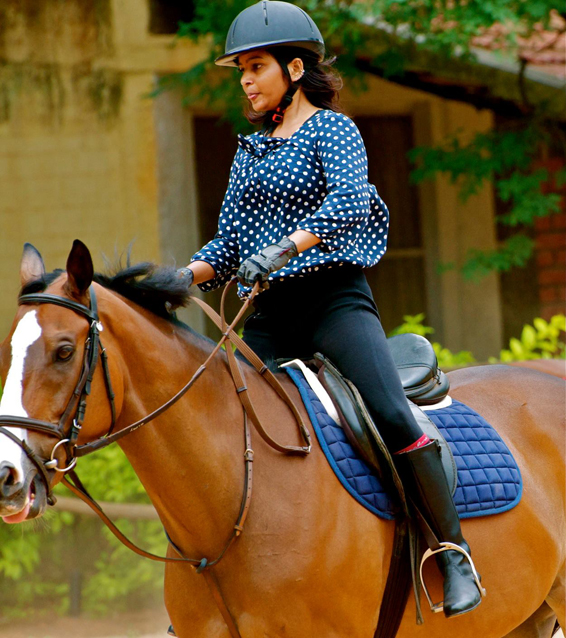
I strived for many years to attain transcendental consciousness through meditation but in vain. However, ever since I started riding horses, transcendental consciousness came to me naturally. And then I wondered how I lived all these years without these beautiful beasts in my life!

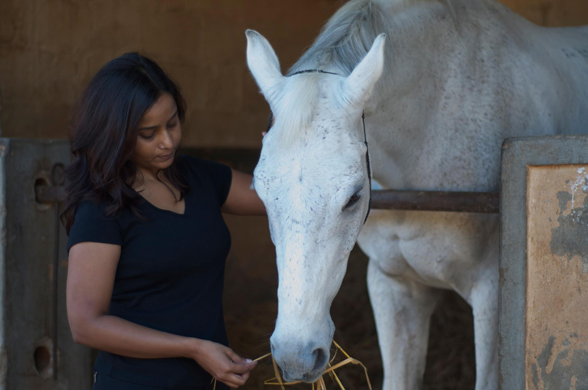
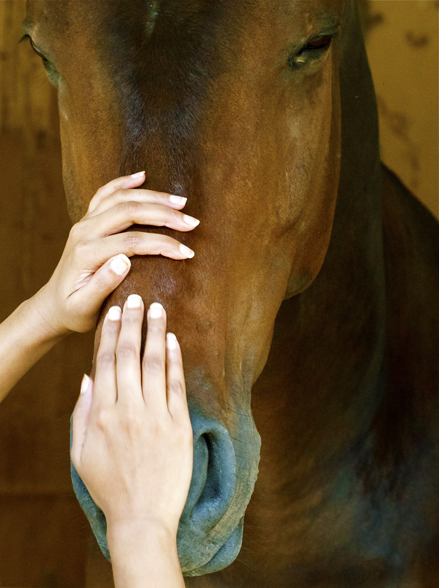
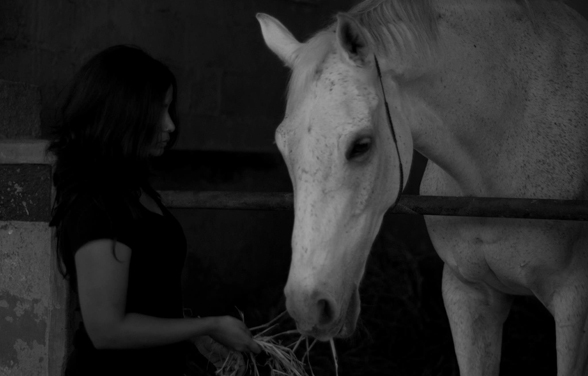
Every time I rode a horse ‘feel good hormones’ obediently kicked in, as if their lives depended on it. After every ride I went through feelings that ranged from “I want to do something heroic” to “God is in his heaven and all’s right with the world”. Magical happiness takes over my entire existence. In my opinion, the scent of a horse is better than the best perfume. Sometimes it provides oxygen to a needy soul.

hourse-place

While riding a horse you are too busy observing your horse’s body language and communicating to the horse through your own body language. Therefore, you do not have time or space in your mind to process other thoughts. That state of thoughtlessness is what most people try to achieve through meditation. In addition, there is physical exertion. Every riding session feels like a spa session, except that it’s sweaty.

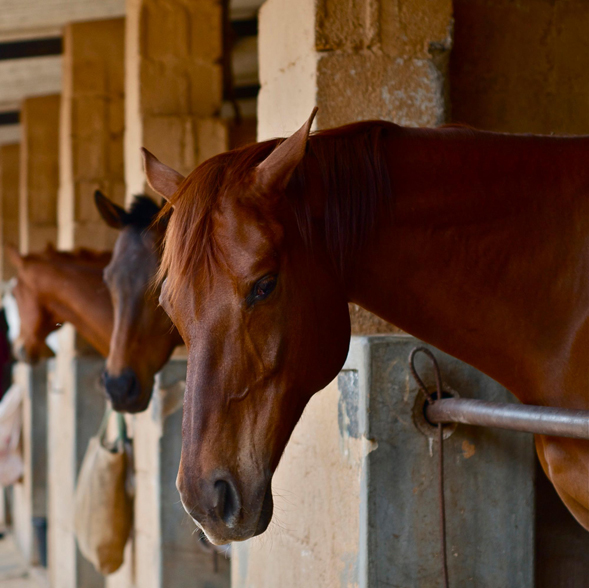
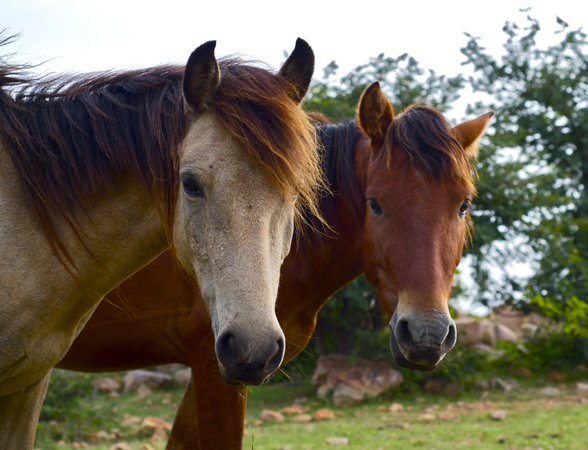
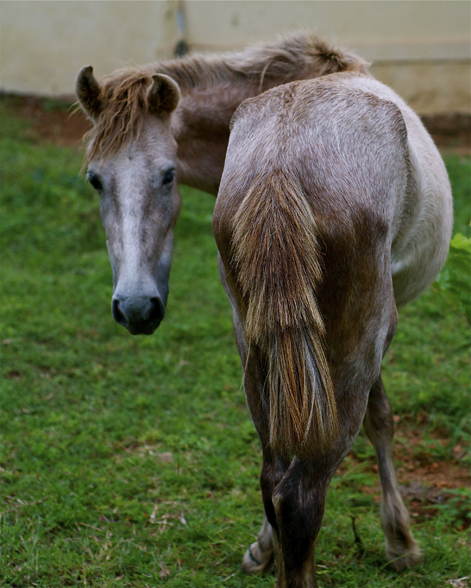
Now, my favorite language is ‘Horse’. It’s very interesting and you don’t have to worry about correct usage of grammar. For example, the position of a horse’s ears indicates his mood.

  • Pricked ears: he’s curious;
  • Pinned back ears: he’s angry;
  • Ears back but not pinned: he’s listening to you;
  • Ears forward: listening to something else.

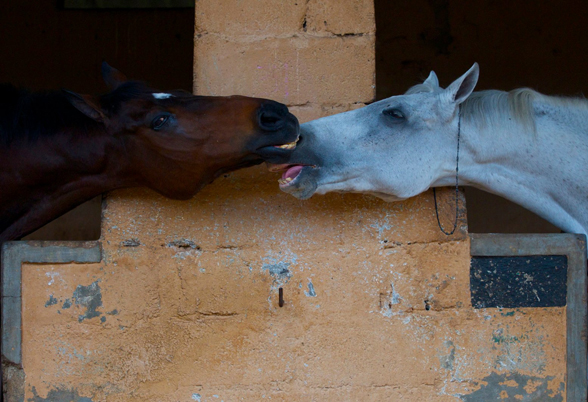
They also talk with the other parts of their body… Swishing tail: sign of agitation or warning the other horses to keep their distance. Flattened tail: fear.
They communicate through sounds too…

  • Sigh followed by a shudder: relaxed or bored
  • Nickering: seeking attention or they recognize you
  • Groaning: pain or just a plain habit
  • Snorting: excitement. It is as simple as that.

Most of us consider horses as dangerous animals and horse riding as a dangerous sport. You’ll be surprised to know that horses are flight animals and not fight animals. This means, they choose to flee at the first opportunity than to fight. However, like any other sport, accidents happen while riding a horse too.

horse’s-ears

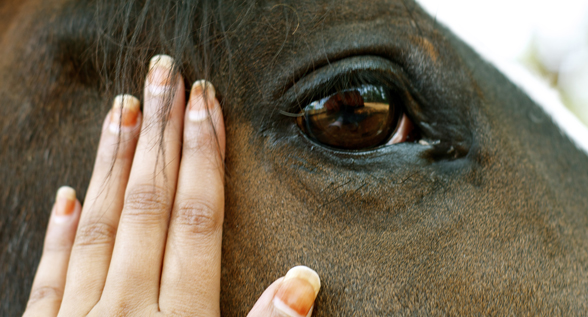
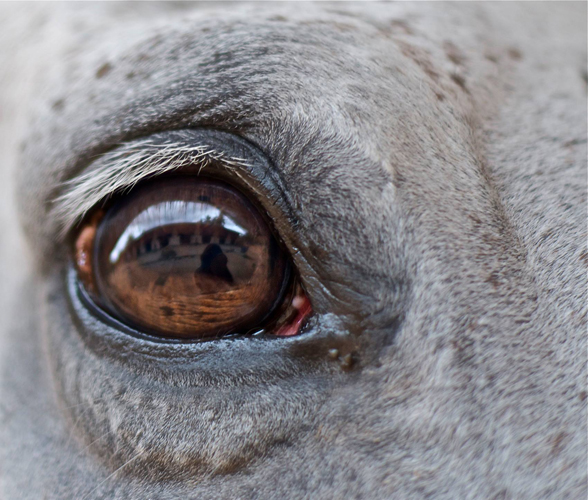
Horses are more like children: innocent, mischievous, and sometimes temperamental and want to be free to do what they want to do. Of course, they are powerful and elegant at the same time. Just by watching their beautiful gait, shiny, swaying mane and tail, your heart will be filled with joy. All you have to do is to look into their large brown glassy eyes and you will be transformed to their world. Besides, horses have the largest eyes among the land mammals and there is absolutely no way you can ignore them. Horses can sleep both standing as well as lying down. They sleep better when they are in a group as some horses stand guard, while the others are sleeping. Horses are herd bound and when isolated they would rather to live with a human than in solitude.

In the world of horses, it’s always about horses. I find it very fascinating when someone says, “Did you ride Starlite before? She’s jumping today;” “Zamindar was fabulous in today’s shows;” “Kalina as always did a great job.” I would be forced to ask who was riding these horses; otherwise there is absolutely no mention of the person in the discussion. It is absolutely thrilling to know that it is not human but another animal that is being treated as a superior creature and without the animal demanding it.

Horses and humans have been working together since time immemorial. Horses have been used in wars, as porters by gypsies, in agriculture to till fields, for entertainment in shows and races, for meat consumption, and in the medical field to make anti-venom. Evidently, horses are viewed as status symbols.

horses-and-humans

One day in Bangalore, I was riding a horse named Donald – an old one with a “been there done that” attitude. When I was trying to hug him, I saw some white flakes on his crest, closer to the mane. Worried, I asked my instructor, if Donald had some problem. My instructor casually shrugged and said he has hair so he will have dandruff too, just like us. Horses have graying hair, thinning hair, dandruff and other hair-related problems!

Horses are not much different from us humans. Some horses are fearful and some are bold. Some have strong work ethics and some are utterly lazy. Some are competitive in nature and some couldn’t care less about winning. Some are truly amiable and some are outright hostile. So understanding a horse’s nature is much like understanding a human being’s nature.

Horses can be great teachers of tolerance, obedience, hard work, and friendship among other things. Horse riding to me has been very therapeutic and my life would have been incomplete without these magnificent, mystical, life-altering creatures. Surprisingly, I found that therapeutic riding or “Hippotherapy” is used to treat mentally and physically disabled persons to help them improve balance and coordination, increase self-confidence, and get a greater feeling of freedom!

two-hourses
two-hourses
pampering-hourse
pampering-hourse
hourse-tile-style
hourse-tile-style
hourse-head-gears
hourse-head-gears
hourse-eye-close-up
hourse-eye-close-up
hourse-eye
hourse-eye
horse-riding
horse-riding
horse-love
horse-love
horse-language
horse-language

Factfile –
http://en.wikipedia.org
http://www.wikihow.com
http://www.equineline.com