Dancing for Pleasure – Part II

2

Continued from Dancing for Pleasure – Part I

Dancing-for-pleasure-nayana-bhat-1
Interacting with other dancers

My three months in the summer improvisation workshop in Amsterdam was mind-boggling. We worked intensively on improvisation – to move as we pleased, to allow the movement to emerge without judgment or guidance. This kind of practice involves observing one’s movement patterns; bringing to surface one’s unconscious ways of moving, and therefore creating space for newer choices. It was a new way of looking at movement, at life!

My next two years were spent on understanding the basics of the body, discovering where movement originates from, where dance begins. I realized that I was never encouraged to simply explore meaningless movement – movement for the sake of it; with no need to make it look beautiful (as opposed to the awe-inspiring geometry of classical forms), or without telling a story (“Radha and Krishna dance on Yamuna banks!”). Of course, when you watch a dance performance as an audience, you want to see beauty, you want to be engaged and entertained; you want to understand what’s going on. But as a practice, how can I create dance that is coming honestly from me, as opposed to wearing a well-practised smile that has lost its real intention long ago?

Dancing for pleasure - Dance-UBcity H2Zero show
Dancing for H2Zero show in UB City, Bangalore

I collaborated with other dance companies in Bangalore; I worked with dancers and choreographers from all over India and the west, persistently looking for a definition that would consists of everything that I was seeking in Indian contemporary dance. In this search, I explored various ways of moving (sometimes not moving at all!), many times challenging the audience’ perception and my own. I have been asked many times “Why are you doing this?” or “Why can’t you do the good-old Bharatanatyam? Everyone likes it; you are even good at it!” (That was my mother, of course). I must confess that it was hard to face such questions and still continue with my research. …To go on without an apparent reason, but being driven just by a strong drive from the inside.

Fortunately, I have been lucky enough in my performing career to experience audiences that were open-minded. There were many times when they were willing to be touched, to be moved; when they were empathetic to honest expressions. For poetry, they were willing to let go of logic. I do not mean to say that classical Indian dance has no poetry. What I mean is the grammar need not have to be that of classical dance in order to be appreciated. This was a wonderful encouragement for me to trust that I didn’t have to explain everything even if I was working with something the audience is unfamiliar with, as long as they get the essence.

I spent my last year participating in the International Choreographers Exchange program at the Salzburg Academy of Experimental Dance (SEAD). The entire year was jam-packed with creating choreographies, and training in contemporary dance techniques under world-class teachers from across Europe. It was amazing to spend an entire year being surrounded only by dancers and choreographers of all kinds, to watch them, to learn from them and share with them my points of view.

Dancing-for-pleasure-nayana-bhat-2
Dancer – Nayana Bhat

SEAD is known for encouraging dancers and choreographers to develop their individual styles in dance. I, on the other hand, coming from an Indian classical dance background, am trained to follow, to learn by following and surrendering. In SEAD, I had to mix the two ways in order to function. It was a new way; I had to put in double the work than the rest.

This one year brought me many revelations regarding my transition from classical to contemporary dance. First of all that the devotion I was speaking of earlier has to be brought into the act of moving itself, especially in the absence of a deity, unlike in classical Indian dance forms that have their roots in ritualistic practices. In contemporary dance, this devotional presence has to be discovered in the simple act of moving, where the dancer treats each of her moves not as movements that she “does”, instead as though they were in her very nature of being.

As philosophical as it may sound, this immediately negates the need for the audience to have a linear narrative in order to experience the emotions that the performance evokes in them. It allows them to surrender to what the dancer is presenting, as she is surrendering herself to it. This is the way a ‘rasa’ is created in the audience, just as in classical Indian dance. I find that to be a powerful connecting point between classical Indian dance and any other performing art.

In the course of my research, I had to redefine my definitions several times of what dancing meant, what the purpose of performing art was according to me. And yet, I do not stand on a steady ground today; the definition of what art serves or means is ever-changing as it always has. I do not know if I can ever find a transition or if I will spend the rest of my life hanging in between two worlds; but I do know that this search has enriched me not only as a dancer, but also as a human being. Last but not the least, I discover time and again that no matter how contemporary I am or I become, my heart still belongs to what is classic.

Benefits of a Healthy Smile

0

Everybody love to have a healthier smile. It makes him or her feel comfortable and confident when interacting with friends and relatives. It also affects how your close friends will view you. For the last few decades, everybody can afford to have a perfect smile they have always dreamed of. People no longer have to allow discoloration, broken, chipped and stained teeth to hold their smile captive. 

Smile
Image Pixabay

There are various and different options available to deal with many issues that can prevent you to have a healthy smile. This article enlightens you on some of the benefits of having a healthy smile as described by Cosmetic Dentistry Phoenix. 

Reduces stress: Normally when someone has a healthy smile, he or she will be willing to show it off to their friends, relatives, and the general public. It comes out that frequently smiling is good for you. This releases a feel-good emotion that will improve your mood making you feel happier. It, therefore, reduces the daily stress that you might be dealing with.

Smile-2

Healthy Smile will make you more attractive: Many people around the world gravitate towards some people who seem to appear sociable and happy. I guess you are the same as well. When you tend to smile, more people will naturally be attracted to you. It makes you be more loved and likable. This helps you to form and maintain a good relationship with your close friends and relatives in your professional and your personal life. According to some studies, most of the people who regularly display good emotions are likely to have and maintain interpersonal relationships and marriages. Are you looking to have and enjoy fun with more friends? Then you need to start fixing your teeth and smile more often. 

Healthy smile boosts your immune system: According to a recent research that was conducted by Mayo Clinic, healthy smile boosts the immune system. They found that laughter and positive thoughts will help your brain to fight off diseases and illness. They also found that negative thoughts and negative moods will lower your immune system. In addition, laughter therapy has been found to be the best for postnatal patients. It was found to improve their immunity’s responses. It, therefore, turns to be true to the Old saying that….’’laughter is medicine.’’

Healthy smile improves heart health: Note that the advantages of health smiling and laughing do not stop with someone’s immunity. It also helps to lower the blood pressure. This also goes well with heart health. When you are prone to laughter, your heart rate beat is increased. This is followed by a decrease in the heart rate and blood pressure as the muscle relax. It, therefore, helps you to lower the possibilities of developing heart complications. 

Smile-3
image – Unsplash

Good habits: Keeping your smile healthy will influence you to practice other good habits such as washing your dishes after dinner, lacing up your shoes, making your bed and cleaning your bathroom and toilet every evening and every morning. Let your health smile trigger you to do new things in terms of good habits. 

It will give you peace of mind: Most of the time when your smile is not health, there is always a constant voice in your head that will keep worrying you. You will experience gum bleeding and teeth pain. If you can care for your gums and teeth as your dentist will recommend, you will definitely silence that worrying voice. Therefore dental care will give you a peace of mind. 

It leads to dental health: Healthy smile means your dental health is perfect. You need to keep your mouth free of diseases and illness-causing tartar and plaque buildup that goes a long way to ensure you are making it and not just faking it. 

Smile-4
Image – Unsplash

Healthy smile allows you to save more money: When you have a healthy smile, you will find yourself saving some cons. The moment you have nailed the healthy dental routine such as visiting your dentist you have been avoiding, you will be ahead of your starting line. If you have a healthy smile, it means you are reducing your chances of needing costly dental procedures in your life. 

Healthy smile boosts the moods of other people around you: Having a healthy smile will improve the mood of your relatives, close friends and all the people around you. This is according to a research which was conducted back in the year 2006 and it was published in the safety research journal. The team in this research found that the moment a motorist is smiled at, he or she tends to drive slower and cautiously when they are near pedestrians. So what will happen if you improve the mood of people around you? It will lead to good and stronger working relationships and you stand a high opportunity of being promoted at the workplace. 

Health smile keeps breath fresh: A healthy smile means a fresh breath. This is a must if you want to communicate comfortably with your fellow workmates and the clients. In other words, bad breath will act as a barrier to career growth especially when you are willing to be promoted or to climb the company’s ladder and impress your line manager. According to Mayo Clinic research, poor oral hygiene, gum disease, and cavities are culprits of bad health.

Smile
Image – Unsplash

Healthy smile leads to the release of Neurochemicals: Generally, health smile provides an emotional lift. You feel more comfortable, calmer and happier after smiling because smiling promotes the brain to produce a balancing chemical known as Neurochemical. When selling the brain releases endorphins, serotonin, neuropeptides and dopamine. These neurochemicals tend to regulate mood and reduce pain. 

In conclusion, we are all aware that we have to maintain the health of our teeth, and we knew some few reasons why we must do that. But with the above reasons and their implementations. We look forward to seeing a generation with good dental health. I hope after reading the above article on the benefits of healthy smiling you have been enlightened.

Dancing for Pleasure?

1

nayana-bhat-dancer

Dancer – Nayana Bhat

I still remember my first Bharatanatyam lesson as a six year old. I was shy and timid and the world seemed monstrously huge. My dance teacher was a 60+ year old man, who didn’t use any special communication skills to teach his younger pupils. When he bluntly asked me bend my knees more and turn them out, I nervously peeked at my peers, who were giggling. That made me feel like digging a hole in the ground and disappear. That was my first dance class. The discomfort made me quit the very next week; I preferred rather spending my Sunday mornings watching Alice in Wonderland on television.

Fortunately, I came back to a new Bharatanatyam class about four years later, and stayed on for another eight years. Dancing was so wonderful, so dreamy, such an escape from the harsh, real world! I could do it forever! However, I was told that we cannot live off dance, which was just a hobby. So I studied the next thing I loved the most – Journalism. While I craved for other forms of dance, the little sea-side town I came from, offered nothing more than Bharatanatyam. It was traditional and it was safe. They didn’t want to corrupt the younger generation with other weird things that were outside our culture.

Dancing for pleasure - Ballet in Bangalore
Ballet in Bangalore

When I started working as a journalist in the crowded city of Bangalore, I could finally take some Ballet lessons. I was very thrilled! Eventually, my Ballet classes became more important than going to my news bureau. On a tiresome working Sunday evening, I asked myself, “If I am working so hard anyway, why shouldn’t I work hard as a dancer instead?” I quit my job the next day and I auditioned with one of the contemporary dance companies in the city and was invited to join them in a week’s time.

Seven years have passed since. When I look back at my decision then, I am filled with amazement for my own younger, naïve self, for the courage showed. It wasn’t easy, it still is not, but it was worth it. I worked with Nritarutya Dance Collective for 20 months. It was my first step into what they called as “Indian contemporary dance”. It was strange, new and very fast. The company was young and upcoming; we were 8 enthusiastic young people dancing there, while also running the administration and other chores. I was under-experienced, but energetic and I danced for the sake of pleasure.

Dancing for the sake of pleasure is where it all begins. Hopefully, that is not where it ends. Sadly, it very well does so for many. But I thank god that it didn’t for me. It could have. I have no clear definition of the dance that I was dancing then. The company liked to call it “Indian contemporary dance”. The intention was to draw from the rich cultural heritage of the fossilized classical dance forms of India (pardon my political incorrectness!) and apply it to the modern world, in a contemporary fashion. I had my questions about the basics of what the word “contemporary” means in dance.

Dancing for pleasure - Nayana BhatWhen you question the basics, life becomes somewhat hard to get on with. The company used motifs from the Indian classical dance like the stance, the gestures, the bhavas, the rhythm patterns, and interlaced them with motifs of martial arts and acrobatics, placing them in various thematic contexts. It was visually stimulating, entertaining; but stirring my questions to become a lot stronger. “Is entertainment the primary purpose of dance? Are the gestures and the rhythms the real essence of Indian classical dance? Therefore, if I use them in my dance in a slightly different context, while wearing new-age clothing, does it translate the essence to a contemporary realm?”

The perfect answer would have been “yes”; a politically correct one “Maybe, maybe not”. However, I strongly disagreed. To me, the essence of the classical Indian dance is its spirituality. This spirituality may be embedded in its gestures and stances, but most importantly, it had to originate from a deep sense of devotion. Devotion to what? I didn’t know. Was I not devoted enough as a contemporary dancer? I was very devoted to my practice. What was missing then? I didn’t know. Thus began my search for a “real” transition from classical to contemporary. The story of every classical-converted-to-contemporary dancer in India, I believe!

Read – Dancing for Pleasure – Part 2

Kumartuli – Casting The Gods

0

This year, I happened to be in Kolkata during Dussehra holidays. The city was bedecking itself for the ten-day long festival with puja pandals being set up everywhere. I was eager to see idols of the Durga puja being handcrafted, so I ended up at a place named Kumartuli.

Kumartuli - Unfinished Sculptures in Kumartuli
Unfinished Sculptures in Kumartuli

It is a Kolkata neighborhood located on the banks of the river Hooghly and lies to the north of central Kolkata. Kumartuli or Kumor Tuli, literally means “potters’ quarter”, ‘kumar’ being a potter or artisan. Over time, it has morphed itself into a leading place for sculpting of idols for most major Indian festivals. This place today, is famous for its sculptures of the Goddess Durga (or Shakti) and even exports to a number of countries.

I had to peer close in order to not miss the narrow lanes of Kumartuli, where reside the sculptors and their masterpieces. Most number of artisans reside on the winding lane of Banamali Sarkar Street. Its location is key to the fact that all idols of deities are cast in the clay found on the banks of the river Hooghly also known as ‘ganga-mati’ or the soil of the river Ganges.

The soil also has another important aspect. The soil from the river is mixed with a handful of soil from the doorstep of a prostitute with her blessing also known as ‘vaishya-mati’. Most people I spoke to abided by the tradition and mentioned it as being a ritual to include all members of the society in the puja or even purging of their (prostitute’s) sins. It is an integral part in the creation of the Durga idols and no idol is created without this soil.

The sculpture is first cast on a framework of straw and supporting beams depending on the final size of the sculpture. A 12-foot structure is made of 1,500-2,000kgs of clay, which includes the – Durga, her escort – a lion, the demon Mahisasura, a cobra in his hand and a buffalo, which is his escort. The sculpture is then left to dry till it develops slight cracks. After this, it is covered with a thin cloth and a final round of sculpting take place before it is painted. The paint is usually mixed with the flour of tamarind seeds, which lends it a gummy texture, thus helping to hold the sculpture better. It is then decorated with various pieces of fine cloth and accessories.

There are various styles of decoration of Durga idols. Some of the well known ones are: Bangla, Art Bangla, and Dhakershaaj – where idols are decorated with fine white Shola or Indian cork made from the Sholapith plants found in marshy areas. A large number of sculptures are adorned with real clothes, while some have clothes sculpted on them and then painted. The variety of sculptures and the diversity in features is astounding!

Kumartuli - Idols covered in Tarpaulin, Ganga-mati in the foreground
Idols covered in Tarpaulin, Ganga-mati in the foreground

As I sit by a sculptor deep in a meditative trance etching fine details into a mane of the Lion, a fine drizzle starts. The entire neighborhood is startled into action and scurry about to cover the sculptures with tarpaulin. The rains have been relentless this year. Being a cyclone-prone area, Kolkata has been facing a heavy rainfall in the weeks leading up to the Durga pujas, owing to a cyclonic storm on the Bay of Bengal. The idols, which would have been dried on its own, now need to be either flame dried or blow dried, both of which come at a heavy price for the sculptors. The artisans have been working round the clock to ensure that deliveries are made on time before Navratri.

Most artisans are old, some in their third generation of sculpting. I meet Pradip Pal, who is having his lunch and invites me in. In his dark workspace, under the light of a single bulb, stands his grandson framed by the idols. His grandson does not foresee a future in sculpting and is studying for an alternate career. There is sadness in Pal’s voice when I ask him if he desires to see his family tradition continued. Pal recounts his ancestral legacy, a time when kumars (artisans) were invited into the house of the wealthy to cast a Durga Pratima (idol). Being a houseguest, kumars would create the idol in front of the household awe everyone with their skills. Today, these spaces are gradually losing their legacy as children of sculptors choose other careers, top among which is the software profession.

Kumartuli - Crammed workspace of sculptors
Crammed workspace of sculptors

The narrow lanes of Kumartuli turn muddy with the rains as the ganga-mati mixes with the dust on the streets, the squalor of the place and its small habitats spills onto the street. And in their midst, rises mighty sculptures of the goddess Shakti, with her numerous arms lording over a slain Mahisasura. She looks calm and ferocious, beautiful yet frightful all at once and inspires awe. As the muddy hands sculpts each feature and paints each line with the care and respect of the maker one cannot help but fall in love with all that transcends the pure beauty of creation.

Factfile –
http://en.wikipedia.org/wiki/Kumortuli
http://www.outlookindia.com/article.aspx?262075

Telangana wins, Hyderabad loses?!

3
Telangana wins - Bonalu festival in Telangana
Bonalu festival in Telangana

I landed in Hyderabad on the day Telangana Rashtra Samithi’s President K Chandrasekhar Rao (infamous KCR of TRS!) began his fast unto death, demanding statehood for Telangana. Those winter days of 2009 exposed me to a period of maximum strife, which I had not witnessed any time in my career. My family shifted house from Bangalore to Hyderabad during those days and our entire belongings was stuck in a warehouse for days!

For a person who was unexposed to issues of Andhra Pradesh (AP), I was quite taken aback by the violence during the statehood agitation. I always thought when we fight against our oppressors we become violent, but Telangana and the rest of Andhraites (Coastal Andhra and Rayalaseema) are supposed to one Telugu brethren. I was perplexed by the anger displayed by Telangana supporters in their agitations. Particularly, the slogan shouted by TRS was baffling – “Telangana wale jago, Andhra wale bhago!”

Talking to my neighbours and colleagues, I found that the T-issue is extremely divisive. I found that there was extreme distrust among each other right from economic development to cultural issues. As an outsider, I always assumed that there was one uniform Telugu culture across Andhra Pradesh. Isn’t this the same state that was first united in 1956 on the basis of linguistic reorganisation of states? The numerous socio-economic terms floating around adds to the confusion –
• Telangana – the 10 northern districts of Andhra Pradesh that was ruled Nizams of Hyderabad
• Rayalaseema – the 4 southern landlocked districts of AP
• Seemandhra – the 9 coastal districts of AP
• Samaikya Andhra – The United Andhra movement to retain the current status of AP

Telangana wins - Pesarattu - the unique dosa of Andhra
Pesarattu – the unique dosa of Andhra

My discussion with my colleague, Satish made me realise that Telangana culture is actually different from the Seemandhra and Rayalaseema. Although many festivals overlap on each other’s traditional calendar, there are festivals like Bathukamma and Bonalu, which are celebrated only in Telangana. Similarly, the Telugu spoken by Seemandhra is considered pure and based on the textbook grammar, while the Telugu spoken in Telangana is considered impure since it borrows Urdu words. The food eaten by Seemandhra is dominated by rice and dhal, while it is roti and chutney in Telangana.

The divisive issues of Andhra seem to originate before India’s independence. My colleague Shalini Nair, a journalist with good grip on history, revealed that it all started with Hyderabad Nizam’s opposition to join the Indian Union. When the Indian Army move in, it routed the Nizam’s Razakar militia and established a new government. Due to Nizam’s autocratic rule, there was no democratic movement in place in Hyderabad region at that time. Soon after, when the Andhra state movement picked up momentum, Telangana leaders were easily manipulated by Andhra politicians who had learnt their art of politicking in the then Madras Presidency. While the “Peddamanushula Oppandam” or the gentlemen’s agreement was signed between Telangana and Andhra leaders before the formation of the state of Andhra Pradesh in 1956, it was never respected.

Hyderabadi-Haleem
Image Source

On the other hand, Srinivasa Rao, another friend of mine from Guntur feels that the lack of development in Telangana originates from the Nizam’s days, when the Muslim ruler only focused on developing certain pockets of the state which enhanced his revenue generation. The lack of infrastructure across Telangana and Vidarbha in Maharashtra and Hyderabad Karnataka stands testimony to the Nizam’s misrule. Particularly, Srinivasa Rao highlights the fact that most businesses in the state are established by Seemandhra businessmen, which highlights their enterprising nature. However, Srinivasa warns that if the Telangana state is granted, Andhra businessmen will be forced. When I probed why or how a legitimate business will be forced out of its immovable properties, I got to know that most of their lands are illegal!

Even an outsider like me could sense that there is a clear socio-economic division among the two communities. All the well-placed infotech professionals I interacted were from Seemandhra, while people doing menial jobs like security, housekeeping were from Telangana. Similar to politics, almost all the Telugu movie heroes originate from the Seemandhra region. The rustic Telugu mixed with Urdu spoken by Telanganaites is seen used by the movie villains!

Telangana wins - Sunset behind Buddha statue in Hussain Sagar, Hyderabad

All said and done, the differences between the two communities have now become irreconcilable today. It is high time for the two warring communities to sit down and settle the issue amicably without intervention from Delhi! As it is said in the Mahabharata epic, ‘Yadavi Kalaha’ brought the end of the Dvapara Yuga, it looks like the tussle for Telangana will end up in ruining Hyderabad as a vibrant city and the AP state as a whole. Despite Hyderabad’s original name being, “Bhagyanagar” I feel the city has lost its Bhagya!

Factfile –

http://articles.timesofindia.indiatimes.com/2009-12-11/hyderabad/28063667_1_golconda-fort-hyderabad-dynasty
http://en.wikipedia.org/wiki/Gentlemen%27s_agreement_of_Andhra_Pradesh_%281956%29
http://tentelangana.blogspot.in/2011/10/why-andhra-people-shouldnt-give-up.html
http://www.firstpost.com/politics/logic-of-telangana-is-sound-why-india-needs-small-50-states-999325.html
http://www.indianexpress.com/news/kcr-threatens-to–chase-away-andhraites-/539515/
http://www.simplydecoded.com/2013/02/06/sri-krishna-committee-report-decoded/
http://www.andhranews.com/ftopic2692.html
http://www.bbc.co.uk/news/magazine-24159594

The Tale of Seven Sisters… Part II

4

Continued from The Tale of Seven Sisters… Part 1

A Pleasant Surprise and an Unplanned Ride

Tale of Seven Sisters - Riding along verdant fields on NH-34
Riding along verdant fields on NH-34 | Click to enlarge

As expected, Guwahati welcomed me with unusual torrents. Although a stranger to the city, I never felt like one. The state capital’s language, culture, mannerisms, food, et-al., among many other things were strikingly similar to things in West Bengal. But I couldn’t help notice a few other similarities:

  1. Laid back authorities
  2. Insane traffic sense of commuters

Thanks to one more ‘babu’, it took me close to three and half hours to get my bike’s ‘gate-pass’ done. I rushed to the Deputy Residence Commissioner’s office of the Government of Arunachal Pradesh located at R.G. Baruah Road to get my ILP done. There, I was treated courteously and advised that it being a Saturday, the signing authorities have left already and the ILP could only be ready by Monday. Mr Deka at the ILP office proactively promised me that he will see to it that the ILP is ready by early Monday morning. In the meanwhile, he suggested that I should ride down south to Meghalaya and Agartala with two days in hand. That sounded like a brilliant idea. It was indeed a pleasant surprise and I was all charged up for an unplanned ride to the wettest place in the world (the highest average annual rainfall)!

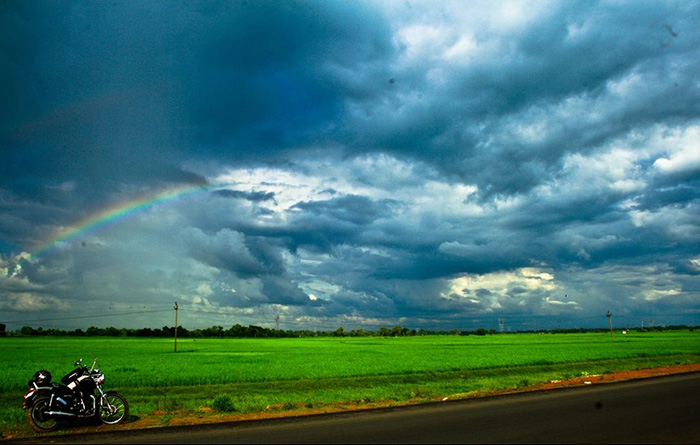
It was time for me to ride with the tide. I set my GPS coordinates to Shillong, which indicated the route via GS Rd/AH 1/AH 2/NH 40 and a distance of a mere 100kms. A happy me finally hit the road at 2.30pm towards the rock capital of India! Road conditions ranged from good to bad. I don’t know if it is a mere coincidence or reality, “road widening”, “two-laning”, “patching” are always in progress whenever I ride out. However, it didn’t quite matter much as I was not racing against time and enjoyed time clicking, shooting, chit-chatting with the locals to cover a distance of 100kms within 5 hours.

Tale of Seven Sisters - Fog envelops the serene beauty of Seven Sisters
Fog envelops the serene beauty of Seven Sisters

Shillong’s alpine valley welcomed me with arms wide open and I embraced her like a playful child. I checked in at Hotel Broadway and lodged myself in a single room. Running away from the maddening crowd is never easy! An over-enthusiastic & incessantly loud Bong family stumbled upon me and I got caught in their line of firing questions. This is how it went:
“Arey dada – Alipore registration…” (Hey dude, Alipore registration?)
“Kothay jaben? (Where to?)
“Eka eka chole elen, barite allow korlo? (You came alone, did they allow at home?)
“Koto dey garita”? (How much mileage?)
“Kolkatay kothay thaken?” (Where do you stay at Kolkata?)

Any other time, I would have enjoyed this interaction, but the rat race inside my tummy almost made me suffocate to their questions. And I whispered to myself “Really… Bongs are everywhere!” I quickly gulped my dinner from a restaurant that served Bengali cuisine and rushed back to the hotel room to face another bigger challenge! Shooting a documentary!

Soon I realised videography was altogether a different ball game and once again inspiration played its part to get me into this. I was inspired by the tales of Gaurav Jani (award-winning filmmaker and traveller) and this was going to be my unsung tribute to him. I tried to shoot an introductory clip in my hotel room and I looked like a fool in front of the rolling camera. I had to re-take almost 10 times to shoot a clip of 3 minutes and I could very well guess what was lying ahead!

Tale of Seven Sisters - On the road- Off the road- Mawsynrum- Cherrapunji - Sohra- Sela
On the road- Off the road- Mawsynrum- Cherrapunji – Sohra- Sela

It was practically my first day on road. So I started quite early, as early as 4.30 in the morning! Just as I packed my saddle, I felt like somebody was calling me out. “Dada”…?? I didn’t pay much heed the first time, quite obviously you don’t expect to be someone’s elder brother during the wee hours of morning. I heard the sound once again, this time nearer and shriller! It was Bhola, the hotel room caretaker I had befriended few hours back during check-in. With a torch and umbrella in his hand, he came up to me and very sweetly asked, “Cha khabe?” (Wanna have some tea?). Albeit not a big fan of this exotic Chinese leaf, I didn’t quite mind a cup of hot tea especially with such wind chill and drizzles around. More than anything else, I was touched by Bhola’s gesture! My instant response to him was “Etto shokale? Kothay pabe?” (Where will you get tea so early in the morning?).

Tale of Seven Sisters StatesHis response was a smile full of warmth. “Two minutes”, he said. Pleasantly surprised, I concentrated on packing once again. After couple of minutes, I could hear quick steps running down the stairs. And there he was with a flask full of tea and two cups. As I took sips off my cup and warmed up, I thought to myself. Truly, there are no strangers here; only friends you haven’t yet met. I was convinced that this ride couldn’t go wrong, no matter what happened!

“Empty your mind!” “Empty your mind!!” I kept whispering to myself. As, by the time I kickstarted the journey, my mind had got filled up like one busy junction of the Times Square. A sky-full of thoughts, apprehensions and anxiety clogged my inner self. What if I don’t come back safe? What if I lost my way? What if… Mom always said whenever you are perplexed, remember God, he takes care! Well, being an atheist, I don’t have much of a relationship with this man-made element. Despite that, I did say my prayers, to my creators: My parents. I left Shillong still in deep slumber and took along with me a very shy sun and a thumping Thunderbird!

Factfile –

http://tinyurl.com/nupme42
http://en.wikipedia.org
http://www.indiamike.com
http://xkmph.com/

Venture out on Vegan Meals!

3

I am well aware of organic food due to my association with various voluntary organisations working in the field of environment and sustainable agriculture. Today, conscious efforts are being made in choosing the right kind of food products that are not harmful for the environment. Eating organic food has become a well established trend among urbanites, who realise that every tiny bit we do adds up to make our lifestyle lot more wholesome and the environment a lot more better.

Veganism is becoming a much talked about food concept that is rising in trend, which was first adopted by environmentalists and animal rights activists. But when I first came across this concept I wondered while avoiding meat to an extent was surely possible, how can anyone avoid all kinds of animal-based products. Since I am a passionate cook, a dear one gifted me a voucher for a green cooking session on my birthday, which falls on the World Vegetarian Day.

Vegan Meals - Nina Osswald demonstrates vegan food
Nina Osswald demonstrates vegan food

But I was still curious about knowing what constitutes green cooking and vegan meals, so I eagerly participated in the session organised by Goethe-Zentrum, the German cultural institute in Hyderabad that regularly organizes various socio-cultural activities. Goethe-Zentrum had invited Nina Osswald, a German researcher and a well known organic consultant to talk on issues of organic food, environment and health.

Nina Osswald introduced us to this new concept called ‘Veganism’, which can be defined as the practice of abstaining from the use of any kind of animal products in diet, as well as preventing cruelty to animals in all human activities. While a vegetarian diet excludes all kinds of meat, a vegan diet does not include a dairy product as well! It is quite an unusual concept for us Indians, who are obsessed with using milk and other dairy products in our food.

Veganism is becoming a much talked about food concept that is rising in trend, which was first adopted by environmentalists and animal rights activists. But when I first came across this concept I wondered while avoiding meat to an extent was surely possible, but how can we exclude dairy products from your daily routine cooking and still stay healthier?

Nina Osswald, who practices veganism explained to us on various ingenious ways by which we can vegan diet in Indian cuisine. Nina had been a part of global organic movement since many years and she also follows a strict vegan diet. She has been a vegan for last two years and she says it does not make much of difference to exclude dairy products from her food for she has found other alternatives to compensate them.

Vegan Meals - Vegan Nina

Nina’s session began with an awareness talk about on organic food and products. Later she shared some important vegan recipes and also prepared a wholesome good meal using them. Lot of interaction between her and the participants made the session more interesting. At the end of the session, we all shared a vegan whole meal and to my surprise it was tasty too!

Nina gave us a list of ingredients that are more suitable to vegan diet:

  • Replace polished rice with millets and whole wheat
  • Soya or Coconut milk instead of dairy milk
  • Sprouts of pulses instead of animal protein
  • Cashew paste and peanut butter instead of butter, ghee

Talking about vitamins, Nina says similar vitamins can be consumed through greens, vegetables, fruits and pulses. She enlightened us many recipes and said if you are determined, you can easily create your own recipes without using any dairy product. when inquired how does she feel being a vegan? she say she been all the more healthy and light and she feels by doing she can do her bit for the mother earth.

Veganism is a small but growing movement. In many countries the number of vegan restaurants is increasing, and some of the top athletes in certain endurance sports such as triathlon and the ultramarathon, etc. practise veganism, including raw veganism. Well-planned vegan diets have been found to offer protection against many degenerative conditions, including heart disease.

Vegan Meals - Vegan Ragi balls with sesame
Vegan Ragi balls with sesame

Vegan diets tend to be higher in dietary fibre, magnesium, folic acid, vitamin C, vitamin E, iron, and phytochemicals, and lower in calories, saturated fat, cholesterol, long-chain omega-3 fatty acids, vitamin D, calcium, zinc, and vitamin B12. Since plant foods tend not to contain significant amounts of B12, researchers agree that vegans should eat foods fortified with B12 or take a daily supplement.
Overall, it looks like a vegan diet is a feasible idea. I am trying it out at home with sprout salads and ragi rotis this World Vegetarian Day. Do let me know if you have created any good recipes out of vegan food!

Factfile –

http://www.indianvegan.com/home.php
http://www.thehindu.com
http://thealternative.in

The Tale of Seven Sisters and a Motorcyclist – Part I

3

Motorcyclist - Biking Seven Sisters States
Riding along verdant fields on NH-34 | Click to enlarge

“A Solo thumping Soul” – I had nothing to prove to anybody. No regrets on what might have happened on any of my past rides. No hard feelings for anybody. No emotional slings or any promotional blabber! All I wanted was “THE RIDE”. I was eager to taste the freedom of riding solo, face and overcome challenges on my own grit. See how much I could really endure… curse, blame and bang myself for whatever baloney might happen on the road and whisper to my mom… “Look Maa, I have grown up”!

East to West …North to South, I consider myself fortunate enough to get a glimpse of the mystic and Incredible India and remain hungry to explore many more unknown lands and meet the most colourful people on my trails. It was this zeal to know the unknown that triggered my solo ride to one of the remote and uncharted parts of the country… the enchanting North East! A part that is also known as the ‘Seven Sister States’.

Why North East?

Motorcyclist - Solo Biker- Royal Enfield Thunderbird
Solo Biker- Royal Enfield Thunderbird

“Beautiful” and “Wild”, these are possibly the most apt adjectives for the Seven Sister States. Situated far away from the maddening crowd and at staggering heights where one could get lost. For me this ride meant liberty to become one with nature… to have a rendezvous with the Bohemian within me. This was my opportunity to break free the shackles of the “earthly disordered” life of a corporate slave. Further, I was always curious about the ethnic and cultural diversity among the north eastern states. Thus began an epic tale of over 5,000kms across 5 states for 15 days.

Historically, I don’t remember dad making a fuss about any of my rides in the past; and my mom was always the ‘Nirupa Roy’ of our family. However, this time I was in for a surprise. All hell broke loose the moment I “itched” the topic of my solo ride at the dinner table. After some heated verbal exchange, dad left the dinner table “half-hungry”. Mom stared at my face with zero gravity. My brother concentrated more on the delicious ‘Muri-ghonto’ and gulped dad’s share too. Mr Arnab Goswami ogled at my face from the TV screen pseudo-asking “Let’s debate on this once more and ask for the nation’s opinion”! I realized that everybody becomes ‘Dad’ eventually and called it a day.

Ride preparations and the Route for the Solo Ride

Motorcyclist - My Royal Enfield Thunderbird packed and ready
My Royal Enfield Thunderbird packed and ready

My readers may be aware, most border states in India such as Arunachal Pradesh require ILP (Inner Line Permits) for entry. On any bright sunny day, acquiring an ILP is usually a hassle-free affair. However, if you hail from a state called West Bengal, you might be standing at the wrong door of fate. I had applied for my ILP for 2 zones in Arunachal (Bomdilla-Tawang- Sela-Bumla Pass [West Kameng district]) and (Itanagar-Gohpur-Ziro-Daporijo) 10 days in advance at the Arunachal Bhavan and was advised to check back after a week. When I inquired about the status with less than 2 days left for the ride, a very pensive attendant quite effortlessly informed me that ‘Bada babu’ is on leave and they can’t find my application. I would have to re-apply which would take another 2-3 days. Just guess my natural reaction to that!

Later, I realized acquiring an ILP from Guwahati would be a better option. One can also apply for ILP in other parts of Assam. So finally I was all set to ride in mid-May 2013 (although without an ILP!).

  • Got my Royal Enfield Thunderbird fully serviced (motorcycles for sale)
  • Installed a pair of Hella fog lamps on a makeshift mount
  • Loaded spare tubes, puncture repair kit, a dozen 10-15amp fuses and Royal Enfield tool kit
  • Packed my riding gears, 4, 5 Bungee ropes, waterproof and outdoor gears
  • Took my camera kit (Canon EOS 1000D), Tripod, Gorillapod, backup memory cards

Finally the Route:

Plotting my route across Seven Sister States on Google Maps

Plotting my route across Seven Sister States on Google Maps

Kolkata -> Siliguri (via NH 34) -> Guwahati -> Shillong -> Cherrapunji‎ -> Mawsynram -> Shella, East Khasi Hills, (all in Meghalaya) -> Agartala (Tripura) -> Tezpur (Assam) -> Bomdila -> Dirang -> Sela Pass -> Tawang -> Itanagar -> Ziro (all in Arunachal Pradesh) -> Sivasagar -> Jorhat -> Guwahati (all in Assam) -> Siliguri -> Kolkata

There was nothing eventful during my journey between Kolkata to Guwahati through the notorious and bone breaking National Highway – NH 34. For a moment, I felt national highways in India only existed on maps! Biking in India is like playing football in Iraq, you never know what hits you!

The Tale of Seven Sisters… Part 2

Factfile –
http://tinyurl.com/nupme42
http://en.wikipedia.org/
http://www.indiamike.com

Celebrate Tourism Day in Offbeat Destinations

0
Offbeat destinations - Beyondwild photography expeditions
Beyondwild photography expeditions

The other day, I happened to visit an interesting trade show named Travel & Tourism Fair (TTF), which claims to be India’s leading travel trade show hosting events across all major cities in India. There all kinds of expo stalls hosted by representatives of state tourism development corporations, large hotel chains, spa & resorts, jungle trek organisers, travel websites, foreign tour operators, and others. The variety of travel options they offered were mind boggling. If you had the money and inclination, you could anywhere from Andamans to the Himalayas in India, Bangkok to Switzerland abroad!

There were very few individual customers visiting the expo. It could be that TTF is a B2B travel trade show mainly visited by travel agents and tour operators. I interviewed a few stall owners and checked out which are the tour itineraries popular among Indian tourists. I was surprised to know that despite the plethora of travel options on offer, most tourists asked for only three options – beach & booze locations, honeymoon packages, shopping destinations!

Offbeat destinations - Scuba diving in Andamans
Scuba diving in Andamans

Are we confining our travel only three options… don’t we want to explore our diverse country, learn about new cultures, see enchanting scenery, experience the adventure and unwind in serene surroundings…

It is so sad that most of us don’t want explore new travel spots; rather we would go to the same location and do the same things. If travel is about enjoying the thrill, I am surprised that how this kind of repetitive visits can be thrilling! This is like saying “Hey, I went to Goa again during holidays and it was mind blowing, man!”

Anyway, for those who still have some adventure left in them, I urge you to take the off-the-beaten track on this world tourism day. Here are some interesting and exotic travel packages to check out –

Offbeat destinations - Homestay amidst coffee estates
Homestay amidst coffee estates

Agri-tourism or farm tourism packages offered in Maharashtra and Punjab
Scuba diving in Andaman & Nicobar Islands 
Ayurvedic treatment and spice plantation visit in Kerala
Homestay amidst coffee estates and angling for fish in Coorg
Tea tasting and tea infused menu in Ooty tea gardens
Trekking in the foothills of Himalayas in the Northeast 
Volunteer for organic farming in Uttarakhand

Heartwarming Homestays at Coorg

0
Homestays at Coorg - built in British bungalow style
Homestay cottage built in British bungalow style

People in Coorg carry hospitality in their genes, homestays help promote the unique Kodava culture. Spend time away from maddening crowds, you can choose to stay in a Coorg homestay which is surrounded by a picturesque coffee estate, verdant forest and water streams. What was special about the vacation you spent in your grandpa’s village house in the good old days? You lived a spacious yet charming tiled roof house with wooden furniture. You roamed around the countryside, playing in the water streams, trekking up the hillside, relishing the wild fruits and fooling around with frogs and crabs. Food made by your grandma in the traditional way was delicious and a number of fruits were available for dessert. Now compare that experience to a stay in a commercial hotel in a hill resort today!

Many of us wonder if it is possible to experience such a heartwarming homely stay in a hillstation in a commercial set up. Fortunately, the new concept of ‘Homestays’ try to recreate exactly the same experience that we all desire for. In a typical homestay, guests are either accommodated in the family home or in separate quarters nearby, and are provided with the same comfort as a regular hotel. While this concept is well established in the West in the form of ‘bed & breakfast’, it has taken roots in India over the last decade.

Homestays at Coorg - Birds eye view of Madikeri from Ajantha Homestay
Birds eye view of Madikeri from Ajantha Homestay

Particularly, homestays are more prevalent in hill resorts such as Ooty, Kodaikanal, Coorg, etc. due to the lack of regular hotels as well as tourist demand to stay in homely place in the hills. Nestled deep in the tropical rainforests of Western Ghats, is the tiny district of Coorg in Karnataka. Misty hills, lush green forest, acres of coffee and tea gardens, orange groves, undulating streets and breathtaking views make Coorg or Kodagu an unforgettable holiday destination.
It was their first time in a Coorg homestay for 34 year old Deepak Jayaram and Shubha Deepak, 32, and they loved the personal touch and the way their hosts made them feel special. They stayed in Ajantha Homestay located just outside Madikeri, the district headquarters of Coorg. Their host K. M. Karumbaiah is one of the homestay pioneers in Coorg, establishing Ajantha Homestay way back in 2003, at a time when Coorg was just warming up to the concept of homestays. Karumbaiah explains “Back then, I had a tourist info centre and I saw several tourists go back disappointed due to lack of rooms in hotels”. He says “the idea of a homestay came about when I stayed at a bed ‘n’ breakfast place in 2001, while visiting Edinburgh in Scotland.”

Coffee wood furniture in verandah – Sandbanks

For Micky Kalappa of Sandbanks nestled in a coffee estate in Ammathi, it was always a pleasure to treat guests at his home in Coorg. “My father loved playing host to people from all around the world”, says a proud Kalappa who started his homestay way back in 1991. Talking about homestays, Micky Kalappa says they have become a trend among the urban elite. “People come to homestays to understand the Kodava culture, while people who stay at hotels just want fun and adventure”.
Many like minded Kodava families soon joined the growing tribe of homestay hosts and finally the Coorg Homestay Association was born and registered in 2006. The then Tourism Secretary of Karnataka, I.M. Vittal Murthy took special interest in helping out the families to get their demands fulfilled. A draft copy of homestays from the UK was studied and based on that model a policy was formulated in 2009. An inspecting agency was formed to monitor these homestays for basic necessities and registration. So today, there are 178 registered homestays in Coorg. Homestays are classified as non-commercial units and there are two types: the Premium Type – Silver and the Luxury Type – Gold.

Homestays at Coorg - Exploring a coffee estate
Exploring a coffee estate

The President of the Coorg Homestay Association K.M. Karumbaiah says that there is a constant increase of 10-20% of people checking into homestays every year. Based on the great Indian tradition of “Athithi devo bhava”, the association aims to promote homestay. “People in Coorg carry hospitality in their genes, we are just making a good use of it”, quips Karumbaiah. Further, homestays also help promote the unique Kodava culture. “We make it a point to see that our guests try out local cuisine, take them to Kodava weddings and ceremonies and tell them about the local culture and tradition”, adds Karumbaiah.
So the next time you need to spend time away from maddening crowds, you can choose to stay in a Coorg homestay which is surrounded by a picturesque coffee estate, verdant forest and gentle water stream. In fact, some of these homestays are located just next to a waterfall like Iruppu Falls!

This is a post by our guest author Apoorva S. All the photographs in this post are by the author.


Factfile –

Homepage


http://www.discovercoorg.info

Check our feature on Coffee Flavoured Honey!