The Era of Aesthetics: Origin of Artistic Functionality

0

Author – Devangini M

Design and décor have seen an evolution of sorts in the past one century. So what really makes an era? To understand that, we must first, fully understand what décor stands for.

To begin with, décor is a matter of imbibing certain design elements within a confined space to make a statement. Having said that, décor is not limited to the technical aspects of design alone. It has to do with sensibilities and an eye for aesthetics.

origin of artisticWhen we speak of aesthetics in design and spaces, we are instantly drawn to the bygone period when this movement in design first began. It was towards the later part of the 19th Century that a need for transition was first felt. It began with an international design movement known as the ‘Arts & Crafts movement’, which era lasted between approximately 1870 and 1920. The evolution of spaces from drab and routine, to spaces full of design came about during this era. It was in this period that the word ‘décor’ first came to the fore.

The term ‘Aesthetics’ refers to the introduction of principles that emphasized art in the production of furniture, metalwork, ceramics, stained glass, textiles, wallpapers, and books. If one does glances through the images of homes in this era, one will find dark yet bold hues represented through a play of pattern and form. Even walls and furniture were not spared. The influx of colour and brooding pattern were the hallmarks of this era of décor. Renowned American artist James Whistler’s Peacock Room is the classic example of this era.

Despite am obvious leaning towards bold styles, the Aestheticians were fans of everything sensual. Gone was the busy intricacy of carving and moulding. In this era of décor, the emphasis was on portrayal of form and scenery rather than the richness of pattern for the sake of pattern. This era was the one where art was created, for art’s sake!

origin of artistic - Paint Whistler Room
Image Source: Flickr

The arts & crafts influx from this era saw a spill over into the ‘Art Deco’ period of décor; an era of garish vibrancy, and everything art. If the Aesthetic era was about a sensual flow of pattern and its brooding aspect, the Art Deco period was one where these very qualities were amplified and presented in what we now term as an “in your face” style.

In the aesthetic way of décor, the elements of design were usually the use of colour in its bold, yet elegant form. The forms and patterns had a shadow, a silhouette, almost breathing life into spaces. These elements pointed towards the 20th Century in a distinct manner. Another distinct feature of this era was the use of silver. Silverware came to be used as a major element that tied other aspects towards to lend that polish and sheen to the groupings of other elements.

origin of artistic - peacock room
Image Source:ibiblio.org

The Aesthetic era also held an eclectic appeal as it was probably the first time that combinations like various kinds of tapestries, woods and metals were seen. The best part about this era was that it pushed aside the superfluous form that was rampant during the Victorian era, which preceded it. With that artists finally managed to do away with the voluptuous and get a grip on the functional. Starting from cabinets to chairs and even the silverware; one could see a concerted effort towards finding a foothold in the area of ‘functional design’.

origin of artistic

This functional design suddenly made décor more accessible. There was scope for beauty even in the drabbest of spaces. More notably, design and décor finally reached the American shores too. This simplified European artistic movement met the functionality of American sensibilities of that time, to give Aestheticism a whole new meaning. The effect was one of beauty in everything.

Much like the Midas touch, this movement or era, seemed to touch everything that came in its way. In interiors, the effect was subtle yet obvious. Eclectic pairings and a use of colour to depict form, rather than intricate work without colour, soon found its way into people’s living spaces.

We still seem to be living in a hangover from those aesthetic times. The Aesthetic movement is still evident in our lives and spaces, in the form of pops of bright colour in the most contemporary settings. In fact, it was with this era that people started leaning more and more towards minimalism, until it has become what we know of it today. Yet, one must remember that aestheticism is much more than mere austerity: it is an expression of form, line and design.

– Factfile –
http://cai.ucdavis.edu
http://www.artdaily.org
http://en.wikipedia.org

Looking beyond the rosy picture

0

It is that time of the year again. Roses and chocolates, cakes and candle night dinners. Valentine’s Day reignites the love in all romantic hearts and brings them together to share their affection publicly! The most prominent symbol for the day of cupids is the bouquet of roses exchanged among loved ones. As usual, lovers of all ages reach out to their nearest florists to customize their bouquets.

beyond the rosy picture - polyhouse-harvesting-robot

Harvesting robot in a polyhouse

For people like me who are romantically disinclined, Valentine’s Day is a day of crass commercialism instigated by large multinational companies to market their products. It is a day that unites both right-wing fundamentalists and left-wing activists in their hatred towards western cultural vices. I wondered why we Indians who live in the land of Kamasutra and Kalidas, cannot tolerate love. Why can’t we have a ‘Kama Diwas’ dedicated to Lord Kama?

Leaving aside controversial issues, I also wondered how come the roses and other flowers available at the florist, are always cut at the same height, with uniform bud size and are freshly blossoming. I felt these flower buds were so perfect that they looked as if they are manufactured in factories! I could say that since I have tried to grow roses at home, but the outcome was miserable.

Little did I realize that these flowers were actually grown in factories! After visiting the floriculture auction centre inside the agricultural university in Bangalore, I got to know growing roses is a serious business involving crores of rupees. Roses are no more grown in open fields exposed to the elements. They grow in sophisticated large plastic covered greenhouses (polyhouses) which are climate controlled. Numerous workers take care of the flowering plants by feeding manure to enhance growth, spraying chemicals to ward off insects and watering them through mist generating sprayers.

beyond the rosy picture - Fresh-Chrysanthemum-saplings-planted-in-polyhouses

Fresh Chrysanthemum saplings planted in polyhouses

These polyhouses ensure that plants grow uniformly unaffected by the harsh sun, wind and rain. Further, they also have artificial lighting to ensure adequate lighting during dull rainy days. So the roses, the gerberas, the lilies and the chrysanthemums grow under optimum lighting, along with an appropriate supply of airflow, moisture and nutrition.

Large polyhouses can be found around the outskirts of cities like Bangalore and Pune. These polyhouses are operated by large agri-business companies, which have nothing similar to a traditional farmer. They utilise advanced technologies to ensure their flowers meet up to quality standards despite fluctuations in weather conditions. Moving beyond soil-based cultivation, they are now using other substrates such as coco-peat or gravel. Further, instead of using human hands to harvest flowers, the floriculture companies are utilising an automatic cut rose harvesting robot. Don’t worry, the cheap Indian labour is not at threat; these robots are being used in the Netherlands!

Coming to back to roses, they fetch the maximum value during the weeks leading to the Valentine’s Day. So a single long stem cut rose that normally costs Rs.5-10, would fetch Rs.15-20 during the two weeks between February 1st and 14th. Roses of all varieties are exported from Bangalore and Pune to European and Japanese markets during the run-up to the V-day. Bangalore-based Karuturi Global claims to be the world’s largest cut rose producer, exporting about 1.5 million stems of 40 different rose varieties a day to Japan, Australia, South-East Asia, West Asia, Europe and North America.

beyond the rosy picture - Chrysanthemum-blooms-in-a-Floriculture-unit-in-Bangalore

Chrysanthemum blooms in a floriculture unit in Bangalore

Evidently, floriculture has become a serious business requiring massive investments. In the fiscal year 2011-12, 300 Indian export-oriented floriculture companies exported flowers worth Rs.365.32 crore to countries such as the UK, the Netherlands, Germany, Japan and the UAE. Around 190,000 hectares of land was under flower cultivation in FY2011-12, which produced about 10.31 lakh loose flowers and 69.27 million cut flowers.

Wondering what is the difference between cut flowers and loose flowers?! Loose flowers are cut in the traditional Indian way of cutting at the neck, while cut flowers are cut along with their stems of around 1-2 feet length. The long stems enable the flowers to survive in bouquets and vases for a week.

Meanwhile, floriculture farmers in India are in trouble this year. A warmer winter in 2013 has turned out to be a thorn in the flesh for rose growing farmers. In Pune and Bangalore, the winter temperature has increased by 40 Celsius. This warmth has advanced the arrival of the roses with at least 25 per cent of the blooms are set to arrive in the market much ahead of Valentine’s Day in 2013. Floriculturists are worried that the sharp rise in temperature could lead to damage. In the domestic market, most planters are expecting a glut that would result in prices plunging.

Warm winters can spell trouble for floriculturists, but we buyers can relish the cheaper roses this time!

Factfile –
http://www.apeda.gov.in
http://businesstoday.intoday.in
http://roses2go.com.au

Ten Green Ways to Improve Your City Forever

0

Green Ways to Improve Your City - improve-your-city-infographic

1. Use public transportation- alternative fuel vehicles are increasing and can save up to 4.2 billion gallons of gas each year.

2. Open parks and trails- greenery inside the city is aesthetically pleasing and can help the production of other green products.

3. Decrease waste- at a rate of 1 million plastic bags used per minute worldwide, switching to reusable bags can have a huge impact.

4. Start local- farmer’s markets and community-supported agriculture are healthier and environmentally friendlier options for produce.

5. Use the roof- rooftop gardens conserve water, reduce runoff, and create insulation on otherwise wasted space.

6. Urban farming- grow produce in the roof gardens.

7. Convert to natural gas- it burns cleaner than oil.

8. Create Smart Cities- that monitor temperature, pollution, and radiation.

9. Build green- use biomaterials and avoid tree harvesting.

10. Switch to electric- electric cars use almost half the amount of gas, and still emit just as much power.

Source: Best Sociology Programs

Sundarbans: In The Flow

2

I must admit that the desire to head to the Sundarbans arose several years ago, while reading the first chapter of Amitav Ghosh’s “The Hungry Tide”. However, the actual trip materialized much later coinciding with my need to escape the urban extravagance of celebration synonymous with every new year.

For serenity seekers, Sundarbans provided many such islands of calm. Far away from any celebration, life here carries on somewhat synonymous with something cosmic, evolving with the tides. Sundarbans () is the world’s largest tidal halophytic mangrove forest, which was declared as a World Heritage Site by UNESCO. Understandably it is huge, the part that lies in India is well over 9,000 sq. km. This effectively means one ventures just about the edge of these Sunder bans (“Shundor bon” means beautiful forest in Bengali) and never quite loses the sense of still being on a journey. My travels around Sundarbans reflected just that, being perpetually in motion, flowing, ebbing, meandering along the canals and island pathways!

Canals-Sundarbans
A villager goes about his chores in the most common mode of transport in the Sundarbans, rowboats.

My journey began from Kolkata (the nearest airport), and after a 100kms drive to Sonakhali, I boarded a ferry run by the West Bengal Tourism Dept to navigate the canals of Sundarbans for the next three days. Sundarbans is a cluster of 102 islands, of which about 54 are inhabited, while the rest are protected mangrove forests, too dense and painful to navigate. So along these islands, we moved from Sonakhali to Gosaba, reaching its main forest outpost in Sajnekhali.

The feeling of waking up on the last morning in the ferry, docked near Sajnekhali, remains vivid. The skies were dark except for streaks of faint pink and the air heavy with expectation. The water lapped gently against the boat and its calm surrounded the mangroves, broken only by the flapping of a flock of birds flying past and receding quickly into the horizon.

Whistling-ducks-Sundarbans
These are the lesser whistling ducks which are found predominantly in the Indian and South Asian subcontinent. They make a shrill whistling noise as their name suggests

As the pink in the sky turned slowly into a rich bright orange, the ferry stirred with the motions of an impending morning. People joined me on the deck, with upbeat calls for their morning cuppa “ki re, cha dibi to?” (“you’ll be serving tea, right?”). And then Arun, our all-knowing guide, bounded up the stairs. Over the last couple days, he had pointed out over 25 species of birds, some migratory some native to the mangroves, estuarine crocodiles, monitor lizards, herds of deer and snakes. He had awed us with his stories of survival in the Sundarbans, of the most recent Cyclone Aila, and having to rebuild his life time and again. Despite all this, we still hadn’t chanced upon the only thing most travelers come here for, a glimpse of the Royal Bengal Tiger.

I persisted, staying on in the Sajnekhali Forest lodge for a few more days. Here, I got the chance to spend time endlessly on the watchtower scanning the mangroves and listening to stories of the forest guards and their many encounters with the tigers in the region. However, the most time I spent was just aimlessly flowing around the canals, just the boatman and me, just the quiet and sometimes the joy in following a flock of whistling ducks. The mist took its own time to rise and unveil the mangroves around. It was breathtaking!

Boatman-Sundarbans
A misty morning boat ride around various canals (known as ‘khali/khadi’ in the local dialect) of the Sundarbans

The boat dropped me off later on the island of Pakhiralay (the abode of birds in Bengali). It was an idyllic village, where I spent my time spotting many tiny birds – sunbirds, kingfishers, wagtails, egrets and more. The village girls were busy threshing crop and I joined in their chores. When we were done, I sat around with the women packing honey, which is harvested from the mangroves around.

I was down to my last morning in the Sundarbans, and yet the Bengal Tiger remained elusive. I packed my bags and set out for my last goodbyes. The forest officer, stood at the gates, looking worried as he waited for the patrol boat to come in. I said goodbye as I waited for my boat to take me to the next island, and as we both waited he mentioned that a tiger has entered a nearby village and they needed to rush. I guess someone would see a tiger today, if not me, and I knew it would be marred by fear!

Defining an Offbeat Travel Destination

0

When we initiated our offbeat travel destination and travelogue contest, many of our friends countered us with a specific question, “What do you mean by an offbeat travel destination?” “How do you define one?”

At first, we were taken aback by this simple question! How can anyone have doubts about the definition of offbeat tourist spots? However, when we sat down to define them, we realized that there is no clear cut demarcation between a mainstream tourist spot and an offbeat one.

So, we began a compilation of defining points to differentiate an offbeat travel destination from a mainstream one. Please check and vote if you agree with these defining points:

[socialpoll id=”2330666″]

If you feel these criteria are inadequate to define an offbeat destination, you can suggest better ones.  Suggest us better defining points by commenting to this post.

Image Source: sxc.hu

Unravelling the Mystery of Udvada!

5

Many of us don’t remember much about the places we lived during our early childhood and if our parents are nostalgic about their memories in such places, we are unlikely to show much interest. One such destination I had often heard from my parents was Udvada in Gujarat. It was in Udvada way back in the 1970s, where my mom & dad stayed after their marriage, where my dad began his career and I had my early childhood. It was their dream to visit this place once before they die and we children decided to make it happen.

Finally, the day came when we set out for South Gujarat, just as Mr. Amitabh Bachchan urges us to explore the beauty of Gujarat! We left early in the morning from Pune and by afternoon, we were already in Valsad passing through Vapi. Valsad is a small town with all the required lodging facilities and it is well connected to most of the nearby places such as Kolak, Daman and Udvada. We chose to stay there and then find out more about the other touring destinations in South Gujarat.

Udvada Parsi fire temple
Oldest Parsi fire temple in Udvada

During our ride to Kolak, my parents were all the more excited and started sharing their nostalgia about the place. Dad told us that he used to cycle around seven kms everyday to go his workplace from Udvada to Vapi. Soon, we reached Udvada thanks to Google maps and to Mr. Narendra Modi, who has facilitated tourism in Gujarat with such well-laid out roads.

Udvada
Religious stalls outside Parsi fire temple

Udvada is a quiet village on the seashore of Gulf of Cambay near the popular tourist destination of Daman. Udvada is a seashore oriented town with few Gujaratis and Parsee families staying together. This village is the holy place of pilgrimage for Parsis (Parsees), who are the followers of the Iranian prophet Zoroaster. They are part of a tiny Zoroastrian community living in India. Legend has it that a group of Iranian Zoroastrians migrated to western India more than 1000 years ago. In the 8th Century, after the Arab invasion of Persia (Iran), these Parsis landed in Sanjan (Gujarat), and were provided with shelter by Jadav Rana, the local Hindu ruler.

In order to preserve their religion, the Parsis constructed the first fire temple, Atash Behram, to protect the holy fire which they have rescued from Iran. Gradually, they acquired the Gujarati custom, language and way of living. Thus, the Gujarati became their native language and the Gujarati sari became the garment of their women.  During the Pateti holidays and other auspicious days, this place is visited by Parsis.

Udvada
Udvada Parsi fire temple model

Built in 1742 AD, the Iranshah Atash Behram is the oldest functioning Parsi place of worship in the world today, which has established Udvada as a major pilgrimage centre for Zoroastrians the world over. Since it is the holiest of the places, only Parsis are allowed to enter the shrine. Non-believers like us can see the fire temple from outside and observe the few stalls outside the shrine which sell sandalwood, scarves and sacred food items.

Udvada also has a Parsi museum nearby, which showcases the Zoroastrian heritage, sponsored by the Government of Gujarat. They also have a tower of silence outside the city, called Dakhma which is the burial place for Parsis. It is a circular raised structure which used by Zoroastrians for exposure of the dead, particularly to scavenging birds.

Udvada Gujarat
Old Dargah in Kolak

In the nearby village of Kolak, one eye catching sight is the Old Dargah Mira Dattar, which is in the centre of the village. It is not only visited by all types of pilgrims from all part of India, but irrespective of caste or religion. Mostly, the dargah is visited by people afflicted by mental maladies. People talk about the miracles of the dargah and my parents were an eye-witness to such miracles. However, the Dargah has now lost its charm and stands in disrepair. The small fishing village is on the seashore and most of the houses are closer to the beach. Although we all were enthusiastic to see the shore but unluckily, we were unable to watch the sea waves due to low tide during our visit 🙁

By the time we finished our visit, our parents were able to extract info about their old contacts in Udvada and Kolak. To our surprise, we received a hearty welcome from their old Gujarati friends who had not met them for the last 30 years! The bonding and affection showered on us was really heart-warming and ambiance of place made our stay worth in Udvada.  Beautiful ancient shrine, endless seashore, calm fishing village which is trying to restore its golden glory and the warm welcome made us realize that the golden memories reminisced by my parents was truly a worth destination to explore.

– Factfile –
http://en.wikipedia.org/wiki/Udvada
http://www.indianetzone.com/43/parsi_culture.htm
http://en.wikipedia.org/wiki/Dakhma

Tip No.1 on Travel Writing: It isn’t Glamorous!

0

Everyone (well, nearly everyone!) wants to be a travel writer. What could be better than free flights, visiting a beach paradise, and then writing about it? Travel writing offers loads of perks: you can explore the world, and get paid to do it. If you are looking for a job that doesn’t require a suit, travel writing could be perfect. However, it is not that easy to break into the industry, and pay cheques don’t come with any regularity. Here are some tips on how you can crack it.

travel-writing
Image source: sxc.hu

Start Right

Quitting your day job and launching into a travel writing career isn’t the best move. Ideally, you should ease into it, while you still have the security of a 9-5 job. Freelancetravelwriter.com suggests that an easy way to break into travel writing is to take a break in your career (if you can afford it), or, if you’re a student, take a gap year. You can then build up a portfolio of travelogues while you explore. However, you don’t necessarily have to venture to faraway places to write about travel. You can just begin by writing about your hometown. You would be surprised by what you can discover by just stepping out of your front door!

Be Realistic

Travel writing is not as glamorous as it sounds. It takes a lot of hard work and perseverance. It could take several years to get your feet off the ground by building a portfolio and a network of contacts. Hence, it is imperative that you have some sort of a backup plan, just in case you struggle at first. Freelancetravelwriter.com suggests that you have an internationally marketable skill, such as medicine or teaching. That way, you will be able to see the world, write about it, and have a steady income to fall back on.

Since a lot of glamour is attached to travel writing, you will sometimes be expected to write pieces for free. Don’t do that. According to VergeMagazine.com, you can do a few freebies at first (for exposure), but don’t get into the habit of doing this. you will end up getting a reputation of working for free.

Travel Writing
Image source: sxc.hu

Think Beyond the Destination

Travel writing isn’t only about writing guides to exotic locations. According to VergeMagazine.com, original ideas and angles will set you apart from other writers. Focus on anything special or unusual about the place you visit, and interview local people. Get ideas from news sites or fact boxes from travel guides. Try to get the maximum number of stories out of one trip: for example, if you are visiting Thailand, you can write about cheap dental treatment, kick boxing training camps, the political situation, and about Thai lady boys who become monks. Think beyond temples and pad thai!

Some research online will reveal a range of freelance journalism courses, with travel writing being fairly popular. Most of these courses can be done online, which offers flexibility and convenience. A well-rounded travel writing course will teach you how to write features, conduct interviews, write fiction, market yourself, and even include the basics of photojournalism. Travel writing is an exciting profession that offers insights into different cultures and countries. If you are looking for a job outside of a cubical, it could be for you.

Top Offbeat Travel Destinations in North India

10

Travelling across the Indian subcontinent, we are amazed by the diversity and splendour of natural and architectural beauty found in the various tourist locations. The main tourist sites are so well known that we tend to avoid them due to the huge crowds that throng these places. Many of us prefer the locations which are off-the-beaten-path and are frequented by few people. However, in a densely populated country like India, even the offbeat destinations tend to become overcrowded after some time!

While some offbeat tourist locations get trampled by increasing number of visitors, some of these locations retain their quaint charm despite the publicity given by regular tour operators. Based on our readers’ suggestions and our panel of travel writers, we have compiled a short list of offbeat tourist destinations, which may have already become mainstream destinations!

Please go through the list of offbeat travel destinations in North India and narrate your experiences to us –

Brahmaputra river cruise

Have you heard of the Brahmaputra river cruise? Have you heard of a river cruise anywhere else in India… Despite the existence of river boats which ferried passengers across the many mighty rivers of India, river cruise is still a novel tourist program. In the days of British Raj, large steamers used to ferry people across the Hooghly and the Ganges right from Calcutta to Allahabad. Today, river cruises on the Brahmaputra recreate this magical experience in Assam.

Offbeat Travel Destinations - Brahmaputra-river-cruise

Assam Bengal Navigation is an Indo-British joint venture, which pioneered long-distance river cruising in India in 2003. Their unique cruises on the River Brahmaputra in Assam, and in 2007 they introduced cruises on the River Hooghly from Kolkata and extending them to the Ganga river. The company operates two luxury river boats the ABN Charaidew and the ABN Sukapha, which run along the Brahmaputra River from October to April. Travellers can choose a four-day or a ten-day tour package which will take them across river islands of Majuli, temples of Dibrugarh rhinos on the Kaziranga National Park and finally to Guwahati. So pack your bags and sail down the river, singing “O Maajhi Re, Apanaa Kinaaraa, nadiyaa Ki Dhaaraa Hai O Maajhi Re!”
http://www.telegraph.co.uk

Valley of Flowers

For the next offbeat travel destination, we head up north into the Himalayas. The Valley of Flowers is quite a well known destination, but it remains offbeat due to two major reasons. The difficult terrain with minimal transport and the peak season coinciding with monsoon rain. Situated near Badrinath, in the state of Uttarakhand in India, the Valley of Flowers is a vast expanse of 87.5 sq kms covered with myriad alpine flowers that bloom during the monsoon months between June to September.

Offbeat Travel Destinations - Valley of Flowers
Image source

Nearly 500 species of wild flowers of vivid colours and spectacular designs attract botanists, nature lovers and adventure lovers from across the world. Officially named as the Bhyundar Valley, it is perched at an elevation of 3,658 metres above sea level. Obviously, this uninhabited region remains completely covered with snow during the rest of the year. So the glimpse of floral glory is available only during the four monsoon months. Since it is a protected National Park and also a UNESCO World Heritage Site, tourists are not allowed to stay in the Valley of Flowers. However, few hours glimpse of this floral glory will be enough to cherish for a life time!
http://www.valleyofflowers.info
http://www.euttaranchal.com

Khajjiar

Continuing further north, on the foothills of the mighty Himalayas in Himachal Pradesh, at height of 2,000 metres above sea level stands the mini Switzerland of India. Khajjiar is a tiny hill station located at 23 kms from Dalhousie. Picturesquely set in the midst of magnificent ‘Deodar’ forests, Khajjiar has a rare combination of three ecosystems: lake, pasture and forest, all in one place. Herds of sheep, goats and other cattle graze in lush green meadows presenting a picture-perfect pastoral scenery. There is a small lake in the centre of the saucer shaped meadow which has in it a floating island.

Offbeat Travel Destinations - Khajjiar
Image source

Khajjiar had minimal tourist infrastructure with just two government guest houses and single hotel. This added to its quaint charm as an offbeat destination. However, over the years some private tourist activity has entered the place. The most exciting activity is Zorbing, where tourists can roll down the sloping hills inside a large transparent plastic ball!
http://travel.india.com
http://www.tripadvisor.in

Karni Mata Temple

India is known as the land of deities and astonishing miracles. So it should not be a surprise if you find a temple dedicated to rats! In Rajasthan, 30 kms south of Bikaner, lies the extraordinary Karni Mata Temple at Deshnok. Legend has it that Karni Mata (an incarnation of the Goddess Durga) asked Yama (the God of Death) to resurrect a storyteller’s son. When Yama refused, Karni Mata reincarnated all storytellers as rats!

Offbeat Travel Destinations - Karni-Mata-TempleImage Source

Rats are everywhere in Karni Mata Temple right from the alcoves, corners, underneath doorways, to the guard-rails. They are quite accustomed to humans touching them and offering them food. However, travellers should not make the mistake of stepping on them ever. If you kill a rat, you must offer the rat’s weight in gold as an offering to the angry goddess!

http://www.travelblog.org
http://www.vanamaliashram.org

Orchha

Located 16 kms from the city of Jhansi, Madhya Pradesh, the ruins of Orchha epitomises the classic Indian medieval imagery. Beautiful architectural structures stand silently by the river symbolising the grandeur of a bygone era, while life in the town goes on a leisurely pace. This ancient capital of Bundelkhand contains splendid 17th Century palaces and temples situated on the banks of the Betwa River.

Offbeat Travel Destinations - Orchha
Image Source

There are 14 Chatries or memorials to the rulers of Orchha built along the Kanchan Ghat on the Betwa River. Build in Indo-Saracenic style, these three storey buildings are open to all sides and have intricately designed pinnacles. Most of the cenotaphs are in a single compound with similar plans. Ram Raja Temple, Chaturbhuj Temple and Jehangir Mahal are the other attractions in Orchha. The ruins of Orchha which were lost in the pages in history are being rediscovered by new age travellers.

http://www.orchha.org/orchha.php

Caleidoscope Offbeat Travelogue Contest! [Closed]

4

offbeat travelogue contestHope all of you are back from your year-end holidays with refreshing and cherishing memories from your travel. We at Caleidoscope are organizing Offbeat Travelogue Contest, where we seek your nominations for the best tourist spots you have visited or dream to visit. Remember, the site has to be off-the-beaten-track kind of a place. Participants have to identify the most popular Offbeat Travel Destination in India by writing an travelogue or sending pictures for their travel.

There are four exciting prizes at stake in the Caleidoscope Offbeat Travelogue Contest –

1. Travelogue article on Most Popular Offbeat Destination 1st prize – Rs.5,000
2. Photographs on Most Popular Offbeat Travel Destination 1st prize – Rs.5,000
3. Travelogue on Most Unknown Offbeat Travel Destination 1st prize – Rs.3,000
4. Photographs on Most Unknown Offbeat Travel Destination 1st prize – Rs.3,000

The contest guidelines are listed below –

Travelogue articles will be selected on basis of four criteria –

  • Offbeatness of the chosen location
  • Discovery of interesting sights in the location
  • Language quality of the travelogue
  • Originality of the written content

Travelogue photographs will be selected on basis of four criteria –

  • Composition of the travel picture
  • Timing on capturing the right mood
  • Offbeatness of the chosen location
  • Discovery of interesting sights in the location

Participants can choose among the destinations listed in the Caleidoscope Offbeat Travel Destination Contest. If they feel their destination is not in the list, they can write about new destination and send it along with its photograph.

Write about a particular location such as Leh, Hampi rather than a region (Ladakh, Karnataka). Please restrict your choice to destinations in India.

Write an original travelogue in a range of 700-800 words and send it in MS-Word.doc or .docx format. Copied content will be rejected, but you are allowed to quote relevant sources in your footnotes.

The contest ends on 25th February 2013. So hurry!

Please send your entries to caleidoscope.in@gmail.com

Send 3 photographs in .jpeg format with a minimum size of 800×600 pixals. Always send your pictures with detailed captions. You can also send images taken and uploaded by your friends (Facebook, Flickr, Panoramio, Picasa), but obtain their written permission.

Judges have the right to reject articles or images that do not conform to Caleidoscope’s editorial policy.

A panel of eminent travel writers will judge and select the winning travelogue articles and images.

All the travelogue articles and images sent to Caleidoscope become our property, which will be published in whatever way we deem necessary.

The top four winning entries will be published on Caleidoscope soon after the contest results are announced.

If we do not get a minimum of 10 entries, we will be forced to cancel the announced cash prizes. However, the participants who have already sent their entries, will be assured of a consolation prize.

Animal Inspirations – Part 2

1

Read Animal Inspirations – part 1

Animal Inspirations - Onymacris-unguicularis

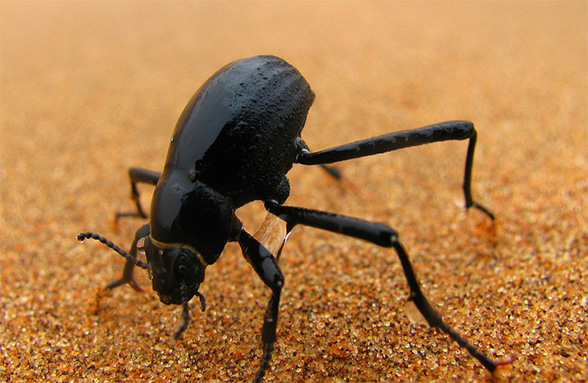
Onymacris unguicularis by James Anderson

Materialising water in a desert

This animal antic is not for the faint hearted! The Namibian desert beetle has learnt to materialise water out of thin air! Onymacris unguicularis is a beetle found in the dry Namibian desert that has found the most unique way of procuring water. Early in the morning, when the dew enriched fog begins to settle over the sand dunes, the beetle goes to a dune peak and positions its body in such a way that it helps in dew formation. Microscopic bumps with hydrophilic (water attracting) tips and hydrophobic (water repelling) sides cover its hardened forewings, which it aims at oncoming fog each morning. Water droplets materialize out of thin air on its back, and slide down channels into its awaiting mouth. The smart beetle slurps up the drops of water thus formed.

Crows crack walnuts in traffic signal

Heard of the Aesop’s fable of a crow dropping stones into a water jar to raise the water level and drink it… Now, hear the modern tale of clever crows. The Japanese crows have found a new way of cracking walnuts. They pick walnuts from the adjoining trees on the road and wait until the traffic lights turn red. Then they place the nuts in the path of oncoming traffic. After the lights turn green, vehicles drive over the nuts, cracking them open. Then the crows join the pedestrians and pick up their meal. If the cars miss the nuts, the birds sometimes hop back and put them somewhere else on the road, or they sit on electricity wires and drop them in front of vehicles!

Nut cracking money exchanging monkeys

For those who think they have mastered their tools and have got their way through the money market, here comes some serious competition! Capuchin monkeys from Brazil have mastered the art of cracking tough palm nuts by using the best stones. The capuchins tap palm nut shells to make sure they aren’t empty – and are therefore worth the effort of cracking. If they think they have found a meal, they twist the nut until it comes loose, and then usually nibble away the soft outer covering until the woody shell is exposed. The monkeys use pits in logs as anvils, to lodge the nuts in place, while they use large stones as hammers to bash through the shells. Researchers have found that these monkeys select just the right stone and an appropriately sized pit as an anvil for nut-cracking. Now, if you think this is no big deal, Scientists from Yale University have found that capuchin monkeys can trade coin-like tokens for food items! The group of capuchin monkeys even appeared to grasp the concept of ‘bargain hunting’ by flocking to lower-priced pieces of fruit!

Guiding humans to honey

Wild animals may adapt to their environment using ingenious ways; while domesticated animals learn the ways of humans. However, the Honeyguides of Africa have innovated a way to use humans to suit their purpose! The Honeyguide feeds primarily on the contents of bee hives: bee eggs, larvae, pupae, and beeswax. Honeyguides are among the few birds that can digest wax. Honeyguides enter beehives while the bees are torpid in the early morning or scavenges at hives robbed by people or other large animals. Most remarkably, they also guide people to beehives to access their food. A guiding bird attracts a person’s attention with wavering, chattering notes and flying toward an occupied hive. If the followers are native honey-hunters, when they reach the hive, they incapacitate the bees with smoke and open the hive with axes. After they take the honey, the honeyguide eats whatever is left.

– Factfile –
http://www.nationalgeographicstock.com
http://www.abc.net.au
http://footage.shutterstock.com
http://en.wikipedia.org/