Relocating snakes will not solve the problem, as there is no guarantee that you will not see another snake in its place. Besides, chances of the relocated snake’s survival are bleak. And even if it manages to survive, we are introducing a new predator to another place that could cause damage to the ecosystem. Snakebites do take place just like road accidents. If you are not cautious while crossing the road or riding/driving chances are you will meet with an accident.
So prevention is always better than cure!
If you live in an area with thick vegetation in the surroundings, there will be a possibility of snakes’ presence, so exercise caution.
Never walk outside in the dark without a flashlight
Don’t walk through tall grass without checking in front of you
Don’t stick your hand in the fuse box without checking first or blindly jump into a hedge to retrieve a ball
It’s generally a good practice. It doesn’t have be a snake always; there could be a scorpion for all you know.
Symptoms of snakebite
Snakebite leaves a characteristic mark of a single or double fang, especially if it is a venomous one.
Pain and swelling at site or the entire limb
Frothing or drooling
Nausea, vomiting
Abdominal pain
Muscle rigidity (stiffness) and fever
Difficulty in breathing
Rapid pulse
Person may become drowsy, dizzy and may lose consciousness
How to handle snakebite?
Here is what wildlife expert and conservationist Gerry Martin had to say:
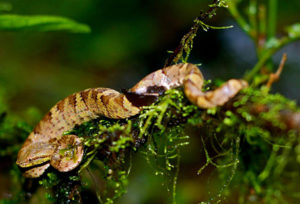
Malabar Pitviper Venomous
As always, it is really important to do the things right if you are in a situation where someone has been bitten by a snake.
Firstly, stay calm! As trivial as it may sound, it makes everything from the victim’s ability to deal with the situation to your ability to make decisions much better. Panicking aggravates the situation by circulating the venom-mixed blood throughout the victim’s body.
Try your best to immobilize the victim. Don’t spend too much time on this. Simply put the limb in a sling or even just get the patient to lie down if you can.
Go straight to a hospital. Along the way, keep an eye for any symptoms such as blurry speech, droopy eyes, swelling and back pain. Knowing what symptoms appeared when will help a good doctor deal with the treatment.
The only known cure for a venomous snakebite is the anti-venom serum that needs to be administered intravenously under medical supervision. Do not go to anyone who claims any other form of remedy. Do not tamper with the wound. You cannot suck out the venom. Doing anything to the bite could cause a lot of damage. Do not tie a tourniquet!
Finally, if you leave your prejudices behind and look at snakes, you’ll see snakes are pretty creatures too. You’ll find them in interesting sizes, shapes, colors and patterns. After all, beauty lies in the eyes of the beholder.
The thought of a snake, so much as the remote sound of it gives most people the creeps. Reactions will range from eww, oh my god, creepy, slimy, dangerous, to kill it!
Ever since I was able to spell cobra in school, I have been an ardent snake lover, much to my mother’s chagrin. Even as a kid, I thought snakes were mysterious and alluring. And my mother, who dragged me to the anthills every Nag Panchami – often mistaken for snake burrows – to seek the Snake God’s blessings, only heightened my fascination for these beautiful creatures.
Having said that, I understand it is not easy to dispel the fear and myths surrounding these innocent creatures completely. Further, the portrayal of snakes as the representation of evil in several mythologies, fairytales, Hollywood and holy books has only added to the misunderstanding. Understanding the importance of the role that snakes play in balancing the ecosystem is the first step towards resolving the conflict between human and snakes.
Malabar Pit Viper Venomous
Snakes in India do form a vital part of our ecosystem and their presence or absence from an area affects the ecosystem directly and in a big way. Snakes are indeed angels in disguise! You may picket in front of my house for uttering this statement. But take heart!
Snakes are our friendly neighbours for they are the greatest pest controllers. They feed on rodents and help us by keeping some of the dreadful diseases at bay. They also help farmers by protecting the crops from rodents. They feed on amphibians, insects, mammals and other reptiles, which keeps their population growth in check. And some predatory birds feed on snakes for their survival as well. Needless to say, the importance of birds in maintaining the ecological balance is paramount.
Some snakes always live closer to human habitats. As human population continues to rise, we are expanding our cities, towns and villages, resulting in our encroachment of the territories belonging to other wild species. When these animal species are accommodating and tolerating us in their space, we at the least should learn to coexist with them. We don’t go about killing people we think are harmful or dangerous to the society, so why snakes?
You will be happy to know that snakes are shy animals, who avoid contact with humans as a principle. The good news is approximately 80% of the snakes found in India are non-venomous, and the remaining 20% have no intensions of wasting their venom on humans even if they come in contact with them. Snake venom is modified saliva; it is also a digestive juice that is essential for their survival. As opposed to the popular belief, snakes are not vindictive and they strike in defence only when they feel threatened.
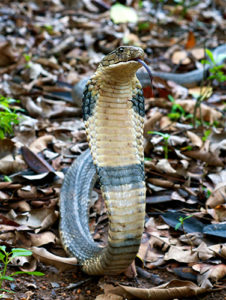
Recently, the Snake God did bless me with an opportunity to learn more about snakes from renowned herpetologists like Romulus Whitaker, Gerry Martin and Nirmal Kulkarni. I had an opportunity to be a part of rescue and release of the longest venomous snake in the world, King Cobra in Agumbe, Karnataka. It was the smoothest operation I have ever witnessed.
When you look into the eyes of a King Cobra you will realize why he deserves the respect he gets. He just gapped at me for a long time in a calm and composed manner and slithered away softly when he realized that the gapping activity didn’t yield any interesting results! Although King Cobras are the most feared snakes and have the reputation of being aggressive, they are reluctant to display any aggression unless provoked or harmed.
I remember watching a documentary on Anna Wintour, Editor-in-Chief of Vogue America, who is considered as one of the most powerful personalities in the global fashion industry. She is often criticized for using fur, which is a vital element in fashion. Criticism for using animal-based apparel is quite common in the fashion world. However, things have changed a lot over the last decade.
There are many fashion houses that have started using eco-friendly materials to produce their garments. Surprisingly, these products have gained popularity among the masses due to its sheer quality of being eco-friendly. Personally, I am fond of eco-friendly products. They not only look good but also are easy to handle. There is no special instruction for using them and can be easily managed; unlike products from other synthetic raw materials that need special attention.
Green products have gained momentum. With technology, a lot of eco fashion materials have been introduced to the fashion industry. Recently, I got introduced to a new jeans made from recycled plastic made by Levis. These jeans are far better than the other material, plus they give you the similar comfort when compared to its counterparts.
Apart from the well-established brands, small garment manufacturers have also entered in the market with their eco-friendly products. Recently, when I attended a trade expo in Pune, I got to see products some of the small manufacturers from different states of India. Consumer awareness about the eco-friendly products and their charm is proving fruitful to such small manufacturers when they showcase their products.
Further, Ecoideaz.com has found that eco fashion and dress material are becoming trendy among many fashion designers and brands. Firstly, these raw materials are easily available and are in abundance. Secondly, with the growing concern over the synthetic material, eco-friendly products seem a bit legitimate to use. Thirdly, these products are getting popular among masses because of rough handling. Considering all these factors, one can certainly expect eco-friendly fashion products to become trendy over the coming years.
It has been almost four years since I moved to a hostel in Pattanagere, a tiny town on the outskirts of Bangalore city. I pursued BE Biotechnology in R. V. College of Engineering (RVCE) and our hostel was located on the banks of a river. The very thought of living on the banks of a river might make you feel how awesome this place is. A beautiful serene place nestled adjacent to a river away from the city’s chaos would be everyone’s dream location. However, the reality was too disturbing!
Toxic chemicals, pollution, health hazards and other aspects of human impact on environment were not just a part of my syllabus book, but they had got materialized in my surroundings. Vrishabhavathi, the river next to my hostel is the tributary of Akravathy river that originates from a spring at a temple on the Bull Temple Road, Basavangudi and runs parallel to the Mysore Road. Vrishabhavathi is nicknamed “Kengeri Mori” (Mori being drain in Kannada), while Google Maps identifies the river as Vrishabhavathi Nala!
Vrishabhavathi river
Vrishabhavathi | Desiree Alemao – IIJNM
As these names suggest, the river has been the carrier of all sorts of industrial toxic waste and domestic waste water for the past few decades now. Sometimes, the Pattanagere bridge crossing is blocked with solid waste during rains, causing the river to overflow and scatter all the plastic waste and dirt on the roads. The entire area gets dirtier and the smell is intolerable.
Shockingly, the river water is said to be treated at the Vrishabhavati sewage treatment plant in Rajarajeshwari Nagar, but the treated water gets equally polluted as it reaches Pattanagere, at a mere distance of about 1.5 km. Due to the detergents and untreated industrial effluents dissolved in the water, a lot of foam is generated. Most of it being alkaline in nature, the river flow causes it to froth and this can be seen across the Mysore Road. Especially, the Kengeri Falls at Jayaramdas stop after RVCE is a sight to behold!
Surprisingly, those residents who complain about this problem are the same ones who wake up early morning to empty their garbage cans into the water. Despite RVCE students making an effort to raise awareness among the residents, Vrishabhavathi is still considered as their very own dump yard. Our brief interaction with the people living on the banks of this river was disappointing too. This was not just a dump yard but a paradise for rag pickers. What a shame!
BWSSB sewage treatment plants
In 2006, major plans were initiated to clean up this water body as it began infecting people by causing water-borne diseases and other health hazards. High levels of toxic pollutants such as arsenic and zinc were found in the groundwater near the Bhyramangala tank, where Vrishabhavathi. Polluted water has impacted agriculture too, with farmers using sewage water for the cultivation of vegetables, cereals, fodder, and coconuts, which are contaminated.
Although the BWSSB sewage treatment plants cleanse the continuously polluted river, there has been no visible change. These plants might have reduced the amount of toxicity in the water, but the source of this waste needs to be prevented from polluting it. Sustainable ways need to be found to address this major environmental issue of Bangalore city.
Many well known companies and institutions that are located on the banks of Vrishabhavathi river must take an initiative on their own to help themselves and not wait for the government to impose stricter rules. The attitude of “rules are meant to be broken” is what has cast this huge ecological shadow on our city. We can undertake some easy steps and some difficult yet innovative solutions to prevent water pollution:
One of my lecturers recalled that there was a time when people took bath, washed clothes and frolicked in the Vrishabhavathi river. However, the grim situation we face today spells doom for our future. Ignoring a serious issue like this is like living in an illusion; I feel ending this illusion is the first step towards making a difference.
India has completed 65 years as the world’s largest democracy. Right now, we are undergoing the 16th General Elections that are the largest and most elaborate in the world. And yet, our democracy is quite immature where the masses are unwilling to take a larger role in decision making, leading to a sheepleocratic Indian society. Indian voters can be considered ‘Sheeple’ (‘sheep’ and ‘people’), a term created to highlight the herd mentality of people and “Sheepleocracy” is a known socio-political culture where the hallucinated Indian mass society behaves in a sheepish manner. The democratic culture of sheepleocracy is more perilous than the law of the jungles, and I assert so because this society is pro-WE. This WE-ism legitimises the infringement of ME-ism, and therefore I believe I am morally right to notify this vileness to your notice.
Moreover, this empiricistic culture has also systematically undermined the potency of rationalism and praxeology. The socio-psychological behaviour of many informative Indians are driven by the animal spirit of the empiricism philosophy. Despite of the drowning of information, ignorance is a rational choice that many people are still vociferously making.
The result: Imposed order transcends over Spontaneous order. Overall speaking, thorough generalized perspective, the tabula rasa is no where to attain the podium because the sheeples are not able to think beyond mainstream models to uplift the consciousness of all. To talk of alternate socioeconomic models, in India, is like administering medicine to a dead person. I am not defaming any unit, but essaying out openly because I have realized the real lies with my real eyes. This real lie is ‘collectivism’, but unfortunately many are ever-ready to condemn my hypotheses without giving any second thought to their own premises because they are inured to believe that “who will build roads without the government?”
These levels of sheepleocracy is lynching as well as discouraging many rational egoists to come forward and take the helm to liberate India. Everyone, as far as I know, sweetly talk about justice, equality, welfare but not many understand the philosophy behind it. Now, let me pose a simple question to all the sheeples out there: “Is it natural justice when 80% of the people take away the natural rights of 20% people through tyrannical modes?”
Anyways, to quote Frédéric Bastiat –
“If the natural tendencies of mankind are so bad that it is not safe to permit people to be free, how is it that the tendencies of these organizers are always good? Do not the legislators and their appointed agents also belong to the human race? Or do they believe that they themselves are made of a finer clay than the rest of mankind?”
To believe that Indian government/society can splendidly administer the culture of democracy is like seeing fire creating the furniture. As long as the so-called culturalists drift away from the praxeology of individualism, the more it will condemn those who valiantly stand for critical consciousness. I am stringently essaying out all these new fancy terms because I am attempting to set man free from men. I have no such special deontology to do so but there is nothing wrong to revive epistemology against the ontologists who have no idea of what they are doing to many methodologies.
As long as the mass society condemns the critical consciousness of any Indian, the more it will abhor the culture of those who valiantly transform the complex lies into simple truth. It is better to slap the Indian society with truth than kiss it with lies. Truth is a maxim and through the methodology of rational thinking one can develop itself without any masquerading collective assistance. Collectivism is actually responsible for the sheeplocratic culture in India. It starts at home, processes through school, facilitates via society and demises at home. Here, you are a mean and not an end. One cannot expect a man to be an end in itself, in the ambiance of sheepleocracy.
Now, just look at this common culture around you from your sceptical eyes, I bet you that you will experience a different thought and that is because my essay is attempting you to think against conformity. Remember that only dead fishes flow with the river stream, whereas awakened ones create their own new culture. To generate a fresh new culture requires development of original thoughts. One cannot solve the problem with the same consciousness that created it. I am not a Marxist to tell you that “let us blame the structural consciousness… blah blah blah”. I am just a spiritual being with human experience.
Start reading Ayn Rand’s Anthem, George Orwell’s 1984, Ludwig von Mises’s Human Action and Murray Rothbard’s The Ethics of Liberty to comprehend of what all complex ideas I have proposed here.
About the Author –
I am an Assistant Professor based in Mumbai. I teach politics, economics, journalism and business management. I am also a Senior Fellow at Indian Libertarians.org. I am just 24yr old and I love to make people think. I like to overthink and discourse with intelligent individuals (not educated people).
While Mumbai may be known for its Bollywood industry and advancements in lifestyle, today we are going to look back at the times when the city was just in its infancy. During the days before independence, Mumbai was known as only a colonial port city. However, post-independence, the city has improved its economic situation through its advanced industrial capabilities and has gradually secured its foothold as the capital city of India.
The city possesses the richness of its history and culture through the majestic historical monuments which it has been preserving from so long. The opulent structures, prehistoric caves, ancient forts, British architected monuments and royal palaces speak of an era gone by. These archaeological pieces of history serve as the testimonies of Mumbai’s greatness. Every monument you see in the city has a story behind it.
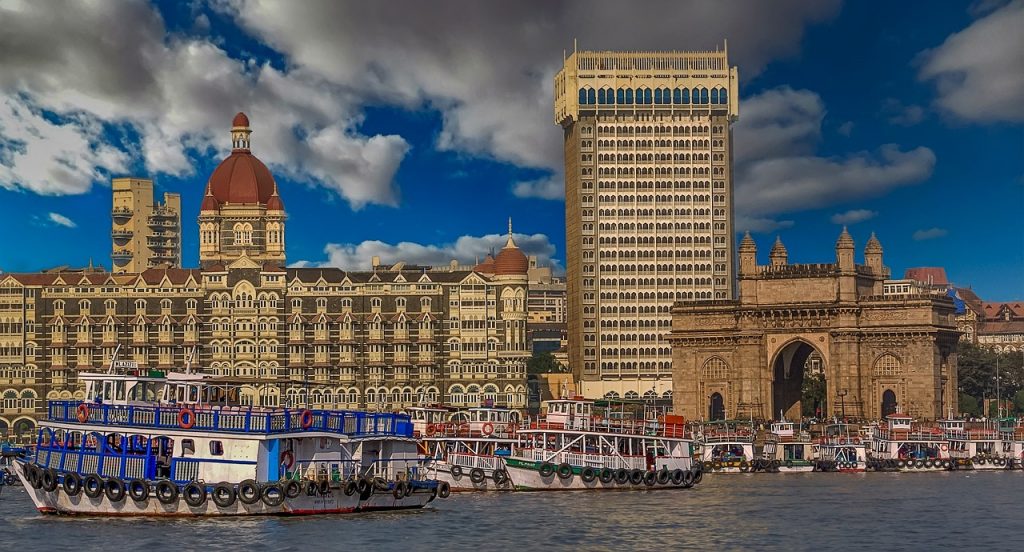
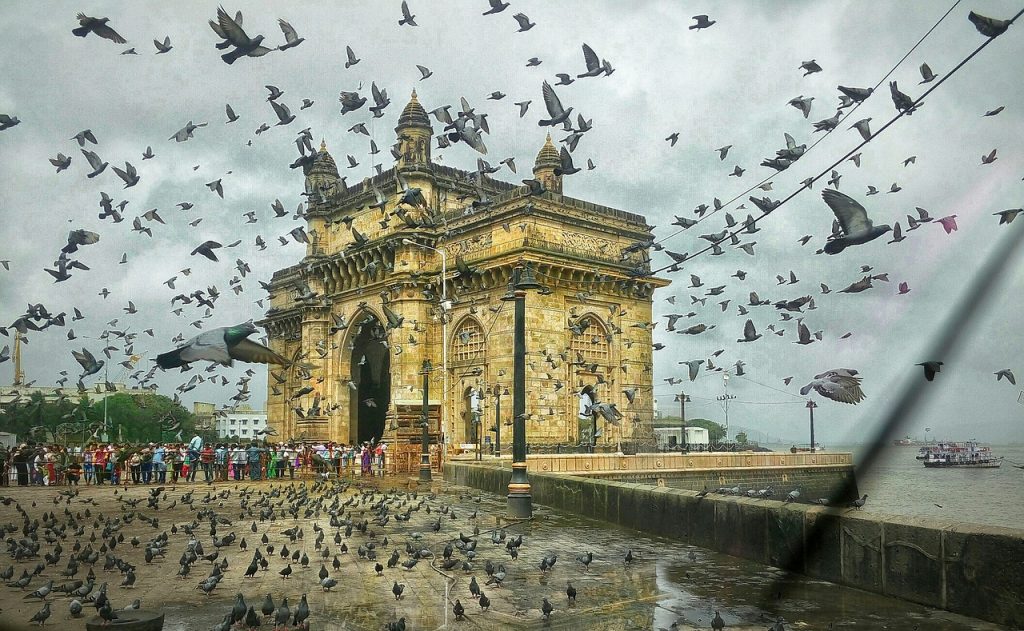
One of the important architectural and historical stops, Gateway of India secures its place among the most visited monuments in Mumbai. Constructed since 1924, this approximately 83 feet tall building stands high on Apollo Bunder overlooking the Arabian Sea. The entire monument is built with yellow basalt and solid concrete. The monument symbolizes the commemoration of the visit of King George V and Queen Mary to India in 1911. Not only this, the monument is also the centre of attraction because this was the way which last British Force adopted to depart from India forever.
Near to this place, you can find Taj Hotel which is another biggest tourist attraction in Mumbai. Because the monument is situated near the Taj Mahal Hotel, it is also called as Taj Mahal of Mumbai. To visit this monument, there is no specific timing; it is open 24*7 for everyone. However, if you want to enjoy the cool breeze and pleasant weather, you are suggested to visit there post monsoon. Boating and ferry rides are also available which add to the excitement of the place.
Built in the early 20th century, this splendid Indo-Saracen structure is regarded as one of the most significant and Grade I heritage buildings of the city. It was named after Prince Wales who visited India in 1905. On November 11, 1905, the foundation of this museum was laid by the Prince Wales and was inaugurated on January 10, 1922 by Lady Lloyd, the wife of Governor of Bombay. This museum is also known as Chhatarpati Shivaji Maharaj Vastu Sangrahalaya.
Spread over 3 acres land and surrounded by a garden of palm trees and formal flower beds, the museum is located in the centre of the South Mumbai and reveals more than 50,000 ancient artworks, sculptures and artefacts dating back from the Harappan sites, Indian and European paintings, porcelain and ivories from China and Japan, etc. and is divided into three sections- National History, Art and Archaeology. It is located at MG Road in South Mumbai. You can visit here at any time of the year. However, it remains closed on Public Holidays. Every day, a 20 minutes show is conducted here in English and Marathi language which depicts the content history and other details related to the museum.
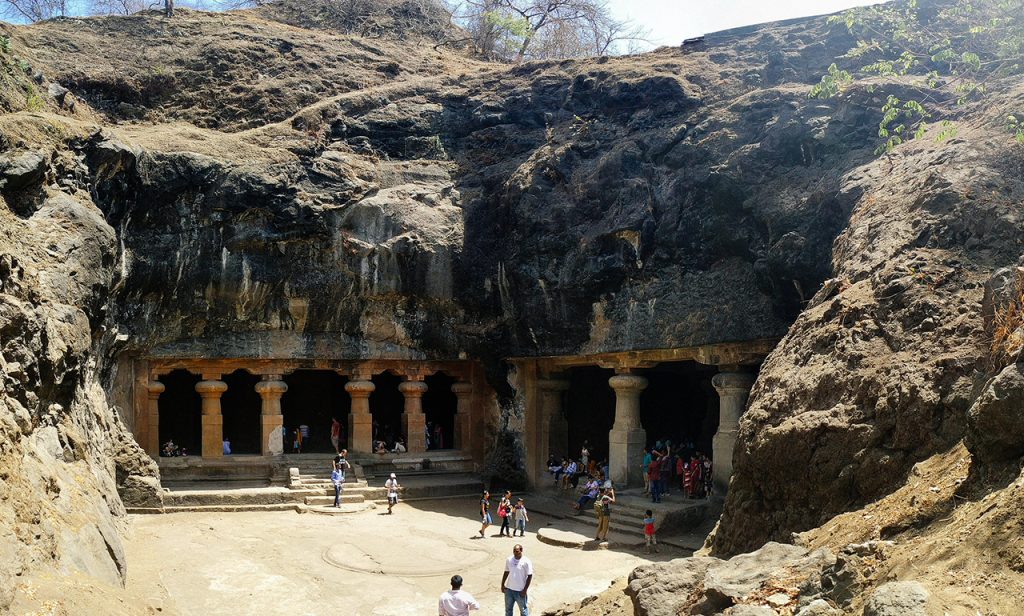
Among the most enigmatic heritage sites in India and about 10 kilometers east of Gateway Of India stands Elephanta Caves. It is also one of the UNESCO heritage sites and represents the diorama of the Hindu and Buddhist culture. There are carved out stone sculptures inside the caves which showcase the syncretism of Hindu and Buddhist ideas and iconography. The caves are believed to be dated between 5th and 9th century.
To reach there, you have to go hire a ferry from Gateway of India. Since Mumbai welcomes end number of tourists every day, there are chances of not getting the ferry to sail across the sea to reach the destination. Another way to reach the caves is going through the suburban local rail network. You can board on a local train from wherever you are in Mumbai and board off at CST Station. At the caves, you can enjoy boating also. The place is closed on all Mondays and visiting hours are between 9 AM and 5 PM on all the other days.
Wrapping it up
Mumbai has come a long way from being just a city to a city with immense history immersed in it. Therefore, it is not possible to appreciate the beauty of a city if you soak yourself in opulence and grandeur by just visiting the famous historical places in Mumbai.You should know the history, culture and historical significance of its renowned places to fathom the greatness of the city.
In the modern times, Mumbai has become India’s one of the well-established city which is packed with lots of historical sites and tourist destinations in hidden corners or even ordinary locations of the city. Here are a few more historical attractions that have a long history attached to them: Mahim Fort, Kanheri Caves, Mount Mary Church, Asiatic Library, Siddhivinayak Temple etc.
Visit these exquisite places with your friends and family!
When we think of wildlife, an image comes to our mind – trekking miles deep into the jungle, camping in the forest overnight, watching predators in their natural habitat, capturing their hunt through a telephoto lens camera, etc. However, most of us who are stuck in our mundane urban life are not blessed enough to undertake such adventures. What if we could get the same thrill here in our concrete jungle…
Whenever you need a quick dose of wonder that observing wildlife could bring, just step outside your house and investigate the trees and plants around you. Cities with greenery do teem with wildlife, Urban Wildlife – birds, insects, mammals, amphibians and reptiles.
Urban nature is full of drama and mysteries, just like spiders which have evolved to look like ants and moths to trick birds into thinking they would make a lousy meal by mimicking the appearance of moths that really are distasteful- and thus avoid being made a meal of. Some detective skills, a curious mind and a watchful eye are all you need. Wildlife watching also makes for interesting conversations with people who are curious to know what you are up to!
Snake Skink
Next time you see something small and snake-like slithering in the sand or the undergrowth by your feet, swallow that yelp of fear. It is most probably a skink – a long lizard with reduced limbs that moves very much like a snake. There are about 50 kinds of skinks in India, but I’ve only seen the snake skink (Lygosoma punctata) or supple skink around residential areas in Bangalore.
Juvenile snake skinks have a bright red tail, leading some to mistakenly think these skinks are poisonous. I am fascinated looking at their red tails wriggle as they move – seems as though they leave a trail of flame as they move! The juvenile skinks also have streaks on their body, unlike the adults that have spots and no red tail. These snake skinks are semi-fossorial (living underground) and have developed a particularly neat adaptation to prevent their eyes getting scratched- a transparent visor they can slide over their eyes. Skinks press their feet against their body to flee from a predator all the more faster. Interestingly, some skinks in Australia were found to have lost their limbs completely due to lack of use.
Purple Sunbird
My garden is always abuzz with these tiny birds who visit flowering plants for their nectar. Seeming as though they are unable to make their minds about which flower to drink nectar from, they dart from one flower to the next – sometimes hovering in air – while calling shrilly others around them. They usually hang out in groups of two or more individuals.
Purple sunbirds (Cinnyris asiaticus) are mostly nectarivorous, but they also feed on fruits and insects. They are huge fans of pumpkin and Indian ivy gourd. My neighbour had planted these two creepers and the sunbirds visit the creepers every day. The Singapore cherry tree is another favourite.
Sunbirds are a little smaller than sparrows and about the size of your palm. Like most birds, male and female sunbirds have a contrasting appearance. An explanation for this might be the difference in amount of care given to offspring between the sexes. The male sunbirds are a pretty indigo blue while females are a pale yellow with brownish olive-green wings. Next time you see them, try to look for signs of their breeding season (males develop a maroon collar in the front of their necks and a bright blue patch of feathers on their shoulder during breeding season) and notice males displaying their colours to prospective mates.
Greater Short-Nosed Fruit Bat
The coffee-hued Greater Short-Nosed Fruit Bat (Cynopterus sphinx) is one of the two kinds of short-nosed fruit bats, the other being the lesser short-nosed fruit bat (Cynopterus brachyotis). Both these bats have the most endearing eyes which look like pools of molten chocolate.
Cynopterus sphinx is found all over India. Their ears are lined with pale white fur. The male sports orange fur on its chin and body while the females have grey fur on their bellies. They are small and fly with rapid wing beats. As its name suggests the greater short-nosed fruit bat is frugivorous (fruit-eating). It likes guavas and bananas and is a useful pollinator (Read about the bats that took over as gardeners). It uses a keen sense of smell to hone in on fruits. Most other bats are insectivorous, while vampire bats feed on blood.
The bats reside in small colonies of ten to twenty individuals under leaves of trees or roofs of buildings and houses. When breeding season dawns, the male constructs tents made of stems for the female and the newborn pups. Bats are hard to identify while in flight, but if you have banana or palm trees, keep an eye out for these coffee-and-chocolate-hued bats.
How to identify animals?
There are plenty of resources online to help you identify the names of insects, birds and reptiles like groups on Facebook (Indian Birds, InsectIndia, Reptiles & Amphibians of India). Many states in India have a birdwatching club (BngBirds in Bangalore, Kerala Birder, Northern India Bird Network) which regularly meets on weekends. While primarily meant for birdwatching, you usually learn a whole lot more from the naturalists who come for the birding trails.
“After one look at this planet, any visitor from outer space would say, ‘I want to see the manager.” A striking quote by William S. Burroughs makes us ponder over we have really done to our Mother Earth. This planet has served us selflessly for centuries and we in return have tried to destroy it in as many innovative ways as possible in the name of development, or term it “economic development” to be precise.
We stand as a solid proof for Darwin’s theory of survival of the fittest, destroying everything that comes in our way, just to ensure us a comfortable survival. No other living being has contributed to the environment as much as we have. We must be feeling proud of ourselves.
Look at our achievements that cannot be matched by any other animal species that has ever existed!
Our comfortable lifestyle comes at the cost of destroying the homes of thousands of rare creatures
We have dirtied our surroundings, polluted the air and water and dumped unimaginable volumes of garbage in the ocean.
We have caused massive destruction of forests across all the continents where we live. The Amazon basin, the Congo river, the Western Ghats have borne the brunt of our greed.
We have disrupted the natural functioning of the eco-system. We don’t care for fellow living creatures.
Burning a hole in the ozone layer that protects us from the harmful ultraviolet rays several kilometres away from the earth’s surface is no easy task. And how do we do it? By continually enjoying the luxuries of air-conditioners and fridges that release harmful chloro-flouro-carbons.
What’s even funnier is that we don’t really care for our children either! The water they would consume, the air they would inhale, are becoming poisonous and all the natural resources are being excessively used.
Living in harmony with the environment comes at a price of sacrificing our comforts. Now, assume that we are living a lifestyle similar to that of a forest tribal community. They are the people who respect their environment who do not disrupt its natural balance. Ironically, tribals are the ones termed “uncivilized”. We of course are much more above all that. Aren’t we? We deserve a better lifestyle!
“We do not inherit from our ancestors; we borrow it from our children.” Somewhere between all the development and modern ways of living, we are destroying our environment and destabilising our earth. This is the only place habitable planet available for us to live. Planets that sustain life are hard to find. What we are doing to nature is a reflection of what we are doing to ourselves. A lot of irreversible damage has already been done. If we do not wake up and take steps at least now, it would be too late to make amends.
Let’s start with small acts such as switching to energy-saving bulbs and carrying durable bags when we shop. Here is a list of things we can do to save the environment and in turn save ourselves:
The key to a greener planet is in our hands. If we want to go on living on the earth, we have to take responsibility for sustainable development. Live gently upon this earth. Go green. Heal the damage that we are guilty of. For when we heal the earth, we heal ourselves.
This summer we at Caleidoscope are doing our bit to build awareness about living an eco-friendly lifestyle by compiling all the best green innovations made in India. Our sister site, Ecoideaz.com will serve as a repository for innovative green ideas both from the investor and consumer perspective. The site focuses on building a comprehensive portfolio of all eco-friendly ideas developed in India, along with a database of all Indian companies working on renewable energy and clean technologies.
Do check it out and give your valuable feedback.
Whenever I introduce myself to someone new, the first thing they ask is ‘Where are you basically from?’ I always take a moment to think since it is not an easy question for me to answer. Where am I basically from? My ancestors are from the Marwar region in Rajasthan; my grandfather was born and brought in Haryana; my father was brought up in Odisha and is settled there, while I was born and brought up in Odisha, but now settled in Pune since 9 years! So, where do I really belong?
This question is quite an important one for every Indian, since it defines other people’s behaviour towards you. I have always failed to understand, why does my state of origin, or a region matter? I always felt I am an Indian, since my ancestors and I have travelled across so many states. I remember when I first came to Pune, I was quite nervous and scared.
Indian culture is so diverse that adjusting to the whole new cultural setup was certainly difficult. The toughest task was to make friends. People in Maharashtra looked at me as if I am from a different nation altogether. During conversations, when I say I am from the east, they would hesitate in having any further communication.
Culture plays a major role in these kinds of regional bifurcations. Every state has its own language, food, dressing sense, interpretation of religious ceremonies, and a different lifestyle. These differences become a barrier when a person tries to adjust him/herself in a new environment. Lohit Chandra, a PR professional, who is basically from Kerala but has been living in Mumbai since a few years, recalls, “When I shifted to Mumbai, I did face some initial cultural adjustments. Language was a big problem as I was not fluent in speaking Hindi, which is the national language. Here I saw strangers chatting up on a particular subject as if they know each other well and I was an alien to this world.”
Sometimes, these differences can badly affect a person. Rajesh Rao, a software engineer from Karnataka, who worked in an IT company in Delhi, recollects, “No matter how I tried to mingle up with locals, I was never accepted in any groups. As most of my colleagues were Hindi speaking, I was left alone and soon found myself lonely. I had no choice to get myself transferred back to South India.”
Many choose to mingle with people from their own state, since language becomes the initial barrier in approaching people and making a space among the locals. College scene is a good example where you can see people moving around grouped with people from their own region. There are rare cases where you would find a person from a different state mingling with locals. Otherwise, a clear state-wise division is quite common and this trend is seen among working professionals as well.
However, things are certainly changing at some levels. In metro cities, where people migrate from different states in the hunt for jobs, their state culture is taking a backseat. People are eager to know about the new culture and are least bothered about the state you belong. Chhayaa Sharma, a student from Odisha who graduated from Pune and now is in Delhi for further education, says, “When I came to Pune, I was certainly scared as to how would I be able to manage with the local crowd. However, things turn otherwise and my classmates welcomed me with opened arms. They weren’t concerned about my state and treated me like an equal.”
Similar things happened with Lohit in Mumbai, who defines himself as an introvert. Lohit says “Being an introvert, I hardly take an initiative to begin the conversation. However, as Mumbai is full of people from different castes, background and states, I was lucky to make some good friends.”
Something similar was faced by Priyanka Shukla from Ranchi, who works in a newspaper in Pune. She shares her feeling when she initially came to the city, and says, “Initially, I was scared. But soon, I realized that people are warm and they accepted me. The new culture and people had so much positivity that it changed my entire perception towards life. We certainly can’t rule out the cultural difference, but a respect for others should always be there.”
2 States – Chetan Bhagat
For cosmopolitan people, their state or national culture doesn’t matter much. In recent times, the trend of love marriage has increased. Generally, people fall in love either in college or while working in the same office. As we all know that love is blind! However, when inter-cast love marriage happens, families oppose. Renowned author Chetan Bhagat has beautifully depicted the tussle between two states and religion in his novel, “2 States”, which is now released as a Bollywood movie.
Furthermore, when asked about what it means to a cosmopolitan Indian, Lohit says, “I don’t try to see myself belonging to a state or impose my state culture on others, except when it comes to clearing certain misconceptions. Otherwise, I see myself as an Indian being with other fellow Indians. Unless they behave differently because they are from a particular region and consider themselves superior to others, I don’t have problem mingling with them.”
Despite this broader sense, we sometimes keep on hearing problems by many people. Giving a solution to such differences, Priyanka says, “I think people need to be a little more frank and patience when they move out. They need to give time to understand the place and culture. This will certainly eliminate any difficulties.”
There is no doubt that the love and affection for the place you are born will remain. But we should never neglect the fact that we are Indians. With migration happening at a fast pace, the difference between a particular state culture and national culture is diminishing. We can hope that one day we can address ourselves as just Indian, rather than from a particular region or state.
‘Freedom lies in being bold.’ Aren’t these words by Robert Frost enlightening! However, many of us have forgotten this message, barring a few. Those few among us are truly bold and have the courage to question the injustice. In my memory, one name stands tall – Vinita Deshmukh – a name that everyone is familiar in Pune. She has won several awards for her work as a journalist, who has gone beyond the call of duty and has taken innumerable social causes.
Vinita’s courageous acts and investigative reporting have brought her many accolades like the Statesman Rural Reporting Award in 1998 and 2005, the Top Management Consortium’s Award for Excellence in Journalism in 2010 and many others. She also wrote a series of articles against the land provided to Dow Chemicals due to which the multinational company had to return back 100 acres of land. The fight went on for 10 months, but she didn’t give up. For this, she was awarded the prestigious Chameli Devi Jain award for `Outstanding Mediaperson Of The Year’ in 2008.
Starting her career as a journalist 26 years ago, Vinita’s journey was never smooth. Sharing memories from her early years, Vinita says, “During our time, newspapers used to hold some value in the eyes of the readers. Journalists had to work hard to bring out the fact. Editors used to have a hold on the editorial content and never compromised with news. However today, things have changed. Marketing has taken over the newspaper and the editor’s hold on the content has eroded.”
Vinita has been a well-known RTI activist and a social worker as well. Through the power of the Right To Information Act (RTI), she has unearthed many facts and brought them to media spotlight. RTI was the primary reason for her to enter into social work. “I remember, when the RTI law was passed in 2005, and people of India were given new power to check the official files, things changed drastically. I got the power to see an official file just as a minister would see it. Then I realized that this law has given immense power in the hands of citizens and if utilized properly, I can help the society at large. Hence, I ventured into the social work,” she recollects.
Vinita soon realised that just writing provoking articles and bring out the truth to the society is not going to work. There was a need for someone to stand up and question the injustice. Corruption is rising and citizens of India are facing more trouble than ever. To have a check on such activities, she decided to stand against it. She has filed numerous RTIs and has published the stories in MoneyLife Magazine, where she is a consulting editor, and run a weekly RTI column. “Before RTI, I used to rely on other people for the stories, whereas now I was able to get them on my own. Officials were bound to give me information, and I properly utilized them,” adds she.
Her fight for the injustice didn’t end here. She joined Nav Bharat Democratic Party and even decided to stand for the Lok Sabha Election of 2014. “This was another interesting phase of my life. While fighting for the Metro plan in Pune, I realized that it is politicians who have the ultimate power. It is they who pass a law and sanction a project. No matter how much we do, without their nod, nothing can change. This motivated me to stand for the election,” says Vinita.
Vinita believes that political participation will not only motivate youngsters to be a part of the changing world, but also show them a way to bring about changes. Change is slow, but somebody has to make a move. However, she had to withdraw her nomination back from the elections. She explained, “Nav Bharat Democratic Party is based on the similar ideologies as AAP. When AAP formed, I saw that people with same motto and ideologies are joining them. I decided to take my name back to avoid any sort of confusion among our voters. Two people with same ideologies from two different parties will divert the vote, which I didn’t want.”
Vinita Deshmukh firmly believes that every Indian citizen should vote and it doesn’t matter whom they are voting. She states, “If we have somewhere between 75-80% of voter turnout, then we can expect that people will bring about good governance; which is the need-of-the-hour. It is the citizens who can keep a check on governance. RTI has given as a weapon to citizens who can now question any government official about their work. As per the RTI Section No.4, the authorities must provide a detailed report of the work done by them. However, at present, minimal activities are being documented, but RTI still gives power to the citizens to see the official files.”
Despite being in her 50s, Vinita is quite active. Her day starts at 4am in the morning when she begins with replying the several emails she gets. Then, after her breakfast, she is out in the field, meeting people, or filing RTI applications or speaking at meetings. When asked about her abundant energy, she gave an unusual answer, “It’s injustice that gives me power to fight. I can’t stand injustice. Whenever I see it happening around me, my blood starts to boil and I start my investigation.”