Rediscovering My Eastern Ghats

6

Eastern Ghats at Visakhapatnam Beach Road
Source

As a child I always dreamt of great valleys, deep jungles, and lofty waterfalls. Fortunately I grew up in an area which was situated close to a spectacular valley with enchanting surroundings. Just 120kms away from my home town, Visakhapatnam, is the Eastern Ghats, which are some of the last remaining wild areas in the state of Andhra Pradesh.

Some of the highest elevations in Eastern Ghats ranging from 1600-1700 meters are located in the Visakhapatnam district. While the Western Ghats are quite famous for biodiversity, the Eastern Ghats also has lush green valleys, dense tropical jungles which support a wide variety of wildlife such as tigers, gaurs, leopards, wild dogs and some rare bird species.

During my early schooling years, I frequently visited these places. Those misty mountains of Eastern Ghats made the climate quite enchanting. After a long time, I recently visited the place and was surprised to see that wildlife is still preserved despite the onslaught of modern civilization. Being wildlife enthusiasts, me and my friend Sujith we were eager to explore the Northern Eastern Ghats region. We started early in the morning on a motor bike.

Eastern Ghats
Eastern Ghats

It was a beautiful sunny day and we soon left behind the busy city traffic and headed towards the mountains. As we got nearer to the mountains, a refreshing cool breeze welcomed us for the coming journey ahead. With steep uphill Ghat road turnings, we crossed 1000mts above the sea level. As our bike moved ahead, Langur monkeys watched us from the trees, while being busy grooming each other. Midway along our journey, we stopped abruptly on the road, when we saw a strange looking creature. It was covered with protective shields. I and my friend took several pictures of it and later realized this insect was ‘female glowworm’ after referring some books.

Pleased with this interesting sighting, we headed further. After another half an hour journey, we entered a tribal hamlet called ‘Lambhasinge’. There, we stopped for several minutes and refreshed ourselves with a cup of tea. Then we continued, heading towards much higher altitude. Throughout our journey, the forest greeted us with cool breeze, lush greenery and beautiful twittering of birds echoed through the forest canopy.

Before reaching our final destiny of Sileru, we passed through villages such as Chintapalle, Sapparla and Dharakonda. Dharakondavillage is famous for its Daralamma Goddess. From the temple, we can see a spectacular waterfall.

Daralamma Falls
Eastern Ghats – Daralamma Falls -Right Eastern Ghats-Sileru Falls

After resting for a while there, we headed towards Sileru town. As we reached late in the evening, without any hesitation we searched for place for our night halt. Thankfully, we settled ourselves in a guest house by the time it started to rain. Soon it was raining cats and dogs, and we could not get a chance to explore the place in the night. However, our guest house was itself a virtual miniature zoo, where we got a chance for observing a variety of insects such as moths, butterflies, walking sticks and even snails and frogs.

Tired of the long journey, we both soon fell asleep. The next morning, we planned to explore the mountains surrounding the village. But we were thwarted by another hour of incessant rain. After the rain stopped, we went exploring the mountains by walk. We saw beautiful waterfall on the mountain edge which was quite endearing to me. In my exploration I captured some interesting animals in my camera.

Eastern Ghats SnakeRoadkill of a snake

After a day of joyful exploration, we returned to our guest house and started our bike to pack off to our home town. Initially, we had decided to stay for couple of days, but the bad weather made us to change our mind. Leaving behind the lush green valley with some striking memories, we left for Visakhapatnam late in the night.

Reminiscing about our visit to the Eastern Ghats, I realized that every time I visit such places, I get a chance to see a rare and unique creature. In my observation, these jungles are some of the most unexplored places in India. But recent human activities are destroying huge tracts of lush green jungles converting them to agriculture lands. Moreover, I observed frequent road kills of snakes, lizards, birds, butterflies, which is seriously harming the fragile environment.

– Factfile –
http://en.wikipedia.org/wiki/Eastern_Ghats
http://en.wikipedia.org/wiki/Glowworm
http://blog.mapsofindia.com

Oh yeah, the grass is green…

1

Ever wondered why the grass always looks greener on the other side…
Ever wondered why all of us have to experience it and never learn from others…
Ever wondered why it keeps happening to us despite all the years of been-there-done-that…

One extraordinary girl Nelly across the seven seas and another ordinary girl next door, Rakshita have some wonderful insights worth reading…

Nelly
Source

“Oh, I once had something
Something that was so good
Better than the last thing I touched
Then I turned right around on that something
And figured I didn’t like that much
Oh yeah, the grass is green
But can you tell me, can you feel it, I just wanna feel it
Oh yeah, the grass is green
But I think I stained my jeans and now everybody knows thah i been in itGrass is green Nelly Furtado
I am a believer
But as i was standing
In line, somebody took my place
Yes, i’m a believer, never mind what they say
I got so tired along the way
Oh yeah, the grass is green…

Nelly Furtado, “The Grass Is Green” Album: Folklore

Today’s green patch is tommorrow’s barren land

What looks like a greener pasture to you today, might turn out to be a piece of barren land when you stand on it tomorrow!

Rakshita
Rakshita

Seriously, human desires, wishes, dreams, aspirations have no boundaries, and can never be fulfilled. I remember how happy I was when my dad bought me a purple shaded ladybird cycle, when I was in my 9th Std. The happiness sustained just for two years, as when in college I wished to ride a Honda Activa and not a Ladybird. My dad bought me a bike, when I was in college and I dreamt of driving a car. Today I am driving a car, hoping to drive a luxurious one someday. I am sure that when that day comes, when I will be driving a posh SUV on Indian roads, I would be cursing the day I learnt to drive and hire a driver to ferry me around.

The grass always looks greener on the other side! When you step on that green patch, you see greenery somewhere else, and just barren land under your foot.

I was a crime reporter, till about two months back. Although I enjoyed my job, I always envied those who were into a 9 to 5 job and had weekends off. While they spent their weekends relaxing I used to work 24 hrs a day, whether I was physically present in office or not.I was jealous, because, although I used to work for longer hours I was being paid in pittance. I was jealous, I was angry, I was frustrated….

I ended my career in journalism to move into a more secured job. Today, even I work from 9 to 5 and have the entire weekends to myself. But I am still not happy. The expressions from anger, jealous, frustration have changed to boredom, lack of satisfaction, a feeling of being unproductive…

Today I look back and when I compare myself from a crime reporter to an editorial head of a mechanical publication I realise this land of boredom was my lush green pasture few months back. Probably its the initial stage feeling. I have sown some seeds of happiness and with time I shall also reap some green patches on this barren land….. Hopefully 🙂

Crime reporting was my first love and that will always be cherished. But time to move on…

– Rakshita Adyanthaya

Deity in Clay: Durga Puja

5

Ma Durga
Source

As a child brought up in Bengal, I have been gripped many a times by the fervour surrounding the Durga Puja. Approaching Pujas, my eyes would search for the motherly silhouette of Maa Durga everywhere I went. In my childhood days, Durga Puja meant a mini-vacation from school and it also meant that I could participate in the festivities with friends and family. I would fancy wearing new clothes and accessories; my parents would also give me some pocket money to buy ice creams, puchkas and trinkets from puja stalls.

Clasped by a spirit of festal reverberation Bengalis celebrate the glittering presence of Maa Durga during her once-a-year four day residence amid earthlings. Shashti, Saptami, Maha Ashtami, and Navami are the names given to these four days, and special puja ceremonies and rituals are conducted by priests during the same. Durga Pujas are organised to welcome the arrival of Durga Maa and to celebrate her triumph over the demon Mahishasur. It is a symbolic festival which is celebrated the world over by the Hindu community, especially the Bengalis. In rest of India, the festivities stretch out over a period of nine days and are known as Navaratris. The symbolism of good prevailing over bad is perfectly represented on this auspicious occasion.

Durga Puja

Enamoured by the sound of ceremonial dhaak and clustered behind a smoke of dried coconut skin and dhuno, people would stand in veneration in Puja pandals, waiting for a glimpse of the pious face of Maa Durga. Decorated pandals in wood, bamboo sheets and structures and the idol of the deity in clay and plaster of Paris, draped in magenta, crimson, dark blue, turquoise, red or pink silk saris; flanked by her sons and daughters on either side, including Saraswati, deity of the arts, knowledge, music, Lakshmi, deity of fortune and wealth and Kartikeya and Shri Ganesh; the ambience would be rent with sublime optimism. And through a layer of light dhuno smoke, Maa Durga would stare back at everyone with élan, almost nudging everyone to pray some more.

Durga Puja - Decoration

During the Pujas, Bhog Prasad would usually be served to all those who came to the Puja pandals. In the evenings events like singing, dancing and other competitions would take place in an adjoining stage within the pandals, mostly for children. Cities would be soaked in lights at night, and any noise or annoying snarling traffic jams forgotten by those rushing on foot to see their deity in golden finery. Not only in the city of Joy, Kolkata, but also in Delhi and other cities across the country I have experienced similar wonder during Pujas. Therefore it has always never really been about the city, but the festival itself, which finds acceptance in almost all regions of the country and amongst most communities.

Durga Puja - Pandals

On Bijoya Dashami, which is the name given to the fifth day of the Pujas; Maa Durga’s idol is submerged in the river, with loud chants of Shri Durga Mai ki Jai. A gust of emptiness would usually come upon me on the last day, because in reality, the Goddess does fill the air with unencumbered positive affluence throughout the festival. But then I would suddenly remember that she would return again next year and this would always give me something precious to look forward to.

Many features of Durga Pujas have essentially remained the same over the years. Except for altering certain aspects related to the designs of the pandals, like shifting to theme-based pujas like themes on Harry Potter, Himalayas, famous Ashrams like Belur Math, Dakhineshwar, Konark Temple, Jurassic Park etc in addition to traditional Puja ornamentation, all else about the pujas has remained unchanged. In several ways even today, Durga Puja retains the same harmony, authenticity, fervour, love, generosity, abundance and efficacy of years gone past. I see similar ecstatic expressions on normally stoic faces, looking at the divine mother with impassioned faith, seeking abundance, love and her blessings. This year too, events, personalities, themes, around her may subtly change, but the goddess shall remain as powerful; ever so angelic, unprejudiced and compassionate.

Durga Puja - Themes

Box Item: Four months prior to Durga Pujas, clay idol makers set out to create corporeal forms of the Goddess; coalesced in ingredients of clay, bamboo and plaster of Paris. Painstakingly, in the skilled hands of the artisans and devotion in their hearts, wisdom takes shape in the heavenly image of Maa Durga, including her arms, feet, torso, entire form and her beautiful large luminous eyes. Clay from the Ganges turns into giant deities. Garlanded in marigolds, roses, and with lotuses at her feet, she showers her blessings on those who fastidiously create her and those who deeply worship her.
Also Published on the HansIndia Daily

Hand in Hand Mahabalipuram – Tourist Trash Turns into Cash

3

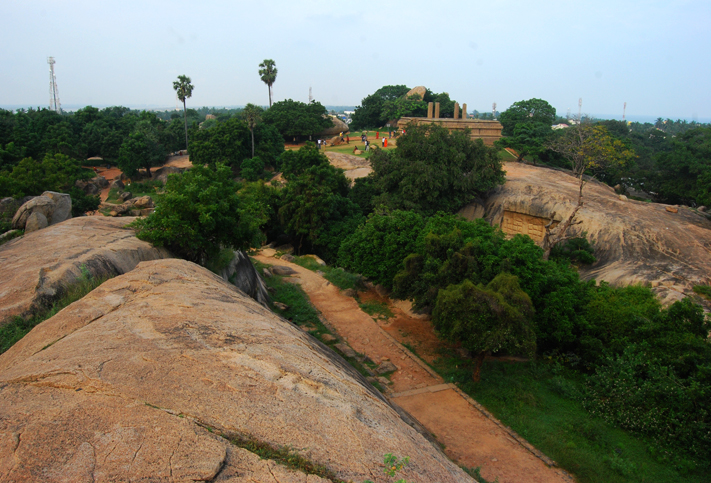
Mahabalipuram-1

I happened to visit Mahabalipuram recently and was fascinated not only by the architectural beauty but also by the good work done in waste management generated by tourist activities. The solid waste management practice done here is commendable, which I feel should be replicated by other tourist towns.

Mahabalipuram (Mamallapuram) is a famous tourist spot in South India renowned for its great temples built in the Pallava dynasty era. This ancient city is now a tiny fishing town which lays 60kms south of Chennai. Typical of any tourist town close to a large city, Mahabalipuram suffered from surge of both Indian and foreign tourist who came in droves and left heaps of garbage behind. The town has a population of just around 12,000-15,000 people, but the floating population of both vendors and tourists is much larger. A steady flow of tourists brought in tons of garbage and water pollution.

In order to alleviate this problem, a local NGO named ‘Hand in Hand’ took up solid waste management initiative. This NGO made efforts to collect the solid organic waste and convert it into compost, which forms the core component of the town’s waste management system. The town was divided into 15 blocks consisting of 1,500 houses and the waste was collected from the houses and commercial establishments. The amount of waste generated was about 8 tons, of which 3 tons was food waste obtained from the nearby hotels. The collected waste was treated by the cost effective technique – Vermicomposting. The solid waste yard had a platform for separating the waste.

Clean-MahabalipuramThe large vermicomposting activity in Mahabalipuram was undertaken under the tourist development plan in 2005-06 at an estimated cost of about Rs.6 lakhs. The waste organic matter was pre-processed and then fed into the vermin composting bed. Vermibed (vermes – earthworms) is the actual layer of good moist loamy soil placed at the bottom, about 15 to 20cm thick above a thin layer (5cm) of broken bricks and coarse sand.

Around 100 earthworms are introduced into a compost pit of about 2m x 1m x 0.75m, with a vermibed of about 15 to 20 cm thick. The vermibed is always kept moist. Lumps of fresh cattle dung are then placed at random over the vermibed. After the first 30 days, wet organic food and farm waste pre-digested is spread over it to a thickness of about 5cm. This is regularly repeated twice a week. The entire organic waste is turned over and mixed periodically with a spade. Care is taken not to disturb the vermibed in which the worms live. The garbage is added at regular intervals until the compost pit is nearly full. Vermicompost is then harvested from the pit, which is then sieved before being packed. The earthworms and the thicker material, which remains on top of the sieve, go back in the pit and the process starts again.

Hand-in-Hand-Mahabalipuram
Image – thehindu.com

Apart from Vermicomposting, Hand in Hand Mahabalipuram has joined hands with another NGO Vivekananda Kendra from Kanyakumari to set up a large Bio-methanation plant from their Natural resources development project. Vivekananda Kendra has built expertise by doing research for the last 10 years and has developed low volume bio-methanation plants that are suitable for both urban and rural households. Now the Mahabalipuram village panchayat generates about 10 Kilowatts of electricity generated from 3 tons of organic kitchen waste obtained from the hotels. The panchayat has become eligible for government subsidies as well. They are converting the plastic carry bags into small pellets using pelletizer, which adds up to the resale value of the recycled plastic.

The solid waste management at Mahabalipuram has proven to be a great example to other tourist towns to replicate. Thetechnique is simple and cost effective. Many of us have a mindset that eco-friendly initiatives need a lot of funds and human resources. The example set by the town of Mahabalipuram not only an eye-opener for all urban cities which lament about garbage disposal.

– -Factfile –

Home


http://www.vknardep.org
http://www.serendipity.li
http://www.hihinternational.org
http://www.thehindubusinessline.com

Top 8 Ways to Travel Stress-free

0
Ways to Travel Stress-free

With globalization and ease of transportation, traveling has become a part of many people’s daily routine. Traveling via cars, buses, trains, or airplanes can be quite convenient but uncomfortable as well. It can become physically and mentally taxing to remain in transit for sometimes days at a stretch. Thankfully, we have a few products available in the market that can make traveling comfortable and convenient.

Read on to learn about the eight ways in which you can travel stress-free and with a happy heart.

A High-quality and Soft Sleep Mask

More often than not, you end up with a co-passenger beside you. If you were looking forward to catching some sleep on your way to a destination, it will not be possible to have the lights switched off for your convenience only. Then, there might be cases where your co-passenger wants to keep their reading light on. This is why you need to invest in a sleeping mask. While it is true that you may get one provided to you by an air hostess, but there is no guarantee that it will be comfortable. So, don’t forget to ensure that the material is soft and not scratchy.

A Cushy Neck Pillow

Long journeys can often make us sleepy. Neck pillows can be a great source of comfort no matter where you travel. Not only are they easy to carry along, but they also make catching up on lost sleep easy. Due to compact seats, sitting upright for hours at a stretch can put a lot of strain on the neck, shoulders, and head.

Buying a neck pillow will ensure that you do not wake up with a stiff body and an unpleasant mood. With so many varieties of styles and colors available in the market, neck pillows can be quite trendy as well.

A Portable Battery Charger

Just imagine all your electronic devices, and especially your mobile phone, to switch off due to low battery. Sounds like something you wouldn’t even wish on your enemy, right? Then why not take preventive measures to make sure that this doesn’t happen to you?

You may not have access to USB charging ports at your seat or stops which is why having a portable charger can help you in emergencies when you don’t want to spend time staring ahead throughout the journey.

Also, you don’t need to worry about them being inconvenient, as they are compact and lightweight. Opt for portable chargers that have more than one slot to charge multiple devices at once.

Hydrating and Nourishing Face Masks

The best part about traveling is that you can give your skin the needed TLC that you’d been depriving it of for months. Make use of your time by applying face masks that will keep your skin hydrated and glowing. During plane rides, especially, the skin can become puffy, dull, and dehydrated. In fact, you can take advantage of sheet masks and other face masks that beauty companies are creating for travel purposes for various skin types.

Plan B Options like Magazines, Books, Kindle, Etc.

We call it Plan B, but it might be Plan A for many people. Before sitting on the plane or bus, do not forget to stock yourself with the latest magazines and comics or books that you always wanted to read. There may be times when you don’t want to scroll through social media or when the movie selection isn’t as per your taste. Hence, it is always better to have a Plan B.

You can buy a Kindle as well so that you don’t have to carry a huge set of books with you.

Comfortable Clothing and Footwear

In order to feel comfortable, you need to be comfortable. Your traveling gear should always be different from your usual clothes. Switch your pants for lycra-based jeans, a tight shirt with a comfy, loose T-shirt, and a blazer for a hoodie. And, of course, high heels should be avoided at all costs. Now, remember to dress casually and not in your nightwear.

A Toiletry Bag Containing All Your Essentials

There is a reason why a few items are considered essentials. Buy a bag that is not bulky yet spacious and fill it with miniature versions of your everyday use items. Don’t forget to keep a disposable toothbrush, hand sanitizer, toothpaste pods, and hand cream. Also, absolutely carry your medication as well. Buy a bag that has a lot of compartments to help you organize your essentials better.

A Collapsible Water Bottle

There may be times when you are feeling parched and immediately need to drink water. For plane rides, air hostesses do provide drinking water, but those tiny cups may not be sufficient. Also, you may not have access to clean drinking water either. In such cases, it is better to have your own personal water bottle. Leave your house after filling the bottle to the brim so that you’ll be sorted and stress-free. Collapsible water bottles can be kept away after use, making them travel-friendly.

So, there you go! These are a few of the most convenient ways to make traveling comfortable and free of any stress. The chances of you having any issues will nearly be absent if you remember to keep these with you the next time you travel. You get to enjoy the ride, catch up on sleep, or pamper your skin, among a number of things. We’ll also suggest carrying an under seat bag to put all these travel items within your reach. Just don’t forget to buy a sturdy one; you wouldn’t want your bag to fall apart at inconvenient times!

Resources – Lifehack, Buzzfeed

GHAC – Adventure greater than life

3

GHAC-Durgam-trek-16

Have you ever travelled to a place in the wilderness where there is no temple, no historic monument, no shopping market, no beach? Do you feel the need for adventure? No, not that video game; I mean the real adventure of climbing rocks, trekking forests, encountering wild animals, parachute jumping! Do you feel is there a need to take such trouble when you can relax at home and watch TV in the weekend… Or do you feel the need for an adrenaline rush and want to try it all before you die…

Then there is hope for you in our laid back nawabi city! There are many adventure groups across the city that regularly organise adventure camps in many well known sites in India, which could range from a short trek around Moula Ali inside the city to Mount Everest base camp. I was fed up of my desk job in a typical services firm where the air-conditioning shuts out all natural light and fresh air completely. I was desperate to get out in the open go for a long ride into the countryside, trek up a mountain and push myself to the limits.

Recently, my colleague went for a trek to Dudhsagar Falls in Goa where he saw the train going under the waterfalls. Train going under a waterfall that too in Goa! It took some time for me to close my gaping mouth! Searching for the group that organises adventure trips to places around the city, I got to know about Great Hyderabad Adventure Club (GHAC) which was founded in 2008. I went for a short trek around Durgam Cheruvu and I realised that there an unexplored part of this well known lake covered with huge boulders and shrub forest.

Trek on track at Dudhsagar falls in Goa

GHAC was founded to bring adventure and fitness to the laid back nawabi city. It was founded by team of working professionals led by Diyanat Ali who wanted to bring Hyderabad on the map for adventure. The progress during the initial two years was tough and there was not much response but Diyanat and his team did not give up easily and continued conducting 750 adventure events despite poor response.

The real growth came in the last one year and there are nearly 5300 members at present. Diyanat says “Today’s youngsters are finding adventure activities much more exciting than pubs or movies. In fact after the recent movie ‘Zindagi Na Milegi Dobara’ the interest in adventure has increased manifold. People have realized that sedentary lifestyle is no good for their health and there is nothing better than a good walk into the wild.”

Rock-climbing organised by GHAC

So now you have options galore – Nature treks, birdwatching hikes, rock climbing, rappelling, white water rafting, paragliding and even serious mountaineering activities. Gyan Shikha and Shobhit Gupta from Deloitte who were part of many such trips rave about the thrill they got for such activities. Particularly the rappelling and white water rafting in near Dandeli was the most exciting for Gyan Shikha. The adrenaline rush she experienced when the raft went over the gushing white waters of Kali River was the most memorable for her. Later the rappelling activity of climbing down a cliff with ropes was the most daunting task she has ever done.

However, experts like Diyanat feel that the difficulty in adventure is relative, but the duration of the event adds to the difficulty. For him the Everest base camp and Annapurna base camp treks in the Himalayas was the most difficult and enchanting at the same time. It’s remarkable that members of GHAC adventure club have been to the Everest Base camp for 5 Times and they are going again in October 2011.

Adventure greater than life - rafting near Dandeli
White water rafting near Dandeli

Now if you think that a trek in the Himalayas is too daunting for you, you can begin with short treks in around our nawabi city. Short duration treks are the most popular among beginners because it takes just 5-6 hours and has negligible cost. Since GHAC is a non-profit club, it sustains itself with nominal fees charged for the activities. Typically events are frequently conducted at locations such as Ammuguda, Shamirpet, Khajaguda nearly every weekend. So it’s high time we wake up from our slumber, switch off the TV and pack our backpacks to head into the nearest wilderness. Let’s do it soon before the nearest wilderness disappears!

Published in The HansIndia daily on 07-09-2011
Pics – GHAC members
Contact – Diyanat Ali, Chief Organiser | GHAC
Tel: 09885039230

Cycle psychos take over town

2

Cycle psychos - FreedomRide-HBC-02What do you feel about riding a cycle… does it sound like a vague memory from your childhood days… How would you react if someone says cycling now a happening movement… if you say weird, then you should have been there at the Freedom Ride 2011 event at Novotel Hotel lawns in Hyderabad on August 15th. Nearly 1,500 people took part in this annual event hosted by the Atlanta Foundation. Students, serious competitors, corporate teams from Deloitte, Invesco, CA, Dell and others, elderly people, and even tiny tots took part enthusiastically on that joyous day. Watching everyone grab a cycle and pedal away for a 5km or 10km ride around the Hitec City was really heart warming. For the serious competitors, there was the gruelling 64km ride beyond Himayat Sagar and back (chosen to commemorate the 64 years of independence!)

Now you may wonder when did our Hyderabad become so serious about cycling?! Ask Krishna Mandava an avid cyclist since years to know about the earliest trend. In 2007, a handful of IT professionals namely Krishna Wadi, Dhanika, Shay Mandel came together to create a meetup group, Hyderabad Bicycling Club (HBC). They used meet together on weekends and ride around the city. That was also when Atlanta Foundation organised its first Freedom Ride as well.

Cycle psychos

Today, there are 1400 members in the HBC and another group named Hyderabad Cycling Club (HCC) with 131 members indicates that the trend is spreading fast. HBC founder member, Krishna Mandava says “Although that number looks impressive, only 25% of our members are serious about cycling. Most of them are one time cyclists who come for events and give up after the initial enthusiasm wears off.”

Raman Garimellam a regular competitor at various cycling events says “Initially well travelled IT professionals who had seen the trend abroad took up cycling. Now students, real estate dons, celebrities and even elderly people are taking up this hobby. On a weekday, around 20-25 people on average participate in our Hussain Sagar loop. There are 30 people taking a pledge on our group every week to take out their cycles every day.”

Freedom Ride HBC

Why does anyone take up cycling… Krishna says “Fitness is obviously the most prominent reason. Many choose cycling since it is easier than jogging. Cycling uses different set of muscles and also there is the joy of cruising downhill without pedalling. Only 10% people like our Raman seriously compete in sports. Second big reason is concern for the environment which encourages people to commute to office on a cycle. Eminent educationist, Lakshman Reddy has been riding a cycle at the ripe age of 60 years!”.

Heavy traffic and bad roads in Hyderabad can really scare anyone, but Krishna feels that is just a myth. “People keep complaining about traffic but once they start riding they will realise that a cyclist is safer than bike riding. I regularly ride a cycle since the last 6-7 years and till now I have not met with an accident nor any of our members. Bad weather and bad roads are all hurdles that an avid cyclist has to overcome!”

Freedom Ride HBC

If you feel that the traffic and pollution in city is not worth it, then there are long rides organised into the countryside. No one can complain about cycling through lush green fields and empty roads. Recently HBC team went to Srisailam covering 220kms in a day! When I wonder about that long distance, Krishna says, “we usually start very early in the morning so that we pick up speed by mid-morning. We rest a while in the noon and continue. We covered the return journey from Srisailam to Hyderabad in 15 hours at a stretch!

Where are does one buy a good cycle… Obviously the cycle dealer in Koti selling the usual Hero and Hercules cycles comes to mind. Then there are the sophisticated showrooms selling fitness equipment and bikes such as the Bike Affair, Pedallers Point, Firefox Bike Station, BSA Go. Raman suggests that people should watch a few cycling events, ask other cyclists, check the suitability and then go for it. However, don’t drool at those flashy imported geared bicycles; they can cost anywhere between Rs.15,000-20,000!

Bikers Hyderabad

Bicycle enthusiasts can join in with HBC on their weekly Hussain Sagar loop on Tank Bunk Road which happens on every Wednesday early morning. Beginning from Prasad’s IMAX theatre at 6am, the group of 20-25 riders cycle around the lake. If you think cycling on a weekday morning is tough, then you can try the Bicycling for Beginners group (BfB), which takes beginners on the Miyapur-Gachibowli route on a Saturday morning. If you really can’t get up early, then HCC organises a weekly Evening Ride to Necklace Road starting from KBR National Park gate on every Saturday at 5pm.

– Factfile –

Published in The HansIndia daily
HyderabadBicyclingClub
http://www.meetup.com
http://www.thebikeaffair.com

An Encounter with a Tusker

3

encounter with a tusker - BR HillsThe Biligiri Rangaswamy Hills (BR Hills) is renowned for its wildlife diversity and forest management by the Soliga tribe. Just recently, the government has notified this unique wildlife sanctuary as a tiger reserve with huge implications on the life of the Soligas. Giridhar Malla our in-house wildlife researcher remembers his visits to the place and his wild encounters. BR Hills wildlife sanctuary is a spectacular continuous stretch of dense jungles connecting the Western Ghats to the Eastern Ghats. Due to this unique feature, this forest preserves some of the rarest species with features from both the biospheres. It is also one of the best habitats for the endangered Indian tiger and Asiatic elephant populations. BR Hills got its name from the temple of Lord Rangaswamy situated on top of a white cliff (‘Bili giri’ means white hill in local language).

As a part of Project Tiger, I was assigned to conduct a census of the tiger population in BR Hills sanctuary. I began my journey on bus from the BR Hills temple bus stop early in the morning to reach a place named K Gudi (Kyathadevara Gudi, South Karnataka is infamous for places with abbreviated names!) situated inside the sanctuary. The bus was the only transportation facility available there apart from the government field vehicles. The route to K. Gudi was really a pleasant experience since the bus meanders through dense forest tracts. If we are lucky, there is a good chance to spot rare birds and wild animals. I was fortunate enough to watch wild dogs, gaur and wild boars.

Wild boar crossing the road - BR Hills
Wild boar crossing the road

As the bus passed through the dense forest tract, I watched barking deer (Muntjacs) feeding on the grass along the road side. As it was early morning, the jungle was filled with melodious twitter of birds, which echoed through the forest canopy. As it was winter, the bus trudged along the winding route, piercing through the thick blanket of mist. Beside me, there was a Soliga tribal, who had covered himself in a thick blanket only allowing space for his eyes. As, I was new to the place, he repeatedly stared at me, hiding his eagerness to enquire about me.

A jolt due to sudden braking of the bus, diverted his attention towards some mighty obstruction that stopped the vehicle. All the passengers stood up and looked anxiously at which is partially visible, through the mist. As it began to come near, the bus driver reversed the vehicle and to our surprise, it was full grown tusker elephant. Tuskers are quite dangerous due to their mood swings and there are many incidents of tuskers killing people in this region. Even the Soliga tribes are afraid them.

Some passengers on the front seats began to yell at the bus driver to reverse the vehicle faster, but the driver was helpless. Since it was a steep mountain, a slight mistake would send the bus tumbling down the valley. The wild elephant had turned rogue and run straight to collide the bus with full speed. Then it suddenly stopped hitting from the front and turned around to hit the bus from the left side. It was exactly where I and Soliga tribal were sitting. We both rushed to the other side of the bus. Taking this opportunity, the bus driver sped away without any hesitation. If the elephant had nudged the bus over the cliff, we would have plunged down on the steep mountain edge.

Tusker attack on the bus - BR Hills
Tusker attack on the bus

Moments later, everyone smiled and breathed freely, relieved from the tense situation. I could only manage to capture only one picture in that tense situation. Everyone in the bus, grabbed my camera to look eagerly at the picture. They exclaimed loudly in their language, which I couldn’t understand. Years later, this incident is still fresh in my mind, where for the first time I looked eye to eye with a rogue wild tusker.

Wild elephants are not always dangerous, rather they are known for their gentle behaviour, their memory and their strong family bonding. But due to forest land destruction and fragmentation, elephants are losing their habitats. Long ago, large herds of elephants where known to migrate across the Indian landscape. Today due to rapid urbanization and population explosion, elephants are confined to small forest tracts. Wild Asiatic elephant population need large continuous stretch of forest lands for their food and water. There is a drastic need to conserve the forest land so these wild animals can thrive.

Text & Pics: Giridhar Malla

– Factfile –
http://en.wikipedia.org
http://www.downtoearth.org.in
http://indigenouspeoplesissues.com
http://cyclists.in

Tiger Sighting at Nagarahole!

5

Tiger sighting - Nagarahole National ParkGiridhar Malla is an eminent wildlife researcher and a doctoral student who has been studying wildlife both as passion as well as education related study. He has done research on Olive Ridley sea turtle, the ecology of leopards in Visakhapatnam reserve forests and even dolphins! One of his many adventures was the tiger estimation survey as part of the all India tiger census, for the Wildlife Institute of India. Here are some excerpts from Giridhar’s field dairies of a tiger encounter!

As a child, I greatly admired the Indian jungles, inspired by Kipling’s Jungle Book. I had always dreamed of wandering in the jungle to explore the unknown and make thrilling encounters with wild animals. I jumped with joy, when my research project senior told me that he would be taking me to Nagarahole National Park in Karnataka for an all India tiger census, on behalf of Wildlife Institute of India. Dwindling tiger count has been in the news for a long time. After I heard this news, I hardly could sleep at nights, rolling over imagining the exciting possibilities in jungle exploration.

Nagarhole National Park on the border of Karnataka and Kerala is a real heaven for good wild tiger sighting in India. Due to the constant monitoring and strict wildlife protection, it stood as one of the best game reserves in the country. To know more about the park and the animals, one can go watch the wildlife film ‘Nagarhole- The tales of Indian Jungle’, filmed by Shekar Dattatri.

Nagarahole National Park

That day soon came when I reached the park entrance, after three days of travel at a stretch on train, bus and jeep. Along with me, my friend Srinu, was also in the team. After some preliminary training, I and my friend were assisted with a forest guard for day to day ungulate survey (hoofed mammals).

My friend and I went out for an early morning walk at 6:00am, as a part of the routine transect lines walk to estimate the prey densities of tigers. We both were accompanied by a local forest guard, who was an old man with sound knowledge of animal tracks. He took along an axe, which he used for chopping the Lantana bush obstructing our path. We walked for few hours along the transect line writing down the information on the animals we have seen, using rangefinder, GPS and compass.

Deer - Nagarahole National Park

After some hard trekking on steep elevation, we came to a patch of forest covered with dense lantana bushes. We could hardly see anything through the dense thicket; somehow we managed to squeeze through the bushes from underneath. As we peeped through the undergrowth, our forest guard alerted that something was moving in the bushes, just before us. He told us to be cautious and be prepared to run, if it was an elephant.

We three became motionless and carefully listened to every sound. We could hear some bird calls in the distance and mosquitoes which had followed us along the transect line, waiting for an opportunity to grab some reward from us. To our surprise, we heard bone crushing sounds not too far from us. After a few nerve wrecking minutes, our guard began to walk slowly on all fours and we too followed him similarly.

water stream - Nagarahole National Park

We could now hear our thumping heart beats in the tense situation. Soon, it seemed like the animal had sensed our movement and the bone crunching sounds ceased. My heart started pounding rapidly, when our forest guard slowly whispered ‘Ulee’ which means a tiger in Kannada. Within seconds, the tiger jumped into the lantana bush away from where we stood. I and my friend could only see its pugmarks, which were left behind by the magnificent tiger, found just seven feet away from where we stood.

Tiger Safari - Nagarahole National Park

That is the most unlucky day in my life, as I have missed a good sighting of wild tiger. But I feel proud telling to everyone that I stood near a wild tiger, just a few feet away. Thanks to the foresight of the forest guard, we were saved that day! With his assistance we enjoyed a lot in the jungle with good sighting of a leopard, gaur, wild boars, elephants, dholes etc.

Catch you soon with another experience with rogue elephants…..!!!!

Text: Giridhar Malla
Pics: Nagz & Giridhar Malla

– Factfile –
http://en.wikipedia.org
http://www.shekardattatri.com
http://churumuri.wordpress.com
http://www.flickr.com
http://blackturtle-oliveridley.blogspot.com/

Chronicled on Canvas

1

Chronicled on Canvas - Rini DhumalTurning away from the quotidian, I was audience to a cyclorama of contemporary Indian art inside Centre of International Modern Art gallery, Kolkata. This was an artist’s world, born of forms and silhouettes, birds and animals, human beings and landscapes; of oil and water colours, acrylics, crayons, gold and charcoal, silk and cotton thread embroidery;  of fiction and reality, women and men, and aquiline and soft features; of power and steel, and nature and creativity.

The artists’ voices were represented thoroughly in this annual exposition, as fifty-two contemporary art pieces from across India. This event was spread across several weeks between the months of May and July ‘2011. The displayed paintings were fragrant in their quietude, angled in beauty, perplexing in their simplicity, and seismic in some of their contortions. And in the reverberating profundity of a collage of understated shades, molten hues, startling imagery and muted tones, I forgot my own presence for a while.

The paintings were a sharp reminder of the poignant and subtle sprit found in nature, in life, and in people. Women in veils, without veils, bare faced, of age and without, the volatile depth of wide-eyes, the warm glow of sapphire eyes, complex part- fish-eyes – were found, layered on canvas, paper, on archival paper, on transparent plastic, and as mixed media on paper, as embossed acrylic colours, oil and paper collage on canvas.

Chronicled on Canvas - Bahuleyan CB
Untitled by Bahuleyan CB (Image Courtesy: CIMA Gallery Pvt.Ltd)

Diametrically opposite but similar – rural (untitled) and royal beauties (namely, Kuntala and Kusum), luxuriating behind glass, adorned in detailed hairpins and nose pins, and ignorant of any worldly disparity, were showing off their painted fingernails or neckpieces and bangles. On the other hand, an urban stoic beauty, Marianna, draped in layered fabric, performed for the audience in black, white and grey, and as a two-piece fragment in silver.

Chronicled on Canvas - Ramananda Bandyopadhyayay
Kuntala by Ramananda Bandyopadhyayay (Courtesy sriaurobindoinstitute.org)

Some of the participating artists’ names are: Bahuleyan CB, Ramananda Bandhopadhyayay, Rini Dhumal, Ganesh Pyne, Shuvaprasanna, Bhagyanath C, Abir Karmakar, Shreyasi Chatterjee , Sumitro Basak, Jyoti Bhatt, Farhad Hussain, Manjunath HP, Abir Karmakar, Surendran P. Karthyayan, Goutam Khamaru, Bimal Kundu, Paresh Maity, Martin O.C., Shakila, Paramjit Singh, Thota Tharrani, and others from across India.

Chronicled on Canvas - Ganesh Pyne
The Throne by Ganesh Pyne (Courtesy:contemporaryindianart.com)

I met so many other beings and imaginings behind these frames; an abstract owl, a cycle-protagonist, the face of a buffalo, the gun inside a Zebra’s head, lanterns, a sombre hero, a smiling politician, the Buddha, a family, inverted hearts, a glittering turpoise black sea-fish, a dusky river-fish, and paisleys on odd backgrounds. Then there were — lineations in dark; reflections of steel columns and marbles on glazed tiles; stern ferns, placid mountains, upturned thorn plants; a life of ladders in space — storied in wooden planks; and a life of a fictitious three letter word — marked on garments, trains, walls — quite alike the advertisements you would see on a train journey through any part of India.

Chronicled on Canvas - Manjunath HP
Manjunath HP with Painting

I went looking for an artist’s impressions and their interpretations; but instead guaged a personal discovery of each individual piece of art. Dichotomising, the paintings initially explained nothing to me in their silence, and yet, with familiarity, they explained a lot, almost everything. Abstract and vivid, a storehouse of vibrant shades of black, white, ochre, gold, blue, dark turquoise, green, mauve, red, yellow and others; engendered off the worldly, and blossoming into enchantment, these images were their own storytellers.

http://www.telegraphindia.com
http://caravanmagazine.in