Multicultural Caleidoscope

2
Multicultural Quiz
Multicultural Quiz

The word ‘Culture’ evokes strong emotions among people. Particularly in India, the debate on what is Indian and what is imported culture, rages on forever. It has been 20 years since our country liberalised its economy and allowed outside influences. So have we changed… it would be interesting to know whether we have changed and if yes, how different are we in our cultural identity.

These beautiful vivid icons were designed by German based Chinese designer Yang Liu to illustrate the differences between Oriental and the Occidental cultures in a convincing manner! This is an interesting way to find out whether we are still Oriental or have adopted Western culture. Please participate in this quiz to find out… Please click on the buttons next to the images to show your preferences:

A path to sustainable living – Auroville

3

Auroville-craft-dog Craft and dogs are ubiquitous in Auroville

Is there an ideal place on earth… where money would no longer be the sovereign lord, where work would not be a way to earn one’s living but a way to express oneself, where education is given for discovering oneself rather than for certificates, where people do not amass personal wealth but create sustainable communities, is there a place of an unending education, of constant progress, and a youth that never ages… Ah! Sounds like yet another naive idealist searching for utopian Shangrila! For a moment let’s imagine that there could be a place which aspires to create a global community of free living and spiritual thinking. For a moment, let’s forget that we are in a materialistic world where everyone lives on their own and nobody cares about the society at large. But if there is a possibility of a global commune which aspires to create a sustainable township of human unity, then it is Auroville.

Stay at Auroville

Auroville-Athithigriha
Athithigriha – the best haunt for every Auroville visitor

I got to know about Auroville when I was working for Madhyam, an NGO in Bangalore. One visit to the nearby Auroville shop was truly enchanting with all its handmade papers, organic soaps, cotton and jute clothing, terracotta and ceramic pottery, natural fibre. Since then I always wanted to visit the place which is outside Pondicherry and get a feel of how a global commune looks like. I visited it for the first time in 2006 and it was love at first time! Since then I have visited the place three times and the hunger is not quenched at all. This time I made an effort to stay in the beautiful Atithi Griha near Visitor’s Centre, which may be the only place outsiders would visit. I was mainly fascinated by the sustainable architecture designed by the Earth Institute mainly using mud and other local material.

Matrimandir

Matri-mandir-Auroville-pondicherry
Enchanting view of the Matrimandir

Every visitor to Auroville eagerly looks forward to a visit inside the Matrimandir. Built like a compressed sphere, it is an ethereal experience to meditate inside the sanctum. There is no deity, no flowers or incense sticks, no image and no ritual. You just sit on white mats lied on white carpeted floor, wearing white socks and stare at the large crystal sphere which is sparkling white due to the sunlight falling on it from a hole above. That 20 minutes of silence can provoke existential questions in you!

Auroville_ideals
Ideals of Auroville and a rare view of Matrimandir’s interior

Courage, serenity, solitude, certitude, revelation, samasti, samriddhi, names that seem to suggest the steps to attain nirvana are actually the names of various communities in Auroville. Each one is self-sustaining commune inhabited by people from all over the world. So you will find a French man milking a cow, a German working on a wind mill, an American teaching yoga, local Tamilian doing the plumbing and visitors like us gaping at the strange confluence of people!

Earth Institute

Auroville-Earth-institute01
Earth Institute director Sat Prem Maini’s eco-friendly house

Since one important aim of Auroville is that Aurovilians receive no money equivalent as ‘payment’ for their work, and that there be no circulation of money within the township, the community is responsible for providing for the regular needs of each person as much as possible. Many ideals at Auroville derive from Sri Aurobindo’s vision, whose ashram at Pondicherry is now an international study centre. The concept of Auroville – an ideal township devoted to an experiment in human unity – was conceptualised by Aurobindo’s spiritual companion the Mother in 1968.

Auroville-Upasana
Recycled designs by Upasana

On 28 February 1968, 5,000 people assembled near the banyan tree at the centre of the future township for an inauguration ceremony attended by representatives of 124 nations, including all the states of India. The representatives brought with them some soil from their homeland, to be mixed in a white marble-clad, lotus-shaped urn, now sited at the focal point of the Amphitheatre next to Matrimandir.

Auroville visitor
A sample of the gold plated covering of the Matrimandir

Aurovilians research on environmental regeneration, organic farming, renewable energy, building technology, handicrafts, and various small scale industries. Although, their research is rarely at the cutting edge in any given field, their aim to lead a sustainable living. Strong emphasis is placed on artistic pursuits. Aurovilians also assist neighbouring Tamil villages with infrastructure development, healthcare, and education. To an outsider, the idea of Auroville may evoke the Jewish Kibbutz, the American Peace Corps, and an Indian ashram, all rolled into one.

– Factfile –
http://www.auroville.info
http://www.auroville.org
http://www.shunya.net
flickr.com/groups/auroville

Knowledge Basket – Journey of a Tuition Teacher

0

Author – Siddhi Aras

Knowledge Basket tuition-kids
My tuition kids

Knowledge basket as the name suggests is a journey from the good old days to the present of being tuition teacher is a passion for me. Right from my school days I loved to help my friends complete their homework and was in constant search of people who are finding difficulties in their studies. I would feel extremely happy when I am in a position to help someone with studies and that gave me immense satisfaction.

Then came the junior college days; it was time to step into the big world with unknown faces around and the constant guidance from parents on do and don’ts. In the initial days, I was quite careful and it involved a huge thought process to decide whom to befriend and whom to stay away from. However, when it came to teaching someone, my cautiousness vanished and all that mattered was that someone needed my help in studies. This way, college days were all about helping my classmates with studies and my only aim was to build up their hunger for knowledge. Soon, I had plenty of friends who respected me and loved me for helping them to face their shortcomings. With every passing day I became “The perfect student teacher” in college and there were more and more juniors approaching me. I was ever joyful to contribute my bit at places wherever they fell short.

Soon, junior college days passed by and it was time to take up a particular stream for my HSC. I took up business management. The reason was to get to learn maximum number of subjects in 3 years and to get a variety of knowledge in a number of areas. However, the turning point in my life was when I saw a woman taking kids tuitions. She just sat watching television engrossed in her own thoughts and the poor kids sitting in front were trying to figure out what exactly needs to be done. That’s when I commenced my tutorials for my neighbourhood school going children. Knowing my passion for teaching and the ease with which I helped individuals understand concepts, my tutorials got a very great response. Every day, these kids came to the class 15 minutes early and left 15 minutes late. Homework was done up to the mark. Every day, children came up with new doubts related to a subject unrelated to their academics, which meant they had read additional books.

I had many pleasant memories teaching my students, but one kid with whom I shared a special bond was Netra. She was a bubbly, innocent first standard kid who simply hated studies. But with time, she began taking keen interest in her studies. She was one of my most devoted as well as the youngest student. The most shocking thing for me was that this kid who once had strong dislike for studies, was now craving to have tuitions in the vacations as well. The higher standard students began asking me to suggest them certain novels which they would find interesting to be read. There was a drastic change in the attitude of these children and they were more dedicated. Each one had a clear goal. The kids were happy, their parents were happy, but the person who was most happy was me.

Somehow it was an accomplishment for me to have brought a shift in the thoughts of these kids and I was totally satisfied with the positive outcome. Now the only hope remains is to widen the knowledge basket with every passing day by educating and passing on knowledge to more and more people regularly and consistently.

Unfair and Lovely?

2
Why can't men be ‘Fair & Lovely'!
Why can’t men be Fair and Lovely!

While watching the movie, ‘Cheeni Kum’, I saw an ad on ‘Fair & Lovely Menz Active’ launched recently! That made an instant connection for me and I was nostalgic about an encounter I had with the movie’s director, ‘adman Balky’ during my early days of journalism…

As a business journalist, press meets, seminars and product launches were daily bread for me. After a while, they lulled me into a trance. Day in and day out, it would be – “So and So Pvt. Ltd launches an ultra new product with extra new features; it is so unique that it gives you an out of the world experience!”

In a brand management seminar, various issues like celebrity endorsements, employee referrals, brand dilution, core competency, thinking out of the box, etc, were talked being about. After two drowsy lectures, the third speaker was good enough make me sit up and notice. He was the renowned creative director Mr.Balkrishnan of O&M or ‘adman Balky’ as he was popularly called. He was talking about how to solve a problem in advertising a product. When he said, “If your client has a problem, rejoice, you have business”, everybody straightened their ears.

As a typical example he took out his campaign on ‘Fair & Lovely’ TV commercial, where a dark girl is crying over her fate and after using the cream, life changes dramatically. He said his client HLL came over to him and told about their problem of deteriorating sales, despite a great brand recall. He thought about an idea how dark girl is always cursed by her parents about not being good enough to get a guy. How the so called ‘Jaathak’ of a dark girl never changes.

This concept was very well highlighted and the TV ad was so well received that Fair and Lovely sales zoomed up. But soon all women organisations went up in arms against it and his team had to change the strategy next time. He quoted his ‘Fair & Lovely Dark Circles’ ad (that cute girl saying “matching not matching!”) was brought in to pacify the moralistic hypocrite women’s lib brigade.

After the lecture, I posed him a query, “Does the product live up to the awesome claims of your commercial?” He asked me, “Do you use Fair & Lovely?” I said no. He said “Use it and you will know the difference!” The audience had a good laugh at my expense.

I came back wondering why don’t all dark coloured women in this world use this miracle cure and become fair. I thought i should tell my dusky girlfriend who is worried that my mom doesn’t approve of her colour. Later I learnt that she does use it and believes that it has done some good thing. I told her I loved her since she is dark and I don’t want her to be fair. She tells me that my mom will never like her that way. I am still perplexed about who is unfair in this world, my mom, HLL company, or Mr.Balky or the whole society?

– Factfile –
First published in Businessgyan – February 2004 –
http://www.dnaindia.com/blogs/post.php?postid=292
http://www.thestar.com/news

Revive-it-yourself – Potli Folk Art Kit

2

Potli-Folk-Art-Kit-Kadam-India

How to be creative using ready do-it-yourself kit of Indian art and craft. Whenever we want to do some artwork, our choices are confined to few things available in the marketplace – fabric design, oil painting, water colours, paper and gum, etc. Many of us marvel at vividly painted folk art styles in exhibitions and wonder if it is possible to be creative using Indian art and craft material…

Warli, Madhubani, Patua, Santhal, Phad Painting are such exquisite folk art styles which appeal to young and old alike. How would it be if such difficult and intricate craft items are available in a ready do-it-yourself kit… sounds exciting?!

Kadam’s range of ‘Potli Educational Activity/Craft Kits’ have been designed to sensitize the children to the arts and crafts of India, in a hope that they can nurture our culture with pride and ensure its continuity. All the Painting kits also come with a DVD of five short animation films of folk tales from various parts of India, and based on the traditional art forms.

Craft Kadam Potli
Kadam Potli ready kit

Potli Educational Do-It-Yourself painting kits represent specific traditional / tribal art forms such as Warli, Madhubani, Patua, Santhal, Phad, Gond, etc. They also have kits on hand block printing, bead craft and shell craft. The objective of the kit is to familiarize children with these arts forms, tell them about the history behind the art form and its peculiarities. These kits also support the village artist, as a certain part of the proceeds from the sale is passed on to them. In a small way, this is a way to keep the art forms and our traditional artists’ vision alive.

potli - craft ideas for kids

Kadam is a Kolkata based voluntary organisation which is working towards creating employment opportunities for rural uneducated youth and teach basic professional skills to rural artisans. It is led by Pooja Ratnakar and Payal Nath, who are professional designers who have dedicated their career for folk art revival. Read more about the organisation here…

– Factfile –
Pic – Pooja Ratnakar
http://www.kadamindia.org

The Treasure Trove of Hyderabad Nizams – Part II

2

Read: The Treasure Trove of the Nizams part 1

Nizams sarpench
Bachkana Sarpench of young Nizam

The Hyderabad Nizam’s jewellery collection is said to have more jewels than all the collections of princes in India put together. Their jewellery designs are a synthesis of Mughal, Deccani and European influences. They reflect the culture of a dynasty that had its roots in the Mughal court, ruled the Deccan and was a staunch ally of the British Empire. The collection includes a number of Sarpenchs (bejewelled headgear), necklaces, waist-belts, buckles, bracelets, anklets, armlets, rings, pocket watches, buttons and cuff-links, to name but a few. All the jewels are flamboyant, yet, there are some pieces that stand out for their unique workmanship.

Most of the diamonds used in the jewellery came from the diamond mines in Golconda which were owned by the Nizams. This is why all the pieces invariably have diamonds that are either uncut or cut into magnificent pieces. They are made of gold, set with diamonds, emerald beads and cabochon rubies. There is a special one named ‘Bachkana Sarpench’ which was made for the young prince, Mehabub Ali when he ascended the throne. The brilliance of Golconda diamonds set in this piece outshines any other piece. A solitaire set in gold, with five smaller diamonds on each side, has on its top an exquisite bird crafted with small diamonds for its plumage and a ruby as its eye. Interestingly, the bird holds a tiny ‘taveez’ (lucky charm) in its beak. A diamond belt was made especially for the Nizam by the House of Oscar Massi Pieres of France.

Nizams
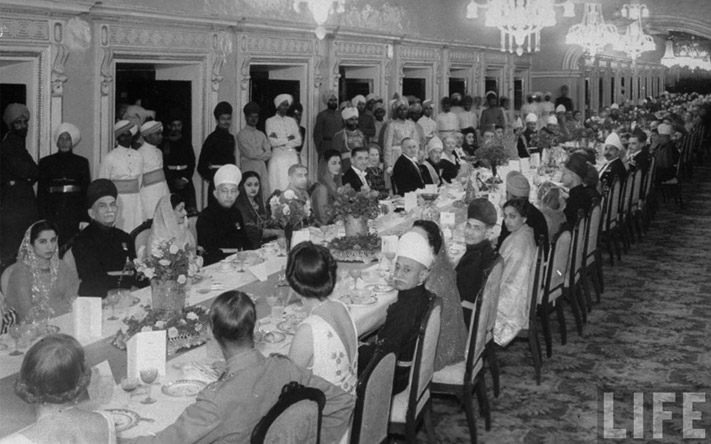
British Viceroy visit to Nizam’s palace

Jacob’s Diamond, is a fabulous piece, weighing 184.75 carats. This sparkling beauty is double the size of the Koh-i-Noor diamond and is said to be the seventh largest in the world. It was acquired by the sixth Nizam, Mir Mahabub Ali Pasha in 1891 from a Jewish trader, A.K. Jacob and hence the name. Mahboob Ali Khan was convinced it was cursed and wrapped it in a dirty rag and tucked it away in the drawer of his writing table. The diamond was later found in the toe of an old slipper during the reign of the 7th Nizam, who had it mounted on gold filigree base. Mahboob Ai Khan may have been right: In 1972, the diamond became the centrepiece of a legal battle that lasted for 30 years and help contributed the downfall of its last owner Mahboob Ali Khan’s great grandson Mukarram Jah.

Nizams palace
Nizam’s Chowmahalla Palace in Hyderabad

The last and seventh ruler of Asaf Jah dynasty, Mir Osman Ali Khan, died in 1967, and immediately a feud over his vast property ensued among his 149 descendants. The Government of India stepped in when things went out of control. However, much of the Nizam’s jewellery collection was already looted by the time. It is stated the aged Nizam never allowed any audit of his jewellery collection and ensured that the dust settled on his collection is not cleaned, so that the glitter never hits anyone’s eyes!

Text by – Shalini Nair

Reference –
The Last Nizam by John Zubrzycki – 2006
http://mahabubnagar.tripod.com/nizam_jewelry1.htm
http://www.hamaraforums.com/lofiversion/index.php/t28241.html

The Treasure Trove of Hyderabad Nizams

6
The Last Nizam - Mir Osman Ali Khan
The Last Nizam – Mir Osman Ali Khan

Hyderabad was the largest princely state before it was merged into the Indian union in 1948 by Operation Polo. For nearly three centuries, Hyderabad State was ruled by the Nizams, who carved their kingdom in South India from the ruins of the Mughal Empire. In seven generations, Hyderabad Nizams amassed such wealth that the last Nizam was titled as the richest man in the world by the Time magazine. The last and seventh ruler of Asaf Jah dynasty, Mir Osman Ali Khan, famous for his idiosyncrasies, was also known for his stunning collection of jewellery.

Stunning is too lame a word to describe the exquisite craftsmanship of the famed Nizam jewellery. The sheer magnificence of rubies, diamonds, pearls, sapphires and other precious stones beautifully embedded in gold and silver, showcase the glory of the erstwhile Nizam. The total worth of 173 jewellery pieces (a fraction acquired by Government of India) is worth Rs 5,000 crore!

Nizam's diamond belt
Nizam’s diamond belt

The last Nizam Osman Ali Khan’s collection included 25,000 diamonds, pearls the size of quail eggs and the famed Jacob’s Diamond. A set of 22 Colombian emeralds weighing 413 carats was so flawless that no jeweller had the courage to set them. One necklace comprised 226 diamonds weighing nearly 150 carats. It is said Osman Ali Khan used to handle his baubles as if they were marbles. The legendary Nizam’s Diamond weighed 400 carats and was said to be the second largest in the world. This diamond was lost and then discovered accidentally in 1870s near Shamshabad by a local goldsmith, buried in an earthen pot.

nizams jewellery

Read: The treasure trove of the Nizams part 2

Text by – Shalini Nair

Images – India Today

Reference –
The Last Nizam by John Zubrzycki – 2006

4 Tips for Organizing Your Fridge the Way It Was Meant to Be

0
refrigerator
Image – Pixabay

You deserve to live a better lifestyle. Maybe you are familiar with tv on rent, but that’s not enough. You also need a well-organized refrigerator will make your work easier. 

It’s not all about storing your items here and there in a fridge. There should be some order so that you can quickly locate anything whenever you need it. 

To give you an insight, some things should always be kept at the bottom of your fridge. Some of these items include meat and dairy. 

Besides, your fridge’s shelves and drawers should help you organize your items in your refrigerator without going through a lot of hassles. 

It’s needless to say that you need to keep your fridge organized. You need to put things where they should be. It won’t just look good, but also be convenient whenever you want something. 

1. Bottom Shelves

As said earlier, some things need to be kept at the bottom shelve of your fridge. Items like dairy products and meat should be kept at the bottom so that you don’t mix them with the other products you’d wish to put in your fridge. 

Maybe you are wondering why you must keep your meat and dairy products at the bottom of your fridge. 

Here is why: the bottom of your fridge is the coldest part, and therefore it will aid in keeping these products such as meat fresh. 

Besides, you would not love drinks like juices to drip to your meat. So, the bottom of your fridge is the best for such. 

Another point you should note is that you need to wrap well your meat before placing it at the bottom of your fridge. 

You can do this by wrapping it using a transparent polythene paper and then putting it in a clean bowl. Don’t have a refrigerator yet? Don’t worry, you can go for refrigerator on rent

2. Side Drawer for Condiments

Did you know that the side drawer is the warmest part of your fridge? Well, if you didn’t know, then now you know. 

That said, it is evident that some items should be considered for such space. And you know what? You should keep your condiments in this section. 

Besides condiments, you can also store a variety of items in this section. You can store your cooking oil, juice or even water in this section. 

3. Upper Shelf Should Be For Items that Don’t Get Bad Easily

Surprisingly, the upper part of your fridge turns to be warmer than other regions in your fridge. As such, you need to store items that don’t go bad easily in this section. 

Sure, you can store spreads like jam, hummus, and jelly in the upper section of your fridge. Besides, you have the freedom to store yogurt in this area too. And in case you were wondering, you can also put the leftovers in the upper region of your fridge. 

4. Foods You Shouldn’t Keep in Your Fridge

Sure, there are certain foods that you shouldn’t keep in your fridge. It’s a surprise, but the truth is that you can’t store every food in the refrigerator. 

Here are the things you should never keep in your fridge: 

  • Coffee
  • Garlic
  • Bananas
  • Bread
  • Potatoes
  • Onions
  • Tomatoes

Final Thoughts

Arranging your fridge to look decent isn’t that easy, and most people fail when it comes to this. Fortunately, you now have the hacks. 

An Obsession called Ilish Maachh

0

ilish fish
Hilsa Fish Curry – Source

The Bengali Bhadralok have a fancy for many things and chief among them is fish or ‘Feesh’. It is a Bengali ritual for the man of the house to go to the market everyday to buy a fresh supply of fish. The queen of fish ‘Hilsa’ or Ilish fish, popularly known as ‘Ilish maachh’, in Bengali language, is the essential ingredient of Bengali cuisine.

Although, ilish maachh is a tropical saltwater fish (scientific name: Tenualosa ilisha), it thrives in rivers and estuaries. This fish is found in the Arabian Sea, the Red Sea and of course in the Bay of Bengal. The Hilsa is also a fast swimming fish, so it can quickly cover kilometers and swim up the rivers draining into the Bay of Bengal. The marine Hilsa caught in sea is not considered as tasty as the fish caught in inland rivers.

Hilsa is mostly available during February-March and in the monsoon season from August to October, as it is a seasonal fish. It is soft and easily perishable. Therefore, it is very expensive and needs quick transportation, freezing and other facilities to maintain it, before it reaches the various fish markets across Bengal. During the rainy season, it is considered to be the most wanted delicacy, meant to stoke the taste buds of the Bengali palate.

Ilish Fish
Fishermen seeking the elusive Ilish – Source: Monsoon Lover

The two main varieties of Hilsa are the Padma variety, loved by the Bangali immigrants from Bangladesh, and the Kolaghat variety found in the tributaries of river Ganga, which is sweeter and softer. This sweeter variety is loved by the Bengalis in Kolkata. The Hilsa is full of tiny bones that require trained eaters/hands to handle.

Bengali Bhadralok ensure that atleast two Hilsa fish (Joda Ilish) are bought for the occasions of Saraswati puja and Lakshmi puja. On auspicious occasions like pujas, functions and weddings, this fish is prepared in several ways: smoked, dried, fried, baked, steamed or cooked in curry. It is also prepared by mixing Brinjal, curd and green banana. There are several simple and grand ways of preparing the Ilish, and here are some of the popular recipes:

hilsa fish
Hilsa fish offered for sale in the market

There is the famous Shorshe Ilish or the Ilish Shorshe Bata, prepared with mustard paste, green chillies, and onions. It is a traditional and easy dish that can be prepared at home. Dahi Ilish is also an easy to serve dish, Bhapa Ilish (steamed Ilish) is a signature Hilsa dish, where fish pieces are mixed with paste of white and black mustard seeds, poppy seeds, marinated and then steamed in a particular way before being served in plantain leaves.

Ilish Maccher Paturi is where the fish pieces are smeared with turmeric powder, and put into a mixture of mustard paste, chili paste, yoghurt, salt and mustard oil, along with spices. Each spiced up piece is then folded in marrow or pumpkin leaf and the pieces are fried in oil. Ilish Maccher Jhol is also made in a somewhat similar manner with ginger paste, garlic paste and tomato puree, but it is mainly a curry preparation. Even the simple to make Illish Macch Bhaja is a mouth watering fried fish dish. Most of these dishes go well with steamed rice.

Ilish fish
Daily ritual at the fish market – Source: $owmya

Not just Bengalis, even visitors from within the country and abroad, fall in love with Ilish delicacies once they taste it. Anyone fond of fish, will truly obsess over the Ilish for the rest of their lives. It is good idea to try it once, and decide for yourself!

Photo Credits:
Monsoon Lover
$owmya

Fact file –
Wiki Hilsa
http://www.bongcookbook.com
Wiki Bengali Cuisine
http://en.wikipedia.org/wiki/Bhadralok

7 Tips for Saving Money On Two Wheeler Insurance This New Year

0

Two Wheeler Insurance India
Image – Pixabay

A brand new year is waiting around the corner. You may have many dreams and wishes to achieve this new year. If one of them has been getting your own two-wheeler, then you must look to achieve the dream by all means. You will find many attractive schemes to buy a new bike around this time. Make full use of these deals and get yourself the two-wheeler you always wanted. And along with that, get a good 2 wheeler insurance plan too.

Tips To Save Money On Two-wheeler Insurance 

Take a look at the simple tips mentioned below to save a lot of money on your bike insurance premium:

  1. Choose the right kind of policy: Two-wheeler insurance is available in two forms – third party and comprehensive. You need to understand what each type of insurance provides. You then need to assess your own requirements. Then see which type of two wheeler insurance suits you the best. Choosing the right plan will ensure you get the correct value for the money you pay. 
  2. Compare: It is vital to compare two wheeler insurance. Unless you compare, you will be unaware of the cheapest option. Without running a comparison and picking up the first plan you see, you will most likely pay more than you need to. So do remember to compare two wheeler insurance before you make your final selection. 
  3. Install some safety devices: Your insurance plan offers cover against damages and thefts. So if you install some safety devices in your vehicle, it will automatically become safer. This will make it less vulnerable to robbery attempts. Your insurance premium will, therefore, reduce, owing to this fact. 
  4. Register in an automobile association: Members of registered automobile associations get motor insurance discounts. So enrol yourself in any recognized Indian auto association and get some great discounts on your 2 wheeler insurance premium. 
  5. Calculate the NCB and IDV properly: The next tip for you is to calculate your no claim bonus (NCB) and IDV properly. These two components play a very important role in bike insurance. You will stand to get heavy discounts when the NCB and the IDV are calculated properly. This will happen mainly when you go in for your two wheeler insurance renewal online. 
  6. Approach your existing insurer: Most people have existing insurance covers such as health insurance plans and home insurance plans. If you have some general insurance plans from a specific insurer, speak to them before you by your two-wheeler insurance plan. Many insurance providers offer loyalty benefits to their customers. If you do get some benefit, it will lower your two-wheeler insurance premium for sure. 
  7. Renew on time: And finally, you should never forget to renew your bike insurance cover on time. Opt for two wheeler insurance renewal online. It is very easy to renew your plan. You can do this in a matter of a few minutes. So never let your policy lapse as then you will unnecessarily end up paying a late fee. This will increase your bike insurance costs. 

In a nutshell 

As you can see, there are indeed some very effective ways in which you can lower your 2 wheeler insurance costs this New Year. This will help you to stick to your budget and will take you one step closer to owning your dream bike. So without wasting any further time, head to your bike dealer’s store. Get a good bike. And along with that, get the best possible bike insurance plan and keep your precious vehicle safe and secured at all times.