Under the Shade of Tree #3335: Penciljam Returns to Cubbon Park

0

Penciljam-Returns-to-Cubbon-Park-01

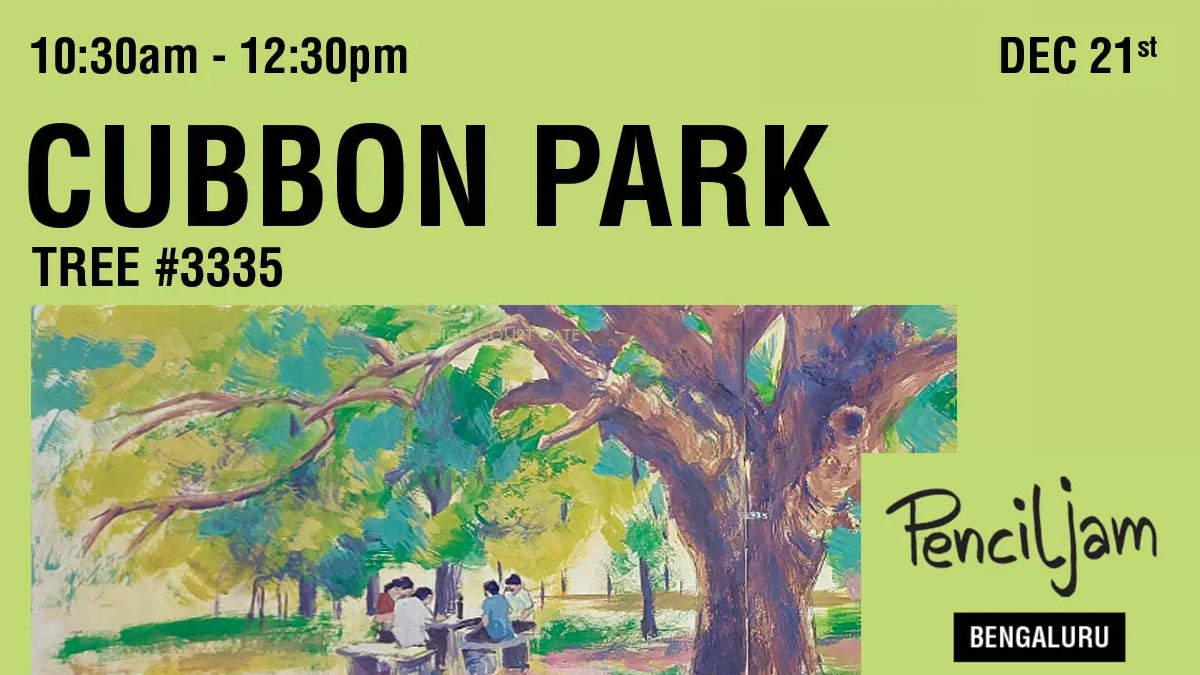
On December 21, 2025, Bengaluru’s much-loved Penciljam community will huddle together in the umbrageous Cubbon Park to host a blissful drawing session amidst the lap of nature. This session, organised by Penciljam, aims to connect people more closely with the natural environment through sketches and artworks. The gathering centred around “Tree #3335” is an open invitation to residents to cease to be a passive straphanger and become an active beholder of their natural environs. It is not just any other weekend activity; it is recreation through mindful living. 

Cubbon Park is known by the official name of Sri Chamarajendra Park. It is a space noted for its old senescent trees. These trees date back to the colonial era and have contributed significantly to the city’s ecological development. Interestingly, these trees have been numbered for conservation and mapping purposes. This space is referred to as the green lung of Bengaluru. The park has been central to Penciljam’s outdoor drawing tradition. The penciljam is a community of people who love to sketch. And for their forthcoming outdoor sketching session, Tree #3335 serves as the spot where strangers would gather and put down their imagination on paper. 

The sketching episode will run from 10:30 am to 12:30 pm, capturing what is known as the “golden window” of Bengaluru’s winter sun. Today, people’s eyes are more accustomed to instant photographs and AI-generated images. Amidst this, an explicit session at the heart of nature is a test of patience as well as the need of the hour. It will enable the participants to slow down, observe better, and find ways to interpret their natural surroundings in a composed manner. The group will move past the Band Stand and the statue of Mark Cubbon and embark upon an artistic journey together. 

Penciljam and The Venue


View this post on Instagram


A post shared by Penciljam (@penciljam)

The Penciljam meet-up is the continuation of a decade-long saga of public sketching sessions. It reflects a crucial turning point in Bengaluru’s evolving art and culture. Hitherto, the community has trodden and marked the city through parks, temples, markets, and neighbourhoods, creating a different vibe within the “known” vicinity. For their forthcoming session, Cubbon Park is an ideal site to hold a direct connection with nature and work in an ambience that is untouched by the core urban ways. 

For this upcoming session, there are no registration fees, no prerequisite artistic training, and no constraints on participation. All someone needs is interest. “Curiosity” is the ticket to pass, and all attendees are encouraged to bring their own sketch books, pencils, watercolours, ink, or any medium of their choice. Often, many people simply join to watch and socialize, or to enjoy the morning calm. 

The Park, spread over 300 acres, dates back to 1870. It withstood the ravages of time and stands still as a living museum of flora. There are thousands of trees, including ancient figs, rain trees, mahogany, and copper pods. It forms a spectacular vaulted canopy that fragments the light and sometimes does not let the sunrays reach the understorey. The shade of Tree #3335 will turn into a transitory classroom, a sketching studio, and a sanctuary. 

Essential Information About the Event

Aspect Details
Event Tree #3335 Sketching Session
Organizer Penciljam Bengaluru
Primary Location Cubbon Park (Near High Court Gate / Band Stand)
Date and Time December 21, 2025; 10:30 AM – 12:30 PM
Target Audience All ages; no prior artistic skill required
Focus Tree Tree #3335 (specific route map provided)
Core Philosophy Slow living and urban nature connection

Key Highlights

  • Open-to-all event encouraging art without judgment
  • No skill level requirement; beginners welcome
  • Immersive outdoor experience under natural light and shade
  • Encourages mindful drawing in silence or conversation
  • Connects artists and non-artists through a shared creative process
  • Adds to Penciljam’s longstanding tradition of urban sketching
  • Celebrates the heritage ecology of Cubbon Park
  • The organizers provide a detailed hand-drawn style map to help participants find the specific tree
  • Penciljam utilizes Discord to keep the conversation going, allowing for post-event sharing and feedback
  • Cubbon Park serves as the “lungs of the city.”
  • These events emphasize the park’s role as a vital “third space” outside of home and work
  • The session encourages drawing in “dappled shade,” focusing on the sensory experience of the park rather than just the visual output

Art, Community, and the Slow Urban Movement

There has been a steady rise in the number of urban sketching groups around the world as a response to digital overload, societal fragmentation, and the increasing commercialization of creativity. Penciljam’s work resonates with movements in cities like Barcelona, Portland, Hanoi, and Tokyo, where sketch meets offer a grounding experience. For Bengaluru, this is a much-needed innovation that would counterbalance the fast-paced life of the metropolis. 

Takeaway

Penciljam’s “Tree #3335” sessions are the unsung heroes of urban mental health. Drawing a tree doesn’t help you meet a deadline or fix a bug, and that is precisely why it is essential. In a city like Bengaluru, where hustle is considered the mainstream modern culture, such recreational activities are a must. It restores a sense of belonging to nature. Public parks were designed to be democratic spaces, and events like this reclaim that democratic purpose.

While the city changes rapidly with new metro lines and glass skyscrapers, these trees remain. By documenting them, Penciljam isn’t just making art; they are building a collective memory of a city that is too often in a hurry to forget its roots. If more urban centers adopted this “sketch-and-stay” model, people would find themselves dwelling in communities that are not just more creative but significantly more empathetic toward the environment they inhabit.

From Indie Music to Wellness Zones: What to Expect at Boho Fest 2025 Lucknow

0

Boho-Fest-2025-Lucknow-01

Lucknow Prepares for Boho Fest 2025

As the chill of December settles over Lucknow, the city is getting ready for its most awaited Boho Fest 2025. The festival shall run on December 27 & 28, 2025, at the Janeshwar Mishra Park, Lucknow. It promises a plethora of activities, including art, music, wellness, food, and creativity under one shared space. The festival will encompass all these themes with a free-spirited bohemian lifestyle. The announcement of this event on social media led to a buzz around it. The organizers have also released a detailed “Festival Map” to facilitate better navigation and help people trace what they called “hidden corners and missed moments.” From the Electronic Dance & Music stage to the Healing Oasis, and from the Food Stalls to the Flea Market, every detail is noted on the map, and it also suggests that the event does not look up to mere ‘consumption’ of its themes, but it aims to forge ‘connections.’

Suggested Story: Culture of Lucknow – Exploring the City of Nawabs

The Ultimate Bohemian Experience

The Historical town of Lucknow is renowned for its Tehzeeb, classical arts, cuisine, heritage, and so forth. Its Nawabi culture has experienced a shift with the evolving contemporary youth culture. The Boho Fest marks an interesting turning point at the juncture of these two. The venue of the fest, Janeshwar Mishra Park, is one of Asia’s largest eco-parks. The layout of this festival denotes a fine decentralization of spaces to cater to diverse interests. The delineation is conducted to create both high-energy dance floors and quiet zones of self-reflection as well. 

India today observes a lot of festivals and events, and the Boho Fest is one of those evolving ones. It beautifully coalesces cultural roots with modern sensations. Fests like this do not aim to undermine the culture, but rather celebrate it as a constellation of individual expressions. The specific zones are carefully curated, complemented by live performances and interactive activities that show a growing youth-led movement that values authenticity, nature, and collective energy. Ultimately, the primary agenda is to bring the best version of the Boho Lifestyle that departs from the concrete boundaries of the monotonous lifestyles and let people tread a path of life that is raw, independent, expressive, and creative. 

A Sneak Peek Into The Boho Fest

Aspect Details
Event Dates BohoFest 2025, Lucknow
Event Dates December 27th and 28th, 2025
Primary Venue Janeshwar Mishra Park, Lucknow (LKO)
Musical Diversity Three distinct stages: Main Stage, Indie Stage, and EDM Stage
Lifestyle Zones Healing Oasis for wellness and Flea Market for artisanal shopping
Family Accessibility Dedicated Kids Play Area and Adventure Sports section
Core Theme Bohemian aesthetics, community, and creative expression

Understanding The Fest’s Layout

The Boho Fest is curated to be a multiverse of entertainment. The main dias is expected to host larger performances, including a mix of popular Bollywood playback singers and renowned national bands. The Indie stage is a spot for upcoming songwriters and homegrown talent. Meanwhile, the EDM (Electronic Dance & Music) stage is set to light up the night, featuring a DJ and light shows to illuminate a major sphere of the city. 


View this post on Instagram


A post shared by Boho Fest (@thebohofest)

Beyond Music, there is the Healing Oasis. This segment adjoins wellness with the constellation of activities taking place at the fest. One might expect sound healing sessions, yoga workshops, and meditation corners, offering a refuge to those who wish to be part of the festival without hopping to loud music. For people who are eager to shop for aesthetic items, the Flea Market is an absolute heaven. It will display stalls with handmade jewellery, sustainable fashion, and home decor items that are oriented to the “Boho” theme. The festival will also serve people’s food cravings. From regional cuisines to global flavours, the Boho fest has it all. The food stalls are more than just eateries; these are the prime juncture of meet up, people hanging out, initiating conversations, and so forth. 

Moreover, there are areas where people can physically engage in playful games and other acts of recreation. The fest is well-planned and family-friendly as well. The organizers ensure that the environment is safe and accessible to all. 

Key Highlights

  • Multi-genre musical experience across EDM, Indie, and Main Stage settings
  • Strong wellness dimension with the Healing Oasis
  • Fusion of performance, sports, food culture, and marketplace recreation
  • Family-friendly festival with dedicated space for children
  • Interactive map design promoting organised navigation
  • Represents broader cultural trends in experiential youth events in India
  • High potential for tourism and economic and cultural exchange
  • Set in one of Lucknow’s most scenic urban parks
  • Multiple food zones offering everything from Lucknow’s famous local delicacies to global   fusion “Boho” snacks
  • The fest is hosted in a lush green park, emphasizing the festival’s connection to nature and open spaces

Takeaway: An Event Worth Experiencing

The Boho Fest is a new cultural reflection of Lucknow’s evolving heritage. Its structure, scale, frameworks, etc., show a glimpse of what the modern Indian audience looks like. Today, people seek more freedom, art, expression, relaxation, and most importantly, a sense of belonging and togetherness. And with the growing buzz around this festival, seems like it will emerge as a one-stop destination for people with varying interests. 


View this post on Instagram


A post shared by Boho Fest (@thebohofest)

The Boho Fest also reflects a cultural milestone of the historic city towards becoming a modern cultural hub. Lucknow, the city of Nawabs, has a rich past and a vibrant heritage, but events like this ensure that the younger generation remains in touch with the aspects of the city with a modern touch. 

The Bohemian theme is a blast, as it drags people out of a claustrophobic routine and lets them breathe freely and choose freedom. Fests like these enable people to gather not just to spectate, but to weave shared stories and form memories for life. The Boho Fest is a confluence of evolving relationships between the youth culture and cultural tourism in Lucknow. It is surely setting a benchmark for experiential fests in India. 

Complete Langtang Valley Trek Guide in Nepal for First-Time Trekkers

0

Langtang-Valley-Trek-01

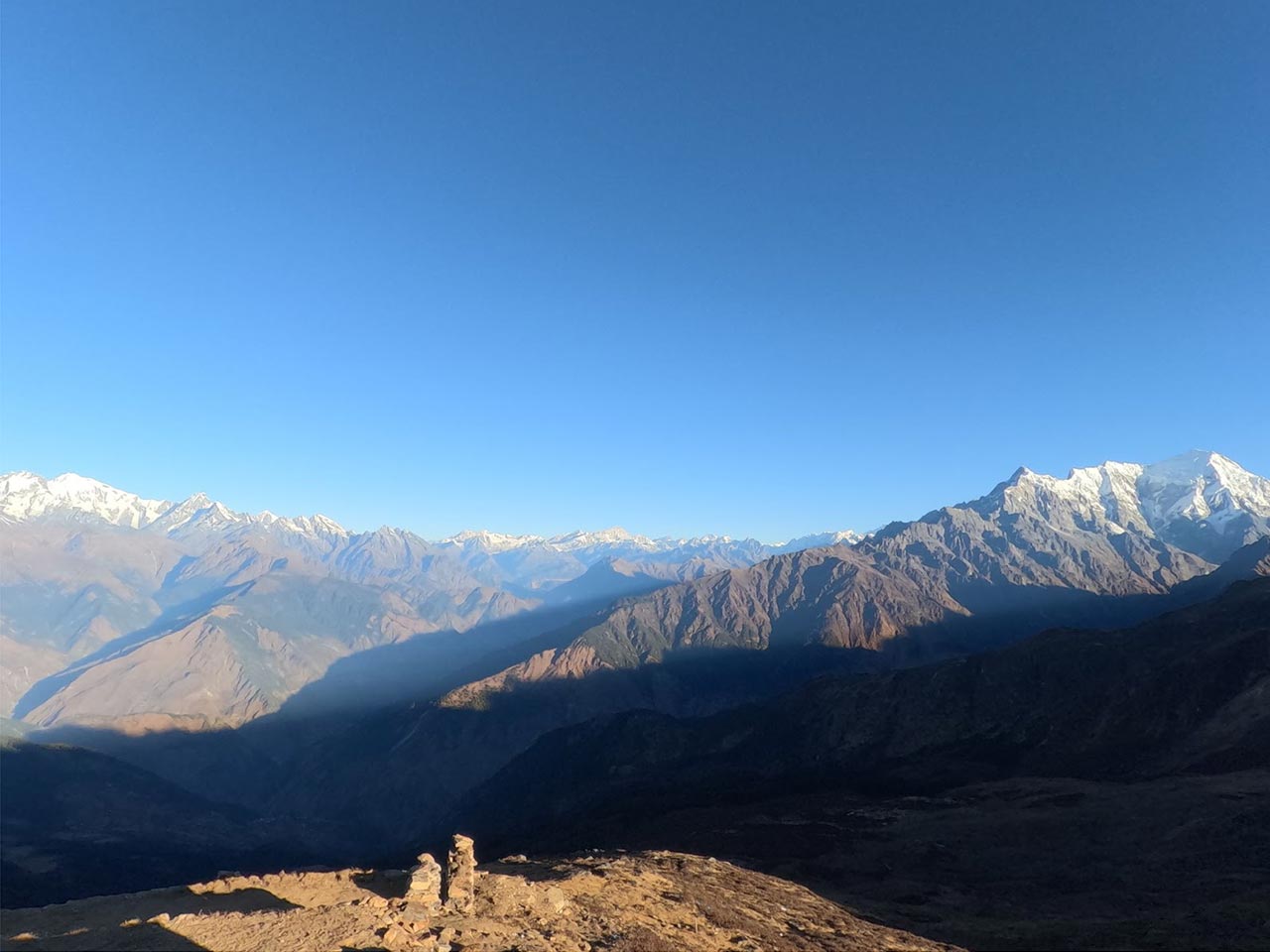
Just imagine it: you are there, among the high snow-topped mountain ranges, inhaling the fresh mountain air, and observing the yaks as they graze calmly in a valley that seems to be miles distant from the contemporary world. You didn’t have to fly to a new, dangerous airport or push through tourists to get here. The result is the enchantment of the Langtang Valley.

If one wants to experience a true Himalayan adventure without having to spend more time completing it, this is just the right trek to choose. It is called the Valley of Glaciers, and it combines both breathtaking scenery and a unique Tamang culture that will remain with you even after you come back.

Ready to lace up your boots? Now, let’s look at what you should know before your first trip to this beautiful area.

What Makes Langtang Special?

Langtang-Valley-Trek-02

For first-time trekkers, choosing the right path can feel overwhelming. You want challenge, but not danger. You want views, but not crowds. Here is why the Langtang Valley Trek is the ideal choice for beginners.

This is why this trek is so special:

  • Easy Start: No terrifying flights to Lukla! You begin on a picturesque Kathmandu to Syabrubesi drive.
  • Cultural Richness: You are going to visit the “Valley of Glaciers” and have a glimpse of the rebuilding spirit of the locals who were able to reconstruct their lives after the earthquake that occurred in 2015.
  • Viewpoints like Kyanjin Ri offer breathtaking views of the Langtang Lirung (7,234 m) and other mountains.
  • Wildlife: You should watch out to see Himalayan tahr, musk deer, and, in the most unlikely case, the red panda that is very difficult to see.
  • Best Time to Trek
  • Everything in the Himalayas is a matter of timing. You can enjoy sunny days to view the mountains, and you can also experience warm weather for leisurely strolls.
  • Spring (March and May): Rhododendrons bloom all over the hills. The climate is very predictable, and the temperatures are favorable.
  • Autumn (September to November): It is not a coincidence that it is peak season. There is also the crispness of the air, the best visibility and crystal mountain views.
  • Winter features heavy snowfall, while summer brings monsoon rains. These seasons are only manageable, though not recommended to everyone who does not like the difficulties.

Key Highlights of the Journey

Langtang-Valley-Trek-03

This is a moderate hike, making it possible for beginners with an average level of fitness to participate. Everything in the Himalayas is a matter of timing. You desire some mountain scenery with clear skies and pleasant temperatures to walk.

This excursion is a moderate hike, making it possible for beginners who have an average level of fitness to participate.

1. The Scenic Drive

The adventure starts with a 7–8-hour drive between Kathmandu and Syabrubesi. It is not smooth sailing, but the sight of terraced fields and the rushing rivers gives us the tone of what is to come.

2. Lama Hotel & Langtang Village

You can be hiking up through beautiful forests of oak and bamboo to Lama Hotel. As you keep going, you will reach Langtang Village. Constructed around the site of the destroyed former village in 2015, this new settlement stands as a testament to human resilience.

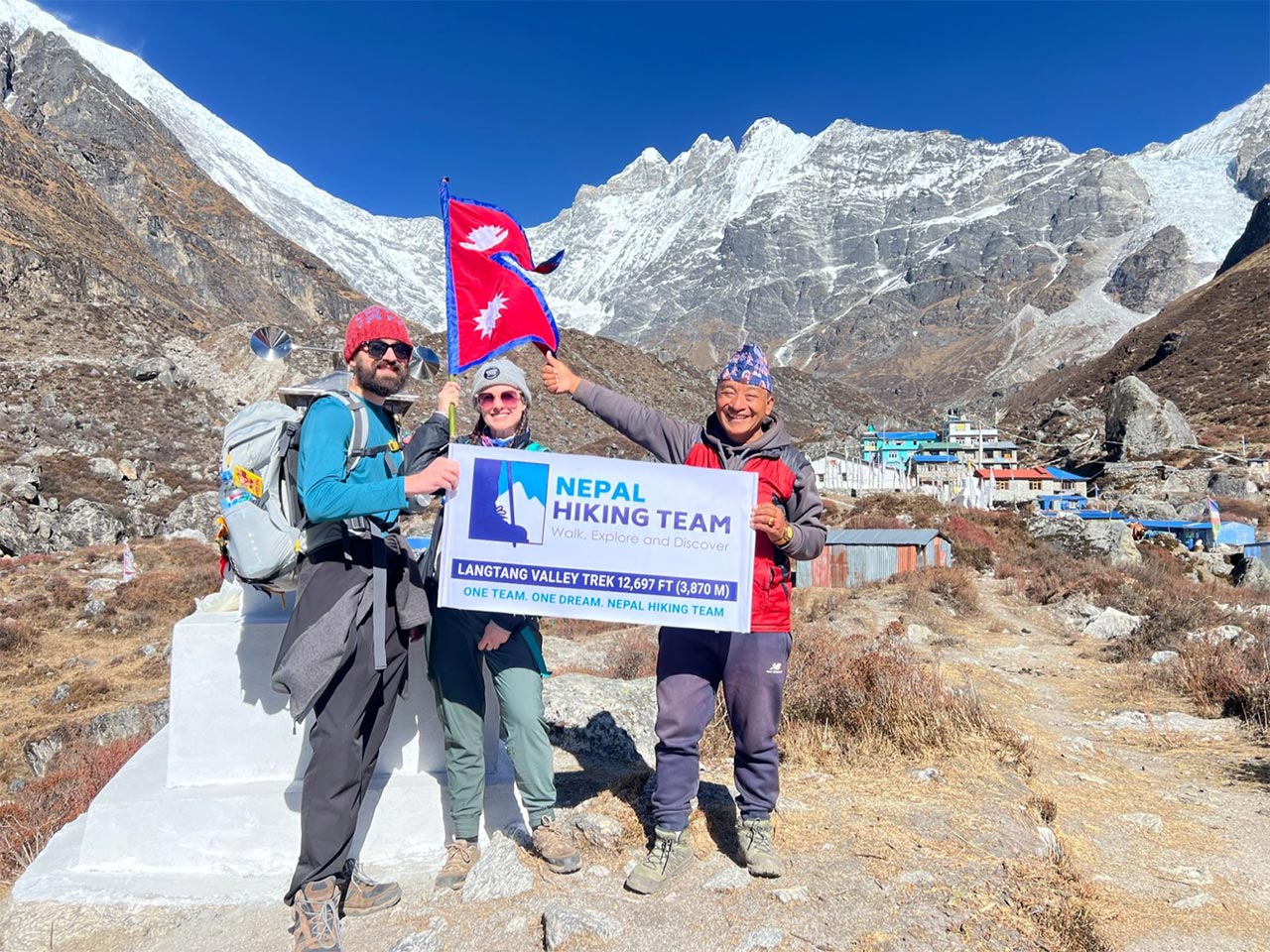
3. Kyanjin Gompa (3,870 m)

This is the last significant destination of the journey. And here you have a chance to see an old monastery, go to the factory of the local cheeses (yes, fresh yak cheese!), and breathe in the spiritual air.

4. Tsergo Ri or Kyanjin Ri

The most preferred will be to hike to Tsergo Ri (4,985 m) or a slightly lower Kyanjin Ri. Here, you are encircled by a 360-degree view of the snow-capped mountains.

For a smooth and well-organized experience, many first-time trekkers choose established operators like Nepal Hiking Team, known for beginner-friendly itineraries and knowledgeable local guides.

Packing Essentials

Langtang-Valley-Trek-04

When trekking, it’s crucial to pack sparingly yet strategically. The following is a rough checklist:

  • Shoe: Durable, worn-out hiking shoes were a necessity.
  • Layers: Thermal tops, fleece jackets, and a waterproof outer shell.
  • Equipment: A decent sleeping bag (-15°C) and trekking poles to save your knees.
  • Hydration: Water pills or a filter bottle to conserve money and plastic.
  • Cash: ATMs are absent on the trail, so make sure to carry enough Nepali Rupees to have snacks, Wi-Fi, and hot showers.

Start Your Adventure

The mountains are beckoning, and the Langtang Valley would be answering all the calls. It provides a combination of nature and traditional flavor, which is difficult to find anywhere. It doesn’t take a pro climber, just someone adventurous and ready to explore.

And are you willing to replace the noise of the city with the relaxing sound of the Langtang River? This valley is there to receive you with open arms.

SMI Interpretations ’25: A Deep Dive into Srishti Manipal’s Winter Showcase

0

SMI-Interpretations-’25

A Sneak Peek At SMI Interpretations’25

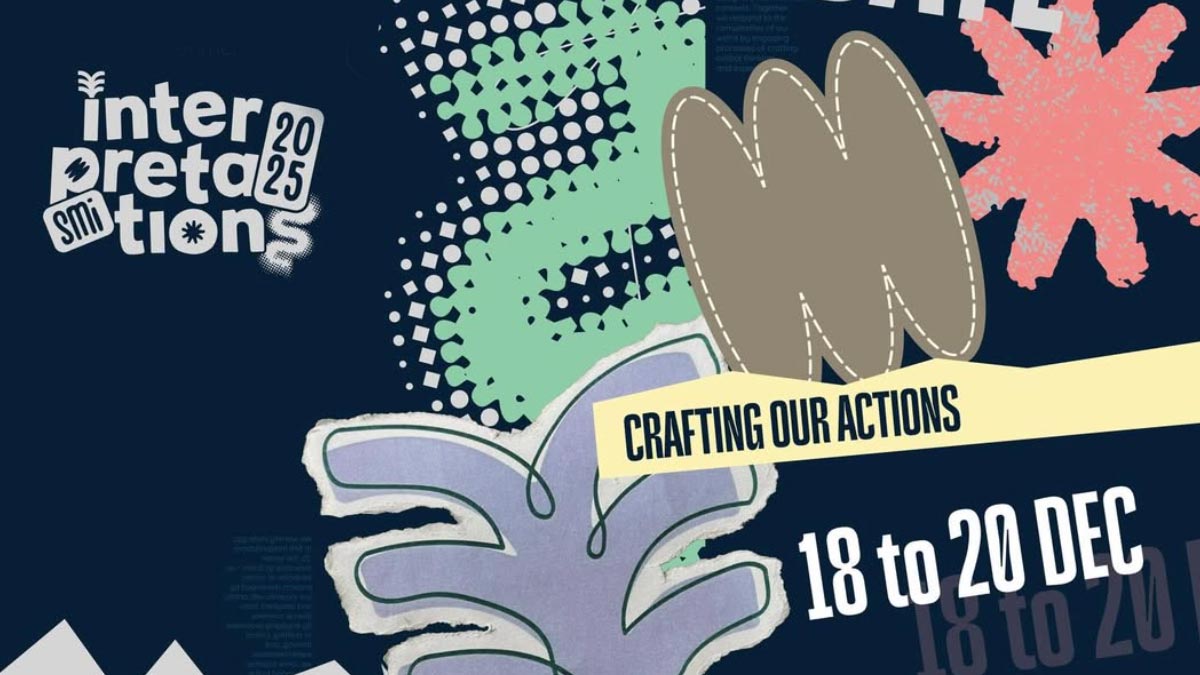
The Srishti Manipal Institute of Art, Design and Technology (SMI) is hosting its annual winter showcase, titled “Interpretations ’25,” that aims to transform the ambit of contemporary art and design education through active engagement. It caters as a zestful platform where academics are intercepted by the erratic pulse of the real world. The event is running from December 18 to 20, 2025. The exhibition titled “Crafting Our Actions” is the biggest highlight of the entire occurrence, which denotes a month-long collaboration between their students and global artists.

The exhibition includes the spirit of the ‘Interim’ program, a special marker in SMI’s academic calendar where undergraduate students work alongside visiting artists and designers. This exercise aims to understand the “complexities of our world” through the tangible processes of crafting, critical thinking, and a relentless method of trial and error. The event is taking place at the MAHE Bengaluru campus in Govindapura

“Interpretations” has regularly functioned as Srishti Manipal’s annual public-facing exhibition, where students showcase their works that are created by rolling beyond classrooms. This is also their formal initiation as a batch into the public domain. The 2025 edition emphasizes the process-driven aspect, rather than being a product-centric display. 

Interpreting “Crafting Our Actions

Among global art schools and design institutions, an emerging trend of delving more towards a more socially responsive practice. It basically refers to works that are oriented with ethics, the concept of sustainability, and critical thinking. Interpretations ’25 seems to move along the same trajectory. This exhibition is rooted in how ideas translate into interventions, narratives, and responses to the world students inhabit. It also manifests SMI’s educational philosophy. The institute emphasizes a “porous and permeable” learning environment. This means the displayed works often include productions of students living in different communities, traveling to diverse locales, and responding to actual societal changes. 

This approach is highly pragmatic and dwells less on classroom briefs. In a nutshell, the institute embraces a positive “chaos” to give birth to limitless creativity. This is a crucial ground where students are exposed to rejection and failure, and it is treated as an important step towards “crafting” a meaningful response to global challenges such as sustainability, identity, and technological ethics. The 2025 edition is a continuation of the ethos, which allows attendees to perceive the exhibition as a constellation. 

A Campus Event with a Community Pulse

The SMI Interpretations ’25 is not an inward-looking academic exercise but a campus-wide cultural event. The institute’s broader learning mechanism emphasizes peer learning, open critique, and public engagement. Student-run blogs, alumni nexuses, and other sources describe this annual event as a space where conversations matter as much as objects. Visitors can expect to see sketches, prototypes, documentation, and dialogues with students complementing their finished works. 

Snapshots of the Event

Aspect Details
Event Name SMI Interpretations ’25: Crafting Our Actions
Primary Dates December 18 to December 20, 2025
Venue SMI Campus, MAHE Bengaluru (Govindapura, Yelahanka)
Participants Undergraduate students and visiting practitioners
Organizing Body Srishti Manipal Institute of Art, Design & Technology
Core Philosophy Transdisciplinary research and experimental pedagogy
Focus Process, action, interdisciplinarity, and community engagement

Key Highlights

  • Annual flagship exhibition showcasing student work across disciplines
  • Emphasis on process-led and action-oriented creative practices
  • Strong alignment with contemporary debates in art, design, and social engagement
  • Open, inclusive campus culture encouraging dialogue between students, faculty, and visitors
  • Visual identity reflecting experimentation, plurality, and layered thinking

A Closer Look

The event is one among multiple-venue fests across Bengaluru, including exhibits such as “Practices of Attunement” at the Bangalore International Centre and “Prologue” at the Venkatappa Art Gallery. The exhibition has an “Open House” spirit, encouraging wider participation. It reflects the Institute’s commitment towards “multimodal representations.” 

Looking at other student-led exhibitions, an increasing consensus about the articulation of “why they make, not just what they make” by the emerging practitioners is noticeable. This exhibition also frames students’ output as “actions.” Thus, it poses an implicit query to the responsibility, agency, and relevance of their work, meaning that students have to be more accountable and responsive towards their own output.  

Takeaway

SMI Interpretation’25 is beyond a mere visual spectacle; it is a thoughtful reinvention of how students’ works are interpreted and engaged with. It offers a blurb for all design institutions regarding public engagement. The best part is that SMI treats this exhibition as a “living conversation” rather than a final “grading” aspect. 

Collective events like this (such as in BIC, Venkatappa, and the Yelahanka campus) turn the city into a living art gallery, making art and designs accessible to all. 

The exhibition emphasizes that creativity is not neutral; it is influenced and moulded by choices, contexts, and consequences. The 2025 edition is not just a mere talent show; it reasserts the role of practical education complemented by meaningful cultural action. It drifts from the routine of listening to lectures and steps ahead towards demonstrative practices. 

As the world is becoming more networked and interdependent, occurrences of events like this are a necessary step in making students more capable and resilient. It is through initiatives like these that a newcomer will gain hands-on experience in the “real” ways of working in their niche. It ultimately stands with the fact that “creativity is not just a skill but a resilient way of being.”

Shilo Shiv Suleman’s Fearless Foundation Painted Cochin’s Largest Mural

0

At-the-Root-How-Fearless-Foundation-Painted-Cochin’s-Largest-Mural-01

Art at the Frontlines of Climate and Community

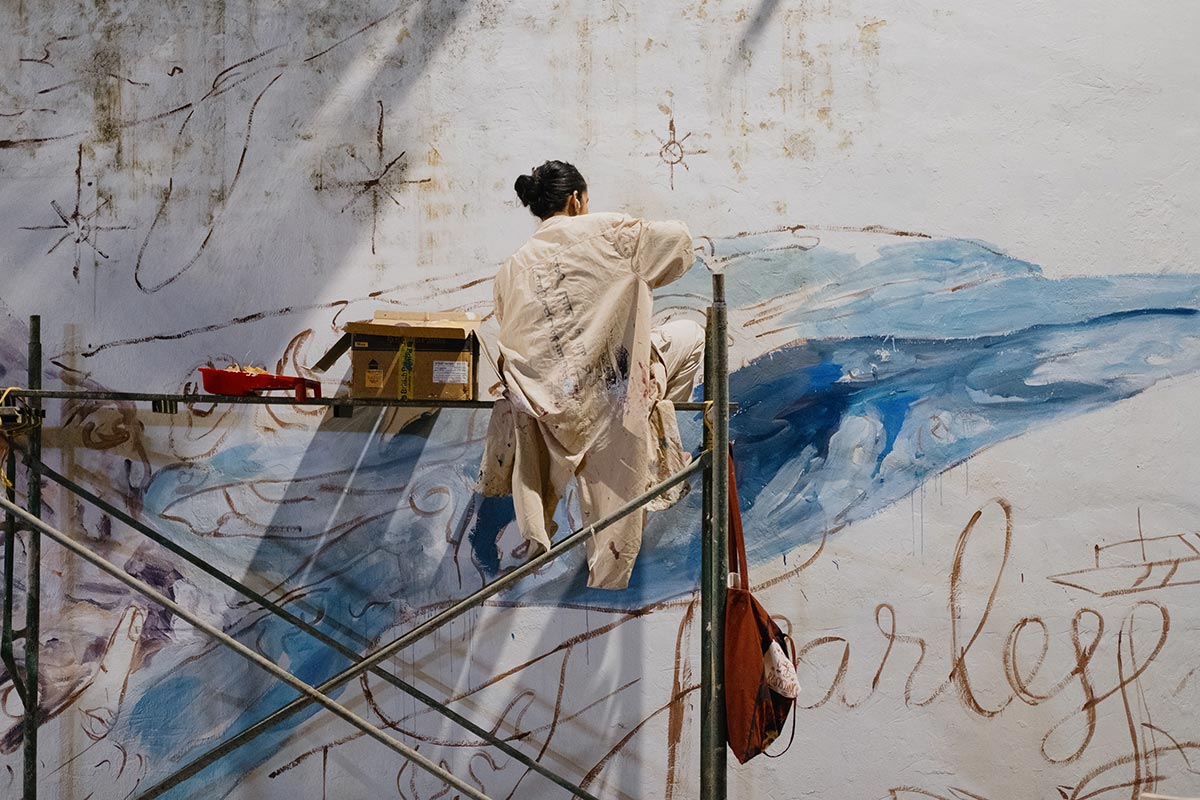
Cochin is a city shaped by tides and trade. Fort Kochi has withstood historic waves of migration, labour, and survival. This historical coastal quarter has emerged as a site of Cochin’s largest painted mural created by Shilo Shiv Suleman’s Fearless Foundation. They have painted a 200-metre-long public artwork on the compound wall of the Indian Coast Guard Office, which has evolved into an artistic space honouring those souls who have worked relentlessly to sustain and safeguard India’s coastline. This mural is not just a visual treat to the city, but a part of the “At the Root” initiative. The rudimentary focus area of this initiative intersects climate justice, gender, and labour. The Fearless Foundation is known across South Asia for its contribution to public art. Engraved in the essence of community engagement and co-creation, the mural taps into lived experiences and the impact of climate change. 

A Confluence of Narratives

The mural is a kaleidoscopic representation of a plethora of tales. It merges the sagas of the Indian Coast Guard, local mangrove plantation workers, and traditional fishing communities. The murals minimize the distance between the security keepers of the coast and the local custodians of the land. 

Fearless Ambassadors and the Power of Listening

At-the-Root-How-Fearless-Foundation-Painted-Cochin’s-Largest-Mural-03

The creation of the mural was a collective effort of 10 “Fearless Ambassadors.” These ambassadors formed an umbrella body of artists and activists from countries across South Asia and beyond. It includes people from Nepal, Bangladesh, Sri Lanka, Uzbekistan, and Myanmar. They facilitated listening circles and rituals in collaboration with residents. These sessions permitted the participants to share stories related to various climatic challenges such as rising sea levels, pollution, and issues related to coastal livelihood. 

Murals as Archives of Lived Experience

The resulting artwork was a genuine reflection of lived experiences. The Fearless Foundation’s broader agenda is to demonstrate public art as a democratic process where people are not mere subjects or viewers, but are the creators of the design. Rather than following a hard and fast artistic vision, they let people opine and choose their artistic call. Fearless’ work has noted how such murals function as “archives on walls,” preserving oral histories and ecological memory in shared urban spaces.

At the Root: Climate Justice Beyond Symptoms

Fort Kochi is a part of the Fearless Foundation’s long-term climate justice focus area called “At The Root.”  This initiative focuses on structural inequalities in how climate change impacts gender, labour, indigeneity, and historical marginalisation. These rituals, storytelling, and other tangible practices, the initiative bridges immediate reality with global crisis. This is the need of the hour in coastal South Asia, where environmental degradation is deeply entangled with its colonial past, extract-oriented economies, and present-day governing challenges. 

Celebrating Collective Imagination


View this post on Instagram


A post shared by Fearless Foundation (@fearless.art)

The completion of the mural was complemented by a formal closing ceremony with a great feast. Food, music, and storytelling animated the space, reimagining the idea that celebration itself can be an act of resistance.  Gatherings like these have been the hallmark of Fearless projects across the globe. In Fort Kochi, the feast served as a statement that climate justice is not only about survival but also about sustaining joy, culture, and connection.

Project Overview and Impact

Feature Details
Location Indian Coast Guard Office, Calvathy Road, Fort Kochi
Dimensions 200 metres (Cochin’s largest mural)
Theme “At the Root” – Climate Justice and Coastal Communities
Participants Shilo Shiv Suleman’s Fearless Ambassadors (6 countries), Indian Coast Guard, and local fisherfolk
Methodology Participatory public art, storytelling rituals, and listening circles
Culmination Fearless Feast featuring community storytelling, music, and food
International Collaboration Fearless Ambassadors from six countries across South Asia and beyond
Closing Event Fearless Feast held at the mural site

Key Highlights

  • Cochin’s largest mural created through community co-creation
  • Focus on coastal protection, climate justice, and invisible labour
  • Participation of international Fearless Ambassadors
  • Integration of storytelling, ritual, and public art
  • Fearless Feast celebrates collective creativity and resilience
  • Unlike traditional street art, the mural featured open “community paint sessions,” where the public was invited to pick up brushes and contribute to the wall
  • This installation adds to the Fearless Collective’s global footprint, which includes over 52 murals across 20 countries, all aimed at replacing narratives of fear with those of love and beauty.

Takeaway

The whole point of this project was to elevate public art from the point of view of being an aesthetic decor to a mainstream engagement programme with real people. Today, climate change is often quoted through daunting statistics and “doom-scrolling” headlines. Amidst this, Shilo Shiv Suleman and the Fearless Foundation’s work demonstrates that murals can function as spaces where climate justice is narrated not through slogans but through lived realities.

Drawing on the walls of institutions like the Indian Coast Guard, it suggests that “safeguarding” a coastline is as much about the policy of the state as it is about the ancestral knowledge of the woman planting saplings in the silt. Thus, it offered a crucial model for how art, activism, and community participation can overlap and produce something creative and worthy of bringing about a change. 


View this post on Instagram


A post shared by Fearless Foundation (@fearless.art)

This mural is a representation of the fact that the public space is also a political arena. By decorating a trivial wall and coating it with colours of the community’s spirit, the Fearless Foundation invigorated the collective psyche of the people who are now more conscious of climate-related issues. 

In the face of ecological uncertainty, such acts of beauty are essential acts of initiating a tide of “change.” This mural stands tall as a proof that when communities are invited to imagine together, walls can speak, history can be rewritten in real time, and art can become an act of protection. 

Kala Ghoda Arts Festival 2026: When Mumbai Turns into a Living Gallery

0

Kala-Ghoda-Arts-Festival-2026

A Reunion of the City’s Creative Pulse

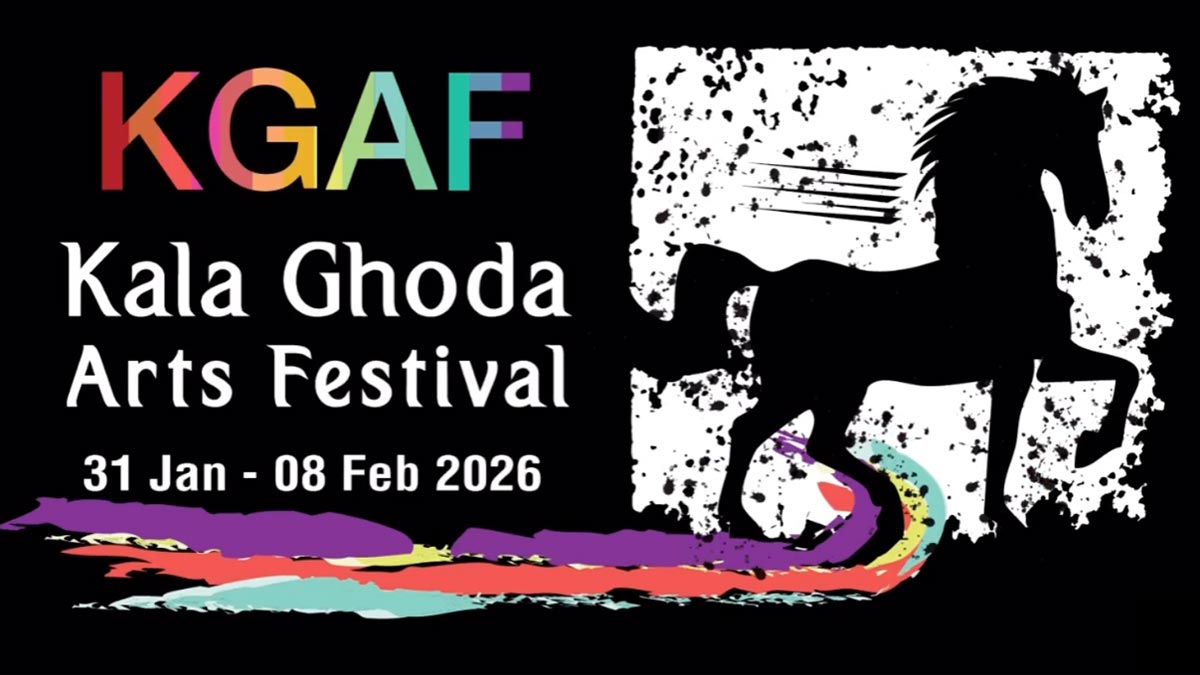
The city of dreams, Mumbai, is about to host Asia’s largest multicultural street arts festival from January 31, 2026, to February 8, 2026. This grand celebration is none other than the Kala Ghoda Arts Festival 2026 (KGAF). Since its inception, it has transformed South Mumbai into the heartthrob of art. The festival spans 9 days and promises an enriching experience, entailing visual art, performance, literature, music, food, and heritage programming. You name it, they have it. This festive extravaganza is organised annually by the Kala Ghoda Association, which has distinctively evolved in the city since 1999. In the current era, it has become a yearly ritual that runs through heritage streets, galleries, and plazas. These are public programs that are free or low-cost for the wider public. Presently, the KGAF has emerged as one of India’s most significant and beloved cultural milestones. Its ability to make art “accessible” to all is phenomenal. 

The Festival As a Grand Canvas

The festival is not just an event; it is a display of unparalleled creativity across numerous themes. It creatively uses the area’s iconic heritage buildings, from museums and libraries to open maidans, as its venues. The core purpose of the festival is not to entertain alone, but to restore the heritage of Kala Ghoda’s rich architectural heritage. All funds raised throughout the event are directly invested in conservation projects. This quality of KGAF makes it distinct and speaks volumes about its success. 

The nine-day festival is a pool of activities taking place in heritage venues such as the Asiatic Library steps and the Cross Maidan. Theatre enthusiasts may look forward to plays in diverse languages at Horniman Circle Gardens, while literature enthusiasts will find their heaven at the book launches, poetry sessions, and discussions with renowned authors at the David Sassoon Library.

A very thoughtful step is taken by creating a separate space for kids, so that the younger audiences do not feel left out. There are workshops for the children covering activities like writing and visual arts. Moreover, dedicated stalls are arranged, showcasing a vibrant street market. These stalls will display the articles of local artisans and design-led products. Food lovers also get their share of the action, with culinary demonstrations and food walks.

The Versatility of The Event 


View this post on Instagram


A post shared by Kala Ghoda Arts Festival (@kgafest)

It is not a single gig; it is a distributed celebration that bridges the colonial aura of “Bombay” with the experiences of “Mumbai.” The edition also incorporates site-specific exhibitions at the Jehangir Art Gallery, the Bombay Art Society, and the statue precinct. The curtain raiser for KGAF 2026 will feature a fusion concert by Santoor maestro Rahul Sharma. The festival’s programming model typically combines headline performances with dozens of weekend stages, masterclasses, and children’s programming that turn the precinct into a live classroom and marketplace for culture.

The Event At a Glance

Aspect Details
Event Kala Ghoda Arts Festival 2026
Festival Dates (2026) Saturday, 31st January – Sunday, 8th February
Venue Kala Ghoda Arts District, South Mumbai
Organiser Kala Ghoda Association (KGA)
Entry Fee Mostly free and open to the public (some workshops or performances may require free pre-registration)
Goal Promote arts and culture; raise funds for heritage restoration of the Kala Ghoda precinct
Scale Referred to as Asia’s largest multi-cultural street festival

Key Highlight 

  • Rahul Sharma’s Santoor fusion concert inaugurates the festival, signalling a blend of classical and contemporary music. 
  • Multi-disciplinary sections: cinema, music, dance, literature, visual arts, heritage walks, food stalls, and a children’s pavilion, a curated structure KGAF has refined over decades.
  • Public art and installations: large-scale sculptures and interactive works installed across the pedestrianised stretch around the Kala Ghoda statue.
  • KGAF emphasises free public programming and partnerships with cultural organisations, artists, and vendors; stall and exhibitor participation is coordinated through official forms. 
  • Digital and social presence: official announcements and schedule teasers appear on @kgafest and partner accounts (including local culture aggregators such as @sabkuch_mumbai), making social channels a key way to track last-minute changes.

Some Practical Notes

KAGF has historically drawn large weekend crowds, so visiting the festival during the weekdays might offer a more relaxed viewof the festival. The Kala Ghoda Association typically publishes detailed programme PDFs and an events calendar a week before the festival; those documents include timings, exact stage locations, and registration links for workshops and masterclasses. So keep an eye!

Takeaway

The KGAF is very grounded in its consistent contributions to heritage conservation. It also offers a live cultural experiment. It is a statement on the importance of public art and heritage preservation. KGAF has successfully managed to make art an everyday, street-level affair. Its success lies in the restoration of magnificent structures like Elphinstone College and the David Sassoon Library. Through actions like this, the festival stands tall as a model of civic responsibility. 

This nine-day celebration illuminates not only the present, but work to safeguard the city’s past. Its essence lies in the fact that the festival has turned Mumbai into a place where art is not confined to a building; it lives and breathes on the street. This is an unmissable opportunity to experience the liveliness of Mumbai through art and culture, where creativity is channeled through a spirit of mass participation and an immersive engagement. 

So, the only mantra is: try to show up a little early, choose a weekday slot if you can, and allow time to move slowly.

Suggested Story: Kala Ghoda Arts Festival 2025: Celebrating 25 Years of Art and Culture

When Memories Sing: IME’s Open Mic Tribute to Mohammed Rafi

0

When-Memories-Sing-IME’s-Open-Mic-Tribute-to-Mohammed-Rafi-01

A Voice That Refuses to Fade

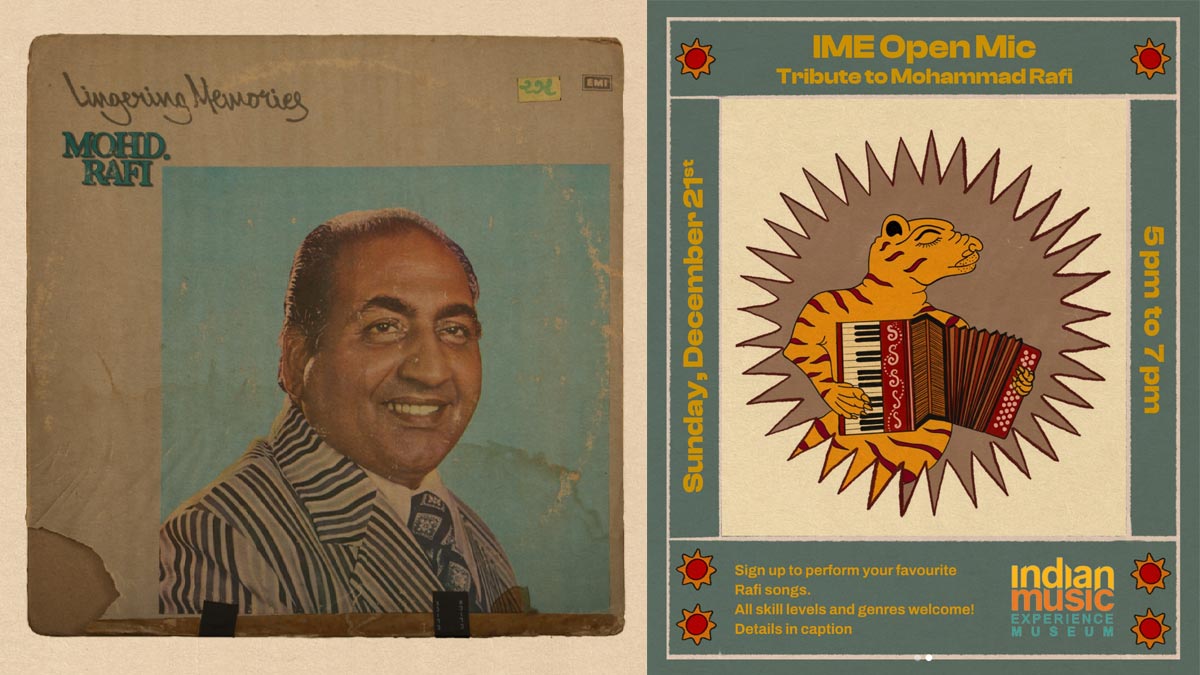
As 2025 winds down and the birthday of the legendary Mohammad Rafi approaches on December 24, 2025, Bangalore is setting the stage to orchestrate a tribute to the musical legend, the ‘Voice of the Millennium.’ The musical event is hosted by the Indian Music Experience (IME), India’s leading interactive music museum. It is set to be one of the most participatory celebrations in Bangalore. This experiential platform is launching a special Mohammad Rafi Open Mic Night on Sunday, 21 December 2025, at its Bengaluru campus.

Mohammad Rafi’s voice felt like a silhouette of velvet, where each note ached with the weight of a thousand unspoken words. His tunes were one of the rarest gifts that breathed life into every song. He possessed a voice that transcended generations; thus, this musical arrangement is not just a thoughtful initiative but an act of collective remembrance. Mohammad Rafi’s voice once shaped the emotional array of Indian cinema and popular culture across decades. Therefore, this open mic will celebrate a true community event to keep the maestro’s legacy alive. 

Mohammad Rafi was a man of immense versatility and zeal, and needs very little reiteration. He was active from the late 1940s to the 1970s and covered a wide range of genres and languages. From devotional bhajans and patriotic anthems to romantic songs, his voice adapted to a wide range of genres. The open mic format of IME is significant because it seamlessly attaches itself to the museum’s goal, i.e., to encourage public engagement and participation in India’s rich musical traditions. The event is orchestrated to unite a community of people who share the same love for the singer’s voice. This open mic not only pays tribute to the musical maestro but also acts as a force of cohesion among people. 

The Indian Music Experience Museum

Situated at the JP Nagar area of Bangalore, the Indian Music Experience Museum is a first-of-its-kind institute in India. Covering 50,000 square feet, the IMEM was established in 2019, with the support of the Brigade Group. The museum currently features nine exhibit galleries, a beautiful sound garden, and a learning centre. With a landscape like that, it forms the perfect background for the instrumentation of the Rafi Open Mic. Hitherto, the museum also launched an online exhibition titled “Mohammed Rafi: The Golden Voice of Hindi Cinema in collaboration with Google Arts & Culture.

The open mic was conceived by the Youth Advisory Board in IMEM to function as a liberal niche for free musical expression. Upto 20 artists are welcome to perform their chosen classic or original compositions. 

A Sneak Peek Into The Event

Open Mics, unlike traditional concerts, emphasize participation over performances. The attendees are encouraged to sing their favourite Rafi classics and recall their personal memories associated with the songs. Playback singing is considered a crucial social phenomenon, and Mohammad Rafi was one of the catalysts who shaped it. Moreover, the IMEM positions itself as an archive of musical history, reaching beyond its experiential projections. The broader injunction of the museum is to “demonstrate how music continues to accrue meaning through communal engagement.”

The Open Mic At a Glance

Aspect Details
Event IME Open Mic: Tribute to Mohammed Rafi
Date & Time Sunday, December 21st, 2025, 5:00 PM
Location Indian Music Experience Museum, Brigade Millennium Avenue, JP Nagar 7th Phase, Bangalore
Organiser Indian Music Experience Museum (IME)
Occasion Celebrating the birth centenary of Mohammed Rafi (Born: December 24, 1924)
Format Open Mic (singing, sharing memories, instrumental performances)
Participation Open to all skill levels
Registration Through a Google Form (link provided in the official bio/website)

Key Highlights

  • A participatory open mic format encouraging community engagement
  • Tribute aligned with Mohammed Rafi’s birth anniversary
  • Hosted by India’s first interactive music museum
  • Inclusive platform for singers, listeners, and storytellers
  • Integration of visual archival material linked to Rafi’s legacy
  • Emphasis on memory, nostalgia, and intergenerational listening
  • The IME itself showcases the entire spectrum of Indian music, from classical maestros to the golden era of Bollywood.
  • The Open Mic serves as a physical counterpart to the IME’s ongoing virtual exhibition on Rafi. 

A Bigger Cultural Context

In the recent years, there has been a trend of revising influential playback singers through dedicated concerts, conferences, and museum events. IME’s initiative fits squarely within this trend but distinguishes itself through its community-centric approach. Rafi’s voice is often described by musicologists as “chameloeonic” as he seamlessly moulded his voice into the complicated compositions that ultimately shaped his identity as the maestro. He could convincingly embody the on-screen personas of actors as diverse as Dilip Kumar, Shammi Kapoor, and Guru Dutt. Thus, it is a great commemorative moment for a personality like him to be interpreted by multiple voices. 

Takeaway

This open mic event is based on the spirit of participation by people who share a common love for Rafi’s voice. IME prioritizes lived memories and collective engagement that feels intimate and filled with nostalgia. Rafi’s songs have survived not because they are endlessly replayed, but because they are repeatedly re-inhabited. 

This event is orchestrated to commemorate Mohammad Rafi’s birthday, but the way it is designed, it transcends a mere birthday commemoration and aims to blend in like a much needed cultural celebration of Rafi and his legendary music. From the buoyant romance of “Deewana Hua Badal” to the philosophical depth of “Yeh Duniya Yeh Mehfil,” his songs are evergreen and will continue to dominate Indian ears for generations to come. It ensures that Rafi’s legacy does not remain frozen in time, but is lived through people who love and honour his work.

Key Highlights

  • A participatory open mic format encouraging community engagement
  • Tribute aligned with Mohammed Rafi’s birth anniversary
  • Hosted by India’s first interactive music museum
  • Inclusive platform for singers, listeners, and storytellers
  • Integration of visual archival material linked to Rafi’s legacy
  • Emphasis on memory, nostalgia, and intergenerational listening
  • The IME itself showcases the entire spectrum of Indian music, from classical maestros to the golden era of Bollywood.
  • The Open Mic serves as a physical counterpart to the IME’s ongoing virtual exhibition on Rafi. 

A Bigger Cultural Context

In the recent years, there has been a trend of revising influential playback singers through dedicated concerts, conferences, and museum events. IME’s initiative fits squarely within this trend but distinguishes itself through its community-centric approach. Rafi’s voice is often described by musicologists as “chameloeonic” as he seamlessly moulded his voice into the complicated compositions that ultimately shaped his identity as the maestro. He could convincingly embody the on-screen personas of actors as diverse as Dilip Kumar, Shammi Kapoor, and Guru Dutt. Thus, it is a great commemorative moment for a personality like him to be interpreted by multiple voices. 

Takeaway

This open mic event is based on the spirit of participation by people who share a common love for Rafi’s voice. IME prioritizes lived memories and collective engagement that feels intimate and filled with nostalgia. Rafi’s songs have survived not because they are endlessly replayed, but because they are repeatedly re-inhabited. 

This event is orchestrated to commemorate Mohammad Rafi’s birthday, but the way it is designed, it transcends a mere birthday commemoration and aims to blend in like a much needed cultural celebration of Rafi and his legendary music. From the buoyant romance of “Deewana Hua Badal” to the philosophical depth of “Yeh Duniya Yeh Mehfil,” his songs are evergreen and will continue to dominate Indian ears for generations to come. It ensures that Rafi’s legacy does not remain frozen in time, but is lived through people who love and honour his work.

Key Highlights

  • A participatory open mic format encouraging community engagement
  • Tribute aligned with Mohammed Rafi’s birth anniversary
  • Hosted by India’s first interactive music museum
  • Inclusive platform for singers, listeners, and storytellers
  • Integration of visual archival material linked to Rafi’s legacy
  • Emphasis on memory, nostalgia, and intergenerational listening
  • The IME itself showcases the entire spectrum of Indian music, from classical maestros to the golden era of Bollywood.
  • The Open Mic serves as a physical counterpart to the IME’s ongoing virtual exhibition on Rafi. 

A Bigger Cultural Context

In the recent years, there has been a trend of revising influential playback singers through dedicated concerts, conferences, and museum events. IME’s initiative fits squarely within this trend but distinguishes itself through its community-centric approach. Rafi’s voice is often described by musicologists as “chameloeonic” as he seamlessly moulded his voice into the complicated compositions that ultimately shaped his identity as the maestro. He could convincingly embody the on-screen personas of actors as diverse as Dilip Kumar, Shammi Kapoor, and Guru Dutt. Thus, it is a great commemorative moment for a personality like him to be interpreted by multiple voices. 

Takeaway

This open mic event is based on the spirit of participation by people who share a common love for Rafi’s voice. IME prioritizes lived memories and collective engagement that feels intimate and filled with nostalgia. Rafi’s songs have survived not because they are endlessly replayed, but because they are repeatedly re-inhabited. 

This event is orchestrated to commemorate Mohammad Rafi’s birthday, but the way it is designed, it transcends a mere birthday commemoration and aims to blend in like a much needed cultural celebration of Rafi and his legendary music. From the buoyant romance of “Deewana Hua Badal” to the philosophical depth of “Yeh Duniya Yeh Mehfil,” his songs are evergreen and will continue to dominate Indian ears for generations to come. It ensures that Rafi’s legacy does not remain frozen in time, but is lived through people who love and honour his work.

The Geometry of Allusions: Radhika Khimji’s ‘The Line in Time’ in Kolkata

0

Radhika-Khimji’s-The-Line-in-Time-in-Kolkata-01

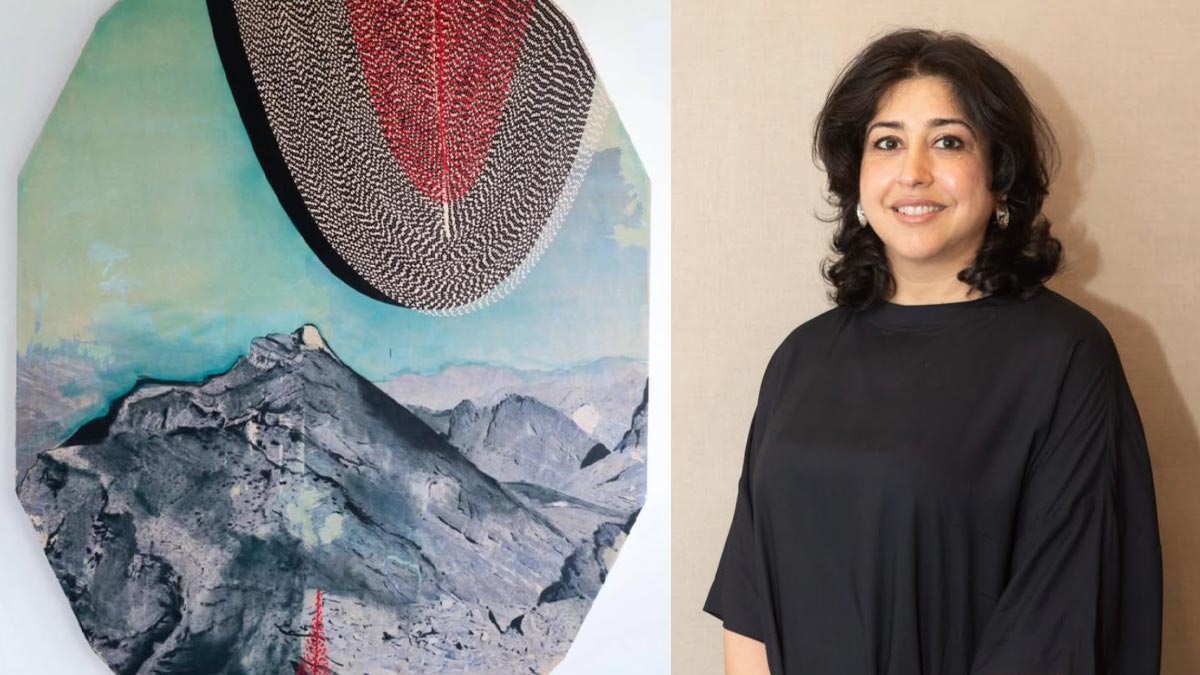
Radhika Khimji is a renowned artist whose artworks overlap the cultural and geographical boundaries between Muscat, Oman, and London. She has recently stepped into Kolkata with her latest and third solo, ‘The Line in Time,’ at Experimenter gallery, Hindustan Road, Kolkata, till January 3, 2026. Her artwork probes into deeper queries of life through an introspective corpus of paintings, sculptures, and installations. In ‘The Line in Time’, Khimji draws the viewer into a complex geometric landscape where lozenges, triangles, and other shapes, rendered in rich earth tones and charcoal grey, appear to float or lean precariously against one another. 

A Deep Dive Into The Exhibition

Radhika’s approach towards time is utterly subjective, which is measured by our internal time-consciousness. Her art challenges the linear perception of time. Upon entering the gallery, people are confronted with surfaces dotted with dormant and inchoate narratives. However, upon a closer look, people find networks of lines coated with earthly hues. Her artworks initially appear abstract, but then the visual elements pop up one by one based on the painter’s philosophy of discernible reality. 

The presentation of her works stands out with the inclusion of photo transfers featuring the harsh, hilly terrain of the Hajar mountains of Oman, Muscat being Radhika’s primary home. These nuanced variations in the depiction of geology immediately stir the idea of time as vast and non-linear.

As the artist herself belongs to a family that settled in Oman 150 years ago, her paintings are thus accompanied by a shifting cultural and geographical identity. Her positioning at a particular place has always been subject to an influx. She can translate her narrative of displacement directly into her canvases. This concept is reiterated in her paintings through the depictions of fragmented spaces. 


View this post on Instagram


A post shared by Experimenter (@experimenterkol)

Interestingly, the Lozenge shape is a recurring motif in her art, and this has a strong symbolic meaning. It is not a mere shape with geometric dimensions; it suggests the cut of the diamonds worn by the deity Shrinathji of Nathdwara, whom her family traditionally worships. These jewels, whose parure (set of ornaments) and matching costumes are changed throughout the day, weave a nexus of muses that encapsulates rituals, daily life, time, etc. 

She also employs the dots, or bindu, in her art. It becomes a very important part in narrating the cross-cultural saga. It draws parallels to the dot-painting of Australian Aboriginal art linked to the tradition of Nigerian art, or the lacy dot patterns prevalent in Ethiopian traditions of tattoos and scarification. By using a global symbol, Radhuka judiciously unites many cultures in one plane. The lines where these dots converge are presented as a “tactile portal,” a space where memories and linear time can be disentangled from their logical sequence. 

Her paintings literally cover a lot, starting from the geological history of the Arabian Peninsula to the specific rituals of Nathdwara, and then to a global history of mark-making. These concepts elevate the exhibition to serve as a visual atlas. 

Ultimately, it is the sensory-based experience of her art that honestly makes it stand out. Radhika maneuvered the understanding of art as experiential and seamlessly stepped out of the didactic box. The inclusion of geometry in her art is also a phenomenal execution of her precision. With these techniques at her disposal, she can create magic in the most trivial way possible. 

The Exhibition At a Glance

Aspect Key Insight
Exhibition Title “The Line in Time”
Artist Radhika Khimji is a contemporary artist based between Muscat and London.
Venue Experimenter Gallery, Hindustan Road, Kolkata
Dates & Timings On view until 3 January 2026; gallery hours as per Experimenter’s regular schedule.
Visual Elements Recurrent use of geometry, dots, lines, and layered surfaces that oscillate between abstraction and material presence.
Medium & Technique A layered, collaged approach using oil, photo transfer, gesso, and stitching on materials like canvas, paper, and wood (MDF panel).
Conceptual Core Time is explored as non-linear and experiential rather than chronological, embedded in gesture and surface.

Key Highlights

  • Radhika’s use of lozenges, triangles, and weaving lines invites viewers into an immersive field where the gesture functions as a trace of lived time and movement.
  • Works in the show intentionally disrupt linear time, proposing simultaneous timelines that intertwine memory and perception in layered visual forms.
  • The geometric motifs have been read as alluding to diverse cultural reference points, from Aboriginal dot traditions to African scarification and Indian bindu practices, although such interpretations are intentionally suggestive rather than prescriptive.
  • Radhika’s technique foregrounds the tactile quality of materials, thread, photo transfers, and paint, which reinforces an embodied encounter with time and space.
  • Subtle photographic shadows of terrains embedded in the works allude to wider geographies and the artist’s diasporic positionality.
  • Radhika’s work acts as a visual manifestation of her Omani-Indian heritage, drawing connections between the Nathdwara tradition and the landscape of Muscat.
  • The works deliberately blur the lines between painting, drawing, collage, and sculpture, informed by the physicality and materiality of the making process itself.

Takeaway

In “The Line is Time, ” Radhika achieves a synthesis by integrating geology, time, and internal consciousness. Her refusal to submit to linear narratives of time and deliberation on displacement and other issues is simply remarkable. Radhika Khimji is among contemporary artists who move away from linear storytelling. The strength of the exhibition lies in its openness; viewers are encouraged to form their own interpretations through direct, physical engagement with the works. She explores her own fluid identity and gives us a way to think about our own sense of belonging in the modern world. She shows us that time, like her artwork, is flexible, personal, and something we create for ourselves. Radhika’s work invites viewers to slow down and engage with art patiently and thoughtfully.

Under The Sun: Doug Aitken’s Immersive New Media Art Debut at NMACC Mumbai

0

Under-The-Sun--Doug-Aitken’s-Immersive-New-Media-Art-Debut-at-NMACC-Mumbai-01

Doug Aitken’s Debut in India

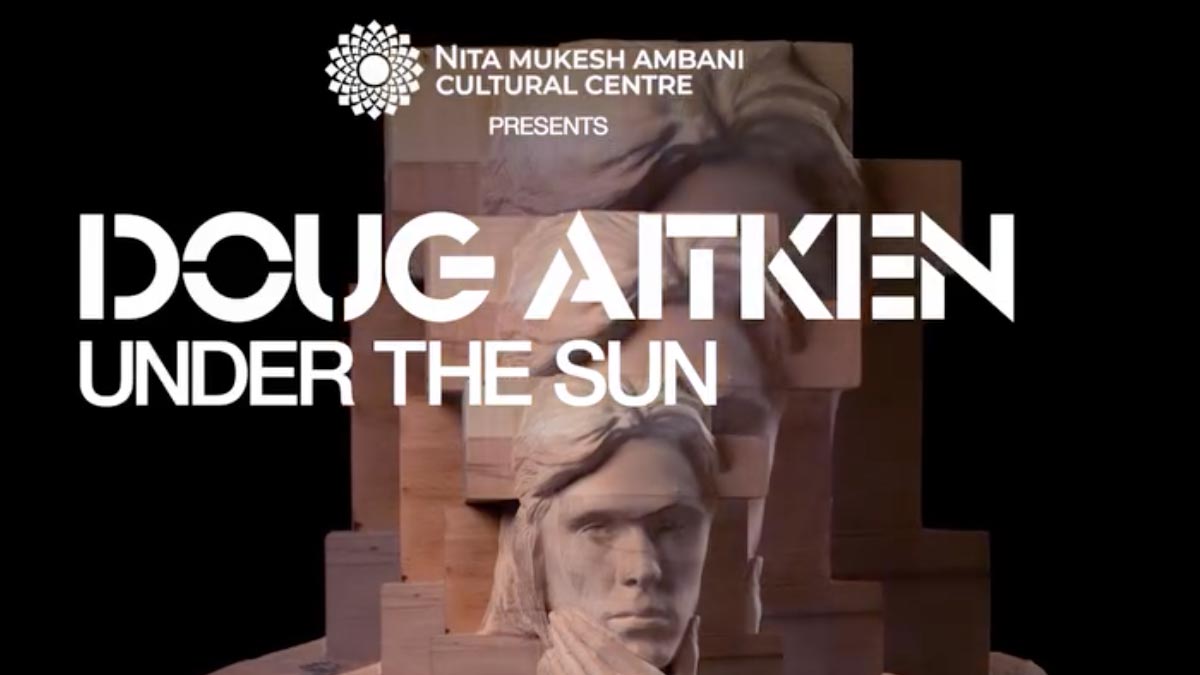
The Nita Mukesh Ambani Cultural Centre (NMACC) in Mumbai is hosting a landmark exhibition, “Under The Sun.” This is the first-ever showcase of the internationally renowned American artist and filmmaker Doug Aitken in India. The Triadic (partners Roya Sachs, Mafalda Kahane, and Elizabeth Edelman) tailors the exhibition and is on show at the Art House, NMACC. This grand exhibition is on view from December 6, 2025, to February 22, 2026. It unfolds as a mesmerizing engagement that transcends time and speculates on the future.  The exposition is conscientiously placed at the juncture of cinema, sculpture, architecture, sound, and light, challenging the traditional modes of displaying art. Aitken describes this event as “a kind of modern mythology.” 

The calibration of this event is colossal. The displayed artefacts are the result of a biennium and a half of coordination across continents and 5 time zones. Each piece, thus, taps into immense philosophical value. Aitken’s work is highly focused on hyper-connectivity, modern isolation, and the evolving relationship between the “natural” and the “virtual.” In Isha Ambani’s words, this exhibition orients itself to NMACC’s aim “to foster global artistic exchange.” This ongoing display is an important link between Indian and Western cultures. 

A Contemporary Mythology in Motion

“Under The Sun” is a synchronized view of sculptures, films, and illuminated installations that form the basics of Aitken’s practice. Spread across three floors, the artworks appear sleek and tech-driven from afar; upon closer look, they unveil a highly embodied experience. Aitken’s artefacts move, reflect, and offer a dense sensory disorientation. His key areas of interest lie in the inquiry into how people navigate their individuality amidst a media-saturated environment. This notion gets a boost in the Indian soil, as it is known to coalesce tradition and futurity, coexisting. 

A striking feature of the exhibition is the development of specific artworks in collaboration with Indian artists over two years. A beautiful amalgamation is framed using locally sourced materials and Aitken’s global vision. 

Key works include NEW ERA (2018), presented as a video installation, and LIGHTFALL / OTHER WORLDS (2025). These installations absorb the viewer into their frame and blur the lines between the observer and the artwork. “Light” is a recurring motif in his art, presented both as a physical entity and a metaphor. Light is the most essential thread that links the exhibits, symbolizing the succession of collapse, renewal, and transformation. Aitken’s art resonates with the post-medium practice and experiential art that have shaped global contemporary art since the late twentieth century. Hitherto, his artworks were discussed in relation to artists like Olafur Eliasson and James Turrell. 

A Journey Through Time, Material, and Light

The First floor is transformed into a landscape of handcrafted artefacts encompassing Indian craft traditions with global elements. The materials include raw logs, debris, stained glass, and woven textiles. A colossal sculpture of human figures created through robotic milling and hand-finishing stands tall at its heart. Six textiles embroidered by Mumbai-based Milaaya Embroidery House for 600+ hours surround the human figures.  These textiles represent India’s sacred rivers as veins across hands.

The Second floor metamorphoses into a kaleidoscopic environment with Aitken’s video installation, NEW ERA (2018). The chamber is adorned with mirroring walls and shifting scenes. The film features Martin Cooper, the inventor of the mobile phone. This display aims to convey the evolving relationship of humans and nature amidst the hyper-digital age. It also showcases the tension between global connection and personal isolation. The mirrored architecture fragments the viewer, making them a part of the accelerated, reflective circuits of the image machine.

The Third floor is the final culmination presented through LIGHTFALL/ OTHER WORLDS. This installation is utterly luminous with hundreds of suspended LED tubes adorning it. It represents something booming. It states the fact that both an atom and an AI consciousness are flickers of life. Both of them are considered pure energy in motion that alters the modes of perception. 

The Exhibition At a Glance

Aspect Details
Exhibition Title ‘Under The Sun’ (Doug Aitken’s first India exhibition)
Venue & Dates Art House, NMACC; December 6, 2025 – February 22, 2026
Curatorial Team TRIADIC (Roya Sachs, Mafalda Kahane, Elizabeth Edelman)
Core Theme A three-part journey through Past, Present, and Future.
Mediums Film, light, sculpture, immersive installations
Special Feature Site-specific works with Indian artisans
Collaboration Two-year effort involving over a dozen Indian artisans using locally sourced materials (Gujarat wood, Mumbai-based embroidery).
Key Installation NEW ERA (Video installation on the second floor); LIGHTFALL / OTHER WORLDS (Immersive light sculpture on the third floor).
Entry Free for senior citizens, children under 7, and fine arts/media students

Key Highlights

  • First-ever solo exhibition of Doug Aitken in India
  • Three-floor immersive installation integrating film, light, and sculpture
  • The linear journey across Past, Present, and Future provides a rare structure that frames the individual art pieces within a larger, philosophical ‘novel’ on human existence and time
  • New commissions developed with Indian artisans using local materials
  • This conscious choice by Aitken ensures the work avoids “awkward colonisation,” weaving local craft into a global vision
  • Major works including NEW ERA and LIGHTFALL / OTHER WORLDS
  • The use of the mobile phone’s inventor in NEW ERA grounds the abstract concepts of technology and connectivity in a tangible human story, enhancing the work’s emotional resonance
  • Curatorial focus on time, mythology, and sensory experience
  • Strong alignment with global new media and experiential art practices

Takeaway

Under the Sun is a beautifully sequentialized encounter that demands time and attention. It is a pivotal show for both NMACC and Mumbai. It is not only a masterful display of a plethora of themes, but with every passing artefact or visual representation, the exhibits turn highly emotionally resonant. Most interestingly, Aitken’s use of light and mirrored environments serves a higher purpose. He employs these media to reflect on the viewer. 

Moreover, the significance of this exhibition lies in the localization of source materials.  By doing so, it committed to Indian craftsmanship. It elevated the local materials to a global platform and made it worthy of an international showcase. It suggests that it is possible to imagine the future even while staying rooted in one’s tradition. Judging on a prudential scale, this exhibition has set a benchmark for future large-scale exhibitions in India

This show is a must-see, not just for art enthusiasts, but for anyone seeking a refuge space to process the hyper-speed reality of modern life in a city like Mumbai.

Echo Chamber by Visakh Menon Explores Digital Abstraction at Blueprint12

0

Echo-Chamber-by-Visakh-Menon-Explores-Digital-Abstraction-at-Blueprint12-01

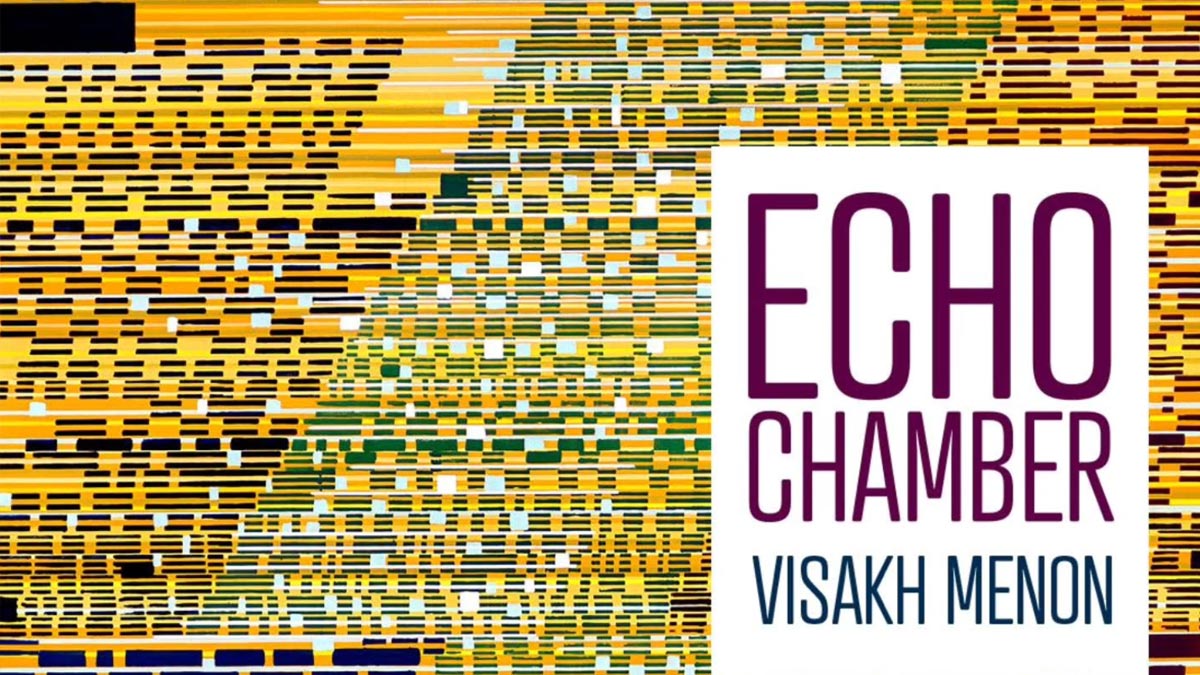
New Delhi’s Blueprint12 in Anand Niketan is currently hosting a solo exhibition by Visakh Menon, titled Echo Chamber. This solo exhibition is a visual take on contemporary visual culture. The exhibition is running from December 5, 2025, to January 15, 2026. The focused area of the exhibition is the display of the New York-based artist’s new paintings. The exhibition is established at the intersection of contemporary abstractions, complemented by technological consciousness. By amalgamating components from both domains, this show aims to reassert the authority of the human hand in the creation of art. Visakh Menon’s artwork displays a range of modern elements, such as algorithms, screens, and artificial intelligence. His work resists instant legibility and instead insists on duration, patience, and embodied looking.

Between Glitch and Gesture

On the first go, Visakh Menon’s acrylic and ink compositions appear to reiterate the screen static, digital noise, or a momentary glitch frozen in time. The heterogeneity in the use of colours serves as the image of disorientation. This rendezvous produces an effect that is immersive and composite. However, as the proximity between the viewer and the painting decreases, the spectator realizes that the paintings are deceptively rudimentary. Actually, there are dense works on the surface of the paintings etched using thousands of fine, linear marks. These are minutely executed by hand. 

This sense of duality of view is central to the theme of the Echo Chamber. Menon reconfigures his paintings through varied hues and geometric abstracts. He executes the artistic traditions that are linked to artists such as Mark Rothko, Barnett Newman, and later minimalist practitioners. Menon’s surfaces are restless and granular. It appears that the paintings of Visakh Menon tune in to a “white noise,” reflecting the constant sound of notifications and data streams.

Art critics often describe his artwork as possessing the ability to frequently engage the digital themes without undermining artistic relevance. The works mimic the aesthetics of machine-generated imagery while simultaneously undermining it through visible human effort. The title Echo Chamber refers to closed systems of information where ideas are endlessly repeated and reinforced.

The Aesthetics of Digital Disquiet


View this post on Instagram


A post shared by Blueprint12 (@blueprint2012)

Menon has previously spoken of his interest in the “collapse of expectation.” This refers ro a phenomenon when an expected process malfunctions, especially in human-machine interaction. The philosophical label of this exhibition is tied to teh concept of “aesthetics of Failure.” The repetitive function of drawing a multitude of linear lines instantaneously is a labour-intensive process. This is described as an act of “meditation” by him. The paintings reimagine the traditions of colour field painting and geometric abstraction for the era of Artificial Intelligence. Artists like Agnes Martin or Nasreen Mohammedi used repetitive lines to explore interiority, silence, and minimalist structure. Menon introduces the “noise” of the digital age into this lineage.

Menon also executes a unique vertical scroll-like format, which was previously used for traditional calligraphy and ink paintings. He delineates many depictions, such as soundwaves and more, that ensure that his artwork encompasses the involvement of modern-day “screen culture.”

Important Points at a Glance

Aspect Details
Exhibition Title Echo Chamber
Artist Visakh Menon
Medium Acrylic and ink on canvas
Venue Blueprint12, Anand Niketan, New Delhi
Exhibition Dates 5 December 2025 – 15 January 2026
Core Themes Digital overload, tactility, abstraction, AI-era aesthetics
Tension: Digital vs. Manual The work first appears like a “digital glitch” but reveals thousands of hand-drawn linear marks, highlighting the value of human labor in a post-digital world.
Abstraction and Data Uses abstract art language to represent data streams, noise patterns, and diagrammatic systems of contemporary electronic and social networks.
Process as Meditation Repetitive mark-making acts as a meditative practice, inviting stillness amid digital-era chaos.

Key Highlights

  • Reimagines colour field painting and geometric abstraction for the digital age
  • Surfaces that shift from apparent digital glitches to hand-worked textures
  • Explores the tension between algorithmic aesthetics and human labour
  • Encourages slow, immersive viewing in contrast to screen-based consumption
  • Conceptually engages with ideas of repetition, resonance, and information loops
  • Dense compositions of acrylic and ink on wood panels and paper. The technique emphasizes meticulous, repetitive, linear mark-making.
  • Blueprint12 is an established, artist-centric contemporary art gallery in New Delhi known for its focus on experimental, process-driven abstraction from the South Asian region.

Takeaway

The Echo Chamber is one of the most radical exhibitions. The speciality of this exhibition is that it neither refutes technology completely, nor surrenders to it. Visakh Menon’s works propose a new mode of analysis and thought-provoking conversations between the paintings and the viewers. His paintings are indeed a beautiful enigma. He uses non-conventional, painstaking methods to represent machine-generated noise in the most “humane” way possible. In a moment where much of what we consume is authored, generated, or filtered by algorithms, Menon forces a necessary confrontation with the human element. He establishes the centrality of the human hand and its role in creating what human beings call “art.”


View this post on Instagram


A post shared by Blueprint12 (@blueprint2012)

This exhibition at Blueprint12 is a must-see because it is a pause button in our digitally-accelerated lives. It drags us to reality with a subtle force and nudges us to draw a line between the digital and reality.  It ultimately argues that the most potent art of the AI era might be that which is most viscerally, painstakingly human.