Festivals of Maharashtra – Vivid Expressions of Marathi Culture

0
Festivals-of-Maharashtra
Image – Dnyaneshwar

Maharashtra has a perfectly juxtaposed image; it conjures up images of various states where people of all religions coexist. India’s second-most populous state is home to individuals from all cultures and walks of life. As one of India’s most multicultural states, festivals of Maharashtra are vibrant and serve as a shining example of cultural inclusion to the rest of the globe. Communities are seen interacting and enjoying a good time together in this cosmopolitan state, regardless of religion, caste, or faith. Festivals, which take place almost every month in the city, bring these individuals together. Maharashtrians take their holiday celebrations far too seriously, and they entirely immerse themselves in the joy of the festivities, which is a sight to witness.

Suggested read – Maharashtra Culture: Exploring the Rich Tradition, Art, Music, Food and Festivals

1. Ganesh Chaturthi 

Festivals of Maharashtra, Ganesh Chaturthi 
Image – Thejas Panarkandy

Lord Ganesha is the most beloved deity in Maharashtra, and Ganesh Chaturthi is celebrated in magnificent style. Preparations for the auspicious day when Lord Ganesh was born began with tremendous zeal in August. It is an 11-day event that begins with the installation of colorfully painted Ganesh idols in houses and gigantic pandals reflecting religious and cultural themes.

Ganesh statues are revered, and several cultural activities are held. People crowd the massive pandals in order to catch a sight of their chosen God. Everyone looks forward to visiting friends and relatives to give prayers, share in the celebrations, and eat some excellent cuisine. It’s also an excellent opportunity to indulge in modaks (steamed rice-flour dumplings with luscious coconut and ghee filling), which are thought to be the Lord’s favorite dish. On the 11th day, it is time to wish Ganesha farewell. The idols are carried in a procession, accompanied by music and dance, to be immersed in the sea or a local river or lake. People are immersed in the spirit of dance and music during this procession, which depicts Maharashtra’s vibrant culture.

2. Nag Panchami

Festivals of Maharashtra, Nag Panchami
Image – P. L. Tandon

Nag Panchali, an important festival in Maharashtra, is held on the fifth day of the holy month of Shravan in honour of the Snake God Shesha Nag. Snake worship is an important practice in India, and cobras made of clay are revered in houses during this festival. It is mostly seen for two reasons. To begin, the nags’ (snakes’) habitation forms the bottom of the patal lok, and the nags’ blessings are sought for the family’s well-being. Second, the nags (snakes) protect the crops from mice and vermin, thus farmers pray to the nag-devta and express their gratitude. People provide sweets and milk sacrifices to the snake god. Snake charmers carry cobras in baskets and solicit contributions from the people on the streets. The day is commemorated with street dances and singing. People go to nag temples as well as Shiva temples because the nag is strongly linked with Lord Shiva.

3. Gudi Padwa

Festivals of Maharashtra, Gudi Padwa
Image – Wikimedia

Gudi Padwa marks the start of a fortunate new year, and Hindus regard it as one of the most auspicious days. It occurs on the first day of the Lunar calendar, signaling the start of the new year. It is celebrated with tremendous fanfare and display throughout the state. Households are decked with garlands and rangolis, and a gudhi is erected outside the home to welcome wealth and good health. Gudhi is a victory emblem represented by a bamboo stick wrapped in a silk fabric. It is decorated with flowers and is given treats.

People celebrate the new year by worshiping the gudhi and distributing prasad to members of the community. Adults and children equally cook and enjoy sweet foods such as shrikhand and basundi. Many processions are held around the state to celebrate Maharashtra’s culture and customs. Thousands of people flock to view the festivities and participate in the festivities. This is one of the saade-teen muhurtas, and any new enterprise begun on this day is expected to be successful and prosperous. As a result, this day is regarded particularly fortunate for buying or moving into a new home, buying a car, establishing a new company, and so on.

4. Narali Pournima

Festivals of Maharashtra, Narali Pournima
Image – Wikimedia

Narali Pournima is celebrated in several parts of Maharashtra on the full moon day of the month of Shravan. During the monsoon season, the sea is hazardous for fishing, thus fishermen avoid it. The conclusion of the monsoon and the start of the new fishing season are marked by Narali Pournima, when fishermen placate the sea deity before sailing off in their gorgeously decked boats.

‘Naral’ means ‘coconut,’ and ‘Pournmia’ is the full-moon day when coconut gifts are presented to the sea deity. As the fishing season begins, the fishermen make offerings of coconuts and prayers to the sea-god, seeking his blessings to avoid any mishaps. On this day, coconut sweets are consumed. Narali Pournima also falls on the same day as Raksha Bandhan, a festival in which brothers promise to protect their sisters and sisters tie a thread around their brothers’ wrists as a sign of respect and affection.

5. Krishna Janmashtami

Festivals-of-Maharashtra-Krishna-Janmashtami
Image – Sandeepa Chetan

Gokul Ashtami, also known as Janmashtami, commemorates the birth of Lord Krishna. On the eve of Lord Krishna’s birth, devotees fast till midnight. Krishna-janma, the birth of Lord Krishna, is commemorated at midnight in temples and households with bhajans (devotional songs).

Gokulashtami is observed the next day. Devotees recall how the Lord loved butter and would go to tremendous lengths to get it. The dahi-handi is a ceremony conducted on this day in honour of the adored Lord. High above the streets, clay pots filled with curd, puffed rice, and milk are strung. After slipping into the residences of gopis to steal butter, groups of eager young people create human pyramids to reach up and smash them open, just like Lord Krishna and his associates. People swarm to observe these human pyramids and their attempts to smash the pot of butter.

6. Makar Sankranti

Festivals of Maharashtra, Makar Sankranti
Image – Wikimedia

Makar Sankranti, also known as Uttarayan or Pongal in various areas of the nation, is the winter solstice holiday. It marks the beginning of spring, when the sun departs the southern hemisphere and begins its trek in the northern hemisphere. On this day, kites may be seen filling the sky, continuing the great history of kite-flying. To keep everyone warm, meals of gulachi poli (jaggery flatbreads) are cooked.

Small sweet sesame laddoos (balls) are specifically created on this day. People visit friends’ and relatives’ houses and say, “Til gul ghya ani god god bola,” which means, “Accept this til-gul and talk pleasantly.” It is a day when everyone resolves to put past feuds and disagreements behind and move forward with mutual love and respect. A pooja for newly married ladies and newborn infants is another typical cultural event. They are dressed in black and adorned with ornaments made of small sugary sweets, and everyone enjoys singing, dancing, and making merry.

7. Bhau Beej

Festivals of Maharashtra, Bhau Beej
Image – Wikimedia

Just as the country honours sibling love on Raksha Bandhan, this Maharashtra festival honours this particular bond on an additional day. It is a spectacular celebration of all the festivity and rivalry of this eternal friendship, celebrated on the fifth and final day of Diwali. Brothers are historically regarded as sisters’ guardians, and on this day, sisters welcome their brothers to their homes. A delicious supper of basundi poori, shrikhand poori, and other brother favourites is served. Gifts are given, and there is overall joy and excitement all around.

8. Ellora Festival

Festivals of Maharashtra, Ajanta-Ellora-International-Festival
Image Source

The Ellora caves, a UNESCO world heritage site, are one of the state’s most important historical landmarks. Ellora festival is a celebration of culture, classical music, and dance set against the stunning Ellora caverns. The performances at this big event, organised by the Maharashtra Tourism Development Corporation, are sure to captivate you. The Ellora festival honours the grandeur of Indian art and cultural traditions at one of the country’s most scenic and historical locations. There are also a number of stalls displaying the arts and crafts of local craftsmen and sculptors. Everyone interested in Indian arts, crafts, and rituals should go.

9. Ashadhi Ekadashi

Festivals of Maharashtra, Ashadhi Ekadashi
Image – Rising Thermals

Ashadhi Ekadashi, which is celebrated in honour of the great Hindu god Vishnu, is the finale of the epic Pandharpur chi Vari (Journey to Pandharpur). Pandharpur is a town in Maharashtra on the banks of the Chandrabhaga River that is said to be the home of Vitthal, a local version of the great God. Almost a month in preparation, millions of pilgrims embark on a foot journey to the holy city. It’s a sight to behold as millions of people pour into this little city, propelled solely by their trust in the Lord. The Warkaris (those who have completed this journey) chant holy melodies and live in extremely basic conditions during the journey, and the environment is one of profound dedication and mutual support, since everyone’s ultimate goal is to approach the Lord and fall at his feet.
People around the state fast and eat only basic foods as a remembrance of the Warkaris’ trek, as well as a symbol of loyalty and confidence in their Vithu Mauli (The Lord).

10. Mangala Gauri

Festivals of Maharashtra, Mangala Gauri
Image – Wikimedia

The Mangala Gauri vrat is a very holy fast celebrated mostly by newly married ladies in Maharashtra. Special pujas are done in honour of Goddess Gowri on this day. To do this puja, women dress in traditional attire. By performing this ritual, women seek the blessings of Goddess Gowri for their husbands’ well-being and a happy married life together. On this day, women draw beautiful rangolis, and the pooja area is also nicely decorated. During this puja, married women offer 16 laddus to their sister-in-laws and mother-in-law, and then this Prasad is offered to a Brahmin. The devotees then light 16 wick lamps to perform aarti in front of the Goddess. On the following day of the puja, the idol of Goddess Gowri is immersed in a pond. It is said that once started, this puja should be performed for 5 years in a row for the peace and harmony of the family.

11. Pola

Festivals of Maharashtra, Bail Pola
Image – Soniarevankar.wordpress.com

Bail Pola, like Lohri in North India, is a harvest festival celebrated by farmers throughout Maharashtra. It falls on Pithori Amavasya, the new moon day of Shravan’s holy month. Bullocks, which are an essential part of agriculture – essentially the backbone of it – are worshipped on this day.

They are bathed, decorated with ornaments, and paraded through the village, accompanied by music and dancing. The order in which the bulls are brought out into the village represents the farmers’ social standing.

12. Shivaji Jayanti

Festivals of Maharashtra-Shivaji Jayanti
Image – Wikimedia

Chattrapati Maharashtra’s greatest king was Shivaji Maharaj. He was well-known for his bravery and brilliance. He built the groundwork for a Hindu kingdom that lasted over two centuries before being conquered by the British. All Maharashtrians hold him in high respect, and his birthday is commemorated as Shivaji Jayanti across the state.

Several pandals have been erected around the state to honour the great king. Actors or statues enact epic battles, the king’s wisdom, generosity, and courage. Processions are held to tell the stories of his greatness, and songs celebrating his bravery and kingship are sung. The state remembers their great king fondly and vows to emulate his qualities in their daily lives.

13. Kojagiri Purnima

Festivals of Maharashtra-Kojagiri Purnima
Image – Wikimedia

Kojagiri Poornima, also known as Ashwin Poornima, is observed on the full moon day of Ashwin to commemorate the end of the rainy season and the beginning of the harvest season. Some think that Goddess Laxmi appears in various locations at night to keep people awake by playing games, dancing, singing, and generally having a good time. These occasions are typically honoured with community meals that include basic yet wonderful foods such as chilled milk and rice crackers.

The moon and the earth are said to be particularly near on this day, thus everyone is encouraged to remain up all night since the moon’s rays are claimed to have healing qualities.

14. Banganga Festival

Festivals-of-Maharashtra-Banganga-Festival
Image – Ghumnewala

The Banganga Celebration, a musical homage to Lord Ram, is a two-day festival conducted every year at Malabar Hills in Mumbai. The Indian Heritage Society and the MTDC are organising it (Maharashtra Tourism Development Corporation). This musical carnival honours and protects the state’s rich heritage. A cultural extravaganza is held in January at Banganga, where cultural enthusiasts can see some of the country’s top artists perform live classical music concerts. It also helps to raise awareness about the importance of preserving the rich cultural heritage of the Walkeshwar temple’s historical Banganga tank. Lord Rama is said to have stopped here in search of freshwater, and when he couldn’t find any, he shot an arrow. The location where the arrow landed on the ground is thought to be the exact location of the Banganga tank, which supplied Lord Rama with Ganges water.

15. Maharashtra Day

Festivals of Maharashtra-Maharashtra Day
Image– Ramesh Lalwani

Maharashtra Day is one of the state’s most prominent holidays. The day is marked by parades, ceremonies, political speeches, and many types of public gatherings and private celebrations in honour of Maharashtra’s traditions and customs. Every year, a huge celebration is conducted in Shivaji Park in Mumbai, which is attended by the Governor. Maharashtra was established on May 1, 1960. The day is known as Maharashtra Day or Mahatashtra Diwas in the Marathi-speaking state. Maharashtra Day commemorates not only statehood but also the legacy and culture of the Maharashtrian people.Maharashtrians also commemorate Maharashtra Diwas by performing traditional Lavani performances – narration of poems penned by Marathi saints – and holding processions around the state. On Maharashtra Day, the state government and various commercial enterprises introduce new projects and programmes.

Suggested read – Folk Dances of Maharashtra, Colourful Expressions of Marathi Culture

Plan a trip to Maharashtra during these festival seasons to see the state in all its glory, with streets lit up with ruffles bringing people from all walks of life together.

Traditional Water Purification Methods in India

0

Traditional-Water-Purification-Methods-in-India

70% of the human body is made of water, which plays an important role in human health. Therefore, civilizations, both ancient and modern, have made it a priority. Almost all settlements have traditionally clustered around water sources. However, in most cases, the water requires purification before consumption

With time the ways of purification have evolved drastically. While now, we have water purifiers packed with RO, UV, UF, TDS and various other technologies. But have you ever thought about what was used before introducing these technologies? Keep reading to find out which are India’s traditional water purification methods.

Traditional water purification methods:

The various traditional water purification methods will help you understand how far the journey of water purification methods has come in several years. Following are some of the traditional water purification methods that were commonly used in India:

1. Purification through Winnowing Sieve: 

This purification method is used when water is polluted by wind-borne impurities such as dry leaves, stalks, and coarse particles. People used to pour water through a winnowing sieve to filter the impurities. It was widely used by people who lived in villages. However, this method cannot purify water containing a high amount of turbidity or mud.

2. Purification through Cloth:

This method can be considered one of the oldest water purification methods that were practised widely. This process used thin white cotton cloth or discarded garments as the filter medium. It can easily filter raw water containing such impurities as plant debris, insects, dust particles or coarse mud particles. However, this purification method is not ideal for highly turbid water. It was widely used to filter well water. In some areas of India, if the raw water is muddy and highly odorous, then the wood ash of the Sal tree (Shora robuta) is mixed with water and filtered through cloth. 

3. Purification through Clay Vessels:

India has an exceptional grip over pottery. People used clay utensils to cook food, store them and in many other ways. Clay vessels with a suitable pore size are sometimes used to filter highly turbid water. First, the turbid water is collected in a big clay jar and allowed to settle down. Next, the water in the jar will trickle through the porous clay wall of the jar. This trickled water is collected in a vessel by placing it at the bottom of the porous clay jar. This doesn’t just purify the water but also helps keep it cool. 

4. Purification using Plant Parts: 

Highly turbid water with fine suspended and colloidal particles were first coalesced and settled out using the nuts of a locally available plant in some of the southern districts of Tamil Nadu, India, which is then filtered using cloth filters. Nuts excrete coagulant chemicals that can purify the water’s impurities. Wiry roots of the rhizomes from the ‘ramachham’ were placed in a clay jar, with a tiny holes in its bottom. The raw water is then poured inside, and then the water is allowed to filter through this layer of roots, resulting in clean water being stored at the bottom of the jar. Such water is usually clean and has a nice smell as well. 

5. Jempeng Stone Filter Method:

This method cuts a small artificial pond or bypass channel by an irrigation canal carrying muddy water. Jempeng stone filter units were usually placed in artificial ponds. This unit has an average height of 60 cm, a diameter of 50 cm, and a wall of 10–12 cm thickness. The unit is placed on the top of a stone-supporting gravel bed, and the water is filtered through the filter unit’s porous wall and collected inside. This method can purify highly turbid water. Besides, the only cost involved is the investment cost; no maintenance is required in such a unit. 

These are some of the commonly used traditional water purification methods in India. According to the analysis made by The Readers Time, they are not as effective as modern, advanced technology-infused purifiers. But they are quite efficient in their ways. You may still use them to purify your water if the impurities content of the source of your water is low to moderate. 

Play, Learn and Preserve – The GI Tagged Toys of India

2
GI-Tagged-Toys
Image – Amitra Kar

GI tags or Geographical Indication tags are assigned to products that are developed in specific geographic regions or locations in India. The spatial importance is reflected and required in the conception and execution of the product. The GI certification is given to agricultural, industrial, as well as handcrafted products. 

What makes GI products stand out is their traditional and heritage significance. These products or agricultural and food items are distinctly characteristic of the region in which they are manufactured, handcrafted or grown. Their recognition lies in their connection with the particular region, city or town. Besides, especially handicrafts, the value of a product is merited with the importance of the craft and skill being passed down through generations. In many ways, giving a GI tag to such products, boosts their markets, as well as, preserves and acknowledges the need to continue passing and enhancing heritage artistic creativities. 

GI Tagged Toys

GI-Tagged-Toys-of-India
Image – World Intellectual Property Organisation

There are more than 300 products that have a GI tag attached to them in India. Each state has its own list of GI products, with Karnataka currently leading as the state with the maximum number of GI tagged items.

 Suggested read: GI Tagged Products in Karnataka, Preserve the Heritage of the Land

Different types of products are given the GI tag and one such manufactured, as well as handmade product are toys. One would wonder why toys are of any significance. However, the toy market of India contributes around $50 billion in terms of revenue and business. 

Toys have always been children’s best friends. And their importance has only increased in recent times, with science and education both recognizing the value and contribution that toys have on the creative, emotional, social and intellectual development of children. 

India has several GI tagged toys that not only are created using traditional and ubiquitous methods. But also, are steeped in the culture and social milieu of the country. Here is taking a look at the different toys that have been certified GI tags in India. 

Channapatna Toys

GI-Tagged-Toys-of-India,-Channapatna-Toys
Image – Shipra Basu Roy

Channapatna toys are instantly recognizable and uniquely wonderful. These wooden toys come in all shapes and sizes and today you can find them on sale in even big international toy stores. They received the GI tag in 2005. Made in the Karnataka town of Channapatna, these toys are traditionally made using the wood from the Wrightia tinctoria tree, also commonly known as ivory wood. 

The town itself is also called Gombegala Ooru or toy town and its origins can be traced to the reign of Tipu Sultan. Tipu Sultan was known to be a patron of arts and woodwork and that is perhaps how the Channapatna toys were first conceived. However, years later Bavas Miyan learned the art of Japanese doll making and incorporated it into the toy art of the region. 

Today the Channapatna toys and dolls are not only made using ivory wood, but the wood of different trees, such as rubber, cedar, sycamore, pine, teak etc. are used. The main work deals with wood lacquering. The wood is cut, pruned and then carved to fit into the designs for toys. The final product is polished and painted with vegetable natural dyes because it is children who use it the most. 

With the help of the government of Karnataka and many other social organizations, the Channapatna toys and dolls have a reasonably good market and customer base. The toys made are categorized for different age groups. They are safe, colorful and durable making them attractive play and learning tools for kids. Simple toys, such as ring stacks, animal figures, blocks etc. are all creations of the Channapatna community. 

Kondapalli Bommallu

GI Tagged Toys of India, Kondapalli Bommallu
Image – Wikimedia

The Kondapalli Bommallu toys are made in the town of Kondapalli, Krishna district in Andhra Pradesh. These toys were given the GI tag in 1999. The Bommallu or Toys colony is where these toys are created and manufactured within the town. These wooden toys have been made for more than 400 years now and the artisans who create them are called Aryakhastriyas. The original artisans were believed to have migrated in the 16th century from Rajasthan. 

The Kondapalli toys are not only toys created for children. But they are also culturally significant and assembled with great care in homes during various festivals, such as Navratri and Sankranti. 

The toys are made from the soft wood or Tella Poniki that are available in the region. The wood is carved and the different pieces of the toy are cemented together using makku. Makku is a paste made from tamarind seed and sawdust. Once the pieces are joined, the final toy is painted. 

The toys range from mythological figures, to birds, animals, dolls etc. One of the most popular Kondapalli toys is the Dancing doll. 

Thanjavur Doll

GI Tagged Toys of India, Thanjavur Doll
Image – Wikimedia

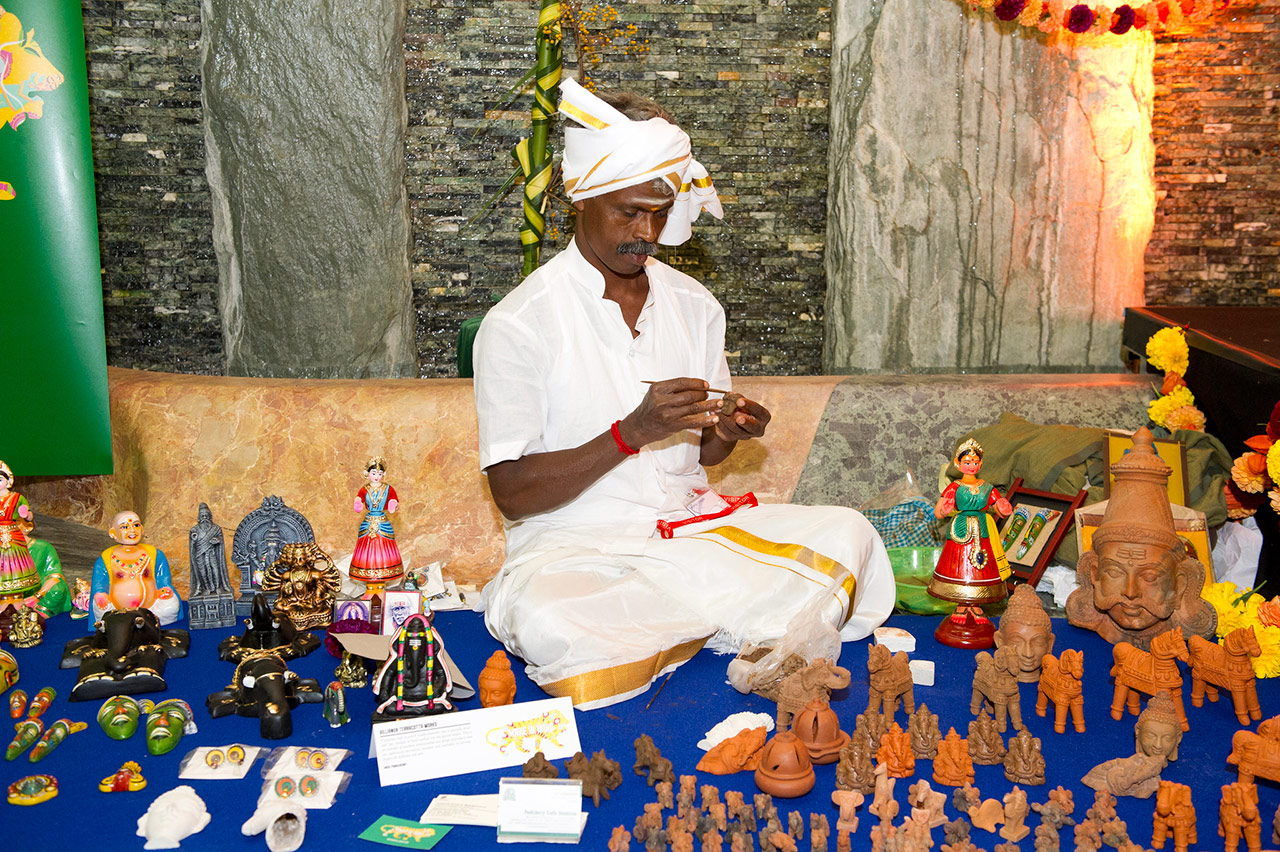
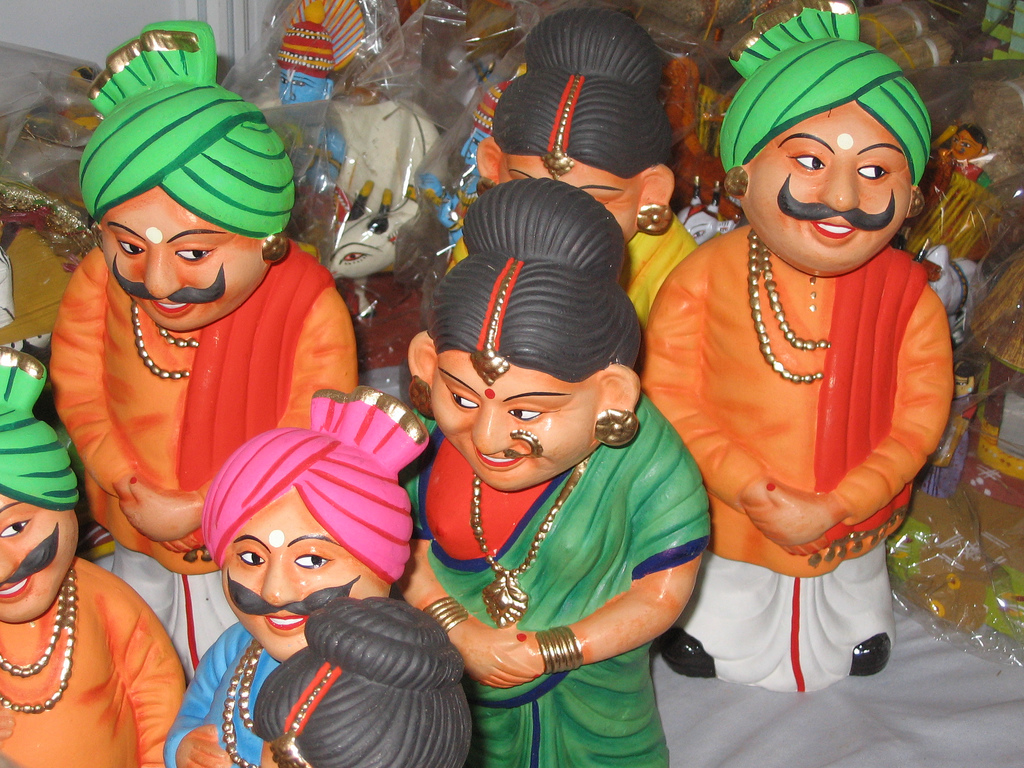
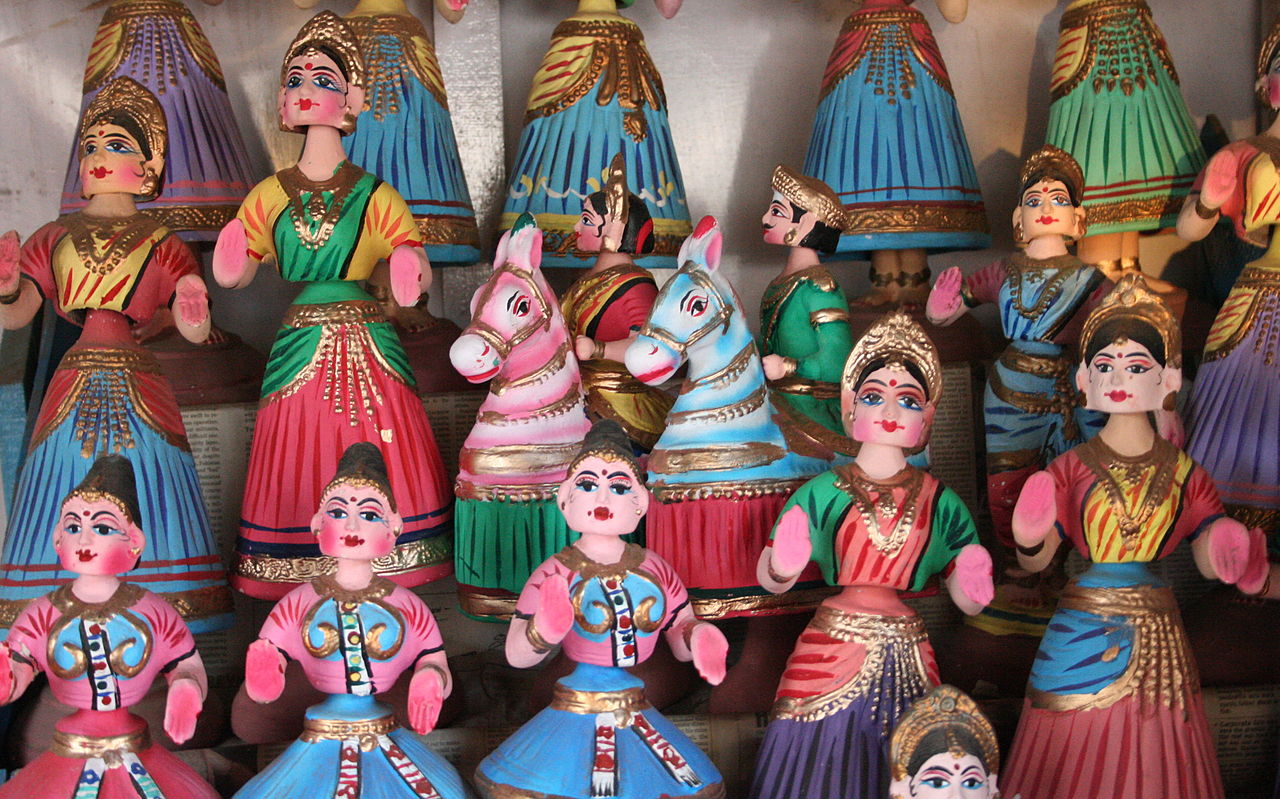
Made from terracotta, the Thanjavur doll is an actionable doll that wobbles or is a bobblehead. Basically, the doll vibrates or moves when pushed as the weight of the doll and its center of gravity is located in the bottom of the toy. The doll hence appears to be dancing and undoubtedly, flutters a smile on the faces of children and adults alike. 

The Thanjavur Doll originates from the city of Thanjavur, also initially known as Tanjore in Tamil Nadu. It was given the GI tag in 2008-09 and has traditionally been made by hand for generations.

The head of the doll is usually larger which allows the oscillating movement. The dolls also represent the classical dance forms of the country, such as Bharatnatyam, Manipuri or Kathakali. These dolls are painted in the dance attires and traditional clothing, makeup and accessories. Additionally, their dance-like movements make them highly adorable. The dolls have different parts of their body attached to them. The legs, upper body, head and lower body are joined to create the final structure. 

These terracotta handmade dolls do face competition from plastic and factory manufactured dolls. However, the authenticity and sheer cultural nuances along with the rawness and craftsmanship of the dolls make them loved and desired. 

Ganjifa Cards

GI Tagged Toys of India, Ganjifa Cards
Image – Wikimedia

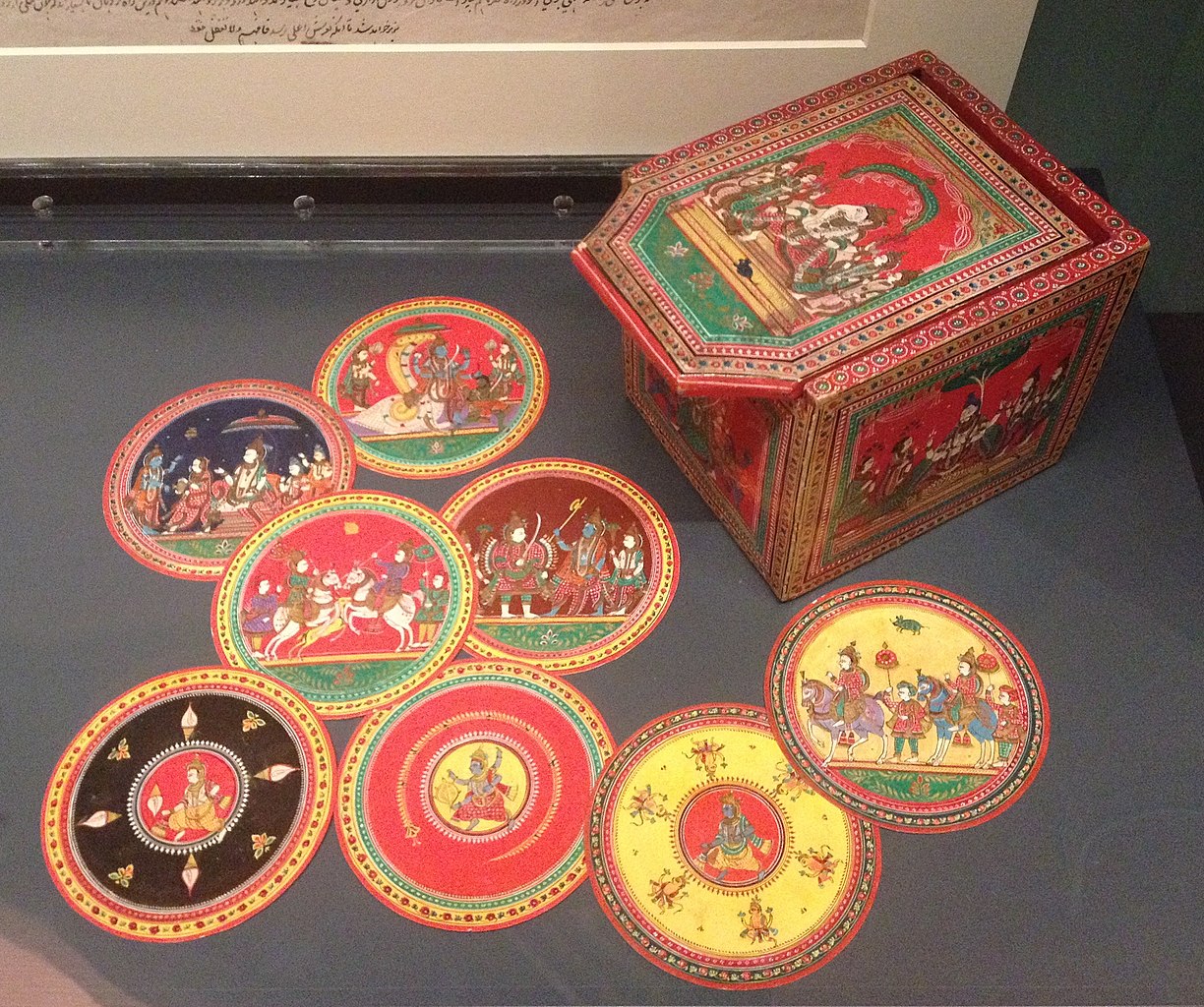
Unlike the wooden toys and dolls, Ganjifa cards are a card game and were certified a GI tag in 2008. Ganjjifa the card game is believed to have originated in Persia. But in the 19th century this card game found its place in India. It was in Mysore under the rule of Krishnaraja Wodeyar III that the game truly developed and several complex games were invented using the Ganjifa cards. The game also became popular in the Mughal courts where opulent sets were made for the royals to play. 

Later when the general public started playing the game, the cards were made using palm leaf, wood, cloth etc. The game is played in different ways and the cards vary in size, color, shape, design accordingly. The cards are rectangular or circular and were traditionally painted by artisans. The Ganjifa cards are not as popular as some of the other GI tag toys.

Kathputlis 

GI Tagged Toys of India, Kathputlis 
Image – Pexels

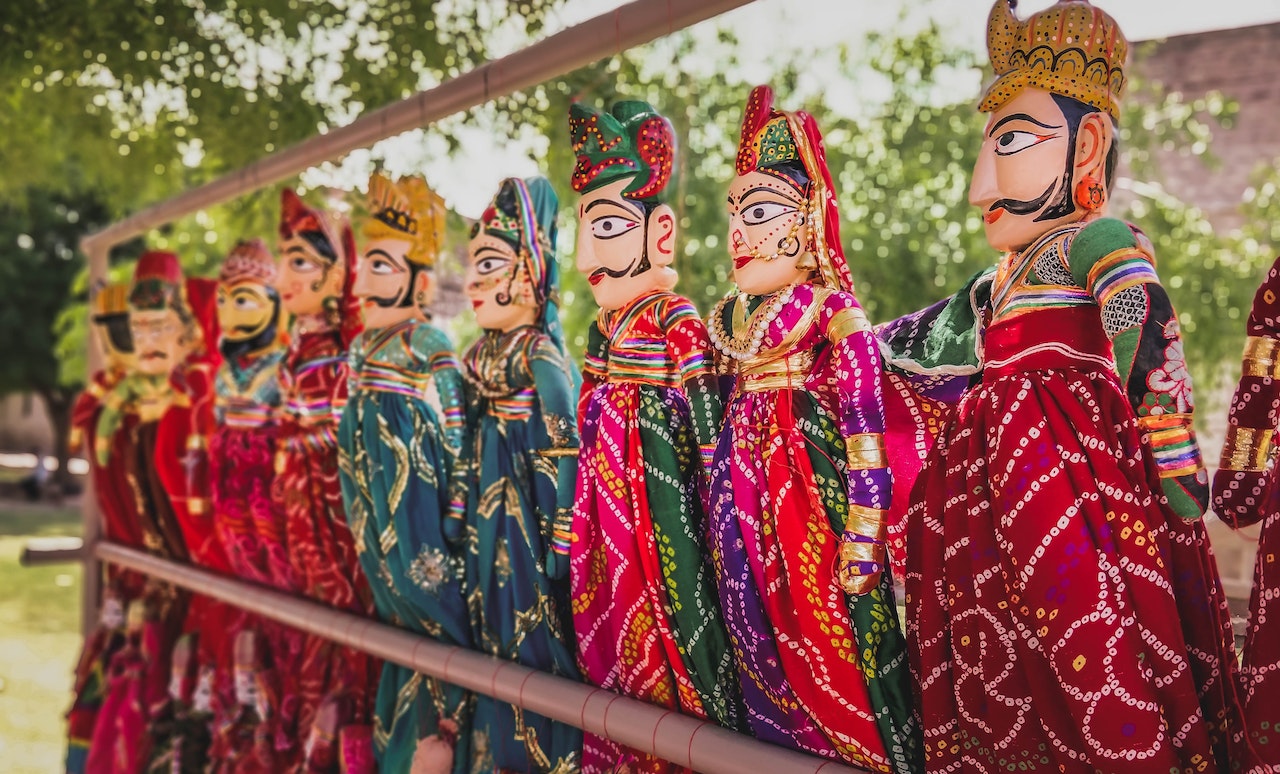
The puppets or Kathputlis from Rajasthan are a delight to watch. Children enjoy watching puppet shows and puppets as toys are a creatively smart way to engage children in storytelling. Agricultural laborers called Bhats were amongst the first to introduce the kathputlis in the Marwar district of Rajasthan. 

The puppet is made from wood, metal wire and cloth. The string doll has been an important instrument in telling folk and historical stories to the masses over the years. 

Nirmal Toys

GI Tagged Toys of India, Nirmal Toys
Image – Wikimedia

The wooden toys from Nirmal town in Telangana are made from softwood and received the GI tag in 2009. It is believed that the art of toy making flourished during the rule of Nimma Naidu in the 17th century. The Naqqash community of craftsmen began making these toys during the reign of the Nizams during which the art form continued to be patronized. The district of Nirmal has been a hotspot of craftsmanship and manufacturing for a long. The Naqqash artisans probably bought this art form from Rajasthan, though there is no concrete evidence of the same. 

The toys are made using local wood called white sander and poniki. The pieces of wood are cut in various shapes and sizes according to the requirements of the toy. They are then stuck together using the chinta lappam, a glue prepared from sawdust and tamarind seeds. With white clay the toys are coated, then dried and finally colored or painted. Besides the Nirmal toys, Nirmal paintings and crafts are also quite famous. 

Kinhal Toys

GI Tagged Toys of India, Kinhal Toys
Image – Wikimedia

The Kinhal toys are again wooden toys that are made in Kinhal in North Karnataka. It was awarded the GI tag in 2012. The Chitragara are the artisans who create these toys using light weight wood. Just as the other wooden toys, the wood is cut and then pasted to each other using a local paste or glue made from different indigenous local materials. 

Some of the other toys that are GI tagged include the leather toys of Indore, leather puppets of Andhra Pradesh etc. and more recently the Etikoppaka toys (wooden) from Andhra.

The GI tagged toys are a wonderful way to encourage the local artisans and traditional methods of artistic forms. Also, the toys are not only play things but an important reflection of the culture of the region too. 

Suggested Read – Traditional Toys of India: Practice of Culture and Profession

An Exploration into the Current Net Worth of Katt Williams Net Worth

0

Katt-Williams

Katt Williams Net Worth’s net worth is a source of excitement and mystery in the huge realm of social media, drawing in users from all over the world. Upon the arrival of 2024, conversations on various social media sites became increasingly focused on the financial situation of this prominent comedian. What sparked this intense conversation was Williams’s guest appearance on the venerable Club Shay podcast, which is hosted by none other than Shannon Sharpe. Even with the shadows left by previous scandals, Williams grabbed the limelight and boldly confronted powerful figures in the industry, sparking a firestorm of passionate comments and lively discussions among fans throughout the globe.

Discovering Surprises and Sparking Controversies

Following Williams’ open disclosures in the podcast interview, a torrent of discussion and analysis erupted, flooding the internet with passionate debates and contemplative reflections on the illusive line separating reality from illusion. Williams’ bold claim to be “one of the richest human beings that ever lived” acted as the focal point of the conversation, drawing viewers into a contemplative space about the actual extent of his wealth. Williams’ moving description of wealth as including contentment and happiness, however, gave nuance to the conversation amid the conjecture and encouraged reflection on what prosperity really is beyond financial plenty.

Overcoming Early Difficulties A Tale of Triumph and Adaptability

The story of Katt Williams Net Worth rise from impoverished upbringing to widespread recognition is replete with tales of tenacity and perseverance. Born Micah Williams on a cool September day in 1971 in the middle of Cincinnati, Ohio, his life took a turn for the worst when, at the age of thirteen, he was facing homelessness as a result of his parents’ abandonment of him. Raised in the loving arms of Christian Jehovah’s Witnesses, his travels back and forth between Haiti and the United States forged a strong character and gave him a complex outlook that would influence his future.

Uncovering Wisdom, The Quest for Enlightenment 

Katt Williams Net Worth shows himself from the beginning of his journey not just as a humorous virtuoso but also as a brilliant thinker with a voracious appetite for knowledge. His insatiable thirst for knowledge, demonstrated by his resolve to learn many languages by the age of three and his early, avid reading of literature, drove his desire for freedom from the restrictions of his religious upbringing. His transformation from a bright youngster to an experienced mind ready to question the status quo and rewrite the rules of artistic expression was largely fueled by this insatiable thirst for knowledge.

A Decade Dedicated to Comedic Celebrity

Katt Williams Net Worth’s rise to prominence in the stand-up comedy world was characterised by her persistent perseverance and determination. As he rose through the ranks in Cincinnati’s Avondale neighbourhood, he became more and more well-known, refining his skills on prestigious venues like The Improv and The Comedy Club. His 2006 HBO special, “The Pimp Chronicles Pt. 1,” was the turning point in his career that thrust him into the canon of comedy history and set the stage for a productive career interspersed with more than a dozen critically acclaimed comedy specials. Even so, Williams negotiated a difficult environment while receiving recognition, overcoming hardship with a fortitude that would come to define him.

Moving from Stage to Screen An Adaptable Conductor

Katt Williams Net Worth’ inventiveness extended beyond the boundaries of stand-up comedy, leaving a lasting impression on both big and small screens. His legendary roles as Money Mike in “Friday After Next” and A Pimp Named Slickback in “The Boondocks” catapulted him into the highest echelons of Hollywood recognition and cemented his reputation as a notable figure in the entertainment industry. Williams enthralled audiences with his magnetic presence and unmatched charisma with every performance, showcasing his chameleonic ability to inhabit characters with depth and delicacy.

Interpreting the Mysteries The Financial Conversation Around Williams

Even though Williams is still an undoubtedly excellent comedian, questions about his wealth have generated a lot of controversy and interest. Reassessments have been spurred by claims of huge gains from operations such as Netflix transactions, despite early estimates estimating his revenues at $2 million. However, outside the domain of financial measurements is an unchangeable fact: Katt Williams Net Worth‘ influence is not limited by money, solidifying his standing as a key player in the comedy business, despite differing assessments.

In conclusion

Katt Williams Net Worth’ journey from lowly beginnings to global superstar status is evidence of his unbreakable will, keen intelligence, and unshakable dedication to his work. There is no denying that Katt Williams Net Worth will always be remembered as an unstoppable titan of the entertainment industry, his lasting influence on the comedy and entertainment sectors lasting through the ages, despite ongoing discussions about his net worth and legacy.

Rogan Art : The Exquisite Art of Cloth Printing

0
About-Rogan-Art
Image – Wikimedia

Traditional art forms of India have such unique qualities that separate one art form from another. Centuries ago, art travelled with people and moved from its place of origin to new foreign lands. Thanks to such movements, India is now home to one of the rarest forms of art, the Rogan Art.   

Rogan art is a centuries-old unique style of art. The Persian art form now settled in Nirona Village of Kutch in Gujarat is a migrant art form that has become a cultural asset for India. Rogan Art is so distinctive that only one particular Khatri family has practised it since it arrived in India. The story of the artist’s practice and survival of the art is equally remarkable. 

In this article, we will try to present the history, practice, techniques, and survival of Rogan Art. Without further ado, let us begin. 

History of Rogan Art 

History of Rogan Art 
Image – History of Rogan Art / Facebook

Rogan Art hails from the land of Persia. The art form crossed many borders and came to India some four hundred years ago. An hour’s drive from Bhuj, Nirona of Kutch is now home to this intricate art. The art form became instantly popular because of its different styles, technique, and patterns. Rogan Art is made by hand, purely out of one’s imagination without any blueprint as reference.  

Etymology of Rogan Art 

The term Rogan in Persian means oil-based. The Rogan Art’s paint is made from castor oil and hence the name. 

Practice of Rogan Art

Traditional-Rogan-Art-Abdulgafur-Khatri
Traditional Rogan Art Abdulgafur Khatri (Padma shri ) National Award Winner family in Nirona. Village Kutch Gujarat – Roganartnirona.com

When it came to India for the first time, this form of art was practised by the local communities of animal herders and farmers. The art form was prevalent in the bridalwear of the community. But with the introduction of modern textiles and machine-made styles, the unique hand-made state of the art was on the verge of becoming extinct.  

Rogan Art, a community art form, is now just a family heirloom. The original Abdul Gafur family of Nirona is the sole practitioner of this art form. At present, the Rogan Art is in its eighth generation of survival with the Gafur family.  

The Gafur’s have been in this creative field for so long that the Rogan Art has become their identity. Only because of them, it has further travelled to the USA in 2014 as a prestigious gift for the then President Barack Obama from India. Our Prime Minister’s recognition of the uniqueness of this art came as a blessing for the survival of the art form.  

Techniques of performing Rogan Art 

Techniques-of-performing-Rogan-Art
Rogan Art Master Artist Sumar D.Khatri National Award winner

The art form’s survival and uniqueness are still intact because of the Gafur family’s dedication to preserving the art form. The family has been practising the art form with all its original techniques and styles.  

Rogan Art’s brief history and etymology give a clue that a lot of technique goes into making this art. The patterns of Rogan Art, like other art forms of India, have many intricate details. But even before starting the painting, the formation of the paint itself requires a particular process.  

Let us find out all the techniques that go into the formation of Rogan Designs.

Paint used in Rogan Art

Paint-Prepration-in-Rogan-Art

The paste of the Rogan Art paint is made from castor oil. The colour pigments are all natural. The process of making the paint’s paste starts with boiling the castor oil. Artists burn the oil in the jungle. After a long period of cooking the oil, it is placed to cool. Once the grease cools down and the oil texture is in the desired rubbery form, the following pigmentation begins. If the surface is not flexible enough, the oil is again put to boil until the required consistency is attained. 

On the other hand, the colour pigments are made into a fine paste by adding water to them. The mixing of the colour paste with the boiled oil is done with a stone. Once the colour doughs are made, they are put in containers with water. The water ensures that the paste does not harden.  

Painting the Rogan Art

Techniques-of-performing-Rogan-Art-1
Image – colleen

The primary process of painting begins once the paste of the paint is ready. Here also there is a distinctive style of painting the clothes.  

All the patterns of the Rogan Art are directly drawn on the clothes without any reference or pencil drawing on the cloth. It is entirely a free-hand painting. The artists use a metal pin, dab it in the paint container, and twist the paint a few times on the heel of their left hands. The colour starts getting a thread-like quality. With exquisite manoeuvring skills, the colour is put on the clothes in unique patterns.  

The most exciting part of this entire process is that the metal pin never touches the cloth.  The thread-like quality of the paint enables the artist to twist it according to the pattern he desires in the air. The thin paste of the colour is now applied to the cloth from its airborne state.  

Patterns in Rogan Art

Patterns-in-Rogan-Art-01
Rogan Art – Sumar Khatri

Rogan Art has its origin in Persia, is typically in association with the Islam tradition. Abdul Hamid Gafur, the present carrier of the baton of the Rogan Art, describes the prevalent Islam themes in the patterns. According to the Islam community, human figures are not permissible as motifs. The typical ways of the Rogan Art are flowers, geometric shapes, and the most famous, the ‘Tree of Life’ motif.  

Hamid Gafur said in interviews that the pattern works in Masjid’s of Delhi is also a source of inspiration for the designs. Staying true to the original work, the motifs carry the essence of the age-old tradition of the Rogan Art. 

Present-day scenario of Rogan Art

Rogan-Art-in-Present-Day
Image – itokri

The Gafur family undertakes the responsibility of the survival and growth of this intricate art form. The Gafur are indeed trying their best to ensure that the legacy of this unique art form does not end anytime soon. 

Rogan Art’s survival is necessary as a cultural asset of the country because of the distinct tradition of the art form. The Gafur’s play their part in sustaining the art form for the future by teaching it to others. The biggest challenge they overcame was including women in practising the art. Earlier, women of the families practising it were not taught the art form. The thought that girls will go to another household after marriage and take the art form with them was not permissible. At present, the Gafur’s take pride in teaching hundreds of girls this beautiful art form.

Breaking free from the stereotype, it has also become popular in online marketing. The only store of the Rogan Art products is the village home of the Gafurs. Thanks to technology, the products are now available online in stores like Amazon. This modification also encourages the artists to make more of it and helps them earn revenues for their hard work. In this way, more people have become aware of Rogan Art and appreciate the unique art form.  

Conclusion

Rogan Art is, therefore, an exquisite art form that must be preserved for its tradition and rare style. The art form is typically painted on a dark cloth to highlight the vibrant, glossy colours and the distinct patterns. Earlier the art form was only found on Lehengas, but now other forms of clothing, bags, and even masks have the Rogan Art. Thanks to the Gafur family and their dedication to Rogan Art, India can still take pride in this old traditional art form. 

– For more details visit Gafur’s official website – Roganartnirona.com

Patachitra Paintings – A Spiritual Endeavor

0
Patachitra-Paintings
Image – Wikimedia

India is a land of various folk art forms and one such unique expression on canvas is Patachitra. Also, known as Pattachitra, it is a form of scroll painting, done on cloth. Derived from two words, ‘pata’ meaning cloth and ‘chitra’ meaning picture, Patachitra is based and originated from the eastern Indian states of Odisha and West Bengal. It is also practiced in Bangladesh. 

Types of Patachitra paintings

Types-of-Patachitra-paintings
Image – Wikimedia

The Patachitra paintings are divided into Odisha and Bengal Patachitra paintings. The main difference between the two is their themes. The Odisha Patachitra is centered on the depiction of Gods and is confined to temple and religious forms of art. On the other hand, the Bengal Patachitra, though also derives its inspiration from religious texts, the paintings were used for story telling of mythological and folklore tales. 

Each of these types of Patachitra paintings is further sub-classified. 

There are three types of Odisha Patachitra paintings. The cloth based paintings are called Patachitra. However, the paintings done on walls are known as ‘Bhitti Chitra’, whereas the ones done on palm leaves are called ‘Tala Patra Chitra’ or ‘Pothi Chitra.’ The painting style of all these types is closely similar as the same artists were commissioned to create all these different types of paintings. 

The Bengal Patachitra paintings are divided into many sub-types, such as Chalchitra, Durga Pat, Medinipur Patachitra, Tribal Patachitra and Kalighat Patachitra. 

Odisha Patachitra

History
Image – Wikimedia

History of Patachitra

The Patachitra paintings probably originated as early as the 5th century. The old temple murals in Puri, Konark and Bhubneswar are evidence to Patachitra paintings being an artistic form in the early centuries. The paintings are closely tied with the spiritual and cultural facets of temple traditions in Odisha. In fact, Lord Jagannath’s present image is often associated with the Patachitra paintings. Every year the deities or idols in Jagannath Temple are taken for a bath during Debasnana Purnima for 15 days. It is during the absence of the deities, that the Patachitra paintings of the Gods are made by the best of Chitrakars. The three Patachitra paintings that are made during this time are of Lord Jagannath, Lord Balabhadra and Goddess Subhadra. These paintings are known as Anasar Patti where the public offers prayers and homage to them. 

Style and Technique of Patachitra paintings

Style and technique of Patachitra paintings
Image – Wikimedia

The entire painting is handmade. First the canvas is prepared. The cotton cloth or strips are coated with a mixture of tamarind seeds made from chalk and gum. The cloth is rubbed with stones and left to dry.  Once dried, the leathery finish of the cloth or patta indicates that it is now ready for the artist to work on. The artists practicing Patachitra are such experts that they do not draw a sketch. Instead, they directly use paint to draw the outline of the picture. The colors are then filled and the final image is given a lacquer coating to withstand different weathers and add a slight sheen to the painting. In fact, the painting is held on top of a fire, such that the painting’s back is exposed to the heat. Lacquer is applied on the other side of the painting. 

Patachitra paintings are created following a set of rules. There are basic techniques and styles that are fundamental to them. For example, the painting must have a floral border. Similarly, the images or face profiles of deities have elongated eyes and prominent facial expressions. Also, Patachitra paintings use natural colors.

Colors in Patachitra Paintings

Colors in Patachitra paintings
Image – Wikimedia

Painters use natural colors and prepare them with care and arduous work. The gum from the Wood Apple or Kaitha tree is the base which is usually used for creating the colors. Black is derived from the lamp soot, white from the paste of conch shells. Similarly, yellow comes from the Hartal stone and orange from the Gerua stone. Leaves of the Hyacinth plant are powdered to make green, whereas, red comes from the Hingula rock. Indigo is prepared from Ramaraja and violet from blackberries. The Patachitra paintings usually use bright vivid colors and their paint brushes are also naturally made from the hair of animals. The paintbrush stick is made using bamboo. 

Over time, in spite of artificial colors and canvases, most Patachitra artists continue to use naturally available ingredients and eco-friendly methods to create their paintings. 

Themes in Patachitra Paintings

Themes in Patachitra paintings
Image – Wikimedia

Besides the paintings depicting Gods and Goddesses associated with the Jagannath Temple, the Bhakti Movement in the 16th century saw Patachitra paintings of Krishna and Radha. Tales and scenes from epics of Ramayana and Mahabharata were also painted and continue to be themes around which Patachitra artists create their piece of art. 

Also, there is not much depiction of natural beauty or landscapes in Patachitra paintings. The focus is on figures and their expressions that are highlighted through their face or body language. The image lines are clear and distinctive and the postures articulate the mood of the figure. The outfits of the figures are also believed to have an influence from the Mughal era. 

Tala Pattachitra

Types-of-Patachitra-Tala-Pattachitra
Image – Wikimedia

Tala Pattachitra or Palm leaf Pattachitra is another popular form of art. Here the palm leaves are sewn together to form the base or canvas for the painting. The picture is sketched using white or black ink and the palm leaves are held together in a way, such that they can be folded or unfolded. 

Chitrakars

Chitrakars of Pattachitra
Image – Wikimedia

The Chitrakaras in earlier days were said to follow a strict schedule while painting. For example, they were to remain vegetarian, wear new clothes or not sleep on a mattress. Once the painting was completed, certain prayers were chanted before it was taken to the temple. Also, traditionally, the men and women in the house were involved in the creation of the paintings. Women helped in preparing the glue, canvas and the lacquer coating. The main artist, usually the men, made the images and gave the painting its final touches. 

Today Patachitra artists have spread out, though most still remain confined to the eastern Indian states. However, around 14km from Puri, in the village of Raghurajpur, there are more than 100 chitrakara families who practice Patachitra paintings. It is the only village in India where practically every household is involved in this artistic pursuit. The paintings are created for the Gods and its artists have in recent times diversified their skill to create palm leaf paintings, carvings on coconut shells, Tussar painting and more. Some other villages where this art form continues to flourish are Paralakhemundi, Sonepur, Chikiti etc. Besides, artists today use the Pattachitra style to create wall hangings, showpieces, toys, wooden carvings etc. Many also teach this art form both domestically and internationally. 

Bengal Patachitra

Bengal Patachitra
Image – Wikimedia

The Bengal Patachitra is similar to the Odisha Patachitra in style and technique. However, the only difference is in the theme. Bengal Patachitra paintings are more social and cultural in nature. They are based on society, traditions, folklore and religious or mythological stories. The Patachitra artist in this school of art is known as a Patua. Hence, many believe that the origin of Bengal Patachitra may be connected to the history of Patua Sangeet. However, there is no clear evidence of when this art form began. 

Also, a song is always related to a Bengal Patachitra. The artist sings the songs, while unfolding the painting. The song known as Patua Sangeet or Poter Gaan, along with the Patachitra were means to bring forth to the public issues, such as current news, elections, folklores, family planning, ills of dowry system and more. Some of the villages where this art form was most popular include Bardhaman, Birbhum, Murshidabad, Jhargram and more. 

Pattachitra_of_Bengal
Image – Wikimedia

The other types of Bengal Patachitra, such as Chalchitra create the idol of Durga as a background. Similarly, Durga Pot is a piece of art that is worshiped. The Bengal Patachitra is also varied because there are subtle differences in color or design from region to region. For example, the scrolls of Birbhum or Bankura prefer red colored backgrounds, whereas, those of Hooghly use dark brown. 

Finally, the Patachitra paintings are a traditional form of art that are deeply interconnected with the spiritual and religious aspects of certain geographic regions in the country. However, their intricacy and exceptional artistic details have made them renowned all over the world. 

9 Times Famous Parents Chose Weird but Wonderful Names for Children

0

Famous Parents Chose Weird but Wonderful Names for Children

Parents believe that their children are the most attractive, intelligent, and special entities in the world. However, when parents start to choose the best preview of the new life that they are bringing into the world, it all begins long before the child is even born.

They might look for names that have particular meanings or appealing sounds. As a matter of fact, in recent trends, it has been fairly mes mesfashionable to choose phrases or invent names that aren’t often thought of as human names.

However, regardless of how unusual the names might have initially seemed, some celebrities came up with some really cute suggestions, and we curated the ones that genuinely sounded good. Read on to find out as we outline nine instances where famous parents chose weird but wonderful names for their children. 

9 Times Famous Parents Chose Weird But Wonderful Names For Their Children

Lyra Antarctica

Ed and his amazing wife Cherry gave their first child the name Lyra because Ed was intrigued by the fact that he had never encountered another Cherry. 

He also intended Lyra to be the only child, but he now realizes that Lyra may not have been the best option because Lyra is the name of the main character in the popular book series His Dark Materials.

The middle name of the girl also contains a backstory. In 2019, Ed and Cherry traveled to Antarctica, as it was the only continent Ed had actually never seen. The couple believed it was a perfect second name for their child because they were mesmerized.

Summer Rain

Summer Rain, the couple’s first child and Christina’s second child, was born in 2014 after Christina got wedded to Matthew Rutler. Although the idea of summer rain has a pleasant sensation associated with it, not everyone may consider using it as a child’s name.

The mother gave an explanation of the significance of the name for her, saying that “summer is a time of spreading warmth and light, while the rain washes away… replenishes and brings new life to allow growth and new beginnings. 

I wanted her name to be a source of hope, love, and joy. She imparts exactly that to everyone who comes into contact with her. Her inner sunshine and beauty radiate outward.”

If you like summer rain as a good name for your child, you can also look into polynesian names for your future children.

Axl Jack

Axl Jack is the name of Josh and Fergie Duhamel’s first child, who was born in 2013. On The Ellen DeGeneres Show, she explained her decision. Evidently, she dreamed about attending a particular festival where Axl Rose, Bob Marley, and Jim Morrison were playing.

The mom was moving and dancing to the music when she felt her unborn child kick for the very first time. 

The parents decided that of the musicians that came in the mother’s dream, Axl Jack had the finest ring because the couple had previously decided on a middle name, which was a tribute to her late uncle.

Jupiter Iris French

Ashley Tisdale, a singer and actress gave birth to a daughter in 2021, and she named the child Jupiter after her own mother. 

“I remember my mum used to sing me a song when I was little,” she reminisced. Similar to “Hands up! Reach for the stars; there goes Mars and Jupiter. Jupiter is such a beautiful name, I thought”.

A gender-friendly name like Jupiter was also ideal because Ashley had already decided what to name her unborn child. Her husband, however, added the beautiful middle name Iris after learning that the child was a girl.

Sunday Rose

Nicole Kidman has a unique story to tell about naming her pretty third child Sunday Rose, who was her very first daughter with the great Keith Urban. 

The parents of Nicole liked this name Sunday, but not necessarily because it belonged to the great patron of the arts; rather, they liked the day of the week: “That’s our favorite day because if you’re happy and you have your family and the things around you, then Sunday’s a beautiful day.” Nicole’s father suggested naming Nicole Sunday in honor of the Australian patron of the arts, Sunday Reed.

Keith’s brother told an Australian radio station that the second portion of the pretty name, Rose, was selected to honor Keith’s grandmother.

Onyx Solace

The pair’s only daughter and oldest child, Onyx Solace was born in 2016 to Ever Imre and Winter Mercy, her two brothers, each with evocative names. 

People are pretty thrilled with what the parents ended up with, but they haven’t revealed the reasoning for their decision.

Thunder Bolt

Usain Bolt is a father of three kids. Olympia Lightning was the name of his firstborn daughter. His partner Kasi chose Olympia, and they both came up with the idea for the cutest middle name. Saint Leo and Thunder are the names of the twin boys Usain became a father to a year later.

Thunder and lightning are obviously puns on each other; however, Saint Leo is actually the sprinter’s middle name.

Suri

Suri, the daughter of Tom Cruise and Katie Holmes, was born in 2006, and her name’s origin was revealed after her birth. The phrase Suri, which in Persian and Hebrew respectively means “red rose,” inspired the parents to give their daughter the name.

The term is still used for the teen 16 years later, despite having other less flattering translations that give rise to odd jokes online.

Daisy Dove

According to the announcement, Daisy Dove was the name given to Katy Perry’s kid with Orlando Bloom, who was born in 2020. Jimmy Kimmel questioned the mother about the baby‘s name when she appeared on his show.

“Daisy, to me, symbolizes pure, like purity”, Katy Perry said. Additionally, the words “dove” and “bloom” both denote purity, serenity, and joy.

Conclusion

Overall, we outlined ten times famous parents chose weird but wonderful names for their children, and we hope that the names mentioned above will inspire you to have meaningful and cute names for your future children as well.

The Great and Simple Itzhak Perlman

0

Itzhak-Perlman-started-his-concert-1

ICJAK PERLMAN is one of the most remarkable musicians of our time, one of the most famous violinists of the second half of the twentieth century. An award-winning musician, conductor, teacher and even opera singer, he became particularly famous for his work on the soundtrack of the Oscar-winning film Schindler’s List.

Despite his mobility difficulties (Perlman contracted poliomyelitis at the age of four, forcing him to use crutches or a power wheelchair), he has toured extensively, and it took a while for him to enjoy the great art of performing to reach Baku. And finally, on the 91st anniversary of outstanding Azerbaijani ophthalmologist Zarifa Aliyeva, Baku’s Heydar Aliyev Center hosted the long-awaited concert by Itskhak Perlman.

Itzhak Perlman started his concert tour 2023 in the US. The tour is scheduled to visit major venues across the country, including Carnegie Hall in New York City and the Hollywood Bowl in Los Angeles. Perlman is expected to perform a mix of classical and contemporary pieces, as well as some traditional Jewish music.

Perlman, silently, keeping a stern focus, rolled onto the stage and performed Ludwig Van Beethoven’s Sonata No. 8 to the accompaniment of his longtime friend Rohan De Silva. Richard Strauss’ Sonata followed, and after the intermission, Claude Debussy’s Sonata for Violin and Piano sounded, according to the program. It seemed that the time had come to say goodbye, but seeing the indescribable enthusiasm with which the audience in Baku received him, Itzhak Perlman gave an encore performance. He went backstage. 

But the audience applauded without ceasing. The violinist came back and performed again. And again, and again… All in all, as many as six opuses by European composers from different eras were performed as an encore. Where had Perlman’s contrived sternness disappeared? But then again there was none. The great violinist turned out to be a jovial, cheerful man. He preceded each piece with joyful comments:

“I will perform for you a piece by Fritz Kreisler, imitating François Francoeur. How, you haven’t heard of François Francoeur? (18th century French composer. -V.S.) And he has a lot of likes on Facebook…!”

“Henrik Wieniawski wrote the Caprice for two violins – for himself and his friend. But the friend was not a very good violinist, so the second violin part was very simple. We don’t have a second violin here, so I’ll give him the easy part (nod towards Rohan De Silva). I hope he can do it…”

Gluck, Brahms, Bozzini, Kreisler again… Itzhak Perlman presented the people of Baku with a delightful evening, filled not only with beautiful music, but also with surprisingly good energy. 

The violinist is interested not only in the classical repertoire, he records music for films, such as the acclaimed film Schindler’s List (composed by D. Williams). And recently he recorded music for “Memoirs of a Geisha” together with the American cellist Yo-Yo-Ma. Perlman has an incredible number of recordings at the best firms in the world, including jazz compositions with O. Peterson and other jazz musicians. 

He was involved in the recording of Jerry Bock’s Broadway musical Fiddler on the Roof. Also on CDs is virtually all classical violin music performed by Pearlman. He plays 1714 Stradivarius violins (the instrument formerly owned by I. Menuhin) and 1743 Guarneri. The violinist has won the Grammy Award five times — in 1979, 1981, 1982, 1988 and 1991 — more times than any other classical musician. 

In 2008 Perlman received the Grammy Award of Honor for his musical achievements in the field of recording, in 1986 he received the Kennedy Center Award, and President R. Reagan awarded him the Medal of Freedom. In 2000 President Clinton awarded him the National Medal of Arts.

Top 10 Honeymoon Destinations of India to Celebrate Your Love

0

Top-10-Honeymoon-Destinations-of-India

When we think about Honeymoon destinations, we often think about Switzerland, Paris, or London. But we forget that India is also filled with endearing locales perfectly suited for a Honeymoon! Whether it’s the snow-capped mountains or the azure beauty of the oceans, the glistening streams and springs, or the breathtaking lakes, you have it all here! Then is it necessary to fly overseas to celebrate your bond? So let us have a look at the top 10 Honeymoon Destinations of India!

Srinagar, Jammu & Kashmir!

Top 10 Honeymoon Destinations of India, Kashmir
Photo by Imad Clicks from Pexels

“If there is Paradise on Earth, it is here it is here, it is here!” Indeed! You are compelled to utter the lines that King Jahangir said ages ago! With the heavenly beauty around, the snow-capped mountains, Chinar Trees, and amazing gardens like Shalimar Gardens and Mughal Gardens you just feel the love in the air! The Dal Lake, fully decked up with heartwarming Houseboats and Shikaras provides the perfect setting for your romantic sojourn! There cannot be a better place to begin your married life than Kashmir!

Andaman & Nicobar Islands!

Top 10 Honeymoon Destinations of India, Andaman & Nicobar Islands
Source – Omkar Patil via Flickr

The Andaman Islands are a unanimous choice of newly-wed couples if you ask them! A land of crystal-clear oceans, dense tropical rainforests, and gleaming coral reefs, the Andaman Islands are heaven for honeymoon couples! The place is far from the hustle and bustle of the city! The calm and serene ambiance soothes you, and it becomes the ideal moment to cherish your togetherness! The best part about booking a tour package to Andaman Islands is that it has unlimited opportunities to try the adventure, like Scuba Diving, Snorkeling, Underwater Sea Walking, Fishing, and Trekking! Booking an Andaman honeymoon tour package is one of the best things to spend quality time with your beloved and enrich your bond!

Coorg, Karnataka! 

Top 10 Honeymoon Destinations of India, Coorg, Karnataka!

O’ Now, what can one say about the Scotland of India? With breathtaking landscapes, gushing waterfalls, and enchanting fortresses, Coorg gives an apt glimpse of stunning Scotland. You can go river rafting, see Abbey Falls, go trekking, enjoy homestays at Coffee Plantation and do so much more! It is a perfect place to feel the august company of your beloved!  And chocolates! You can bring home plenty of them at a nominal cost! The Closest airport to Coorg is Mangalore! So, no need to think twice, just book your tickets and fly away to the haven of beauty!

Goa! 

Top-10-Honeymoon-Destinations-of-India-Goa
Photo by Spora Weddings/Pexels

So we are here in the land of sea beaches and captivating Churches. Goa is a favorite of many newlyweds, or shall we say it is the first preference when we think of Honeymoon! Blessed with beautiful sea beaches, coconut trees, and a Portuguese feel, Goa is a favorite holiday destination! You can enjoy sunbath and water sports like surfing, Hiking, and Hot air Balloon Ride, apart from the usual playtime with the waves! You can book flight tickets for Dabolim, 29 km from Panaji, the capital of Goa! So why wait, pack your bags and dash your way to Goa!

Nainital, Uttarakhand!

Top-10-Honeymoon-Destinations-of-India-Nainital

Nainital is another heartwarming destination for honeymoon couples. Based atop Kumaon Foothills in the Himalayas, Nainital is located around the breathtaking ‘Naini’ Lake that beams with pride in its lap! The fir trees add to the glory! Naturally, the hill station inspires newlyweds to choose Nainital as their romantic resort! And snowfall, Wow! It is the best experience to cherish with your life partner! There are hotels and cottages to suit your pocket! You can reach Nainital via the Kathgodam Railway station or the Pantnagar Airport! So book your tickets to the Jewel of Kumaon and give your married life a delightful beginning!

Jaisalmer, Rajasthan!

Top-10-Honeymoon-Destinations-of-India-Jaisalmer

O’ the Golden City! Jaisalmer in Rajasthan provides the perfect setting to give your life a royal beginning! Laced by awe-inspiring palaces and forts, the city mesmerizes with its grandeur! The yellow finish of the sandstone walls gleams under the sun like gold which renders a golden aura. From food to hospitality, everything has a royal appeal to it, making you feel like a prince or a princess! Jaisalmer is 300 km away from Jodhpur, the nearest airport! So book your tickets and give a golden streak to your love story!

Manali, Himachal Pradesh!

Top-10-Honeymoon-Destinations-of-India-Manali

Manali in Himachal Pradesh ranks high in the minds of Honeymoon couples! And why not, with snow-capped mountain ranges, springs, tall fir trees, and a beautiful stream ‘Beas’ flowing through the city natural beauty resides in the ‘Valley of Gods! You can also try adventure activities like river rafting and scale the mountains with Paragliding! You can feel the love and romance in the best way in Manali and also click memorable moments. So book your tickets or take a package and create a joyful moment to last forever!

Backwaters, Kerala!

Top-10-Honeymoon-Destinations-of-India-Kerala

South India is a favorite Honeymoon spot for newlyweds! The beauty of rivers, waterfalls, and canals is spellbinding! Kerala, especially the backwaters, is an example of such beauty! Rivers, lakes, coconut trees, and canals soak the entire region in a charismatic charm! Calm and quiet, you cannot resist getting lost in it! It is the perfect place to spend some quality time together. What else do you need, a Houseboat that delights you with its heartwarming design? So book your honeymoon holiday and feel the love in the air!

Ooty, Tamilnadu!

Family-Friendly-Vacation-Spots-in-India-Ooty
Image – Muhammed siraj

A small hill station in the Nilgiri hills, Ooty is the first choice for newlyweds for their honeymoon destination. The breathtaking visuals of hills, lakes, and tea plantations steal your heart! And yes, the delightful Toy Train, how can you miss it? It is the best way to enjoy the beauty and the romance brimming in your heart! Ooty is just 88 km from the nearest airport Coimbatore in Tamilnadu! So book your tickets and cherish the memories always!

Darjeeling, West Bengal!

Top-10-Honeymoon-Destinations-of-India-Darjeeling

O’! So we land here in the Queen of Hills, Darjeeling! The moment you say it, the famous Bollywood song reverberates in your ears, “Mere Sapnon ki Rani” and you get engrossed in mesmerizing visuals of endearing tea plantations, beautiful hills wrapped in clouds, and a quaint town! You can enjoy the blissful company of your beloved in the Ropeway and feel the joy of togetherness! Bagdogra is the nearest Airport, just 70 km from Darjeeling while you need to reach Jalpaiguri to go to Darjeeling! So pack your bags and let your life take a beautiful turn!

Conclusion

These are blissful destinations that enhance the beauty of your bond. The hotels and resorts suit every budget. You can also get suitable honeymoon holiday packages to have a memorable stay! So no need to think, just hold your hands and fly away in the skies of love!

Yakshagana Dance – Traditional Folk Art of Karnataka

0
Yakshagana-Dance
Image – Kaustubh Naik / Flickr

Yakshagana is a traditional folk dance popular in the coastal districts of Karnataka. This is a distinctive dance form representing mythological and historical stories of India. A lot of effort and details go into the performance of the Yakshagana dance. 

Suggested Read – Karnataka Culture – A Directory Of Rich Tradition, Art, Music, Food And Festivals

In this article, we will learn about the different features of the Yakshagana dance. The dance form requires a lot of planning and practice before staging the performance. The article will highlight everything, from the origin of the dance to the small elements that are crucial parts of producing the dance. The music, dance moves, costumes, dialogues, and expressions, all lead to a compact recital of the Yakshagana dance.  

History Yakshagana Dance

History Yakshagana Dance
Image – Wikimedia

The Yakshagana dance form came into existence during the 11th-16th Century in coastal Karnataka and Kasargod district of Kerala. Etymologically Yakshagana means the songs of the Demi-Gods. The performance includes songs, dance, and dialogues that narrate the poems of Yakshagana. The Vaishnava Bhakti movement, which spread its roots in the 11th Century, is the inspiration of this narrative dance. A sage named Narahari Thirtha started performing Dashavathara in the 13th Century in Udupi, which later developed into Yakshagana today. The plot of the Yakshagana dance revolves around the Hindu epics Ramayana and Mahabharata.

Suggested Read – The Exuberant Art Forms of Karnataka That Will Leave You Enchanted

Types of Yakshagana Dance 

The Yakshagana dance is of two types broadly- Moodalapaya and Paduvalapaya.  

Moodalapaya 

Moodalapaya is the old form of the Yakshagana dance, and this dance form is still prevalent in the village where the lead singer lives. Unlike the famous folk dances, Moodalapaya is not a commercial dance form. The primitive quality of the dance was achievable because of its limitation within the village of the lead singers. 

Paduvalapaya  

Paduvalapaya is the more popular of the two types of dance forms. The Yakshagana dance shown to tourists when they visit Karnataka is Paduvalapaya. This particular type of dance form further has two groups.  

Badaguthittu and Thenkuthittu are the two types of Paduvalapaya. Badaguthittu is particular to the northern coast of Karnataka. In Badaguthittu, the artists put more emphasis on their facial expressions. Thenkuthittu is prevalent on the southern coast of Karnataka. In Thenkuthittu, folk art and folk dance are more distinct.  

Components of Yakshagana 

A lot of details need to be taken into account to stage a performance successfully. This invigorating dance form is in honour of the Gods and therefore requires a lot of accompaniments.  

Following is the list of components that are crucial for performing the Yakshagana dance. 

Artists of Yakshagana Dance

Yakshagana Dance - Traditional Folk dance of Karnataka - Artists 
Image – Wikimedia

Art cannot take place without artists. Artists are the most essential part of any show. The Yakshagana artists are professionals who immerse themselves into the role they play. In the Indian tradition, dance troupes from earlier days were of all male members only. The Yakshagana male artists play the female parts and portray the female characters very beautifully. Nowadays, these troupes have become more inclusive. Women are also part of these performances. Some Yakshagana dance groups are all women as well. 

Facial Makeup of Yakshagana Dance

Facial Makeup of Yakshagana Dance
Image – Vandan Desai / Flickr

Theatre demands a lot of expressions. Artists need to skillfully express every movement through their faces and graceful dance moves. Makeup is, therefore, a very vital part of the dance. It puts a lot of emphasis on the elaborate facial makeup of the artists. They use natural dyes to paint their faces. The inspiration for the intricate makeup is visuals and sculptures. Particular attention is given to role-specific makeup.  

Headgear and Costumes of Yakshagana Dance

Yakshagana-Dance-head-gears
Image – Nayana Sondi / Flickr

The folk dance of India is famous for its dynamic costumes and fancy headgears. The evocative headgears are beautifully made. The headgears are called Yakshagana Pagade and are custom-made for each actor and performance. The costumes are also very colourful and vary according to the role the artist plays. 

Music of Yakshagana Dance

Yakshagana Dance - Traditional Folk dance of Karnataka - Music  
Image – Wikimedia

The use of live instruments for performance bring out the authenticity of the Yakshagana dance. The music is in perfect synchronization with the dance moves, and the artists’ dialogues are efficiently in sync with the music. Flute, drum, harmonium, cymbals, and Maddale, a drum variation, are the accompanying musical instruments. The speciality of Yakshagana dance is the unique combination of cymbals and Maddale.

Plot Used in Yakshagana Dance

The basis of any performance is a plot or theme. Ramayana and Mahabharata, the two epics of India, form the story of the Yakshagana dance. The artists display particular scenes from the epics. Yakshagana performances that lasted all night were once typical. However, they have now been cut down to under three hours.

Resemblance to Bhoota-kola and Theyyam

Theyyam-Folk-Art-Kerala-02
Theyyam – Dhruvaraj S via Flickr

It is evident from the above discussion that Yakshagana dance takes inspiration from the epics of Ramayana and Mahabharata. Another strong belief regarding the originality of the Yakshagana dance is the motivation from Bhoota-kola of coastal Karnataka and Tamil Nadu and Theyyam of Kerala. Bhoota-Kola and Theyyam have very similar origins. The specialty of these two types of folk dances is the representation of the local deities. The only difference with the Yakshagana dance is that it is more influenced by Sanskrit drama. The representation of the Indian epics is more particular to Yakshagana dance than to that of Bhoota-Kola and Theyyam.   

Staging of the Yakshagana Dance 

Yakshagana Dance - Traditional Folk dance of Karnataka - cover
Image – Wikimedia

The main attractions of the Yakshagana dance are the beautiful facial expressions, dialogues, and graceful dance moves. The other important feature of the Yakshagana dance is the way they stage the performance.  

The elaborate and expressive dance of the Yakshagana takes place at night. The dynamic costumes and makeup, along with the vibrating rhythms of the instruments, creates a stimulating environment. The beating drums and the intoxicating recitation of the songs and mantras develop an electric effect during its performance.  

The performance begins with Bhagavatha, the lead singer, invoking the gods, and he calls upon the gods for a successful recital. Later, as the characters take center stage, Bhagavatha continues his live commentary.  

Karnataka-folk-art-Yakshagana
Image – Nayana Sondi / Flickr

These shows, the folk theatre dance, would carry on for an entire night. It was the norm to stage these shows late at night and continue it throughout as mentioned earlier. At present, the dance shows are only for a few hours. But even with less time, the quality of the dance remains intact. The exhilaration of the bold dance moves, vibration of the live music, and eloquence of the dialogues everything still evokes a positive response from the audience.

Suggested ReadBhoota Kola – Fiery Folk Art Form of Konkan Culture

Conclusion

Given the fast growth and development, it is essential to keep alive the traditional art and culture. Yakshagana is one such art form that retains the old customs and history of long generations of involvement with it, To have a complete experience of your trip to Karnataka, make sure to catch a Yakshagana dance performance and get to witness mythology come alive on stage.